

www.aliyun.com/aliware
HBase Synchronous Replication
Meng Qingyi
Shen Chunhui
www.aliyun.com/aliware
Outline
 Where to use replication
 Asynchronous replication
 Synchronous replication
www.aliyun.com/aliware
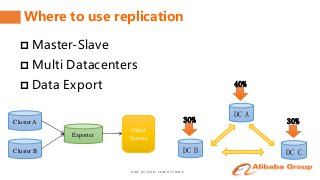
Where to use replication
 Master-Slave
 Multi Datacenters
 Data Export
DC A
40%
DC B
30%
DC C
30%Cluster A
Cluster B
Exporter
Other
System
www.aliyun.com/aliware
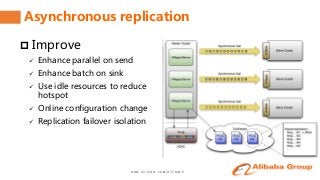
Asynchronous replication
 Improve
 Enhance parallel on send
 Enhance batch on sink
 Use idle resources to reduce
hotspot
 Online configuration change
 Replication failover isolation
www.aliyun.com/aliware 5
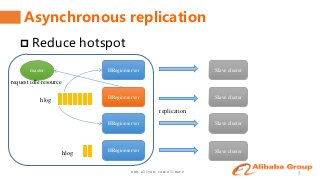
Asynchronous replication
 Reduce hotspot
HRegionserver
HRegionserver
HRegionserver
Slave cluster
Slave cluster
Slave cluster
master
HRegionserver Slave cluster
hlog
hlog
replication
request idle resource
www.aliyun.com/aliware
Asynchronous replication
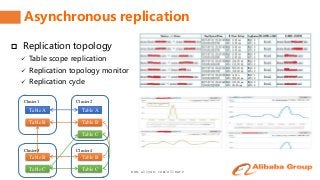
 Replication topology
 Table scope replication
 Replication topology monitor
 Replication cycle
Table A
Table B
Table A
Table B
Table B Table B
Table C
Table C
Table C
Cluster 1 Cluster 2
Cluster 3 Cluster 4
www.aliyun.com/aliware
Synchronous replication
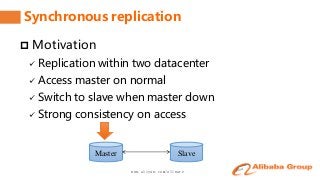
 Motivation
 Replication within two datacenter
 Access master on normal
 Switch to slave when master down
 Strong consistency on access
Master Slave
www.aliyun.com/aliware
Synchronous replication
 Consistency semantic
 Write
-Success when response is “success”
-Unknown when response is “failure”
 Read
-Data is always readable after it is written successfully
 In any circumstances, data remain eventual
consistency between master and slave
www.aliyun.com/aliware
Synchronous replication
handler
Mem HDFS
Async-
Replication
Manager
handler
MemHDFS
Async-
Replication
Manager
Application
1 put
2 local log 2 remote log3
Master Slave
www.aliyun.com/aliware
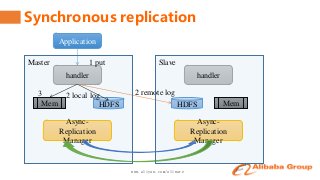
Remote log
 Log content
 Data not yet replicated by asynchronous replication
 File format
 Same as hlog, collection of entries
 Log organization
 remote log and hlog is many to one relationship
 Use same prefix for file name
 Store on slave hdfs
www.aliyun.com/aliware
Remote log clean
 When to clean remote log?
 when the corresponding hlog is replicated by
asynchronous replication
 Who clean remote log?
 Master cluster
www.aliyun.com/aliware 12
Remote log
 When need disable Remote log
 Before switch. There may be some client still
accessing master.
 How to disable Remote log
 Create lock file
 recover lease for current remote logs
www.aliyun.com/aliware
Failure scenarios
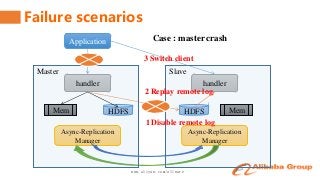
handler
Mem HDFS
Async-Replication
Manager
handler
MemHDFS
Async-Replication
Manager
Application
Master Slave
Case : master crash
1 Disable remote log
2 Replay remote log
3 Switch client
www.aliyun.com/aliware
Failure scenarios
handler
Mem HDFS
Async-Replication
Manager
handler
MemHDFS
Async-Replication
Manager
Application
Master Slave
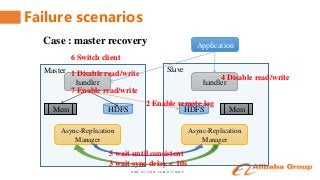
Case : master recovery
1 Disable read/write
2 Enable remote log
3 wait sync delay < 10s
4 Disable read/write
5 wait until consistent
6 Switch client
7 Enable read/write
www.aliyun.com/aliware
Failure scenarios
handler
Mem HDFS
Async-Replication
Manager
handler
MemHDFS
Async-Replication
Manager
Application
Master Slave
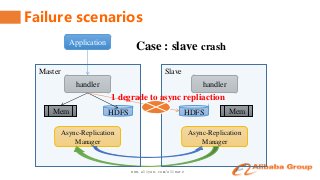
Case : slave crash
1 degrade to async repliaction
www.aliyun.com/aliware
Consistency
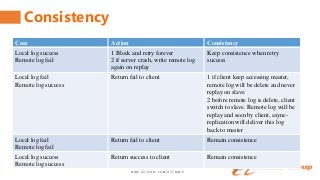
Case Action Consistency
Local log success
Remote log fail
1 Block and retry forever
2 if server crash, write remote log
again on replay
Keep consistence when retry
success
Local log fail
Remote log success
Return fail to client 1 if client keep accessing master,
remote log will be delete and never
replay on slave
2 before remote log is delete, client
switch to slave. Remote log will be
replay and seen by client, async-
replication will deliver this log
back to master
Local log fail
Remote log fail
Return fail to client Remain consistence
Local log success
Remote log success
Return success to client Remain consistence
www.aliyun.com/aliware
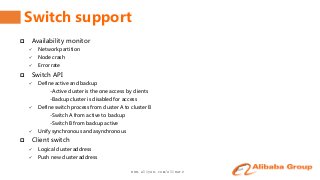
Switch support
 Availability monitor
 Network partition
 Node crash
 Error rate
 Switch API
 Define active and backup
-Active cluster is the one access by clients
-Backup cluster is disabled for access
 Define switch process from cluster A to cluster B
-Switch A from active to backup
-Switch B from backup active
 Unify synchronous and asynchronous
 Client switch
 Logical cluster address
 Push new cluster address
www.aliyun.com/aliware
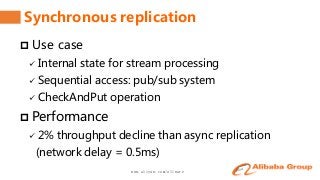
Synchronous replication
 Use case
 Internal state for stream processing
 Sequential access: pub/sub system
 CheckAndPut operation
 Performance
 2% throughput decline than async replication
(network delay = 0.5ms)
www.aliyun.com/aliware
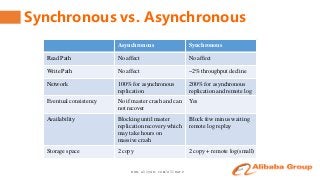
Synchronous vs. Asynchronous
Asynchronous Synchronous
Read Path No affect No affect
Write Path No affect ~2% throughput decline
Network 100% for asynchronous
replication
200% for asynchronous
replication and remote log
Eventual consistency No if master crash and can
not recover
Yes
Availability Blocking until master
replication recovery which
may take hours on
massive crash
Block few minus waiting
remote log replay
Storage space 2 copy 2 copy + remote log(small)
www.aliyun.com/aliware
Thanks
tianwu.sch@alibaba-inc.com
qingyi.mqy@alibaba-inc.com

hbaseconasia2017: Synchronous Replication for HBase