African Forum for Agricultural
Advisory Services
6TH AFRICA AGRICULTURE SCIENCE WEEK & FARA GENERAL
ASSEMBLY
Dr. Silim M. Nahdy – Executive Director
18 July 2013
Accra International Conference Centre –Accra Ghana
www.afaas-africa.org
EXPERIENCES FROM AFAAS
1. AEAS in Context
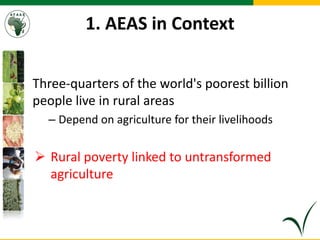
Three-quarters of the world's poorest billion
people live in rural areas
– Depend on agriculture for their livelihoods
 Rural poverty linked to untransformed
agriculture
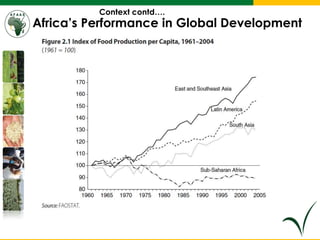
Africa’s Performance in Global Development
Context contd….
AEAS in Context ….
• AEAS are front line actors in upscaling KIT and
agr. innovations
• AEAS therefore play a significant role in;
– increased agric. productivity,
– agricultural transformation,
– improving food and nutrition security, and
– ultimately reducing poverty
YET AEAS is inadequately emphasized and
funded
2. National AEAS
Originally extension conceived as a
service to “extend” research-based
knowledge to rural sector to improve
their livelihoods;
–Traditional - focus on increasing
production, improving yields, training
farmers, and transferring technology
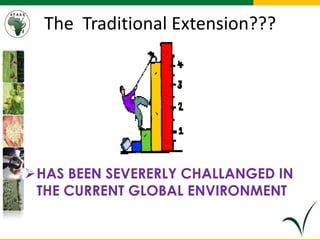
The Traditional Extension???
HAS BEEN SEVERERLY CHALLANGED IN
THE CURRENT GLOBAL ENVIRONMENT
Broad Challenges …….
• Global developments affecting EAS:
– globalization
– market liberalization and market focus
– privatization
– decentralization and devolution
– natural and man-made disasters
– rural poverty and food insecurity
– climate change
– Use of ICT
– HIV/AIDS epidemic
Generic Challenges in the Governmental
Extension (Public)
• Weak/inadequate Policies
• Role conflict
• Inappropriate legal setup and structure
• Top down messages and quality control
• Finance by budgets (input), not linked to tasks and
outputs
• Inappropriate content & blanket recommendations
• Lack of efficiency and inadequate flexibility in a
learning environment
• Capacity and inappropriate training
3. Refocusing AEAS
• AES roles evolving in wake of Challenges ……
• Key transformation and reforms embeds AES
in the value chain and innovation systems.
• National AEAS in Developing Countries
undergone major changes in the past two
decades ……
– And continues to evolve based on
context
Refocusing AEAS…
AES re-defined
– Originally conceived as a service to
“extend” research-based knowledge to
improve the lives of rural farmers
– Now goes beyond technology transfer
to facilitation; beyond training to
education, and includes assisting farmer
groups to form and organize, dealing
with marketing and financial issues, and
partnering with a broad range of service
providers and other agencies
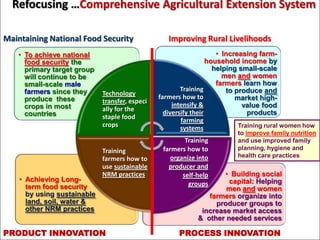
PRODUCT INNOVATION PROCESS INNOVATION
• Building social
capital: Helping
men and women
farmers organize into
producer groups to
increase market access
& other needed services
• Achieving Long-
term food security
by using sustainable
land, soil, water &
other NRM practices
• Increasing farm-
household income by
helping small-scale
men and women
farmers learn how
to produce and
market high-
value food
products
• To achieve national
food security the
primary target group
will continue to be
small-scale male
farmers since they
produce these
crops in most
countries
Technology
transfer, especi
ally for the
staple food
crops
Training
farmers how to
intensify &
diversify their
farming
systems
Training
farmers how to
organize into
producer and
self-help
groups
Training
farmers how to
use sustainable
NRM practices
Training rural women how
to improve family nutrition
and use improved family
planning, hygiene and
health care practices
Improving Rural LivelihoodsMaintaining National Food Security
PRODUCT INNOVATION PROCESS INNOVATION
Refocusing …Comprehensive Agricultural Extension System
5. Status and Reforms in AEAS in Developing
Countries
AEAS weak , mainly due to many years of public
neglect. However;
• Reforms are being undertaken;
– Policies, strategies, institutions, methodologies, tools
• Use of several models for different situations
• New approaches emerging based on
experimentation, learning, and adaptation
• Partnerships for varied skills and competencies
emerging
Status and Reforms……
Reforms include use of
• pluralism in service delivery
• decentralization/devolution,
• privatization, contracting in and out,
• cost-sharing, fee-for service
• demand-driven/participatory approaches,
• use of ICTs
• accountability to farmers who have role AES
performance
• Innovations systems approach
Status of reforms ……
Reforms and CAADP Pillar iv - FAAP
• The Framework for African Agricultural
Productivity, (FAAP) – Pillar IV of CAADP provides
above as some of key principles to guide the reforms.
• Although many SSA countries, in paper, are
committed to the reforms, how that takes
place, however, is another matter.
Examples of Country Reforms
• Ethiopia: Public agricultural extension system
• Ghana: Early adopter of liberalization, pluralism and
privatization policies for extension services
• Kenya: Pluralistic extension and demand driven
• Malawi: Towards Pluralistic Demand Driven Services
• Mozambique: Pluralistic and demand driven
extension system
• Rwanda: Developing a local service provider
capacity
• Tanzania: Decentralized pluralist market-oriented
research and extension system
• Uganda- Pluralistic Advisory Services, Private Public
Partnerships driven –
6. Evidence for Successes and Failures of
Extension Models
• In general, extension shown to have
significant and positive effects on
knowledge, adoption, and productivity.
• A review of 48 studies of extension found the
majority (36) had significantly positive results.
• Studies of rates of return, generally, showed
very high numbers (between 13-500%).
• Highest payoffs in developing countries .
7. Agricultural Extension and Advisory
Service policies
• A major problem of organizing AEAS in
developing countries is absence of legal and
policy frameworks for providing the service
• A sound agricultural policy is indispensable
to guide the key players involved in AEAS
Forms of AEAS Policy
• Decrees and Proclamation
• Provisional Extension Policies
• Legislated extension policy
It is important to note that countries that have
enacted extension policy through legislative action
tend to have well-organized, financially stable
extension systems that have sustained effectiveness
and a cumulative impact (Hanyani-Mlambo, 2000).
Forms of AEAS Policy Contd………..
• Decrees and proclamations: These are policies issued
by the head of state which does not go through the
process of consultation and debate involving various
stakeholders and beneficiaries
• Provisional Extension Policies: This is the most common
form of extension policy in most developing countries.
In the absence of more formalized extension policies, or
at the time when the formally enacted policy has been
suspended, a provisional or ad hoc policy comes into
play
• Legislated extension policies are embodied by the
country’s highest law-making authority (e.g., congress
or parliament). Countries that have enacted extension
policy through legislative action tend to have well-
organized, financially stable extension systems that
have sustained effectiveness and a cumulative impact
8. Key undertakings
• AFAAS engagement in CAADP agenda
– Science Agenda for African Agriculture ;
– Capacity Strengthening in Post-Conflict & Protracted Crises
Countries
– Guidelines of integrating AEAS in CAADP
– Tropical Agricultural platform
Information & Knowledge Management
• Three Symposia organised; Third symposium co- organised
with FARA
• A website, & a virtual social networking platform;
• A conceptual framework for lesson learning developed;
• A guide for Piloting Market Oriented AAS;
• Study on targeting Women Advisory Service Providers in
Capacity Development Programmes;
• Study on how issues of Climate Change are being
addressed in AAS
• Capacity building for CIKM facilitators
• EAS Policy dialogue and support –
Sudan/S, Liberia, Zimbabwe, Uganda, DRC.
Establishing and Supporting
Country Fora
• AFAAS membership 37 African Countries
• Country Fora are a backbone of AFAAS
• Supporting AEAS Country Fora
 SDC Support in Benin and Ethiopia- Good Progress
and continued mentorship
 GFRAS – BMGF : Kenya, Rwanda, South
Sudan, Uganda ; also Botswana and Mozambique
 IFAD Support - Burkina
Faso, Malawi, Mozambique, Sierra Leone and
Uganda
MDTF - More countries will be supported
Linkages and Partnerships
• GFRAS- Global Forum for Rural Advisory Services
• FARA
• SROs; ASARECA- MoU signed and CORAF, CCARDESA to be
formalized
• NRI- Natural Resources Institute - climate change Learning
• CABI International- Plantwise ( Plant Clinics)
• Icipe- up and out scaling innovations and technologies
• Climate Change, Agriculture and Food Security (CCAFS) –
climate change esp. adaptation and capacity of community
works
• Joint projects formulation with universities and SCOs
Linkages and Partnerships… contd
• Helvetas , FANRPAN, Agridea International – Post Harvest
Management Project for SSA( Mozambique and Benin) – on
going
• INNODEV- Knowledge Management component
• COMPACI- Competitive Africa Cotton Initiative
• TEAM- Africa -Tertiary Education in Agriculture Mechanisms
• RUFORUM
• NAFE
• KIT- Royal Tropical Institute on MOAAS
• CTA- on Knowledge Management - discussions
Thank you
Secretariat@afaas-africa.org
http://www.afaas-africa.org
http://networking.afaas-africa.org

Afaas presentation __accra sc week july 2013

  • 1.
    African Forum forAgricultural Advisory Services 6TH AFRICA AGRICULTURE SCIENCE WEEK & FARA GENERAL ASSEMBLY Dr. Silim M. Nahdy – Executive Director 18 July 2013 Accra International Conference Centre –Accra Ghana www.afaas-africa.org EXPERIENCES FROM AFAAS
  • 2.
    1. AEAS inContext Three-quarters of the world's poorest billion people live in rural areas – Depend on agriculture for their livelihoods  Rural poverty linked to untransformed agriculture
  • 3.
    Africa’s Performance inGlobal Development Context contd….
  • 4.
    AEAS in Context…. • AEAS are front line actors in upscaling KIT and agr. innovations • AEAS therefore play a significant role in; – increased agric. productivity, – agricultural transformation, – improving food and nutrition security, and – ultimately reducing poverty YET AEAS is inadequately emphasized and funded
  • 5.
    2. National AEAS Originallyextension conceived as a service to “extend” research-based knowledge to rural sector to improve their livelihoods; –Traditional - focus on increasing production, improving yields, training farmers, and transferring technology
  • 6.
    The Traditional Extension??? HASBEEN SEVERERLY CHALLANGED IN THE CURRENT GLOBAL ENVIRONMENT
  • 7.
    Broad Challenges ……. •Global developments affecting EAS: – globalization – market liberalization and market focus – privatization – decentralization and devolution – natural and man-made disasters – rural poverty and food insecurity – climate change – Use of ICT – HIV/AIDS epidemic
  • 8.
    Generic Challenges inthe Governmental Extension (Public) • Weak/inadequate Policies • Role conflict • Inappropriate legal setup and structure • Top down messages and quality control • Finance by budgets (input), not linked to tasks and outputs • Inappropriate content & blanket recommendations • Lack of efficiency and inadequate flexibility in a learning environment • Capacity and inappropriate training
  • 9.
    3. Refocusing AEAS •AES roles evolving in wake of Challenges …… • Key transformation and reforms embeds AES in the value chain and innovation systems. • National AEAS in Developing Countries undergone major changes in the past two decades …… – And continues to evolve based on context
  • 10.
    Refocusing AEAS… AES re-defined –Originally conceived as a service to “extend” research-based knowledge to improve the lives of rural farmers – Now goes beyond technology transfer to facilitation; beyond training to education, and includes assisting farmer groups to form and organize, dealing with marketing and financial issues, and partnering with a broad range of service providers and other agencies
  • 11.
    PRODUCT INNOVATION PROCESSINNOVATION • Building social capital: Helping men and women farmers organize into producer groups to increase market access & other needed services • Achieving Long- term food security by using sustainable land, soil, water & other NRM practices • Increasing farm- household income by helping small-scale men and women farmers learn how to produce and market high- value food products • To achieve national food security the primary target group will continue to be small-scale male farmers since they produce these crops in most countries Technology transfer, especi ally for the staple food crops Training farmers how to intensify & diversify their farming systems Training farmers how to organize into producer and self-help groups Training farmers how to use sustainable NRM practices Training rural women how to improve family nutrition and use improved family planning, hygiene and health care practices Improving Rural LivelihoodsMaintaining National Food Security PRODUCT INNOVATION PROCESS INNOVATION Refocusing …Comprehensive Agricultural Extension System
  • 12.
    5. Status andReforms in AEAS in Developing Countries AEAS weak , mainly due to many years of public neglect. However; • Reforms are being undertaken; – Policies, strategies, institutions, methodologies, tools • Use of several models for different situations • New approaches emerging based on experimentation, learning, and adaptation • Partnerships for varied skills and competencies emerging
  • 13.
    Status and Reforms…… Reformsinclude use of • pluralism in service delivery • decentralization/devolution, • privatization, contracting in and out, • cost-sharing, fee-for service • demand-driven/participatory approaches, • use of ICTs • accountability to farmers who have role AES performance • Innovations systems approach
  • 14.
    Status of reforms…… Reforms and CAADP Pillar iv - FAAP • The Framework for African Agricultural Productivity, (FAAP) – Pillar IV of CAADP provides above as some of key principles to guide the reforms. • Although many SSA countries, in paper, are committed to the reforms, how that takes place, however, is another matter.
  • 15.
    Examples of CountryReforms • Ethiopia: Public agricultural extension system • Ghana: Early adopter of liberalization, pluralism and privatization policies for extension services • Kenya: Pluralistic extension and demand driven • Malawi: Towards Pluralistic Demand Driven Services • Mozambique: Pluralistic and demand driven extension system • Rwanda: Developing a local service provider capacity • Tanzania: Decentralized pluralist market-oriented research and extension system • Uganda- Pluralistic Advisory Services, Private Public Partnerships driven –
  • 16.
    6. Evidence forSuccesses and Failures of Extension Models • In general, extension shown to have significant and positive effects on knowledge, adoption, and productivity. • A review of 48 studies of extension found the majority (36) had significantly positive results. • Studies of rates of return, generally, showed very high numbers (between 13-500%). • Highest payoffs in developing countries .
  • 17.
    7. Agricultural Extensionand Advisory Service policies • A major problem of organizing AEAS in developing countries is absence of legal and policy frameworks for providing the service • A sound agricultural policy is indispensable to guide the key players involved in AEAS
  • 18.
    Forms of AEASPolicy • Decrees and Proclamation • Provisional Extension Policies • Legislated extension policy It is important to note that countries that have enacted extension policy through legislative action tend to have well-organized, financially stable extension systems that have sustained effectiveness and a cumulative impact (Hanyani-Mlambo, 2000).
  • 19.
    Forms of AEASPolicy Contd……….. • Decrees and proclamations: These are policies issued by the head of state which does not go through the process of consultation and debate involving various stakeholders and beneficiaries • Provisional Extension Policies: This is the most common form of extension policy in most developing countries. In the absence of more formalized extension policies, or at the time when the formally enacted policy has been suspended, a provisional or ad hoc policy comes into play • Legislated extension policies are embodied by the country’s highest law-making authority (e.g., congress or parliament). Countries that have enacted extension policy through legislative action tend to have well- organized, financially stable extension systems that have sustained effectiveness and a cumulative impact
  • 20.
    8. Key undertakings •AFAAS engagement in CAADP agenda – Science Agenda for African Agriculture ; – Capacity Strengthening in Post-Conflict & Protracted Crises Countries – Guidelines of integrating AEAS in CAADP – Tropical Agricultural platform
  • 21.
    Information & KnowledgeManagement • Three Symposia organised; Third symposium co- organised with FARA • A website, & a virtual social networking platform; • A conceptual framework for lesson learning developed; • A guide for Piloting Market Oriented AAS; • Study on targeting Women Advisory Service Providers in Capacity Development Programmes; • Study on how issues of Climate Change are being addressed in AAS • Capacity building for CIKM facilitators • EAS Policy dialogue and support – Sudan/S, Liberia, Zimbabwe, Uganda, DRC.
  • 22.
    Establishing and Supporting CountryFora • AFAAS membership 37 African Countries • Country Fora are a backbone of AFAAS • Supporting AEAS Country Fora  SDC Support in Benin and Ethiopia- Good Progress and continued mentorship  GFRAS – BMGF : Kenya, Rwanda, South Sudan, Uganda ; also Botswana and Mozambique  IFAD Support - Burkina Faso, Malawi, Mozambique, Sierra Leone and Uganda MDTF - More countries will be supported
  • 23.
    Linkages and Partnerships •GFRAS- Global Forum for Rural Advisory Services • FARA • SROs; ASARECA- MoU signed and CORAF, CCARDESA to be formalized • NRI- Natural Resources Institute - climate change Learning • CABI International- Plantwise ( Plant Clinics) • Icipe- up and out scaling innovations and technologies • Climate Change, Agriculture and Food Security (CCAFS) – climate change esp. adaptation and capacity of community works • Joint projects formulation with universities and SCOs
  • 24.
    Linkages and Partnerships…contd • Helvetas , FANRPAN, Agridea International – Post Harvest Management Project for SSA( Mozambique and Benin) – on going • INNODEV- Knowledge Management component • COMPACI- Competitive Africa Cotton Initiative • TEAM- Africa -Tertiary Education in Agriculture Mechanisms • RUFORUM • NAFE • KIT- Royal Tropical Institute on MOAAS • CTA- on Knowledge Management - discussions
  • 25.