Metadata
in the GSOС map
Konstantin Viatkin
GSP Secretariat
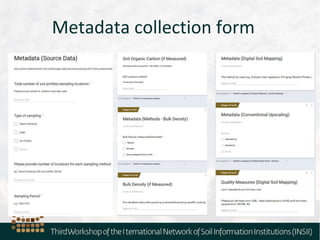
Metadata collection form
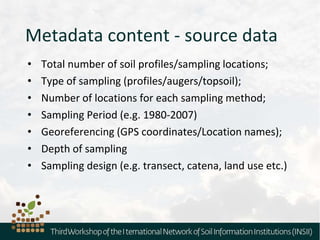
Metadata content - source data
• Total number of soil profiles/sampling locations;
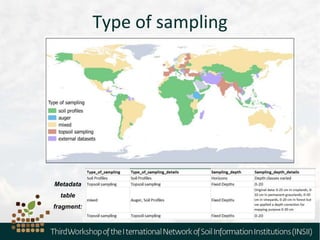
• Type of sampling (profiles/augers/topsoil);
• Number of locations for each sampling method;
• Sampling Period (e.g. 1980-2007)
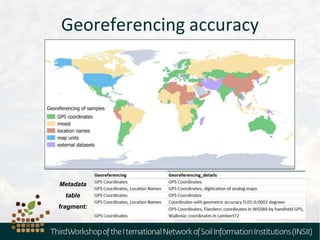
• Georeferencing (GPS coordinates/Location names);
• Depth of sampling
• Sampling design (e.g. transect, catena, land use etc.)
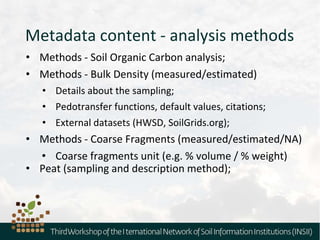
Metadata content - analysis methods
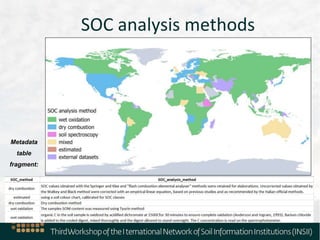
• Methods - Soil Organic Carbon analysis;
• Methods - Bulk Density (measured/estimated)
• Details about the sampling;
• Pedotransfer functions, default values, citations;
• External datasets (HWSD, SoilGrids.org);
• Methods - Coarse Fragments (measured/estimated/NA)
• Coarse fragments unit (e.g. % volume / % weight)
• Peat (sampling and description method);
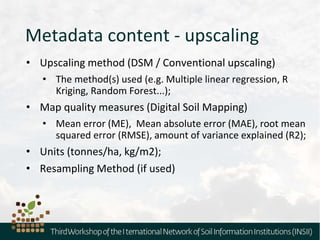
Metadata content - upscaling
• Upscaling method (DSM / Conventional upscaling)
• The method(s) used (e.g. Multiple linear regression, R
Kriging, Random Forest...);
• Map quality measures (Digital Soil Mapping)
• Mean error (ME), Mean absolute error (MAE), root mean
squared error (RMSE), amount of variance explained (R2);
• Units (tonnes/ha, kg/m2);
• Resampling Method (if used)
Metadata content - contacts
• Submitter contact details;
• Institute (Data Holder / Handler);
• Citation;
• Update Frequency;
• Comments, Remarks
Countries’ reports: different
cases
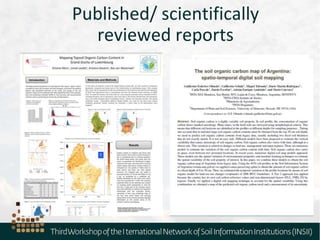
• Previously published scientific reports
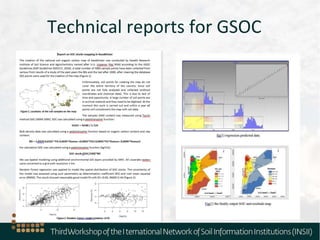
• Technical reports prepared for GSOC
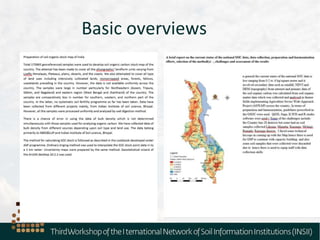
• Basic overviews of the mapping activities
Published/ scientifically
reviewed reports
Technical reports for GSOC
Basic overviews
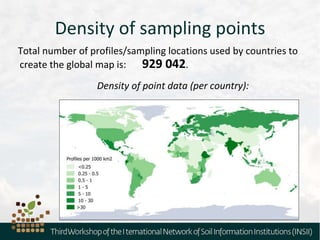
Density of sampling points
Total number of profiles/sampling locations used by countries to
create the global map is: 929 042.
Density of point data (per country):
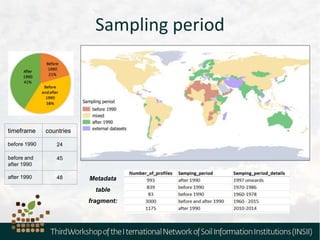
Sampling period
timeframe countries
before 1990 24
before and
after 1990
45
after 1990 48 Metadata
table
fragment:
Type of sampling
Metadata
table
fragment:
Georeferencing accuracy
Metadata
table
fragment:
SOC analysis methods
Metadata
table
fragment:
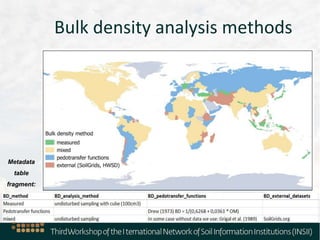
Bulk density analysis methods
Metadata
table
fragment:
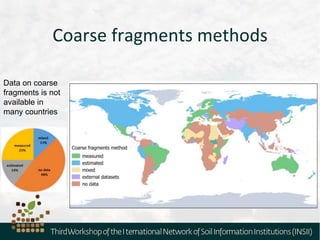
Coarse fragments methods
Data on coarse
fragments is not
available in
many countries
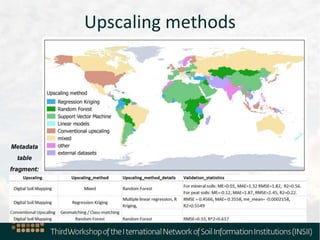
Upscaling methods
Metadata
table
fragment:
Upscaling methods
• Conventional Upscaling: Geo-matching, Class-matching;
• Digital Soil Mapping methods: Multiple linear regression,
Regression Kriging, Multivariate adaptive regression splines,
Generalized Linear Models, Generalized Additive Models, etc.
• Machine learning techniques: Random Forest, Support
Vector Machine, Neural Networks, Regression trees,
Bayesian trees, etc.
• Ensemble models combining different DSM methods;
• Geostatistical methods: Ordinary Kriging, IDW.
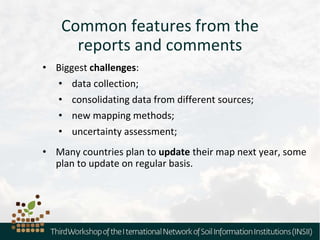
Common features from the
reports and comments
• Biggest challenges:
• data collection;
• consolidating data from different sources;
• new mapping methods;
• uncertainty assessment;
• Many countries plan to update their map next year, some
plan to update on regular basis.
Thank you
for your attention!

Metadata and uncertainties

  • 2.
    Metadata in the GSOСmap Konstantin Viatkin GSP Secretariat
  • 3.
  • 4.
    Metadata content -source data • Total number of soil profiles/sampling locations; • Type of sampling (profiles/augers/topsoil); • Number of locations for each sampling method; • Sampling Period (e.g. 1980-2007) • Georeferencing (GPS coordinates/Location names); • Depth of sampling • Sampling design (e.g. transect, catena, land use etc.)
  • 5.
    Metadata content -analysis methods • Methods - Soil Organic Carbon analysis; • Methods - Bulk Density (measured/estimated) • Details about the sampling; • Pedotransfer functions, default values, citations; • External datasets (HWSD, SoilGrids.org); • Methods - Coarse Fragments (measured/estimated/NA) • Coarse fragments unit (e.g. % volume / % weight) • Peat (sampling and description method);
  • 6.
    Metadata content -upscaling • Upscaling method (DSM / Conventional upscaling) • The method(s) used (e.g. Multiple linear regression, R Kriging, Random Forest...); • Map quality measures (Digital Soil Mapping) • Mean error (ME), Mean absolute error (MAE), root mean squared error (RMSE), amount of variance explained (R2); • Units (tonnes/ha, kg/m2); • Resampling Method (if used)
  • 7.
    Metadata content -contacts • Submitter contact details; • Institute (Data Holder / Handler); • Citation; • Update Frequency; • Comments, Remarks
  • 8.
    Countries’ reports: different cases •Previously published scientific reports • Technical reports prepared for GSOC • Basic overviews of the mapping activities
  • 9.
  • 10.
  • 11.
  • 12.
    Density of samplingpoints Total number of profiles/sampling locations used by countries to create the global map is: 929 042. Density of point data (per country):
  • 13.
    Sampling period timeframe countries before1990 24 before and after 1990 45 after 1990 48 Metadata table fragment:
  • 14.
  • 15.
  • 16.
  • 17.
    Bulk density analysismethods Metadata table fragment:
  • 18.
    Coarse fragments methods Dataon coarse fragments is not available in many countries
  • 19.
  • 20.
    Upscaling methods • ConventionalUpscaling: Geo-matching, Class-matching; • Digital Soil Mapping methods: Multiple linear regression, Regression Kriging, Multivariate adaptive regression splines, Generalized Linear Models, Generalized Additive Models, etc. • Machine learning techniques: Random Forest, Support Vector Machine, Neural Networks, Regression trees, Bayesian trees, etc. • Ensemble models combining different DSM methods; • Geostatistical methods: Ordinary Kriging, IDW.
  • 21.
    Common features fromthe reports and comments • Biggest challenges: • data collection; • consolidating data from different sources; • new mapping methods; • uncertainty assessment; • Many countries plan to update their map next year, some plan to update on regular basis.
  • 22.