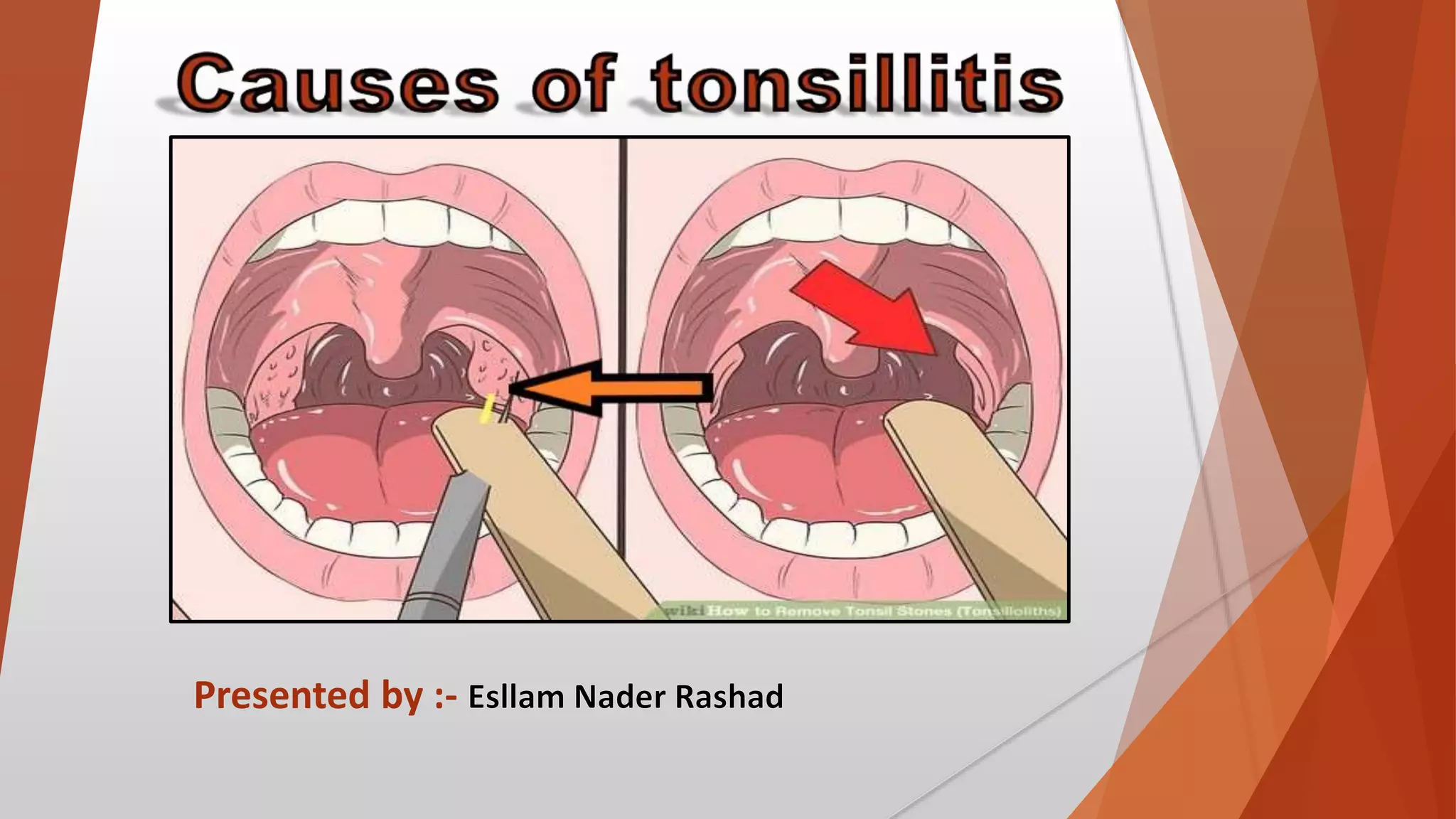
Presented by :-
The tonsils :-
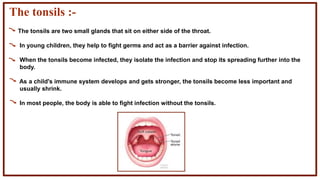
The tonsils are two small glands that sit on either side of the throat.
In young children, they help to fight germs and act as a barrier against infection.
When the tonsils become infected, they isolate the infection and stop its spreading further into the
body.
As a child's immune system develops and gets stronger, the tonsils become less important and
usually shrink.
In most people, the body is able to fight infection without the tonsils.
What is tonsillitis :-
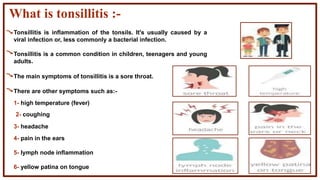
1- high temperature (fever)
2- coughing
3- headache
4- pain in the ears
5- lymph node inflammation
6- yellow patina on tongue
Tonsillitis is inflammation of the tonsils. It's usually caused by a
viral infection or, less commonly a bacterial infection.
Tonsillitis is a common condition in children, teenagers and young
adults.
The main symptoms of tonsillitis is a sore throat.
There are other symptoms such as:-
Causes of tonsillitis :-
Note:- Most cases of tonsillitis are caused by a viral infection.
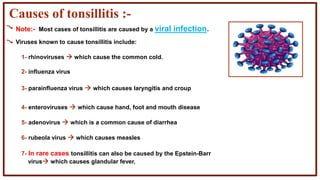
Viruses known to cause tonsillitis include:
1- rhinoviruses  which cause the common cold.
2- influenza virus
3- parainfluenza virus  which causes laryngitis and croup
4- enteroviruses  which cause hand, foot and mouth disease
5- adenovirus  which is a common cause of diarrhea
6- rubeola virus  which causes measles
7- In rare cases tonsillitis can also be caused by the Epstein-Barr
virus which causes glandular fever.
Causes of tonsillitis :-
Bacterial tonsillitis :-
In the past, serious bacterial infections, such as diphtheria and
rheumatic fever, have been linked with tonsillitis.
But now is rare, because these conditions are vaccinated
against and treatment for them has greatly improved.
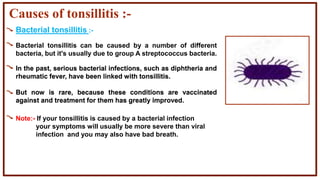
Bacterial tonsillitis can be caused by a number of different
bacteria, but it's usually due to group A streptococcus bacteria.
Note:- If your tonsillitis is caused by a bacterial infection
your symptoms will usually be more severe than viral
infection and you may also have bad breath.
In the past, serious bacterial infections, such as diphtheria and
rheumatic fever, have been linked with tonsillitis.
But now is rare, because these conditions are vaccinated
against and treatment for them has greatly improved.
Causes of tonsillitis.pptx

Causes of tonsillitis.pptx

  • 1.
  • 2.
    The tonsils :- Thetonsils are two small glands that sit on either side of the throat. In young children, they help to fight germs and act as a barrier against infection. When the tonsils become infected, they isolate the infection and stop its spreading further into the body. As a child's immune system develops and gets stronger, the tonsils become less important and usually shrink. In most people, the body is able to fight infection without the tonsils.
  • 3.
    What is tonsillitis:- 1- high temperature (fever) 2- coughing 3- headache 4- pain in the ears 5- lymph node inflammation 6- yellow patina on tongue Tonsillitis is inflammation of the tonsils. It's usually caused by a viral infection or, less commonly a bacterial infection. Tonsillitis is a common condition in children, teenagers and young adults. The main symptoms of tonsillitis is a sore throat. There are other symptoms such as:-
  • 4.
    Causes of tonsillitis:- Note:- Most cases of tonsillitis are caused by a viral infection. Viruses known to cause tonsillitis include: 1- rhinoviruses  which cause the common cold. 2- influenza virus 3- parainfluenza virus  which causes laryngitis and croup 4- enteroviruses  which cause hand, foot and mouth disease 5- adenovirus  which is a common cause of diarrhea 6- rubeola virus  which causes measles 7- In rare cases tonsillitis can also be caused by the Epstein-Barr virus which causes glandular fever.
  • 5.
    Causes of tonsillitis:- Bacterial tonsillitis :- In the past, serious bacterial infections, such as diphtheria and rheumatic fever, have been linked with tonsillitis. But now is rare, because these conditions are vaccinated against and treatment for them has greatly improved. Bacterial tonsillitis can be caused by a number of different bacteria, but it's usually due to group A streptococcus bacteria. Note:- If your tonsillitis is caused by a bacterial infection your symptoms will usually be more severe than viral infection and you may also have bad breath. In the past, serious bacterial infections, such as diphtheria and rheumatic fever, have been linked with tonsillitis. But now is rare, because these conditions are vaccinated against and treatment for them has greatly improved.