





Collaborative Filtering 
for fun 
Elissa Brown 
Erin Shellman 
Stella Rowlett 
…and profit! 
  
How’s it done? 
‣ Collaborative filtering! 
‣ Look for people who like the stuff 
you like, and recommend the 
things they’ve rated positively 
that you haven’t seen yet.
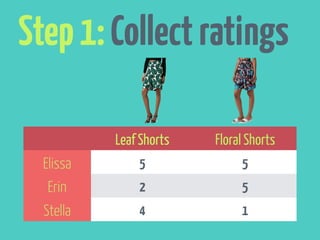
Step 1: Collect ratings 
Leaf Shorts Floral Shorts 
Elissa 5 5 
Erin 2 5 
Stella 4 1
5 
4 
3 
2 
1 
2 3 4 5 
Leaf Shorts 
Floral Shorts 
Person 
Elissa 
Erin 
Stella
Step 2: Find someone 
similar for Mr. New Customer 
‣ A new customer wants to 
buy a pair of shorts for 
his new “girlfriend.” 
 
‣ Which of us is most 
similar to Justin? 
 
 

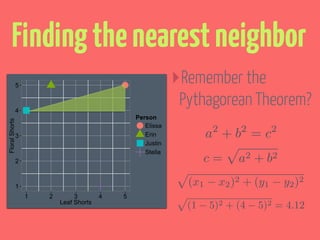
Finding the nearest neighbor 
‣Remember the 
Pythagorean Theorem? 
a2 + b2 = c2 
c = 
p 
a2 + b2 
p 
(x1  x2)2 + (y1  y2)2 
p 
(1  5)2 + (4  5)2 = 4.12 
5 
4 
3 
2 
1 
1 2 3 4 5 
Leaf Shorts 
Floral Shorts 
Person 
Elissa 
Erin 
Justin 
Stella
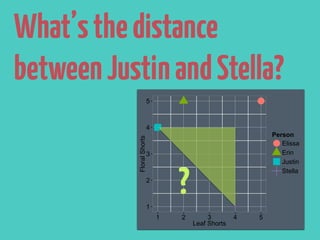
What’s the distance 
between Justin and Stella? 
5 
4 
3 
2 
1 
1 2 3 4 5 
Leaf Shorts 
Floral Shorts 
Person 
Elissa 
Erin 
Justin 
Stella ?
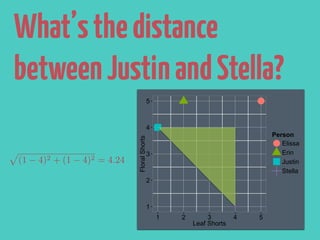
What’s the distance 
between Justin and Stella? 
5 
4 
3 
2 
1 
1 2 3 4 5 
Leaf Shorts 
Floral Shorts 
Person 
Elissa 
Erin 
Justin 
Stella 
p 
(1  4)2 + (1  4)2 = 4.24
Meant to be! 
 
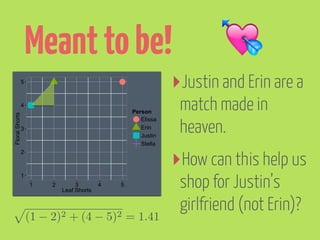
‣Justin and Erin are a 
match made in 
heaven. 
‣How can this help us 
shop for Justin’s 
5 
4 
Floral Shorts 
3 
2 
1 
1 2 3 4 5 
Leaf Shorts 
Person 
Elissa 
Erin 
Justin 
Stella 
p girlfriend (not Erin)? 
(1  2)2 + (4  5)2 = 1.41
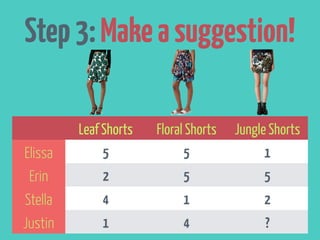
Step 3: Make a suggestion! 
Leaf Shorts Floral Shorts Jungle Shorts 
Elissa 5 5 1 
Erin 2 5 5 
Stella 4 1 2 
Justin 1 4 ?
Let’s go shopping! 

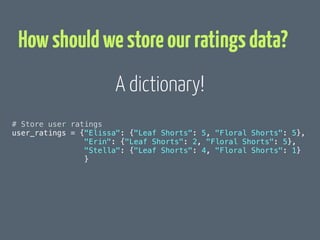
How should we store our ratings data?
How should we store our ratings data? 
A dictionary! 
# Store user ratings 
user_ratings = {Elissa: {Leaf Shorts: 5, Floral Shorts: 5}, 
Erin: {Leaf Shorts: 2, Floral Shorts: 5}, 
Stella: {Leaf Shorts: 4, Floral Shorts: 1} 
}
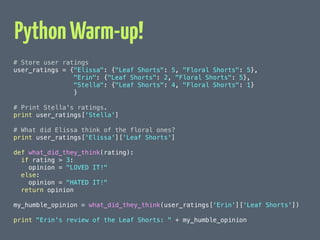
Python Warm-up! 
# Store user ratings 
user_ratings = {Elissa: {Leaf Shorts: 5, Floral Shorts: 5}, 
Erin: {Leaf Shorts: 2, Floral Shorts: 5}, 
Stella: {Leaf Shorts: 4, Floral Shorts: 1} 
} 
! 
# Print Stella's ratings. 
print user_ratings['Stella'] 
! 
# What did Elissa think of the floral ones? 
print user_ratings['Elissa']['Leaf Shorts'] 
! 
def what_did_they_think(rating): 
if rating  3: 
opinion = LOVED IT! 
else: 
opinion = HATED IT! 
return opinion 
! 
my_humble_opinion = what_did_they_think(user_ratings['Erin']['Leaf Shorts']) 
! 
print Erin's review of the Leaf Shorts:  + my_humble_opinion 
!!
What functions do we need 
to build a recommender?
What functions do we need 
to build a recommender? 
1. Function to compute distances 
2. Function to find nearby people 
3. Function to recommend items I haven’t rated yet
Pseudocode: 
Function to compute distances
compute_distance 
def compute_distance(user1_ratings, user2_ratings): 
 
This function computes the distance between two user's 
ratings. Both arguments should be dictionaries keyed on users, 
and items. 
 
distances = [] 
for key in user1_ratings: 
if key in user2_ratings: 
distances.append((user1_ratings[key] - user2_ratings[key]) ** 2) 
total_distance = round(sum(distances) ** 0.5, 2) 
return total_distance
Pseudocode: 
Function to find closest match
find_nearest_neighbors 
def find_nearest_neighbors(username, user_ratings): 
 
Returns the list of neighbors, ordered by distance. 
Call like this: find_nearest_neighbors('Erin', user_ratings) 
 
distances = [] 
for user in user_ratings: 
if user != username: 
distance = compute_distance(user_ratings[user], user_ratings[username]) 
distances.append((distance, user)) 
distances.sort() 
return distances
Pseudocode: 
Function to make recommendations
get_recommendations 
def get_recommendations(username, user_ratings): 
 
Return a list of recommendations. 
 
nearest_users = find_nearest_neighbors(username, user_ratings) 
recommendations = [] 
! 
# Input user's ratings 
ratings = user_ratings[username] 
! 
for neighbor in nearest_users: 
neighbor_name = neighbor[1] 
for item in user_ratings[neighbor_name]: 
if not item in ratings: 
recommendations.append((item, user_ratings[neighbor_name][item])) 
! 
return sorted(recommendations, 
key = lambda personTuple: personTuple[1], 
reverse = True)
Limitations 
‣ What happens if everyone rated the 
same group of items? 
‣ What if there’s no overlap? 
‣ What about new users with no ratings?
Now what? 
‣Ask your classmates to rate their electives, 
and make a recommender to help students 
pick their classes. 
‣Poll recent graduates from your school about 
their college, and make a recommender to 
help students pick colleges.
 
https://github.com/erinshellman/girls-who-code-recommender

Collaborative Filtering for fun ...and profit!

  • 1.
    Collaborative Filtering forfun Elissa Brown Erin Shellman Stella Rowlett …and profit!   
  • 5.
    How’s it done? ‣ Collaborative filtering! ‣ Look for people who like the stuff you like, and recommend the things they’ve rated positively that you haven’t seen yet.
  • 6.
    Step 1: Collectratings Leaf Shorts Floral Shorts Elissa 5 5 Erin 2 5 Stella 4 1
  • 7.
    5 4 3 2 1 2 3 4 5 Leaf Shorts Floral Shorts Person Elissa Erin Stella
  • 8.
    Step 2: Findsomeone similar for Mr. New Customer ‣ A new customer wants to buy a pair of shorts for his new “girlfriend.”  ‣ Which of us is most similar to Justin?   
  • 9.
    Finding the nearestneighbor ‣Remember the Pythagorean Theorem? a2 + b2 = c2 c = p a2 + b2 p (x1 x2)2 + (y1 y2)2 p (1 5)2 + (4 5)2 = 4.12 5 4 3 2 1 1 2 3 4 5 Leaf Shorts Floral Shorts Person Elissa Erin Justin Stella
  • 10.
    What’s the distance between Justin and Stella? 5 4 3 2 1 1 2 3 4 5 Leaf Shorts Floral Shorts Person Elissa Erin Justin Stella ?
  • 11.
    What’s the distance between Justin and Stella? 5 4 3 2 1 1 2 3 4 5 Leaf Shorts Floral Shorts Person Elissa Erin Justin Stella p (1 4)2 + (1 4)2 = 4.24
  • 12.
    Meant to be!  ‣Justin and Erin are a match made in heaven. ‣How can this help us shop for Justin’s 5 4 Floral Shorts 3 2 1 1 2 3 4 5 Leaf Shorts Person Elissa Erin Justin Stella p girlfriend (not Erin)? (1 2)2 + (4 5)2 = 1.41
  • 13.
    Step 3: Makea suggestion! Leaf Shorts Floral Shorts Jungle Shorts Elissa 5 5 1 Erin 2 5 5 Stella 4 1 2 Justin 1 4 ?
  • 14.
  • 15.
    How should westore our ratings data?
  • 16.
    How should westore our ratings data? A dictionary! # Store user ratings user_ratings = {Elissa: {Leaf Shorts: 5, Floral Shorts: 5}, Erin: {Leaf Shorts: 2, Floral Shorts: 5}, Stella: {Leaf Shorts: 4, Floral Shorts: 1} }
  • 17.
    Python Warm-up! #Store user ratings user_ratings = {Elissa: {Leaf Shorts: 5, Floral Shorts: 5}, Erin: {Leaf Shorts: 2, Floral Shorts: 5}, Stella: {Leaf Shorts: 4, Floral Shorts: 1} } ! # Print Stella's ratings. print user_ratings['Stella'] ! # What did Elissa think of the floral ones? print user_ratings['Elissa']['Leaf Shorts'] ! def what_did_they_think(rating): if rating 3: opinion = LOVED IT! else: opinion = HATED IT! return opinion ! my_humble_opinion = what_did_they_think(user_ratings['Erin']['Leaf Shorts']) ! print Erin's review of the Leaf Shorts: + my_humble_opinion !!
  • 18.
    What functions dowe need to build a recommender?
  • 19.
    What functions dowe need to build a recommender? 1. Function to compute distances 2. Function to find nearby people 3. Function to recommend items I haven’t rated yet
  • 20.
    Pseudocode: Function tocompute distances
  • 21.
    compute_distance def compute_distance(user1_ratings,user2_ratings): This function computes the distance between two user's ratings. Both arguments should be dictionaries keyed on users, and items. distances = [] for key in user1_ratings: if key in user2_ratings: distances.append((user1_ratings[key] - user2_ratings[key]) ** 2) total_distance = round(sum(distances) ** 0.5, 2) return total_distance
  • 22.
    Pseudocode: Function tofind closest match
  • 23.
    find_nearest_neighbors def find_nearest_neighbors(username,user_ratings): Returns the list of neighbors, ordered by distance. Call like this: find_nearest_neighbors('Erin', user_ratings) distances = [] for user in user_ratings: if user != username: distance = compute_distance(user_ratings[user], user_ratings[username]) distances.append((distance, user)) distances.sort() return distances
  • 24.
    Pseudocode: Function tomake recommendations
  • 25.
    get_recommendations def get_recommendations(username,user_ratings): Return a list of recommendations. nearest_users = find_nearest_neighbors(username, user_ratings) recommendations = [] ! # Input user's ratings ratings = user_ratings[username] ! for neighbor in nearest_users: neighbor_name = neighbor[1] for item in user_ratings[neighbor_name]: if not item in ratings: recommendations.append((item, user_ratings[neighbor_name][item])) ! return sorted(recommendations, key = lambda personTuple: personTuple[1], reverse = True)
  • 26.
    Limitations ‣ Whathappens if everyone rated the same group of items? ‣ What if there’s no overlap? ‣ What about new users with no ratings?
  • 27.
    Now what? ‣Askyour classmates to rate their electives, and make a recommender to help students pick their classes. ‣Poll recent graduates from your school about their college, and make a recommender to help students pick colleges.
  • 28.