Bot Not?
@erinshellman
PyData Seattle, July 26, 2015
orEnd-to-end data analysis in Python
PySpark Workshop
@Tune
August 27,6-8pm
Starting a new career in software
@Moz
October 22,6-8pm
Q: Why?
Bots are fun.
Q: How?
Python.
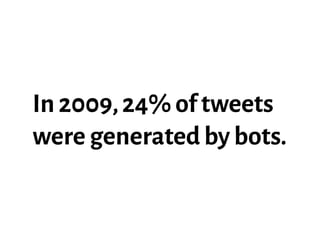
In 2009,24% of tweets
were generated by bots.
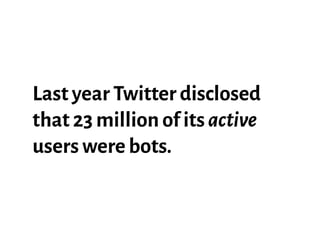
Last year Twitter disclosed
that 23 million of its active
users were bots.
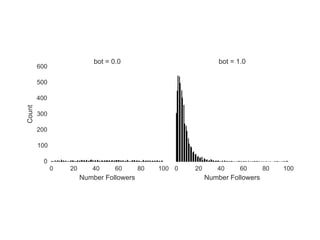
Hypothesis:
Bot behavior is
differentiable from
human behavior.
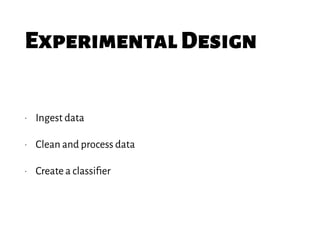
ExperimentalDesign
• Ingest data
• Clean and process data
• Create a classifier
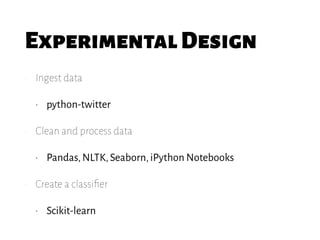
ExperimentalDesign
• Ingest data
• python-twitter
• Clean and process data
• Pandas,NLTK,Seaborn,iPython Notebooks
• Create a classifier
• Scikit-learn
Step1:
Getdata.
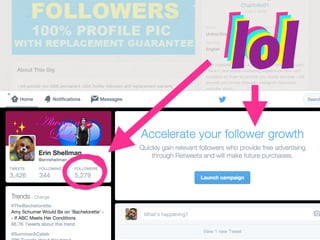
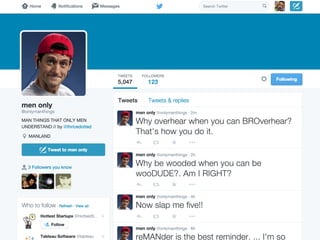
lollollollol
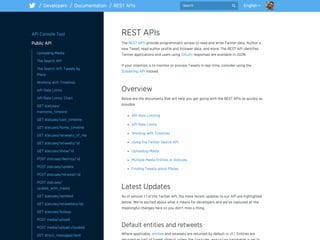
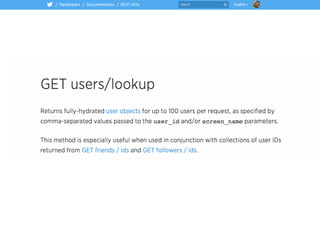
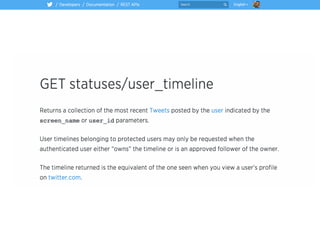
ConnectingtoTwitter
https://github.com/bear/python-twitter
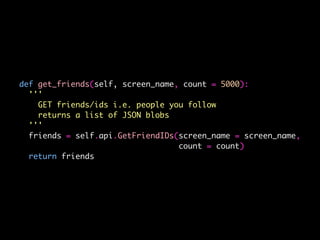
def get_friends(self, screen_name, count = 5000):
'''
GET friends/ids i.e. people you follow
returns a list of JSON blobs
'''
friends = self.api.GetFriendIDs(screen_name = screen_name,
count = count)
return friends
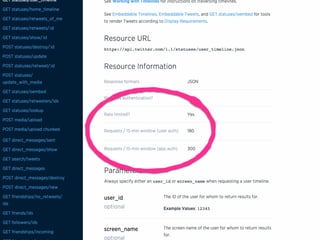
# break query into bite-size chunks 🍔
def blow_chunks(self, data, max_chunk_size):
for i in range(0, len(data), max_chunk_size):
yield data[i:i + max_chunk_size]
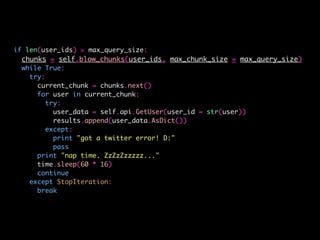
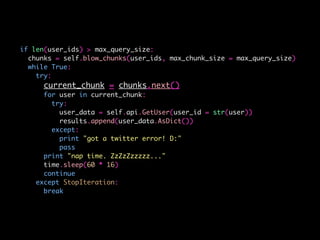
if len(user_ids) > max_query_size:
chunks = self.blow_chunks(user_ids, max_chunk_size = max_query_size)
while True:
try:
current_chunk = chunks.next()
for user in current_chunk:
try:
user_data = self.api.GetUser(user_id = str(user))
results.append(user_data.AsDict())
except:
print "got a twitter error! D:"
pass
print "nap time. ZzZzZzzzzz..."
time.sleep(60 * 16)
continue
except StopIteration:
break
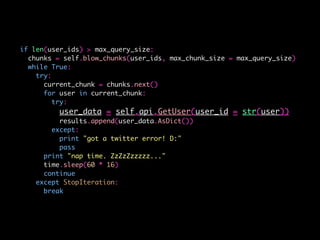
if len(user_ids) > max_query_size:
chunks = self.blow_chunks(user_ids, max_chunk_size = max_query_size)
while True:
try:
current_chunk = chunks.next()
for user in current_chunk:
try:
user_data = self.api.GetUser(user_id = str(user))
results.append(user_data.AsDict())
except:
print "got a twitter error! D:"
pass
print "nap time. ZzZzZzzzzz..."
time.sleep(60 * 16)
continue
except StopIteration:
break
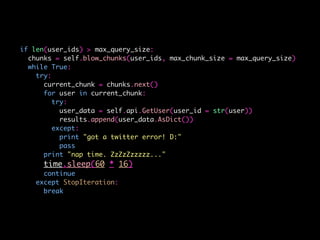
if len(user_ids) > max_query_size:
chunks = self.blow_chunks(user_ids, max_chunk_size = max_query_size)
while True:
try:
current_chunk = chunks.next()
for user in current_chunk:
try:
user_data = self.api.GetUser(user_id = str(user))
results.append(user_data.AsDict())
except:
print "got a twitter error! D:"
pass
print "nap time. ZzZzZzzzzz..."
time.sleep(60 * 16)
continue
except StopIteration:
break
if len(user_ids) > max_query_size:
chunks = self.blow_chunks(user_ids, max_chunk_size = max_query_size)
while True:
try:
current_chunk = chunks.next()
for user in current_chunk:
try:
user_data = self.api.GetUser(user_id = str(user))
results.append(user_data.AsDict())
except:
print "got a twitter error! D:"
pass
print "nap time. ZzZzZzzzzz..."
time.sleep(60 * 16)
continue
except StopIteration:
break
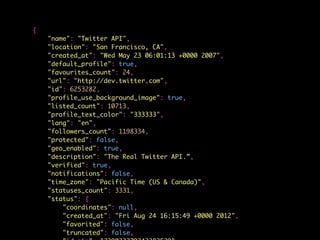
{
"name": "Twitter API",
"location": "San Francisco, CA",
"created_at": "Wed May 23 06:01:13 +0000 2007",
"default_profile": true,
"favourites_count": 24,
"url": "http://dev.twitter.com",
"id": 6253282,
"profile_use_background_image": true,
"listed_count": 10713,
"profile_text_color": "333333",
"lang": "en",
"followers_count": 1198334,
"protected": false,
"geo_enabled": true,
"description": "The Real Twitter API.”,
"verified": true,
"notifications": false,
"time_zone": "Pacific Time (US & Canada)",
"statuses_count": 3331,
"status": {
"coordinates": null,
"created_at": "Fri Aug 24 16:15:49 +0000 2012",
"favorited": false,
"truncated": false,
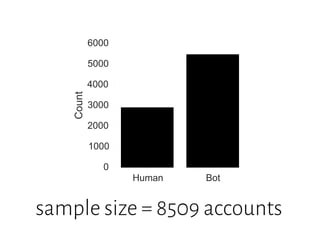
sample size = 8509 accounts
Step2:
preprocessing.
Who'sready
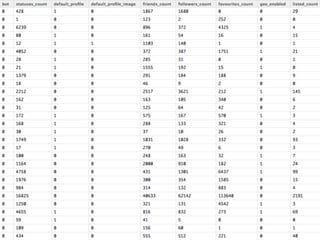
1. “Flatten” the JSON into one
row per user.
2.Variable recodes. e.g.
consistently denoting
missing values, True/False
into 1/0
3.Select only desired features
for modeling.
toclean?
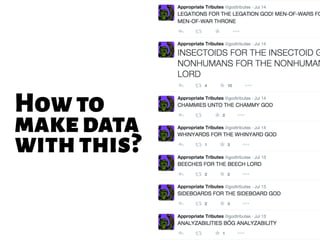
Howto
makedata
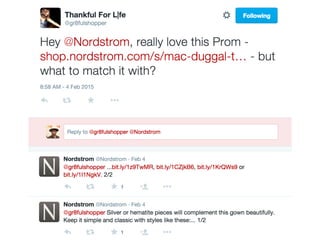
withthis?
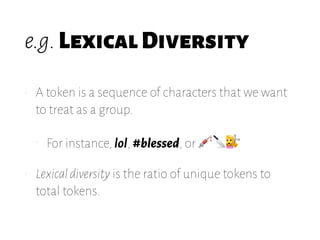
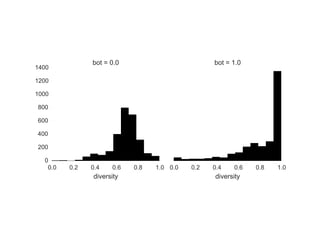
e.g.LexicalDiversity
• A token is a sequence of characters that we want
to treat as a group.
• For instance, lol, #blessed, or 💉🔪💇
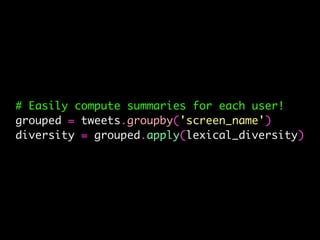
• Lexicaldiversity is the ratio of unique tokens to
total tokens.
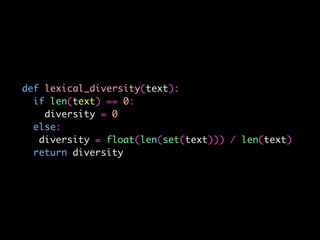
def lexical_diversity(text):
if len(text) == 0:
diversity = 0
else:
diversity = float(len(set(text))) / len(text)
return diversity
# Easily compute summaries for each user!
grouped = tweets.groupby('screen_name')
diversity = grouped.apply(lexical_diversity)
Step3:
Classification.
# Naive Bayes
bayes = GaussianNB().fit(train[features], y)
bayes_predict = bayes.predict(test[features])
# Logistic regression
logistic = LogisticRegression().fit(train[features], y)
logistic_predict = logistic.predict(test[features])
# Random Forest
rf = RandomForestClassifier().fit(train[features], y)
rf_predict = rf.predict(test[features])
# Classification Metrics
print(metrics.classification_report(test.bot, bayes_predict))
print(metrics.classification_report(test.bot, logistic_predict))
print(metrics.classification_report(test.bot, rf_predict))
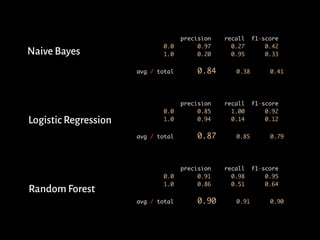
precision recall f1-score
0.0 0.97 0.27 0.42
1.0 0.20 0.95 0.33
avg / total 0.84 0.38 0.41
precision recall f1-score
0.0 0.85 1.00 0.92
1.0 0.94 0.14 0.12
avg / total 0.87 0.85 0.79
precision recall f1-score
0.0 0.91 0.98 0.95
1.0 0.86 0.51 0.64
avg / total 0.90 0.91 0.90
Naive Bayes
Logistic Regression
Random Forest
# construct parameter grid
param_grid = {'max_depth': [1, 3, 6, 9, 12, 15, None],
'max_features': [1, 3, 6, 9, 12],
'min_samples_split': [1, 3, 6, 9, 12, 15],
'min_samples_leaf': [1, 3, 6, 9, 12, 15],
'bootstrap': [True, False],
'criterion': ['gini', 'entropy']}
# fit best classifier
grid_search = GridSearchCV(RandomForestClassifier(), param_grid = param_grid).fit(train[features], y)
# assess predictive accuracy
predict = grid_search.predict(test[features])
print(metrics.classification_report(test.bot, predict))
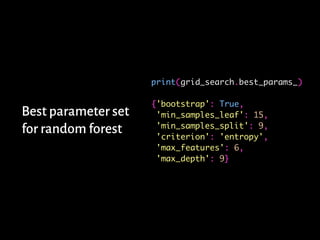
print(grid_search.best_params_)
{'bootstrap': True,
'min_samples_leaf': 15,
'min_samples_split': 9,
'criterion': 'entropy',
'max_features': 6,
'max_depth': 9}
Best parameter set
for random forest
precision recall f1-score
0.0 0.93 0.99 0.96
1.0 0.89 0.59 0.71
avg / total 0.92 0.93 0.92
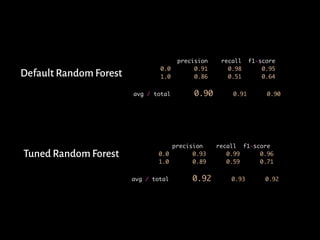
precision recall f1-score
0.0 0.91 0.98 0.95
1.0 0.86 0.51 0.64
avg / total 0.90 0.91 0.90
Default Random Forest
Tuned Random Forest
Iterative model development
in Scikit-learn is laborious.
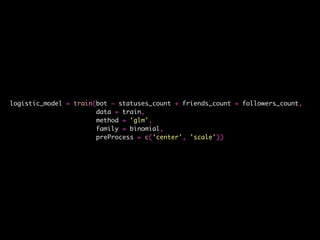
logistic_model = train(bot ~ statuses_count + friends_count + followers_count,
data = train,
method = 'glm',
family = binomial,
preProcess = c('center', 'scale'))
> confusionMatrix(logistic_predictions, test$bot)
Confusion Matrix and Statistics
Reference
Prediction 0 1
0 394 22
1 144 70
Accuracy : 0.7365
95% CI : (0.7003, 0.7705)
No Information Rate : 0.854
P-Value [Acc > NIR] : 1
Kappa : 0.3183
Mcnemars Test P-Value : <2e-16
Sensitivity : 0.7323
Specificity : 0.7609
Pos Pred Value : 0.9471
Neg Pred Value : 0.3271
Prevalence : 0.8540
Detection Rate : 0.6254
Detection Prevalence : 0.6603
Balanced Accuracy : 0.7466
'Positive' Class : 0
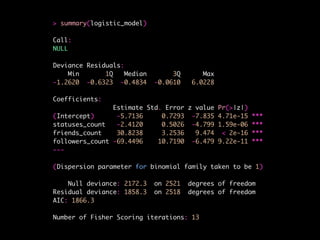
> summary(logistic_model)
Call:
NULL
Deviance Residuals:
Min 1Q Median 3Q Max
-1.2620 -0.6323 -0.4834 -0.0610 6.0228
Coefficients:
Estimate Std. Error z value Pr(>|z|)
(Intercept) -5.7136 0.7293 -7.835 4.71e-15 ***
statuses_count -2.4120 0.5026 -4.799 1.59e-06 ***
friends_count 30.8238 3.2536 9.474 < 2e-16 ***
followers_count -69.4496 10.7190 -6.479 9.22e-11 ***
---
(Dispersion parameter for binomial family taken to be 1)
Null deviance: 2172.3 on 2521 degrees of freedom
Residual deviance: 1858.3 on 2518 degrees of freedom
AIC: 1866.3
Number of Fisher Scoring iterations: 13
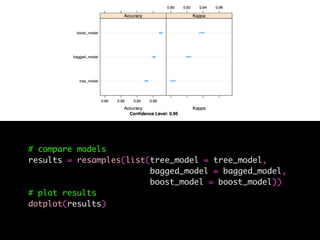
# compare models
results = resamples(list(tree_model = tree_model,
bagged_model = bagged_model,
boost_model = boost_model))
# plot results
dotplot(results)
Step5:
Pontificate.
Pythonrules!
• The Python language is an incredibly powerful tool for end-
to-end data analysis.
• Even so,some tasks are more work than they should be.
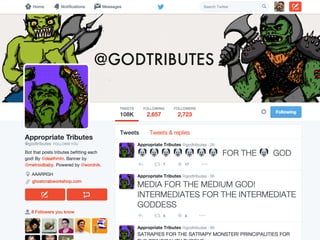
Lamebots
Andnow…
thebots.
Clicks
• Twitter Is Plagued With 23 Million Automated Accounts: http://valleywag.gawker.com/twitter-is-riddled-with-23-million-
bots-1620466086
• HOW TWITTER BOTS FOOL YOU INTO THINKING THEY ARE REAL PEOPLE: http://www.fastcompany.com/3031500/how-
twitter-bots-fool-you-into-thinking-they-are-real-people
• Rise of the Twitter bots: Social network admits 23 MILLION of its users tweet automatically without human input: http://
www.dailymail.co.uk/sciencetech/article-2722677/Rise-Twitter-bots-Social-network-admits-23-MILLION-users-tweet-
automatically-without-human-input.html
• Twitter Zombies: 24% of Tweets Created by Bots: http://mashable.com/2009/08/06/twitter-bots/
• How bots are taking over the world: http://www.theguardian.com/commentisfree/2012/mar/30/how-bots-are-taking-over-the-
world
• That Time 2 Bots Were Talking, and Bank of America Butted In: http://www.theatlantic.com/technology/archive/2014/07/that-
time-2-bots-were-talking-and-bank-of-america-butted-in/374023/
• The Rise of Twitter Bots: http://www.newyorker.com/tech/elements/the-rise-of-twitter-bots
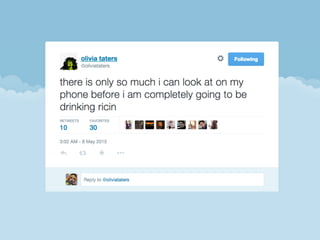
• OLIVIA TATERS, ROBOT TEENAGER: http://www.onthemedia.org/story/29-olivia-taters-robot-teenager/

Bot or Not

  • 1.
    Bot Not? @erinshellman PyData Seattle,July 26, 2015 orEnd-to-end data analysis in Python
  • 3.
    PySpark Workshop @Tune August 27,6-8pm Startinga new career in software @Moz October 22,6-8pm
  • 4.
    Q: Why? Bots arefun. Q: How? Python.
  • 7.
    In 2009,24% oftweets were generated by bots.
  • 8.
    Last year Twitterdisclosed that 23 million of its active users were bots.
  • 11.
  • 12.
    ExperimentalDesign • Ingest data •Clean and process data • Create a classifier
  • 13.
    ExperimentalDesign • Ingest data •python-twitter • Clean and process data • Pandas,NLTK,Seaborn,iPython Notebooks • Create a classifier • Scikit-learn
  • 14.
  • 16.
  • 20.
  • 21.
    def get_friends(self, screen_name,count = 5000): ''' GET friends/ids i.e. people you follow returns a list of JSON blobs ''' friends = self.api.GetFriendIDs(screen_name = screen_name, count = count) return friends
  • 23.
    # break queryinto bite-size chunks 🍔 def blow_chunks(self, data, max_chunk_size): for i in range(0, len(data), max_chunk_size): yield data[i:i + max_chunk_size]
  • 24.
    if len(user_ids) >max_query_size: chunks = self.blow_chunks(user_ids, max_chunk_size = max_query_size) while True: try: current_chunk = chunks.next() for user in current_chunk: try: user_data = self.api.GetUser(user_id = str(user)) results.append(user_data.AsDict()) except: print "got a twitter error! D:" pass print "nap time. ZzZzZzzzzz..." time.sleep(60 * 16) continue except StopIteration: break
  • 25.
    if len(user_ids) >max_query_size: chunks = self.blow_chunks(user_ids, max_chunk_size = max_query_size) while True: try: current_chunk = chunks.next() for user in current_chunk: try: user_data = self.api.GetUser(user_id = str(user)) results.append(user_data.AsDict()) except: print "got a twitter error! D:" pass print "nap time. ZzZzZzzzzz..." time.sleep(60 * 16) continue except StopIteration: break
  • 26.
    if len(user_ids) >max_query_size: chunks = self.blow_chunks(user_ids, max_chunk_size = max_query_size) while True: try: current_chunk = chunks.next() for user in current_chunk: try: user_data = self.api.GetUser(user_id = str(user)) results.append(user_data.AsDict()) except: print "got a twitter error! D:" pass print "nap time. ZzZzZzzzzz..." time.sleep(60 * 16) continue except StopIteration: break
  • 27.
    if len(user_ids) >max_query_size: chunks = self.blow_chunks(user_ids, max_chunk_size = max_query_size) while True: try: current_chunk = chunks.next() for user in current_chunk: try: user_data = self.api.GetUser(user_id = str(user)) results.append(user_data.AsDict()) except: print "got a twitter error! D:" pass print "nap time. ZzZzZzzzzz..." time.sleep(60 * 16) continue except StopIteration: break
  • 28.
    { "name": "Twitter API", "location":"San Francisco, CA", "created_at": "Wed May 23 06:01:13 +0000 2007", "default_profile": true, "favourites_count": 24, "url": "http://dev.twitter.com", "id": 6253282, "profile_use_background_image": true, "listed_count": 10713, "profile_text_color": "333333", "lang": "en", "followers_count": 1198334, "protected": false, "geo_enabled": true, "description": "The Real Twitter API.”, "verified": true, "notifications": false, "time_zone": "Pacific Time (US & Canada)", "statuses_count": 3331, "status": { "coordinates": null, "created_at": "Fri Aug 24 16:15:49 +0000 2012", "favorited": false, "truncated": false,
  • 29.
    sample size =8509 accounts
  • 30.
  • 31.
    Who'sready 1. “Flatten” theJSON into one row per user. 2.Variable recodes. e.g. consistently denoting missing values, True/False into 1/0 3.Select only desired features for modeling. toclean?
  • 35.
  • 37.
    e.g.LexicalDiversity • A tokenis a sequence of characters that we want to treat as a group. • For instance, lol, #blessed, or 💉🔪💇 • Lexicaldiversity is the ratio of unique tokens to total tokens.
  • 38.
    def lexical_diversity(text): if len(text)== 0: diversity = 0 else: diversity = float(len(set(text))) / len(text) return diversity
  • 39.
    # Easily computesummaries for each user! grouped = tweets.groupby('screen_name') diversity = grouped.apply(lexical_diversity)
  • 41.
  • 43.
    # Naive Bayes bayes= GaussianNB().fit(train[features], y) bayes_predict = bayes.predict(test[features]) # Logistic regression logistic = LogisticRegression().fit(train[features], y) logistic_predict = logistic.predict(test[features]) # Random Forest rf = RandomForestClassifier().fit(train[features], y) rf_predict = rf.predict(test[features]) # Classification Metrics print(metrics.classification_report(test.bot, bayes_predict)) print(metrics.classification_report(test.bot, logistic_predict)) print(metrics.classification_report(test.bot, rf_predict))
  • 44.
    precision recall f1-score 0.00.97 0.27 0.42 1.0 0.20 0.95 0.33 avg / total 0.84 0.38 0.41 precision recall f1-score 0.0 0.85 1.00 0.92 1.0 0.94 0.14 0.12 avg / total 0.87 0.85 0.79 precision recall f1-score 0.0 0.91 0.98 0.95 1.0 0.86 0.51 0.64 avg / total 0.90 0.91 0.90 Naive Bayes Logistic Regression Random Forest
  • 45.
    # construct parametergrid param_grid = {'max_depth': [1, 3, 6, 9, 12, 15, None], 'max_features': [1, 3, 6, 9, 12], 'min_samples_split': [1, 3, 6, 9, 12, 15], 'min_samples_leaf': [1, 3, 6, 9, 12, 15], 'bootstrap': [True, False], 'criterion': ['gini', 'entropy']} # fit best classifier grid_search = GridSearchCV(RandomForestClassifier(), param_grid = param_grid).fit(train[features], y) # assess predictive accuracy predict = grid_search.predict(test[features]) print(metrics.classification_report(test.bot, predict))
  • 46.
    print(grid_search.best_params_) {'bootstrap': True, 'min_samples_leaf': 15, 'min_samples_split':9, 'criterion': 'entropy', 'max_features': 6, 'max_depth': 9} Best parameter set for random forest
  • 47.
    precision recall f1-score 0.00.93 0.99 0.96 1.0 0.89 0.59 0.71 avg / total 0.92 0.93 0.92 precision recall f1-score 0.0 0.91 0.98 0.95 1.0 0.86 0.51 0.64 avg / total 0.90 0.91 0.90 Default Random Forest Tuned Random Forest
  • 49.
    Iterative model development inScikit-learn is laborious.
  • 50.
    logistic_model = train(bot~ statuses_count + friends_count + followers_count, data = train, method = 'glm', family = binomial, preProcess = c('center', 'scale'))
  • 51.
    > confusionMatrix(logistic_predictions, test$bot) ConfusionMatrix and Statistics Reference Prediction 0 1 0 394 22 1 144 70 Accuracy : 0.7365 95% CI : (0.7003, 0.7705) No Information Rate : 0.854 P-Value [Acc > NIR] : 1 Kappa : 0.3183 Mcnemars Test P-Value : <2e-16 Sensitivity : 0.7323 Specificity : 0.7609 Pos Pred Value : 0.9471 Neg Pred Value : 0.3271 Prevalence : 0.8540 Detection Rate : 0.6254 Detection Prevalence : 0.6603 Balanced Accuracy : 0.7466 'Positive' Class : 0
  • 52.
    > summary(logistic_model) Call: NULL Deviance Residuals: Min1Q Median 3Q Max -1.2620 -0.6323 -0.4834 -0.0610 6.0228 Coefficients: Estimate Std. Error z value Pr(>|z|) (Intercept) -5.7136 0.7293 -7.835 4.71e-15 *** statuses_count -2.4120 0.5026 -4.799 1.59e-06 *** friends_count 30.8238 3.2536 9.474 < 2e-16 *** followers_count -69.4496 10.7190 -6.479 9.22e-11 *** --- (Dispersion parameter for binomial family taken to be 1) Null deviance: 2172.3 on 2521 degrees of freedom Residual deviance: 1858.3 on 2518 degrees of freedom AIC: 1866.3 Number of Fisher Scoring iterations: 13
  • 53.
    # compare models results= resamples(list(tree_model = tree_model, bagged_model = bagged_model, boost_model = boost_model)) # plot results dotplot(results)
  • 54.
  • 55.
    Pythonrules! • The Pythonlanguage is an incredibly powerful tool for end- to-end data analysis. • Even so,some tasks are more work than they should be.
  • 56.
  • 57.
  • 58.
  • 64.
    Clicks • Twitter IsPlagued With 23 Million Automated Accounts: http://valleywag.gawker.com/twitter-is-riddled-with-23-million- bots-1620466086 • HOW TWITTER BOTS FOOL YOU INTO THINKING THEY ARE REAL PEOPLE: http://www.fastcompany.com/3031500/how- twitter-bots-fool-you-into-thinking-they-are-real-people • Rise of the Twitter bots: Social network admits 23 MILLION of its users tweet automatically without human input: http:// www.dailymail.co.uk/sciencetech/article-2722677/Rise-Twitter-bots-Social-network-admits-23-MILLION-users-tweet- automatically-without-human-input.html • Twitter Zombies: 24% of Tweets Created by Bots: http://mashable.com/2009/08/06/twitter-bots/ • How bots are taking over the world: http://www.theguardian.com/commentisfree/2012/mar/30/how-bots-are-taking-over-the- world • That Time 2 Bots Were Talking, and Bank of America Butted In: http://www.theatlantic.com/technology/archive/2014/07/that- time-2-bots-were-talking-and-bank-of-america-butted-in/374023/ • The Rise of Twitter Bots: http://www.newyorker.com/tech/elements/the-rise-of-twitter-bots • OLIVIA TATERS, ROBOT TEENAGER: http://www.onthemedia.org/story/29-olivia-taters-robot-teenager/