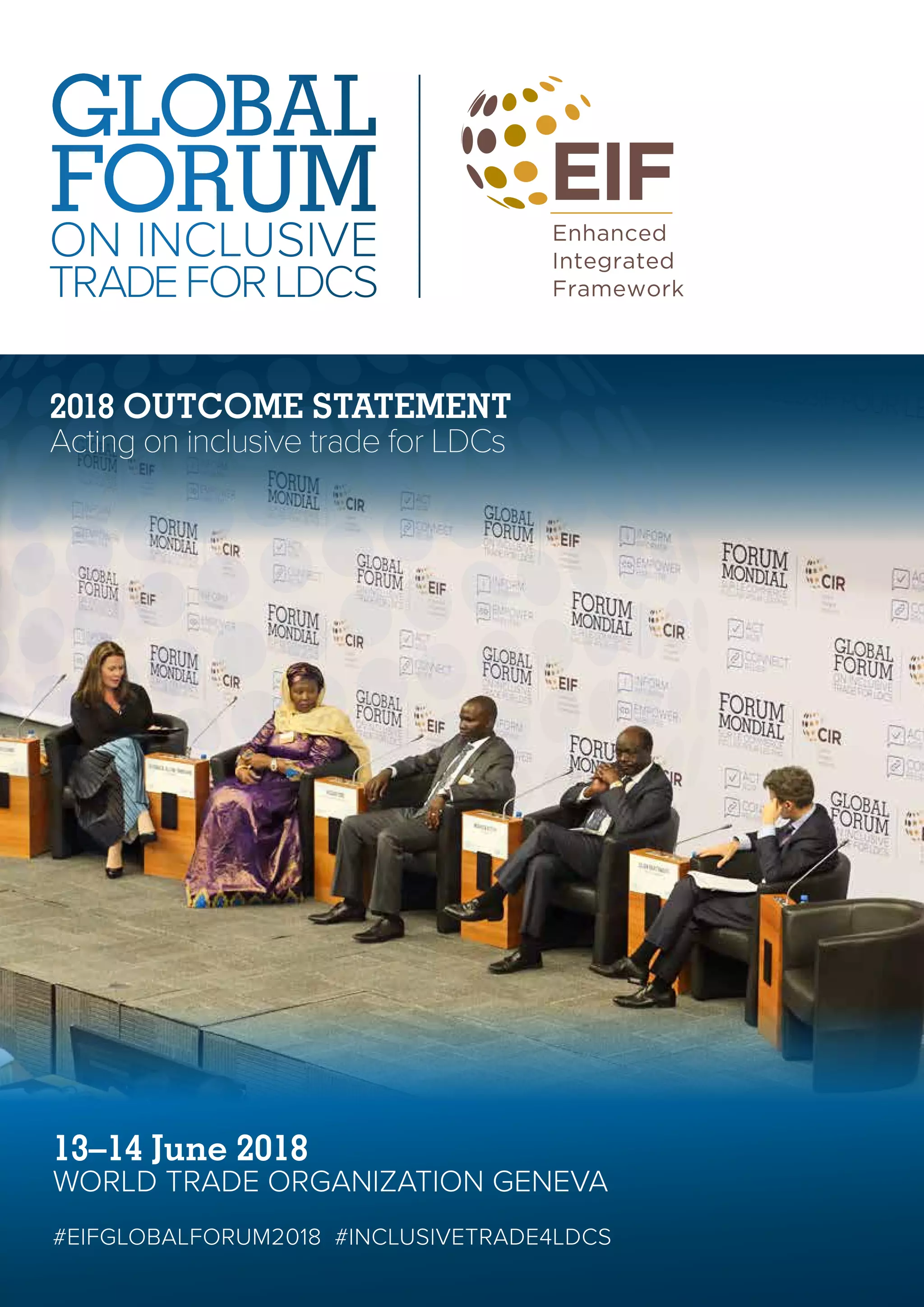
13–14 June 2018
WORLD TRADE ORGANIZATION GENEVA
#EIFGLOBALFORUM2018 #INCLUSIVETRADE4LDCS
2018 OUTCOME STATEMENT
Acting on inclusive trade for LDCs
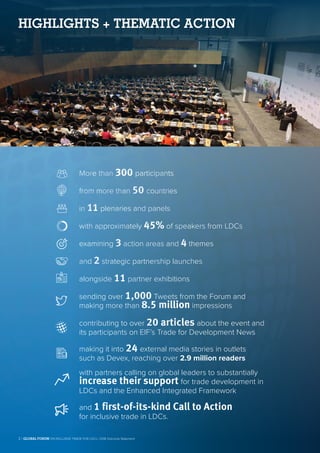
More than 300 participants
from more than 50 countries
in 11 plenaries and panels
with approximately 45% of speakers from LDCs
examining 3 action areas and 4 themes
alongside 11 partner exhibitions
sending over 1,000 Tweets from the Forum and
making more than 8.5 million impressions
contributing to over 20 articles about the event and
its participants on EIF’s Trade for Development News
making it into 24 external media stories in outlets
such as Devex, reaching over 2.9 million readers
and 1 first-of-its-kind Call to Action
for inclusive trade in LDCs.
with partners calling on global leaders to substantially
increase their support for trade development in
LDCs and the Enhanced Integrated Framework
and 2 strategic partnership launches
HIGHLIGHTS + THEMATIC ACTION
2 | GLOBAL FORUM ON INCLUSIVE TRADE FOR LDCs | 2018 Outcome Statement
A diverse range of people – from ministers to business leaders to farm managers – came together at the
Global Forum on Inclusive Trade for Least Developed Countries (LDCs). The Forum, which was held from
13 to 14 June 2018 at the World Trade Organization (WTO), fostered practical solutions, offered results-
oriented theoretical discussions, presented on-the-ground successes, and supported an innovative call to
ramp up actions on inclusive trade for LDCs.
THEMATIC ACHIEVEMENTS
The Forum provided dynamic,
diverse spaces along four themes:
Discussions ranged from the just-launched African Continental Free Trade Area (AfCFTA)
to the future of multilateral trade for the world’s poorest countries to the particular issues
facing less-connected island nations. The Forum cultivated the ready exchange of
information – and discussants came up with ideas for scalable actions.
At the plenary on ‘Forging new paths for LDCs in multilateral and regional trade’,
participants brainstormed on youth-centred solutions for development. These include
giving young people in LDCs access to education about trade and business, connecting
them with the private sector, and providing skills training, especially on technology – all
to give youth a competitive edge. Youth are the key, discussants agreed, and they need
good, reliable jobs.
For the first time, representatives from more than 40 LDCs – including 23 partner
organizations and governments – came together to act for inclusive trade. One particular
area of interest was the agriculture and trade nexus and its massive potential for sustained
impact. ‘Connecting’ was the key word in these conversations – connecting the two
sectors, connecting the ministries involved, connecting farmers to markets, and connecting
markets to buyers.
This drawing of necessary connections and networks reached well beyond the walls of
the WTO. During the 18-hour event, people from Australia to Oman to the United States
joined the livestream of the discussions, the event hashtag trended at #1 in Geneva and in
Switzerland, and people engaged across the Forum’s themes and around the globe.
At the Forum’s Closing Ceremony, a group of esteemed LDC attendees made a united
call: for inclusive trade action for LDCs, to highlight the need for action to leverage trade
to fight poverty and in support of the multilateral trading system to support LDCs in global
markets. This Call to Action is a first, and promises to benefit the citizens of LDCs and
develop a trading system that depends on them.
At the Dragons’ Den, ‘empowerment’ was the refrain of the hour, with three women from
LDC businesses taking centre stage. Their unique presentations – enlivened by their
expertise, examples of market-based results and their evident joy in their chosen fields –
reversed the usual panel politics. These entrepreneurs combined evidence and passion
to make their case for the ‘dragons’ to back up real-world investment opportunities in
Samoa’s coconut oil-based products, crops that support Bhutanese youth, and Malawi’s
groundnuts.
GLOBAL FORUM ON INCLUSIVE TRADE FOR LDCs | 2018 Outcome Statement | 3
The Forum was a first-of-its-kind event exclusively dedicated to achieving inclusive trade in the world’s
poorest nations. LDC status is determined by a combination of three factors: per capita income, human
assets like education and nutrition, and economic vulnerability. Despite strong efforts to incorporate LDCs
into the global trading system, there is a widening trade gap, and more efforts are needed.
At the event’s Opening Ceremony, more than 300 in-
person participants joined then Vice President and Minister
of Women’s Affairs for The Gambia Fatoumata Jallow-
Tambajang, UK Permanent Representative to the WTO Julian
Braithwaite, and UNCTAD Secretary-General Mukhisa Kituyi,
among others, to speak about the need to support LDCs. An
introductory video by WTO Director General Roberto Azevêdo
kicked off two days of focused discussions. Panellists agreed
that while there is often a focus on the challenges facing
LDCs, a pivot is needed to also look at the many opportunities
that trade offers.
“Action is needed to build synergies and
strong partnerships. Action is needed to
fight poverty around the world, taking into
consideration the significant contributions of
women and youth entrepreneurs. Action is
needed to foster inclusive trade.”
– Fatoumata Jallow-Tambajang,
then Vice President and Minister
of Women’s Affairs, The Gambia
Speakers recognized that investments in LDCs are on the
decline, and global uncertainties, whether trade or politics or
climactic, impact LDCs more. That precariousness means that
new, alternate and diverse methods are required to meet LDC
needs, and that trade offers one solution with its mobility and
multiplicity.
ON THE FIRST
GLOBAL FORUM
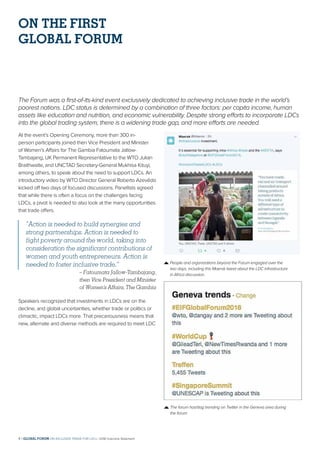
People and organizations beyond the Forum engaged over the
two days, including this Maersk tweet about the LDC infrastructure
in Africa discussion.
The forum hashtag trending on Twitter in the Geneva area during
the forum
4 | GLOBAL FORUM ON INCLUSIVE TRADE FOR LDCs | 2018 Outcome Statement
BUILDING INCLUSIVE TRADE
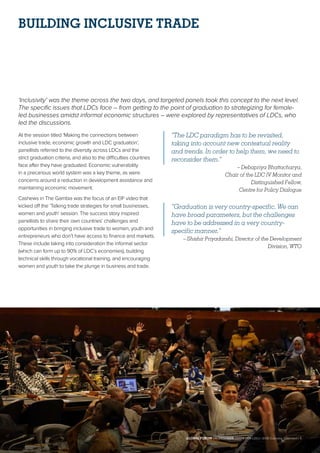
‘Inclusivity’ was the theme across the two days, and targeted panels took this concept to the next level.
The specific issues that LDCs face – from getting to the point of graduation to strategizing for female-
led businesses amidst informal economic structures – were explored by representatives of LDCs, who
led the discussions.
At the session titled ‘Making the connections between
inclusive trade, economic growth and LDC graduation’,
panellists referred to the diversity across LDCs and the
strict graduation criteria, and also to the difficulties countries
face after they have graduated. Economic vulnerability
in a precarious world system was a key theme, as were
concerns around a reduction in development assistance and
maintaining economic movement.
Cashews in The Gambia was the focus of an EIF video that
kicked off the ‘Talking trade strategies for small businesses,
women and youth’ session. The success story inspired
panellists to share their own countries’ challenges and
opportunities in bringing inclusive trade to women, youth and
entrepreneurs who don’t have access to finance and markets.
These include taking into consideration the informal sector
(which can form up to 90% of LDC’s economies), building
technical skills through vocational training, and encouraging
women and youth to take the plunge in business and trade.
“The LDC paradigm has to be revisited,
taking into account new contextual reality
and trends. In order to help them, we need to
reconsider them.”
– Debapriya Bhattacharya,
Chair of the LDC IV Monitor and
Distinguished Fellow,
Centre for Policy Dialogue
“Graduation is very country-specific. We can
have broad parameters, but the challenges
have to be addressed in a very country-
specific manner.”
– Shishir Priyadarshi, Director of the Development
Division, WTO
GLOBAL FORUM ON INCLUSIVE TRADE FOR LDCs | 2018 Outcome Statement | 5
LDC LEADERS UNITE IN
CALL TO ACTION
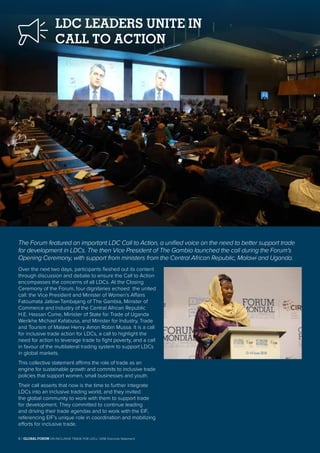
The Forum featured an important LDC Call to Action, a unified voice on the need to better support trade
for development in LDCs. The then Vice President of The Gambia launched the call during the Forum’s
Opening Ceremony, with support from ministers from the Central African Republic, Malawi and Uganda.
Over the next two days, participants fleshed out its content
through discussion and debate to ensure the Call to Action
encompasses the concerns of all LDCs. At the Closing
Ceremony of the Forum, four dignitaries echoed the united
call: the Vice President and Minister of Women’s Affairs
Fatoumata Jallow-Tambajang of The Gambia, Minister of
Commerce and Industry of the Central African Republic
H.E. Hassan Come, Minister of State for Trade of Uganda
Werikhe Michael Kafabusa, and Minister for Industry, Trade
and Tourism of Malawi Henry Amon Robin Mussa. It is a call
for inclusive trade action for LDCs, a call to highlight the
need for action to leverage trade to fight poverty, and a call
in favour of the multilateral trading system to support LDCs
in global markets.
This collective statement affirms the role of trade as an
engine for sustainable growth and commits to inclusive trade
policies that support women, small businesses and youth.
Their call asserts that now is the time to further integrate
LDCs into an inclusive trading world, and they invited
the global community to work with them to support trade
for development. They committed to continue leading
and driving their trade agendas and to work with the EIF,
referencing EIF’s unique role in coordination and mobilizing
efforts for inclusive trade.
6 | GLOBAL FORUM ON INCLUSIVE TRADE FOR LDCs | 2018 Outcome Statement
CALL TO ACTION
2018 GLOBAL FORUM ON INCLUSIVE TRADE FOR LDCS
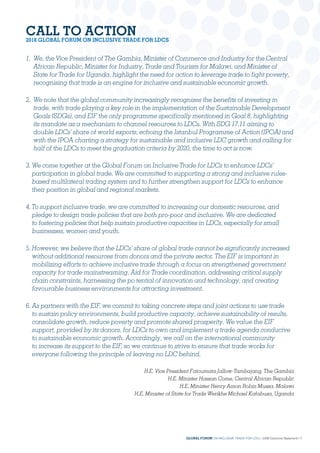
1. We, the Vice President of The Gambia, Minister of Commerce and Industry for the Central
African Republic, Minister for Industry, Trade and Tourism for Malawi, and Minister of
State for Trade for Uganda, highlight the need for action to leverage trade to fight poverty,
recognising that trade is an engine for inclusive and sustainable economic growth.
2. We note that the global community increasingly recognizes the benefits of investing in
trade, with trade playing a key role in the implementation of the Sustainable Development
Goals (SDGs), and EIF the only programme specifically mentioned in Goal 8, highlighting
its mandate as a mechanism to channel resources to LDCs. With SDG 17.11 aiming to
double LDCs’ share of world exports, echoing the Istanbul Programme of Action (IPOA) and
with the IPOA charting a strategy for sustainable and inclusive LDC growth and calling for
half of the LDCs to meet the graduation criteria by 2020, the time to act is now.
3. We come together at the Global Forum on Inclusive Trade for LDCs to enhance LDCs’
participation in global trade. We are committed to supporting a strong and inclusive rules-
based multilateral trading system and to further strengthen support for LDCs to enhance
their position in global and regional markets.
4. To support inclusive trade, we are committed to increasing our domestic resources, and
pledge to design trade policies that are both pro-poor and inclusive. We are dedicated
to fostering policies that help sustain productive capacities in LDCs, especially for small
businesses, women and youth.
5. However, we believe that the LDCs’ share of global trade cannot be significantly increased
without additional resources from donors and the private sector. The EIF is important in
mobilizing efforts to achieve inclusive trade through a focus on strengthened government
capacity for trade mainstreaming, Aid for Trade coordination, addressing critical supply
chain constraints, harnessing the po tential of innovation and technology, and creating
favourable business environments for attracting investment.
6. As partners with the EIF, we commit to taking concrete steps and joint actions to use trade
to sustain policy environments, build productive capacity, achieve sustainability of results,
consolidate growth, reduce poverty and promote shared prosperity. We value the EIF
support, provided by its donors, for LDCs to own and implement a trade agenda conducive
to sustainable economic growth. Accordingly, we call on the international community
to increase its support to the EIF, so we continue to strive to ensure that trade works for
everyone following the principle of leaving no LDC behind.
H.E. Vice President Fatoumata Jallow-Tambajang, The Gambia
H.E. Minister Hassan Come, Central African Republic
H.E. Minister Henry Amon Robin Mussa, Malawi
H.E. Minister of State for Trade Werikhe Michael Kafabusa, Uganda
GLOBAL FORUM ON INCLUSIVE TRADE FOR LDCs | 2018 Outcome Statement | 7
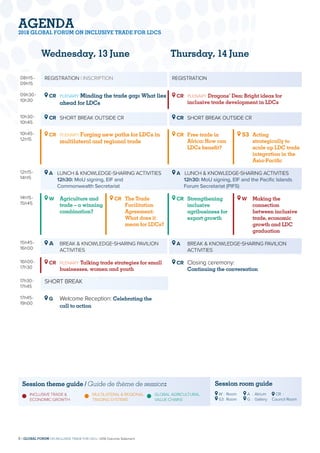
08h15-
09h15
REGISTRATION | INSCRIPTION REGISTRATION
09h30-
10h30
CR	 PLENARY Minding the trade gap: What lies
ahead for LDCs
CR	 PLENARY Dragons’ Den: Bright ideas for
inclusive trade development in LDCs
10h30-
10h45
CR	 SHORT BREAK OUTSIDE CR CR	 SHORT BREAK OUTSIDE CR
10h45-
12h15
CR	 PLENARY Forging new paths for LDCs in
multilateral and regional trade
CR	 Free trade in
Africa: How can
LDCs benefit?
S3	 Acting
strategically to
scale up LDC trade
integration in the
Asia-Pacific
12h15-
14h15
A LUNCH  KNOWLEDGE-SHARING ACTIVITIES
12h30: MoU signing, EIF and
Commonwealth Secretariat
A LUNCH  KNOWLEDGE-SHARING ACTIVITIES
12h30: MoU signing, EIF and the Pacific Islands
Forum Secretariat (PIFS)
14h15-
15h45
W	Agriculture and
trade – a winning
combination?
CR	The Trade
Facilitation
Agreement:
What does it
mean for LDCs?
CR	 Strengthening
inclusive
agribusiness for
export growth
W	 Making the
connection
between inclusive
trade, economic
growth and LDC
graduation
15h45-
16h00
A	BREAK  KNOWLEDGE-SHARING PAVILION
ACTIVITIES
A	BREAK  KNOWLEDGE-SHARING PAVILION
ACTIVITIES
16h00-
17h30
CR	 PLENARY Talking trade strategies for small
businesses, women and youth
CR	Closing ceremony:
Continuing the conversation
17h30-
17h45
SHORT BREAK
17h45-
19h00
G	 Welcome Reception: Celebrating the
call to action
Wednesday, 13 June
Session theme guide / Guide de thème de session:
	INCLUSIVE TRADE 
ECONOMIC GROWTH
	MULTILATERAL  REGIONAL
TRADING SYSTEMS
	 GLOBAL AGRICULTURAL
	 VALUE CHAINS
Session room guide
W	:	Room
S3	:	 Room
A	 :	Atrium
G	 :	Gallery
CR	 :	
Council Room
Thursday, 14 June
AGENDA
2018 GLOBAL FORUM ON INCLUSIVE TRADE FOR LDCS
8 | GLOBAL FORUM ON INCLUSIVE TRADE FOR LDCs | 2018 Outcome Statement
DRAGONS’ DEN: BRIGHT IDEAS FOR
INCLUSIVE TRADE IN LDCS
•	 Alberta Vitale, Associate Director of
Women in Business Development
in Samoa, spoke of her country’s
organic coconut oil products, which
are sourced from 796 certified
growers in 183 villages across
the island. The industry employs
traditional and new knowledge
in its product development, but it
remains isolated from international
markets. Instead of seeing this as an
obstacle, Vitale shared how it can
be an opportunity to engage with
vulnerable communities and ensure
the products meet the highest quality
standards, given the growing global
demand for coconut oil. Her pitch
aimed at increasing production
capacity and accessing new markets.
	 The ‘dragons’ asked her about
standards and quality assurance, the
key inclusivity question of women’s
roles, and from her buyer The Body
Shop, how much more could they
obtain by scaling up her business.
•	 Damchae Den, Executive Director
of the Bhutan Association of
Women Entrepreneurs, shared the
challenges associated with her
country’s particular geographic
location, as well as climate change.
She pitched a project in Thimphu
that offers two-year apprenticeships
for youth to learn in four sectors,
with a focus of remaining mindful of
their environment and of their impact
on the world. There is potential in
organic foods, she said, and her
program offers technical skills to
grow herbs, turmeric, mushrooms
and more – with the promise of
collective happiness for her students
and those they work with.
	 Dem faced off against questions
on Bhutan’s export goals, young
people’s scepticism toward
agriculture jobs, medium-term
sustainability and the public-private
partnership, and the specifics of what
would be available for purchase.
•	 Betty Chinyamunyamu, CEO of the
National Smallholders’ Farmers
Association of Malawi, pitched an
innovative project that improves
farmers’ production capacity and
gives them access to markets. Her
story is of the transformation from
farmer to entrepreneur to change-
agent. Participating farmers have
more than doubled their yields,
reduced post-harvest losses and
exported regionally, and incomes
have increased threefold. They want
to produce even more fair trade
items such as organic nuts, and to
create value-added items like peanut
butter for export.
	 She confronted questions about
farming risks to crops, the viability
of niche markets, financing and
partnerships, and whether their
agriculture was climate-smart,
considering Malawi’s climate change-
related issues.
GLOBAL FORUM ON INCLUSIVE TRADE FOR LDCs | 2018 Outcome Statement | 9
REPOSITIONING LDCS IN MULTILATERAL
AND REGIONAL TRADE
During our current period of global trade upheaval, this topic is particularly relevant for LDCs. Joost
Pauwelyn, Professor of International Law at the Graduate Institute of International and Development
Studies in Geneva, set the stage on the first morning with an analogy that compares world trade to a pack
of wolves – with LDCs in the middle of the fight.
Pauwelyn cited an UNCTAD report statistic that Foreign Direct
Investment dropped by 24% last year and that global value
chains are stagnating. What are LDCs to do? He urged the
LDC representatives in the room to push for what they want,
and encouraged all trade-centred and trade-associated
participants to move from ideological trade agendas to data-
driven ones, from the abstract to the concrete.
Panellists Arancha Gonzalez, Executive Director, ITC, and
Patricia Scotland, Secretary-General of the Commonwealth
of Nations, spoke of opportunities on the ground to support
small businesses, and discussants mentioned the African
Continental Free Trade Area (AfCFTA), the central topic of
the ‘Free trade in Africa: How can LDCs benefit?’ panel.
Speakers broke down the details of the Trade Facilitation
Agreement, which entered into force last year, in ‘The Trade
Facilitation Agreement: What does it mean for LDCs?’ panel.
The presentations explored the particulars of these topics and
emphasized that the focus needs to be on political will and
implementation, as well as efforts from the private sector.
“Everybody in this room has a choice. We
can either continue along the path we have
now and we can drown separately, or we
can swim together. And I’m for swimming
together… I hope we’ll all swim.”
– Patricia Scotland,
Secretary-General of the
Commonwealth of Nations
“Let me start by thanking [EIF] for having
put LDCs in the trade scene. Because if you
watch television or you listen to the radio or
you look at your iPad, you would think that
trade today is a matter of four or five big guys
fighting like dogs, with lots of other countries
just watching.”
– Arancha Gonzalez, Executive Director,
International Trade Centre (ITC)
10 | GLOBAL FORUM ON INCLUSIVE TRADE FOR LDCs | 2018 Outcome Statement
AGRICULTURE AND TRADE,
A WINNING COMBINATION
With two engaging panels devoted to the Forum action area ‘global agricultural value chains’, participants
emphasized the need to recognize the role of agriculture as a driver of trade and inclusive value chain
development in LDCs.
During the Opening Ceremony, Minister of Commerce and
Industry of the Central African Republic Hassan Come stated
that his country has an abundance of natural resources, but
that they are underutilized. “We can only harness that potential
through trade,” he said.
Cross-sectoral partnerships and alignment across agriculture
and trade ministries are needed, noted a number of the
discussants in the ‘Agriculture and trade – a winning
combination?’ session. Participants recognized that Africa’s
potential needs to be unlocked, including through better
aligning agriculture programmes and budgets with trade-
related priorities. José Graziano da Silva, Director-General
of the Food and Agriculture Organization of the United
Nations (FAO), highlighted FAO’s commitment to work with
EIF to achieve these objectives. Others highlighted ways to
leverage regional trade, such as through the Common Market
for Eastern and Southern Africa (COMESA), as well as to
increase engagement across stakeholders, such as through
FAO. Zambia shared innovations underway to develop closer
alignment in agriculture and trade.
Continuing this theme, growth in the sector needs to be
driven by market demands. At the ‘Strengthening inclusive
agribusiness for export growth’ discussion, The Body Shop’s
Heather Ducharme spoke of their demand-driven sourcing
and supply chain development programmes. Panellists
discussed the many faces and opportunities for adding
value in agribusiness and how to generate scale. Trish Kabi
of Alosang Enterprise in Lesotho shared her experience in
growing, packaging and marketing high-value agriculture
products, which are generating scores of new jobs for the
country. Likewise, Said Salime explained how Comoros is
adding value by successfully targeting high-quality product
markets, like Japan.
“This is a defining moment for Africa. We
have an opportunity. We need to leave a
legacy for our future generations, who will
benefit from the sustainable business models
we put in place today.”
– Matiti Trish Kabi, Alosang Enterprise, Lesotho
“If we look at why trade amongst ourselves
isn’t growing, we discover the bottlenecks.
We always blame infrastructure, but [there
are] also other factors on the soft side that are
fragmenting supply chains and stopping the
flow of products.”
– Martha Byanyima, Coordinator of the Sanitary and
Phytosanitary (SPS) Unit at the Common Market for East
and Southern Africa (COMESA)
GLOBAL FORUM ON INCLUSIVE TRADE FOR LDCs | 2018 Outcome Statement | 11
GLOBAL REACH: IN THE GLOBAL TRADING
SPACE, REACHING OUT TO THE WORLD
PARTICIPANTS
The Global Forum hosted a truly international
group of experts, with more than 300 in-person
participants from the WTO, Geneva, and other
European locales, and from more than 40 LDCs
– from Cabo Verde and Nepal to the Solomon
Islands and Lesotho.
On YouTube, the livestreamed sessions drew in
over 200 users over two days, from the Congo
to Cambodia, from Sudan to Switzerland.
On Facebook Live, the livestreams were viewed
over 1,300 times around the world.
SOCIAL MEDIA
The event hashtag #EIFGlobalForum2018 was
•	 featured in 1,134 tweets
•	from 294 people
•	making over 8.5 million impressions in Twitter
feeds around the world
MEDIA CONNECTIONS
Coverage of the Forum included stories in
international, regional and local media, including
Devex’s ‘Using trade as a tool for development’,
AllAfrica’s ‘African Nations Pledge to Use Trade
to Reduce Poverty’, the Malawi Broadcasting
Corporation’s ‘Malawi shares trade developments
at the EIF Global Forum’, and New Business
Ethiopia’s ‘Geneva panel reflects on benefits
Africa’s free trade area’.
12 | GLOBAL FORUM ON INCLUSIVE TRADE FOR LDCs | 2018 Outcome Statement
“The fact that the agenda of inclusive trade
should not be working in a vacuum is an idea
that came out clearly.”
– Ratnakar Adhikari,
Executive Director, EIF
“The EIF Global Forum succeeded in exposing
the numerous, often complex constraints and
opportunities that affect LDCs’ ability to trade
at the regional and international levels and to
remain competitive on a level playing field,
which ultimately benefits all countries and
consumers – not only LDCs.”
– Forum participant
“We need to foster trade development in
our countries, as trade is the best weapon to
fight poverty. And, importantly, that action
will include women, who are so often part of
informal economies.”
– Her Royal Highness Abze Djigma,
Mossi Princess, Burkina Faso
GLOBAL FORUM ON INCLUSIVE TRADE FOR LDCs | 2018 Outcome Statement | 13
By including focused time for audience and social
media-driven questions in each session, and
through our participant surveys, EIF is listening to
you as we move into the future and its work with
LDCs.
We take your constructive feedback seriously.
Below is a representative selection of feedback
for us to reflect on, digest and incorporate into our
future events.
“A well-designed and well-executed Global Forum for
LDCs. Lets take the work a notch higher by focusing
EIF support on creating capacity to utilize opportunities
in the AfCFTA.”
– Forum participant
“The Partners Hub was a very useful way for the
World Bank Group to reach out to our LDC clients,
inform them about our product offerings and country
interventions, and – perhaps most importantly
– to listen to their stated priorities in matters of
trade-related technical assistance and capacity
strengthening. The Hub also allowed for very fruitful
interaction with the representatives of major donors
attending the Forum.”
– Pierre Sauvé, Senior Trade Specialist,
World Bank Group
“I think the global big picture was missing – US/
China trading relations and impacts on the rest of the
world. Brexit. These are daily in the media headlines
but not really mentioned. The section on Africa trade
agreements was very interesting, but the multilateral
response was not really sufficient. How can the
development machinery support trade for inclusive
development is a good question – for next time!”
– Forum participant
“Firstly, I think EIF proved that there is value in this
type of conversation, which feels very new in the
development space. How can the momentum raised
be built upon and brought into mainstream debates in
the future? The insights raised need to reach a wider
audience. But it was an excellent step on that journey.”
– Forum participant
“The structure of the Forum content was alright, but
I think next time there should be joint sessions for all
LDCs instead of breaking them up according to their
regions, for instance Africa and Asia, etc. This will help
to get insights of what is going on in the other regions
to develop trade.”
– Forum participant
“Timing could be improved as it is not enough for the
participants to ask questions to panellists. More time
allocated for question and answer session.”
– Forum participant
All sessions, featured great learnings and
experiences... The selection of panelists should
be balanced. There were very little numbers of
representative from the Caribbean and Pacific in the
first day sessions
– Forum participant
WE HEAR YOU!
14 | GLOBAL FORUM ON INCLUSIVE TRADE FOR LDCs | 2018 Outcome Statement
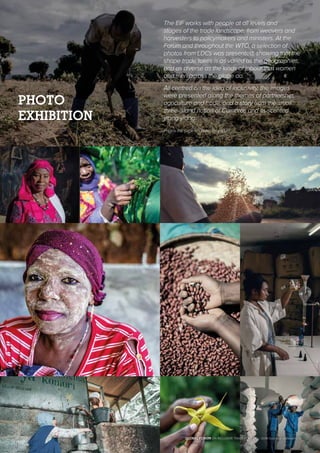
The EIF works with people at all levels and
stages of the trade landscape, from weavers and
harvesters to policymakers and ministers. At the
Forum and throughout the WTO, a selection of
photos from LDCs was presented, showing that the
shape trade takes is as varied as the geographies,
and as diverse as the kinds of labour that women
and men across the globe do.
All centred on the idea of inclusivity, the images
were presented along the themes of partnership,
agriculture and trade, and a story from the small
three-island nation of Comoros and its scented
ylang-ylang.
Photos this page © Ollivier Girard/EIF
PHOTO
EXHIBITION
GLOBAL FORUM ON INCLUSIVE TRADE FOR LDCs | 2018 Outcome Statement | 15
 @EIF4LDCs
 @enhancedintegratedframework
 facebook.com/eif4ldcs
enhancedif.org
 youtube.com/user/EIF4LDCs
 flickr.com/photos/152818923@N04/
 linkedin.com/company/11161784/
EIF Executive Secretariat at the WTO
Rue de Lausanne 154
CH-1211 Geneva 2
Switzerland
	 +41 (0)22 739 6650
	eif.secretariat@wto.org


International Monetary Fund (IMF)
International Trade Centre (ITC)
United Nations Conference on Trade and
Development (UNCTAD)
United Nations Development Programme
(UNDP)
World Bank Group
World Trade Organization (WTO)
United Nations Industrial Development
Organization (UNIDO)
World Tourism Organization (UNWTO)
The Enhanced Integrated Framework (EIF) is the only multilateral
partnership dedicated exclusively to assisting Least Developed
Countries (LDCs) in their use of trade as an engine for growth,
sustainable development and poverty reduction.
EIF TRUST FUND DONORS
EIF PARTNER AGENCIES
EIF TRUST FUND MANAGER
United Nations Office for Project Services (UNOPS)
ADDITIONAL FORUM SPONSORSHOST  EIF PARTNER
AGENCY
The Global Forum on Inclusive Trade for LDCs is the first
event for LDCs dedicated to achieving equitable trade
benefits for all.
Special thanks to our session rapporteurs Sainabou Taal, Anastasiya Letnikava, Helen Chang, Apurva
Mudliar, Khuong Ngoc Le, Feruza Nabiyeva and Sophia Gnych. Without them this document would not
have been possible.
All photos © Jan Turnbull/EIF except where noted

Outcome Statement: Global Forum on Inclusive Trade for LDCs

  • 1.
    13–14 June 2018 WORLDTRADE ORGANIZATION GENEVA #EIFGLOBALFORUM2018 #INCLUSIVETRADE4LDCS 2018 OUTCOME STATEMENT Acting on inclusive trade for LDCs
  • 2.
    More than 300participants from more than 50 countries in 11 plenaries and panels with approximately 45% of speakers from LDCs examining 3 action areas and 4 themes alongside 11 partner exhibitions sending over 1,000 Tweets from the Forum and making more than 8.5 million impressions contributing to over 20 articles about the event and its participants on EIF’s Trade for Development News making it into 24 external media stories in outlets such as Devex, reaching over 2.9 million readers and 1 first-of-its-kind Call to Action for inclusive trade in LDCs. with partners calling on global leaders to substantially increase their support for trade development in LDCs and the Enhanced Integrated Framework and 2 strategic partnership launches HIGHLIGHTS + THEMATIC ACTION 2 | GLOBAL FORUM ON INCLUSIVE TRADE FOR LDCs | 2018 Outcome Statement
  • 3.
    A diverse rangeof people – from ministers to business leaders to farm managers – came together at the Global Forum on Inclusive Trade for Least Developed Countries (LDCs). The Forum, which was held from 13 to 14 June 2018 at the World Trade Organization (WTO), fostered practical solutions, offered results- oriented theoretical discussions, presented on-the-ground successes, and supported an innovative call to ramp up actions on inclusive trade for LDCs. THEMATIC ACHIEVEMENTS The Forum provided dynamic, diverse spaces along four themes: Discussions ranged from the just-launched African Continental Free Trade Area (AfCFTA) to the future of multilateral trade for the world’s poorest countries to the particular issues facing less-connected island nations. The Forum cultivated the ready exchange of information – and discussants came up with ideas for scalable actions. At the plenary on ‘Forging new paths for LDCs in multilateral and regional trade’, participants brainstormed on youth-centred solutions for development. These include giving young people in LDCs access to education about trade and business, connecting them with the private sector, and providing skills training, especially on technology – all to give youth a competitive edge. Youth are the key, discussants agreed, and they need good, reliable jobs. For the first time, representatives from more than 40 LDCs – including 23 partner organizations and governments – came together to act for inclusive trade. One particular area of interest was the agriculture and trade nexus and its massive potential for sustained impact. ‘Connecting’ was the key word in these conversations – connecting the two sectors, connecting the ministries involved, connecting farmers to markets, and connecting markets to buyers. This drawing of necessary connections and networks reached well beyond the walls of the WTO. During the 18-hour event, people from Australia to Oman to the United States joined the livestream of the discussions, the event hashtag trended at #1 in Geneva and in Switzerland, and people engaged across the Forum’s themes and around the globe. At the Forum’s Closing Ceremony, a group of esteemed LDC attendees made a united call: for inclusive trade action for LDCs, to highlight the need for action to leverage trade to fight poverty and in support of the multilateral trading system to support LDCs in global markets. This Call to Action is a first, and promises to benefit the citizens of LDCs and develop a trading system that depends on them. At the Dragons’ Den, ‘empowerment’ was the refrain of the hour, with three women from LDC businesses taking centre stage. Their unique presentations – enlivened by their expertise, examples of market-based results and their evident joy in their chosen fields – reversed the usual panel politics. These entrepreneurs combined evidence and passion to make their case for the ‘dragons’ to back up real-world investment opportunities in Samoa’s coconut oil-based products, crops that support Bhutanese youth, and Malawi’s groundnuts. GLOBAL FORUM ON INCLUSIVE TRADE FOR LDCs | 2018 Outcome Statement | 3
  • 4.
    The Forum wasa first-of-its-kind event exclusively dedicated to achieving inclusive trade in the world’s poorest nations. LDC status is determined by a combination of three factors: per capita income, human assets like education and nutrition, and economic vulnerability. Despite strong efforts to incorporate LDCs into the global trading system, there is a widening trade gap, and more efforts are needed. At the event’s Opening Ceremony, more than 300 in- person participants joined then Vice President and Minister of Women’s Affairs for The Gambia Fatoumata Jallow- Tambajang, UK Permanent Representative to the WTO Julian Braithwaite, and UNCTAD Secretary-General Mukhisa Kituyi, among others, to speak about the need to support LDCs. An introductory video by WTO Director General Roberto Azevêdo kicked off two days of focused discussions. Panellists agreed that while there is often a focus on the challenges facing LDCs, a pivot is needed to also look at the many opportunities that trade offers. “Action is needed to build synergies and strong partnerships. Action is needed to fight poverty around the world, taking into consideration the significant contributions of women and youth entrepreneurs. Action is needed to foster inclusive trade.” – Fatoumata Jallow-Tambajang, then Vice President and Minister of Women’s Affairs, The Gambia Speakers recognized that investments in LDCs are on the decline, and global uncertainties, whether trade or politics or climactic, impact LDCs more. That precariousness means that new, alternate and diverse methods are required to meet LDC needs, and that trade offers one solution with its mobility and multiplicity. ON THE FIRST GLOBAL FORUM People and organizations beyond the Forum engaged over the two days, including this Maersk tweet about the LDC infrastructure in Africa discussion. The forum hashtag trending on Twitter in the Geneva area during the forum 4 | GLOBAL FORUM ON INCLUSIVE TRADE FOR LDCs | 2018 Outcome Statement
  • 5.
    BUILDING INCLUSIVE TRADE ‘Inclusivity’was the theme across the two days, and targeted panels took this concept to the next level. The specific issues that LDCs face – from getting to the point of graduation to strategizing for female- led businesses amidst informal economic structures – were explored by representatives of LDCs, who led the discussions. At the session titled ‘Making the connections between inclusive trade, economic growth and LDC graduation’, panellists referred to the diversity across LDCs and the strict graduation criteria, and also to the difficulties countries face after they have graduated. Economic vulnerability in a precarious world system was a key theme, as were concerns around a reduction in development assistance and maintaining economic movement. Cashews in The Gambia was the focus of an EIF video that kicked off the ‘Talking trade strategies for small businesses, women and youth’ session. The success story inspired panellists to share their own countries’ challenges and opportunities in bringing inclusive trade to women, youth and entrepreneurs who don’t have access to finance and markets. These include taking into consideration the informal sector (which can form up to 90% of LDC’s economies), building technical skills through vocational training, and encouraging women and youth to take the plunge in business and trade. “The LDC paradigm has to be revisited, taking into account new contextual reality and trends. In order to help them, we need to reconsider them.” – Debapriya Bhattacharya, Chair of the LDC IV Monitor and Distinguished Fellow, Centre for Policy Dialogue “Graduation is very country-specific. We can have broad parameters, but the challenges have to be addressed in a very country- specific manner.” – Shishir Priyadarshi, Director of the Development Division, WTO GLOBAL FORUM ON INCLUSIVE TRADE FOR LDCs | 2018 Outcome Statement | 5
  • 6.
    LDC LEADERS UNITEIN CALL TO ACTION The Forum featured an important LDC Call to Action, a unified voice on the need to better support trade for development in LDCs. The then Vice President of The Gambia launched the call during the Forum’s Opening Ceremony, with support from ministers from the Central African Republic, Malawi and Uganda. Over the next two days, participants fleshed out its content through discussion and debate to ensure the Call to Action encompasses the concerns of all LDCs. At the Closing Ceremony of the Forum, four dignitaries echoed the united call: the Vice President and Minister of Women’s Affairs Fatoumata Jallow-Tambajang of The Gambia, Minister of Commerce and Industry of the Central African Republic H.E. Hassan Come, Minister of State for Trade of Uganda Werikhe Michael Kafabusa, and Minister for Industry, Trade and Tourism of Malawi Henry Amon Robin Mussa. It is a call for inclusive trade action for LDCs, a call to highlight the need for action to leverage trade to fight poverty, and a call in favour of the multilateral trading system to support LDCs in global markets. This collective statement affirms the role of trade as an engine for sustainable growth and commits to inclusive trade policies that support women, small businesses and youth. Their call asserts that now is the time to further integrate LDCs into an inclusive trading world, and they invited the global community to work with them to support trade for development. They committed to continue leading and driving their trade agendas and to work with the EIF, referencing EIF’s unique role in coordination and mobilizing efforts for inclusive trade. 6 | GLOBAL FORUM ON INCLUSIVE TRADE FOR LDCs | 2018 Outcome Statement
  • 7.
    CALL TO ACTION 2018GLOBAL FORUM ON INCLUSIVE TRADE FOR LDCS 1. We, the Vice President of The Gambia, Minister of Commerce and Industry for the Central African Republic, Minister for Industry, Trade and Tourism for Malawi, and Minister of State for Trade for Uganda, highlight the need for action to leverage trade to fight poverty, recognising that trade is an engine for inclusive and sustainable economic growth. 2. We note that the global community increasingly recognizes the benefits of investing in trade, with trade playing a key role in the implementation of the Sustainable Development Goals (SDGs), and EIF the only programme specifically mentioned in Goal 8, highlighting its mandate as a mechanism to channel resources to LDCs. With SDG 17.11 aiming to double LDCs’ share of world exports, echoing the Istanbul Programme of Action (IPOA) and with the IPOA charting a strategy for sustainable and inclusive LDC growth and calling for half of the LDCs to meet the graduation criteria by 2020, the time to act is now. 3. We come together at the Global Forum on Inclusive Trade for LDCs to enhance LDCs’ participation in global trade. We are committed to supporting a strong and inclusive rules- based multilateral trading system and to further strengthen support for LDCs to enhance their position in global and regional markets. 4. To support inclusive trade, we are committed to increasing our domestic resources, and pledge to design trade policies that are both pro-poor and inclusive. We are dedicated to fostering policies that help sustain productive capacities in LDCs, especially for small businesses, women and youth. 5. However, we believe that the LDCs’ share of global trade cannot be significantly increased without additional resources from donors and the private sector. The EIF is important in mobilizing efforts to achieve inclusive trade through a focus on strengthened government capacity for trade mainstreaming, Aid for Trade coordination, addressing critical supply chain constraints, harnessing the po tential of innovation and technology, and creating favourable business environments for attracting investment. 6. As partners with the EIF, we commit to taking concrete steps and joint actions to use trade to sustain policy environments, build productive capacity, achieve sustainability of results, consolidate growth, reduce poverty and promote shared prosperity. We value the EIF support, provided by its donors, for LDCs to own and implement a trade agenda conducive to sustainable economic growth. Accordingly, we call on the international community to increase its support to the EIF, so we continue to strive to ensure that trade works for everyone following the principle of leaving no LDC behind. H.E. Vice President Fatoumata Jallow-Tambajang, The Gambia H.E. Minister Hassan Come, Central African Republic H.E. Minister Henry Amon Robin Mussa, Malawi H.E. Minister of State for Trade Werikhe Michael Kafabusa, Uganda GLOBAL FORUM ON INCLUSIVE TRADE FOR LDCs | 2018 Outcome Statement | 7
  • 8.
    08h15- 09h15 REGISTRATION | INSCRIPTIONREGISTRATION 09h30- 10h30 CR PLENARY Minding the trade gap: What lies ahead for LDCs CR PLENARY Dragons’ Den: Bright ideas for inclusive trade development in LDCs 10h30- 10h45 CR SHORT BREAK OUTSIDE CR CR SHORT BREAK OUTSIDE CR 10h45- 12h15 CR PLENARY Forging new paths for LDCs in multilateral and regional trade CR Free trade in Africa: How can LDCs benefit? S3 Acting strategically to scale up LDC trade integration in the Asia-Pacific 12h15- 14h15 A LUNCH KNOWLEDGE-SHARING ACTIVITIES 12h30: MoU signing, EIF and Commonwealth Secretariat A LUNCH KNOWLEDGE-SHARING ACTIVITIES 12h30: MoU signing, EIF and the Pacific Islands Forum Secretariat (PIFS) 14h15- 15h45 W Agriculture and trade – a winning combination? CR The Trade Facilitation Agreement: What does it mean for LDCs? CR Strengthening inclusive agribusiness for export growth W Making the connection between inclusive trade, economic growth and LDC graduation 15h45- 16h00 A BREAK KNOWLEDGE-SHARING PAVILION ACTIVITIES A BREAK KNOWLEDGE-SHARING PAVILION ACTIVITIES 16h00- 17h30 CR PLENARY Talking trade strategies for small businesses, women and youth CR Closing ceremony: Continuing the conversation 17h30- 17h45 SHORT BREAK 17h45- 19h00 G Welcome Reception: Celebrating the call to action Wednesday, 13 June Session theme guide / Guide de thème de session: INCLUSIVE TRADE ECONOMIC GROWTH MULTILATERAL REGIONAL TRADING SYSTEMS GLOBAL AGRICULTURAL VALUE CHAINS Session room guide W : Room S3 : Room A : Atrium G : Gallery CR : Council Room Thursday, 14 June AGENDA 2018 GLOBAL FORUM ON INCLUSIVE TRADE FOR LDCS 8 | GLOBAL FORUM ON INCLUSIVE TRADE FOR LDCs | 2018 Outcome Statement
  • 9.
    DRAGONS’ DEN: BRIGHTIDEAS FOR INCLUSIVE TRADE IN LDCS • Alberta Vitale, Associate Director of Women in Business Development in Samoa, spoke of her country’s organic coconut oil products, which are sourced from 796 certified growers in 183 villages across the island. The industry employs traditional and new knowledge in its product development, but it remains isolated from international markets. Instead of seeing this as an obstacle, Vitale shared how it can be an opportunity to engage with vulnerable communities and ensure the products meet the highest quality standards, given the growing global demand for coconut oil. Her pitch aimed at increasing production capacity and accessing new markets. The ‘dragons’ asked her about standards and quality assurance, the key inclusivity question of women’s roles, and from her buyer The Body Shop, how much more could they obtain by scaling up her business. • Damchae Den, Executive Director of the Bhutan Association of Women Entrepreneurs, shared the challenges associated with her country’s particular geographic location, as well as climate change. She pitched a project in Thimphu that offers two-year apprenticeships for youth to learn in four sectors, with a focus of remaining mindful of their environment and of their impact on the world. There is potential in organic foods, she said, and her program offers technical skills to grow herbs, turmeric, mushrooms and more – with the promise of collective happiness for her students and those they work with. Dem faced off against questions on Bhutan’s export goals, young people’s scepticism toward agriculture jobs, medium-term sustainability and the public-private partnership, and the specifics of what would be available for purchase. • Betty Chinyamunyamu, CEO of the National Smallholders’ Farmers Association of Malawi, pitched an innovative project that improves farmers’ production capacity and gives them access to markets. Her story is of the transformation from farmer to entrepreneur to change- agent. Participating farmers have more than doubled their yields, reduced post-harvest losses and exported regionally, and incomes have increased threefold. They want to produce even more fair trade items such as organic nuts, and to create value-added items like peanut butter for export. She confronted questions about farming risks to crops, the viability of niche markets, financing and partnerships, and whether their agriculture was climate-smart, considering Malawi’s climate change- related issues. GLOBAL FORUM ON INCLUSIVE TRADE FOR LDCs | 2018 Outcome Statement | 9
  • 10.
    REPOSITIONING LDCS INMULTILATERAL AND REGIONAL TRADE During our current period of global trade upheaval, this topic is particularly relevant for LDCs. Joost Pauwelyn, Professor of International Law at the Graduate Institute of International and Development Studies in Geneva, set the stage on the first morning with an analogy that compares world trade to a pack of wolves – with LDCs in the middle of the fight. Pauwelyn cited an UNCTAD report statistic that Foreign Direct Investment dropped by 24% last year and that global value chains are stagnating. What are LDCs to do? He urged the LDC representatives in the room to push for what they want, and encouraged all trade-centred and trade-associated participants to move from ideological trade agendas to data- driven ones, from the abstract to the concrete. Panellists Arancha Gonzalez, Executive Director, ITC, and Patricia Scotland, Secretary-General of the Commonwealth of Nations, spoke of opportunities on the ground to support small businesses, and discussants mentioned the African Continental Free Trade Area (AfCFTA), the central topic of the ‘Free trade in Africa: How can LDCs benefit?’ panel. Speakers broke down the details of the Trade Facilitation Agreement, which entered into force last year, in ‘The Trade Facilitation Agreement: What does it mean for LDCs?’ panel. The presentations explored the particulars of these topics and emphasized that the focus needs to be on political will and implementation, as well as efforts from the private sector. “Everybody in this room has a choice. We can either continue along the path we have now and we can drown separately, or we can swim together. And I’m for swimming together… I hope we’ll all swim.” – Patricia Scotland, Secretary-General of the Commonwealth of Nations “Let me start by thanking [EIF] for having put LDCs in the trade scene. Because if you watch television or you listen to the radio or you look at your iPad, you would think that trade today is a matter of four or five big guys fighting like dogs, with lots of other countries just watching.” – Arancha Gonzalez, Executive Director, International Trade Centre (ITC) 10 | GLOBAL FORUM ON INCLUSIVE TRADE FOR LDCs | 2018 Outcome Statement
  • 11.
    AGRICULTURE AND TRADE, AWINNING COMBINATION With two engaging panels devoted to the Forum action area ‘global agricultural value chains’, participants emphasized the need to recognize the role of agriculture as a driver of trade and inclusive value chain development in LDCs. During the Opening Ceremony, Minister of Commerce and Industry of the Central African Republic Hassan Come stated that his country has an abundance of natural resources, but that they are underutilized. “We can only harness that potential through trade,” he said. Cross-sectoral partnerships and alignment across agriculture and trade ministries are needed, noted a number of the discussants in the ‘Agriculture and trade – a winning combination?’ session. Participants recognized that Africa’s potential needs to be unlocked, including through better aligning agriculture programmes and budgets with trade- related priorities. José Graziano da Silva, Director-General of the Food and Agriculture Organization of the United Nations (FAO), highlighted FAO’s commitment to work with EIF to achieve these objectives. Others highlighted ways to leverage regional trade, such as through the Common Market for Eastern and Southern Africa (COMESA), as well as to increase engagement across stakeholders, such as through FAO. Zambia shared innovations underway to develop closer alignment in agriculture and trade. Continuing this theme, growth in the sector needs to be driven by market demands. At the ‘Strengthening inclusive agribusiness for export growth’ discussion, The Body Shop’s Heather Ducharme spoke of their demand-driven sourcing and supply chain development programmes. Panellists discussed the many faces and opportunities for adding value in agribusiness and how to generate scale. Trish Kabi of Alosang Enterprise in Lesotho shared her experience in growing, packaging and marketing high-value agriculture products, which are generating scores of new jobs for the country. Likewise, Said Salime explained how Comoros is adding value by successfully targeting high-quality product markets, like Japan. “This is a defining moment for Africa. We have an opportunity. We need to leave a legacy for our future generations, who will benefit from the sustainable business models we put in place today.” – Matiti Trish Kabi, Alosang Enterprise, Lesotho “If we look at why trade amongst ourselves isn’t growing, we discover the bottlenecks. We always blame infrastructure, but [there are] also other factors on the soft side that are fragmenting supply chains and stopping the flow of products.” – Martha Byanyima, Coordinator of the Sanitary and Phytosanitary (SPS) Unit at the Common Market for East and Southern Africa (COMESA) GLOBAL FORUM ON INCLUSIVE TRADE FOR LDCs | 2018 Outcome Statement | 11
  • 12.
    GLOBAL REACH: INTHE GLOBAL TRADING SPACE, REACHING OUT TO THE WORLD PARTICIPANTS The Global Forum hosted a truly international group of experts, with more than 300 in-person participants from the WTO, Geneva, and other European locales, and from more than 40 LDCs – from Cabo Verde and Nepal to the Solomon Islands and Lesotho. On YouTube, the livestreamed sessions drew in over 200 users over two days, from the Congo to Cambodia, from Sudan to Switzerland. On Facebook Live, the livestreams were viewed over 1,300 times around the world. SOCIAL MEDIA The event hashtag #EIFGlobalForum2018 was • featured in 1,134 tweets • from 294 people • making over 8.5 million impressions in Twitter feeds around the world MEDIA CONNECTIONS Coverage of the Forum included stories in international, regional and local media, including Devex’s ‘Using trade as a tool for development’, AllAfrica’s ‘African Nations Pledge to Use Trade to Reduce Poverty’, the Malawi Broadcasting Corporation’s ‘Malawi shares trade developments at the EIF Global Forum’, and New Business Ethiopia’s ‘Geneva panel reflects on benefits Africa’s free trade area’. 12 | GLOBAL FORUM ON INCLUSIVE TRADE FOR LDCs | 2018 Outcome Statement
  • 13.
    “The fact thatthe agenda of inclusive trade should not be working in a vacuum is an idea that came out clearly.” – Ratnakar Adhikari, Executive Director, EIF “The EIF Global Forum succeeded in exposing the numerous, often complex constraints and opportunities that affect LDCs’ ability to trade at the regional and international levels and to remain competitive on a level playing field, which ultimately benefits all countries and consumers – not only LDCs.” – Forum participant “We need to foster trade development in our countries, as trade is the best weapon to fight poverty. And, importantly, that action will include women, who are so often part of informal economies.” – Her Royal Highness Abze Djigma, Mossi Princess, Burkina Faso GLOBAL FORUM ON INCLUSIVE TRADE FOR LDCs | 2018 Outcome Statement | 13
  • 14.
    By including focusedtime for audience and social media-driven questions in each session, and through our participant surveys, EIF is listening to you as we move into the future and its work with LDCs. We take your constructive feedback seriously. Below is a representative selection of feedback for us to reflect on, digest and incorporate into our future events. “A well-designed and well-executed Global Forum for LDCs. Lets take the work a notch higher by focusing EIF support on creating capacity to utilize opportunities in the AfCFTA.” – Forum participant “The Partners Hub was a very useful way for the World Bank Group to reach out to our LDC clients, inform them about our product offerings and country interventions, and – perhaps most importantly – to listen to their stated priorities in matters of trade-related technical assistance and capacity strengthening. The Hub also allowed for very fruitful interaction with the representatives of major donors attending the Forum.” – Pierre Sauvé, Senior Trade Specialist, World Bank Group “I think the global big picture was missing – US/ China trading relations and impacts on the rest of the world. Brexit. These are daily in the media headlines but not really mentioned. The section on Africa trade agreements was very interesting, but the multilateral response was not really sufficient. How can the development machinery support trade for inclusive development is a good question – for next time!” – Forum participant “Firstly, I think EIF proved that there is value in this type of conversation, which feels very new in the development space. How can the momentum raised be built upon and brought into mainstream debates in the future? The insights raised need to reach a wider audience. But it was an excellent step on that journey.” – Forum participant “The structure of the Forum content was alright, but I think next time there should be joint sessions for all LDCs instead of breaking them up according to their regions, for instance Africa and Asia, etc. This will help to get insights of what is going on in the other regions to develop trade.” – Forum participant “Timing could be improved as it is not enough for the participants to ask questions to panellists. More time allocated for question and answer session.” – Forum participant All sessions, featured great learnings and experiences... The selection of panelists should be balanced. There were very little numbers of representative from the Caribbean and Pacific in the first day sessions – Forum participant WE HEAR YOU! 14 | GLOBAL FORUM ON INCLUSIVE TRADE FOR LDCs | 2018 Outcome Statement
  • 15.
    The EIF workswith people at all levels and stages of the trade landscape, from weavers and harvesters to policymakers and ministers. At the Forum and throughout the WTO, a selection of photos from LDCs was presented, showing that the shape trade takes is as varied as the geographies, and as diverse as the kinds of labour that women and men across the globe do. All centred on the idea of inclusivity, the images were presented along the themes of partnership, agriculture and trade, and a story from the small three-island nation of Comoros and its scented ylang-ylang. Photos this page © Ollivier Girard/EIF PHOTO EXHIBITION GLOBAL FORUM ON INCLUSIVE TRADE FOR LDCs | 2018 Outcome Statement | 15
  • 16.
     @EIF4LDCs  @enhancedintegratedframework facebook.com/eif4ldcs enhancedif.org  youtube.com/user/EIF4LDCs  flickr.com/photos/152818923@N04/  linkedin.com/company/11161784/ EIF Executive Secretariat at the WTO Rue de Lausanne 154 CH-1211 Geneva 2 Switzerland +41 (0)22 739 6650 eif.secretariat@wto.org   International Monetary Fund (IMF) International Trade Centre (ITC) United Nations Conference on Trade and Development (UNCTAD) United Nations Development Programme (UNDP) World Bank Group World Trade Organization (WTO) United Nations Industrial Development Organization (UNIDO) World Tourism Organization (UNWTO) The Enhanced Integrated Framework (EIF) is the only multilateral partnership dedicated exclusively to assisting Least Developed Countries (LDCs) in their use of trade as an engine for growth, sustainable development and poverty reduction. EIF TRUST FUND DONORS EIF PARTNER AGENCIES EIF TRUST FUND MANAGER United Nations Office for Project Services (UNOPS) ADDITIONAL FORUM SPONSORSHOST EIF PARTNER AGENCY The Global Forum on Inclusive Trade for LDCs is the first event for LDCs dedicated to achieving equitable trade benefits for all. Special thanks to our session rapporteurs Sainabou Taal, Anastasiya Letnikava, Helen Chang, Apurva Mudliar, Khuong Ngoc Le, Feruza Nabiyeva and Sophia Gnych. Without them this document would not have been possible. All photos © Jan Turnbull/EIF except where noted