Tradefor
Development
newsBYEIF
trade4devnews.enhancedif.org
The Gambia
sounding out its
agricultural potential
As one woman
innovates,
a nation’s exports set
to bloom
In Malawi,enriching what
happens between farm and table
Agriculture
& trade
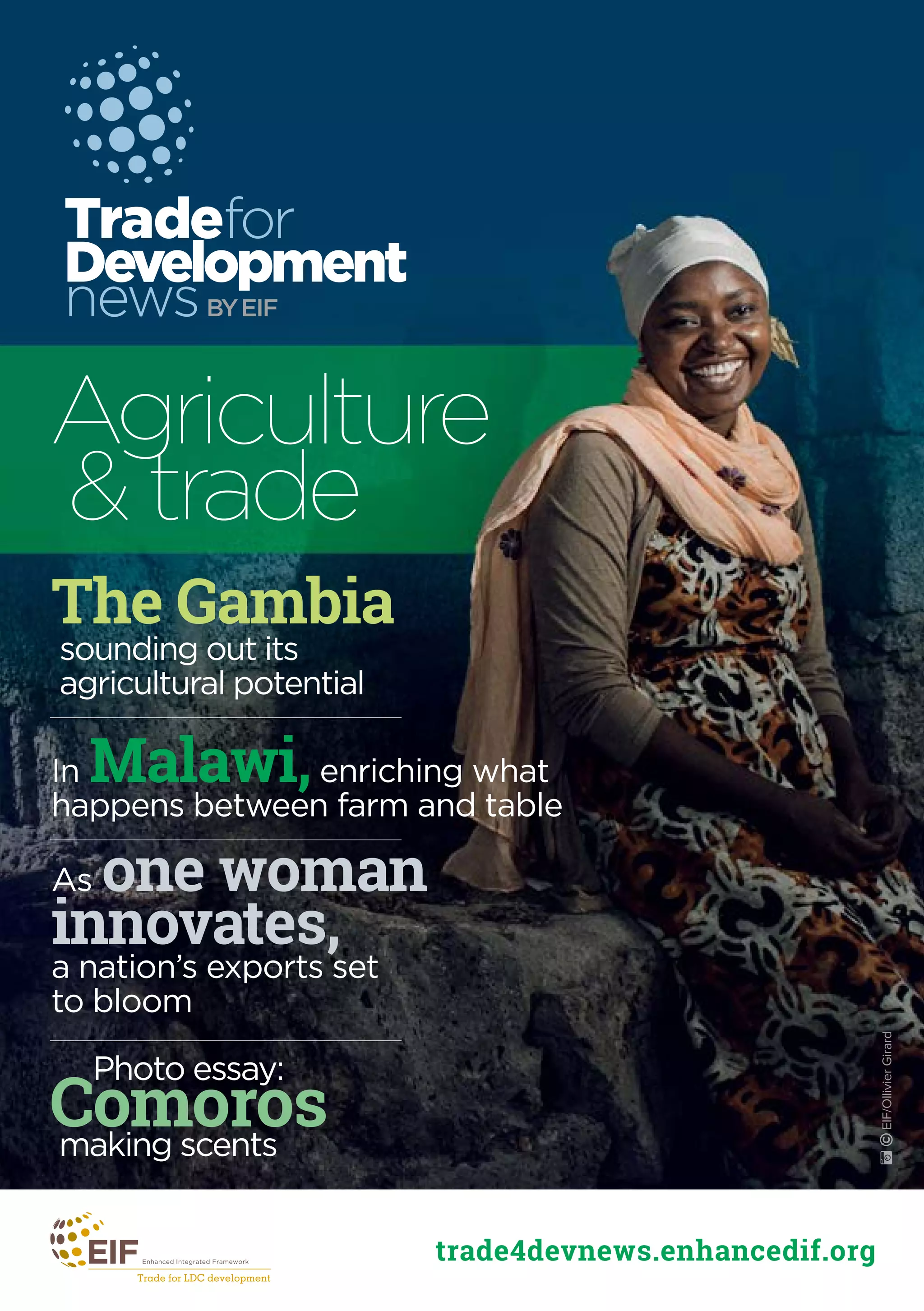
˚©EIF/OllivierGirard
Comorosmaking scents
Photo essay:
Voices for trade and development in Least Developed Countries (LDCs)
OP-ED
Q&A
NEWS
EVENT COVERAGE
IMPACT STORIES
OP-ED
PHOTO STORIES
Q&A
OP-ED
Q&A
NEWS
EVENT COVERAGE
IMPACT STORIES
OP-ED
PHOTO STORIES
Q&A
VIDEOS
trade4devnews.enhancedif.org
Tradefor
Development
newsBYEIF
Trade for Development News is a place to share EIF stories on the ground,
across 47 Least Developed Countries (LDCs), 4 recently graduated
countries and several themes and sectors. From op-eds to impact stories,
videos to photo essays, this platform is a window into the far-reaching
impact of the EIF.
Also designed with a strong focus on partner content in mind, Trade for
Development News is intended to be a knowledge hub on all things trade
for development and aid for trade. We invite you to share your stories with
us, so we can disseminate them further to our readers.
Violeta Gonzalez,
Partnerships, Outreach
& Fundraising Coordinator
Violeta.Gonzalez@wto.org
Deanna Ramsay,
Cécile de Gardelle,
Communications Officers
deannamichelle.ramsay@wto.org
cecile.degardelle@wto.org
Lynsey Grosfield,
Managing
Editor
Lynsey.Grosfield@wto.org
Trade4DevNews.enhancedif.org | Agriculture & Trade | 1
The Gambia sounding out its
agricultural potential . . . . . . . . . . . . . . . . . . . . . . . . . . . . . . . . 2
Ibrahima Sittina Farate:
As one woman innovates,
a nation’s exports set to bloom  . . . . . . . . . . . . . . . . . . . . . . . 6
Comoros making scents . . . . . . . . . . . . . . . . . . . . . . . . . . . . . 8
In Malawi, enriching what happens
between farm and table . . . . . . . . . . . . . . . . . . . . . . . . . . . . . 10
Partner story | In brief
Benin cassava flour makers seek geographical
indication . . . . . . . . . . . . . . . . . . . . . . . . . . . . . . . . . . . . . . . . . .  13
Trade4DevNews | Agriculture & Trade
2 | Trade4DevNews.enhancedif.org | Agriculture & Trade
The Gambia sounding out its
agricultural potential
Deanna Ramsay
With cashew prices surging
and armed with solid trade
policy, the country is looking
to boost its farmers and
processors.
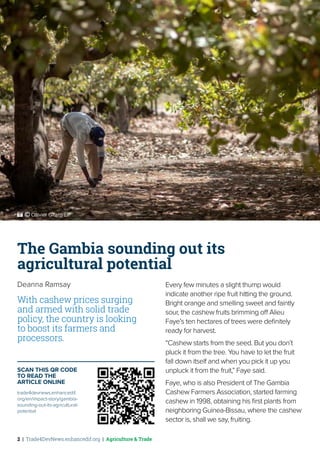
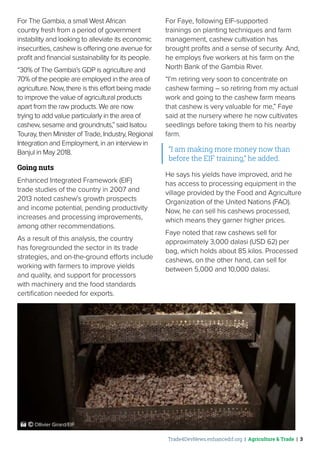
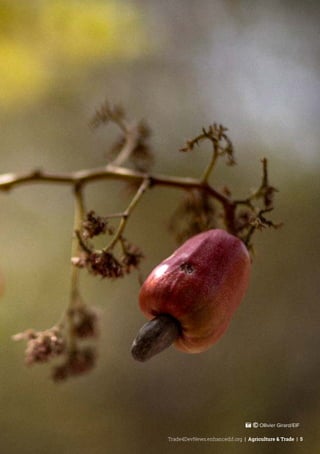
Every few minutes a slight thump would
indicate another ripe fruit hitting the ground.
Bright orange and smelling sweet and faintly
sour, the cashew fruits brimming off Alieu
Faye’s ten hectares of trees were definitely
ready for harvest.
“Cashew starts from the seed. But you don’t
pluck it from the tree. You have to let the fruit
fall down itself and when you pick it up you
unpluck it from the fruit,” Faye said.
Faye, who is also President of The Gambia
Cashew Farmers Association, started farming
cashew in 1998, obtaining his first plants from
neighboring Guinea-Bissau, where the cashew
sector is, shall we say, fruiting.
SCAN THIS QR CODE
TO READ THE
ARTICLE ONLINE
trade4devnews.enhancedif.
org/en/impact-story/gambia-
sounding-out-its-agricultural-
potential
 ˚© Ollivier Girard/EIF
Trade4DevNews.enhancedif.org | Agriculture & Trade | 3
For The Gambia, a small West African
country fresh from a period of government
instability and looking to alleviate its economic
insecurities, cashew is offering one avenue for
profit and financial sustainability for its people.
“30% of The Gambia’s GDP is agriculture and
70% of the people are employed in the area of
agriculture. Now, there is this effort being made
to improve the value of agricultural products
apart from the raw products. We are now
trying to add value particularly in the area of
cashew, sesame and groundnuts,” said Isatou
Touray, then Minister of Trade, Industry, Regional
Integration and Employment, in an interview in
Banjul in May 2018.
Going nuts
Enhanced Integrated Framework (EIF)
trade studies of the country in 2007 and
2013 noted cashew’s growth prospects
and income potential, pending productivity
increases and processing improvements,
among other recommendations.
As a result of this analysis, the country
has foregrounded the sector in its trade
strategies, and on-the-ground efforts include
working with farmers to improve yields
and quality, and support for processors
with machinery and the food standards
certification needed for exports.
For Faye, following EIF-supported
trainings on planting techniques and farm
management, cashew cultivation has
brought profits and a sense of security. And,
he employs five workers at his farm on the
North Bank of the Gambia River.
“I’m retiring very soon to concentrate on
cashew farming – so retiring from my actual
work and going to the cashew farm means
that cashew is very valuable for me,” Faye
said at the nursery where he now cultivates
seedlings before taking them to his nearby
farm.
“I am making more money now than
before the EIF training,” he added.
He says his yields have improved, and he
has access to processing equipment in the
village provided by the Food and Agriculture
Organization of the United Nations (FAO).
Now, he can sell his cashews processed,
which means they garner higher prices.
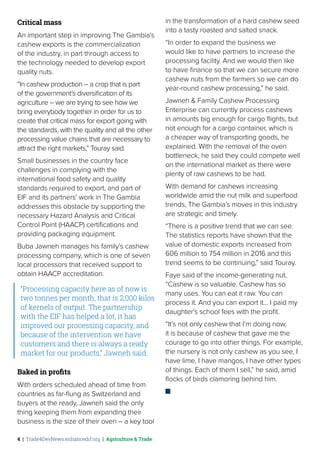
Faye noted that raw cashews sell for
approximately 3,000 dalasi (USD 62) per
bag, which holds about 85 kilos. Processed
cashews, on the other hand, can sell for
between 5,000 and 10,000 dalasi.
 ˚© Ollivier Girard/EIF
4 | Trade4DevNews.enhancedif.org | Agriculture & Trade
Critical mass
An important step in improving The Gambia’s
cashew exports is the commercialization
of the industry, in part through access to
the technology needed to develop export
quality nuts.
“In cashew production – a crop that is part
of the government’s diversification of its
agriculture – we are trying to see how we
bring everybody together in order for us to
create that critical mass for export going with
the standards, with the quality and all the other
processing value chains that are necessary to
attract the right markets,” Touray said.
Small businesses in the country face
challenges in complying with the
international food safety and quality
standards required to export, and part of
EIF and its partners’ work in The Gambia
addresses this obstacle by supporting the
necessary Hazard Analysis and Critical
Control Point (HAACP) certifications and
providing packaging equipment.
Buba Jawneh manages his family’s cashew
processing company, which is one of seven
local processors that received support to
obtain HAACP accreditation.
“Processing capacity here as of now is
two tonnes per month, that is 2,000 kilos
of kernels of output. The partnership
with the EIF has helped a lot, it has
improved our processing capacity, and
because of the intervention we have
customers and there is always a ready
market for our products,” Jawneh said.
Baked in profits
With orders scheduled ahead of time from
countries as far-flung as Switzerland and
buyers at the ready, Jawneh said the only
thing keeping them from expanding their
business is the size of their oven – a key tool
in the transformation of a hard cashew seed
into a tasty roasted and salted snack.
“In order to expand the business we
would like to have partners to increase the
processing facility. And we would then like
to have finance so that we can secure more
cashew nuts from the farmers so we can do
year-round cashew processing,” he said.
Jawneh & Family Cashew Processing
Enterprise can currently process cashews
in amounts big enough for cargo flights, but
not enough for a cargo container, which is
a cheaper way of transporting goods, he
explained. With the removal of the oven
bottleneck, he said they could compete well
on the international market as there were
plenty of raw cashews to be had.
With demand for cashews increasing
worldwide amid the nut milk and superfood
trends, The Gambia’s moves in this industry
are strategic and timely.
“There is a positive trend that we can see.
The statistics reports have shown that the
value of domestic exports increased from
606 million to 754 million in 2016 and this
trend seems to be continuing,” said Touray.
Faye said of the income-generating nut,
“Cashew is so valuable. Cashew has so
many uses. You can eat it raw. You can
process it. And you can export it… I paid my
daughter’s school fees with the profit.
“It’s not only cashew that I’m doing now,
it is because of cashew that gave me the
courage to go into other things. For example,
the nursery is not only cashew as you see, I
have lime, I have mangos, I have other types
of things. Each of them I sell,” he said, amid
flocks of birds clamoring behind him.
Trade4DevNews.enhancedif.org | Agriculture & Trade | 5
 ˚© Ollivier Girard/EIF
6 | Trade4DevNews.enhancedif.org | Agriculture & Trade
Ibrahima Sittina Farate:
As one woman innovates,
a nation’s exports set to bloom
Deanna Ramsay
In Comoros, a doyenne has plans for her country’s unique yields.
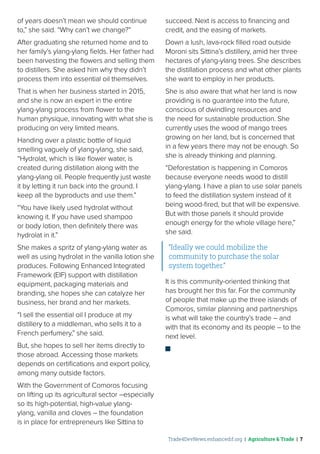
Bottles of varying sizes were filled with
scents, serums, potions and lotions – all
made with Comoros-grown items that are
definitely also made in Comoros.
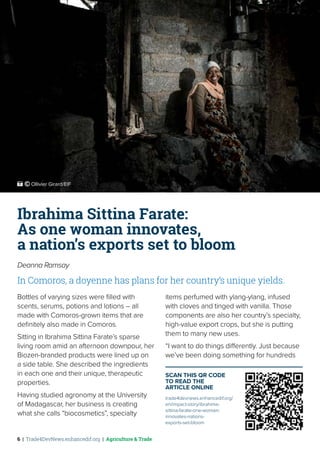
Sitting in Ibrahima Sittina Farate’s sparse
living room amid an afternoon downpour, her
Biozen-branded products were lined up on
a side table. She described the ingredients
in each one and their unique, therapeutic
properties.
Having studied agronomy at the University
of Madagascar, her business is creating
what she calls “biocosmetics”, specialty
items perfumed with ylang-ylang, infused
with cloves and tinged with vanilla. Those
components are also her country’s specialty,
high-value export crops, but she is putting
them to many new uses.
“I want to do things differently. Just because
we’ve been doing something for hundreds
SCAN THIS QR CODE
TO READ THE
ARTICLE ONLINE
trade4devnews.enhancedif.org/
en/impact-story/ibrahima-
sittina-farate-one-woman-
innovates-nations-
exports-set-bloom
 ˚© Ollivier Girard/EIF
Trade4DevNews.enhancedif.org | Agriculture & Trade | 7
of years doesn’t mean we should continue
to,” she said. “Why can’t we change?”
After graduating she returned home and to
her family’s ylang-ylang fields. Her father had
been harvesting the flowers and selling them
to distillers. She asked him why they didn’t
process them into essential oil themselves.
That is when her business started in 2015,
and she is now an expert in the entire
ylang-ylang process from flower to the
human physique, innovating with what she is
producing on very limited means.
Handing over a plastic bottle of liquid
smelling vaguely of ylang-ylang, she said,
“Hydrolat, which is like flower water, is
created during distillation along with the
ylang-ylang oil. People frequently just waste
it by letting it run back into the ground. I
keep all the byproducts and use them.”
“You have likely used hydrolat without
knowing it. If you have used shampoo
or body lotion, then definitely there was
hydrolat in it.”
She makes a spritz of ylang-ylang water as
well as using hydrolat in the vanilla lotion she
produces. Following Enhanced Integrated
Framework (EIF) support with distillation
equipment, packaging materials and
branding, she hopes she can catalyze her
business, her brand and her markets.
“I sell the essential oil I produce at my
distillery to a middleman, who sells it to a
French perfumery,” she said.
But, she hopes to sell her items directly to
those abroad. Accessing those markets
depends on certifications and export policy,
among many outside factors.
With the Government of Comoros focusing
on lifting up its agricultural sector –especially
so its high-potential, high-value ylang-
ylang, vanilla and cloves – the foundation
is in place for entrepreneurs like Sittina to
succeed. Next is access to financing and
credit, and the easing of markets.
Down a lush, lava-rock filled road outside
Moroni sits Sittina’s distillery, amid her three
hectares of ylang-ylang trees. She describes
the distillation process and what other plants
she want to employ in her products.
She is also aware that what her land is now
providing is no guarantee into the future,
conscious of dwindling resources and
the need for sustainable production. She
currently uses the wood of mango trees
growing on her land, but is concerned that
in a few years there may not be enough. So
she is already thinking and planning.
“Deforestation is happening in Comoros
because everyone needs wood to distill
ylang-ylang. I have a plan to use solar panels
to feed the distillation system instead of it
being wood-fired, but that will be expensive.
But with those panels it should provide
enough energy for the whole village here,”
she said.
“Ideally we could mobilize the
community to purchase the solar
system together.”
It is this community-oriented thinking that
has brought her this far. For the community
of people that make up the three islands of
Comoros, similar planning and partnerships
is what will take the country’s trade – and
with that its economy and its people – to the
next level.
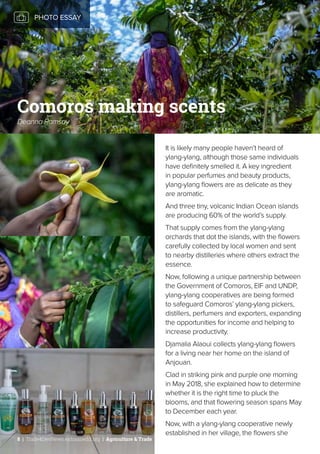
It is likely many people haven’t heard of
ylang-ylang, although those same individuals
have definitely smelled it. A key ingredient
in popular perfumes and beauty products,
ylang-ylang flowers are as delicate as they
are aromatic.
And three tiny, volcanic Indian Ocean islands
are producing 60% of the world’s supply.
That supply comes from the ylang-ylang
orchards that dot the islands, with the flowers
carefully collected by local women and sent
to nearby distilleries where others extract the
essence.
Now, following a unique partnership between
the Government of Comoros, EIF and UNDP,
ylang-ylang cooperatives are being formed
to safeguard Comoros’ ylang-ylang pickers,
distillers, perfumers and exporters, expanding
the opportunities for income and helping to
increase productivity.
Djamalia Alaoui collects ylang-ylang flowers
for a living near her home on the island of
Anjouan.
Clad in striking pink and purple one morning
in May 2018, she explained how to determine
whether it is the right time to pluck the
blooms, and that flowering season spans May
to December each year.
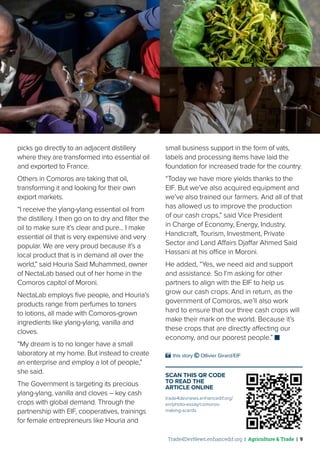
Now, with a ylang-ylang cooperative newly
established in her village, the flowers she
PHOTO ESSAY
Comoros making scents
Deanna Ramsay
8 | Trade4DevNews.enhancedif.org | Agriculture & Trade
Trade4DevNews.enhancedif.org | Agriculture & Trade | 9
picks go directly to an adjacent distillery
where they are transformed into essential oil
and exported to France.
Others in Comoros are taking that oil,
transforming it and looking for their own
export markets.
“I receive the ylang-ylang essential oil from
the distillery. I then go on to dry and filter the
oil to make sure it’s clear and pure... I make
essential oil that is very expensive and very
popular. We are very proud because it’s a
local product that is in demand all over the
world,” said Houria Said Muhammed, owner
of NectaLab based out of her home in the
Comoros capitol of Moroni.
NectaLab employs five people, and Houria’s
products range from perfumes to toners
to lotions, all made with Comoros-grown
ingredients like ylang-ylang, vanilla and
cloves.
“My dream is to no longer have a small
laboratory at my home. But instead to create
an enterprise and employ a lot of people,”
she said.
The Government is targeting its precious
ylang-ylang, vanilla and cloves – key cash
crops with global demand. Through the
partnership with EIF, cooperatives, trainings
for female entrepreneurs like Houria and
small business support in the form of vats,
labels and processing items have laid the
foundation for increased trade for the country.
“Today we have more yields thanks to the
EIF. But we’ve also acquired equipment and
we’ve also trained our farmers. And all of that
has allowed us to improve the production
of our cash crops,” said Vice President
in Charge of Economy, Energy, Industry,
Handicraft, Tourism, Investment, Private
Sector and Land Affairs Djaffar Ahmed Said
Hassani at his office in Moroni.
He added, “Yes, we need aid and support
and assistance. So I’m asking for other
partners to align with the EIF to help us
grow our cash crops. And in return, as the
government of Comoros, we’ll also work
hard to ensure that our three cash crops will
make their mark on the world. Because it’s
these crops that are directly affecting our
economy, and our poorest people.”
SCAN THIS QR CODE
TO READ THE
ARTICLE ONLINE
trade4devnews.enhancedif.org/
en/photo-essay/comoros-
making-scents
 this story © Ollivier Girard/EIF
10 | Trade4DevNews.enhancedif.org | Agriculture & Trade
In Malawi, enriching what happens
between farm and table
Deanna Ramsay
The country is working hard to
get its harvests to consumers
– in the country, region and
beyond
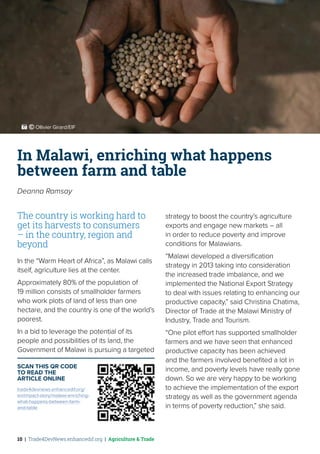
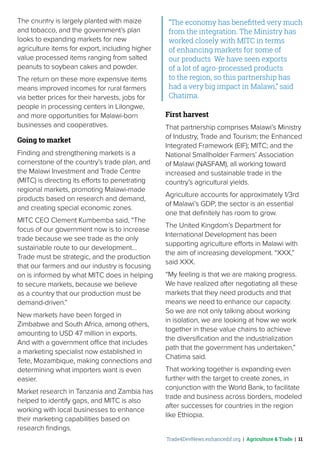
In the “Warm Heart of Africa”, as Malawi calls
itself, agriculture lies at the center.
Approximately 80% of the population of
19 million consists of smallholder farmers
who work plots of land of less than one
hectare, and the country is one of the world’s
poorest.
In a bid to leverage the potential of its
people and possibilities of its land, the
Government of Malawi is pursuing a targeted
strategy to boost the country’s agriculture
exports and engage new markets – all
in order to reduce poverty and improve
conditions for Malawians.
“Malawi developed a diversification
strategy in 2013 taking into consideration
the increased trade imbalance, and we
implemented the National Export Strategy
to deal with issues relating to enhancing our
productive capacity,” said Christina Chatima,
Director of Trade at the Malawi Ministry of
Industry, Trade and Tourism.
“One pilot effort has supported smallholder
farmers and we have seen that enhanced
productive capacity has been achieved
and the farmers involved benefited a lot in
income, and poverty levels have really gone
down. So we are very happy to be working
to achieve the implementation of the export
strategy as well as the government agenda
in terms of poverty reduction,” she said.
SCAN THIS QR CODE
TO READ THE
ARTICLE ONLINE
trade4devnews.enhancedif.org/
en/impact-story/malawi-enriching-
what-happens-between-farm-
and-table
 ˚© Ollivier Girard/EIF
Trade4DevNews.enhancedif.org | Agriculture & Trade | 11
The country is largely planted with maize
and tobacco, and the government’s plan
looks to expanding markets for new
agriculture items for export, including higher
value processed items ranging from salted
peanuts to soybean cakes and powder.
The return on these more expensive items
means improved incomes for rural farmers
via better prices for their harvests, jobs for
people in processing centers in Lilongwe,
and more opportunities for Malawi-born
businesses and cooperatives.
Going to market
Finding and strengthening markets is a
cornerstone of the country’s trade plan, and
the Malawi Investment and Trade Centre
(MITC) is directing its efforts to penetrating
regional markets, promoting Malawi-made
products based on research and demand,
and creating special economic zones.
MITC CEO Clement Kumbemba said, “The
focus of our government now is to increase
trade because we see trade as the only
sustainable route to our development…
Trade must be strategic, and the production
that our farmers and our industry is focusing
on is informed by what MITC does in helping
to secure markets, because we believe
as a country that our production must be
demand-driven.”
New markets have been forged in
Zimbabwe and South Africa, among others,
amounting to USD 47 million in exports.
And with a government office that includes
a marketing specialist now established in
Tete, Mozambique, making connections and
determining what importers want is even
easier.
Market research in Tanzania and Zambia has
helped to identify gaps, and MITC is also
working with local businesses to enhance
their marketing capabilities based on
research findings.
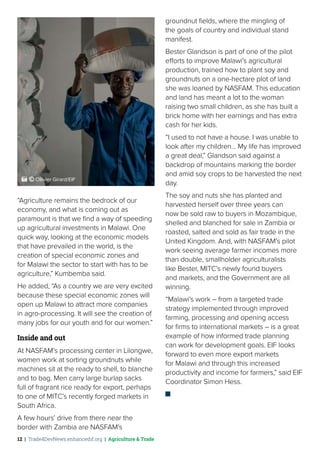
“The economy has benefitted very much
from the integration. The Ministry has
worked closely with MITC in terms
of enhancing markets for some of
our products… We have seen exports
of a lot of agro-processed products
to the region, so this partnership has
had a very big impact in Malawi,” said
Chatima.
First harvest
That partnership comprises Malawi’s Ministry
of Industry, Trade and Tourism; the Enhanced
Integrated Framework (EIF); MITC; and the
National Smallholder Farmers’ Association
of Malawi (NASFAM), all working toward
increased and sustainable trade in the
country’s agricultural yields.
Agriculture accounts for approximately 1/3rd
of Malawi’s GDP; the sector is an essential
one that definitely has room to grow.
The United Kingdom’s Department for
International Development has been
supporting agriculture efforts in Malawi with
the aim of increasing development. “XXX,”
said XXX.
“My feeling is that we are making progress.
We have realized after negotiating all these
markets that they need products and that
means we need to enhance our capacity.
So we are not only talking about working
in isolation, we are looking at how we work
together in these value chains to achieve
the diversification and the industrialization
path that the government has undertaken,”
Chatima said.
That working together is expanding even
further with the target to create zones, in
conjunction with the World Bank, to facilitate
trade and business across borders, modeled
after successes for countries in the region
like Ethiopia.
 ˚© ITC / FLICKR
12 | Trade4DevNews.enhancedif.org | Agriculture & Trade
“Agriculture remains the bedrock of our
economy, and what is coming out as
paramount is that we find a way of speeding
up agricultural investments in Malawi. One
quick way, looking at the economic models
that have prevailed in the world, is the
creation of special economic zones and
for Malawi the sector to start with has to be
agriculture,” Kumbemba said.
He added, “As a country we are very excited
because these special economic zones will
open up Malawi to attract more companies
in agro-processing. It will see the creation of
many jobs for our youth and for our women.”
Inside and out
At NASFAM’s processing center in Lilongwe,
women work at sorting groundnuts while
machines sit at the ready to shell, to blanche
and to bag. Men carry large burlap sacks
full of fragrant rice ready for export, perhaps
to one of MITC’s recently forged markets in
South Africa.
A few hours’ drive from there near the
border with Zambia are NASFAM’s
groundnut fields, where the mingling of
the goals of country and individual stand
manifest.
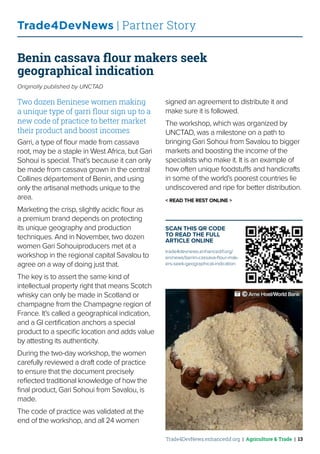
Bester Glandson is part of one of the pilot
efforts to improve Malawi’s agricultural
production, trained how to plant soy and
groundnuts on a one-hectare plot of land
she was loaned by NASFAM. This education
and land has meant a lot to the woman
raising two small children, as she has built a
brick home with her earnings and has extra
cash for her kids.
“I used to not have a house. I was unable to
look after my children… My life has improved
a great deal,” Glandson said against a
backdrop of mountains marking the border
and amid soy crops to be harvested the next
day.
The soy and nuts she has planted and
harvested herself over three years can
now be sold raw to buyers in Mozambique,
shelled and blanched for sale in Zambia or
roasted, salted and sold as fair trade in the
United Kingdom. And, with NASFAM’s pilot
work seeing average farmer incomes more
than double, smallholder agriculturalists
like Bester, MITC’s newly found buyers
and markets, and the Government are all
winning.
“Malawi’s work – from a targeted trade
strategy implemented through improved
farming, processing and opening access
for firms to international markets – is a great
example of how informed trade planning
can work for development goals. EIF looks
forward to even more export markets
for Malawi and through this increased
productivity and income for farmers,” said EIF
Coordinator Simon Hess.
 ˚© Ollivier Girard/EIF
Trade4DevNews.enhancedif.org | Agriculture & Trade | 13
Trade4DevNews | Partner Story
Benin cassava flour makers seek
geographical indication
Originally published by UNCTAD
Two dozen Beninese women making
a unique type of garri flour sign up to a
new code of practice to better market
their product and boost incomes
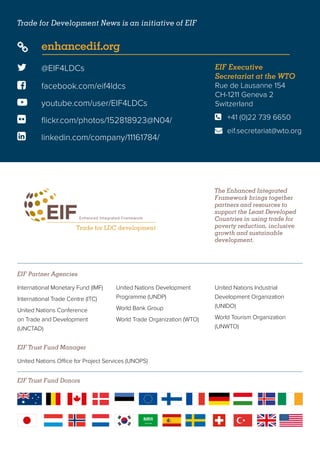
Garri, a type of flour made from cassava
root, may be a staple in West Africa, but Gari
Sohoui is special. That’s because it can only
be made from cassava grown in the central
Collines département of Benin, and using
only the artisanal methods unique to the
area.
Marketing the crisp, slightly acidic flour as
a premium brand depends on protecting
its unique geography and production
techniques. And in November, two dozen
women Gari Sohouiproducers met at a
workshop in the regional capital Savalou to
agree on a way of doing just that.
The key is to assert the same kind of
intellectual property right that means Scotch
whisky can only be made in Scotland or
champagne from the Champagne region of
France. It’s called a geographical indication,
and a GI certification anchors a special
product to a specific location and adds value
by attesting its authenticity.
During the two-day workshop, the women
carefully reviewed a draft code of practice
to ensure that the document precisely
reflected traditional knowledge of how the
final product, Gari Sohoui from Savalou, is
made.
The code of practice was validated at the
end of the workshop, and all 24 women
signed an agreement to distribute it and
make sure it is followed.
The workshop, which was organized by
UNCTAD, was a milestone on a path to
bringing Gari Sohoui from Savalou to bigger
markets and boosting the income of the
specialists who make it. It is an example of
how often unique foodstuffs and handicrafts
in some of the world’s poorest countries lie
undiscovered and ripe for better distribution.
< READ THE REST ONLINE >
SCAN THIS QR CODE
TO READ THE FULL
ARTICLE ONLINE
trade4devnews.enhancedif.org/
en/news/benin-cassava-flour-mak-
ers-seek-geographical-indication
 ˚© Arne Hoel/World Bank
The Enhanced Integrated
Framework brings together
partners and resources to
support the Least Developed
Countries in using trade for
poverty reduction, inclusive
growth and sustainable
development.
Trade for Development News is an initiative of EIF
EIF Trust Fund Donors
 @EIF4LDCs
 facebook.com/eif4ldcs
 enhancedif.org
 youtube.com/user/EIF4LDCs
 flickr.com/photos/152818923@N04/
 linkedin.com/company/11161784/
EIF Executive
Secretariat at the WTO
Rue de Lausanne 154
CH-1211 Geneva 2
Switzerland
	 +41 (0)22 739 6650
	eif.secretariat@wto.org


EIF Partner Agencies
EIF Trust Fund Manager
International Monetary Fund (IMF)
International Trade Centre (ITC)
United Nations Conference
on Trade and Development
(UNCTAD)
United Nations Development
Programme (UNDP)
World Bank Group
World Trade Organization (WTO)
United Nations Industrial
Development Organization
(UNIDO)
World Tourism Organization
(UNWTO)
United Nations Office for Project Services (UNOPS)

Agriculture & trade

  • 1.
    Tradefor Development newsBYEIF trade4devnews.enhancedif.org The Gambia sounding outits agricultural potential As one woman innovates, a nation’s exports set to bloom In Malawi,enriching what happens between farm and table Agriculture & trade ˚©EIF/OllivierGirard Comorosmaking scents Photo essay:
  • 2.
    Voices for tradeand development in Least Developed Countries (LDCs) OP-ED Q&A NEWS EVENT COVERAGE IMPACT STORIES OP-ED PHOTO STORIES Q&A OP-ED Q&A NEWS EVENT COVERAGE IMPACT STORIES OP-ED PHOTO STORIES Q&A VIDEOS trade4devnews.enhancedif.org Tradefor Development newsBYEIF Trade for Development News is a place to share EIF stories on the ground, across 47 Least Developed Countries (LDCs), 4 recently graduated countries and several themes and sectors. From op-eds to impact stories, videos to photo essays, this platform is a window into the far-reaching impact of the EIF. Also designed with a strong focus on partner content in mind, Trade for Development News is intended to be a knowledge hub on all things trade for development and aid for trade. We invite you to share your stories with us, so we can disseminate them further to our readers. Violeta Gonzalez, Partnerships, Outreach & Fundraising Coordinator Violeta.Gonzalez@wto.org Deanna Ramsay, Cécile de Gardelle, Communications Officers deannamichelle.ramsay@wto.org cecile.degardelle@wto.org Lynsey Grosfield, Managing Editor Lynsey.Grosfield@wto.org
  • 3.
    Trade4DevNews.enhancedif.org | Agriculture& Trade | 1 The Gambia sounding out its agricultural potential . . . . . . . . . . . . . . . . . . . . . . . . . . . . . . . . 2 Ibrahima Sittina Farate: As one woman innovates, a nation’s exports set to bloom . . . . . . . . . . . . . . . . . . . . . . . 6 Comoros making scents . . . . . . . . . . . . . . . . . . . . . . . . . . . . . 8 In Malawi, enriching what happens between farm and table . . . . . . . . . . . . . . . . . . . . . . . . . . . . . 10 Partner story | In brief Benin cassava flour makers seek geographical indication . . . . . . . . . . . . . . . . . . . . . . . . . . . . . . . . . . . . . . . . . . 13 Trade4DevNews | Agriculture & Trade
  • 4.
    2 | Trade4DevNews.enhancedif.org| Agriculture & Trade The Gambia sounding out its agricultural potential Deanna Ramsay With cashew prices surging and armed with solid trade policy, the country is looking to boost its farmers and processors. Every few minutes a slight thump would indicate another ripe fruit hitting the ground. Bright orange and smelling sweet and faintly sour, the cashew fruits brimming off Alieu Faye’s ten hectares of trees were definitely ready for harvest. “Cashew starts from the seed. But you don’t pluck it from the tree. You have to let the fruit fall down itself and when you pick it up you unpluck it from the fruit,” Faye said. Faye, who is also President of The Gambia Cashew Farmers Association, started farming cashew in 1998, obtaining his first plants from neighboring Guinea-Bissau, where the cashew sector is, shall we say, fruiting. SCAN THIS QR CODE TO READ THE ARTICLE ONLINE trade4devnews.enhancedif. org/en/impact-story/gambia- sounding-out-its-agricultural- potential  ˚© Ollivier Girard/EIF
  • 5.
    Trade4DevNews.enhancedif.org | Agriculture& Trade | 3 For The Gambia, a small West African country fresh from a period of government instability and looking to alleviate its economic insecurities, cashew is offering one avenue for profit and financial sustainability for its people. “30% of The Gambia’s GDP is agriculture and 70% of the people are employed in the area of agriculture. Now, there is this effort being made to improve the value of agricultural products apart from the raw products. We are now trying to add value particularly in the area of cashew, sesame and groundnuts,” said Isatou Touray, then Minister of Trade, Industry, Regional Integration and Employment, in an interview in Banjul in May 2018. Going nuts Enhanced Integrated Framework (EIF) trade studies of the country in 2007 and 2013 noted cashew’s growth prospects and income potential, pending productivity increases and processing improvements, among other recommendations. As a result of this analysis, the country has foregrounded the sector in its trade strategies, and on-the-ground efforts include working with farmers to improve yields and quality, and support for processors with machinery and the food standards certification needed for exports. For Faye, following EIF-supported trainings on planting techniques and farm management, cashew cultivation has brought profits and a sense of security. And, he employs five workers at his farm on the North Bank of the Gambia River. “I’m retiring very soon to concentrate on cashew farming – so retiring from my actual work and going to the cashew farm means that cashew is very valuable for me,” Faye said at the nursery where he now cultivates seedlings before taking them to his nearby farm. “I am making more money now than before the EIF training,” he added. He says his yields have improved, and he has access to processing equipment in the village provided by the Food and Agriculture Organization of the United Nations (FAO). Now, he can sell his cashews processed, which means they garner higher prices. Faye noted that raw cashews sell for approximately 3,000 dalasi (USD 62) per bag, which holds about 85 kilos. Processed cashews, on the other hand, can sell for between 5,000 and 10,000 dalasi.  ˚© Ollivier Girard/EIF
  • 6.
    4 | Trade4DevNews.enhancedif.org| Agriculture & Trade Critical mass An important step in improving The Gambia’s cashew exports is the commercialization of the industry, in part through access to the technology needed to develop export quality nuts. “In cashew production – a crop that is part of the government’s diversification of its agriculture – we are trying to see how we bring everybody together in order for us to create that critical mass for export going with the standards, with the quality and all the other processing value chains that are necessary to attract the right markets,” Touray said. Small businesses in the country face challenges in complying with the international food safety and quality standards required to export, and part of EIF and its partners’ work in The Gambia addresses this obstacle by supporting the necessary Hazard Analysis and Critical Control Point (HAACP) certifications and providing packaging equipment. Buba Jawneh manages his family’s cashew processing company, which is one of seven local processors that received support to obtain HAACP accreditation. “Processing capacity here as of now is two tonnes per month, that is 2,000 kilos of kernels of output. The partnership with the EIF has helped a lot, it has improved our processing capacity, and because of the intervention we have customers and there is always a ready market for our products,” Jawneh said. Baked in profits With orders scheduled ahead of time from countries as far-flung as Switzerland and buyers at the ready, Jawneh said the only thing keeping them from expanding their business is the size of their oven – a key tool in the transformation of a hard cashew seed into a tasty roasted and salted snack. “In order to expand the business we would like to have partners to increase the processing facility. And we would then like to have finance so that we can secure more cashew nuts from the farmers so we can do year-round cashew processing,” he said. Jawneh & Family Cashew Processing Enterprise can currently process cashews in amounts big enough for cargo flights, but not enough for a cargo container, which is a cheaper way of transporting goods, he explained. With the removal of the oven bottleneck, he said they could compete well on the international market as there were plenty of raw cashews to be had. With demand for cashews increasing worldwide amid the nut milk and superfood trends, The Gambia’s moves in this industry are strategic and timely. “There is a positive trend that we can see. The statistics reports have shown that the value of domestic exports increased from 606 million to 754 million in 2016 and this trend seems to be continuing,” said Touray. Faye said of the income-generating nut, “Cashew is so valuable. Cashew has so many uses. You can eat it raw. You can process it. And you can export it… I paid my daughter’s school fees with the profit. “It’s not only cashew that I’m doing now, it is because of cashew that gave me the courage to go into other things. For example, the nursery is not only cashew as you see, I have lime, I have mangos, I have other types of things. Each of them I sell,” he said, amid flocks of birds clamoring behind him.
  • 7.
    Trade4DevNews.enhancedif.org | Agriculture& Trade | 5  ˚© Ollivier Girard/EIF
  • 8.
    6 | Trade4DevNews.enhancedif.org| Agriculture & Trade Ibrahima Sittina Farate: As one woman innovates, a nation’s exports set to bloom Deanna Ramsay In Comoros, a doyenne has plans for her country’s unique yields. Bottles of varying sizes were filled with scents, serums, potions and lotions – all made with Comoros-grown items that are definitely also made in Comoros. Sitting in Ibrahima Sittina Farate’s sparse living room amid an afternoon downpour, her Biozen-branded products were lined up on a side table. She described the ingredients in each one and their unique, therapeutic properties. Having studied agronomy at the University of Madagascar, her business is creating what she calls “biocosmetics”, specialty items perfumed with ylang-ylang, infused with cloves and tinged with vanilla. Those components are also her country’s specialty, high-value export crops, but she is putting them to many new uses. “I want to do things differently. Just because we’ve been doing something for hundreds SCAN THIS QR CODE TO READ THE ARTICLE ONLINE trade4devnews.enhancedif.org/ en/impact-story/ibrahima- sittina-farate-one-woman- innovates-nations- exports-set-bloom  ˚© Ollivier Girard/EIF
  • 9.
    Trade4DevNews.enhancedif.org | Agriculture& Trade | 7 of years doesn’t mean we should continue to,” she said. “Why can’t we change?” After graduating she returned home and to her family’s ylang-ylang fields. Her father had been harvesting the flowers and selling them to distillers. She asked him why they didn’t process them into essential oil themselves. That is when her business started in 2015, and she is now an expert in the entire ylang-ylang process from flower to the human physique, innovating with what she is producing on very limited means. Handing over a plastic bottle of liquid smelling vaguely of ylang-ylang, she said, “Hydrolat, which is like flower water, is created during distillation along with the ylang-ylang oil. People frequently just waste it by letting it run back into the ground. I keep all the byproducts and use them.” “You have likely used hydrolat without knowing it. If you have used shampoo or body lotion, then definitely there was hydrolat in it.” She makes a spritz of ylang-ylang water as well as using hydrolat in the vanilla lotion she produces. Following Enhanced Integrated Framework (EIF) support with distillation equipment, packaging materials and branding, she hopes she can catalyze her business, her brand and her markets. “I sell the essential oil I produce at my distillery to a middleman, who sells it to a French perfumery,” she said. But, she hopes to sell her items directly to those abroad. Accessing those markets depends on certifications and export policy, among many outside factors. With the Government of Comoros focusing on lifting up its agricultural sector –especially so its high-potential, high-value ylang- ylang, vanilla and cloves – the foundation is in place for entrepreneurs like Sittina to succeed. Next is access to financing and credit, and the easing of markets. Down a lush, lava-rock filled road outside Moroni sits Sittina’s distillery, amid her three hectares of ylang-ylang trees. She describes the distillation process and what other plants she want to employ in her products. She is also aware that what her land is now providing is no guarantee into the future, conscious of dwindling resources and the need for sustainable production. She currently uses the wood of mango trees growing on her land, but is concerned that in a few years there may not be enough. So she is already thinking and planning. “Deforestation is happening in Comoros because everyone needs wood to distill ylang-ylang. I have a plan to use solar panels to feed the distillation system instead of it being wood-fired, but that will be expensive. But with those panels it should provide enough energy for the whole village here,” she said. “Ideally we could mobilize the community to purchase the solar system together.” It is this community-oriented thinking that has brought her this far. For the community of people that make up the three islands of Comoros, similar planning and partnerships is what will take the country’s trade – and with that its economy and its people – to the next level.
  • 10.
    It is likelymany people haven’t heard of ylang-ylang, although those same individuals have definitely smelled it. A key ingredient in popular perfumes and beauty products, ylang-ylang flowers are as delicate as they are aromatic. And three tiny, volcanic Indian Ocean islands are producing 60% of the world’s supply. That supply comes from the ylang-ylang orchards that dot the islands, with the flowers carefully collected by local women and sent to nearby distilleries where others extract the essence. Now, following a unique partnership between the Government of Comoros, EIF and UNDP, ylang-ylang cooperatives are being formed to safeguard Comoros’ ylang-ylang pickers, distillers, perfumers and exporters, expanding the opportunities for income and helping to increase productivity. Djamalia Alaoui collects ylang-ylang flowers for a living near her home on the island of Anjouan. Clad in striking pink and purple one morning in May 2018, she explained how to determine whether it is the right time to pluck the blooms, and that flowering season spans May to December each year. Now, with a ylang-ylang cooperative newly established in her village, the flowers she PHOTO ESSAY Comoros making scents Deanna Ramsay 8 | Trade4DevNews.enhancedif.org | Agriculture & Trade
  • 11.
    Trade4DevNews.enhancedif.org | Agriculture& Trade | 9 picks go directly to an adjacent distillery where they are transformed into essential oil and exported to France. Others in Comoros are taking that oil, transforming it and looking for their own export markets. “I receive the ylang-ylang essential oil from the distillery. I then go on to dry and filter the oil to make sure it’s clear and pure... I make essential oil that is very expensive and very popular. We are very proud because it’s a local product that is in demand all over the world,” said Houria Said Muhammed, owner of NectaLab based out of her home in the Comoros capitol of Moroni. NectaLab employs five people, and Houria’s products range from perfumes to toners to lotions, all made with Comoros-grown ingredients like ylang-ylang, vanilla and cloves. “My dream is to no longer have a small laboratory at my home. But instead to create an enterprise and employ a lot of people,” she said. The Government is targeting its precious ylang-ylang, vanilla and cloves – key cash crops with global demand. Through the partnership with EIF, cooperatives, trainings for female entrepreneurs like Houria and small business support in the form of vats, labels and processing items have laid the foundation for increased trade for the country. “Today we have more yields thanks to the EIF. But we’ve also acquired equipment and we’ve also trained our farmers. And all of that has allowed us to improve the production of our cash crops,” said Vice President in Charge of Economy, Energy, Industry, Handicraft, Tourism, Investment, Private Sector and Land Affairs Djaffar Ahmed Said Hassani at his office in Moroni. He added, “Yes, we need aid and support and assistance. So I’m asking for other partners to align with the EIF to help us grow our cash crops. And in return, as the government of Comoros, we’ll also work hard to ensure that our three cash crops will make their mark on the world. Because it’s these crops that are directly affecting our economy, and our poorest people.” SCAN THIS QR CODE TO READ THE ARTICLE ONLINE trade4devnews.enhancedif.org/ en/photo-essay/comoros- making-scents  this story © Ollivier Girard/EIF
  • 12.
    10 | Trade4DevNews.enhancedif.org| Agriculture & Trade In Malawi, enriching what happens between farm and table Deanna Ramsay The country is working hard to get its harvests to consumers – in the country, region and beyond In the “Warm Heart of Africa”, as Malawi calls itself, agriculture lies at the center. Approximately 80% of the population of 19 million consists of smallholder farmers who work plots of land of less than one hectare, and the country is one of the world’s poorest. In a bid to leverage the potential of its people and possibilities of its land, the Government of Malawi is pursuing a targeted strategy to boost the country’s agriculture exports and engage new markets – all in order to reduce poverty and improve conditions for Malawians. “Malawi developed a diversification strategy in 2013 taking into consideration the increased trade imbalance, and we implemented the National Export Strategy to deal with issues relating to enhancing our productive capacity,” said Christina Chatima, Director of Trade at the Malawi Ministry of Industry, Trade and Tourism. “One pilot effort has supported smallholder farmers and we have seen that enhanced productive capacity has been achieved and the farmers involved benefited a lot in income, and poverty levels have really gone down. So we are very happy to be working to achieve the implementation of the export strategy as well as the government agenda in terms of poverty reduction,” she said. SCAN THIS QR CODE TO READ THE ARTICLE ONLINE trade4devnews.enhancedif.org/ en/impact-story/malawi-enriching- what-happens-between-farm- and-table  ˚© Ollivier Girard/EIF
  • 13.
    Trade4DevNews.enhancedif.org | Agriculture& Trade | 11 The country is largely planted with maize and tobacco, and the government’s plan looks to expanding markets for new agriculture items for export, including higher value processed items ranging from salted peanuts to soybean cakes and powder. The return on these more expensive items means improved incomes for rural farmers via better prices for their harvests, jobs for people in processing centers in Lilongwe, and more opportunities for Malawi-born businesses and cooperatives. Going to market Finding and strengthening markets is a cornerstone of the country’s trade plan, and the Malawi Investment and Trade Centre (MITC) is directing its efforts to penetrating regional markets, promoting Malawi-made products based on research and demand, and creating special economic zones. MITC CEO Clement Kumbemba said, “The focus of our government now is to increase trade because we see trade as the only sustainable route to our development… Trade must be strategic, and the production that our farmers and our industry is focusing on is informed by what MITC does in helping to secure markets, because we believe as a country that our production must be demand-driven.” New markets have been forged in Zimbabwe and South Africa, among others, amounting to USD 47 million in exports. And with a government office that includes a marketing specialist now established in Tete, Mozambique, making connections and determining what importers want is even easier. Market research in Tanzania and Zambia has helped to identify gaps, and MITC is also working with local businesses to enhance their marketing capabilities based on research findings. “The economy has benefitted very much from the integration. The Ministry has worked closely with MITC in terms of enhancing markets for some of our products… We have seen exports of a lot of agro-processed products to the region, so this partnership has had a very big impact in Malawi,” said Chatima. First harvest That partnership comprises Malawi’s Ministry of Industry, Trade and Tourism; the Enhanced Integrated Framework (EIF); MITC; and the National Smallholder Farmers’ Association of Malawi (NASFAM), all working toward increased and sustainable trade in the country’s agricultural yields. Agriculture accounts for approximately 1/3rd of Malawi’s GDP; the sector is an essential one that definitely has room to grow. The United Kingdom’s Department for International Development has been supporting agriculture efforts in Malawi with the aim of increasing development. “XXX,” said XXX. “My feeling is that we are making progress. We have realized after negotiating all these markets that they need products and that means we need to enhance our capacity. So we are not only talking about working in isolation, we are looking at how we work together in these value chains to achieve the diversification and the industrialization path that the government has undertaken,” Chatima said. That working together is expanding even further with the target to create zones, in conjunction with the World Bank, to facilitate trade and business across borders, modeled after successes for countries in the region like Ethiopia.  ˚© ITC / FLICKR
  • 14.
    12 | Trade4DevNews.enhancedif.org| Agriculture & Trade “Agriculture remains the bedrock of our economy, and what is coming out as paramount is that we find a way of speeding up agricultural investments in Malawi. One quick way, looking at the economic models that have prevailed in the world, is the creation of special economic zones and for Malawi the sector to start with has to be agriculture,” Kumbemba said. He added, “As a country we are very excited because these special economic zones will open up Malawi to attract more companies in agro-processing. It will see the creation of many jobs for our youth and for our women.” Inside and out At NASFAM’s processing center in Lilongwe, women work at sorting groundnuts while machines sit at the ready to shell, to blanche and to bag. Men carry large burlap sacks full of fragrant rice ready for export, perhaps to one of MITC’s recently forged markets in South Africa. A few hours’ drive from there near the border with Zambia are NASFAM’s groundnut fields, where the mingling of the goals of country and individual stand manifest. Bester Glandson is part of one of the pilot efforts to improve Malawi’s agricultural production, trained how to plant soy and groundnuts on a one-hectare plot of land she was loaned by NASFAM. This education and land has meant a lot to the woman raising two small children, as she has built a brick home with her earnings and has extra cash for her kids. “I used to not have a house. I was unable to look after my children… My life has improved a great deal,” Glandson said against a backdrop of mountains marking the border and amid soy crops to be harvested the next day. The soy and nuts she has planted and harvested herself over three years can now be sold raw to buyers in Mozambique, shelled and blanched for sale in Zambia or roasted, salted and sold as fair trade in the United Kingdom. And, with NASFAM’s pilot work seeing average farmer incomes more than double, smallholder agriculturalists like Bester, MITC’s newly found buyers and markets, and the Government are all winning. “Malawi’s work – from a targeted trade strategy implemented through improved farming, processing and opening access for firms to international markets – is a great example of how informed trade planning can work for development goals. EIF looks forward to even more export markets for Malawi and through this increased productivity and income for farmers,” said EIF Coordinator Simon Hess.  ˚© Ollivier Girard/EIF
  • 15.
    Trade4DevNews.enhancedif.org | Agriculture& Trade | 13 Trade4DevNews | Partner Story Benin cassava flour makers seek geographical indication Originally published by UNCTAD Two dozen Beninese women making a unique type of garri flour sign up to a new code of practice to better market their product and boost incomes Garri, a type of flour made from cassava root, may be a staple in West Africa, but Gari Sohoui is special. That’s because it can only be made from cassava grown in the central Collines département of Benin, and using only the artisanal methods unique to the area. Marketing the crisp, slightly acidic flour as a premium brand depends on protecting its unique geography and production techniques. And in November, two dozen women Gari Sohouiproducers met at a workshop in the regional capital Savalou to agree on a way of doing just that. The key is to assert the same kind of intellectual property right that means Scotch whisky can only be made in Scotland or champagne from the Champagne region of France. It’s called a geographical indication, and a GI certification anchors a special product to a specific location and adds value by attesting its authenticity. During the two-day workshop, the women carefully reviewed a draft code of practice to ensure that the document precisely reflected traditional knowledge of how the final product, Gari Sohoui from Savalou, is made. The code of practice was validated at the end of the workshop, and all 24 women signed an agreement to distribute it and make sure it is followed. The workshop, which was organized by UNCTAD, was a milestone on a path to bringing Gari Sohoui from Savalou to bigger markets and boosting the income of the specialists who make it. It is an example of how often unique foodstuffs and handicrafts in some of the world’s poorest countries lie undiscovered and ripe for better distribution. < READ THE REST ONLINE > SCAN THIS QR CODE TO READ THE FULL ARTICLE ONLINE trade4devnews.enhancedif.org/ en/news/benin-cassava-flour-mak- ers-seek-geographical-indication  ˚© Arne Hoel/World Bank
  • 16.
    The Enhanced Integrated Frameworkbrings together partners and resources to support the Least Developed Countries in using trade for poverty reduction, inclusive growth and sustainable development. Trade for Development News is an initiative of EIF EIF Trust Fund Donors  @EIF4LDCs  facebook.com/eif4ldcs  enhancedif.org  youtube.com/user/EIF4LDCs  flickr.com/photos/152818923@N04/  linkedin.com/company/11161784/ EIF Executive Secretariat at the WTO Rue de Lausanne 154 CH-1211 Geneva 2 Switzerland +41 (0)22 739 6650 eif.secretariat@wto.org   EIF Partner Agencies EIF Trust Fund Manager International Monetary Fund (IMF) International Trade Centre (ITC) United Nations Conference on Trade and Development (UNCTAD) United Nations Development Programme (UNDP) World Bank Group World Trade Organization (WTO) United Nations Industrial Development Organization (UNIDO) World Tourism Organization (UNWTO) United Nations Office for Project Services (UNOPS)