EdiPHP
The Students PHP meetup


         @EdiPHP
    http://bit.ly/EdiPHP
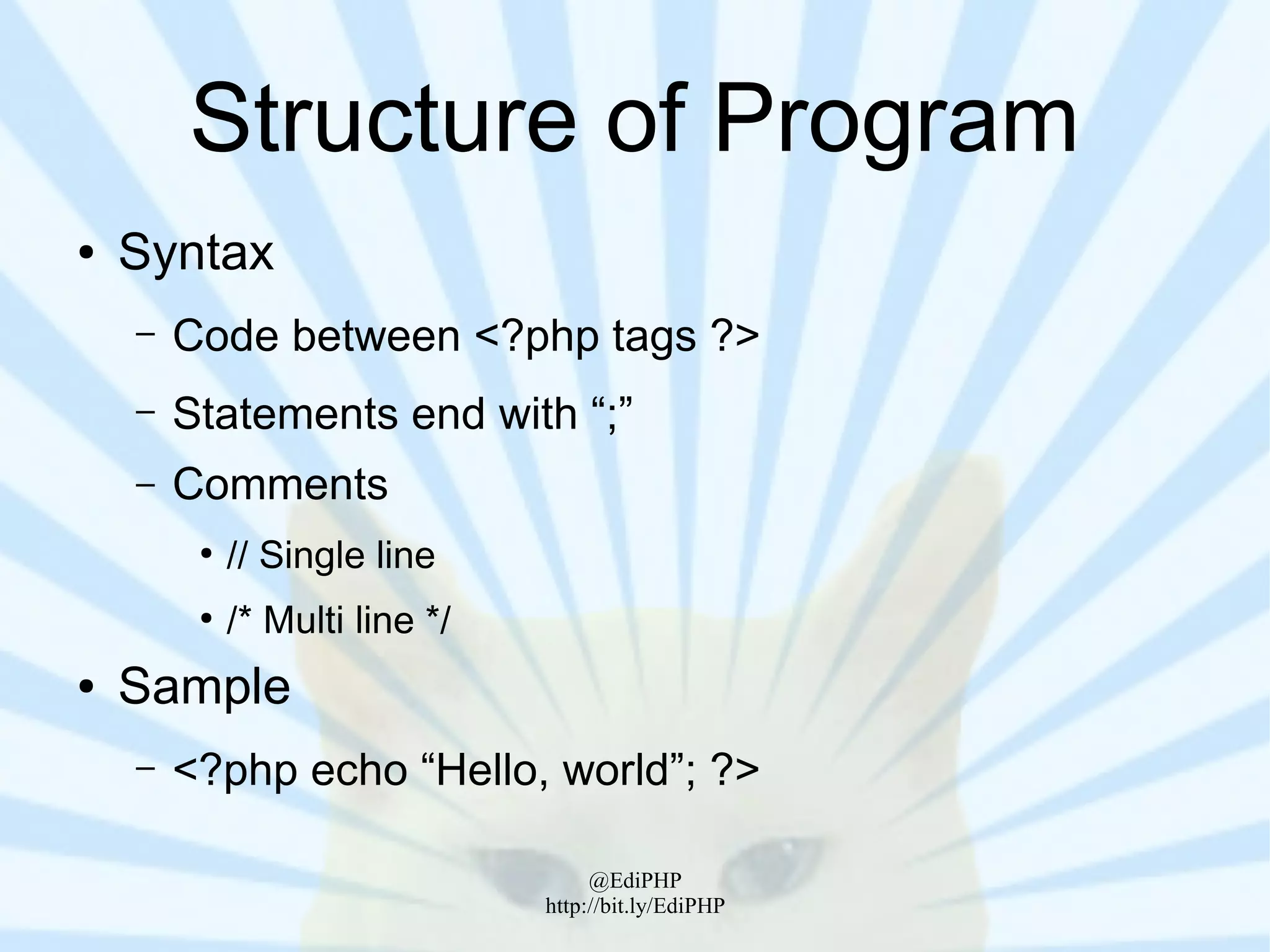
Structure of Program
●   Syntax
    –   Code between <?php tags ?>
    –   Statements end with “;”
    –   Comments
         ●
             // Single line
         ●
             /* Multi line */
●   Sample
    –   <?php echo “Hello, world”; ?>

                                     @EdiPHP
                                http://bit.ly/EdiPHP
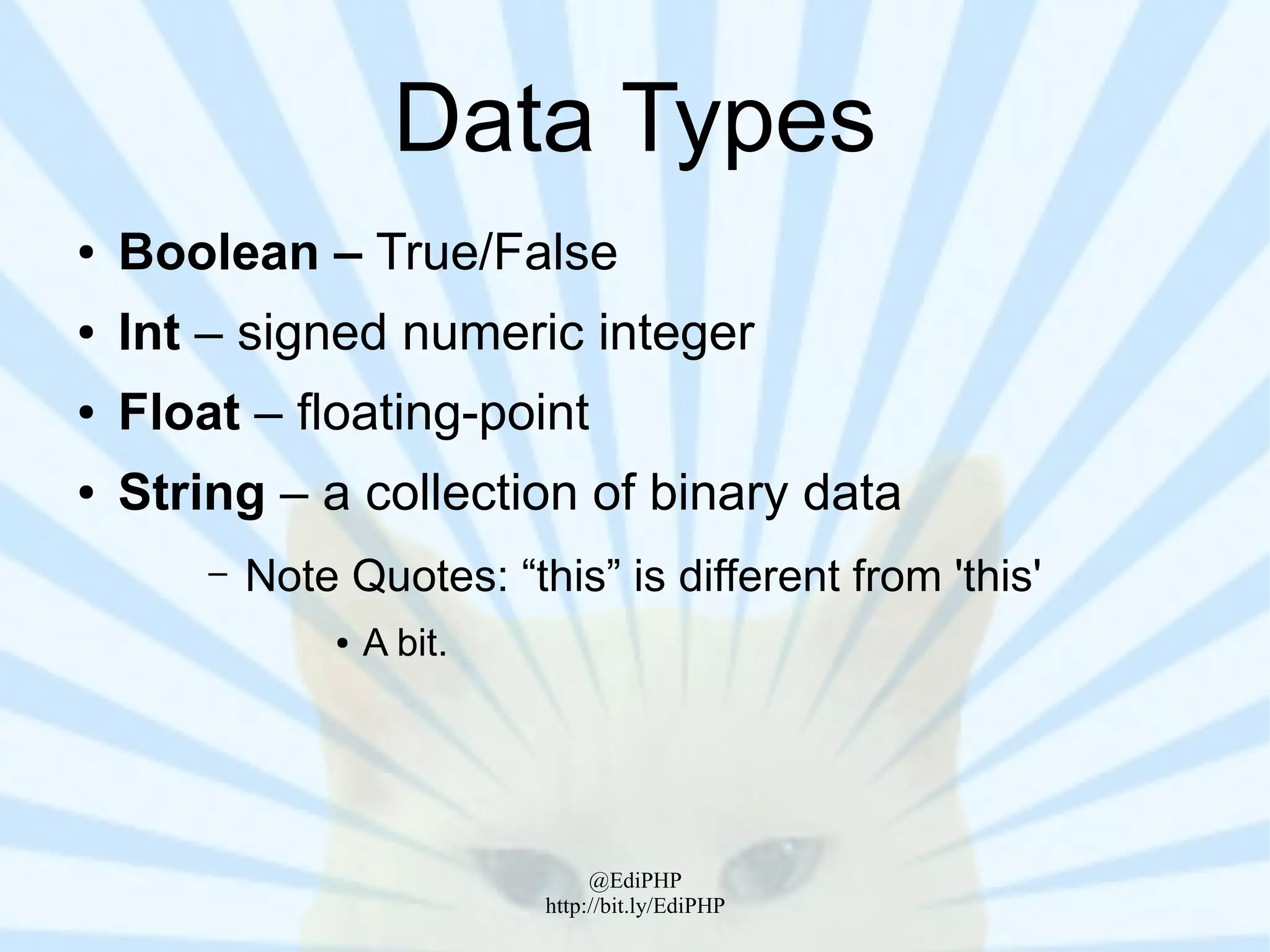
Data Types
●   Boolean – True/False
●   Int – signed numeric integer
●   Float – floating-point
●   String – a collection of binary data
        –   Note Quotes: “this” is different from 'this'
                 ●   A bit.


                                   @EdiPHP
                              http://bit.ly/EdiPHP
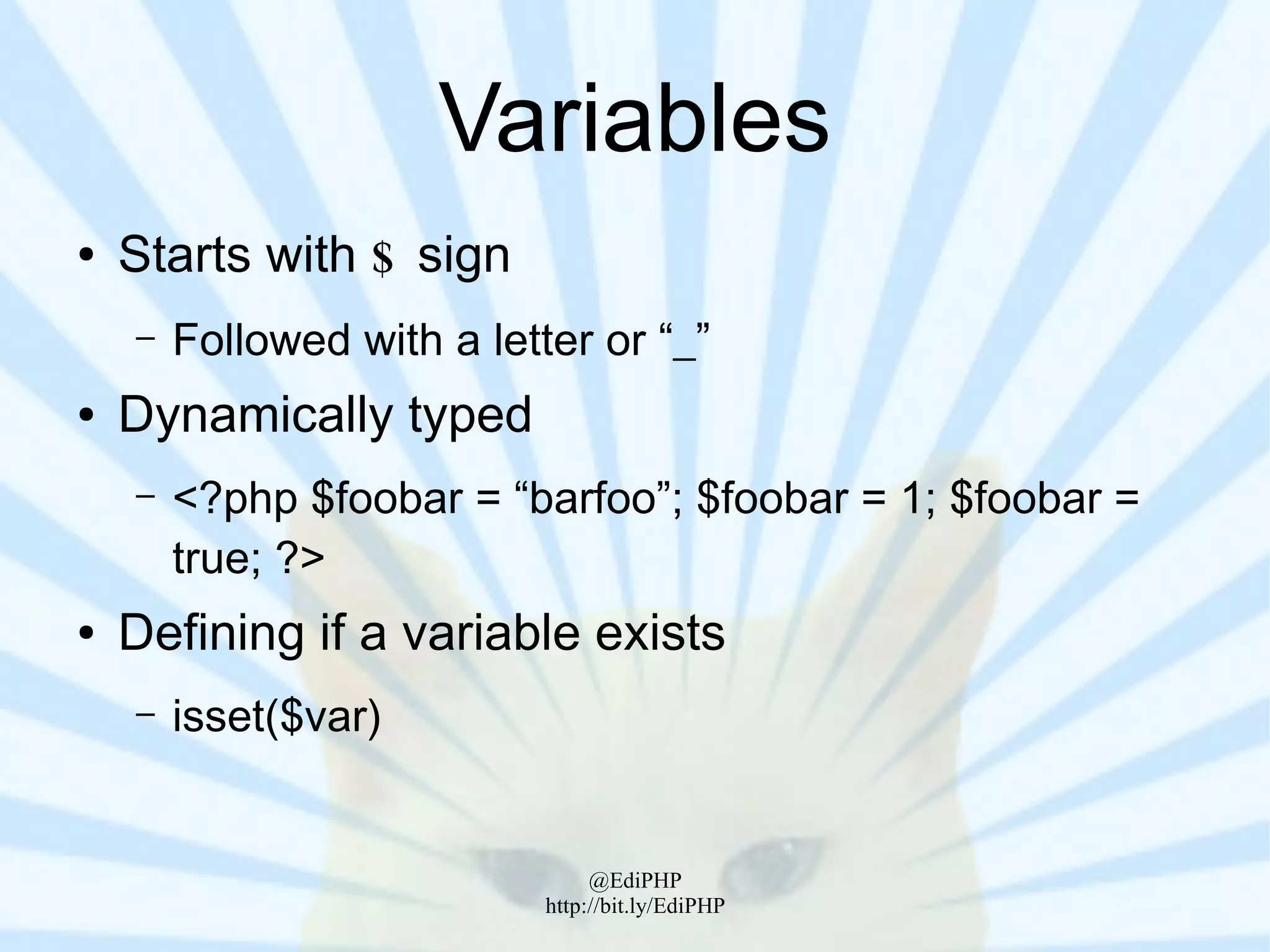
Variables
●   Starts with $ sign
    –   Followed with a letter or “_”
●   Dynamically typed
    –   <?php $foobar = “barfoo”; $foobar = 1; $foobar =
        true; ?>
●   Defining if a variable exists
    –   isset($var)


                                 @EdiPHP
                            http://bit.ly/EdiPHP
Arrays
●   Can be constructed following ways:
●
    $var = Array(1,2,3,4,5,6);
●
    $var = Array(‘cat’ => ‘lolcat’, 0 => 4);
●   Or:
          $var = Array();
          $var[] = 'A';
          $var[] = 'B';
●
    Is equivalent to $var = Array (‘A’, ‘B’, ‘c’);
          $var[] = 'c';


                                  @EdiPHP
                             http://bit.ly/EdiPHP
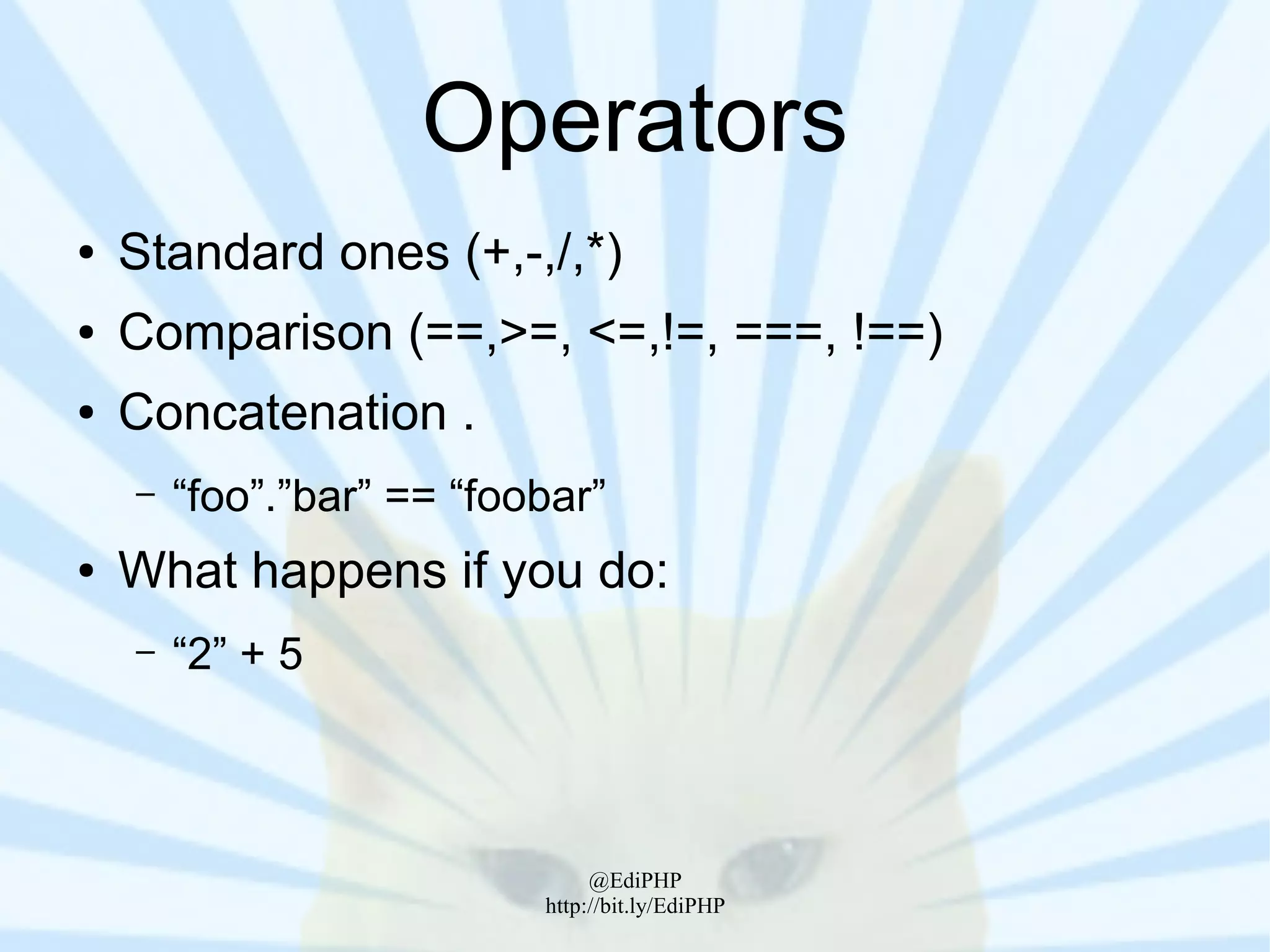
Operators
●   Standard ones (+,-,/,*)
●   Comparison (==,>=, <=,!=, ===, !==)
●   Concatenation .
    –   “foo”.”bar” == “foobar”
●   What happens if you do:
    –   “2” + 5


                                @EdiPHP
                           http://bit.ly/EdiPHP
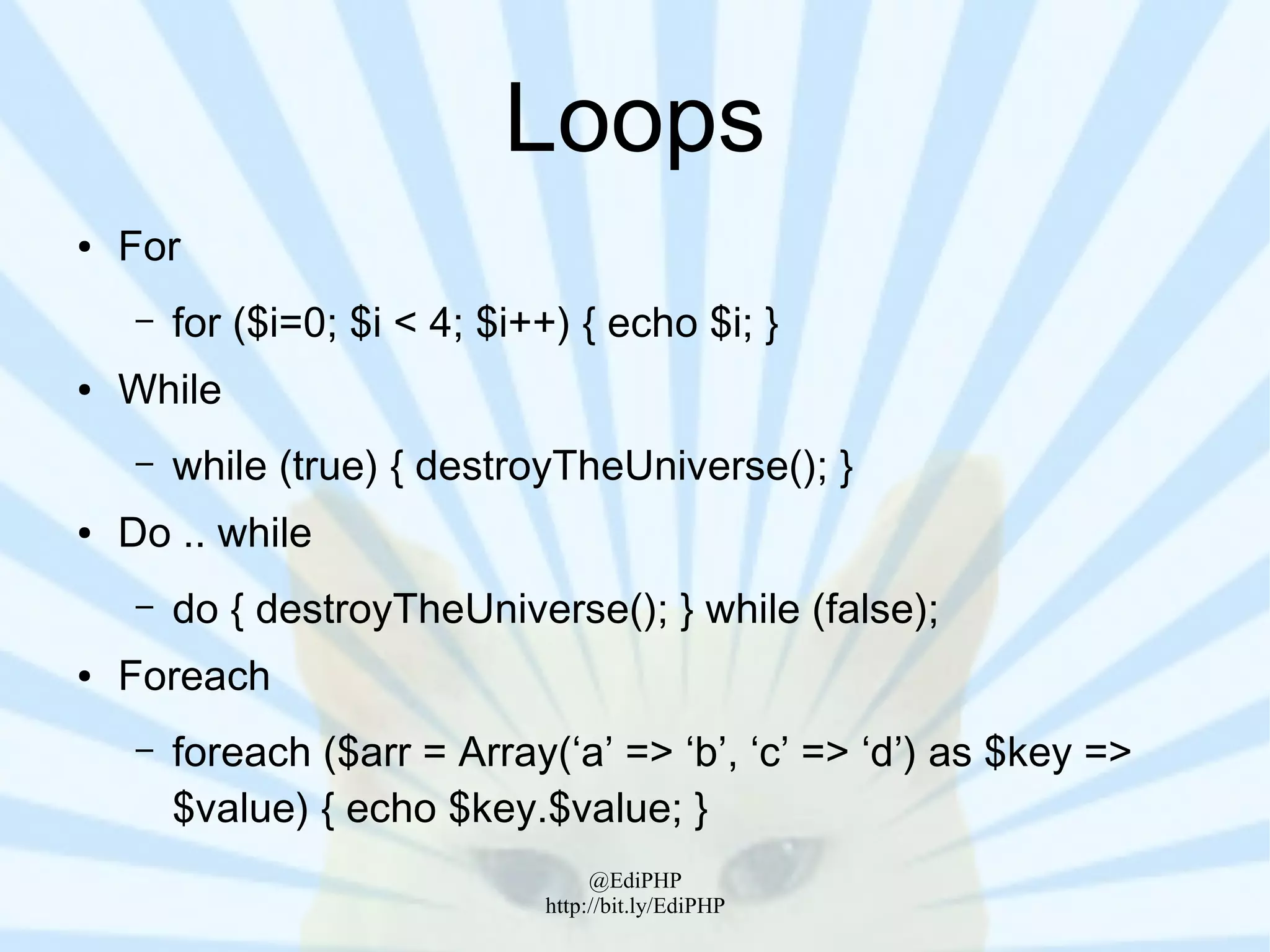
Loops
●   For
     –   for ($i=0; $i < 4; $i++) { echo $i; }
●   While
     –   while (true) { destroyTheUniverse(); }
●   Do .. while
     –   do { destroyTheUniverse(); } while (false);
●   Foreach
     –   foreach ($arr = Array(‘a’ => ‘b’, ‘c’ => ‘d’) as $key =>
         $value) { echo $key.$value; }
                                    @EdiPHP
                               http://bit.ly/EdiPHP
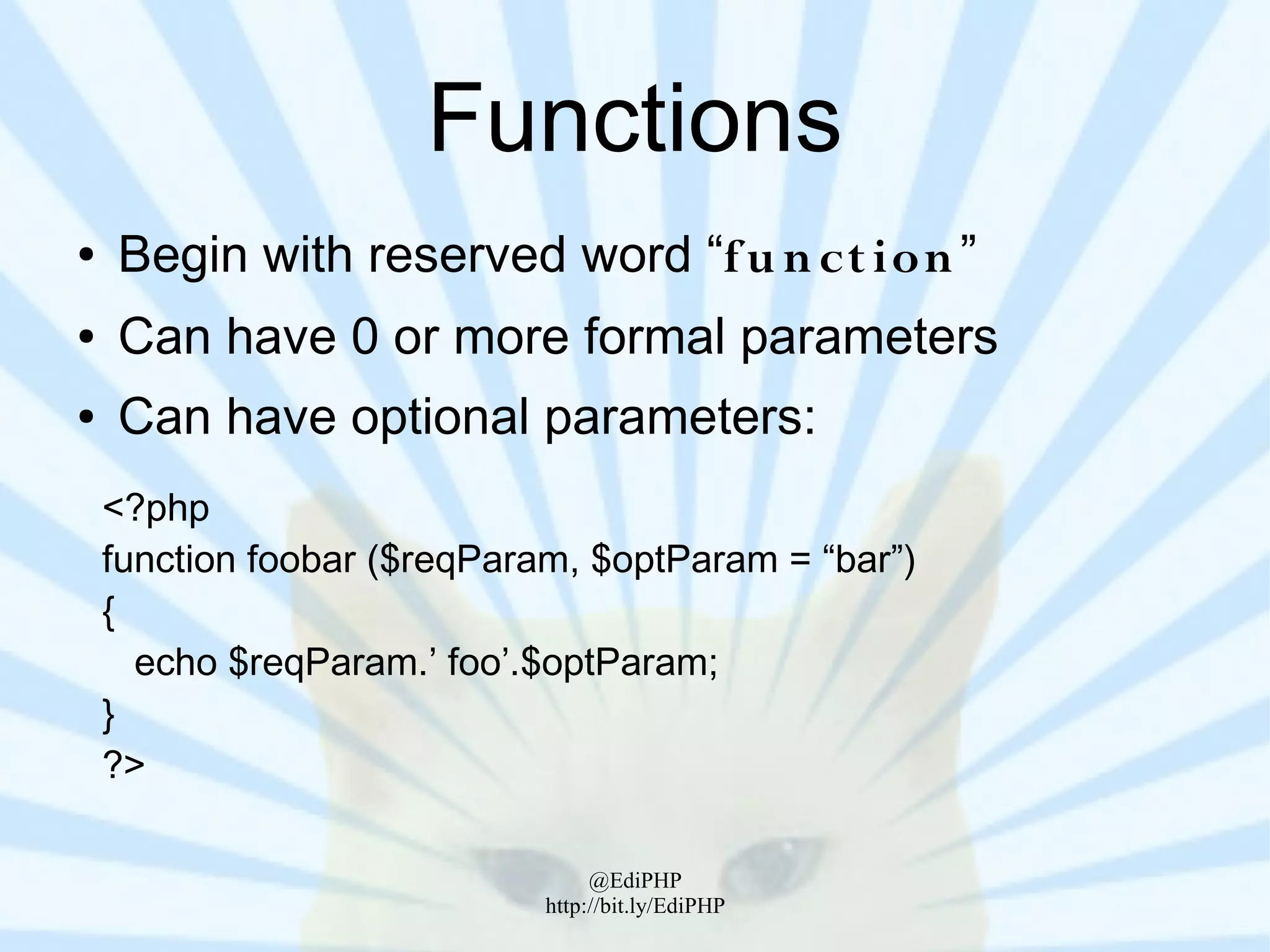
Functions
●   Begin with reserved word “f u n ct ion ”
●   Can have 0 or more formal parameters
●   Can have optional parameters:
    <?php
    function foobar ($reqParam, $optParam = “bar”)
    {
      echo $reqParam.’ foo’.$optParam;
    }
    ?>

                                  @EdiPHP
                             http://bit.ly/EdiPHP
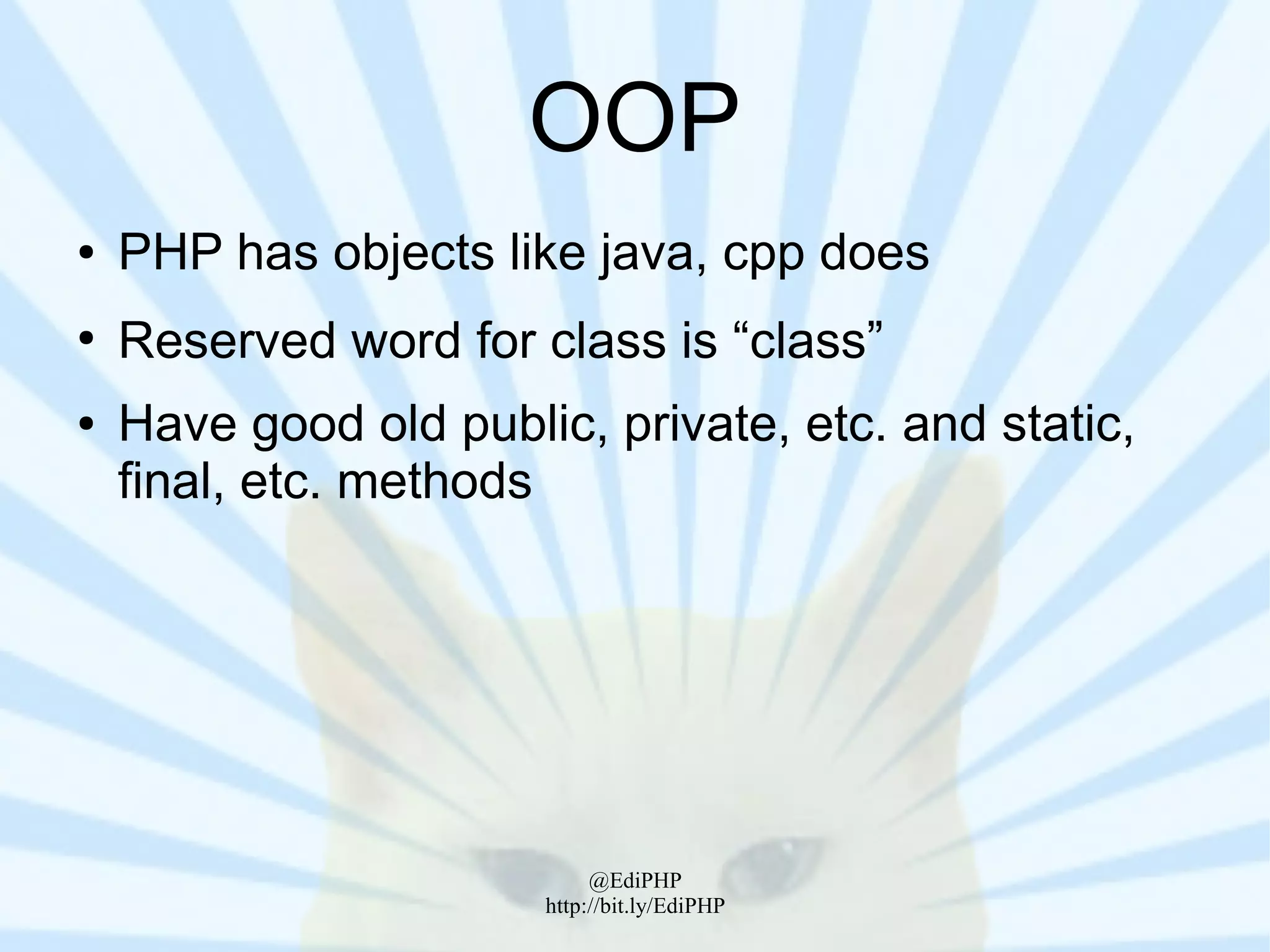
OOP
●   PHP has objects like java, cpp does
●
    Reserved word for class is “class”
●   Have good old public, private, etc. and static,
    final, etc. methods


                            @EdiPHP
                       http://bit.ly/EdiPHP
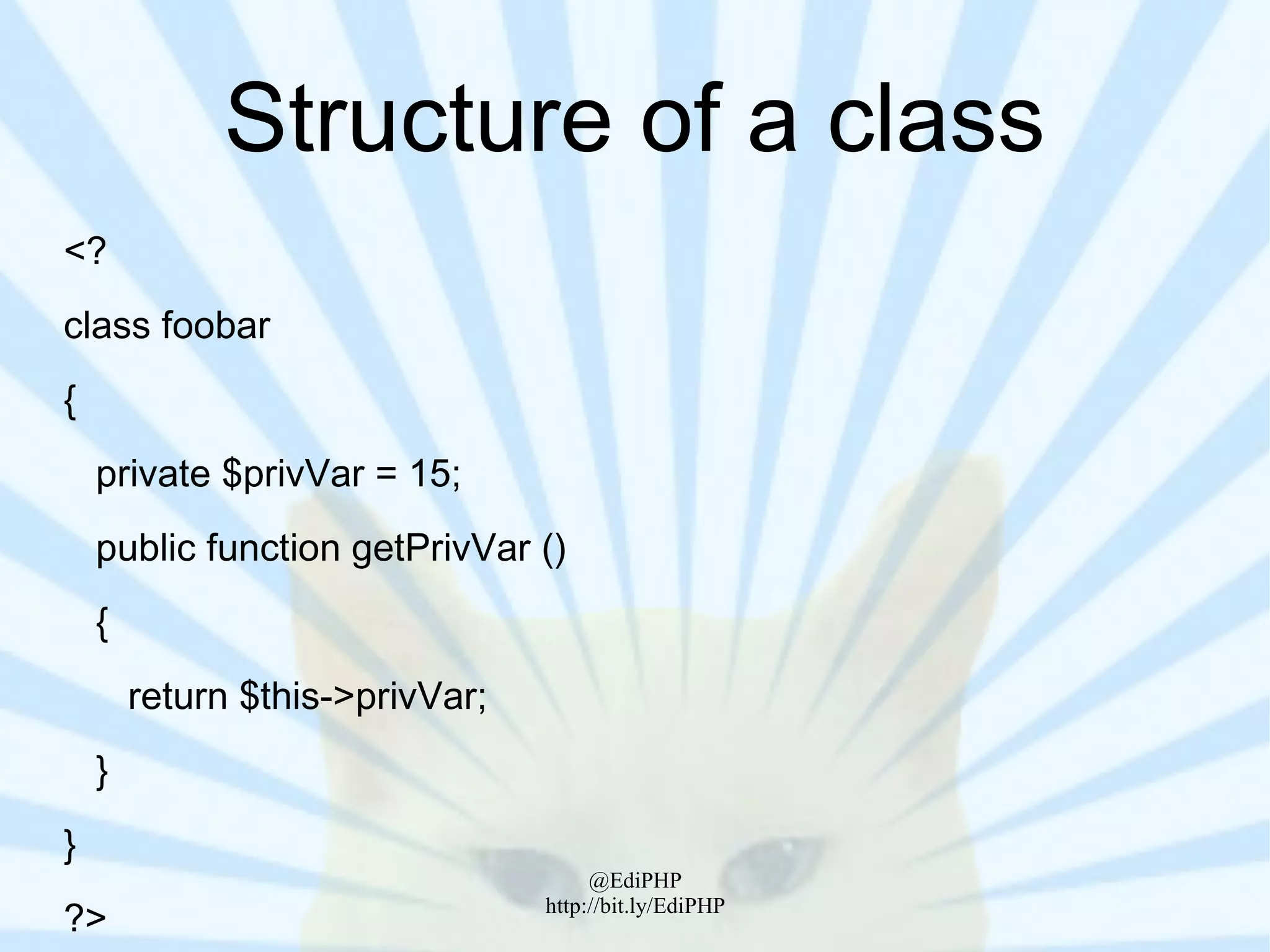
Structure of a class
<?
class foobar
{
    private $privVar = 15;
    public function getPrivVar ()
    {
        return $this->privVar;
    }
}
                                      @EdiPHP
?>                               http://bit.ly/EdiPHP
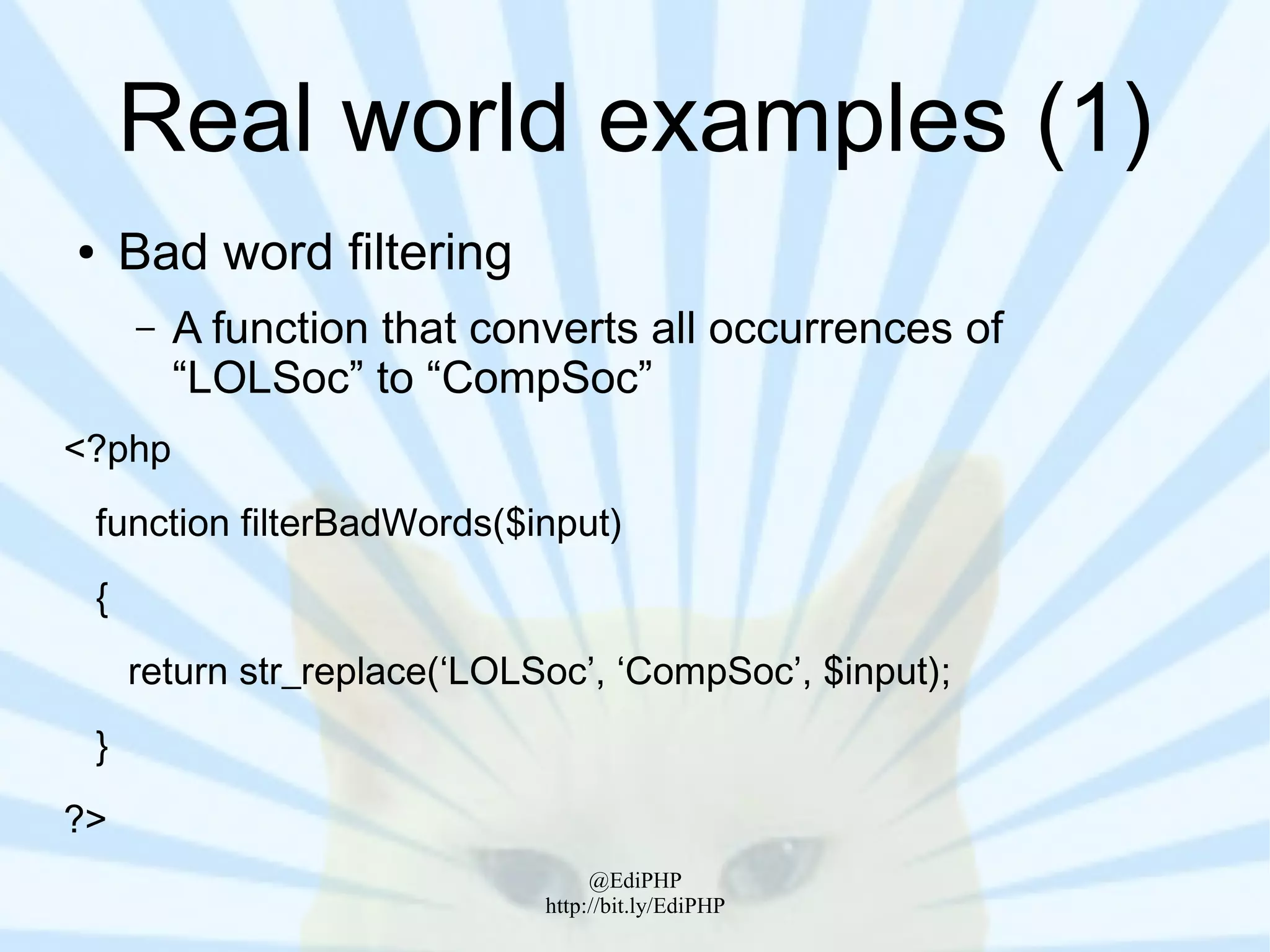
Real world examples (1)
●       Bad word filtering
        –   A function that converts all occurrences of
            “LOLSoc” to “CompSoc”
<?php
    function filterBadWords($input)
    {
        return str_replace(‘LOLSoc’, ‘CompSoc’, $input);
    }
?>
                                     @EdiPHP
                                http://bit.ly/EdiPHP
Real World examples (2)
    ●    Calculating sum of digits in array
<?php

$arr = array(1,2,3,4,5,6,7,-6);

function sumDigits ($a)

{

    $sum = 0;

    for ($i=0; $i < count($a); $i++)

    {

        $sum += $a[$i];

    }

    return $sum;
                                            @EdiPHP
}
                                       http://bit.ly/EdiPHP
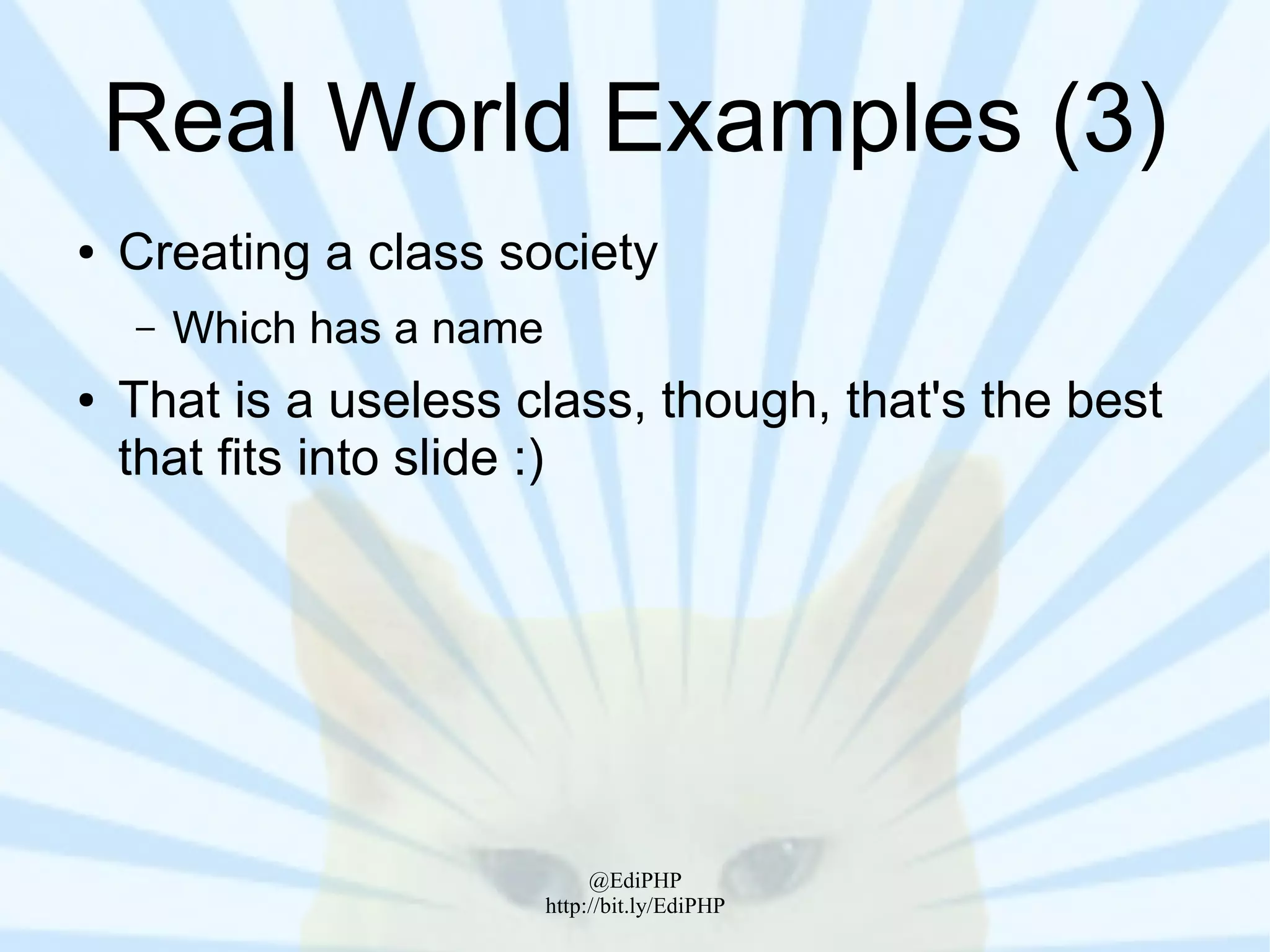
Real World Examples (3)
●   Creating a class society
    –   Which has a name
●   That is a useless class, though, that's the best
    that fits into slide :)


                                @EdiPHP
                           http://bit.ly/EdiPHP
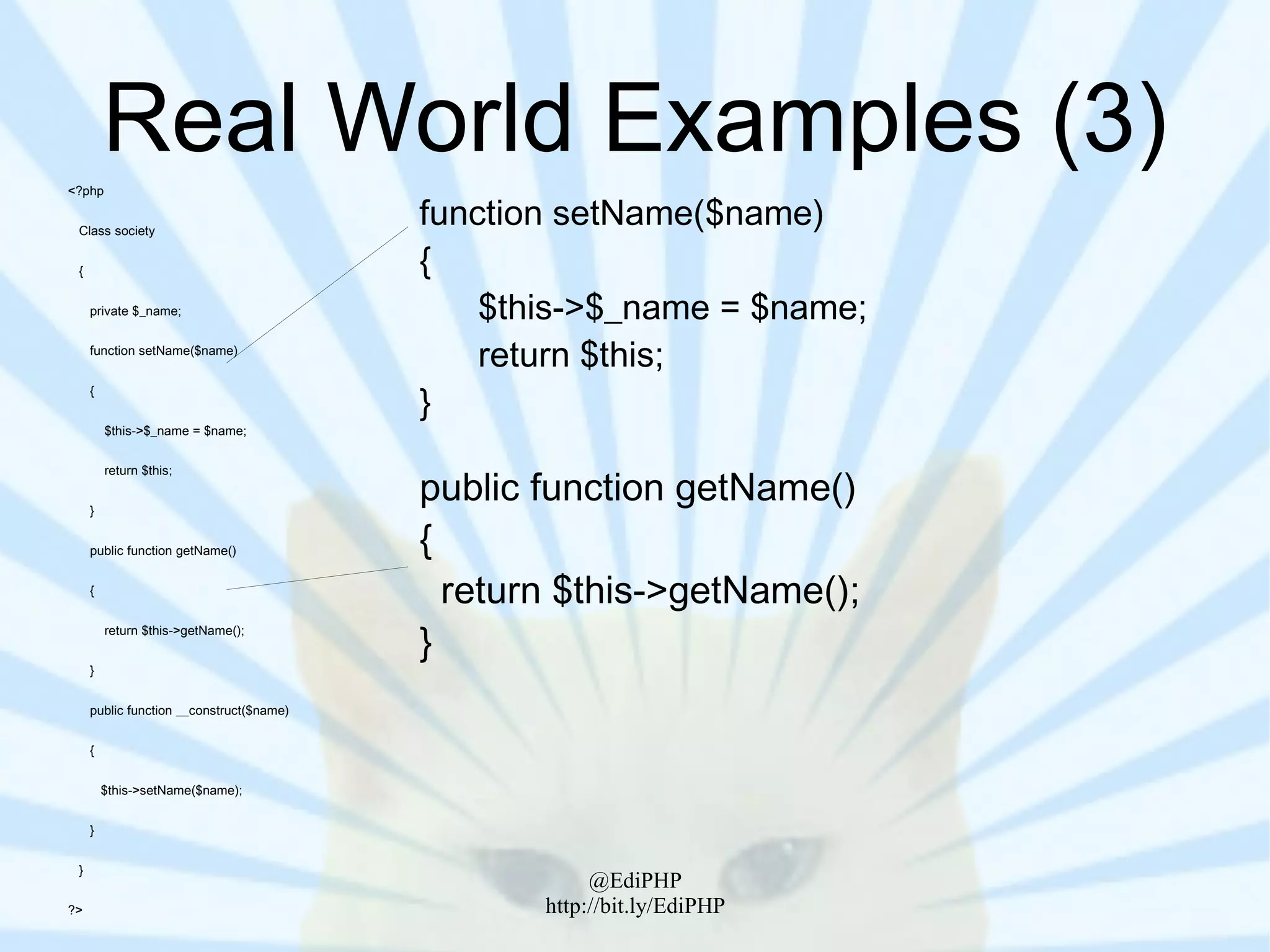
<?php
         Real World Examples (3)
 Class society
                                          function setName($name)
 {                                        {
     private $_name;                          $this->$_name = $name;
     function setName($name)
                                              return $this;
                                          }
     {


         $this->$_name = $name;


                                          public function getName()
         return $this;


     }


     public function getName()            {
     {
                                            return $this->getName();
                                          }
         return $this->getName();


     }


     public function __construct($name)


     {


         $this->setName($name);


     }


 }
                                                      @EdiPHP
?>                                               http://bit.ly/EdiPHP
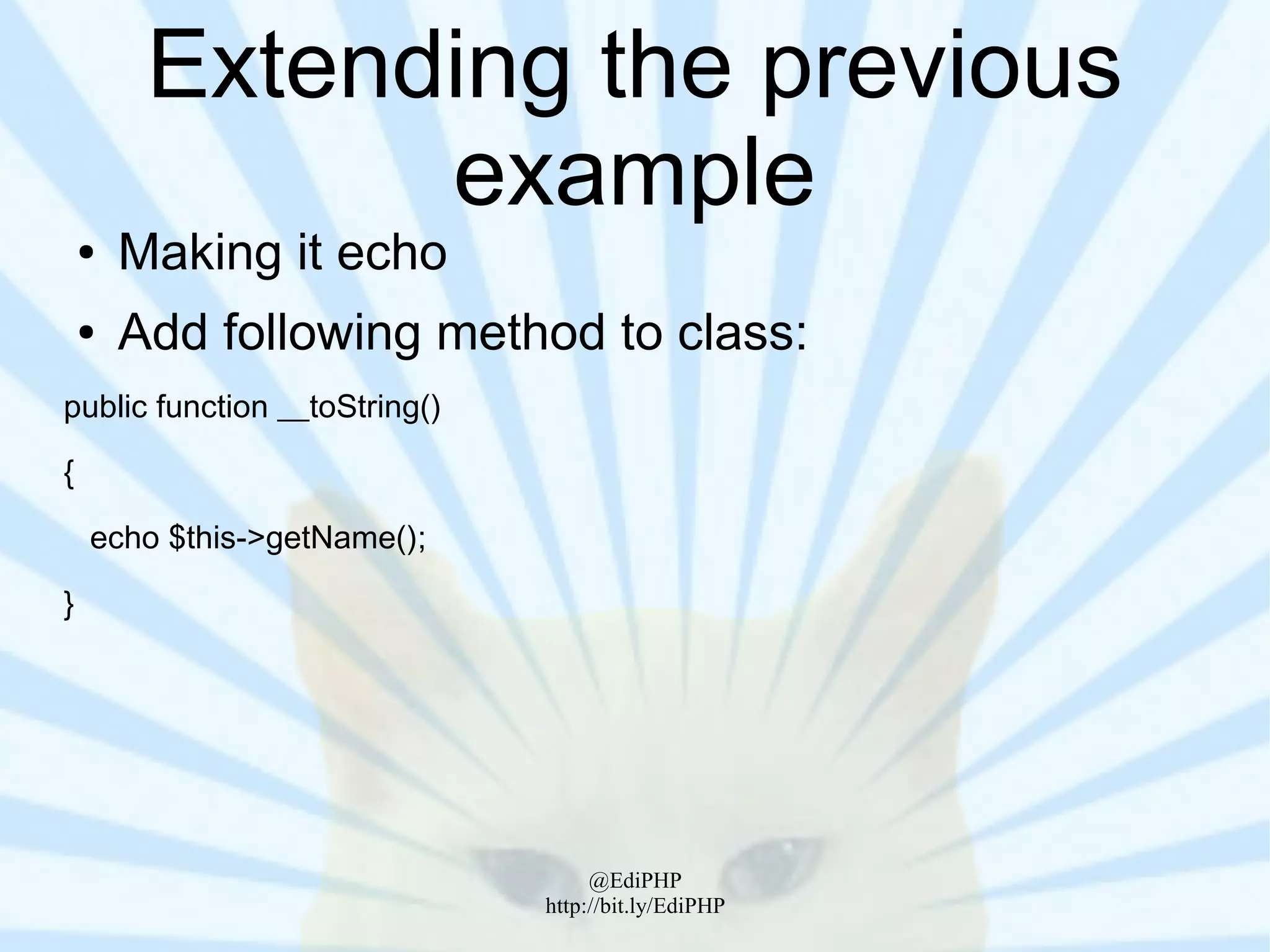
Extending the previous
               example
    ●   Making it echo
    ●   Add following method to class:
public function __toString()

{

    echo $this->getName();

}


                                    @EdiPHP
                               http://bit.ly/EdiPHP
A bit about static methods
    ●    To define a static function:
public static function foobar ()
{
        return “foobar”;
}
    ●    To call a static function
               –   From outside the class scope: className::function()
               –   From inside the class: self::function()

                                         @EdiPHP
                                    http://bit.ly/EdiPHP
Questions


      @EdiPHP
 http://bit.ly/EdiPHP
Tasks
●   Yes, we have them.
●   Please try to do them until next meetup, where
    we'll discuss the solutions.


                           @EdiPHP
                      http://bit.ly/EdiPHP
EdiPHP
The Students PHP meetup


         @EdiPHP
    http://bit.ly/EdiPHP

02 - Second meetup

  • 1.
    EdiPHP The Students PHPmeetup @EdiPHP http://bit.ly/EdiPHP
  • 2.
    Structure of Program ● Syntax – Code between <?php tags ?> – Statements end with “;” – Comments ● // Single line ● /* Multi line */ ● Sample – <?php echo “Hello, world”; ?> @EdiPHP http://bit.ly/EdiPHP
  • 3.
    Data Types ● Boolean – True/False ● Int – signed numeric integer ● Float – floating-point ● String – a collection of binary data – Note Quotes: “this” is different from 'this' ● A bit. @EdiPHP http://bit.ly/EdiPHP
  • 4.
    Variables ● Starts with $ sign – Followed with a letter or “_” ● Dynamically typed – <?php $foobar = “barfoo”; $foobar = 1; $foobar = true; ?> ● Defining if a variable exists – isset($var) @EdiPHP http://bit.ly/EdiPHP
  • 5.
    Arrays ● Can be constructed following ways: ● $var = Array(1,2,3,4,5,6); ● $var = Array(‘cat’ => ‘lolcat’, 0 => 4); ● Or: $var = Array(); $var[] = 'A'; $var[] = 'B'; ● Is equivalent to $var = Array (‘A’, ‘B’, ‘c’); $var[] = 'c'; @EdiPHP http://bit.ly/EdiPHP
  • 6.
    Operators ● Standard ones (+,-,/,*) ● Comparison (==,>=, <=,!=, ===, !==) ● Concatenation . – “foo”.”bar” == “foobar” ● What happens if you do: – “2” + 5 @EdiPHP http://bit.ly/EdiPHP
  • 7.
    Loops ● For – for ($i=0; $i < 4; $i++) { echo $i; } ● While – while (true) { destroyTheUniverse(); } ● Do .. while – do { destroyTheUniverse(); } while (false); ● Foreach – foreach ($arr = Array(‘a’ => ‘b’, ‘c’ => ‘d’) as $key => $value) { echo $key.$value; } @EdiPHP http://bit.ly/EdiPHP
  • 8.
    Functions ● Begin with reserved word “f u n ct ion ” ● Can have 0 or more formal parameters ● Can have optional parameters: <?php function foobar ($reqParam, $optParam = “bar”) { echo $reqParam.’ foo’.$optParam; } ?> @EdiPHP http://bit.ly/EdiPHP
  • 9.
    OOP ● PHP has objects like java, cpp does ● Reserved word for class is “class” ● Have good old public, private, etc. and static, final, etc. methods @EdiPHP http://bit.ly/EdiPHP
  • 10.
    Structure of aclass <? class foobar { private $privVar = 15; public function getPrivVar () { return $this->privVar; } } @EdiPHP ?> http://bit.ly/EdiPHP
  • 11.
    Real world examples(1) ● Bad word filtering – A function that converts all occurrences of “LOLSoc” to “CompSoc” <?php function filterBadWords($input) { return str_replace(‘LOLSoc’, ‘CompSoc’, $input); } ?> @EdiPHP http://bit.ly/EdiPHP
  • 12.
    Real World examples(2) ● Calculating sum of digits in array <?php $arr = array(1,2,3,4,5,6,7,-6); function sumDigits ($a) { $sum = 0; for ($i=0; $i < count($a); $i++) { $sum += $a[$i]; } return $sum; @EdiPHP } http://bit.ly/EdiPHP
  • 13.
    Real World Examples(3) ● Creating a class society – Which has a name ● That is a useless class, though, that's the best that fits into slide :) @EdiPHP http://bit.ly/EdiPHP
  • 14.
    <?php Real World Examples (3) Class society function setName($name) { { private $_name; $this->$_name = $name; function setName($name) return $this; } { $this->$_name = $name; public function getName() return $this; } public function getName() { { return $this->getName(); } return $this->getName(); } public function __construct($name) { $this->setName($name); } } @EdiPHP ?> http://bit.ly/EdiPHP
  • 15.
    Extending the previous example ● Making it echo ● Add following method to class: public function __toString() { echo $this->getName(); } @EdiPHP http://bit.ly/EdiPHP
  • 16.
    A bit aboutstatic methods ● To define a static function: public static function foobar () { return “foobar”; } ● To call a static function – From outside the class scope: className::function() – From inside the class: self::function() @EdiPHP http://bit.ly/EdiPHP
  • 17.
    Questions @EdiPHP http://bit.ly/EdiPHP
  • 18.
    Tasks ● Yes, we have them. ● Please try to do them until next meetup, where we'll discuss the solutions. @EdiPHP http://bit.ly/EdiPHP
  • 19.
    EdiPHP The Students PHPmeetup @EdiPHP http://bit.ly/EdiPHP