INTRODUCTION TO COMMERCIAL
CONTRACT DRAFTING
By: Dendi Adisuryo (ADCO Attorneys At Law)
 My Background
 Audience: In house - external counsel
 Methodology
Agenda
 Introduction
 Legal communications
 Contract forms and purposes
 Preliminary agreement forms
 Structure and format of agreements
 General drafting pitfalls
 Simulations
Introduction
 A contract is an agreement between two or more parties that
creates an obligation on all parties to perform (or not perform) a
particular action or set of related actions.
 Contract law determines what makes a particular contract
enforceable, and provides remedies when a contract is breached.
 If you are not careful, a contract may not be enforceable when you
want it to be, and may be enforceable when you don’t want it to be.
 Working with a qualified attorney on all significant issues is the only
certain way to make sure your contract works how you intend.
Legal Communications
 Whether a contract exists depends on whether parties have reached
a mutual agreement – which can be oral.
 Generally a written contract is entered into to protect the parties
against misunderstandings and to clarify the obligations and
particular agreement between parties.
 Contracts can cover a wide range of circumstances, both in
business settings and personal relationships. Business contracts
are varied and can cover all aspects of a business, including those
with customers, employees, investors and business partners.
Whats a good contract?
 A contract where each party gets what it bargained for – without any
disruption or disputes – during or post performance
 Because business people need to run their business, not spend
more time with lawyers
Business person vs Lawyer
 Business people: risk takers who look for practical and quick
solutions with the ultimate desire to obtain profit / grow the business
 Lawyers: risk adverse / avoiders, prone to legalese to justify their
existence, often not knowledgeable in the industry and live by
bilable hours
 The gap needs to be closed in the contract process.
Preparation for Contract Drafting
 Understand client’s business intention and goals
 Measure positioning of your client and the opposite party: the
purpose is to develop a bargaining position during negotiation and
implementing stage
 Understand the regulatory and legal framework of the proposed
transaction
 Understand all constraints that may be coming from the prevailing
laws, regulations and government policies, and how to minimize or
solve it effectively
Preparation for Contract Drafting
 Assessing constraints in negotiation process and project
implementation
 Understand the deal structure and alternatives of option
 Setting up of a strong and effective negotiation team
 Composing strategy and techniques of negotiation and drafting
 Utilization of database, R & D materials & studies
 Applying best practices and authoritative precedence
Preparation for Contract Drafting
 Conflict check in the industry
 BKPM Negative List of Investments
 Investment incentives, guarantees, and supports available
(regulatory or special treatment for industry or location)
 Tariff barriers; export and import constraints
 Regulatory issues (investment, industry, trade, anti monopoly,
environmental, labor, local regulations)
 Competitors in the industry
 Location of the projects: access to infrastructure
 Non-regulatory issues (local community, politics, and social issues,
governance, etc)
Contract forms and purposes
Below is a list of other types of contracts that are commonly used in
commercial businesses:
 Arbitration Agreement
 Asset Purchase Agreement
 Assignment Agreement
 Bonus Agreement
 Collaboration Agreement
 Consulting Agreement
 Credit Agreement
 Deferred Compensation
Plan
 Development Agreement
 Distribution Agreement
 Employee Stock Plan
 Employment Agreement
 Equipment Lease
 Franchise Agreement
 Guaranty Agreement
 Indemnification Agreement
 Joint Venture Agreement
 Lease
 License Agreement
 Loan Agreement
 Manufacturing Contract
 Merger Agreement
 Non-Disclosure Agreement
 Operating Agreement
 Promissory Note
 Repurchase Agreements
 Sales Contract
 Services Agreement
 Shareholder Agreement
 Stock Option Agreement
 Stock Purchase Agreement
 Supply Agreement
 Trademark License Agreement
 Underwriting Agreement
 Voting Agreements
 Waiver Agreement
Contract forms and purposes
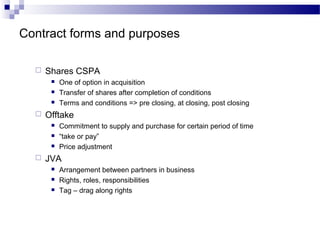
 Shares CSPA
 One of option in acquisition
 Transfer of shares after completion of conditions
 Terms and conditions => pre closing, at closing, post closing
 Offtake
 Commitment to supply and purchase for certain period of time
 “take or pay”
 Price adjustment
 JVA
 Arrangement between partners in business
 Rights, roles, responsibilities
 Tag – drag along rights
Contract forms and purposes
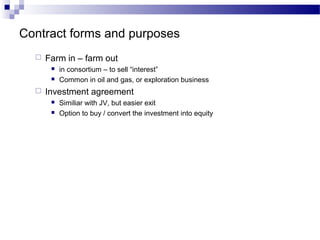
 Farm in – farm out
 in consortium – to sell “interest”
 Common in oil and gas, or exploration business
 Investment agreement
 Similiar with JV, but easier exit
 Option to buy / convert the investment into equity
Preliminary agreement forms
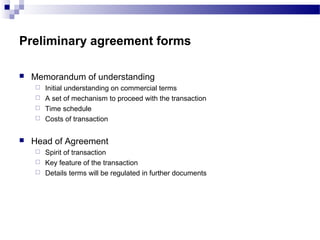
 Memorandum of understanding
 Initial understanding on commercial terms
 A set of mechanism to proceed with the transaction
 Time schedule
 Costs of transaction
 Head of Agreement
 Spirit of transaction
 Key feature of the transaction
 Details terms will be regulated in further documents
Preliminary agreement forms
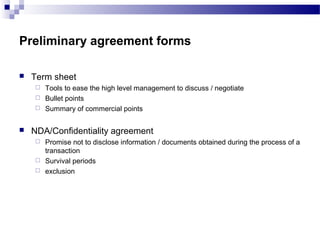
 Term sheet
 Tools to ease the high level management to discuss / negotiate
 Bullet points
 Summary of commercial points
 NDA/Confidentiality agreement
 Promise not to disclose information / documents obtained during the process of a
transaction
 Survival periods
 exclusion
Simmulation I: Terms Sheet (Acquisition)
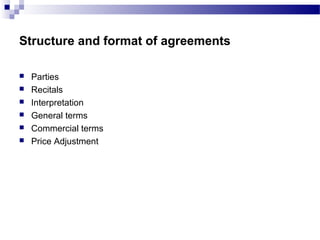
Structure and format of agreements
 Parties
 Recitals
 Interpretation
 General terms
 Commercial terms
 Price Adjustment
Simulation II – Stage of Transaction
Simulation II.a – Payment of purchase price
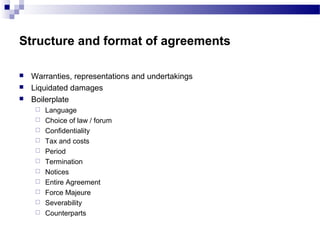
Structure and format of agreements
 Warranties, representations and undertakings
 Liquidated damages
 Boilerplate
 Language
 Choice of law / forum
 Confidentiality
 Tax and costs
 Period
 Termination
 Notices
 Entire Agreement
 Force Majeure
 Severability
 Counterparts
Simmulation III – Representation, warranties
and undertaking
Simulation IIIa - Liquidated Damages
Structure and format of agreements
 Schedules
 Execution
 Side Letters
Simmulation IV – Side Letter
General drafting pitfalls
 Hasty, Inadequate or Non- Existent Due Diligence
 Drafting a clause or section from scratch.
 Inconsistently defining terms and phrases.
 Leaving out key details
 Lack of details in mechanism
 Not spending enough time on choice of law, forum, dispute resolution, damages, and
limitation of liabilityeaving out key details
 Relying on Word’s Track Changes feature
 Running out of time to review
 Assuming that outside counsel provided perfect work product.
 Not having a system for managing standard forms
 Forgetting what version you sent and to whom.
 What is the exact amount to be paid? When? How? Conditions of non payment?
 Delay..what the cpnsequence?
 Shipping / delivery? Demurage, dispatch
 Dont understand what we drafted [??]
Simmulation V – Details of Mechanism
(claim of past liabilities of tax and
outstanding payment to vendors)
Thanks!

Introduction to Commercial Contract Drafting

  • 1.
    INTRODUCTION TO COMMERCIAL CONTRACTDRAFTING By: Dendi Adisuryo (ADCO Attorneys At Law)
  • 2.
     My Background Audience: In house - external counsel  Methodology
  • 3.
    Agenda  Introduction  Legalcommunications  Contract forms and purposes  Preliminary agreement forms  Structure and format of agreements  General drafting pitfalls  Simulations
  • 4.
    Introduction  A contractis an agreement between two or more parties that creates an obligation on all parties to perform (or not perform) a particular action or set of related actions.  Contract law determines what makes a particular contract enforceable, and provides remedies when a contract is breached.  If you are not careful, a contract may not be enforceable when you want it to be, and may be enforceable when you don’t want it to be.  Working with a qualified attorney on all significant issues is the only certain way to make sure your contract works how you intend.
  • 5.
    Legal Communications  Whethera contract exists depends on whether parties have reached a mutual agreement – which can be oral.  Generally a written contract is entered into to protect the parties against misunderstandings and to clarify the obligations and particular agreement between parties.  Contracts can cover a wide range of circumstances, both in business settings and personal relationships. Business contracts are varied and can cover all aspects of a business, including those with customers, employees, investors and business partners.
  • 6.
    Whats a goodcontract?  A contract where each party gets what it bargained for – without any disruption or disputes – during or post performance  Because business people need to run their business, not spend more time with lawyers
  • 7.
    Business person vsLawyer  Business people: risk takers who look for practical and quick solutions with the ultimate desire to obtain profit / grow the business  Lawyers: risk adverse / avoiders, prone to legalese to justify their existence, often not knowledgeable in the industry and live by bilable hours  The gap needs to be closed in the contract process.
  • 8.
    Preparation for ContractDrafting  Understand client’s business intention and goals  Measure positioning of your client and the opposite party: the purpose is to develop a bargaining position during negotiation and implementing stage  Understand the regulatory and legal framework of the proposed transaction  Understand all constraints that may be coming from the prevailing laws, regulations and government policies, and how to minimize or solve it effectively
  • 9.
    Preparation for ContractDrafting  Assessing constraints in negotiation process and project implementation  Understand the deal structure and alternatives of option  Setting up of a strong and effective negotiation team  Composing strategy and techniques of negotiation and drafting  Utilization of database, R & D materials & studies  Applying best practices and authoritative precedence
  • 10.
    Preparation for ContractDrafting  Conflict check in the industry  BKPM Negative List of Investments  Investment incentives, guarantees, and supports available (regulatory or special treatment for industry or location)  Tariff barriers; export and import constraints  Regulatory issues (investment, industry, trade, anti monopoly, environmental, labor, local regulations)  Competitors in the industry  Location of the projects: access to infrastructure  Non-regulatory issues (local community, politics, and social issues, governance, etc)
  • 11.
    Contract forms andpurposes Below is a list of other types of contracts that are commonly used in commercial businesses:  Arbitration Agreement  Asset Purchase Agreement  Assignment Agreement  Bonus Agreement  Collaboration Agreement  Consulting Agreement  Credit Agreement  Deferred Compensation Plan  Development Agreement  Distribution Agreement  Employee Stock Plan  Employment Agreement  Equipment Lease  Franchise Agreement  Guaranty Agreement  Indemnification Agreement  Joint Venture Agreement  Lease  License Agreement  Loan Agreement  Manufacturing Contract  Merger Agreement  Non-Disclosure Agreement  Operating Agreement  Promissory Note  Repurchase Agreements  Sales Contract  Services Agreement  Shareholder Agreement  Stock Option Agreement  Stock Purchase Agreement  Supply Agreement  Trademark License Agreement  Underwriting Agreement  Voting Agreements  Waiver Agreement
  • 12.
    Contract forms andpurposes  Shares CSPA  One of option in acquisition  Transfer of shares after completion of conditions  Terms and conditions => pre closing, at closing, post closing  Offtake  Commitment to supply and purchase for certain period of time  “take or pay”  Price adjustment  JVA  Arrangement between partners in business  Rights, roles, responsibilities  Tag – drag along rights
  • 13.
    Contract forms andpurposes  Farm in – farm out  in consortium – to sell “interest”  Common in oil and gas, or exploration business  Investment agreement  Similiar with JV, but easier exit  Option to buy / convert the investment into equity
  • 14.
    Preliminary agreement forms Memorandum of understanding  Initial understanding on commercial terms  A set of mechanism to proceed with the transaction  Time schedule  Costs of transaction  Head of Agreement  Spirit of transaction  Key feature of the transaction  Details terms will be regulated in further documents
  • 15.
    Preliminary agreement forms Term sheet  Tools to ease the high level management to discuss / negotiate  Bullet points  Summary of commercial points  NDA/Confidentiality agreement  Promise not to disclose information / documents obtained during the process of a transaction  Survival periods  exclusion
  • 16.
    Simmulation I: TermsSheet (Acquisition)
  • 17.
    Structure and formatof agreements  Parties  Recitals  Interpretation  General terms  Commercial terms  Price Adjustment
  • 18.
    Simulation II –Stage of Transaction Simulation II.a – Payment of purchase price
  • 19.
    Structure and formatof agreements  Warranties, representations and undertakings  Liquidated damages  Boilerplate  Language  Choice of law / forum  Confidentiality  Tax and costs  Period  Termination  Notices  Entire Agreement  Force Majeure  Severability  Counterparts
  • 20.
    Simmulation III –Representation, warranties and undertaking Simulation IIIa - Liquidated Damages
  • 21.
    Structure and formatof agreements  Schedules  Execution  Side Letters
  • 22.
    Simmulation IV –Side Letter
  • 23.
    General drafting pitfalls Hasty, Inadequate or Non- Existent Due Diligence  Drafting a clause or section from scratch.  Inconsistently defining terms and phrases.  Leaving out key details  Lack of details in mechanism  Not spending enough time on choice of law, forum, dispute resolution, damages, and limitation of liabilityeaving out key details  Relying on Word’s Track Changes feature  Running out of time to review  Assuming that outside counsel provided perfect work product.  Not having a system for managing standard forms  Forgetting what version you sent and to whom.  What is the exact amount to be paid? When? How? Conditions of non payment?  Delay..what the cpnsequence?  Shipping / delivery? Demurage, dispatch  Dont understand what we drafted [??]
  • 24.
    Simmulation V –Details of Mechanism (claim of past liabilities of tax and outstanding payment to vendors)
  • 25.