microlinks.org/events
Gary Gereffi
Center on Globalization,
Governance &
Competitiveness
Ajmal Abdulsamad
Center on Globalization,
Governance &
Competitiveness
Microlinks Seminar #18
Can Public-Private
Partnerships Actually
Benefit the Poor?
Shawn Stokes
Center on Globalization,
Governance &
Competitiveness
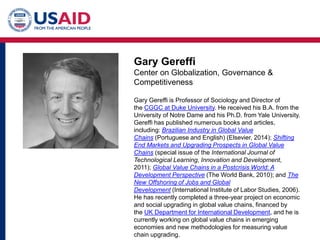
Gary Gereffi
Center on Globalization, Governance &
Competitiveness
Gary Gereffi is Professor of Sociology and Director of
the CGGC at Duke University. He received his B.A. from the
University of Notre Dame and his Ph.D. from Yale University.
Gereffi has published numerous books and articles,
including: Brazilian Industry in Global Value
Chains (Portuguese and English) (Elsevier, 2014); Shifting
End Markets and Upgrading Prospects in Global Value
Chains (special issue of the International Journal of
Technological Learning, Innovation and Development,
2011); Global Value Chains in a Postcrisis World: A
Development Perspective (The World Bank, 2010); and The
New Offshoring of Jobs and Global
Development (International Institute of Labor Studies, 2006).
He has recently completed a three-year project on economic
and social upgrading in global value chains, financed by
the UK Department for International Development, and he is
currently working on global value chains in emerging
economies and new methodologies for measuring value
chain upgrading.
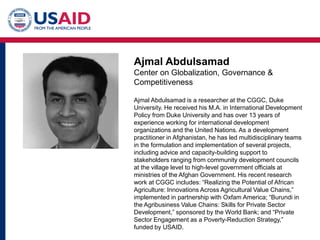
Ajmal Abdulsamad
Center on Globalization, Governance &
Competitiveness
Ajmal Abdulsamad is a researcher at the CGGC, Duke
University. He received his M.A. in International Development
Policy from Duke University and has over 13 years of
experience working for international development
organizations and the United Nations. As a development
practitioner in Afghanistan, he has led multidisciplinary teams
in the formulation and implementation of several projects,
including advice and capacity-building support to
stakeholders ranging from community development councils
at the village level to high-level government officials at
ministries of the Afghan Government. His recent research
work at CGGC includes: “Realizing the Potential of African
Agriculture: Innovations Across Agricultural Value Chains,”
implemented in partnership with Oxfam America; “Burundi in
the Agribusiness Value Chains: Skills for Private Sector
Development,” sponsored by the World Bank; and “Private
Sector Engagement as a Poverty-Reduction Strategy,”
funded by USAID.
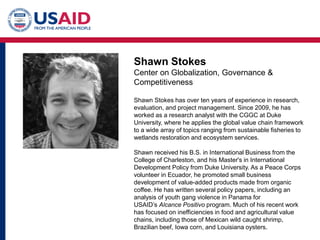
Shawn Stokes
Center on Globalization, Governance &
Competitiveness
Shawn Stokes has over ten years of experience in research,
evaluation, and project management. Since 2009, he has
worked as a research analyst with the CGGC at Duke
University, where he applies the global value chain framework
to a wide array of topics ranging from sustainable fisheries to
wetlands restoration and ecosystem services.
Shawn received his B.S. in International Business from the
College of Charleston, and his Master's in International
Development Policy from Duke University. As a Peace Corps
volunteer in Ecuador, he promoted small business
development of value-added products made from organic
coffee. He has written several policy papers, including an
analysis of youth gang violence in Panama for
USAID’s Alcance Positivo program. Much of his recent work
has focused on inefficiencies in food and agricultural value
chains, including those of Mexican wild caught shrimp,
Brazilian beef, Iowa corn, and Louisiana oysters.
© 2015 CGGC, Duke University
Public-Private Partnerships in Global Value
Chains:
Can They Actually Benefit the Poor?
Center on Globalization, Governance & Competitiveness (CGGC)
Duke University
Gary Gereffi, Ajmal Abdulsamad, and Shawn
Stokes
January 29, 2015
© 2015 CGGC, Duke University
6
Overview
Part I. Global Value Chains and Development
• Economic Globalization & Development: Key Trends
• Global Value Chains: A Systemic Approach
Part II. Public-Private Partnerships: Case Study Findings
• Research Objective & Methodology
• Brief Overview of Three Public-Private Partnership Cases
• Key Takeaways
© 2015 CGGC, Duke University
Global Value Chains and Development
© 2015 CGGC, Duke University
8
Economic Globalization & Development: Key
Trends
• Trends
– GVCs as 80% of world trade (UNCTAD, WIR 2013)
– Valued-added trade 30% of GDP in developing countries
– Consolidation within GVCs in fewer, larger suppliers
• Implications
– More opportunities for public-private partnerships (PPPs)
– Challenges for small firms and smallholders
– Economic upgrading ≠ Social upgrading
© 2015 CGGC, Duke University
9
Global Value Chains: A Systemic Approach
Global value chain (GVC) analysis provides both
conceptual and methodological tools for examining
the global economy.
• Top-down: a focus on lead firms and inter-firm
networks, using varied typologies of industrial
“governance”
• Bottom-up: a focus on countries and regions,
which are analyzed in terms of various
trajectories of economic and social
“upgrading”
© 2015 CGGC, Duke University
10
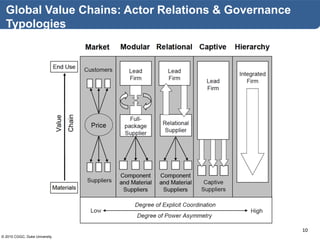
Global Value Chains: Actor Relations & Governance
Typologies
© 2015 CGGC, Duke University
11
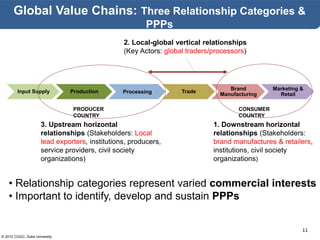
Global Value Chains: Three Relationship Categories &
PPPs
Input Supply Production Processing Trade
Brand
Manufacturing
Marketing &
Retail
3. Upstream horizontal
relationships (Stakeholders: Local
lead exporters, institutions, producers,
service providers, civil society
organizations)
1. Downstream horizontal
relationships (Stakeholders:
brand manufactures & retailers,
institutions, civil society
organizations)
2. Local-global vertical relationships
(Key Actors: global traders/processors)
CONSUMER
COUNTRY
PRODUCER
COUNTRY
• Relationship categories represent varied commercial interests
• Important to identify, develop and sustain PPPs
© 2015 CGGC, Duke University
Three PPP Case Studies
© 2015 CGGC, Duke University
13
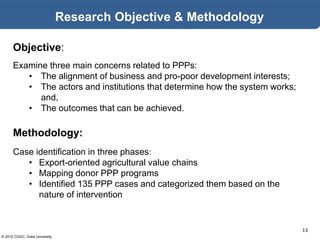
Research Objective & Methodology
Objective:
Examine three main concerns related to PPPs:
• The alignment of business and pro-poor development interests;
• The actors and institutions that determine how the system works;
and,
• The outcomes that can be achieved.
Methodology:
Case identification in three phases:
• Export-oriented agricultural value chains
• Mapping donor PPP programs
• Identified 135 PPP cases and categorized them based on the
nature of intervention
© 2015 CGGC, Duke University
14
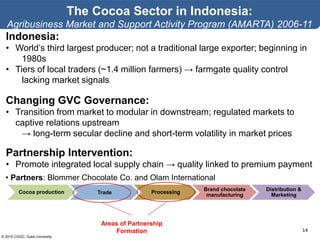
The Cocoa Sector in Indonesia:
Agribusiness Market and Support Activity Program (AMARTA) 2006-11
Cocoa production Trade Processing
Brand chocolate
manufacturing
Distribution &
Marketing
Areas of Partnership
Formation
Indonesia:
• World’s third largest producer; not a traditional large exporter; beginning in
1980s
• Tiers of local traders (~1.4 million farmers) → farmgate quality control
lacking market signals
Changing GVC Governance:
• Transition from market to modular in downstream; regulated markets to
captive relations upstream
→ long-term secular decline and short-term volatility in market prices
Partnership Intervention:
• Promote integrated local supply chain → quality linked to premium payment
• Partners: Blommer Chocolate Co. and Olam International
© 2015 CGGC, Duke University
15
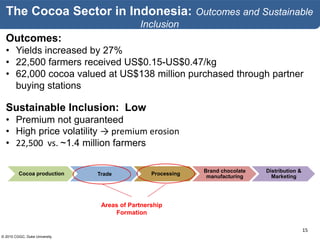
The Cocoa Sector in Indonesia: Outcomes and Sustainable
Inclusion
Outcomes:
• Yields increased by 27%
• 22,500 farmers received US$0.15-US$0.47/kg
• 62,000 cocoa valued at US$138 million purchased through partner
buying stations
Sustainable Inclusion: Low
• Premium not guaranteed
• High price volatility → premium erosion
• 22,500 vs. ~1.4 million farmers
Cocoa production Trade Processing
Brand chocolate
manufacturing
Distribution &
Marketing
Areas of Partnership
Formation
© 2015 CGGC, Duke University
16
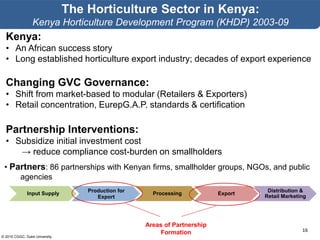
The Horticulture Sector in Kenya:
Kenya Horticulture Development Program (KHDP) 2003-09
Input Supply
Production for
Export
Processing Export
Distribution &
Retail Marketing
Areas of Partnership
Formation
Kenya:
• An African success story
• Long established horticulture export industry; decades of export experience
Changing GVC Governance:
• Shift from market-based to modular (Retailers & Exporters)
• Retail concentration, EurepG.A.P. standards & certification
Partnership Interventions:
• Subsidize initial investment cost
→ reduce compliance cost-burden on smallholders
• Partners: 86 partnerships with Kenyan firms, smallholder groups, NGOs, and public
agencies
© 2015 CGGC, Duke University
17
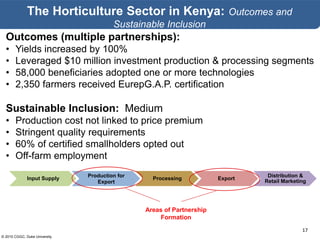
The Horticulture Sector in Kenya: Outcomes and
Sustainable Inclusion
Outcomes (multiple partnerships):
• Yields increased by 100%
• Leveraged $10 million investment production & processing segments
• 58,000 beneficiaries adopted one or more technologies
• 2,350 farmers received EurepG.A.P. certification
Sustainable Inclusion: Medium
• Production cost not linked to price premium
• Stringent quality requirements
• 60% of certified smallholders opted out
• Off-farm employment
Input Supply
Production for
Export
Processing Export
Distribution &
Retail Marketing
Areas of Partnership
Formation
© 2015 CGGC, Duke University
18
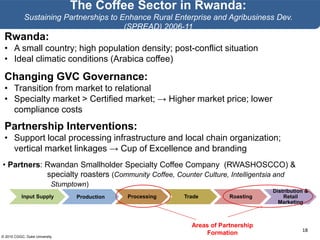
The Coffee Sector in Rwanda:
Sustaining Partnerships to Enhance Rural Enterprise and Agribusiness Dev.
(SPREAD) 2006-11
• Partners: Rwandan Smallholder Specialty Coffee Company (RWASHOSCCO) &
specialty roasters (Community Coffee, Counter Culture, Intelligentsia and
Stumptown)
Input Supply Production Processing Trade Roasting
Distribution &
Retail
Marketing
Areas of Partnership
Formation
Rwanda:
• A small country; high population density; post-conflict situation
• Ideal climatic conditions (Arabica coffee)
Changing GVC Governance:
• Transition from market to relational
• Specialty market > Certified market; → Higher market price; lower
compliance costs
Partnership Interventions:
• Support local processing infrastructure and local chain organization;
vertical market linkages → Cup of Excellence and branding
© 2015 CGGC, Duke University
19
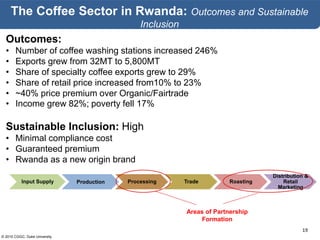
The Coffee Sector in Rwanda: Outcomes and Sustainable
Inclusion
Outcomes:
• Number of coffee washing stations increased 246%
• Exports grew from 32MT to 5,800MT
• Share of specialty coffee exports grew to 29%
• Share of retail price increased from10% to 23%
• ~40% price premium over Organic/Fairtrade
• Income grew 82%; poverty fell 17%
Sustainable Inclusion: High
• Minimal compliance cost
• Guaranteed premium
• Rwanda as a new origin brand
Input Supply Production Processing Trade Roasting
Distribution &
Retail
Marketing
Areas of Partnership
Formation
© 2015 CGGC, Duke University
20
Public-Private Partnerships: Key Takeaways
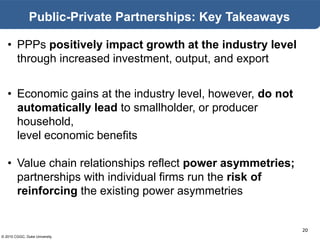
• PPPs positively impact growth at the industry level
through increased investment, output, and export
• Economic gains at the industry level, however, do not
automatically lead to smallholder, or producer
household,
level economic benefits
• Value chain relationships reflect power asymmetries;
partnerships with individual firms run the risk of
reinforcing the existing power asymmetries
© 2015 CGGC, Duke University
21
Public-Private Partnerships: Key Takeaways
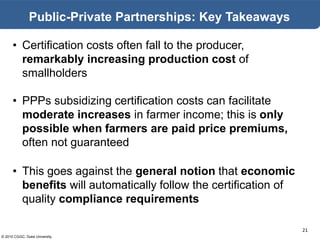
• Certification costs often fall to the producer,
remarkably increasing production cost of
smallholders
• PPPs subsidizing certification costs can facilitate
moderate increases in farmer income; this is only
possible when farmers are paid price premiums,
often not guaranteed
• This goes against the general notion that economic
benefits will automatically follow the certification of
quality compliance requirements
© 2015 CGGC, Duke University
22
Key Conditions for Inclusive Development through
PPPs
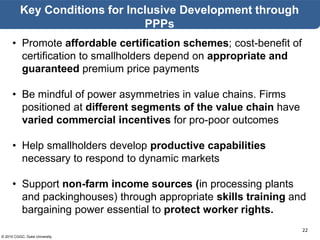
• Promote affordable certification schemes; cost-benefit of
certification to smallholders depend on appropriate and
guaranteed premium price payments
• Be mindful of power asymmetries in value chains. Firms
positioned at different segments of the value chain have
varied commercial incentives for pro-poor outcomes
• Help smallholders develop productive capabilities
necessary to respond to dynamic markets
• Support non-farm income sources (in processing plants
and packinghouses) through appropriate skills training and
bargaining power essential to protect worker rights.
© 2015 CGGC, Duke University
23
Necessary Conditions for Inclusive Development
through PPPs
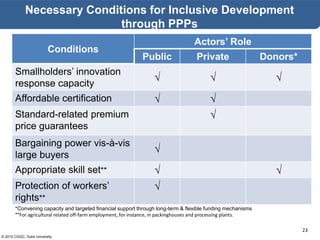
Conditions
Actors’ Role
Public Private Donors*
Smallholders’ innovation
response capacity
√ √ √
Affordable certification √ √
Standard-related premium
price guarantees
√
Bargaining power vis-à-vis
large buyers
√
Appropriate skill set** √ √
Protection of workers’
rights**
√
*Convening capacity and targeted financial support through long-term & flexible funding mechanisms
**For agricultural related off-farm employment, for instance, in packinghouses and processing plants.
© 2015 CGGC, Duke University
24
Contact Details
Ajmal Abdulsamad, Project Manager
Email: ajmal.abdulsamad@duke.edu
Center on Globalization, Governance and Competitiveness
Duke University
Phone: 919.681.6564
Fax: 919.681.4183
Thank you for joining us!
Microlinks and the Seminar Series are brought to you by USAID as a product of the Feed the Future
Knowledge-Driven Agricultural Development project.
Upcoming EventsShare Feedback Stay In Touch
Please take a few
minutes to fill out the
webinar poll
questions!
You can also visit the
event page to post
comments & questions.
Contact Us:
microlinks@microlinks.org
Subscribe today:
microlinks.org/subscribe
Find upcoming events &
past presentations:
www.microlinks.org/new-
events-page

Can Public-Private Partnerships Actually Benefit the Poor?

  • 1.
    microlinks.org/events Gary Gereffi Center onGlobalization, Governance & Competitiveness Ajmal Abdulsamad Center on Globalization, Governance & Competitiveness Microlinks Seminar #18 Can Public-Private Partnerships Actually Benefit the Poor? Shawn Stokes Center on Globalization, Governance & Competitiveness
  • 2.
    Gary Gereffi Center onGlobalization, Governance & Competitiveness Gary Gereffi is Professor of Sociology and Director of the CGGC at Duke University. He received his B.A. from the University of Notre Dame and his Ph.D. from Yale University. Gereffi has published numerous books and articles, including: Brazilian Industry in Global Value Chains (Portuguese and English) (Elsevier, 2014); Shifting End Markets and Upgrading Prospects in Global Value Chains (special issue of the International Journal of Technological Learning, Innovation and Development, 2011); Global Value Chains in a Postcrisis World: A Development Perspective (The World Bank, 2010); and The New Offshoring of Jobs and Global Development (International Institute of Labor Studies, 2006). He has recently completed a three-year project on economic and social upgrading in global value chains, financed by the UK Department for International Development, and he is currently working on global value chains in emerging economies and new methodologies for measuring value chain upgrading.
  • 3.
    Ajmal Abdulsamad Center onGlobalization, Governance & Competitiveness Ajmal Abdulsamad is a researcher at the CGGC, Duke University. He received his M.A. in International Development Policy from Duke University and has over 13 years of experience working for international development organizations and the United Nations. As a development practitioner in Afghanistan, he has led multidisciplinary teams in the formulation and implementation of several projects, including advice and capacity-building support to stakeholders ranging from community development councils at the village level to high-level government officials at ministries of the Afghan Government. His recent research work at CGGC includes: “Realizing the Potential of African Agriculture: Innovations Across Agricultural Value Chains,” implemented in partnership with Oxfam America; “Burundi in the Agribusiness Value Chains: Skills for Private Sector Development,” sponsored by the World Bank; and “Private Sector Engagement as a Poverty-Reduction Strategy,” funded by USAID.
  • 4.
    Shawn Stokes Center onGlobalization, Governance & Competitiveness Shawn Stokes has over ten years of experience in research, evaluation, and project management. Since 2009, he has worked as a research analyst with the CGGC at Duke University, where he applies the global value chain framework to a wide array of topics ranging from sustainable fisheries to wetlands restoration and ecosystem services. Shawn received his B.S. in International Business from the College of Charleston, and his Master's in International Development Policy from Duke University. As a Peace Corps volunteer in Ecuador, he promoted small business development of value-added products made from organic coffee. He has written several policy papers, including an analysis of youth gang violence in Panama for USAID’s Alcance Positivo program. Much of his recent work has focused on inefficiencies in food and agricultural value chains, including those of Mexican wild caught shrimp, Brazilian beef, Iowa corn, and Louisiana oysters.
  • 5.
    © 2015 CGGC,Duke University Public-Private Partnerships in Global Value Chains: Can They Actually Benefit the Poor? Center on Globalization, Governance & Competitiveness (CGGC) Duke University Gary Gereffi, Ajmal Abdulsamad, and Shawn Stokes January 29, 2015
  • 6.
    © 2015 CGGC,Duke University 6 Overview Part I. Global Value Chains and Development • Economic Globalization & Development: Key Trends • Global Value Chains: A Systemic Approach Part II. Public-Private Partnerships: Case Study Findings • Research Objective & Methodology • Brief Overview of Three Public-Private Partnership Cases • Key Takeaways
  • 7.
    © 2015 CGGC,Duke University Global Value Chains and Development
  • 8.
    © 2015 CGGC,Duke University 8 Economic Globalization & Development: Key Trends • Trends – GVCs as 80% of world trade (UNCTAD, WIR 2013) – Valued-added trade 30% of GDP in developing countries – Consolidation within GVCs in fewer, larger suppliers • Implications – More opportunities for public-private partnerships (PPPs) – Challenges for small firms and smallholders – Economic upgrading ≠ Social upgrading
  • 9.
    © 2015 CGGC,Duke University 9 Global Value Chains: A Systemic Approach Global value chain (GVC) analysis provides both conceptual and methodological tools for examining the global economy. • Top-down: a focus on lead firms and inter-firm networks, using varied typologies of industrial “governance” • Bottom-up: a focus on countries and regions, which are analyzed in terms of various trajectories of economic and social “upgrading”
  • 10.
    © 2015 CGGC,Duke University 10 Global Value Chains: Actor Relations & Governance Typologies
  • 11.
    © 2015 CGGC,Duke University 11 Global Value Chains: Three Relationship Categories & PPPs Input Supply Production Processing Trade Brand Manufacturing Marketing & Retail 3. Upstream horizontal relationships (Stakeholders: Local lead exporters, institutions, producers, service providers, civil society organizations) 1. Downstream horizontal relationships (Stakeholders: brand manufactures & retailers, institutions, civil society organizations) 2. Local-global vertical relationships (Key Actors: global traders/processors) CONSUMER COUNTRY PRODUCER COUNTRY • Relationship categories represent varied commercial interests • Important to identify, develop and sustain PPPs
  • 12.
    © 2015 CGGC,Duke University Three PPP Case Studies
  • 13.
    © 2015 CGGC,Duke University 13 Research Objective & Methodology Objective: Examine three main concerns related to PPPs: • The alignment of business and pro-poor development interests; • The actors and institutions that determine how the system works; and, • The outcomes that can be achieved. Methodology: Case identification in three phases: • Export-oriented agricultural value chains • Mapping donor PPP programs • Identified 135 PPP cases and categorized them based on the nature of intervention
  • 14.
    © 2015 CGGC,Duke University 14 The Cocoa Sector in Indonesia: Agribusiness Market and Support Activity Program (AMARTA) 2006-11 Cocoa production Trade Processing Brand chocolate manufacturing Distribution & Marketing Areas of Partnership Formation Indonesia: • World’s third largest producer; not a traditional large exporter; beginning in 1980s • Tiers of local traders (~1.4 million farmers) → farmgate quality control lacking market signals Changing GVC Governance: • Transition from market to modular in downstream; regulated markets to captive relations upstream → long-term secular decline and short-term volatility in market prices Partnership Intervention: • Promote integrated local supply chain → quality linked to premium payment • Partners: Blommer Chocolate Co. and Olam International
  • 15.
    © 2015 CGGC,Duke University 15 The Cocoa Sector in Indonesia: Outcomes and Sustainable Inclusion Outcomes: • Yields increased by 27% • 22,500 farmers received US$0.15-US$0.47/kg • 62,000 cocoa valued at US$138 million purchased through partner buying stations Sustainable Inclusion: Low • Premium not guaranteed • High price volatility → premium erosion • 22,500 vs. ~1.4 million farmers Cocoa production Trade Processing Brand chocolate manufacturing Distribution & Marketing Areas of Partnership Formation
  • 16.
    © 2015 CGGC,Duke University 16 The Horticulture Sector in Kenya: Kenya Horticulture Development Program (KHDP) 2003-09 Input Supply Production for Export Processing Export Distribution & Retail Marketing Areas of Partnership Formation Kenya: • An African success story • Long established horticulture export industry; decades of export experience Changing GVC Governance: • Shift from market-based to modular (Retailers & Exporters) • Retail concentration, EurepG.A.P. standards & certification Partnership Interventions: • Subsidize initial investment cost → reduce compliance cost-burden on smallholders • Partners: 86 partnerships with Kenyan firms, smallholder groups, NGOs, and public agencies
  • 17.
    © 2015 CGGC,Duke University 17 The Horticulture Sector in Kenya: Outcomes and Sustainable Inclusion Outcomes (multiple partnerships): • Yields increased by 100% • Leveraged $10 million investment production & processing segments • 58,000 beneficiaries adopted one or more technologies • 2,350 farmers received EurepG.A.P. certification Sustainable Inclusion: Medium • Production cost not linked to price premium • Stringent quality requirements • 60% of certified smallholders opted out • Off-farm employment Input Supply Production for Export Processing Export Distribution & Retail Marketing Areas of Partnership Formation
  • 18.
    © 2015 CGGC,Duke University 18 The Coffee Sector in Rwanda: Sustaining Partnerships to Enhance Rural Enterprise and Agribusiness Dev. (SPREAD) 2006-11 • Partners: Rwandan Smallholder Specialty Coffee Company (RWASHOSCCO) & specialty roasters (Community Coffee, Counter Culture, Intelligentsia and Stumptown) Input Supply Production Processing Trade Roasting Distribution & Retail Marketing Areas of Partnership Formation Rwanda: • A small country; high population density; post-conflict situation • Ideal climatic conditions (Arabica coffee) Changing GVC Governance: • Transition from market to relational • Specialty market > Certified market; → Higher market price; lower compliance costs Partnership Interventions: • Support local processing infrastructure and local chain organization; vertical market linkages → Cup of Excellence and branding
  • 19.
    © 2015 CGGC,Duke University 19 The Coffee Sector in Rwanda: Outcomes and Sustainable Inclusion Outcomes: • Number of coffee washing stations increased 246% • Exports grew from 32MT to 5,800MT • Share of specialty coffee exports grew to 29% • Share of retail price increased from10% to 23% • ~40% price premium over Organic/Fairtrade • Income grew 82%; poverty fell 17% Sustainable Inclusion: High • Minimal compliance cost • Guaranteed premium • Rwanda as a new origin brand Input Supply Production Processing Trade Roasting Distribution & Retail Marketing Areas of Partnership Formation
  • 20.
    © 2015 CGGC,Duke University 20 Public-Private Partnerships: Key Takeaways • PPPs positively impact growth at the industry level through increased investment, output, and export • Economic gains at the industry level, however, do not automatically lead to smallholder, or producer household, level economic benefits • Value chain relationships reflect power asymmetries; partnerships with individual firms run the risk of reinforcing the existing power asymmetries
  • 21.
    © 2015 CGGC,Duke University 21 Public-Private Partnerships: Key Takeaways • Certification costs often fall to the producer, remarkably increasing production cost of smallholders • PPPs subsidizing certification costs can facilitate moderate increases in farmer income; this is only possible when farmers are paid price premiums, often not guaranteed • This goes against the general notion that economic benefits will automatically follow the certification of quality compliance requirements
  • 22.
    © 2015 CGGC,Duke University 22 Key Conditions for Inclusive Development through PPPs • Promote affordable certification schemes; cost-benefit of certification to smallholders depend on appropriate and guaranteed premium price payments • Be mindful of power asymmetries in value chains. Firms positioned at different segments of the value chain have varied commercial incentives for pro-poor outcomes • Help smallholders develop productive capabilities necessary to respond to dynamic markets • Support non-farm income sources (in processing plants and packinghouses) through appropriate skills training and bargaining power essential to protect worker rights.
  • 23.
    © 2015 CGGC,Duke University 23 Necessary Conditions for Inclusive Development through PPPs Conditions Actors’ Role Public Private Donors* Smallholders’ innovation response capacity √ √ √ Affordable certification √ √ Standard-related premium price guarantees √ Bargaining power vis-à-vis large buyers √ Appropriate skill set** √ √ Protection of workers’ rights** √ *Convening capacity and targeted financial support through long-term & flexible funding mechanisms **For agricultural related off-farm employment, for instance, in packinghouses and processing plants.
  • 24.
    © 2015 CGGC,Duke University 24 Contact Details Ajmal Abdulsamad, Project Manager Email: ajmal.abdulsamad@duke.edu Center on Globalization, Governance and Competitiveness Duke University Phone: 919.681.6564 Fax: 919.681.4183
  • 25.
    Thank you forjoining us! Microlinks and the Seminar Series are brought to you by USAID as a product of the Feed the Future Knowledge-Driven Agricultural Development project. Upcoming EventsShare Feedback Stay In Touch Please take a few minutes to fill out the webinar poll questions! You can also visit the event page to post comments & questions. Contact Us: microlinks@microlinks.org Subscribe today: microlinks.org/subscribe Find upcoming events & past presentations: www.microlinks.org/new- events-page