PREHENSION
Dr. Chandan Verma(PT)
Assistant pofessor
(Mahatma Gandhi Physiotherapy
College, Jaipur)
Prehension Introduction
• Grip
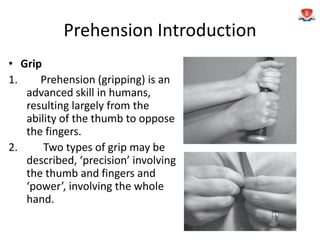
1. Prehension (gripping) is an
advanced skill in humans,
resulting largely from the
ability of the thumb to oppose
the fingers.
2. Two types of grip may be
described, ‘precision’ involving
the thumb and fingers and
‘power’, involving the whole
hand.
Power grip
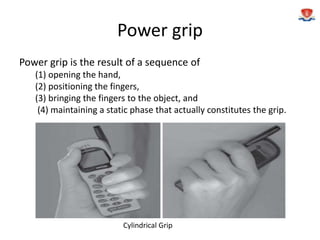
Power grip is the result of a sequence of
(1) opening the hand,
(2) positioning the fingers,
(3) bringing the fingers to the object, and
(4) maintaining a static phase that actually constitutes the grip.
Cylindrical Grip
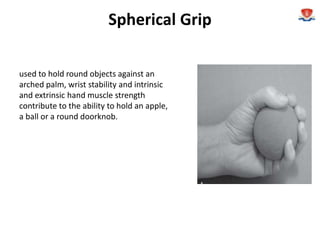
Spherical Grip
used to hold round objects against an
arched palm, wrist stability and intrinsic
and extrinsic hand muscle strength
contribute to the ability to hold an apple,
a ball or a round doorknob.
Hook Grip (Cylindrical Grasp)
occurs when an object is stabilized against
the palm by finger flexion, intrinsic and
thenar muscles are essential to the power of
this grasp.ex: include holding a drinking
glass, hammer, or pot handle.
The major muscular activity is provided by
the flexor digitorum profundus and flexor
digitorum superficialis muscles.
The load may be sustained completely by
one muscle or the other or by both muscles
Lateral prehension
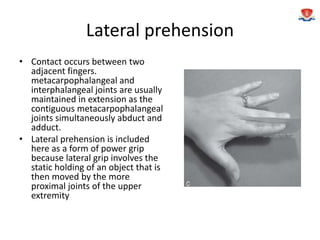
• Contact occurs between two
adjacent fingers.
metacarpophalangeal and
interphalangeal joints are usually
maintained in extension as the
contiguous metacarpophalangeal
joints simultaneously abduct and
adduct.
• Lateral prehension is included
here as a form of power grip
because lateral grip involves the
static holding of an object that is
then moved by the more
proximal joints of the upper
extremity
Precision Handling
The positions and muscular requirements of precision handling are
somewhat more variable than those of power grip, require much
finer motor control, and are more dependent on intact sensation.
The three varieties of precision handling that exemplify
this mode of prehension
Pad-to-pad prehension
• Pad-to-pad prehension involves opposition of the pad, or
pulp, of the thumb to the pad, or pulp, of th
• The pad of the distal phalanx of each digit has the greatest
concentration of tactile corpuscles found e finger
• The thumb in pad-to-pad prehension is held in
carpometacarpal flexion, abduction, and rotation
(opposition).
• The first metacarpophalangeal and interphalangeal joints
may be partially flexed or fully extended. The thenar
muscle control is provided by the opponens pollicis, flexor
pollicis brevis, and abductor pollicis brevis muscles, each of
which is innervated by the median nerve. The adductor
pollicis activity (ulnar nerve innervated) increases with
increased pressure of pinch. In ulnar nerve paralysis, loss
of adductor pollicis function (as well as loss of function of
the first dorsal interossei and first volar interossei muscles)
makes the thumb less stable and affects the precision of
the grasp activity
tip-to-tip prehension,
•The MCP joint of the opposing finger
must also be ulnarly deviated (with
fingertip pointed radially) to present the
tip of the finger to the thumb. In the first
finger, the ulnar deviation occurs as MCP
joint adduction. In the remaining fingers,
MCP abduction produces ulnar deviation
•Activity of the flexor digitorum
profundus, flexor pollicis longus, and
interossei muscles
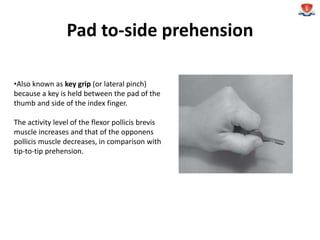
Pad to-side prehension
•Also known as key grip (or lateral pinch)
because a key is held between the pad of the
thumb and side of the index finger.
The activity level of the flexor pollicis brevis
muscle increases and that of the opponens
pollicis muscle decreases, in comparison with
tip-to-tip prehension.
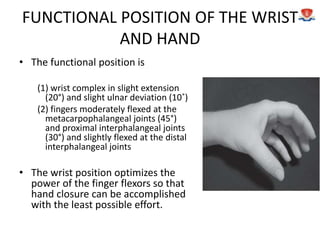
FUNCTIONAL POSITION OF THE WRIST
AND HAND
• The functional position is
(1) wrist complex in slight extension
(20°) and slight ulnar deviation (10˚)
(2) fingers moderately flexed at the
metacarpophalangeal joints (45°)
and proximal interphalangeal joints
(30°) and slightly flexed at the distal
interphalangeal joints
• The wrist position optimizes the
power of the finger flexors so that
hand closure can be accomplished
with the least possible effort.
Thank you…

Prehension

  • 1.
    PREHENSION Dr. Chandan Verma(PT) Assistantpofessor (Mahatma Gandhi Physiotherapy College, Jaipur)
  • 2.
    Prehension Introduction • Grip 1.Prehension (gripping) is an advanced skill in humans, resulting largely from the ability of the thumb to oppose the fingers. 2. Two types of grip may be described, ‘precision’ involving the thumb and fingers and ‘power’, involving the whole hand.
  • 3.
    Power grip Power gripis the result of a sequence of (1) opening the hand, (2) positioning the fingers, (3) bringing the fingers to the object, and (4) maintaining a static phase that actually constitutes the grip. Cylindrical Grip
  • 4.
    Spherical Grip used tohold round objects against an arched palm, wrist stability and intrinsic and extrinsic hand muscle strength contribute to the ability to hold an apple, a ball or a round doorknob.
  • 5.
    Hook Grip (CylindricalGrasp) occurs when an object is stabilized against the palm by finger flexion, intrinsic and thenar muscles are essential to the power of this grasp.ex: include holding a drinking glass, hammer, or pot handle. The major muscular activity is provided by the flexor digitorum profundus and flexor digitorum superficialis muscles. The load may be sustained completely by one muscle or the other or by both muscles
  • 6.
    Lateral prehension • Contactoccurs between two adjacent fingers. metacarpophalangeal and interphalangeal joints are usually maintained in extension as the contiguous metacarpophalangeal joints simultaneously abduct and adduct. • Lateral prehension is included here as a form of power grip because lateral grip involves the static holding of an object that is then moved by the more proximal joints of the upper extremity
  • 7.
    Precision Handling The positionsand muscular requirements of precision handling are somewhat more variable than those of power grip, require much finer motor control, and are more dependent on intact sensation. The three varieties of precision handling that exemplify this mode of prehension
  • 8.
    Pad-to-pad prehension • Pad-to-padprehension involves opposition of the pad, or pulp, of the thumb to the pad, or pulp, of th • The pad of the distal phalanx of each digit has the greatest concentration of tactile corpuscles found e finger • The thumb in pad-to-pad prehension is held in carpometacarpal flexion, abduction, and rotation (opposition). • The first metacarpophalangeal and interphalangeal joints may be partially flexed or fully extended. The thenar muscle control is provided by the opponens pollicis, flexor pollicis brevis, and abductor pollicis brevis muscles, each of which is innervated by the median nerve. The adductor pollicis activity (ulnar nerve innervated) increases with increased pressure of pinch. In ulnar nerve paralysis, loss of adductor pollicis function (as well as loss of function of the first dorsal interossei and first volar interossei muscles) makes the thumb less stable and affects the precision of the grasp activity
  • 9.
    tip-to-tip prehension, •The MCPjoint of the opposing finger must also be ulnarly deviated (with fingertip pointed radially) to present the tip of the finger to the thumb. In the first finger, the ulnar deviation occurs as MCP joint adduction. In the remaining fingers, MCP abduction produces ulnar deviation •Activity of the flexor digitorum profundus, flexor pollicis longus, and interossei muscles
  • 10.
    Pad to-side prehension •Alsoknown as key grip (or lateral pinch) because a key is held between the pad of the thumb and side of the index finger. The activity level of the flexor pollicis brevis muscle increases and that of the opponens pollicis muscle decreases, in comparison with tip-to-tip prehension.
  • 11.
    FUNCTIONAL POSITION OFTHE WRIST AND HAND • The functional position is (1) wrist complex in slight extension (20°) and slight ulnar deviation (10˚) (2) fingers moderately flexed at the metacarpophalangeal joints (45°) and proximal interphalangeal joints (30°) and slightly flexed at the distal interphalangeal joints • The wrist position optimizes the power of the finger flexors so that hand closure can be accomplished with the least possible effort.
  • 12.