

BY :
DIVYA KHANDELWAL
16164
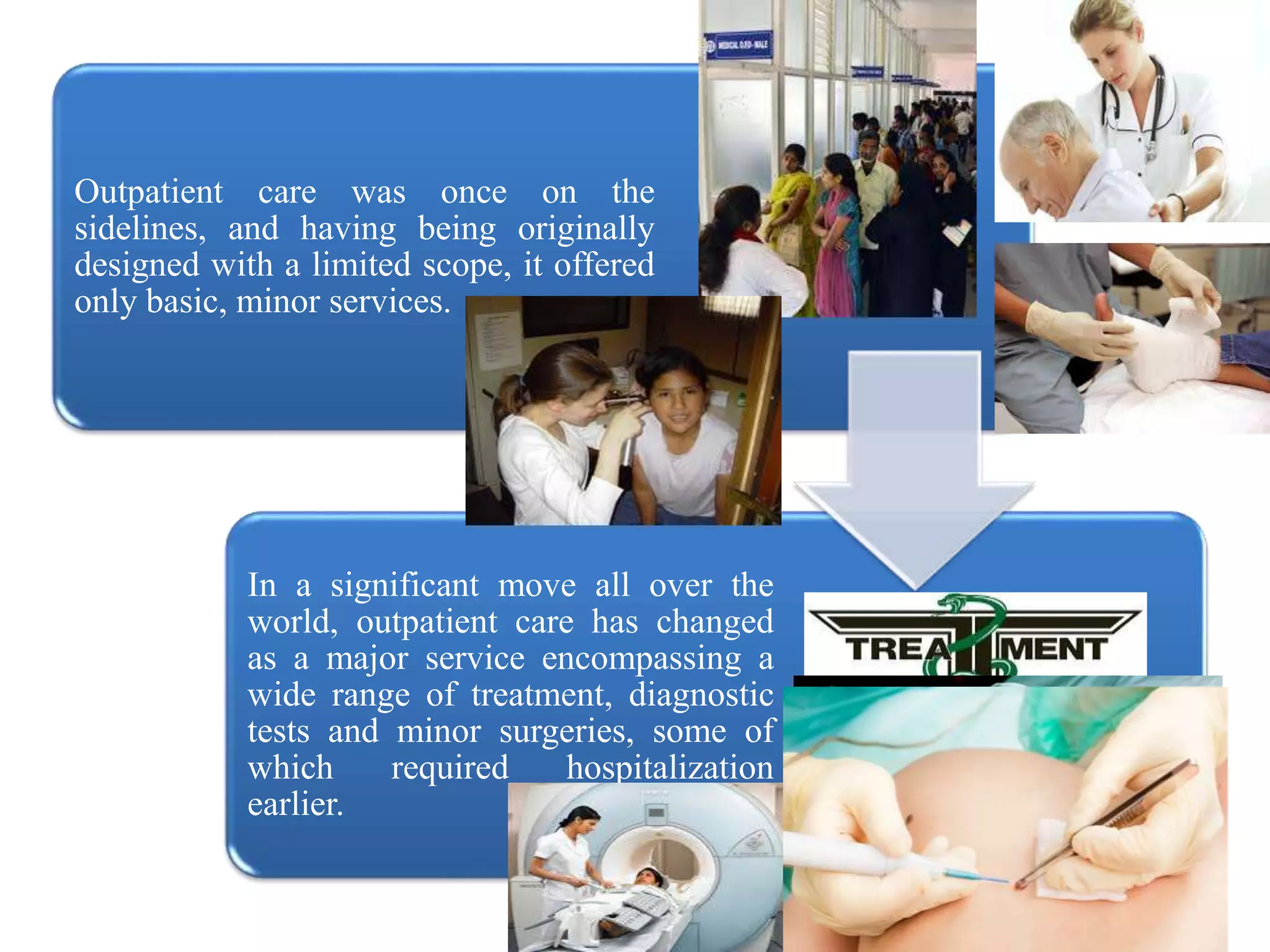
Outpatient care was once on the
sidelines, and having being originally
designed with a limited scope, it offered
only basic, minor services.
In a significant move all over the
world, outpatient care has changed
as a major service encompassing a
wide range of treatment, diagnostic
tests and minor surgeries, some of
which required hospitalization
earlier.
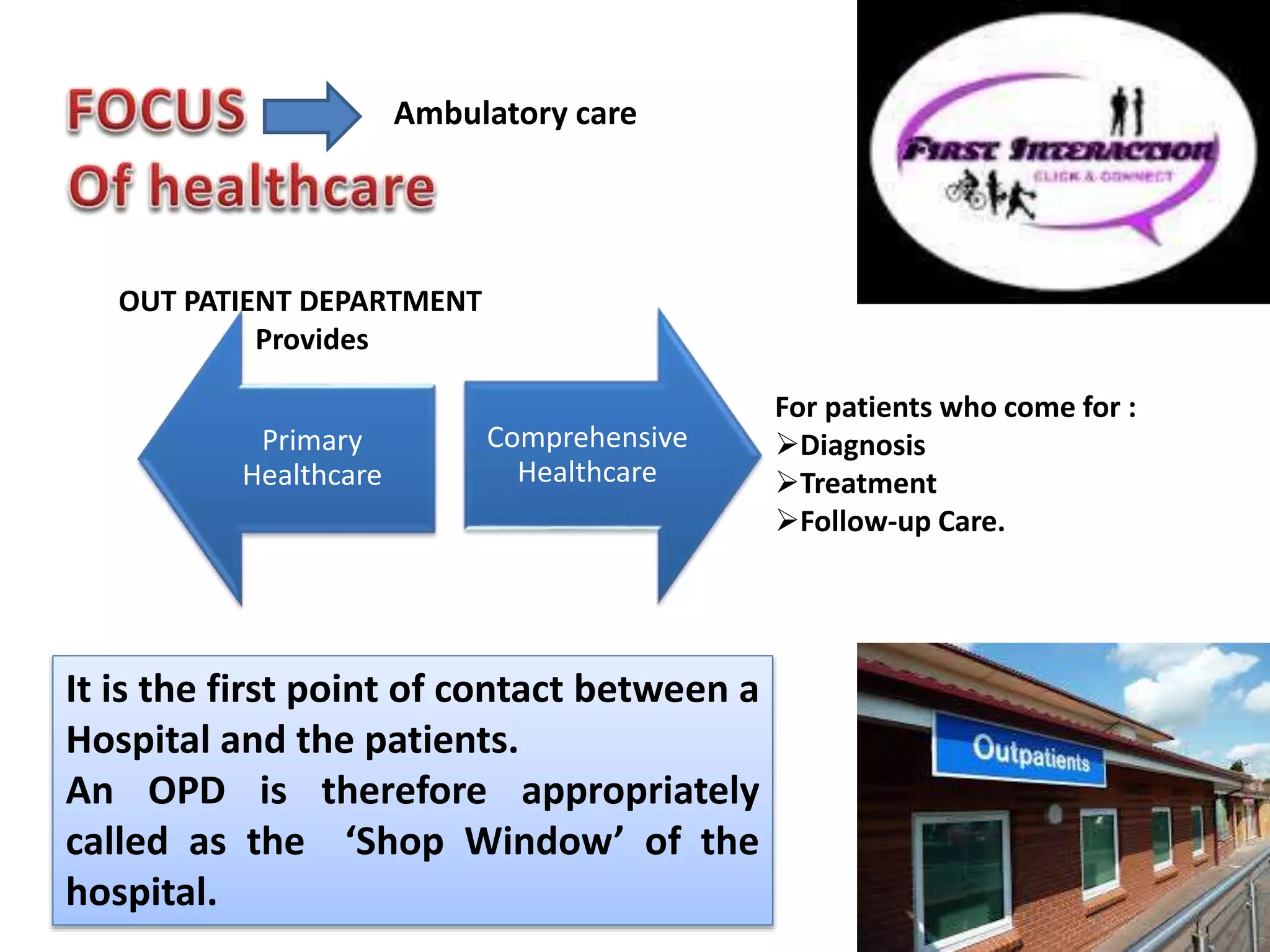
Ambulatory care
Primary
Healthcare
Comprehensive
Healthcare
OUT PATIENT DEPARTMENT
Provides
For patients who come for :
Diagnosis
Treatment
Follow-up Care.
It is the first point of contact between a
Hospital and the patients.
An OPD is therefore appropriately
called as the ‘Shop Window’ of the
hospital.
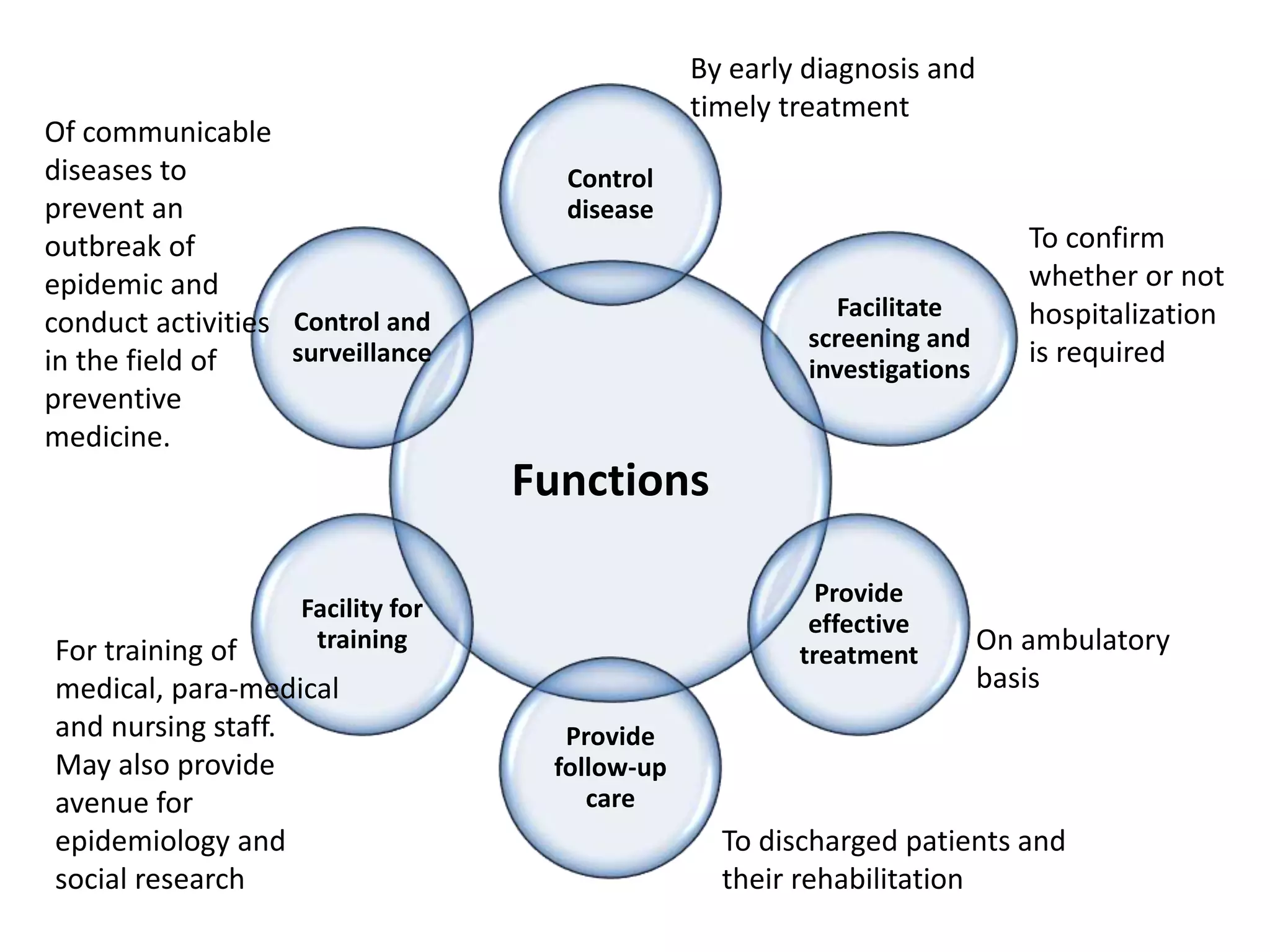
Functions
Control
disease
Facilitate
screening and
investigations
Provide
effective
treatment
Provide
follow-up
care
Facility for
training
Control and
surveillance
By early diagnosis and
timely treatment
To confirm
whether or not
hospitalization
is required
On ambulatory
basis
To discharged patients and
their rehabilitation
For training of
medical, para-medical
and nursing staff.
May also provide
avenue for
epidemiology and
social research
Of communicable
diseases to
prevent an
outbreak of
epidemic and
conduct activities
in the field of
preventive
medicine.
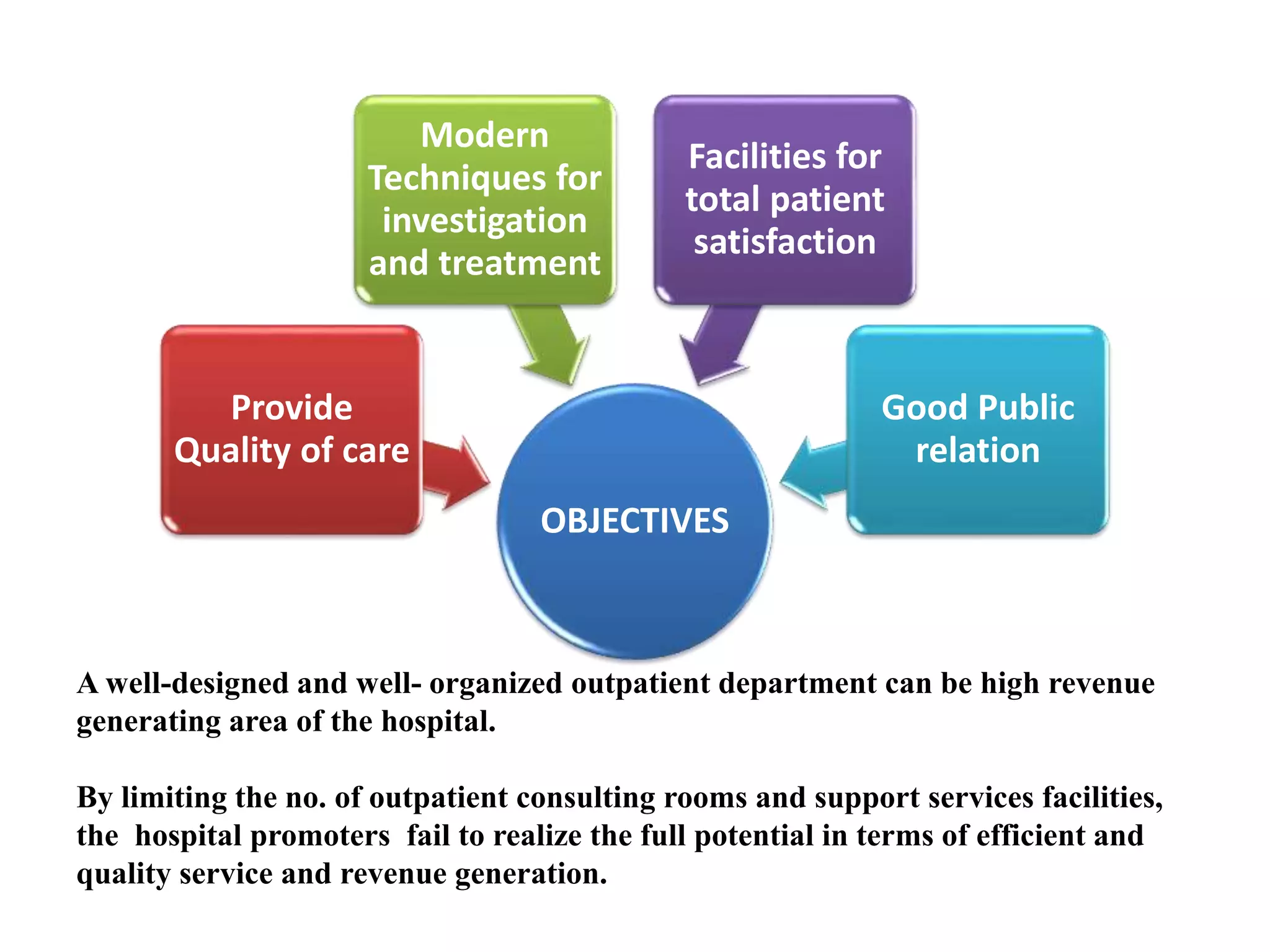
OBJECTIVES
Provide
Quality of care
Modern
Techniques for
investigation
and treatment
Facilities for
total patient
satisfaction
Good Public
relation
A well-designed and well- organized outpatient department can be high revenue
generating area of the hospital.
By limiting the no. of outpatient consulting rooms and support services facilities,
the hospital promoters fail to realize the full potential in terms of efficient and
quality service and revenue generation.
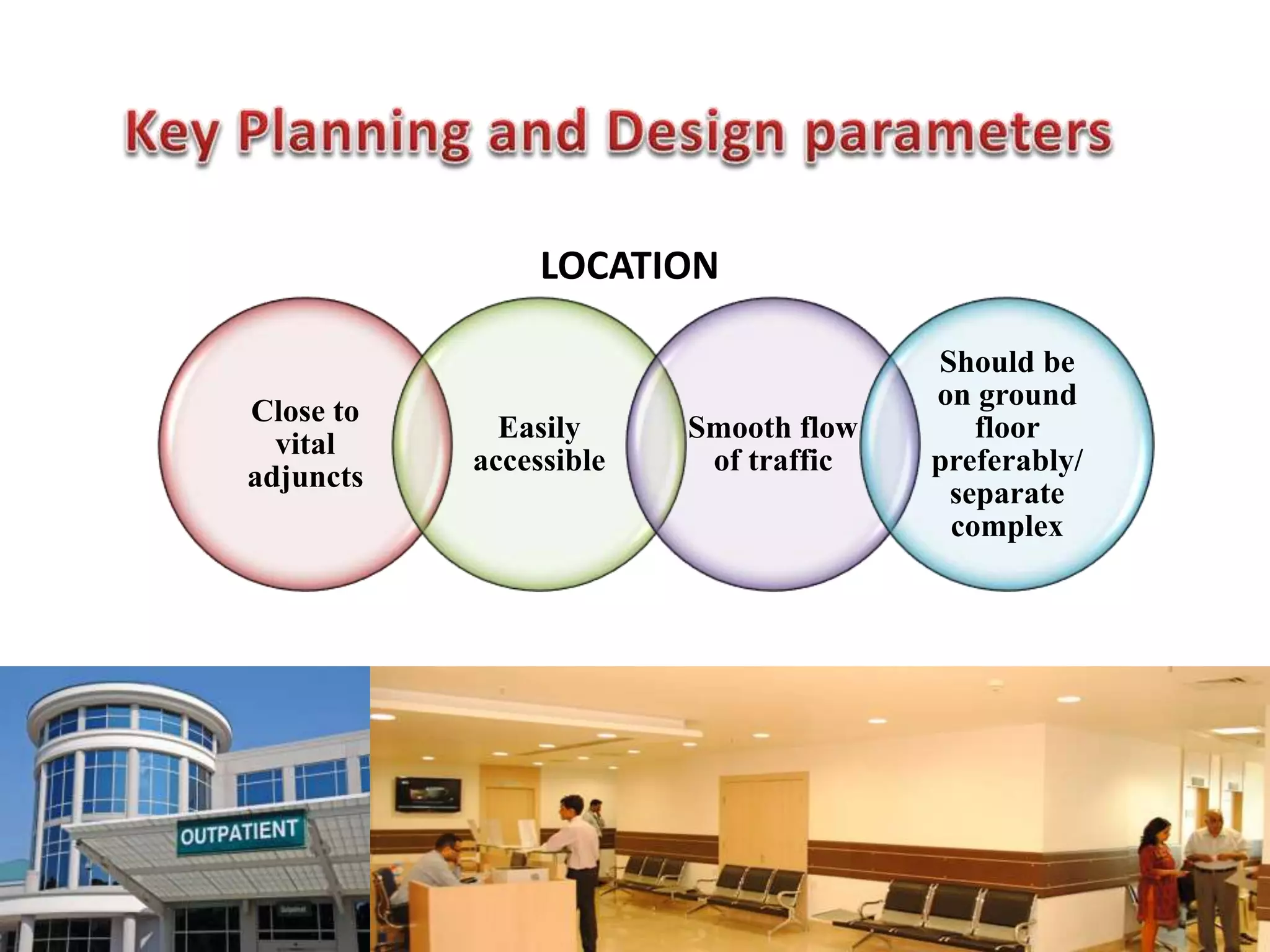
Close to
vital
adjuncts
Easily
accessible
Smooth flow
of traffic
Should be
on ground
floor
preferably/
separate
complex
LOCATION
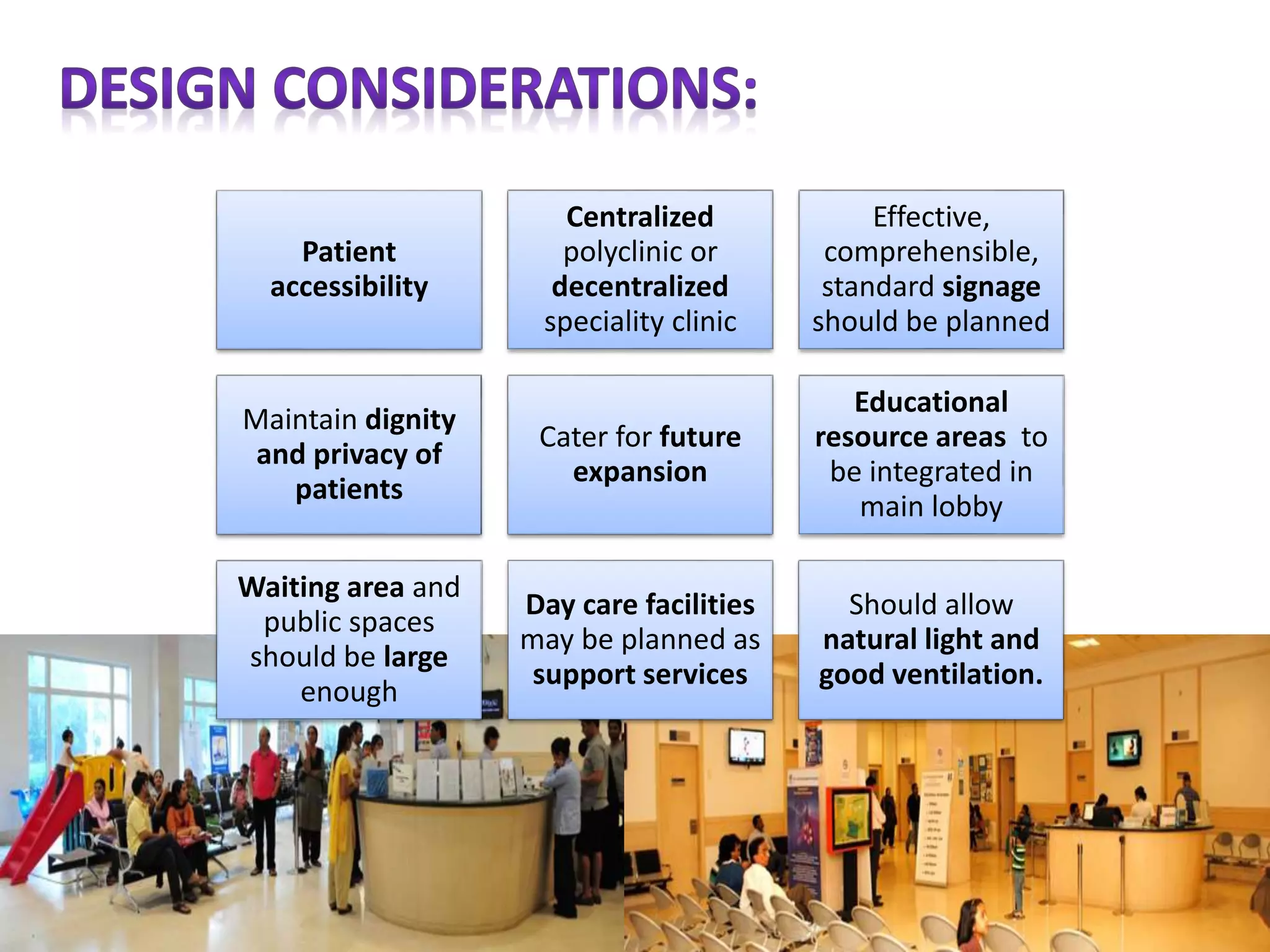
Patient
accessibility
Centralized
polyclinic or
decentralized
speciality clinic
Effective,
comprehensible,
standard signage
should be planned
Maintain dignity
and privacy of
patients
Cater for future
expansion
Educational
resource areas to
be integrated in
main lobby
Waiting area and
public spaces
should be large
enough
Day care facilities
may be planned as
support services
Should allow
natural light and
good ventilation.
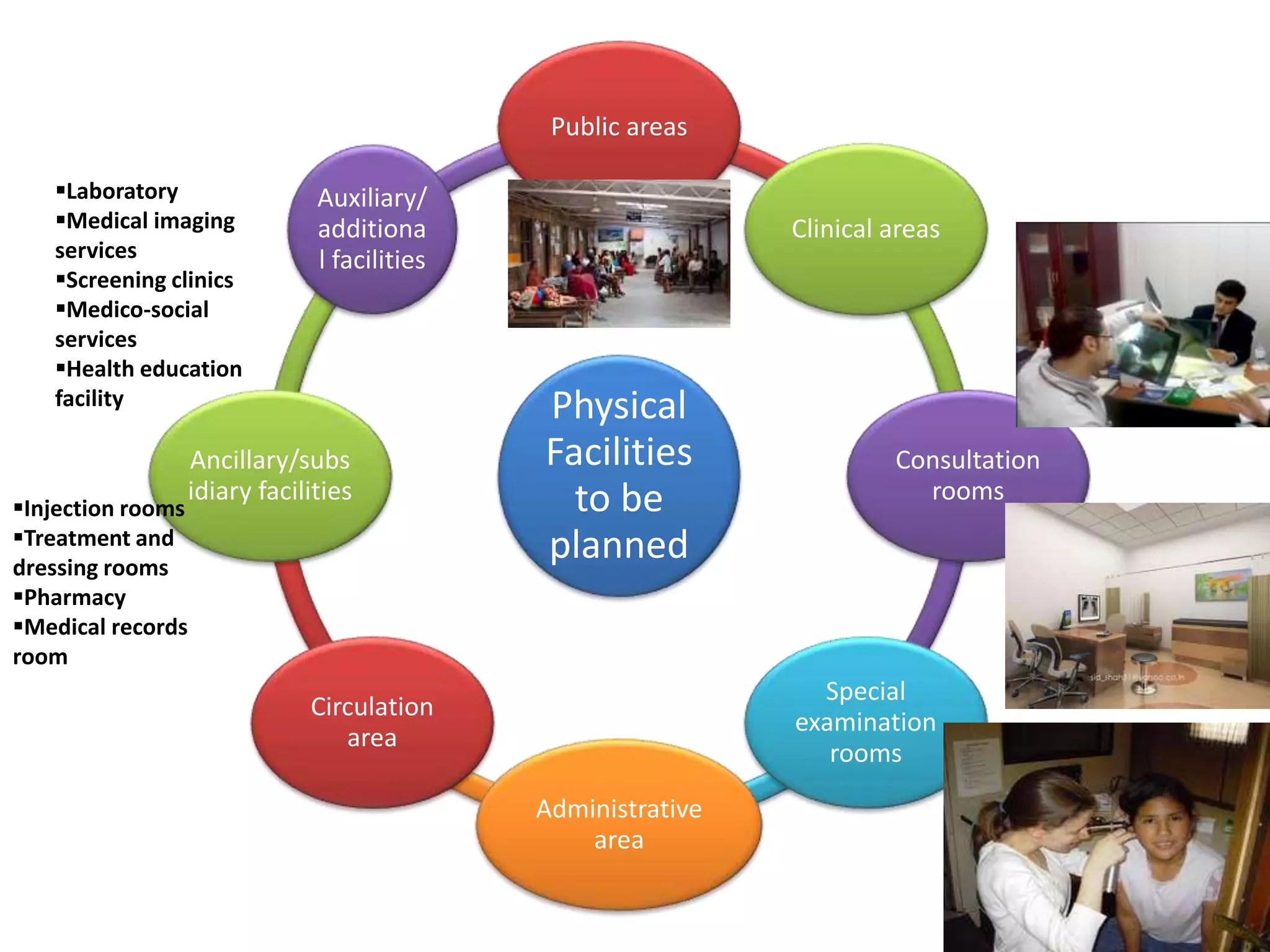
Physical
Facilities
to be
planned
Public areas
Clinical areas
Consultation
rooms
Special
examination
rooms
Administrative
area
Circulation
area
Ancillary/subs
idiary facilities
Auxiliary/
additiona
l facilities
Injection rooms
Treatment and
dressing rooms
Pharmacy
Medical records
room
Laboratory
Medical imaging
services
Screening clinics
Medico-social
services
Health education
facility
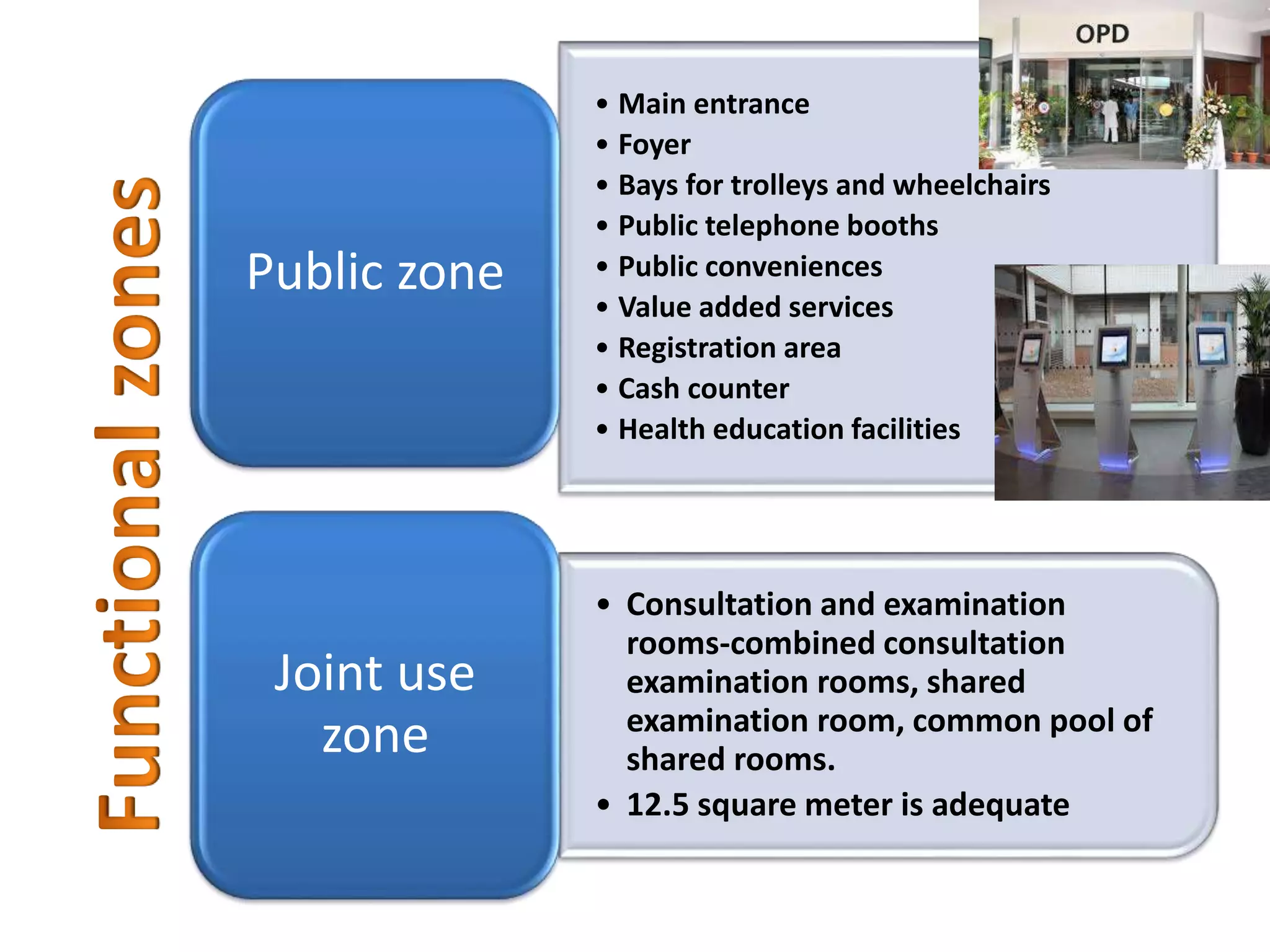
• Main entrance
• Foyer
• Bays for trolleys and wheelchairs
• Public telephone booths
• Public conveniences
• Value added services
• Registration area
• Cash counter
• Health education facilities
Public zone
• Consultation and examination
rooms-combined consultation
examination rooms, shared
examination room, common pool of
shared rooms.
• 12.5 square meter is adequate
Joint use
zone
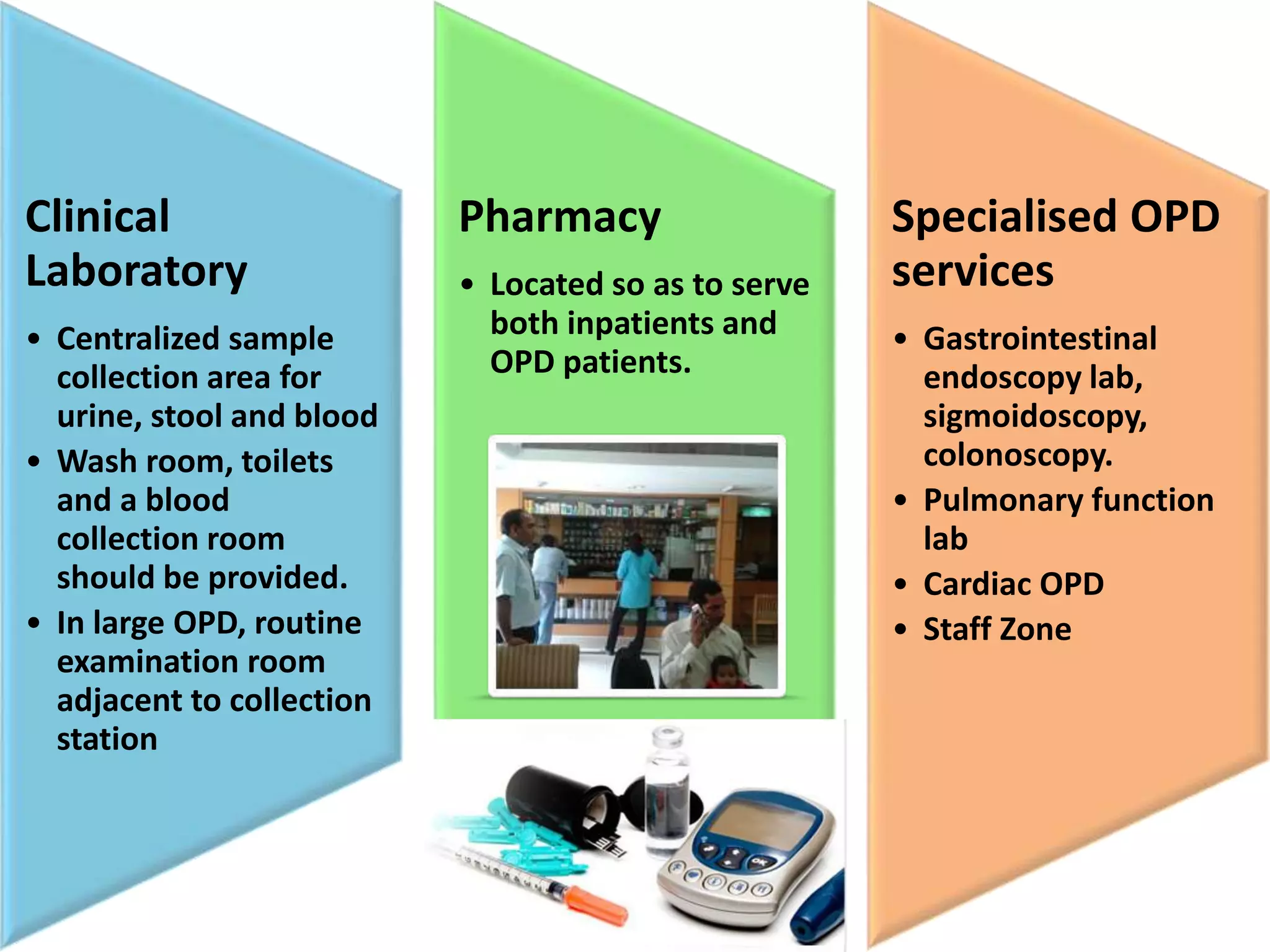
Clinical
Laboratory
• Centralized sample
collection area for
urine, stool and blood
• Wash room, toilets
and a blood
collection room
should be provided.
• In large OPD, routine
examination room
adjacent to collection
station
Pharmacy
• Located so as to serve
both inpatients and
OPD patients.
Specialised OPD
services
• Gastrointestinal
endoscopy lab,
sigmoidoscopy,
colonoscopy.
• Pulmonary function
lab
• Cardiac OPD
• Staff Zone
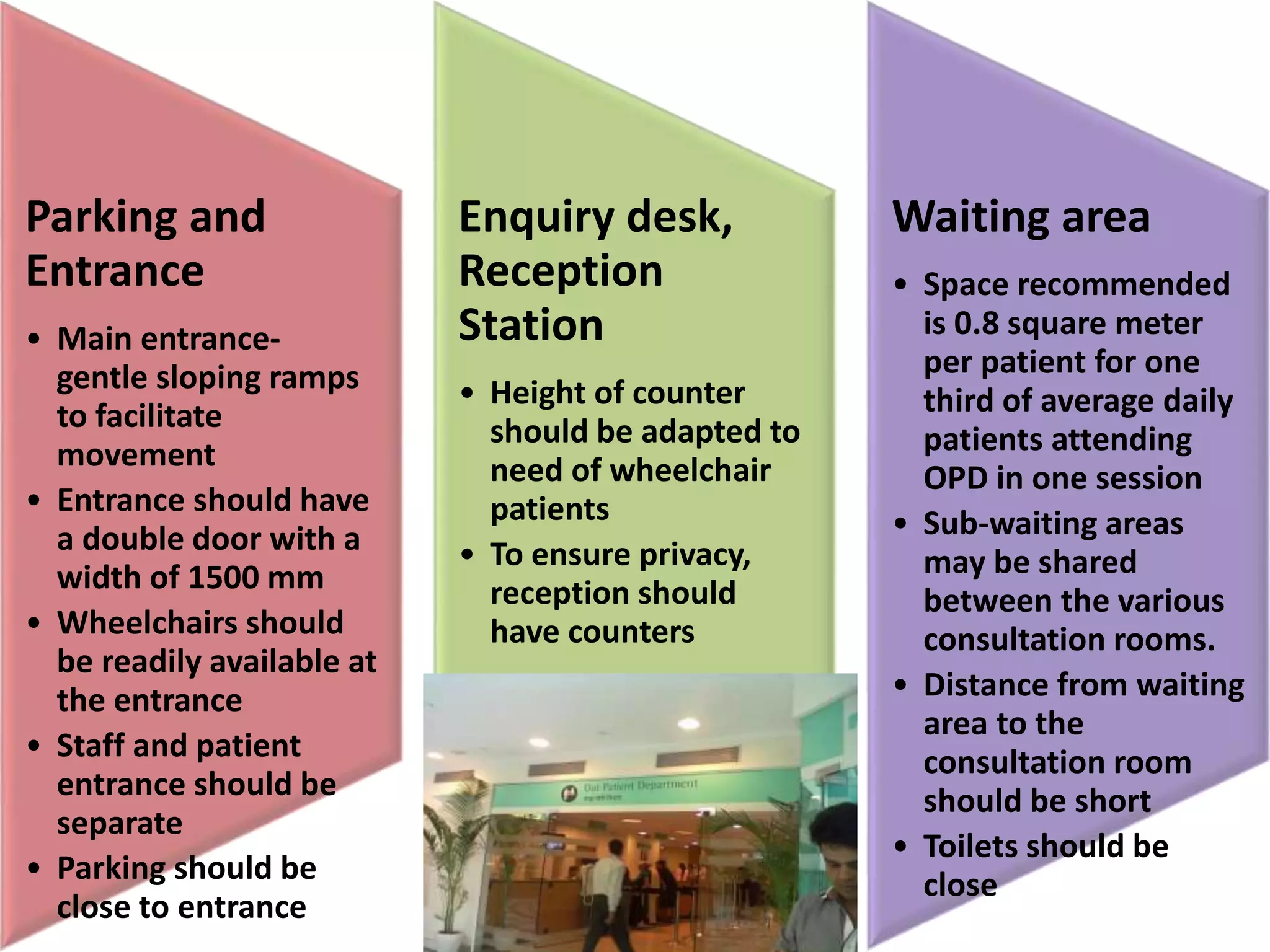
Parking and
Entrance
• Main entrance-
gentle sloping ramps
to facilitate
movement
• Entrance should have
a double door with a
width of 1500 mm
• Wheelchairs should
be readily available at
the entrance
• Staff and patient
entrance should be
separate
• Parking should be
close to entrance
Enquiry desk,
Reception
Station
• Height of counter
should be adapted to
need of wheelchair
patients
• To ensure privacy,
reception should
have counters
Waiting area
• Space recommended
is 0.8 square meter
per patient for one
third of average daily
patients attending
OPD in one session
• Sub-waiting areas
may be shared
between the various
consultation rooms.
• Distance from waiting
area to the
consultation room
should be short
• Toilets should be
close
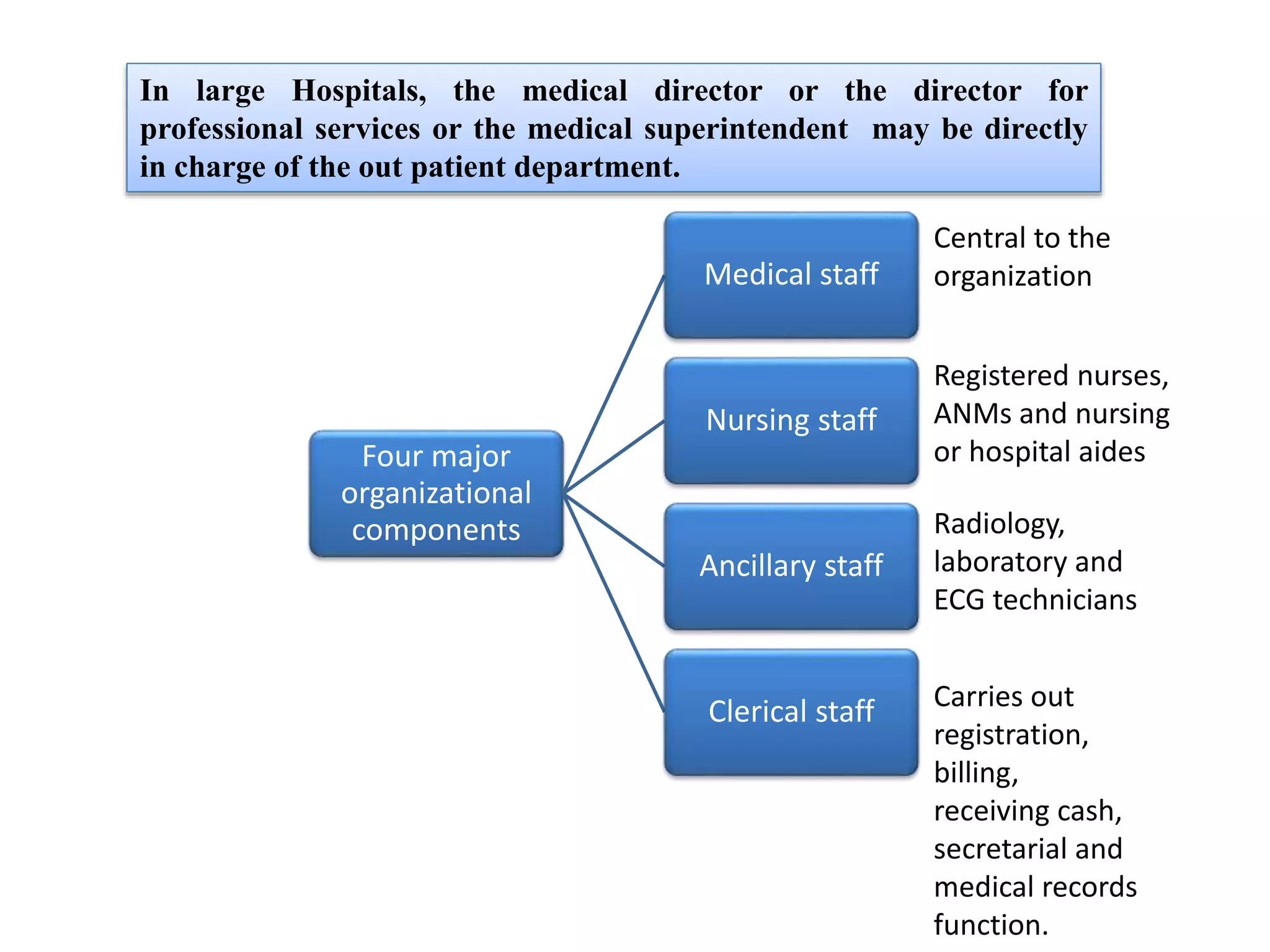
Four major
organizational
components
Medical staff
Nursing staff
Ancillary staff
Clerical staff
In large Hospitals, the medical director or the director for
professional services or the medical superintendent may be directly
in charge of the out patient department.
Central to the
organization
Registered nurses,
ANMs and nursing
or hospital aides
Radiology,
laboratory and
ECG technicians
Carries out
registration,
billing,
receiving cash,
secretarial and
medical records
function.
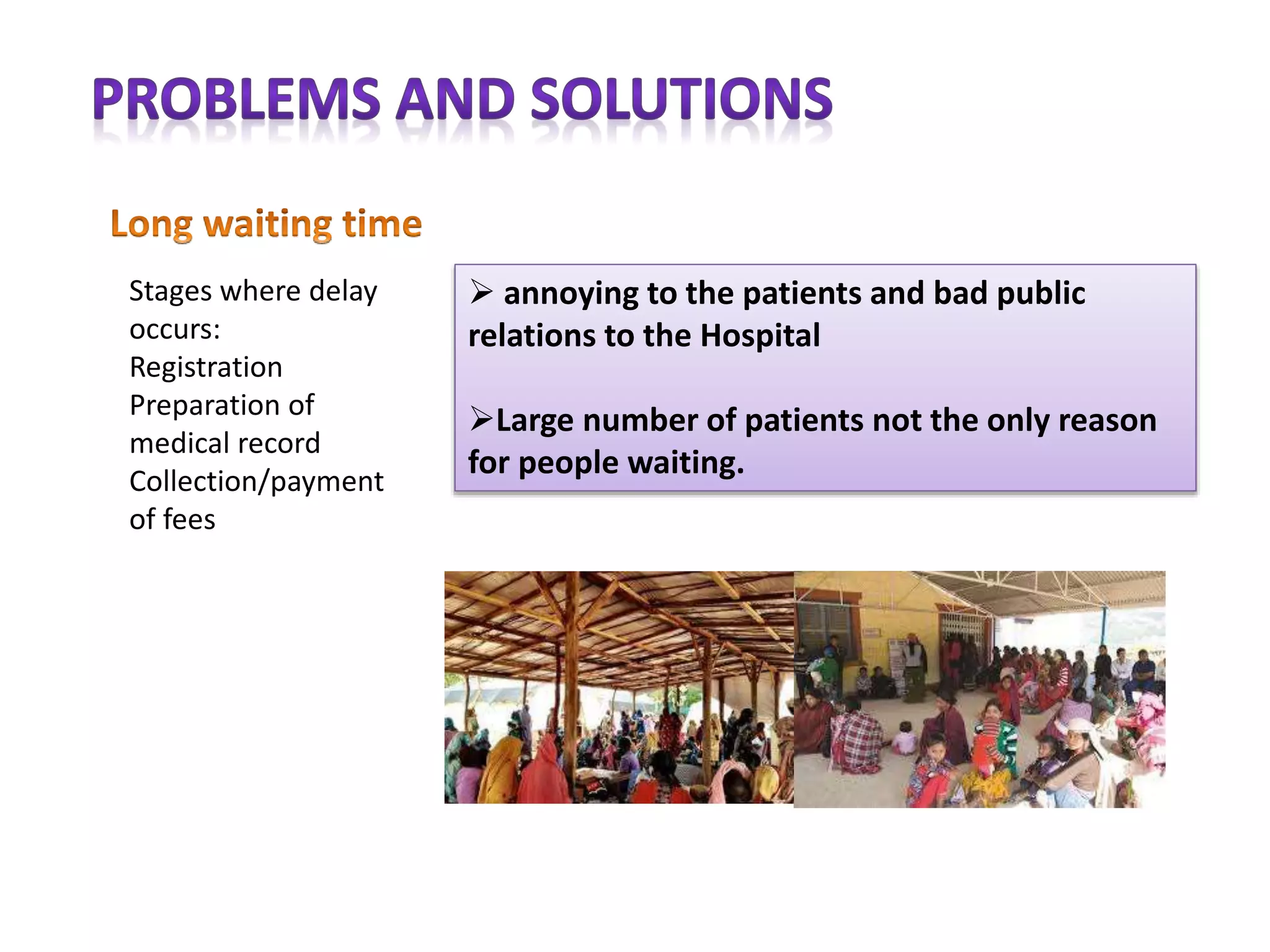
 annoying to the patients and bad public
relations to the Hospital
Large number of patients not the only reason
for people waiting.
Stages where delay
occurs:
Registration
Preparation of
medical record
Collection/payment
of fees
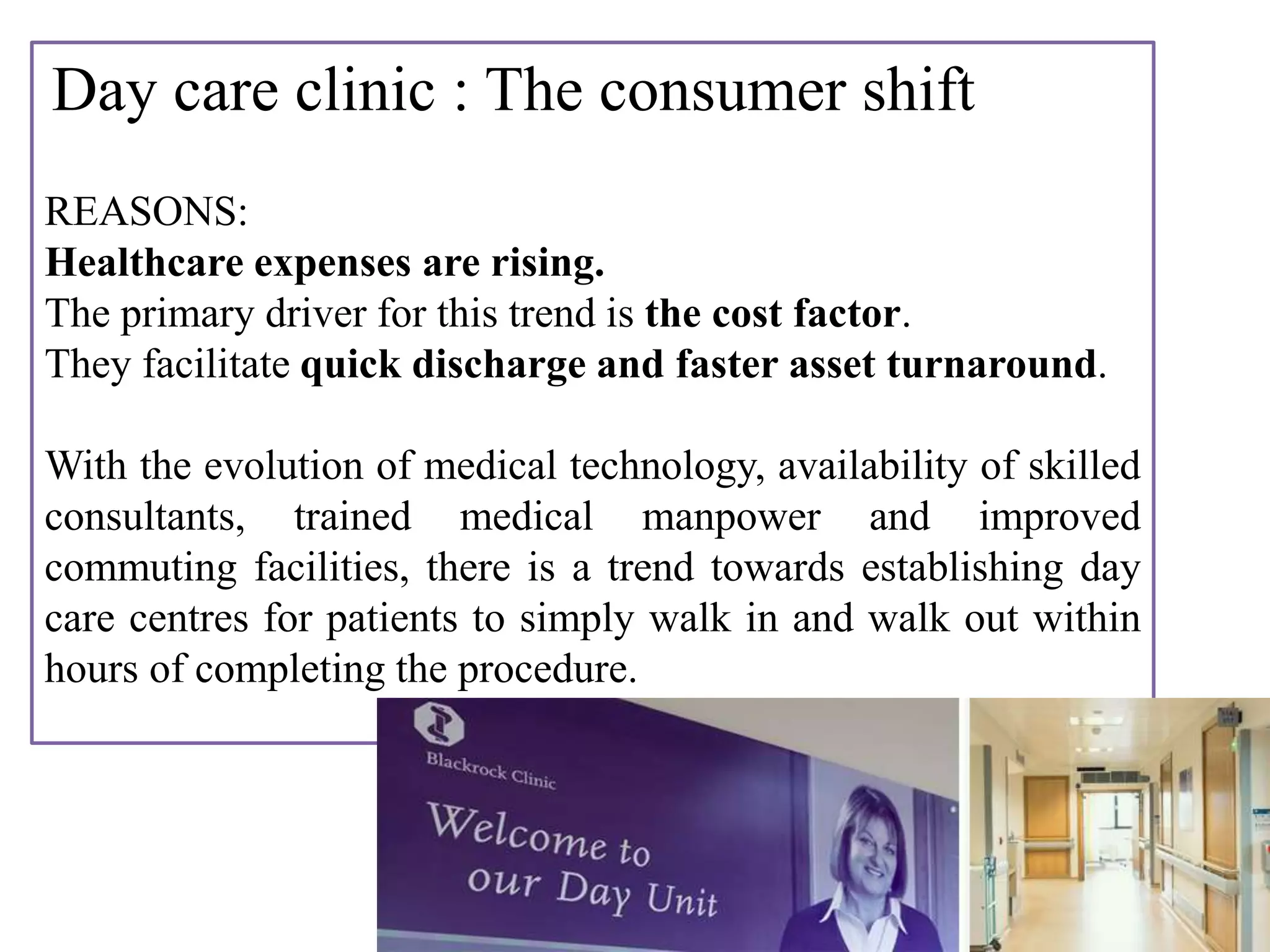
Day care clinic : The consumer shift
REASONS:
Healthcare expenses are rising.
The primary driver for this trend is the cost factor.
They facilitate quick discharge and faster asset turnaround.
With the evolution of medical technology, availability of skilled
consultants, trained medical manpower and improved
commuting facilities, there is a trend towards establishing day
care centres for patients to simply walk in and walk out within
hours of completing the procedure.
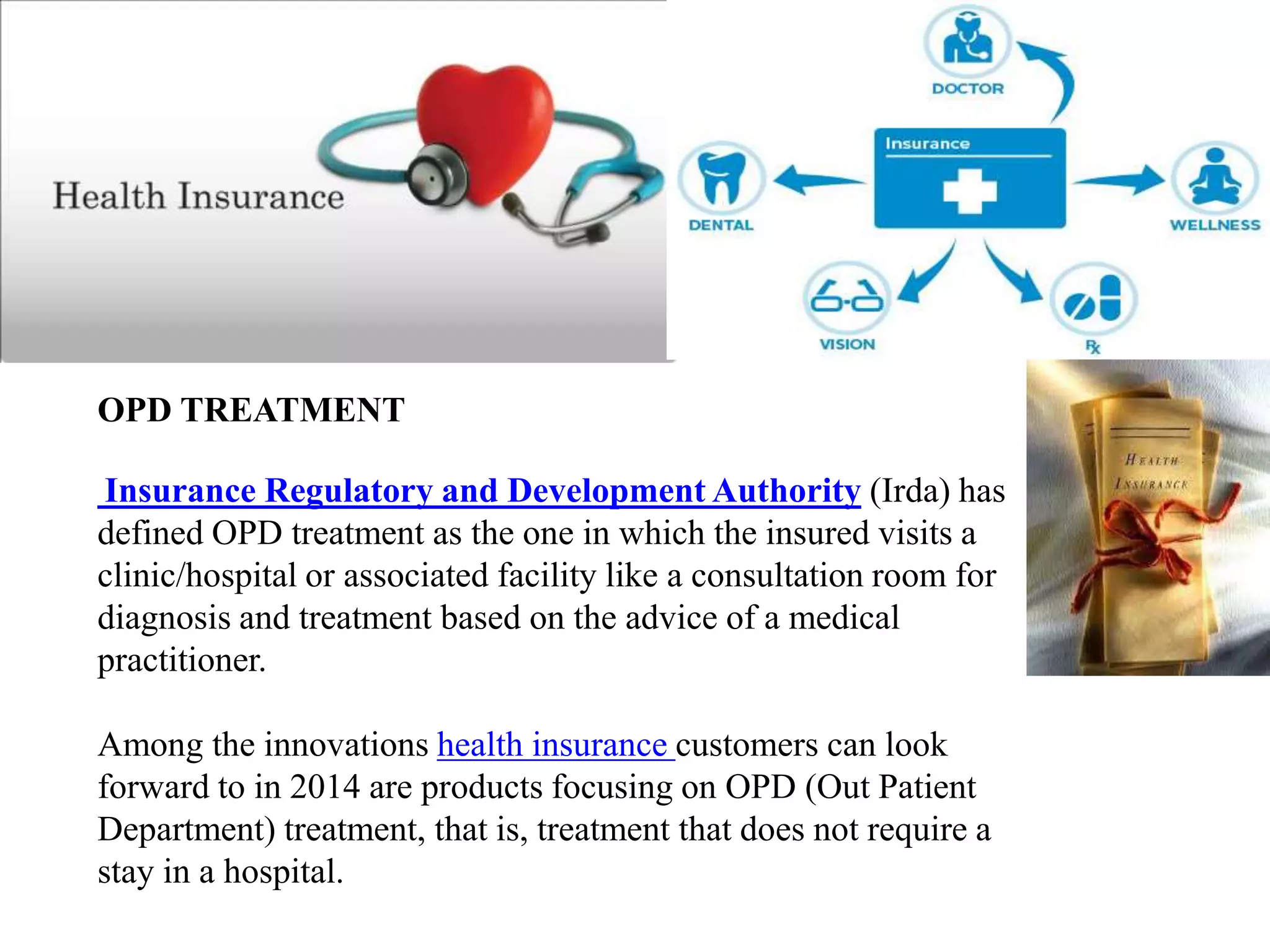
OPD TREATMENT
Insurance Regulatory and Development Authority (Irda) has
defined OPD treatment as the one in which the insured visits a
clinic/hospital or associated facility like a consultation room for
diagnosis and treatment based on the advice of a medical
practitioner.
Among the innovations health insurance customers can look
forward to in 2014 are products focusing on OPD (Out Patient
Department) treatment, that is, treatment that does not require a
stay in a hospital.
A recent report by ICICI Lombard General
Insurance company says insurance companies will
focus on OPD, in line with changing customer trends
and the emergence of shorter treatments.
The fact that primary healthcare in India is still
largely unorganized is the biggest reason insurers
don’t offer or market OPD covers in a big way. That
is also why the pricing for such covers tends to be 100
per cent.
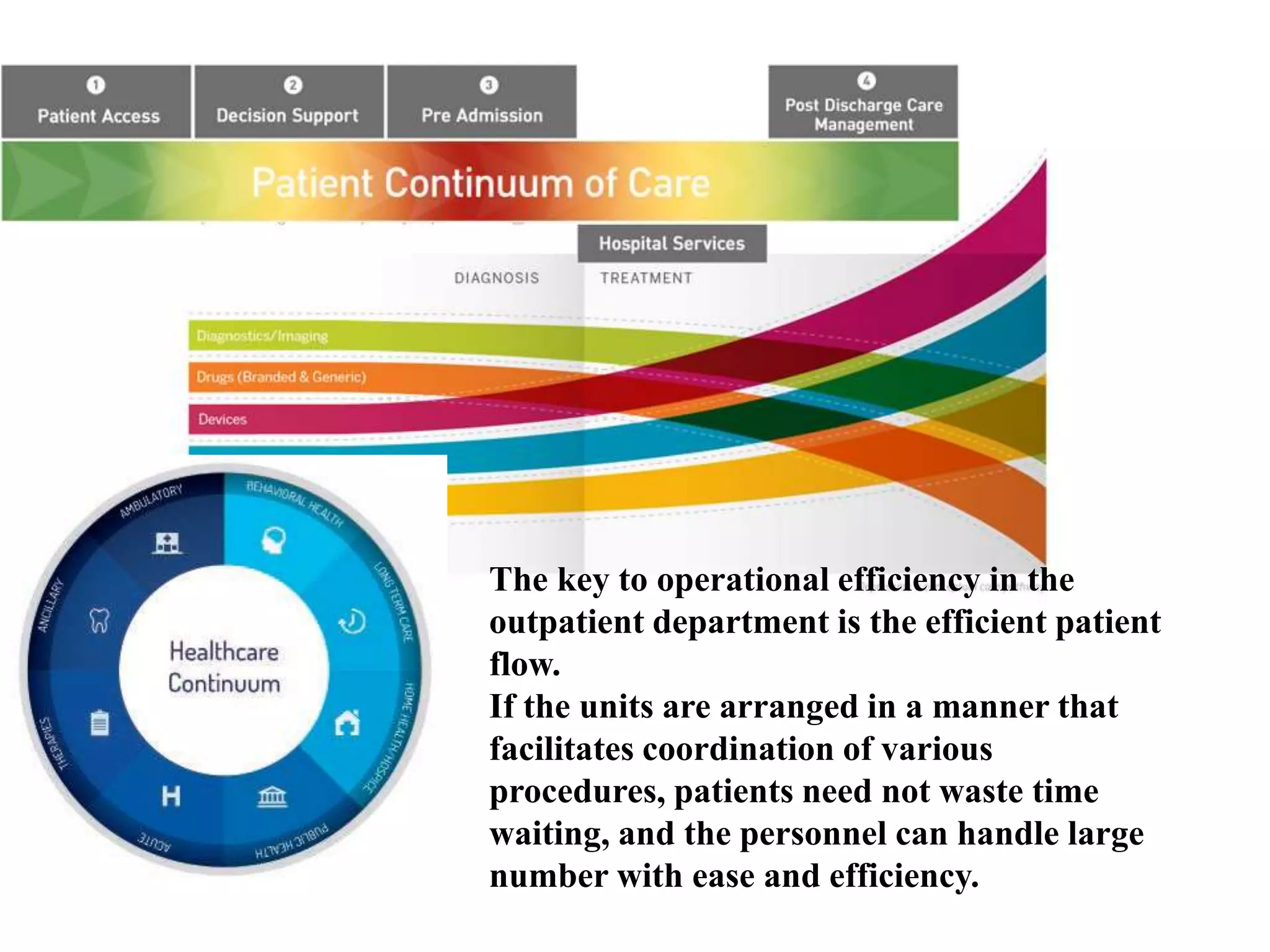
The key to operational efficiency in the
outpatient department is the efficient patient
flow.
If the units are arranged in a manner that
facilitates coordination of various
procedures, patients need not waste time
waiting, and the personnel can handle large
number with ease and efficiency.
Design and Management of Opd

Design and Management of Opd

  • 1.
  • 2.
    Outpatient care wasonce on the sidelines, and having being originally designed with a limited scope, it offered only basic, minor services. In a significant move all over the world, outpatient care has changed as a major service encompassing a wide range of treatment, diagnostic tests and minor surgeries, some of which required hospitalization earlier.
  • 3.
    Ambulatory care Primary Healthcare Comprehensive Healthcare OUT PATIENTDEPARTMENT Provides For patients who come for : Diagnosis Treatment Follow-up Care. It is the first point of contact between a Hospital and the patients. An OPD is therefore appropriately called as the ‘Shop Window’ of the hospital.
  • 4.
    Functions Control disease Facilitate screening and investigations Provide effective treatment Provide follow-up care Facility for training Controland surveillance By early diagnosis and timely treatment To confirm whether or not hospitalization is required On ambulatory basis To discharged patients and their rehabilitation For training of medical, para-medical and nursing staff. May also provide avenue for epidemiology and social research Of communicable diseases to prevent an outbreak of epidemic and conduct activities in the field of preventive medicine.
  • 5.
    OBJECTIVES Provide Quality of care Modern Techniquesfor investigation and treatment Facilities for total patient satisfaction Good Public relation A well-designed and well- organized outpatient department can be high revenue generating area of the hospital. By limiting the no. of outpatient consulting rooms and support services facilities, the hospital promoters fail to realize the full potential in terms of efficient and quality service and revenue generation.
  • 6.
    Close to vital adjuncts Easily accessible Smooth flow oftraffic Should be on ground floor preferably/ separate complex LOCATION
  • 7.
    Patient accessibility Centralized polyclinic or decentralized speciality clinic Effective, comprehensible, standardsignage should be planned Maintain dignity and privacy of patients Cater for future expansion Educational resource areas to be integrated in main lobby Waiting area and public spaces should be large enough Day care facilities may be planned as support services Should allow natural light and good ventilation.
  • 8.
    Physical Facilities to be planned Public areas Clinicalareas Consultation rooms Special examination rooms Administrative area Circulation area Ancillary/subs idiary facilities Auxiliary/ additiona l facilities Injection rooms Treatment and dressing rooms Pharmacy Medical records room Laboratory Medical imaging services Screening clinics Medico-social services Health education facility
  • 9.
    • Main entrance •Foyer • Bays for trolleys and wheelchairs • Public telephone booths • Public conveniences • Value added services • Registration area • Cash counter • Health education facilities Public zone • Consultation and examination rooms-combined consultation examination rooms, shared examination room, common pool of shared rooms. • 12.5 square meter is adequate Joint use zone
  • 10.
    Clinical Laboratory • Centralized sample collectionarea for urine, stool and blood • Wash room, toilets and a blood collection room should be provided. • In large OPD, routine examination room adjacent to collection station Pharmacy • Located so as to serve both inpatients and OPD patients. Specialised OPD services • Gastrointestinal endoscopy lab, sigmoidoscopy, colonoscopy. • Pulmonary function lab • Cardiac OPD • Staff Zone
  • 11.
    Parking and Entrance • Mainentrance- gentle sloping ramps to facilitate movement • Entrance should have a double door with a width of 1500 mm • Wheelchairs should be readily available at the entrance • Staff and patient entrance should be separate • Parking should be close to entrance Enquiry desk, Reception Station • Height of counter should be adapted to need of wheelchair patients • To ensure privacy, reception should have counters Waiting area • Space recommended is 0.8 square meter per patient for one third of average daily patients attending OPD in one session • Sub-waiting areas may be shared between the various consultation rooms. • Distance from waiting area to the consultation room should be short • Toilets should be close
  • 12.
    Four major organizational components Medical staff Nursingstaff Ancillary staff Clerical staff In large Hospitals, the medical director or the director for professional services or the medical superintendent may be directly in charge of the out patient department. Central to the organization Registered nurses, ANMs and nursing or hospital aides Radiology, laboratory and ECG technicians Carries out registration, billing, receiving cash, secretarial and medical records function.
  • 13.
     annoying tothe patients and bad public relations to the Hospital Large number of patients not the only reason for people waiting. Stages where delay occurs: Registration Preparation of medical record Collection/payment of fees
  • 14.
    Day care clinic: The consumer shift REASONS: Healthcare expenses are rising. The primary driver for this trend is the cost factor. They facilitate quick discharge and faster asset turnaround. With the evolution of medical technology, availability of skilled consultants, trained medical manpower and improved commuting facilities, there is a trend towards establishing day care centres for patients to simply walk in and walk out within hours of completing the procedure.
  • 15.
    OPD TREATMENT Insurance Regulatoryand Development Authority (Irda) has defined OPD treatment as the one in which the insured visits a clinic/hospital or associated facility like a consultation room for diagnosis and treatment based on the advice of a medical practitioner. Among the innovations health insurance customers can look forward to in 2014 are products focusing on OPD (Out Patient Department) treatment, that is, treatment that does not require a stay in a hospital.
  • 16.
    A recent reportby ICICI Lombard General Insurance company says insurance companies will focus on OPD, in line with changing customer trends and the emergence of shorter treatments. The fact that primary healthcare in India is still largely unorganized is the biggest reason insurers don’t offer or market OPD covers in a big way. That is also why the pricing for such covers tends to be 100 per cent.
  • 17.
    The key tooperational efficiency in the outpatient department is the efficient patient flow. If the units are arranged in a manner that facilitates coordination of various procedures, patients need not waste time waiting, and the personnel can handle large number with ease and efficiency.