An IPv6 Case Study: Finland
ION Conference, Malta 18.9.2017
|
To regulate or not to regulate?
18.9.2017Klaus Nieminen 2
|
The Finnish IPv6 Task Force
FICORA working group
Group of 67 IPv6
experts and advocates
» IETF, industry and ISP
experts
» some of them even you
might know
The group has been
active ≥ 10 years
» And now its work is
more or less done
18.9.2017Klaus Nieminen 3
|
Recommendation for implementing IPv6
in consumer broadband subscriptions
FICORA published a recommendation to promote
the introduction of IPv6 to consumer broadband
subscriptions in 2014.
» The recommendation was prepared by the Finnish IPv6
working group and is available only in Finnish.
Some highlights
» All additional services such as email, webpage and
security should work with both IPv4 and IPv6
» /56 prefix for end users
» Recommendations e.g. for security, subscription
identification, CPE support, lease times, packet
filtering, transition (6rd) and informing end users
18.9.2017Klaus Nieminen 4
|
Finnish IPv6 launch
The launch date was 9.6.2015
» It is still open for anyone who wants to participate
The requirement for participating the launch is
» to take IPv6 into use permanently
» in broadband subscriptions, websites or services
» The participation is possible also with selected
broadband technologies, websites or content services.
For more information
» www.ipv6now.fi
18.9.2017Klaus Nieminen 5
|
The Finnish IPv6 launch was
organized with partners:
18.9.2017Klaus Nieminen 6
|
Finnish IPv6 launch participants
Broadband Service Providers
• 8 ISPs including all 3 major ISPs
Content and web service providers
• 16 hosting providers, media and private
companies and organizations.
• Including the national broadcasting company Yle
and 2 of the top 5 websites
18.9.2017Klaus Nieminen 7
We had two participation categories
|
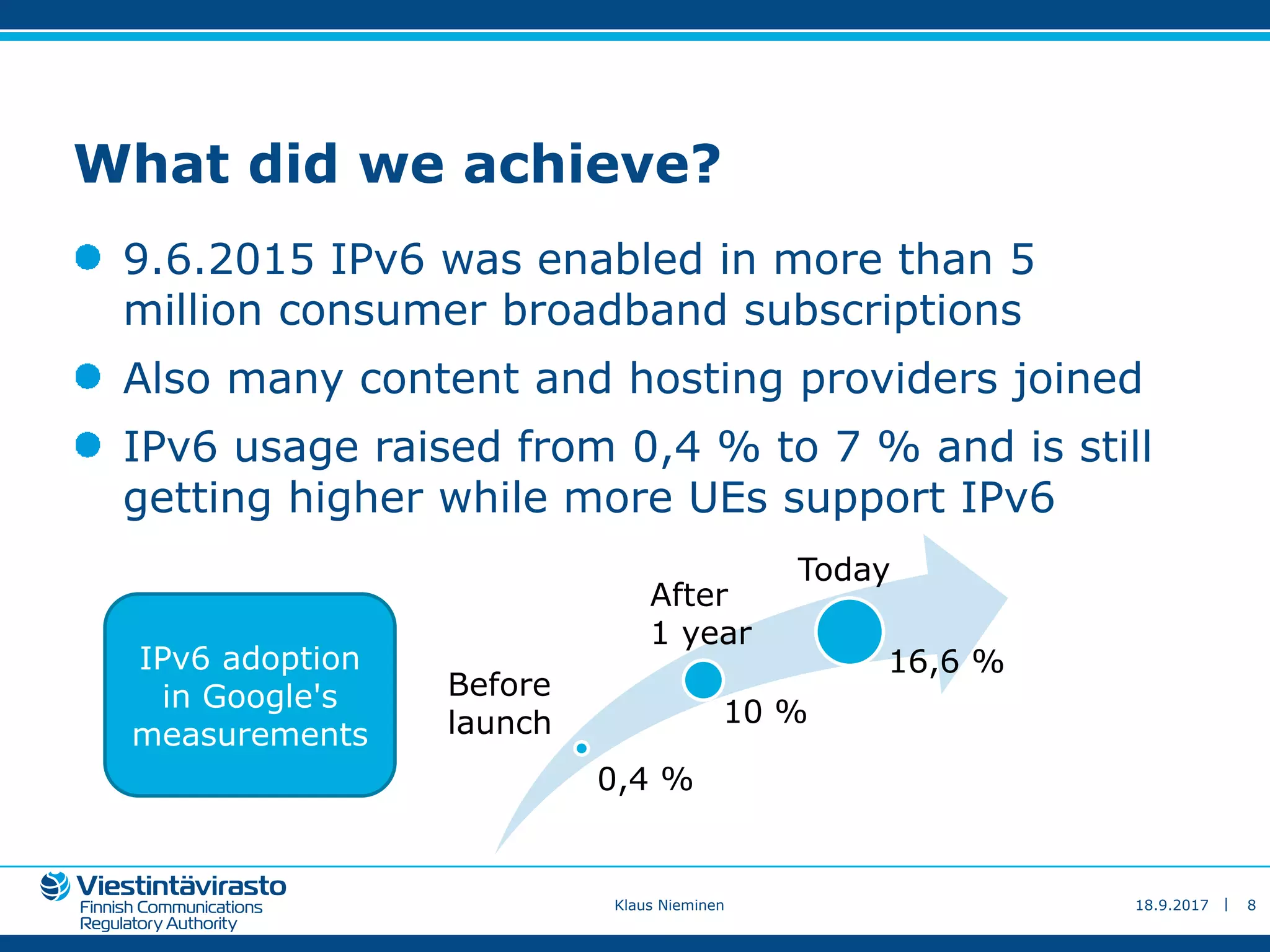
What did we achieve?
0,4 %
10 %
16,6 %
18.9.2017Klaus Nieminen 8
9.6.2015 IPv6 was enabled in more than 5
million consumer broadband subscriptions
Also many content and hosting providers joined
IPv6 usage raised from 0,4 % to 7 % and is still
getting higher while more UEs support IPv6
Before
launch
After
1 year
Today
IPv6 adoption
in Google's
measurements
|
Challenges and how to tackle them?
Attitude and myths
» education (IPv6 – myths and answers)
How to motivate ISPs and content providers?
» public/peer pressure
» demonstrate benefits
How to make the benefits more concreate
» both user and ISP benefits
Network equipment and CPE support
» require IPv6 from all new equipment
18.9.2017Klaus Nieminen 9
|
Lessons learned
IPv6 introduction costs money
» yes, but impacts can be limited by introducing IPv6
first where it is easiest to get up and running
» everyone can take the 1st steps
Security
» no real security problems were detected
» less problems with IP address scanning – dramatic
effect on paging load in mobile networks
Work still needs to be done to enhance IPv6
support with CAPs and CPEs
» it is getting better all the time
18.9.2017Klaus Nieminen 10
DNA’s IPv6 history & statistics
Public 11Kimmo Liikonen | 24.08.2017
 DNA participated to Finnish national IPv6 launch (9.6.2015)
 Enabled IPv6 for mobile, cable, DSL and Ethernet subscribers
 Two years after the launch: 66% of 4G connections are dual-stack
enabled
 ~20% of mobile traffic is carried via IPv6 (peak IPv6 traffic tens of gigabits)
 ~12% of cable traffic is carried via IPv6 protocol
 ~6% of DSL and Ethernet traffic is carried via IPv6 protocol
 Capex savings in Carrier Grade NAT
Increased by 2 400 % from 9.6.2015
Public 12Kimmo Liikonen | 24.08.2017
 Attitude of employees was the biggest challenge when enabling
IPv6, there was a lot of fear against it
 Challenges in cable network
 DNA had cable modems (CPE’s) that did not support fast path for IPv6
protocol. There were also some performance issues with IPv6 that
needed help from chipset vendor.
 Challenges in mobile network
 It took a long time for mobile phone vendors to switch ipv4v6 dual-stack
to be enabled as default
 Many mobile operators does not support dual-stack for inbound roaming
according to the GSMA IR.21 documentation
 dual-stack works mainly in Finland. DNA has patched HLR to send
IPv4 profile for foreign operators. Currently 10 of DNA’s roaming
partners support dual-stack in roaming.
 DNA mobile packet core vendor only supports /64 prefix per subscriber
DNA’s IPv6 history & statistics
Public 13Kimmo Liikonen | 24.08.2017
 Challenges in DSL
 Some old DSLAM’s in DNA’s network doesn’t support IPv6
 Old CPE devices doesn’t support IPv6
 Stateful IPv6 firewall is not supported in CPE’s
 Future development
 More support for dual-stack from foreign operators -> IPv6 will work
better for outbound roamers.
 Currently DNA is testing 464XLAT for mobile subscribers to simplify
addressing and IP network configuration
IPv6 challenges and future development
www.ficora.fi
Klaus.nieminen@ficora.fi

ION Malta - IPv6 Case Study: Finland

  • 1.
    An IPv6 CaseStudy: Finland ION Conference, Malta 18.9.2017
  • 2.
    | To regulate ornot to regulate? 18.9.2017Klaus Nieminen 2
  • 3.
    | The Finnish IPv6Task Force FICORA working group Group of 67 IPv6 experts and advocates » IETF, industry and ISP experts » some of them even you might know The group has been active ≥ 10 years » And now its work is more or less done 18.9.2017Klaus Nieminen 3
  • 4.
    | Recommendation for implementingIPv6 in consumer broadband subscriptions FICORA published a recommendation to promote the introduction of IPv6 to consumer broadband subscriptions in 2014. » The recommendation was prepared by the Finnish IPv6 working group and is available only in Finnish. Some highlights » All additional services such as email, webpage and security should work with both IPv4 and IPv6 » /56 prefix for end users » Recommendations e.g. for security, subscription identification, CPE support, lease times, packet filtering, transition (6rd) and informing end users 18.9.2017Klaus Nieminen 4
  • 5.
    | Finnish IPv6 launch Thelaunch date was 9.6.2015 » It is still open for anyone who wants to participate The requirement for participating the launch is » to take IPv6 into use permanently » in broadband subscriptions, websites or services » The participation is possible also with selected broadband technologies, websites or content services. For more information » www.ipv6now.fi 18.9.2017Klaus Nieminen 5
  • 6.
    | The Finnish IPv6launch was organized with partners: 18.9.2017Klaus Nieminen 6
  • 7.
    | Finnish IPv6 launchparticipants Broadband Service Providers • 8 ISPs including all 3 major ISPs Content and web service providers • 16 hosting providers, media and private companies and organizations. • Including the national broadcasting company Yle and 2 of the top 5 websites 18.9.2017Klaus Nieminen 7 We had two participation categories
  • 8.
    | What did weachieve? 0,4 % 10 % 16,6 % 18.9.2017Klaus Nieminen 8 9.6.2015 IPv6 was enabled in more than 5 million consumer broadband subscriptions Also many content and hosting providers joined IPv6 usage raised from 0,4 % to 7 % and is still getting higher while more UEs support IPv6 Before launch After 1 year Today IPv6 adoption in Google's measurements
  • 9.
    | Challenges and howto tackle them? Attitude and myths » education (IPv6 – myths and answers) How to motivate ISPs and content providers? » public/peer pressure » demonstrate benefits How to make the benefits more concreate » both user and ISP benefits Network equipment and CPE support » require IPv6 from all new equipment 18.9.2017Klaus Nieminen 9
  • 10.
    | Lessons learned IPv6 introductioncosts money » yes, but impacts can be limited by introducing IPv6 first where it is easiest to get up and running » everyone can take the 1st steps Security » no real security problems were detected » less problems with IP address scanning – dramatic effect on paging load in mobile networks Work still needs to be done to enhance IPv6 support with CAPs and CPEs » it is getting better all the time 18.9.2017Klaus Nieminen 10
  • 11.
    DNA’s IPv6 history& statistics Public 11Kimmo Liikonen | 24.08.2017  DNA participated to Finnish national IPv6 launch (9.6.2015)  Enabled IPv6 for mobile, cable, DSL and Ethernet subscribers  Two years after the launch: 66% of 4G connections are dual-stack enabled  ~20% of mobile traffic is carried via IPv6 (peak IPv6 traffic tens of gigabits)  ~12% of cable traffic is carried via IPv6 protocol  ~6% of DSL and Ethernet traffic is carried via IPv6 protocol  Capex savings in Carrier Grade NAT Increased by 2 400 % from 9.6.2015
  • 12.
    Public 12Kimmo Liikonen| 24.08.2017  Attitude of employees was the biggest challenge when enabling IPv6, there was a lot of fear against it  Challenges in cable network  DNA had cable modems (CPE’s) that did not support fast path for IPv6 protocol. There were also some performance issues with IPv6 that needed help from chipset vendor.  Challenges in mobile network  It took a long time for mobile phone vendors to switch ipv4v6 dual-stack to be enabled as default  Many mobile operators does not support dual-stack for inbound roaming according to the GSMA IR.21 documentation  dual-stack works mainly in Finland. DNA has patched HLR to send IPv4 profile for foreign operators. Currently 10 of DNA’s roaming partners support dual-stack in roaming.  DNA mobile packet core vendor only supports /64 prefix per subscriber DNA’s IPv6 history & statistics
  • 13.
    Public 13Kimmo Liikonen| 24.08.2017  Challenges in DSL  Some old DSLAM’s in DNA’s network doesn’t support IPv6  Old CPE devices doesn’t support IPv6  Stateful IPv6 firewall is not supported in CPE’s  Future development  More support for dual-stack from foreign operators -> IPv6 will work better for outbound roamers.  Currently DNA is testing 464XLAT for mobile subscribers to simplify addressing and IP network configuration IPv6 challenges and future development
  • 14.