Med Math
Tips for success Pick one method, that is easiest for YOU Study it Learn it Practice it Practice it Practice it
Topics Apothecary System Weight and Temperature Conversions Metric System Med Math Administration Doses Weight Based Doses Drip Rate Calculations
Apothecary System Phased out and replaced by metric system Basic Units: grain (gr), dram (dr), drop (gtt), ounce, (oz), pint (pt), quart (qt) Equivalents 1dr = 1 tsp = 60 gtts 3tsp = 1 Tbsp
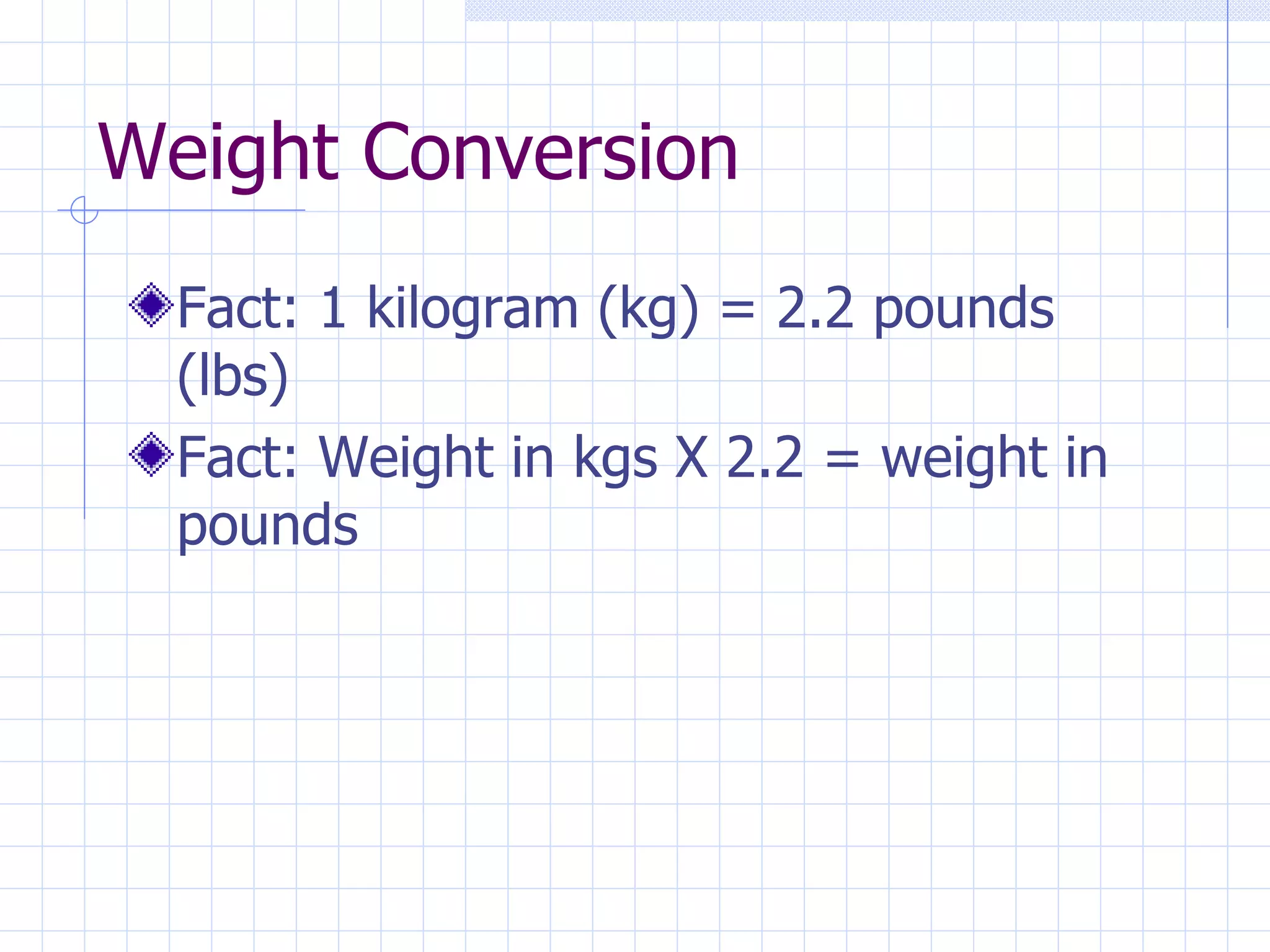
Weight Conversion Fact: 1 kilogram (kg) = 2.2 pounds (lbs) Fact: Weight in kgs X 2.2 = weight in pounds
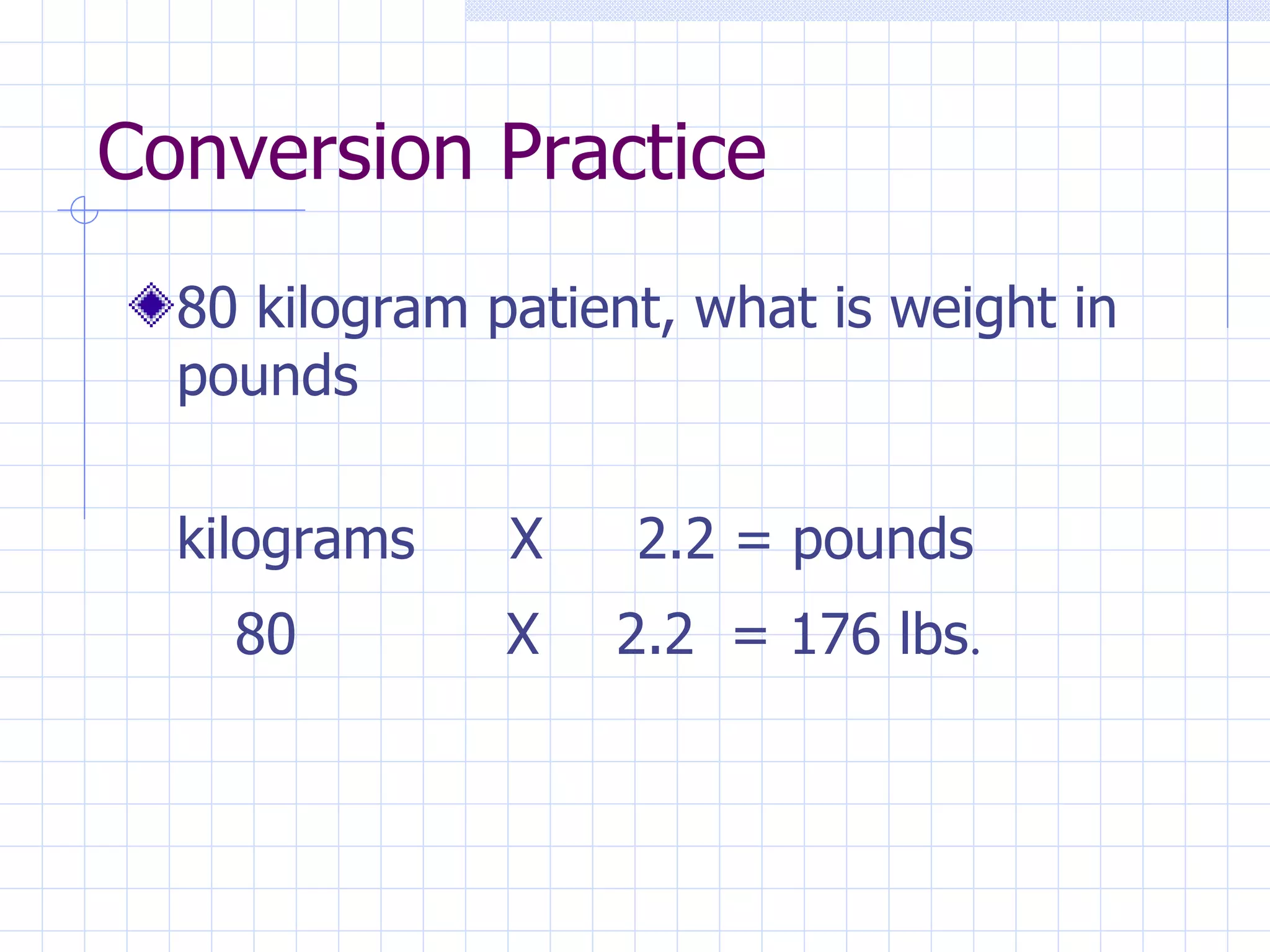
Conversion Practice 80 kilogram patient, what is weight in pounds kilograms  X  2.2 = pounds 80  X 2.2  = 176 lbs .
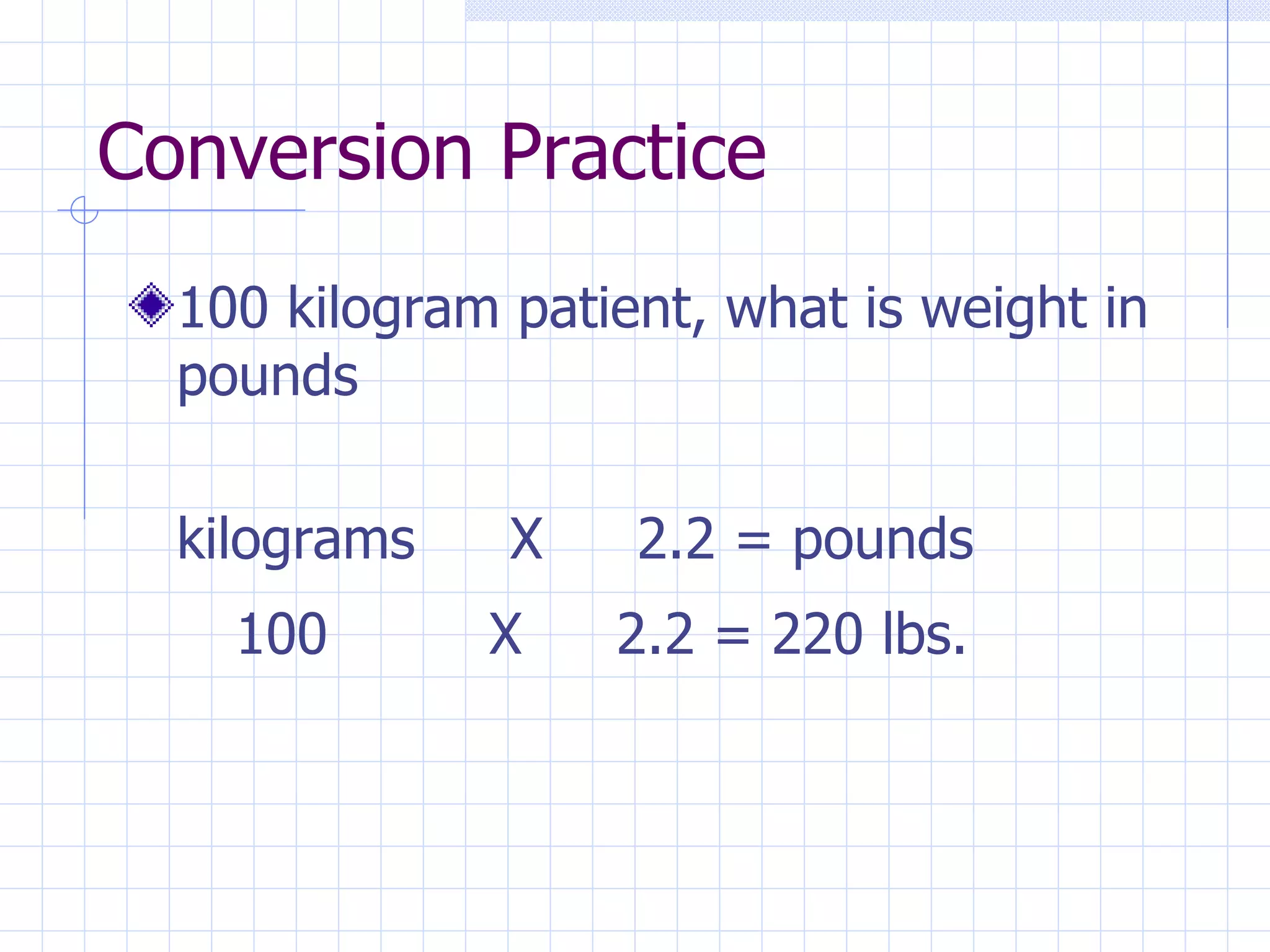
Conversion Practice 100 kilogram patient, what is weight in pounds kilograms X 2.2 = pounds 100 X 2.2 = 220 lbs.
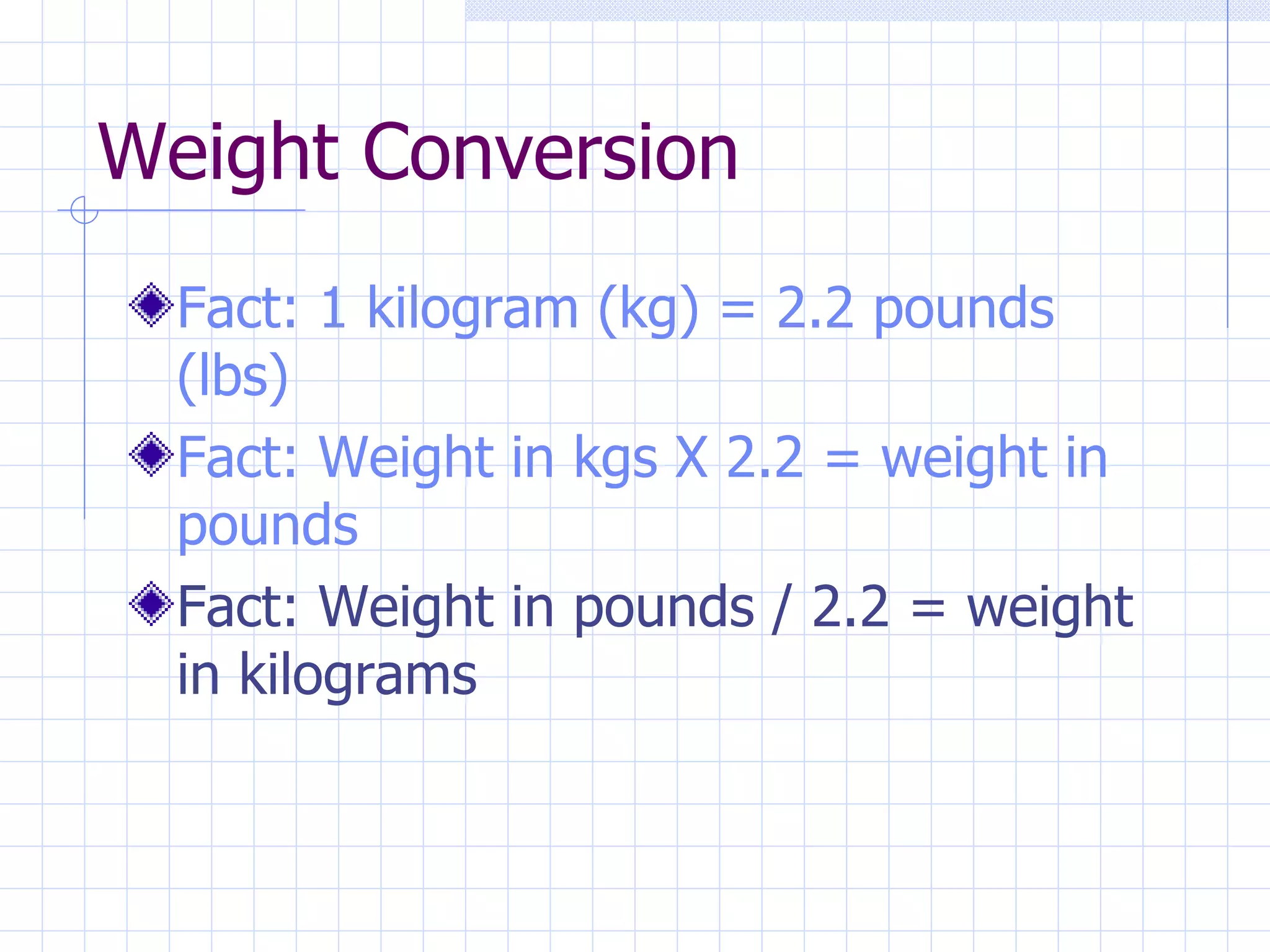
Weight Conversion Fact: 1 kilogram (kg) = 2.2 pounds (lbs) Fact: Weight in kgs X 2.2 = weight in pounds Fact: Weight in pounds / 2.2 = weight in kilograms
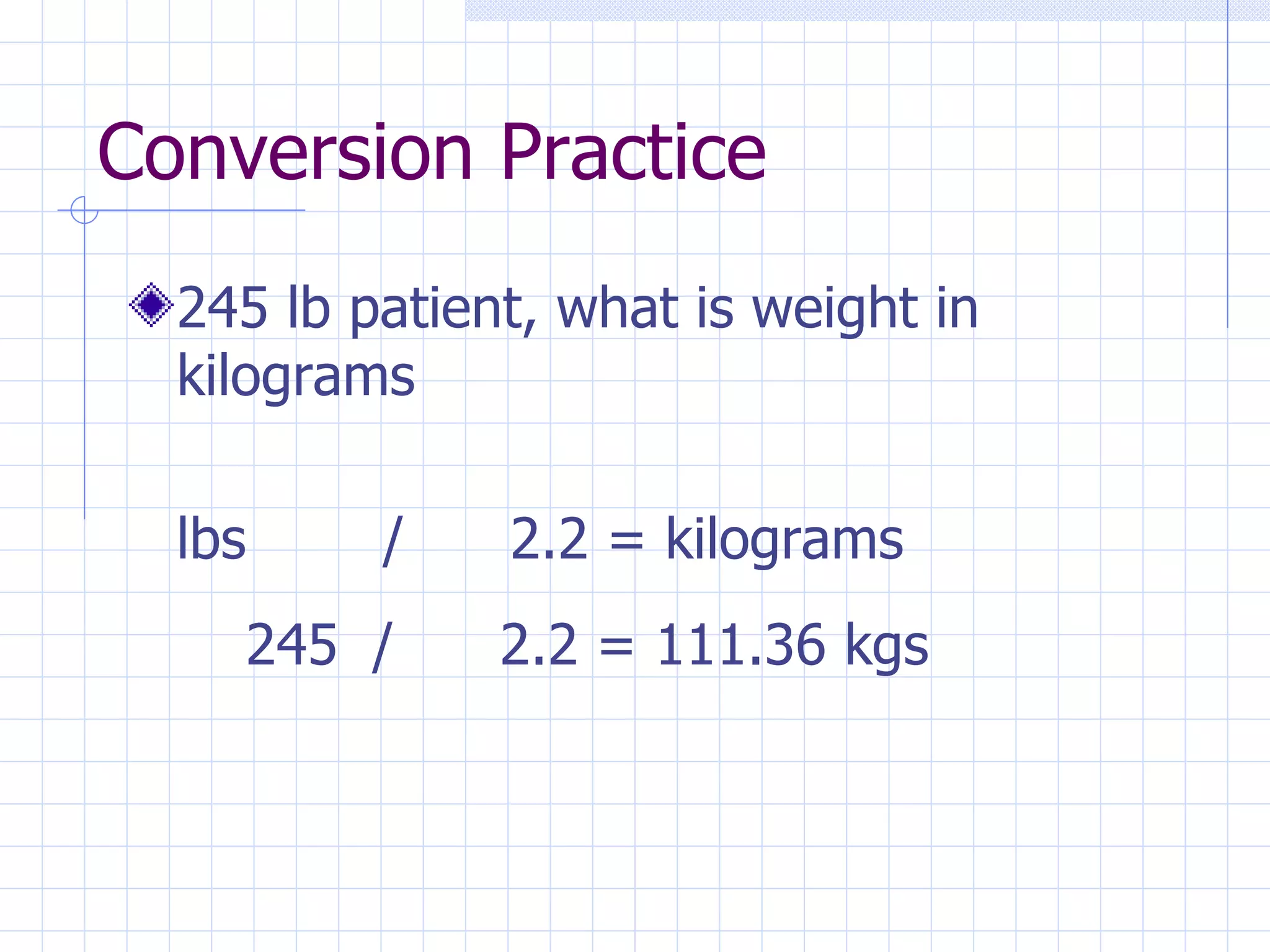
Conversion Practice 245 lb patient, what is weight in kilograms lbs / 2.2 = kilograms 245 / 2.2 = 111.36 kgs
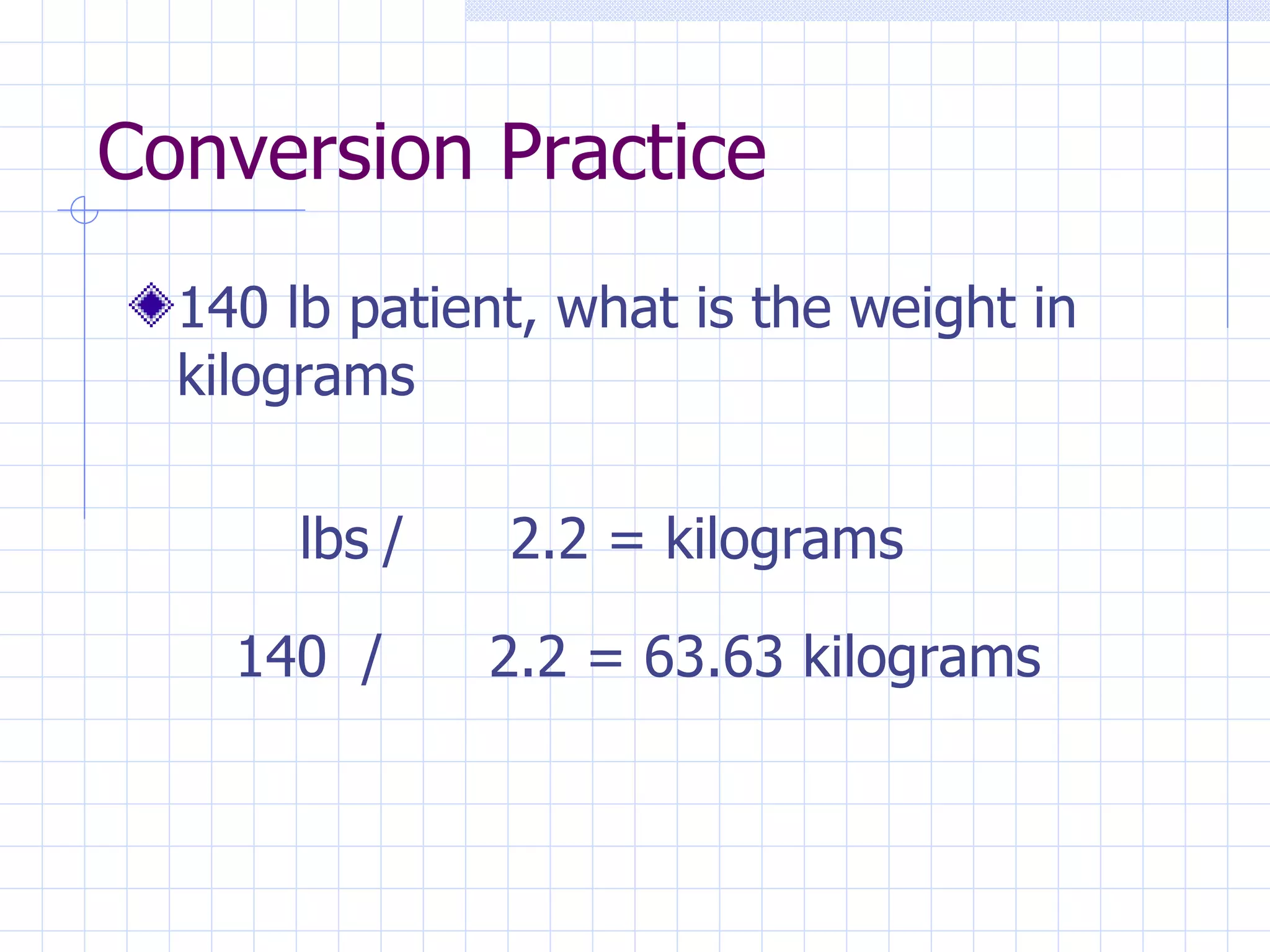
Conversion Practice 140 lb patient, what is the weight in kilograms   lbs / 2.2 = kilograms 140 / 2.2 = 63.63 kilograms
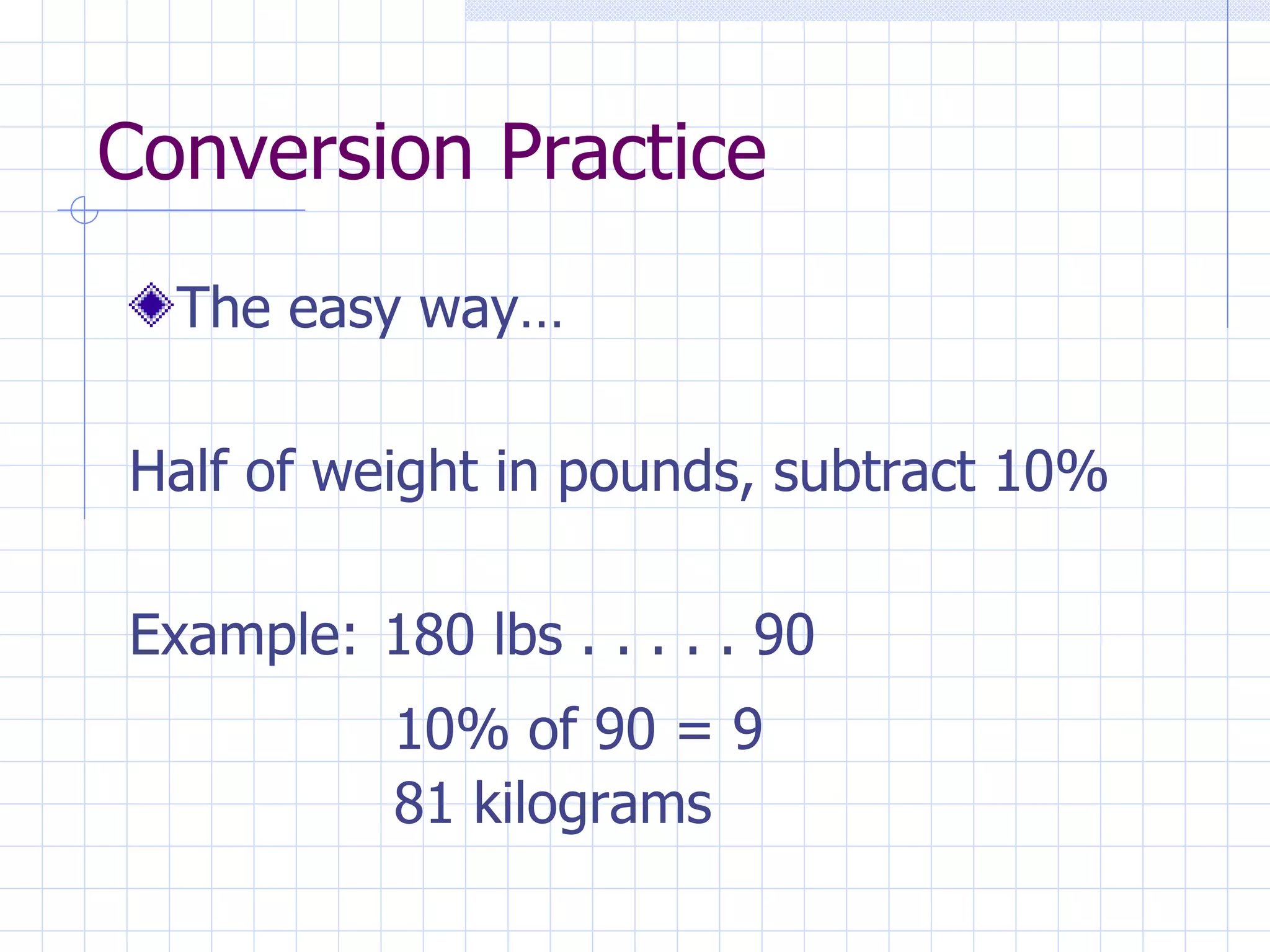
Conversion Practice The easy way… Half of weight in pounds, subtract 10% Example:  180 lbs . . . . . 90 10% of 90 = 9 81 kilograms
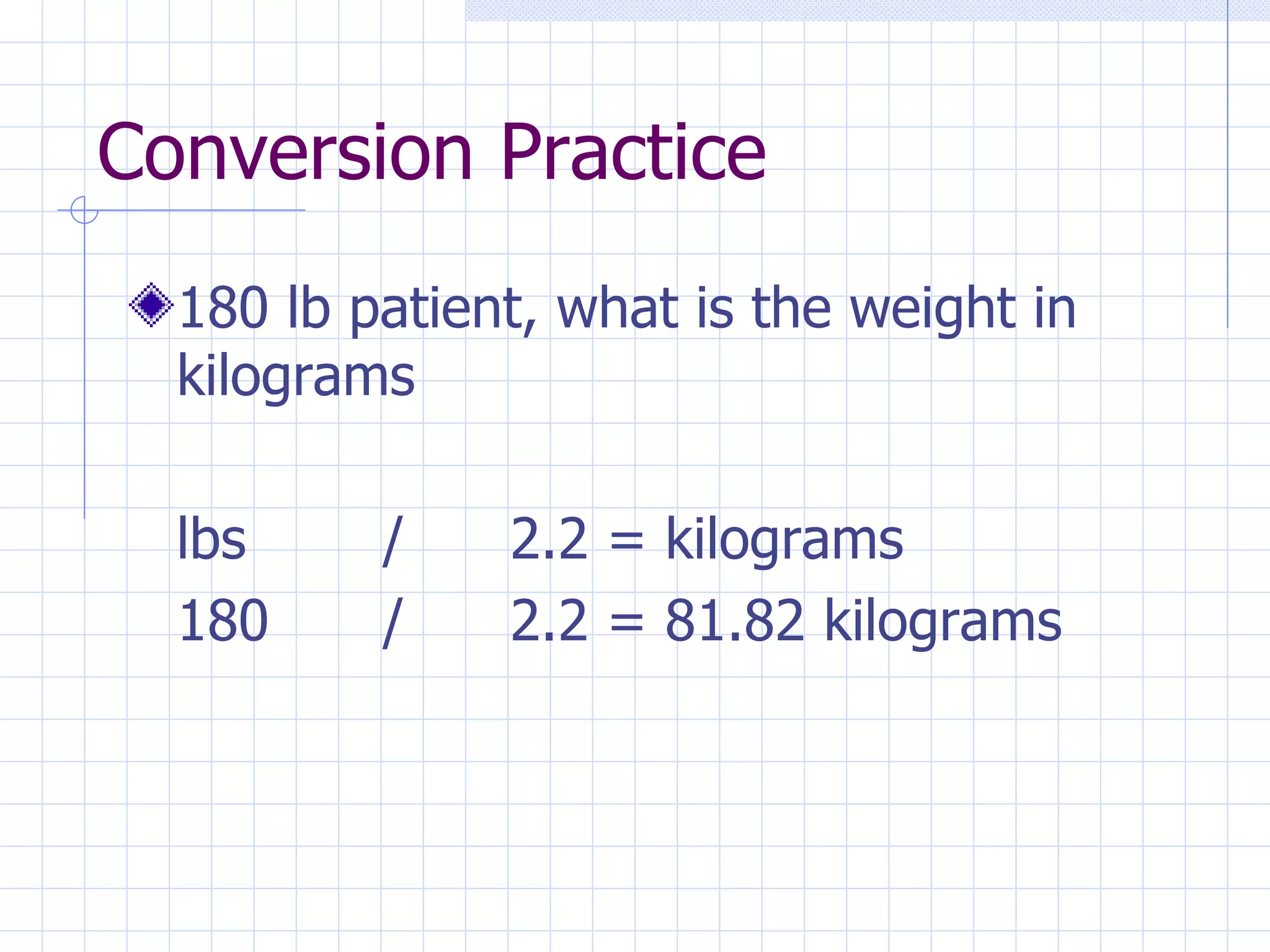
Conversion Practice 180 lb patient, what is the weight in kilograms lbs / 2.2 = kilograms 180 / 2.2 = 81.82 kilograms
KNOW YOUR WEIGHT CONVERSIONS!!!!!
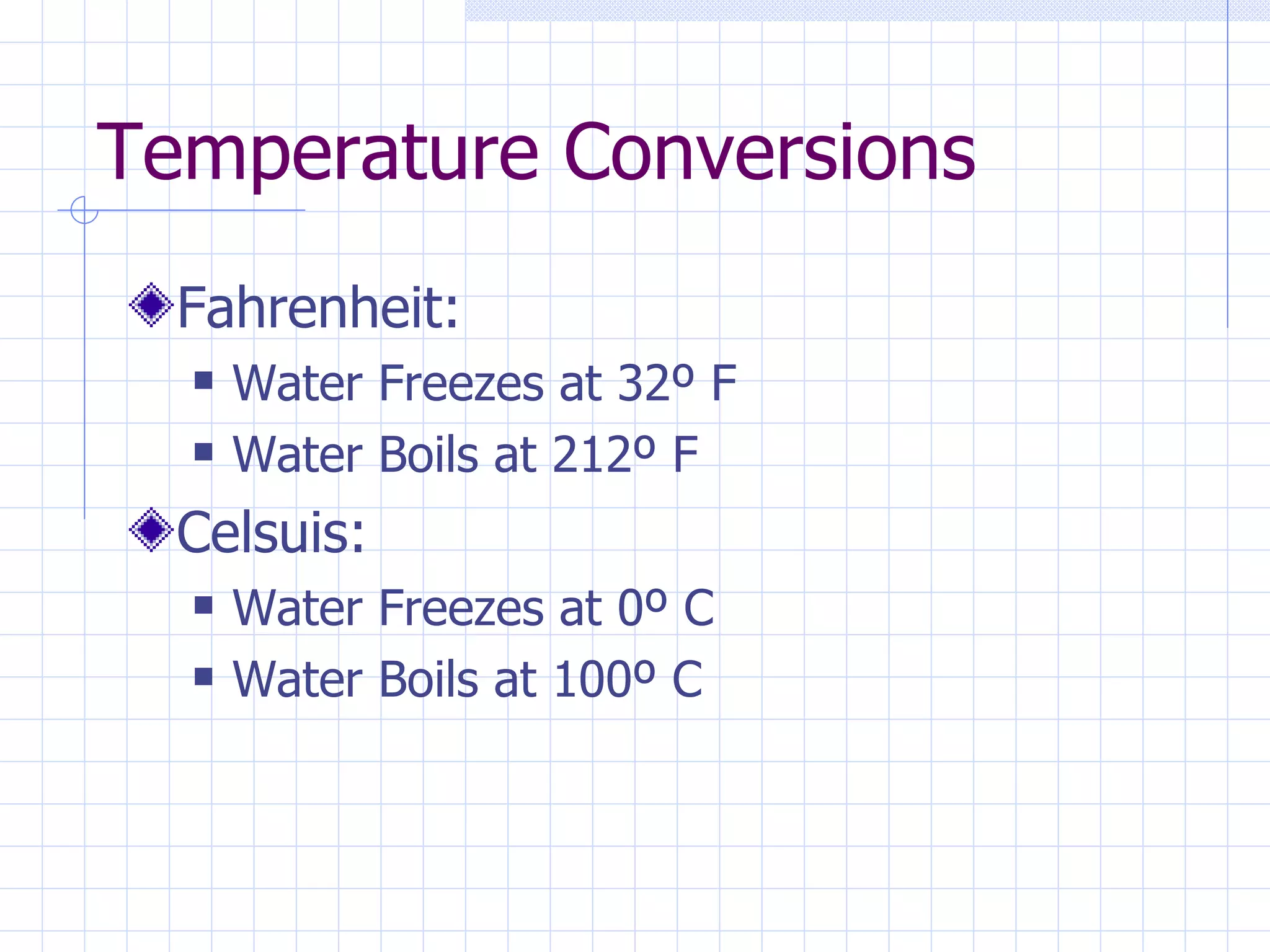
Temperature Conversions Fahrenheit: Water Freezes at 32 º F Water Boils at 212º F Celsuis: Water Freezes at 0 º C Water Boils at 100º C
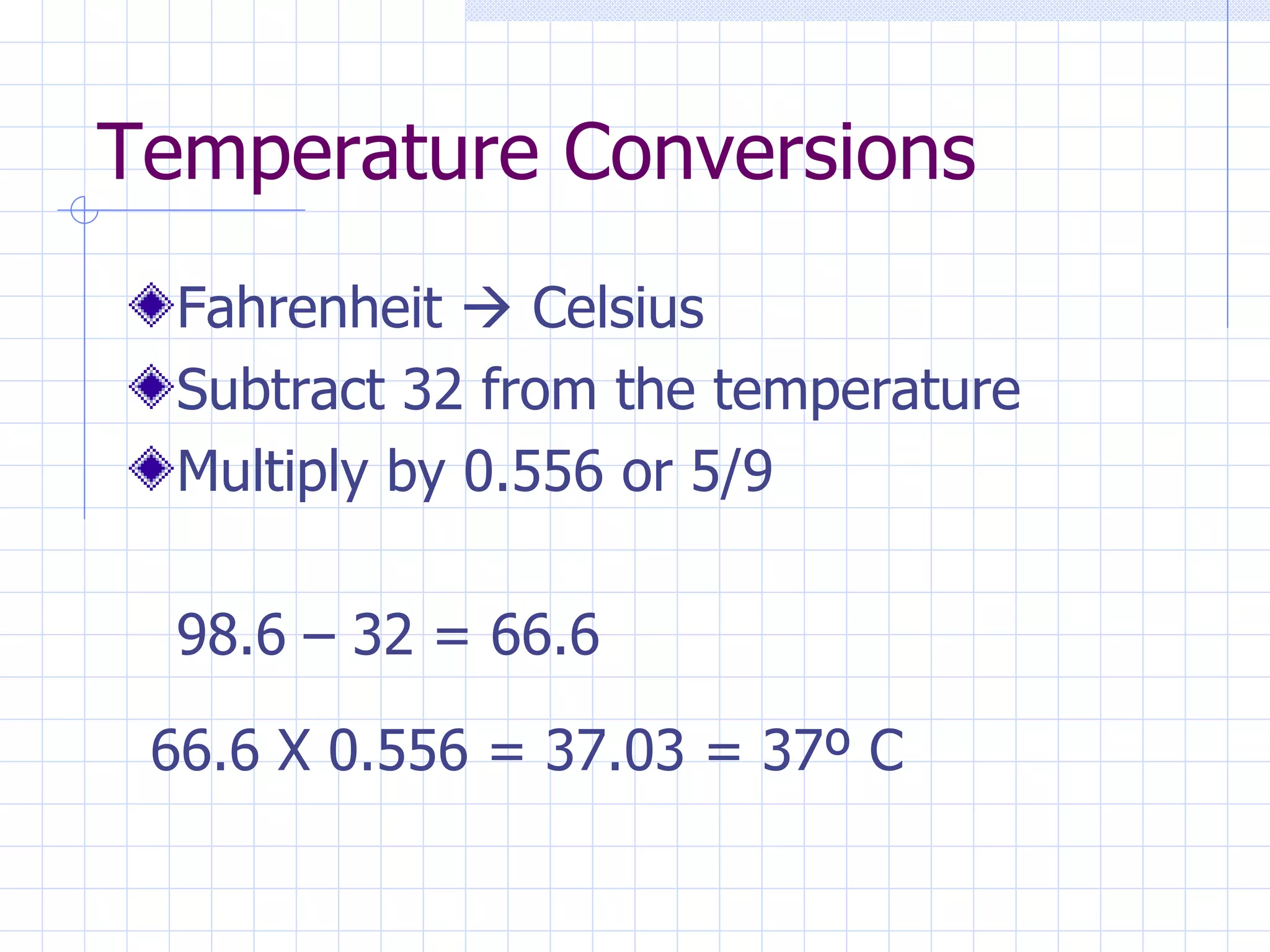
Temperature Conversions Fahrenheit    Celsius Subtract 32 from the temperature Multiply by 0.556 or 5/9 98.6 – 32 = 66.6 66.6 X 0.556 = 37.03 = 37 º C
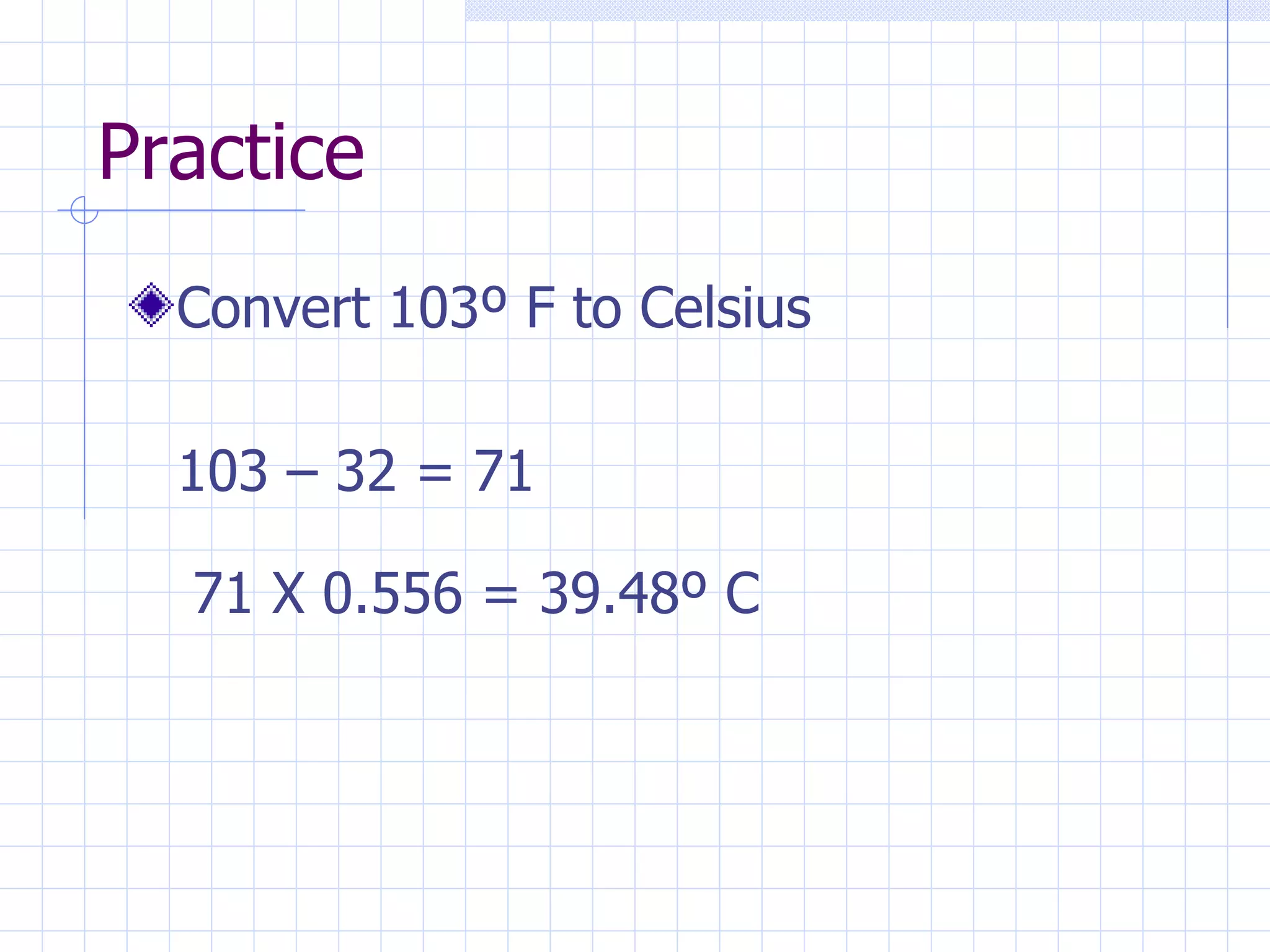
Practice Convert 103 º F to Celsius 103 – 32 = 71 71 X 0.556 = 39.48 º C
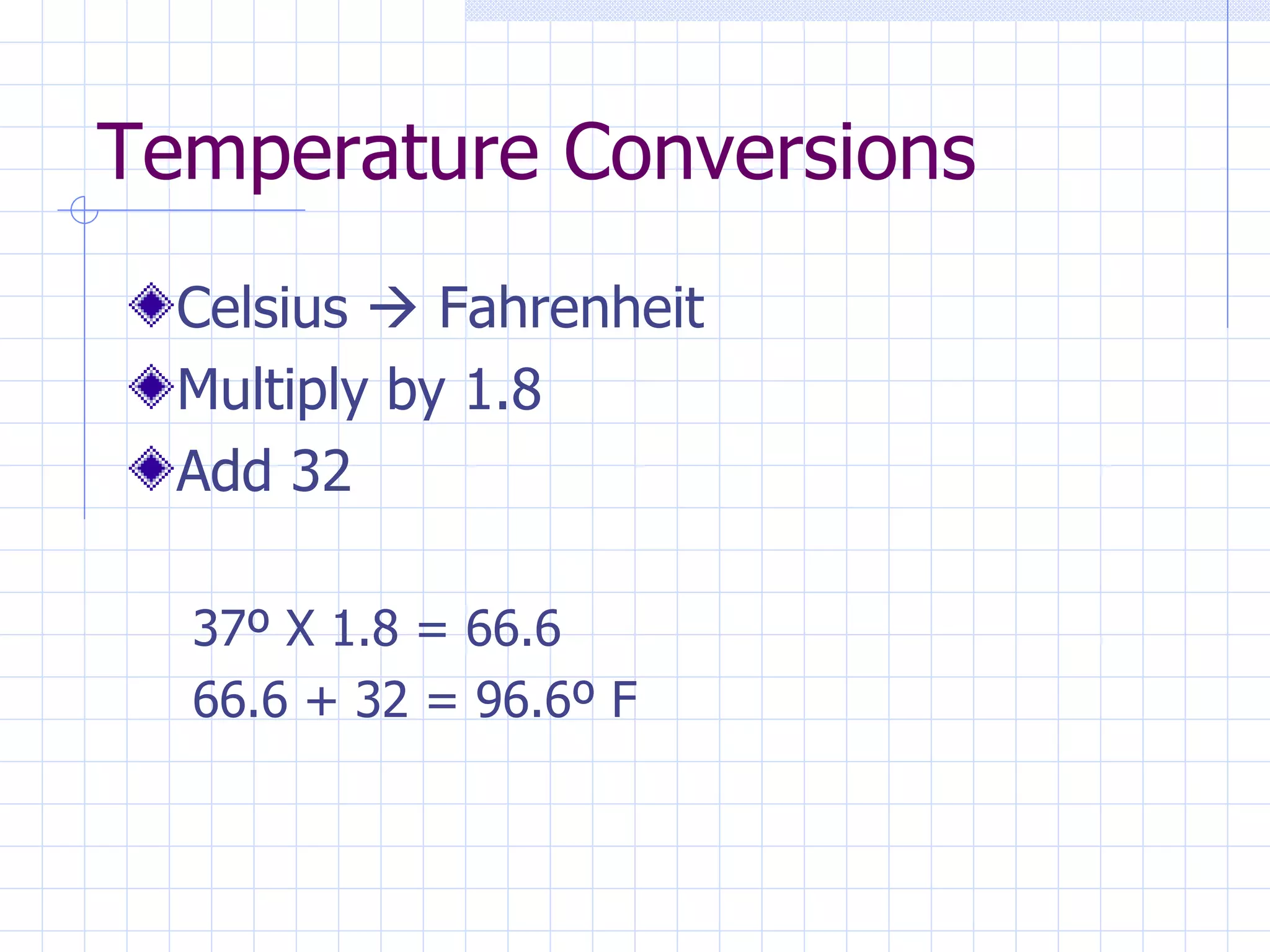
Temperature Conversions Celsius    Fahrenheit Multiply by 1.8 Add 32 37 º X 1.8 = 66.6 66.6 + 32 = 96.6º F
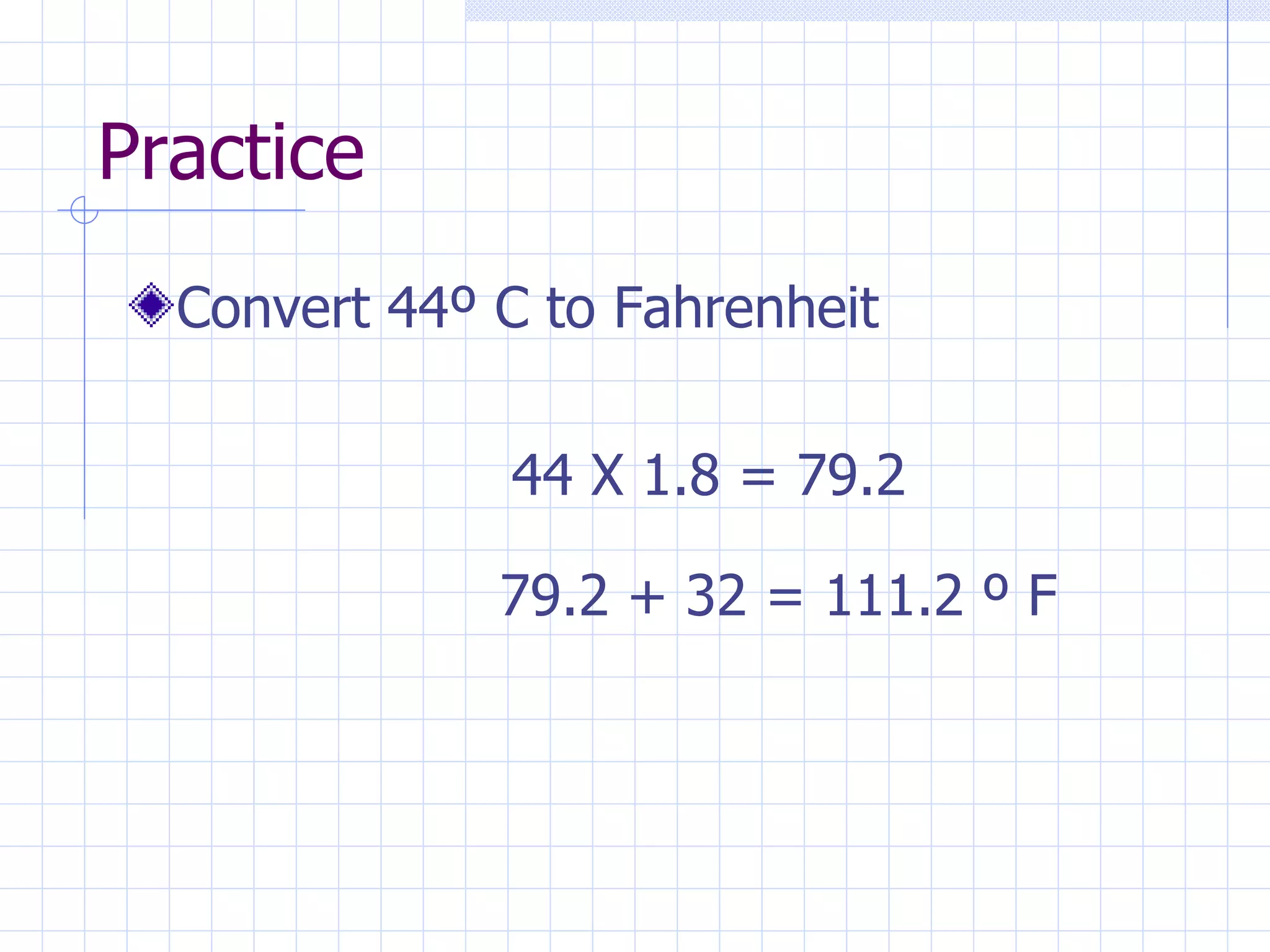
Practice Convert 44 º C to Fahrenheit 44 X 1.8 = 79.2 79.2 + 32 = 111.2  º F
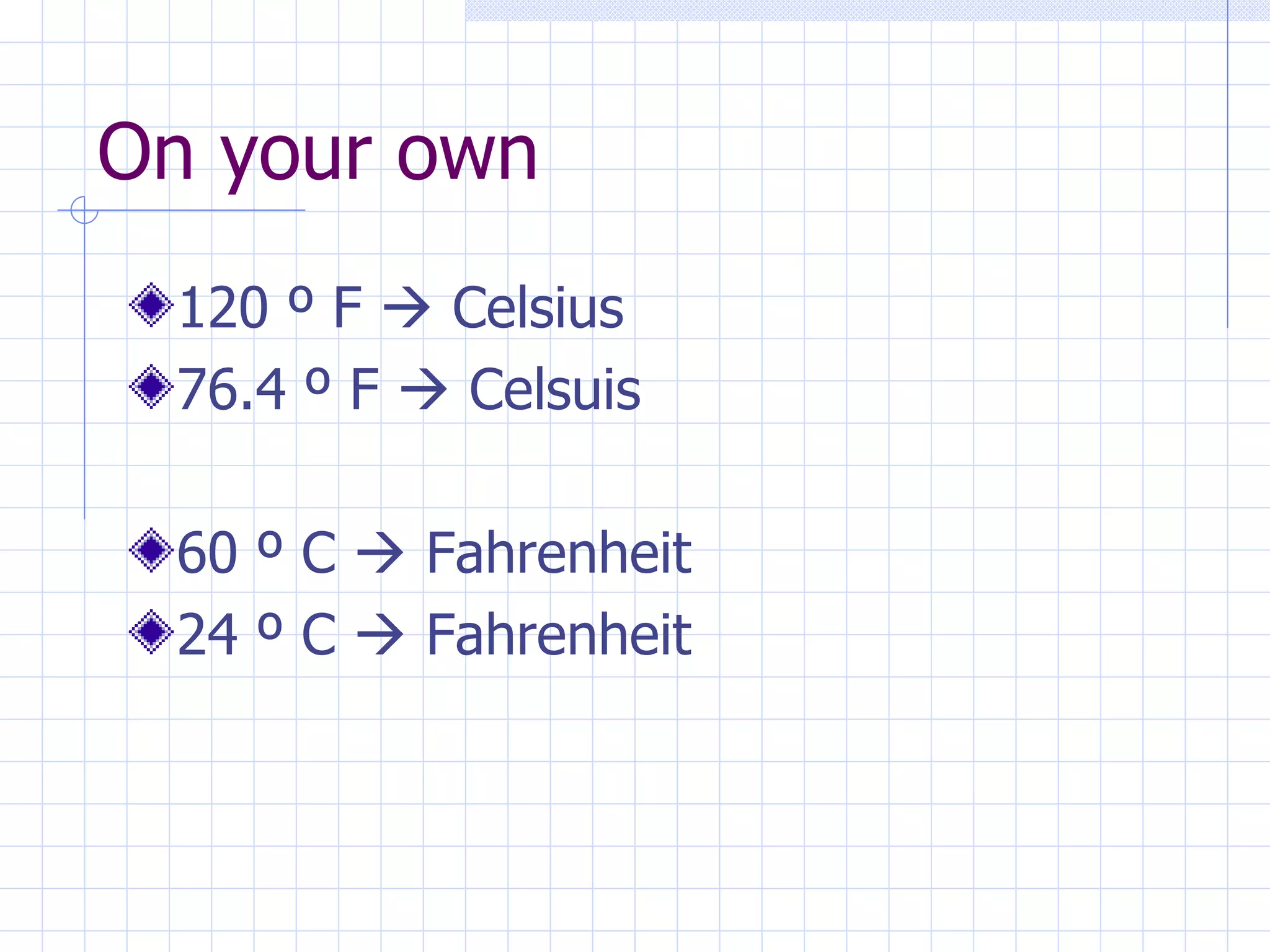
On your own 120  º F    Celsius 76.4 º F    Celsuis 60 º C    Fahrenheit 24 º C    Fahrenheit
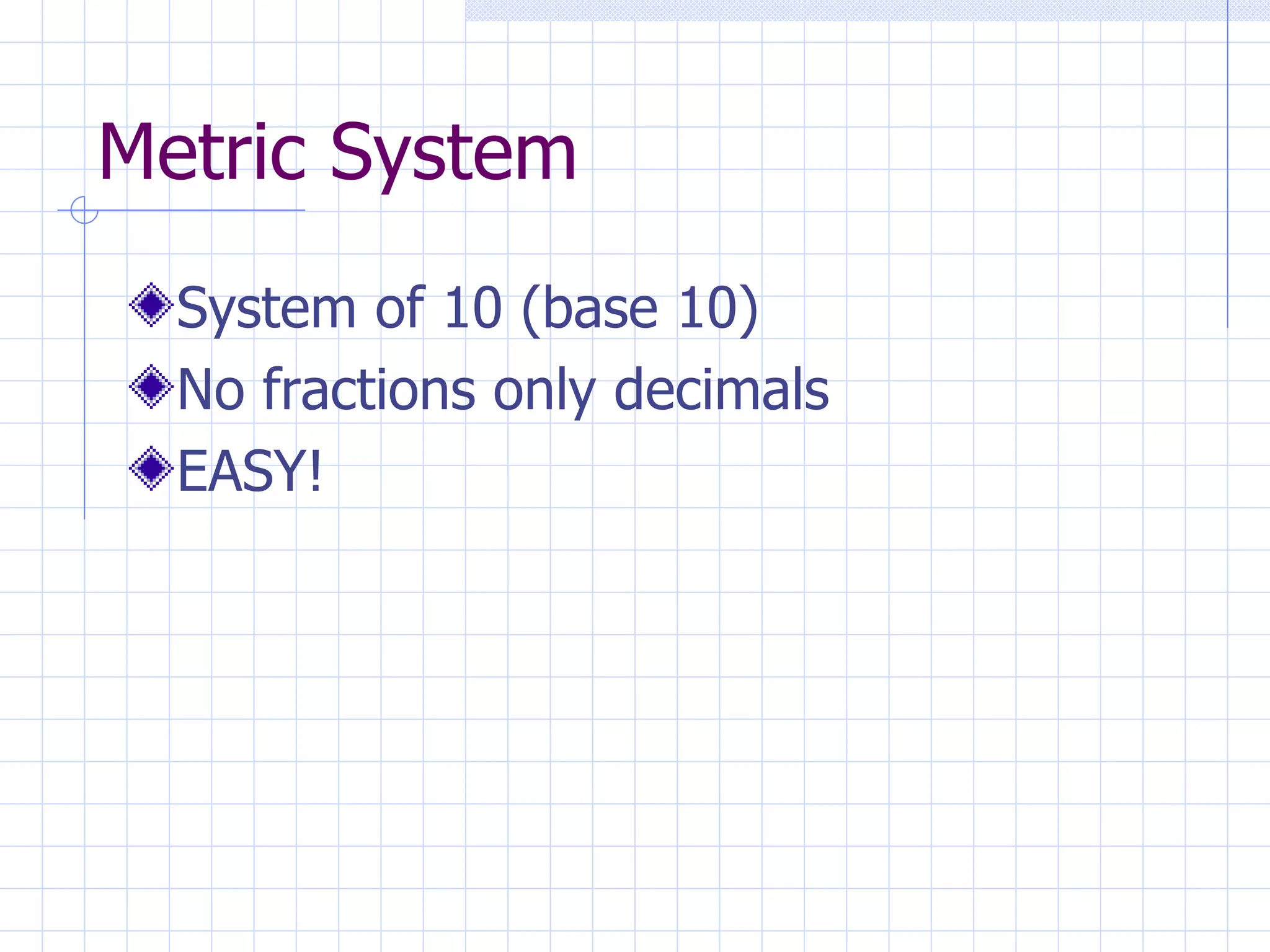
Metric System System of 10 (base 10) No fractions only decimals EASY!
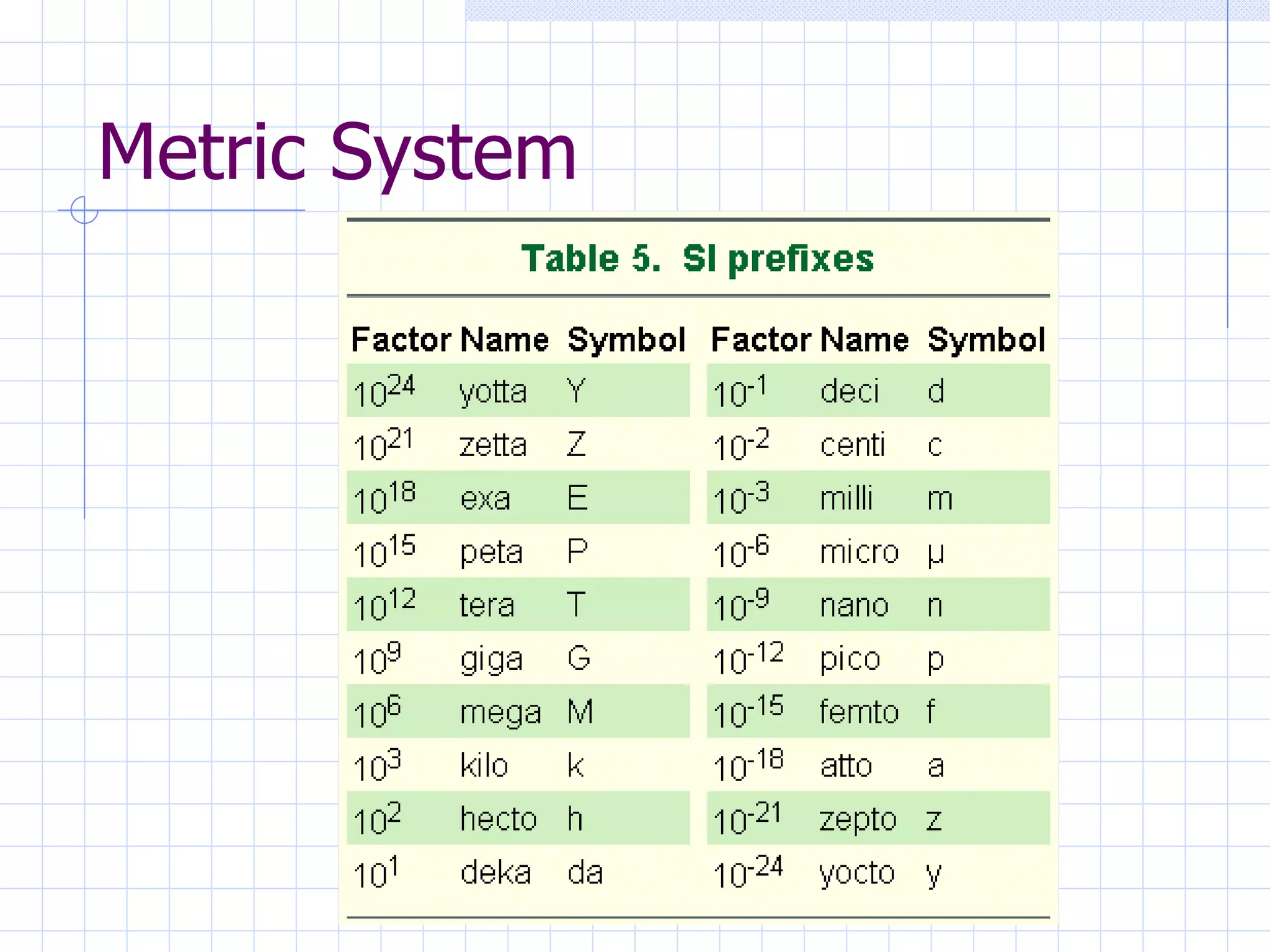
Metric System
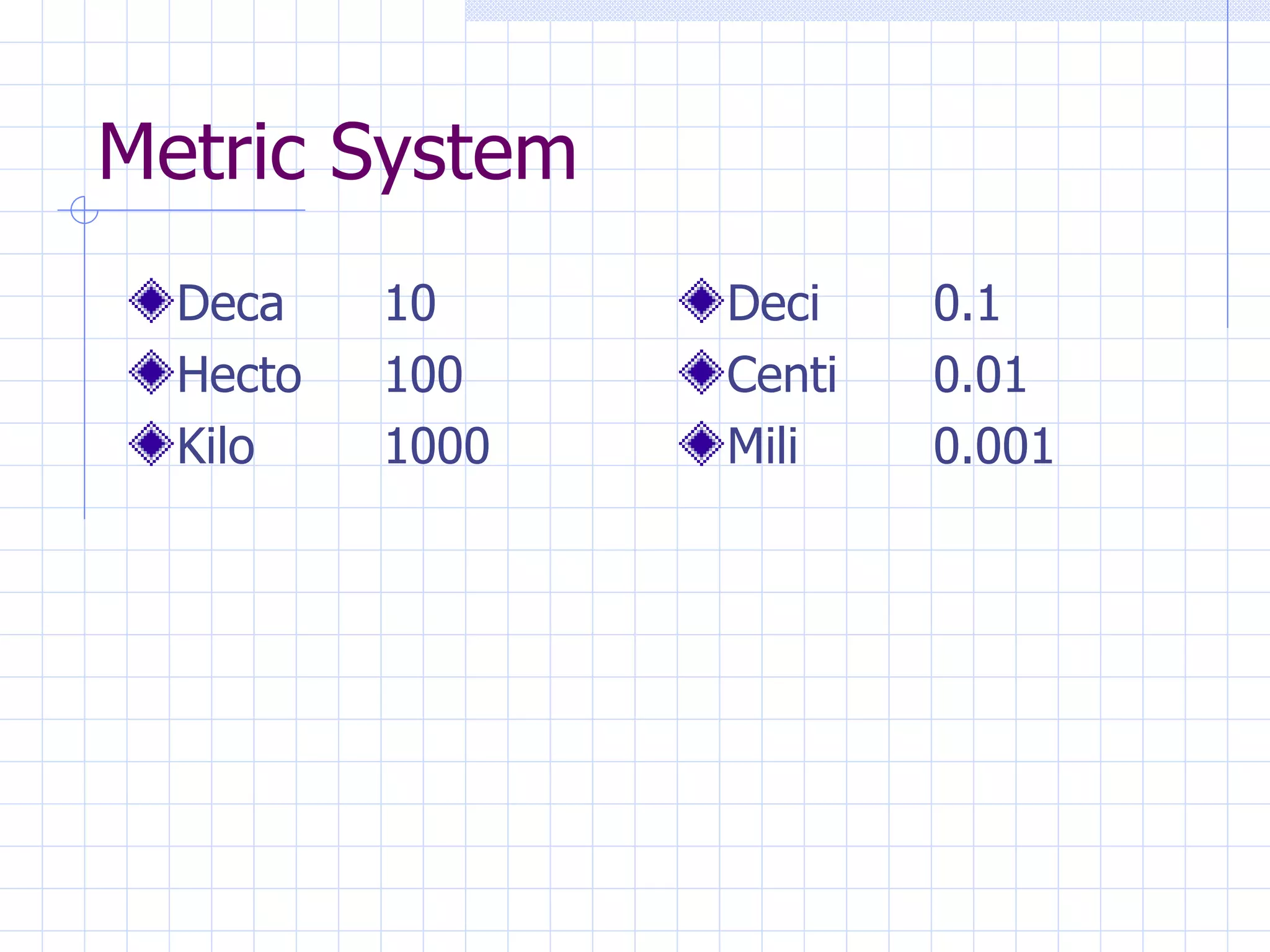
Metric System Deca 10 Hecto 100 Kilo 1000 Deci 0.1 Centi 0.01 Mili 0.001
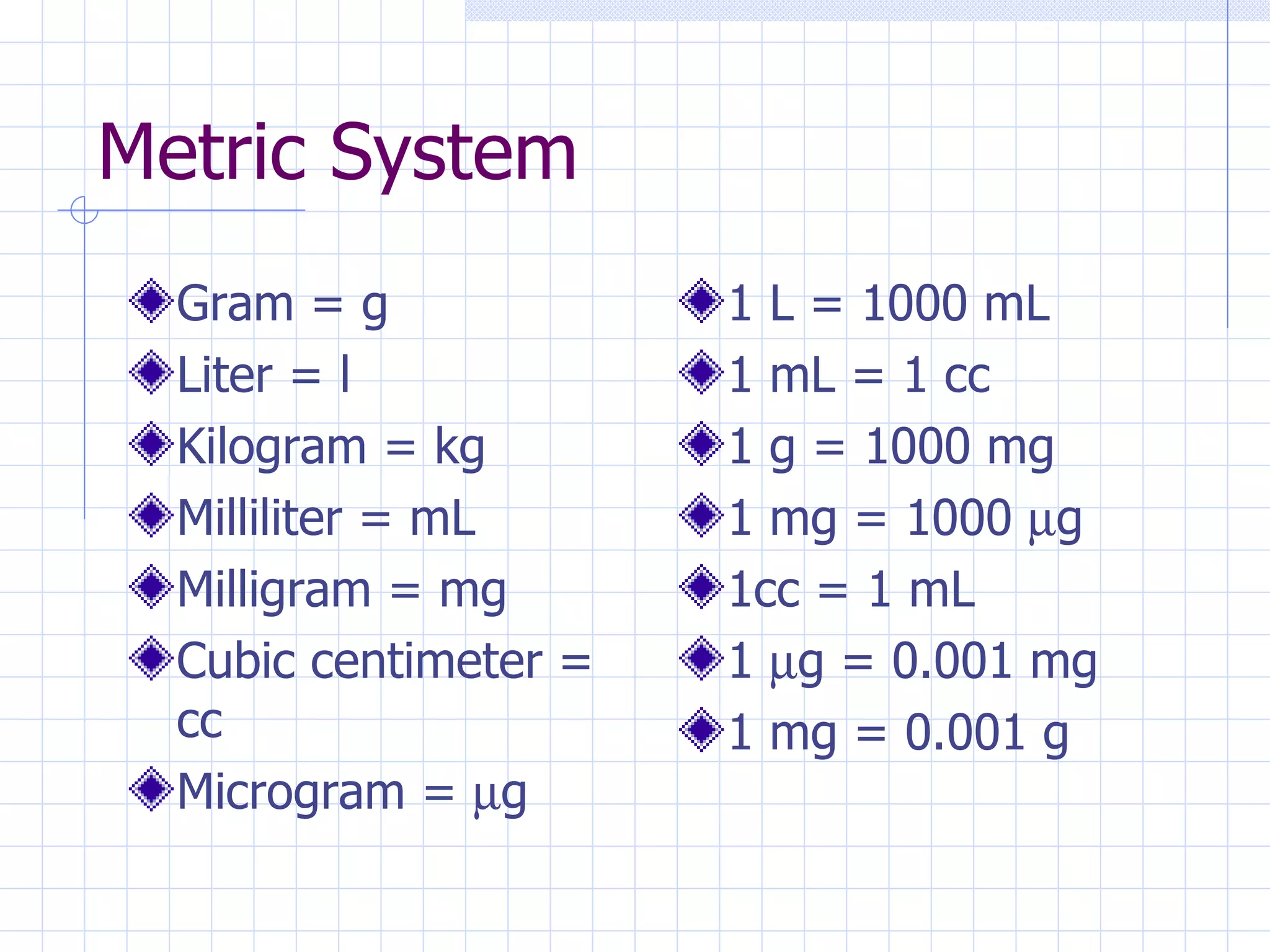
Metric System Gram = g Liter = l Kilogram = kg Milliliter = mL Milligram = mg Cubic centimeter = cc Microgram =   g 1 L = 1000 mL 1 mL = 1 cc 1 g = 1000 mg 1 mg = 1000   g 1cc = 1 mL 1   g = 0.001 mg 1 mg = 0.001 g
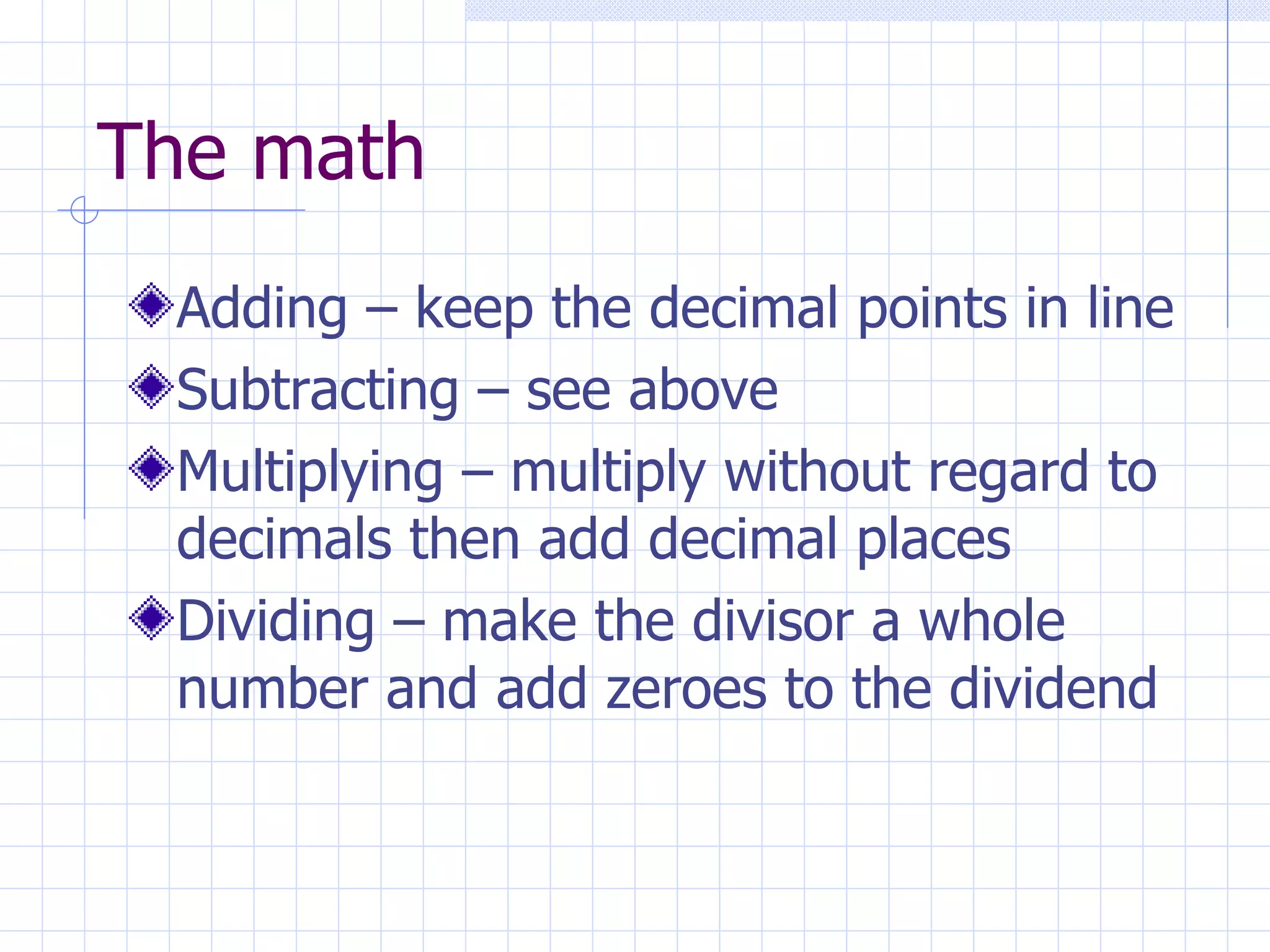
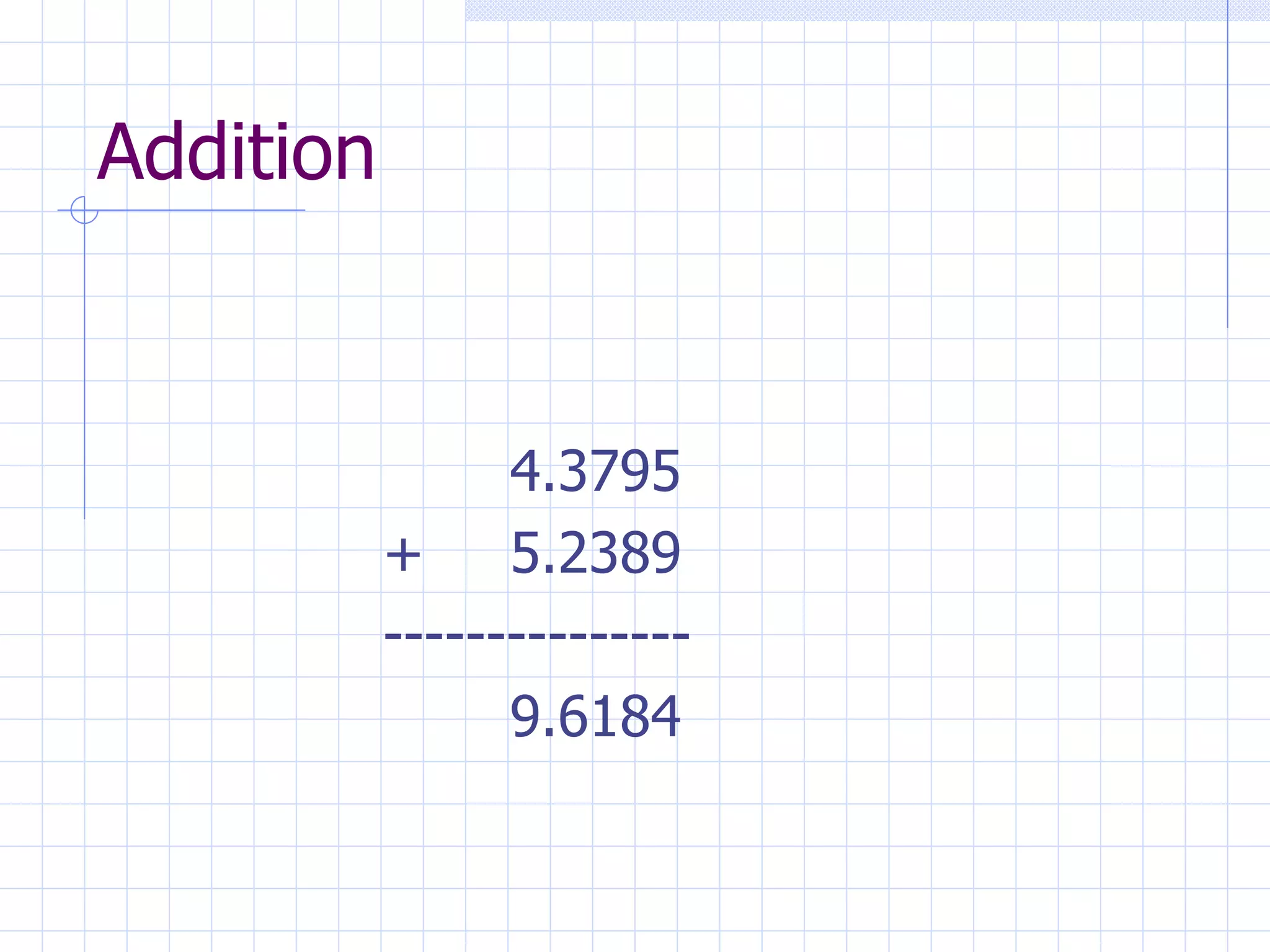
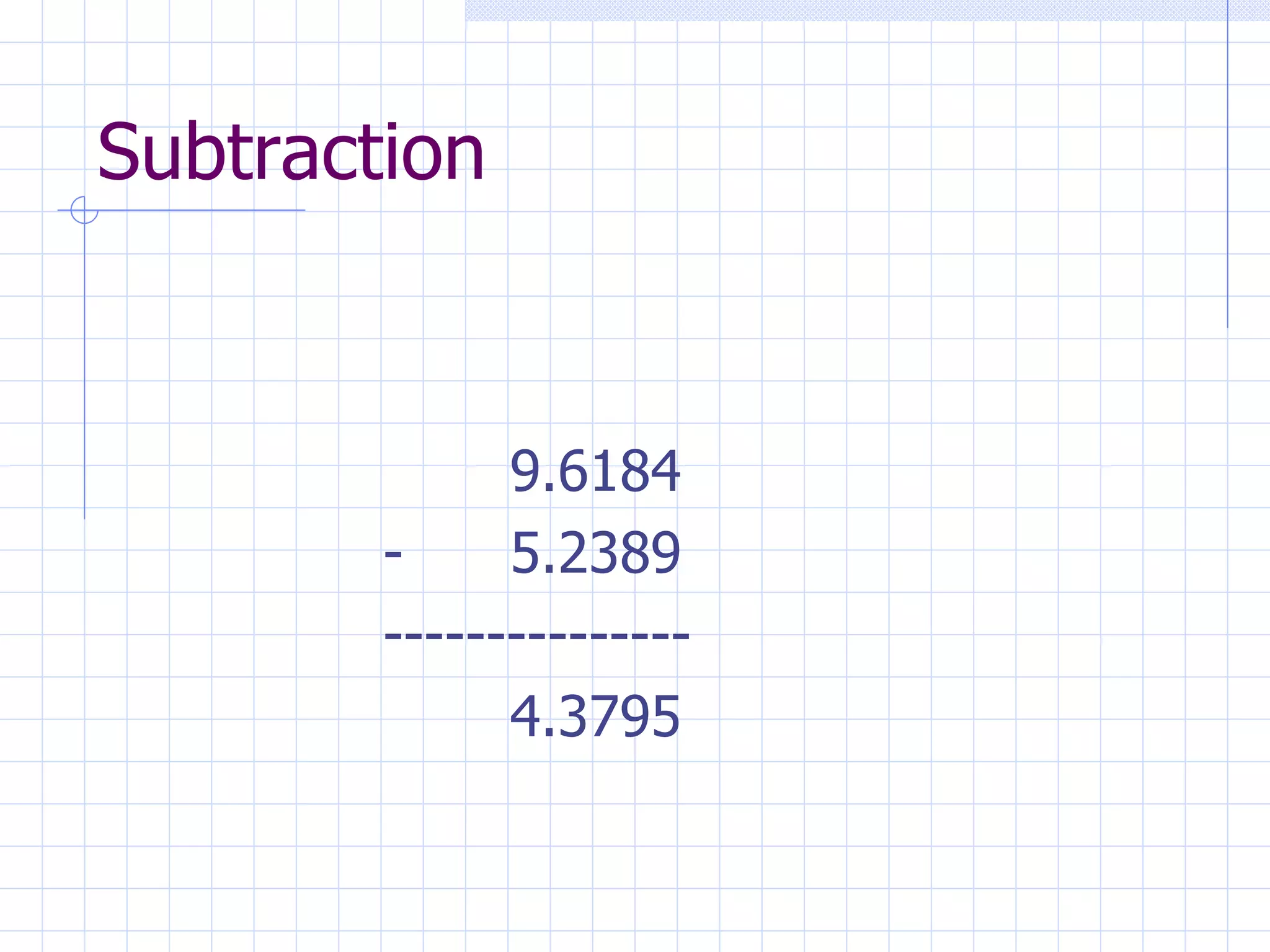
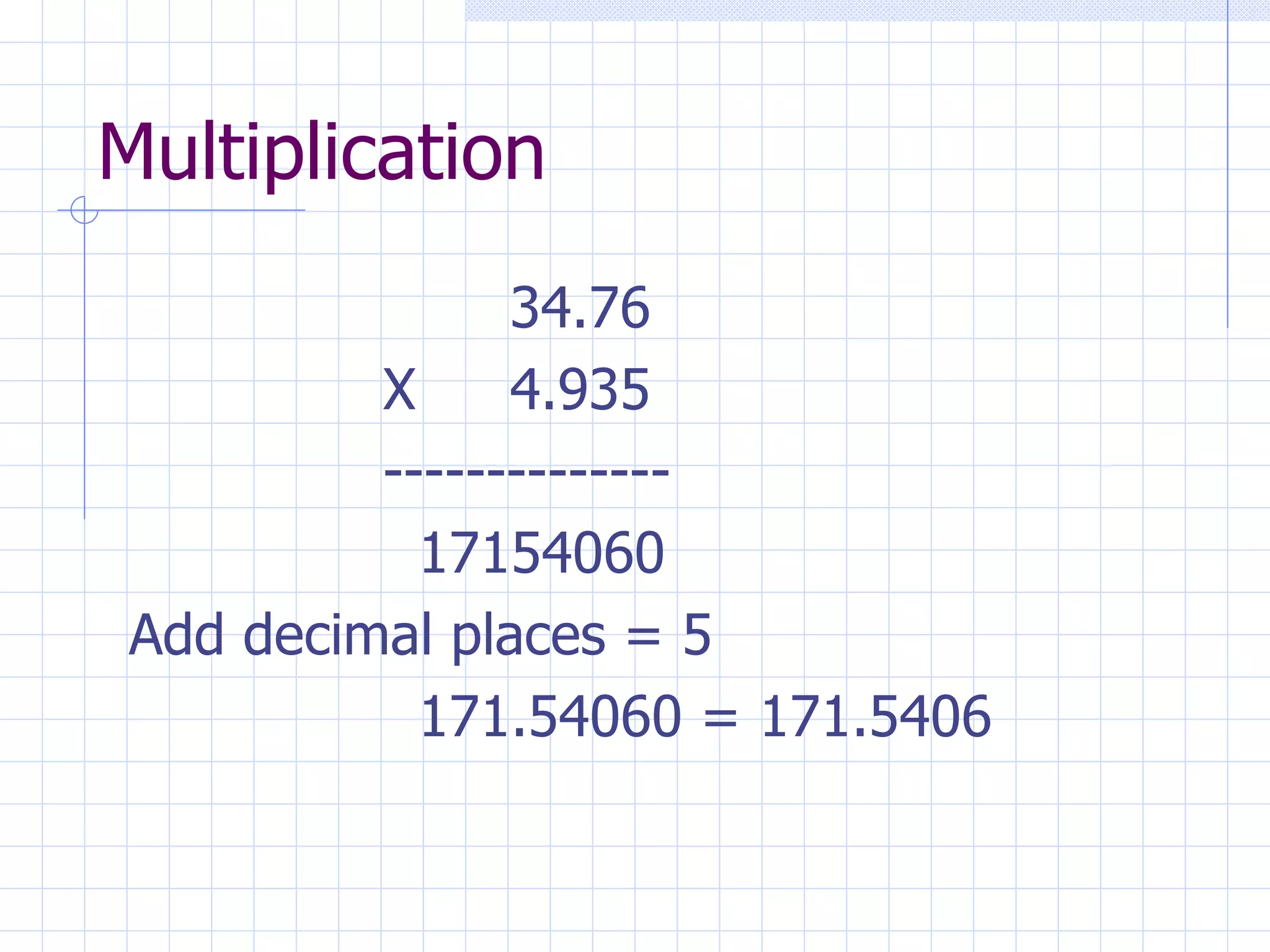
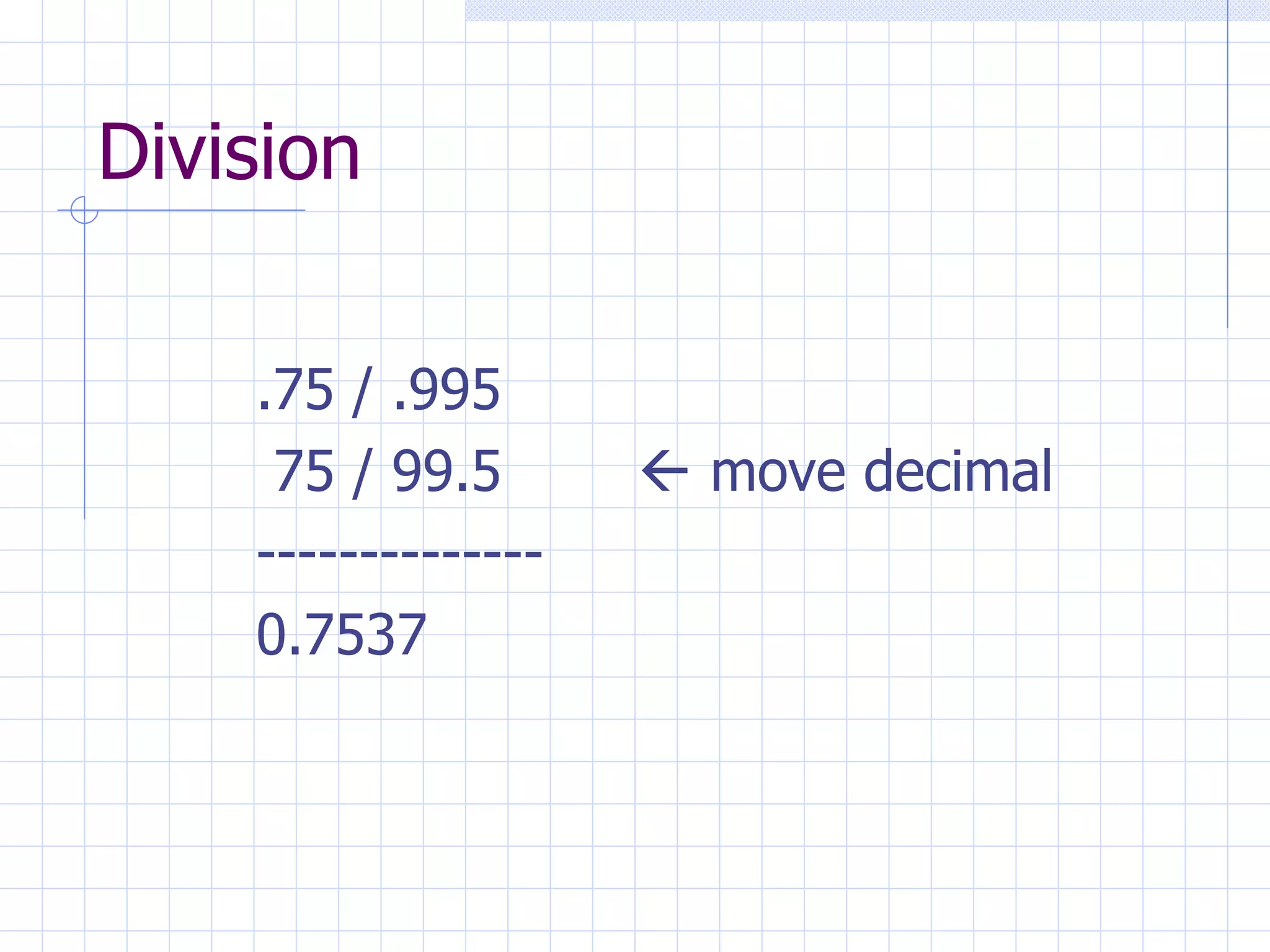
The math Adding – keep the decimal points in line Subtracting – see above Multiplying – multiply without regard to decimals then add decimal places Dividing – make the divisor a whole number and add zeroes to the dividend
Addition 4.3795 + 5.2389 --------------- 9.6184
Subtraction 9.6184 - 5.2389 --------------- 4.3795
Multiplication 34.76 X 4.935 --------------   17154060 Add decimal places = 5   171.54060 = 171.5406
Division .75 / .995  75 / 99.5   move decimal -------------- 0.7537
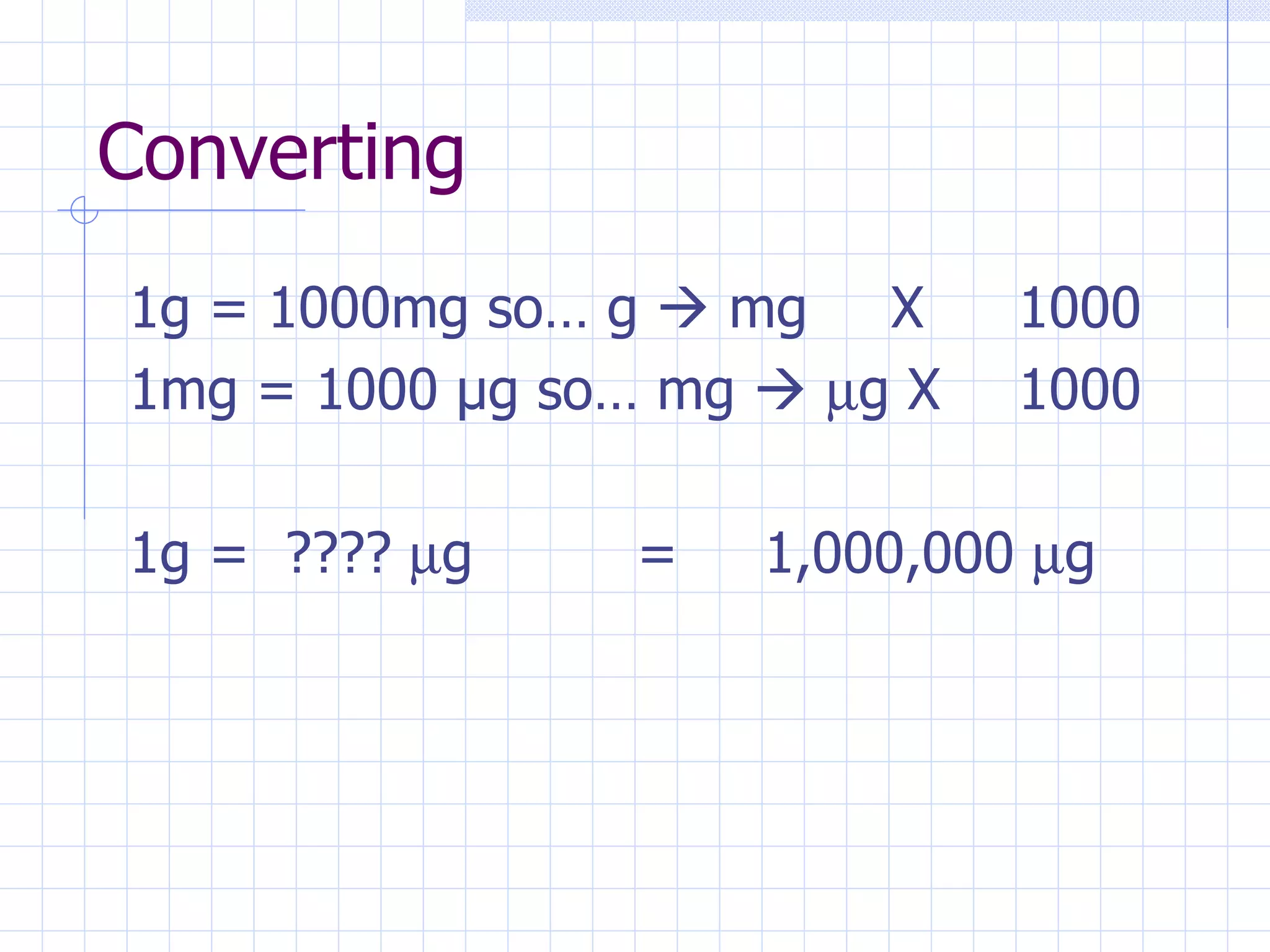
Converting 1g = 1000mg so… g    mg X 1000 1mg = 1000  µg so… mg      g X  1000 1g =  ????   g = 1,000,000   g
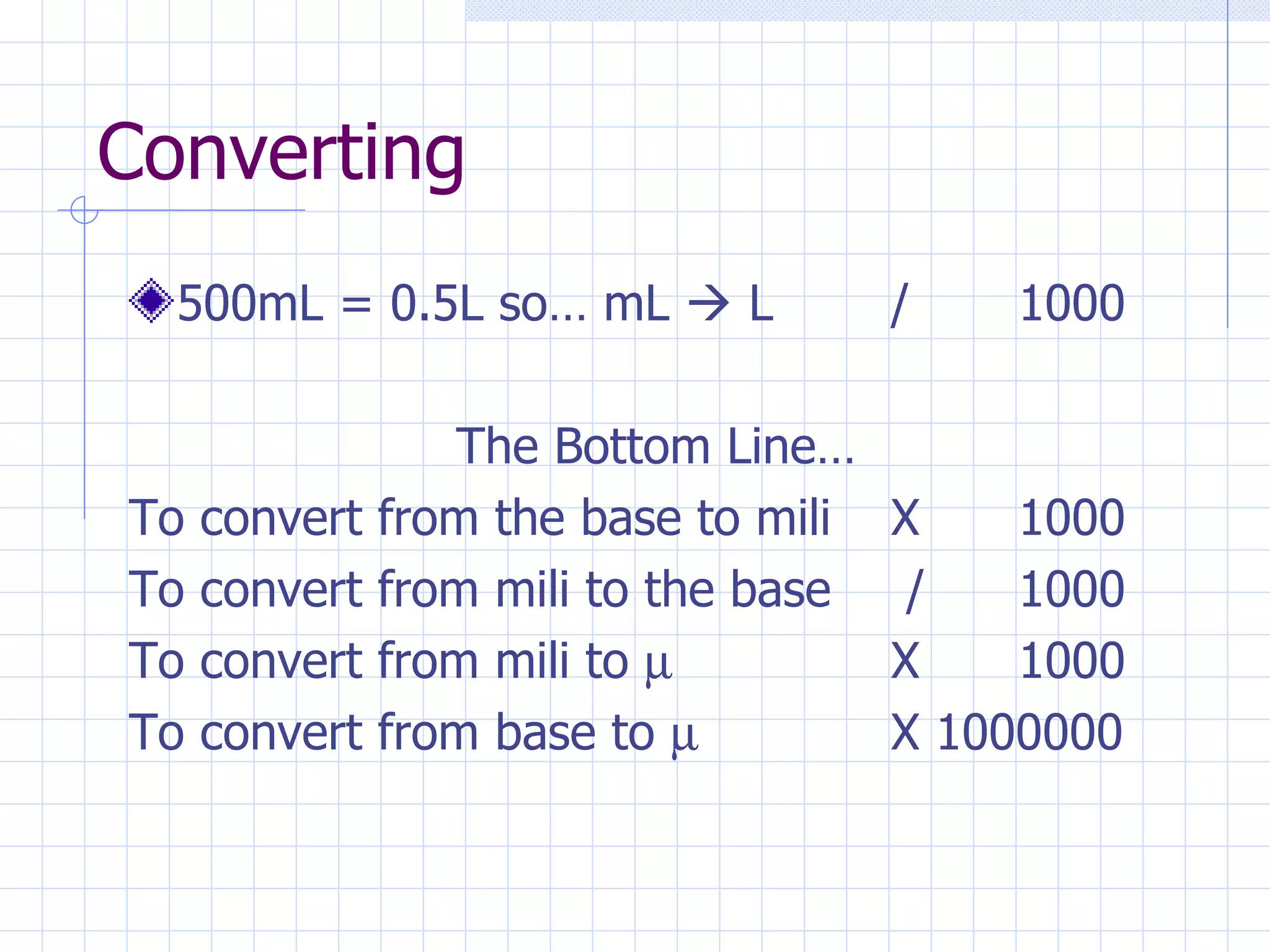
Converting 500mL = 0.5L so… mL    L / 1000 The Bottom Line… To convert from the base to mili  X 1000 To convert from mili to the base  / 1000 To convert from mili to   X 1000 To convert from base to   X 1000000
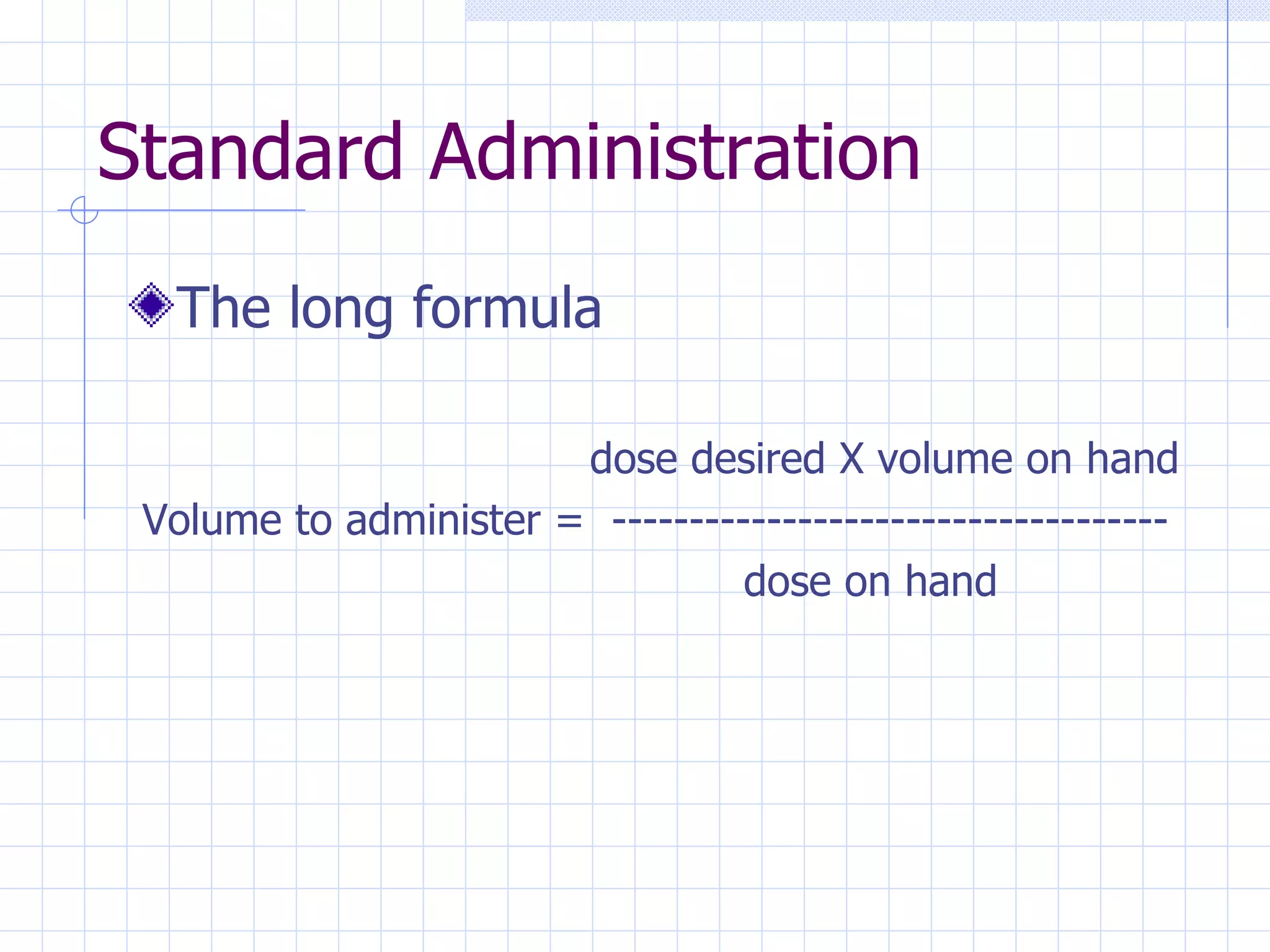
Standard Administration The long formula   dose desired X volume on hand Volume to administer =  ------------------------------------   dose on hand
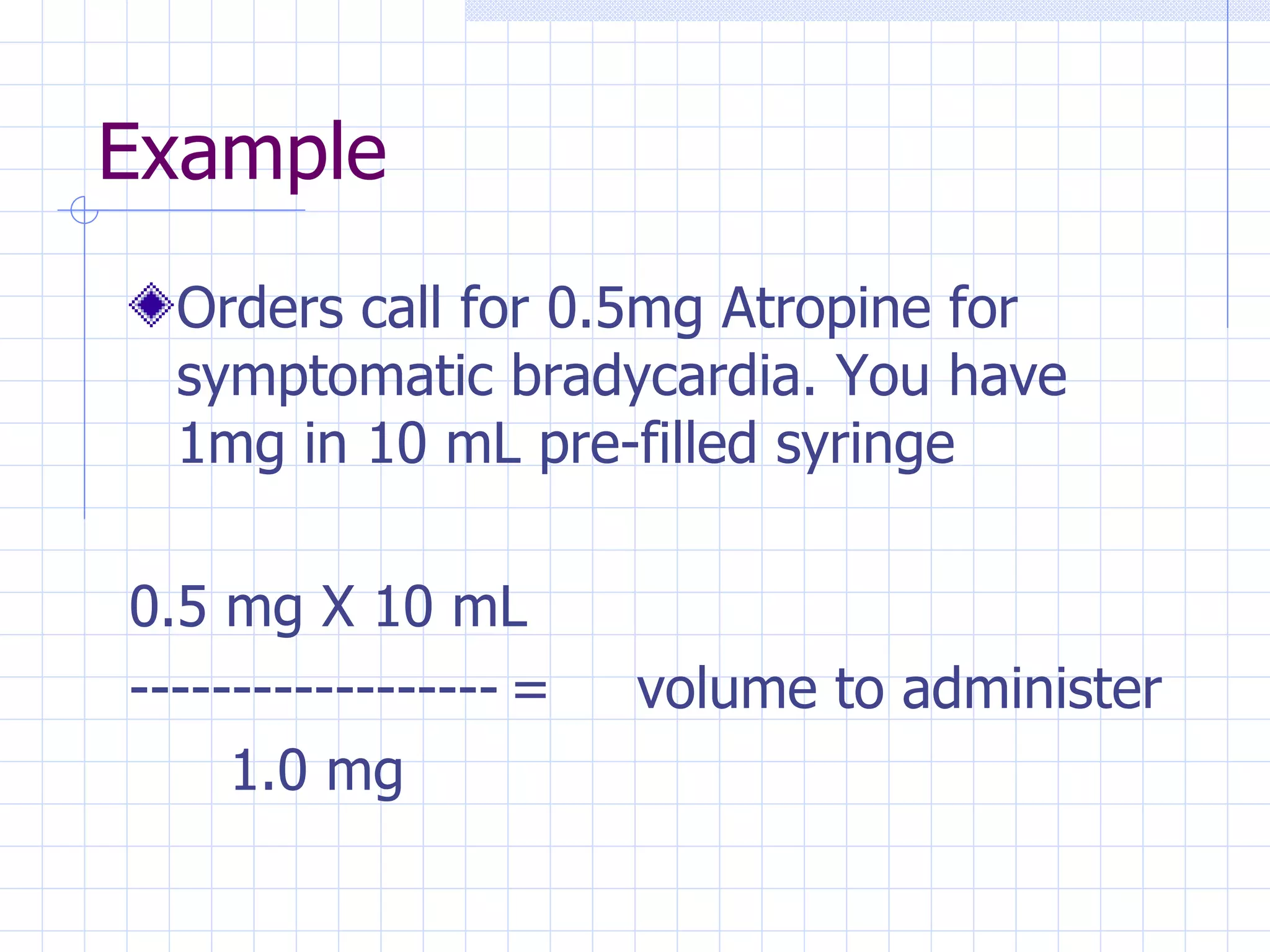
Example Orders call for 0.5mg Atropine for symptomatic bradycardia. You have 1mg in 10 mL pre-filled syringe 0.5 mg X 10 mL ------------------ = volume to administer   1.0 mg
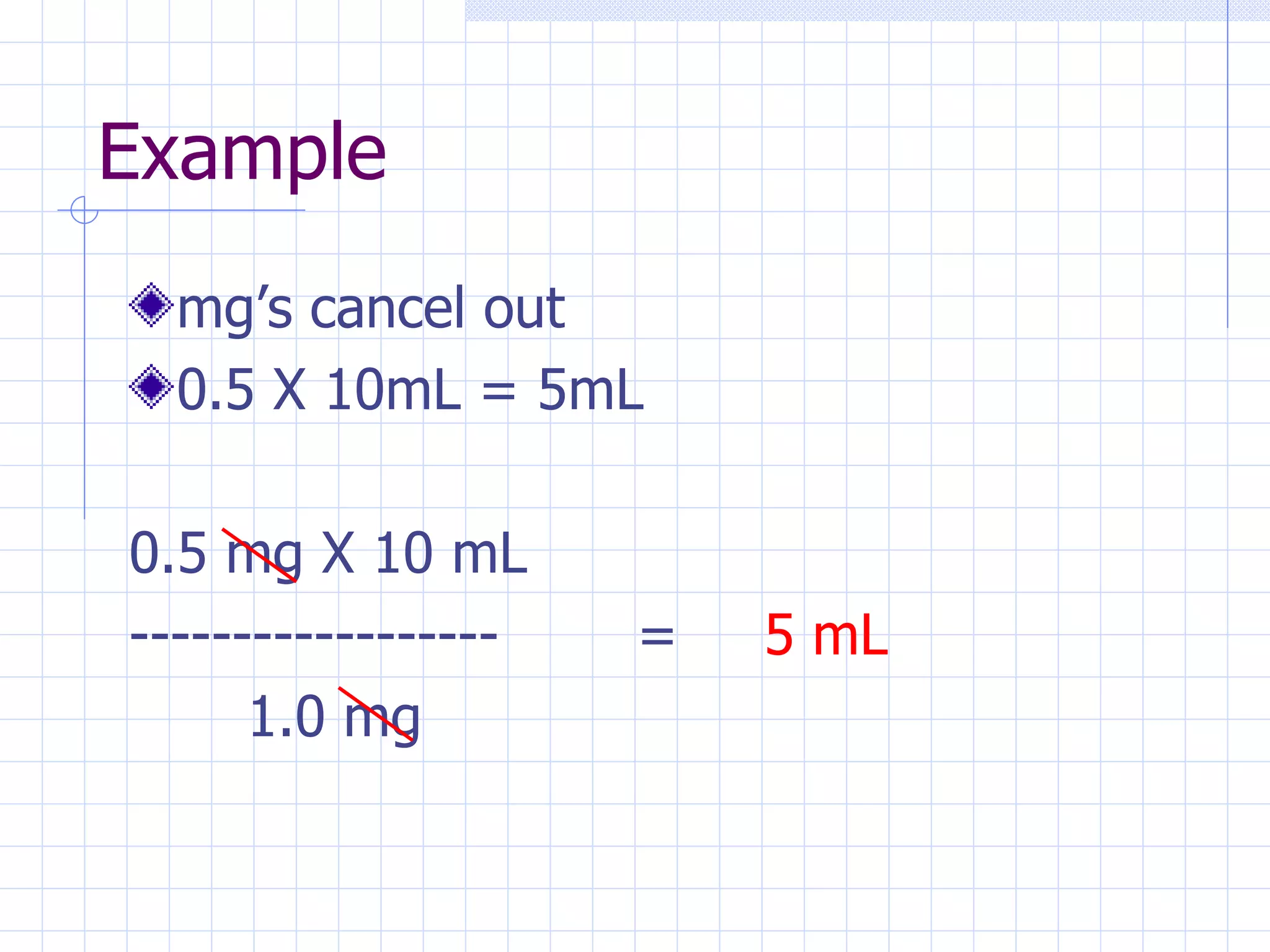
Example mg’s cancel out 0.5 X 10mL = 5mL 0.5 mg X 10 mL ------------------ = 5 mL   1.0 mg
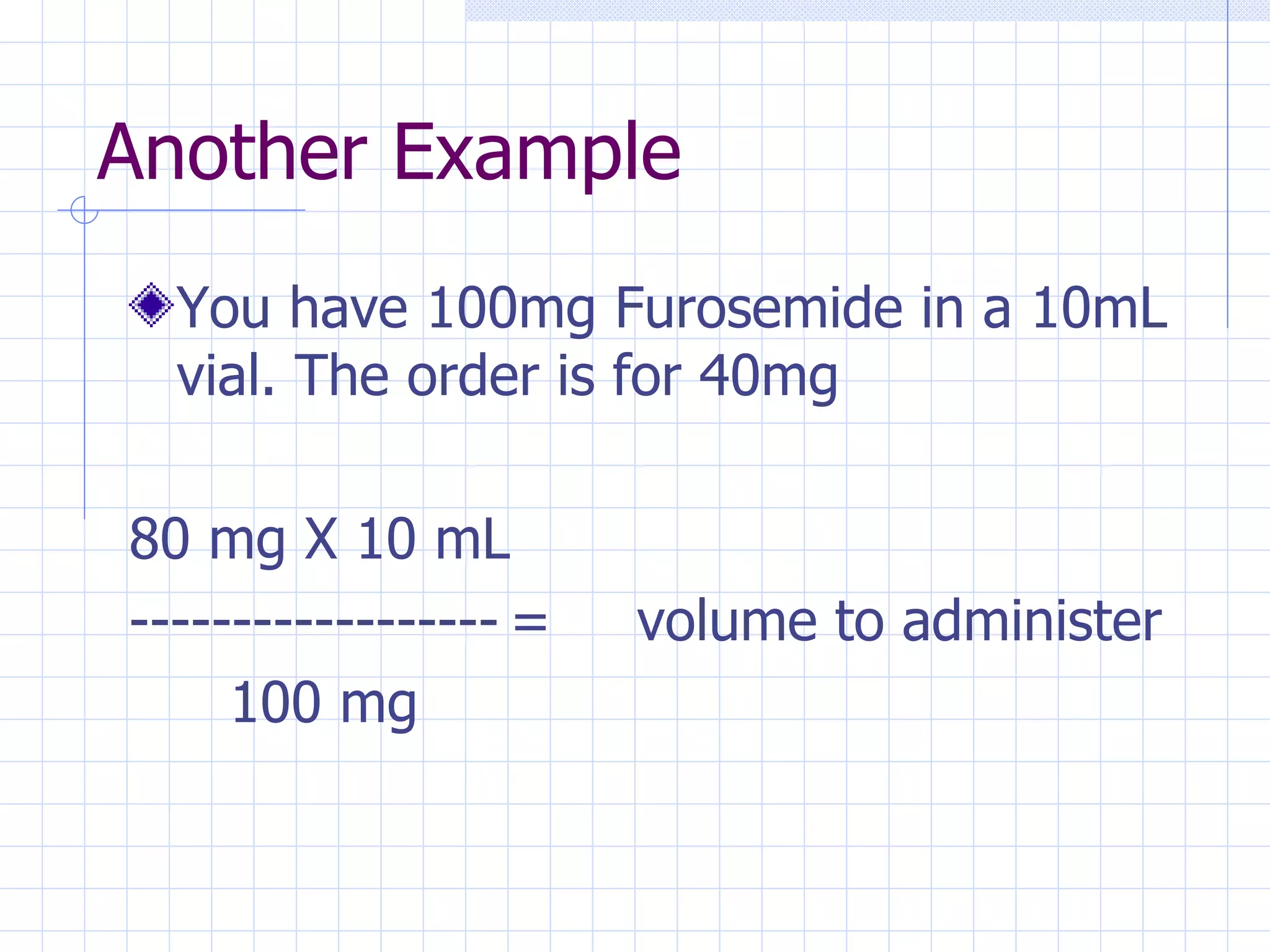
Another Example You have 100mg Furosemide in a 10mL vial. The order is for 40mg 80 mg X 10 mL ------------------ = volume to administer   100 mg
Example mg’s cancel out 80 X 10mL = 800mL/100 = 8 80 mg X 10 mL ------------------ = 8 mL   100 mg
Catching on?
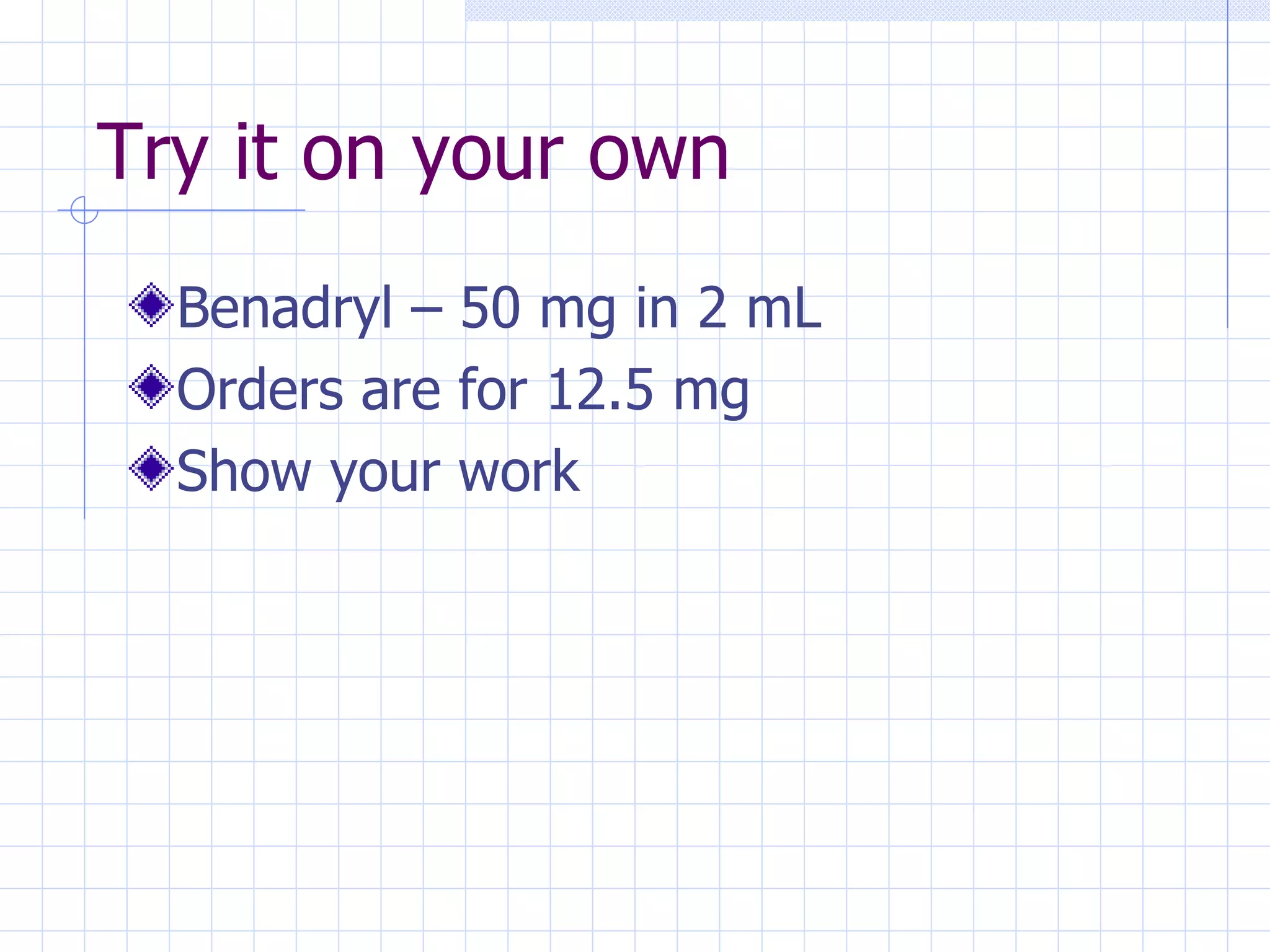
Try it on your own Benadryl – 50 mg in 2 mL Orders are for 12.5 mg Show your work
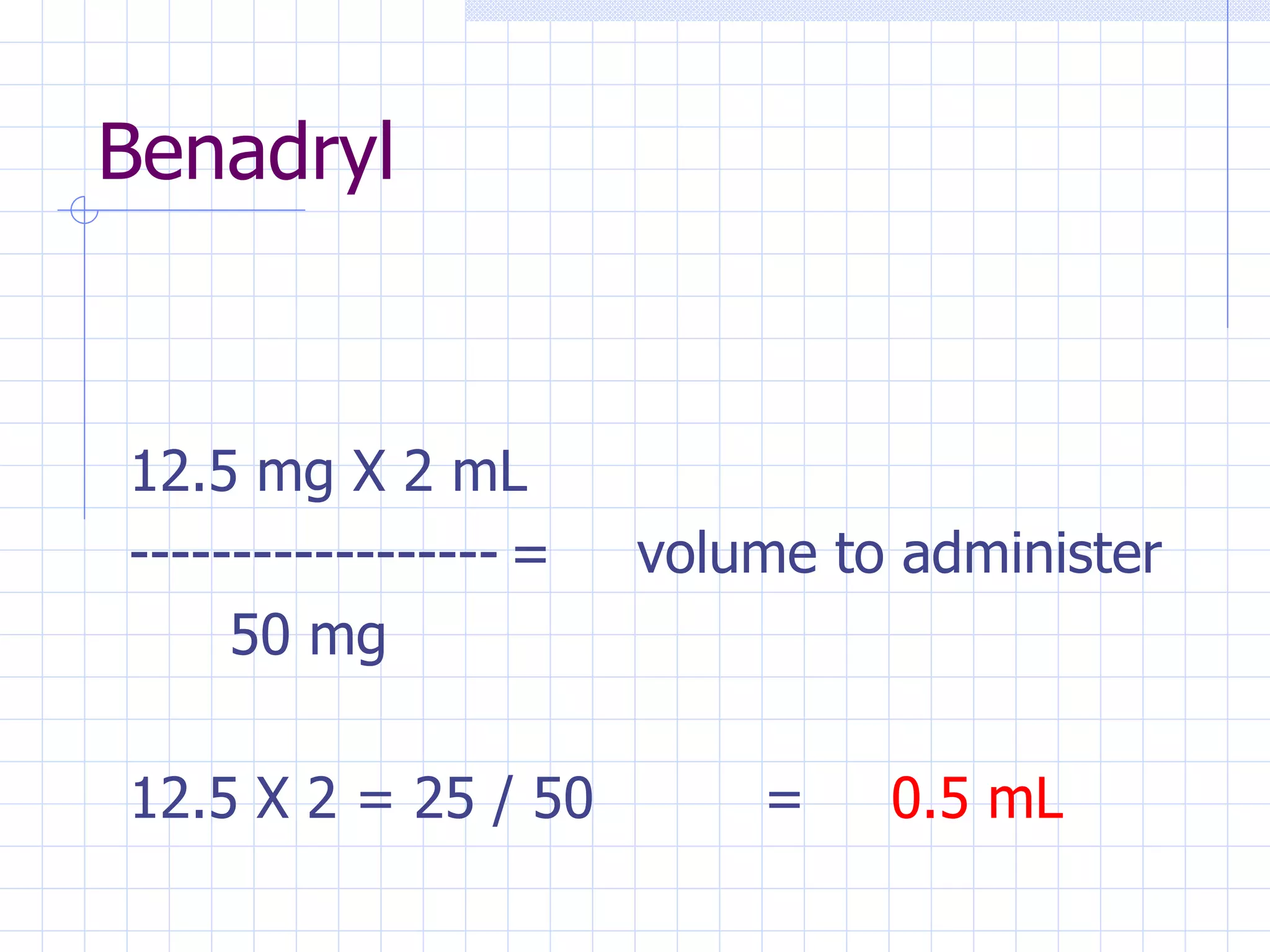
Benadryl 12.5 mg X 2 mL ------------------ = volume to administer   50 mg 12.5 X 2 = 25 / 50 = 0.5 mL
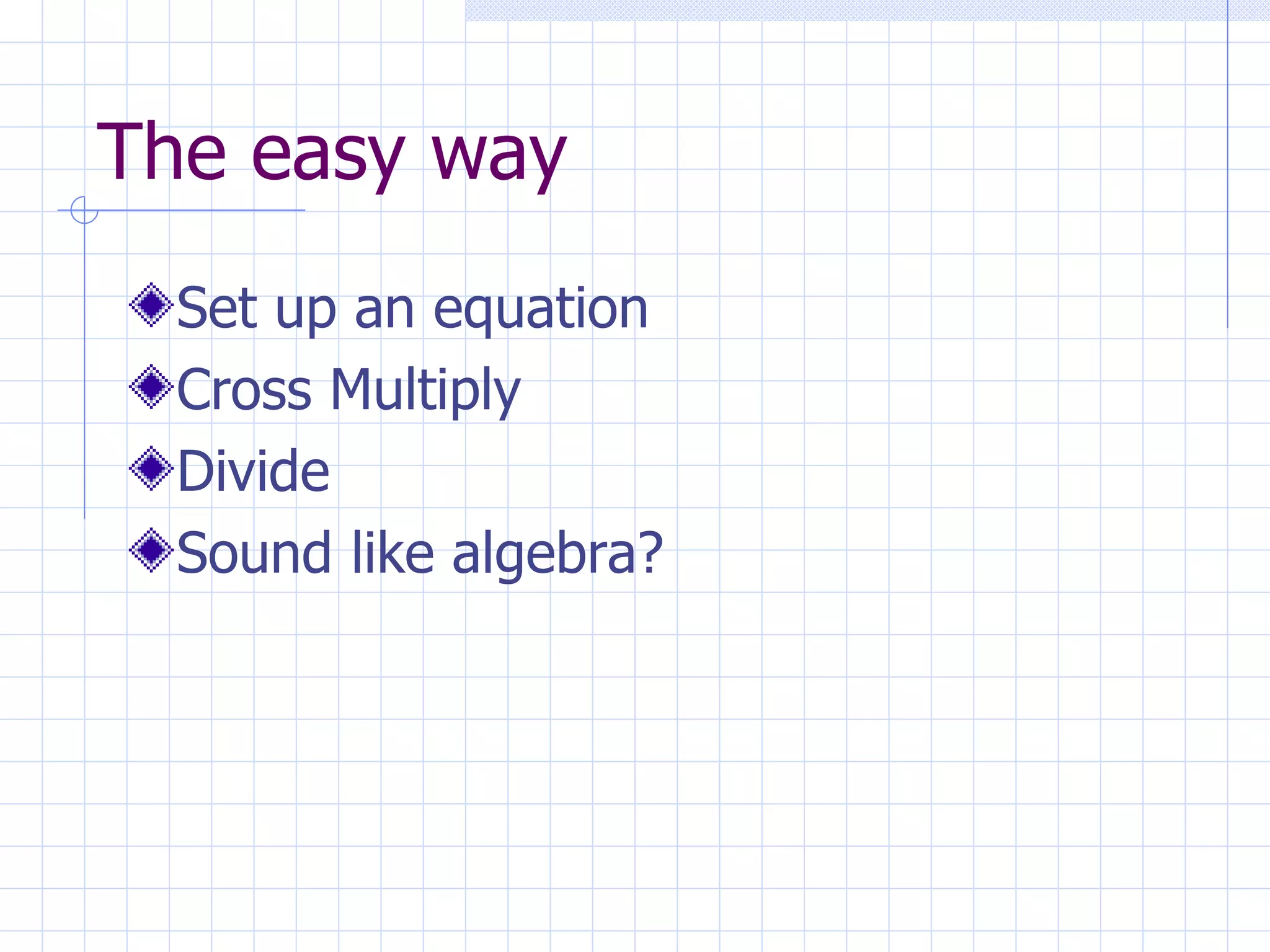
The easy way Set up an equation Cross Multiply Divide Sound like algebra?
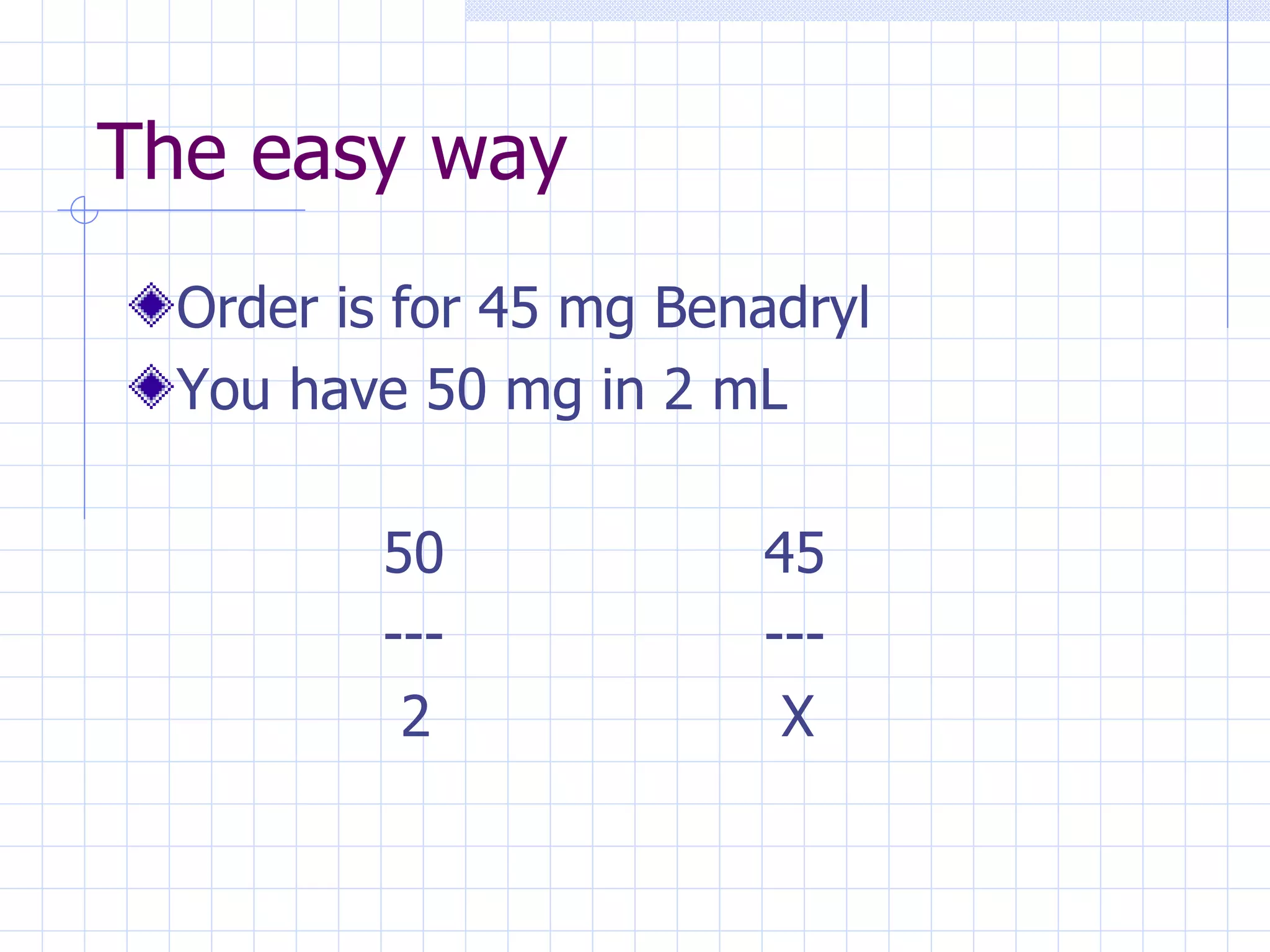
The easy way Order is for 45 mg Benadryl You have 50 mg in 2 mL 50 45 --- ---   2  X
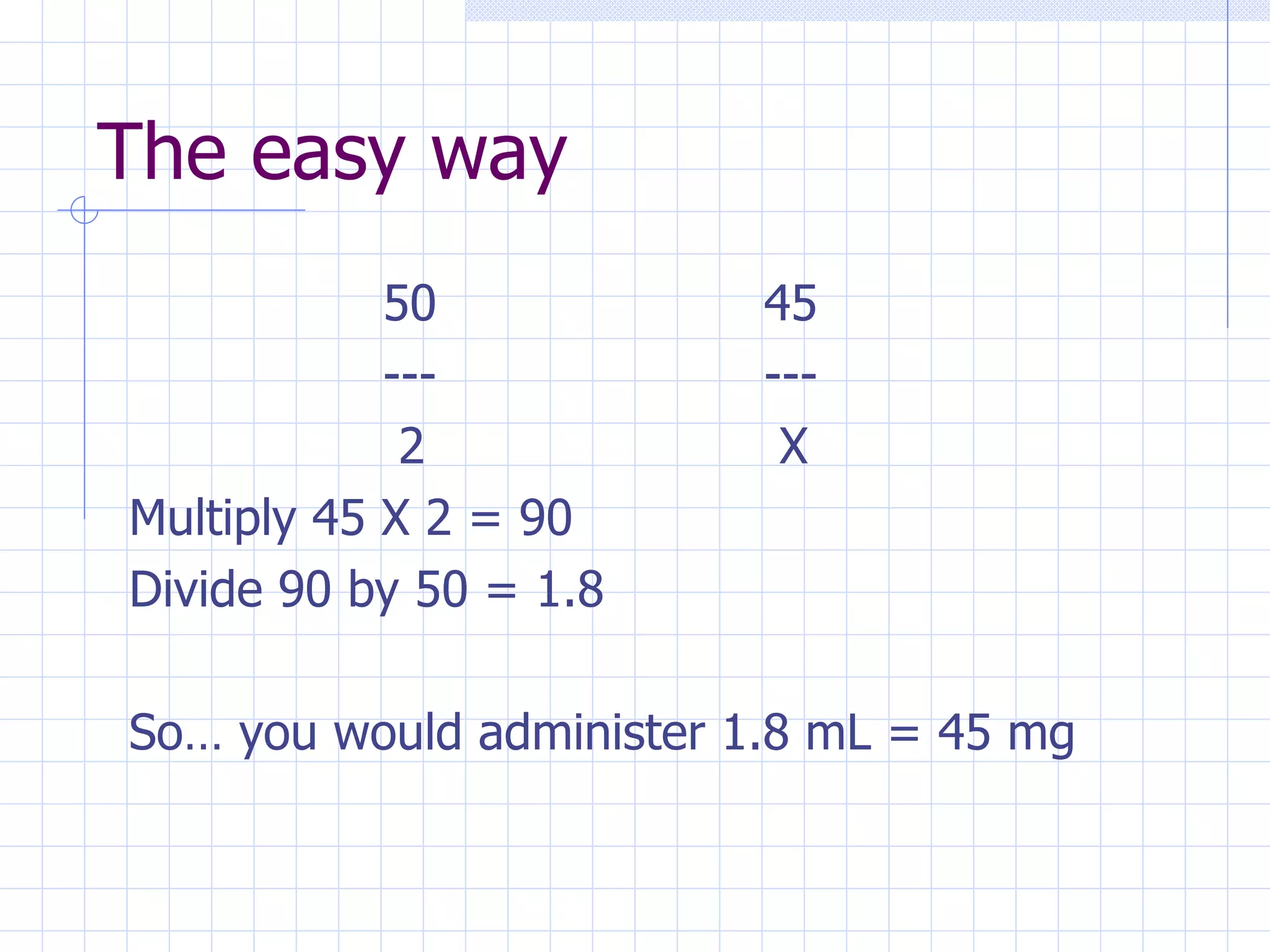
The easy way 50 45 --- ---   2  X Multiply 45 X 2 = 90 Divide 90 by 50 = 1.8 So… you would administer 1.8 mL = 45 mg
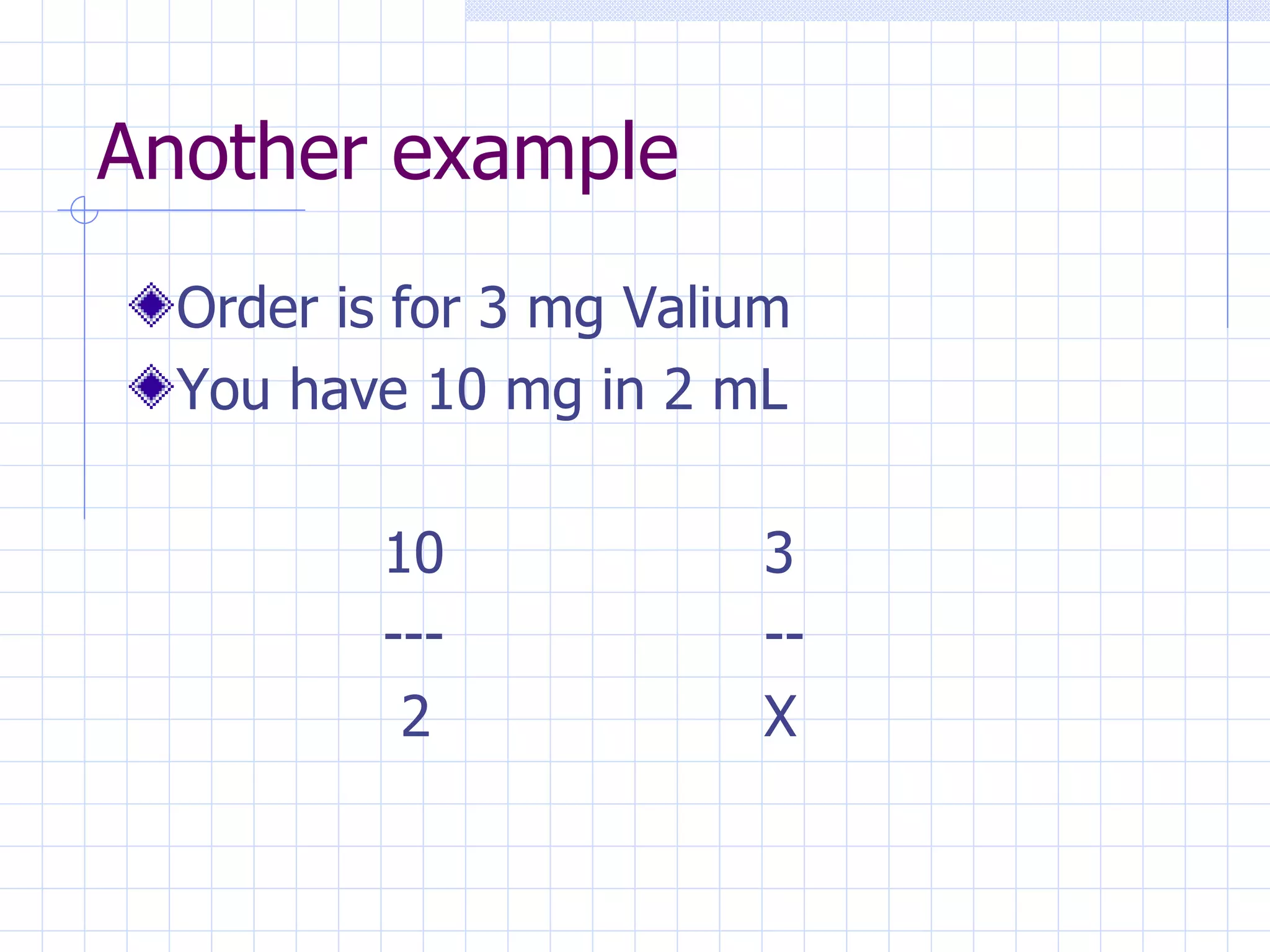
Another example Order is for 3 mg Valium You have 10 mg in 2 mL 10 3 --- --   2 X
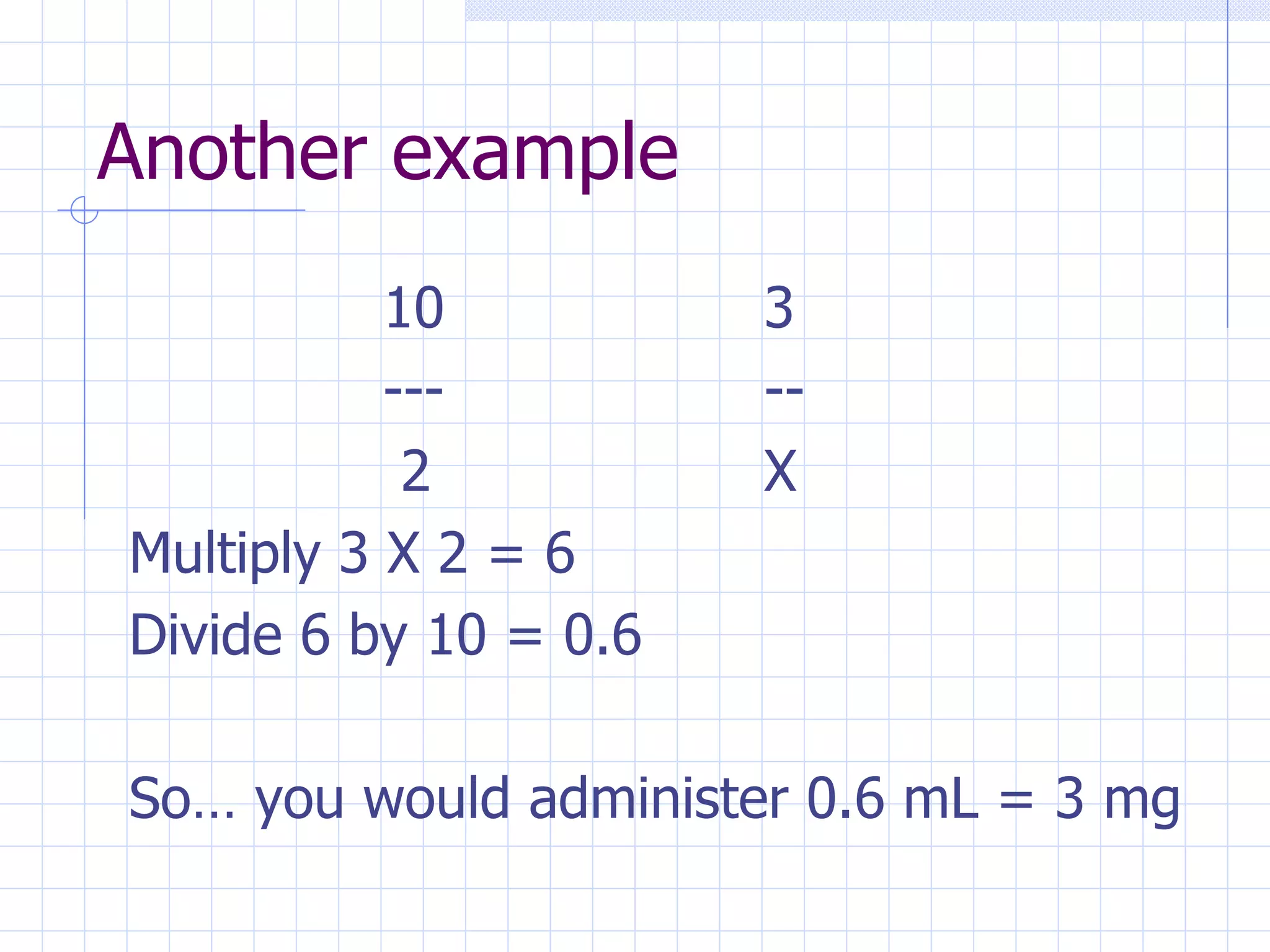
Another example 10 3 --- --   2 X Multiply 3 X 2 = 6 Divide 6 by 10 = 0.6 So… you would administer 0.6 mL = 3 mg
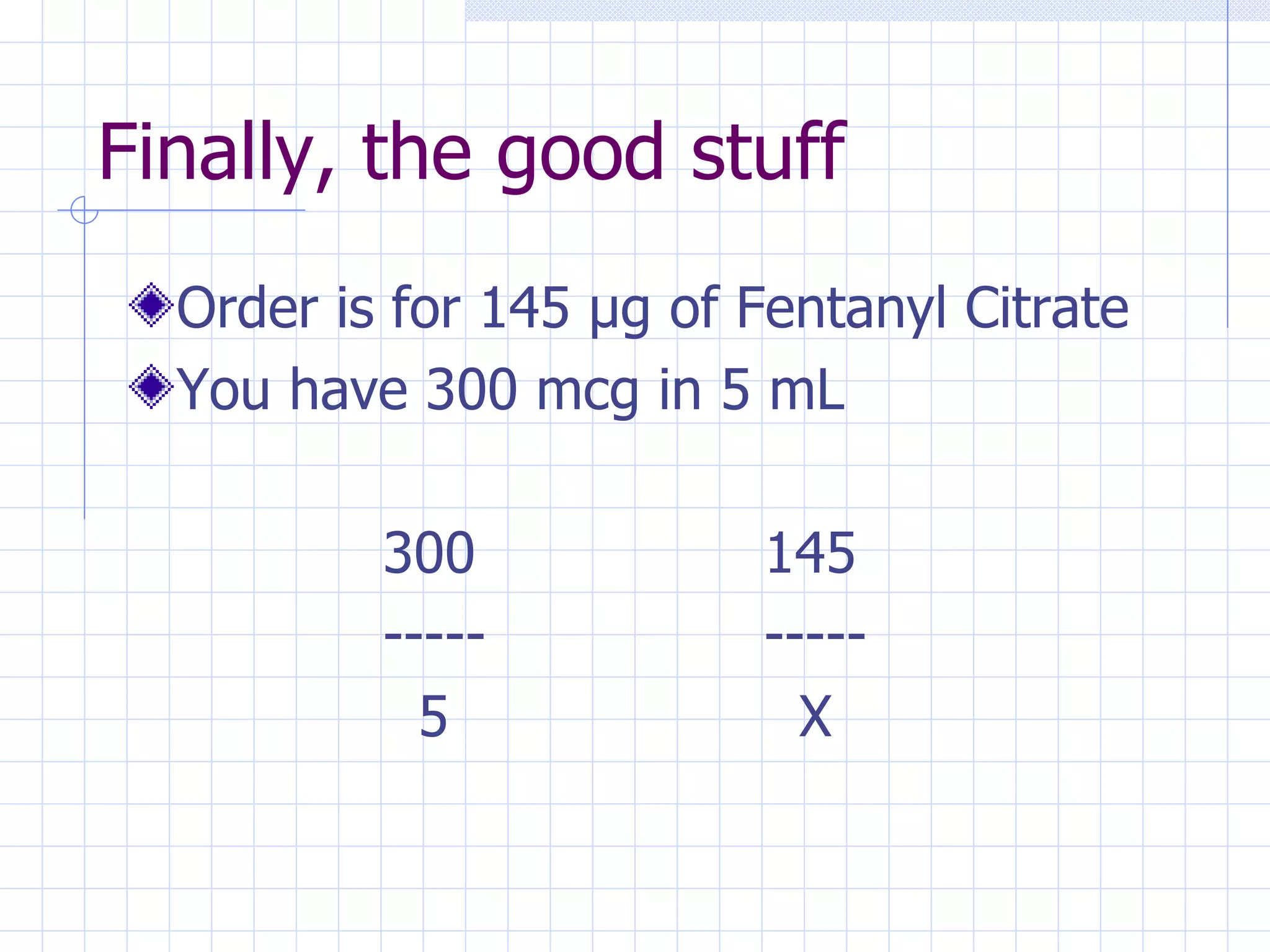
Finally, the good stuff Order is for 145  µ g of Fentanyl Citrate You have 300 mcg in 5 mL 300 145 ----- -----   5   X
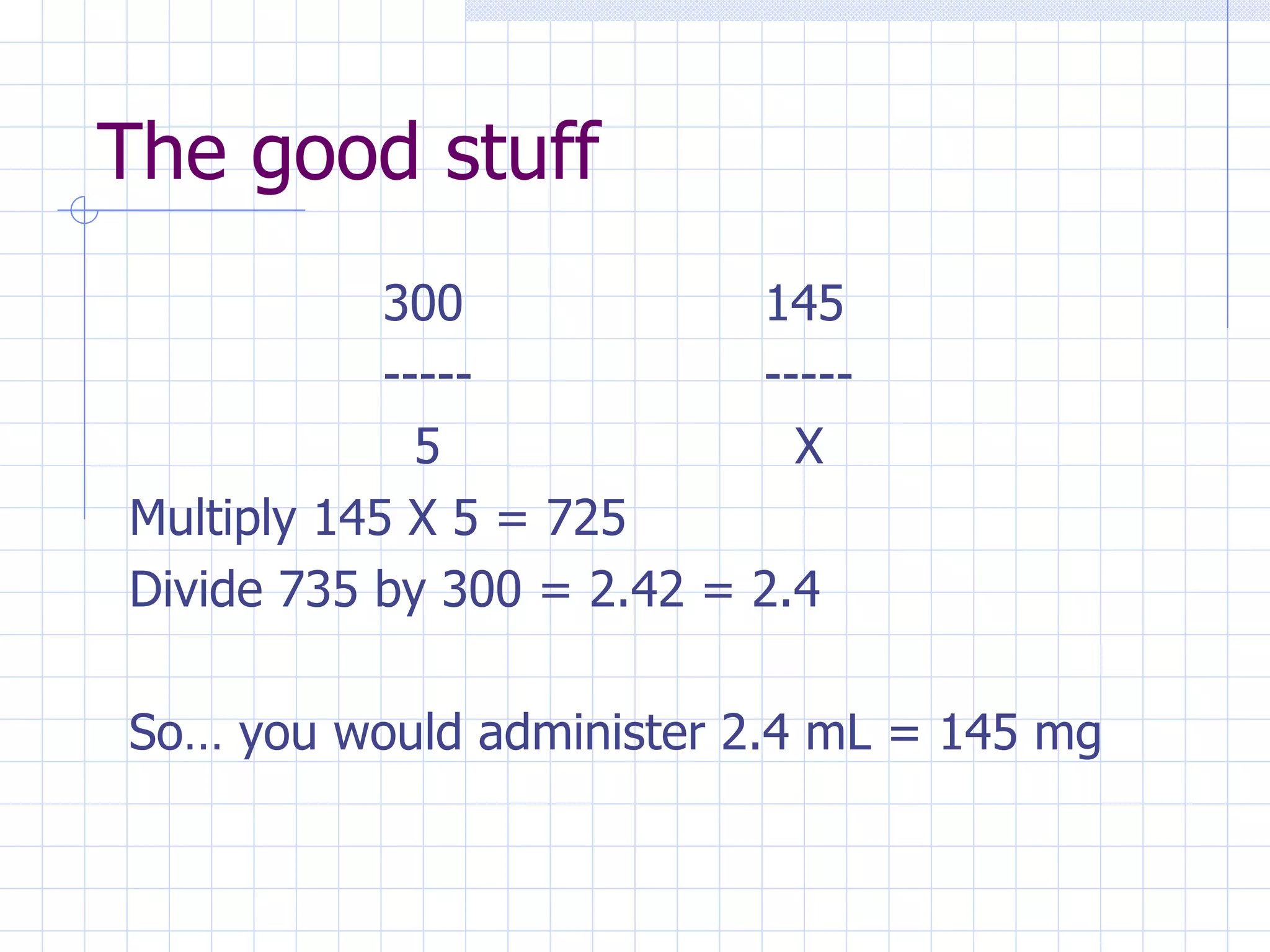
The good stuff 300 145 ----- -----   5   X Multiply 145 X 5 = 725 Divide 735 by 300 = 2.42 = 2.4 So… you would administer 2.4 mL = 145 mg
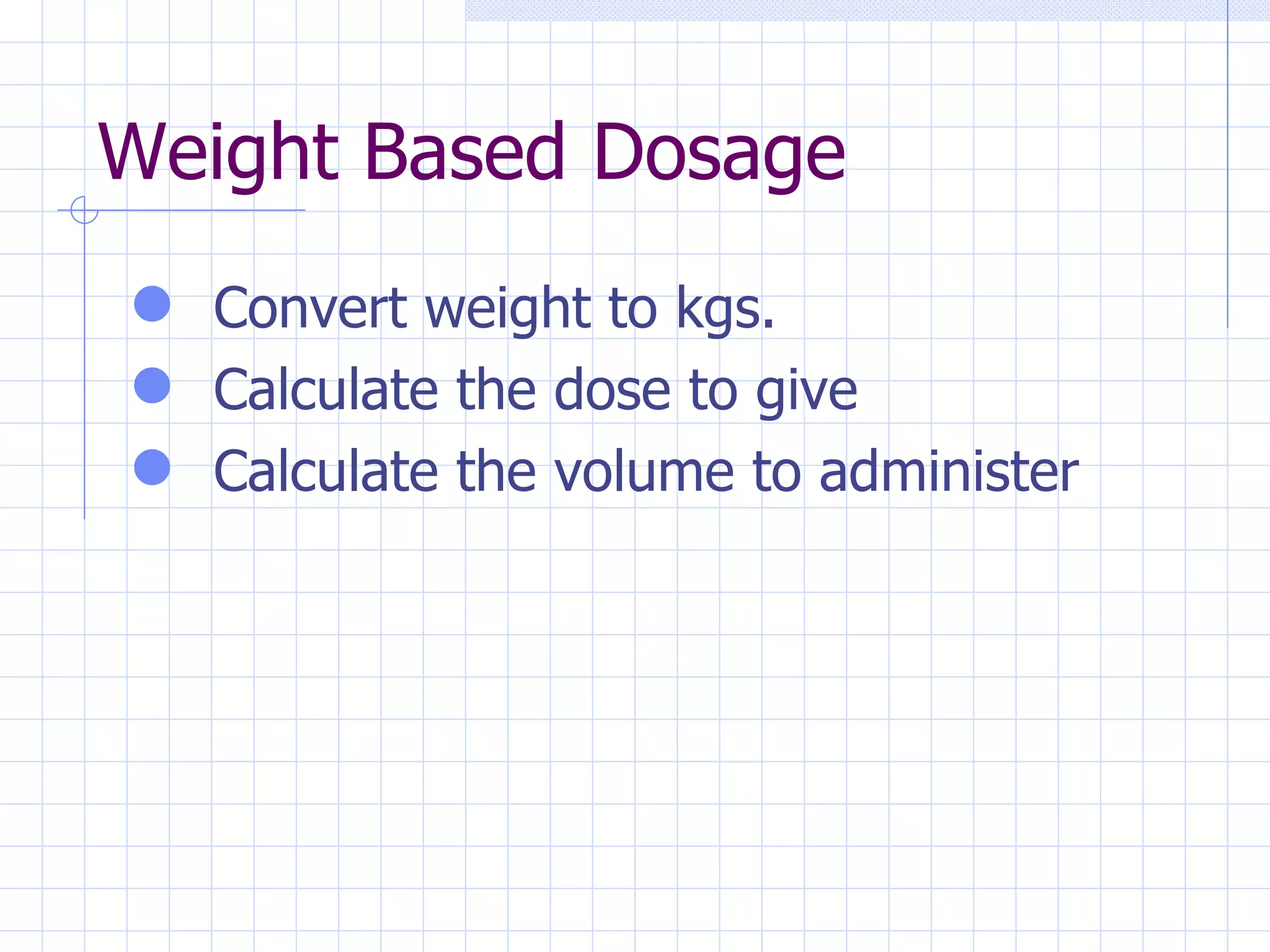
Weight Based Dosage Convert weight to kgs. Calculate the dose to give Calculate the volume to administer
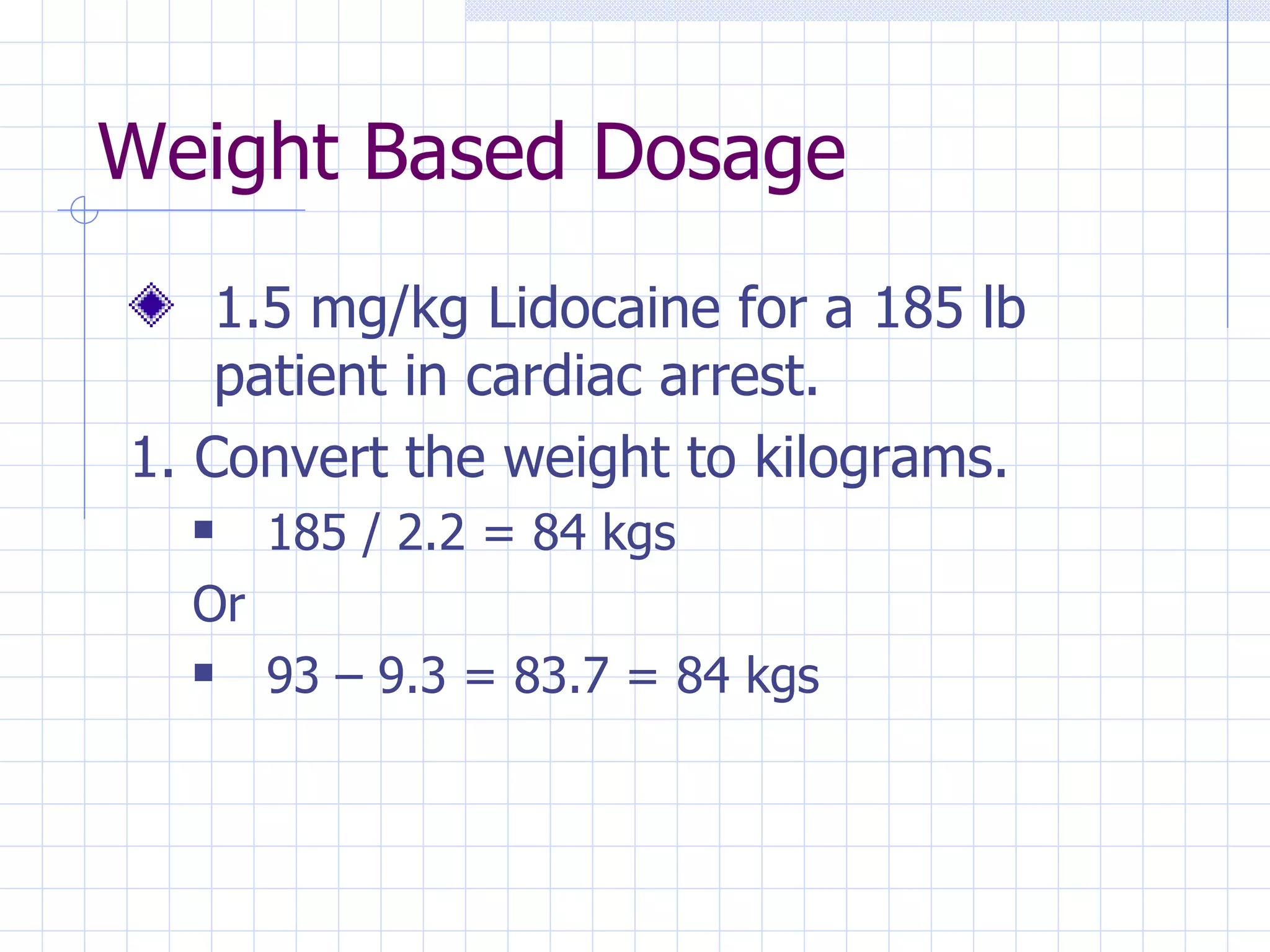
Weight Based Dosage 1.5 mg/kg Lidocaine for a 185 lb patient in cardiac arrest. 1. Convert the weight to kilograms. 185 / 2.2 = 84 kgs Or 93 – 9.3 = 83.7 = 84 kgs
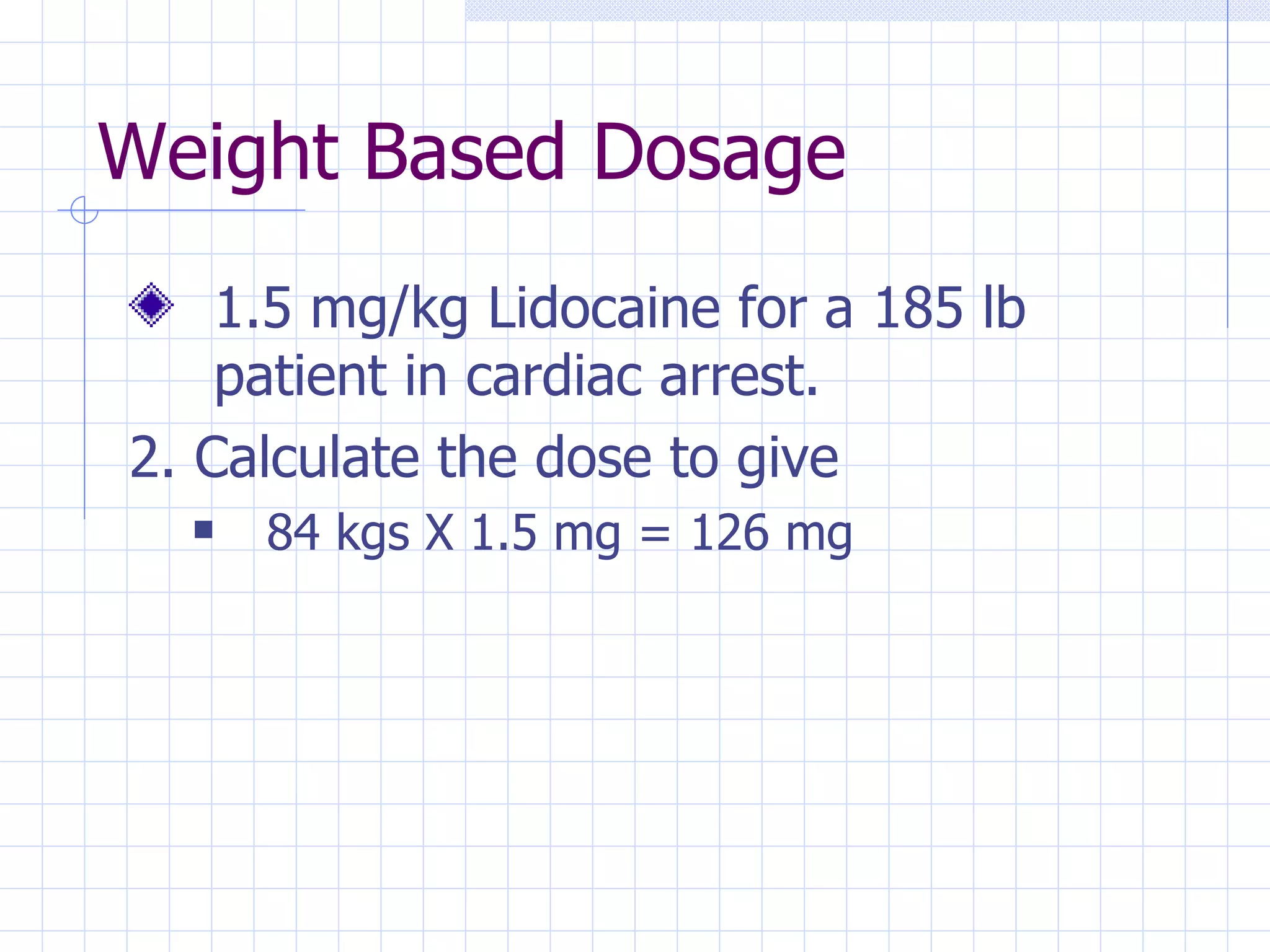
Weight Based Dosage 1.5 mg/kg Lidocaine for a 185 lb patient in cardiac arrest. 2. Calculate the dose to give 84 kgs X 1.5 mg = 126 mg
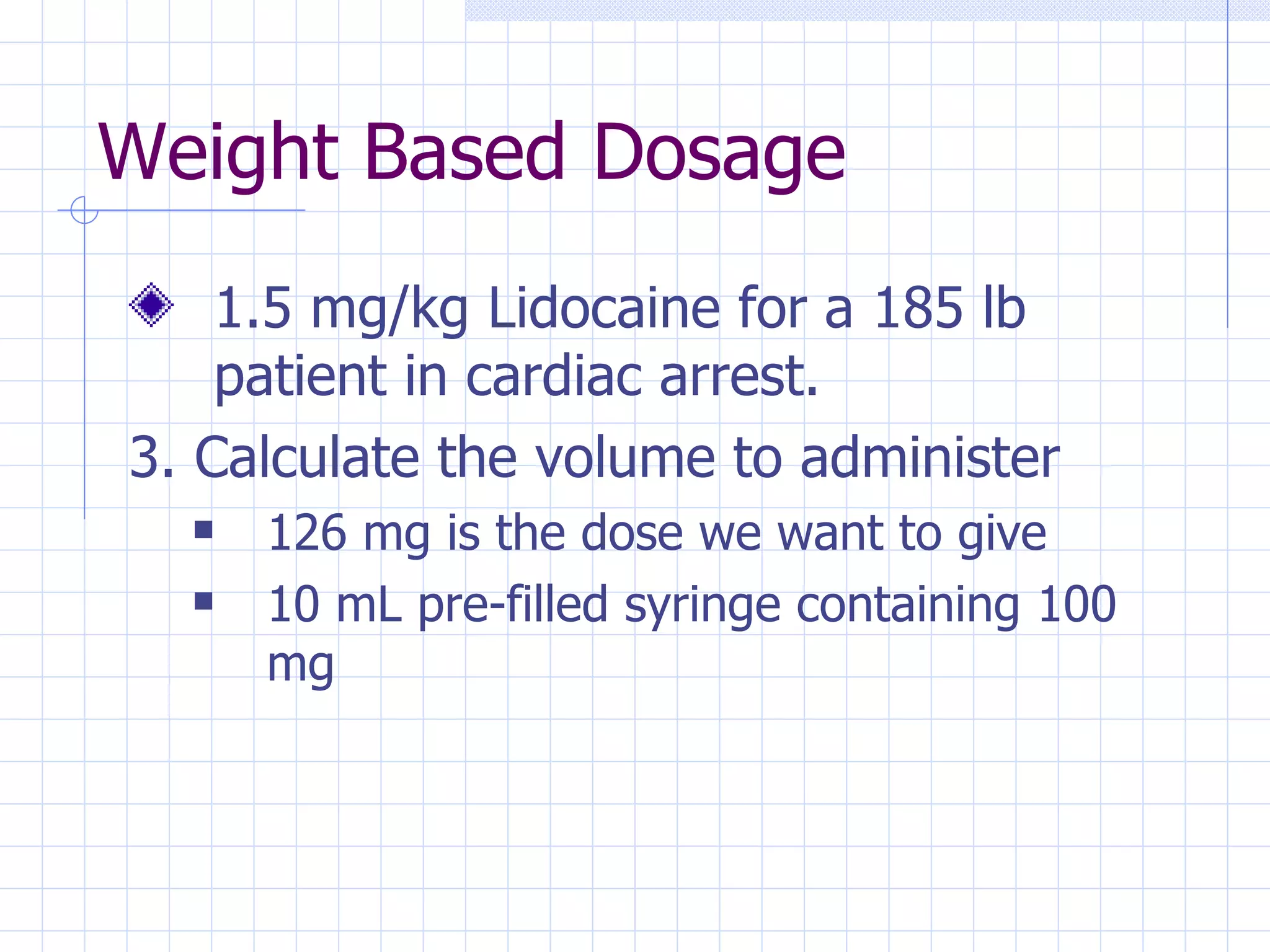
Weight Based Dosage 1.5 mg/kg Lidocaine for a 185 lb patient in cardiac arrest. 3. Calculate the volume to administer 126 mg is the dose we want to give 10 mL pre-filled syringe containing 100 mg
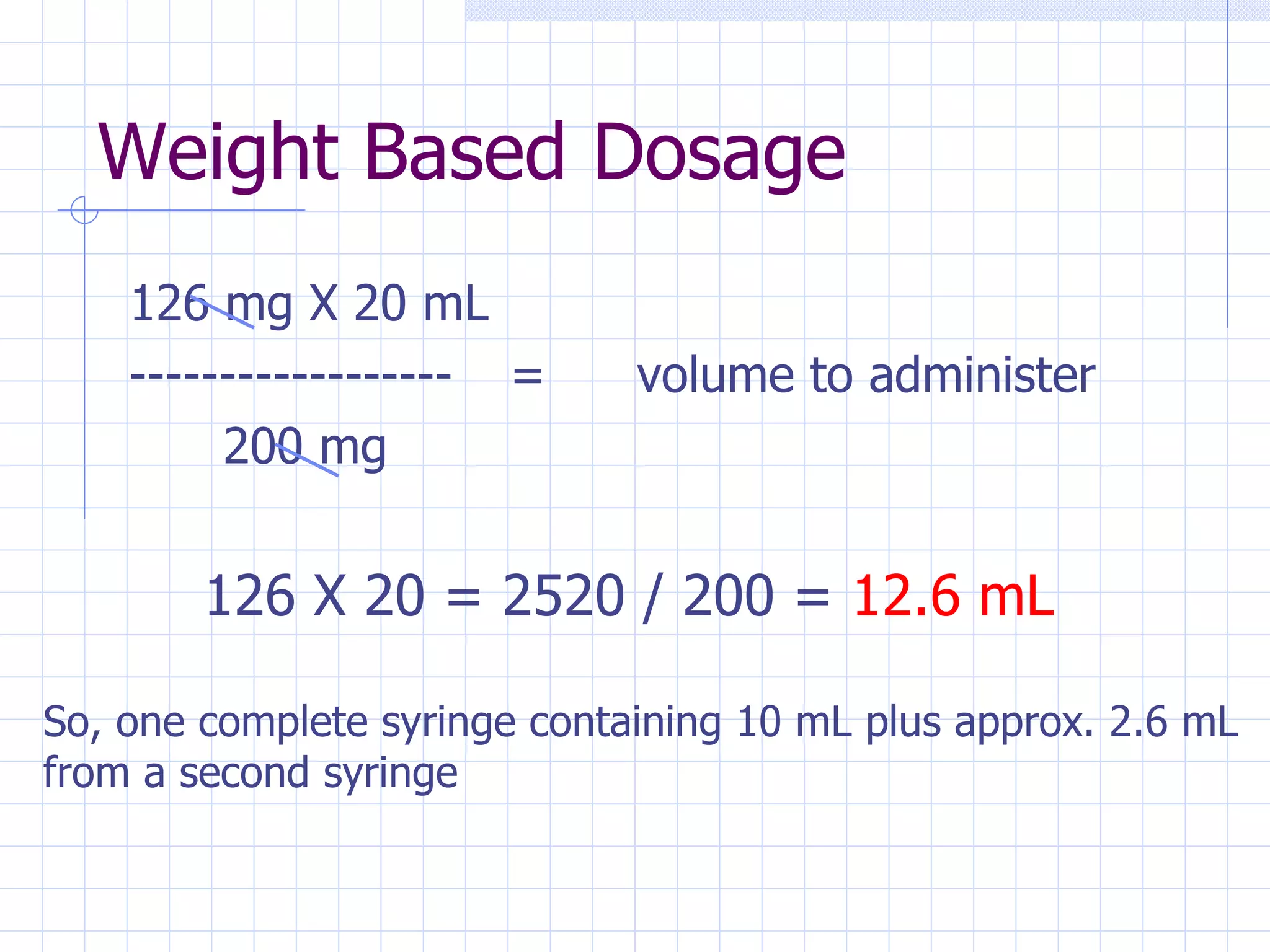
Weight Based Dosage 126 mg X 20 mL ------------------ = volume to administer   200 mg 126 X 20 = 2520 / 200 =  12.6 mL So, one complete syringe containing 10 mL plus approx. 2.6 mL from a second syringe
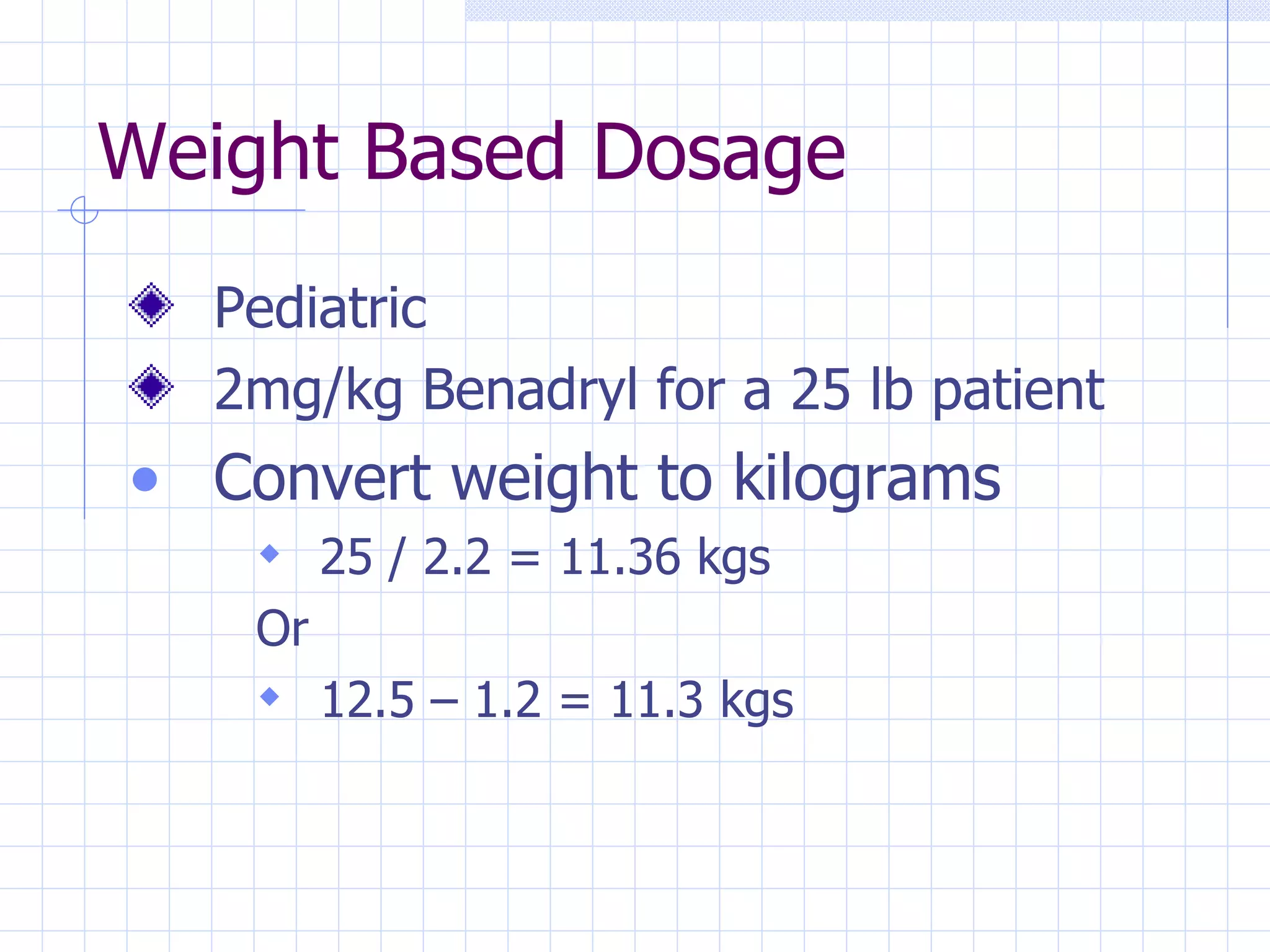
Weight Based Dosage Pediatric 2mg/kg Benadryl for a 25 lb patient Convert weight to kilograms 25 / 2.2 = 11.36 kgs Or 12.5 – 1.2 = 11.3 kgs
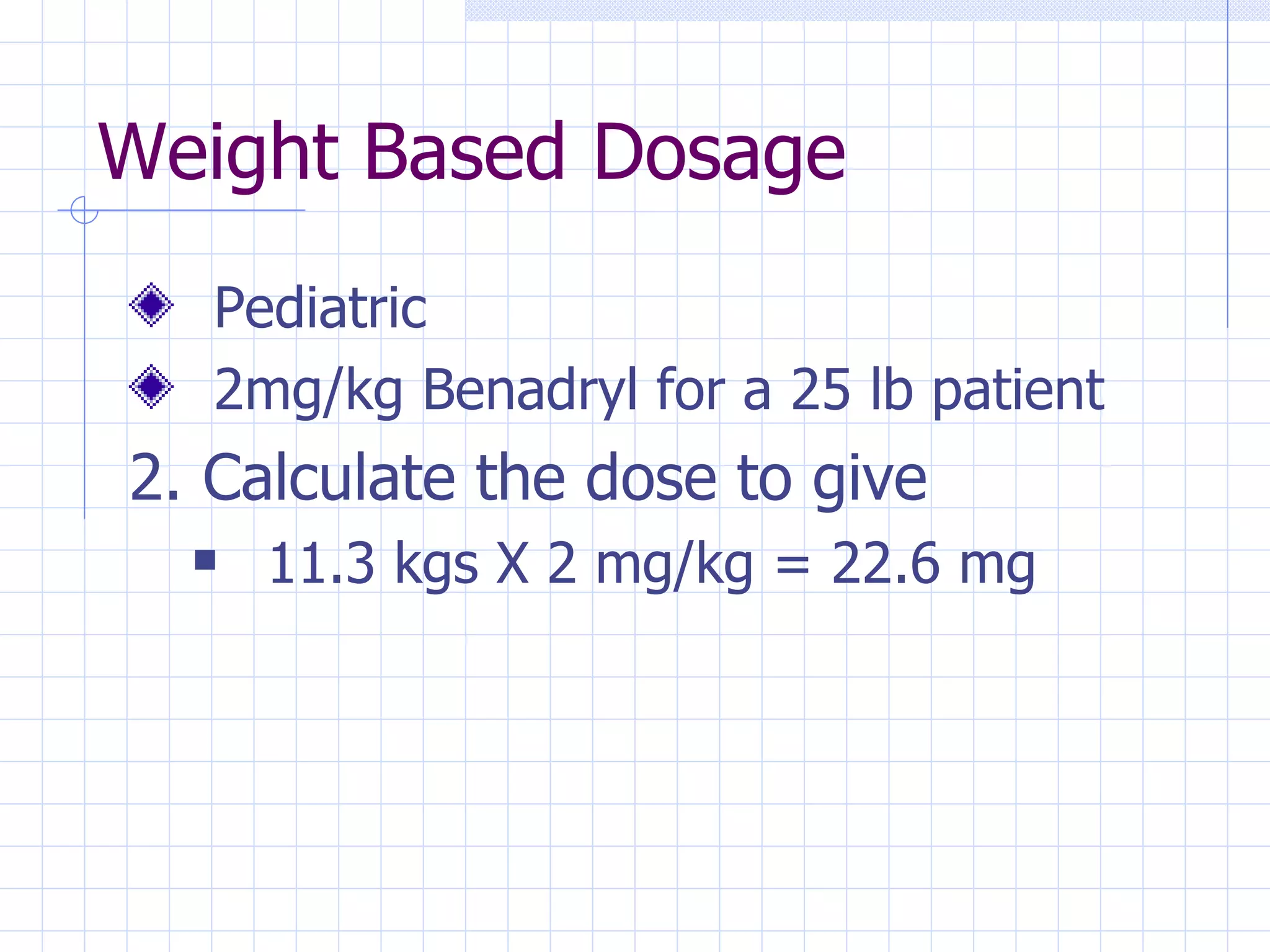
Weight Based Dosage Pediatric 2mg/kg Benadryl for a 25 lb patient 2. Calculate the dose to give 11.3 kgs X 2 mg/kg = 22.6 mg
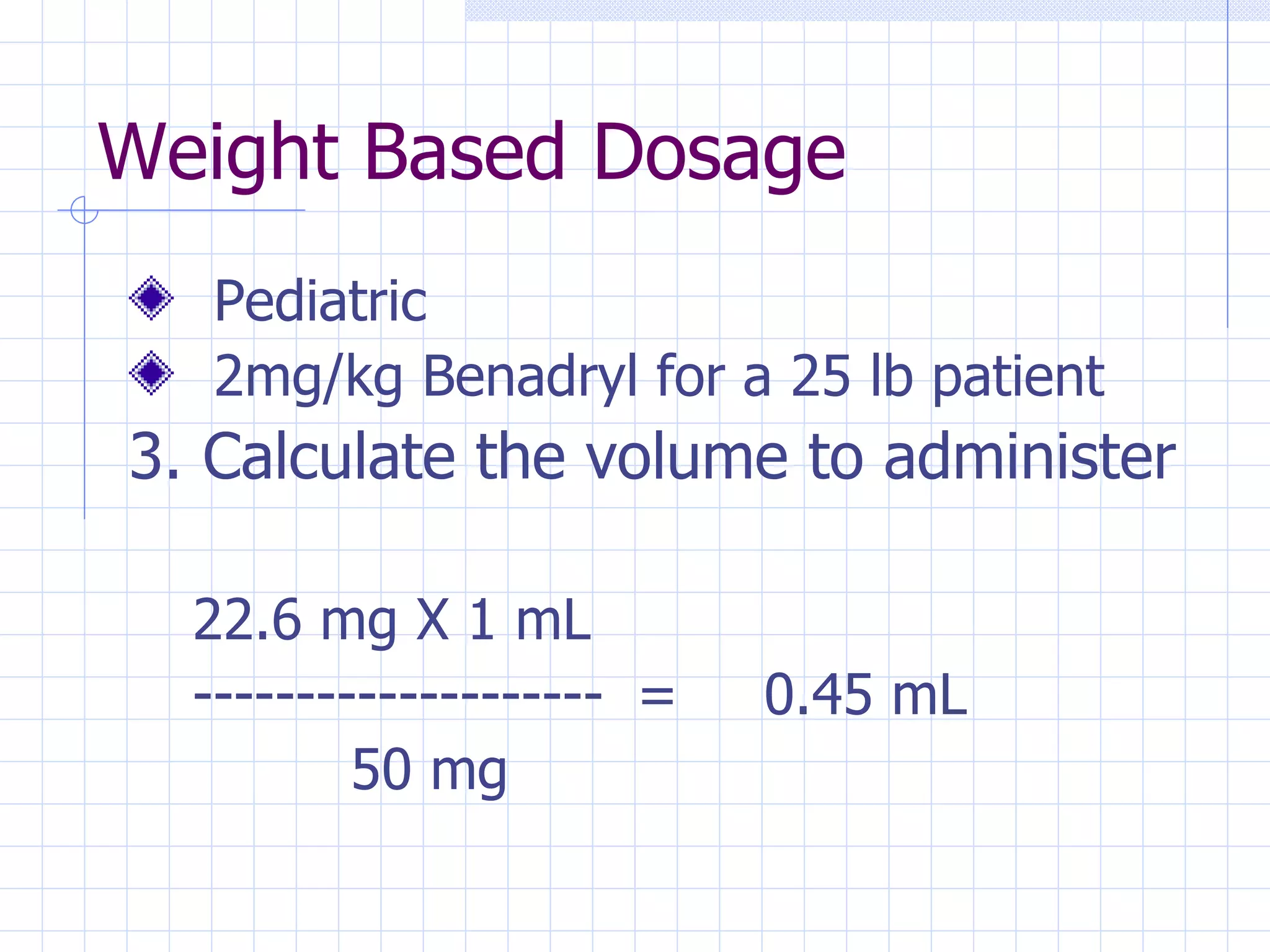
Weight Based Dosage Pediatric 2mg/kg Benadryl for a 25 lb patient 3. Calculate the volume to administer 22.6 mg X 1 mL -------------------- = 0.45 mL 50 mg
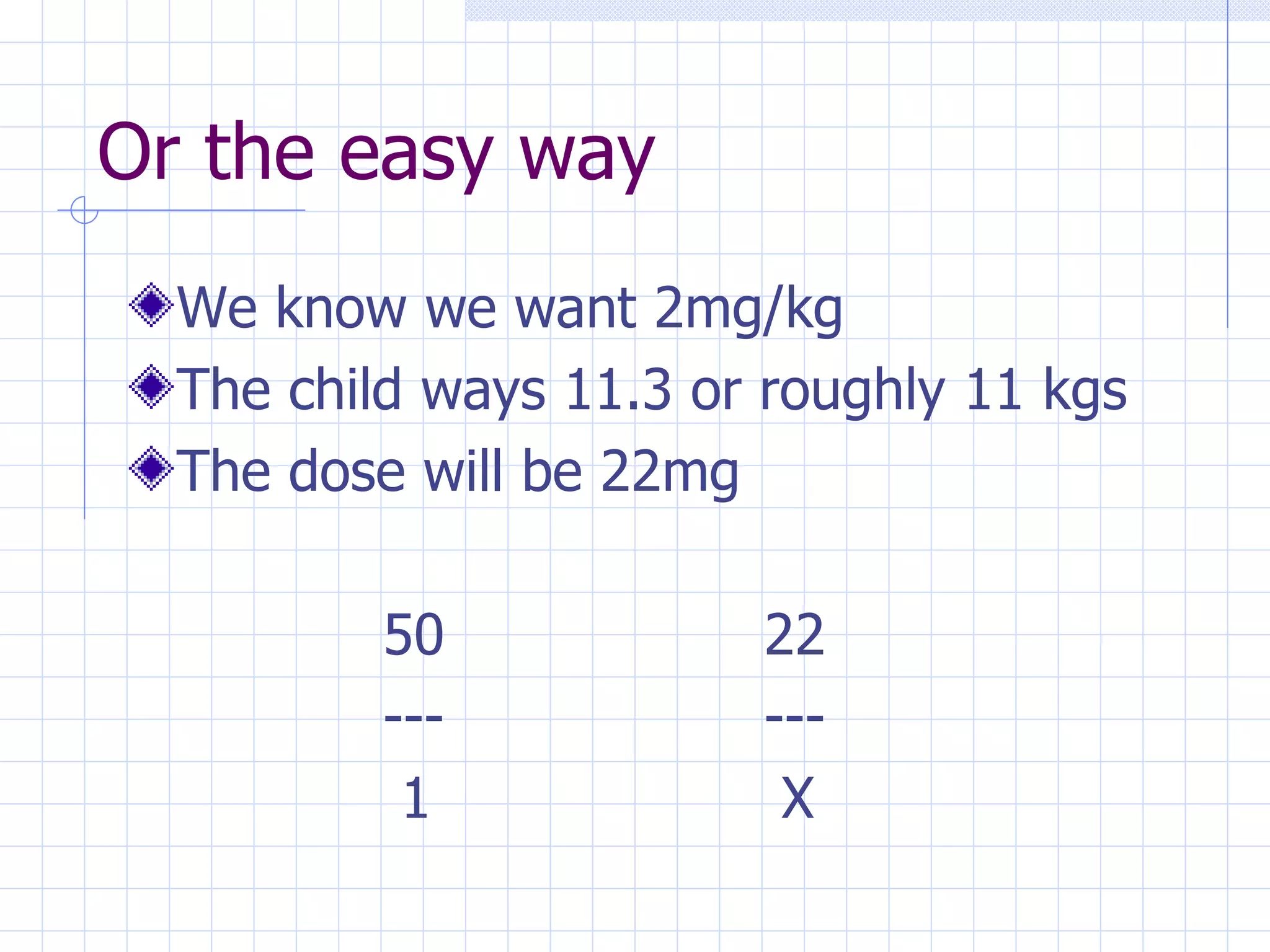
Or the easy way We know we want 2mg/kg The child ways 11.3 or roughly 11 kgs The dose will be 22mg 50 22 --- ---   1  X
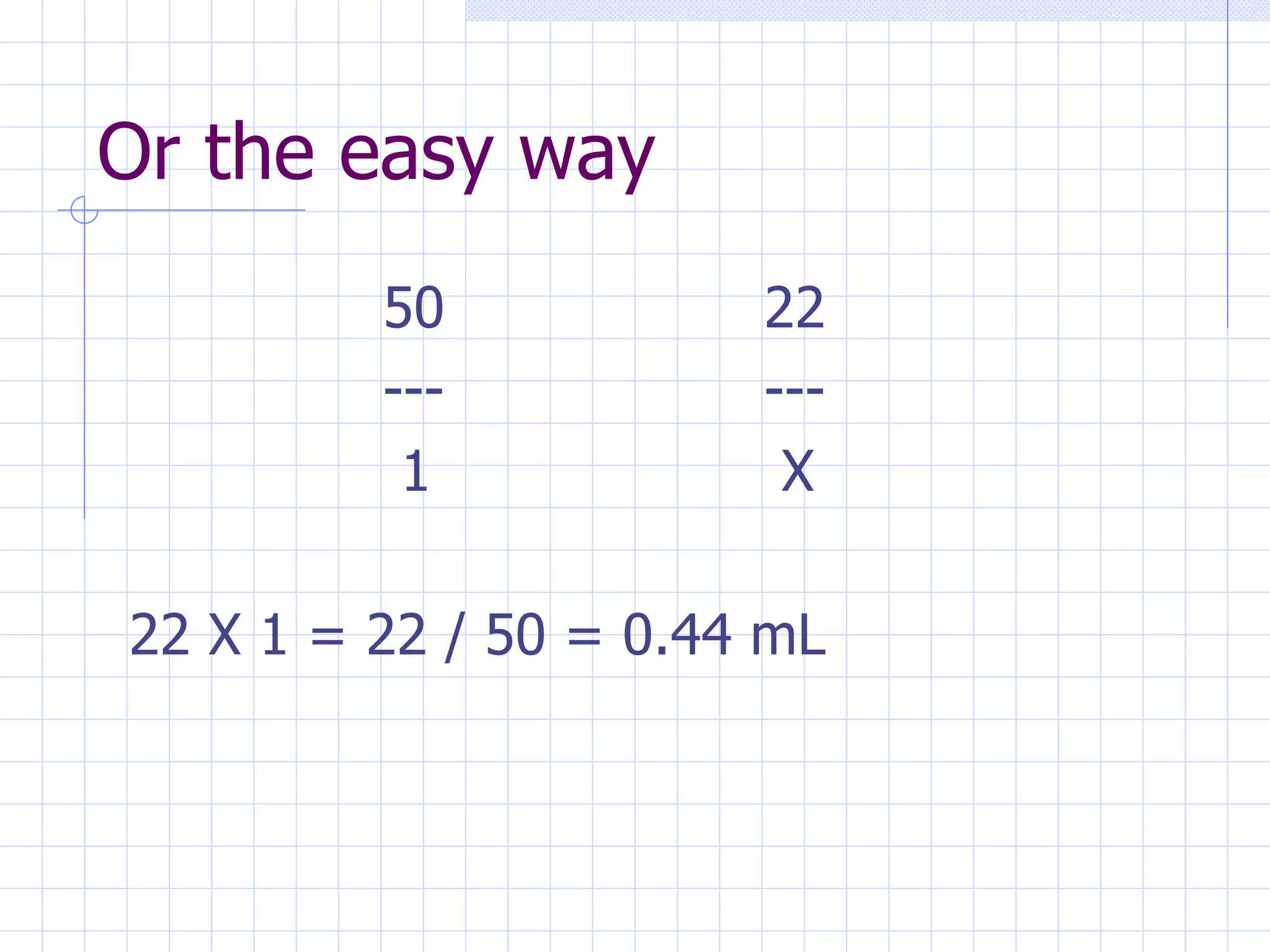
Or the easy way 50 22 --- ---   1  X 22 X 1 = 22 / 50 = 0.44 mL
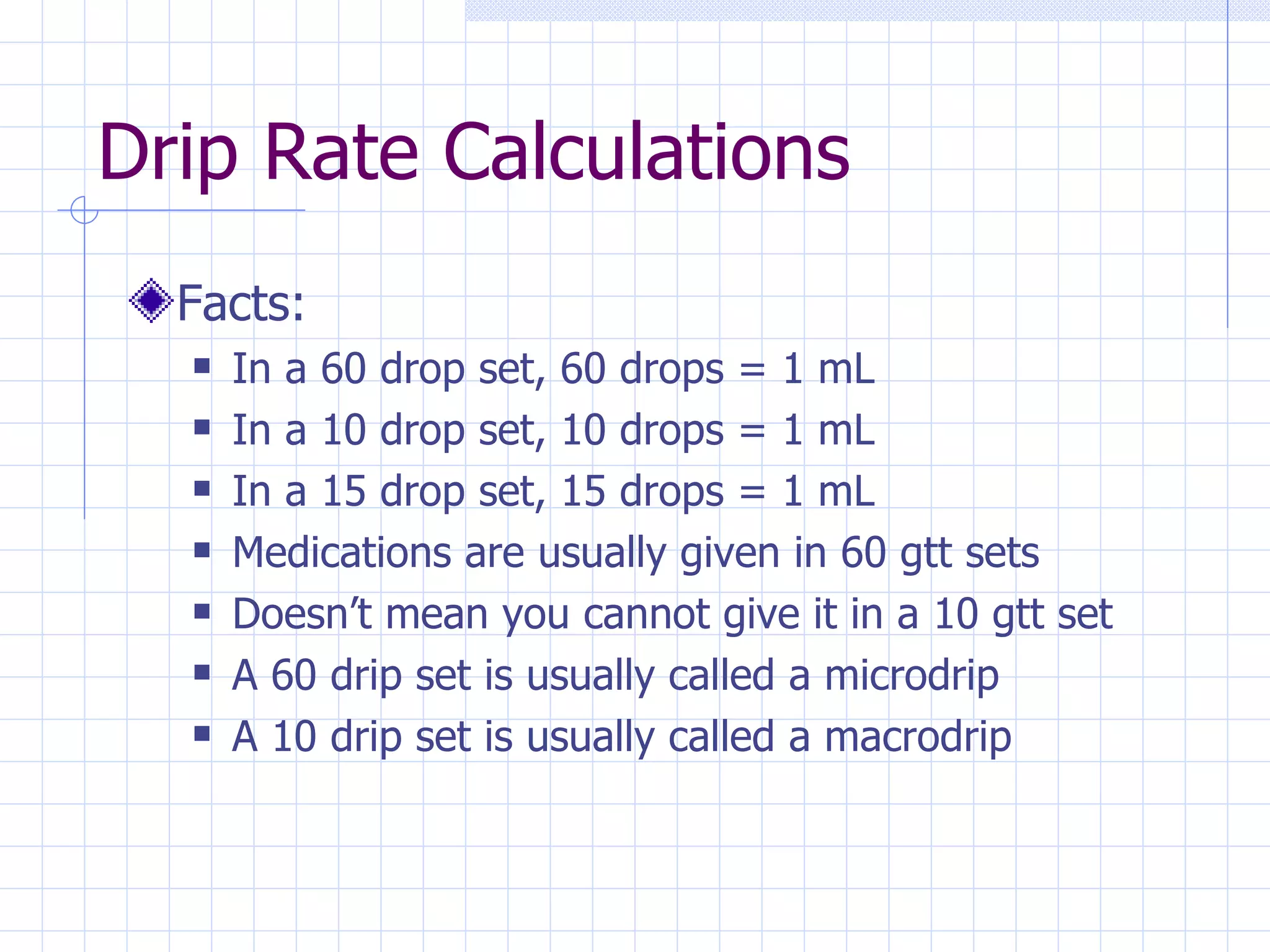
Drip Rate Calculations Facts: In a 60 drop set, 60 drops = 1 mL In a 10 drop set, 10 drops = 1 mL In a 15 drop set, 15 drops = 1 mL Medications are usually given in 60 gtt sets Doesn’t mean you cannot give it in a 10 gtt set A 60 drip set is usually called a microdrip A 10 drip set is usually called a macrodrip
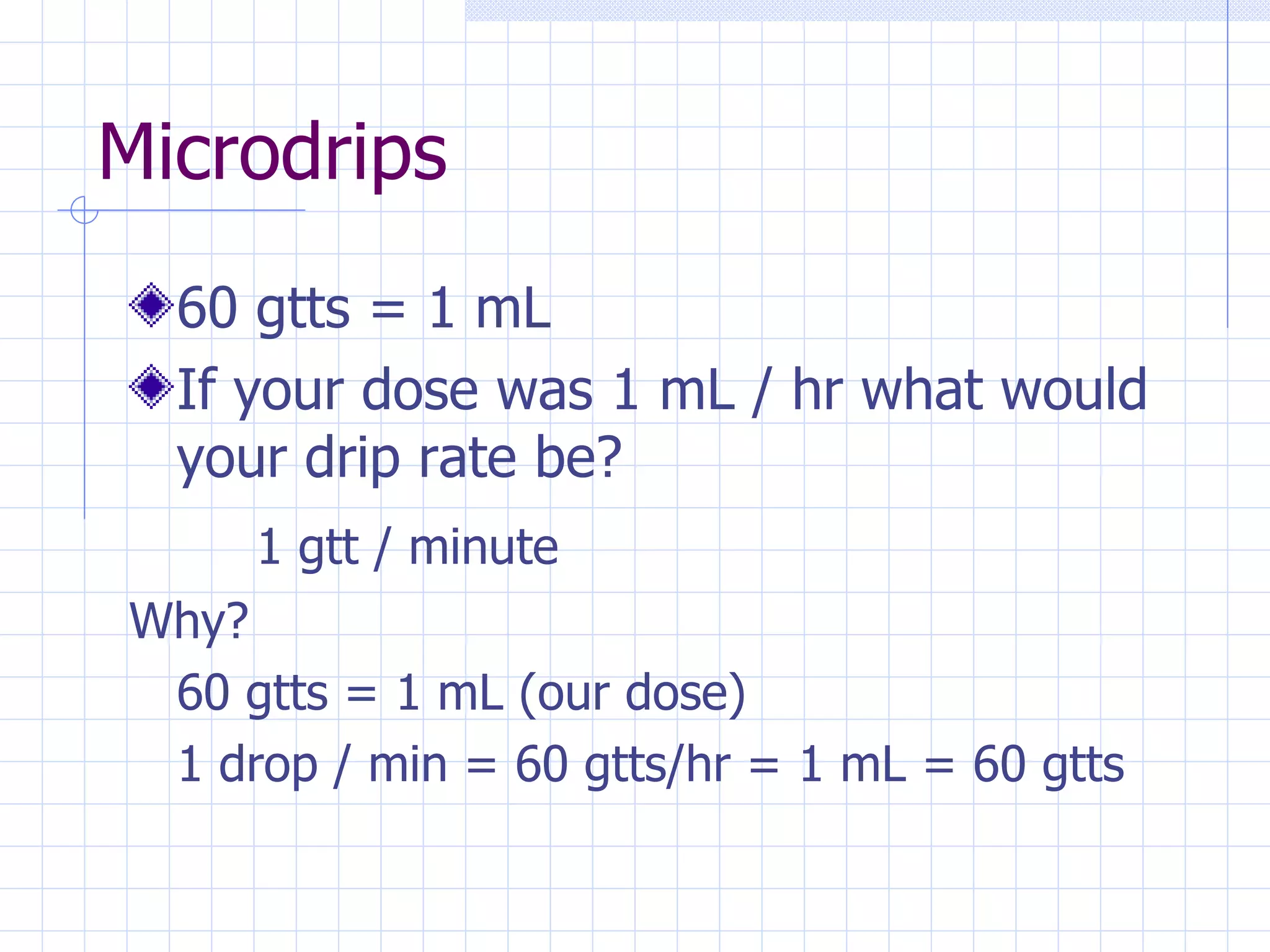
Microdrips 60 gtts = 1 mL If your dose was 1 mL / hr what would your drip rate be? 1 gtt / minute Why? 60 gtts = 1 mL (our dose) 1 drop / min = 60 gtts/hr = 1 mL = 60 gtts
Easy huh?
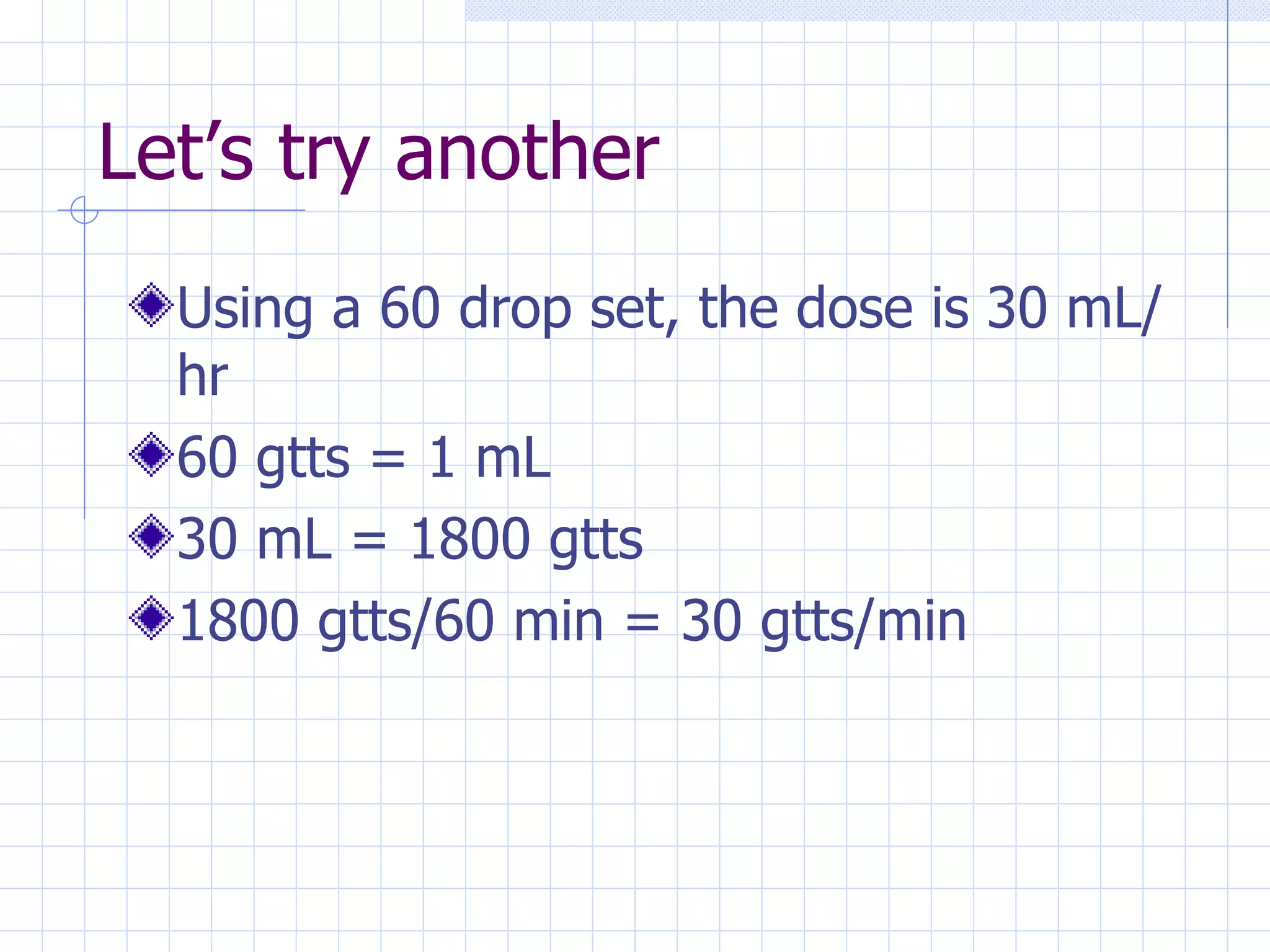
Let’s try another Using a 60 drop set, the dose is 30 mL/hr 60 gtts = 1 mL 30 mL = 1800 gtts 1800 gtts/60 min = 30 gtts/min
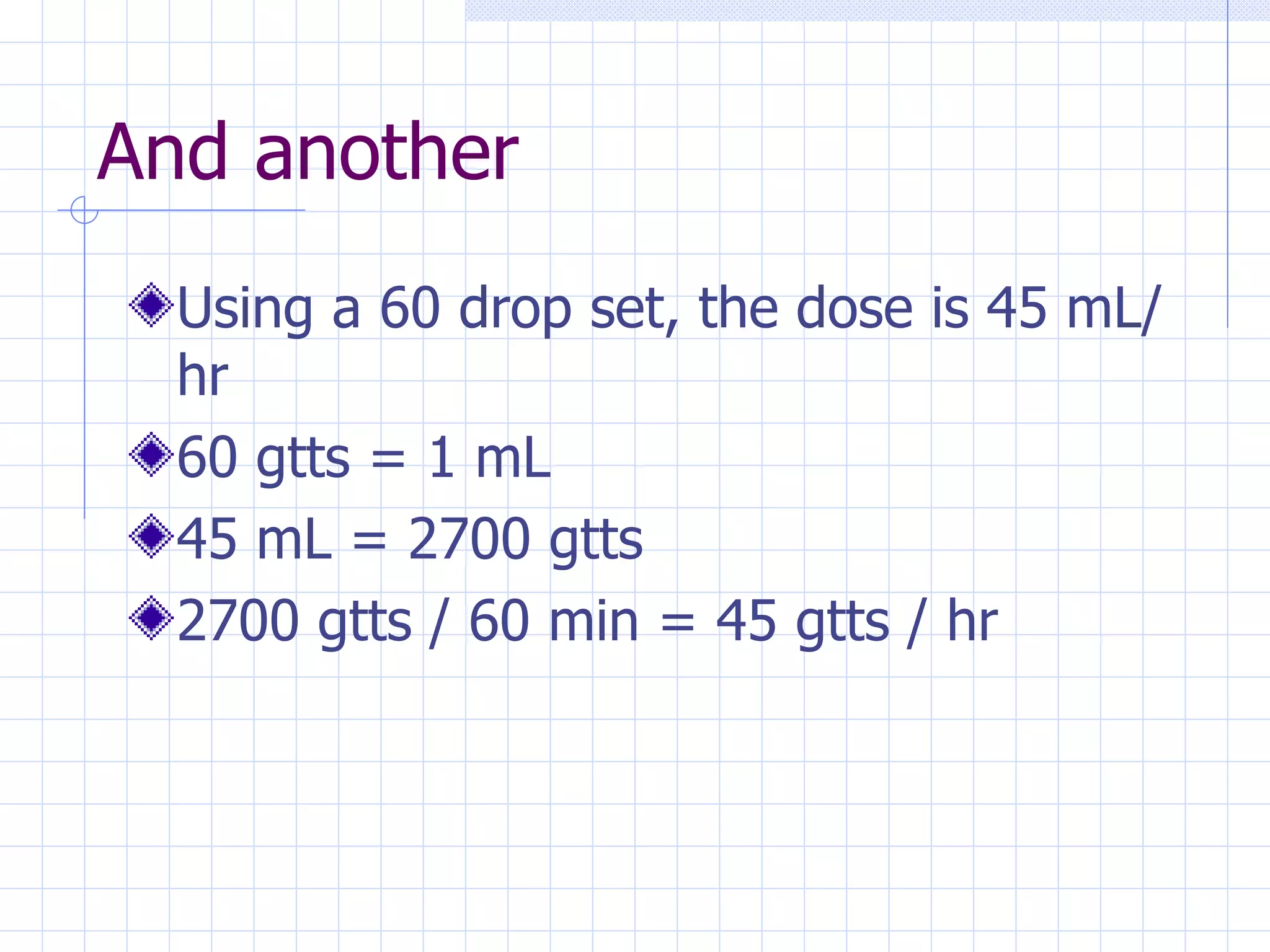
And another Using a 60 drop set, the dose is 45 mL/hr 60 gtts = 1 mL   45 mL = 2700 gtts 2700 gtts / 60 min = 45 gtts / hr
Dose not in mL/hr or mL/min?
No sweat…
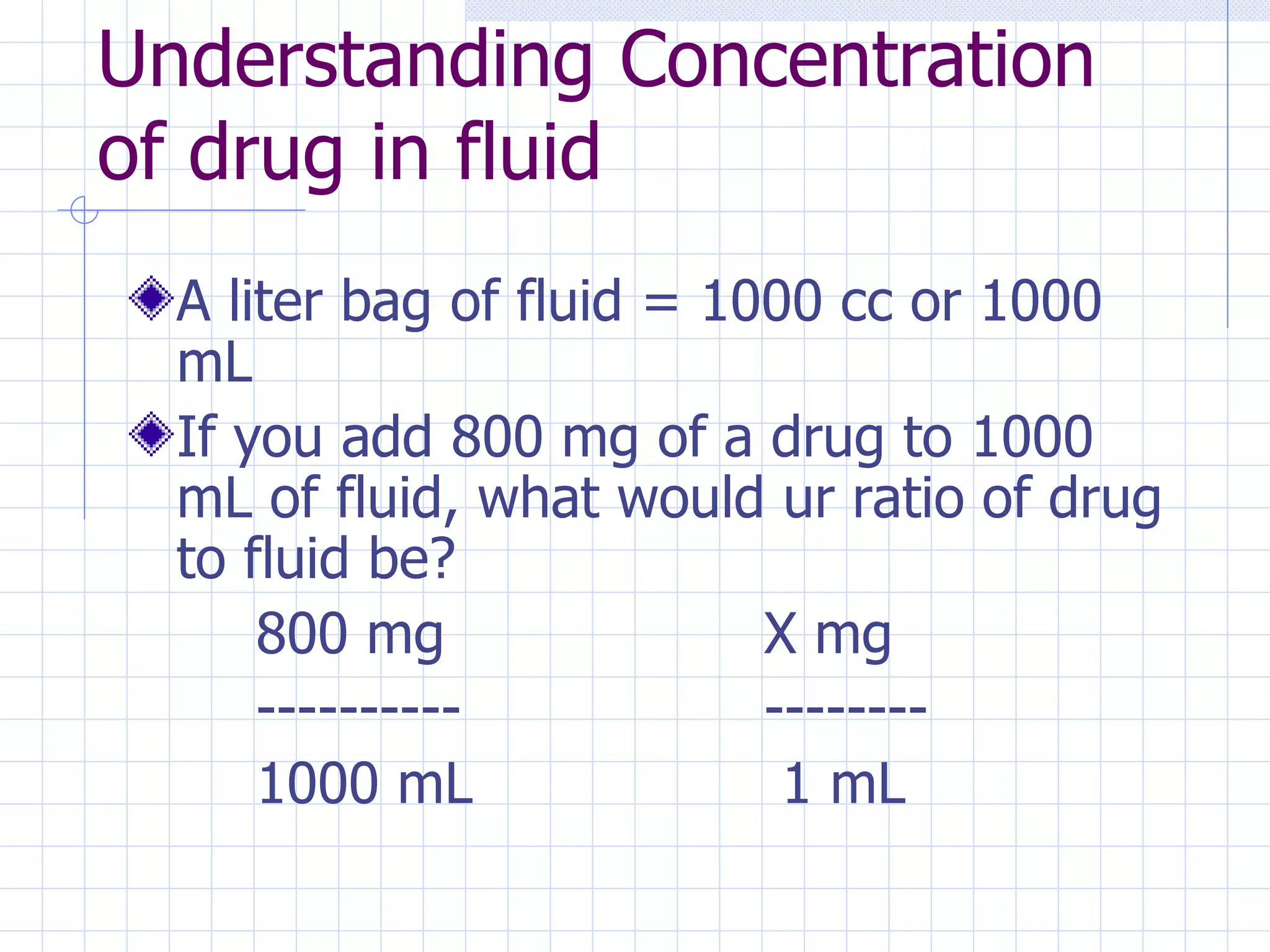
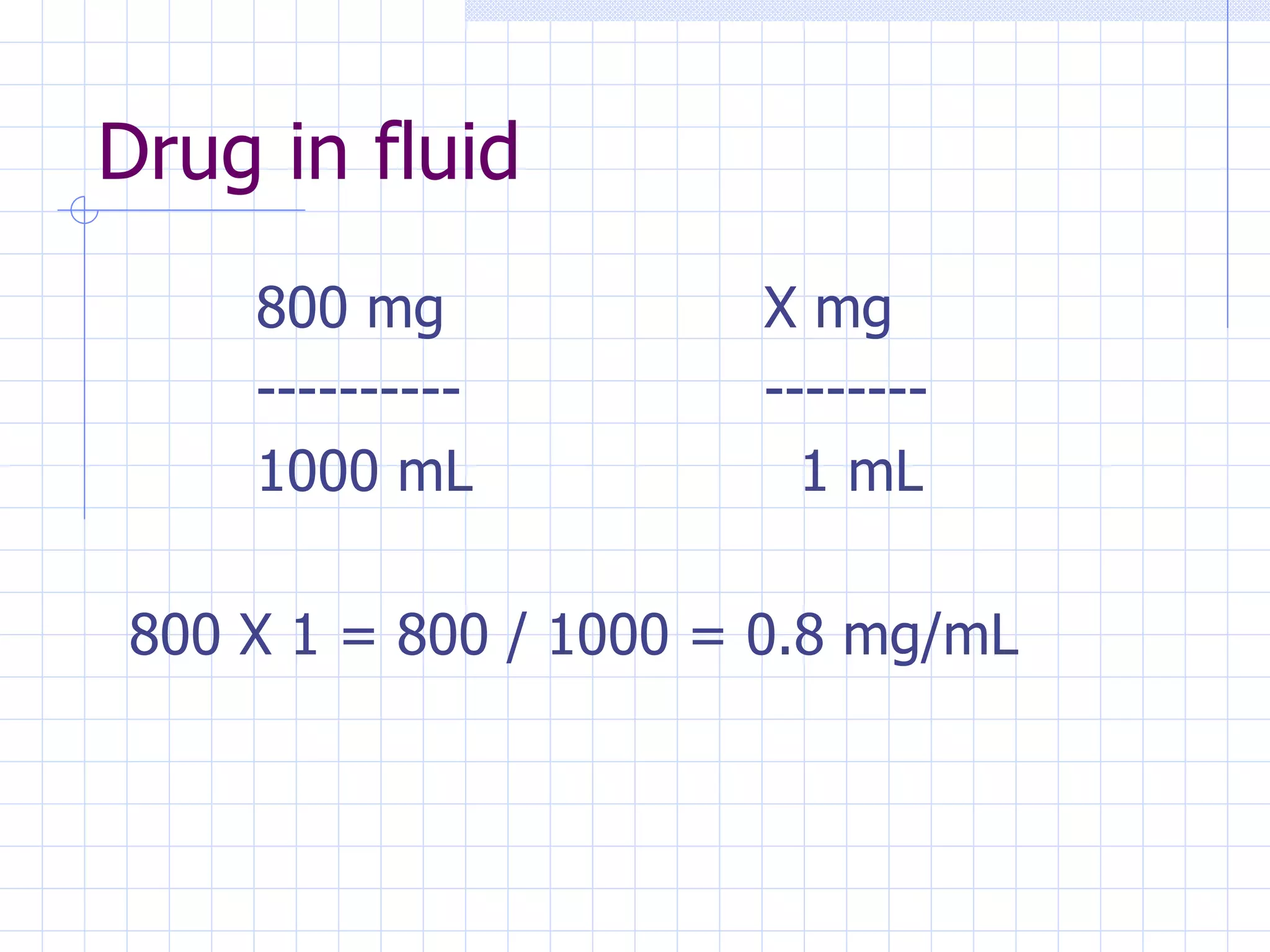
Understanding Concentration of drug in fluid A liter bag of fluid = 1000 cc or 1000 mL If you add 800 mg of a drug to 1000 mL of fluid, what would ur ratio of drug to fluid be? 800 mg X mg ---------- -------- 1000 mL  1 mL
Drug in fluid 800 mg X mg ---------- -------- 1000 mL   1 mL 800 X 1 = 800 / 1000 = 0.8 mg/mL
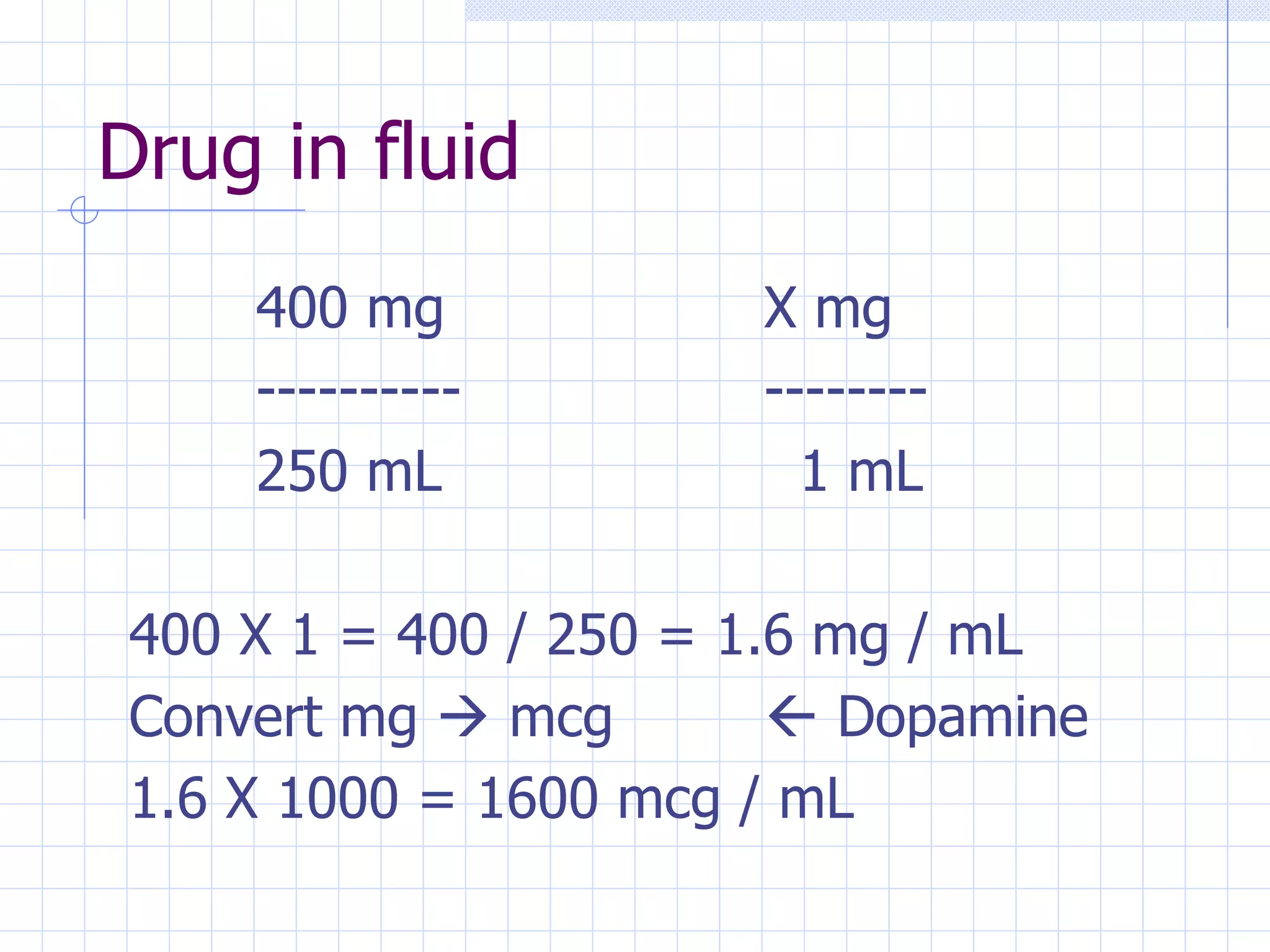
Drug in fluid 400 mg X mg ---------- -------- 250 mL   1 mL 400 X 1 = 400 / 250 = 1.6 mg / mL Convert mg    mcg    Dopamine 1.6 X 1000 = 1600 mcg / mL
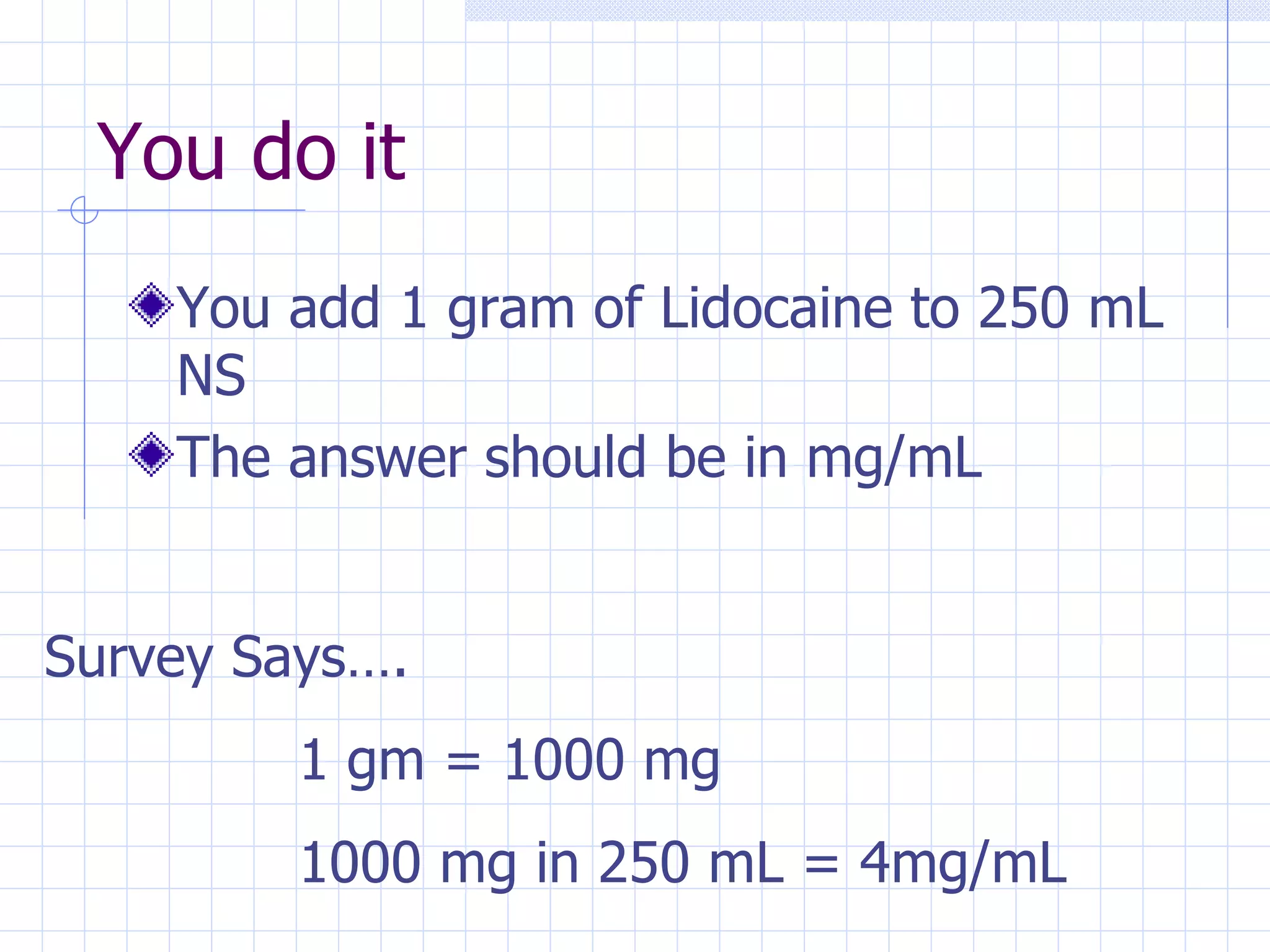
You do it You add 1 gram of Lidocaine to 250 mL NS The answer should be in mg/mL Survey Says…. 1 gm = 1000 mg 1000 mg in 250 mL = 4mg/mL
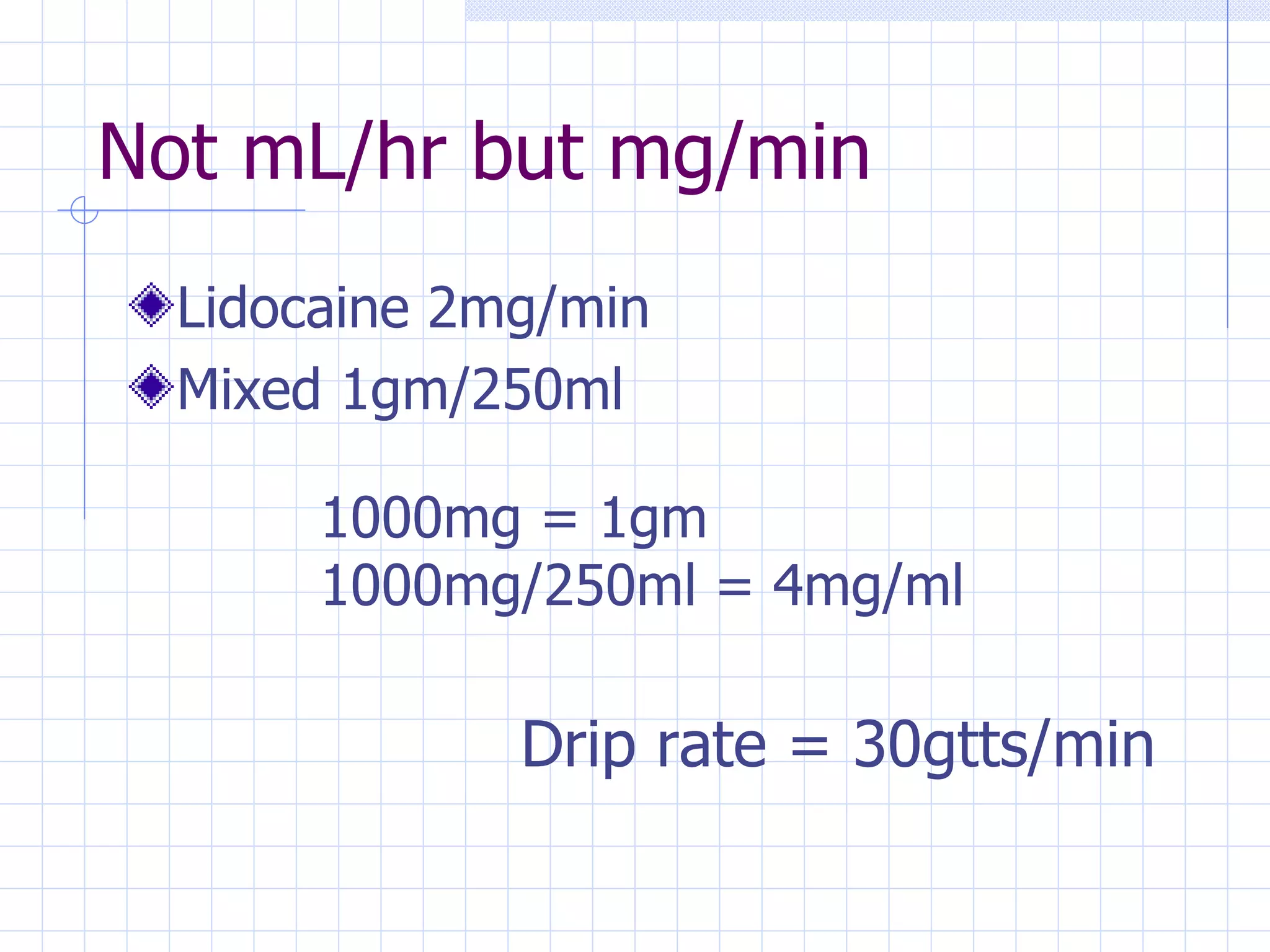
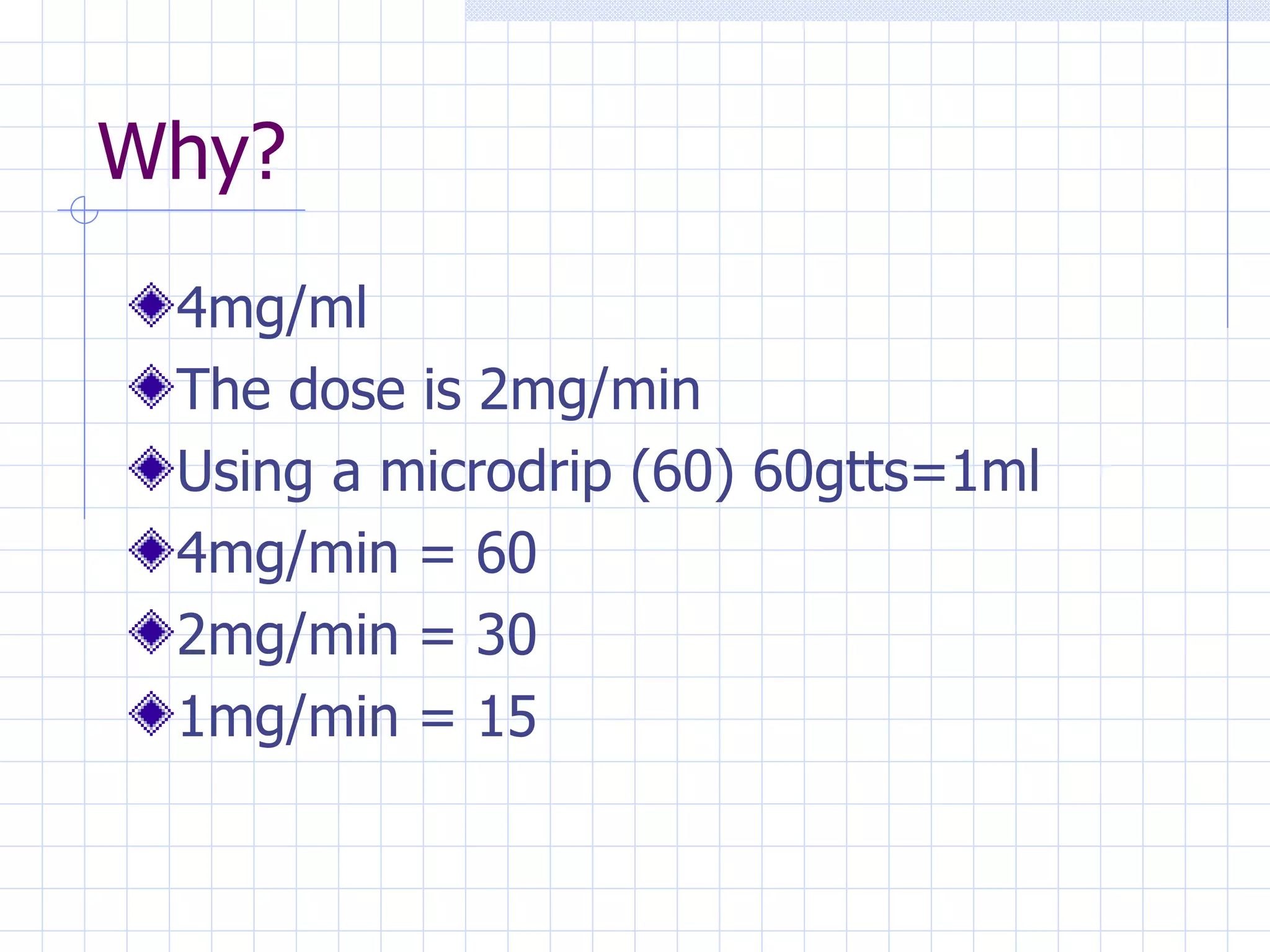
Not mL/hr but mg/min Lidocaine 2mg/min Mixed 1gm/250ml 1000mg = 1gm 1000mg/250ml = 4mg/ml Drip rate = 30gtts/min
Why? 4mg/ml The dose is 2mg/min Using a microdrip (60) 60gtts=1ml 4mg/min = 60 2mg/min = 30 1mg/min = 15
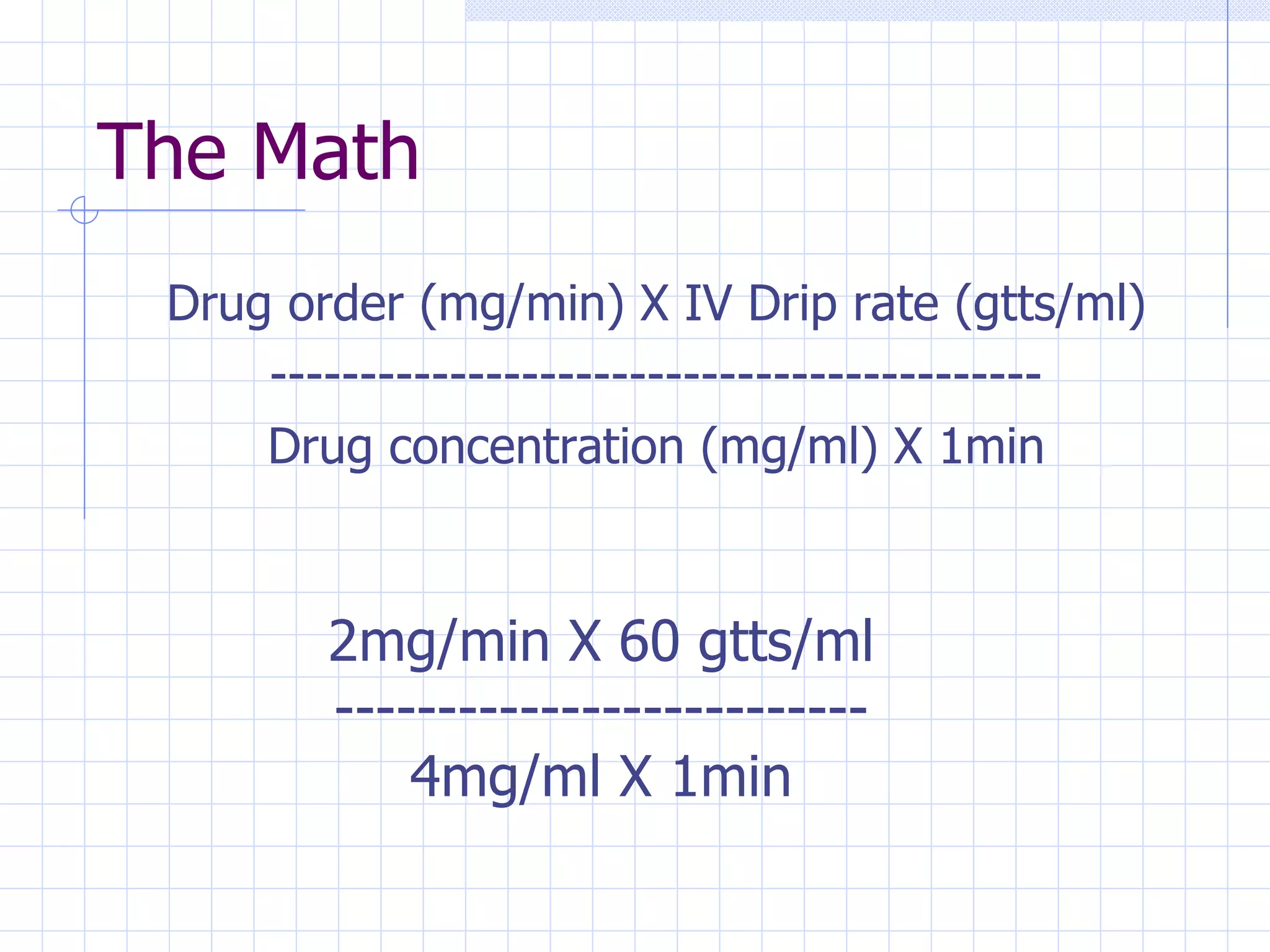
The Math Drug order (mg/min) X IV Drip rate (gtts/ml) ------------------------------------------- Drug concentration (mg/ml) X 1min 2mg/min X 60 gtts/ml -------------------------- 4mg/ml X 1min
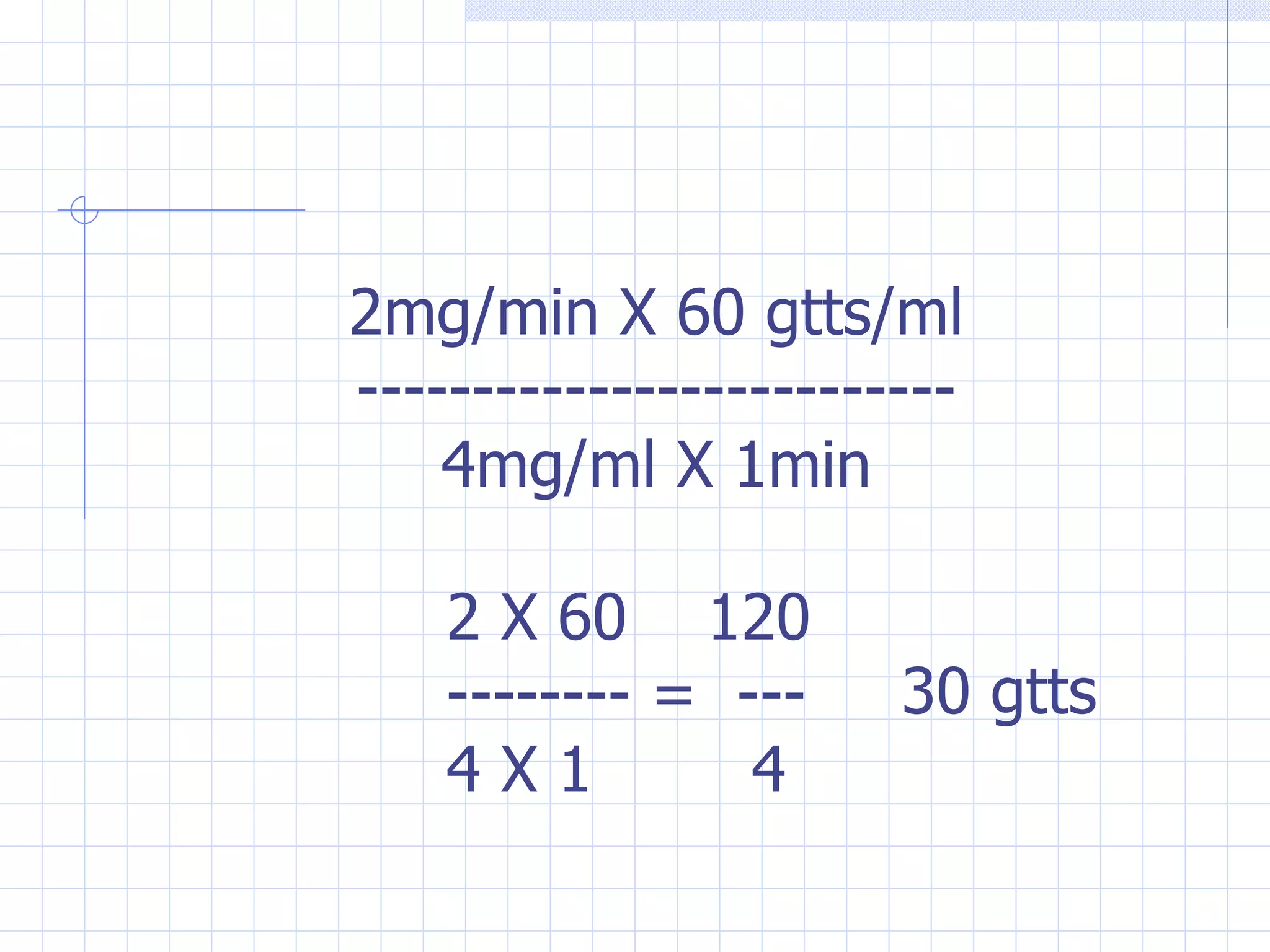
2mg/min X 60 gtts/ml -------------------------- 4mg/ml X 1min 2 X 60  120 -------- =  --- 4 X 1  4 30 gtts
Putting it ALL together
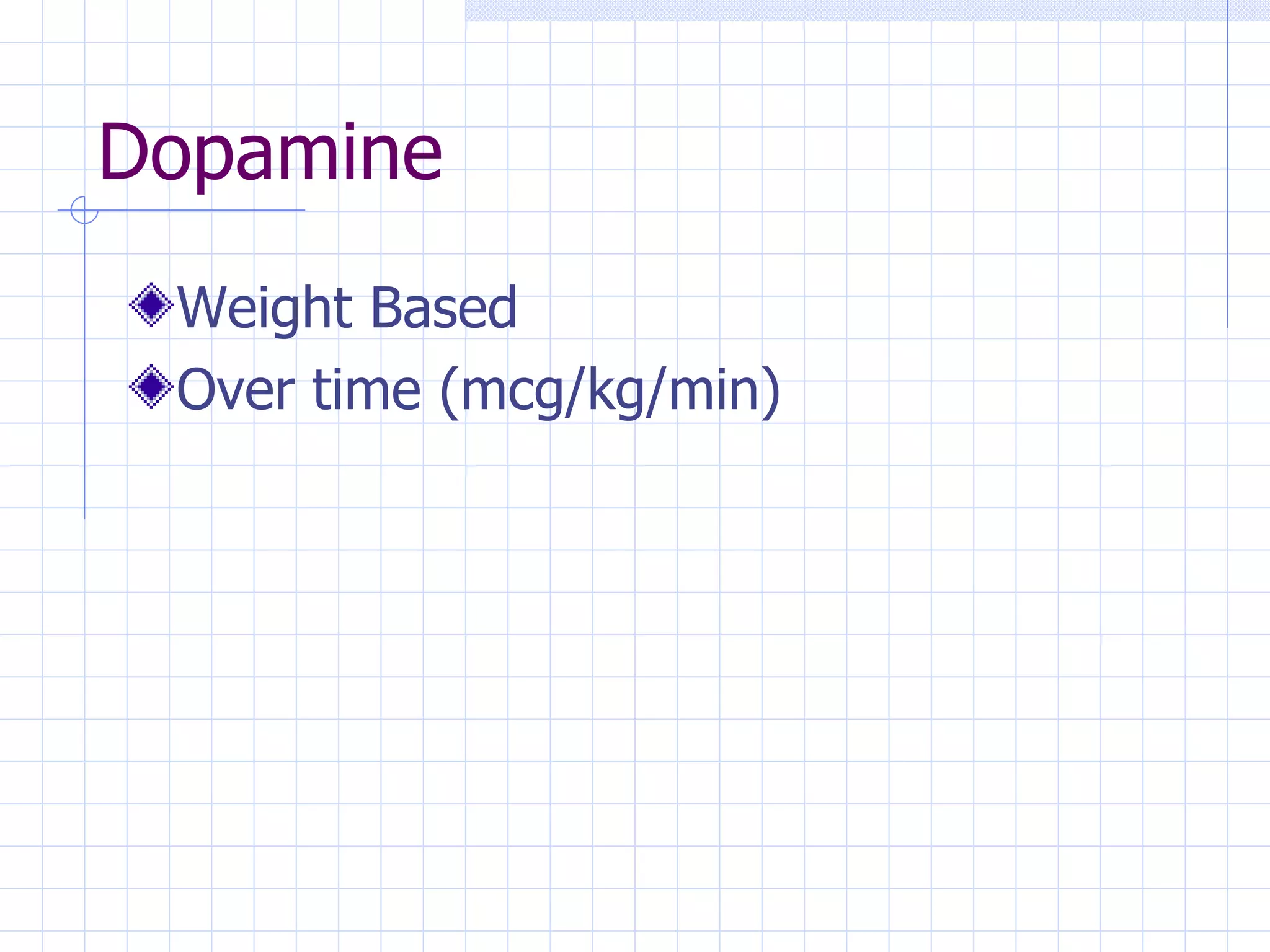
Dopamine Weight Based Over time (mcg/kg/min)
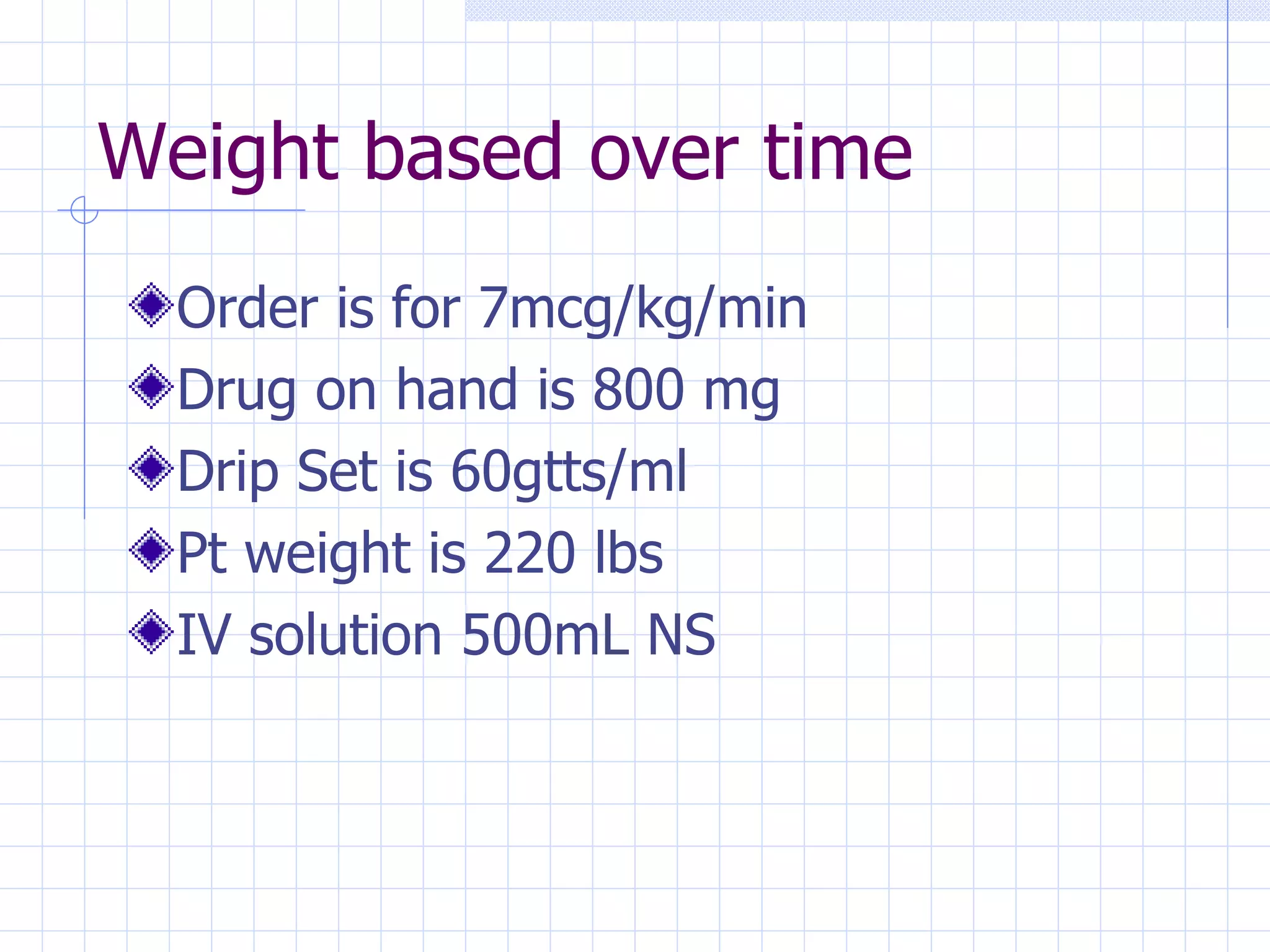
Weight based over time Order is for 7mcg/kg/min Drug on hand is 800 mg Drip Set is 60gtts/ml Pt weight is 220 lbs IV solution 500mL NS
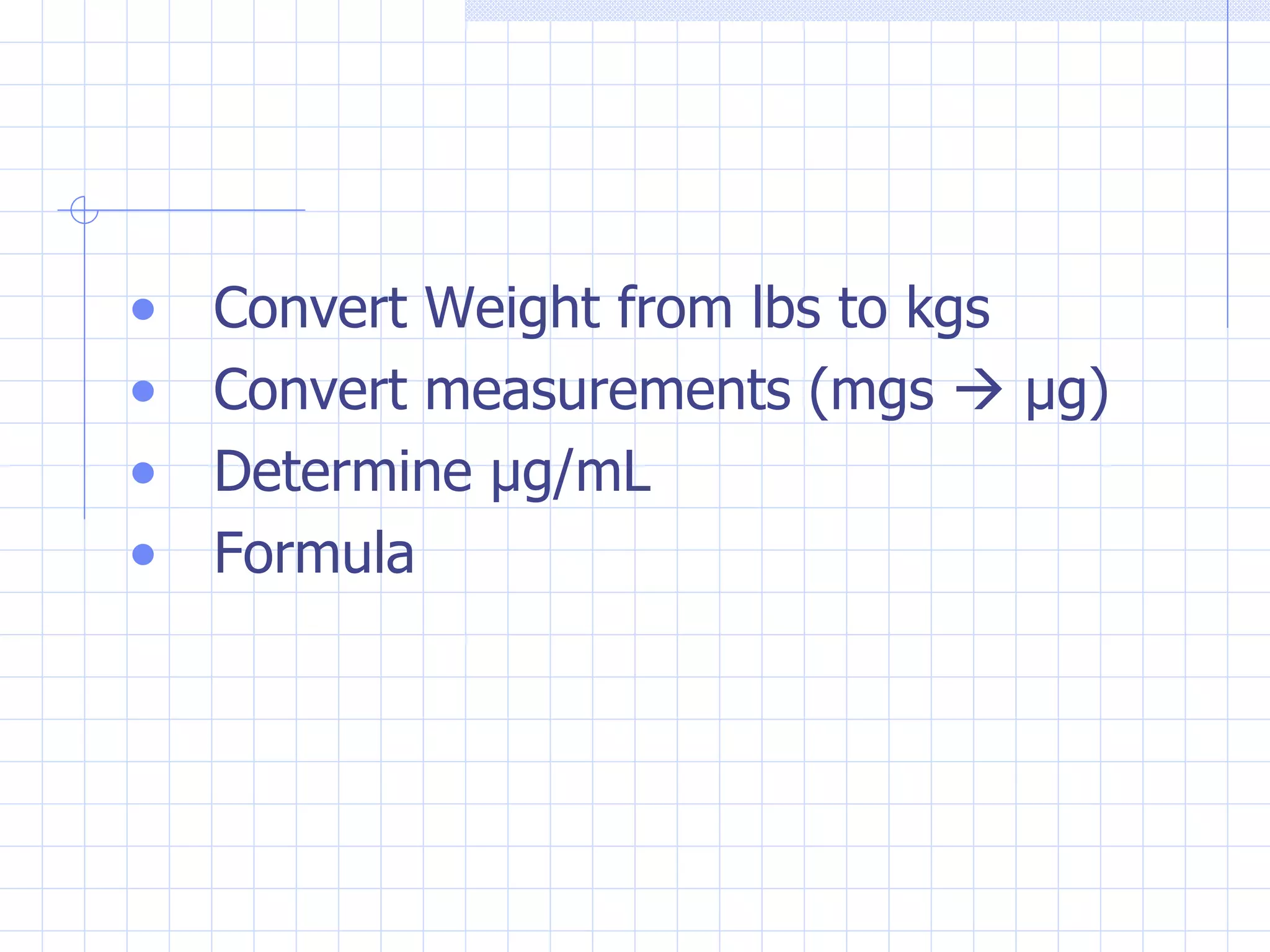
Convert Weight from lbs to kgs Convert measurements (mgs     µg) Determine µg/mL Formula
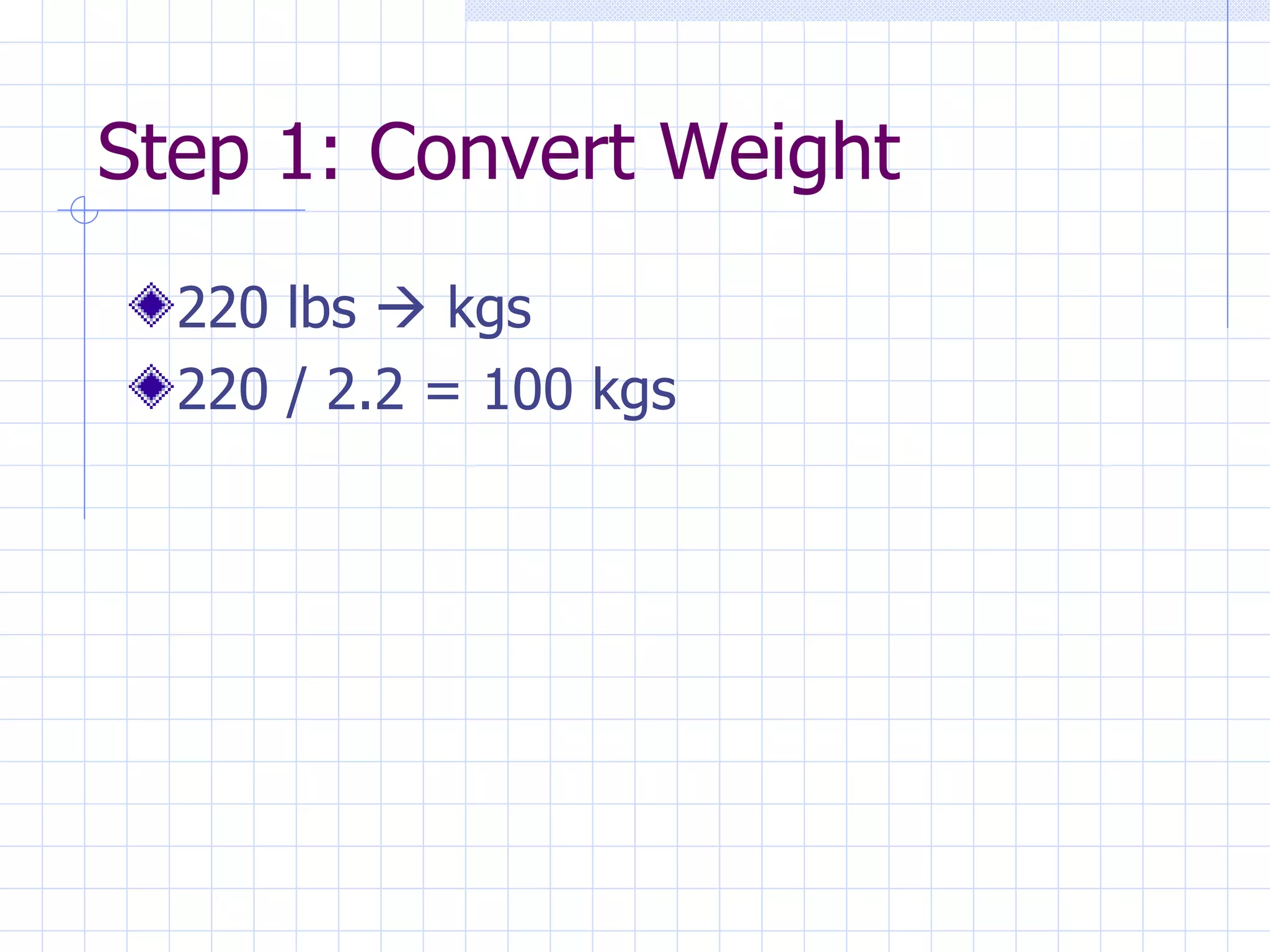
Step 1: Convert Weight 220 lbs    kgs 220 / 2.2 = 100 kgs
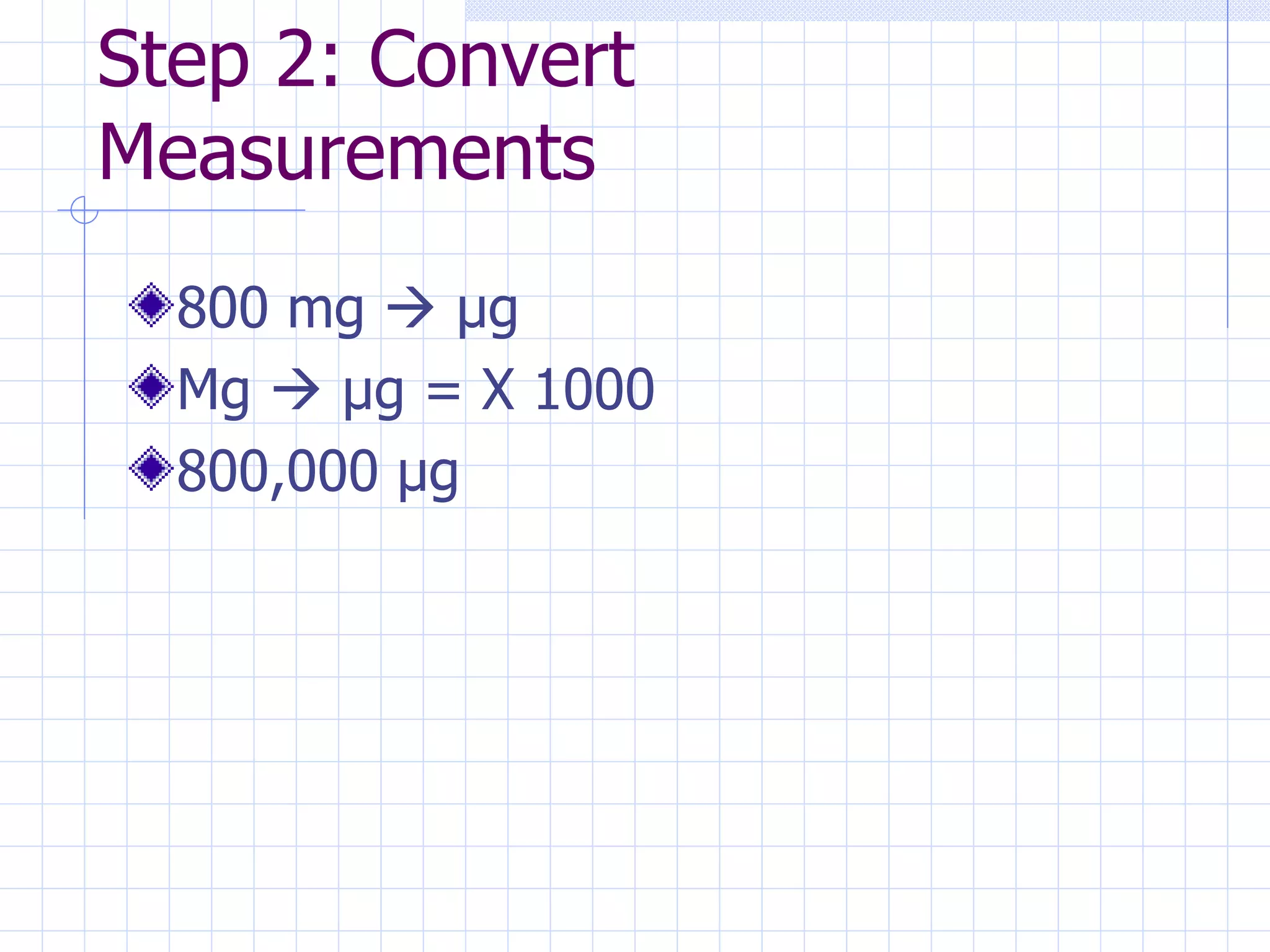
Step 2: Convert Measurements 800 mg     µg Mg    µg = X 1000 800,000 µg
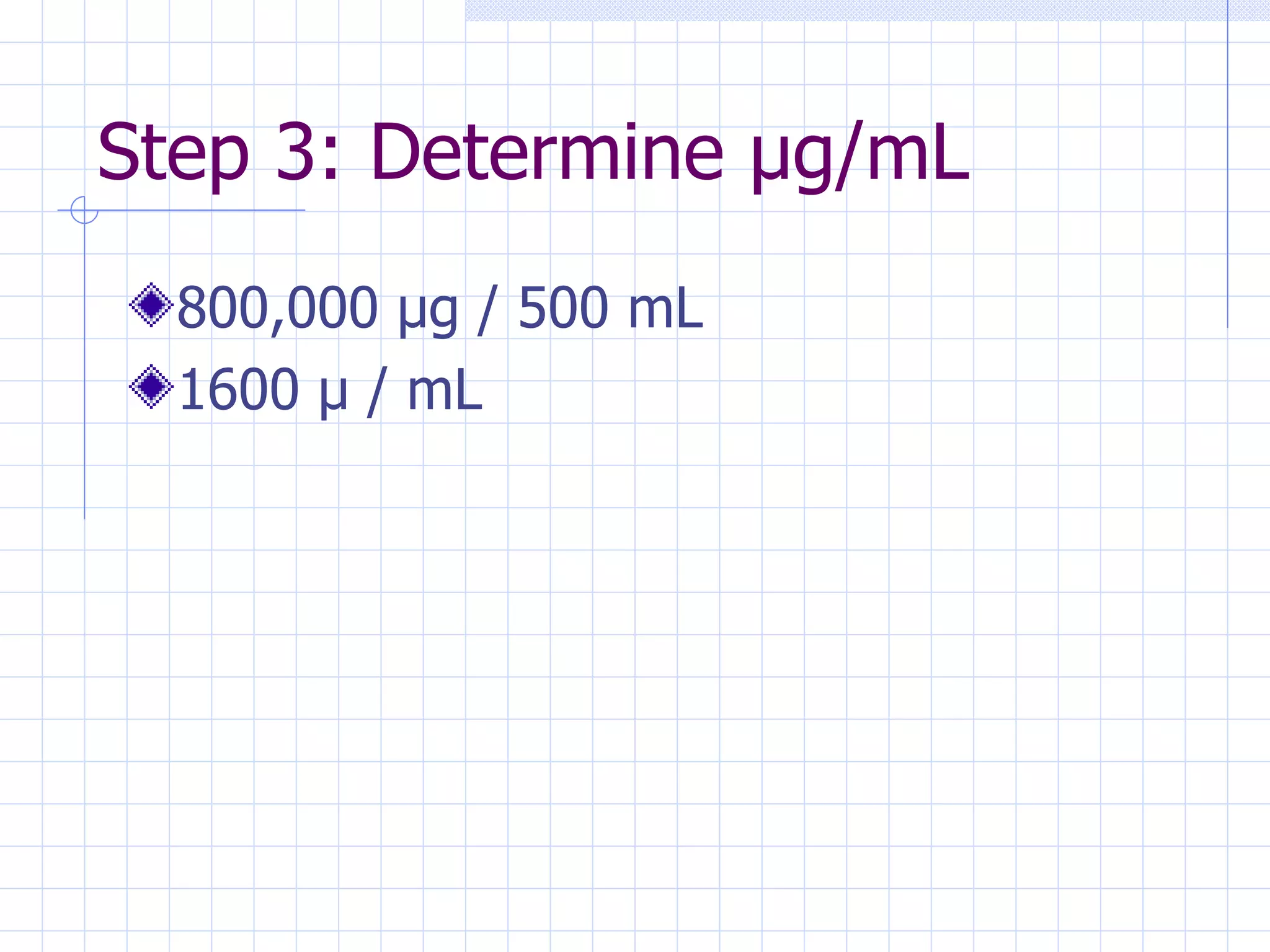
Step 3: Determine  µg/mL 800,000  µg / 500 mL 1600 µ / mL
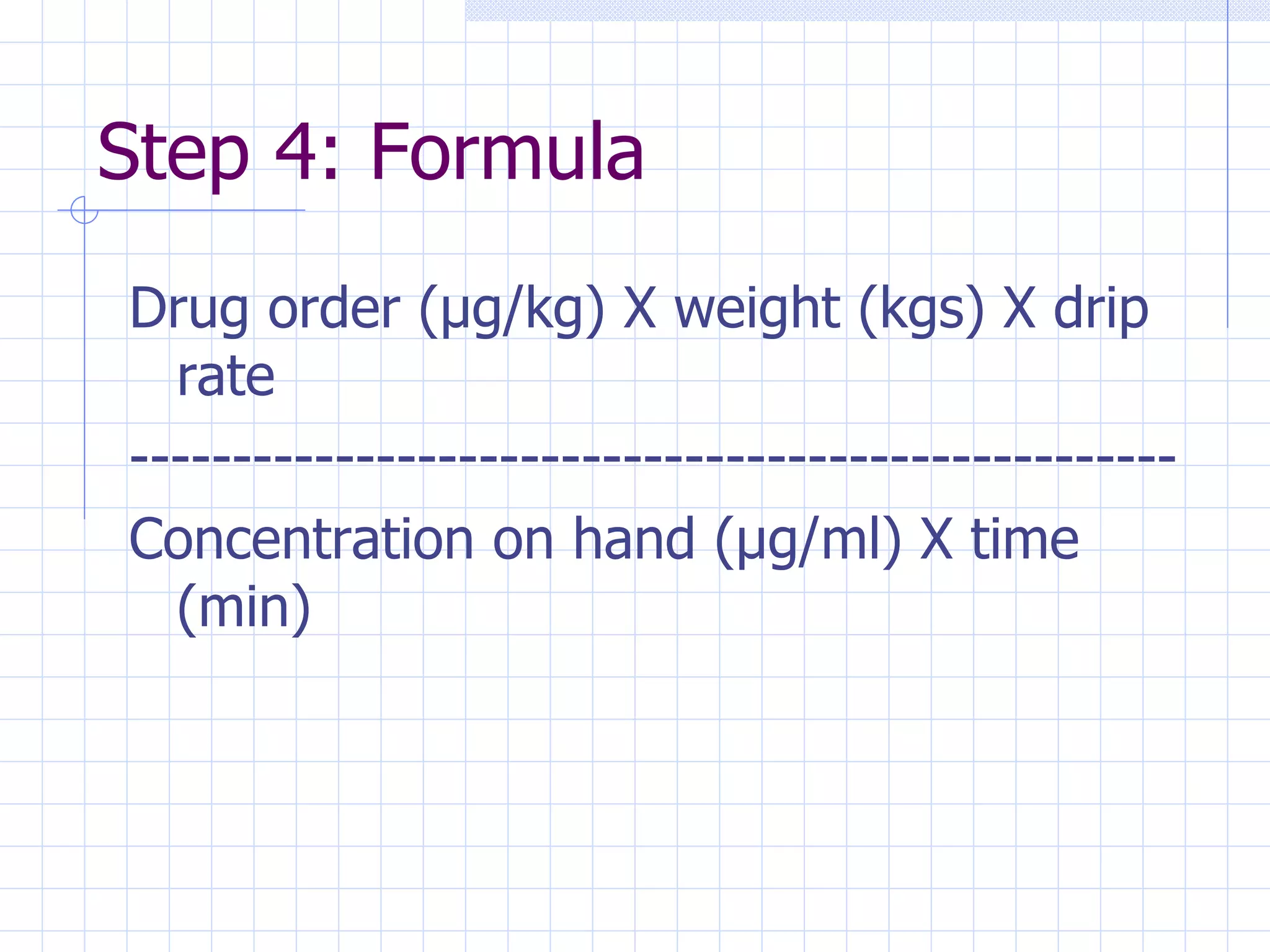
Step 4: Formula Drug order ( µg/kg) X weight (kgs) X drip rate --------------------------------------------------- Concentration on hand (µg/ml) X time (min)
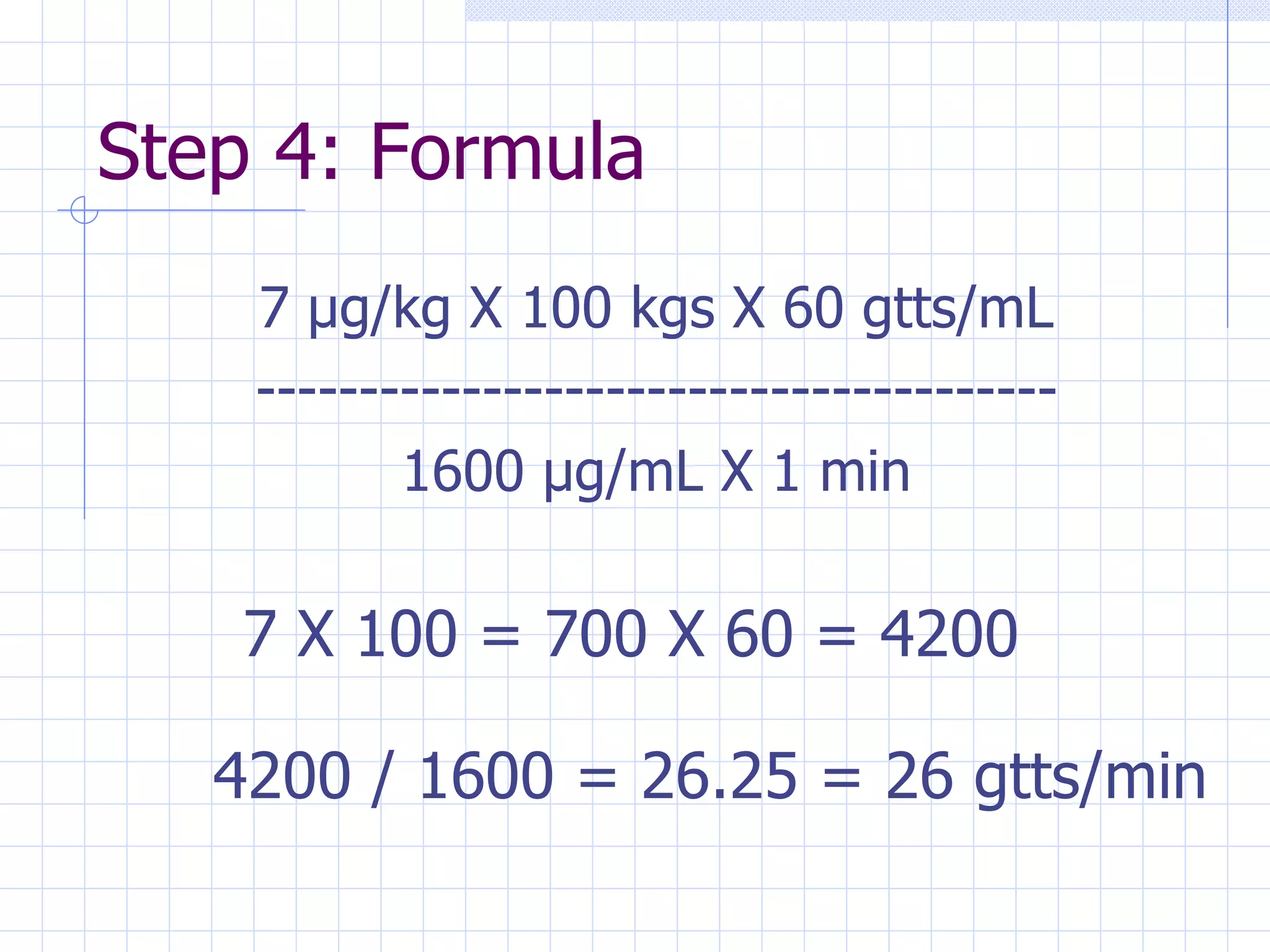
Step 4: Formula 7  µg/kg X 100 kgs X 60 gtts/mL --------------------------------------- 1600 µg/mL X 1 min 7 X 100 = 700 X 60 = 4200 4200 / 1600 = 26.25 = 26 gtts/min
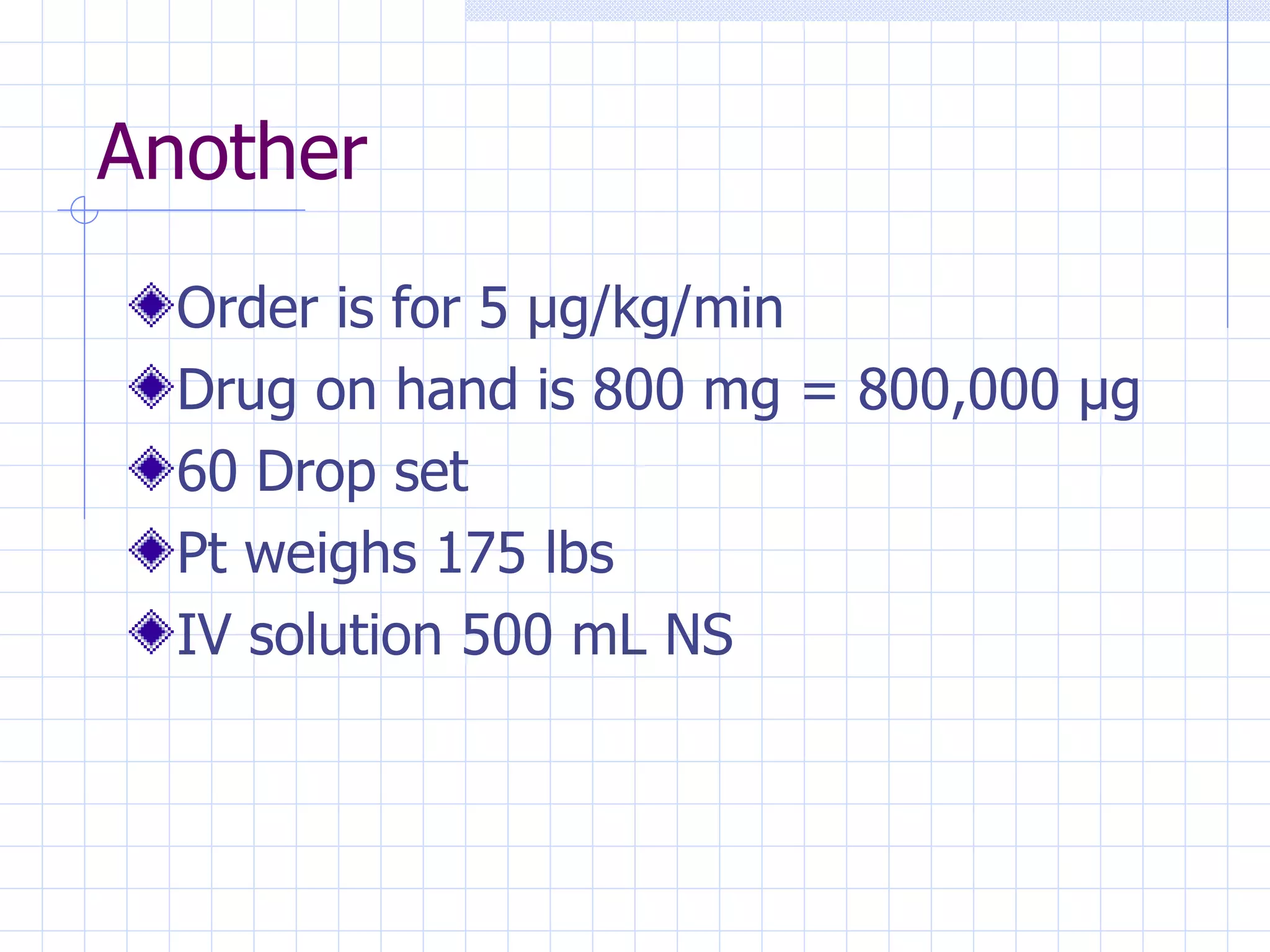
Another Order is for 5  µg/kg/min Drug on hand is 800 mg = 800,000 µg 60 Drop set Pt weighs 175 lbs IV solution 500 mL NS
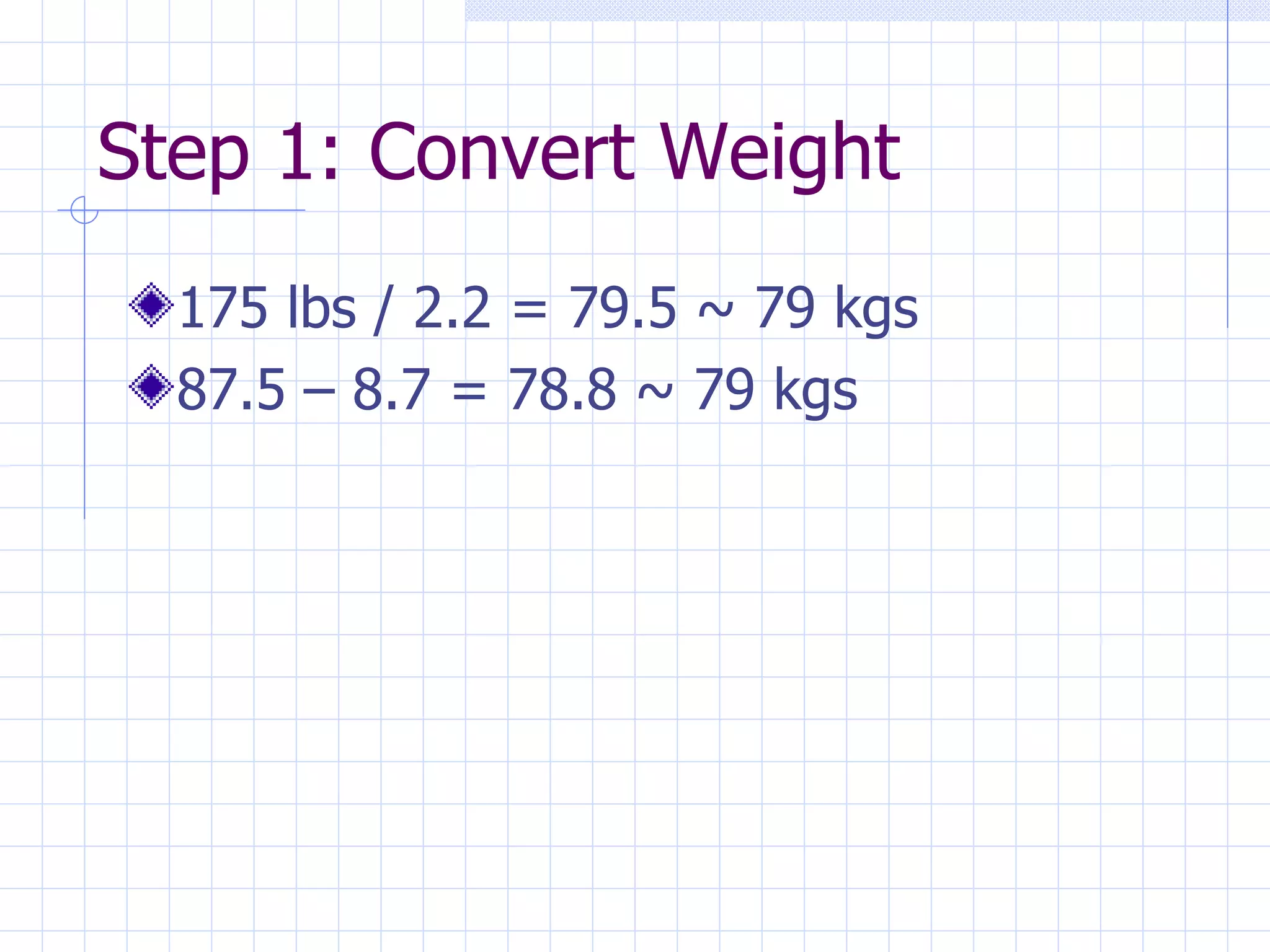
Step 1: Convert Weight 175 lbs / 2.2 = 79.5 ~ 79 kgs 87.5 – 8.7 = 78.8 ~ 79 kgs
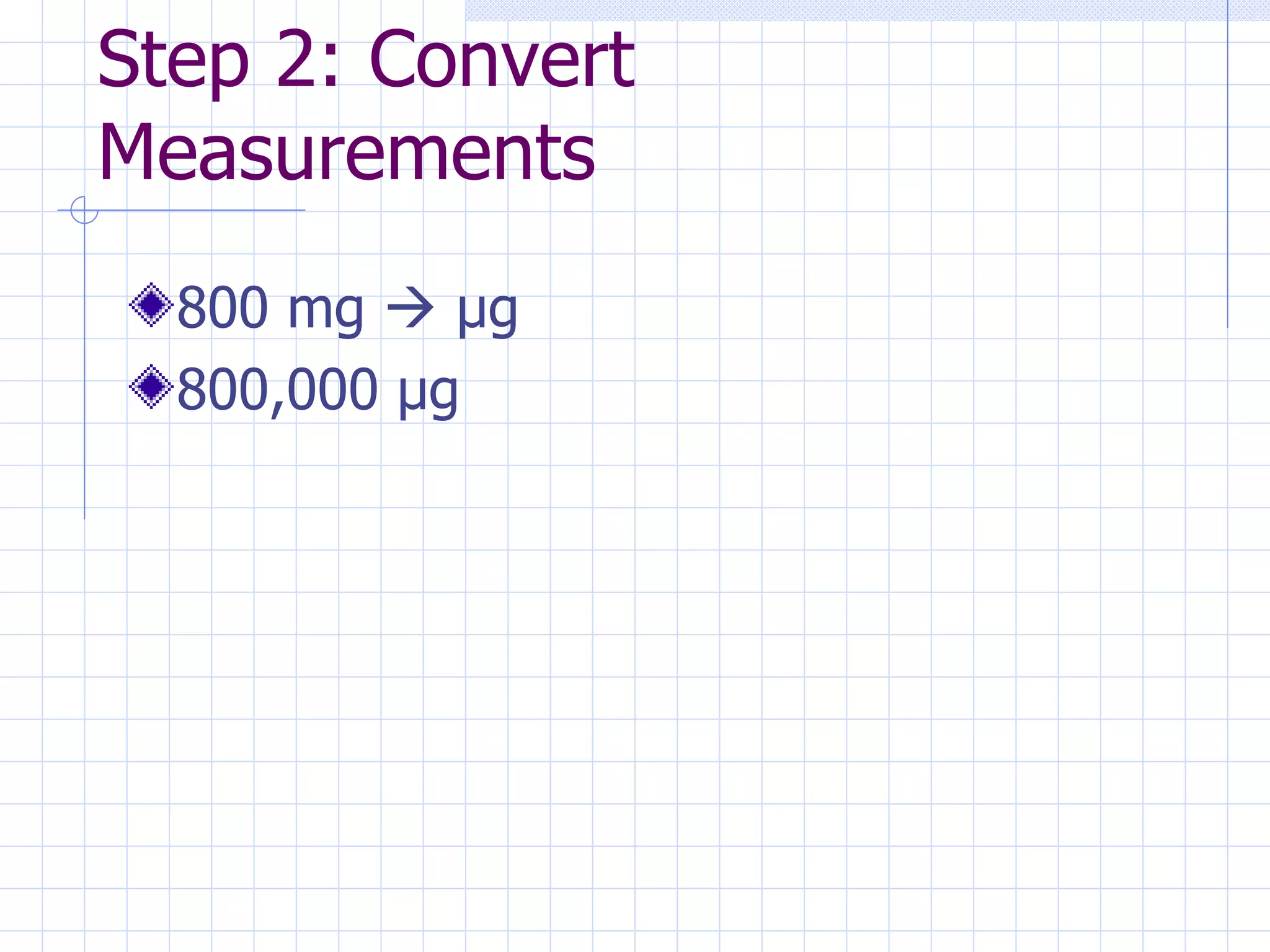
Step 2: Convert Measurements 800 mg     µg 800,000 µg
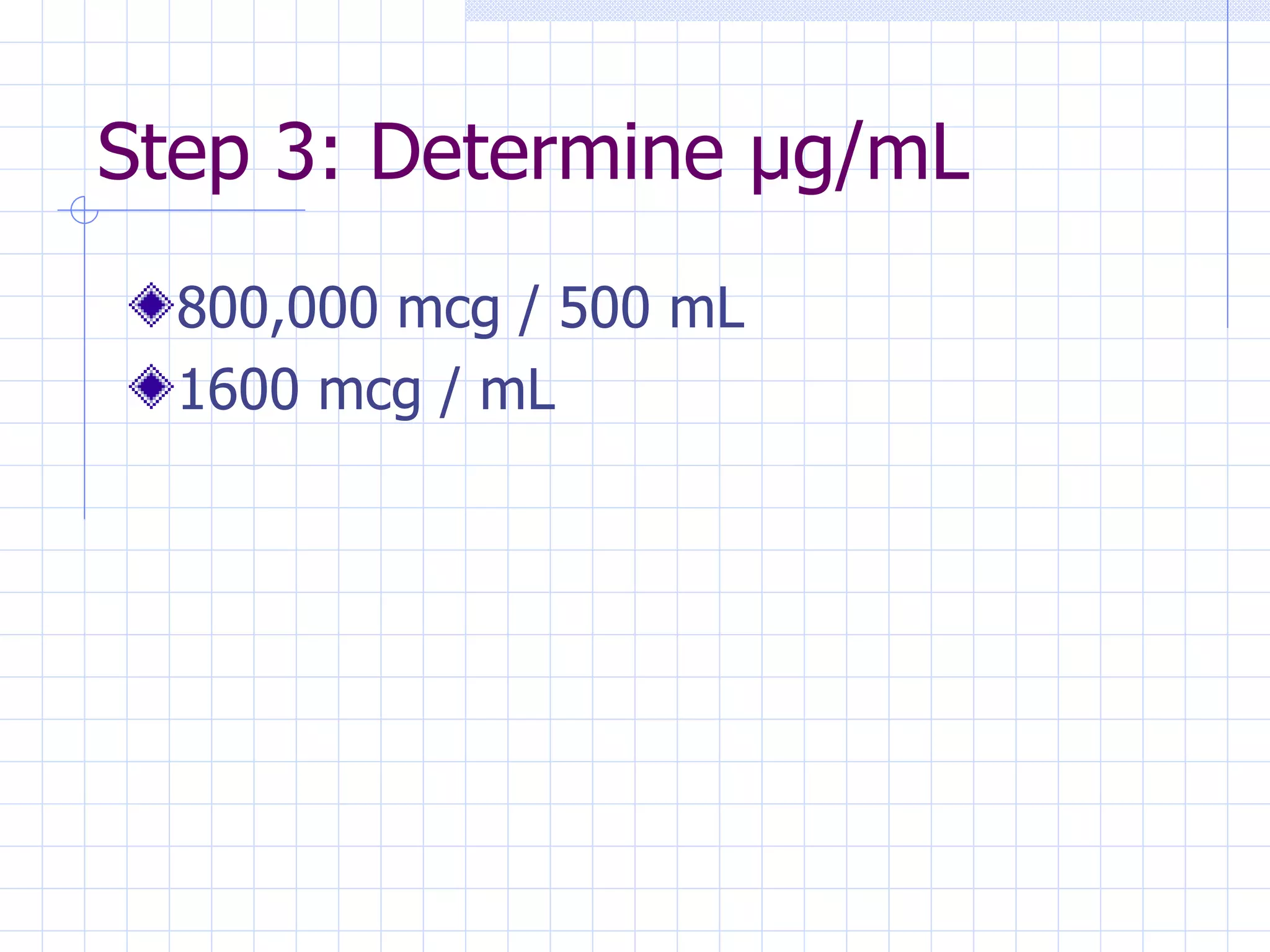
Step 3: Determine  µg/mL 800,000 mcg / 500 mL 1600 mcg / mL
Step 4: Formula Drug order X weight X drip rate --------------------------------------- Conc on hand X time 5 mcg/kg X 79 kgs X 60 ----------------------------- 1600 mcg/mL X 1 min
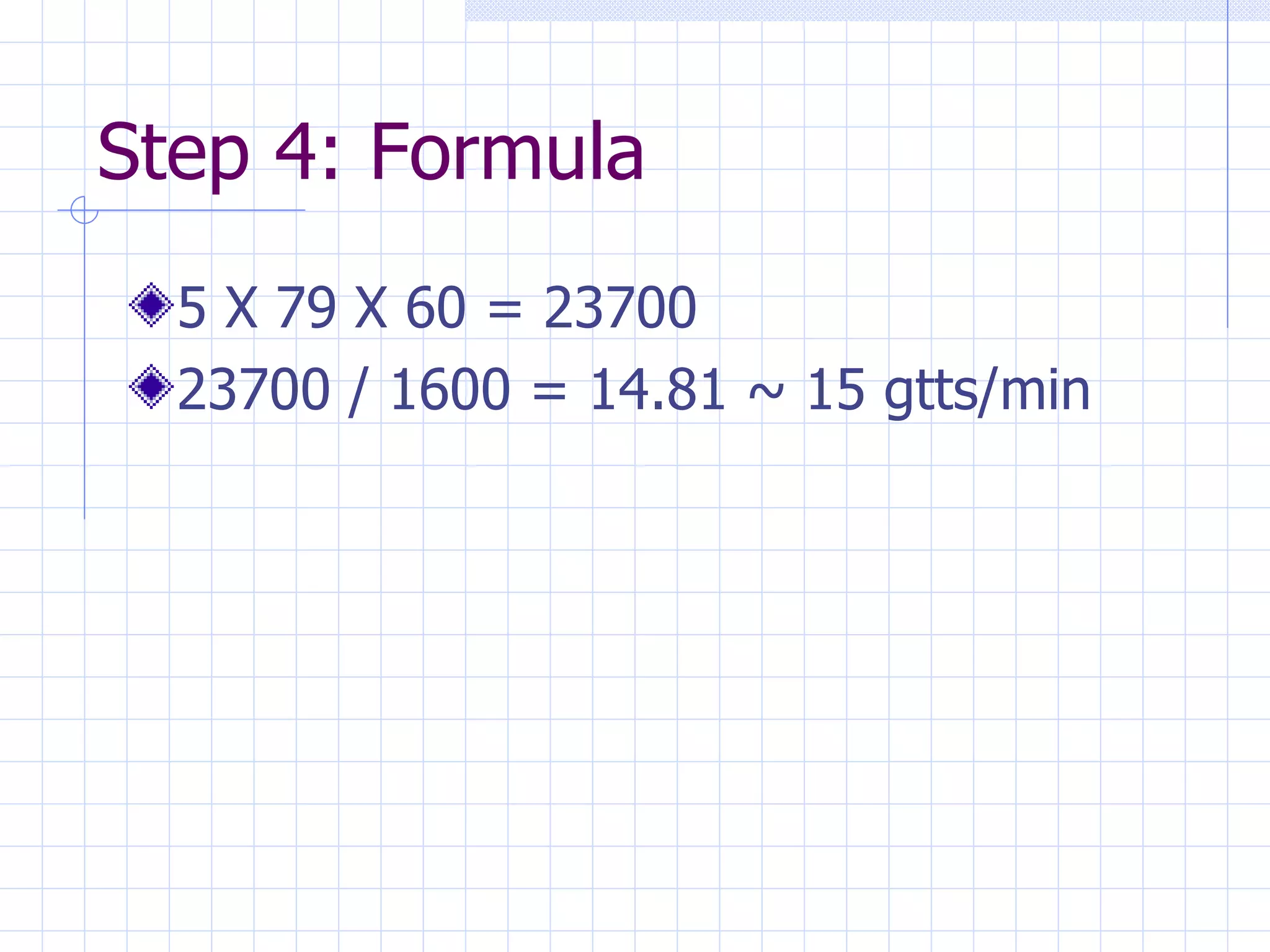
Step 4: Formula 5 X 79 X 60 = 23700 23700 / 1600 = 14.81 ~ 15 gtts/min
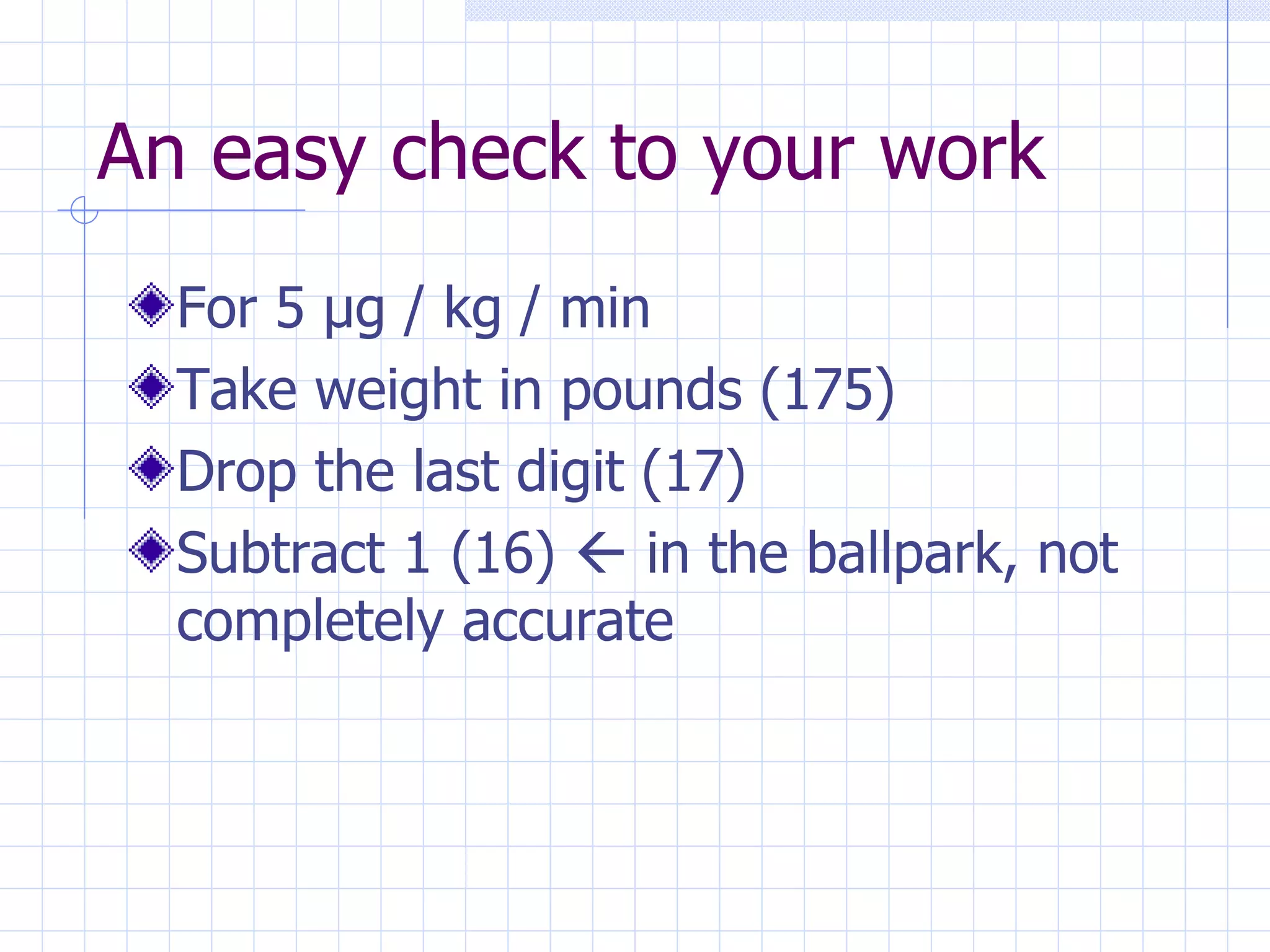
An easy check to your work For 5  µg / kg / min Take weight in pounds (175) Drop the last digit (17) Subtract 1 (16)    in the ballpark, not completely accurate

Med Math

  • 1.
  • 2.
    Tips for successPick one method, that is easiest for YOU Study it Learn it Practice it Practice it Practice it
  • 3.
    Topics Apothecary SystemWeight and Temperature Conversions Metric System Med Math Administration Doses Weight Based Doses Drip Rate Calculations
  • 4.
    Apothecary System Phasedout and replaced by metric system Basic Units: grain (gr), dram (dr), drop (gtt), ounce, (oz), pint (pt), quart (qt) Equivalents 1dr = 1 tsp = 60 gtts 3tsp = 1 Tbsp
  • 5.
    Weight Conversion Fact:1 kilogram (kg) = 2.2 pounds (lbs) Fact: Weight in kgs X 2.2 = weight in pounds
  • 6.
    Conversion Practice 80kilogram patient, what is weight in pounds kilograms X 2.2 = pounds 80 X 2.2 = 176 lbs .
  • 7.
    Conversion Practice 100kilogram patient, what is weight in pounds kilograms X 2.2 = pounds 100 X 2.2 = 220 lbs.
  • 8.
    Weight Conversion Fact:1 kilogram (kg) = 2.2 pounds (lbs) Fact: Weight in kgs X 2.2 = weight in pounds Fact: Weight in pounds / 2.2 = weight in kilograms
  • 9.
    Conversion Practice 245lb patient, what is weight in kilograms lbs / 2.2 = kilograms 245 / 2.2 = 111.36 kgs
  • 10.
    Conversion Practice 140lb patient, what is the weight in kilograms lbs / 2.2 = kilograms 140 / 2.2 = 63.63 kilograms
  • 11.
    Conversion Practice Theeasy way… Half of weight in pounds, subtract 10% Example: 180 lbs . . . . . 90 10% of 90 = 9 81 kilograms
  • 12.
    Conversion Practice 180lb patient, what is the weight in kilograms lbs / 2.2 = kilograms 180 / 2.2 = 81.82 kilograms
  • 13.
    KNOW YOUR WEIGHTCONVERSIONS!!!!!
  • 14.
    Temperature Conversions Fahrenheit:Water Freezes at 32 º F Water Boils at 212º F Celsuis: Water Freezes at 0 º C Water Boils at 100º C
  • 15.
    Temperature Conversions Fahrenheit  Celsius Subtract 32 from the temperature Multiply by 0.556 or 5/9 98.6 – 32 = 66.6 66.6 X 0.556 = 37.03 = 37 º C
  • 16.
    Practice Convert 103º F to Celsius 103 – 32 = 71 71 X 0.556 = 39.48 º C
  • 17.
    Temperature Conversions Celsius  Fahrenheit Multiply by 1.8 Add 32 37 º X 1.8 = 66.6 66.6 + 32 = 96.6º F
  • 18.
    Practice Convert 44º C to Fahrenheit 44 X 1.8 = 79.2 79.2 + 32 = 111.2 º F
  • 19.
    On your own120 º F  Celsius 76.4 º F  Celsuis 60 º C  Fahrenheit 24 º C  Fahrenheit
  • 20.
    Metric System Systemof 10 (base 10) No fractions only decimals EASY!
  • 21.
  • 22.
    Metric System Deca10 Hecto 100 Kilo 1000 Deci 0.1 Centi 0.01 Mili 0.001
  • 23.
    Metric System Gram= g Liter = l Kilogram = kg Milliliter = mL Milligram = mg Cubic centimeter = cc Microgram =  g 1 L = 1000 mL 1 mL = 1 cc 1 g = 1000 mg 1 mg = 1000  g 1cc = 1 mL 1  g = 0.001 mg 1 mg = 0.001 g
  • 24.
    The math Adding– keep the decimal points in line Subtracting – see above Multiplying – multiply without regard to decimals then add decimal places Dividing – make the divisor a whole number and add zeroes to the dividend
  • 25.
    Addition 4.3795 +5.2389 --------------- 9.6184
  • 26.
    Subtraction 9.6184 -5.2389 --------------- 4.3795
  • 27.
    Multiplication 34.76 X4.935 -------------- 17154060 Add decimal places = 5 171.54060 = 171.5406
  • 28.
    Division .75 /.995 75 / 99.5  move decimal -------------- 0.7537
  • 29.
    Converting 1g =1000mg so… g  mg X 1000 1mg = 1000 µg so… mg   g X 1000 1g = ????  g = 1,000,000  g
  • 30.
    Converting 500mL =0.5L so… mL  L / 1000 The Bottom Line… To convert from the base to mili X 1000 To convert from mili to the base / 1000 To convert from mili to  X 1000 To convert from base to  X 1000000
  • 31.
    Standard Administration Thelong formula dose desired X volume on hand Volume to administer = ------------------------------------ dose on hand
  • 32.
    Example Orders callfor 0.5mg Atropine for symptomatic bradycardia. You have 1mg in 10 mL pre-filled syringe 0.5 mg X 10 mL ------------------ = volume to administer 1.0 mg
  • 33.
    Example mg’s cancelout 0.5 X 10mL = 5mL 0.5 mg X 10 mL ------------------ = 5 mL 1.0 mg
  • 34.
    Another Example Youhave 100mg Furosemide in a 10mL vial. The order is for 40mg 80 mg X 10 mL ------------------ = volume to administer 100 mg
  • 35.
    Example mg’s cancelout 80 X 10mL = 800mL/100 = 8 80 mg X 10 mL ------------------ = 8 mL 100 mg
  • 36.
  • 37.
    Try it onyour own Benadryl – 50 mg in 2 mL Orders are for 12.5 mg Show your work
  • 38.
    Benadryl 12.5 mgX 2 mL ------------------ = volume to administer 50 mg 12.5 X 2 = 25 / 50 = 0.5 mL
  • 39.
    The easy waySet up an equation Cross Multiply Divide Sound like algebra?
  • 40.
    The easy wayOrder is for 45 mg Benadryl You have 50 mg in 2 mL 50 45 --- --- 2 X
  • 41.
    The easy way50 45 --- --- 2 X Multiply 45 X 2 = 90 Divide 90 by 50 = 1.8 So… you would administer 1.8 mL = 45 mg
  • 42.
    Another example Orderis for 3 mg Valium You have 10 mg in 2 mL 10 3 --- -- 2 X
  • 43.
    Another example 103 --- -- 2 X Multiply 3 X 2 = 6 Divide 6 by 10 = 0.6 So… you would administer 0.6 mL = 3 mg
  • 44.
    Finally, the goodstuff Order is for 145 µ g of Fentanyl Citrate You have 300 mcg in 5 mL 300 145 ----- ----- 5 X
  • 45.
    The good stuff300 145 ----- ----- 5 X Multiply 145 X 5 = 725 Divide 735 by 300 = 2.42 = 2.4 So… you would administer 2.4 mL = 145 mg
  • 46.
    Weight Based DosageConvert weight to kgs. Calculate the dose to give Calculate the volume to administer
  • 47.
    Weight Based Dosage1.5 mg/kg Lidocaine for a 185 lb patient in cardiac arrest. 1. Convert the weight to kilograms. 185 / 2.2 = 84 kgs Or 93 – 9.3 = 83.7 = 84 kgs
  • 48.
    Weight Based Dosage1.5 mg/kg Lidocaine for a 185 lb patient in cardiac arrest. 2. Calculate the dose to give 84 kgs X 1.5 mg = 126 mg
  • 49.
    Weight Based Dosage1.5 mg/kg Lidocaine for a 185 lb patient in cardiac arrest. 3. Calculate the volume to administer 126 mg is the dose we want to give 10 mL pre-filled syringe containing 100 mg
  • 50.
    Weight Based Dosage126 mg X 20 mL ------------------ = volume to administer 200 mg 126 X 20 = 2520 / 200 = 12.6 mL So, one complete syringe containing 10 mL plus approx. 2.6 mL from a second syringe
  • 51.
    Weight Based DosagePediatric 2mg/kg Benadryl for a 25 lb patient Convert weight to kilograms 25 / 2.2 = 11.36 kgs Or 12.5 – 1.2 = 11.3 kgs
  • 52.
    Weight Based DosagePediatric 2mg/kg Benadryl for a 25 lb patient 2. Calculate the dose to give 11.3 kgs X 2 mg/kg = 22.6 mg
  • 53.
    Weight Based DosagePediatric 2mg/kg Benadryl for a 25 lb patient 3. Calculate the volume to administer 22.6 mg X 1 mL -------------------- = 0.45 mL 50 mg
  • 54.
    Or the easyway We know we want 2mg/kg The child ways 11.3 or roughly 11 kgs The dose will be 22mg 50 22 --- --- 1 X
  • 55.
    Or the easyway 50 22 --- --- 1 X 22 X 1 = 22 / 50 = 0.44 mL
  • 56.
    Drip Rate CalculationsFacts: In a 60 drop set, 60 drops = 1 mL In a 10 drop set, 10 drops = 1 mL In a 15 drop set, 15 drops = 1 mL Medications are usually given in 60 gtt sets Doesn’t mean you cannot give it in a 10 gtt set A 60 drip set is usually called a microdrip A 10 drip set is usually called a macrodrip
  • 57.
    Microdrips 60 gtts= 1 mL If your dose was 1 mL / hr what would your drip rate be? 1 gtt / minute Why? 60 gtts = 1 mL (our dose) 1 drop / min = 60 gtts/hr = 1 mL = 60 gtts
  • 58.
  • 59.
    Let’s try anotherUsing a 60 drop set, the dose is 30 mL/hr 60 gtts = 1 mL 30 mL = 1800 gtts 1800 gtts/60 min = 30 gtts/min
  • 60.
    And another Usinga 60 drop set, the dose is 45 mL/hr 60 gtts = 1 mL 45 mL = 2700 gtts 2700 gtts / 60 min = 45 gtts / hr
  • 61.
    Dose not inmL/hr or mL/min?
  • 62.
  • 63.
    Understanding Concentration ofdrug in fluid A liter bag of fluid = 1000 cc or 1000 mL If you add 800 mg of a drug to 1000 mL of fluid, what would ur ratio of drug to fluid be? 800 mg X mg ---------- -------- 1000 mL 1 mL
  • 64.
    Drug in fluid800 mg X mg ---------- -------- 1000 mL 1 mL 800 X 1 = 800 / 1000 = 0.8 mg/mL
  • 65.
    Drug in fluid400 mg X mg ---------- -------- 250 mL 1 mL 400 X 1 = 400 / 250 = 1.6 mg / mL Convert mg  mcg  Dopamine 1.6 X 1000 = 1600 mcg / mL
  • 66.
    You do itYou add 1 gram of Lidocaine to 250 mL NS The answer should be in mg/mL Survey Says…. 1 gm = 1000 mg 1000 mg in 250 mL = 4mg/mL
  • 67.
    Not mL/hr butmg/min Lidocaine 2mg/min Mixed 1gm/250ml 1000mg = 1gm 1000mg/250ml = 4mg/ml Drip rate = 30gtts/min
  • 68.
    Why? 4mg/ml Thedose is 2mg/min Using a microdrip (60) 60gtts=1ml 4mg/min = 60 2mg/min = 30 1mg/min = 15
  • 69.
    The Math Drugorder (mg/min) X IV Drip rate (gtts/ml) ------------------------------------------- Drug concentration (mg/ml) X 1min 2mg/min X 60 gtts/ml -------------------------- 4mg/ml X 1min
  • 70.
    2mg/min X 60gtts/ml -------------------------- 4mg/ml X 1min 2 X 60 120 -------- = --- 4 X 1 4 30 gtts
  • 71.
  • 72.
    Dopamine Weight BasedOver time (mcg/kg/min)
  • 73.
    Weight based overtime Order is for 7mcg/kg/min Drug on hand is 800 mg Drip Set is 60gtts/ml Pt weight is 220 lbs IV solution 500mL NS
  • 74.
    Convert Weight fromlbs to kgs Convert measurements (mgs  µg) Determine µg/mL Formula
  • 75.
    Step 1: ConvertWeight 220 lbs  kgs 220 / 2.2 = 100 kgs
  • 76.
    Step 2: ConvertMeasurements 800 mg  µg Mg  µg = X 1000 800,000 µg
  • 77.
    Step 3: Determine µg/mL 800,000 µg / 500 mL 1600 µ / mL
  • 78.
    Step 4: FormulaDrug order ( µg/kg) X weight (kgs) X drip rate --------------------------------------------------- Concentration on hand (µg/ml) X time (min)
  • 79.
    Step 4: Formula7 µg/kg X 100 kgs X 60 gtts/mL --------------------------------------- 1600 µg/mL X 1 min 7 X 100 = 700 X 60 = 4200 4200 / 1600 = 26.25 = 26 gtts/min
  • 80.
    Another Order isfor 5 µg/kg/min Drug on hand is 800 mg = 800,000 µg 60 Drop set Pt weighs 175 lbs IV solution 500 mL NS
  • 81.
    Step 1: ConvertWeight 175 lbs / 2.2 = 79.5 ~ 79 kgs 87.5 – 8.7 = 78.8 ~ 79 kgs
  • 82.
    Step 2: ConvertMeasurements 800 mg  µg 800,000 µg
  • 83.
    Step 3: Determine µg/mL 800,000 mcg / 500 mL 1600 mcg / mL
  • 84.
    Step 4: FormulaDrug order X weight X drip rate --------------------------------------- Conc on hand X time 5 mcg/kg X 79 kgs X 60 ----------------------------- 1600 mcg/mL X 1 min
  • 85.
    Step 4: Formula5 X 79 X 60 = 23700 23700 / 1600 = 14.81 ~ 15 gtts/min
  • 86.
    An easy checkto your work For 5 µg / kg / min Take weight in pounds (175) Drop the last digit (17) Subtract 1 (16)  in the ballpark, not completely accurate