SOUND
SOUND
• Vibrations that travel through the air or another
medium and can be heard when they reach a
person's or animal's ear.
HOW
TRAVEL?
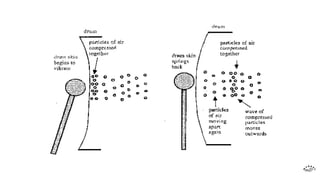
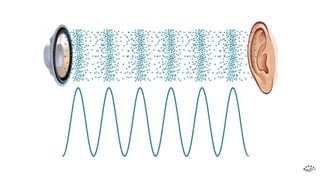
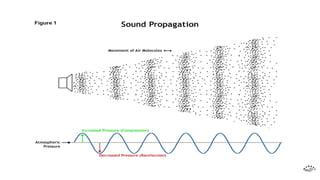
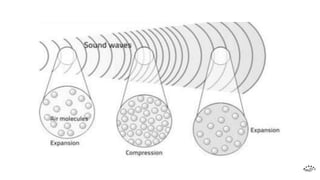
• Sound vibrations travel in a wave pattern, and we call these
vibrations sound waves.
• Sound waves move by vibrating objects and these objects
vibrate other surrounding objects, carrying the sound along.
• Sound can move through the air, water, or solids, as long as
there are particles to bounce off.
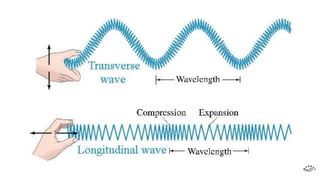
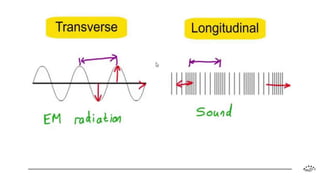
• LONGITUDINAL WAVES:
A wave in which the particles of the medium vibrate
back and forth in the ā€˜same direction’ in which the wave is moving.
Medium can be solid, liquid or gases. Therefore, sound waves are
longitudinal waves.
• TRANSVERSE WAVES:
A wave in which the particles of the medium vibrate
up and down ā€˜at right angles’ to the direction in which the wave is moving.
These waves are produced only in a solids and liquids but not in gases.
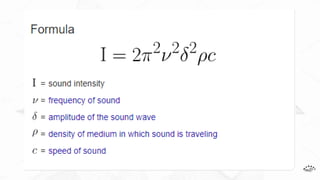
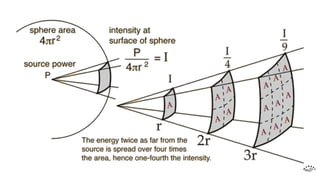
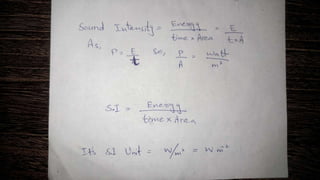
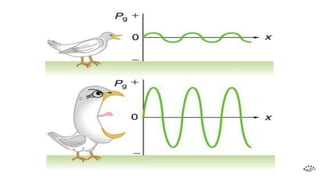
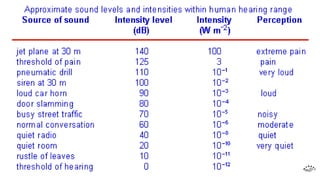
SOUND INTENSITY
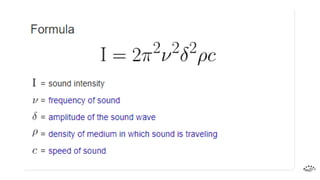
• Sound intensity, also known as acoustic intensity, is defined as the
power carried by sound waves per unit area in a direction
perpendicular to that area.
• The SI unit of intensity, which includes sound intensity, is the watt
per square meter (W/m2).
FREQUENCY
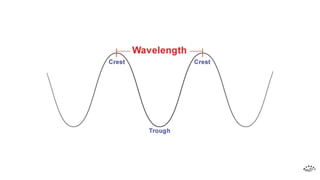
Also called wave frequency, is a measurement of the total number of
vibrations or oscillations made within a certain amount of time. There
are a few different ways to calculate frequency based on the information
you have available to you.
FORMULAS
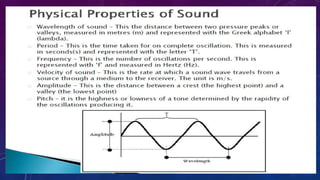
F= VELOCITY(speed of sound)/WAVELENGHT
F= 1/TIME PERIOD
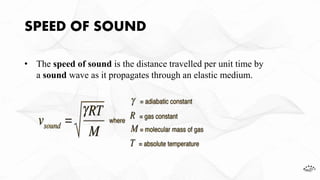
SPEED OF SOUND
• The speed of sound is the distance travelled per unit time by
a sound wave as it propagates through an elastic medium.
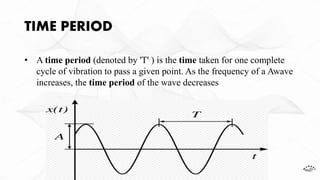
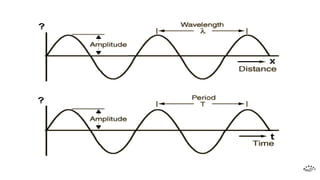
TIME PERIOD
• A time period (denoted by 'T' ) is the time taken for one complete
cycle of vibration to pass a given point. As the frequency of a Awave
increases, the time period of the wave decreases
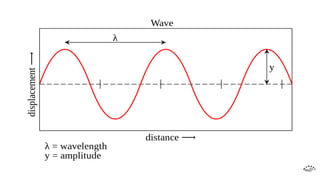
AMPLITUDE
• In physics, the maximum displacement or distance moved by a
point on a vibrating body or wave measured from its equilibrium
position. It is equal to one-half the length of the vibration path.
DENSITY
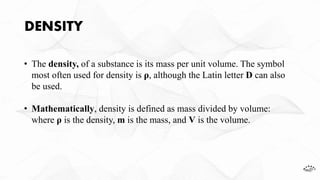
• The density, of a substance is its mass per unit volume. The symbol
most often used for density is ρ, although the Latin letter D can also
be used.
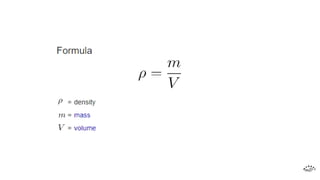
• Mathematically, density is defined as mass divided by volume:
where ρ is the density, m is the mass, and V is the volume.
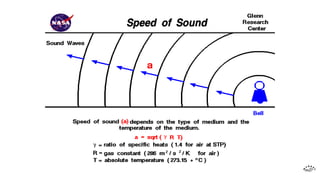
SPEED OF SOUND
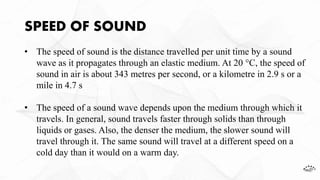
• The speed of sound is the distance travelled per unit time by a sound
wave as it propagates through an elastic medium. At 20 °C, the speed of
sound in air is about 343 metres per second, or a kilometre in 2.9 s or a
mile in 4.7 s
• The speed of a sound wave depends upon the medium through which it
travels. In general, sound travels faster through solids than through
liquids or gases. Also, the denser the medium, the slower sound will
travel through it. The same sound will travel at a different speed on a
cold day than it would on a warm day.
SOUND
INTENSITY
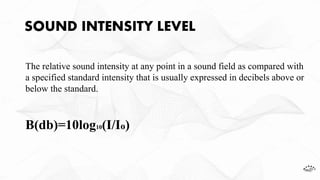
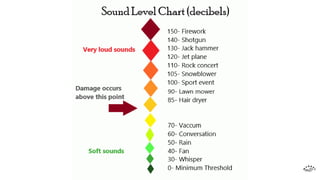
SOUND INTENSITY LEVEL
The relative sound intensity at any point in a sound field as compared with
a specified standard intensity that is usually expressed in decibels above or
below the standard.
Ī’(db)=10log10(I/Io)
ABSOLUTE THRESHOLD OF HEARING
• The absolute threshold of hearing is the minimum sound level of a
pure tone that an average human ear with normal hearing can hear
with no other sound present. The absolute threshold relates to the
sound that can just be heard by the organism.
Properties of Acoustics(Sound) in Space
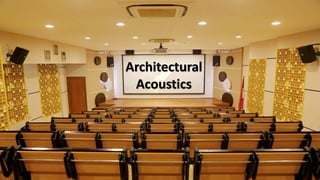
Architectural
Acoustics
ŪžWhat is Building Acoustics
 Building acoustics is the science of controlling
noise in buildings. This includes the minimisation
of noise transmission from one space to another
and the control of the characteristics of sound within
spaces themselves. ... The generation of sound
inside or outside the space
 The first application of modern scientific methods to
architectural acoustics was carried out by Wallace
Sabine in the Fogg Museum 1900
• By this we mean a situation where a room (and we still
only talking about room acoustics) will be perceived as
comfortable, well-balanced, suitably furnished for its
purpose and as having a clear and distinct sound
reproduction and experience. Good acoustics are linked to
human well-being.
Good Acoustics mean
BUILDING ACOUSTICS CAN BE INFLUENCED
BY:
• The geometry and volume of a space:
• The sound absorption, transmission and reflection characteristics of
surfaces enclosing the space and within the space:
• The sound absorption, transmission and reflection characteristics
of materials separating spaces:
• The generation of sound inside or outside the space:
• Airborne sound transmission:
• Impact noise:
CONSTRUCTION TECHNIQUES IN ACOUSTIC
PLANNING OF A BUILDING
• Wall Mass and the Thickness are Increased:
• Use of Cavity Partition in Buildings for Noise Control:
• Increase Airspace Width of Walls:
• Increasing the Stud Spacing:
• Sound Absorbing Blankets Used in the Airspace:
• The Cracks and Edges are Sealed:
• Windows Size can be Reduced:
• Glass Thickness can be Increased:
• Replacing a hollow core door by a solid door (EXPENSIVE):
• Using a floating floor:
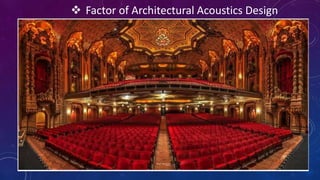
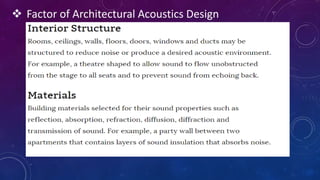
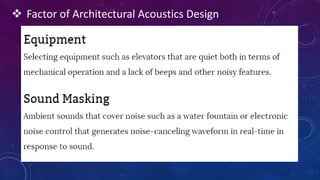
 Factor of Architectural Acoustics Design
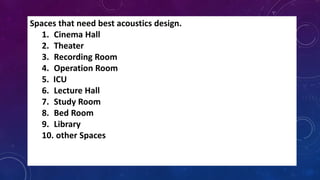
Spaces that need best acoustics design.
1. Cinema Hall
2. Theater
3. Recording Room
4. Operation Room
5. ICU
6. Lecture Hall
7. Study Room
8. Bed Room
9. Library
10. other Spaces
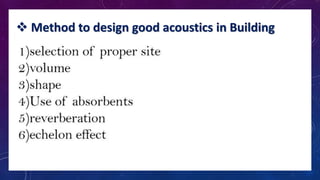
 Method to design good acoustics in Building
TYPES OF MATERIALS
• SOUNDABSORBERS
• SOUND DIFFUSERS
• NOISE BARRIERS
• SOUND REFLECTORS
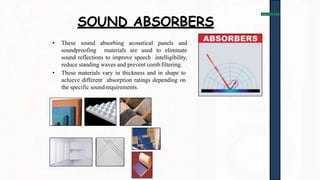
SOUND ABSORBERS
• These sound absorbing acoustical panels and
soundproofing materials are used to eliminate
sound reflections to improve speech intelligibility,
reduce standing waves and prevent comb filtering.
• These materials vary in thickness and in shape to
achieve different absorption ratings depending on
the specific soundrequirements.
TYPES
Acoustical foam panels
White paintable acoustical wall panels
Fabric wrapped panels
Acoustical wall coverings
Ceiling tiles
Baffles and banners for ceiling
Fibre glass blankets and roll
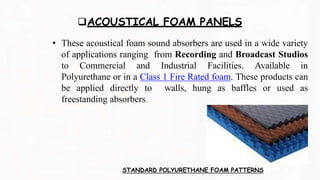
ACOUSTICAL FOAM PANELS
• These acoustical foam sound absorbers are used in a wide variety
of applications ranging from Recording and Broadcast Studios
to Commercial and Industrial Facilities. Available in
Polyurethane or in a Class 1 Fire Rated foam. These products can
be applied directly to walls, hung as baffles or used as
freestanding absorbers.
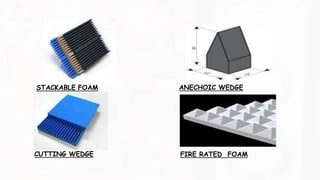
STANDARD POLYURETHANE FOAM PATTERNS
STACKABLE FOAM
CUTTING WEDGE FIRE RATED FOAM
ANECHOIC WEDGE
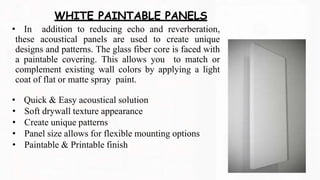
• In addition to reducing echo and reverberation,
these acoustical panels are used to create unique
designs and patterns. The glass fiber core is faced with
a paintable covering. This allows you to match or
complement existing wall colors by applying a light
coat of flat or matte spray paint.
• Quick & Easy acoustical solution
• Soft drywall texture appearance
• Create unique patterns
• Panel size allows for flexible mounting options
• Paintable & Printable finish
WHITE PAINTABLE PANELS
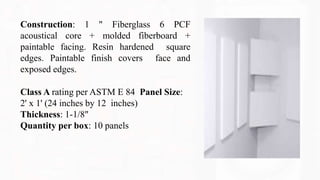
Construction: 1 " Fiberglass 6 PCF
acoustical core + molded fiberboard +
paintable facing. Resin hardened square
edges. Paintable finish covers face and
exposed edges.
Class A rating per ASTM E 84 Panel Size:
2' x 1' (24 inches by 12 inches)
Thickness: 1-1/8"
Quantity per box: 10 panels
FABRIC WRAPPED PANELS
• Acoustical sound panels utilize 6-7 PCF glass fiber material for
maximum absorption. Available as wall panels, ceiling tiles,
hanging baffles, acoustical clouds and bass traps, with more than
50 standard colors to choose from, these materials will look as good
as they sound.
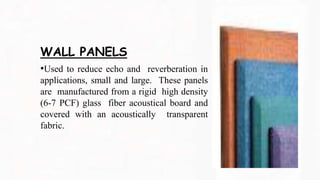
WALL PANELS
•Used to reduce echo and reverberation in
applications, small and large. These panels
are manufactured from a rigid high density
(6-7 PCF) glass fiber acoustical board and
covered with an acoustically transparent
fabric.
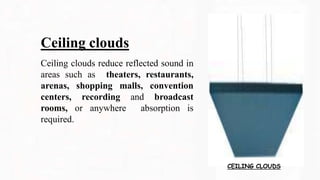
Ceiling clouds
Ceiling clouds reduce reflected sound in
areas such as theaters, restaurants,
arenas, shopping malls, convention
centers, recording and broadcast
rooms, or anywhere absorption is
required.
CEILING CLOUDS
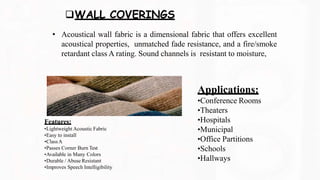
WALL COVERINGS
• Acoustical wall fabric is a dimensional fabric that offers excellent
acoustical properties, unmatched fade resistance, and a fire/smoke
retardant class A rating. Sound channels is resistant to moisture,
Features:
•Lightweight Acoustic Fabric
•Easy to install
•ClassA
•Passes Corner Burn Test
•Available in Many Colors
•Durable / Abuse Resistant
Applications:
•Conference Rooms
•Theaters
•Hospitals
•Municipal
•Office Partitions
•Schools
•Hallways
•Improves Speech Intelligibility
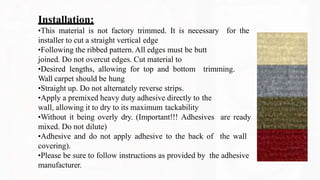
Installation:
•This material is not factory trimmed. It is necessary for the
installer to cut a straight vertical edge
•Following the ribbed pattern. All edges must be butt
joined. Do not overcut edges. Cut material to
•Desired lengths, allowing for top and bottom trimming.
Wall carpet should be hung
•Straight up. Do not alternately reverse strips.
•Apply a premixed heavy duty adhesive directly to the
wall, allowing it to dry to its maximum tackability
•Without it being overly dry. (Important!!! Adhesives are ready
mixed. Do not dilute)
•Adhesive and do not apply adhesive to the back of the wall
covering).
•Please be sure to follow instructions as provided by the adhesive
manufacturer.
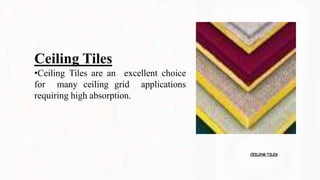
CEILING TILES
Ceiling Tiles
•Ceiling Tiles are an excellent choice
for many ceiling grid applications
requiring high absorption.
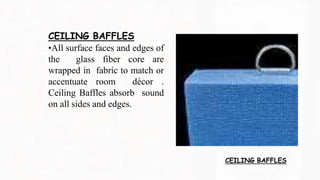
CEILING BAFFLES
CEILING BAFFLES
•All surface faces and edges of
the glass fiber core are
wrapped in fabric to match or
accentuate room dƩcor .
Ceiling Baffles absorb sound
on all sides and edges.
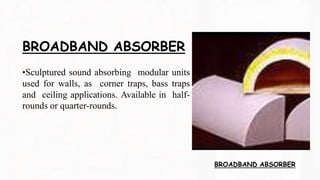
BROADBAND ABSORBER
BROADBAND ABSORBER
•Sculptured sound absorbing modular units
used for walls, as corner traps, bass traps
and ceiling applications. Available in half-
rounds or quarter-rounds.
CEILING TILES
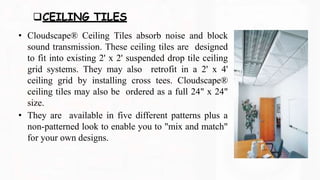
• CloudscapeĀ® Ceiling Tiles absorb noise and block
sound transmission. These ceiling tiles are designed
to fit into existing 2' x 2' suspended drop tile ceiling
grid systems. They may also retrofit in a 2' x 4'
ceiling grid by installing cross tees. CloudscapeĀ®
ceiling tiles may also be ordered as a full 24" x 24"
size.
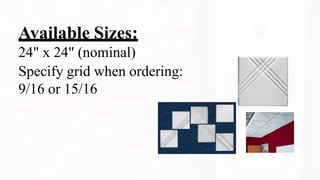
• They are available in five different patterns plus a
non-patterned look to enable you to "mix and match"
for your own designs.
Available Sizes:
24" x 24" (nominal)
Specify grid when ordering:
9/16 or 15/16
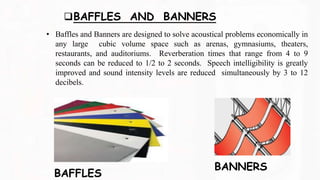
BAFFLES AND BANNERS
• Baffles and Banners are designed to solve acoustical problems economically in
any large cubic volume space such as arenas, gymnasiums, theaters,
restaurants, and auditoriums. Reverberation times that range from 4 to 9
seconds can be reduced to 1/2 to 2 seconds. Speech intelligibility is greatly
improved and sound intensity levels are reduced simultaneously by 3 to 12
decibels.
BAFFLES
BANNERS
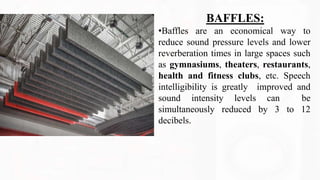
BAFFLES:
•Baffles are an economical way to
reduce sound pressure levels and lower
reverberation times in large spaces such
as gymnasiums, theaters, restaurants,
health and fitness clubs, etc. Speech
intelligibility is greatly improved and
sound intensity levels can be
simultaneously reduced by 3 to 12
decibels.
BANNERS:
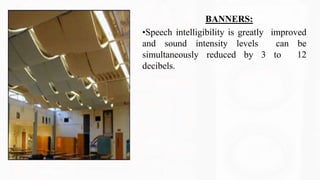
•Speech intelligibility is greatly improved
and sound intensity levels can be
simultaneously reduced by 3 to 12
decibels.
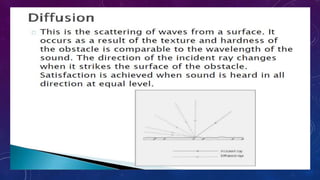
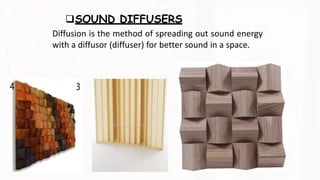
SOUND DIFFUSERS
Diffusion is the method of spreading out sound energy
with a diffusor (diffuser) for better sound in a space.
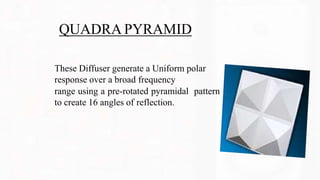
QUADRA PYRAMID
These Diffuser generate a Uniform polar
response over a broad frequency
range using a pre-rotated pyramidal pattern
to create 16 angles of reflection.
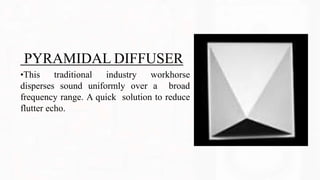
PYRAMIDAL DIFFUSER
•This traditional industry workhorse
disperses sound uniformly over a broad
frequency range. A quick solution to reduce
flutter echo.
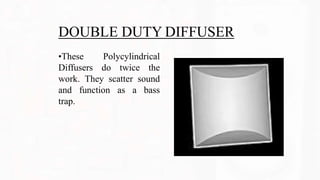
DOUBLE DUTY DIFFUSER
•These Polycylindrical
Diffusers do twice the
work. They scatter sound
and function as a bass
trap.
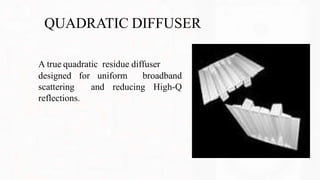
QUADRATIC DIFFUSER
A true quadratic residue diffuser
designed for uniform broadband
scattering and reducing High-Q
reflections.
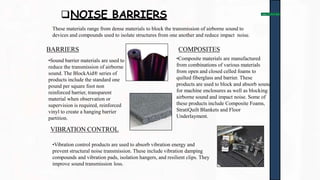
NOISE BARRIERS
These materials range from dense materials to block the transmission of airborne sound to
devices and compounds used to isolate structures from one another and reduce impact noise.
COMPOSITES
•Composite materials are manufactured
from combinations of various materials
from open and closed celled foams to
quilted fiberglass and barrier. These
products are used to block and absorb sound
for machine enclosures as well as blocking
airborne sound and impact noise. Some of
these products include Composite Foams,
StratiQuilt Blankets and Floor
Underlayment.
BARRIERS
•Sound barrier materials are used to
reduce the transmission of airborne
sound. The BlockAidĀ® series of
products include the standard one
pound per square foot non
reinforced barrier, transparent
material when observation or
supervision is required, reinforced
vinyl to create a hanging barrier
partition.
VIBRATION CONTROL
•Vibration control products are used to absorb vibration energy and
prevent structural noise transmission. These include vibration damping
compounds and vibration pads, isolation hangers, and resilient clips. They
improve sound transmission loss.
FACTORS AFFECTING ACOUSTIC OF BUILDING AND THEIR
REMEDIES
THE VARIOUS FACTORS AFFECTING THE
ACOUSTIC OF BUILDING SUCH AS
REVERBERATION TIME, LOUDNESS,
FOCUSSING, ECHO, ECHELON EFFECT,
RESONANCE AND NOISE WITH THEIR
REMEDIES ARE EXPLAINED IN BRIEF IN
THIS PECTION
1. REVERBERATION TIME
REVERBERATION IS THE PERSISTANCE OR PROLONGATION OF SOUND IN A HALL EVEN AFTER
THE SOURCE STOPPED EMITTING SOUND.
IN ORDER TO HAVE GOOD ACOUSTIC EFFECT, THE REVERBERATION TIME HAS TO BE
MAINTAINED AT OPTIMUM VALUE. THE REASON IS, IF THE REVERBERATION TIME IS TOO
SMALL, THE LOUDNESS BECOMES INADEQUATE. AS A RESULT THE SOUND MAY NOT REACH
TO THE LISTENER.
THUS, THIS GIVE THE HALL A DEAD EFFECT. ON THE OTHER HAND, IF THE REVERBERATION
TIME IS TOO LONG, IT WILL LEAD TO MORE CONFUSION DUE TO MIXING OF DIFFERENT
STYLE.
HENCE TO MAINTAIN GOOD EFFECT REVERBERATION TIME SHOULD BE MAINTAINED.
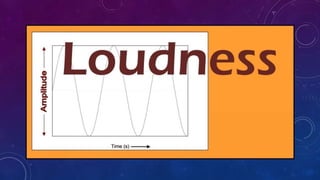
LOUDNESS
THE UNIFIRM DISTRIBUTION OF LOUDNESS IN A HALL OR A ROOM IS AN IMPORTANT FACTOR FOR
SATISFACTORY HEARING. SOMETIMES, THE LOUDNESS MAY GET REDUCED DUE TO EXCESS OF
SOUND- ABSORBING MATERIALS IN A HALL OR A ROOM.
DEFINATION:
ā€œLoudness is a characteristic of sound by which loud and faind sound can be
distinguishedā€
REMEDIES
IF THE LOUDNESS OF SOUND IS NOT ADEQUATE, THE LOUDNESS CAN BE INCREASED BY ADOPTING
THE FOLLOWING METHODS.
1. BY USING SUITABLE ABSORBANTS AT PLACE WHERE NOISE IS HIGH. AS A RESULT, THE
DISTRIBUTION OF LOUDNESS MAY BECOME UNIFORM.
2. BY CONSTRUCTING LOW CEILING FOR THE REFLECTION OF SOUND TOWARDS THE LISTENER.
3. BY USING LARGE SOUNDING BOARDS BEHIND THE SPEAKER AND FACING THE AUDIENCE.
4. BY USING PUBLIC ADRESS SYSTEM LIKE LOUDSPEAKERS.
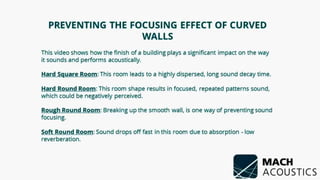
FOCUSING AND INTERFERENCE EFFECTS
THE PRESENCE OF ANY CONCAVE SURFACE OR ANY OTHER CURVED SURFACE IN THE HALL OR ROOM
MAY MAKE THE SOUND TO BE CONCENTRATED AT THIS FOCUS REGION. AS A RESULT, THE SOUND
MAY NOT BE HEARD AT ALL AT OTHER REGIONS. THE SOUNDS MAY NOT BE HEARD AT ALL AT OTHER
REGIONS. THESE REGIONS ARE REFERRED AS DEAD SPACE. HENCE, SUCH SURFACES MUST BE
AVOIDED.
IN ADDITION TO FOCUSING THERE SHOULD NOT BE INTERFERENCE OF DIRECT AND REFLECTED
WAVES. THIS IS BECAUSE, A CONSTRUCTIVE INTERFERANCE MAY PRODUCE A SOUND OF MAXIMUM
INTENSITY IN SOME PLACES AND A DESTRUCTIVE INTERFERENCE MAY PRODUCE A SOUND OF
MINIMUM INTENSITY IN OTHER PLACES. THUS, THERE WILL BE AN UNEVEN DISTRIBUTION OF
SOUND INTENSITY.
REMEDY
CURVED SURFACE CAN BE AVOIDED. IF CURVED SURFACE ARE PRESENT, THEY SHOULD BE COVERED
WITH SUITABLE SOUND ABSORBING MATERIAL.
ECHO
AN ECO IS HEARD DUE TO REFLECTION OF SOUND FROM A DISASTER SOUND- REFLECTING OBJECT.
IF THE TIME INTERVEL BETWEEN THE DIRECT SOUND AND REFLECTED SOUND IS LESS THAN
0.066 SECONDS, THE REFLECTED SOUND IS HELPFUL IN INCREASING THE LOUDNESS. BUT, THOSE
SOUNDS ARRIVING LATER THEN THIS CAUSE CONFUSION.
REMEDY
AN ECHO CAN BE AVOIDED BY COVERING A LONG DISTENCE WALLS AND HIGH CEILING WITH
SUITABLE SOUND ABSORBING MATERIAL.
THIS PREVENTS REFLECTION OF SOUND.
ECHLON EFFECT
IT REFERS TO THE GENERATION OF A NEW SEPARATE SOUND DUE TO MULTIPLE ECHOS.A SET OF
RAILINGS OR ANY REGULAR REFLECTING SURFACE IS SAID TO PRODUCE THE ECHLON EFFECT. THIS
ECHLON EFFECTS EFFECT AFFECTS THE QUALITY OF THE ORIGINAL SOUND.
REMEDY
THE REMEDY TO AVOID ECHLON EFFECT IS TO COVER SUCH SURFACE WITH SOUND ABSORBING
MATERIALS.
RESONANCE
RESONANCE OCCURS DUE TO THE MATCHING OF FREQUENCY. IF THE WINDOW PANELS AND
SECTIONS OF WOODEN PORTIONS HAVE NOT BEEN TIGHTLY FITTED, THEY MAY START VIBRATING,
THEREBY CREATING AN EXTRA SOUND IN ADDITION TO THE SOUND PRODUCED IN THE HALL OR
ROOM.
REMEDY
THE RESONANCE MAY BE AVOIDED BY FIXING THE WINDOW PANELS PROPERLY. ANY OTHER
VIBRATING OBJECT WHICH MAY PRODUCE RESONANCE BAN BE PLACED OVER A SUITABLE SOUND
ABSORBING MATERIAL.
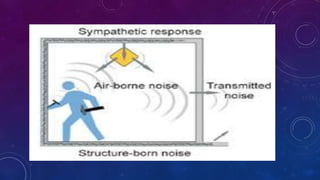
NOISE
THE UNWANTED SOUND IS CALLED A NOISE. THE HALL
OR ROOM SHOULD BE PROPERLY INSULATED FROM
EXTERNAL AND INTERNAL NOISE. IN GENERAL, THERE
ARE THREE TYPES OF NOISES:
1. AIR-BORNE NOISE,
2. STRUCTURE-BORNE NOISE,
3. INSIDE/TRANSMITTED
NOISE.
AIR-BORNE NOISE
EXTRANEOUS NOISE WHICH ARE COMING FROM OUTSIDE THROUGH OPEN WINDOWS, DOORS AND
VENTILATORS ARE KNOWN AS AIR-BORNE NOISE. THE AIR-BORNE NOISE CAN BE AVOIDED BY
FOLLOWING THE REMEDIES MENTIONED.
REMEDIES
1. THE HALL OR ROOM CAN BE MADE AIR CONDITIONED.
2. BY USING DOORS AND WINDOWS WITH SEPARATE FRAMES WITH PROPER SOUND INSULATING
MATERIAL.
STRUCTURE-BORNE NOISE
THE NOISE WHICH IS CONVEYED THROUGH THE STRUCTURE OF THE BUILDING IS CALLED
STRUCTURE-BORNE NOISE. THE STRUCTURAL VIBRATION MAY OCCUR DUE TO STREET TRAFFIC,
OPERATION OF HEAVY MACHINES, ETC.
REMEDIES
1. THIS NOISE CAN BE ELIMINATE DBY USING DOUBLE WALLS WITH AIR SPACE BETWEEN THEM.
2. BY USING ANTI-VIBRATION MOUNTS THIS TYPE OF NOISE CAN BE REDUCED.
3. BY COVERING THE FLOOR AND WALL WITH PROPER SOUND-ABSORBING MATERIAL THIS NOISE
CAN BE ELIMINATED.
INSIDE NOISE
THE NOISE WHICH ARE PRODUCED INSIDE THE HALL OR ROOM IS CALLED INSIDE NOISE. THE
INSIDE NOISE MAY BE PRODUCED DUE TO MACHINARIES LIKE AIR CONDITIONERS, GENERATORS,
FANS, TYPEWRITERS, ETC.
REMEDIES
1. THE SOUND PRODUCING MACHINARIES CAN BE PLACED OVER SOUND ABSORBING MATERIALS
LIKE CARPET, PADS, WOOD, FELT, ETC.
2. BY USING CURTAINS OF SOUND ABSORBING MATERIALS.
3. BY COVERING TH EFLOOR, WALL AND CEILING WITH SOUND ABSORBING MATERIALS.
Sounds In Architecture

Sounds In Architecture

  • 1.
  • 2.
    SOUND • Vibrations thattravel through the air or another medium and can be heard when they reach a person's or animal's ear.
  • 3.
  • 4.
    • Sound vibrationstravel in a wave pattern, and we call these vibrations sound waves. • Sound waves move by vibrating objects and these objects vibrate other surrounding objects, carrying the sound along. • Sound can move through the air, water, or solids, as long as there are particles to bounce off.
  • 9.
    • LONGITUDINAL WAVES: Awave in which the particles of the medium vibrate back and forth in the ā€˜same direction’ in which the wave is moving. Medium can be solid, liquid or gases. Therefore, sound waves are longitudinal waves. • TRANSVERSE WAVES: A wave in which the particles of the medium vibrate up and down ā€˜at right angles’ to the direction in which the wave is moving. These waves are produced only in a solids and liquids but not in gases.
  • 12.
    SOUND INTENSITY • Soundintensity, also known as acoustic intensity, is defined as the power carried by sound waves per unit area in a direction perpendicular to that area. • The SI unit of intensity, which includes sound intensity, is the watt per square meter (W/m2).
  • 15.
    FREQUENCY Also called wavefrequency, is a measurement of the total number of vibrations or oscillations made within a certain amount of time. There are a few different ways to calculate frequency based on the information you have available to you. FORMULAS F= VELOCITY(speed of sound)/WAVELENGHT F= 1/TIME PERIOD
  • 17.
    SPEED OF SOUND •The speed of sound is the distance travelled per unit time by a sound wave as it propagates through an elastic medium.
  • 19.
    TIME PERIOD • Atime period (denoted by 'T' ) is the time taken for one complete cycle of vibration to pass a given point. As the frequency of a Awave increases, the time period of the wave decreases
  • 20.
    AMPLITUDE • In physics,the maximum displacement or distance moved by a point on a vibrating body or wave measured from its equilibrium position. It is equal to one-half the length of the vibration path.
  • 23.
    DENSITY • The density,of a substance is its mass per unit volume. The symbol most often used for density is ρ, although the Latin letter D can also be used. • Mathematically, density is defined as mass divided by volume: where ρ is the density, m is the mass, and V is the volume.
  • 25.
    SPEED OF SOUND •The speed of sound is the distance travelled per unit time by a sound wave as it propagates through an elastic medium. At 20 °C, the speed of sound in air is about 343 metres per second, or a kilometre in 2.9 s or a mile in 4.7 s • The speed of a sound wave depends upon the medium through which it travels. In general, sound travels faster through solids than through liquids or gases. Also, the denser the medium, the slower sound will travel through it. The same sound will travel at a different speed on a cold day than it would on a warm day.
  • 26.
  • 29.
    SOUND INTENSITY LEVEL Therelative sound intensity at any point in a sound field as compared with a specified standard intensity that is usually expressed in decibels above or below the standard. Ī’(db)=10log10(I/Io)
  • 31.
    ABSOLUTE THRESHOLD OFHEARING • The absolute threshold of hearing is the minimum sound level of a pure tone that an average human ear with normal hearing can hear with no other sound present. The absolute threshold relates to the sound that can just be heard by the organism.
  • 34.
  • 44.
  • 45.
    ŪžWhat is BuildingAcoustics  Building acoustics is the science of controlling noise in buildings. This includes the minimisation of noise transmission from one space to another and the control of the characteristics of sound within spaces themselves. ... The generation of sound inside or outside the space  The first application of modern scientific methods to architectural acoustics was carried out by Wallace Sabine in the Fogg Museum 1900
  • 46.
    • By thiswe mean a situation where a room (and we still only talking about room acoustics) will be perceived as comfortable, well-balanced, suitably furnished for its purpose and as having a clear and distinct sound reproduction and experience. Good acoustics are linked to human well-being. Good Acoustics mean
  • 47.
    BUILDING ACOUSTICS CANBE INFLUENCED BY: • The geometry and volume of a space: • The sound absorption, transmission and reflection characteristics of surfaces enclosing the space and within the space: • The sound absorption, transmission and reflection characteristics of materials separating spaces: • The generation of sound inside or outside the space: • Airborne sound transmission: • Impact noise:
  • 48.
    CONSTRUCTION TECHNIQUES INACOUSTIC PLANNING OF A BUILDING • Wall Mass and the Thickness are Increased: • Use of Cavity Partition in Buildings for Noise Control: • Increase Airspace Width of Walls: • Increasing the Stud Spacing: • Sound Absorbing Blankets Used in the Airspace: • The Cracks and Edges are Sealed: • Windows Size can be Reduced: • Glass Thickness can be Increased: • Replacing a hollow core door by a solid door (EXPENSIVE): • Using a floating floor:
  • 49.
     Factor ofArchitectural Acoustics Design
  • 50.
     Factor ofArchitectural Acoustics Design
  • 51.
     Factor ofArchitectural Acoustics Design
  • 52.
     Factor ofArchitectural Acoustics Design
  • 53.
    Spaces that needbest acoustics design. 1. Cinema Hall 2. Theater 3. Recording Room 4. Operation Room 5. ICU 6. Lecture Hall 7. Study Room 8. Bed Room 9. Library 10. other Spaces
  • 54.
     Method todesign good acoustics in Building
  • 66.
    TYPES OF MATERIALS •SOUNDABSORBERS • SOUND DIFFUSERS • NOISE BARRIERS • SOUND REFLECTORS
  • 67.
    SOUND ABSORBERS • Thesesound absorbing acoustical panels and soundproofing materials are used to eliminate sound reflections to improve speech intelligibility, reduce standing waves and prevent comb filtering. • These materials vary in thickness and in shape to achieve different absorption ratings depending on the specific soundrequirements.
  • 68.
    TYPES Acoustical foam panels Whitepaintable acoustical wall panels Fabric wrapped panels Acoustical wall coverings Ceiling tiles Baffles and banners for ceiling Fibre glass blankets and roll
  • 69.
    ACOUSTICAL FOAM PANELS •These acoustical foam sound absorbers are used in a wide variety of applications ranging from Recording and Broadcast Studios to Commercial and Industrial Facilities. Available in Polyurethane or in a Class 1 Fire Rated foam. These products can be applied directly to walls, hung as baffles or used as freestanding absorbers. STANDARD POLYURETHANE FOAM PATTERNS
  • 70.
    STACKABLE FOAM CUTTING WEDGEFIRE RATED FOAM ANECHOIC WEDGE
  • 71.
    • In additionto reducing echo and reverberation, these acoustical panels are used to create unique designs and patterns. The glass fiber core is faced with a paintable covering. This allows you to match or complement existing wall colors by applying a light coat of flat or matte spray paint. • Quick & Easy acoustical solution • Soft drywall texture appearance • Create unique patterns • Panel size allows for flexible mounting options • Paintable & Printable finish WHITE PAINTABLE PANELS
  • 72.
    Construction: 1 "Fiberglass 6 PCF acoustical core + molded fiberboard + paintable facing. Resin hardened square edges. Paintable finish covers face and exposed edges. Class A rating per ASTM E 84 Panel Size: 2' x 1' (24 inches by 12 inches) Thickness: 1-1/8" Quantity per box: 10 panels
  • 73.
    FABRIC WRAPPED PANELS •Acoustical sound panels utilize 6-7 PCF glass fiber material for maximum absorption. Available as wall panels, ceiling tiles, hanging baffles, acoustical clouds and bass traps, with more than 50 standard colors to choose from, these materials will look as good as they sound.
  • 74.
    WALL PANELS •Used toreduce echo and reverberation in applications, small and large. These panels are manufactured from a rigid high density (6-7 PCF) glass fiber acoustical board and covered with an acoustically transparent fabric.
  • 75.
    Ceiling clouds Ceiling cloudsreduce reflected sound in areas such as theaters, restaurants, arenas, shopping malls, convention centers, recording and broadcast rooms, or anywhere absorption is required. CEILING CLOUDS
  • 76.
    WALL COVERINGS • Acousticalwall fabric is a dimensional fabric that offers excellent acoustical properties, unmatched fade resistance, and a fire/smoke retardant class A rating. Sound channels is resistant to moisture, Features: •Lightweight Acoustic Fabric •Easy to install •ClassA •Passes Corner Burn Test •Available in Many Colors •Durable / Abuse Resistant Applications: •Conference Rooms •Theaters •Hospitals •Municipal •Office Partitions •Schools •Hallways •Improves Speech Intelligibility
  • 77.
    Installation: •This material isnot factory trimmed. It is necessary for the installer to cut a straight vertical edge •Following the ribbed pattern. All edges must be butt joined. Do not overcut edges. Cut material to •Desired lengths, allowing for top and bottom trimming. Wall carpet should be hung •Straight up. Do not alternately reverse strips. •Apply a premixed heavy duty adhesive directly to the wall, allowing it to dry to its maximum tackability •Without it being overly dry. (Important!!! Adhesives are ready mixed. Do not dilute) •Adhesive and do not apply adhesive to the back of the wall covering). •Please be sure to follow instructions as provided by the adhesive manufacturer.
  • 78.
    CEILING TILES Ceiling Tiles •CeilingTiles are an excellent choice for many ceiling grid applications requiring high absorption.
  • 79.
    CEILING BAFFLES CEILING BAFFLES •Allsurface faces and edges of the glass fiber core are wrapped in fabric to match or accentuate room dĆ©cor . Ceiling Baffles absorb sound on all sides and edges.
  • 80.
    BROADBAND ABSORBER BROADBAND ABSORBER •Sculpturedsound absorbing modular units used for walls, as corner traps, bass traps and ceiling applications. Available in half- rounds or quarter-rounds.
  • 81.
    CEILING TILES • CloudscapeĀ®Ceiling Tiles absorb noise and block sound transmission. These ceiling tiles are designed to fit into existing 2' x 2' suspended drop tile ceiling grid systems. They may also retrofit in a 2' x 4' ceiling grid by installing cross tees. CloudscapeĀ® ceiling tiles may also be ordered as a full 24" x 24" size. • They are available in five different patterns plus a non-patterned look to enable you to "mix and match" for your own designs.
  • 82.
    Available Sizes: 24" x24" (nominal) Specify grid when ordering: 9/16 or 15/16
  • 83.
    BAFFLES AND BANNERS •Baffles and Banners are designed to solve acoustical problems economically in any large cubic volume space such as arenas, gymnasiums, theaters, restaurants, and auditoriums. Reverberation times that range from 4 to 9 seconds can be reduced to 1/2 to 2 seconds. Speech intelligibility is greatly improved and sound intensity levels are reduced simultaneously by 3 to 12 decibels. BAFFLES BANNERS
  • 84.
    BAFFLES: •Baffles are aneconomical way to reduce sound pressure levels and lower reverberation times in large spaces such as gymnasiums, theaters, restaurants, health and fitness clubs, etc. Speech intelligibility is greatly improved and sound intensity levels can be simultaneously reduced by 3 to 12 decibels.
  • 85.
    BANNERS: •Speech intelligibility isgreatly improved and sound intensity levels can be simultaneously reduced by 3 to 12 decibels.
  • 86.
    SOUND DIFFUSERS Diffusion isthe method of spreading out sound energy with a diffusor (diffuser) for better sound in a space.
  • 87.
    QUADRA PYRAMID These Diffusergenerate a Uniform polar response over a broad frequency range using a pre-rotated pyramidal pattern to create 16 angles of reflection.
  • 88.
    PYRAMIDAL DIFFUSER •This traditionalindustry workhorse disperses sound uniformly over a broad frequency range. A quick solution to reduce flutter echo.
  • 89.
    DOUBLE DUTY DIFFUSER •ThesePolycylindrical Diffusers do twice the work. They scatter sound and function as a bass trap.
  • 90.
    QUADRATIC DIFFUSER A truequadratic residue diffuser designed for uniform broadband scattering and reducing High-Q reflections.
  • 91.
    NOISE BARRIERS These materialsrange from dense materials to block the transmission of airborne sound to devices and compounds used to isolate structures from one another and reduce impact noise. COMPOSITES •Composite materials are manufactured from combinations of various materials from open and closed celled foams to quilted fiberglass and barrier. These products are used to block and absorb sound for machine enclosures as well as blocking airborne sound and impact noise. Some of these products include Composite Foams, StratiQuilt Blankets and Floor Underlayment. BARRIERS •Sound barrier materials are used to reduce the transmission of airborne sound. The BlockAidĀ® series of products include the standard one pound per square foot non reinforced barrier, transparent material when observation or supervision is required, reinforced vinyl to create a hanging barrier partition. VIBRATION CONTROL •Vibration control products are used to absorb vibration energy and prevent structural noise transmission. These include vibration damping compounds and vibration pads, isolation hangers, and resilient clips. They improve sound transmission loss.
  • 93.
    FACTORS AFFECTING ACOUSTICOF BUILDING AND THEIR REMEDIES
  • 94.
    THE VARIOUS FACTORSAFFECTING THE ACOUSTIC OF BUILDING SUCH AS REVERBERATION TIME, LOUDNESS, FOCUSSING, ECHO, ECHELON EFFECT, RESONANCE AND NOISE WITH THEIR REMEDIES ARE EXPLAINED IN BRIEF IN THIS PECTION
  • 95.
    1. REVERBERATION TIME REVERBERATIONIS THE PERSISTANCE OR PROLONGATION OF SOUND IN A HALL EVEN AFTER THE SOURCE STOPPED EMITTING SOUND. IN ORDER TO HAVE GOOD ACOUSTIC EFFECT, THE REVERBERATION TIME HAS TO BE MAINTAINED AT OPTIMUM VALUE. THE REASON IS, IF THE REVERBERATION TIME IS TOO SMALL, THE LOUDNESS BECOMES INADEQUATE. AS A RESULT THE SOUND MAY NOT REACH TO THE LISTENER. THUS, THIS GIVE THE HALL A DEAD EFFECT. ON THE OTHER HAND, IF THE REVERBERATION TIME IS TOO LONG, IT WILL LEAD TO MORE CONFUSION DUE TO MIXING OF DIFFERENT STYLE. HENCE TO MAINTAIN GOOD EFFECT REVERBERATION TIME SHOULD BE MAINTAINED.
  • 97.
    LOUDNESS THE UNIFIRM DISTRIBUTIONOF LOUDNESS IN A HALL OR A ROOM IS AN IMPORTANT FACTOR FOR SATISFACTORY HEARING. SOMETIMES, THE LOUDNESS MAY GET REDUCED DUE TO EXCESS OF SOUND- ABSORBING MATERIALS IN A HALL OR A ROOM. DEFINATION: ā€œLoudness is a characteristic of sound by which loud and faind sound can be distinguishedā€
  • 98.
    REMEDIES IF THE LOUDNESSOF SOUND IS NOT ADEQUATE, THE LOUDNESS CAN BE INCREASED BY ADOPTING THE FOLLOWING METHODS. 1. BY USING SUITABLE ABSORBANTS AT PLACE WHERE NOISE IS HIGH. AS A RESULT, THE DISTRIBUTION OF LOUDNESS MAY BECOME UNIFORM. 2. BY CONSTRUCTING LOW CEILING FOR THE REFLECTION OF SOUND TOWARDS THE LISTENER. 3. BY USING LARGE SOUNDING BOARDS BEHIND THE SPEAKER AND FACING THE AUDIENCE. 4. BY USING PUBLIC ADRESS SYSTEM LIKE LOUDSPEAKERS.
  • 100.
    FOCUSING AND INTERFERENCEEFFECTS THE PRESENCE OF ANY CONCAVE SURFACE OR ANY OTHER CURVED SURFACE IN THE HALL OR ROOM MAY MAKE THE SOUND TO BE CONCENTRATED AT THIS FOCUS REGION. AS A RESULT, THE SOUND MAY NOT BE HEARD AT ALL AT OTHER REGIONS. THE SOUNDS MAY NOT BE HEARD AT ALL AT OTHER REGIONS. THESE REGIONS ARE REFERRED AS DEAD SPACE. HENCE, SUCH SURFACES MUST BE AVOIDED. IN ADDITION TO FOCUSING THERE SHOULD NOT BE INTERFERENCE OF DIRECT AND REFLECTED WAVES. THIS IS BECAUSE, A CONSTRUCTIVE INTERFERANCE MAY PRODUCE A SOUND OF MAXIMUM INTENSITY IN SOME PLACES AND A DESTRUCTIVE INTERFERENCE MAY PRODUCE A SOUND OF MINIMUM INTENSITY IN OTHER PLACES. THUS, THERE WILL BE AN UNEVEN DISTRIBUTION OF SOUND INTENSITY. REMEDY CURVED SURFACE CAN BE AVOIDED. IF CURVED SURFACE ARE PRESENT, THEY SHOULD BE COVERED WITH SUITABLE SOUND ABSORBING MATERIAL.
  • 101.
    ECHO AN ECO ISHEARD DUE TO REFLECTION OF SOUND FROM A DISASTER SOUND- REFLECTING OBJECT. IF THE TIME INTERVEL BETWEEN THE DIRECT SOUND AND REFLECTED SOUND IS LESS THAN 0.066 SECONDS, THE REFLECTED SOUND IS HELPFUL IN INCREASING THE LOUDNESS. BUT, THOSE SOUNDS ARRIVING LATER THEN THIS CAUSE CONFUSION. REMEDY AN ECHO CAN BE AVOIDED BY COVERING A LONG DISTENCE WALLS AND HIGH CEILING WITH SUITABLE SOUND ABSORBING MATERIAL. THIS PREVENTS REFLECTION OF SOUND.
  • 102.
    ECHLON EFFECT IT REFERSTO THE GENERATION OF A NEW SEPARATE SOUND DUE TO MULTIPLE ECHOS.A SET OF RAILINGS OR ANY REGULAR REFLECTING SURFACE IS SAID TO PRODUCE THE ECHLON EFFECT. THIS ECHLON EFFECTS EFFECT AFFECTS THE QUALITY OF THE ORIGINAL SOUND. REMEDY THE REMEDY TO AVOID ECHLON EFFECT IS TO COVER SUCH SURFACE WITH SOUND ABSORBING MATERIALS.
  • 103.
    RESONANCE RESONANCE OCCURS DUETO THE MATCHING OF FREQUENCY. IF THE WINDOW PANELS AND SECTIONS OF WOODEN PORTIONS HAVE NOT BEEN TIGHTLY FITTED, THEY MAY START VIBRATING, THEREBY CREATING AN EXTRA SOUND IN ADDITION TO THE SOUND PRODUCED IN THE HALL OR ROOM. REMEDY THE RESONANCE MAY BE AVOIDED BY FIXING THE WINDOW PANELS PROPERLY. ANY OTHER VIBRATING OBJECT WHICH MAY PRODUCE RESONANCE BAN BE PLACED OVER A SUITABLE SOUND ABSORBING MATERIAL.
  • 104.
    NOISE THE UNWANTED SOUNDIS CALLED A NOISE. THE HALL OR ROOM SHOULD BE PROPERLY INSULATED FROM EXTERNAL AND INTERNAL NOISE. IN GENERAL, THERE ARE THREE TYPES OF NOISES: 1. AIR-BORNE NOISE, 2. STRUCTURE-BORNE NOISE, 3. INSIDE/TRANSMITTED NOISE.
  • 105.
    AIR-BORNE NOISE EXTRANEOUS NOISEWHICH ARE COMING FROM OUTSIDE THROUGH OPEN WINDOWS, DOORS AND VENTILATORS ARE KNOWN AS AIR-BORNE NOISE. THE AIR-BORNE NOISE CAN BE AVOIDED BY FOLLOWING THE REMEDIES MENTIONED. REMEDIES 1. THE HALL OR ROOM CAN BE MADE AIR CONDITIONED. 2. BY USING DOORS AND WINDOWS WITH SEPARATE FRAMES WITH PROPER SOUND INSULATING MATERIAL.
  • 106.
    STRUCTURE-BORNE NOISE THE NOISEWHICH IS CONVEYED THROUGH THE STRUCTURE OF THE BUILDING IS CALLED STRUCTURE-BORNE NOISE. THE STRUCTURAL VIBRATION MAY OCCUR DUE TO STREET TRAFFIC, OPERATION OF HEAVY MACHINES, ETC. REMEDIES 1. THIS NOISE CAN BE ELIMINATE DBY USING DOUBLE WALLS WITH AIR SPACE BETWEEN THEM. 2. BY USING ANTI-VIBRATION MOUNTS THIS TYPE OF NOISE CAN BE REDUCED. 3. BY COVERING THE FLOOR AND WALL WITH PROPER SOUND-ABSORBING MATERIAL THIS NOISE CAN BE ELIMINATED.
  • 107.
    INSIDE NOISE THE NOISEWHICH ARE PRODUCED INSIDE THE HALL OR ROOM IS CALLED INSIDE NOISE. THE INSIDE NOISE MAY BE PRODUCED DUE TO MACHINARIES LIKE AIR CONDITIONERS, GENERATORS, FANS, TYPEWRITERS, ETC. REMEDIES 1. THE SOUND PRODUCING MACHINARIES CAN BE PLACED OVER SOUND ABSORBING MATERIALS LIKE CARPET, PADS, WOOD, FELT, ETC. 2. BY USING CURTAINS OF SOUND ABSORBING MATERIALS. 3. BY COVERING TH EFLOOR, WALL AND CEILING WITH SOUND ABSORBING MATERIALS.