Taking a Landscape Management Approach to Palm Oil in Indonesia 1
BRAZIL
CHINA
EUROPE
INDIA
INDONESIA
UNITED STATES
Sustainable Oil Palm Investments:
Benefits of a Landscape
Management Approach
Global Landscapes Forum
London, June 2015
Taking a Landscape Management Approach to Palm Oil in Indonesia 2
Goals & challenges:
• Transform the rural economy in Indonesia (and
ultimately globally)
• Focus on the oil palm value chain, to deliver net
positive environmental impacts and improved
smallholder farmer livelihoods
Challenges...
• Achieving the goal at least cost while ensuring supply
chain security/integrity, delivering benefits at scale
• Sharing costs, risks and benefits among a critical mass
of government, business, smallholder farmers and civil
society actors
Taking a Landscape Management Approach to Palm Oil in Indonesia 3
A ‘landscape management approach’ :
1. Working within a defined landscape
2. Partnerships between business, smallholder
farmers, and governments to deliver outcomes
and investment at scale
3. Allocating land within landscape to its highest
value or best use
4. Increasing productivity and supporting
protection of valuable ecosystems
5. Monitor and report results
Taking a Landscape Management Approach to Palm Oil in Indonesia 4
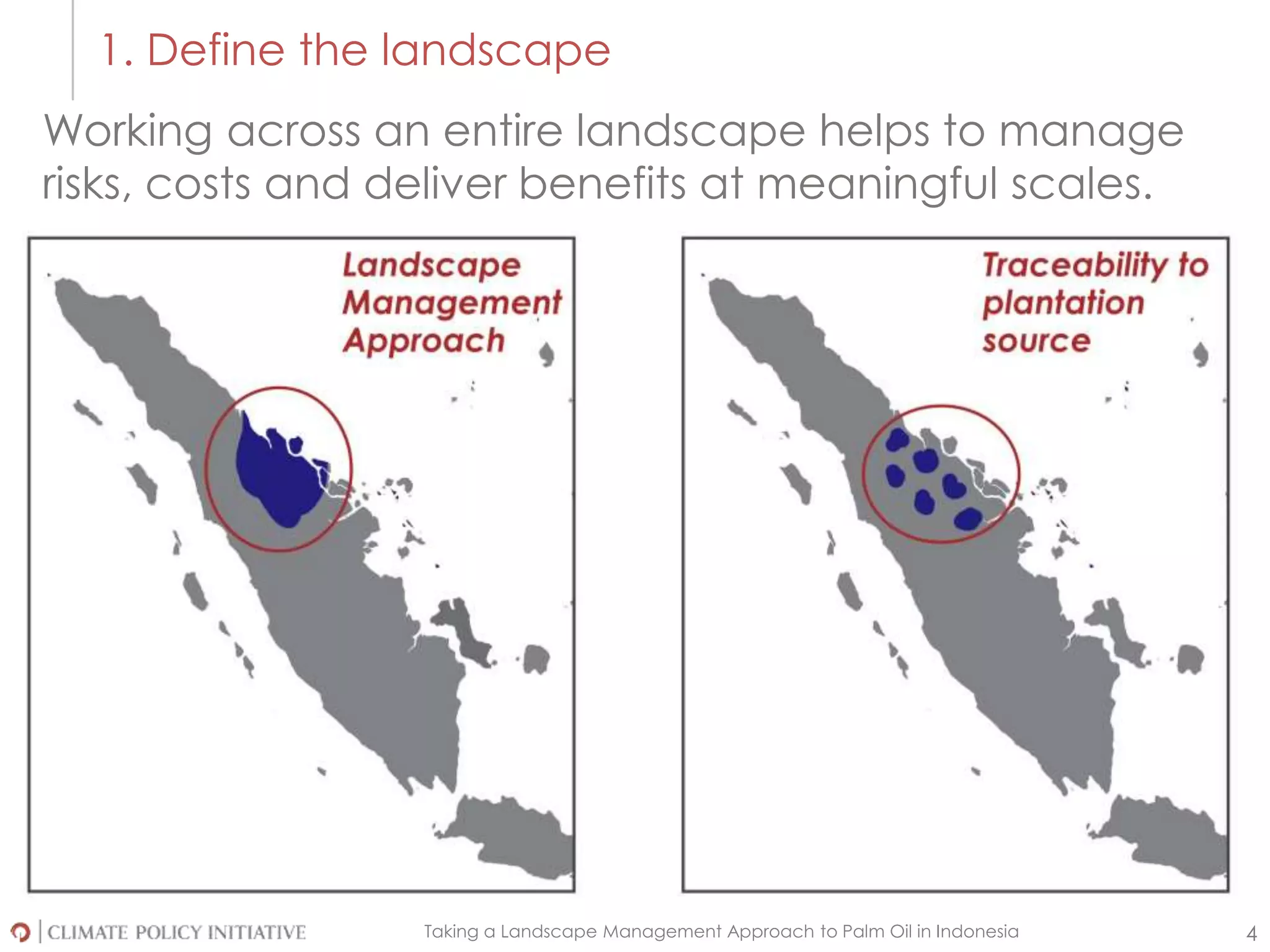
1. Define the landscape
Working across an entire landscape helps to manage
risks, costs and deliver benefits at meaningful scales.
Taking a Landscape Management Approach to Palm Oil in Indonesia 5
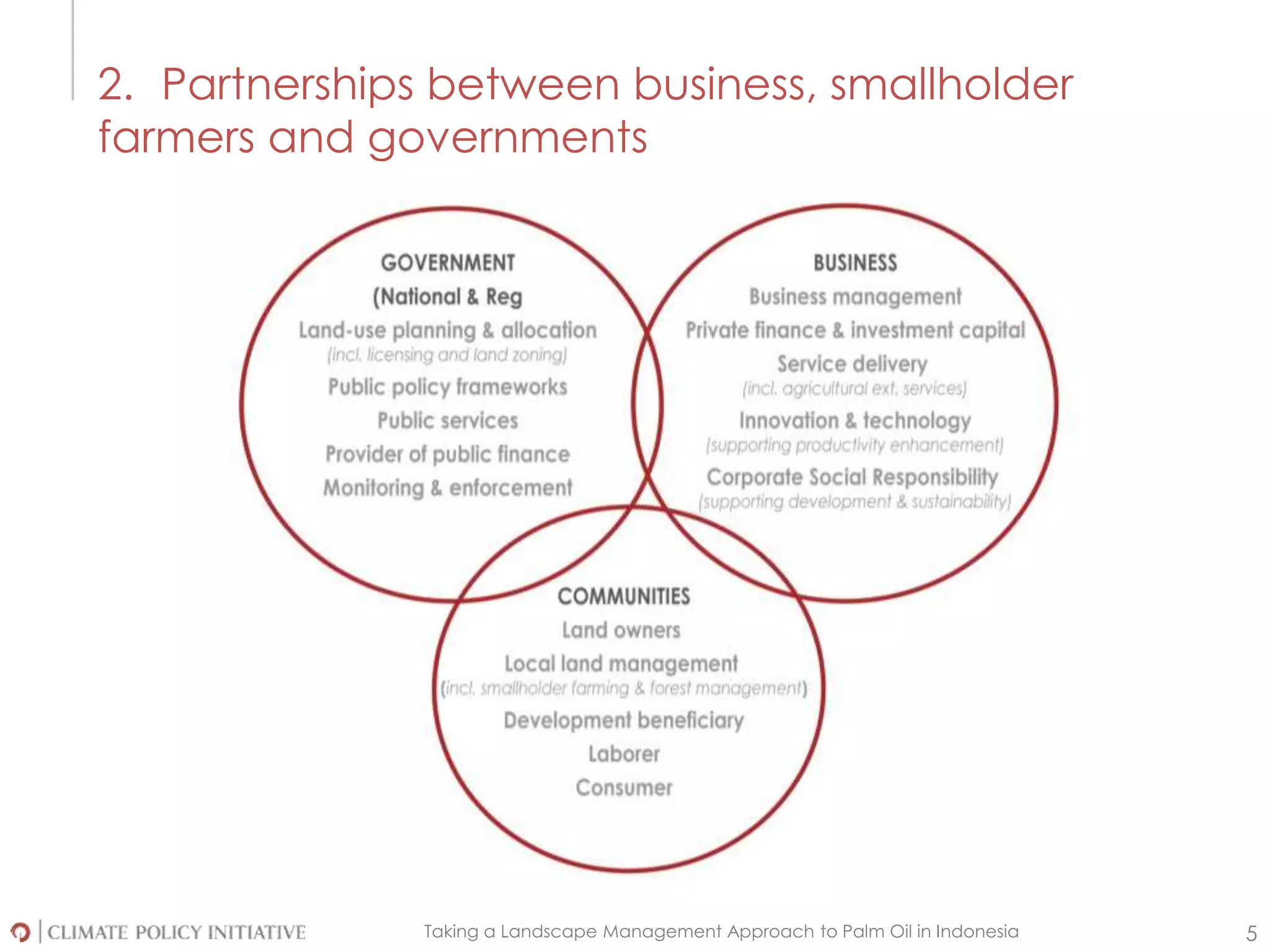
2. Partnerships between business, smallholder
farmers and governments
Taking a Landscape Management Approach to Palm Oil in Indonesia 6
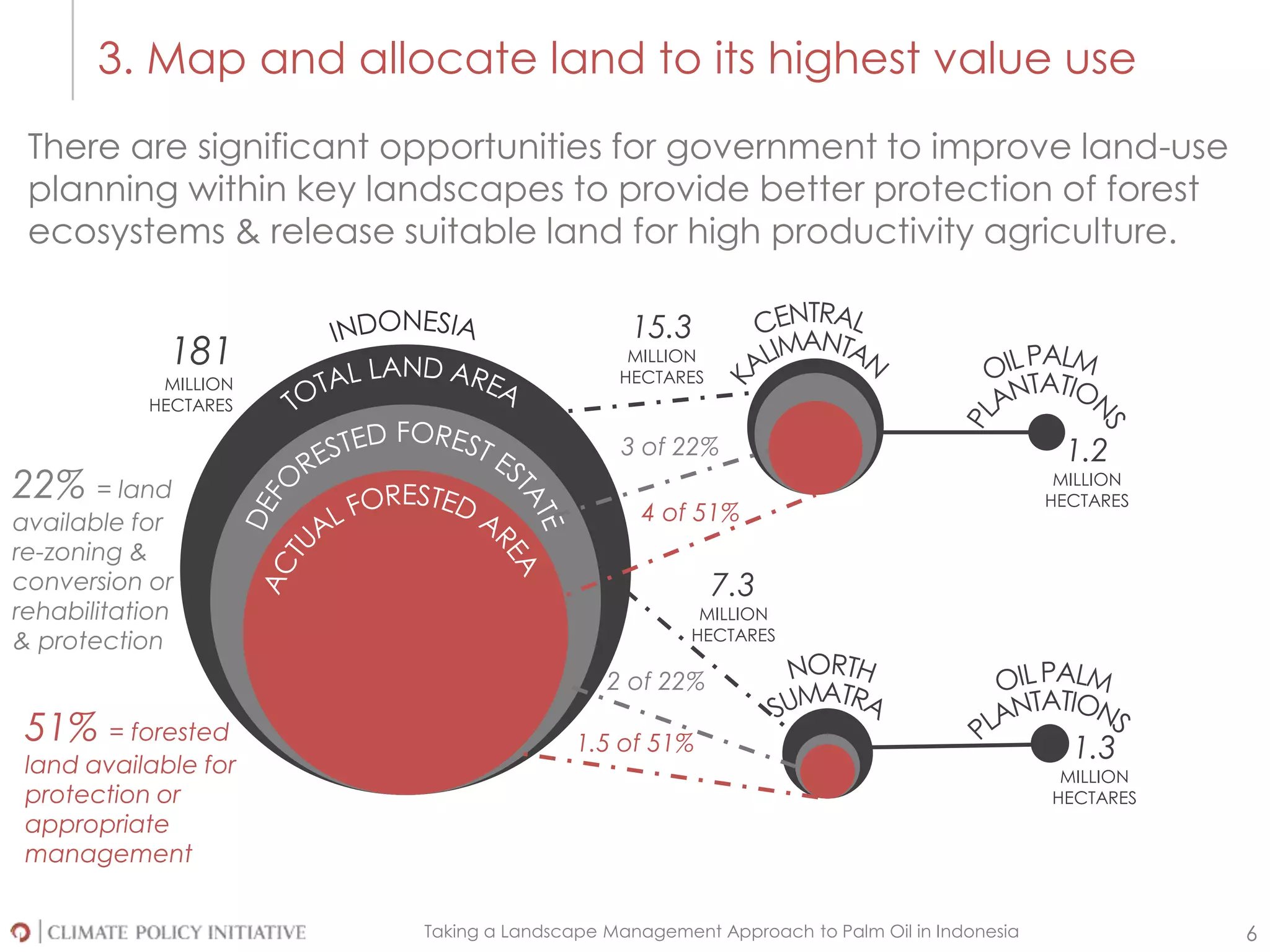
181
MILLION
HECTARES
22% = land
available for
re-zoning &
conversion or
rehabilitation
& protection
51% = forested
land available for
protection or
appropriate
management
3. Map and allocate land to its highest value use
There are significant opportunities for government to improve land-use
planning within key landscapes to provide better protection of forest
ecosystems & release suitable land for high productivity agriculture.
15.3
MILLION
HECTARES
3 of 22%
4 of 51%
1.2
MILLION
HECTARES
7.3
MILLION
HECTARES
2 of 22%
1.5 of 51% 1.3
MILLION
HECTARES
Taking a Landscape Management Approach to Palm Oil in Indonesia 7
• Governments have primary responsibility for
land use planning, zoning and allocation
• Business and smallholder farmers must ensure
new developments are suitably located and
maximize value change efficiency
• Strengthened fiscal frameworks can provide
appropriate incentives for action and are a key
element of the landscape management
approach.
3. Map & allocate land: fiscal policies
determine decisions
Taking a Landscape Management Approach to Palm Oil in Indonesia 8
3. There are opportunities to correct
misaligned fiscal incentives
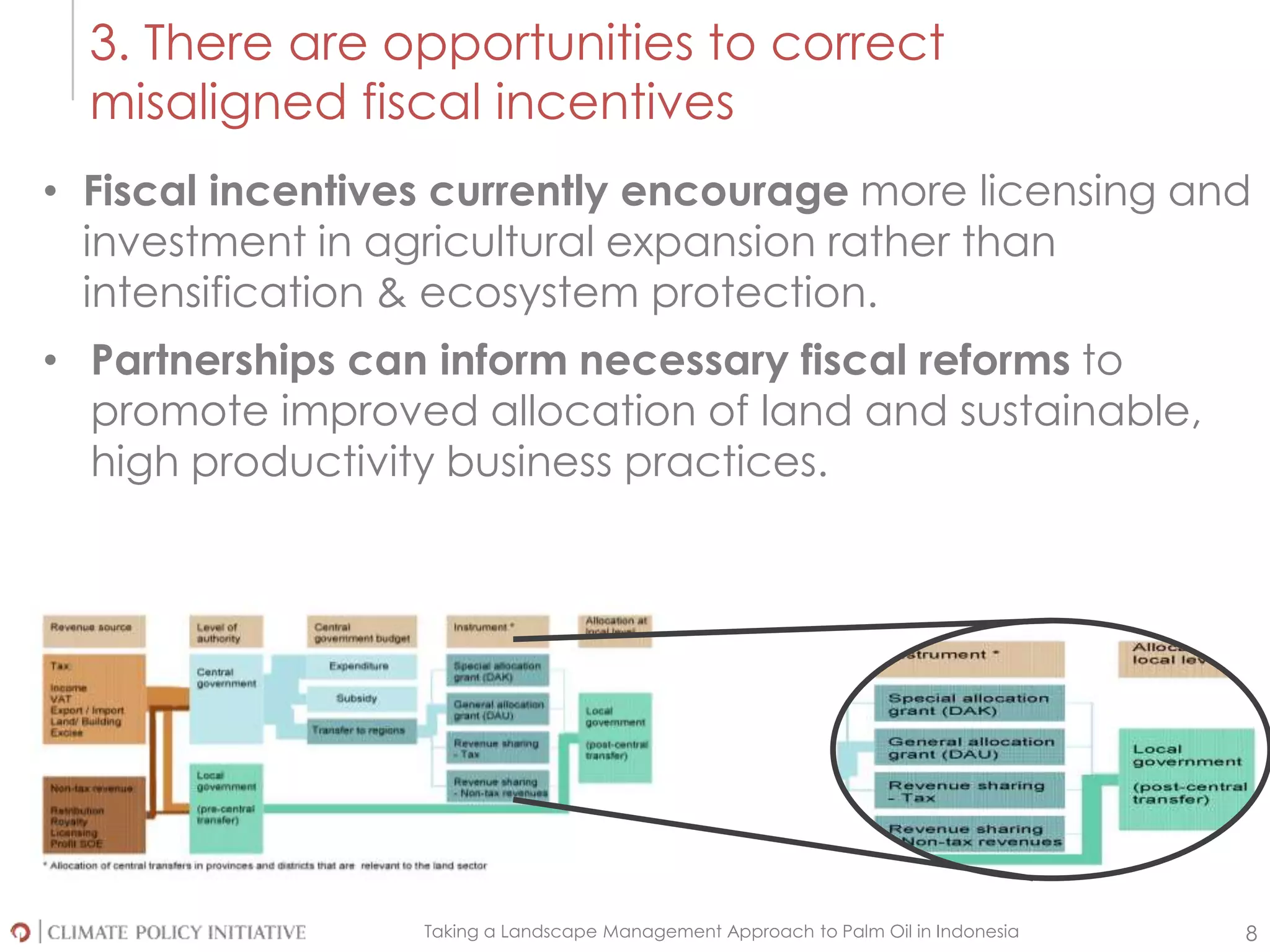
• Fiscal incentives currently encourage more licensing and
investment in agricultural expansion rather than
intensification & ecosystem protection.
• Partnerships can inform necessary fiscal reforms to
promote improved allocation of land and sustainable,
high productivity business practices.
Taking a Landscape Management Approach to Palm Oil in Indonesia 9
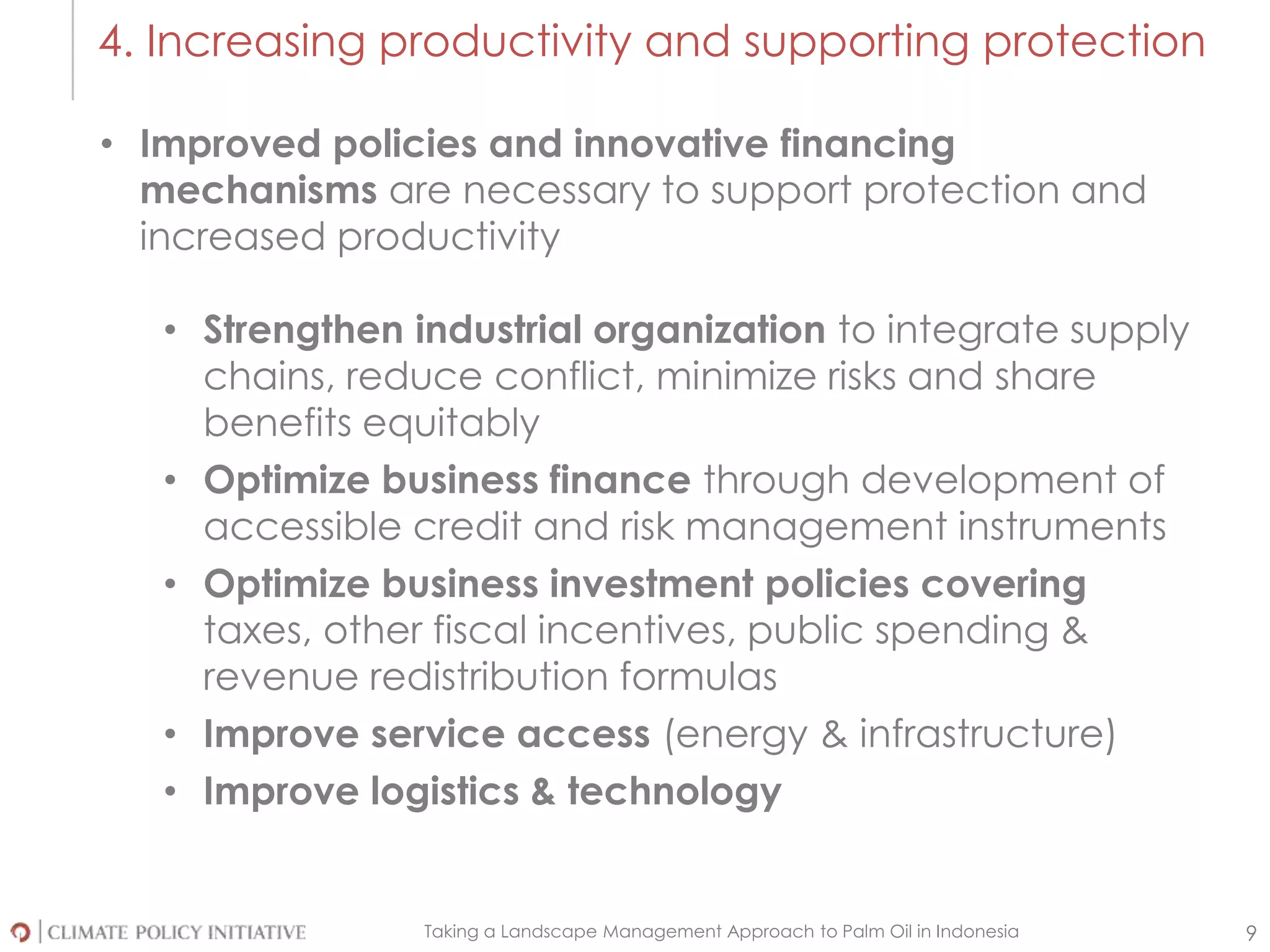
4. Increasing productivity and supporting protection
• Improved policies and innovative financing
mechanisms are necessary to support protection and
increased productivity
• Strengthen industrial organization to integrate supply
chains, reduce conflict, minimize risks and share
benefits equitably
• Optimize business finance through development of
accessible credit and risk management instruments
• Optimize business investment policies covering
taxes, other fiscal incentives, public spending &
revenue redistribution formulas
• Improve service access (energy & infrastructure)
• Improve logistics & technology
Taking a Landscape Management Approach to Palm Oil in Indonesia 10
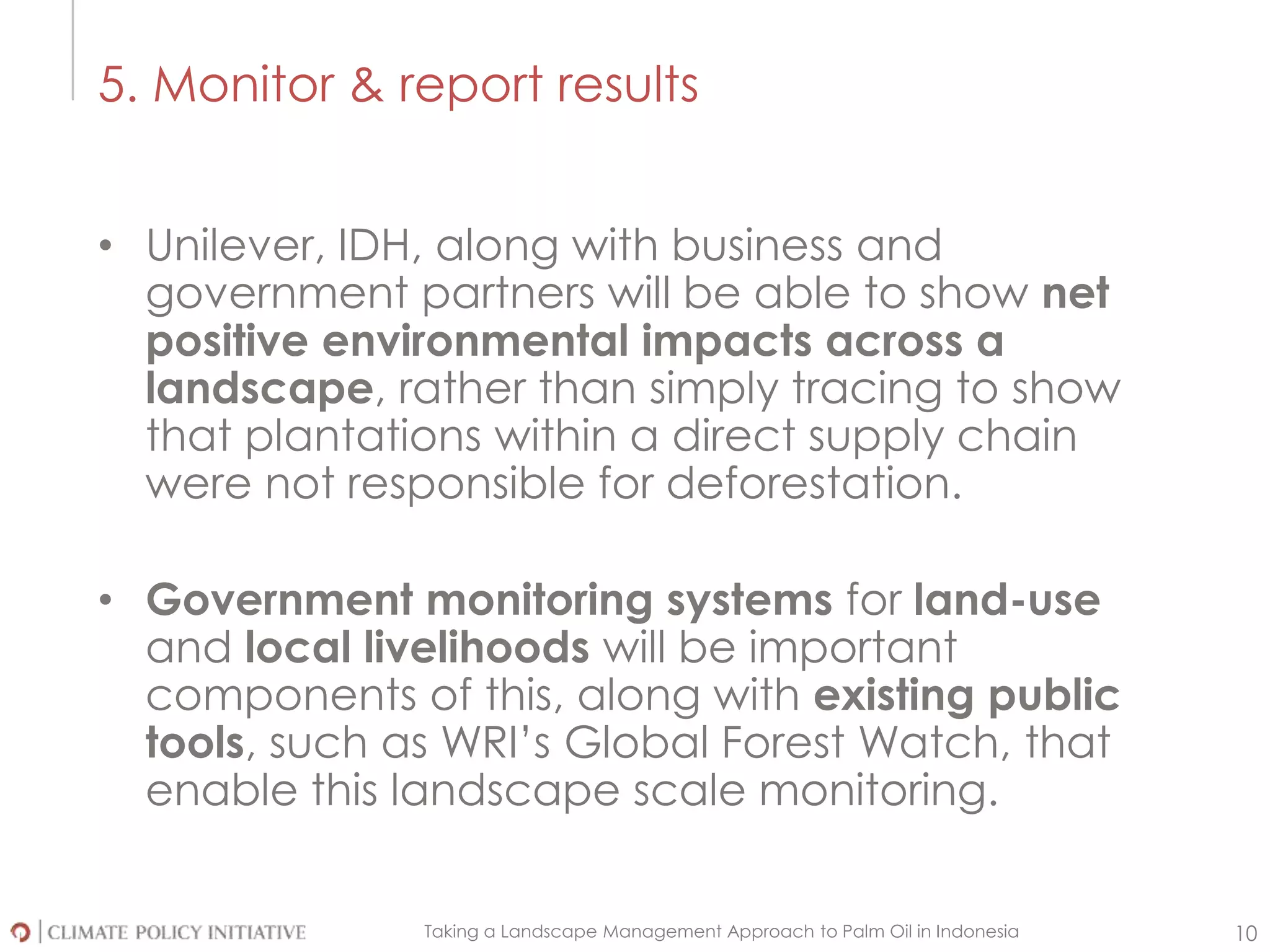
5. Monitor & report results
• Unilever, IDH, along with business and
government partners will be able to show net
positive environmental impacts across a
landscape, rather than simply tracing to show
that plantations within a direct supply chain
were not responsible for deforestation.
• Government monitoring systems for land-use
and local livelihoods will be important
components of this, along with existing public
tools, such as WRI’s Global Forest Watch, that
enable this landscape scale monitoring.
Taking a Landscape Management Approach to Palm Oil in Indonesia 11
Thank you
For more information see the report:
‘Achieving a high-productivity, sustainable palm oil
sector in Indonesia: a landscape management
approach’
www.climatepolicyinitiative.org
Taking a Landscape Management Approach to Palm Oil in Indonesia 12
Back-ups
Taking a Landscape Management Approach to Palm Oil in Indonesia 13
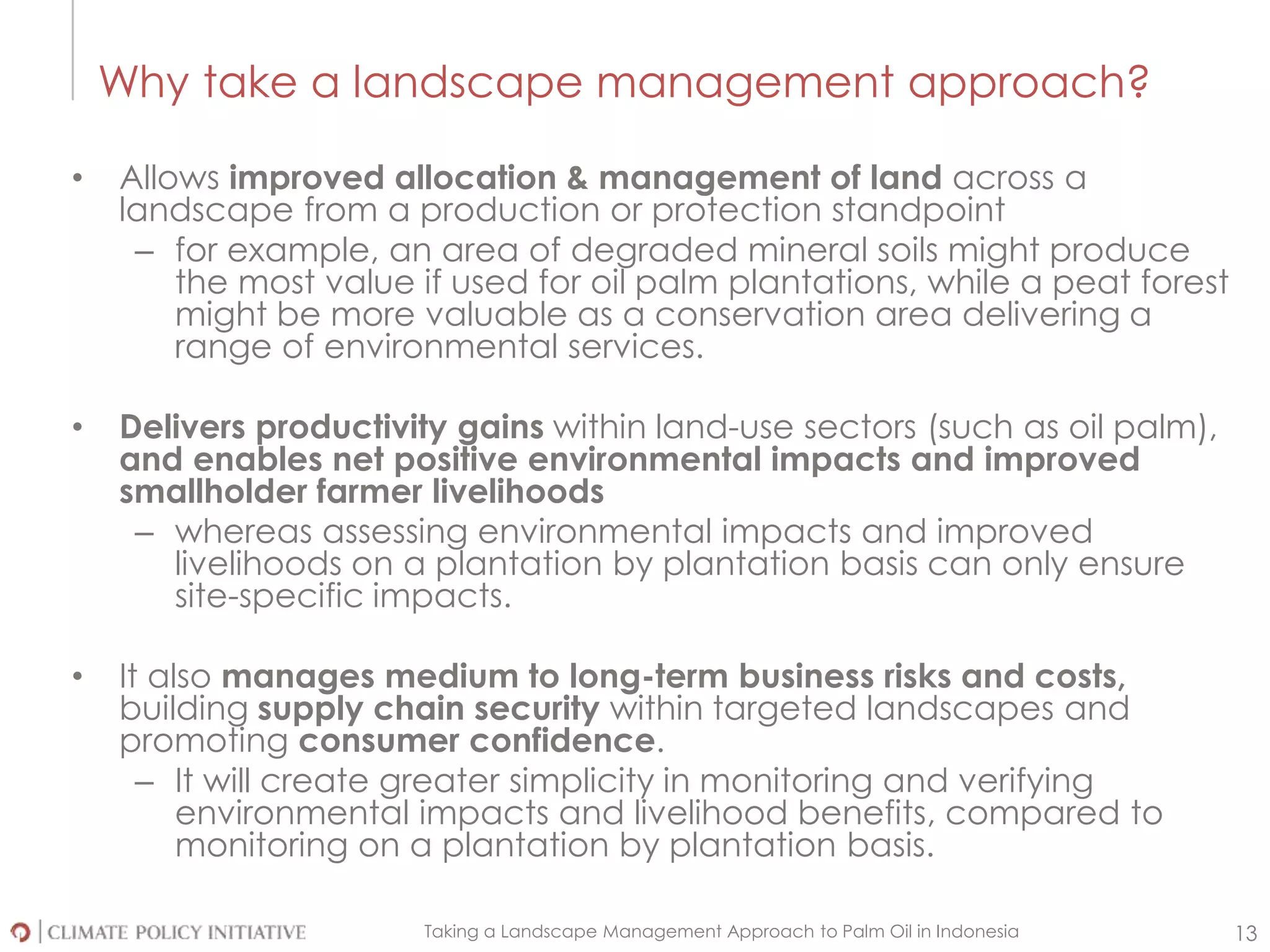
Why take a landscape management approach?
• Allows improved allocation & management of land across a
landscape from a production or protection standpoint
– for example, an area of degraded mineral soils might produce
the most value if used for oil palm plantations, while a peat forest
might be more valuable as a conservation area delivering a
range of environmental services.
• Delivers productivity gains within land-use sectors (such as oil palm),
and enables net positive environmental impacts and improved
smallholder farmer livelihoods
– whereas assessing environmental impacts and improved
livelihoods on a plantation by plantation basis can only ensure
site-specific impacts.
• It also manages medium to long-term business risks and costs,
building supply chain security within targeted landscapes and
promoting consumer confidence.
– It will create greater simplicity in monitoring and verifying
environmental impacts and livelihood benefits, compared to
monitoring on a plantation by plantation basis.
Taking a Landscape Management Approach to Palm Oil in Indonesia 14
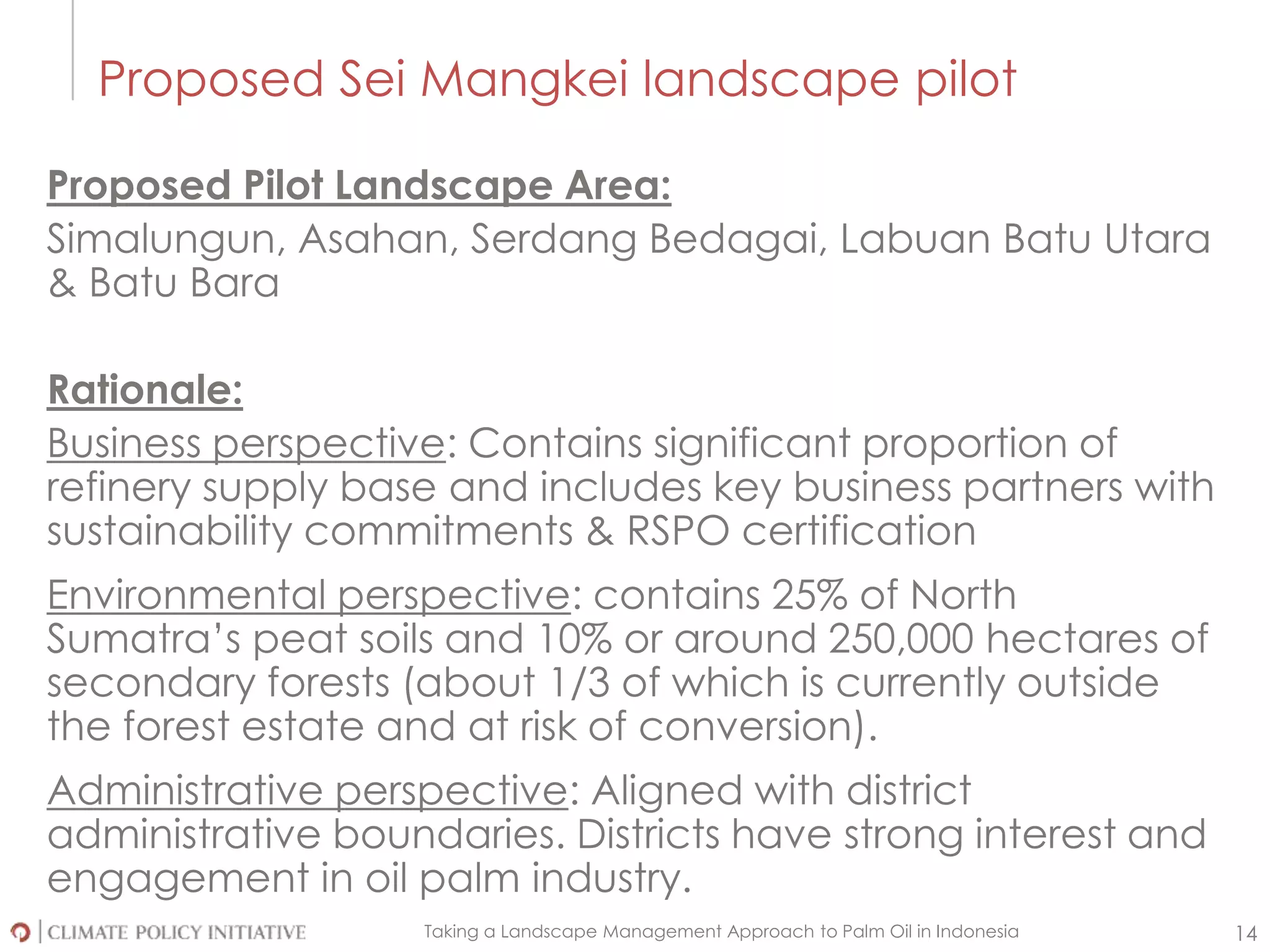
Proposed Sei Mangkei landscape pilot
Proposed Pilot Landscape Area:
Simalungun, Asahan, Serdang Bedagai, Labuan Batu Utara
& Batu Bara
Rationale:
Business perspective: Contains significant proportion of
refinery supply base and includes key business partners with
sustainability commitments & RSPO certification
Environmental perspective: contains 25% of North
Sumatra’s peat soils and 10% or around 250,000 hectares of
secondary forests (about 1/3 of which is currently outside
the forest estate and at risk of conversion).
Administrative perspective: Aligned with district
administrative boundaries. Districts have strong interest and
engagement in oil palm industry.
Taking a Landscape Management Approach to Palm Oil in Indonesia 15
4. Increasing productivity for smallholder farmers in
Sei Mangkei landscape
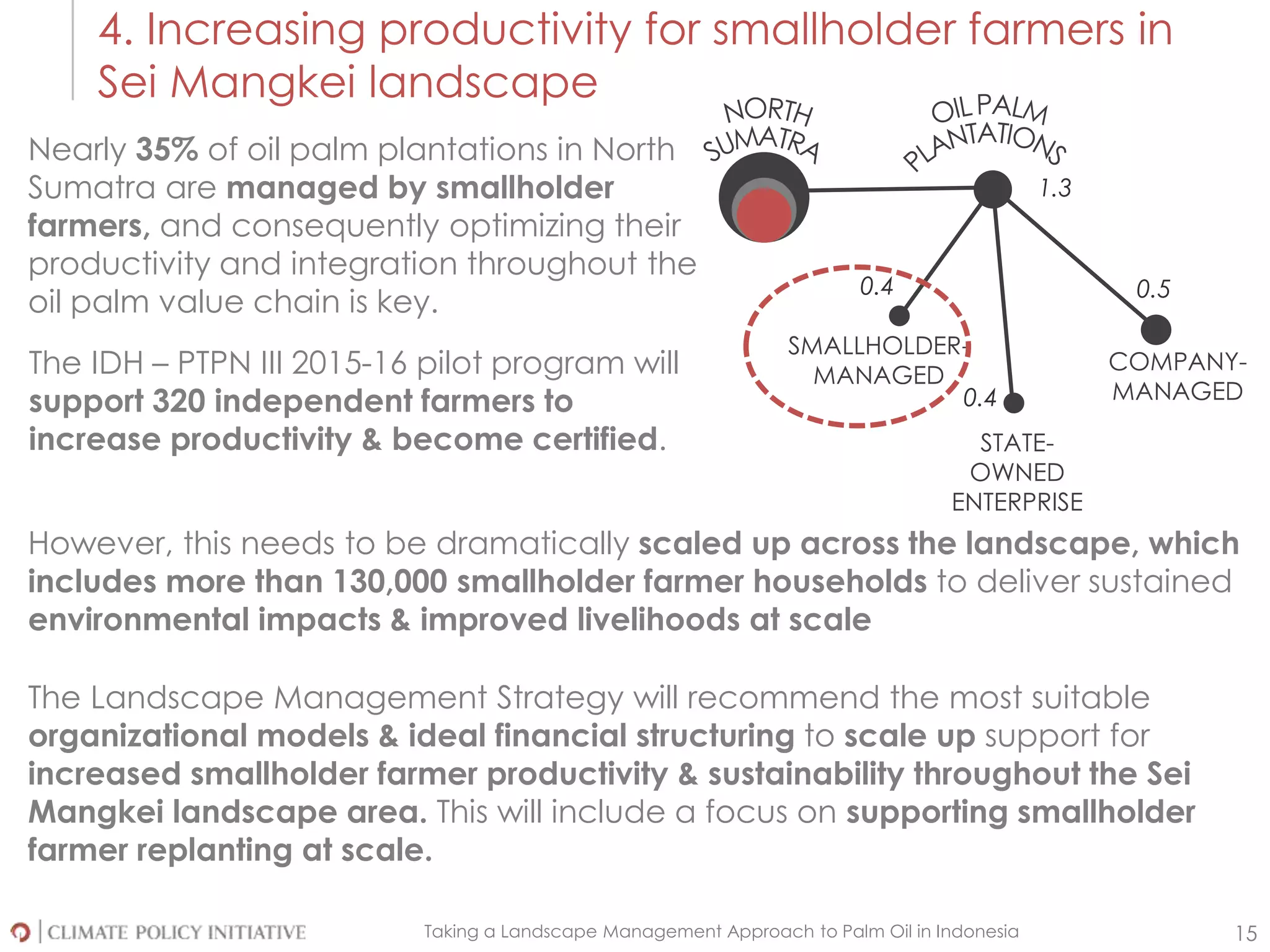
SMALLHOLDER-
MANAGED
1.3
0.4
STATE-
OWNED
ENTERPRISE
0.4
COMPANY-
MANAGED
0.5
Nearly 35% of oil palm plantations in North
Sumatra are managed by smallholder
farmers, and consequently optimizing their
productivity and integration throughout the
oil palm value chain is key.
The IDH – PTPN III 2015-16 pilot program will
support 320 independent farmers to
increase productivity & become certified.
However, this needs to be dramatically scaled up across the landscape, which
includes more than 130,000 smallholder farmer households to deliver sustained
environmental impacts & improved livelihoods at scale
The Landscape Management Strategy will recommend the most suitable
organizational models & ideal financial structuring to scale up support for
increased smallholder farmer productivity & sustainability throughout the Sei
Mangkei landscape area. This will include a focus on supporting smallholder
farmer replanting at scale.
Taking a Landscape Management Approach to Palm Oil in Indonesia 16
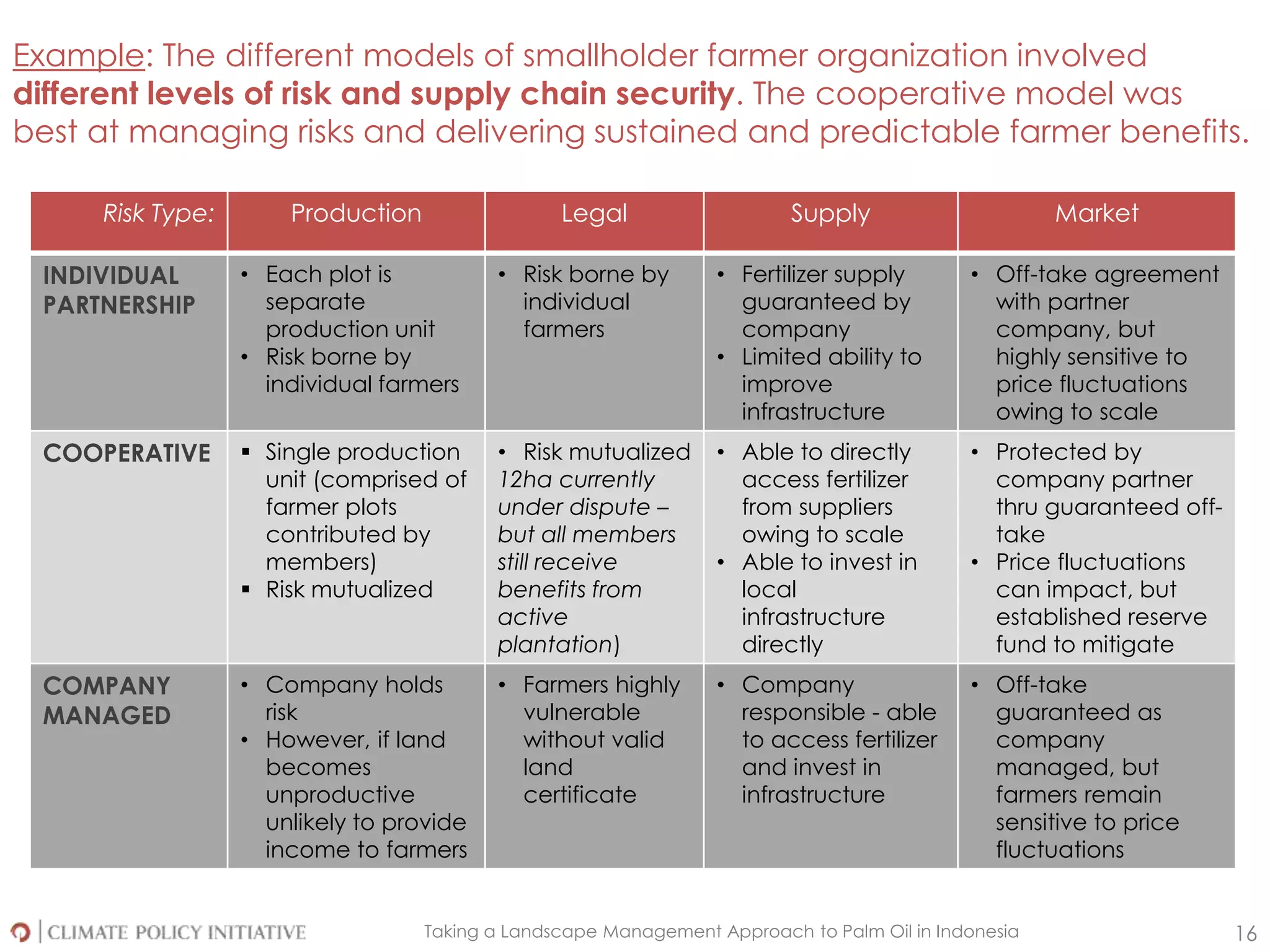
Risk Type: Production Legal Supply Market
INDIVIDUAL
PARTNERSHIP
• Each plot is
separate
production unit
• Risk borne by
individual farmers
• Risk borne by
individual
farmers
• Fertilizer supply
guaranteed by
company
• Limited ability to
improve
infrastructure
• Off-take agreement
with partner
company, but
highly sensitive to
price fluctuations
owing to scale
COOPERATIVE  Single production
unit (comprised of
farmer plots
contributed by
members)
 Risk mutualized
• Risk mutualized
12ha currently
under dispute –
but all members
still receive
benefits from
active
plantation)
• Able to directly
access fertilizer
from suppliers
owing to scale
• Able to invest in
local
infrastructure
directly
• Protected by
company partner
thru guaranteed off-
take
• Price fluctuations
can impact, but
established reserve
fund to mitigate
COMPANY
MANAGED
• Company holds
risk
• However, if land
becomes
unproductive
unlikely to provide
income to farmers
• Farmers highly
vulnerable
without valid
land
certificate
• Company
responsible - able
to access fertilizer
and invest in
infrastructure
• Off-take
guaranteed as
company
managed, but
farmers remain
sensitive to price
fluctuations
Example: The different models of smallholder farmer organization involved
different levels of risk and supply chain security. The cooperative model was
best at managing risks and delivering sustained and predictable farmer benefits.

Sustainable Oil Palm Investments: Benefits of a Landscape Management Approach – CPI, IDH & Unilever

  • 1.
    Taking a LandscapeManagement Approach to Palm Oil in Indonesia 1 BRAZIL CHINA EUROPE INDIA INDONESIA UNITED STATES Sustainable Oil Palm Investments: Benefits of a Landscape Management Approach Global Landscapes Forum London, June 2015
  • 2.
    Taking a LandscapeManagement Approach to Palm Oil in Indonesia 2 Goals & challenges: • Transform the rural economy in Indonesia (and ultimately globally) • Focus on the oil palm value chain, to deliver net positive environmental impacts and improved smallholder farmer livelihoods Challenges... • Achieving the goal at least cost while ensuring supply chain security/integrity, delivering benefits at scale • Sharing costs, risks and benefits among a critical mass of government, business, smallholder farmers and civil society actors
  • 3.
    Taking a LandscapeManagement Approach to Palm Oil in Indonesia 3 A ‘landscape management approach’ : 1. Working within a defined landscape 2. Partnerships between business, smallholder farmers, and governments to deliver outcomes and investment at scale 3. Allocating land within landscape to its highest value or best use 4. Increasing productivity and supporting protection of valuable ecosystems 5. Monitor and report results
  • 4.
    Taking a LandscapeManagement Approach to Palm Oil in Indonesia 4 1. Define the landscape Working across an entire landscape helps to manage risks, costs and deliver benefits at meaningful scales.
  • 5.
    Taking a LandscapeManagement Approach to Palm Oil in Indonesia 5 2. Partnerships between business, smallholder farmers and governments
  • 6.
    Taking a LandscapeManagement Approach to Palm Oil in Indonesia 6 181 MILLION HECTARES 22% = land available for re-zoning & conversion or rehabilitation & protection 51% = forested land available for protection or appropriate management 3. Map and allocate land to its highest value use There are significant opportunities for government to improve land-use planning within key landscapes to provide better protection of forest ecosystems & release suitable land for high productivity agriculture. 15.3 MILLION HECTARES 3 of 22% 4 of 51% 1.2 MILLION HECTARES 7.3 MILLION HECTARES 2 of 22% 1.5 of 51% 1.3 MILLION HECTARES
  • 7.
    Taking a LandscapeManagement Approach to Palm Oil in Indonesia 7 • Governments have primary responsibility for land use planning, zoning and allocation • Business and smallholder farmers must ensure new developments are suitably located and maximize value change efficiency • Strengthened fiscal frameworks can provide appropriate incentives for action and are a key element of the landscape management approach. 3. Map & allocate land: fiscal policies determine decisions
  • 8.
    Taking a LandscapeManagement Approach to Palm Oil in Indonesia 8 3. There are opportunities to correct misaligned fiscal incentives • Fiscal incentives currently encourage more licensing and investment in agricultural expansion rather than intensification & ecosystem protection. • Partnerships can inform necessary fiscal reforms to promote improved allocation of land and sustainable, high productivity business practices.
  • 9.
    Taking a LandscapeManagement Approach to Palm Oil in Indonesia 9 4. Increasing productivity and supporting protection • Improved policies and innovative financing mechanisms are necessary to support protection and increased productivity • Strengthen industrial organization to integrate supply chains, reduce conflict, minimize risks and share benefits equitably • Optimize business finance through development of accessible credit and risk management instruments • Optimize business investment policies covering taxes, other fiscal incentives, public spending & revenue redistribution formulas • Improve service access (energy & infrastructure) • Improve logistics & technology
  • 10.
    Taking a LandscapeManagement Approach to Palm Oil in Indonesia 10 5. Monitor & report results • Unilever, IDH, along with business and government partners will be able to show net positive environmental impacts across a landscape, rather than simply tracing to show that plantations within a direct supply chain were not responsible for deforestation. • Government monitoring systems for land-use and local livelihoods will be important components of this, along with existing public tools, such as WRI’s Global Forest Watch, that enable this landscape scale monitoring.
  • 11.
    Taking a LandscapeManagement Approach to Palm Oil in Indonesia 11 Thank you For more information see the report: ‘Achieving a high-productivity, sustainable palm oil sector in Indonesia: a landscape management approach’ www.climatepolicyinitiative.org
  • 12.
    Taking a LandscapeManagement Approach to Palm Oil in Indonesia 12 Back-ups
  • 13.
    Taking a LandscapeManagement Approach to Palm Oil in Indonesia 13 Why take a landscape management approach? • Allows improved allocation & management of land across a landscape from a production or protection standpoint – for example, an area of degraded mineral soils might produce the most value if used for oil palm plantations, while a peat forest might be more valuable as a conservation area delivering a range of environmental services. • Delivers productivity gains within land-use sectors (such as oil palm), and enables net positive environmental impacts and improved smallholder farmer livelihoods – whereas assessing environmental impacts and improved livelihoods on a plantation by plantation basis can only ensure site-specific impacts. • It also manages medium to long-term business risks and costs, building supply chain security within targeted landscapes and promoting consumer confidence. – It will create greater simplicity in monitoring and verifying environmental impacts and livelihood benefits, compared to monitoring on a plantation by plantation basis.
  • 14.
    Taking a LandscapeManagement Approach to Palm Oil in Indonesia 14 Proposed Sei Mangkei landscape pilot Proposed Pilot Landscape Area: Simalungun, Asahan, Serdang Bedagai, Labuan Batu Utara & Batu Bara Rationale: Business perspective: Contains significant proportion of refinery supply base and includes key business partners with sustainability commitments & RSPO certification Environmental perspective: contains 25% of North Sumatra’s peat soils and 10% or around 250,000 hectares of secondary forests (about 1/3 of which is currently outside the forest estate and at risk of conversion). Administrative perspective: Aligned with district administrative boundaries. Districts have strong interest and engagement in oil palm industry.
  • 15.
    Taking a LandscapeManagement Approach to Palm Oil in Indonesia 15 4. Increasing productivity for smallholder farmers in Sei Mangkei landscape SMALLHOLDER- MANAGED 1.3 0.4 STATE- OWNED ENTERPRISE 0.4 COMPANY- MANAGED 0.5 Nearly 35% of oil palm plantations in North Sumatra are managed by smallholder farmers, and consequently optimizing their productivity and integration throughout the oil palm value chain is key. The IDH – PTPN III 2015-16 pilot program will support 320 independent farmers to increase productivity & become certified. However, this needs to be dramatically scaled up across the landscape, which includes more than 130,000 smallholder farmer households to deliver sustained environmental impacts & improved livelihoods at scale The Landscape Management Strategy will recommend the most suitable organizational models & ideal financial structuring to scale up support for increased smallholder farmer productivity & sustainability throughout the Sei Mangkei landscape area. This will include a focus on supporting smallholder farmer replanting at scale.
  • 16.
    Taking a LandscapeManagement Approach to Palm Oil in Indonesia 16 Risk Type: Production Legal Supply Market INDIVIDUAL PARTNERSHIP • Each plot is separate production unit • Risk borne by individual farmers • Risk borne by individual farmers • Fertilizer supply guaranteed by company • Limited ability to improve infrastructure • Off-take agreement with partner company, but highly sensitive to price fluctuations owing to scale COOPERATIVE  Single production unit (comprised of farmer plots contributed by members)  Risk mutualized • Risk mutualized 12ha currently under dispute – but all members still receive benefits from active plantation) • Able to directly access fertilizer from suppliers owing to scale • Able to invest in local infrastructure directly • Protected by company partner thru guaranteed off- take • Price fluctuations can impact, but established reserve fund to mitigate COMPANY MANAGED • Company holds risk • However, if land becomes unproductive unlikely to provide income to farmers • Farmers highly vulnerable without valid land certificate • Company responsible - able to access fertilizer and invest in infrastructure • Off-take guaranteed as company managed, but farmers remain sensitive to price fluctuations Example: The different models of smallholder farmer organization involved different levels of risk and supply chain security. The cooperative model was best at managing risks and delivering sustained and predictable farmer benefits.

Editor's Notes

  • #3 Corporate commitments to no deforestation so far rely upon tracing supply to points of origin to provide evidence that companies did not directly contribute to deforestation in their supply chain…
  • #4  Defining the landscape boundaries will require some trade offs and context specific decisions. In determining the relative importance of the business investment, environmental and governance perspectives in the given context, the primary goal should be facilitating the greatest proportion of net positive environmental impacts & improved smallholder farmer livelihoods, with minimal impact on business investment costs.
  • #5  A landscape management approach goes beyond traceability, which can only manage environmental and livelihood benefits in a patchwork of dispersed sites or plantations. It involves partnerships to manage agricultural production and protection across a larger scale landscape, which enables more systematic allocation of land for production and protection purposes, and monitoring of net environmental impact and smallholder farmer livelihood benefits across an entire landscape area.
  • #6 Dynamic partnerships identify and reduce risks & share the costs of transformation Each actor has a necessary and unique role Partnerships offer the greatest benefits from a business investment, environmental and farmer livelihood perspective
  • #7 Note for Jeff and Hannah – I will spend 20 seconds on this slide
  • #9 For example, while land-use contributes 40% of Central Kalimantan’s GDP, local government only receives marginal revenues & benefits outside of licensing fees. And for business, the bulk of taxes and fiscal incentives related to oil palm are not linked to productivity, let alone encouraging sustainable practices.
  • #10 Taking the case of small holders: Nearly 35% of oil palm plantations in North Sumatra are managed by smallholder farmers, and consequently optimizing their productivity and integration throughout the oil palm value chain is key. The question is HOW. In Central Kalimantan, analysis by CPI and our local partner, PILAR, has shown that there are at least four organizational models of smallholder farming. These deliver different levels of livelihood benefits and have different degrees of integration into the value chain and different levels of risk and supply chain security. The cooperative model was best at managing risks and delivering sustained and predictable farmer benefits. Scale of the organizational model, along with operating costs & yield, all had significant impacts on farmer profits. In the case of the Unilever IDH CPI partnership, the landscape management approach aims to identify most suitable organizational models & ideal financial structuring to scale up support for increased smallholder farmer productivity & sustainability throughout the Sei Mangkei landscape area. This will include a focus on supporting smallholder farmer replanting at scale. In Sei Mangkei taking a landscape approach will involve some new business costs, as well as cost saving opportunities. For example, protection of high value landscapes needs to be financed, as well as improved integration, productivity and replanting of smallholder farmer plantations. Conversely, a landscape approach will reduce the need to purchase offsets to demonstrate sustainability. These costs and benefits involve a mixture of public and private goods and services, and hence appropriate cost and benefits sharing arrangements and mechanisms need to be developed. The landscape management strategy will recommend how costs, risks, and benefits can be shared by public and private actors throughout the value chain.
  • #11 Taking a landscape approach will ultimately simplify the monitoring and reporting of results.