International Journal of Engineering and Technical Research (IJETR)
ISSN: 2321-0869, Volume-2, Issue-12, December 2014
192 www.erpublication.org

Abstract— Examination process is an important activity for
educational institutions to assess student performance. Thus the
nature of the exam questions would determine the quality of the
students produced by the institutions. Preparing the exam
questions is very challenging, tedious and time consuming for
the instructors. Thus with the help of this paper we present the
solution in form of Automatic Question Paper Generator System
(QGS) which makes use of shuffling algorithm as a
randomization technique. This system includes several modules
like user administration, subject selection, difficulty level
specification, question entry, question management, paper
generation, and paper management. The design process
performs the scrutiny and composes the examination paper
using an efficient algorithm with a high rate of success. With this
algorithm, the user needs to specify the subject, the question
type and the difficulty level. From the entered input, the
examination paper will be generated automatically. The editing
of questions is performed using Word processor and the final
paper may be stored as ``.doc'' files. The system shows
characteristics like simple operation, a great interface, good
usability, immense security, and high stability along with
reliability.
Index Terms—Automation, Question Paper Generation,
Randomization, Shuffling.
I. INTRODUCTION
With the onset of computer based technology there have been
evolutionary changes in many areas of our professional
environments. Most strangely e-education and e-learning is
highly influenced. There is a shift from manual to automated
systems for different aspects of education system. At every
stage/level of education some admission procedure is present.
The fundamental to this admission procedure is a test paper.
However the main problem is, a low quality of papers
generated because of some human factors such as instability
and relatively narrow scope of topics. Teachers need to invest
a lot of time and energy in composing examination papers.
Manuscript received December 22, 2014.
Kapil G. Naik, B.E Student, Department of Computer Engineering ,
Bharat College of Engineering, Badlapur, Maharashtra, India. Mobile No.
9870594178,
Shreyas P. Sule, B.E Student, Department of Computer Engineering ,
Bharat College of Engineering, Badlapur, Maharashtra, India. Mobile No.
9769961712
Shruti N. Jadhav, B.E Student, Department of Computer Engineering ,
Bharat College of Engineering, Badlapur, Maharashtra, India. Mobile No.
9765944228,
Surya S. Pandey, B.E Student, Department of Computer Engineering ,
Bharat College of Engineering, Badlapur, Maharashtra, India. Mobile No.
9029061771.
Also, the concern remains is how the current technologies
would also help the instructors automatically generate the
different sets of questions from time to time without being
concern about repetition and duplication from the past exam
while the exam bank keeps growing. Making assignment
sheets, daily practice tests, weekly tests, test series, online
tests, etc. is a repetitive and time consuming task which
involves both teacher as well as computer operator. Using this
software the same action can be accomplished in minutes and
even in absence of operators. The finest part of the software is
that it takes intelligent decisions to eliminate repeated
questions and checks even for the alternatives. Not only this,
for formation of a question paper it is also possible to restrict
the search to questions which have not been used at all or have
been used less than specified number of times. This makes it
greatly advantageous as the headache of manually avoiding
repetition at the time of feeding is totally eradicated. These
automated systems provide cost saving and time-efficient
solutions.
II. PROPOSED MODEL
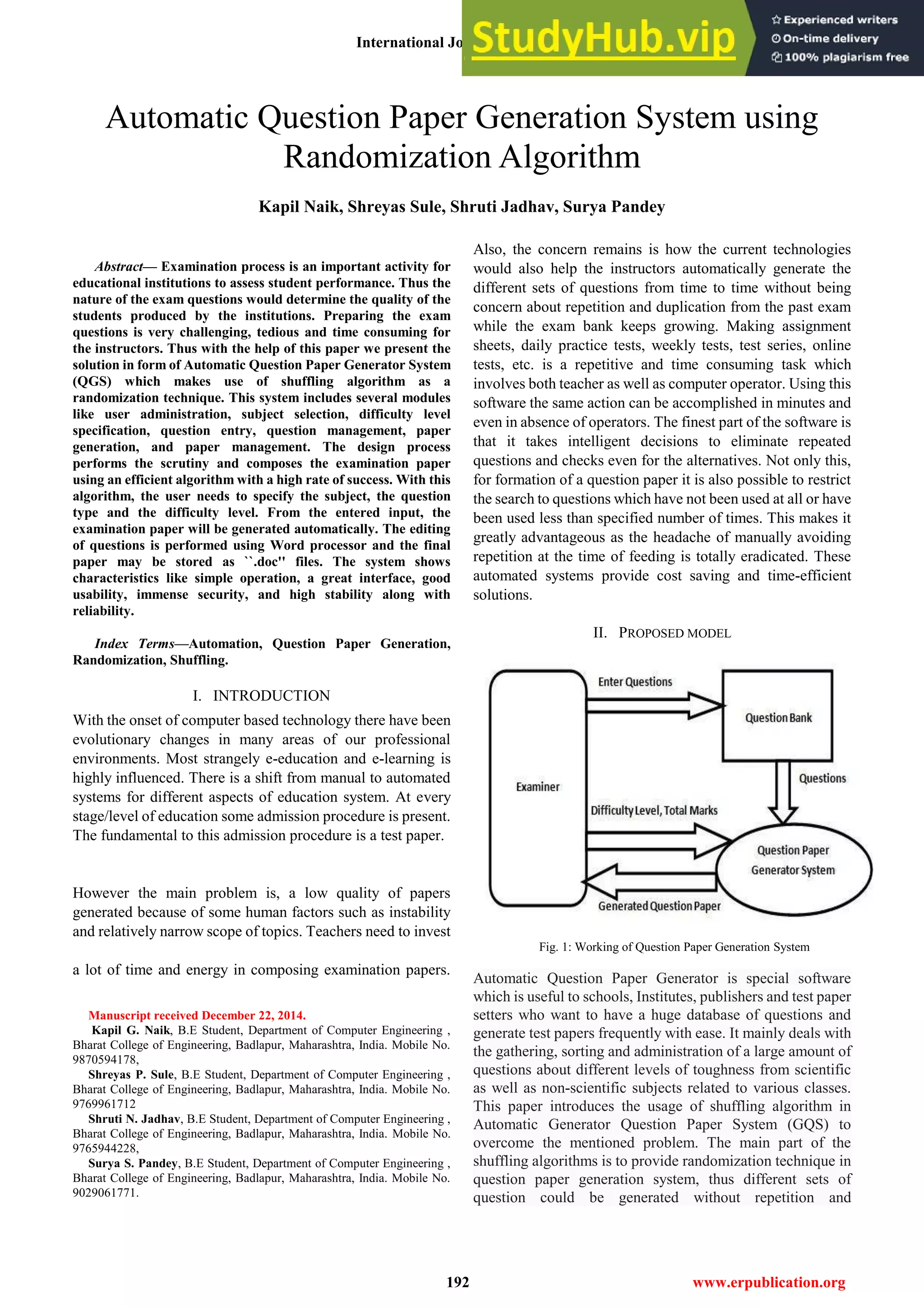
Fig. 1: Working of Question Paper Generation System
Automatic Question Paper Generator is special software
which is useful to schools, Institutes, publishers and test paper
setters who want to have a huge database of questions and
generate test papers frequently with ease. It mainly deals with
the gathering, sorting and administration of a large amount of
questions about different levels of toughness from scientific
as well as non-scientific subjects related to various classes.
This paper introduces the usage of shuffling algorithm in
Automatic Generator Question Paper System (GQS) to
overcome the mentioned problem. The main part of the
shuffling algorithms is to provide randomization technique in
question paper generation system, thus different sets of
question could be generated without repetition and
Automatic Question Paper Generation System using
Randomization Algorithm
Kapil Naik, Shreyas Sule, Shruti Jadhav, Surya Pandey
Automatic Question Paper Generation System using Randomization Algorithm
193 www.erpublication.org
duplication. Fig. 1 displays the general block diagram of
Automatic Question Paper Generator System.
Fig. 2 shown below describes the different modules included
in QGS.
Fig. 2: Modules in Question Paper Generation System
III. SHUFFLING ALGORITHM
Shuffling algorithms is a suitable and very effective way to
implement for randomization of stored questions.
This algorithm checks for duplication and repetition of the
randomly generated questions. The nature of this algorithm is
as followed, for a set of N (the total number of question in the
database) elements for generating a random alteration of the
numbers 1–N, the algorithm goes as follows:
Step 1: Create an array of N locations.
Step 2: Generate random number.
Step 3:if(loc==0)
store generated number.
else
compare the generated number with previous
number in array.
if matching value found, go to step 2;
else
store the no in next location.
Step 4: Repeat step 2 for N numbers.
Step 5: Select questions from DB matching with values from
array location one by one.
ex: select * from question bank where question
no=array[n];
IV. CASE STUDY
Step 1: When the application starts the user authentication
takes place.
Step 2: After successful user authentication, the program asks
for number of questions to be included in the test paper.
Step 3: When the number of questions is specified, the user is
asked for mentioning the particular subject and topics to be
referred from previously stored question banks.
Step 4: Finally the user needs to select the difficulty level for
generating the test paper.
Step 4: After specifying the difficulty level, the user has to
click on the “Generate Paper” which results into successful
generation of question paper using randomization by means
of shuffling algorithm.
Consider an example, where we have entered the number of
questions that will appear in test paper to be 5. The examiner
then selects the subject and topics. The program then asks for
the percentage of difficulty level for test paper. Let’s assume
that the user enters value a value 60.
Finally after computing the questions based on given input
parameters, the user will be returned with an appropriate test
paper as displayed in the figure below.
Fig. 3: Sample Output generated using QGS
V. FEATURES AND BENEFITS
A. Features
1. Simply copy and paste your questions in given editor
in any language, as question bank generator software
is provided with different language support.
2. Prepare Question Paper in 25 Seconds in Easy Steps
which covers all the topics from different subjects.
3. Question Type can be Single option, Multiple Option,
Comprehension type question, MCQs, Short
questions, OSCE questions and station material.
4. Questions that integrate rich text, scientific diagrams,
mathematical/chemical formula and pictures can
also be included.
5. Formatting can be done for the generated Questions.
B. Benefits
The QGS brings various advantages to user when compared
to the traditional manual system. Listed below are some of the
advantages of the system:
1. Examiners can generate test papers randomly by using
QGS instantly, thus saving a lot of time.
2. QGS can help examiners to generate the question
paper based on the learning outcomes elements.
3. Shuffling Algorithms helps randomization process by
choosing questions in the database thus preventing
duplication and repetition.
International Journal of Engineering and Technical Research (IJETR)
ISSN: 2321-0869, Volume-2, Issue-12, December 2014
194 www.erpublication.org
4. A new question can be added to the bank at any
instance. Different sets of test papers could be
generated without any limitation.
VI. CONCLUSION
A novel prototype of randomization scheme has been
described in this paper. The main purpose of this application
is to describe automatic question paper generator using
shuffling algorithm for randomization. This system is
web-based as well as desktop-based application system with
several features mainly producing unduplicated sets of exam
paper. The result shows the potential proofs of employment of
such algorithm for this type of system. Our future effort is to
employ different types of randomization as well as in addition
to question generation we can enhance the same software by
making provision to produce questions from simple online
text, which can be achieved using natural language processing
algorithms.
ACKNOWLEDGMENT
F. A. Author thanks all the Professors at Bharat College of
Engineering for their unconditional support and
encouragement.
REFERENCES
[1] Yang Yu, Hongyan Wang, Adaptive Online Exam Questions Based on
Systematic Analysis and Design, vol. 4, Wuhan University of
Technology, 2008,p. 30.
[2] F. logics, “Paper Builder. Foundation for Examination Question Paper
generation,” 2009. Available from
http://www.freshlogics.com/paper_generator.php
[3] Nor Shahida bt Mohd Jamail & Abu Bakar Md Sultan, Shuffling
Algorithms for Automatic Generator Question Paper System,Vol. 3, No.
2; May 2010, www.ccsenet.org/cis
[4] Guang Cena, Yuxiao Donga, A implementation of an automatic
examination paper generation system, Mathematical and Computer
Modelling 51 (2010) 1339_1342
[5] Memoona Naz, M. Aslam2 and Ehtesham-ul-haq Dar, Utility Based
Agent for Test Paper Generation, INTERNATIONAL JOURNAL OF
MULTIDISCIPLINARY SCIENCES AND ENGINEERING, VOL. 1,
NO. 1, SEPTEMBER 2010
[6] Wikipedia (2010a).Randomization.
http://en.wikipedia.org/wiki/Randomization
[7] Wikipedia. (2010c).Shuffling algorithm.
http://en.wikipedia.org/wiki/Shuffling_algorithm
[8] Astech (2010).Atlantic Simulation and Training Technologies.
http://www.astech.ie/
Mr. Kapil Naik is pursuing B.E. from Mumbai
University. His field of interest is software engineering. Ph No. 9870594178.
Mr. Shreyas Sule is pursuing B.E. from Mumbai
University. His area of concern is implementation of security mechanism.
Ph. No. 9769961712.
Miss Surya Pandey is a B.E student from Mumbai
University. Her field of interest is database administration. Ph. No.
9029061771
Miss Shruti Jadhav is pursuing B.E. from
Mumbai University. Her area of expertise is analysis of algorithms. Ph. No.
9765944228

Automatic Question Paper Generation Syst

  • 1.
    International Journal ofEngineering and Technical Research (IJETR) ISSN: 2321-0869, Volume-2, Issue-12, December 2014 192 www.erpublication.org  Abstract— Examination process is an important activity for educational institutions to assess student performance. Thus the nature of the exam questions would determine the quality of the students produced by the institutions. Preparing the exam questions is very challenging, tedious and time consuming for the instructors. Thus with the help of this paper we present the solution in form of Automatic Question Paper Generator System (QGS) which makes use of shuffling algorithm as a randomization technique. This system includes several modules like user administration, subject selection, difficulty level specification, question entry, question management, paper generation, and paper management. The design process performs the scrutiny and composes the examination paper using an efficient algorithm with a high rate of success. With this algorithm, the user needs to specify the subject, the question type and the difficulty level. From the entered input, the examination paper will be generated automatically. The editing of questions is performed using Word processor and the final paper may be stored as ``.doc'' files. The system shows characteristics like simple operation, a great interface, good usability, immense security, and high stability along with reliability. Index Terms—Automation, Question Paper Generation, Randomization, Shuffling. I. INTRODUCTION With the onset of computer based technology there have been evolutionary changes in many areas of our professional environments. Most strangely e-education and e-learning is highly influenced. There is a shift from manual to automated systems for different aspects of education system. At every stage/level of education some admission procedure is present. The fundamental to this admission procedure is a test paper. However the main problem is, a low quality of papers generated because of some human factors such as instability and relatively narrow scope of topics. Teachers need to invest a lot of time and energy in composing examination papers. Manuscript received December 22, 2014. Kapil G. Naik, B.E Student, Department of Computer Engineering , Bharat College of Engineering, Badlapur, Maharashtra, India. Mobile No. 9870594178, Shreyas P. Sule, B.E Student, Department of Computer Engineering , Bharat College of Engineering, Badlapur, Maharashtra, India. Mobile No. 9769961712 Shruti N. Jadhav, B.E Student, Department of Computer Engineering , Bharat College of Engineering, Badlapur, Maharashtra, India. Mobile No. 9765944228, Surya S. Pandey, B.E Student, Department of Computer Engineering , Bharat College of Engineering, Badlapur, Maharashtra, India. Mobile No. 9029061771. Also, the concern remains is how the current technologies would also help the instructors automatically generate the different sets of questions from time to time without being concern about repetition and duplication from the past exam while the exam bank keeps growing. Making assignment sheets, daily practice tests, weekly tests, test series, online tests, etc. is a repetitive and time consuming task which involves both teacher as well as computer operator. Using this software the same action can be accomplished in minutes and even in absence of operators. The finest part of the software is that it takes intelligent decisions to eliminate repeated questions and checks even for the alternatives. Not only this, for formation of a question paper it is also possible to restrict the search to questions which have not been used at all or have been used less than specified number of times. This makes it greatly advantageous as the headache of manually avoiding repetition at the time of feeding is totally eradicated. These automated systems provide cost saving and time-efficient solutions. II. PROPOSED MODEL Fig. 1: Working of Question Paper Generation System Automatic Question Paper Generator is special software which is useful to schools, Institutes, publishers and test paper setters who want to have a huge database of questions and generate test papers frequently with ease. It mainly deals with the gathering, sorting and administration of a large amount of questions about different levels of toughness from scientific as well as non-scientific subjects related to various classes. This paper introduces the usage of shuffling algorithm in Automatic Generator Question Paper System (GQS) to overcome the mentioned problem. The main part of the shuffling algorithms is to provide randomization technique in question paper generation system, thus different sets of question could be generated without repetition and Automatic Question Paper Generation System using Randomization Algorithm Kapil Naik, Shreyas Sule, Shruti Jadhav, Surya Pandey
  • 2.
    Automatic Question PaperGeneration System using Randomization Algorithm 193 www.erpublication.org duplication. Fig. 1 displays the general block diagram of Automatic Question Paper Generator System. Fig. 2 shown below describes the different modules included in QGS. Fig. 2: Modules in Question Paper Generation System III. SHUFFLING ALGORITHM Shuffling algorithms is a suitable and very effective way to implement for randomization of stored questions. This algorithm checks for duplication and repetition of the randomly generated questions. The nature of this algorithm is as followed, for a set of N (the total number of question in the database) elements for generating a random alteration of the numbers 1–N, the algorithm goes as follows: Step 1: Create an array of N locations. Step 2: Generate random number. Step 3:if(loc==0) store generated number. else compare the generated number with previous number in array. if matching value found, go to step 2; else store the no in next location. Step 4: Repeat step 2 for N numbers. Step 5: Select questions from DB matching with values from array location one by one. ex: select * from question bank where question no=array[n]; IV. CASE STUDY Step 1: When the application starts the user authentication takes place. Step 2: After successful user authentication, the program asks for number of questions to be included in the test paper. Step 3: When the number of questions is specified, the user is asked for mentioning the particular subject and topics to be referred from previously stored question banks. Step 4: Finally the user needs to select the difficulty level for generating the test paper. Step 4: After specifying the difficulty level, the user has to click on the “Generate Paper” which results into successful generation of question paper using randomization by means of shuffling algorithm. Consider an example, where we have entered the number of questions that will appear in test paper to be 5. The examiner then selects the subject and topics. The program then asks for the percentage of difficulty level for test paper. Let’s assume that the user enters value a value 60. Finally after computing the questions based on given input parameters, the user will be returned with an appropriate test paper as displayed in the figure below. Fig. 3: Sample Output generated using QGS V. FEATURES AND BENEFITS A. Features 1. Simply copy and paste your questions in given editor in any language, as question bank generator software is provided with different language support. 2. Prepare Question Paper in 25 Seconds in Easy Steps which covers all the topics from different subjects. 3. Question Type can be Single option, Multiple Option, Comprehension type question, MCQs, Short questions, OSCE questions and station material. 4. Questions that integrate rich text, scientific diagrams, mathematical/chemical formula and pictures can also be included. 5. Formatting can be done for the generated Questions. B. Benefits The QGS brings various advantages to user when compared to the traditional manual system. Listed below are some of the advantages of the system: 1. Examiners can generate test papers randomly by using QGS instantly, thus saving a lot of time. 2. QGS can help examiners to generate the question paper based on the learning outcomes elements. 3. Shuffling Algorithms helps randomization process by choosing questions in the database thus preventing duplication and repetition.
  • 3.
    International Journal ofEngineering and Technical Research (IJETR) ISSN: 2321-0869, Volume-2, Issue-12, December 2014 194 www.erpublication.org 4. A new question can be added to the bank at any instance. Different sets of test papers could be generated without any limitation. VI. CONCLUSION A novel prototype of randomization scheme has been described in this paper. The main purpose of this application is to describe automatic question paper generator using shuffling algorithm for randomization. This system is web-based as well as desktop-based application system with several features mainly producing unduplicated sets of exam paper. The result shows the potential proofs of employment of such algorithm for this type of system. Our future effort is to employ different types of randomization as well as in addition to question generation we can enhance the same software by making provision to produce questions from simple online text, which can be achieved using natural language processing algorithms. ACKNOWLEDGMENT F. A. Author thanks all the Professors at Bharat College of Engineering for their unconditional support and encouragement. REFERENCES [1] Yang Yu, Hongyan Wang, Adaptive Online Exam Questions Based on Systematic Analysis and Design, vol. 4, Wuhan University of Technology, 2008,p. 30. [2] F. logics, “Paper Builder. Foundation for Examination Question Paper generation,” 2009. Available from http://www.freshlogics.com/paper_generator.php [3] Nor Shahida bt Mohd Jamail & Abu Bakar Md Sultan, Shuffling Algorithms for Automatic Generator Question Paper System,Vol. 3, No. 2; May 2010, www.ccsenet.org/cis [4] Guang Cena, Yuxiao Donga, A implementation of an automatic examination paper generation system, Mathematical and Computer Modelling 51 (2010) 1339_1342 [5] Memoona Naz, M. Aslam2 and Ehtesham-ul-haq Dar, Utility Based Agent for Test Paper Generation, INTERNATIONAL JOURNAL OF MULTIDISCIPLINARY SCIENCES AND ENGINEERING, VOL. 1, NO. 1, SEPTEMBER 2010 [6] Wikipedia (2010a).Randomization. http://en.wikipedia.org/wiki/Randomization [7] Wikipedia. (2010c).Shuffling algorithm. http://en.wikipedia.org/wiki/Shuffling_algorithm [8] Astech (2010).Atlantic Simulation and Training Technologies. http://www.astech.ie/ Mr. Kapil Naik is pursuing B.E. from Mumbai University. His field of interest is software engineering. Ph No. 9870594178. Mr. Shreyas Sule is pursuing B.E. from Mumbai University. His area of concern is implementation of security mechanism. Ph. No. 9769961712. Miss Surya Pandey is a B.E student from Mumbai University. Her field of interest is database administration. Ph. No. 9029061771 Miss Shruti Jadhav is pursuing B.E. from Mumbai University. Her area of expertise is analysis of algorithms. Ph. No. 9765944228