
How to Write an Op-Ed Article
Op Ed
Do you have an interesting opinion to share? If you can express it
clearly and persuasively in an op-ed article, you may reach millions of
people, sway hearts, change minds and perhaps even reshape public
policy. In the process, you may also earn recognition for yourself and
your cause.
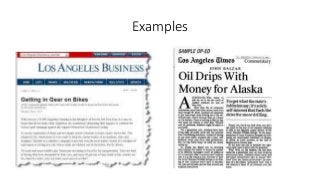
Examples
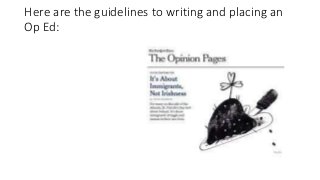
Here are the guidelines to writing and placing an
Op Ed:
Track the news and jump at opportunities
Timing is essential. When an issue is dominating the news — whether
it’s a war, a stock market panic or just the latest controversy on a reality
TV show — that’s what readers want to read and op-ed editors want to
publish. Whenever possible, link your issue explicitly to something
happening in the news. If you’re a researcher studying cancer, for
instance, start off by discussing the celebrity who died yesterday. Or,
look ahead to a holiday or anniversary a week from now that will
provide a fresh news peg (and enable editors to plan the story in
advance).
Limit the article to 750 words
Shorter is even better. Some
academic authors insist they need
more room to explain their
argument. Unfortunately,
newspapers have limited space to
offer, and editors generally won’t
take the time to cut a long article
down to size.
Make a single point — well
You cannot solve all of the world’s
problems in 750 words. Be
satisfied with making a single
point clearly and persuasively. If
you cannot explain your message
in a sentence or two, you’re trying
to cover too much.
Put your main point on top
Don’t wait until the final paragraphs
to reveal your punchline. Op-ed
articles do the opposite.
You have no more than 10 seconds
to hook a busy reader, which means
you shouldn’t “clear your throat”
with a witticism or historical aside.
Just get to the point and convince
the reader that it’s worth his or her
valuable time to continue.
Tell readers why they should care
Put yourself in the place of the
busy person looking at your
article. At the end of every few
paragraphs, ask out loud: “So
what? Who cares?” You need to
answer these questions. Will your
suggestions help reduce readers’
taxes? Protect them from disease?
Make their children happier?
Explain why. Appeals to self-
interest usually are more effective
than abstract punditry.
Offer specific recommendations
An op-ed is not a news story that
simply describes a situation; it is
your opinion about how to improve
matters. Don’t be satisfied, as you
might be in a classroom, with mere
analysis. In an op-ed article you need
to offer recommendations. How
exactly should your state protect its
environment, or the White House
change its foreign policy or parents
choose healthier foods for their
children? You'll need to do more
than call for “more research!” or
suggest that opposing parties work
out their differences.
Showing is better than discussing
You may remember the Pentagon’s
overpriced toilet seat that became a
symbol of profligate federal
spending. You probably don’t recall
the total Pentagon budget for that
year (or for that matter, for the
current year). That’s because we
humans remember colorful details
better than dry facts. When writing
an op-ed article, therefore, look for
great examples that will bring your
argument to life.
Embrace your personal voice
The best of these examples will come from your own experience. Academics
tend to avoid first-person exposition in professional journals, which rarely
begin with phrases like “You won't believe what I found when I was working
in my lab last month.” When it comes to op-eds, however, you should
embrace your own voice whenever possible. If you are a physician, describe
the plight of one of your patients, and then tell us how this made you feel
personally. If you’ve worked with poor families, tell a story about one of
them to help argue your point. In other words, come down from Mt.
Olympus and share details that will reveal your humanity. In so doing, your
words will ring truer and the reader will care more about what you are
saying. If you are a student or someone else without a fancy degree or title,
your personal voice becomes even more important.
Play up your personal connection to the readers
Daily newspapers in many cities are struggling to survive. As they
compete with national publications, television, blogs and others, they
are playing up their local roots and coverage. Op-ed editors at these
papers increasingly prefer authors who live locally or have other local
connections. If you’re submitting an article to your local paper, this will
work in your favor. If you’re submitting it in a city where you once lived
or worked, be sure to mention this in your cover note and byline.
Likewise, if you’re writing for a publication that serves a particular
profession, ethnic group or other cohort, let them know how you
connect personally to their audience.
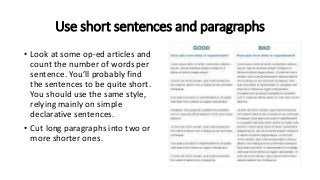
Use short sentences and paragraphs
• Look at some op-ed articles and
count the number of words per
sentence. You’ll probably find
the sentences to be quite short.
You should use the same style,
relying mainly on simple
declarative sentences.
• Cut long paragraphs into two or
more shorter ones.
Avoid jargon
If a technical detail is not essential
to your argument, don’t use it.
When in doubt, leave it out.
Simple language doesn’t mean
simple thinking; it means you are
being considerate of readers who
lack your expertise and are sitting
half-awake at their breakfast table
or computer screen.
Use the active voice
Don't write: “It is hoped that [or:
One would hope that] the
government will …” Instead, say “I
hope the government will …”
Active voice is nearly always
better than passive voice. It’s
easier to read, and it leaves no
doubt about who is doing the
hoping, recommending or other
action.
Avoid tedious rebuttals
If you’ve written your article in
response to an earlier piece that
made your blood boil, avoid the
temptation to prepare a point-by-
point rebuttal. It makes you look
petty. It’s likely that readers didn’t
see the earlier article and, if they
did, they’ve probably forgotten it. So,
just take a deep breath, mention the
earlier article once and argue your
own case. If you really need to rebut
the article, forego an op-ed article
and instead write a letter to the
editor, which is more appropriate for
this purpose.
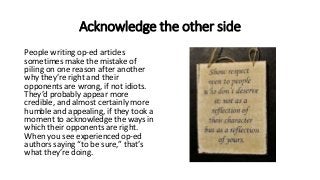
Acknowledge the other side
People writing op-ed articles
sometimes make the mistake of
piling on one reason after another
why they’re right and their
opponents are wrong, if not idiots.
They’d probably appear more
credible, and almost certainly more
humble and appealing, if they took a
moment to acknowledge the ways in
which their opponents are right.
When you see experienced op-ed
authors saying “to be sure,” that’s
what they’re doing.
Make your ending a winner
You need a strong opening
paragraph, or “lead,” to hook
readers. When writing for the op-ed
page, it’s also important to
summarize your argument in a
strong final paragraph. That’s
because many casual readers scan
the headline, skim the opening and
then read the final paragraph and
byline. In fact, one trick many
columnists use is to conclude with a
phrase or thought that appeared in
the opening, thereby closing the
circle.
Relax and have fun
Many authors, particularly
academics, approach an op-ed
article as an exercise in solemnity.
Frankly, they’d improve their chances
if they’d lighten up, have some fun
and entertain the reader a bit.
Newspaper editors despair of
weighty articles — known in the
trade as “thumb suckers” — and
delight in an academic writer who
chooses examples from
“Entertainment Tonight” as well as
from Eminent Authorities.
Don’t worry about the headline
The newspaper will write its own
headline. You can suggest one, but
don’t spend a lot of time worrying
about it.
Offer graphics
Until recently, newspaper op-ed
pages rarely accepted graphics or
photos to accompany op-ed
article submissions. This tradition
is now changing, especially as
publications move online. If you
have a terrific illustration, photo,
video or other asset that might
accompany your article, alert the
editor when you send it.
How to submit an article
Almost all newspapers and
commentary sites now post
guidelines about how they prefer
to receive op-ed submissions. In
general, they provide an e-mail
address where you can submit the
article electronically, but check
first. Always be sure to include
your contact information, and say
whether you have a photo of
yourself available.
Where to submit the article
Here’s a wild guess: You’re hoping to publish your article in The New
York Times, with The Washington Post and The Wall Street Journal as
backups. Well, welcome to the club. These and other national
publications such as USA Today receive a staggering number of
submissions, the overwhelming majority of which are rejected. You
have a better shot at regional newspapers and, especially, at papers
serving your own community. Web sites such as “Slate” and “The
Huffington Post” are also gaining in importance. Regardless of where
you send it, you’ll probably fare best with arguments that are
provocative, humorous, personal or unexpected.
How to write an Op Ed

How to write an Op Ed

  • 1.
    How to Writean Op-Ed Article
  • 2.
    Op Ed Do youhave an interesting opinion to share? If you can express it clearly and persuasively in an op-ed article, you may reach millions of people, sway hearts, change minds and perhaps even reshape public policy. In the process, you may also earn recognition for yourself and your cause.
  • 3.
  • 4.
    Here are theguidelines to writing and placing an Op Ed:
  • 5.
    Track the newsand jump at opportunities Timing is essential. When an issue is dominating the news — whether it’s a war, a stock market panic or just the latest controversy on a reality TV show — that’s what readers want to read and op-ed editors want to publish. Whenever possible, link your issue explicitly to something happening in the news. If you’re a researcher studying cancer, for instance, start off by discussing the celebrity who died yesterday. Or, look ahead to a holiday or anniversary a week from now that will provide a fresh news peg (and enable editors to plan the story in advance).
  • 6.
    Limit the articleto 750 words Shorter is even better. Some academic authors insist they need more room to explain their argument. Unfortunately, newspapers have limited space to offer, and editors generally won’t take the time to cut a long article down to size.
  • 7.
    Make a singlepoint — well You cannot solve all of the world’s problems in 750 words. Be satisfied with making a single point clearly and persuasively. If you cannot explain your message in a sentence or two, you’re trying to cover too much.
  • 8.
    Put your mainpoint on top Don’t wait until the final paragraphs to reveal your punchline. Op-ed articles do the opposite. You have no more than 10 seconds to hook a busy reader, which means you shouldn’t “clear your throat” with a witticism or historical aside. Just get to the point and convince the reader that it’s worth his or her valuable time to continue.
  • 9.
    Tell readers whythey should care Put yourself in the place of the busy person looking at your article. At the end of every few paragraphs, ask out loud: “So what? Who cares?” You need to answer these questions. Will your suggestions help reduce readers’ taxes? Protect them from disease? Make their children happier? Explain why. Appeals to self- interest usually are more effective than abstract punditry.
  • 10.
    Offer specific recommendations Anop-ed is not a news story that simply describes a situation; it is your opinion about how to improve matters. Don’t be satisfied, as you might be in a classroom, with mere analysis. In an op-ed article you need to offer recommendations. How exactly should your state protect its environment, or the White House change its foreign policy or parents choose healthier foods for their children? You'll need to do more than call for “more research!” or suggest that opposing parties work out their differences.
  • 11.
    Showing is betterthan discussing You may remember the Pentagon’s overpriced toilet seat that became a symbol of profligate federal spending. You probably don’t recall the total Pentagon budget for that year (or for that matter, for the current year). That’s because we humans remember colorful details better than dry facts. When writing an op-ed article, therefore, look for great examples that will bring your argument to life.
  • 12.
    Embrace your personalvoice The best of these examples will come from your own experience. Academics tend to avoid first-person exposition in professional journals, which rarely begin with phrases like “You won't believe what I found when I was working in my lab last month.” When it comes to op-eds, however, you should embrace your own voice whenever possible. If you are a physician, describe the plight of one of your patients, and then tell us how this made you feel personally. If you’ve worked with poor families, tell a story about one of them to help argue your point. In other words, come down from Mt. Olympus and share details that will reveal your humanity. In so doing, your words will ring truer and the reader will care more about what you are saying. If you are a student or someone else without a fancy degree or title, your personal voice becomes even more important.
  • 13.
    Play up yourpersonal connection to the readers Daily newspapers in many cities are struggling to survive. As they compete with national publications, television, blogs and others, they are playing up their local roots and coverage. Op-ed editors at these papers increasingly prefer authors who live locally or have other local connections. If you’re submitting an article to your local paper, this will work in your favor. If you’re submitting it in a city where you once lived or worked, be sure to mention this in your cover note and byline. Likewise, if you’re writing for a publication that serves a particular profession, ethnic group or other cohort, let them know how you connect personally to their audience.
  • 14.
    Use short sentencesand paragraphs • Look at some op-ed articles and count the number of words per sentence. You’ll probably find the sentences to be quite short. You should use the same style, relying mainly on simple declarative sentences. • Cut long paragraphs into two or more shorter ones.
  • 15.
    Avoid jargon If atechnical detail is not essential to your argument, don’t use it. When in doubt, leave it out. Simple language doesn’t mean simple thinking; it means you are being considerate of readers who lack your expertise and are sitting half-awake at their breakfast table or computer screen.
  • 16.
    Use the activevoice Don't write: “It is hoped that [or: One would hope that] the government will …” Instead, say “I hope the government will …” Active voice is nearly always better than passive voice. It’s easier to read, and it leaves no doubt about who is doing the hoping, recommending or other action.
  • 17.
    Avoid tedious rebuttals Ifyou’ve written your article in response to an earlier piece that made your blood boil, avoid the temptation to prepare a point-by- point rebuttal. It makes you look petty. It’s likely that readers didn’t see the earlier article and, if they did, they’ve probably forgotten it. So, just take a deep breath, mention the earlier article once and argue your own case. If you really need to rebut the article, forego an op-ed article and instead write a letter to the editor, which is more appropriate for this purpose.
  • 18.
    Acknowledge the otherside People writing op-ed articles sometimes make the mistake of piling on one reason after another why they’re right and their opponents are wrong, if not idiots. They’d probably appear more credible, and almost certainly more humble and appealing, if they took a moment to acknowledge the ways in which their opponents are right. When you see experienced op-ed authors saying “to be sure,” that’s what they’re doing.
  • 19.
    Make your endinga winner You need a strong opening paragraph, or “lead,” to hook readers. When writing for the op-ed page, it’s also important to summarize your argument in a strong final paragraph. That’s because many casual readers scan the headline, skim the opening and then read the final paragraph and byline. In fact, one trick many columnists use is to conclude with a phrase or thought that appeared in the opening, thereby closing the circle.
  • 20.
    Relax and havefun Many authors, particularly academics, approach an op-ed article as an exercise in solemnity. Frankly, they’d improve their chances if they’d lighten up, have some fun and entertain the reader a bit. Newspaper editors despair of weighty articles — known in the trade as “thumb suckers” — and delight in an academic writer who chooses examples from “Entertainment Tonight” as well as from Eminent Authorities.
  • 21.
    Don’t worry aboutthe headline The newspaper will write its own headline. You can suggest one, but don’t spend a lot of time worrying about it.
  • 22.
    Offer graphics Until recently,newspaper op-ed pages rarely accepted graphics or photos to accompany op-ed article submissions. This tradition is now changing, especially as publications move online. If you have a terrific illustration, photo, video or other asset that might accompany your article, alert the editor when you send it.
  • 23.
    How to submitan article Almost all newspapers and commentary sites now post guidelines about how they prefer to receive op-ed submissions. In general, they provide an e-mail address where you can submit the article electronically, but check first. Always be sure to include your contact information, and say whether you have a photo of yourself available.
  • 24.
    Where to submitthe article Here’s a wild guess: You’re hoping to publish your article in The New York Times, with The Washington Post and The Wall Street Journal as backups. Well, welcome to the club. These and other national publications such as USA Today receive a staggering number of submissions, the overwhelming majority of which are rejected. You have a better shot at regional newspapers and, especially, at papers serving your own community. Web sites such as “Slate” and “The Huffington Post” are also gaining in importance. Regardless of where you send it, you’ll probably fare best with arguments that are provocative, humorous, personal or unexpected.