Citing Sources for
Public Speaking
Creative Commons 2016 CC-BY Douglas A. Switzer
Citing Sources for Public Speaking
Personal knowledge and experience
PLUS outside sources will…
1. …increase the credibility of your speech.
2. …improve the accuracy of what you have to say.
3. …increase appearance of competency.
4. …increase your ethos--your “professionalism.”
5. …provide your listeners with sources to seek out.
Citing Sources for Public Speaking
It is HIGHLY UNETHICAL
and potentially ILLEGAL
to use outside sources without any kind of
acknowledgement and/or documentation.
KNOW how to cite sources you use.
Citing Sources for Public Speaking
Properly citing sources in public speaking requires
you to cite in THREE places:
1. …the formal written outline
including in-text AND a separate sources cited section
2. …a presentation aid
i.e., images and statistical information in a PowerPoint or
overhead transparency.
3. …the actual speech
Citing Sources for Public Speaking
1. In the formal written outline.
Why should I properly cite sources in the outline?
A. Helps to track sources when writing/rewriting your
speech.
B. Provides a record of sources for use in updating future
presentations.
C. Creates appearance of competency should listeners
request information AFTER a presentation.
Consult your textbook for an example of citing sources in
an outline.
Citing Sources for Public Speaking
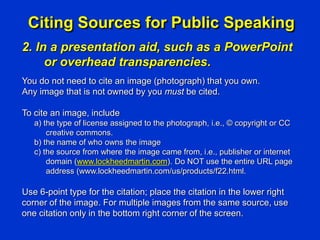
2. In a presentation aid, such as a PowerPoint
or overhead transparencies.
You do not need to cite an image (photograph) that you own.
Any image that is not owned by you must be cited.
To cite an image, include
a) the type of license assigned to the photograph, i.e., © copyright or CC
creative commons.
b) the name of who owns the image
c) the source from where the image came from, i.e., publisher or internet
domain (www.lockheedmartin.com). Do NOT use the entire URL page
address (www.lockheedmartin.com/us/products/f22.html.
Use 6-point type for the citation; place the citation in the lower right
corner of the image. For multiple images from the same source, use
one citation only in the bottom right corner of the screen.
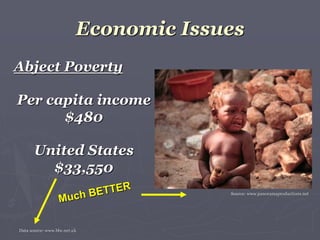
Economic Issues
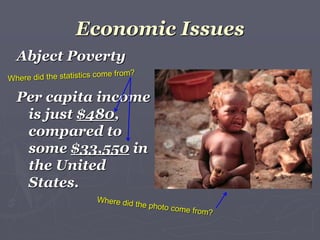
Abject Poverty
Per capita income
is just $480,
compared to
some $33,550 in
the United
States.
Economic Issues
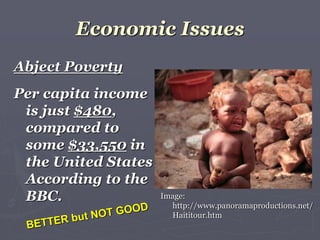
Abject Poverty
Per capita income
is just $480,
compared to
some $33,550 in
the United States
According to the
BBC. Image:
http://www.panoramaproductions.net/
Haititour.htm
Economic Issues
Abject Poverty
Per capita income
$480
United States
$33,550
Source: www.panoramaproductions.net
Data source: www.bbc.net.uk
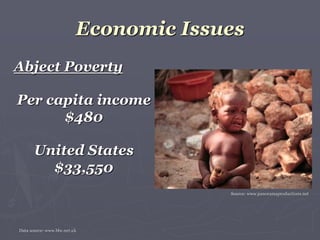
Economic Issues
Abject Poverty
Per capita income
$480
United States
$33,550
Source: www.panoramaproductions.net
Data source: www.bbc.net.uk
Citing Sources for Public Speaking
3. In the actual speech
ALWAYS say your sources ORALLY as you use them
These are called “oral footnotes.”.
Avoid FULL citations, which are already in your outline
Citation may include author, article title, publication date
and/or publication name
State citations conversationally
NEVER do the following…(next slide)
Works Cited
• Campbell, Ray. Personal Interview. October 10, 2003.
• Carney, John. Personal Interview. October 10, 2003.
• Negro League Baseball Players Association. WWW:
http://www.nlbpa.com/walker__moses_fleetwood.html.
2000-2003
• Moses Fleetwood Walker. WWW.
http://www.oberlin.edu/external/EOG/OYTT-
images/MFWalker.html.
• Fleet Walker. WWW:
http://www.baseballlibrary.com/baseballlibrary/ballplayers/
W/Walker_Fleet.stm.
NEVER share a works cited slide to your PowerPoint slide presentation
because:
1. It distracts listeners from the speech you just completed.
2. The sources do not specifically identify in the speech what belongs
to you or what is attributed to your sources.
3. Your listeners will never remember your sources anyhow.
If a listener would like to follow-up on your sources, for example, to
gain direction in their own research, simply show them the sources
cited page on your outline.
Citing Sources for Public Speaking
Always ask any
instructor should you be
confused or have questions
about how to properly cite
sources used in a
public speech.

How to Cite Sources in a Speech

  • 1.
    Citing Sources for PublicSpeaking Creative Commons 2016 CC-BY Douglas A. Switzer
  • 2.
    Citing Sources forPublic Speaking Personal knowledge and experience PLUS outside sources will… 1. …increase the credibility of your speech. 2. …improve the accuracy of what you have to say. 3. …increase appearance of competency. 4. …increase your ethos--your “professionalism.” 5. …provide your listeners with sources to seek out.
  • 3.
    Citing Sources forPublic Speaking It is HIGHLY UNETHICAL and potentially ILLEGAL to use outside sources without any kind of acknowledgement and/or documentation. KNOW how to cite sources you use.
  • 4.
    Citing Sources forPublic Speaking Properly citing sources in public speaking requires you to cite in THREE places: 1. …the formal written outline including in-text AND a separate sources cited section 2. …a presentation aid i.e., images and statistical information in a PowerPoint or overhead transparency. 3. …the actual speech
  • 5.
    Citing Sources forPublic Speaking 1. In the formal written outline. Why should I properly cite sources in the outline? A. Helps to track sources when writing/rewriting your speech. B. Provides a record of sources for use in updating future presentations. C. Creates appearance of competency should listeners request information AFTER a presentation. Consult your textbook for an example of citing sources in an outline.
  • 6.
    Citing Sources forPublic Speaking 2. In a presentation aid, such as a PowerPoint or overhead transparencies. You do not need to cite an image (photograph) that you own. Any image that is not owned by you must be cited. To cite an image, include a) the type of license assigned to the photograph, i.e., © copyright or CC creative commons. b) the name of who owns the image c) the source from where the image came from, i.e., publisher or internet domain (www.lockheedmartin.com). Do NOT use the entire URL page address (www.lockheedmartin.com/us/products/f22.html. Use 6-point type for the citation; place the citation in the lower right corner of the image. For multiple images from the same source, use one citation only in the bottom right corner of the screen.
  • 7.
    Economic Issues Abject Poverty Percapita income is just $480, compared to some $33,550 in the United States.
  • 8.
    Economic Issues Abject Poverty Percapita income is just $480, compared to some $33,550 in the United States According to the BBC. Image: http://www.panoramaproductions.net/ Haititour.htm
  • 9.
    Economic Issues Abject Poverty Percapita income $480 United States $33,550 Source: www.panoramaproductions.net Data source: www.bbc.net.uk
  • 10.
    Economic Issues Abject Poverty Percapita income $480 United States $33,550 Source: www.panoramaproductions.net Data source: www.bbc.net.uk
  • 11.
    Citing Sources forPublic Speaking 3. In the actual speech ALWAYS say your sources ORALLY as you use them These are called “oral footnotes.”. Avoid FULL citations, which are already in your outline Citation may include author, article title, publication date and/or publication name State citations conversationally NEVER do the following…(next slide)
  • 12.
    Works Cited • Campbell,Ray. Personal Interview. October 10, 2003. • Carney, John. Personal Interview. October 10, 2003. • Negro League Baseball Players Association. WWW: http://www.nlbpa.com/walker__moses_fleetwood.html. 2000-2003 • Moses Fleetwood Walker. WWW. http://www.oberlin.edu/external/EOG/OYTT- images/MFWalker.html. • Fleet Walker. WWW: http://www.baseballlibrary.com/baseballlibrary/ballplayers/ W/Walker_Fleet.stm. NEVER share a works cited slide to your PowerPoint slide presentation because: 1. It distracts listeners from the speech you just completed. 2. The sources do not specifically identify in the speech what belongs to you or what is attributed to your sources. 3. Your listeners will never remember your sources anyhow. If a listener would like to follow-up on your sources, for example, to gain direction in their own research, simply show them the sources cited page on your outline.
  • 13.
    Citing Sources forPublic Speaking Always ask any instructor should you be confused or have questions about how to properly cite sources used in a public speech.