Slide 2
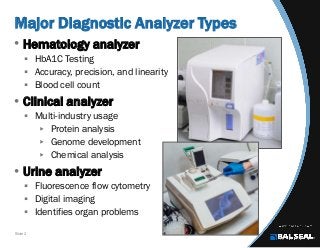
Major Diagnostic Analyzer Types
• Hematology analyzer
 HbA1C Testing
 Accuracy, precision, and linearity
 Blood cell count
• Clinical analyzer
 Multi-industry usage
 Protein analysis
 Genome development
 Chemical analysis
• Urine analyzer
 Fluorescence flow cytometry
 Digital imaging
 Identifies organ problems
Slide 3
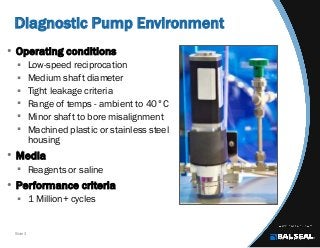
Diagnostic Pump Environment
• Operating conditions
 Low-speed reciprocation
 Medium shaft diameter
 Tight leakage criteria
 Range of temps - ambient to 40°C
 Minor shaft to bore misalignment
 Machined plastic or stainless steel
housing
• Media
 Reagents or saline
• Performance criteria
 1 Million+ cycles
Slide 4
Design Challenges
• Hardware
 Large hardware tolerances create potential leak
paths
 Hardware misalignment creates more wear on one side
of the seal resulting in rapid leakage
 Housing without surface treatment reduces seal
life
 Seals wear rapidly due to poor surface finish
 Lack of rinse portion allows salt crystals to form
behind the high pressure seal
 Damage to dynamic seal lip diminishes seal life
Slide 5
Design Challenges
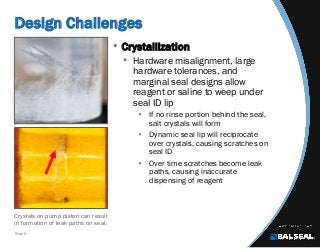
• Crystallization
 Hardware misalignment, large
hardware tolerances, and
marginal seal designs allow
reagent or saline to weep under
seal ID lip
 If no rinse portion behind the seal,
salt crystals will form
 Dynamic seal lip will reciprocate
over crystals, causing scratches on
seal ID
 Over time scratches become leak
paths, causing inaccurate
dispensing of reagent
Crystals on pump piston can result
in formation of leak paths on seal.
Slide 6
Seals: A Critical Element
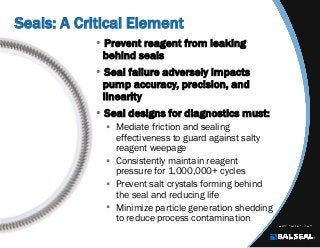
• Prevent reagent from leaking
behind seals
• Seal failure adversely impacts
pump accuracy, precision, and
linearity
• Seal designs for diagnostics must:
 Mediate friction and sealing
effectiveness to guard against salty
reagent weepage
 Consistently maintain reagent
pressure for 1,000,000+ cycles
 Prevent salt crystals forming behind
the seal and reducing life
 Minimize particle generation shedding
to reduce process contamination
Slide 7
Seal Performance Factors
• Housing Hardware
 Tight tolerances of < ±0.001”
 Machined stainless steel with coated or machined plastic
 Minimal clearance between housing & plunger (0.002” max)
 Suggested sealing surface of 9.1 – 14.5 µin Ra
• Piston Hardware
 Smoother surface finish is better
 Suggested dynamic surface is 7.3 - 14.5 µin Ra
 Minimum shaft hardness is 30Rc for un-filled materials.
 Higher surface hardness enhances seal performance
 Sapphire or ceramic have excellent surface finish and high
hardness with minimal porosity
 Stainless steel with hardness treatment and/or polishing
Slide 8
Sealing Performance Factors
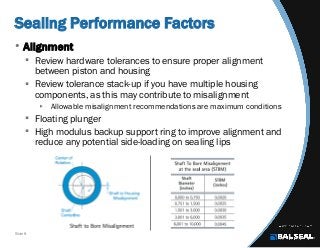
• Alignment
 Review hardware tolerances to ensure proper alignment
between piston and housing
 Review tolerance stack-up if you have multiple housing
components, as this may contribute to misalignment
 Allowable misalignment recommendations are maximum conditions
 Floating plunger
 High modulus backup support ring to improve alignment and
reduce any potential side-loading on sealing lips
Slide 9
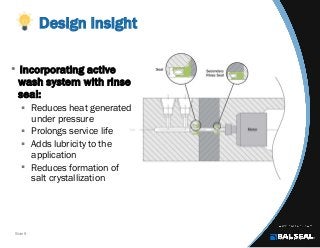
Design Insight
• Incorporating active
wash system with rinse
seal:
 Reduces heat generated
under pressure
 Prolongs service life
 Adds lubricity to the
application
 Reduces formation of
salt crystallization
Slide 10
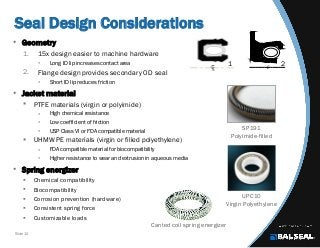
Seal Design Considerations
LC
SP191
Polyimide-filled
UPC10
Virgin Polyethylene
Canted coil spring energizer
1 2
• Geometry
1. 15x design easier to machine hardware
 Long ID lip increases contact area
2. Flange design provides secondary OD seal
 Short ID lip reduces friction
• Jacket material
 PTFE materials (virgin or polyimide)
 High chemical resistance
 Low coefficient of friction
 USP Class VI or FDA compatible material
 UHMW PE materials (virgin or filled polyethylene)
 FDA compatible material for biocompatibility
 Higher resistance to wear and extrusion in aqueous media
• Spring energizer
 Chemical compatibility
 Biocompatibility
 Corrosion prevention (hardware)
 Consistent spring force
 Customizable loads
Slide 11
Optimizing Diagnostic Seal Design
Requirements Solutions
• Low-speed
reciprocation
• Chemical
compatibility
• Low-friction
• FDA compliant
• Biocompatible
• 1,000,000+
cycles
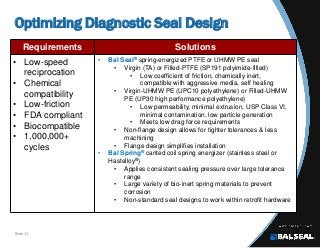
• Bal Seal® spring-energized PTFE or UHMW PE seal
• Virgin (TA) or Filled-PTFE (SP191 polyimide-filled)
• Low coefficient of friction, chemically inert,
compatible with aggressive media, self healing
• Virgin-UHMW PE (UPC10 polyethylene) or Filled-UHMW
PE (UP30 high performance polyethylene)
• Low permeability, minimal extrusion, USP Class VI,
minimal contamination, low particle generation
• Meets low drag force requirements
• Non-flange design allows for tighter tolerances & less
machining
• Flange design simplifies installation
• Bal Spring® canted coil spring energizer (stainless steel or
Hastelloy®)
• Applies consistent sealing pressure over large tolerance
range
• Large variety of bio-inert spring materials to prevent
corrosion
• Non-standard seal designs to work within retrofit hardware
Slide 12
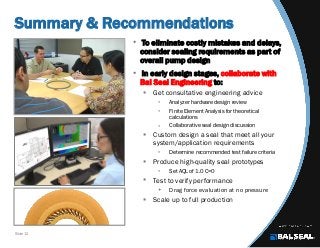
Summary & Recommendations
• To eliminate costly mistakes and delays,
consider sealing requirements as part of
overall pump design
• In early design stages, collaborate with
Bal Seal Engineering to:
 Get consultative engineering advice
 Analyzer hardware design review
 Finite Element Analysis for theoretical
calculations
 Collaborative seal design discussion
 Custom design a seal that meet all your
system/application requirements
 Determine recommended test failure criteria
 Produce high-quality seal prototypes
 Set AQL of 1.0 C=0
 Test to verify performance
 Drag force evaluation at no pressure
 Scale up to full production
Slide 13
Resources & Contact Information
Sarah Smith
Global Market Manager, Analytical Products
Bal Seal Engineering, Inc.
ssmith@balseal.com
+1 949.460.2226
marketing@balseal.com www.balseal.com +1 949.460.2100 Design request form
Custom components that drive
tomorrow’s technologies®
©Bal Seal Engineering, Inc. This document contains and/or refers to information that is PROPRIETARY to Bal Seal Engineering, Inc. Products referenced herein are the
subject of issued or pending United States and foreign patents. Bal Seal Engineering, Inc. products and designs are PROPRIETARY and products may not be manufactured,
or caused to be manufactured, by any other party.

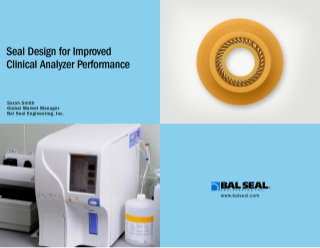
Seal Design For Improved Clinical Analyzer Performance

  • 2.
    Slide 2 Major DiagnosticAnalyzer Types • Hematology analyzer  HbA1C Testing  Accuracy, precision, and linearity  Blood cell count • Clinical analyzer  Multi-industry usage  Protein analysis  Genome development  Chemical analysis • Urine analyzer  Fluorescence flow cytometry  Digital imaging  Identifies organ problems
  • 3.
    Slide 3 Diagnostic PumpEnvironment • Operating conditions  Low-speed reciprocation  Medium shaft diameter  Tight leakage criteria  Range of temps - ambient to 40°C  Minor shaft to bore misalignment  Machined plastic or stainless steel housing • Media  Reagents or saline • Performance criteria  1 Million+ cycles
  • 4.
    Slide 4 Design Challenges •Hardware  Large hardware tolerances create potential leak paths  Hardware misalignment creates more wear on one side of the seal resulting in rapid leakage  Housing without surface treatment reduces seal life  Seals wear rapidly due to poor surface finish  Lack of rinse portion allows salt crystals to form behind the high pressure seal  Damage to dynamic seal lip diminishes seal life
  • 5.
    Slide 5 Design Challenges •Crystallization  Hardware misalignment, large hardware tolerances, and marginal seal designs allow reagent or saline to weep under seal ID lip  If no rinse portion behind the seal, salt crystals will form  Dynamic seal lip will reciprocate over crystals, causing scratches on seal ID  Over time scratches become leak paths, causing inaccurate dispensing of reagent Crystals on pump piston can result in formation of leak paths on seal.
  • 6.
    Slide 6 Seals: ACritical Element • Prevent reagent from leaking behind seals • Seal failure adversely impacts pump accuracy, precision, and linearity • Seal designs for diagnostics must:  Mediate friction and sealing effectiveness to guard against salty reagent weepage  Consistently maintain reagent pressure for 1,000,000+ cycles  Prevent salt crystals forming behind the seal and reducing life  Minimize particle generation shedding to reduce process contamination
  • 7.
    Slide 7 Seal PerformanceFactors • Housing Hardware  Tight tolerances of < ±0.001”  Machined stainless steel with coated or machined plastic  Minimal clearance between housing & plunger (0.002” max)  Suggested sealing surface of 9.1 – 14.5 µin Ra • Piston Hardware  Smoother surface finish is better  Suggested dynamic surface is 7.3 - 14.5 µin Ra  Minimum shaft hardness is 30Rc for un-filled materials.  Higher surface hardness enhances seal performance  Sapphire or ceramic have excellent surface finish and high hardness with minimal porosity  Stainless steel with hardness treatment and/or polishing
  • 8.
    Slide 8 Sealing PerformanceFactors • Alignment  Review hardware tolerances to ensure proper alignment between piston and housing  Review tolerance stack-up if you have multiple housing components, as this may contribute to misalignment  Allowable misalignment recommendations are maximum conditions  Floating plunger  High modulus backup support ring to improve alignment and reduce any potential side-loading on sealing lips
  • 9.
    Slide 9 Design Insight •Incorporating active wash system with rinse seal:  Reduces heat generated under pressure  Prolongs service life  Adds lubricity to the application  Reduces formation of salt crystallization
  • 10.
    Slide 10 Seal DesignConsiderations LC SP191 Polyimide-filled UPC10 Virgin Polyethylene Canted coil spring energizer 1 2 • Geometry 1. 15x design easier to machine hardware  Long ID lip increases contact area 2. Flange design provides secondary OD seal  Short ID lip reduces friction • Jacket material  PTFE materials (virgin or polyimide)  High chemical resistance  Low coefficient of friction  USP Class VI or FDA compatible material  UHMW PE materials (virgin or filled polyethylene)  FDA compatible material for biocompatibility  Higher resistance to wear and extrusion in aqueous media • Spring energizer  Chemical compatibility  Biocompatibility  Corrosion prevention (hardware)  Consistent spring force  Customizable loads
  • 11.
    Slide 11 Optimizing DiagnosticSeal Design Requirements Solutions • Low-speed reciprocation • Chemical compatibility • Low-friction • FDA compliant • Biocompatible • 1,000,000+ cycles • Bal Seal® spring-energized PTFE or UHMW PE seal • Virgin (TA) or Filled-PTFE (SP191 polyimide-filled) • Low coefficient of friction, chemically inert, compatible with aggressive media, self healing • Virgin-UHMW PE (UPC10 polyethylene) or Filled-UHMW PE (UP30 high performance polyethylene) • Low permeability, minimal extrusion, USP Class VI, minimal contamination, low particle generation • Meets low drag force requirements • Non-flange design allows for tighter tolerances & less machining • Flange design simplifies installation • Bal Spring® canted coil spring energizer (stainless steel or Hastelloy®) • Applies consistent sealing pressure over large tolerance range • Large variety of bio-inert spring materials to prevent corrosion • Non-standard seal designs to work within retrofit hardware
  • 12.
    Slide 12 Summary &Recommendations • To eliminate costly mistakes and delays, consider sealing requirements as part of overall pump design • In early design stages, collaborate with Bal Seal Engineering to:  Get consultative engineering advice  Analyzer hardware design review  Finite Element Analysis for theoretical calculations  Collaborative seal design discussion  Custom design a seal that meet all your system/application requirements  Determine recommended test failure criteria  Produce high-quality seal prototypes  Set AQL of 1.0 C=0  Test to verify performance  Drag force evaluation at no pressure  Scale up to full production
  • 13.
    Slide 13 Resources &Contact Information Sarah Smith Global Market Manager, Analytical Products Bal Seal Engineering, Inc. ssmith@balseal.com +1 949.460.2226 marketing@balseal.com www.balseal.com +1 949.460.2100 Design request form
  • 14.
    Custom components thatdrive tomorrow’s technologies® ©Bal Seal Engineering, Inc. This document contains and/or refers to information that is PROPRIETARY to Bal Seal Engineering, Inc. Products referenced herein are the subject of issued or pending United States and foreign patents. Bal Seal Engineering, Inc. products and designs are PROPRIETARY and products may not be manufactured, or caused to be manufactured, by any other party.