NATIONAL EDUCATION
POLICY – 2020
PRESENTED BY
K.BALASRI PRASAD
B.Sc (KU) , M.B.A (OU), NET (UGC), (Ph.D) (MGU)
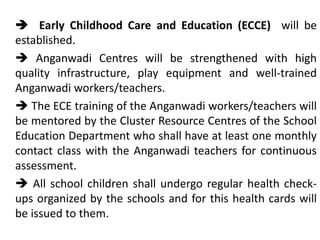
 Early Childhood Care and Education (ECCE) will be
established.
 Anganwadi Centres will be strengthened with high
quality infrastructure, play equipment and well-trained
Anganwadi workers/teachers.
 The ECE training of the Anganwadi workers/teachers will
be mentored by the Cluster Resource Centres of the School
Education Department who shall have at least one monthly
contact class with the Anganwadi teachers for continuous
assessment.
 All school children shall undergo regular health check-
ups organized by the schools and for this health cards will
be issued to them.
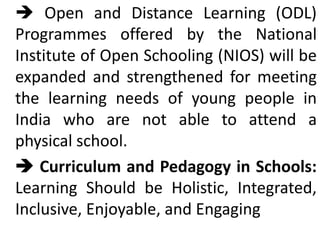
 Open and Distance Learning (ODL)
Programmes offered by the National
Institute of Open Schooling (NIOS) will be
expanded and strengthened for meeting
the learning needs of young people in
India who are not able to attend a
physical school.
 Curriculum and Pedagogy in Schools:
Learning Should be Holistic, Integrated,
Inclusive, Enjoyable, and Engaging
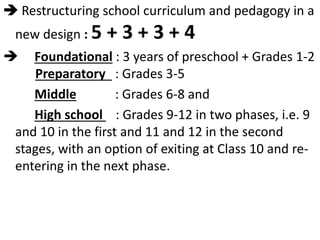
 Restructuring school curriculum and pedagogy in a
new design : 5 + 3 + 3 + 4
 Foundational : 3 years of preschool + Grades 1-2
Preparatory : Grades 3-5
Middle : Grades 6-8 and
High school : Grades 9-12 in two phases, i.e. 9
and 10 in the first and 11 and 12 in the second
stages, with an option of exiting at Class 10 and re-
entering in the next phase.
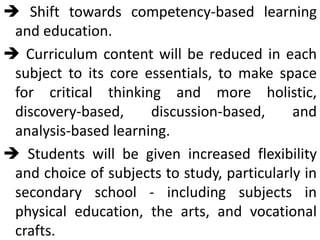
 Shift towards competency-based learning
and education.
 Curriculum content will be reduced in each
subject to its core essentials, to make space
for critical thinking and more holistic,
discovery-based, discussion-based, and
analysis-based learning.
 Students will be given increased flexibility
and choice of subjects to study, particularly in
secondary school - including subjects in
physical education, the arts, and vocational
crafts.
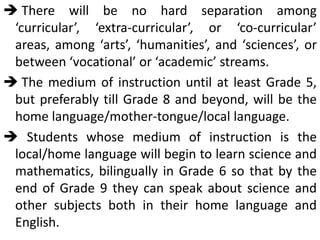
 There will be no hard separation among
‘curricular’, ‘extra-curricular’, or ‘co-curricular’
areas, among ‘arts’, ‘humanities’, and ‘sciences’, or
between ‘vocational’ or ‘academic’ streams.
 The medium of instruction until at least Grade 5,
but preferably till Grade 8 and beyond, will be the
home language/mother-tongue/local language.
 Students whose medium of instruction is the
local/home language will begin to learn science and
mathematics, bilingually in Grade 6 so that by the
end of Grade 9 they can speak about science and
other subjects both in their home language and
English.
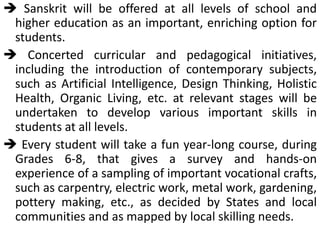
 Sanskrit will be offered at all levels of school and
higher education as an important, enriching option for
students.
 Concerted curricular and pedagogical initiatives,
including the introduction of contemporary subjects,
such as Artificial Intelligence, Design Thinking, Holistic
Health, Organic Living, etc. at relevant stages will be
undertaken to develop various important skills in
students at all levels.
 Every student will take a fun year-long course, during
Grades 6-8, that gives a survey and hands-on
experience of a sampling of important vocational crafts,
such as carpentry, electric work, metal work, gardening,
pottery making, etc., as decided by States and local
communities and as mapped by local skilling needs.
 Basic training in health, including preventive
health, mental health, nutrition, personal and
public hygiene, and first-aid will also be included in
the curriculum.
 Concerted efforts will be made by NCERT, SCERTs,
schools and educators, to significantly reduce the
weight of school bags and textbooks that students
are asked to carry to and from school on a daily
basis.
 The primary purpose of assessment will indeed be
for learning and the entire schooling system
continuously revise teaching-learning processes to
optimise learning and development for all students.
 The current nature of secondary school exams and
the resulting coaching culture of today - are doing
much harm, especially at the secondary school
level, replacing valuable time for true learning with
excessive exam coaching and preparation.
 All students will be allowed to take Board Exams
on up to two occasions during any given school
year, one main examination and one for
improvement.
 All students will take State School examinations in
Grades 3, 5, and 8 in addition to Board
Examinations in Grades 10 and 12.
 The National Assessment Centre for School
Education (NACSE) shall be a standard-setting Body
under the Ministry of Education (MoE).
 The principles for university entrance exams will be
similar; the National Testing Agency (NTA) will work
to offer high-quality common aptitude test.
Students will be able to choose the subjects that
they are interested in having tested, and each
university will be able to see each student’s
individual subject portfolio and admit students into
their programmes based on individual interests and
talents.
Topic-centered and Project-based Clubs and Circles
will be highly encouraged and supported at the
levels of schools, school complexes, districts, and
beyond.
Examples include Science Circles, Math Circles, Music
Performance Circles, Chess Circles, Poetry Circles, Language Circles,
Drama Circles, Debate Circles, Sports Circles, and so on.
 4-year integrated B.Ed. programmes will be
introduced. Teacher Eligibility Tests (TETs) will be
strengthened. For subject teachers, suitable TET or
NTA test scores in the corresponding subjects will
also be taken into account for recruitment.
To promote local knowledge and expertise,
schools/school complexes will be encouraged and
indeed will be supported with suitable resources to
hire local eminent persons or experts as ‘specialized
instructors’ in various subjects, such as in traditional
local arts, vocational crafts, entrepreneurship,
agriculture, or any other subject where local
expertise exists and would benefit students and
help preserve and promote local knowledge.
 Teachers will be given more autonomy in choosing
finer aspects of pedagogy.
 By 2030, the minimum degree qualification for
teaching will be a 4 -year integrated B.Ed. Degree.
 Establishment of a National Research Foundation
to fund outstanding peer-reviewed research and to
actively seed research in universities and colleges;
 The main thrust of this policy in higher education
is to end the fragmentation of higher education by
transforming higher education institutions into
large multidisciplinary universities, colleges, and HEI
clusters, each of which will aim to have 3,000 or
more students.
 It is envisioned that over a period of time all
existing HEIs and new HEIs will evolve into research-
intensive universities (RUs), teaching universities
(TUs), and autonomous degree-granting colleges
(ACs).
 All types of institutions will have the option to run
Open Distance Learning (ODL) and online
programmes, provided they are specifically
accredited to do so, to enhance their offerings,
improve access, increase GER (Gross Enrolment
Ratio) – up to 5o%, and provide increased
opportunities for lifelong learning.
 Phasing out the system of ‘affiliated colleges’ over
a period of fifteen years. By 2025, the maximum
number of colleges that can be affiliated by a
University shall not exceed 300;
 The undergraduate degree will be of either 3-or 4-year
duration, with multiple exit options within this period, with
appropriate certifications. The 4-year programme may also
lead to a degree 'with research'. A student can obtain a
diploma after completing 1 year, or an advanced diploma in a
discipline or field (including vocational and professional
areas) after completing 2 years of study or obtain a Bachelors
degree after a 3-year programme.
 HEIs will have the flexibility to offer different designs of
Masters programmes, (a) there may be a two-year
programme with the second year devoted entirely to research
for those who have completed the three-year Bachelors
programme; (b) for students completing a four-year Bachelors
programme with Research there could be a one-year Masters
programme and (c) there may be an integrated five-year
Bachelor’s/Masters programme. Undertaking a PhD shall
require either a Master’s degree or a 4-year Bachelor’s degree
with Research. The M.Phil. programme shall be discontinued.
 Model public universities for holistic education, at
par with IITs, IIMs, etc., called MERUs
(Multidisciplinary Education and Research
Universities) will be set up and will aim to reach the
global status
 High performing Indian universities will be
encouraged to set up campuses in other countries,
and similarly, select universities (e.g., those from
among the top 100 universities in the world) will be
permitted to operate in India.
 Opportunities for PhD students to assist faculty as
teaching assistants must be created as part of all
PhD programmes.
 Using technology platforms such as SWAYAM
/DIKSHA for online training of the teachers shall be
encouraged so that standardised training
programmes can be administered to large number
of teachers within a short span of time.
 Vocational education will be integrated into all
educational institutions in a phased manner over
the next decade. Focus areas will be chosen based
on skills gap analysis and mapping of local
opportunities, and technical and vocational
education will become part of the larger vision of
holistic education.
 An autonomous body, the National Educational
Alliance for Technology (NEAT), will be created to
provide a platform for use of technology to enhance
learning, assessment, planning, administration, and so
on, both for school and higher education. The aim of
NEAT will be to provide on a single portal various
educational technology solutions that are tested for
their robustness for improving the learning experience,
with a special focus on the needs of the students with
disabilities.
 A rich variety of educational software will be
developed and made available for students and
teachers at all levels. Teaching-learning e-content will
continue to be developed by all States in all regional
languages, as well as by the NCERT (including CIET),
CBSE, NIOS, and other bodies/institutions, and will be
uploaded onto the National Teacher’s Portal.
National Education Policy - India - 2020

National Education Policy - India - 2020

  • 1.
    NATIONAL EDUCATION POLICY –2020 PRESENTED BY K.BALASRI PRASAD B.Sc (KU) , M.B.A (OU), NET (UGC), (Ph.D) (MGU)
  • 2.
     Early ChildhoodCare and Education (ECCE) will be established.  Anganwadi Centres will be strengthened with high quality infrastructure, play equipment and well-trained Anganwadi workers/teachers.  The ECE training of the Anganwadi workers/teachers will be mentored by the Cluster Resource Centres of the School Education Department who shall have at least one monthly contact class with the Anganwadi teachers for continuous assessment.  All school children shall undergo regular health check- ups organized by the schools and for this health cards will be issued to them.
  • 3.
     Open andDistance Learning (ODL) Programmes offered by the National Institute of Open Schooling (NIOS) will be expanded and strengthened for meeting the learning needs of young people in India who are not able to attend a physical school.  Curriculum and Pedagogy in Schools: Learning Should be Holistic, Integrated, Inclusive, Enjoyable, and Engaging
  • 4.
     Restructuring schoolcurriculum and pedagogy in a new design : 5 + 3 + 3 + 4  Foundational : 3 years of preschool + Grades 1-2 Preparatory : Grades 3-5 Middle : Grades 6-8 and High school : Grades 9-12 in two phases, i.e. 9 and 10 in the first and 11 and 12 in the second stages, with an option of exiting at Class 10 and re- entering in the next phase.
  • 5.
     Shift towardscompetency-based learning and education.  Curriculum content will be reduced in each subject to its core essentials, to make space for critical thinking and more holistic, discovery-based, discussion-based, and analysis-based learning.  Students will be given increased flexibility and choice of subjects to study, particularly in secondary school - including subjects in physical education, the arts, and vocational crafts.
  • 6.
     There willbe no hard separation among ‘curricular’, ‘extra-curricular’, or ‘co-curricular’ areas, among ‘arts’, ‘humanities’, and ‘sciences’, or between ‘vocational’ or ‘academic’ streams.  The medium of instruction until at least Grade 5, but preferably till Grade 8 and beyond, will be the home language/mother-tongue/local language.  Students whose medium of instruction is the local/home language will begin to learn science and mathematics, bilingually in Grade 6 so that by the end of Grade 9 they can speak about science and other subjects both in their home language and English.
  • 7.
     Sanskrit willbe offered at all levels of school and higher education as an important, enriching option for students.  Concerted curricular and pedagogical initiatives, including the introduction of contemporary subjects, such as Artificial Intelligence, Design Thinking, Holistic Health, Organic Living, etc. at relevant stages will be undertaken to develop various important skills in students at all levels.  Every student will take a fun year-long course, during Grades 6-8, that gives a survey and hands-on experience of a sampling of important vocational crafts, such as carpentry, electric work, metal work, gardening, pottery making, etc., as decided by States and local communities and as mapped by local skilling needs.
  • 8.
     Basic trainingin health, including preventive health, mental health, nutrition, personal and public hygiene, and first-aid will also be included in the curriculum.  Concerted efforts will be made by NCERT, SCERTs, schools and educators, to significantly reduce the weight of school bags and textbooks that students are asked to carry to and from school on a daily basis.  The primary purpose of assessment will indeed be for learning and the entire schooling system continuously revise teaching-learning processes to optimise learning and development for all students.
  • 9.
     The currentnature of secondary school exams and the resulting coaching culture of today - are doing much harm, especially at the secondary school level, replacing valuable time for true learning with excessive exam coaching and preparation.  All students will be allowed to take Board Exams on up to two occasions during any given school year, one main examination and one for improvement.  All students will take State School examinations in Grades 3, 5, and 8 in addition to Board Examinations in Grades 10 and 12.
  • 10.
     The NationalAssessment Centre for School Education (NACSE) shall be a standard-setting Body under the Ministry of Education (MoE).  The principles for university entrance exams will be similar; the National Testing Agency (NTA) will work to offer high-quality common aptitude test. Students will be able to choose the subjects that they are interested in having tested, and each university will be able to see each student’s individual subject portfolio and admit students into their programmes based on individual interests and talents.
  • 11.
    Topic-centered and Project-basedClubs and Circles will be highly encouraged and supported at the levels of schools, school complexes, districts, and beyond. Examples include Science Circles, Math Circles, Music Performance Circles, Chess Circles, Poetry Circles, Language Circles, Drama Circles, Debate Circles, Sports Circles, and so on.  4-year integrated B.Ed. programmes will be introduced. Teacher Eligibility Tests (TETs) will be strengthened. For subject teachers, suitable TET or NTA test scores in the corresponding subjects will also be taken into account for recruitment.
  • 12.
    To promote localknowledge and expertise, schools/school complexes will be encouraged and indeed will be supported with suitable resources to hire local eminent persons or experts as ‘specialized instructors’ in various subjects, such as in traditional local arts, vocational crafts, entrepreneurship, agriculture, or any other subject where local expertise exists and would benefit students and help preserve and promote local knowledge.  Teachers will be given more autonomy in choosing finer aspects of pedagogy.  By 2030, the minimum degree qualification for teaching will be a 4 -year integrated B.Ed. Degree.
  • 13.
     Establishment ofa National Research Foundation to fund outstanding peer-reviewed research and to actively seed research in universities and colleges;  The main thrust of this policy in higher education is to end the fragmentation of higher education by transforming higher education institutions into large multidisciplinary universities, colleges, and HEI clusters, each of which will aim to have 3,000 or more students.  It is envisioned that over a period of time all existing HEIs and new HEIs will evolve into research- intensive universities (RUs), teaching universities (TUs), and autonomous degree-granting colleges (ACs).
  • 14.
     All typesof institutions will have the option to run Open Distance Learning (ODL) and online programmes, provided they are specifically accredited to do so, to enhance their offerings, improve access, increase GER (Gross Enrolment Ratio) – up to 5o%, and provide increased opportunities for lifelong learning.  Phasing out the system of ‘affiliated colleges’ over a period of fifteen years. By 2025, the maximum number of colleges that can be affiliated by a University shall not exceed 300;
  • 15.
     The undergraduatedegree will be of either 3-or 4-year duration, with multiple exit options within this period, with appropriate certifications. The 4-year programme may also lead to a degree 'with research'. A student can obtain a diploma after completing 1 year, or an advanced diploma in a discipline or field (including vocational and professional areas) after completing 2 years of study or obtain a Bachelors degree after a 3-year programme.  HEIs will have the flexibility to offer different designs of Masters programmes, (a) there may be a two-year programme with the second year devoted entirely to research for those who have completed the three-year Bachelors programme; (b) for students completing a four-year Bachelors programme with Research there could be a one-year Masters programme and (c) there may be an integrated five-year Bachelor’s/Masters programme. Undertaking a PhD shall require either a Master’s degree or a 4-year Bachelor’s degree with Research. The M.Phil. programme shall be discontinued.
  • 16.
     Model publicuniversities for holistic education, at par with IITs, IIMs, etc., called MERUs (Multidisciplinary Education and Research Universities) will be set up and will aim to reach the global status  High performing Indian universities will be encouraged to set up campuses in other countries, and similarly, select universities (e.g., those from among the top 100 universities in the world) will be permitted to operate in India.  Opportunities for PhD students to assist faculty as teaching assistants must be created as part of all PhD programmes.
  • 17.
     Using technologyplatforms such as SWAYAM /DIKSHA for online training of the teachers shall be encouraged so that standardised training programmes can be administered to large number of teachers within a short span of time.  Vocational education will be integrated into all educational institutions in a phased manner over the next decade. Focus areas will be chosen based on skills gap analysis and mapping of local opportunities, and technical and vocational education will become part of the larger vision of holistic education.
  • 18.
     An autonomousbody, the National Educational Alliance for Technology (NEAT), will be created to provide a platform for use of technology to enhance learning, assessment, planning, administration, and so on, both for school and higher education. The aim of NEAT will be to provide on a single portal various educational technology solutions that are tested for their robustness for improving the learning experience, with a special focus on the needs of the students with disabilities.  A rich variety of educational software will be developed and made available for students and teachers at all levels. Teaching-learning e-content will continue to be developed by all States in all regional languages, as well as by the NCERT (including CIET), CBSE, NIOS, and other bodies/institutions, and will be uploaded onto the National Teacher’s Portal.