3/27/2017 Critical Differences Between H­1B and J­1 Visas by Peng & Weber
http://greencardlawyers.com/answers_for/H­1B_J­1ComparisonChart.html 1/4
Green Cards (Common)
 National Interest Waivers
 Extraordinary Ability
 Professors & Researchers
 Executives & Managers
 PERM Labor Certification
 Investors (EB­5 visas)
 Family (Spouse, etc.)
Work Visas (Common)
 H­1B Professionals
 L­1 Transferees
 O­1 Extraordinary Ability
 TN Canadians & Mexicans
Answers for­­
 Employers
 Researchers
 J­1 Visa Holders
 Nurses & Physical Therapists
 Physicians
How We Can Help
 Consultation & Fees
 
微信订阅
WeChat Subscription: 
 
微信号
 WeChat ID: PengWeber
Related Links
J­1 Visas
J­1 Waivers
FAQs about J­1 visas
H­1B Visas
FAQs about H­1B visas
Employment­Based Green Cards
 
Critical Differences Between H­1B and J­1 Visas
Purpose of visa
Eligibility
Differences
Maximum length of stay
Requirements for obtaining visa
Extensions
Home residency requirement
Travel restrictions
Cost to obtain the immigration status
Who pays for visa processing
Who files the request for immigration status
Processing times
Can the procedure be expedited
Cost of expedited service
Authorized employer
Limit on obtaining status
Consequences of letting immigration status lapse
Work while waiting for a change in visa category
Visas for family members
Family members work authorization
Travel by family members travel
Apply for visas for family members
Federal taxes
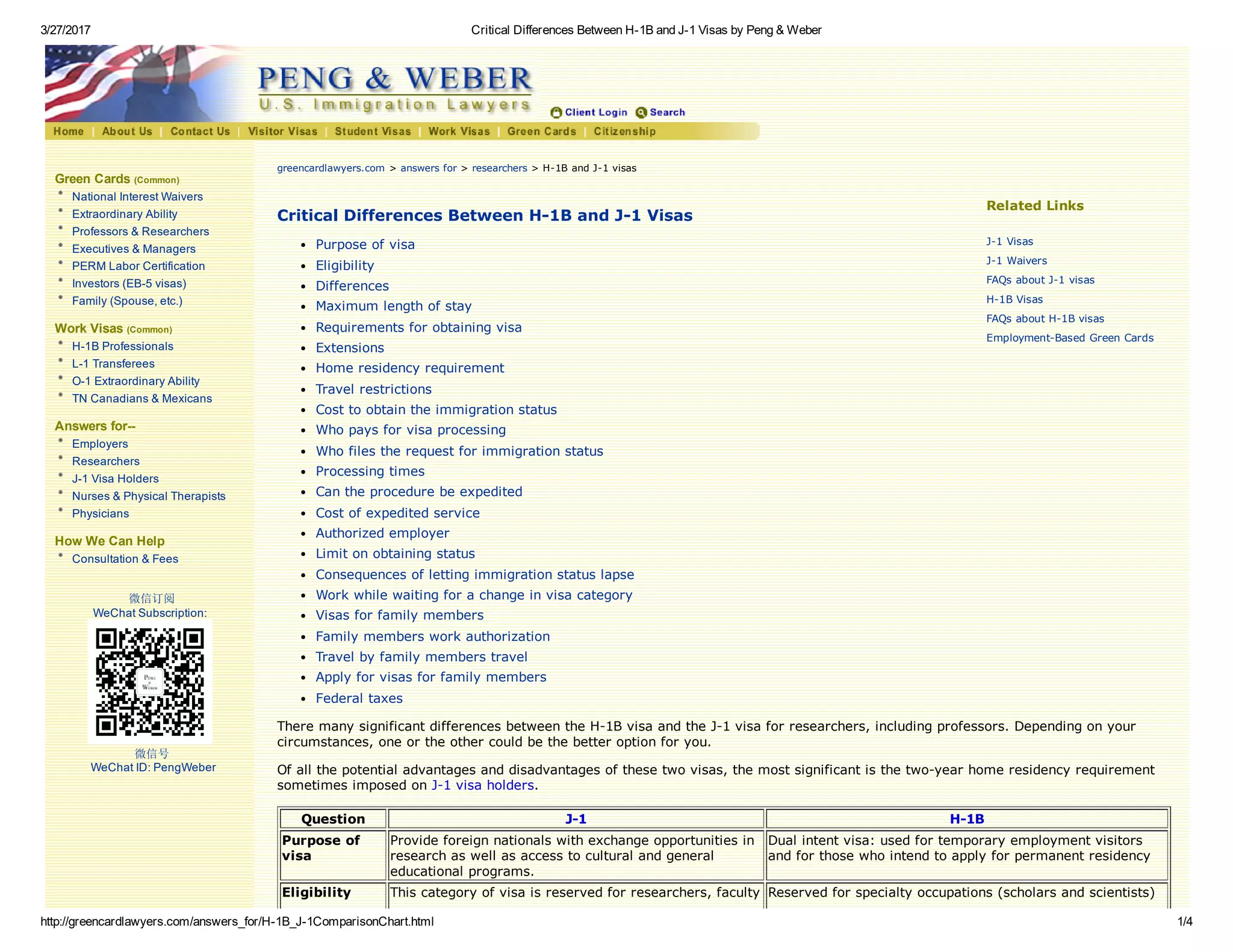
There many significant differences between the H­1B visa and the J­1 visa for researchers, including professors. Depending on your
circumstances, one or the other could be the better option for you.
Of all the potential advantages and disadvantages of these two visas, the most significant is the two­year home residency requirement
sometimes imposed on J­1 visa holders.
Question J­1 H­1B
Purpose of
visa
Provide foreign nationals with exchange opportunities in
research as well as access to cultural and general
educational programs.
Dual intent visa: used for temporary employment visitors
and for those who intend to apply for permanent residency
Eligibility This category of visa is reserved for researchers, faculty Reserved for specialty occupations (scholars and scientists)
that require theoretical and practical application of a body of
greencardlawyers.com > answers for > researchers > H­1B and J­1 visas
3/27/2017 Critical Differences Between H­1B and J­1 Visas by Peng & Weber
http://greencardlawyers.com/answers_for/H­1B_J­1ComparisonChart.html 2/4
and scholars, specialists and speakers, and students in
exchange programs. All are in the U.S. on fixed terms.
Researchers must be brought in for a specific purpose as
defined by the sponsoring institution.
that require theoretical and practical application of a body of
highly specialized knowledge in a field of human endeavor.
Requires a Ph.D.
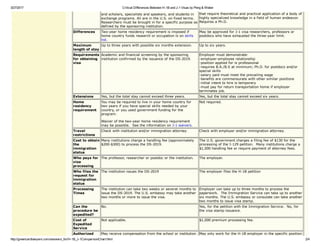
Differences Two­year home residency requirement is imposed if
home country funds research or occupation is on skills
list.
May be approved for J­1 visa researchers, professors or
postdocs who have exhausted the three­year limit.
Maximum
length of stay
Up to three years with possible six months extension. Up to six years.
Requirements
for obtaining
visa
Academic and financial screening by the sponsoring
institution confirmed by the issuance of the DS­2019.
Employer must demonstrate:
­employer­employee relationship
­position applied for is professional
­requires B.A./B.S at minimum; Ph.D. for postdocs and/or
special skills 
­salary paid must meet the prevailing wage
­benefits are commensurate with other similar positions
­initial intent to hire is temporary
­must pay for return transportation home if employer
terminates job.
Extensions Yes, but the total stay cannot exceed three years. Yes, but the total stay cannot exceed six years.
Home
residency
requirement
You may be required to live in your home country for
two years if you have special skills needed by your
country, or you used government funding for the
program. 
Waiver of the two­year home residency requirement
may be possible.  See the information on J­1 waivers.
Not required.
Travel
restrictions
Check with institution and/or immigration attorney. Check with employer and/or immigration attorney.
Cost to obtain
the
immigration
status
Many institutions charge a handling fee (approximately
$200­$300) to process the DS­2019.
The U.S. government charges a filing fee of $130 for the
processing of the I­129 petition.  Many institutions charge a
$1,000 handling fee or require payment of attorney fees.
Who pays for
visa
processing
The professor, researcher or postdoc or the institution. The employer.
Who files the
request for
immigration
status
The institution issues the DS­2019 The employer files the H­1B petition
Processing
Times
The institution can take two weeks or several months to
issue the DS­2019. The U.S. embassy may take another
two months or more to issue the visa.
Employer can take up to three months to process the
paperwork.  The Immigration Service can take up to another
six months. The U.S. embassy or consulate can take another
two months to issue visa stamp.
Can the
procedure be
expedited?
No. Yes, for the petition with the Immigration Service.  No, for
the visa stamp issuance.
Cost of
Expedited
Service
Not applicable. $1,000 premium processing fee.
Authorized May receive compensation from the school or institution May only work for the H­1B employer in the specific position
3/27/2017 Critical Differences Between H­1B and J­1 Visas by Peng & Weber
http://greencardlawyers.com/answers_for/H­1B_J­1ComparisonChart.html 3/4
Employer that issued the DS­2019. You may also engage in
temporary work in another institution if the work is
related to the program and if you receive advance
permission. Compensation may include travel grants and
reimbursements.
approved. You are not eligible for honorariums; however, in
some cases they can be paid reimbursements.
Limit on
obtaining
status
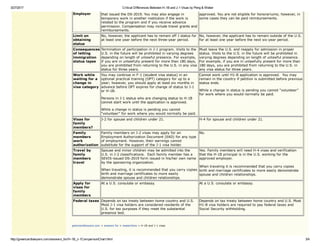
No, however, the applicant has to remain off J status for
at least one year before the next three­year period.
No, however, the applicant has to remain outside of the U.S.
for at least one year before the next six­year period.
Consequences
of letting
immigration
status lapse
Termination of participation in J­1 program. Visits to the
U.S. in the future will be prohibited in varying degrees
depending on length of unlawful presence. For example,
if you are in unlawfully present for more than 180 days,
you are prohibited from returning to the U.S. in any visa
status for three years.
Must leave the U.S. and reapply for admission in proper
status. Visits to the U.S. in the future will be prohibited in
varying degrees depending on length of unlawful presence.
For example, if you are in unlawfully present for more than
180 days, you are prohibited from returning to the U.S. in
any visa status for three years.
Work while
waiting for a
change in
visa category
You may continue in F­1 (student visa status) in an
optional practical training (OPT) category for up to a
year; however, you should apply at least six months in
advance before OPT expires for change of status to J­1
or H­1B.
Persons in J­1 status who are changing status to H­1B
cannot start work until the application is approved.
While a change in status is pending you cannot
“volunteer” for work where you would normally be paid.
Cannot work until H1­B application is approved.  You may
remain in the country if petition is submitted before previous
status ends.
While a change in status is pending you cannot “volunteer”
for work where you would normally be paid.
Visas for
family
members?
J­2 for spouse and children under 21. H­4 for spouse and children under 21.
Family
members
work
authorization
Family members on J­2 visas may apply for an
Employment Authorization Document (EAD) for any type
of employment. However, their earnings cannot
substitute for the support of the J­1 visa holder. 
No.
Travel by
family
members
travel
Spouse and minor children may be admitted into the
U.S. in J­2 classifications.  Each family member has a
SEVIS­issued DS­2019 form issued in his/her own name
by the sponsoring organization.
When traveling, it is recommended that you carry copies
birth and marriage certificates to more easily
demonstrate spouse and children relationships.
Yes. Family members will need H­4 visas and verification
that the H­1B principal is in the U.S. working for the
approved employer. 
When traveling it is recommended that you carry copies
birth and marriage certificates to more easily demonstrate
spouse and children relationships.
Apply for
visas for
family
members
At a U.S. consulate or embassy. At a U.S. consulate or embassy.
Federal taxes Depends on tax treaty between home country and U.S.
Most J­1 visa holders are considered residents of the
U.S. for tax purposes if they meet the substantial
presence test.
Depends on tax treaty between home country and U.S. Most
H1­B visa holders are required to pay federal taxes and
Social Security withholding.
greencardlawyers.com > answers for > researchers > H­1B and J­1 visas
3/27/2017 Critical Differences Between H­1B and J­1 Visas by Peng & Weber
http://greencardlawyers.com/answers_for/H­1B_J­1ComparisonChart.html 4/4
Peng & Weber, PLLC  3035 Island Crest Way, Suite 200  Mercer Island (Seattle suburb), Washington 98040
(206) 382­1962  Fax (206) 382­0245  info2010@greencardlawyers.com
Disclaimer: This website provides only general information and not legal advice on solving specific immigration law issues.
Copyright © 1999­2011, Peng & Weber, PLLC.  All rights reserved. 

Critical differences between H1b and J-1 visas: Peng & Weber