SALT ANALYSIS
SCHEME OF ANALYSIS
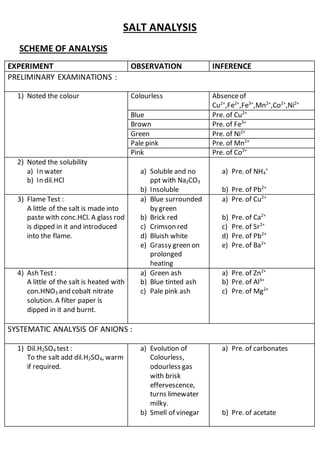
EXPERIMENT OBSERVATION INFERENCE
PRELIMINARY EXAMINATIONS :
1) Noted the colour Colourless Absenceof
Cu2+
,Fe2+
,Fe3+
,Mn2+
,Co2+
,Ni2+
Blue Pre. of Cu2+
Brown Pre. of Fe3+
Green Pre. of Ni2+
Pale pink Pre. of Mn2+
Pink Pre. of Co2+
2) Noted the solubility
a) In water
b) In dil.HCl
a) Soluble and no
ppt with Na2CO3
b) Insoluble
a) Pre. of NH4
+
b) Pre. of Pb2+
3) Flame Test :
A little of the salt is made into
paste with conc.HCl. A glass rod
is dipped in it and introduced
into the flame.
a) Blue surrounded
by green
b) Brick red
c) Crimson red
d) Bluish white
e) Grassy green on
prolonged
heating
a) Pre. of Cu2+
b) Pre. of Ca2+
c) Pre. of Sr2+
d) Pre. of Pb2+
e) Pre. of Ba2+
4) Ash Test :
A little of the salt is heated with
con.HNO3 and cobalt nitrate
solution. A filter paper is
dipped in it and burnt.
a) Green ash
b) Blue tinted ash
c) Pale pink ash
a) Pre. of Zn2+
b) Pre. of Al3+
c) Pre. of Mg2+
SYSTEMATIC ANALYSIS OF ANIONS :
1) Dil.H2SO4 test :
To the salt add dil.H2SO4, warm
if required.
a) Evolution of
Colourless,
odourless gas
with brisk
effervescence,
turns limewater
milky.
b) Smell of vinegar
a) Pre. of carbonates
b) Pre. of acetate
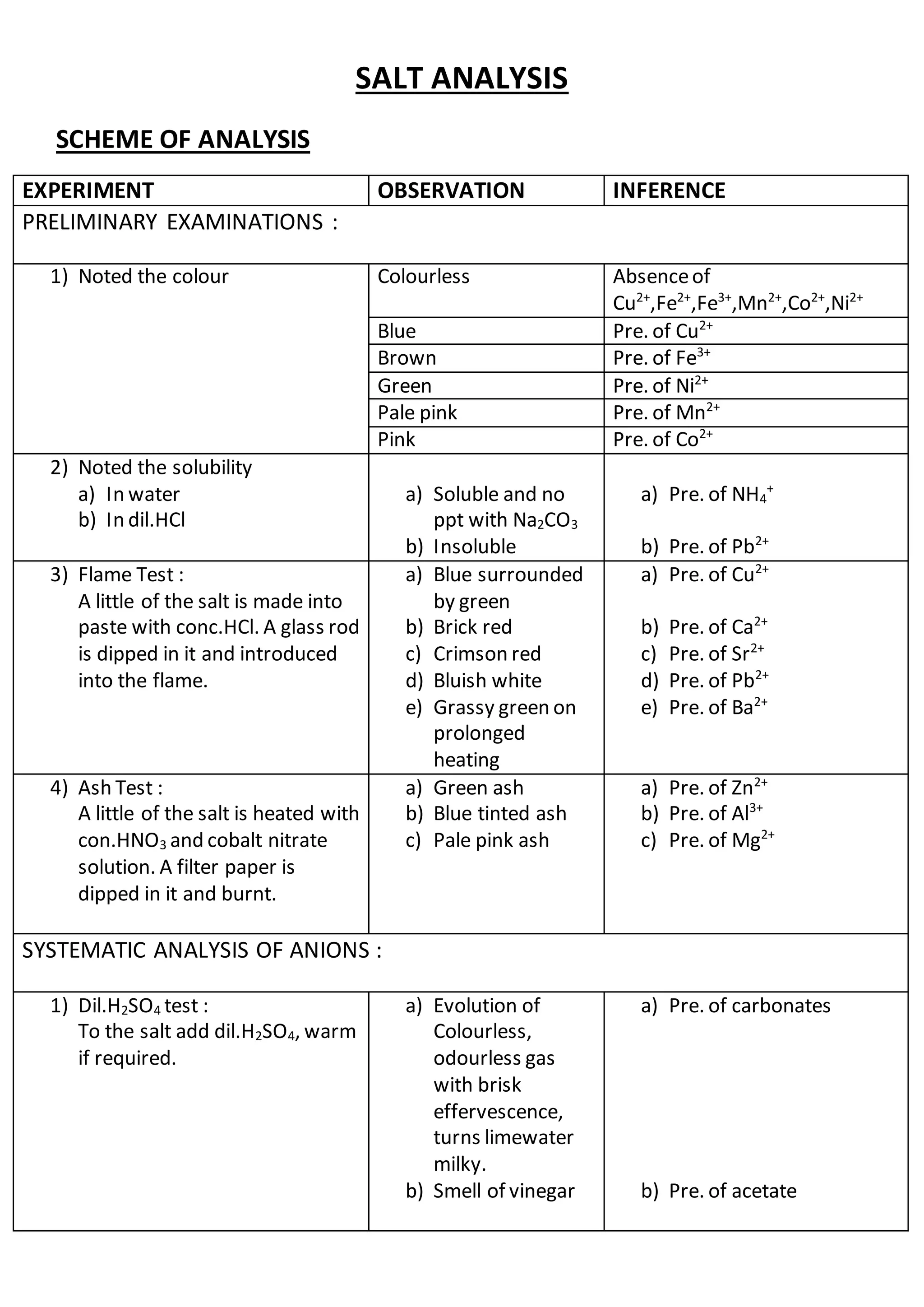
2) Conc.H2SO4 test :
Treat a small quantity of the
salt with Conc.H2SO4, warmif
necessary.
a) Colourless gas
with pungent
smell, give dense
white fumes
when a glass rod
dipped in NH4OH
is shown.
b) Brown gas with
pungent smell
c) Violet vapours
with pungent
smell
d) Light brown gas
with pungent
smell on strong
heating.
e) Smell of vinegar
a) Pre. of Cl-1
b) Pre. of Br-1
c) Pre. of I-1
d) Pre. of NO3
-1
e) Pre. of CH3COO-1
3) Paper ball test :
Heat a little of the salt with
Conc.H2SO4 and introduce a
paper ball to it.
Brown fumes Pre. of NO3
-1
4) Test for sulphates :
Heat a little of the salt solution
with dil.HCl and add BaCl2
solution.
White ppt insoluble in
Conc.HCl
Pre. of sulphate
5) Test for phosphates :
Add Conc.HNO3 to the salt
solution and boil. Add exess of
ammonium molybdate solution
and boil again.
Yellow ppt Pre. of phosphate
CONFIRMATORY TEST FOR ANIONS :
1) Carbonates :
Magnesium sulphate test :
To the salt solution add MgSO4
solution.
White ppt Pre. of carbonates confirmed
2) Chlorides :
a) MnO2 test :
Heat a smallquantity of salt
with Conc.H2SO4 and MnO2
.
a) Greenish yellow
gas with pungent
smell
Pre. of chloride confirmed
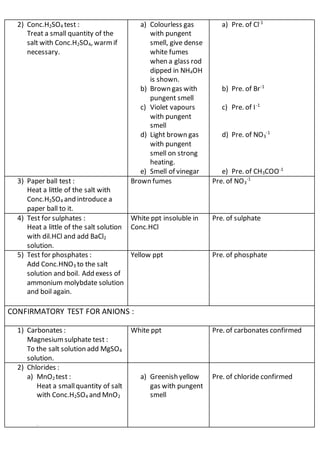
b) Chromylchloride test :
Salt is heated with
conc.sulphuric acid and
pot.dichromate.
The vapours arecollected
and passed through NaOH
solution.
Add lead acetate solution to
this.
c) Silver nitrate test :
Acidify the salt solution with
dil.nitric acid and add silver
nitrate solution.
b) Reddish brown
vapours
Yellow solution
Yellow ppt
c) White curdy ppt
soluble in excess
of NH4OH
Pre. of chloride confirmed
3) Acetates :
a) Oxalic acid test :
Make a paste of the salt
with oxalic acid. Rub the
paste and smell.
b) Ester test :
To the salt add conc.H2SO4
and heat. Add alcohol.
Shake. Pour the contents
into a beaker containing
water.
c) Ferric chloride test :
To the salt solution add
neutral ferric chloride
solution. Filter. Dividethe
filtrate into two portions :
I. To one add dil.HCl.
II. To the second, add
water and boil
a) Smell of vinegar
b) Pleasant fruity
smell
c) Reddish coloured
ppt
I. Reddish colour
disappears
II. Reddish ppt
Pre. of acetate
Pre. of acetate confirmed
4) Sulphate :
a) To the salt solution add
dil.HCl and barium chloride
solution.
b) To the salt solution add
acetic acid and lead acetate
solution.
White ppt insoluble in
HCl
White ppt solublein hot
ammonium acetate
Pre. of sulphate confirmed
5) Phosphate:
a) Ammonium molybdatetest :
To salt solution add
conc.HNO3 and boil. Add
ammonium molybdate and
a) Yellow ppt Pre. of phosphate
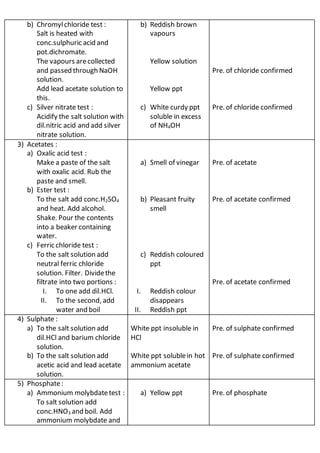
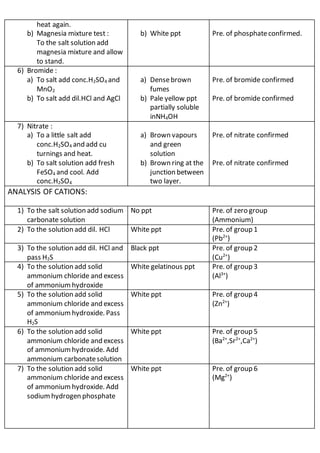
heat again.
b) Magnesia mixture test :
To the salt solution add
magnesia mixture and allow
to stand.
b) White ppt Pre. of phosphateconfirmed.
6) Bromide :
a) To salt add conc.H2SO4 and
MnO2
b) To salt add dil.HCl and AgCl
a) Densebrown
fumes
b) Pale yellow ppt
partially soluble
inNH4OH
Pre. of bromide confirmed
7) Nitrate :
a) To a little salt add
conc.H2SO4 and add cu
turnings and heat.
b) To salt solution add fresh
FeSO4 and cool. Add
conc.H2SO4
a) Brown vapours
and green
solution
b) Brown ring at the
junction between
two layer.
Pre. of nitrate confirmed
ANALYSIS OF CATIONS:
1) To the salt solution add sodium
carbonate solution
No ppt Pre. of zero group
(Ammonium)
2) To the solution add dil. HCl White ppt Pre. of group 1
(Pb2+
)
3) To the solution add dil. HCl and
pass H2S
Black ppt Pre. of group 2
(Cu2+
)
4) To the solution add solid
ammonium chloride and excess
of ammonium hydroxide
White gelatinous ppt Pre. of group 3
(Al3+
)
5) To the solution add solid
ammonium chloride and excess
of ammonium hydroxide. Pass
H2S
White ppt Pre. of group 4
(Zn2+
)
6) To the solution add solid
ammonium chloride and excess
of ammonium hydroxide. Add
ammonium carbonatesolution
White ppt Pre. of group 5
(Ba2+
,Sr2+
,Ca2+
)
7) To the solution add solid
ammonium chloride and excess
of ammonium hydroxide. Add
sodium hydrogen phosphate
White ppt Pre. of group 6
(Mg2+
)
ANALYSIS OF GROUP 0(AMMONIUM)
1) To the salt solution add NaOH
solution. Warm
Smell of ammonia.
Gives white dense
fumes when a glass rod
dipped in HCl is
introduced.
Pre. of ammonium confirmed
2) To the salt solution add NaOH
solution. Warm. Add Nesslers
reagent
Brown ppt Pre. of ammonium confirmed
ANALYSIS OF GROUP 1(LEAD)
1) Potassium iodide test :
To the salt solution add KI
solution
Yellow ppt Pre. of lead confirmed
2) Potassium chromate
test :
To the salt solution add
k2CrO4 solution
Yellow ppt Pre. of lead confirmed
ANALYSIS OF GROUP 2(Copper)
1) To the salt solution add few
drops of potassium
ferrocyanidesolution and
acetic acid.
Chocolate coloured
precipitate
Pre. of Cu2+
confirmed
2) To the salt solution add acetic
acid and potassium iodide
solution.
White ppt Pre. of Cu2+
confirmed
3) To the salt solution add NH4OH
solution.
Deep blue colour Pre. of Cu2+
confirmed
ANALYSIS OF GROUP 3(Aluminium)
1) The white ppt obtained is
dissolved in dil.HCl
Add 2 drops of blue litmus
solution. Then add ammonium
hydroxidedropwisetill blue
colour develops.
Blue ppt floating in
colourless solution
Pre. of aluminium confirmed
2) Add excess of NaOH to the salt
solution
White ppt solublein
excess of NaOH
Pre. of aluminium confirmed
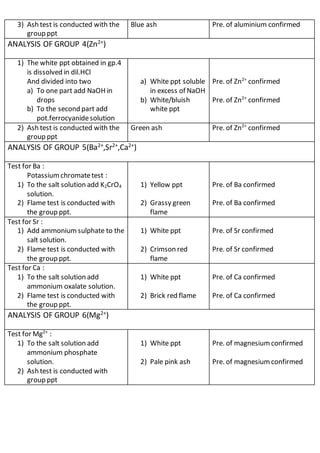
3) Ash test is conducted with the
group ppt
Blue ash Pre. of aluminium confirmed
ANALYSIS OF GROUP 4(Zn2+
)
1) The white ppt obtained in gp.4
is dissolved in dil.HCl
And divided into two
a) To one part add NaOH in
drops
b) To the second part add
pot.ferrocyanidesolution
a) White ppt soluble
in excess of NaOH
b) White/bluish
white ppt
Pre. of Zn2+
confirmed
Pre. of Zn2+
confirmed
2) Ash test is conducted with the
group ppt
Green ash Pre. of Zn2+
confirmed
ANALYSIS OF GROUP 5(Ba2+
,Sr2+
,Ca2+
)
Test for Ba :
Potassium chromatetest :
1) To the salt solution add K2CrO4
solution.
2) Flame test is conducted with
the group ppt.
1) Yellow ppt
2) Grassy green
flame
Pre. of Ba confirmed
Test for Sr :
1) Add ammonium sulphate to the
salt solution.
2) Flame test is conducted with
the group ppt.
1) White ppt
2) Crimson red
flame
Pre. of Sr confirmed
Test for Ca :
1) To the salt solution add
ammonium oxalate solution.
2) Flame test is conducted with
the group ppt.
1) White ppt
2) Brick red flame
Pre. of Ca confirmed
ANALYSIS OF GROUP 6(Mg2+
)
Test for Mg2+
:
1) To the salt solution add
ammonium phosphate
solution.
2) Ash test is conducted with
group ppt
1) White ppt
2) Pale pink ash
Pre. of magnesium confirmed

CHEMISTRY Salt analysis class 12

  • 1.
    SALT ANALYSIS SCHEME OFANALYSIS EXPERIMENT OBSERVATION INFERENCE PRELIMINARY EXAMINATIONS : 1) Noted the colour Colourless Absenceof Cu2+ ,Fe2+ ,Fe3+ ,Mn2+ ,Co2+ ,Ni2+ Blue Pre. of Cu2+ Brown Pre. of Fe3+ Green Pre. of Ni2+ Pale pink Pre. of Mn2+ Pink Pre. of Co2+ 2) Noted the solubility a) In water b) In dil.HCl a) Soluble and no ppt with Na2CO3 b) Insoluble a) Pre. of NH4 + b) Pre. of Pb2+ 3) Flame Test : A little of the salt is made into paste with conc.HCl. A glass rod is dipped in it and introduced into the flame. a) Blue surrounded by green b) Brick red c) Crimson red d) Bluish white e) Grassy green on prolonged heating a) Pre. of Cu2+ b) Pre. of Ca2+ c) Pre. of Sr2+ d) Pre. of Pb2+ e) Pre. of Ba2+ 4) Ash Test : A little of the salt is heated with con.HNO3 and cobalt nitrate solution. A filter paper is dipped in it and burnt. a) Green ash b) Blue tinted ash c) Pale pink ash a) Pre. of Zn2+ b) Pre. of Al3+ c) Pre. of Mg2+ SYSTEMATIC ANALYSIS OF ANIONS : 1) Dil.H2SO4 test : To the salt add dil.H2SO4, warm if required. a) Evolution of Colourless, odourless gas with brisk effervescence, turns limewater milky. b) Smell of vinegar a) Pre. of carbonates b) Pre. of acetate
  • 2.
    2) Conc.H2SO4 test: Treat a small quantity of the salt with Conc.H2SO4, warmif necessary. a) Colourless gas with pungent smell, give dense white fumes when a glass rod dipped in NH4OH is shown. b) Brown gas with pungent smell c) Violet vapours with pungent smell d) Light brown gas with pungent smell on strong heating. e) Smell of vinegar a) Pre. of Cl-1 b) Pre. of Br-1 c) Pre. of I-1 d) Pre. of NO3 -1 e) Pre. of CH3COO-1 3) Paper ball test : Heat a little of the salt with Conc.H2SO4 and introduce a paper ball to it. Brown fumes Pre. of NO3 -1 4) Test for sulphates : Heat a little of the salt solution with dil.HCl and add BaCl2 solution. White ppt insoluble in Conc.HCl Pre. of sulphate 5) Test for phosphates : Add Conc.HNO3 to the salt solution and boil. Add exess of ammonium molybdate solution and boil again. Yellow ppt Pre. of phosphate CONFIRMATORY TEST FOR ANIONS : 1) Carbonates : Magnesium sulphate test : To the salt solution add MgSO4 solution. White ppt Pre. of carbonates confirmed 2) Chlorides : a) MnO2 test : Heat a smallquantity of salt with Conc.H2SO4 and MnO2 . a) Greenish yellow gas with pungent smell Pre. of chloride confirmed
  • 3.
    b) Chromylchloride test: Salt is heated with conc.sulphuric acid and pot.dichromate. The vapours arecollected and passed through NaOH solution. Add lead acetate solution to this. c) Silver nitrate test : Acidify the salt solution with dil.nitric acid and add silver nitrate solution. b) Reddish brown vapours Yellow solution Yellow ppt c) White curdy ppt soluble in excess of NH4OH Pre. of chloride confirmed Pre. of chloride confirmed 3) Acetates : a) Oxalic acid test : Make a paste of the salt with oxalic acid. Rub the paste and smell. b) Ester test : To the salt add conc.H2SO4 and heat. Add alcohol. Shake. Pour the contents into a beaker containing water. c) Ferric chloride test : To the salt solution add neutral ferric chloride solution. Filter. Dividethe filtrate into two portions : I. To one add dil.HCl. II. To the second, add water and boil a) Smell of vinegar b) Pleasant fruity smell c) Reddish coloured ppt I. Reddish colour disappears II. Reddish ppt Pre. of acetate Pre. of acetate confirmed Pre. of acetate confirmed 4) Sulphate : a) To the salt solution add dil.HCl and barium chloride solution. b) To the salt solution add acetic acid and lead acetate solution. White ppt insoluble in HCl White ppt solublein hot ammonium acetate Pre. of sulphate confirmed Pre. of sulphate confirmed 5) Phosphate: a) Ammonium molybdatetest : To salt solution add conc.HNO3 and boil. Add ammonium molybdate and a) Yellow ppt Pre. of phosphate
  • 4.
    heat again. b) Magnesiamixture test : To the salt solution add magnesia mixture and allow to stand. b) White ppt Pre. of phosphateconfirmed. 6) Bromide : a) To salt add conc.H2SO4 and MnO2 b) To salt add dil.HCl and AgCl a) Densebrown fumes b) Pale yellow ppt partially soluble inNH4OH Pre. of bromide confirmed Pre. of bromide confirmed 7) Nitrate : a) To a little salt add conc.H2SO4 and add cu turnings and heat. b) To salt solution add fresh FeSO4 and cool. Add conc.H2SO4 a) Brown vapours and green solution b) Brown ring at the junction between two layer. Pre. of nitrate confirmed Pre. of nitrate confirmed ANALYSIS OF CATIONS: 1) To the salt solution add sodium carbonate solution No ppt Pre. of zero group (Ammonium) 2) To the solution add dil. HCl White ppt Pre. of group 1 (Pb2+ ) 3) To the solution add dil. HCl and pass H2S Black ppt Pre. of group 2 (Cu2+ ) 4) To the solution add solid ammonium chloride and excess of ammonium hydroxide White gelatinous ppt Pre. of group 3 (Al3+ ) 5) To the solution add solid ammonium chloride and excess of ammonium hydroxide. Pass H2S White ppt Pre. of group 4 (Zn2+ ) 6) To the solution add solid ammonium chloride and excess of ammonium hydroxide. Add ammonium carbonatesolution White ppt Pre. of group 5 (Ba2+ ,Sr2+ ,Ca2+ ) 7) To the solution add solid ammonium chloride and excess of ammonium hydroxide. Add sodium hydrogen phosphate White ppt Pre. of group 6 (Mg2+ )
  • 5.
    ANALYSIS OF GROUP0(AMMONIUM) 1) To the salt solution add NaOH solution. Warm Smell of ammonia. Gives white dense fumes when a glass rod dipped in HCl is introduced. Pre. of ammonium confirmed 2) To the salt solution add NaOH solution. Warm. Add Nesslers reagent Brown ppt Pre. of ammonium confirmed ANALYSIS OF GROUP 1(LEAD) 1) Potassium iodide test : To the salt solution add KI solution Yellow ppt Pre. of lead confirmed 2) Potassium chromate test : To the salt solution add k2CrO4 solution Yellow ppt Pre. of lead confirmed ANALYSIS OF GROUP 2(Copper) 1) To the salt solution add few drops of potassium ferrocyanidesolution and acetic acid. Chocolate coloured precipitate Pre. of Cu2+ confirmed 2) To the salt solution add acetic acid and potassium iodide solution. White ppt Pre. of Cu2+ confirmed 3) To the salt solution add NH4OH solution. Deep blue colour Pre. of Cu2+ confirmed ANALYSIS OF GROUP 3(Aluminium) 1) The white ppt obtained is dissolved in dil.HCl Add 2 drops of blue litmus solution. Then add ammonium hydroxidedropwisetill blue colour develops. Blue ppt floating in colourless solution Pre. of aluminium confirmed 2) Add excess of NaOH to the salt solution White ppt solublein excess of NaOH Pre. of aluminium confirmed
  • 6.
    3) Ash testis conducted with the group ppt Blue ash Pre. of aluminium confirmed ANALYSIS OF GROUP 4(Zn2+ ) 1) The white ppt obtained in gp.4 is dissolved in dil.HCl And divided into two a) To one part add NaOH in drops b) To the second part add pot.ferrocyanidesolution a) White ppt soluble in excess of NaOH b) White/bluish white ppt Pre. of Zn2+ confirmed Pre. of Zn2+ confirmed 2) Ash test is conducted with the group ppt Green ash Pre. of Zn2+ confirmed ANALYSIS OF GROUP 5(Ba2+ ,Sr2+ ,Ca2+ ) Test for Ba : Potassium chromatetest : 1) To the salt solution add K2CrO4 solution. 2) Flame test is conducted with the group ppt. 1) Yellow ppt 2) Grassy green flame Pre. of Ba confirmed Pre. of Ba confirmed Test for Sr : 1) Add ammonium sulphate to the salt solution. 2) Flame test is conducted with the group ppt. 1) White ppt 2) Crimson red flame Pre. of Sr confirmed Pre. of Sr confirmed Test for Ca : 1) To the salt solution add ammonium oxalate solution. 2) Flame test is conducted with the group ppt. 1) White ppt 2) Brick red flame Pre. of Ca confirmed Pre. of Ca confirmed ANALYSIS OF GROUP 6(Mg2+ ) Test for Mg2+ : 1) To the salt solution add ammonium phosphate solution. 2) Ash test is conducted with group ppt 1) White ppt 2) Pale pink ash Pre. of magnesium confirmed Pre. of magnesium confirmed