Opportunity
Execution
Project
  Venture Lab Assignment:
       Tech-Educate
Personal story & Team
description
The story of our team comes from different sources. Alicia, Victoria and
Lola met on Twitter. After a time of a very good twitter relationship they met
several times (as they all come from different cities) and they decided to
participate in this course together. Alicia, Lola and Victoria share great
experience as EFL teachers and the idea of focussing on education and
technology was clear since the very beginning. Then, Ankush, attracted to
the idea of education and technology, joined the team and he provided "the
business knowledge" to our team. Unfortunately, Ankush went through
some personal problems and couldn't finish the course, but his participation
at the beginning of the course was very active and enriching.
Product description


Our startup idea is Languages e-school, an online school to learn and
practise languages that offers the customer a very exclusive learning
environment designed to meet their needs. It includes exclusive lessons on
videos designed by an heterogeneous team of skilled professionals giving
the customers a better pool from which to choose. It also provides the
students with a space to ask questions and to practise speaking with the
teacher they choose, and also with a forum where they will have the
possibility of practicing the language with other users. The platform also
offers a series of streaming lectures by other talented educators, a library
including a wide range of materials and resources. An application for IOS
and Android to access the platform from mobile devices is also available.


*This simple prototype gives an idea of the website.
Our Business Model
•   Customers segment: All language learners from 18 and above
-Big companies (Professional Development Departments)
-Teachers
-Libraries
-Researchers
-Editorials


•   Value propositions: A unique collection of contents (courses, videos,
    syllabus,...) on foreign languages, including video content library,
    lectures in streaming, a forum where learners from different countries
    can interact with each other, and an heterogeneous group of skilled
    professionals giving the customers a better pool from which to choose.
    Access to content through mobile app and online platform.
Our Business Model

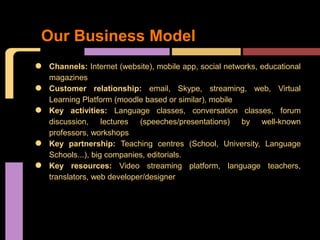
•   Channels: Internet (website), mobile app, social networks, educational
    magazines
•   Customer relationship: email, Skype, streaming, web, Virtual
    Learning Platform (moodle based or similar), mobile
•   Key activities: Language classes, conversation classes, forum
    discussion, lectures (speeches/presentations) by well-known
    professors, workshops
•   Key partnership: Teaching centres (School, University, Language
    Schools...), big companies, editorials.
•   Key resources: Video streaming platform, language teachers,
    translators, web developer/designer
Our Business Model

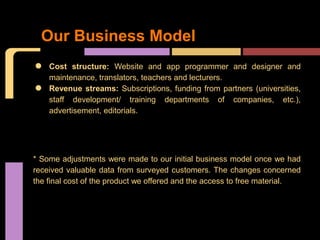
•   Cost structure: Website and app programmer and designer and
    maintenance, translators, teachers and lecturers.
•   Revenue streams: Subscriptions, funding from partners (universities,
    staff development/ training departments of companies, etc.),
    advertisement, editorials.


* Some adjustments were made to our initial business model once we had
received valuable data from surveyed customers. The changes concerned
the final cost of the product we offered and the access to free material.
Partnerships

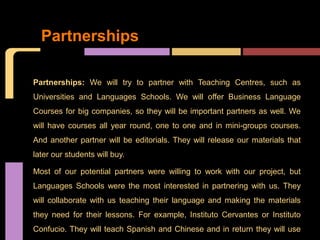
Partnerships: We will try to partner with Teaching Centres, such as
Universities and Languages Schools. We will offer Business Language
Courses for big companies, so they will be important partners as well. We
will have courses all year round, one to one and in mini-groups courses.
And another partner will be editorials. They will release our materials that
later our students will buy.

Most of our potential partners were willing to work with our project, but
Languages Schools were the most interested in partnering with us. They
will collaborate with us teaching their language and making the materials
they need for their lessons. For example, Instituto Cervantes or Instituto
Confucio. They will teach Spanish and Chinese and in return they will use
Distribution


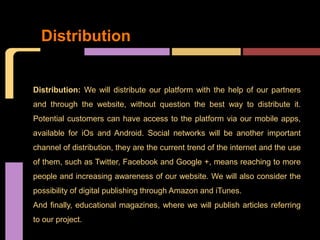
Distribution: We will distribute our platform with the help of our partners
and through the website, without question the best way to distribute it.
Potential customers can have access to the platform via our mobile apps,
available for iOs and Android. Social networks will be another important
channel of distribution, they are the current trend of the internet and the use
of them, such as Twitter, Facebook and Google +, means reaching to more
people and increasing awareness of our website. We will also consider the
possibility of digital publishing through Amazon and iTunes.
And finally, educational magazines, where we will publish articles referring
to our project.
Sales and Marketing Strategy

•   Free apps/ free subscriptions/ free trials to generate demand or get
    upgrades to pro content.


•   Presence in major social networks (cost free for us): Twitter
                                                         Facebook
                                                         Google+
Revenue Model
Changes were made in our revenue model. Based on the surveys and
interviews conducted, 53% of potential customers were willing to pay up to
$20 per month. We decided to adjust the price of our packages and offer
more content with a free subscription (freemium service).


Funding (from partners and venture capitalist)
We will have to bootstrap for about 2 years. Apart from subscriptions, our
major source of income, we will ask for an investment from the venture
capitalist of at least $100.000 for 20% stake in our company. That will allow
us to move forward and develop the platform, apps and resources.
Other sources of income are advertisements (mainly from editorials) in our
web and apps.
The fact that most of the platforms we will be using are cost free (Skype,
moodle, etc.) also contributes to minimize the overall cost of running this e-
school business.
Risks


•   We find our main risk to be economic; finding investment could be
    hard, but we will participate in different funding meetings to show our
    product to potential investors.

•   Second, technical; building the infrastructure we need. For this reason,
    we will contact qualified web designers.

•   Differentiation from other online platforms. We have to improve our
    competitors offer.


 >>> Reduction of risk through customers surveys and close
observation of our competitors offer.
Conclusions
We have learnt from all the assignments of
this course and we would like to consider the
possibility of entrepreneuring a model similar
to the one we have been working in.

As we stated at the beginning of this course:

   Education + Technology = Future

Opportunity execution project

  • 1.
    Opportunity Execution Project VentureLab Assignment: Tech-Educate
  • 2.
    Personal story &Team description The story of our team comes from different sources. Alicia, Victoria and Lola met on Twitter. After a time of a very good twitter relationship they met several times (as they all come from different cities) and they decided to participate in this course together. Alicia, Lola and Victoria share great experience as EFL teachers and the idea of focussing on education and technology was clear since the very beginning. Then, Ankush, attracted to the idea of education and technology, joined the team and he provided "the business knowledge" to our team. Unfortunately, Ankush went through some personal problems and couldn't finish the course, but his participation at the beginning of the course was very active and enriching.
  • 3.
    Product description Our startupidea is Languages e-school, an online school to learn and practise languages that offers the customer a very exclusive learning environment designed to meet their needs. It includes exclusive lessons on videos designed by an heterogeneous team of skilled professionals giving the customers a better pool from which to choose. It also provides the students with a space to ask questions and to practise speaking with the teacher they choose, and also with a forum where they will have the possibility of practicing the language with other users. The platform also offers a series of streaming lectures by other talented educators, a library including a wide range of materials and resources. An application for IOS and Android to access the platform from mobile devices is also available. *This simple prototype gives an idea of the website.
  • 4.
    Our Business Model • Customers segment: All language learners from 18 and above -Big companies (Professional Development Departments) -Teachers -Libraries -Researchers -Editorials • Value propositions: A unique collection of contents (courses, videos, syllabus,...) on foreign languages, including video content library, lectures in streaming, a forum where learners from different countries can interact with each other, and an heterogeneous group of skilled professionals giving the customers a better pool from which to choose. Access to content through mobile app and online platform.
  • 5.
    Our Business Model • Channels: Internet (website), mobile app, social networks, educational magazines • Customer relationship: email, Skype, streaming, web, Virtual Learning Platform (moodle based or similar), mobile • Key activities: Language classes, conversation classes, forum discussion, lectures (speeches/presentations) by well-known professors, workshops • Key partnership: Teaching centres (School, University, Language Schools...), big companies, editorials. • Key resources: Video streaming platform, language teachers, translators, web developer/designer
  • 6.
    Our Business Model • Cost structure: Website and app programmer and designer and maintenance, translators, teachers and lecturers. • Revenue streams: Subscriptions, funding from partners (universities, staff development/ training departments of companies, etc.), advertisement, editorials. * Some adjustments were made to our initial business model once we had received valuable data from surveyed customers. The changes concerned the final cost of the product we offered and the access to free material.
  • 7.
    Partnerships Partnerships: We willtry to partner with Teaching Centres, such as Universities and Languages Schools. We will offer Business Language Courses for big companies, so they will be important partners as well. We will have courses all year round, one to one and in mini-groups courses. And another partner will be editorials. They will release our materials that later our students will buy. Most of our potential partners were willing to work with our project, but Languages Schools were the most interested in partnering with us. They will collaborate with us teaching their language and making the materials they need for their lessons. For example, Instituto Cervantes or Instituto Confucio. They will teach Spanish and Chinese and in return they will use
  • 8.
    Distribution Distribution: We willdistribute our platform with the help of our partners and through the website, without question the best way to distribute it. Potential customers can have access to the platform via our mobile apps, available for iOs and Android. Social networks will be another important channel of distribution, they are the current trend of the internet and the use of them, such as Twitter, Facebook and Google +, means reaching to more people and increasing awareness of our website. We will also consider the possibility of digital publishing through Amazon and iTunes. And finally, educational magazines, where we will publish articles referring to our project.
  • 9.
    Sales and MarketingStrategy • Free apps/ free subscriptions/ free trials to generate demand or get upgrades to pro content. • Presence in major social networks (cost free for us): Twitter Facebook Google+
  • 10.
    Revenue Model Changes weremade in our revenue model. Based on the surveys and interviews conducted, 53% of potential customers were willing to pay up to $20 per month. We decided to adjust the price of our packages and offer more content with a free subscription (freemium service). Funding (from partners and venture capitalist) We will have to bootstrap for about 2 years. Apart from subscriptions, our major source of income, we will ask for an investment from the venture capitalist of at least $100.000 for 20% stake in our company. That will allow us to move forward and develop the platform, apps and resources. Other sources of income are advertisements (mainly from editorials) in our web and apps. The fact that most of the platforms we will be using are cost free (Skype, moodle, etc.) also contributes to minimize the overall cost of running this e- school business.
  • 11.
    Risks • We find our main risk to be economic; finding investment could be hard, but we will participate in different funding meetings to show our product to potential investors. • Second, technical; building the infrastructure we need. For this reason, we will contact qualified web designers. • Differentiation from other online platforms. We have to improve our competitors offer. >>> Reduction of risk through customers surveys and close observation of our competitors offer.
  • 12.
    Conclusions We have learntfrom all the assignments of this course and we would like to consider the possibility of entrepreneuring a model similar to the one we have been working in. As we stated at the beginning of this course: Education + Technology = Future