OS in FP9
Jc Burgelman.
DG RTD
RSA OS policy Workshop
15-april 2018
(via Skype)
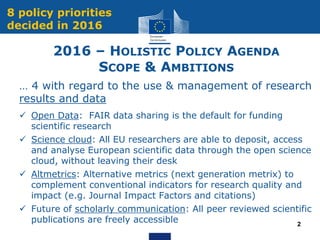
2016 – HOLISTIC POLICY AGENDA
SCOPE & AMBITIONS
… 4 with regard to the use & management of research
results and data
 Open Data: FAIR data sharing is the default for funding
scientific research
 Science cloud: All EU researchers are able to deposit, access
and analyse European scientific data through the open science
cloud, without leaving their desk
 Altmetrics: Alternative metrics (next generation metrix) to
complement conventional indicators for research quality and
impact (e.g. Journal Impact Factors and citations)
 Future of scholarly communication: All peer reviewed scientific
publications are freely accessible 2
8 policy priorities
decided in 2016
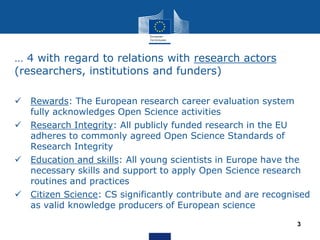
… 4 with regard to relations with research actors
(researchers, institutions and funders)
 Rewards: The European research career evaluation system
fully acknowledges Open Science activities
 Research Integrity: All publicly funded research in the EU
adheres to commonly agreed Open Science Standards of
Research Integrity
 Education and skills: All young scientists in Europe have the
necessary skills and support to apply Open Science research
routines and practices
 Citizen Science: CS significantly contribute and are recognised
as valid knowledge producers of European science
3
Open Science Policy now
• Mandatory Open Access to Publications:
2014: mandatory
2018: launch of Open Access Publishing Platform (stand-alone
peer reviewed scientific articles and pre-prints from
H2020 projects)
• Mandatory Open Access to research data:
2017: ORD Pilot (2014) extended to entire H2020;
Data is as open as possible, as closed as necessary;
FAIR Research DMPs;
2018: Revised Recommendation on Scientific Information
• European Open Science Cloud:
2018: launch of the 1st phase (adoption SWD)
• Rewards and Skills
2017: new matrix proposed
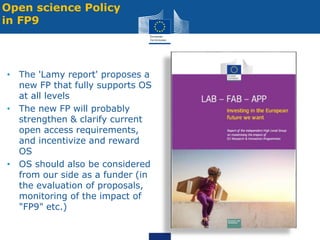
• The 'Lamy report' proposes a
new FP that fully supports OS
at all levels
• The new FP will probably
strengthen & clarify current
open access requirements,
and incentivize and reward
OS
• OS should also be considered
from our side as a funder (in
the evaluation of proposals,
monitoring of the impact of
"FP9" etc.)
Open science Policy
in FP9
How to make FP9
Open science “radiant’’
FP9: beyond Open Access (publications and data) to embrace &
incentivise OS as modus operandi for research and science
• FP9 clarifies and strengthens the OA obligations,
• FP9 empowers authors of scientific publications,
• FP9 is home of FAIR data sharing while complying with IPR rules and
exploitation obligations set in the GA
• FP9 broadens OA (with opting out options) to other research output
• FP9 promotes compliance with 'Open Science principles' through a combination
of obligations and incentives
• FP9 further implements sanctions for those beneficiaries significantly failing to
provide open access, requiring institutions to assume responsibility for their
intellectual output
• FP9 introduces the use of 'next generation' metrics for better assessing the
systemic impact of research output and the engagement in Open Science by
researchers and their institutions
Note: where necessary, justified exemptions remain possible
(‘as open as possible as closed as needed’)
(1) FAIR AND OPEN DATA
Actions
• • Ensuring, through the Model Grant Agreement, that
research data is open by default according to the
principle 'as open as possible, as closed as necessary'.
• • Making the development and implementation of a DMP
an obligation and a mandatory element of the Model
Grant Agreement for all projects (even if opt out)
• • Ensuring that Research Data Management is carried
out in compliance with the FAIR principles in order to
be EOSC compatible
8 policy priorities
Future actions
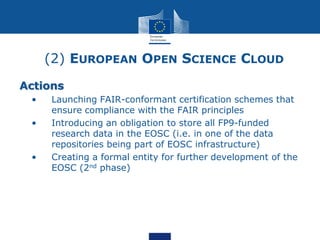
(2) EUROPEAN OPEN SCIENCE CLOUD
Actions
• • Launching FAIR-conformant certification schemes that
ensure compliance with the FAIR principles
• • Introducing an obligation to store all FP9-funded
research data in the EOSC (i.e. in one of the data
repositories being part of EOSC infrastructure)
• • Creating a formal entity for further development of the
EOSC (2nd phase)
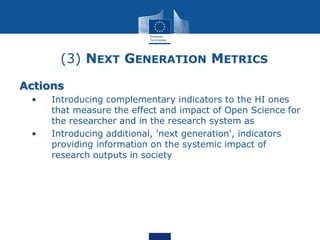
(3) NEXT GENERATION METRICS
Actions
• • Introducing complementary indicators to the HI ones
that measure the effect and impact of Open Science for
the researcher and in the research system as
• • Introducing additional, 'next generation', indicators
providing information on the systemic impact of
research outputs in society
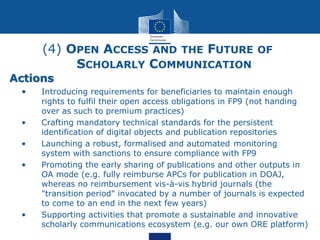
(4) OPEN ACCESS AND THE FUTURE OF
SCHOLARLY COMMUNICATION
Actions
• • Introducing requirements for beneficiaries to maintain enough
rights to fulfil their open access obligations in FP9 (not handing
over as such to premium practices)
• • Crafting mandatory technical standards for the persistent
identification of digital objects and publication repositories
• • Launching a robust, formalised and automated monitoring
system with sanctions to ensure compliance with FP9
• • Promoting the early sharing of publications and other outputs in
OA mode (e.g. fully reimburse APCs for publication in DOAJ,
whereas no reimbursement vis-à-vis hybrid journals (the
"transition period" invocated by a number of journals is expected
to come to an end in the next few years)
• • Supporting activities that promote a sustainable and innovative
scholarly communications ecosystem (e.g. our own ORE platform)
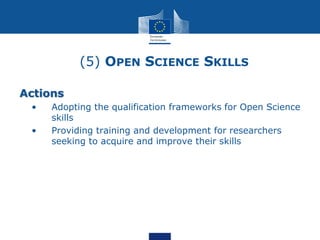
(5) OPEN SCIENCE SKILLS
Actions
• • Adopting the qualification frameworks for Open Science
skills
• • Providing training and development for researchers
seeking to acquire and improve their skills
(6) OPEN SCIENCE REWARDS
Actions
• • Introducing an Open Science label to recognise
universities which embody modern, collaborative
practices.
• • Encouraging uptake and dissemination of the Open
Science Career Assessment Matrix (CAM), developed in
cooperation with stakeholders
(7) RESEARCH INTEGRITY
Actions
• • Preparing for FP9 Research Integrity guidelines specifically
addressing Open Science
• • Enhancing in FP9 the funding of research that fosters the
uptake of OS and Research Integrity principles
• • Adapting the European Code of Conduct for RI in order
to further support the development of OS in Europe
• • Foreseeing in the FP9 Model Grant Agreement minimum
scientific quality requirements (e. g. publishing research
protocols) to facilitate reproducibility of research funded
under H2020
(8) CITIZEN SCIENCE
Actions
• • Ensuring funding for citizen science
• • Setting specific Key Performance and Impact Indicators
linked to citizen science activities

OS in FP9/JC Burgelman

  • 1.
    OS in FP9 JcBurgelman. DG RTD RSA OS policy Workshop 15-april 2018 (via Skype)
  • 2.
    2016 – HOLISTICPOLICY AGENDA SCOPE & AMBITIONS … 4 with regard to the use & management of research results and data  Open Data: FAIR data sharing is the default for funding scientific research  Science cloud: All EU researchers are able to deposit, access and analyse European scientific data through the open science cloud, without leaving their desk  Altmetrics: Alternative metrics (next generation metrix) to complement conventional indicators for research quality and impact (e.g. Journal Impact Factors and citations)  Future of scholarly communication: All peer reviewed scientific publications are freely accessible 2 8 policy priorities decided in 2016
  • 3.
    … 4 withregard to relations with research actors (researchers, institutions and funders)  Rewards: The European research career evaluation system fully acknowledges Open Science activities  Research Integrity: All publicly funded research in the EU adheres to commonly agreed Open Science Standards of Research Integrity  Education and skills: All young scientists in Europe have the necessary skills and support to apply Open Science research routines and practices  Citizen Science: CS significantly contribute and are recognised as valid knowledge producers of European science 3
  • 4.
    Open Science Policynow • Mandatory Open Access to Publications: 2014: mandatory 2018: launch of Open Access Publishing Platform (stand-alone peer reviewed scientific articles and pre-prints from H2020 projects) • Mandatory Open Access to research data: 2017: ORD Pilot (2014) extended to entire H2020; Data is as open as possible, as closed as necessary; FAIR Research DMPs; 2018: Revised Recommendation on Scientific Information • European Open Science Cloud: 2018: launch of the 1st phase (adoption SWD) • Rewards and Skills 2017: new matrix proposed
  • 5.
    • The 'Lamyreport' proposes a new FP that fully supports OS at all levels • The new FP will probably strengthen & clarify current open access requirements, and incentivize and reward OS • OS should also be considered from our side as a funder (in the evaluation of proposals, monitoring of the impact of "FP9" etc.) Open science Policy in FP9
  • 6.
    How to makeFP9 Open science “radiant’’ FP9: beyond Open Access (publications and data) to embrace & incentivise OS as modus operandi for research and science • FP9 clarifies and strengthens the OA obligations, • FP9 empowers authors of scientific publications, • FP9 is home of FAIR data sharing while complying with IPR rules and exploitation obligations set in the GA • FP9 broadens OA (with opting out options) to other research output • FP9 promotes compliance with 'Open Science principles' through a combination of obligations and incentives • FP9 further implements sanctions for those beneficiaries significantly failing to provide open access, requiring institutions to assume responsibility for their intellectual output • FP9 introduces the use of 'next generation' metrics for better assessing the systemic impact of research output and the engagement in Open Science by researchers and their institutions Note: where necessary, justified exemptions remain possible (‘as open as possible as closed as needed’)
  • 7.
    (1) FAIR ANDOPEN DATA Actions • • Ensuring, through the Model Grant Agreement, that research data is open by default according to the principle 'as open as possible, as closed as necessary'. • • Making the development and implementation of a DMP an obligation and a mandatory element of the Model Grant Agreement for all projects (even if opt out) • • Ensuring that Research Data Management is carried out in compliance with the FAIR principles in order to be EOSC compatible 8 policy priorities Future actions
  • 8.
    (2) EUROPEAN OPENSCIENCE CLOUD Actions • • Launching FAIR-conformant certification schemes that ensure compliance with the FAIR principles • • Introducing an obligation to store all FP9-funded research data in the EOSC (i.e. in one of the data repositories being part of EOSC infrastructure) • • Creating a formal entity for further development of the EOSC (2nd phase)
  • 9.
    (3) NEXT GENERATIONMETRICS Actions • • Introducing complementary indicators to the HI ones that measure the effect and impact of Open Science for the researcher and in the research system as • • Introducing additional, 'next generation', indicators providing information on the systemic impact of research outputs in society
  • 10.
    (4) OPEN ACCESSAND THE FUTURE OF SCHOLARLY COMMUNICATION Actions • • Introducing requirements for beneficiaries to maintain enough rights to fulfil their open access obligations in FP9 (not handing over as such to premium practices) • • Crafting mandatory technical standards for the persistent identification of digital objects and publication repositories • • Launching a robust, formalised and automated monitoring system with sanctions to ensure compliance with FP9 • • Promoting the early sharing of publications and other outputs in OA mode (e.g. fully reimburse APCs for publication in DOAJ, whereas no reimbursement vis-à-vis hybrid journals (the "transition period" invocated by a number of journals is expected to come to an end in the next few years) • • Supporting activities that promote a sustainable and innovative scholarly communications ecosystem (e.g. our own ORE platform)
  • 11.
    (5) OPEN SCIENCESKILLS Actions • • Adopting the qualification frameworks for Open Science skills • • Providing training and development for researchers seeking to acquire and improve their skills
  • 12.
    (6) OPEN SCIENCEREWARDS Actions • • Introducing an Open Science label to recognise universities which embody modern, collaborative practices. • • Encouraging uptake and dissemination of the Open Science Career Assessment Matrix (CAM), developed in cooperation with stakeholders
  • 13.
    (7) RESEARCH INTEGRITY Actions •• Preparing for FP9 Research Integrity guidelines specifically addressing Open Science • • Enhancing in FP9 the funding of research that fosters the uptake of OS and Research Integrity principles • • Adapting the European Code of Conduct for RI in order to further support the development of OS in Europe • • Foreseeing in the FP9 Model Grant Agreement minimum scientific quality requirements (e. g. publishing research protocols) to facilitate reproducibility of research funded under H2020
  • 14.
    (8) CITIZEN SCIENCE Actions •• Ensuring funding for citizen science • • Setting specific Key Performance and Impact Indicators linked to citizen science activities