Pilot Study and Landscape
Findings
Himla Soodyall & Ina Smith
Academy of Science of South Africa (ASSAf)
AOSP Delivery Phase Planning Workshop,
Alexandria, Egypt
2 - 3 Sept. 2019
Part I:
Pilot Study – Himla Soodyall
About AOSP
• Outcome of ISC “Open Data in a
Big Data World”
• NRF/ASSAf agreement signed on
9 Feb. 2017
• October 2016 – October 2019 (3
years)
• Fully funded by the National
Research Foundation (NRF) (SA
Dept. of Science and Technology)
• Directed by CODATA (ISC)
• Managed by Academy of Science
of South Africa (ASSAf)
• Through ASSAf hosting ISC
Regional Office for Africa (ISC
ROA)
Addressing the UN SDGs
“… Africa’s common objectives
and commitment to
collective actions to develop
and use science and
technology for the socio-
economic transformation of
the continent and its
integration into the world
economy.”
- Africa Consolidated Science and
Technology Plan of Action (2005)
UNECA Africa Regional Forum
“T[t]he creation of an African
platform for research and
innovation exchange will enable
the dissemination of goal-relevant
African research and innovation to
governments and citizens. It could
form the basis for linking
researchers and innovators with
the funding required to scale up
their work. The proposed platform
would showcase and share Africa’s
efforts to develop goal-relevant
research and innovation and could
be coordinated with the Global
Innovation Exchange.” – Dakar (2018)
STI Strategy of Africa 2024
8 Priorities for the African research community –
will be requiring data, data sharing, openness (as
open possible, as closed necessary) and
collaboration:
disease prevention & control;
climate resilience (disaster risk);
environmental protection (biosphere, hydrosphere);
food and nutritional security;
smart resilient cities;
achieving sustainability goals;
improved knowledge production;
improved intra-Africa research collaboration.
South African White Paper on STI
“As part of its commitment to
African STI cooperation, South
Africa will also work to advance
the open science agenda
elsewhere on the continent and
within regional frameworks. The
strategic role of the African Open
Science Platform, hosted by the
Academy of Science of South
Africa, which promotes African-
wide development and
coordination of data policies, data
training and data infrastructure,
will be leveraged with the support
of the DST and the National
Research Foundation (NRF).”
– SA White Paper on Science, Technology
and Innovation (2018)
7 Pilot Deliverables
Established an African Open Data Forum
Launched AOSP during SFSA 2016
Framework for incentives for sharing
research data
Framework for open data policies
Framework for capacity building in research
data
Framework & roadmap for e-Infrastructure
Landscape report on Open Data in Africa
Specific Highlights
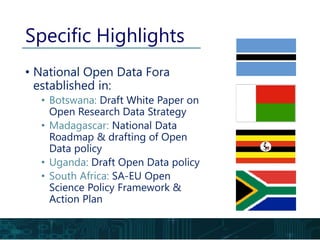
• National Open Data Fora
established in:
• Botswana: Draft White Paper on
Open Research Data Strategy
• Madagascar: National Data
Roadmap & drafting of Open
Data policy
• Uganda: Draft Open Data policy
• South Africa: SA-EU Open
Science Policy Framework &
Action Plan
African Open Data Forum
• 44+ AOSP events attended by representatives from 37
African countries – funded many individuals
• 66+ data-intensive research initiatives identified (incl.
priority disciplines)
• Registry of 1,900 individuals in OS, OD, STI, ICT, IPR, HE,
Funders
• AOSP School of Research Data Science – Ethiopia
(2019) (with CODATA & RDA)
• International, Continental, National
• Website http://africanopenscience.org.za/
• Mailing list
• Webinars
• Desktop & Literature Studies
Stakeholder Consultation
• AAS
• AfDB
• AU – NEPAD, PAP
• AAU
• ISC (CODATA, WDS,
ROA)
• African governments,
research councils,
universities
• Centres of Excellence
• NAS & NASAC
• NRENs
• RDA
• SGCI
• TWAS
• UN
• IAP
• Etc
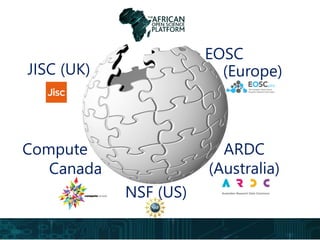
JISC (UK)
NSF (US)
(Europe)
Compute ARDC
(Australia)
EOSC
Canada
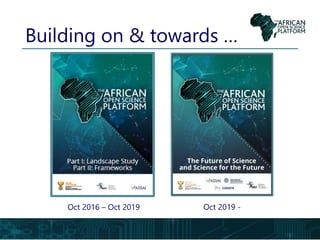
Building on & towards …
Oct 2016 – Oct 2019 Oct 2019 -
Part II:
Selected Landscape Study Findings –
Ina Smith
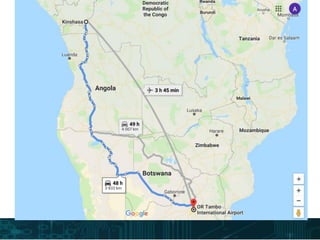
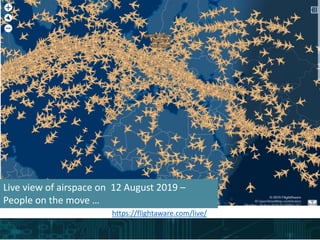
https://flightaware.com/live/
Live view of airspace on 12 August 2019 –
People on the move …
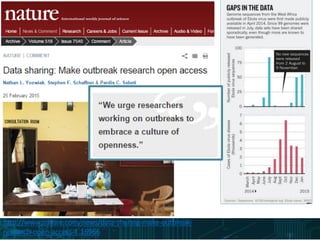
http://www.nature.com/news/data-sharing-make-outbreak-
research-open-access-1.16966
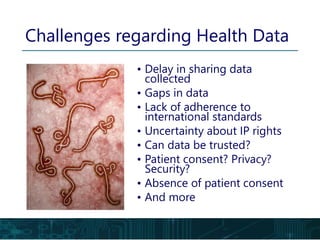
Challenges regarding Health Data
• Delay in sharing data
collected
• Gaps in data
• Lack of adherence to
international standards
• Uncertainty about IP rights
• Can data be trusted?
• Patient consent? Privacy?
Security?
• Absence of patient consent
• And more
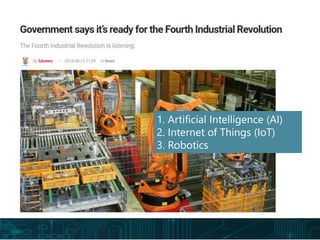
1. Artificial Intelligence (AI)
2. Internet of Things (IoT)
3. Robotics
Government Data
• Strategy for the Harmonisation of Statistics in
Africa (SHaSA) (ECA, AfDB, AU)
• AFRISTAT
• STATAFRIC (Pan-African Institute for Statistics)
• Sunlight Foundation
• Open Data Barometer
• G20 Anti-Corruption Open Data Principles
• Africa Data Consensus Roadmap
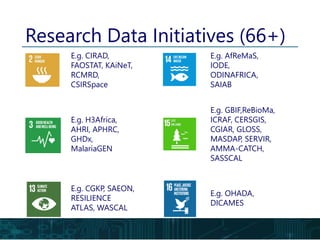
E.g. CIRAD,
FAOSTAT, KAiNeT,
RCMRD,
CSIRSpace
E.g. H3Africa,
AHRI, APHRC,
GHDx,
MalariaGEN
E.g. CGKP, SAEON,
RESILIENCE
ATLAS, WASCAL
E.g. AfReMaS,
IODE,
ODINAFRICA,
SAIAB
E.g. GBIF,ReBioMa,
ICRAF, CERSGIS,
CGIAR, GLOSS,
MASDAP, SERVIR,
AMMA-CATCH,
SASSCAL
E.g. OHADA,
DICAMES
Research Data Initiatives (66+)
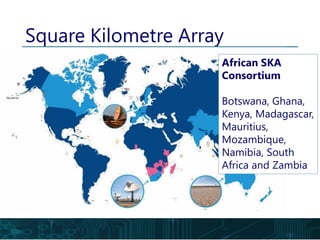
Square Kilometre Array
African SKA
Consortium
Botswana, Ghana,
Kenya, Madagascar,
Mauritius,
Mozambique,
Namibia, South
Africa and Zambia
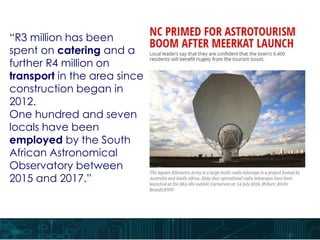
“R3 million has been
spent on catering and a
further R4 million on
transport in the area since
construction began in
2012.
One hundred and seven
locals have been
employed by the South
African Astronomical
Observatory between
2015 and 2017.”
SKA SA Managing Director Rob Adam
said, “We have electricians being trained,
boilermakers, fitters and turners and
people splashing the fibre that carries the
signal from the satellites through the
computers, that fibre is being splashed by
people from the local community.”
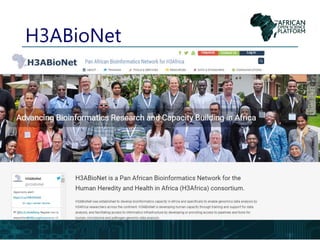
H3ABioNet
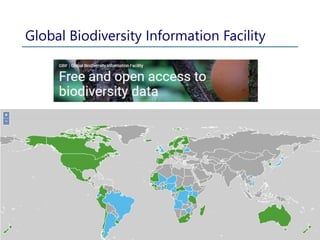
Global Biodiversity Information Facility
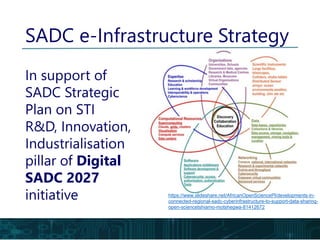
https://www.slideshare.net/AfricanOpenSciencePl/developments-in-
connected-regional-sadc-cyberinfrastructure-to-support-data-sharing-
open-sciencetshiamo-motshegwa-81412672
SADC e-Infrastructure Strategy
In support of
SADC Strategic
Plan on STI
R&D, Innovation,
Industrialisation
pillar of Digital
SADC 2027
initiative
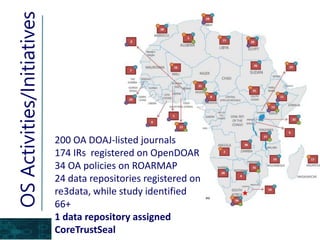
OSActivities/Initiatives
200 OA DOAJ-listed journals
174 IRs registered on OpenDOAR
34 OA policies on ROARMAP
24 data repositories registered on
re3data, while study identified
66+
1 data repository assigned
CoreTrustSeal
BUT …
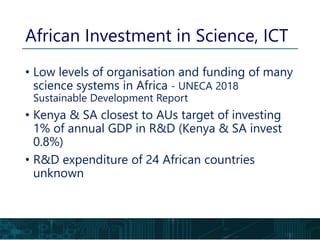
African Investment in Science, ICT
• Low levels of organisation and funding of many
science systems in Africa - UNECA 2018
Sustainable Development Report
• Kenya & SA closest to AUs target of investing
1% of annual GDP in R&D (Kenya & SA invest
0.8%)
• R&D expenditure of 24 African countries
unknown
Political Willingness
National Academies of Science [26]
National Young Academies of Science [18]
R&D spending between 0.5%-0.8% of GDP [12]
African Science Granting Councils [15]
Incentives & recognition for sharing research data [2]
Ministries of Science/Technology/Innovation [25]
National Open Data policy & policy initiatives [5]
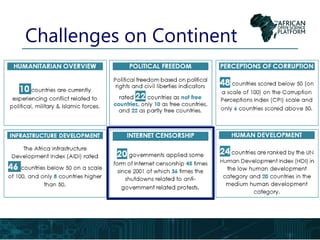
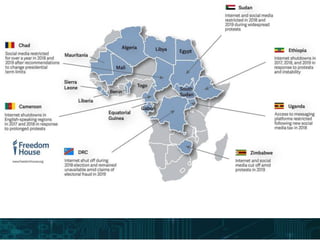
Challenges on Continent
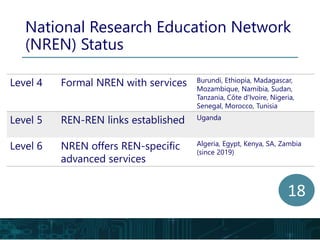
Level 4 Formal NREN with services Burundi, Ethiopia, Madagascar,
Mozambique, Namibia, Sudan,
Tanzania, Côte d'Ivoire, Nigeria,
Senegal, Morocco, Tunisia
Level 5 REN-REN links established Uganda
Level 6 NREN offers REN-specific
advanced services
Algeria, Egypt, Kenya, SA, Zambia
(since 2019)
18
National Research Education Network
(NREN) Status
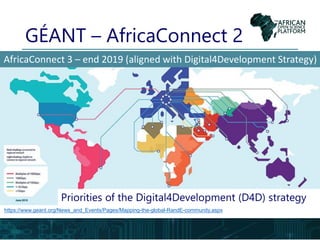
GÉANT – AfricaConnect 2
https://www.geant.org/News_and_Events/Pages/Mapping-the-global-RandE-community.aspx
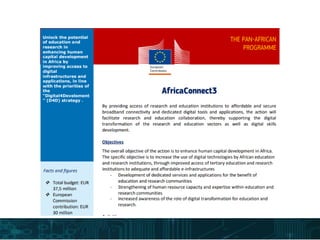
AfricaConnect 3 – end 2019 (aligned with Digital4Development Strategy)
Priorities of the Digital4Development (D4D) strategy
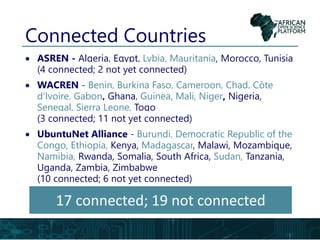
Connected Countries
 ASREN - Algeria, Egypt, Lybia, Mauritania, Morocco, Tunisia
(4 connected; 2 not yet connected)
 WACREN - Benin, Burkina Faso, Cameroon, Chad, Côte
d’Ivoire, Gabon, Ghana, Guinea, Mali, Niger, Nigeria,
Senegal, Sierra Leone, Togo
(3 connected; 11 not yet connected)
 UbuntuNet Alliance - Burundi, Democratic Republic of the
Congo, Ethiopia, Kenya, Madagascar, Malawi, Mozambique,
Namibia, Rwanda, Somalia, South Africa, Sudan, Tanzania,
Uganda, Zambia, Zimbabwe
(10 connected; 6 not yet connected)
17 connected; 19 not connected
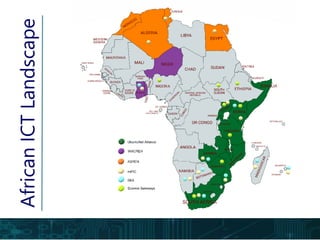
AfricanICTLandscape
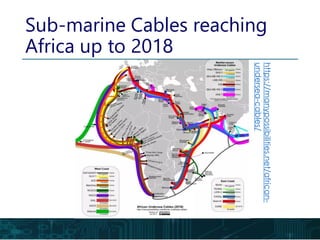
Sub-marine Cables reaching
Africa up to 2018
https://manypossibilities.net/african-
undersea-cables/
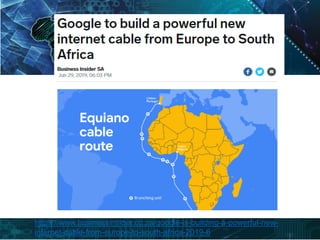
“It was revealed last month [April 2019] that the tech
giant plans to launch a network of more than 3,000 low
Earth orbit satellites to provide high-speed broadband
connectivity to "unserved and underserved
communities around the world".
https://www.businessinsider.co.za/google-is-building-a-powerful-new-
internet-cable-from-europe-to-south-africa-2019-6
e-Infrastructure Challenges
Connectivity & Bandwidth
• Selected governments have low awareness of
value of NREN – Foley (2016)
• Many NRENs not operational, low/no budgets
• Commercial public ISPs a threat to NRENs,
while NRENs do far more than just being an ISP
• Private ISPs with monopolies (Central, West
Africa) close down access to cable landing
stations – not allowing other competitors into
market, keeping costs high
• Power outages on continent interrupting
Internet service delivery, interrupting science
• Cloud services require high-speed Internet
access/broadband - very expensive
• Medium-scale server infrastructures only; not
trusted; infrastructure not funded
(H3ABioNet)
• Small number of computer workstations,
outdated/software outdated
e-Infrastructure Status &
Challenges
Data Management (Curation)
• Only one trusted registered data repository on
continent (CoreTrustSeal)
• Lack of centralised, secure data storage
• Data repositories not registered with Registry
of Research Data Repositories (re3data.org)
• Data management plans not the norm, due to
lack of policies/funder requirements
• Few repositories use proper data repository
software or science gateways, tailor-made for
purpose, adhering to international best practise
regarding persistent identifiers, metadata,
licensing, IPR, data citation, archiving, and
back-up of data
• Some instances - low awareness of free and
open source software (FOSS) to collaborate and
share data
• Institutional metric & funding systems rely heavily
on publishing in high impact factor publications
• Data sharing not acknowledged for promotional
purposes/performance appraisal – lack of
incentives
• Researchers want to exhaust publication
possibilities before sharing data
• Trust – ‘parachute’ research prevent sharing – in
past African researchers were often excluded and
not acknowledged for contributions to
international research
Research Cultures Impacting
on Data Sharing
• Lack of proper infrastructure makes
collaboration and data sharing impossible
• Already lack of support for publishing research
papers (African researchers fund own
publication costs – even more so for data
sharing)
African Research Policy/
Legislation Framework
• EU General Data Protection Regulation (GDPR)
has increased awareness on risks of personal
data in digital world
• 17 African countries have adopted data
protection legislation
• Protection of Personal Information Act (POPIA)
in SA
• AU Convention on Cyber-security and Personal
Data Protection signed by 14 African member
countries; ratified by 5 African countries
• Open data policies where data are regarded as
“assets” e.g. Botswana International University
of Science and Technology (BIUST), Makerere
University (Uganda)
• Policies to:
• Discourage “helicopter research”
• Allow for recognition and partnership opportunities
for African researchers
• Protect researchers – what to share, what not
• Progress re Open Data/Open Science Policies
• Botswana – Draft White Paper on Open Research
Data Strategy
• Madagascar – Lobbying for Open Data policy
• South Africa – White Paper on STI
• Uganda – Draft Open Data Policy
• Policies not aligned, harmonised (STI, IP, HE,
ICT, Research)
• IP protection undeveloped, ineffective,
expensive, unenforced
• African Observatory of Science and Technology
Indicators (AOSTI)
• Established in 2011 (AU) to help African countries
build capacity for STI policy activities and initiatives
• AOSTI Report: Assessment of Scientific
Production in the African Union (2005 – 2010)
• Recommended “creating open and free access
publication outlets for Africa, with improved review
committees” – AU AOSTI (2014)
• Challenge of high article publication & subscription
fees
Build on …
Harmonisation of Policies
• E.g. ICT: HIPSSA (Harmonization of ICT Policies
in Sub-Saharan Africa – Access to Submarine
Cables in West Africa – Assessment Report)
• Regulation of telecom sector in collaboration with
WATRA
• E.g. Food Security: Delayed harmonisation
of policies for encouraging the transfer of
seeds across East and Southern Africa is
hampering trade and increased agricultural
growth
Capacity Building Initiatives
• NRENs providing training e.g. KENET (Kenya),
CHPC (SA) – network management, blockchain,
programming, data processing etc.
• Training through funded projects e.g.
H3ABioNet bioinformatics training & GBIF
Biodiversity for Development Programme
• University & short courses e.g. dLAB (University
of Dar es Salaam (Tanzania))
• Online Open Science courses e.g. Open Science
MOOC, Coursera, FOSTER, MANTRA, AIMS
• The Carpentries – trained 19 instructors from
Africa, presented 110 workshops in Africa,
trained 1,577 delegates from Africa
• CODATA-RDA School of Research Data Science
(Rwanda, 2018) – AOSP sponsored 3
participants
• AOSP School of Research Data Science in
collaboration with CODATA & RDA (Ethiopia,
2019) – 20+ participants
Similar to EOSC ….
"We are not building the future EOSC [AOSP]
from scratch, but will be starting from what
members of the community worked in the last
years: inclusiveness is going to be critical,
especially in regions whose voice has not been
heard enough so far." -
Cathrin Stöver, Chief Collaboration Officer, GÉANT
Key to Future AOSP
• Collaboration among countries, institutions,
projects, researchers – sharing resources; free flow
of data, research, knowledge
• Trust relationships, openness, transparency –
trusting others for having your best interest at
heart, and not because of the profits they can
make from your research
• Researcher driven – needs addressed & bring
infrastructure to data
• Keep momentum, strong leadership, build on
knowledge (also tacit) collected through project
Thank you!
AOSP Advisory Council
AOSP Technical Advisory Board
AOSP Community
International Science Community
SA Dept. of Science & Technology (now Dept. of
Science & Innovation), National Research
Foundation (NRF)
Stakeholders engaged with, especially in
developing the landscape study & frameworks
Bibliography
Academy of Science of South Africa (2019), African Open
Science Platform - Landscape Study.
doi: http://dx.doi.org/10.17159/assaf.2019/0047
Under embargo until 30 September 2019

African Open Science Platform pilot study and landscape findings

  • 1.
    Pilot Study andLandscape Findings Himla Soodyall & Ina Smith Academy of Science of South Africa (ASSAf) AOSP Delivery Phase Planning Workshop, Alexandria, Egypt 2 - 3 Sept. 2019
  • 2.
    Part I: Pilot Study– Himla Soodyall
  • 3.
    About AOSP • Outcomeof ISC “Open Data in a Big Data World” • NRF/ASSAf agreement signed on 9 Feb. 2017 • October 2016 – October 2019 (3 years) • Fully funded by the National Research Foundation (NRF) (SA Dept. of Science and Technology) • Directed by CODATA (ISC) • Managed by Academy of Science of South Africa (ASSAf) • Through ASSAf hosting ISC Regional Office for Africa (ISC ROA)
  • 4.
    Addressing the UNSDGs “… Africa’s common objectives and commitment to collective actions to develop and use science and technology for the socio- economic transformation of the continent and its integration into the world economy.” - Africa Consolidated Science and Technology Plan of Action (2005)
  • 5.
    UNECA Africa RegionalForum “T[t]he creation of an African platform for research and innovation exchange will enable the dissemination of goal-relevant African research and innovation to governments and citizens. It could form the basis for linking researchers and innovators with the funding required to scale up their work. The proposed platform would showcase and share Africa’s efforts to develop goal-relevant research and innovation and could be coordinated with the Global Innovation Exchange.” – Dakar (2018)
  • 6.
    STI Strategy ofAfrica 2024 8 Priorities for the African research community – will be requiring data, data sharing, openness (as open possible, as closed necessary) and collaboration: disease prevention & control; climate resilience (disaster risk); environmental protection (biosphere, hydrosphere); food and nutritional security; smart resilient cities; achieving sustainability goals; improved knowledge production; improved intra-Africa research collaboration.
  • 7.
    South African WhitePaper on STI “As part of its commitment to African STI cooperation, South Africa will also work to advance the open science agenda elsewhere on the continent and within regional frameworks. The strategic role of the African Open Science Platform, hosted by the Academy of Science of South Africa, which promotes African- wide development and coordination of data policies, data training and data infrastructure, will be leveraged with the support of the DST and the National Research Foundation (NRF).” – SA White Paper on Science, Technology and Innovation (2018)
  • 8.
    7 Pilot Deliverables Establishedan African Open Data Forum Launched AOSP during SFSA 2016 Framework for incentives for sharing research data Framework for open data policies Framework for capacity building in research data Framework & roadmap for e-Infrastructure Landscape report on Open Data in Africa
  • 9.
    Specific Highlights • NationalOpen Data Fora established in: • Botswana: Draft White Paper on Open Research Data Strategy • Madagascar: National Data Roadmap & drafting of Open Data policy • Uganda: Draft Open Data policy • South Africa: SA-EU Open Science Policy Framework & Action Plan
  • 10.
    African Open DataForum • 44+ AOSP events attended by representatives from 37 African countries – funded many individuals • 66+ data-intensive research initiatives identified (incl. priority disciplines) • Registry of 1,900 individuals in OS, OD, STI, ICT, IPR, HE, Funders • AOSP School of Research Data Science – Ethiopia (2019) (with CODATA & RDA) • International, Continental, National • Website http://africanopenscience.org.za/ • Mailing list • Webinars • Desktop & Literature Studies
  • 11.
    Stakeholder Consultation • AAS •AfDB • AU – NEPAD, PAP • AAU • ISC (CODATA, WDS, ROA) • African governments, research councils, universities • Centres of Excellence • NAS & NASAC • NRENs • RDA • SGCI • TWAS • UN • IAP • Etc
  • 13.
    JISC (UK) NSF (US) (Europe) ComputeARDC (Australia) EOSC Canada
  • 14.
    Building on &towards … Oct 2016 – Oct 2019 Oct 2019 -
  • 15.
    Part II: Selected LandscapeStudy Findings – Ina Smith
  • 17.
    https://flightaware.com/live/ Live view ofairspace on 12 August 2019 – People on the move …
  • 18.
  • 19.
    Challenges regarding HealthData • Delay in sharing data collected • Gaps in data • Lack of adherence to international standards • Uncertainty about IP rights • Can data be trusted? • Patient consent? Privacy? Security? • Absence of patient consent • And more
  • 20.
    1. Artificial Intelligence(AI) 2. Internet of Things (IoT) 3. Robotics
  • 21.
    Government Data • Strategyfor the Harmonisation of Statistics in Africa (SHaSA) (ECA, AfDB, AU) • AFRISTAT • STATAFRIC (Pan-African Institute for Statistics) • Sunlight Foundation • Open Data Barometer • G20 Anti-Corruption Open Data Principles • Africa Data Consensus Roadmap
  • 22.
    E.g. CIRAD, FAOSTAT, KAiNeT, RCMRD, CSIRSpace E.g.H3Africa, AHRI, APHRC, GHDx, MalariaGEN E.g. CGKP, SAEON, RESILIENCE ATLAS, WASCAL E.g. AfReMaS, IODE, ODINAFRICA, SAIAB E.g. GBIF,ReBioMa, ICRAF, CERSGIS, CGIAR, GLOSS, MASDAP, SERVIR, AMMA-CATCH, SASSCAL E.g. OHADA, DICAMES Research Data Initiatives (66+)
  • 23.
    Square Kilometre Array AfricanSKA Consortium Botswana, Ghana, Kenya, Madagascar, Mauritius, Mozambique, Namibia, South Africa and Zambia
  • 25.
    “R3 million hasbeen spent on catering and a further R4 million on transport in the area since construction began in 2012. One hundred and seven locals have been employed by the South African Astronomical Observatory between 2015 and 2017.”
  • 27.
    SKA SA ManagingDirector Rob Adam said, “We have electricians being trained, boilermakers, fitters and turners and people splashing the fibre that carries the signal from the satellites through the computers, that fibre is being splashed by people from the local community.”
  • 28.
  • 29.
  • 30.
  • 32.
    OSActivities/Initiatives 200 OA DOAJ-listedjournals 174 IRs registered on OpenDOAR 34 OA policies on ROARMAP 24 data repositories registered on re3data, while study identified 66+ 1 data repository assigned CoreTrustSeal
  • 33.
  • 34.
    African Investment inScience, ICT • Low levels of organisation and funding of many science systems in Africa - UNECA 2018 Sustainable Development Report • Kenya & SA closest to AUs target of investing 1% of annual GDP in R&D (Kenya & SA invest 0.8%) • R&D expenditure of 24 African countries unknown
  • 35.
    Political Willingness National Academiesof Science [26] National Young Academies of Science [18] R&D spending between 0.5%-0.8% of GDP [12] African Science Granting Councils [15] Incentives & recognition for sharing research data [2] Ministries of Science/Technology/Innovation [25] National Open Data policy & policy initiatives [5]
  • 36.
  • 38.
    Level 4 FormalNREN with services Burundi, Ethiopia, Madagascar, Mozambique, Namibia, Sudan, Tanzania, Côte d'Ivoire, Nigeria, Senegal, Morocco, Tunisia Level 5 REN-REN links established Uganda Level 6 NREN offers REN-specific advanced services Algeria, Egypt, Kenya, SA, Zambia (since 2019) 18 National Research Education Network (NREN) Status
  • 39.
    GÉANT – AfricaConnect2 https://www.geant.org/News_and_Events/Pages/Mapping-the-global-RandE-community.aspx AfricaConnect 3 – end 2019 (aligned with Digital4Development Strategy) Priorities of the Digital4Development (D4D) strategy
  • 40.
    Connected Countries  ASREN- Algeria, Egypt, Lybia, Mauritania, Morocco, Tunisia (4 connected; 2 not yet connected)  WACREN - Benin, Burkina Faso, Cameroon, Chad, Côte d’Ivoire, Gabon, Ghana, Guinea, Mali, Niger, Nigeria, Senegal, Sierra Leone, Togo (3 connected; 11 not yet connected)  UbuntuNet Alliance - Burundi, Democratic Republic of the Congo, Ethiopia, Kenya, Madagascar, Malawi, Mozambique, Namibia, Rwanda, Somalia, South Africa, Sudan, Tanzania, Uganda, Zambia, Zimbabwe (10 connected; 6 not yet connected) 17 connected; 19 not connected
  • 41.
  • 43.
    Sub-marine Cables reaching Africaup to 2018 https://manypossibilities.net/african- undersea-cables/
  • 45.
    “It was revealedlast month [April 2019] that the tech giant plans to launch a network of more than 3,000 low Earth orbit satellites to provide high-speed broadband connectivity to "unserved and underserved communities around the world".
  • 46.
  • 47.
    e-Infrastructure Challenges Connectivity &Bandwidth • Selected governments have low awareness of value of NREN – Foley (2016) • Many NRENs not operational, low/no budgets • Commercial public ISPs a threat to NRENs, while NRENs do far more than just being an ISP • Private ISPs with monopolies (Central, West Africa) close down access to cable landing stations – not allowing other competitors into market, keeping costs high
  • 48.
    • Power outageson continent interrupting Internet service delivery, interrupting science • Cloud services require high-speed Internet access/broadband - very expensive • Medium-scale server infrastructures only; not trusted; infrastructure not funded (H3ABioNet) • Small number of computer workstations, outdated/software outdated
  • 49.
    e-Infrastructure Status & Challenges DataManagement (Curation) • Only one trusted registered data repository on continent (CoreTrustSeal) • Lack of centralised, secure data storage • Data repositories not registered with Registry of Research Data Repositories (re3data.org) • Data management plans not the norm, due to lack of policies/funder requirements
  • 50.
    • Few repositoriesuse proper data repository software or science gateways, tailor-made for purpose, adhering to international best practise regarding persistent identifiers, metadata, licensing, IPR, data citation, archiving, and back-up of data • Some instances - low awareness of free and open source software (FOSS) to collaborate and share data
  • 51.
    • Institutional metric& funding systems rely heavily on publishing in high impact factor publications • Data sharing not acknowledged for promotional purposes/performance appraisal – lack of incentives • Researchers want to exhaust publication possibilities before sharing data • Trust – ‘parachute’ research prevent sharing – in past African researchers were often excluded and not acknowledged for contributions to international research Research Cultures Impacting on Data Sharing
  • 52.
    • Lack ofproper infrastructure makes collaboration and data sharing impossible • Already lack of support for publishing research papers (African researchers fund own publication costs – even more so for data sharing)
  • 53.
    African Research Policy/ LegislationFramework • EU General Data Protection Regulation (GDPR) has increased awareness on risks of personal data in digital world • 17 African countries have adopted data protection legislation • Protection of Personal Information Act (POPIA) in SA • AU Convention on Cyber-security and Personal Data Protection signed by 14 African member countries; ratified by 5 African countries
  • 54.
    • Open datapolicies where data are regarded as “assets” e.g. Botswana International University of Science and Technology (BIUST), Makerere University (Uganda) • Policies to: • Discourage “helicopter research” • Allow for recognition and partnership opportunities for African researchers • Protect researchers – what to share, what not
  • 55.
    • Progress reOpen Data/Open Science Policies • Botswana – Draft White Paper on Open Research Data Strategy • Madagascar – Lobbying for Open Data policy • South Africa – White Paper on STI • Uganda – Draft Open Data Policy • Policies not aligned, harmonised (STI, IP, HE, ICT, Research) • IP protection undeveloped, ineffective, expensive, unenforced
  • 56.
    • African Observatoryof Science and Technology Indicators (AOSTI) • Established in 2011 (AU) to help African countries build capacity for STI policy activities and initiatives • AOSTI Report: Assessment of Scientific Production in the African Union (2005 – 2010) • Recommended “creating open and free access publication outlets for Africa, with improved review committees” – AU AOSTI (2014) • Challenge of high article publication & subscription fees Build on …
  • 57.
    Harmonisation of Policies •E.g. ICT: HIPSSA (Harmonization of ICT Policies in Sub-Saharan Africa – Access to Submarine Cables in West Africa – Assessment Report) • Regulation of telecom sector in collaboration with WATRA • E.g. Food Security: Delayed harmonisation of policies for encouraging the transfer of seeds across East and Southern Africa is hampering trade and increased agricultural growth
  • 58.
    Capacity Building Initiatives •NRENs providing training e.g. KENET (Kenya), CHPC (SA) – network management, blockchain, programming, data processing etc. • Training through funded projects e.g. H3ABioNet bioinformatics training & GBIF Biodiversity for Development Programme • University & short courses e.g. dLAB (University of Dar es Salaam (Tanzania)) • Online Open Science courses e.g. Open Science MOOC, Coursera, FOSTER, MANTRA, AIMS
  • 59.
    • The Carpentries– trained 19 instructors from Africa, presented 110 workshops in Africa, trained 1,577 delegates from Africa • CODATA-RDA School of Research Data Science (Rwanda, 2018) – AOSP sponsored 3 participants • AOSP School of Research Data Science in collaboration with CODATA & RDA (Ethiopia, 2019) – 20+ participants
  • 60.
    Similar to EOSC…. "We are not building the future EOSC [AOSP] from scratch, but will be starting from what members of the community worked in the last years: inclusiveness is going to be critical, especially in regions whose voice has not been heard enough so far." - Cathrin Stöver, Chief Collaboration Officer, GÉANT
  • 61.
    Key to FutureAOSP • Collaboration among countries, institutions, projects, researchers – sharing resources; free flow of data, research, knowledge • Trust relationships, openness, transparency – trusting others for having your best interest at heart, and not because of the profits they can make from your research • Researcher driven – needs addressed & bring infrastructure to data • Keep momentum, strong leadership, build on knowledge (also tacit) collected through project
  • 62.
    Thank you! AOSP AdvisoryCouncil AOSP Technical Advisory Board AOSP Community International Science Community SA Dept. of Science & Technology (now Dept. of Science & Innovation), National Research Foundation (NRF) Stakeholders engaged with, especially in developing the landscape study & frameworks
  • 63.
    Bibliography Academy of Scienceof South Africa (2019), African Open Science Platform - Landscape Study. doi: http://dx.doi.org/10.17159/assaf.2019/0047 Under embargo until 30 September 2019