www.activate.com
ACTIVATE TECHNOLOGY & MEDIA
OUTLOOK 2021
October 2020
www.activate.com 2Continued ➔
12 Takeaways from the 

Activate Technology & Media Outlook 2021
Time and Attention: The entire growth curve for consumer time spent with technology
and media has shifted upwards and will be sustained at a higher level than ever before,
opening up new opportunities. 
Video Games: Gaming is the new technology paradigm as most digital activities
(e.g. search, social, shopping, live events) will increasingly take place inside of gaming. All of
the major technology platforms will expand their presence in the gaming stack, leading to a
new wave of mergers and technology investments.
AR/VR: Augmented reality and virtual reality are on the verge of widespread adoption as
headset sales take off and use cases expand beyond gaming into other consumer digital
activities and enterprise functionality.
Video: By 2024, nearly all American households will have a Connected TV. The average paid
video streaming subscriber will own 5.7 subscriptions, while also watching other services for
free (e.g. sharing passwords, using advertising-supported services, viewing social video).
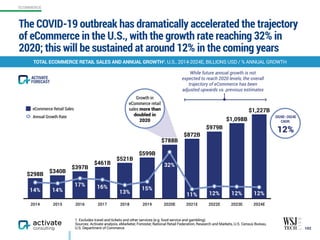
eCommerce: The growth curve of eCommerce has accelerated by 5 years in 5 months.
Consumers will expand their digital shopping destinations beyond the retailers that they
bought from before shelter-in-place. Marketplace platforms and the shift to online grocery
buying will level the eCommerce playing field for large traditional retailers and brands.
Esports: During shelter-in-place, esports were sports for many consumers; going forward,
esports will be a major global catalyst for interest in interactive gaming, technology, and
entertainment experiences.
www.activate.com 3
12 Takeaways from the 

Activate Technology & Media Outlook 2021
Sports Tech and Sports: New technologies will reshape every aspect of sports,
including data, athlete performance, and viewing experiences. If the broadcast rights 

are maintained, sports fans will create a floor for Pay TV households and a ceiling 

for cord cutting.
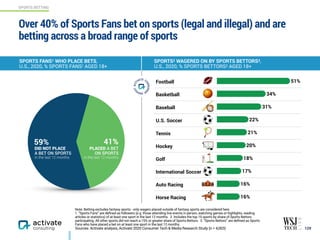
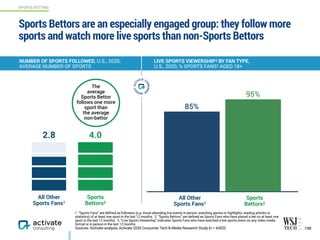
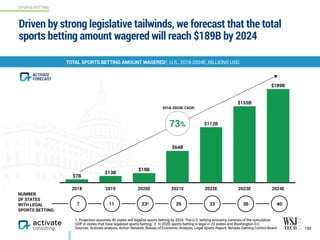
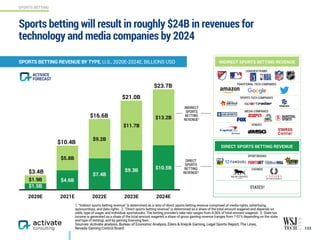
Sports Betting: By 2024, we forecast $24B in sports betting revenues for technology 

and media companies, enabled by state legalization as well as advanced sports viewing
experiences and functionality.
Super Users: To drive growth, technology and media companies will need to focus their
efforts on super-serving the 23% of all users who account for the overwhelming majority of
time and money spent on eCommerce, video, gaming, virtual reality, and music.
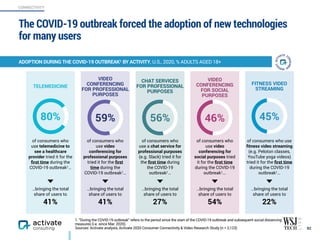
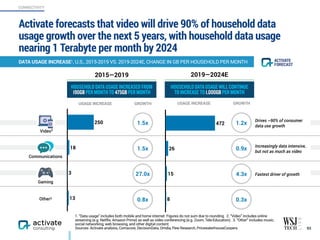
Connectivity: A large percentage of consumers will upgrade to 5G mobile devices and
higher bandwidth speeds, as they dramatically expand their use of digital technologies such 

as telemedicine, video conferencing, video streaming, digital fitness, and cloud gaming.
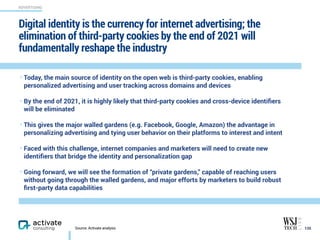
Advertising: For marketers and media and technology companies, the elimination 

of third-party cookies by the end of 2021 will create the critical need for entirely new ways 

of identifying consumers and personalizing their advertising experience.
Growth Dollars: Between 2020 and 2024, technology and media companies will add 

over $374B in revenue growth dollars. It’s going to be an exciting couple of years!
4www.activate.com
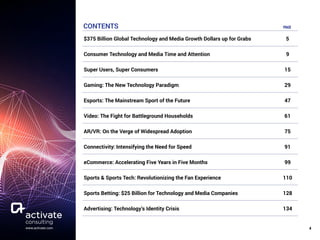
CONTENTS
$375 Billion Global Technology and Media Growth Dollars up for Grabs 5
Consumer Technology and Media Time and Attention 9
Super Users, Super Consumers 15
Gaming: The New Technology Paradigm 29
Esports: The Mainstream Sport of the Future 47
Video: The Fight for Battleground Households 61
AR/VR: On the Verge of Widespread Adoption 75
Connectivity: Intensifying the Need for Speed 91
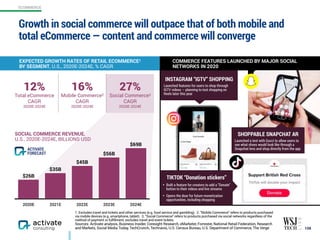
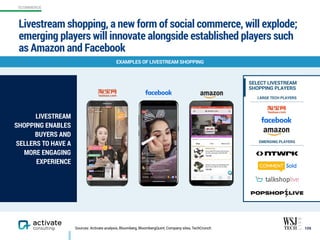
eCommerce: Accelerating Five Years in Five Months 99
Sports & Sports Tech: Revolutionizing the Fan Experience 110
Sports Betting: $25 Billion for Technology and Media Companies 128
Advertising: Technology’s Identity Crisis 134
PAGE
5www.activate.com
CONTENTS
$375 Billion Global Technology and Media Growth Dollars up for Grabs 5
Consumer Technology and Media Time and Attention 9
Super Users, Super Consumers 15
Gaming: The New Technology Paradigm 29
Esports: The Mainstream Sport of the Future 47
Video: The Fight for Battleground Households 61
AR/VR: On the Verge of Widespread Adoption 75
Connectivity: Intensifying the Need for Speed 91
eCommerce: Accelerating Five Years in Five Months 99
Sports & Sports Tech: Revolutionizing the Fan Experience 110
Sports Betting: $25 Billion for Technology and Media Companies 128
Advertising: Technology’s Identity Crisis 134
PAGE
ACTIVATE
FORECAST
2020E 2024E
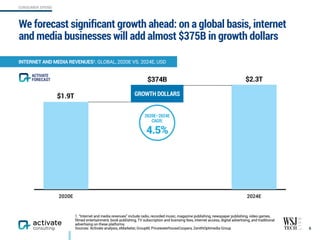
We forecast significant growth ahead: on a global basis, internet
and media businesses will add almost $375B in growth dollars
6
INTERNET AND MEDIA REVENUES1, GLOBAL, 2020E VS. 2024E, USD
1. “Internet and media revenues” include radio, recorded music, magazine publishing, newspaper publishing, video games,
filmed entertainment, book publishing, TV subscription and licensing fees, internet access, digital advertising, and traditional
advertising on these platforms.
Sources: Activate analysis, eMarketer, GroupM, PricewaterhouseCoopers, ZenithOptimedia Group
$1.9T
$2.3T$374B
GROWTH DOLLARS
2020E–2024E 

CAGR:
4.5%
CONSUMER SPEND
2020E 2024E
223.3%
212.3%
193.6%
Ad revenue
Cost of
internet
access3
Paid
content2
7
ROBOTO BOLD 16PT, ROBOTO REGULAR 16 PT
1. “Internet and media revenues” include radio, recorded music, magazine publishing, newspaper publishing, video games, filmed
entertainment, book publishing, TV subscription and licensing fees, internet access, digital advertising, and traditional advertising
on these platforms. 2. “Paid content” includes music, magazine publishing, book publishing, newspapers, video games,
television, and filmed entertainment. 3. “Cost of internet access” includes fixed broadband, wireless, and mobile internet access.
Sources: Activate analysis, eMarketer, GroupM, PricewaterhouseCoopers, ZenithOptimedia Group
35%
36%
29%
32%
35%
33%
$1.9T
$187B
$110B $77B $2.3T
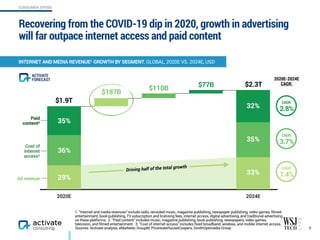
INTERNET AND MEDIA REVENUE1 GROWTH BY SEGMENT, GLOBAL, 2020E VS. 2024E, USD
CAGR:
2.8%
CAGR:
3.7%
CAGR:
7.4%
Driving half of the total growth
2020E-2024E
CAGR:
Recovering from the COVID-19 dip in 2020, growth in advertising
will far outpace internet access and paid content
CONSUMER SPEND
ACTIVATE
FORECAST
2020E 2024E
Subscription

revenue
Single

transactions
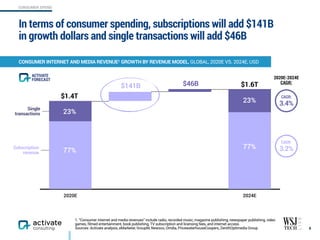
In terms of consumer spending, subscriptions will add $141B
in growth dollars and single transactions will add $46B
8
ROBOTO BOLD 16PT, ROBOTO REGULAR 16 PT
1. “Consumer internet and media revenues” include radio, recorded music, magazine publishing, newspaper publishing, video
games, filmed entertainment, book publishing, TV subscription and licensing fees, and internet access.

Sources: Activate analysis, eMarketer, GroupM, Newzoo, Omdia, PricewaterhouseCoopers, ZenithOptimedia Group
CONSUMER INTERNET AND MEDIA REVENUE1 GROWTH BY REVENUE MODEL, GLOBAL, 2020E VS. 2024E, USD
23%
77%
23%
77%
$1.4T
$141B $46B $1.6T
CAGR:
3.4%
CAGR:
3.2%
2020E-2024E
CAGR:
CONSUMER SPEND
ACTIVATE
FORECAST
9www.activate.com
CONTENTS
$375 Billion Global Technology and Media Growth Dollars up for Grabs 5
Consumer Technology and Media Time and Attention 9
Super Users, Super Consumers 15
Gaming: The New Technology Paradigm 29
Esports: The Mainstream Sport of the Future 47
Video: The Fight for Battleground Households 61
AR/VR: On the Verge of Widespread Adoption 75
Connectivity: Intensifying the Need for Speed 91
eCommerce: Accelerating Five Years in Five Months 99
Sports & Sports Tech: Revolutionizing the Fan Experience 110
Sports Betting: $25 Billion for Technology and Media Companies 128
Advertising: Technology’s Identity Crisis 134
PAGE
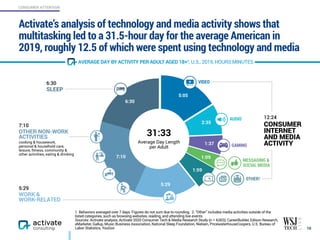
Activate’s analysis of technology and media activity shows that
multitasking led to a 31.5-hour day for the average American in
2019, roughly 12.5 of which were spent using technology and media
10
CONSUMER ATTENTION
1. Behaviors averaged over 7 days. Figures do not sum due to rounding. 2. “Other” includes media activities outside of the
listed categories, such as browsing websites, reading, and attending live events.
Sources: Activate analysis, Activate 2020 Consumer Tech & Media Research Study (n = 4,003), CareerBuilder, Edison Research,
eMarketer, Gallup, Music Business Association, National Sleep Foundation, Nielsen, PricewaterhouseCoopers, U.S. Bureau of
Labor Statistics, YouGov
6:30
SLEEP
7:10
OTHER NON-WORK
ACTIVITIES
cooking & housework, 

personal & household care,
leisure, fitness, community &
other activities, eating & drinking
5:29
WORK & 

WORK-RELATED
6:30
12:24
CONSUMER
INTERNET
AND MEDIA
ACTIVITY
7:10
5:29
1:37
2:35
5:05
1:09
1:59
31:33
Average Day Length
per Adult
MESSAGING &
SOCIAL MEDIA
OTHER2
VIDEO
AUDIO
GAMING
AVERAGE DAY BY ACTIVITY PER ADULT AGED 18+1, U.S., 2019, HOURS:MINUTES
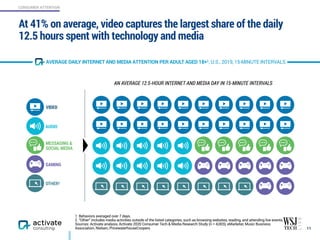
At 41% on average, video captures the largest share of the daily
12.5 hours spent with technology and media
11
AVERAGE DAILY INTERNET AND MEDIA ATTENTION PER ADULT AGED 18+1, U.S., 2019, 15-MINUTE INTERVALS
1. Behaviors averaged over 7 days.

2. “Other” includes media activities outside of the listed categories, such as browsing websites, reading, and attending live events.
Sources: Activate analysis, Activate 2020 Consumer Tech & Media Research Study (n = 4,003), eMarketer, Music Business
Association, Nielsen, PricewaterhouseCoopers
A TYPICAL 12:13-HOUR MEDIA DAY: 48 X 15-MINUTE INTERVALS
AN AVERAGE 12.5-HOUR INTERNET AND MEDIA DAY IN 15-MINUTE INTERVALS
AUDIO
GAMING
MESSAGING &
SOCIAL MEDIA
VIDEO
OTHER2
CONSUMER ATTENTION
2017 2018 2019 2020E
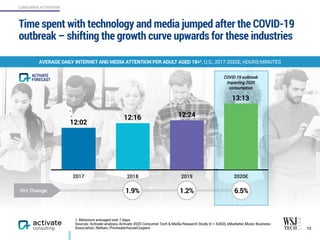
Time spent with technology and media jumped after the COVID-19
outbreak – shifting the growth curve upwards for these industries
12
AVERAGE DAILY INTERNET AND MEDIA ATTENTION PER ADULT AGED 18+1, U.S., 2017-2020E, HOURS:MINUTES
1. Behaviors averaged over 7 days.
Sources: Activate analysis, Activate 2020 Consumer Tech & Media Research Study (n = 4,003), eMarketer, Music Business
Association, Nielsen, PricewaterhouseCoopers 12
12:02
12:16 12:24
13:13
1.9% 1.2% 6.5%
COVID-19 outbreak
impacting 2020
consumption
YoY Change:
CONSUMER ATTENTION
ACTIVATE
FORECAST
2020E 2024E
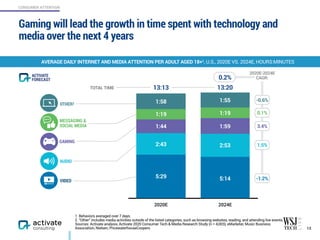
Gaming will lead the growth in time spent with technology and
media over the next 4 years
13
AVERAGE DAILY INTERNET AND MEDIA ATTENTION PER ADULT AGED 18+1, U.S., 2020E VS. 2024E, HOURS:MINUTES
1. Behaviors averaged over 7 days.

2. “Other” includes media activities outside of the listed categories, such as browsing websites, reading, and attending live events.
Sources: Activate analysis, Activate 2020 Consumer Tech & Media Research Study (n = 4,003), eMarketer, Music Business
Association, Nielsen, PricewaterhouseCoopers
13:13 13:20
5:29
2:43
1:44
1:19
1:58
5:14
2:53
1:59
1:19
1:55
TOTAL TIME
2020E-2024E
CAGR:0.2%
VIDEO
MESSAGING &
SOCIAL MEDIA
GAMING
OTHER2
AUDIO
-0.6%
0.1%
3.4%
1.5%
-1.2%
CONSUMER ATTENTION
ACTIVATE
FORECAST
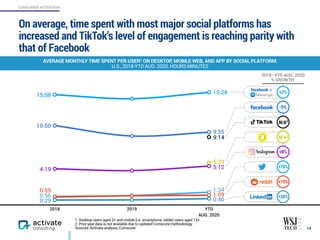
On average, time spent with most major social platforms has
increased and TikTok’s level of engagement is reaching parity with
that of Facebook
14
AVERAGE MONTHLY TIME SPENT PER USER1 ON DESKTOP, MOBILE WEB, AND APP BY SOCIAL PLATFORM, 

U.S., 2018-YTD AUG. 2020, HOURS:MINUTES
1. Desktop users aged 2+ and mobile (i.e. smartphone, tablet) users aged 13+.

2. Prior year data is not available due to updated Comscore methodology.
Sources: Activate analysis, Comscore
2018 2019 YTD 

AUG. 2020
9:55
5:12
1:34
1:09
0:40
9:14
5:39
15:28
2018–YTD AUG. 2020
% GROWTH:
+2%
10:50
4:19
0:56
0:59
0:29
15:08
+
+19%
N/A2
-9%
+8%
+78%
+38%
N/A2
CONSUMER ATTENTION
15www.activate.com
CONTENTS
$375 Billion Global Technology and Media Growth Dollars up for Grabs 5
Consumer Technology and Media Time and Attention 9
Super Users, Super Consumers 15
Gaming: The New Technology Paradigm 29
Esports: The Mainstream Sport of the Future 47
Video: The Fight for Battleground Households 61
AR/VR: On the Verge of Widespread Adoption 75
Connectivity: Intensifying the Need for Speed 91
eCommerce: Accelerating Five Years in Five Months 99
Sports & Sports Tech: Revolutionizing the Fan Experience 110
Sports Betting: $25 Billion for Technology and Media Companies 128
Advertising: Technology’s Identity Crisis 134
PAGE
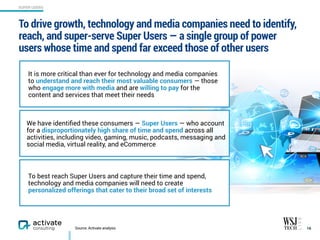
We have identified these consumers — Super Users — who account
for a disproportionately high share of time and spend across all
activities, including video, gaming, music, podcasts, messaging and
social media, virtual reality, and eCommerce
To drive growth, technology and media companies need to identify,
reach, and super-serve Super Users — a single group of power
users whose time and spend far exceed those of other users
16
SUPER USERS
Source: Activate analysis
It is more critical than ever for technology and media companies
to understand and reach their most valuable consumers — those
who engage more with media and are willing to pay for the
content and services that meet their needs
To best reach Super Users and capture their time and spend,
technology and media companies will need to create
personalized offerings that cater to their broad set of interests
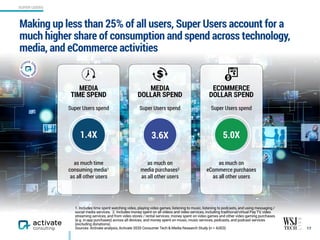
Making up less than 25% of all users, Super Users account for a
much higher share of consumption and spend across technology,
media, and eCommerce activities
17
SUPER USERS
1. Includes time spent watching video, playing video games, listening to music, listening to podcasts, and using messaging /
social media services. 2. Includes money spent on all videos and video services, including traditional/virtual Pay TV, video
streaming services, and from video stores / rental services; money spent on video games and other video gaming purchases
(e.g. in-app purchases) across all devices; and money spent on music, music services, podcasts, and podcast services
(excluding donations).
Sources: Activate analysis, Activate 2020 Consumer Tech & Media Research Study (n = 4,003)
as much on
eCommerce purchases
as all other users
5.0X
Super Users spend
ECOMMERCE
DOLLAR SPEND
as much time
consuming media1 

as all other users
MEDIA 

TIME SPEND
1.4X
Super Users spend
as much on 

media purchases2 

as all other users
3.6X
MEDIA 

DOLLAR SPEND
Super Users spend
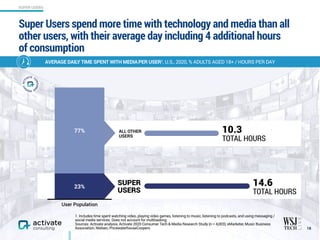
Super Users spend more time with technology and media than all
other users, with their average day including 4 additional hours
of consumption
18
AVERAGE DAILY TIME SPENT WITH MEDIAPER USER1, U.S., 2020, % ADULTS AGED 18+ / HOURS PER DAY
SUPER USERS
1. Includes time spent watching video, playing video games, listening to music, listening to podcasts, and using messaging /
social media services. Does not account for multitasking.
Sources: Activate analysis, Activate 2020 Consumer Tech & Media Research Study (n = 4,003), eMarketer, Music Business
Association, Nielsen, PricewaterhouseCoopers
77%
23%
SUPER
USERS
ALL OTHER

USERS
User Population
10.3 

TOTAL HOURS
14.6 

TOTAL HOURS
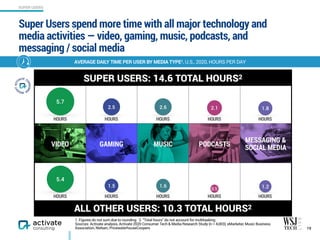
SUPER USERS: 14.6 TOTAL HOURS2
ALL OTHER USERS: 10.3 TOTAL HOURS2
Super Users spend more time with all major technology and
media activities — video, gaming, music, podcasts, and
messaging / social media
19
AVERAGE DAILY TIME PER USER BY MEDIA TYPE1, U.S., 2020, HOURS PER DAY
SUPER USERS
1. Figures do not sum due to rounding. 2. “Total hours” do not account for multitasking.
Sources: Activate analysis, Activate 2020 Consumer Tech & Media Research Study (n = 4,003), eMarketer, Music Business
Association, Nielsen, PricewaterhouseCoopers
5.7
2.5 2.6 2.1 1.8
HOURS HOURS HOURS HOURS HOURS
5.4
1.5 1.6 1.20.5
HOURS HOURS HOURS HOURS HOURS
VIDEO GAMING MUSIC PODCASTS
MESSAGING &
SOCIAL MEDIA
1. Includes money spent on all videos and video services, including traditional/virtual Pay TV, video streaming services, and from
video stores / rental services. 2. Includes money spent on video games and other video gaming purchases (e.g. in-app purchases)
across all devices. 3. Includes money spent on music, music services, podcasts, and podcast services (excluding donations).
Sources: Activate analysis, Activate 2020 Consumer Tech & Media Research Study (n = 4,003), Newzoo,
PricewaterhouseCoopers, Statista, U.S. Census Bureau
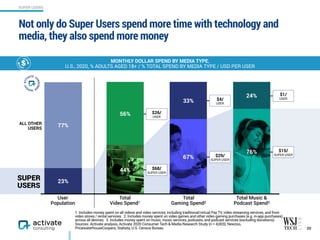
Not only do Super Users spend more time with technology and
media, they also spend more money
20
MONTHLY DOLLAR SPEND BY MEDIA TYPE, 

U.S., 2020, % ADULTS AGED 18+ / % TOTAL SPEND BY MEDIA TYPE / USD PER USER
SUPER USERS
77%
23%SUPER
USERS
ALL OTHER

USERS
User
Population
Total
Video Spend1
Total
Gaming Spend2
Total Music &
Podcast Spend3
$26/
USER
$68/
SUPER USER
$1/
USER
$15/
SUPER USER
$4/
USER
$29/
SUPER USER
24%
76%
33%
67%
56%
44%
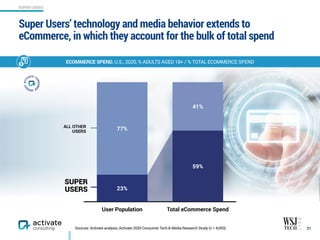
Super Users’ technology and media behavior extends to
eCommerce, in which they account for the bulk of total spend
21
SUPER USERS
Sources: Activate analysis, Activate 2020 Consumer Tech & Media Research Study (n = 4,003)
User Population Total eCommerce Spend
77%
23%
41%
59%
SUPER
USERS
ALL OTHER

USERS
ECOMMERCE SPEND, U.S., 2020, % ADULTS AGED 18+ / % TOTAL ECOMMERCE SPEND
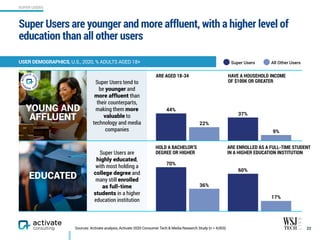
Super Users tend to
be younger and
more affluent than
their counterparts,
making them more
valuable to
technology and media
companies
Super Users are
highly educated,
with most holding a
college degree and
many still enrolled
as full-time
students in a higher
education institution
Super Users are younger and more affluent, with a higher level of
education than all other users
22
USER DEMOGRAPHICS, U.S., 2020, % ADULTS AGED 18+
SUPER USERS
ARE AGED 18-34
HOLD A BACHELOR’S
DEGREE OR HIGHER
Super Users
22%
44%
All Other Users
9%
37%
36%
70%
17%
60%
HAVE A HOUSEHOLD INCOME
OF $100K OR GREATER
ARE ENROLLED AS A FULL-TIME STUDENT
IN A HIGHER EDUCATION INSTITUTION
Sources: Activate analysis, Activate 2020 Consumer Tech & Media Research Study (n = 4,003)
YOUNG AND
AFFLUENT
EDUCATED
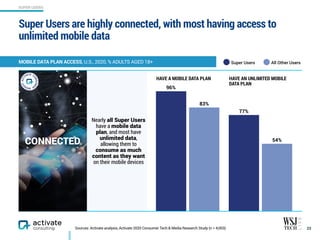
Nearly all Super Users
have a mobile data
plan, and most have
unlimited data,
allowing them to
consume as much
content as they want
on their mobile devices
Super Users are highly connected, with most having access to
unlimited mobile data
23
MOBILE DATA PLAN ACCESS, U.S., 2020, % ADULTS AGED 18+
SUPER USERS
HAVE A MOBILE DATA PLAN
83%
96%
54%
77%
HAVE AN UNLIMITED MOBILE
DATA PLAN
Sources: Activate analysis, Activate 2020 Consumer Tech & Media Research Study (n = 4,003)
CONNECTED
Super Users All Other Users
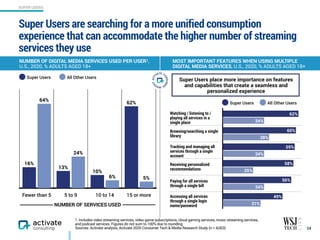
Super Users are searching for a more unified consumption
experience that can accommodate the higher number of streaming
services they use
24
SUPER USERS
1. Includes video streaming services, video game subscriptions, cloud gaming services, music streaming services,
and podcast services. Figures do not sum to 100% due to rounding.
Sources: Activate analysis, Activate 2020 Consumer Tech & Media Research Study (n = 4,003)
NUMBER OF DIGITAL MEDIA SERVICES USED PER USER1,
U.S., 2020, % ADULTS AGED 18+
MOST IMPORTANT FEATURES WHEN USING MULTIPLE
DIGITAL MEDIA SERVICES, U.S., 2020, % ADULTS AGED 18+
Fewer than 5 5 to 9 10 to 14 15 or more
5%6%
24%
64%
62%
10%
13%
16%
Watching / listening to /
playing all services in a
single place
Browsing/searching a single
library
Tracking and managing all
services through a single
account
Receiving personalized
recommendations
Paying for all services
through a single bill
Accessing all services
through a single login
name/password 31%
34%
25%
34%
38%
34%
49%
56%
58%
59%
60%
62%
Super Users place more importance on features
and capabilities that create a seamless and
personalized experience
NUMBER OF SERVICES USED
Super Users All Other Users
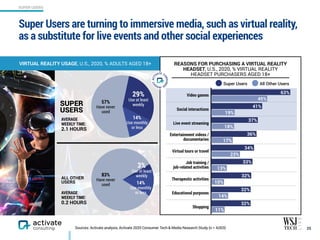
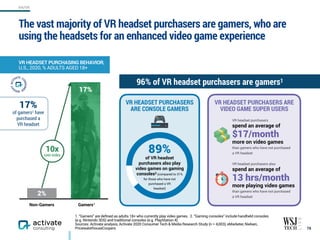
Super Users are turning to immersive media, such as virtual reality,
as a substitute for live events and other social experiences
25
SUPER USERS
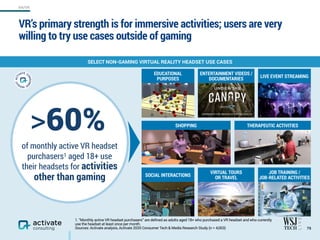
VIRTUAL REALITY USAGE, U.S., 2020, % ADULTS AGED 18+
Video games
Social interactions
Live event streaming
Entertainment videos /
documentaries
Virtual tours or travel
Job training /
job-related activities
Therapeutic activities
Educational purposes
Shopping
11%
14%
10%
13%
23%
17%
18%
19%
45%
32%
32%
32%
33%
34%
36%
37%
41%
63%
Sources: Activate analysis, Activate 2020 Consumer Tech & Media Research Study (n = 4,003)
29%

Use at least
weekly
57%

Have never
used
14%

Use monthly 

or less
SUPER
USERS
ALL OTHER

USERS
AVERAGE
WEEKLY TIME: 

2.1 HOURS
AVERAGE
WEEKLY TIME: 

0.2 HOURS
3%

Use at least

weekly83%

Have never

used 14%

Use monthly 

or less
REASONS FOR PURCHASING A VIRTUAL REALITY
HEADSET, U.S., 2020, % VIRTUAL REALITY
HEADSET PURCHASERS AGED 18+
Super Users All Other Users
22%22%
25%26%
35%
46%
42%44%
49%49%
53%
58%
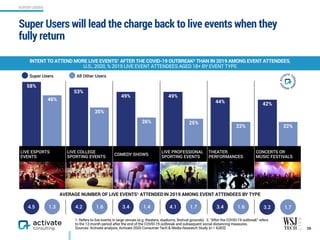
LIVE ESPORTS

EVENTS
LIVE COLLEGE
SPORTING EVENTS
COMEDY SHOWS
LIVE PROFESSIONAL

SPORTING EVENTS
THEATER

PERFORMANCES
CONCERTS OR
MUSIC FESTIVALS
AVERAGE NUMBER OF LIVE EVENTS1 ATTENDED IN 2019 AMONG EVENT ATTENDEES BY TYPE
Super Users will lead the charge back to live events when they
fully return
26
INTENT TO ATTEND MORE LIVE EVENTS1 AFTER THE COVID-19 OUTBREAK2 THAN IN 2019 AMONG EVENT ATTENDEES,
U.S., 2020, % 2019 LIVE EVENT ATTENDEES AGED 18+ BY EVENT TYPE
SUPER USERS
1. Refers to live events in large venues (e.g. theaters, stadiums, festival grounds). 2. “After the COVID-19 outbreak” refers 

to the 12-month period after the end of the COVID-19 outbreak and subsequent social distancing measures.
Sources: Activate analysis, Activate 2020 Consumer Tech & Media Research Study (n = 4,003)
1.34.5 1.64.2 1.43.4 1.63.41.74.1 1.73.2
Super Users All Other Users
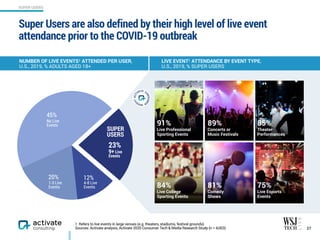
Super Users are also defined by their high level of live event
attendance prior to the COVID-19 outbreak
27
SUPER USERS
NUMBER OF LIVE EVENTS1 ATTENDED PER USER,
U.S., 2019, % ADULTS AGED 18+
45%
20% 12%
23%
No Live
Events
1-3 Live
Events
4-8 Live
Events
9+ Live
Events
SUPER
USERS
LIVE EVENT1 ATTENDANCE BY EVENT TYPE,
U.S., 2019, % SUPER USERS
91%
Live Professional

Sporting Events
89%
Concerts or
Music Festivals
85%
Theater 

Performances
84%
Live College

Sporting Events
81%
Comedy 

Shows
75%
Live Esports

Events
1. Refers to live events in large venues (e.g. theaters, stadiums, festival grounds).
Sources: Activate analysis, Activate 2020 Consumer Tech & Media Research Study (n = 4,003)
12%
31%
13%
19%
22%
34%
53%
17%
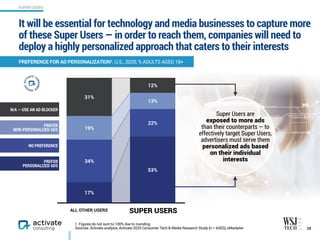
It will be essential for technology and media businesses to capture more
of these Super Users — in order to reach them, companies will need to
deploy a highly personalized approach that caters to their interests
28
SUPER USERS
1. Figures do not sum to 100% due to rounding.
Sources: Activate analysis, Activate 2020 Consumer Tech & Media Research Study (n = 4,003), eMarketer
Super Users are
exposed to more ads
than their counterparts — to
effectively target Super Users,
advertisers must serve them
personalized ads based
on their individual
interests
N/A — USE AN AD BLOCKER
PREFER 

NON-PERSONALIZED ADS
NO PREFERENCE
PREFER 

PERSONALIZED ADS
PREFERENCE FOR AD PERSONALIZATION1, U.S., 2020, % ADULTS AGED 18+
SUPER USERSALL OTHER USERS
29www.activate.com
CONTENTS
$375 Billion Global Technology and Media Growth Dollars up for Grabs 5
Consumer Technology and Media Time and Attention 9
Super Users, Super Consumers 15
Gaming: The New Technology Paradigm 29
Esports: The Mainstream Sport of the Future 47
Video: The Fight for Battleground Households 61
AR/VR: On the Verge of Widespread Adoption 75
Connectivity: Intensifying the Need for Speed 91
eCommerce: Accelerating Five Years in Five Months 99
Sports & Sports Tech: Revolutionizing the Fan Experience 110
Sports Betting: $25 Billion for Technology and Media Companies 128
Advertising: Technology’s Identity Crisis 134
PAGE
2016 2020E 2024E
$103B
$74B
$43B
$50B
$36B
$28B
$45B$36B$30B
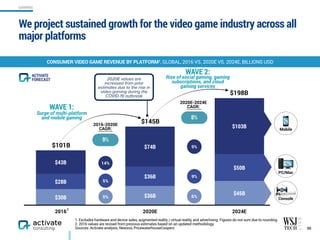
We project sustained growth for the video game industry across all
major platforms
30
CONSUMER VIDEO GAME REVENUE BY PLATFORM1, GLOBAL, 2016 VS. 2020E VS. 2024E, BILLIONS USD
1. Excludes hardware and device sales, augmented reality / virtual reality, and advertising. Figures do not sum due to rounding.
2. 2016 values are revised from previous estimates based on an updated methodology.
Sources: Activate analysis, Newzoo, PricewaterhouseCoopers
$101B
$145B
Surge of multi-platform
and mobile gaming
WAVE 1:
9%
9%
6% Console
$198B
14%
5%
5%
2016-2020E
CAGR:
2020E-2024E
CAGR:
Mobile
PC/Mac
2
Rise of social gaming, gaming
subscriptions, and cloud 

gaming services
WAVE 2:
2020E values are
increased from prior
estimates due to the rise in
video gaming during the
COVID-19 outbreak
9%
8%
GAMING
ACTIVATE
FORECAST
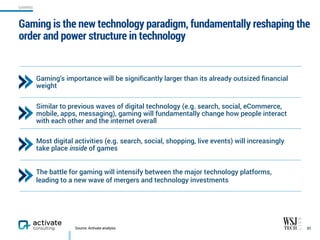
Gaming is the new technology paradigm, fundamentally reshaping the
order and power structure in technology
31
GAMING
Source: Activate analysis
Gaming’s importance will be significantly larger than its already outsized financial
weight
Similar to previous waves of digital technology (e.g. search, social, eCommerce,
mobile, apps, messaging), gaming will fundamentally change how people interact
with each other and the internet overall
Most digital activities (e.g. search, social, shopping, live events) will increasingly 

take place inside of games
The battle for gaming will intensify between the major technology platforms, 

leading to a new wave of mergers and technology investments
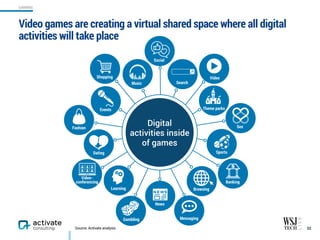
Video games are creating a virtual shared space where all digital
activities will take place
32Source: Activate analysis
GAMING
Music
Events
Social
Gambling
Dating
Learning
Shopping
Fashion
News
Messaging
Sports
Video-

conferencing
Sex
Search
Banking
Browsing
Video
Theme parks
Digital
activities inside
of games
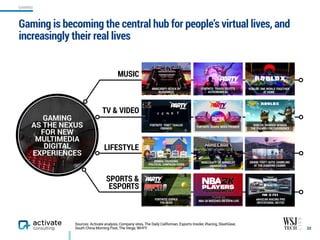
Gaming is becoming the central hub for people’s virtual lives, and
increasingly their real lives
33
Sources: Activate analysis, Company sites, The Daily Californian, Esports Insider, iRacing, SlashGear,
South China Morning Post, The Verge, WHYY
GAMING 

AS THE NEXUS
FOR NEW
MULTIMEDIA
DIGITAL
EXPERIENCES
MINECRAFT: BLOCK BY
BLOCKWEST
ROBLOX: ONE WORLD TOGETHER
AT HOME
FORTNITE: TRAVIS SCOTT’S
ASTRONOMICAL
MUSIC
SPORTS &
ESPORTS
NBA 2K MATCHES ON ESPN LIVE
FORTNITE: ESPN 8 

THE OCHO
TV & VIDEO
FORTNITE: SHARK WEEK PREMIER
FORTNITE: TENET TRAILER
PREMIER
ROBLOX: WONDER WOMAN

THE THEMYSCIRA EXPERIENCE
LIFESTYLE
MINECRAFT: UC BERKELEY
GRADUATION
ANIMAL CROSSING: 

POLITICAL CAMPAIGN SIGNS
GRAND THEFT AUTO: GAMBLING
AT THE DIAMOND CASINO
eNASCAR iRACING PRO
INVITATIONAL ON FOX
GAMING
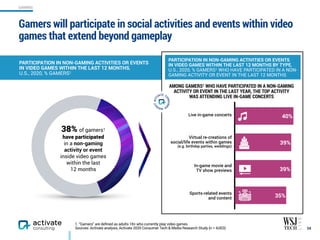
PARTICIPATION IN NON-GAMING ACTIVITIES OR EVENTS
IN VIDEO GAMES WITHIN THE LAST 12 MONTHS, 

U.S., 2020, % GAMERS1
34
1. “Gamers” are defined as adults 18+ who currently play video games.
Sources: Activate analysis, Activate 2020 Consumer Tech & Media Research Study (n = 4,003)
38% of gamers1
have participated 

in a non-gaming
activity or event
inside video games
within the last 

12 months
35%
39%
39%
40%Live in-game concerts
Virtual re-creations of
social/life events within games
(e.g. birthday parties, weddings)
In-game movie and 

TV show previews
Sports-related events 

and content
AMONG GAMERS1 WHO HAVE PARTICIPATED IN A NON-GAMING
ACTIVITY OR EVENT IN THE LAST YEAR, THE TOP ACTIVITY
WAS ATTENDING LIVE IN-GAME CONCERTS
PARTICIPATION IN NON-GAMING ACTIVITIES OR EVENTS
IN VIDEO GAMES WITHIN THE LAST 12 MONTHS BY TYPE,
U.S., 2020, % GAMERS1 WHO HAVE PARTICIPATED IN A NON-
GAMING ACTIVITY OR EVENT IN THE LAST 12 MONTHS
GAMING
Gamers will participate in social activities and events within video
games that extend beyond gameplay
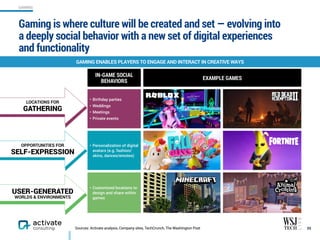
IN-GAME SOCIAL
BEHAVIORS
EXAMPLE GAMES
• Birthday parties
• Weddings
• Meetings
• Private events
• Personalization of digital
avatars (e.g. fashion/
skins, dances/emotes)
• Customized locations to
design and share within
games
Gaming is where culture will be created and set — evolving into
a deeply social behavior with a new set of digital experiences
and functionality
35
GAMING ENABLES PLAYERS TO ENGAGE AND INTERACT IN CREATIVE WAYS
LOCATIONS FOR 

GATHERING
OPPORTUNITIES FOR 

SELF-EXPRESSION
USER-GENERATED 

WORLDS & ENVIRONMENTS
Sources: Activate analysis, Company sites, TechCrunch, The Washington Post
GAMING
All of the top titles feature online multiplayer gameplay
36
TOP-EARNING PAID PC AND CONSOLE VIDEO GAME TITLES, GLOBAL, 2019, MILLIONS USD
Sources: Activate analysis, Company sites, SuperData 36
CALL OF DUTY:
MODERN WARFARE $645MFIFA 19 $786M GRAND THEFT 

AUTO V $595M FIFA 20 $504M
CALL OF DUTY:
BLACK OPS III $487M TOM CLANCY’S 

THE DIVISION 2 $370M TOM CLANCY’S
RAINBOW SIX SIEGE $358MNBA 2K19 $370M
PC PC
PC
PCPLAYSTATION XBOX PERSONAL COMPUTER NINTENDO SWITCH
PC
PC PC
PC PC
GAMING
Ability to play
co-op with up 

to three other
players
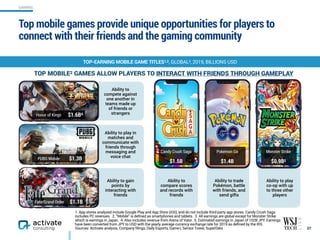
Top mobile games provide unique opportunities for players to
connect with their friends and the gaming community
37
1. App stores analyzed include Google Play and App Store (iOS), and do not include third-party app stores. Candy Crush Saga
includes PC revenues. 2. ”Mobile” is defined as smartphones and tablets. 3. All earnings are global except for Monster Strike
which is earnings in Japan. 4. Also includes revenue from Arena of Valor. 5. Estimated earnings in Japan of 102B JPY. Earnings
have been converted from JPY to USD with the yearly average currency exchange rate for 2019 as defined by the IRS.
Sources: Activate analysis, Company filings, Daily Esports, Game-i, Sensor Tower, SuperData
TOP MOBILE2 GAMES ALLOW PLAYERS TO INTERACT WITH FRIENDS THROUGH GAMEPLAY
37
PUBG Mobile $1.3B
Fate/Grand Order $1.1B
Pokémon Go
$1.4B
Candy Crush Saga
$1.5B
Monster Strike
$0.9B5
Honor of Kings $1.6B4
Ability to play in
matches and
communicate with
friends through
messaging and
voice chat
Ability to gain
points by
interacting with
friends
Ability to
compare scores
and records with
friends
Ability to trade
Pokémon, battle
with friends, and
send gifts
Ability to
compete against
one another in
teams made up
of friends or
strangers
TOP-EARNING MOBILE GAME TITLES1,2, GLOBAL3, 2019, BILLIONS USD
GAMING
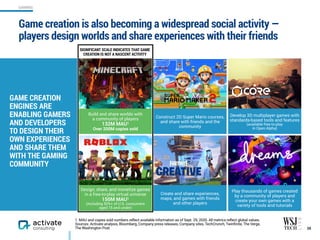
Game creation is also becoming a widespread social activity —
players design worlds and share experiences with their friends
38
1. MAU and copies sold numbers reflect available information as of Sept. 29, 2020. All metrics reflect global values.
Sources: Activate analysis, Bloomberg, Company press releases, Company sites, TechCrunch, Twinfinite, The Verge, 

The Washington Post
Build and share worlds with 

a community of players
132M MAU1
Over 200M copies sold
Construct 2D Super Mario courses,
and share with friends and the
community
Develop 3D multiplayer games with
standards-based tools and features
(available free-to-play 

in Open Alpha)
Design, share, and monetize games
in a free-to-play virtual universe
150M MAU1 

(including 50%+ of U.S. consumers
aged 15 and under)
Create and share experiences,
maps, and games with friends 

and other players
Play thousands of games created
by a community of players and
create your own games with a
variety of tools and tutorials
GAME CREATION
ENGINES ARE
ENABLING GAMERS
AND DEVELOPERS 

TO DESIGN THEIR
OWN EXPERIENCES
AND SHARE THEM
WITH THE GAMING
COMMUNITY
SIGNIFICANT SCALE INDICATES THAT GAME
CREATION IS NOT A NASCENT ACTIVITY
GAMING
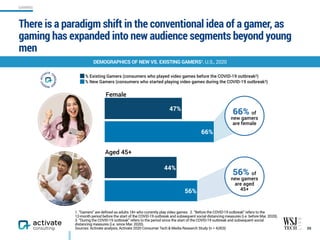
There is a paradigm shift in the conventional idea of a gamer, as
gaming has expanded into new audience segments beyond young
men
56%
66%
44%
47%
% Existing Gamers (consumers who played video games before the COVID-19 outbreak )
% New Gamers (consumers who started playing video games during the COVID-19 outbreak)
39
DEMOGRAPHICS OF NEW VS. EXISTING GAMERS1, U.S., 2020
1. “Gamers” are defined as adults 18+ who currently play video games. 2. “Before the COVID-19 outbreak” refers to the 

12-month period before the start of the COVID-19 outbreak and subsequent social distancing measures (i.e. before Mar. 2020). 

3. “During the COVID-19 outbreak” refers to the period since the start of the COVID-19 outbreak and subsequent social 

distancing measures (i.e. since Mar. 2020).
Sources: Activate analysis, Activate 2020 Consumer Tech & Media Research Study (n = 4,003)
Female
Aged 45+
% Existing Gamers (consumers who played video games before the COVID-19 outbreak2)
% New Gamers (consumers who started playing video games during the COVID-19 outbreak3)
56% of
new gamers
are aged
45+
66% of
new gamers
are female
GAMING
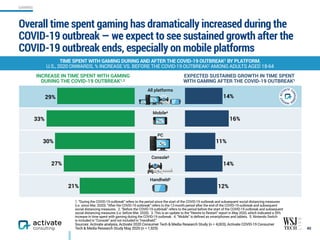
Overall time spent gaming has dramatically increased during the
COVID-19 outbreak — we expect to see sustained growth after the
COVID-19 outbreak ends, especially on mobile platforms
40
TIME SPENT WITH GAMING DURING AND AFTER THE COVID-19 OUTBREAK1 BY PLATFORM, 

U.S., 2020 ONWARDS, % INCREASE VS. BEFORE THE COVID-19 OUTBREAK2 AMONG ADULTS AGED 18-64
1. “During the COVID-19 outbreak” refers to the period since the start of the COVID-19 outbreak and subsequent social distancing measures
(i.e. since Mar. 2020). “After the COVID-19 outbreak” refers to the 12-month period after the end of the COVID-19 outbreak and subsequent
social distancing measures. 2. “Before the COVID-19 outbreak” refers to the period before the start of the COVID-19 outbreak and subsequent
social distancing measures (i.e. before Mar. 2020). 3. This is an update to the “Rewire to Restart” report in May 2020, which indicated a 39%
increase in time spent with gaming during the COVID-19 outbreak. 4. “Mobile” is defined as smartphones and tablets. 5. Nintendo Switch 

is included in “Console” and not included in “Handheld.”
Sources: Activate analysis, Activate 2020 Consumer Tech & Media Research Study (n = 4,003), Activate COVID-19 Consumer 

Tech & Media Research Study May 2020 (n = 1,925)
All platforms
Mobile4
PC
Console5
Handheld5
12%
14%
11%
16%
14%
INCREASE IN TIME SPENT WITH GAMING
DURING THE COVID-19 OUTBREAK1,3
29%
33%
30%
27%
21%
EXPECTED SUSTAINED GROWTH IN TIME SPENT
WITH GAMING AFTER THE COVID-19 OUTBREAK1
GAMING
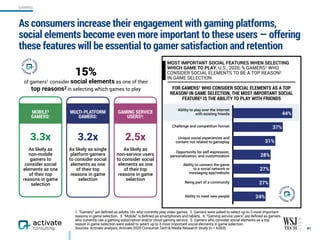
15%

of gamers1 consider social elements as one of their

top reasons2 in selecting which games to play
As consumers increase their engagement with gaming platforms,
social elements become even more important to these users — offering
these features will be essential to gamer satisfaction and retention
41
1. “Gamers” are defined as adults 18+ who currently play video games. 2. Gamers were asked to select up to 3 most important
reasons in game selection. 3. “Mobile” is defined as smartphones and tablets. 4. “Gaming service users” are defined as gamers
who currently use a gaming subscription and/or cloud gaming service. 5. Gamers who consider social elements as a top
reason in game selection were asked to select up to 3 most important social elements in game selection.
Sources: Activate analysis, Activate 2020 Consumer Tech & Media Research Study (n = 4,003)
MOST IMPORTANT SOCIAL FEATURES WHEN SELECTING
WHICH GAME TO PLAY, U.S., 2020, % GAMERS1 WHO
CONSIDER SOCIAL ELEMENTS TO BE A TOP REASON2 

IN GAME SELECTION
24%
27%
27%
28%
31%
37%
44%
FOR GAMERS1 WHO CONSIDER SOCIAL ELEMENTS AS A TOP
REASON2 IN GAME SELECTION, THE MOST IMPORTANT SOCIAL
FEATURE5 IS THE ABILITY TO PLAY WITH FRIENDS
Ability to play over the internet
with existing friends
Challenge and competition format
Unique social experiences and
content not related to gameplay
Opportunity for self-expression,
personalization, and customization
Ability to connect the game 

to a social network or
messaging app/website
Being part of a community
Ability to meet new people
As likely as
non-mobile
gamers to
consider social
elements as one
of their top
reasons in game
selection
3.3x
MOBILE3
GAMERS:
As likely as 

non-service users
to consider social
elements as one
of their top
reasons in game
selection
2.5x
GAMING SERVICE
USERS4:
As likely as single
platform gamers
to consider social
elements as one
of their top
reasons in game
selection
3.2x
MULTI-PLATFORM
GAMERS:
GAMING
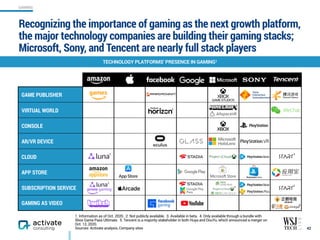
Recognizing the importance of gaming as the next growth platform,
the major technology companies are building their gaming stacks;
Microsoft, Sony, and Tencent are nearly full stack players
GAME PUBLISHER
VIRTUAL WORLD
CONSOLE
AR/VR DEVICE
CLOUD
APP STORE
SUBSCRIPTION SERVICE
GAMING AS VIDEO
1. Information as of Oct. 2020. 2. Not publicly available. 3. Available in beta. 4. Only available through a bundle with
Xbox Game Pass Ultimate. 5. Tencent is a majority stakeholder in both Huya and DouYu, which announced a merger on 

Oct. 12, 2020.
Sources: Activate analysis, Company sites
3
2 3
2
34
eGame
5
GAMING
42
TECHNOLOGY PLATFORMS’ PRESENCE IN GAMING1
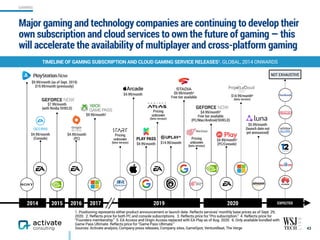
Major gaming and technology companies are continuing to develop their
own subscription and cloud services to own the future of gaming — this
will accelerate the availability of multiplayer and cross-platform gaming
43
TIMELINE OF GAMING SUBSCRIPTION AND CLOUD GAMING SERVICE RELEASES1, GLOBAL, 2014 ONWARDS
2015 2019
$9.99/month (as of Sept. 2019)
$19.99/month (previously)
2014 2016 2017 EXPECTED2020
$4.99/month4
Free tier available
(PC/Mac/Android/SHIELD)
$7.99/month
(with Nvidia SHIELD)
$9.99/month2
$4.99/month
(Console)
$4.99/month
(PC)
$14.99/month6
(beta version)
Pricing
unknown
(beta version)
$4.99/month
Pricing
unknown
(beta version)
$14.99/month
PLAY PASS
$4.99/month
$9.99/month3
Free tier available
Pricing
unknown 

(beta version)
$5.99/month
(launch date not
yet announced)
$4.99/month5
(PC/Console)
NOT EXHAUSTIVE
1. Positioning represents either product announcement or launch date. Reflects services’ monthly base prices as of Sept. 29,
2020. 2. Reflects price for both PC and console subscriptions. 3. Reflects price for “Pro subscription.” 4. Reflects price for
“Founders membership.” 5. EA Access and Origin Access replaced with EA Play as of Aug. 2020. 6. Only available bundled with
Game Pass Ultimate. Reflects price for “Game Pass Ultimate.”
Sources: Activate analysis, Company press releases, Company sites, GameSpot, VentureBeat, The Verge
GAMING
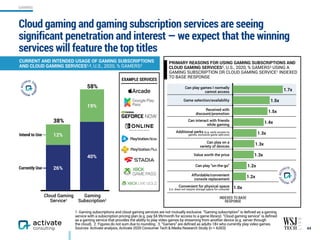
Cloud gaming and gaming subscription services are seeing
significant penetration and interest — we expect that the winning
services will feature the top titles
44
CURRENT AND INTENDED USAGE OF GAMING SUBSCRIPTIONS
AND CLOUD GAMING SERVICES1,2, U.S., 2020, % GAMERS3
19%
12%
40%
26%
38%
58%
Intend to Use
Currently Use
EXAMPLE SERVICES
Can play games I normally 

cannot access
Game selection/availability
Received with
discount/promotion
Can interact with friends 

while gaming
Additional perks (e.g. early access to
games, exclusive game add-ons)
Can play on a
variety of devices
Value worth the price
Can play "on-the-go"
Affordable/convenient
console replacement
Convenient for physical space 

(i.e. does not require storage space for console) 1.0x
1.2x
1.2x
1.3x
1.3x
1.3x
1.4x
1.5x
1.5x
1.7x
INDEXED TO BASE
RESPONSE
PRIMARY REASONS FOR USING GAMING SUBSCRIPTIONS AND
CLOUD GAMING SERVICES1, U.S., 2020, % GAMERS3 USING A
GAMING SUBSCRIPTION OR CLOUD GAMING SERVICE1 INDEXED
TO BASE RESPONSE
Cloud Gaming
Service1
Gaming
Subscription1
1. Gaming subscriptions and cloud gaming services are not mutually exclusive. “Gaming subscription” is defined as a gaming
service with a subscription pricing plan (e.g. pay $4.99/month for access to a game library). “Cloud gaming service” is defined
as a gaming service that provides the ability to play video games by streaming from another device (e.g. server through
the cloud). 2. Figures do not sum due to rounding. 3. “Gamers” are defined as adults 18+ who currently play video games.
Sources: Activate analysis, Activate 2020 Consumer Tech & Media Research Study (n = 4,003)
GAMING
1. Includes money spent on video games and other video gaming purchases (e.g. in-app purchases) across all devices. 2. “Gamers” are
defined as adults 18+ who currently play video games. 3. “Gaming subscriptions” are defined as gaming services with a subscription
pricing plan. 4. “New users” are defined as gamers who have begun using a gaming subscription since the COVID-19 outbreak (as of May
2020) and did not use one in the 12 months prior to outbreak. 5. “During the COVID-19 outbreak” refers to the period since the start of the
COVID-19 outbreak and subsequent social distancing measures (i.e. since Mar. 2020). “After the COVID-19 outbreak” refers to the 12-month
period after the end of the COVID-19 outbreak and subsequent social distancing measures.

Sources: Activate analysis, Activate 2019 Consumer Tech & Media Research Study (n = 4,006), Activate COVID-19 Consumer
Tech & Media Research Study April 2020 (n = 1,866), eMarketer, Nielsen, PricewaterhouseCoopers 45
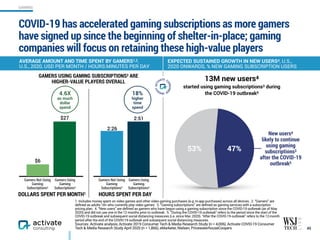
AVERAGE AMOUNT AND TIME SPENT BY GAMERS1,2, 

U.S., 2020, USD PER MONTH / HOURS:MINUTES PER DAY
EXPECTED SUSTAINED GROWTH IN NEW USERS4, U.S., 

2020 ONWARDS, % NEW GAMING SUBSCRIPTION USERS
GAMERS USING GAMING SUBSCRIPTIONS3 ARE 

HIGHER-VALUE PLAYERS OVERALL
$27
$6
Gamers Not Using
Gaming
Subscriptions3
Gamers Using
Gaming
Subscriptions3
DOLLARS SPENT PER MONTH1 HOURS SPENT PER DAY
18%
higher 

time

spend
4.6X
as much
dollar
spend
COVID-19 has accelerated gaming subscriptions as more gamers
have signed up since the beginning of shelter-in-place; gaming
companies will focus on retaining these high-value players
2:26
2:51
Gamers Not Using
Gaming
Subscriptions3
Gamers Using
Gaming
Subscriptions3
13M new users4
started using gaming subscriptions3 during
the COVID-19 outbreak5
47%53%
New users4
likely to continue
using gaming
subscriptions3
after the COVID-19
outbreak5
GAMING
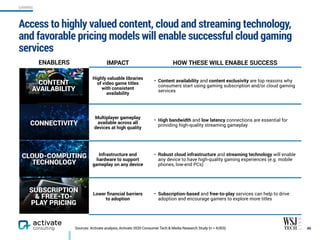
Access to highly valued content, cloud and streaming technology,
and favorable pricing models will enable successful cloud gaming
services
46Sources: Activate analysis, Activate 2020 Consumer Tech & Media Research Study (n = 4,003)
ENABLERS IMPACT HOW THESE WILL ENABLE SUCCESS
Highly valuable libraries
of video game titles
with consistent
availability
• Content availability and content exclusivity are top reasons why
consumers start using gaming subscription and/or cloud gaming
services
Multiplayer gameplay
available across all
devices at high quality
• High bandwidth and low latency connections are essential for
providing high-quality streaming gameplay
Infrastructure and
hardware to support
gameplay on any device
• Robust cloud infrastructure and streaming technology will enable
any device to have high-quality gaming experiences (e.g. mobile
phones, low-end PCs)
Lower financial barriers
to adoption
• Subscription-based and free-to-play services can help to drive
adoption and encourage gamers to explore more titles
SUBSCRIPTION
& FREE-TO-
PLAY PRICING
CONNECTIVITY
CONTENT
AVAILABILITY
CLOUD-COMPUTING
TECHNOLOGY
GAMING
47www.activate.com
CONTENTS
$375 Billion Global Technology and Media Growth Dollars up for Grabs 5
Consumer Technology and Media Time and Attention 9
Super Users, Super Consumers 15
Gaming: The New Technology Paradigm 29
Esports: The Mainstream Sport of the Future 47
Video: The Fight for Battleground Households 61
AR/VR: On the Verge of Widespread Adoption 75
Connectivity: Intensifying the Need for Speed 91
eCommerce: Accelerating Five Years in Five Months 99
Sports & Sports Tech: Revolutionizing the Fan Experience 110
Sports Betting: $25 Billion for Technology and Media Companies 128
Advertising: Technology’s Identity Crisis 134
PAGE
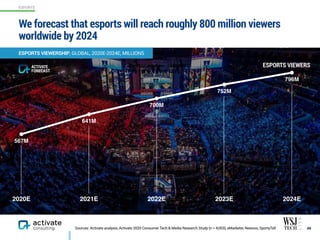
2020E 2021E 2022E 2023E 2024E
796M
752M
700M
641M
567M
We forecast that esports will reach roughly 800 million viewers
worldwide by 2024
48
ESPORTS VIEWERSHIP, GLOBAL, 2020E-2024E, MILLIONS
Sources: Activate analysis, Activate 2020 Consumer Tech & Media Research Study (n = 4,003), eMarketer, Newzoo, SportyTell
ESPORTS VIEWERS
ESPORTS
ACTIVATE
FORECAST
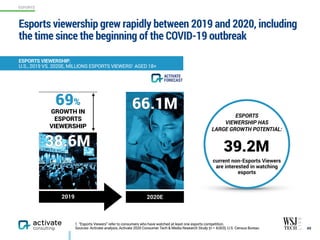
Esports viewership grew rapidly between 2019 and 2020, including
the time since the beginning of the COVID-19 outbreak
49
ESPORTS VIEWERSHIP,

U.S., 2019 VS. 2020E, MILLIONS ESPORTS VIEWERS1 AGED 18+
1. “Esports Viewers” refer to consumers who have watched at least one esports competition.
Sources: Activate analysis, Activate 2020 Consumer Tech & Media Research Study (n = 4,003), U.S. Census Bureau
66.1M69% 

GROWTH IN 

ESPORTS
VIEWERSHIP
2019 2020E
39.2M
current non-Esports Viewers
are interested in watching 

esports
ESPORTS 

VIEWERSHIP HAS 

LARGE GROWTH POTENTIAL:
38.6M
ESPORTS
ACTIVATE
FORECAST
TIME SPENT WATCHING 

SPORTS ONLINE
TIME SPENT WATCHING 

SPORTS ON TV
TIME SPENT WATCHING OTHERS 

PLAY VIDEO GAMES ONLINE1
TIME SPENT WATCHING 

ESPORTS COMPETITIONS
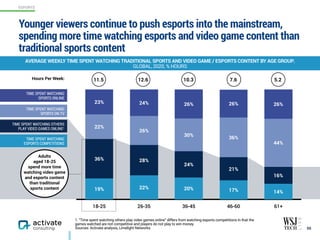
Younger viewers continue to push esports into the mainstream,
spending more time watching esports and video game content than
traditional sports content
50
AVERAGE WEEKLY TIME SPENT WATCHING TRADITIONAL SPORTS AND VIDEO GAME / ESPORTS CONTENT BY AGE GROUP, 

GLOBAL, 2020, % HOURS
1. “Time spent watching others play video games online” differs from watching esports competitions in that the
games watched are not competitive and players do not play to win money.
Sources: Activate analysis, Limelight Networks
18-25 26-35 36-45 46-60 61+
26%26%26%24%23%
44%
36%
30%
26%
22%
16%
21%
24%
28%36%
14%17%20%22%19%
11.5Hours Per Week: 12.6 10.3 7.6 5.2
Adults
aged 18-25
spend more time
watching video game
and esports content
than traditional
sports content
ESPORTS
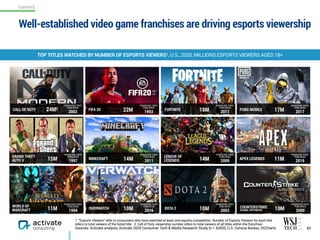
Well-established video game franchises are driving esports viewership
51
TOP TITLES WATCHED BY NUMBER OF ESPORTS VIEWERS1, U.S., 2020, MILLIONS ESPORTS VIEWERS AGED 18+
1. “Esports Viewers” refer to consumers who have watched at least one esports competition. Number of Esports Viewers for each title
refers to total viewers of the listed title. 2. Call of Duty viewership number refers to total viewers of all titles within the franchise.
Sources: Activate analysis, Activate 2020 Consumer Tech & Media Research Study (n = 4,003), U.S. Census Bureau, VGChartz 51
CALL OF DUTY 24M2
FRANCHISE FIRST
PUBLISHED
2003
FIFA 20 22M
FRANCHISE FIRST
PUBLISHED
1993
FORTNITE 18M
FRANCHISE FIRST
PUBLISHED
2017
PUBG MOBILE 17M
FRANCHISE FIRST
PUBLISHED
2017
GRAND THEFT
AUTO V 15M
FRANCHISE FIRST
PUBLISHED
1997
MINECRAFT 14M
FRANCHISE FIRST
PUBLISHED
2011
LEAGUE OF
LEGENDS 14M
FRANCHISE FIRST
PUBLISHED
2009
APEX LEGENDS 11M
FRANCHISE FIRST
PUBLISHED
2019
WORLD OF
WARCRAFT 11M
FRANCHISE FIRST
PUBLISHED
1994
OVERWATCH 10M
FRANCHISE FIRST
PUBLISHED
2016
DOTA 2 10M
FRANCHISE FIRST
PUBLISHED
2003
COUNTERSTRIKE
GLOBAL OFFENSIVE 10M
FRANCHISE FIRST
PUBLISHED
2000
ESPORTS
Esports Viewers1
Sports Viewers2
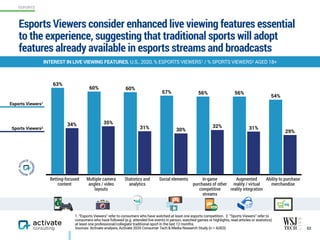
Esports Viewers consider enhanced live viewing features essential
to the experience, suggesting that traditional sports will adopt
features already available in esports streams and broadcasts
52
1. “Esports Viewers” refer to consumers who have watched at least one esports competition. 2. “Sports Viewers” refer to
consumers who have followed (e.g. attended live events in person, watched games or highlights, read articles or statistics)
at least one professional/collegiate traditional sport in the last 12 months.
Sources: Activate analysis, Activate 2020 Consumer Tech & Media Research Study (n = 4,003)
29%
31%32%
30%31%
35%34%
54%
56%56%57%
60%60%
63%
Betting-focused
content
Multiple camera
angles / video
layouts
Statistics and
analytics
Social elements In-game 

purchases of other
competitive
streams
Augmented
reality / virtual
reality integration
Ability to purchase
merchandise
ESPORTS
INTEREST IN LIVE VIEWING FEATURES, U.S., 2020, % ESPORTS VIEWERS1 / % SPORTS VIEWERS2 AGED 18+
15%
24%
20%
23%
14%
29%
30%
24%
31%
16%
19%
20%
21%
21%
21%
25%
29%
29%
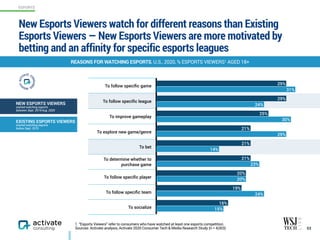
New Esports Viewers watch for different reasons than Existing
Esports Viewers — New Esports Viewers are more motivated by
betting and an affinity for specific esports leagues
53
1. “Esports Viewers” refer to consumers who have watched at least one esports competition.
Sources: Activate analysis, Activate 2020 Consumer Tech & Media Research Study (n = 4,003)
NEW ESPORTS VIEWERS
started watching esports
between Sept. 2019-Aug. 2020
EXISTING ESPORTS VIEWERS
started watching esports 

before Sept. 2019
To follow specific game
To follow specific league
To improve gameplay
To explore new game/genre
To bet
To determine whether to
purchase game
To follow specific player
To follow specific team
To socialize
ESPORTS
REASONS FOR WATCHING ESPORTS, U.S., 2020, % ESPORTS VIEWERS1 AGED 18+
Chat publicly as John Smith
here we go
Do you think they’ll win?
I am not sure they can…
neither am I
It just keeps going back and forth,
both teams are on fire today
Here we go
I’ve got money on this one!
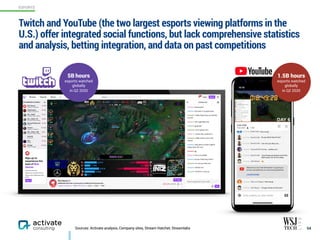
Twitch and YouTube (the two largest esports viewing platforms in the
U.S.) offer integrated social functions, but lack comprehensive statistics
and analysis, betting integration, and data on past competitions
54Sources: Activate analysis, Company sites, Stream Hatchet, Streamlabs
Gamer1: Good work!
Gamer2: this team is so good wow
Gamer3: I really hope they can pull this
win off
Gamer1: this is ge:ng close
Gamer4: go go go!
Gamer3: I can’t believe it!!!
Gamer 1: I knew they could do it
Gamer3: I really wasn’t sure to be
honest
Gamer2: they were on their A-game
today, that’s for sure
Gamer5: gg
Gamer1: this is incredible
Gamer2: do you think they’ll win?
Gamer3: I’m not sure they can…
Gamer2: neither am I
Gamer4: I think it’s a toss up
1.5B hours 

esports watched
globally
in Q2 2020
ESPORTS
5B hours
esports watched
globally
in Q2 2020
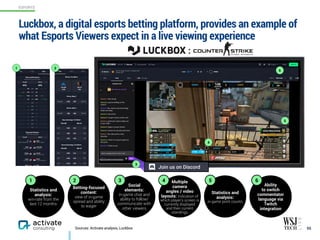
Luckbox, a digital esports betting platform, provides an example of
what Esports Viewers expect in a live viewing experience
55Sources: Activate analysis, Luckbox
Join us on Discord
1
Statistics and
analysis: 

win-rate from the 

last 12 months
1
Betting-focused
content: 

view of in-game
spread and ability 

to wager
2
2
Social
elements: 

in-game chat and
ability to follow/
communicate with
other viewers
3 Multiple
camera
angles / video
layouts: indication of
which player’s screen is
currently displayed
and their current
standings
4
4
Statistics and
analysis: 

in-game point counts
5
5
Ability 

to switch
commentator
language via 

Twitch
integration
6
6
3
:
Gamer1: here we go
Gamer2: anyone be:ng on this
match?
Gamer3: No, need to see how things
shake out today
Gamer2: same here
Gamer4: I’ve got money on this one!
Gamer1: good luck, hope it plays out
in your favor
Gamer4: fingers crossed, thanks
Gamer2: Curious to see who wins here
Gamer1: the stats point a clear
direcGon
Gamer2: I think it’s anyone’s game at
this point
Gamer3: I think so too
ESPORTS
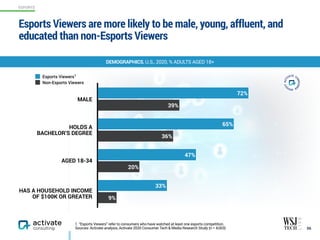
Esports Viewers are more likely to be male, young, affluent, and
educated than non-Esports Viewers
56
1. “Esports Viewers” refer to consumers who have watched at least one esports competition.
Sources: Activate analysis, Activate 2020 Consumer Tech & Media Research Study (n = 4,003)
9%
20%
36%
39%
33%
47%
65%
72%
Esports Viewers
Non-Esports Viewers
MALE
HOLDS A 

BACHELOR’S DEGREE
AGED 18-34
HAS A HOUSEHOLD INCOME
OF $100K OR GREATER
1
DEMOGRAPHICS, U.S., 2020, % ADULTS AGED 18+
ESPORTS
31%
37%
69%
63%
Paid to gain access
to a live esports
competition online
(e.g. ESPN+, DAZN)
Bought an item after
seeing it promoted
by an esports player
(e.g. energy drink,
vitamin/supplement)
Bought esports
merchandise 

(e.g. team or player
apparel, tournament
collectible)
Donated to 

an esports team 

or player 

(e.g. Twitch or
PayPal donation)
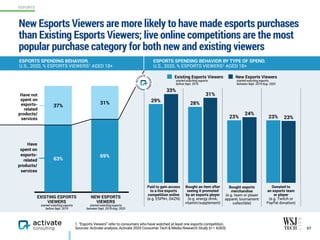
New Esports Viewers are more likely to have made esports purchases
than Existing Esports Viewers; live online competitions are the most
popular purchase category for both new and existing viewers
57
1. “Esports Viewers” refer to consumers who have watched at least one esports competition.
Sources: Activate analysis, Activate 2020 Consumer Tech & Media Research Study (n = 4,003)
ESPORTS SPENDING BEHAVIOR,
U.S., 2020, % ESPORTS VIEWERS1 AGED 18+
ESPORTS SPENDING BEHAVIOR BY TYPE OF SPEND, 

U.S., 2020, % ESPORTS VIEWERS1 AGED 18+
23%
24%
31%
33%
23%23%
28%
29%
Existing Esports Viewers New Esports Viewers
Have

spent on
esports-
related
products/
services
Have not

spent on
esports-
related
products/
services
started watching esports
before Sept. 2019
started watching esports
between Sept. 2019-Aug. 2020
EXISTING ESPORTS 

VIEWERS
started watching esports 

before Sept. 2019
NEW ESPORTS 

VIEWERS
started watching esports
between Sept. 2019-Aug. 2020
ESPORTS
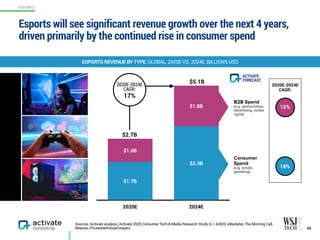
Esports will see significant revenue growth over the next 4 years,
driven primarily by the continued rise in consumer spend
58
ESPORTS REVENUE BY TYPE, GLOBAL, 2020E VS. 2024E, BILLIONS USD
Sources: Activate analysis, Activate 2020 Consumer Tech & Media Research Study (n = 4,003), eMarketer, The Morning Call,
Newzoo, PricewaterhouseCoopers
2020E 2024E
$1.8B
$1.0B
$3.3B
$1.7B
2020E-2024E
CAGR:
Consumer
Spend 

(e.g. tickets,
gambling)
B2B Spend 

(e.g. sponsorships,
advertising, media
rights)
$2.7B
$5.1B
15%
18%
2020E-2024E
CAGR:
17%
ESPORTS
ACTIVATE
FORECAST
59
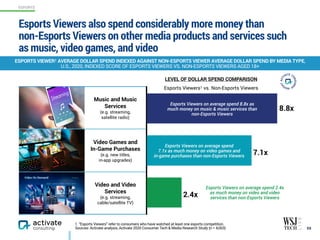
ESPORTS VIEWER1 AVERAGE DOLLAR SPEND INDEXED AGAINST NON-ESPORTS VIEWER AVERAGE DOLLAR SPEND BY MEDIA TYPE,

U.S., 2020, INDEXED SCORE OF ESPORTS VIEWERS VS. NON-ESPORTS VIEWERS AGED 18+
Music and Music
Services
(e.g. streaming,
satellite radio)
Video Games and 

In-Game Purchases
(e.g. new titles,
in-app upgrades)
Video and Video
Services
(e.g. streaming,
cable/satellite TV)
1. “Esports Viewers” refer to consumers who have watched at least one esports competition.
Sources: Activate analysis, Activate 2020 Consumer Tech & Media Research Study (n = 4,003)
LEVEL OF DOLLAR SPEND COMPARISON
Esports Viewers also spend considerably more money than
non-Esports Viewers on other media products and services such
as music, video games, and video
8.8x
7.1x
2.4x
Esports Viewers on average spend 8.8x as 

much money on music & music services than 

non-Esports Viewers
Esports Viewers on average spend 

7.1x as much money on video games and 

in-game purchases than non-Esports Viewers
Esports Viewers1 vs. Non-Esports Viewers
Esports Viewers on average spend 2.4x
as much money on video and video
services than non-Esports Viewers
ESPORTS
To improve my own
gameplay
To watch the specific
game being played
To become familiar
with a new game or
genre
To decide whether to
purchase/play a
game
28%
32%
34%
35%
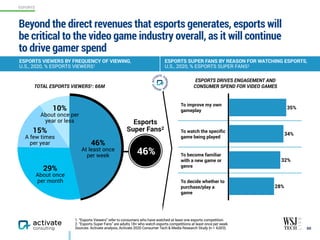
Beyond the direct revenues that esports generates, esports will
be critical to the video game industry overall, as it will continue
to drive gamer spend
60
1. “Esports Viewers” refer to consumers who have watched at least one esports competition.
2. “Esports Super Fans” are adults 18+ who watch esports competitions at least once per week.
Sources: Activate analysis, Activate 2020 Consumer Tech & Media Research Study (n = 4,003)
ESPORTS VIEWERS BY FREQUENCY OF VIEWING,
U.S., 2020, % ESPORTS VIEWERS1
ESPORTS SUPER FANS BY REASON FOR WATCHING ESPORTS,
U.S., 2020, % ESPORTS SUPER FANS2
46%
At least once
per week
15%

A few times
per year
29%
About once
per month
10%

About once per
year or less
ESPORTS DRIVES ENGAGEMENT AND
CONSUMER SPEND FOR VIDEO GAMES
46%
Esports
Super Fans2
TOTAL ESPORTS VIEWERS1: 66M
ESPORTS
61www.activate.com
CONTENTS
$375 Billion Global Technology and Media Growth Dollars up for Grabs 5
Consumer Technology and Media Time and Attention 9
Super Users, Super Consumers 15
Gaming: The New Technology Paradigm 29
Esports: The Mainstream Sport of the Future 47
Video: The Fight for Battleground Households 61
AR/VR: On the Verge of Widespread Adoption 75
Connectivity: Intensifying the Need for Speed 91
eCommerce: Accelerating Five Years in Five Months 99
Sports & Sports Tech: Revolutionizing the Fan Experience 110
Sports Betting: $25 Billion for Technology and Media Companies 128
Advertising: Technology’s Identity Crisis 134
PAGE
2020E-2024E 

CAGR:
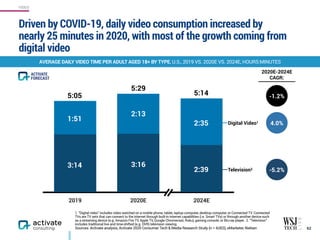
Driven by COVID-19, daily video consumption increased by
nearly 25 minutes in 2020, with most of the growth coming from 

digital video
62
AVERAGE DAILY VIDEO TIME PER ADULT AGED 18+ BY TYPE, U.S., 2019 VS. 2020E VS. 2024E, HOURS:MINUTES
1. “Digital video” includes video watched on a mobile phone, tablet, laptop computer, desktop computer, or Connected TV. Connected
TVs are TV sets that can connect to the internet through built-in internet capabilities (i.e. Smart TVs) or through another device such
as a streaming device (e.g. Amazon Fire TV, Apple TV, Google Chromecast, Roku), gaming console, or Blu-ray player. 2. “Television”
includes traditional live and time-shifted (e.g. DVR) television viewing.
Sources: Activate analysis, Activate 2020 Consumer Tech & Media Research Study (n = 4,003), eMarketer, Nielsen
2019 2020E 2024E
Television2
Digital Video1
3:14
2:39
2:35
1:51
5:05 5:14
-5.2%
4.0%
-1.2%
ACTIVATE
FORECAST
5:29
3:16
2:13
VIDEO
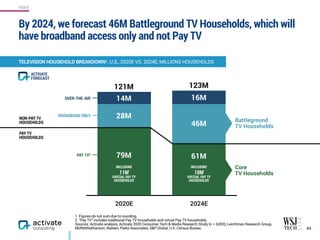
By 2024, we forecast 46M Battleground TV Households, which will
have broadband access only and not Pay TV
63
TELEVISION HOUSEHOLD BREAKDOWN1, U.S., 2020E VS. 2024E, MILLIONS HOUSEHOLDS
1. Figures do not sum due to rounding.
2. “Pay TV” includes traditional Pay TV households and virtual Pay TV households.
Sources: Activate analysis, Activate 2020 Consumer Tech & Media Research Study (n = 4,003), Leichtman Research Group,
MoffettNathanson, Nielsen, Parks Associates, S&P Global, U.S. Census Bureau
2020E 2024E
79M 61M
28M
46M
14M 16M
121M 123M
PAY TV
HOUSEHOLDS
NON-PAY TV
HOUSEHOLDS
BROADBAND ONLY
OVER-THE-AIR
PAY TV2
Battleground 

TV Households
Core 

TV Households
INCLUDING
11M
VIRTUAL PAY TV
HOUSEHOLDS
ACTIVATE
FORECAST
INCLUDING
18M
VIRTUAL PAY TV
HOUSEHOLDS
VIDEO
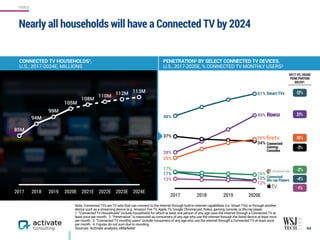
Nearly all households will have a Connected TV by 2024
64
Note: Connected TVs are TV sets that can connect to the internet through built-in internet capabilities (i.e. Smart TVs) or through another
device such as a streaming device (e.g. Amazon Fire TV, Apple TV, Google Chromecast, Roku), gaming console, or Blu-ray player.

1. ”Connected TV Households” include households for which at least one person of any age uses the internet through a Connected TV at
least once per month. 2. “Penetration” is measured as consumers of any age who use the internet through the listed device at least once
per month. 3. “Connected TV monthly users” include consumers of any age who use the internet through a Connected TV at least once
per month. 4. Figures do not sum due to rounding.
Sources: Activate analysis, eMarketer
CONNECTED TV HOUSEHOLDS1, 

U.S., 2017-2024E, MILLIONS
PENETRATION2 BY SELECT CONNECTED TV DEVICES,
U.S., 2017-2020E, % CONNECTED TV MONTHLY USERS3
2017 2018 2019 2020E 2021E 2022E 2023E 2024E
105M
99M
94M
85M
113M112M
110M
108M
105M
2017 2018 2019 2020E
28%
37%
25%
17%
13%
48%
17%
Connected
Gaming
Consoles
Smart TVs
2017 VS. 2020E
PENETRATION

DELTA4:
Connected

Blu-ray Players
49%
34%
35%
16%
12%
61%
12%
21%
10%
-3%
-2%
-1%
12%
-4%
VIDEO
65
ESTIMATED NUMBER OF SUBSCRIBERS / USERS FOR SELECT MAJOR VIDEO STREAMING SERVICES, 

GLOBAL, 2020 OR MOST RECENT, MILLIONS SUBSCRIBERS / MILLIONS MONTHLY ACTIVE USERS
1. Reflects estimated monthly active users as no recent official numbers have been reported. 2. Reflects average monthly active users for 2019. 

3. Reflects the most recently reported number of monthly active users as of Apr. 2019. 4. Subscriber count as of Q4 2019. 5. Reflects self-reporting that
The Roku Channel reached active accounts with approximately 43 million people in Q2 2020. 6. Reflects U.S. monthly active users as reported in Sept.
2020. Although Xumo is also available internationally, global users were not reported. 7. Reflects the number of sign-ups for Peacock across the free and
paid subscription tiers. 9. Reflects monthly active users as of Mar. 2019. 8. Does not include consumers subscribing to HBO / HBO Max through a Pay TV
provider (e.g. purchasing the HBO add-on to a cable/satellite TV package and receiving HBO Max at no additional cost). Includes consumers subscribing to
the HBO Max or HBO (formerly HBO Now) OTT service directly (e.g. subscribing to HBO Max through the service website) or through a non-Pay TV third
party (e.g. subscribing to HBO through Amazon Prime Video Channels). 9. Represents estimated sign-ups for Apple TV+ as Apple has not released official
subscriber counts. Does not represent all Apple device customers eligible for the 12-month free trial of the service. 10. Reflects the number of registered
users on MUBI.

Sources: Activate analysis, Bloomberg, Business Insider, Business Wire, CNBC, Company filings, Company press releases, Company sites, Cord Cutters
News, Deadline, Digiday, Digital TV News, eMarketer, FierceVideo, Media Play News, MediaPost, Multichannel News, nScreenMedia, TechCrunch, Variety, 

The Verge, The Washington Post
476M
150M
43M
36M 34M 33M 33M
15M
11M
24M
10M 9M 9M 9M 7M
13M
4
(including
Prim
e
Video)
(form
erly Hotstar)
The streaming wars will be fought locally and globally
Paid video streaming subscription [SVOD] 

(Millions subscribers)
Free video streaming service with ads [AVOD, FAST]

(Millions monthly active users)
Video streaming service with a paid subscription
tier and a free tier with ads (Millions monthly active users)
41M
8M
61M
500M
193M
300M
3 5 6 7 98 101 2
VIDEO
+
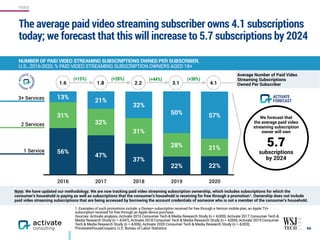
The average paid video streaming subscriber owns 4.1 subscriptions
today; we forecast that this will increase to 5.7 subscriptions by 2024
66
NUMBER OF PAID VIDEO STREAMING SUBSCRIPTIONS OWNED PER SUBSCRIBER, 

U.S., 2016-2020, % PAID VIDEO STREAMING SUBSCRIPTION OWNERS AGED 18+
1. Examples of such promotions include: a Disney+ subscription received for free through a Verizon mobile plan, an Apple TV+
subscription received for free through an Apple device purchase.
Sources: Activate analysis, Activate 2016 Consumer Tech & Media Research Study (n = 4,000), Activate 2017 Consumer Tech &
Media Research Study (n = 4,047), Activate 2018 Consumer Tech & Media Research Study (n = 4,000), Activate 2019 Consumer
Tech & Media Research Study (n = 4,006), Activate 2020 Consumer Tech & Media Research Study (n = 4,003),
PricewaterhouseCoopers, U.S. Bureau of Labor Statistics
2016 2017 2018 2019 2020
57%50%
32%
21%
13%
21%28%
31%
32%
31%
22%22%
37%
47%
56%1 Service
2 Services
3.1
3+ Services
Average Number of Paid Video
Streaming Subscriptions 

Owned Per Subscriber2.21.8
(+20%) (+44%) (+30%)
4.1
We forecast that
the average paid video
streaming subscription
owner will own
5.7
subscriptions 

by 2024
1.6
(+15%)
ACTIVATE
FORECAST
Note: We have updated our methodology. We are now tracking paid video streaming subscription ownership, which includes subscriptions for which the
consumer’s household is paying as well as subscriptions that the consumer’s household is receiving for free through a promotion1. Ownership does not include
paid video streaming subscriptions that are being accessed by borrowing the account credentials of someone who is not a member of the consumer’s household.
VIDEO
Paid video streaming subscribers are also watching video for 

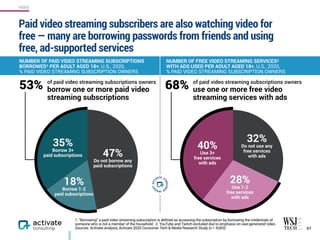
free — many are borrowing passwords from friends and using 

free, ad-supported services
67
1. “Borrowing” a paid video streaming subscription is defined as accessing the subscription by borrowing the credentials of
someone who is not a member of the household. 2. YouTube and Twitch excluded due to emphasis on user-generated video.
Sources: Activate analysis, Activate 2020 Consumer Tech & Media Research Study (n = 4,003)
NUMBER OF PAID VIDEO STREAMING SUBSCRIPTIONS
BORROWED1 PER ADULT AGED 18+, U.S., 2020, 

% PAID VIDEO STREAMING SUBSCRIPTION OWNERS
NUMBER OF FREE VIDEO STREAMING SERVICES2 

WITH ADS USED PER ADULT AGED 18+, U.S., 2020, 

% PAID VIDEO STREAMING SUBSCRIPTION OWNERS
47%
Do not borrow any 

paid subscriptions
35%
Borrow 3+

paid subscriptions
18%
Borrow 1-2 

paid subscriptions
53%
32%
Do not use any 

free services 

with ads
40%
Use 3+ 

free services 

with ads
28%
Use 1-2 

free services 

with ads
68%of paid video streaming subscriptions owners
borrow one or more paid video
streaming subscriptions
of paid video streaming subscriptions owners
use one or more free video
streaming services with ads
VIDEO
Enhancements to the video streaming experience have the potential
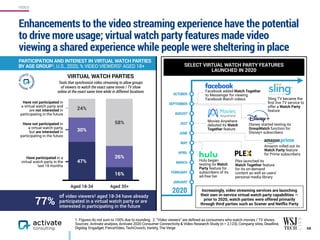
to drive more usage; virtual watch party features made video
viewing a shared experience while people were sheltering in place
68
1. Figures do not sum to 100% due to rounding. 2. “Video viewers” are defined as consumers who watch movies / TV shows.
Sources: Activate analysis, Activate 2020 Consumer Connectivity & Video Research Study (n = 2,123), Company sites, Deadline,
Digiday, Engadget, FierceVideo, TechCrunch, Variety, The Verge
Hulu began
testing its Watch
Party feature for
subscribers of its
ad-free tier
2020
APRIL
MAY
JUNE
JULY
AUGUST
SEPTEMBER
MARCH
FEBRUARY
JANUARY
OCTOBER
VIRTUAL WATCH PARTIES
Tools that synchronize video streaming to allow groups
of viewers to watch the exact same movie / TV show
online at the exact same time while in different locations
Increasingly, video streaming services are launching 

their own in-service virtual watch party capabilities —
prior to 2020, watch parties were offered primarily
through third parties such as Scener and Netflix Party
Amazon rolled out its
Watch Party feature
for Prime subscribers
Movies Anywhere
debuted its Watch
Together feature
Facebook added Watch Together
to Messenger for viewing
Facebook Watch videos
Disney started testing its
GroupWatch function for
Disney+ subscribers
Plex launched its 

Watch Together feature
for its on-demand
content as well as users’
personal media library
SELECT VIRTUAL WATCH PARTY FEATURES
LAUNCHED IN 2020
PARTICIPATION AND INTEREST IN VIRTUAL WATCH PARTIES
BY AGE GROUP1, U.S., 2020, % VIDEO VIEWERS2 AGED 18+
Aged 18-34 Aged 35+
58%
24%
26%
30%
16%
47%
Have participated in a
virtual watch party in the
last 18 months
Have not participated in
a virtual watch party,
but are interested in
participating in the future
Have not participated in
a virtual watch party and
are not interested in
participating in the future
of video viewers2 aged 18-34 have already
participated in a virtual watch party or are
interested in participating in the future
Sling TV became the
first live TV service to
offer a Watch Party
feature
77%
VIDEO
Interactive titles and augmented reality will pave the way for video
streaming to approximate a video gaming experience
69Sources: Activate analysis, Company press releases, Company sites, Deadline, Digiday, Variety, The Verge
SELECT NEXT GENERATION VIDEO STREAMING SERVICE FEATURES
INTERACTIVE TITLES
MOVIES / TV SHOWS THAT ALLOW THE VIEWER TO
MAKE CHOICES THAT INFLUENCE THE NARRATIVE
AUGMENTED REALITY CONTENT
CONTENT THAT USES AUGMENTED REALITY (AR)
TECHNOLOGY TO PLACE THE VIEWER 

INTO THE MOVIE / TV SHOW
VIRTUAL EXPERIENCES
IMMERSIVE EXPERIENCES IN WHICH THE USER CAN
EXPLORE AND INTERACT WITH AN ONLINE WORLD
Since 2017, Netflix has released several
interactive titles, including Black Mirror:
Bandersnatch, which allow viewers to
participate in what they are watching
Snapchat has increasingly been adding AR
capabilities that put viewers into its Originals; this
includes Move It!, which will track viewers’
movements as they learn dances
As part of its annual Halloween event, 

Hulu has launched The Screamlands, 

a virtual haunted house experience with five
different themed rooms that users can tour
Black Mirror: Bandersnatch
Released 2018 Move It!
Announced 2020
VISIT DR. HAYNES FOLLOW COLIN
The Screamlands
Launched 2020
VIDEO
As consumers use more video streaming services, there is an
increasing need for aggregators to unify the user experience
70
VIDEO STREAMING SERVICE AGGREGATORS
Sources: Activate analysis, Company press releases, Company sites, Digiday, FierceVideo, TechCrunch, The Verge
Video 

Streaming 

Hubs
Allow consumers to subscribe
to, manage, and watch multiple
video streaming services
through a single website/app
Video 

Streaming
Guides
Allow consumers to browse,
search, and/or receive
recommendations across
multiple video streaming
services through a single
website/app
Example Players
Example Players
CHANNELS
channels
VUNIVERSE
(BETA)
VIDEO
RICK LAX SAFAREE ADLEY JUSTIM FLOM PAUL VU
56M
Unique Viewers
56M
Unique Viewers
46M
Unique Viewers
43M
Unique Viewers
37M
Unique Viewers
MICHAEL ANDREAS CARDI B TEDDY RILEY ROD WAVE YOUNG BUCK
38M
Unique Viewers
38M
Unique Viewers
29M
Unique Viewers
20M
Unique Viewers
20M
Unique Viewers
KIDS DIANA SHOW GIRLSTTOYZZ VLAD AND NIKI GENEVIEVE’S PLAYHOUSE RYAN’S WORLD
57M
Unique Viewers
34M
Unique Viewers
28M
Unique Viewers
28M
Unique Viewers
25M
Unique Viewers
JULIUS DEIN MRBEAST DANCINGDAN BIGDAWSTV LANCE210 PRANKS
53M
Unique Viewers
34M
Unique Viewers
23M
Unique Viewers
18M
Unique Viewers
16M
Unique Viewers
ENTERTAINMENT
KIDS
ENTERTAINMENT

&ANIMATION
MUSIC&DANCEPEOPLE&BLOGSWeb video will continue to be a large part of people’s video viewing,
driven by their dedication to web-native influencers and personalities
71
TOP INFLUENCERS ACROSS FACEBOOK AND YOUTUBE BY TOP GENRE1, 

U.S., AUG. 2020, MILLIONS UNIQUE VIEWERS AGED 13+2
1. Top influencers determined by the number of deduplicated unique viewers across Facebook and YouTube based on 30-second
views. Does not include accounts that primarily aggregate third-party, user-submitted content or memes. Top genres based on
total unique viewers among the top 100 influencers. 2. Represents deduplicated unique viewers across Facebook and YouTube
based on 30-second views.
Sources: Activate analysis, Tubular Labs
VIDEO
MUSIC
DISNEYMUSICVEVO ULTRA MUSIC ATLANTIC RECORDS
WORLDSTAR HIP HOP /
WSHH WARNER MÚSICA
85M

UNIQUE VIEWERS
61M

UNIQUE VIEWERS
55M

UNIQUE VIEWERS
48M

UNIQUE VIEWERS
42M

UNIQUE VIEWERS
On YouTube, major media companies account for substantial
viewership
72
1. Based on YouTube’s definition of views. Figures do not sum to 100% due to rounding. 2. “Media companies” are defined as
organizations whose primary business model is in production and/or distribution of content (e.g. TV, movies, music, print, radio).
3. Top media company pages determined by the number of unique viewers on YouTube.
Sources: Activate analysis, Tubular Labs
SHARE OF YOUTUBE VIEWS OF U.S.-BASED MEDIA 

COMPANY PROGRAMMING BY CATEGORY1,2, 

GLOBAL, YTD AUG. 2020, % VIEWS
TOP U.S.-BASED MEDIA COMPANY PAGES ON YOUTUBE 

BY CATEGORY2,3, GLOBAL, AUG. 2020, MILLIONS UNIQUE VIEWERS
27%
MOVIES AND TV
21%
MUSIC
12%
KIDS ENTERTAINMENT

AND TOYS
7%
NEWS,
GOVERNMENT, 

AND POLITICS
8%
SPORTS
26%
OTHER
MOVIES AND TV
MOVIECLIPS NETFLIX
THE TONIGHT SHOW
STARRING 

JIMMY FALLON
WARNER BROS.
PICTURES ELLEN DEGENERES
135M

UNIQUE VIEWERS
46M

UNIQUE VIEWERS
37M

UNIQUE VIEWERS
37M

UNIQUE VIEWERS
30M

UNIQUE VIEWERS
1 2 3 4 5
KIDS ENTERTAINMENT AND TOYS
COCOMELON - 

NURSERY RHYMES
PINKFONG! KIDS’
SONGS & STORIES
LITTLE ANGEL:
NURSERY RHYMES 

& KIDS SONGS
TALKING TOM BABYBUS - 

NURSERY RHYMES
317M

UNIQUE VIEWERS
197M

UNIQUE VIEWERS
103M

UNIQUE VIEWERS
96M

UNIQUE VIEWERS
85M

UNIQUE VIEWERS
1 2 3 4 5
1 2 4 53
VIDEO
TikTok has seen tremendous user and engagement growth in 2020
73
1. Desktop users aged 2+ and mobile (i.e. smartphone, tablet) users aged 13+.
Sources: Activate analysis, Comscore
TOTAL UNIQUE VISITORS1, 

U.S., JAN. 2020-AUG. 2020, MILLIONS
AVERAGE MONTHLY TIME SPENT PER VISITOR ON DESKTOP, 

MOBILE WEB, AND APP BY SOCIAL PLATFORM1, 

U.S., JAN. 2020-AUG. 2020, HOURS
4
11
7
6
January 2020 August 2020
35M
139M
159M
70M
January 2020 August 2020
VIDEO
2019 2020E 2021E
$20B
$18B
$14B
$45B
$35B
$32B
$67B$61B
$70B
$78B$80B$89B
Though digital video is drawing significant consumer spend and
attention, most of the dollars in video will still be in television
74
VIDEO REVENUE BY TYPE1, U.S., 2019-2021E, BILLIONS USD
1. Figures do not sum due to rounding. 2. Includes spend on online video on-demand transactions (e.g. purchases and rentals). 

3. Includes spend on paid video streaming subscriptions. 4. Includes in-stream video advertising (e.g. pre-roll, mid-roll, post-roll)
on digital video content, including on social networks, and out-stream video advertising (e.g. native, in-feed, in-article, in-banner,
interstitial). 5. Includes advertising on broadcast TV and Pay TV. 6. Includes revenue from Pay TV subscriptions.
Sources: Activate analysis, Digital TV Research, eMarketer, PricewaterhouseCoopers, Statista
Pay TV
Subscriptions6
TV Advertising5
Ad-Supported4
Subscription3
EST/Rental2
$214B
$199B
$209B
2019-2021E

CAGR:
6.6%
21.4%
18.7%
-2.5%
-6.6%
$4B
$4B
$5B
DIGITAL
VIDEO
TELEVISION
1.2%
VIDEO
75www.activate.com
CONTENTS
$375 Billion Global Technology and Media Growth Dollars up for Grabs 5
Consumer Technology and Media Time and Attention 9
Super Users, Super Consumers 15
Gaming: The New Technology Paradigm 29
Esports: The Mainstream Sport of the Future 47
Video: The Fight for Battleground Households 61
AR/VR: On the Verge of Widespread Adoption 75
Connectivity: Intensifying the Need for Speed 91
eCommerce: Accelerating Five Years in Five Months 99
Sports & Sports Tech: Revolutionizing the Fan Experience 110
Sports Betting: $25 Billion for Technology and Media Companies 128
Advertising: Technology’s Identity Crisis 134
PAGE
Virtual Reality (VR)
We forecast that the Augmented Reality (AR) / Virtual Reality (VR)
market will reach roughly $20B by 2024
76
AR/VR
1. Excludes revenues associated with mobile AR, data, advertising, and peripherals.
2. Excludes Google Cardboard and other headsets with no built-in technology.
Sources: Activate analysis, Activate 2020 Consumer Tech & Media Research Study (n = 4,003), AR Insider, ARtillery Intelligence,
Company press releases, Company sites, eMarketer, IDC, Morgan Stanley Research, PricewaterhouseCoopers, Road to VR, 

Sensor Tower, Statista, Steam Spy, Strategy Analytics, SuperData, VGChartz
$19.8B
• VR technology matures and pricing
remains at reasonably low levels
• Standalone VR headsets, which
improve the user experience,
capture a greater share of total 

unit sales
• A robust content ecosystem for VR
headsets is available and
encourages spending
• VR adoption primarily serves
gaming use cases for consumers,
but also increases usage and
adoption for non-gaming activities
What would you have to believe?
Augmented Reality (AR)
• AR technology, form factor, and
price improve sufficiently to
overcome adoption barriers
• At least one major technology
company launches an AR headset
and achieves broad consumer
adoption
• Initial models of consumer AR
glasses are paired with
smartphones, similar to other
wearables
• Investment in enterprise-focused
AR increases, spurring hardware
adoption and software development
for an array of use cases and
specialized applications
• Advertising
• Peripherals
• Mobile AR
• Data
• Headsets with no
built-in technology2
Excluded
from sizing:
CONSUMER AND ENTERPRISE SPEND1 ON AR/VR, U.S., 2020E VS. 2024E, BILLIONS USD
2020E 2024E
$4.2B
$1.4B
$2.4B
<$0.1B
$0.3B
AR Consumer
AR Enterprise
VR Consumer
VR Enterprise
$0.6B
$2.5B
$8.2B
$4.9B
ACTIVATE
FORECAST
Video games
Social interactions
Live event streaming
Entertainment videos /
documentaries
Virtual tours or travel
Job training / 

job-related activities
Therapeutic activities
Shopping
Educational purposes
VR has experienced increased adoption during the COVID-19
outbreak; beyond video games, VR has replaced a broad set of
physical experiences and has also become a social platform
77
1. “During the COVID-19 outbreak” refers to the period since the start of the COVID-19 outbreak and subsequent social
distancing measures (i.e. since Mar. 2020). Includes pre-orders.
Sources: Activate analysis, Activate 2020 Consumer Tech & Media Research Study (n = 4,003)
REASONS FOR PURCHASING A VR HEADSET DURING THE
COVID-19 OUTBREAK1, U.S., 2020, ADULTS AGED 18+ WHO
PURCHASED A VR HEADSET DURING THE COVID-19 OUTBREAK1
22% of VR headset
purchasers bought their
first headset during the
COVID-19 outbreak1
56% of VR headset
purchasers bought a
headset during the
COVID-19 outbreak1
24%
26%
27%
28%
31%
31%
33%
35%
59%
AR/VR
The vast majority of VR headset purchasers are gamers, who are
using the headsets for an enhanced video game experience
78
VR HEADSET PURCHASING BEHAVIOR,
U.S., 2020, % ADULTS AGED 18+
1. “Gamers” are defined as adults 18+ who currently play video games. 2. “Gaming consoles” include handheld consoles
(e.g. Nintendo 3DS) and traditional consoles (e.g. PlayStation 4).
Sources: Activate analysis, Activate 2020 Consumer Tech & Media Research Study (n = 4,003), eMarketer, Nielsen,
PricewaterhouseCoopers
VR HEADSET PURCHASERS ARE
VIDEO GAME SUPER USERS
VR headset purchasers
spend an average of
$17/month
more on video games
than gamers who have not purchased
a VR headset
VR headset purchasers also
spend an average of
13 hrs/month
more playing video games
than gamers who have not purchased 

a VR headset
VR HEADSET PURCHASERS
ARE CONSOLE GAMERS
89%
of VR headset
purchasers also play
video games on gaming
consoles2 (compared to 31%
for those who have not 

purchased a VR 

headset)
96% of VR headset purchasers are gamers1
Non-Gamers Gamers
2%
1
17%
17%
of gamers1 have
purchased a 

VR headset
10x
over-index
AR/VR
VR’s primary strength is for immersive activities; users are very
willing to try use cases outside of gaming
79
SELECT NON-GAMING VIRTUAL REALITY HEADSET USE CASES
1. “Monthly active VR headset purchasers” are defined as adults aged 18+ who purchased a VR headset and who currently
use the headset at least once per month.
Sources: Activate analysis, Activate 2020 Consumer Tech & Media Research Study (n = 4,003)
of monthly active VR headset
purchasers1 aged 18+ use
their headsets for activities
other than gaming
>60%
EDUCATIONAL
PURPOSES
ENTERTAINMENT VIDEOS /
DOCUMENTARIES LIVE EVENT STREAMING
SHOPPING THERAPEUTIC ACTIVITIES
SOCIAL INTERACTIONS
VIRTUAL TOURS 

OR TRAVEL
JOB TRAINING / 

JOB-RELATED ACTIVITIES
AR/VR
Tethered
Headsets
Headset powered by 

an external computing
device (e.g. PC, gaming
console) with a built-in
display screen
Screenless
Viewers2
Headset that requires 

a separate device for 

a display screen 

(e.g. smartphone)
Standalone
Headsets
Fully functional
headset without the
need for an external
computing device
We believe that the shift in consumer VR adoption from screenless
viewers to standalone headsets will continue
80
1. Figures do not sum to 100% due to rounding.
2. Excludes headsets with no built-in technology, such as Google Cardboard.
Sources: Activate analysis, Company sites, IDC, VentureBeat, Virtual Perceptions, Wareable
2015 2016 2017 2018 2019
61%
34%
2%2%4%
36%
51%
44%
29%
7%
3%
15%
53%
69%
89%
CONSUMER VR HEADSET SHIPMENTS BY TYPE1,
U.S., 2015-2019, % SHIPMENTS
4% 2% 2%
3%
AR/VR
How Standalone Headsets1 Create 

a Superior User Experience
Advantage over
Tethered
Headsets2
Advantage over
Screenless
Viewers3
No Wires
• No cables required
• No need to carry an external device
• Ability to use and set up anywhere
✓
No Hardware
Requirements
• Built-in screen, processors, and storage
• No external PC/console required, which
can present additional costs
✓ ✓
Frees Up 

User Devices
• Does not drain smartphone battery
• Consumer can continue to use their
smartphone simultaneously
✓
Better Visuals
than Phone
Display
• Higher display speeds
• Clearer graphics
• VR-optimized chips for video processing
✓
Standalone headsets provide a superior experience for users and
address key limitations of tethered headsets and screenless viewers
81
1. “Standalone headset” is defined as a headset that is fully functional without the need to be tethered to another computing
device (e.g. Oculus Quest). 2. “Tethered headset” is defined as a headset that has a screen but relies on another computing
device to function (e.g. PC, gaming console). 3. “Screenless viewer” is defined as a headset that relies on a separate device for
a screen (e.g. phone). Excludes headsets such as Google Cardboard with no built-in technology.
Sources: Activate analysis, Company sites, IDC, VentureBeat, Virtual Perceptions, Wareable
Standalone headsets1
have been a significant
factor in the
improvement of the VR
user experience
Standalone headsets1
are driving further
consumer adoption of
VR (growing to 61% of
U.S. VR headset
shipments in 2019 from
2% in 2017)
AR/VR
SOFTWARE-BASED VISUAL IMPROVEMENT
KEY
IMPROVEMENT
AREAS
Eye tracking
Automated IPD2 calculation
END-USER
IMPACT
Improved image quality
Reduced chance of nausea
Extended functionalities

(e.g. eye-based navigation)
EXAMPLE
EFFORTS
SCREEN QUALITY
KEY
IMPROVEMENT
AREAS
Display resolution (e.g. 2K, 4K, 8K)
Field of view (e.g. 90° view)
Image quality (e.g. MicroLEDs, OLEDs)1
END-USER
IMPACT
Improved image quality
Greater perception of immersion
EXAMPLE
EFFORTS
CONNECTIVITY
KEY
IMPROVEMENT
AREAS
Connections with high bandwidth
Connections with low latency
Remote storage and compute
END-USER
IMPACT
Improved image quality
Reduced vision lag
Lighter weight headsets (e.g. remote storage)
EXAMPLE
EFFORTS
VR will see additional growth from technology improvements specific 

to VR as well as more general technology developments, such as 5G
connectivity and improved batteries
82
1. Other elements of image quality include subpixel count, pixel density, subpixel layout (e.g. RGB Stripe vs. Pentile), and more.
2. “IPD” refers to inter-pupillary distance, which is the physical distance between the user’s pupils.
Sources: Activate analysis, Ars Technica, Company press releases, Company sites, Digital Trends, Forbes, SPIE, TechRadar,
University of Rochester, The Verge, Wareable
5G
Verizon, AT&T,
T-Mobile
Cloud
Amazon Web
Services,
Microsoft Azure
Peripherals for
Wireless Play
TPCast,
DisplayLink
ENERGY EFFICIENCY
KEY
IMPROVEMENT
AREAS
Battery life 

(while retaining low size and weight)
Processor efficiency
Foveated rendering (i.e. natural blur)
END-USER
IMPACT
Longer sessions of usage
Lighter weight headsets
EXAMPLE
EFFORTS
Battery
Peripherals
VRPower
Research Labs
Facebook
Research,
Universities
Processors
Nvidia, AMD
VR Headsets
Pimax, Varjo, HP, StarVR, XTAL
Eye Tracking
Tobii, FOVE, 

XXXXXX(acquired by X X)
Research Labs
Facebook Research,
Universities
AR/VR
AR has massive potential to augment smartphones (similar to smartwatches)
through increased integrations between the real world and the digital world
83
1. 6DoF (6 degrees of freedom, which includes x, y, z, roll, pitch, yaw) tracking enabled by SLAM (simultaneous location and
mapping). Pokémon Go originally did not map environment, but used GPS as a rough approximation. Current versions can map
to the environment.
Sources: Activate analysis, KGOnTech Blog, TechCrunch, The Verge
AR ROADMAP
ENTERPRISE / FIRST
ADOPTER TOOL
DIFFERENTIATING FUNCTIONALITY
• Headsets allowing free use of hands and a larger field of
view vs. phone (but often bulky)
• Significant increases in reliability, durability, and accuracy
• Improved integration of digital and physical data 

(e.g. precise overlays for surgeons)
APPLICATIONS
• Enterprise applications where overlaid 

content significantly enhances performance 

(e.g. surgery, oil & gas fieldwork, assembly lines)
EXAMPLES
NICHE TOOLSET DIFFERENTIATING FUNCTIONALITY
• Apps on smartphones using the phone screen and camera(s)
• Tracking and mapping environment1
• Facial recognition
• Physics engines / light estimation
APPLICATIONS
• Games anchored in the real world 

(e.g. Minecraft on a table)
• Retail (e.g. ability to digitally try on clothes and place
furniture before purchase)
• Ability to apply filters to face
• Visual search (using phone’s camera to identify items)
EXAMPLES
(Furniture placement)
(Lenses)
TODAY
SMARTPHONE REPLACEMENT/
COMPANION
DIFFERENTIATING FUNCTIONALITY
• Headsets either augmenting or replacing
smartphones
• Integrating other technologies and connectivity: 5G,
IoT, data contextualization via AI, etc.
• Lower price and improved form factor
• Usability improvements: longer battery life, improved
field of view via consumer headsets
APPLICATIONS
• Consumer-specific applications: communication,
navigation, fitness, real-time health diagnostics, etc.
• Multiple virtual screens that can be overlaid on 

any surface
• Intuitive 3D data modeling 

(e.g. weather, traffic)
EXAMPLES Not yet developed
AR/VR
84
Note: Prices as of Oct. 1, 2020.
1. North was acquired by Google in June 2020. 2. Measured as the diagonal field of view in this example.
Sources: Activate analysis, Aniwaa, CB Insights, Company press releases, Company sites, Perkins Coie, Road to VR, Statista,
Tom's Hardware,  U.S. News & World Report, Wareable
Consumer-grade AR headsets are not there as of yet — most of the 

big tech firms are working to refine price, design, and technology to
encourage mass adoption
PRICE
FORM FACTOR /
DESIGN TECHNOLOGY
BARRIER 

TO MASS
ADOPTION
With prices often exceeding $1,000,
AR headsets are too expensive for
the average consumer — example
prices include:
• Microsoft HoloLens 2: $3,500
• Epson Moverio BT-350: $1,199
Consumers are unlikely to wear
heavy and unattractive headgear
• Many current AR headsets are
quite heavy (e.g. Microsoft
HoloLens 2 weighs 566g vs.
eyeglasses at an average of 25g
to 50g)
Consumer adoption will require
longer battery life, larger viewing
area (FOV), improved visuals, and
greater mobility
• Industry specialists rated user
experience (including hardware/
technology) as the top obstacle
for mass AR adoption (32% for
AR vs. 19% for VR)
ATTEMPTS TO 

OVERCOME
BARRIER
Several AR companies have
lowered headset prices to spur
growth, often by hundreds of
dollars
Companies are pushing to create
AR glasses with a profile similar to
eyeglasses or sunglasses — stylish
and lightweight for 

daily use
Companies are launching headsets
with greater storage and larger field
of view to create more immersive
AR experiences
COMPANIES
WORKING ON
BARRIER
• Kopin SOLOS: AR glasses for
cyclists at $499
• Nreal Light: consumer product
priced at ~$600
• Facebook: partnering with
Luxottica to build AR Ray-Bans
glasses
• Focals by North smart glasses1: 	
similar to stylish prescription
glasses, weigh 70g to 80g
• Nreal Light: weighs 88g
• Microsoft HoloLens 2: larger field
of view (FOV)2 of 52° compared
to the original HoloLens with an
FOV of 34°
• Vuzix M400: 64GB storage and
6GB RAM, compared to Vuzix
Blade’s 8GB storage 	and 	1GB
RAM
AR ADOPTION BARRIERS AND ATTEMPTS TO OVERCOME
EXAMPLE COMPANIES
DEVELOPING AR HEADSETS
BIG TECH
AR-FOCUSED
1
AR/VR
SOLOS AR SMART GLASSES
Use case: Cycling
Price: $4991
Description: SOLOS are smart glasses made for cyclists
that sync with fitness apps, are compatible with Bluetooth
and ANT+, offer navigation, are lightweight (65g), and
track workout performance
Limitations: Limited display2, single use case
SNAP SPECTACLES 3
Use case: Social Media
Price: $3801
Description: Spectacles are camera glasses that capture
3D photos and record videos, sync with Snapchat, and can
keep up to 100 videos and 1,200 photos
Limitations: No real-time AR effects (added afterward
inside the Snapchat app)
CAREOS - POSEIDON SMART MIRROR
Use case: Health & Beauty
Price: $3,000-$5,0001
Description: Poseidon mirrors have the CareOS platform
built in with facial recognition, 360° videos, virtual try-ons,
skin analysis, vision tests, and voice commands
Limitations: Expensive, stationary
While working to create consumer-friendly AR headsets, companies
are exploring transitional technologies to address specific 

use cases
85
1. Prices as of Sept. 21, 2020. 2. Display field of view (FOV) of <11°. 3. Smithsonian National Museum of Natural History.
Sources: Activate analysis, Company press releases, Company sites, Engadget, Wareable
CURRENT AR HARDWARE IS LIMITED TO NICHE USE CASES
EXAMPLE AUGMENTED REALITY SMARTPHONE
APPLICATIONS AND TOOLS
SNAPCHAT LENSES
SOCIAL MEDIA
GOOGLE LENS
VISUAL SEARCH
IKEA PLACE
SHOPPING
SEPHORA’S VIRTUAL ARTIST
MAKEUP
POKÉMON GO
GAMES
GOOGLE MAPS AR
NAVIGATION
CURIOSCOPE
EDUCATION
SKIN AND BONES (SMITHSONIAN)3
LOCATION-BASED
EXAMPLES
AR/VR
EXAMPLES OF ENTERPRISE-FOCUSED
HEADSETS1
MICROSOFT 

HOLOLENS 2
REALWEAR 

HMT-1
Price: $3,500 Price: $2,520
GOOGLE GLASS
ENTERPRISE EDITION 2
APPLE GLASS
Price: $999 Price: ?
Enterprises are serving as early adopters of AR headsets, due to
lower requirements than consumer-grade devices
86
1. Prices as of Sept. 21, 2020.
Sources: Activate analysis, Ars Technica, Company sites
ENTERPRISE AR HEADSET REQUIREMENTS ARE
LOWER THAN THOSE FOR CONSUMER DEVICES
Cost is less of a concern for enterprises
Comfort is less critical for work, as most
enterprise applications do not require 

extended wear
Style matters far less in a job setting than for
personal use
Battery life can be extended for companies
through extra batteries/devices
Eye fatigue is less of a concern at work, as most
enterprise applications do not require extended
wear vs. habitual consumer use
Color accuracy (e.g. rendering black, chromatic
aberrations, etc.) matters less to enterprises
AR/VR
HEALTHCARE
Aid surgeons with precise overlays, give physicians readily
viewable patient information, allow paramedics to monitor
vitals hands-free, and improve telehealth
HIGHER EDUCATION
Allow students to contextualize complex information,
dissect virtual cadavers, and visualize 3D mathematical
models
A number of enterprise applications have already emerged for AR
headsets that allow users to augment additional information, such as
surgical overlays and interactive learning
87Sources: Activate analysis, Ars Technica, Company sites
SELECT AR ENTERPRISE APPLICATIONS
MANUFACTURING
Facilitate the installation and maintenance of industrial
machinery, and assist engineers with operating and
repairing equipment
JOB TRAINING
Enable more interactive and safer job training in an easily
replicable manner with real-time feedback
AR/VR
88
1. Perkins Coie Augmented and Virtual Reality Survey 2016 (n = 653) and 2019 (n = 200). Respondents consisted of
industry professionals. “Industry professionals” include industry executives and founders, advisors, policymakers,
investors, and other professionals.
Sources: Activate analysis, Company press releases, Company sites, Crunchbase, Perkins Coie
EXPECTED INVESTMENT AREAS FOR AR/VR,
GLOBAL, 2016 VS. 2019, % INDUSTRY PROFESSIONALS1
M&A AND INTERNAL DEVELOPMENTS
BY SELECT LARGE TECHNOLOGY COMPANIES
COMPANY ACQUISITIONS
INTERNAL
DEVELOPMENTS
PRIMARY
FOCUS
Apple
• NextVR
• Camerai
• Spaces
• Flyby Media
• Vrvana
• Metaio
• Apple Glasses (rumored)
• ARKit
Consumer
Facebook
• Oculus
• Scape Technologies
• Dreambit
• Sanzaru Games
• Two Big Ears
• CTRL-Labs
• Beat Games
• Ready at Dawn
• Zurich Eye
Facebook Reality Labs
Oculus headsets
(Quest, Rift, Rift S, Go)
Facebook AR Spark
Consumer &
Enterprise
Google
• North
• Owlchemy Labs
• Phonetic Arts
• Skillman & Hackett
Daydream (discontinued)
Google Cardboard
Google Glass
ARCore
Consumer &
Enterprise
Microsoft • AltSpace VR
• Hololens
• Windows Mixed Reality
Enterprise
Amazon None Publicly Stated
Minor developments
(e.g. features to virtually
preview products)
None
Declared
(rumored)
Gaming
Healthcare
Education
Military and Defense
Movies and TV
Live Events
Real Estate
9%
15%
17%
28%
36%
43%
54%
18%
34%
40%
15%
30%
24%
78%
2016 2019
Expected investment across AR and VR reflects this growing emphasis
on enterprise — however, large technology firms still have an eye on
the consumer prize
-24%
-9%
-19%
-23%
+13%
+6%
+19%
Industry professionals increasingly expect investment
to shift towards enterprise-focused applications
AR Glasses Announced
(e.g. Project Aria, Luxottica partnership)
AR/VR
DESCRIPTION VALUE OF DATA COMPANIES
INVOLVED
BIOMETRIC
DATA
Data on facial
expressions, body
movements, eye
tracking (i.e. what a
user is looking at)
Measures biometric data to leverage
for several use cases
• Build psychographic profiles for
targeted ads
• Track and make health predictions
(e.g. dermatology diagnosis)
• Identify users with eye-based logins
for access control, ID management,
and purchases
Virtuleap, 

Mimerse, 

Facebook,
MagicLeap, 

Microsoft
VIRTUAL 

REAL ESTATE
Digital layer of
information/visuals
overlaid on top of
real-world locations
(analogous to Google
Maps in AR)
Creates a new advertising channel
• Generate higher engagement from
interactive local ads
• Improve ad attribution
• Increase digital ad inventory
Facebook, 

Sony, 

Samsung, 

HTC, 

Snapchat
VISUAL
SEARCH DATA
Information on real-
world items, identified
by augmented realty
Creates a new marketing and
shopping channel
• Suggest where to buy items to users
and learn users’ design preferences
• Increase engagement with
interactive ads
Google (+Niantic)
A significant portion of the value of owning consumer AR/VR is
around data, especially for AR — companies will need to convince
consumers that their privacy will be protected in order to succeed
89
1. Includes adults aged 18+ who have used AR headsets for personal use in the last 12 months.
Sources: Activate analysis, Activate 2020 Consumer Tech & Media Research Study (n = 4,003), Company press releases, 

HubSpot, Shopify, World Economic Forum, ZDNet
EXAMPLE DATA TYPES ENABLED BY AUGMENTED REALITY
AR HEADSET USAGE1, U.S., 2020, % ADULTS AGED
18+ BY DEGREE OF DATA PRIVACY CONCERN
3%
4%
4%
8%
11%
Least Privacy
Conscious
Most Privacy
Conscious
Companies selling AR headsets will need to offer data
privacy protections to reach the largest audience
Those who care the least
about data privacy are roughly 

3x more likely to use AR
headsets than those who care
the most about data privacy
+
AR/VR
90Source: Activate analysis
AR/VR: What will determine the winners?
AUGMENTED REALITY / VIRTUAL REALITY
A robust ecosystem with
enough content for users 

and sophisticated
developer tools
Consumer trust in privacy
protections (for both wearers
and those around them)
Affordable price at a level
comparable to smartphones
or high-end wearables
(e.g. smartwatches)
LOGO
Mature technology that 

allows for quality visuals,
reasonable battery life, and
a high degree of
mobility
An attractive form factor that
is stylish and light enough 

to be worn in public
(similar to eyeglasses/
sunglasses)
PRIVACY ASSURANCE
CONTENT ECOSYSTEM
AFFORDABLE PRICE
MATURE TECHNOLOGY ATTRACTIVE FORM FACTOR
AR/VR
91www.activate.com
CONTENTS
$375 Billion Global Technology and Media Growth Dollars up for Grabs 5
Consumer Technology and Media Time and Attention 9
Super Users, Super Consumers 15
Gaming: The New Technology Paradigm 29
Esports: The Mainstream Sport of the Future 47
Video: The Fight for Battleground Households 61
AR/VR: On the Verge of Widespread Adoption 75
Connectivity: Intensifying the Need for Speed 91
eCommerce: Accelerating Five Years in Five Months 99
Sports & Sports Tech: Revolutionizing the Fan Experience 110
Sports Betting: $25 Billion for Technology and Media Companies 128
Advertising: Technology’s Identity Crisis 134
PAGE
The COVID-19 outbreak forced the adoption of new technologies
for many users
92
CONNECTIVITY
1. “During the COVID-19 outbreak” refers to the period since the start of the COVID-19 outbreak and subsequent social distancing
measures (i.e. since Mar. 2020).
Sources: Activate analysis, Activate 2020 Consumer Connectivity & Video Research Study (n = 2,123)
45%
of consumers who use
fitness video streaming
(e.g. Peloton classes,
YouTube yoga videos)
tried it for the first time
during the COVID-19
outbreak1…
…bringing the total
share of users to
22%
80%
of consumers who
use telemedicine to
see a healthcare
provider tried it for the
first time during the
COVID-19 outbreak1…
…bringing the total
share of users to
41%
56%
of consumers who
use a chat service for
professional purposes
(e.g. Slack) tried it for
the first time during
the COVID-19
outbreak1…
…bringing the total
share of users to
27%
59%
of consumers who
use video
conferencing for
professional purposes
tried it for the first
time during the
COVID-19 outbreak1…
…bringing the total
share of users to
41%
46%
of consumers who
use video
conferencing for
social purposes tried
it for the first time
during the COVID-19
outbreak1...
…bringing the total
share of users to
54%
TELEMEDICINE
VIDEO
CONFERENCING
FOR SOCIAL
PURPOSES
VIDEO
CONFERENCING
FOR PROFESSIONAL
PURPOSES
ADOPTION DURING THE COVID-19 OUTBREAK1 BY ACTIVITY, U.S., 2020, % ADULTS AGED 18+
CHAT SERVICES
FOR PROFESSIONAL
PURPOSES
FITNESS VIDEO
STREAMING
Video
Communications
Gaming
Other3
Activate forecasts that video will drive 90% of household data
usage growth over the next 5 years, with household data usage
nearing 1 Terabyte per month by 2024
93
DATA USAGE INCREASE1, U.S., 2015-2019 VS. 2019-2024E, CHANGE IN GB PER HOUSEHOLD PER MONTH
CONNECTIVITY
1. “Data usage” includes both mobile and home internet. Figures do not sum due to rounding. 2. “Video” includes online
streaming (e.g. Netflix, Amazon Prime) as well as video conferencing (e.g. Zoom, Tele-Education). 3. “Other” includes music,
social networking, web browsing, and other digital content.
Sources: Activate analysis, Comscore, DecisionData, Omdia, Pew Research, PricewaterhouseCoopers
13
3
18
250 1.5x
1.5x
27.0x
0.8x
2015—2019
8
15
26
472 1.2x
0.9x
4.3x
0.3x
GROWTHUSAGE INCREASE
2019—2024E
GROWTHUSAGE INCREASE
Drives ~90% of consumer
data use growth
Increasingly data intensive,
but not as much as video
Fastest driver of growth
ACTIVATE
FORECAST
HOUSEHOLD DATA USAGE INCREASED FROM
190GB PER MONTH TO 475GB PER MONTH
HOUSEHOLD DATA USAGE WILL CONTINUE 

TO INCREASE TO 1,000GB PER MONTH
2
37%
38%
47%
51%
52%
53%
53%
54%
56%
60%
40%
42%
50%
55%
57%
52%
62%
57%
63%
65% 2019
2020
Consumers indicate that connectivity continues to be a limitation
despite efforts to increase speeds during the COVID-19 outbreak
94
CONNECTIVITY AS A REPORTED LIMITATION BY ACTIVITY,
U.S., 2019 VS. 2020, % ADULTS AGED 18+ WHO PARTICIPATE IN EACH ACTIVITY
CONNECTIVITY
Cloud Gaming
Video Game 

Live Streaming1
Online Multiplayer
Gaming
Video Conferencing
Uploading Media
Video Sharing2
Downloading Media
Higher Definition 

Video Streaming
Music Streaming
Standard Definition
Video Streaming
28%
16%
HOME INTERNET UPGRADE
BEHAVIOR, U.S., 2020, % ADULTS
AGED 18+ WITH HOME INTERNET
Upgraded home internet
during the COVID-19
outbreak3 (i.e. since
March 2020)
Plan to upgrade 

home internet
in the next 

12 months
1. Includes recording and broadcasting a live video stream of gaming content via YouTube, Twitch, Mixer, etc. 2. This does not
include video game live streaming (e.g. Facebook/Instagram Live, Periscope). 3. “During the COVID-19 outbreak” refers to the
period since the start of the COVID-19 outbreak and subsequent social distancing measures (i.e. since Mar. 2020).
Sources: Activate analysis, Activate 2019 Consumer Tech & Media Research Study (n = 4,006), Activate 2020 Consumer
Connectivity & Video Research Study (n = 2,123)
Today, fixed-line broadband remains the primary method for
consumer internet connection
95
CONNECTIVITY
1. Figures do not sum to 100% due to rounding.
Sources: Activate analysis, Activate 2020 Consumer Connectivity & Video Research Study (n = 2,123), Federal Communications
Commission, Microsoft, Pew Research
CONSUMERS WITH A SMARTPHONE AND NO FIXED BROADBAND,
U.S., 2015-2019, % ADULTS AGED 18+
Mobile data
through
mobile phone
21%
Mobile data
through tablet
Home
internet
through
tablet
7%
Home internet
through laptop/
desktop computer
48% Home
internet
through
mobile phone

20%
PRIMARY METHOD OF CONNECTING TO
THE INTERNET AT HOME BASED ON
TIME SPENT1, U.S., 2020, % ADULTS
AGED 18+ WITH A HOME INTERNET AND/
OR MOBILE DATA PLAN
While the FCC estimates only 21 million U.S. consumers lack
broadband access, Microsoft and Pew Research estimate that up
to 160 million U.S. consumers are not using internet with
broadband level speeds
3%
2015 2016 2017 2018 2019
17%
20%
16%
12%13%
Already have
access to a 5G-
enabled phone
Will upgrade as
soon as available
Will upgrade the
next time I purchase
a smartphone
Intend to have 

a 5G-enabled 

phone after 1 

upgrade cycle
45%28%
12%
5%
17%
of consumers who intend to have a
5G-enabled phone after 1 upgrade
cycle are willing to pay more for a
5G-enabled smartphone
12%
of consumers who intend to have
a 5G-enabled phone after 1
upgrade cycle are willing to pay
more for a data plan with 5G
Activate research indicates that there will be quick adoption of
5G mobile devices, with 45% of consumers intending to have a
5G-enabled phone within an upgrade cycle
96
5G UPGRADE INTENT, U.S., 2020, % ADULTS AGED 18+
CONNECTIVITY
Sources: Activate analysis, Activate 2020 Consumer Connectivity & Video Research Study (n = 2,123)
Availability is
also a factor for
consumers
getting
5G
devices
By 2024, roughly 40% of U.S. consumers will use 5G, and mobile
data demand will continue to rise; 5G’s potential will far outstrip
consumer demand alone
97
CONNECTIVITY
CONSUMER ADOPTION OF CONNECTIVITY STANDARDS,
U.S., 2015-2024E, % CONSUMERS WITH A MOBILE DATA PLAN
DATA USAGE PER MOBILE SUBSCRIBER,
U.S., 2019 VS. 2024E, GB PER MONTH
20%
40%
60%
80%
100%
2015 2016 2017 2018 2019 2020E 2021E 2022E 2023E 2024E
4G LTE
5G MOBILE
2G/3G
ACTIVATE
FORECAST
2019 2024E
OTHER
VIDEO9GB
45GB
5x ACTIVATE
FORECAST
5G can support 10x-100x faster download speeds and 99.5% lower latency — existing
consumer use cases will not require nearly this much speed and capacity
Forecast
COMMUNICATIONS
Sources: Activate analysis, Activate 2020 Consumer Connectivity & Video Research Study (n = 2,123), Comscore, Consumer
Technology Association, Counterpoint Research, eMarketer, Ericsson, GSM Association, Omdia, PricewaterhouseCoopers,
Statista, U.S. Census Bureau
5G will have a great deal more capacity than required for consumer applications,
enabling an entirely new set of applications and innovations in IoT, wireless
broadband, smart infrastructure, self-driving cars, and autonomous robotics
98
CONNECTIVITY
Fiber to the Curb / Street Light
Cable or Fiber to the Home
Mobile 5G
Consumer
Wireless BroadbandTransport & Robotics
Cable or Fiber to the Enterprise
HD/4K/6K Video Streaming
Video Conferencing
Online & Cloud Gaming
Augmented Reality / Virtual Reality
Residential IoT Devices
Self-Driving Cars
Autonomous Public Transport
Autonomous Drones
Enterprise
Wireless Broadband
Virtual Reality Video Conferencing
Autonomous Manufacturing
Autonomous Robots
IoT Monitoring Applications
HD/4K/6K Video Streaming
Video Conferencing
Mobile & Cloud Gaming
Augmented Reality / Virtual Reality
Wireless
Broadband
Receiver
Wireless
Broadband
Receiver
5G Rooftop Antenna
5G Street Light Antenna
Sources: Activate analysis, Company sites
99www.activate.com
CONTENTS
$375 Billion Global Technology and Media Growth Dollars up for Grabs 5
Consumer Technology and Media Time and Attention 9
Super Users, Super Consumers 15
Gaming: The New Technology Paradigm 29
Esports: The Mainstream Sport of the Future 47
Video: The Fight for Battleground Households 61
AR/VR: On the Verge of Widespread Adoption 75
Connectivity: Intensifying the Need for Speed 91
eCommerce: Accelerating Five Years in Five Months 99
Sports & Sports Tech: Revolutionizing the Fan Experience 110
Sports Betting: $25 Billion for Technology and Media Companies 128
Advertising: Technology’s Identity Crisis 134
PAGE
2020E 2024E
$26
$23
Global eCommerce will reach $6.5T in 2024, growing by over

13% CAGR; nevertheless, physical retail will continue to grow
(recovering from a severe decline in 2020)
100
RETAIL SALES BY CHANNEL1, GLOBAL, 2020E VS. 2024E, TRILLIONS USD
1. Figures do not sum due to rounding. Excludes travel and tickets and other services (e.g. food service and gambling).
Sources: Activate analysis, eMarketer, Forrester, National Retail Federation, Research and Markets, U.S. Census Bureau, 

U.S. Department of Commerce
$22.5T CAGR:13%
$27.9T
CAGR: 4%
eCommerce Share of
Total Retail Sales 18% 23%
2020E-2024E
CAGR: 6%
FORECAST
ACTIVATE
eCommerce
Physical Retail
$2.9T
$18.5T
$21.4T
$4.0T
$2.4T
$6.5T
ECOMMERCE
Two thirds of the global eCommerce transaction volume is
concentrated within the top 6 players; most importantly, these are
largely marketplaces vs. online retailers
101
ONLINE GROSS MERCHANDISE VOLUME (GMV)1, GLOBAL, 2019, % TOTAL GMV
1. Excludes the combination of individual merchants using eCommerce enablement platforms (e.g. Shopify). 

2. Each company accounts for between 0.5% and 2% of the total GMV.
Sources: Activate analysis, Company filings, Company press releases, Company sites, Digital Commerce 360, eMarketer
Rest of the Web
PINDUODUO2019 

TOTAL GLOBAL
ONLINE GMV:
$3.4T
5%2
3%
4%
9%
13%
14%
15%
37%
of the GMV for the
top 6 eCommerce
players is from
marketplace sales
Over 50%
ECOMMERCE
The COVID-19 outbreak has dramatically accelerated the trajectory
of eCommerce in the U.S., with the growth rate reaching 32% in
2020; this will be sustained at around 12% in the coming years
102
TOTAL ECOMMERCE RETAIL SALES AND ANNUAL GROWTH1, U.S., 2014-2024E, BILLIONS USD / % ANNUAL GROWTH
1. Excludes travel and tickets and other services (e.g. food service and gambling).
Sources: Activate analysis, eMarketer, Forrester, National Retail Federation, Research and Markets, U.S. Census Bureau, 

U.S. Department of Commerce
2014 2015 2016 2017 2018 2019 2020E 2021E 2022E 2023E 2024E
$1,227B
$1,098B
$979B
$872B
$788B
$599B
$521B
$461B
$397B
$340B
$298B
eCommerce Retail Sales
Annual Growth Rate
14% 14%
17% 16%
13%
15%
32%
11% 12% 12% 12%
While future annual growth is not
expected to reach 2020 levels, the overall
trajectory of eCommerce has been
adjusted upwards vs. previous estimates
2020E–2024E
CAGR:
12%
Growth in
eCommerce retail
sales more than
doubled in 

2020
ECOMMERCE
FORECAST
ACTIVATE
Clothing, shoes, accessories
Grocery
Household products3
Beauty and personal care
Consumer media4
Electronics5
Home improvement and decor
Toys and games
Auto parts
Furniture
Sporting goods
Jewelry
Strong U.S. eCommerce growth is supported by high levels of
penetration across product categories, led by clothing, grocery,
household products, and beauty / personal care
103
ECOMMERCE PENETRATION1 DURING THE COVID-19 OUTBREAK2 BY PRODUCT CATEGORY, U.S., 2020, % ADULTS AGED 18+
24%
25%
26%
27%
31%
34%
35%
38%
50%
52%
55%
56%
Categories with
historically weak
eCommerce performance
such as auto parts and
jewelry have seen strong
penetration during the
COVID-19 outbreak
1. “Penetration” is defined as those who indicated that at least 10% of their purchases in the category were online. 2. “During the COVID-19
outbreak” refers to the period since the start of the COVID-19 outbreak and subsequent social distancing measures (i.e. since Mar. 2020).
3. “Household products” include cleaning supplies and paper towels. 4. “Consumer media” includes CDs, books, DVDs, and video games. 

5. “Electronics” include mobile phones and gaming consoles.
Sources: Activate analysis, Activate 2020 Consumer Tech & Media Research Study (n = 4,003)
ECOMMERCE
22%
27%27%
43%
33%34%30%19%
67%66%
70%
81%
Expect to continue purchasing online from the new retailer(s) in the next 6 months
Do not expect to continue purchasing online from the new retailer(s) in the next 6 months
Purchased online from a new retailer that they have never purchased from before the COVID-19 outbreak
Grocery
During the COVID-19 outbreak, many customers purchased from
eCommerce retailers that they had not purchased from before — most
indicate that they are likely to continue shopping at these new retailers
104
CONSUMER ONLINE PURCHASING BEHAVIOR FROM NEW RETAILERS1 DURING THE COVID-19 OUTBREAK2, U.S., 2020, % 

ECOMMERCE PURCHASERS3 BY PRODUCT CATEGORY / % ECOMMERCE PURCHASERS FROM NEW RETAILERS BY PRODUCT CATEGORY
1. “New retailers” refer to retailers that the consumer had never purchased from before the COVID-19 outbreak. 2. “During the
COVID-19 outbreak” refers to the period since the start of the COVID-19 outbreak and subsequent social distancing measures
(i.e. since Mar. 2020). 3. “eCommerce purchasers” refer to adults aged 18+ who have purchased at least one item in the
product category online during the COVID-19 outbreak. 4. “Before the COVID-19 outbreak” refers to the period before the start
of the COVID-19 outbreak and subsequent social distancing measures (i.e. before Mar. 2020).
Sources: Activate analysis, Activate 2020 Consumer Tech & Media Research Study (n = 4,003)
Clothing, Shoes, Accessories Household Products Beauty and Personal Care
ACROSS PRODUCT
CATEGORIES, THOSE
THAT PURCHASED
ONLINE FROM A
RETAILER THAT THEY
HAD NOT PURCHASED
FROM BEFORE THE
COVID-19 OUTBREAK
ARE LIKELY
TO CONTINUE
PURCHASING FROM
THAT RETAILER
4
ECOMMERCE
2018 2019 2020E 2021E 2022E
$74B
$65B
$59B
$36B
$23B
Following the COVID-19 outbreak, buy online, pick up in-store will
be important to sustain eCommerce growth, especially in grocery
105
1. “During the COVID-19 outbreak” refers to the period since the start of the COVID-19 outbreak and subsequent social distancing
measures (i.e. since Mar. 2020). 2. “Other retailers” do not include pharmacies.
Sources: Activate analysis, eMarketer, Qudini
TOTAL “BUY ONLINE, PICK UP IN-STORE” SALES, 

U.S., 2018-2022E, BILLIONS USD
LIKELIHOOD OF USING “BUY ONLINE, PICK UP IN-STORE”
DURING THE COVID-19 OUTBREAK1,
U.S., JUNE 2020, % ADULTS AGED 16+
LESS
LIKELY
EQUALLY
LIKELY
MORE
LIKELY
Consumers are more
likely to use “buy online,
pick up in-store” for
grocery than other
retailer types during the
COVID-19 outbreak
Other
Retailers
Grocery
Stores
8%
13%
24%
37%
68%
50%
2018–2020E
CAGR:
58%
2020E–2022E
CAGR:
13%
2
ECOMMERCE


Grocery was one of the primary beneficiaries of accelerated
eCommerce growth — in 2020, the number of online grocery
purchasers reached the level previously not expected until 2024
106
ONLINE GROCERY PURCHASERS1, U.S., 2018-2024E, MILLIONS PURCHASERS AGED 18+
1. “Online grocery purchasers” refer to consumers who have made at least one grocery order online, including "buy online,
pick up in-store.” 2. “During the COVID-19 outbreak” refers to the period since the start of the COVID-19 outbreak and
subsequent social distancing measures (i.e. since Mar. 2020).
Sources: Activate analysis, Activate 2020 Consumer Tech & Media Research Study (n = 4,003), eMarketer, U.S. Census Bureau
DRIVERS OF CONTINUED
GROCERY ECOMMERCE GROWTH
Buy online,
pick up 

in-store
offering
Speedier
delivery
Commitment
to quality
produce
1
2
3
2018 2019 2020E 2021E 2022E 2023E 2024E
163
158
153
147
140
87
134
127
118
108
98
87
LAST YEAR’S
FORECAST
UPDATED
FORECAST
Grocery eCommerce adoption during the
COVID-19 outbreak2 has accelerated to the
level that was previously expected in 2024
72
ECOMMERCE
FORECAST
ACTIVATE
Platforms such as Shopify are enabling eCommerce growth by
making it easier for companies to sell online
107Sources: Activate analysis, Company filings, Company sites, Digiday, TechCrunch
• Capability to integrate drop shipping fulfillment
• Connection to ShipBob, Shipwire, ShipStation,
and other fulfillment partners
SHOPIFY GROSS MERCHANDISE VOLUME (GMV) AND 

NUMBER OF MERCHANTS USING THE SHOPIFY PLATFORM,
GLOBAL, 2014-2019, BILLIONS USD / MILLIONS MERCHANTS
$61.1B
$41.1B
$26.3B
$15.4B
$7.7B
$3.8B
2014 2015 2016 2017 2018 2019
1.1M
0.8M
0.6M
0.4M
0.2M
0.1M
June 2020: The partnership between
Walmart Marketplace and Shopify
expands the reach of Shopify sellers 

to Walmart’s 120M monthly website
visitors and enables Walmart
Marketplace to bring on additional
sellers (~1,200 by the end of 2020)
• eCommerce website creation, including free and
paid website themes
• Website hosting (provided by Shopify and
BigCommerce)
• Ability to plug into additional channels:
Point of sale mobile apps and hardware integration
(e.g. barcode scanners)
Built-in tools and apps to assist with marketing
campaigns
Ability to connect with first-party and/or 

third-party payment gateways (e.g. Shopify
Payments, PayPal)
POINT OF SALE
STORE CREATION
FULFILLMENT
MARKETING
PAYMENTS
ANALYTICS
Access to customer data (e.g. acquisition, spend,
search, cart abandonment) and financial
performance metrics
PROVIDE MERCHANTS WITH CAPABILITIES
AND RESOURCES ACROSS THE
ECOMMERCE STACK, INCLUDING:
EXAMPLE PLATFORMS
✕
GMV:
74%
MERCHANTS:
50%
EXAMPLE PARTNERSHIP
2014-2019 CAGR:
ECOMMERCE
12%

Total eCommerce
CAGR
2020E-2024E
16%

Mobile Commerce2
CAGR
2020E-2024E
27%

Social Commerce3
CAGR
2020E-2024E
Growth in social commerce will outpace that of both mobile and
total eCommerce — content and commerce will converge
108
1. Excludes travel and tickets and other services (e.g. food service and gambling). 2. “Mobile Commerce” refers to products purchased 

via mobile devices (e.g. smartphone, tablet). 3. “Social Commerce” refers to products purchased via social networks regardless of the 

method of payment or fulfillment; excludes travel and event tickets.
Sources: Activate analysis, Business Insider, Coresight Research, eMarketer, Forrester, National Retail Federation, Research 

and Markets, Social Media Today, TechCrunch, Technavio, U.S. Census Bureau, U.S. Department of Commerce, The Verge
EXPECTED GROWTH RATES OF RETAIL ECOMMERCE1
BY SEGMENT, U.S., 2020E-2024E, % CAGR
COMMERCE FEATURES LAUNCHED BY MAJOR SOCIAL
NETWORKS IN 2020
2020E 2021E 2022E 2023E 2024E
$69B
$56B
$45B
$35B
$26B
SHOPPABLE SNAPCHAT AR
Launched a test with Gucci to allow users to
see what shoes would look like through a
Snapchat lens and shop directly from the app
INSTAGRAM “IGTV” SHOPPING
Launched features for users to shop through 

IGTV videos — planning to test shopping on 

Reels later this year
SOCIAL COMMERCE REVENUE,
U.S., 2020E-2024E, BILLIONS USD
ACTIVATE
FORECAST
TIKTOK “Donation stickers”
• Built a feature for creators to add a “Donate"
button to their videos and live streams
• Opens the door for future monetization
opportunities, including shopping
ECOMMERCE
Livestream shopping, a new form of social commerce, will explode;
emerging players will innovate alongside established players such
as Amazon and Facebook
109Sources: Activate analysis, Bloomberg, BloombergQuint, Company sites, TechCrunch
SELECT LIVESTREAM 

SHOPPING PLAYERS
LARGE TECH PLAYERS
EMERGING PLAYERS
LIVESTREAM
SHOPPING ENABLES
BUYERS AND
SELLERS TO HAVE A
MORE ENGAGING
EXPERIENCE
EXAMPLES OF LIVESTREAM SHOPPING
ECOMMERCE
110www.activate.com
CONTENTS
$375 Billion Global Technology and Media Growth Dollars up for Grabs 5
Consumer Technology and Media Time and Attention 9
Super Users, Super Consumers 15
Gaming: The New Technology Paradigm 29
Esports: The Mainstream Sport of the Future 47
Video: The Fight for Battleground Households 61
AR/VR: On the Verge of Widespread Adoption 75
Connectivity: Intensifying the Need for Speed 91
eCommerce: Accelerating Five Years in Five Months 99
Sports & Sports Tech: Revolutionizing the Fan Experience 110
Sports Betting: $25 Billion for Technology and Media Companies 128
Advertising: Technology’s Identity Crisis 134
PAGE
Our research, conducted during the sports interruptions
related to COVID-19, pointed to significant pent-up demand
from live sports viewers
111
VIEWERSHIP INTENT ONCE LIVE SPORTS RETURN, 

U.S., APRIL 2020, % ADULTS AGED 18-64 WHO WATCHED A LIVE SPORTS EVENT IN THE LAST 12 MONTHS
1. “Net increase” reflects intended future viewing compared to viewership in the last 12 months prior to Apr. 2020.
Sources: Activate analysis, Activate COVID-19 Consumer Tech & Media Research Study April 2020 (n = 1,866)
+26%
In April 2020, when asked about
intended viewership once
regular sports schedules return,
viewers of live sports planned to:
NET INCREASE1 IN LIVE SPORTS 

VIEWERSHIP WHEN SPORTS RETURN
19% 20% 48% 7% 6%
WATCH
SIGNIFICANTLY
MORE
WATCH
SOMEWHAT
MORE
WATCH 

THE SAME
WATCH 

SOMEWHAT

LESS
WATCH
SIGNIFICANTLY
LESS
SPORTS & SPORTS TECH
Now that many sports are back, Super Sports Fans have returned,
but a number of Casual Sports Fans have not
112
SPORTS FANDOM BY FAN TYPE, U.S., 2019 VS. 2020, % ADULTS AGED 18+
2019 2020
37%
29%
44%
52%
19%19%Super Sports
Fans3
Casual Sports
Fans2
There are 

47M 

Super 

Sports Fans
aged 18+ in the
U.S.
There are 

119M 

Casual
Sports Fans
aged 18+ in the
U.S.
Non-Sports
Fans
1. “Sports Fans” are defined as followers (e.g. those attending live events in person, watching games or highlights, reading articles or
statistics) of at least one sport in the last 12 months. 2. “Casual Sports Fans” are defined as Sports Fans who watched less than 10 hours 

of live sports and sports content (e.g. pre-game and post-game shows, sports network programming) per week before the COVID-19 outbreak
(i.e. before Mar. 2020). 3. “Super Sports Fans” are defined as Sports Fans who watched at least 10 hours of live sports and sports content
(e.g. pre-game and post-game shows, sports network programming) per week before the COVID-19 outbreak (i.e. before Mar. 2020).
Sources: Activate analysis, Activate 2019 Consumer Tech & Media Research Study (n = 4,006), Activate 2020 Consumer 

Tech & Media Research Study (n = 4,003), U.S. Census Bureau
The total share of
Sports Fans1 has
decreased but the
total share of
Super Sports Fans
has stayed the
same — Casual
Sports Fans have
been slow to return
as compared to
last year
SPORTS & SPORTS TECH
Super Sports Fans’ engagement remains very strong: they account for 30%
of Sports Fans and over 70% of total time spent watching sports content,
spending 6x as much time watching sports content as Casual Sports Fans
113
1. Includes media beyond live game broadcasts such as pre-game / post-game shows and sports network programming. 2. “Sports Fans”
are defined as followers (e.g. those attending live events in person, watching games or highlights, reading articles or statistics) of at least
one sport in the last 12 months. 3. “Casual Sports Fans” are defined as Sports Fans who watched less than 10 hours of live sports and
sports content (e.g. pre-game and post-game shows, sports network programming) before the COVID-19 outbreak (i.e. before Mar. 2020).
4. “Super Sports Fans” are defined as Sports Fans who watched at least 10 hours of live sports and sports content (e.g. pre-game and
post-game shows, sports network programming) per week before the COVID-19 outbreak (i.e. before Mar. 2020).
Sources: Activate analysis, Activate 2020 Consumer Tech & Media Research Study (n = 4,003), U.S. Census Bureau
SHARE OF HOURS OF SPORTS CONTENT1 WATCHED BY
FAN TYPE, U.S., 2020, % SPORTS FANS2 AGED 18+
AVERAGE WEEKLY HOURS OF SPORTS CONTENT WATCHED 

BY FAN TYPE, U.S., 2020, HOURS PER WEEK
Share of Fans Share of Hours Watched
28%
70%
72%
30%
Super 

Sports Fans4
Super Sports Fans4Casual Sports Fans3
19.6
3.2
Sports Fans2
watch a total of

1.3B

hours
of sports content
per week
Casual 

Sports Fans3
SPORTS & SPORTS TECH
After the COVID-19 outbreak interruption in Q2 2020, the upcoming
2020-2021 sports calendar will look different, potentially altering
how sports are consumed
114
2020-2021 SEASON TIMELINES FOR THE "BIG FOUR” U.S. PROFESSIONAL SPORTS LEAGUES
1. Tentative 2020-2021 calendar is subject to change based on further adjustments to season timelines
depending on the COVID-19 outbreak.
Sources: Activate analysis, Company sites
DELAYS INTO SUMMER MONTHS RESULTED IN
OVERLAPPING SEASONS (INCLUDING PLAYOFFS)
NFL BENEFITS FROM LACK OF COMPETING
SEASONS THROUGH THE END OF THE YEAR
June July Aug. Sept. Oct. Nov. Dec. Jan. Feb. Mar. Apr. May
ADJUSTED

2020-2021CALENDAR1NORMALCALENDAR
NFL PlayoffsNFL Season
NBA Season (TBD)NBA Playoffs NBA Playoffs (TBD)
NHL Season (TBD)NHL Playoffs NHL Playoffs (TBD)
MLB Season MLB Playoffs
FALL 2020
GAP
Potential Q1 2021 Gap
NFL Season NFL Playoffs
MLB Season MLB Playoffs
NHL Season NHL Playoffs
NBA Season NBA Playoffs
MLB Season
SPORTS & SPORTS TECH
1. Includes only telecasts lasting longer than 90 minutes.
2. “Major broadcast networks” defined as ABC, CBS, Fox, and NBC.
3. “Top organizations” defined as the top 6 professional sports organizations by number of telecasts in Sept. 2020.
Sources: Activate analysis, Comscore TV Essentials
As a result of the sports calendar shift, the number of major live
sports events that aired on broadcast TV alone (excluding cable)
almost doubled in September 2020 vs. September 2019
115
PROFESSIONAL SPORTS LIVE EVENT TELECASTS1 ON MAJOR BROADCAST NETWORKS2 BY TOP ORGANIZATION3,
U.S., SEPT. 2019 VS. SEPT. 2020, NUMBER OF EVENTS
September 2019 September 2020
14
18
4
3
8
7
3
21
37
1
+76%
SPORTS & SPORTS TECH
For example, in September 2020, a number of scheduling conflicts
occurred for major events; while overall sports viewership actually
increased, ratings for some specific events were lower than last year
116
SPORTING EVENT TV VIEWERSHIP BY DAY, SEPT. 2019 VS. SEPT. 2020, U.S., MILLIONS NIELSEN VIEWERS1
1. “Nielsen viewers” are defined as viewers who tuned into a program for at least one minute as measured by Nielsen.

2. “Combined viewership” may include viewers watching multiple events.
Sources: Activate analysis, Nielsen, Sports Media Watch
THURSDAY, WEEK 1 OF THE NFL SEASON
Event
Viewership YoY %
Growth2019 2020
Thursday Night Football 22.0M 20.5M -7%
U.S. Open: Women’s Semifinal 1.9M 1.6M -17%
Conference Finals 2.5M
Conference Finals 0.8M
COMBINED VIEWERSHIP2 23.9M 25.4M +6%
SUNDAY, WEEK 2 OF THE NFL SEASON
Event
Viewership YoY %
Growth2019 2020
Sunday Night Football 17.6M 17.7M +0%
Conference Finals 3.2M
COMBINED VIEWERSHIP2 17.6M 20.9M +19%
THURSDAY, WEEK 2 OF THE NFL SEASON
Event
Viewership YoY %
Growth2019 2020
Thursday Night Football 6.6M 6.7M +2%
Conference Finals 3.5M
Conference Finals 1.2M
COMBINED VIEWERSHIP2 6.6M 11.4M +73%
SUNDAY, WEEK 3 OF THE NFL SEASON
Event
Viewership YoY %
Growth2019 2020
Sunday Night Football 18.5M 17.8M -4%
Conference Finals 3.2M
COMBINED VIEWERSHIP2 18.5M 21.0M +14%
EVENTS RESCHEDULED FROM 

Q2 2020 DUE TO THE COVID-19 OUTBREAK
SPORTS & SPORTS TECH
Today, the largest sporting events happen on the major broadcast
networks — rights deal renegotiations in the coming years will be
critical to defend the Pay TV bundle
117
SELECT CONTENT RIGHTS TIMELINES AND ANNUAL VALUE BY SPORT, U.S., 2018-2028, BILLIONS USD
1. Public information for streaming deals does not include financial terms.
Sources: Activate analysis, Axios, Company press releases, Sports Business Journal
2018 2019 2020 2021 2022 2023 2024 2025 2026 2027 2028
ANNUAL
VALUE
$2.7B
N/A1
$1.9B
$1.1B
$1.0B
$1.2B
$0.6B
N/A1
$0.7B
$0.5B
$0.7B
$0.2B
The NFL and NHL
are reportedly
delaying
negotiations until at
least 2021 to let
sports viewership
demand return
before signing 

new deals
Tech platforms
such as Amazon
and Twitter are
establishing
themselves as
competitors to the
major incumbents
Indicates previous deal in place with same distributor (that has since been renewed)
SPORTS & SPORTS TECH
Given current rights deals, Sports Fans primarily watch live sports
on cable; at the same time, fans increasingly use multiple sports
video streaming services to supplement their Pay TV subscriptions
118
1. “Sports Fans” are defined as followers (e.g. those attending live events in person, watching games or highlights, reading articles or
statistics) of at least one sport in the last 12 months. 2. Includes usage of paid video streaming subscriptions specifically for sports in 

the last 12 months, not free services included with Pay TV subscriptions or general video streaming subscriptions that host live sports
content. 3. “Pay TV” includes traditional Pay TV households and virtual Pay TV households. 4. Only includes consumers who indicate 

they have used subscriptions to watch live sports, not overall subscribers.
Sources: Activate analysis, Activate 2019 Consumer Tech & Media Research Study (n = 4,006), Activate 2020 Consumer 

Tech & Media Research Study (n = 4,003), Leichtman Research Group, MoffettNathanson, Nielsen, Parks Associates, 

S&P Global, U.S. Census Bureau
LIVE SPORTS VIEWERSHIP BY DELIVERY TYPE, 

U.S., 2020, % SPORTS FANS1 AGED 18+
PAY TV3 SUBSCRIPTION OWNERSHIP, 

U.S., 2020, % SPORTS FANS1 AGED 18+ THAT USE PAID 

SPORTS-SPECIFIC VIDEO STREAMING SUBSCRIPTIONS2
15%
16%
61%
87%
Own a Pay TV3
subscription
Do not own a
Pay TV3
subscription
Up from
6% 

in 2019
Paid Sports-Specific
Video Streaming
Subscriptions2
13%
There are 10.2 million 

Pay TV households that also
use paid sports-specific video
streaming subscriptions2 to
watch live sports4
Over-The-Air
Pay TV3
SPORTS & SPORTS TECH
1. “Sports Fans” are defined as followers (e.g. those attending live events in person, watching games or highlights, reading articles or
statistics) of at least one sport in the last 12 months. 2. Figures do not sum due to rounding. 3. “Pay TV” includes traditional Pay TV
households and virtual Pay TV households. 4. “Super Sports Fans” are defined as Sports Fans who watched at least 10 hours of live sports
and sports content (e.g. pre-game and post-game shows, sports network programming) per week before the COVID-19 outbreak (i.e. before
Mar. 2020). 5. “Casual Sports Fans” are defined as Sports Fans who watched less than 10 hours of live sports and sports content (e.g. pre-
game and post-game shows, sports network programming) per week before the COVID-19 outbreak (i.e. before Mar. 2020). 6. “SVOD” is
defined as a paid video streaming subscription.
Sources: Activate analysis, Activate 2020 Consumer Tech & Media Research Study (n = 4,003), Leichtman Research Group,
MoffettNathanson, Nielsen, Parks Associates, S&P Global, U.S. Census Bureau
Sports Fans are primarily Pay TV subscribers, creating a floor for
Pay TV subscribers amidst cord-cutting trends
119
SPORTS TV HOUSEHOLDS % CASUAL SPORTS FANS5 % SUPER SPORTS FANS4
OVER-THE-AIR 79% 21%
BROADBAND-ONLY WITHOUT
SPORTS-SPECIFIC SVOD6 82% 18%
BROADBAND-ONLY WITH
SPORTS-SPECIFIC SVOD6 59% 41%
PAY TV3
69% 31%
KEY QUESTIONS FOR THE FUTURE OF SPORTS TV HOUSEHOLDS:
•Could live offerings by streaming services erode Pay TV3 penetration
among Super Sports Fans4?
•What will it take for Casual Sports Fans5 to keep their Pay TV3
subscriptions given cord-cutting trends?
•What are the types of customer propositions that could engage more
sports TV battleground households?
76M Sports TV Households2
Super Sports Fans4 are concentrated in Pay TV3 households
and broadband households with sports-specific SVOD6
OVER-THE-AIR
PAY TV3
BROADBAND-ONLY
WITHOUT SPORTS-
SPECIFIC SVOD6
BROADBAND-ONLY
WITH SPORTS-
SPECIFIC SVOD6
65M8M
1M
1M
HOUSEHOLD BREAKDOWN OF SPORTS FANS1, U.S., 2020E, MILLIONS HOUSEHOLDS
SPORTS & SPORTS TECH
Tech-driven at-home
viewing improvements
are providing fans with
more options and
features when
watching their 

favorite sports
Media companies are
increasing sports
betting programming
and integrating betting
commentary into live
broadcasts
Sports teams are
providing technology
solutions to improve
in-person viewing
experiences like
mobile concession
ordering 

and mobile retail
Leagues, inspired by
scheduling creativity
to account for the
COVID-19 outbreak,
are actively assessing
their schedules to
optimize potential
viewership
Drone racing, esports,
parkour, and other
emerging sports are
attracting younger
fans across digital
and linear media
outlets
Sports-themed TV
shows like 

Holey Moley and
Ultimate Tag are
generating strong
viewership numbers
Sport experience innovation will drive more viewership, bringing
back Casual Sports Fans and driving even more engagement from
Super Sports Fans
120Source: Activate analysis
NEW ADVANCED
VIEWING
ENHANCEMENTS
INTERACTIVE
SPORTS BETTING
EXPERIENCES
NEW TECH-ENABLED 

IN-PERSON
EXPERIENCES
UPDATED
SCHEDULES TO
ACCOMMODATE THE
MAJOR EVENTS
NEW SPORTS SPORTS-TAINMENT
SPORTS & SPORTS TECH
Fans demonstrate strong interest in new advanced viewing
experiences — these hold the potential to increase fan engagement,
even more so for Casual Sports Fans
121
1. “Sports Fans” are defined as followers (e.g. those attending live events in person, watching games or highlights, reading articles or
statistics) of at least one sport in the last 12 months. 2. Only includes Sports Fans who indicated they have watched a live sports event in
any video media format in the last 12 months. 3. “Casual Sports Fans” are defined as Sports Fans who watched less than 10 hours of live
sports and sports content (e.g. pre-game and post-game shows, sports network programming) per week before the COVID-19 outbreak 

(i.e. before Mar. 2020). 4. “Super Sports Fans” are defined as Sports Fans who watched at least 10 hours of live sports and sports content
(e.g. pre-game and post-game shows, sports network programming) per week before the COVID-19 outbreak (i.e. before Mar. 2020).
Sources: Activate analysis, Activate 2020 Consumer Tech & Media Research Study (n = 4,003)
44%
45%
49%
54%
58%
59%
66%
55%
57%
59%
62%
64%
66%
71%
CASUAL SPORTS FANS3
SUPER SPORTS FANS4
Camera angles / video layouts 

(e.g. focus on team sideline during 

and alongside the broadcast)
Customized statistics and analysis
(e.g. fantasy football scores 

of individual players on screen)
Choice of commentators 

(e.g. multiple broadcast teams 

available during a game)
Individual game/team packages 

(e.g. purchase of one game 

or one team’s games only)
Betting-focused content 

(e.g. betting lines on screen)
Social media updates 

(e.g. relevant in-game tweets 

displayed on screen)
In-game purchases 

(e.g. on-screen purchase of 

tickets and merchandise)
SPORTS & SPORTS TECH
INTEREST IN LIVE SPORTS VIDEO FEATURES, U.S., 2020, % SPORTS FANS1 AGED 18+ WHO WATCH LIVE SPORTS2
Amazon Prime Video offers multiple commentary options for its broadcast of 

Thursday Night Football, allowing fans to choose which commentary team they prefer
Sports Tech: The next generation of sports technology will
transform the fan experience both at home and in person
122
EXAMPLES OF NEW AT-HOME LIVE GAME EXPERIENCES
Sources: Activate analysis, Company press releases, Company sites, SportTechie
In 2020, Verizon launched its NFL Watch
Together feature through the Yahoo
Sports app, allowing synchronized
livestream and video chat for up to four
users at a time
NextVR and the NBA added regular season coverage of
3D/panoramic camera angles and real-time stats
through Oculus after testing the product during the 

2019 Playoffs
NBA League Pass
offers single game
purchase or a 

10-minute window of
live content, catering 

to consumers who
might have a bet on 

the game or want 

to watch small samples 

of live games
NTT Ltd. built a virtual “global stadium” to stream
the 2020 Tour de France through an augmented
reality app with real-time 3D roadside and in-air views
SPORTS & SPORTS TECH
Health/Safety Pricing Experience Promotions Loyalty/Rewards Other
9%
13%
21%22%
28%
48%
Once health and safety concerns have been addressed, pricing,
experience, and promotions will be the most important triggers
to bring consumers back to in-person sporting events
123
FACTORS THAT WOULD ENCOURAGE ATTENDANCE AT LIVE SPORTING EVENTS AFTER THE COVID-19 OUTBREAK1, 

U.S., 2020, % ADULTS AGED 18-64 WHO ATTENDED LIVE SPORTING EVENTS BEFORE THE COVID-19 OUTBREAK2
1. "After the COVID-19 outbreak” refers to the 12-month period after the end of the COVID-19 outbreak and subsequent social
distancing measures. 2. “Before the COVID-19 outbreak” refers to the period before the start of the COVID-19 outbreak and
subsequent social distancing measures (i.e. before Mar. 2020).
Sources: Activate analysis, Activate COVID-19 Consumer Tech & Media Research Study May 2020 (n = 1,925)
Experience will
be a critical
lever to
encourage

fans to return to
sports venues
SPORTS & SPORTS TECH
Venues will continue to deploy tech-enabled services to transform
the in-person experience
124Sources: Activate analysis, Company press releases, Company sites
VenueNext’s mobile ordering platform has been
introduced across NFL, MLB, NHL, and NBA home
venues to allow fans to order food and beverage
from their seats and not just in premium sections
Denver Broncos are building the NFL's first in-
stadium luxury betting lounge with BetMGM where
live odds will be shown and assistance on how to use
MGM’s betting app will be available
The Boston Red Sox have installed a virtual reality
(VR) experience in their ballpark via its VR Home
Run Challenge game for kids
SELECT TECH-ENABLED IN-VENUE SERVICES
Vikings Mobile App helps fans find the least
crowded concessions and bathrooms, and alerts
fans to the fastest ingress/egress locations to and
from the stadium
Verizon has deployed 5G Ultra Wideband networks
in 20+ stadiums and arenas since the end of 2019 to
increase connectivity and download speeds for fans
in attendance
Cisco has implemented Wi-Fi 6 at SoFi Stadium in
Los Angeles — the network is designed to meet the
needs of fans using mobile devices to place food and
beverage orders, purchase merchandise, and 

stream videos
Fan Connectivity Interactive Experiences Digital Services
SPORTS & SPORTS TECH
31%69%
DID NOT START
following a
new sport
DID START 

following a 

new sport
The COVID-19 outbreak has facilitated fan interest in sports
outside of the major sports, with early-returning sports such 

as soccer and golf showing the greatest gains in new followers
125
1. “During the COVID-19 outbreak” refers to the period since the start of the COVID-19 outbreak and subsequent social
distancing measures (i.e. since Mar. 2020). 2. “Sports Fans” are defined as followers (e.g. those attending live events in
person, watching games or highlights, reading articles or statistics) of at least one sport in the last 12 months. 3. “Big Four”
sports include football, baseball, basketball, and hockey.
Sources: Activate analysis, Activate 2020 Consumer Tech & Media Research Study (n = 4,003)
SPORTS FANS WHO STARTED FOLLOWING AT LEAST 

ONE NEW SPORT DURING THE COVID-19 OUTBREAK1,
U.S., 2020, % SPORTS FANS2 AGED 18+
SPORTS FOLLOWED EXCLUDING THE "BIG FOUR3”
DURING THE COVID-19 OUTBREAK1, U.S., 2020, 

% SPORTS FANS2 AGED 18+ WHO STARTED FOLLOWING 

AT LEAST ONE NEW SPORT OUTSIDE OF THE “BIG FOUR”
75%
of Sports Fans2 

that DID START 

following a new sport
followed at least one
outside of the
“Big Four3”
U.S. Soccer
International Soccer
Golf
Tennis
Auto Racing
Horse Racing
Esports
Drone Racing
Rugby
Combat Sports
Wrestling
Lacrosse
Parkour 4%
5%
7%
8%
8%
9%
10%
10%
13%
15%
16%
20%
26%
SPORTS & SPORTS TECH
126
LIKELIHOOD TO CONTINUE WATCHING NEW SPORTS FOLLOWED DURING THE COVID-19 OUTBREAK1,
U.S., 2020, % SPORTS FANS2 AGED 18+ WHO STARTED FOLLOWING EACH SPORT
1. “During the COVID-19 outbreak” refers to the period since the start of the COVID-19 outbreak and subsequent social 

distancing measures (i.e. since Mar. 2020). Drone racing, parkour, rugby, and lacrosse are excluded due to insufficient
sample size for U.S.-based viewers. “Big Four” sports (i.e. football, baseball, basketball, and hockey) are also excluded.
2. “Sports Fans” are defined as followers (e.g. those attending live events in person, watching games or highlights,
reading articles or statistics) of at least one sport in the last 12 months.
Sources: Activate analysis, Activate 2020 Consumer Tech & Media Research Study (n = 4,003)
Sports Fans indicate that they will continue to watch the sports they
picked up during the COVID-19 outbreak
Combat Sports
International Soccer
Esports
U.S. Soccer
Tennis
Golf
Wrestling
Auto Racing
Horse Racing 61%
66%
68%
74%
75%
76%
76%
77%
78%
SPORTS & SPORTS TECH
127
1. “Sports Fans” are defined as followers (e.g. those attending live events in person, watching games or highlights, reading articles or
statistics) of at least one sport in the last 12 months. 2. “Casual Sports Fans” are defined as Sports Fans who watched less than 10 hours
of live sports and sports content (e.g. pre-game and post-game shows, sports network programming) per week before the COVID-19
outbreak (i.e. before Mar. 2020). 3. “Super Sports Fans” are defined as Sports Fans who watched at least 10 hours of live sports and sports
content (e.g. pre-game and post-game shows, sports network programming) per week before the COVID-19 outbreak (i.e. before Mar. 2020).
Sources: Activate analysis, Activate 2020 Consumer Tech & Media Research Study (n = 4,003), Nielsen
INTEREST IN ALTERNATIVE SPORTS PROGRAMMING,
U.S., 2020, % SPORTS FANS1 AGED 18+ WHO WATCHED
LIVE SPORTS CONTENT IN THE LAST 12 MONTHS
EXAMPLES OF ALTERNATIVE SPORTS PROGRAMMING
THE LAST DANCE 

became the most-watched
ESPN documentary of all time,
averaging 5.6M same-day and
12.9M on-demand viewers 

per episode
THE MATCH: CHAMPIONS

FOR CHARITY became the
most-watched golf telecast 

on cable TV ever with 

5.8M average viewers
HISTORICAL SPORTS DOCUMENTARIES
PEYTON’S PLACES 

NFL HISTORY DOCUSERIES
scored 1.3M viewers in its top
episode of its first season
NASCAR iRACING SERIES
reached over 1M viewers 

in multiple races across 

FOX and FS1
ALTERNATIVE FORMAT COMPETITIONS
26%
26%
27%
32%
36%
47%
50%
32%
32%
33%
37%
36%
45%
45%
Casual Sports Fans
Super Sports Fans
Sports documentaries
Historic games/series
Made-for-TV, head-to-
head competitive
events
TV series hosted 

by athletes
Esports league events
Events for 

non-traditional 

sports leagues
Sports betting
programming
2
3
Casual Sports Fans and Super Sports Fans enjoy alternative sports
programming; major programs have attracted audiences of a
similar scale to major live sports events
SPORTS & SPORTS TECH
128www.activate.com
CONTENTS
$375 Billion Global Technology and Media Growth Dollars up for Grabs 5
Consumer Technology and Media Time and Attention 9
Super Users, Super Consumers 15
Gaming: The New Technology Paradigm 29
Esports: The Mainstream Sport of the Future 47
Video: The Fight for Battleground Households 61
AR/VR: On the Verge of Widespread Adoption 75
Connectivity: Intensifying the Need for Speed 91
eCommerce: Accelerating Five Years in Five Months 99
Sports & Sports Tech: Revolutionizing the Fan Experience 110
Sports Betting: $25 Billion for Technology and Media Companies 128
Advertising: Technology’s Identity Crisis 134
PAGE
Football
Basketball
Baseball
U.S. Soccer
Tennis
Hockey
Golf
International Soccer
Auto Racing
Horse Racing
Over 40% of Sports Fans bet on sports (legal and illegal) and are
betting across a broad range of sports
129
Note: Betting excludes fantasy sports - only wagers placed outside of fantasy sports are considered here.
1. “Sports Fans” are defined as followers (e.g. those attending live events in person, watching games or highlights, reading
articles or statistics) of at least one sport in the last 12 months. 2. Includes the top 10 sports by share of Sports Bettors
participating. All other sports did not reach a 15% or greater share of Sports Bettors. 3. “Sports Bettors” are defined as Sports
Fans who have placed a bet on at least one sport in the last 12 months.
Sources: Activate analysis, Activate 2020 Consumer Tech & Media Research Study (n = 4,003)
SPORTS FANS1 WHO PLACE BETS, 

U.S., 2020, % SPORTS FANS1 AGED 18+
SPORTS2 WAGERED ON BY SPORTS BETTORS3,

U.S., 2020, % SPORTS BETTORS3 AGED 18+
16%
16%
17%
18%
20%
21%
22%
31%
34%
51%
41%59%
DID NOT PLACE 

A BET ON SPORTS 

in the last 12 months
PLACED A BET 

ON SPORTS
in the last 12 months
SPORTS BETTING
2.8 4.0
All Other
Sports Fans1
Sports
Bettors2
Sports Bettors are an especially engaged group: they follow more
sports and watch more live sports than non-Sports Bettors
130
1. “Sports Fans” are defined as followers (e.g. those attending live events in person, watching games or highlights, reading articles or
statistics) of at least one sport in the last 12 months. 2. "Sports Bettors” are defined as Sports Fans who have placed a bet on at least one
sport in the last 12 months. 3. “Live Sports Viewership” indicates Sports Fans who have watched a live sports event on any video media
format or in person in the last 12 months.
Sources: Activate analysis, Activate 2020 Consumer Tech & Media Research Study (n = 4,003)
95%
85%
All Other
Sports Fans1
Sports 

Bettors2
SPORTS BETTING
The
average
Sports Bettor
follows one more
sport than
the average
non-bettor
NUMBER OF SPORTS FOLLOWED, U.S., 2020,
AVERAGE NUMBER OF SPORTS
LIVE SPORTS VIEWERSHIP3 BY FAN TYPE,

U.S., 2020, % SPORTS FANS2 AGED 18+
Partnerships between sports betting operators, leagues, and media
companies will create new sports betting experiences
131Sources: Activate analysis, Company press releases, PRNewswire
SPORTS BETTING
PARTNERSHIPS WITH SPORTS BETTING OPERATORS ESTABLISHED OVER THE LAST 12 MONTHS
MEDIA COMPANIES
are integrating betting data from major
operators to enhance sports programming
across linear and digital properties
SPORTS LEAGUES
are partnering with betting operators to share
exclusive content and data insights to provide
new experiences to engage fans
SPORTS TEAMS
are working with betting operators to create
unique, team-specific fan experiences both 

in-venue and out-of-venue
Driven by strong legislative tailwinds, we forecast that the total
sports betting amount wagered will reach $189B by 2024
132
TOTAL SPORTS BETTING AMOUNT WAGERED1, U.S., 2018-2024E, BILLIONS USD
SPORTS BETTING
1. Projection assumes 40 states will legalize sports betting by 2024. The U.S. betting economy consists of the cumulative 

GDP in states that have legalized sports betting. 2. In 2020, sports betting is legal in 22 states and Washington D.C.
Sources: Activate analysis, Action Network, Bureau of Economic Analysis, Legal Sports Report, Nevada Gaming Control Board
2018 2019 2020E 2021E 2022E 2023E 2024E
$189B
$155B
$112B
$64B
$19B
$13B
$7B
73%
7 11 232 26 33 36
NUMBER 

OF STATES 

WITH LEGAL 

SPORTS BETTING:
40
2018-2024E CAGR:
ACTIVATE
FORECAST
SPORTSBOOKS
CASINOS
STATES3
LEAGUES/TEAMS
TRADITIONAL TECH COMPANIES
SPORTS TECH COMPANIES
MEDIA COMPANIES
VENUES
Sports betting will result in roughly $24B in revenues for
technology and media companies by 2024
133
SPORTS BETTING REVENUE BY TYPE, U.S., 2020E-2024E, BILLIONS USD
2020E 2021E 2022E 2023E 2024E
$13.2B
$11.7B
$9.2B
$5.8B
$1.9B
$10.5B$9.3B
$7.4B
$4.6B
$1.5B
INDIRECT SPORTS BETTING REVENUE
DIRECT SPORTS BETTING REVENUE
INDIRECT
SPORTS
BETTING
REVENUE1
DIRECT
SPORTS
BETTING
REVENUE2$3.4B
$10.4B
$16.6B
$21.0B
$23.7B
1. “Indirect sports betting revenue” is determined as a ratio of direct sports betting revenue comprised of media rights, advertising,
sponsorships, and data rights. 2. “Direct sports betting revenue" is determined as a share of the total amount wagered and depends on
odds, type of wager, and individual sportsbooks. The betting provider’s take rate ranges from 4-36% of total amount wagered. 3. State tax
income is generated as a share of the total amount wagered, a share of gross gaming revenue (ranges from 7-51% depending on the state
and type of betting), and by gaming licensing fees.
Sources: Activate analysis, Bureau of Economic Analysis, Eilers & Krejcik Gaming, Legal Sports Report, The Lines, 

Nevada Gaming Control Board
SPORTS BETTING
ACTIVATE
FORECAST
134www.activate.com
PAGECONTENTS
$375 Billion Global Technology and Media Growth Dollars up for Grabs 5
Consumer Technology and Media Time and Attention 9
Super Users, Super Consumers 15
Gaming: The New Technology Paradigm 29
Esports: The Mainstream Sport of the Future 47
Video: The Fight for Battleground Households 61
AR/VR: On the Verge of Widespread Adoption 75
Connectivity: Intensifying the Need for Speed 91
eCommerce: Accelerating Five Years in Five Months 99
Sports & Sports Tech: Revolutionizing the Fan Experience 110
Sports Betting: $25 Billion for Technology and Media Companies 128
Advertising: Technology’s Identity Crisis 134
Digital identity is the currency for internet advertising; the
elimination of third-party cookies by the end of 2021 will
fundamentally reshape the industry
135Source: Activate analysis
ADVERTISING
• Today, the main source of identity on the open web is third-party cookies, enabling
personalized advertising and user tracking across domains and devices
• By the end of 2021, it is highly likely that third-party cookies and cross-device identifiers
will be eliminated
• This gives the major walled gardens (e.g. Facebook, Google, Amazon) the advantage in
personalizing advertising and tying user behavior on their platforms to interest and intent
• Faced with this challenge, internet companies and marketers will need to create new
identifiers that bridge the identity and personalization gap
• Going forward, we will see the formation of “private gardens,” capable of reaching users
without going through the walled gardens, and major efforts by marketers to build robust
first-party data capabilities 
Over the next 3 years, U.S. internet digital advertising spend will
become almost two thirds of all advertising spend in the U.S.
136
AD SPEND BY TYPE, U.S., 2017 VS. 2020E VS. 2023E, BILLIONS USD
ADVERTISING
1. “Offline” includes TV, radio, print, direct mail, out-of-home, and other non-digital media.
2. “Online” includes search, social, display, video, apps, audio streaming, and other digital media.
Sources: Activate analysis, eMarketer, GroupM, Magna, MoffettNathanson, Morgan Stanley, ZenithOptimedia Group
2017 2020E 2023E
$280B
$215B$207B
38%
55%
64%
62%
45%
36% 1.8%
2020E-2023E
CAGR:
14.7%
9.3%
ONLINE2
OFFLINE1
ACTIVATE
FORECAST
Websites / apps / digital
platforms / digital publishers that
sell advertising inventory to be
bought through any digital tool or
channel
Digital platforms that take
advantage of proprietary user
data to sell advertising through
their own tools without making
data available to other parties
Consumer Time 

Spent Online
Digital 

Ad Spend
65%
34%
35%
66%
Walled gardens capture a disproportionate share of advertising relative to
their share of consumer internet time; this is driven by their control of users’
data and their ability to use that data to target and personalize advertising
137
CONSUMER TIME SPENT ONLINE VS. DIGITAL AD SPEND BY TYPE, U.S., 2020E, % TOTAL TIME ONLINE / % TOTAL DIGITAL AD SPEND
ADVERTISING
1. Open Web ad spend of 35% includes 10% of total digital ad spend that is allocated through walled garden tools (e.g. Google
Display & Video 360).
Sources: Activate analysis, Forrester, Jounce Media, LUMA Partners, OpenX Harris Poll (n = 2,000)
1
WALLED GARDENS
OPEN WEB
16%
27% 57%
Personalization – enabled by extensive user data – will be critical
to the growth of internet advertising
138
ADVERTISING
1. Excludes consumers who use an ad blocker, as well as consumers who answered that they have no preference between
personalized and non-personalized ads.
Sources: Activate analysis, Activate 2020 Consumer Tech & Media Research Study (n = 4,003)
CONSUMER PREFERENCE FOR ADS IN EXCHANGE FOR
FREE CONTENT, U.S., 2020, % ADULTS AGED 18+ WHO DO
NOT USE AD BLOCKERS
PREFERENCE FOR PERSONALIZED ADVERTISING BY AGE
GROUP1, U.S., 2020, % ADULTS AGED 18+ WHO PREFER TO
WATCH ADS IN EXCHANGE FOR FREE CONTENT
Prefer to watch
ads in exchange
for free contentNo preference
Prefer to pay for content
in exchange for no ads
18-24
25-34
35-44
45-54
55-64
65+
29%
28%
20%
9%
11%
21%
13%
20%
28%
59%
54%
37%
Prefer personalized ads because they are more informative
Prefer non-personalized ads because they are less intrusive
For technology companies and advertisers, cross-domain cross-
device identity is critical for personalization and targeting
139
IDENTITY AND THE DIGITAL
ADVERTISING ECOSYSTEM
ADVERTISING
Source: Activate analysis
Cross-Domain /
Cross-Device
Identity
Connecting events
together to form profiles,
linking to users through
1:1 matching 

or probabilistically
Finding users and
lookalike audiences
for marketers to
target
Measuring advertising
outcomes for exposed
audiences
Online 

Activities
Capture
User 

Profile/
Segment
Creation
Advertising
Deployment
Browsing
behavior
Purchasing
history
Media
consumption
Email
behavior
Video 

gaming
Search
behavior
The biggest disruption across the internet is going to be the
elimination of cookies in 2022, crippling the ability for advertisers and
technology companies to identify users as they travel across the web
140
MAJOR THREATS TO THE DIGITAL ADVERTISING ECOSYSTEM
ADVERTISING
1. Not exhaustive. 2. “IDFA” refers to the Identifier For Advertisers, the Apple iOS identifier used for mobile devices. 3. “GDPR”
refers to the European Union’s General Data Protection Regulation. 4. “CCPA” refers to the California Consumer Privacy Act.
Sources: Activate analysis, Company sites, Government sites
IDENTITY
ROADBLOCKS PLAYERS1 DESCRIPTION TIMING
IMPLICATION FOR:
CONSUMER ADVERTISER PUBLISHER
DATA PRIVACY
Governments
Regulation of data collection 

and usage requiring user consent
(e.g. GDPR3, CCPA4)
Ongoing
Ability to choose more
data privacy and
disable data sharing
with third parties
Loss of consumer data Loss of consumer data
ANTITRUST
Investigations into anticompetitive
practices by major tech platforms in
several areas, including digital
advertising (e.g. Google, Apple)
Ongoing
Pending outcome of ongoing investigations 

and legislative efforts
THIRD-PARTY
COOKIE
ELIMINATION
Third-party cookies being eliminated
on Chrome browser
(which accounts for the majority 

of internet browser usage)
Takes effect
in 2022
Reduction in advertising
personalization

in the near term
Lower ad inventory value
especially for smaller
publishers
DEVICE IDS UNDER
THREAT (IDFA2)
Apple planning then delaying
restrictions on IDFA2 in iOS 14
(released 2020)
Postponed
to 2021
Inability to track
personalization and
effectiveness of ad
campaigns in mobile apps
Lower ad inventory value
through reduced
effectiveness of app
download and retargeting
capabilities
NEW “PRIVATE
GARDENS”
Smaller “private gardens” using their
first-party data and building
capabilities for advertisers
on their platforms
Ongoing
Ability to replicate walled
gardens’ personalization and
attribution in smaller and/or
specialized platforms
Improved value proposition
for advertisers through
emulating what walled
gardens offer
0
20
40
60
80
100
120
140
The end of cookies will significantly impact publisher revenues as
targeting will lead to less effective advertising — different identifiers
and alternatives need to be established to make up for the gap
141
1. Includes browsers on all platforms (e.g. desktop, mobile, tablet)
Sources: Activate analysis, Company sites, Google, Statcounter
MARKET SHARE OF MAJOR WEB BROWSERS1, 

GLOBAL VS. U.S., 2020E, % WEB BROWSER
MARKET BY USAGE
REVENUE IMPACT TO TOP 500 PUBLISHERS FROM DISABLING 

THIRD-PARTY COOKIES, GLOBAL, 2019, % ADVERTISING REVENUE /
NUMBER OF PUBLISHERS
10%
4%
17%
64%
<
0%
0%
-10%
10%
-20%
20%
-30%
30%
-40%
40%
-50%
50%
-60%
60%
-70%
70%
-80%
80%
-90%
90%
-100%
52%
Average expected
drop in ad revenue
per publisher
Third-party cookie
elimination status:
Chrome Scheduled for 2022
Safari In effect
Edge In effect
Firefox In effect
Other
NUMBEROFPUBLISHERS
% EXPECTED LOSS IN AD REVENUE
5%
7%
36%
48%
Global U.S.
5%
4%
ADVERTISING
USER CONSENT1
Identifiers and personal data
collection methods will need 

to evolve to obtain active user
consent to mitigate consumer
concerns and abide by privacy
regulations
Consumers should be incentivized
to consent and authenticate in 

the future, or else personalization 

across the open web will be 

a challenge
MAJOR CURRENT IDENTIFIERS
WEB
First-Party Cookie
Third-Party Cookie
PERSONAL 

INFORMATION
Name
Email
Phone
Address
ANONYMIZED 

PERSONAL 

INFORMATION
Credit cards
Loyalty cards
LOCATION IP address
PERSONAL 

ELECTRONIC 

DEVICES
Mobile Device ID 

(IDFA2, GAID3, MAID4)
Device Fingerprinting
INTERNET 

OF THINGS
Smart TV
Smart Appliances 

(e.g. Smart Fridge)
Smart Car ID
As privacy regulation is heightened, user consent will become a
requirement for all identifiers passively collecting data in the
background — either by government or ad-tech players
142
ADVERTISING
1. User consent is currently collected actively (users opt-in / users volunteer data) and passively (collection happening in the background) 

for different identifiers. 2. “IDFA” refers to the Identifier For Advertisers, the Apple iOS identifier used for mobile devices. 3. “GAID” refers 

to the Google Advertising ID, the Android identifier used for mobile devices. 4. “MAID” refers to the Mobile Advertising ID.
Sources: Activate analysis, Beeswax, Company sites, Didomi
Consent request and
app privacy
management
examples on iOS
“Private gardens” will sprout in every industry where players
capture abundant first-party data
143
ADVERTISING
Source: Activate analysis
PLATFORM TYPE PLATFORM ADVANTAGES POTENTIAL CONTENDERS
TECHNOLOGY Scaled data on user activity across various technology platforms
TELECOM Scaled data on user location and data consumption
MEDIA
Scaled user data buoyed by the increasing requirement for
authentication
RETAIL
Scaled user and purchasing data driven by increasing eCommerce
penetration and loyalty programs driving the ability to connect
online and offline behavior
DIGITAL MARKETPLACES
Scaled user data with location and consumption behavior relevant
to many industries (e.g. Food & Beverage, Consumer Packaged
Goods, Transport/Mobility)
PUBLISHING
Scaled user data driven by the increasing shift to paywalls and
authentication requirements
LOYALTY PROGRAM 

/ INTEREST GROUPS
Scaled user data that cuts across many industries with significant
offline audience engagement
WALLED GARDEN
Scaled, highly engaged audiences across the dominant platforms
with insight into high intent, extremely granular, actionable 

user data
POTENTIAL“PRIVATEGARDENS”
LIKELY ELEMENTS OF THE FUTURE OF TARGETED ADVERTISING
TARGETING
SOLUTIONS
TARGETING BASED ON 

FIRST-PARTY DATA
COHORT-BASED TARGETING3
(STARTING 2022)
CONTEXTUAL 

TARGETING
DESCRIPTION
Consumers are identified on a 1:1 basis
via first-party cookies, but only on
publisher sites where they authenticate
Consumers are anonymously grouped 

into cohorts by browser or an
independent ad server
Consumers are not identified and
advertising is delivered based on
context and publisher affinity
With the elimination of third-party cookies, the ecosystem players will
need to leverage a combination of deterministic and probabilistic
targeting techniques to reach a wide consumer base across the internet
144
ADVERTISING
1. “Deterministic targeting” is defined as targeting that uses data to identify a consumer via a 1:1 match. 2. “Probabilistic targeting”
is defined as targeting that uses modeled data to identify an individual with a high probability of being a particular consumer / part
of a consumer cohort. 3. The future paradigm of cohort-based targeting on Google Chrome is still being decided (e.g. Dovekey
Privacy Sandbox proposal).

Source: Activate analysis
DETERMINISTIC TARGETING1 PROBABILISTIC TARGETING2
THE NEW DIGITAL ADVERTISING PARADIGM
ADVERTISERS PUBLISHERS AD-TECH
• Incentivize consumer authentication and
collect more first-party data
• Connect first-party data with that of
publishers and ad-tech players to target and
convert consumers effectively
• Increase the value of advertising inventory
through:
–More first-party data via authentication
–Adding contextual cues (e.g. keywords,
topics) on websites
• Offer a combination of available targeting
solutions
• Capture new identifiers and partner with data
providers to enrich user graph
• Find compliant ways to enable cross-domain /
cross-device identification

(e.g. clean rooms)
Digital identity is one of the most important issues facing major
marketers, and will be a C-suite and board-level issue in 2021…
145Source: Activate analysis
ADVERTISING
The cookie-less future is fast approaching and will radically impact the overall effectiveness of digital
advertising and put current business models at risk
Marketers need to take action now to prepare for changes in consumer tracking technology 

and privacy regulations to enable customer acquisition, sales, brand-building, and 

marketing performance
The solutions will include new identifiers based on a value trade with users: providing a reason for
consumers to share their information in return for a more personalized experience and a superior 

value proposition
Technology and media companies, as well as marketers, will need to determine how they can build
extensive first-party data based on that value trade, and create or work with “private gardens” to counter
the walled gardens
...Every major marketer will need an identity strategy
to ensure the continued growth of their business
The Activate team thanks our data partners
146
ACTIVATE DATA PARTNERS
Activate growth.
Own the future.
Technology. Internet. Media. Entertainment. These are the industries we’ve shaped, but the future is 

where we live.
Activate Consulting helps technology and media companies drive revenue growth, identify new strategic
opportunities, and position their businesses for the future.
As the leading management consulting firm for these industries, we know what success looks like because
we’ve helped our clients achieve it in the key areas that will impact their top and bottom lines:
Together, we can help you grow faster than the market and smarter than the competition.
•Go-to-market
•Marketing optimization
•Salesforce activation
•Pricing
New York
212 316 4444
www.activate.comGET IN TOUCH:
Seref Turkmenoglu
seref@activate.com
Michael J. Wolf
michael@activate.com
•Strategy
•Digital strategy
•Strategic due diligence
•M&A-led growth
Michael J. Wolf
Seref Turkmenoglu
Samuel Studnia
Edward Doueihi
Joe Simon
Donovan Rose
Mitch Gainer
David Howard
Ellis Bowen
Allison Flanders Brito
Cigdem Binal
Brian Flaxman
Marlee Melendy
Mark Manley
Zachary Remsen
Kyle Kroeger
CREATED BY 

THE ACTIVATE CONSULTING TEAM:
Lily Silva
Kyler Meehan
Tyler Davis
Karinya Ghiara
Phoebe Gould
Joe Sileo
James Goldberg
Sonali Dane
Brigid Lynch
Caleb O’Brien
Cory Goldenthal
Laura Miller
Annik Wolf
Frank Noto
Denise Shea
Stephen Corsello
www.activate.com
Activate Technology & Media 

Outlook 2021

Activate Technology & Media Outlook 2021

  • 1.
    www.activate.com ACTIVATE TECHNOLOGY &MEDIA OUTLOOK 2021 October 2020
  • 2.
    www.activate.com 2Continued ➔ 12Takeaways from the 
 Activate Technology & Media Outlook 2021 Time and Attention: The entire growth curve for consumer time spent with technology and media has shifted upwards and will be sustained at a higher level than ever before, opening up new opportunities.  Video Games: Gaming is the new technology paradigm as most digital activities (e.g. search, social, shopping, live events) will increasingly take place inside of gaming. All of the major technology platforms will expand their presence in the gaming stack, leading to a new wave of mergers and technology investments. AR/VR: Augmented reality and virtual reality are on the verge of widespread adoption as headset sales take off and use cases expand beyond gaming into other consumer digital activities and enterprise functionality. Video: By 2024, nearly all American households will have a Connected TV. The average paid video streaming subscriber will own 5.7 subscriptions, while also watching other services for free (e.g. sharing passwords, using advertising-supported services, viewing social video). eCommerce: The growth curve of eCommerce has accelerated by 5 years in 5 months. Consumers will expand their digital shopping destinations beyond the retailers that they bought from before shelter-in-place. Marketplace platforms and the shift to online grocery buying will level the eCommerce playing field for large traditional retailers and brands. Esports: During shelter-in-place, esports were sports for many consumers; going forward, esports will be a major global catalyst for interest in interactive gaming, technology, and entertainment experiences.
  • 3.
    www.activate.com 3 12 Takeawaysfrom the 
 Activate Technology & Media Outlook 2021 Sports Tech and Sports: New technologies will reshape every aspect of sports, including data, athlete performance, and viewing experiences. If the broadcast rights 
 are maintained, sports fans will create a floor for Pay TV households and a ceiling 
 for cord cutting. Sports Betting: By 2024, we forecast $24B in sports betting revenues for technology 
 and media companies, enabled by state legalization as well as advanced sports viewing experiences and functionality. Super Users: To drive growth, technology and media companies will need to focus their efforts on super-serving the 23% of all users who account for the overwhelming majority of time and money spent on eCommerce, video, gaming, virtual reality, and music. Connectivity: A large percentage of consumers will upgrade to 5G mobile devices and higher bandwidth speeds, as they dramatically expand their use of digital technologies such 
 as telemedicine, video conferencing, video streaming, digital fitness, and cloud gaming. Advertising: For marketers and media and technology companies, the elimination 
 of third-party cookies by the end of 2021 will create the critical need for entirely new ways 
 of identifying consumers and personalizing their advertising experience. Growth Dollars: Between 2020 and 2024, technology and media companies will add 
 over $374B in revenue growth dollars. It’s going to be an exciting couple of years!
  • 4.
    4www.activate.com CONTENTS $375 Billion GlobalTechnology and Media Growth Dollars up for Grabs 5 Consumer Technology and Media Time and Attention 9 Super Users, Super Consumers 15 Gaming: The New Technology Paradigm 29 Esports: The Mainstream Sport of the Future 47 Video: The Fight for Battleground Households 61 AR/VR: On the Verge of Widespread Adoption 75 Connectivity: Intensifying the Need for Speed 91 eCommerce: Accelerating Five Years in Five Months 99 Sports & Sports Tech: Revolutionizing the Fan Experience 110 Sports Betting: $25 Billion for Technology and Media Companies 128 Advertising: Technology’s Identity Crisis 134 PAGE
  • 5.
    5www.activate.com CONTENTS $375 Billion GlobalTechnology and Media Growth Dollars up for Grabs 5 Consumer Technology and Media Time and Attention 9 Super Users, Super Consumers 15 Gaming: The New Technology Paradigm 29 Esports: The Mainstream Sport of the Future 47 Video: The Fight for Battleground Households 61 AR/VR: On the Verge of Widespread Adoption 75 Connectivity: Intensifying the Need for Speed 91 eCommerce: Accelerating Five Years in Five Months 99 Sports & Sports Tech: Revolutionizing the Fan Experience 110 Sports Betting: $25 Billion for Technology and Media Companies 128 Advertising: Technology’s Identity Crisis 134 PAGE
  • 6.
    ACTIVATE FORECAST 2020E 2024E We forecastsignificant growth ahead: on a global basis, internet and media businesses will add almost $375B in growth dollars 6 INTERNET AND MEDIA REVENUES1, GLOBAL, 2020E VS. 2024E, USD 1. “Internet and media revenues” include radio, recorded music, magazine publishing, newspaper publishing, video games, filmed entertainment, book publishing, TV subscription and licensing fees, internet access, digital advertising, and traditional advertising on these platforms. Sources: Activate analysis, eMarketer, GroupM, PricewaterhouseCoopers, ZenithOptimedia Group $1.9T $2.3T$374B GROWTH DOLLARS 2020E–2024E 
 CAGR: 4.5% CONSUMER SPEND
  • 7.
    2020E 2024E 223.3% 212.3% 193.6% Ad revenue Costof internet access3 Paid content2 7 ROBOTO BOLD 16PT, ROBOTO REGULAR 16 PT 1. “Internet and media revenues” include radio, recorded music, magazine publishing, newspaper publishing, video games, filmed entertainment, book publishing, TV subscription and licensing fees, internet access, digital advertising, and traditional advertising on these platforms. 2. “Paid content” includes music, magazine publishing, book publishing, newspapers, video games, television, and filmed entertainment. 3. “Cost of internet access” includes fixed broadband, wireless, and mobile internet access. Sources: Activate analysis, eMarketer, GroupM, PricewaterhouseCoopers, ZenithOptimedia Group 35% 36% 29% 32% 35% 33% $1.9T $187B $110B $77B $2.3T INTERNET AND MEDIA REVENUE1 GROWTH BY SEGMENT, GLOBAL, 2020E VS. 2024E, USD CAGR: 2.8% CAGR: 3.7% CAGR: 7.4% Driving half of the total growth 2020E-2024E CAGR: Recovering from the COVID-19 dip in 2020, growth in advertising will far outpace internet access and paid content CONSUMER SPEND ACTIVATE FORECAST
  • 8.
    2020E 2024E Subscription
 revenue Single
 transactions In termsof consumer spending, subscriptions will add $141B in growth dollars and single transactions will add $46B 8 ROBOTO BOLD 16PT, ROBOTO REGULAR 16 PT 1. “Consumer internet and media revenues” include radio, recorded music, magazine publishing, newspaper publishing, video games, filmed entertainment, book publishing, TV subscription and licensing fees, and internet access.
 Sources: Activate analysis, eMarketer, GroupM, Newzoo, Omdia, PricewaterhouseCoopers, ZenithOptimedia Group CONSUMER INTERNET AND MEDIA REVENUE1 GROWTH BY REVENUE MODEL, GLOBAL, 2020E VS. 2024E, USD 23% 77% 23% 77% $1.4T $141B $46B $1.6T CAGR: 3.4% CAGR: 3.2% 2020E-2024E CAGR: CONSUMER SPEND ACTIVATE FORECAST
  • 9.
    9www.activate.com CONTENTS $375 Billion GlobalTechnology and Media Growth Dollars up for Grabs 5 Consumer Technology and Media Time and Attention 9 Super Users, Super Consumers 15 Gaming: The New Technology Paradigm 29 Esports: The Mainstream Sport of the Future 47 Video: The Fight for Battleground Households 61 AR/VR: On the Verge of Widespread Adoption 75 Connectivity: Intensifying the Need for Speed 91 eCommerce: Accelerating Five Years in Five Months 99 Sports & Sports Tech: Revolutionizing the Fan Experience 110 Sports Betting: $25 Billion for Technology and Media Companies 128 Advertising: Technology’s Identity Crisis 134 PAGE
  • 10.
    Activate’s analysis oftechnology and media activity shows that multitasking led to a 31.5-hour day for the average American in 2019, roughly 12.5 of which were spent using technology and media 10 CONSUMER ATTENTION 1. Behaviors averaged over 7 days. Figures do not sum due to rounding. 2. “Other” includes media activities outside of the listed categories, such as browsing websites, reading, and attending live events. Sources: Activate analysis, Activate 2020 Consumer Tech & Media Research Study (n = 4,003), CareerBuilder, Edison Research, eMarketer, Gallup, Music Business Association, National Sleep Foundation, Nielsen, PricewaterhouseCoopers, U.S. Bureau of Labor Statistics, YouGov 6:30 SLEEP 7:10 OTHER NON-WORK ACTIVITIES cooking & housework, 
 personal & household care, leisure, fitness, community & other activities, eating & drinking 5:29 WORK & 
 WORK-RELATED 6:30 12:24 CONSUMER INTERNET AND MEDIA ACTIVITY 7:10 5:29 1:37 2:35 5:05 1:09 1:59 31:33 Average Day Length per Adult MESSAGING & SOCIAL MEDIA OTHER2 VIDEO AUDIO GAMING AVERAGE DAY BY ACTIVITY PER ADULT AGED 18+1, U.S., 2019, HOURS:MINUTES
  • 11.
    At 41% onaverage, video captures the largest share of the daily 12.5 hours spent with technology and media 11 AVERAGE DAILY INTERNET AND MEDIA ATTENTION PER ADULT AGED 18+1, U.S., 2019, 15-MINUTE INTERVALS 1. Behaviors averaged over 7 days.
 2. “Other” includes media activities outside of the listed categories, such as browsing websites, reading, and attending live events. Sources: Activate analysis, Activate 2020 Consumer Tech & Media Research Study (n = 4,003), eMarketer, Music Business Association, Nielsen, PricewaterhouseCoopers A TYPICAL 12:13-HOUR MEDIA DAY: 48 X 15-MINUTE INTERVALS AN AVERAGE 12.5-HOUR INTERNET AND MEDIA DAY IN 15-MINUTE INTERVALS AUDIO GAMING MESSAGING & SOCIAL MEDIA VIDEO OTHER2 CONSUMER ATTENTION
  • 12.
    2017 2018 20192020E Time spent with technology and media jumped after the COVID-19 outbreak – shifting the growth curve upwards for these industries 12 AVERAGE DAILY INTERNET AND MEDIA ATTENTION PER ADULT AGED 18+1, U.S., 2017-2020E, HOURS:MINUTES 1. Behaviors averaged over 7 days. Sources: Activate analysis, Activate 2020 Consumer Tech & Media Research Study (n = 4,003), eMarketer, Music Business Association, Nielsen, PricewaterhouseCoopers 12 12:02 12:16 12:24 13:13 1.9% 1.2% 6.5% COVID-19 outbreak impacting 2020 consumption YoY Change: CONSUMER ATTENTION ACTIVATE FORECAST
  • 13.
    2020E 2024E Gaming willlead the growth in time spent with technology and media over the next 4 years 13 AVERAGE DAILY INTERNET AND MEDIA ATTENTION PER ADULT AGED 18+1, U.S., 2020E VS. 2024E, HOURS:MINUTES 1. Behaviors averaged over 7 days.
 2. “Other” includes media activities outside of the listed categories, such as browsing websites, reading, and attending live events. Sources: Activate analysis, Activate 2020 Consumer Tech & Media Research Study (n = 4,003), eMarketer, Music Business Association, Nielsen, PricewaterhouseCoopers 13:13 13:20 5:29 2:43 1:44 1:19 1:58 5:14 2:53 1:59 1:19 1:55 TOTAL TIME 2020E-2024E CAGR:0.2% VIDEO MESSAGING & SOCIAL MEDIA GAMING OTHER2 AUDIO -0.6% 0.1% 3.4% 1.5% -1.2% CONSUMER ATTENTION ACTIVATE FORECAST
  • 14.
    On average, timespent with most major social platforms has increased and TikTok’s level of engagement is reaching parity with that of Facebook 14 AVERAGE MONTHLY TIME SPENT PER USER1 ON DESKTOP, MOBILE WEB, AND APP BY SOCIAL PLATFORM, 
 U.S., 2018-YTD AUG. 2020, HOURS:MINUTES 1. Desktop users aged 2+ and mobile (i.e. smartphone, tablet) users aged 13+.
 2. Prior year data is not available due to updated Comscore methodology. Sources: Activate analysis, Comscore 2018 2019 YTD 
 AUG. 2020 9:55 5:12 1:34 1:09 0:40 9:14 5:39 15:28 2018–YTD AUG. 2020 % GROWTH: +2% 10:50 4:19 0:56 0:59 0:29 15:08 + +19% N/A2 -9% +8% +78% +38% N/A2 CONSUMER ATTENTION
  • 15.
    15www.activate.com CONTENTS $375 Billion GlobalTechnology and Media Growth Dollars up for Grabs 5 Consumer Technology and Media Time and Attention 9 Super Users, Super Consumers 15 Gaming: The New Technology Paradigm 29 Esports: The Mainstream Sport of the Future 47 Video: The Fight for Battleground Households 61 AR/VR: On the Verge of Widespread Adoption 75 Connectivity: Intensifying the Need for Speed 91 eCommerce: Accelerating Five Years in Five Months 99 Sports & Sports Tech: Revolutionizing the Fan Experience 110 Sports Betting: $25 Billion for Technology and Media Companies 128 Advertising: Technology’s Identity Crisis 134 PAGE
  • 16.
    We have identifiedthese consumers — Super Users — who account for a disproportionately high share of time and spend across all activities, including video, gaming, music, podcasts, messaging and social media, virtual reality, and eCommerce To drive growth, technology and media companies need to identify, reach, and super-serve Super Users — a single group of power users whose time and spend far exceed those of other users 16 SUPER USERS Source: Activate analysis It is more critical than ever for technology and media companies to understand and reach their most valuable consumers — those who engage more with media and are willing to pay for the content and services that meet their needs To best reach Super Users and capture their time and spend, technology and media companies will need to create personalized offerings that cater to their broad set of interests
  • 17.
    Making up lessthan 25% of all users, Super Users account for a much higher share of consumption and spend across technology, media, and eCommerce activities 17 SUPER USERS 1. Includes time spent watching video, playing video games, listening to music, listening to podcasts, and using messaging / social media services. 2. Includes money spent on all videos and video services, including traditional/virtual Pay TV, video streaming services, and from video stores / rental services; money spent on video games and other video gaming purchases (e.g. in-app purchases) across all devices; and money spent on music, music services, podcasts, and podcast services (excluding donations). Sources: Activate analysis, Activate 2020 Consumer Tech & Media Research Study (n = 4,003) as much on eCommerce purchases as all other users 5.0X Super Users spend ECOMMERCE DOLLAR SPEND as much time consuming media1 
 as all other users MEDIA 
 TIME SPEND 1.4X Super Users spend as much on 
 media purchases2 
 as all other users 3.6X MEDIA 
 DOLLAR SPEND Super Users spend
  • 18.
    Super Users spendmore time with technology and media than all other users, with their average day including 4 additional hours of consumption 18 AVERAGE DAILY TIME SPENT WITH MEDIAPER USER1, U.S., 2020, % ADULTS AGED 18+ / HOURS PER DAY SUPER USERS 1. Includes time spent watching video, playing video games, listening to music, listening to podcasts, and using messaging / social media services. Does not account for multitasking. Sources: Activate analysis, Activate 2020 Consumer Tech & Media Research Study (n = 4,003), eMarketer, Music Business Association, Nielsen, PricewaterhouseCoopers 77% 23% SUPER USERS ALL OTHER
 USERS User Population 10.3 
 TOTAL HOURS 14.6 
 TOTAL HOURS
  • 19.
    SUPER USERS: 14.6TOTAL HOURS2 ALL OTHER USERS: 10.3 TOTAL HOURS2 Super Users spend more time with all major technology and media activities — video, gaming, music, podcasts, and messaging / social media 19 AVERAGE DAILY TIME PER USER BY MEDIA TYPE1, U.S., 2020, HOURS PER DAY SUPER USERS 1. Figures do not sum due to rounding. 2. “Total hours” do not account for multitasking. Sources: Activate analysis, Activate 2020 Consumer Tech & Media Research Study (n = 4,003), eMarketer, Music Business Association, Nielsen, PricewaterhouseCoopers 5.7 2.5 2.6 2.1 1.8 HOURS HOURS HOURS HOURS HOURS 5.4 1.5 1.6 1.20.5 HOURS HOURS HOURS HOURS HOURS VIDEO GAMING MUSIC PODCASTS MESSAGING & SOCIAL MEDIA
  • 20.
    1. Includes moneyspent on all videos and video services, including traditional/virtual Pay TV, video streaming services, and from video stores / rental services. 2. Includes money spent on video games and other video gaming purchases (e.g. in-app purchases) across all devices. 3. Includes money spent on music, music services, podcasts, and podcast services (excluding donations). Sources: Activate analysis, Activate 2020 Consumer Tech & Media Research Study (n = 4,003), Newzoo, PricewaterhouseCoopers, Statista, U.S. Census Bureau Not only do Super Users spend more time with technology and media, they also spend more money 20 MONTHLY DOLLAR SPEND BY MEDIA TYPE, 
 U.S., 2020, % ADULTS AGED 18+ / % TOTAL SPEND BY MEDIA TYPE / USD PER USER SUPER USERS 77% 23%SUPER USERS ALL OTHER
 USERS User Population Total Video Spend1 Total Gaming Spend2 Total Music & Podcast Spend3 $26/ USER $68/ SUPER USER $1/ USER $15/ SUPER USER $4/ USER $29/ SUPER USER 24% 76% 33% 67% 56% 44%
  • 21.
    Super Users’ technologyand media behavior extends to eCommerce, in which they account for the bulk of total spend 21 SUPER USERS Sources: Activate analysis, Activate 2020 Consumer Tech & Media Research Study (n = 4,003) User Population Total eCommerce Spend 77% 23% 41% 59% SUPER USERS ALL OTHER
 USERS ECOMMERCE SPEND, U.S., 2020, % ADULTS AGED 18+ / % TOTAL ECOMMERCE SPEND
  • 22.
    Super Users tendto be younger and more affluent than their counterparts, making them more valuable to technology and media companies Super Users are highly educated, with most holding a college degree and many still enrolled as full-time students in a higher education institution Super Users are younger and more affluent, with a higher level of education than all other users 22 USER DEMOGRAPHICS, U.S., 2020, % ADULTS AGED 18+ SUPER USERS ARE AGED 18-34 HOLD A BACHELOR’S DEGREE OR HIGHER Super Users 22% 44% All Other Users 9% 37% 36% 70% 17% 60% HAVE A HOUSEHOLD INCOME OF $100K OR GREATER ARE ENROLLED AS A FULL-TIME STUDENT IN A HIGHER EDUCATION INSTITUTION Sources: Activate analysis, Activate 2020 Consumer Tech & Media Research Study (n = 4,003) YOUNG AND AFFLUENT EDUCATED
  • 23.
    Nearly all SuperUsers have a mobile data plan, and most have unlimited data, allowing them to consume as much content as they want on their mobile devices Super Users are highly connected, with most having access to unlimited mobile data 23 MOBILE DATA PLAN ACCESS, U.S., 2020, % ADULTS AGED 18+ SUPER USERS HAVE A MOBILE DATA PLAN 83% 96% 54% 77% HAVE AN UNLIMITED MOBILE DATA PLAN Sources: Activate analysis, Activate 2020 Consumer Tech & Media Research Study (n = 4,003) CONNECTED Super Users All Other Users
  • 24.
    Super Users aresearching for a more unified consumption experience that can accommodate the higher number of streaming services they use 24 SUPER USERS 1. Includes video streaming services, video game subscriptions, cloud gaming services, music streaming services, and podcast services. Figures do not sum to 100% due to rounding. Sources: Activate analysis, Activate 2020 Consumer Tech & Media Research Study (n = 4,003) NUMBER OF DIGITAL MEDIA SERVICES USED PER USER1, U.S., 2020, % ADULTS AGED 18+ MOST IMPORTANT FEATURES WHEN USING MULTIPLE DIGITAL MEDIA SERVICES, U.S., 2020, % ADULTS AGED 18+ Fewer than 5 5 to 9 10 to 14 15 or more 5%6% 24% 64% 62% 10% 13% 16% Watching / listening to / playing all services in a single place Browsing/searching a single library Tracking and managing all services through a single account Receiving personalized recommendations Paying for all services through a single bill Accessing all services through a single login name/password 31% 34% 25% 34% 38% 34% 49% 56% 58% 59% 60% 62% Super Users place more importance on features and capabilities that create a seamless and personalized experience NUMBER OF SERVICES USED Super Users All Other Users Super Users All Other Users
  • 25.
    Super Users areturning to immersive media, such as virtual reality, as a substitute for live events and other social experiences 25 SUPER USERS VIRTUAL REALITY USAGE, U.S., 2020, % ADULTS AGED 18+ Video games Social interactions Live event streaming Entertainment videos / documentaries Virtual tours or travel Job training / job-related activities Therapeutic activities Educational purposes Shopping 11% 14% 10% 13% 23% 17% 18% 19% 45% 32% 32% 32% 33% 34% 36% 37% 41% 63% Sources: Activate analysis, Activate 2020 Consumer Tech & Media Research Study (n = 4,003) 29%
 Use at least weekly 57%
 Have never used 14%
 Use monthly 
 or less SUPER USERS ALL OTHER
 USERS AVERAGE WEEKLY TIME: 
 2.1 HOURS AVERAGE WEEKLY TIME: 
 0.2 HOURS 3%
 Use at least
 weekly83%
 Have never
 used 14%
 Use monthly 
 or less REASONS FOR PURCHASING A VIRTUAL REALITY HEADSET, U.S., 2020, % VIRTUAL REALITY HEADSET PURCHASERS AGED 18+ Super Users All Other Users
  • 26.
    22%22% 25%26% 35% 46% 42%44% 49%49% 53% 58% LIVE ESPORTS
 EVENTS LIVE COLLEGE SPORTINGEVENTS COMEDY SHOWS LIVE PROFESSIONAL
 SPORTING EVENTS THEATER
 PERFORMANCES CONCERTS OR MUSIC FESTIVALS AVERAGE NUMBER OF LIVE EVENTS1 ATTENDED IN 2019 AMONG EVENT ATTENDEES BY TYPE Super Users will lead the charge back to live events when they fully return 26 INTENT TO ATTEND MORE LIVE EVENTS1 AFTER THE COVID-19 OUTBREAK2 THAN IN 2019 AMONG EVENT ATTENDEES, U.S., 2020, % 2019 LIVE EVENT ATTENDEES AGED 18+ BY EVENT TYPE SUPER USERS 1. Refers to live events in large venues (e.g. theaters, stadiums, festival grounds). 2. “After the COVID-19 outbreak” refers 
 to the 12-month period after the end of the COVID-19 outbreak and subsequent social distancing measures. Sources: Activate analysis, Activate 2020 Consumer Tech & Media Research Study (n = 4,003) 1.34.5 1.64.2 1.43.4 1.63.41.74.1 1.73.2 Super Users All Other Users
  • 27.
    Super Users arealso defined by their high level of live event attendance prior to the COVID-19 outbreak 27 SUPER USERS NUMBER OF LIVE EVENTS1 ATTENDED PER USER, U.S., 2019, % ADULTS AGED 18+ 45% 20% 12% 23% No Live Events 1-3 Live Events 4-8 Live Events 9+ Live Events SUPER USERS LIVE EVENT1 ATTENDANCE BY EVENT TYPE, U.S., 2019, % SUPER USERS 91% Live Professional
 Sporting Events 89% Concerts or Music Festivals 85% Theater 
 Performances 84% Live College
 Sporting Events 81% Comedy 
 Shows 75% Live Esports
 Events 1. Refers to live events in large venues (e.g. theaters, stadiums, festival grounds). Sources: Activate analysis, Activate 2020 Consumer Tech & Media Research Study (n = 4,003)
  • 28.
    12% 31% 13% 19% 22% 34% 53% 17% It will beessential for technology and media businesses to capture more of these Super Users — in order to reach them, companies will need to deploy a highly personalized approach that caters to their interests 28 SUPER USERS 1. Figures do not sum to 100% due to rounding. Sources: Activate analysis, Activate 2020 Consumer Tech & Media Research Study (n = 4,003), eMarketer Super Users are exposed to more ads than their counterparts — to effectively target Super Users, advertisers must serve them personalized ads based on their individual interests N/A — USE AN AD BLOCKER PREFER 
 NON-PERSONALIZED ADS NO PREFERENCE PREFER 
 PERSONALIZED ADS PREFERENCE FOR AD PERSONALIZATION1, U.S., 2020, % ADULTS AGED 18+ SUPER USERSALL OTHER USERS
  • 29.
    29www.activate.com CONTENTS $375 Billion GlobalTechnology and Media Growth Dollars up for Grabs 5 Consumer Technology and Media Time and Attention 9 Super Users, Super Consumers 15 Gaming: The New Technology Paradigm 29 Esports: The Mainstream Sport of the Future 47 Video: The Fight for Battleground Households 61 AR/VR: On the Verge of Widespread Adoption 75 Connectivity: Intensifying the Need for Speed 91 eCommerce: Accelerating Five Years in Five Months 99 Sports & Sports Tech: Revolutionizing the Fan Experience 110 Sports Betting: $25 Billion for Technology and Media Companies 128 Advertising: Technology’s Identity Crisis 134 PAGE
  • 30.
    2016 2020E 2024E $103B $74B $43B $50B $36B $28B $45B$36B$30B Weproject sustained growth for the video game industry across all major platforms 30 CONSUMER VIDEO GAME REVENUE BY PLATFORM1, GLOBAL, 2016 VS. 2020E VS. 2024E, BILLIONS USD 1. Excludes hardware and device sales, augmented reality / virtual reality, and advertising. Figures do not sum due to rounding. 2. 2016 values are revised from previous estimates based on an updated methodology. Sources: Activate analysis, Newzoo, PricewaterhouseCoopers $101B $145B Surge of multi-platform and mobile gaming WAVE 1: 9% 9% 6% Console $198B 14% 5% 5% 2016-2020E CAGR: 2020E-2024E CAGR: Mobile PC/Mac 2 Rise of social gaming, gaming subscriptions, and cloud 
 gaming services WAVE 2: 2020E values are increased from prior estimates due to the rise in video gaming during the COVID-19 outbreak 9% 8% GAMING ACTIVATE FORECAST
  • 31.
    Gaming is thenew technology paradigm, fundamentally reshaping the order and power structure in technology 31 GAMING Source: Activate analysis Gaming’s importance will be significantly larger than its already outsized financial weight Similar to previous waves of digital technology (e.g. search, social, eCommerce, mobile, apps, messaging), gaming will fundamentally change how people interact with each other and the internet overall Most digital activities (e.g. search, social, shopping, live events) will increasingly 
 take place inside of games The battle for gaming will intensify between the major technology platforms, 
 leading to a new wave of mergers and technology investments
  • 32.
    Video games arecreating a virtual shared space where all digital activities will take place 32Source: Activate analysis GAMING Music Events Social Gambling Dating Learning Shopping Fashion News Messaging Sports Video-
 conferencing Sex Search Banking Browsing Video Theme parks Digital activities inside of games
  • 33.
    Gaming is becomingthe central hub for people’s virtual lives, and increasingly their real lives 33 Sources: Activate analysis, Company sites, The Daily Californian, Esports Insider, iRacing, SlashGear, South China Morning Post, The Verge, WHYY GAMING 
 AS THE NEXUS FOR NEW MULTIMEDIA DIGITAL EXPERIENCES MINECRAFT: BLOCK BY BLOCKWEST ROBLOX: ONE WORLD TOGETHER AT HOME FORTNITE: TRAVIS SCOTT’S ASTRONOMICAL MUSIC SPORTS & ESPORTS NBA 2K MATCHES ON ESPN LIVE FORTNITE: ESPN 8 
 THE OCHO TV & VIDEO FORTNITE: SHARK WEEK PREMIER FORTNITE: TENET TRAILER PREMIER ROBLOX: WONDER WOMAN
 THE THEMYSCIRA EXPERIENCE LIFESTYLE MINECRAFT: UC BERKELEY GRADUATION ANIMAL CROSSING: 
 POLITICAL CAMPAIGN SIGNS GRAND THEFT AUTO: GAMBLING AT THE DIAMOND CASINO eNASCAR iRACING PRO INVITATIONAL ON FOX GAMING
  • 34.
    PARTICIPATION IN NON-GAMINGACTIVITIES OR EVENTS IN VIDEO GAMES WITHIN THE LAST 12 MONTHS, 
 U.S., 2020, % GAMERS1 34 1. “Gamers” are defined as adults 18+ who currently play video games. Sources: Activate analysis, Activate 2020 Consumer Tech & Media Research Study (n = 4,003) 38% of gamers1 have participated 
 in a non-gaming activity or event inside video games within the last 
 12 months 35% 39% 39% 40%Live in-game concerts Virtual re-creations of social/life events within games (e.g. birthday parties, weddings) In-game movie and 
 TV show previews Sports-related events 
 and content AMONG GAMERS1 WHO HAVE PARTICIPATED IN A NON-GAMING ACTIVITY OR EVENT IN THE LAST YEAR, THE TOP ACTIVITY WAS ATTENDING LIVE IN-GAME CONCERTS PARTICIPATION IN NON-GAMING ACTIVITIES OR EVENTS IN VIDEO GAMES WITHIN THE LAST 12 MONTHS BY TYPE, U.S., 2020, % GAMERS1 WHO HAVE PARTICIPATED IN A NON- GAMING ACTIVITY OR EVENT IN THE LAST 12 MONTHS GAMING Gamers will participate in social activities and events within video games that extend beyond gameplay
  • 35.
    IN-GAME SOCIAL BEHAVIORS EXAMPLE GAMES •Birthday parties • Weddings • Meetings • Private events • Personalization of digital avatars (e.g. fashion/ skins, dances/emotes) • Customized locations to design and share within games Gaming is where culture will be created and set — evolving into a deeply social behavior with a new set of digital experiences and functionality 35 GAMING ENABLES PLAYERS TO ENGAGE AND INTERACT IN CREATIVE WAYS LOCATIONS FOR 
 GATHERING OPPORTUNITIES FOR 
 SELF-EXPRESSION USER-GENERATED 
 WORLDS & ENVIRONMENTS Sources: Activate analysis, Company sites, TechCrunch, The Washington Post GAMING
  • 36.
    All of thetop titles feature online multiplayer gameplay 36 TOP-EARNING PAID PC AND CONSOLE VIDEO GAME TITLES, GLOBAL, 2019, MILLIONS USD Sources: Activate analysis, Company sites, SuperData 36 CALL OF DUTY: MODERN WARFARE $645MFIFA 19 $786M GRAND THEFT 
 AUTO V $595M FIFA 20 $504M CALL OF DUTY: BLACK OPS III $487M TOM CLANCY’S 
 THE DIVISION 2 $370M TOM CLANCY’S RAINBOW SIX SIEGE $358MNBA 2K19 $370M PC PC PC PCPLAYSTATION XBOX PERSONAL COMPUTER NINTENDO SWITCH PC PC PC PC PC GAMING
  • 37.
    Ability to play co-opwith up 
 to three other players Top mobile games provide unique opportunities for players to connect with their friends and the gaming community 37 1. App stores analyzed include Google Play and App Store (iOS), and do not include third-party app stores. Candy Crush Saga includes PC revenues. 2. ”Mobile” is defined as smartphones and tablets. 3. All earnings are global except for Monster Strike which is earnings in Japan. 4. Also includes revenue from Arena of Valor. 5. Estimated earnings in Japan of 102B JPY. Earnings have been converted from JPY to USD with the yearly average currency exchange rate for 2019 as defined by the IRS. Sources: Activate analysis, Company filings, Daily Esports, Game-i, Sensor Tower, SuperData TOP MOBILE2 GAMES ALLOW PLAYERS TO INTERACT WITH FRIENDS THROUGH GAMEPLAY 37 PUBG Mobile $1.3B Fate/Grand Order $1.1B Pokémon Go $1.4B Candy Crush Saga $1.5B Monster Strike $0.9B5 Honor of Kings $1.6B4 Ability to play in matches and communicate with friends through messaging and voice chat Ability to gain points by interacting with friends Ability to compare scores and records with friends Ability to trade Pokémon, battle with friends, and send gifts Ability to compete against one another in teams made up of friends or strangers TOP-EARNING MOBILE GAME TITLES1,2, GLOBAL3, 2019, BILLIONS USD GAMING
  • 38.
    Game creation isalso becoming a widespread social activity — players design worlds and share experiences with their friends 38 1. MAU and copies sold numbers reflect available information as of Sept. 29, 2020. All metrics reflect global values. Sources: Activate analysis, Bloomberg, Company press releases, Company sites, TechCrunch, Twinfinite, The Verge, 
 The Washington Post Build and share worlds with 
 a community of players 132M MAU1 Over 200M copies sold Construct 2D Super Mario courses, and share with friends and the community Develop 3D multiplayer games with standards-based tools and features (available free-to-play 
 in Open Alpha) Design, share, and monetize games in a free-to-play virtual universe 150M MAU1 
 (including 50%+ of U.S. consumers aged 15 and under) Create and share experiences, maps, and games with friends 
 and other players Play thousands of games created by a community of players and create your own games with a variety of tools and tutorials GAME CREATION ENGINES ARE ENABLING GAMERS AND DEVELOPERS 
 TO DESIGN THEIR OWN EXPERIENCES AND SHARE THEM WITH THE GAMING COMMUNITY SIGNIFICANT SCALE INDICATES THAT GAME CREATION IS NOT A NASCENT ACTIVITY GAMING
  • 39.
    There is aparadigm shift in the conventional idea of a gamer, as gaming has expanded into new audience segments beyond young men 56% 66% 44% 47% % Existing Gamers (consumers who played video games before the COVID-19 outbreak ) % New Gamers (consumers who started playing video games during the COVID-19 outbreak) 39 DEMOGRAPHICS OF NEW VS. EXISTING GAMERS1, U.S., 2020 1. “Gamers” are defined as adults 18+ who currently play video games. 2. “Before the COVID-19 outbreak” refers to the 
 12-month period before the start of the COVID-19 outbreak and subsequent social distancing measures (i.e. before Mar. 2020). 
 3. “During the COVID-19 outbreak” refers to the period since the start of the COVID-19 outbreak and subsequent social 
 distancing measures (i.e. since Mar. 2020). Sources: Activate analysis, Activate 2020 Consumer Tech & Media Research Study (n = 4,003) Female Aged 45+ % Existing Gamers (consumers who played video games before the COVID-19 outbreak2) % New Gamers (consumers who started playing video games during the COVID-19 outbreak3) 56% of new gamers are aged 45+ 66% of new gamers are female GAMING
  • 40.
    Overall time spentgaming has dramatically increased during the COVID-19 outbreak — we expect to see sustained growth after the COVID-19 outbreak ends, especially on mobile platforms 40 TIME SPENT WITH GAMING DURING AND AFTER THE COVID-19 OUTBREAK1 BY PLATFORM, 
 U.S., 2020 ONWARDS, % INCREASE VS. BEFORE THE COVID-19 OUTBREAK2 AMONG ADULTS AGED 18-64 1. “During the COVID-19 outbreak” refers to the period since the start of the COVID-19 outbreak and subsequent social distancing measures (i.e. since Mar. 2020). “After the COVID-19 outbreak” refers to the 12-month period after the end of the COVID-19 outbreak and subsequent social distancing measures. 2. “Before the COVID-19 outbreak” refers to the period before the start of the COVID-19 outbreak and subsequent social distancing measures (i.e. before Mar. 2020). 3. This is an update to the “Rewire to Restart” report in May 2020, which indicated a 39% increase in time spent with gaming during the COVID-19 outbreak. 4. “Mobile” is defined as smartphones and tablets. 5. Nintendo Switch 
 is included in “Console” and not included in “Handheld.” Sources: Activate analysis, Activate 2020 Consumer Tech & Media Research Study (n = 4,003), Activate COVID-19 Consumer 
 Tech & Media Research Study May 2020 (n = 1,925) All platforms Mobile4 PC Console5 Handheld5 12% 14% 11% 16% 14% INCREASE IN TIME SPENT WITH GAMING DURING THE COVID-19 OUTBREAK1,3 29% 33% 30% 27% 21% EXPECTED SUSTAINED GROWTH IN TIME SPENT WITH GAMING AFTER THE COVID-19 OUTBREAK1 GAMING
  • 41.
    15%
 of gamers1 considersocial elements as one of their
 top reasons2 in selecting which games to play As consumers increase their engagement with gaming platforms, social elements become even more important to these users — offering these features will be essential to gamer satisfaction and retention 41 1. “Gamers” are defined as adults 18+ who currently play video games. 2. Gamers were asked to select up to 3 most important reasons in game selection. 3. “Mobile” is defined as smartphones and tablets. 4. “Gaming service users” are defined as gamers who currently use a gaming subscription and/or cloud gaming service. 5. Gamers who consider social elements as a top reason in game selection were asked to select up to 3 most important social elements in game selection. Sources: Activate analysis, Activate 2020 Consumer Tech & Media Research Study (n = 4,003) MOST IMPORTANT SOCIAL FEATURES WHEN SELECTING WHICH GAME TO PLAY, U.S., 2020, % GAMERS1 WHO CONSIDER SOCIAL ELEMENTS TO BE A TOP REASON2 
 IN GAME SELECTION 24% 27% 27% 28% 31% 37% 44% FOR GAMERS1 WHO CONSIDER SOCIAL ELEMENTS AS A TOP REASON2 IN GAME SELECTION, THE MOST IMPORTANT SOCIAL FEATURE5 IS THE ABILITY TO PLAY WITH FRIENDS Ability to play over the internet with existing friends Challenge and competition format Unique social experiences and content not related to gameplay Opportunity for self-expression, personalization, and customization Ability to connect the game 
 to a social network or messaging app/website Being part of a community Ability to meet new people As likely as non-mobile gamers to consider social elements as one of their top reasons in game selection 3.3x MOBILE3 GAMERS: As likely as 
 non-service users to consider social elements as one of their top reasons in game selection 2.5x GAMING SERVICE USERS4: As likely as single platform gamers to consider social elements as one of their top reasons in game selection 3.2x MULTI-PLATFORM GAMERS: GAMING
  • 42.
    Recognizing the importanceof gaming as the next growth platform, the major technology companies are building their gaming stacks; Microsoft, Sony, and Tencent are nearly full stack players GAME PUBLISHER VIRTUAL WORLD CONSOLE AR/VR DEVICE CLOUD APP STORE SUBSCRIPTION SERVICE GAMING AS VIDEO 1. Information as of Oct. 2020. 2. Not publicly available. 3. Available in beta. 4. Only available through a bundle with Xbox Game Pass Ultimate. 5. Tencent is a majority stakeholder in both Huya and DouYu, which announced a merger on 
 Oct. 12, 2020. Sources: Activate analysis, Company sites 3 2 3 2 34 eGame 5 GAMING 42 TECHNOLOGY PLATFORMS’ PRESENCE IN GAMING1
  • 43.
    Major gaming andtechnology companies are continuing to develop their own subscription and cloud services to own the future of gaming — this will accelerate the availability of multiplayer and cross-platform gaming 43 TIMELINE OF GAMING SUBSCRIPTION AND CLOUD GAMING SERVICE RELEASES1, GLOBAL, 2014 ONWARDS 2015 2019 $9.99/month (as of Sept. 2019) $19.99/month (previously) 2014 2016 2017 EXPECTED2020 $4.99/month4 Free tier available (PC/Mac/Android/SHIELD) $7.99/month (with Nvidia SHIELD) $9.99/month2 $4.99/month (Console) $4.99/month (PC) $14.99/month6 (beta version) Pricing unknown (beta version) $4.99/month Pricing unknown (beta version) $14.99/month PLAY PASS $4.99/month $9.99/month3 Free tier available Pricing unknown 
 (beta version) $5.99/month (launch date not yet announced) $4.99/month5 (PC/Console) NOT EXHAUSTIVE 1. Positioning represents either product announcement or launch date. Reflects services’ monthly base prices as of Sept. 29, 2020. 2. Reflects price for both PC and console subscriptions. 3. Reflects price for “Pro subscription.” 4. Reflects price for “Founders membership.” 5. EA Access and Origin Access replaced with EA Play as of Aug. 2020. 6. Only available bundled with Game Pass Ultimate. Reflects price for “Game Pass Ultimate.” Sources: Activate analysis, Company press releases, Company sites, GameSpot, VentureBeat, The Verge GAMING
  • 44.
    Cloud gaming andgaming subscription services are seeing significant penetration and interest — we expect that the winning services will feature the top titles 44 CURRENT AND INTENDED USAGE OF GAMING SUBSCRIPTIONS AND CLOUD GAMING SERVICES1,2, U.S., 2020, % GAMERS3 19% 12% 40% 26% 38% 58% Intend to Use Currently Use EXAMPLE SERVICES Can play games I normally 
 cannot access Game selection/availability Received with discount/promotion Can interact with friends 
 while gaming Additional perks (e.g. early access to games, exclusive game add-ons) Can play on a variety of devices Value worth the price Can play "on-the-go" Affordable/convenient console replacement Convenient for physical space 
 (i.e. does not require storage space for console) 1.0x 1.2x 1.2x 1.3x 1.3x 1.3x 1.4x 1.5x 1.5x 1.7x INDEXED TO BASE RESPONSE PRIMARY REASONS FOR USING GAMING SUBSCRIPTIONS AND CLOUD GAMING SERVICES1, U.S., 2020, % GAMERS3 USING A GAMING SUBSCRIPTION OR CLOUD GAMING SERVICE1 INDEXED TO BASE RESPONSE Cloud Gaming Service1 Gaming Subscription1 1. Gaming subscriptions and cloud gaming services are not mutually exclusive. “Gaming subscription” is defined as a gaming service with a subscription pricing plan (e.g. pay $4.99/month for access to a game library). “Cloud gaming service” is defined as a gaming service that provides the ability to play video games by streaming from another device (e.g. server through the cloud). 2. Figures do not sum due to rounding. 3. “Gamers” are defined as adults 18+ who currently play video games. Sources: Activate analysis, Activate 2020 Consumer Tech & Media Research Study (n = 4,003) GAMING
  • 45.
    1. Includes moneyspent on video games and other video gaming purchases (e.g. in-app purchases) across all devices. 2. “Gamers” are defined as adults 18+ who currently play video games. 3. “Gaming subscriptions” are defined as gaming services with a subscription pricing plan. 4. “New users” are defined as gamers who have begun using a gaming subscription since the COVID-19 outbreak (as of May 2020) and did not use one in the 12 months prior to outbreak. 5. “During the COVID-19 outbreak” refers to the period since the start of the COVID-19 outbreak and subsequent social distancing measures (i.e. since Mar. 2020). “After the COVID-19 outbreak” refers to the 12-month period after the end of the COVID-19 outbreak and subsequent social distancing measures.
 Sources: Activate analysis, Activate 2019 Consumer Tech & Media Research Study (n = 4,006), Activate COVID-19 Consumer Tech & Media Research Study April 2020 (n = 1,866), eMarketer, Nielsen, PricewaterhouseCoopers 45 AVERAGE AMOUNT AND TIME SPENT BY GAMERS1,2, 
 U.S., 2020, USD PER MONTH / HOURS:MINUTES PER DAY EXPECTED SUSTAINED GROWTH IN NEW USERS4, U.S., 
 2020 ONWARDS, % NEW GAMING SUBSCRIPTION USERS GAMERS USING GAMING SUBSCRIPTIONS3 ARE 
 HIGHER-VALUE PLAYERS OVERALL $27 $6 Gamers Not Using Gaming Subscriptions3 Gamers Using Gaming Subscriptions3 DOLLARS SPENT PER MONTH1 HOURS SPENT PER DAY 18% higher 
 time
 spend 4.6X as much dollar spend COVID-19 has accelerated gaming subscriptions as more gamers have signed up since the beginning of shelter-in-place; gaming companies will focus on retaining these high-value players 2:26 2:51 Gamers Not Using Gaming Subscriptions3 Gamers Using Gaming Subscriptions3 13M new users4 started using gaming subscriptions3 during the COVID-19 outbreak5 47%53% New users4 likely to continue using gaming subscriptions3 after the COVID-19 outbreak5 GAMING
  • 46.
    Access to highlyvalued content, cloud and streaming technology, and favorable pricing models will enable successful cloud gaming services 46Sources: Activate analysis, Activate 2020 Consumer Tech & Media Research Study (n = 4,003) ENABLERS IMPACT HOW THESE WILL ENABLE SUCCESS Highly valuable libraries of video game titles with consistent availability • Content availability and content exclusivity are top reasons why consumers start using gaming subscription and/or cloud gaming services Multiplayer gameplay available across all devices at high quality • High bandwidth and low latency connections are essential for providing high-quality streaming gameplay Infrastructure and hardware to support gameplay on any device • Robust cloud infrastructure and streaming technology will enable any device to have high-quality gaming experiences (e.g. mobile phones, low-end PCs) Lower financial barriers to adoption • Subscription-based and free-to-play services can help to drive adoption and encourage gamers to explore more titles SUBSCRIPTION & FREE-TO- PLAY PRICING CONNECTIVITY CONTENT AVAILABILITY CLOUD-COMPUTING TECHNOLOGY GAMING
  • 47.
    47www.activate.com CONTENTS $375 Billion GlobalTechnology and Media Growth Dollars up for Grabs 5 Consumer Technology and Media Time and Attention 9 Super Users, Super Consumers 15 Gaming: The New Technology Paradigm 29 Esports: The Mainstream Sport of the Future 47 Video: The Fight for Battleground Households 61 AR/VR: On the Verge of Widespread Adoption 75 Connectivity: Intensifying the Need for Speed 91 eCommerce: Accelerating Five Years in Five Months 99 Sports & Sports Tech: Revolutionizing the Fan Experience 110 Sports Betting: $25 Billion for Technology and Media Companies 128 Advertising: Technology’s Identity Crisis 134 PAGE
  • 48.
    2020E 2021E 2022E2023E 2024E 796M 752M 700M 641M 567M We forecast that esports will reach roughly 800 million viewers worldwide by 2024 48 ESPORTS VIEWERSHIP, GLOBAL, 2020E-2024E, MILLIONS Sources: Activate analysis, Activate 2020 Consumer Tech & Media Research Study (n = 4,003), eMarketer, Newzoo, SportyTell ESPORTS VIEWERS ESPORTS ACTIVATE FORECAST
  • 49.
    Esports viewership grewrapidly between 2019 and 2020, including the time since the beginning of the COVID-19 outbreak 49 ESPORTS VIEWERSHIP,
 U.S., 2019 VS. 2020E, MILLIONS ESPORTS VIEWERS1 AGED 18+ 1. “Esports Viewers” refer to consumers who have watched at least one esports competition. Sources: Activate analysis, Activate 2020 Consumer Tech & Media Research Study (n = 4,003), U.S. Census Bureau 66.1M69% 
 GROWTH IN 
 ESPORTS VIEWERSHIP 2019 2020E 39.2M current non-Esports Viewers are interested in watching 
 esports ESPORTS 
 VIEWERSHIP HAS 
 LARGE GROWTH POTENTIAL: 38.6M ESPORTS ACTIVATE FORECAST
  • 50.
    TIME SPENT WATCHING
 SPORTS ONLINE TIME SPENT WATCHING 
 SPORTS ON TV TIME SPENT WATCHING OTHERS 
 PLAY VIDEO GAMES ONLINE1 TIME SPENT WATCHING 
 ESPORTS COMPETITIONS Younger viewers continue to push esports into the mainstream, spending more time watching esports and video game content than traditional sports content 50 AVERAGE WEEKLY TIME SPENT WATCHING TRADITIONAL SPORTS AND VIDEO GAME / ESPORTS CONTENT BY AGE GROUP, 
 GLOBAL, 2020, % HOURS 1. “Time spent watching others play video games online” differs from watching esports competitions in that the games watched are not competitive and players do not play to win money. Sources: Activate analysis, Limelight Networks 18-25 26-35 36-45 46-60 61+ 26%26%26%24%23% 44% 36% 30% 26% 22% 16% 21% 24% 28%36% 14%17%20%22%19% 11.5Hours Per Week: 12.6 10.3 7.6 5.2 Adults aged 18-25 spend more time watching video game and esports content than traditional sports content ESPORTS
  • 51.
    Well-established video gamefranchises are driving esports viewership 51 TOP TITLES WATCHED BY NUMBER OF ESPORTS VIEWERS1, U.S., 2020, MILLIONS ESPORTS VIEWERS AGED 18+ 1. “Esports Viewers” refer to consumers who have watched at least one esports competition. Number of Esports Viewers for each title refers to total viewers of the listed title. 2. Call of Duty viewership number refers to total viewers of all titles within the franchise. Sources: Activate analysis, Activate 2020 Consumer Tech & Media Research Study (n = 4,003), U.S. Census Bureau, VGChartz 51 CALL OF DUTY 24M2 FRANCHISE FIRST PUBLISHED 2003 FIFA 20 22M FRANCHISE FIRST PUBLISHED 1993 FORTNITE 18M FRANCHISE FIRST PUBLISHED 2017 PUBG MOBILE 17M FRANCHISE FIRST PUBLISHED 2017 GRAND THEFT AUTO V 15M FRANCHISE FIRST PUBLISHED 1997 MINECRAFT 14M FRANCHISE FIRST PUBLISHED 2011 LEAGUE OF LEGENDS 14M FRANCHISE FIRST PUBLISHED 2009 APEX LEGENDS 11M FRANCHISE FIRST PUBLISHED 2019 WORLD OF WARCRAFT 11M FRANCHISE FIRST PUBLISHED 1994 OVERWATCH 10M FRANCHISE FIRST PUBLISHED 2016 DOTA 2 10M FRANCHISE FIRST PUBLISHED 2003 COUNTERSTRIKE GLOBAL OFFENSIVE 10M FRANCHISE FIRST PUBLISHED 2000 ESPORTS
  • 52.
    Esports Viewers1 Sports Viewers2 EsportsViewers consider enhanced live viewing features essential to the experience, suggesting that traditional sports will adopt features already available in esports streams and broadcasts 52 1. “Esports Viewers” refer to consumers who have watched at least one esports competition. 2. “Sports Viewers” refer to consumers who have followed (e.g. attended live events in person, watched games or highlights, read articles or statistics) at least one professional/collegiate traditional sport in the last 12 months. Sources: Activate analysis, Activate 2020 Consumer Tech & Media Research Study (n = 4,003) 29% 31%32% 30%31% 35%34% 54% 56%56%57% 60%60% 63% Betting-focused content Multiple camera angles / video layouts Statistics and analytics Social elements In-game 
 purchases of other competitive streams Augmented reality / virtual reality integration Ability to purchase merchandise ESPORTS INTEREST IN LIVE VIEWING FEATURES, U.S., 2020, % ESPORTS VIEWERS1 / % SPORTS VIEWERS2 AGED 18+
  • 53.
    15% 24% 20% 23% 14% 29% 30% 24% 31% 16% 19% 20% 21% 21% 21% 25% 29% 29% New Esports Viewerswatch for different reasons than Existing Esports Viewers — New Esports Viewers are more motivated by betting and an affinity for specific esports leagues 53 1. “Esports Viewers” refer to consumers who have watched at least one esports competition. Sources: Activate analysis, Activate 2020 Consumer Tech & Media Research Study (n = 4,003) NEW ESPORTS VIEWERS started watching esports between Sept. 2019-Aug. 2020 EXISTING ESPORTS VIEWERS started watching esports 
 before Sept. 2019 To follow specific game To follow specific league To improve gameplay To explore new game/genre To bet To determine whether to purchase game To follow specific player To follow specific team To socialize ESPORTS REASONS FOR WATCHING ESPORTS, U.S., 2020, % ESPORTS VIEWERS1 AGED 18+
  • 54.
    Chat publicly asJohn Smith here we go Do you think they’ll win? I am not sure they can… neither am I It just keeps going back and forth, both teams are on fire today Here we go I’ve got money on this one! Twitch and YouTube (the two largest esports viewing platforms in the U.S.) offer integrated social functions, but lack comprehensive statistics and analysis, betting integration, and data on past competitions 54Sources: Activate analysis, Company sites, Stream Hatchet, Streamlabs Gamer1: Good work! Gamer2: this team is so good wow Gamer3: I really hope they can pull this win off Gamer1: this is ge:ng close Gamer4: go go go! Gamer3: I can’t believe it!!! Gamer 1: I knew they could do it Gamer3: I really wasn’t sure to be honest Gamer2: they were on their A-game today, that’s for sure Gamer5: gg Gamer1: this is incredible Gamer2: do you think they’ll win? Gamer3: I’m not sure they can… Gamer2: neither am I Gamer4: I think it’s a toss up 1.5B hours 
 esports watched globally in Q2 2020 ESPORTS 5B hours esports watched globally in Q2 2020
  • 55.
    Luckbox, a digitalesports betting platform, provides an example of what Esports Viewers expect in a live viewing experience 55Sources: Activate analysis, Luckbox Join us on Discord 1 Statistics and analysis: 
 win-rate from the 
 last 12 months 1 Betting-focused content: 
 view of in-game spread and ability 
 to wager 2 2 Social elements: 
 in-game chat and ability to follow/ communicate with other viewers 3 Multiple camera angles / video layouts: indication of which player’s screen is currently displayed and their current standings 4 4 Statistics and analysis: 
 in-game point counts 5 5 Ability 
 to switch commentator language via 
 Twitch integration 6 6 3 : Gamer1: here we go Gamer2: anyone be:ng on this match? Gamer3: No, need to see how things shake out today Gamer2: same here Gamer4: I’ve got money on this one! Gamer1: good luck, hope it plays out in your favor Gamer4: fingers crossed, thanks Gamer2: Curious to see who wins here Gamer1: the stats point a clear direcGon Gamer2: I think it’s anyone’s game at this point Gamer3: I think so too ESPORTS
  • 56.
    Esports Viewers aremore likely to be male, young, affluent, and educated than non-Esports Viewers 56 1. “Esports Viewers” refer to consumers who have watched at least one esports competition. Sources: Activate analysis, Activate 2020 Consumer Tech & Media Research Study (n = 4,003) 9% 20% 36% 39% 33% 47% 65% 72% Esports Viewers Non-Esports Viewers MALE HOLDS A 
 BACHELOR’S DEGREE AGED 18-34 HAS A HOUSEHOLD INCOME OF $100K OR GREATER 1 DEMOGRAPHICS, U.S., 2020, % ADULTS AGED 18+ ESPORTS
  • 57.
    31% 37% 69% 63% Paid to gainaccess to a live esports competition online (e.g. ESPN+, DAZN) Bought an item after seeing it promoted by an esports player (e.g. energy drink, vitamin/supplement) Bought esports merchandise 
 (e.g. team or player apparel, tournament collectible) Donated to 
 an esports team 
 or player 
 (e.g. Twitch or PayPal donation) New Esports Viewers are more likely to have made esports purchases than Existing Esports Viewers; live online competitions are the most popular purchase category for both new and existing viewers 57 1. “Esports Viewers” refer to consumers who have watched at least one esports competition. Sources: Activate analysis, Activate 2020 Consumer Tech & Media Research Study (n = 4,003) ESPORTS SPENDING BEHAVIOR, U.S., 2020, % ESPORTS VIEWERS1 AGED 18+ ESPORTS SPENDING BEHAVIOR BY TYPE OF SPEND, 
 U.S., 2020, % ESPORTS VIEWERS1 AGED 18+ 23% 24% 31% 33% 23%23% 28% 29% Existing Esports Viewers New Esports Viewers Have
 spent on esports- related products/ services Have not
 spent on esports- related products/ services started watching esports before Sept. 2019 started watching esports between Sept. 2019-Aug. 2020 EXISTING ESPORTS 
 VIEWERS started watching esports 
 before Sept. 2019 NEW ESPORTS 
 VIEWERS started watching esports between Sept. 2019-Aug. 2020 ESPORTS
  • 58.
    Esports will seesignificant revenue growth over the next 4 years, driven primarily by the continued rise in consumer spend 58 ESPORTS REVENUE BY TYPE, GLOBAL, 2020E VS. 2024E, BILLIONS USD Sources: Activate analysis, Activate 2020 Consumer Tech & Media Research Study (n = 4,003), eMarketer, The Morning Call, Newzoo, PricewaterhouseCoopers 2020E 2024E $1.8B $1.0B $3.3B $1.7B 2020E-2024E CAGR: Consumer Spend 
 (e.g. tickets, gambling) B2B Spend 
 (e.g. sponsorships, advertising, media rights) $2.7B $5.1B 15% 18% 2020E-2024E CAGR: 17% ESPORTS ACTIVATE FORECAST
  • 59.
    59 ESPORTS VIEWER1 AVERAGEDOLLAR SPEND INDEXED AGAINST NON-ESPORTS VIEWER AVERAGE DOLLAR SPEND BY MEDIA TYPE,
 U.S., 2020, INDEXED SCORE OF ESPORTS VIEWERS VS. NON-ESPORTS VIEWERS AGED 18+ Music and Music Services (e.g. streaming, satellite radio) Video Games and 
 In-Game Purchases (e.g. new titles, in-app upgrades) Video and Video Services (e.g. streaming, cable/satellite TV) 1. “Esports Viewers” refer to consumers who have watched at least one esports competition. Sources: Activate analysis, Activate 2020 Consumer Tech & Media Research Study (n = 4,003) LEVEL OF DOLLAR SPEND COMPARISON Esports Viewers also spend considerably more money than non-Esports Viewers on other media products and services such as music, video games, and video 8.8x 7.1x 2.4x Esports Viewers on average spend 8.8x as 
 much money on music & music services than 
 non-Esports Viewers Esports Viewers on average spend 
 7.1x as much money on video games and 
 in-game purchases than non-Esports Viewers Esports Viewers1 vs. Non-Esports Viewers Esports Viewers on average spend 2.4x as much money on video and video services than non-Esports Viewers ESPORTS
  • 60.
    To improve myown gameplay To watch the specific game being played To become familiar with a new game or genre To decide whether to purchase/play a game 28% 32% 34% 35% Beyond the direct revenues that esports generates, esports will be critical to the video game industry overall, as it will continue to drive gamer spend 60 1. “Esports Viewers” refer to consumers who have watched at least one esports competition. 2. “Esports Super Fans” are adults 18+ who watch esports competitions at least once per week. Sources: Activate analysis, Activate 2020 Consumer Tech & Media Research Study (n = 4,003) ESPORTS VIEWERS BY FREQUENCY OF VIEWING, U.S., 2020, % ESPORTS VIEWERS1 ESPORTS SUPER FANS BY REASON FOR WATCHING ESPORTS, U.S., 2020, % ESPORTS SUPER FANS2 46% At least once per week 15%
 A few times per year 29% About once per month 10%
 About once per year or less ESPORTS DRIVES ENGAGEMENT AND CONSUMER SPEND FOR VIDEO GAMES 46% Esports Super Fans2 TOTAL ESPORTS VIEWERS1: 66M ESPORTS
  • 61.
    61www.activate.com CONTENTS $375 Billion GlobalTechnology and Media Growth Dollars up for Grabs 5 Consumer Technology and Media Time and Attention 9 Super Users, Super Consumers 15 Gaming: The New Technology Paradigm 29 Esports: The Mainstream Sport of the Future 47 Video: The Fight for Battleground Households 61 AR/VR: On the Verge of Widespread Adoption 75 Connectivity: Intensifying the Need for Speed 91 eCommerce: Accelerating Five Years in Five Months 99 Sports & Sports Tech: Revolutionizing the Fan Experience 110 Sports Betting: $25 Billion for Technology and Media Companies 128 Advertising: Technology’s Identity Crisis 134 PAGE
  • 62.
    2020E-2024E 
 CAGR: Driven byCOVID-19, daily video consumption increased by nearly 25 minutes in 2020, with most of the growth coming from 
 digital video 62 AVERAGE DAILY VIDEO TIME PER ADULT AGED 18+ BY TYPE, U.S., 2019 VS. 2020E VS. 2024E, HOURS:MINUTES 1. “Digital video” includes video watched on a mobile phone, tablet, laptop computer, desktop computer, or Connected TV. Connected TVs are TV sets that can connect to the internet through built-in internet capabilities (i.e. Smart TVs) or through another device such as a streaming device (e.g. Amazon Fire TV, Apple TV, Google Chromecast, Roku), gaming console, or Blu-ray player. 2. “Television” includes traditional live and time-shifted (e.g. DVR) television viewing. Sources: Activate analysis, Activate 2020 Consumer Tech & Media Research Study (n = 4,003), eMarketer, Nielsen 2019 2020E 2024E Television2 Digital Video1 3:14 2:39 2:35 1:51 5:05 5:14 -5.2% 4.0% -1.2% ACTIVATE FORECAST 5:29 3:16 2:13 VIDEO
  • 63.
    By 2024, weforecast 46M Battleground TV Households, which will have broadband access only and not Pay TV 63 TELEVISION HOUSEHOLD BREAKDOWN1, U.S., 2020E VS. 2024E, MILLIONS HOUSEHOLDS 1. Figures do not sum due to rounding. 2. “Pay TV” includes traditional Pay TV households and virtual Pay TV households. Sources: Activate analysis, Activate 2020 Consumer Tech & Media Research Study (n = 4,003), Leichtman Research Group, MoffettNathanson, Nielsen, Parks Associates, S&P Global, U.S. Census Bureau 2020E 2024E 79M 61M 28M 46M 14M 16M 121M 123M PAY TV HOUSEHOLDS NON-PAY TV HOUSEHOLDS BROADBAND ONLY OVER-THE-AIR PAY TV2 Battleground 
 TV Households Core 
 TV Households INCLUDING 11M VIRTUAL PAY TV HOUSEHOLDS ACTIVATE FORECAST INCLUDING 18M VIRTUAL PAY TV HOUSEHOLDS VIDEO
  • 64.
    Nearly all householdswill have a Connected TV by 2024 64 Note: Connected TVs are TV sets that can connect to the internet through built-in internet capabilities (i.e. Smart TVs) or through another device such as a streaming device (e.g. Amazon Fire TV, Apple TV, Google Chromecast, Roku), gaming console, or Blu-ray player.
 1. ”Connected TV Households” include households for which at least one person of any age uses the internet through a Connected TV at least once per month. 2. “Penetration” is measured as consumers of any age who use the internet through the listed device at least once per month. 3. “Connected TV monthly users” include consumers of any age who use the internet through a Connected TV at least once per month. 4. Figures do not sum due to rounding. Sources: Activate analysis, eMarketer CONNECTED TV HOUSEHOLDS1, 
 U.S., 2017-2024E, MILLIONS PENETRATION2 BY SELECT CONNECTED TV DEVICES, U.S., 2017-2020E, % CONNECTED TV MONTHLY USERS3 2017 2018 2019 2020E 2021E 2022E 2023E 2024E 105M 99M 94M 85M 113M112M 110M 108M 105M 2017 2018 2019 2020E 28% 37% 25% 17% 13% 48% 17% Connected Gaming Consoles Smart TVs 2017 VS. 2020E PENETRATION
 DELTA4: Connected
 Blu-ray Players 49% 34% 35% 16% 12% 61% 12% 21% 10% -3% -2% -1% 12% -4% VIDEO
  • 65.
    65 ESTIMATED NUMBER OFSUBSCRIBERS / USERS FOR SELECT MAJOR VIDEO STREAMING SERVICES, 
 GLOBAL, 2020 OR MOST RECENT, MILLIONS SUBSCRIBERS / MILLIONS MONTHLY ACTIVE USERS 1. Reflects estimated monthly active users as no recent official numbers have been reported. 2. Reflects average monthly active users for 2019. 
 3. Reflects the most recently reported number of monthly active users as of Apr. 2019. 4. Subscriber count as of Q4 2019. 5. Reflects self-reporting that The Roku Channel reached active accounts with approximately 43 million people in Q2 2020. 6. Reflects U.S. monthly active users as reported in Sept. 2020. Although Xumo is also available internationally, global users were not reported. 7. Reflects the number of sign-ups for Peacock across the free and paid subscription tiers. 9. Reflects monthly active users as of Mar. 2019. 8. Does not include consumers subscribing to HBO / HBO Max through a Pay TV provider (e.g. purchasing the HBO add-on to a cable/satellite TV package and receiving HBO Max at no additional cost). Includes consumers subscribing to the HBO Max or HBO (formerly HBO Now) OTT service directly (e.g. subscribing to HBO Max through the service website) or through a non-Pay TV third party (e.g. subscribing to HBO through Amazon Prime Video Channels). 9. Represents estimated sign-ups for Apple TV+ as Apple has not released official subscriber counts. Does not represent all Apple device customers eligible for the 12-month free trial of the service. 10. Reflects the number of registered users on MUBI.
 Sources: Activate analysis, Bloomberg, Business Insider, Business Wire, CNBC, Company filings, Company press releases, Company sites, Cord Cutters News, Deadline, Digiday, Digital TV News, eMarketer, FierceVideo, Media Play News, MediaPost, Multichannel News, nScreenMedia, TechCrunch, Variety, 
 The Verge, The Washington Post 476M 150M 43M 36M 34M 33M 33M 15M 11M 24M 10M 9M 9M 9M 7M 13M 4 (including Prim e Video) (form erly Hotstar) The streaming wars will be fought locally and globally Paid video streaming subscription [SVOD] 
 (Millions subscribers) Free video streaming service with ads [AVOD, FAST]
 (Millions monthly active users) Video streaming service with a paid subscription tier and a free tier with ads (Millions monthly active users) 41M 8M 61M 500M 193M 300M 3 5 6 7 98 101 2 VIDEO +
  • 66.
    The average paidvideo streaming subscriber owns 4.1 subscriptions today; we forecast that this will increase to 5.7 subscriptions by 2024 66 NUMBER OF PAID VIDEO STREAMING SUBSCRIPTIONS OWNED PER SUBSCRIBER, 
 U.S., 2016-2020, % PAID VIDEO STREAMING SUBSCRIPTION OWNERS AGED 18+ 1. Examples of such promotions include: a Disney+ subscription received for free through a Verizon mobile plan, an Apple TV+ subscription received for free through an Apple device purchase. Sources: Activate analysis, Activate 2016 Consumer Tech & Media Research Study (n = 4,000), Activate 2017 Consumer Tech & Media Research Study (n = 4,047), Activate 2018 Consumer Tech & Media Research Study (n = 4,000), Activate 2019 Consumer Tech & Media Research Study (n = 4,006), Activate 2020 Consumer Tech & Media Research Study (n = 4,003), PricewaterhouseCoopers, U.S. Bureau of Labor Statistics 2016 2017 2018 2019 2020 57%50% 32% 21% 13% 21%28% 31% 32% 31% 22%22% 37% 47% 56%1 Service 2 Services 3.1 3+ Services Average Number of Paid Video Streaming Subscriptions 
 Owned Per Subscriber2.21.8 (+20%) (+44%) (+30%) 4.1 We forecast that the average paid video streaming subscription owner will own 5.7 subscriptions 
 by 2024 1.6 (+15%) ACTIVATE FORECAST Note: We have updated our methodology. We are now tracking paid video streaming subscription ownership, which includes subscriptions for which the consumer’s household is paying as well as subscriptions that the consumer’s household is receiving for free through a promotion1. Ownership does not include paid video streaming subscriptions that are being accessed by borrowing the account credentials of someone who is not a member of the consumer’s household. VIDEO
  • 67.
    Paid video streamingsubscribers are also watching video for 
 free — many are borrowing passwords from friends and using 
 free, ad-supported services 67 1. “Borrowing” a paid video streaming subscription is defined as accessing the subscription by borrowing the credentials of someone who is not a member of the household. 2. YouTube and Twitch excluded due to emphasis on user-generated video. Sources: Activate analysis, Activate 2020 Consumer Tech & Media Research Study (n = 4,003) NUMBER OF PAID VIDEO STREAMING SUBSCRIPTIONS BORROWED1 PER ADULT AGED 18+, U.S., 2020, 
 % PAID VIDEO STREAMING SUBSCRIPTION OWNERS NUMBER OF FREE VIDEO STREAMING SERVICES2 
 WITH ADS USED PER ADULT AGED 18+, U.S., 2020, 
 % PAID VIDEO STREAMING SUBSCRIPTION OWNERS 47% Do not borrow any 
 paid subscriptions 35% Borrow 3+
 paid subscriptions 18% Borrow 1-2 
 paid subscriptions 53% 32% Do not use any 
 free services 
 with ads 40% Use 3+ 
 free services 
 with ads 28% Use 1-2 
 free services 
 with ads 68%of paid video streaming subscriptions owners borrow one or more paid video streaming subscriptions of paid video streaming subscriptions owners use one or more free video streaming services with ads VIDEO
  • 68.
    Enhancements to thevideo streaming experience have the potential to drive more usage; virtual watch party features made video viewing a shared experience while people were sheltering in place 68 1. Figures do not sum to 100% due to rounding. 2. “Video viewers” are defined as consumers who watch movies / TV shows. Sources: Activate analysis, Activate 2020 Consumer Connectivity & Video Research Study (n = 2,123), Company sites, Deadline, Digiday, Engadget, FierceVideo, TechCrunch, Variety, The Verge Hulu began testing its Watch Party feature for subscribers of its ad-free tier 2020 APRIL MAY JUNE JULY AUGUST SEPTEMBER MARCH FEBRUARY JANUARY OCTOBER VIRTUAL WATCH PARTIES Tools that synchronize video streaming to allow groups of viewers to watch the exact same movie / TV show online at the exact same time while in different locations Increasingly, video streaming services are launching 
 their own in-service virtual watch party capabilities — prior to 2020, watch parties were offered primarily through third parties such as Scener and Netflix Party Amazon rolled out its Watch Party feature for Prime subscribers Movies Anywhere debuted its Watch Together feature Facebook added Watch Together to Messenger for viewing Facebook Watch videos Disney started testing its GroupWatch function for Disney+ subscribers Plex launched its 
 Watch Together feature for its on-demand content as well as users’ personal media library SELECT VIRTUAL WATCH PARTY FEATURES LAUNCHED IN 2020 PARTICIPATION AND INTEREST IN VIRTUAL WATCH PARTIES BY AGE GROUP1, U.S., 2020, % VIDEO VIEWERS2 AGED 18+ Aged 18-34 Aged 35+ 58% 24% 26% 30% 16% 47% Have participated in a virtual watch party in the last 18 months Have not participated in a virtual watch party, but are interested in participating in the future Have not participated in a virtual watch party and are not interested in participating in the future of video viewers2 aged 18-34 have already participated in a virtual watch party or are interested in participating in the future Sling TV became the first live TV service to offer a Watch Party feature 77% VIDEO
  • 69.
    Interactive titles andaugmented reality will pave the way for video streaming to approximate a video gaming experience 69Sources: Activate analysis, Company press releases, Company sites, Deadline, Digiday, Variety, The Verge SELECT NEXT GENERATION VIDEO STREAMING SERVICE FEATURES INTERACTIVE TITLES MOVIES / TV SHOWS THAT ALLOW THE VIEWER TO MAKE CHOICES THAT INFLUENCE THE NARRATIVE AUGMENTED REALITY CONTENT CONTENT THAT USES AUGMENTED REALITY (AR) TECHNOLOGY TO PLACE THE VIEWER 
 INTO THE MOVIE / TV SHOW VIRTUAL EXPERIENCES IMMERSIVE EXPERIENCES IN WHICH THE USER CAN EXPLORE AND INTERACT WITH AN ONLINE WORLD Since 2017, Netflix has released several interactive titles, including Black Mirror: Bandersnatch, which allow viewers to participate in what they are watching Snapchat has increasingly been adding AR capabilities that put viewers into its Originals; this includes Move It!, which will track viewers’ movements as they learn dances As part of its annual Halloween event, 
 Hulu has launched The Screamlands, 
 a virtual haunted house experience with five different themed rooms that users can tour Black Mirror: Bandersnatch Released 2018 Move It! Announced 2020 VISIT DR. HAYNES FOLLOW COLIN The Screamlands Launched 2020 VIDEO
  • 70.
    As consumers usemore video streaming services, there is an increasing need for aggregators to unify the user experience 70 VIDEO STREAMING SERVICE AGGREGATORS Sources: Activate analysis, Company press releases, Company sites, Digiday, FierceVideo, TechCrunch, The Verge Video 
 Streaming 
 Hubs Allow consumers to subscribe to, manage, and watch multiple video streaming services through a single website/app Video 
 Streaming Guides Allow consumers to browse, search, and/or receive recommendations across multiple video streaming services through a single website/app Example Players Example Players CHANNELS channels VUNIVERSE (BETA) VIDEO
  • 71.
    RICK LAX SAFAREEADLEY JUSTIM FLOM PAUL VU 56M Unique Viewers 56M Unique Viewers 46M Unique Viewers 43M Unique Viewers 37M Unique Viewers MICHAEL ANDREAS CARDI B TEDDY RILEY ROD WAVE YOUNG BUCK 38M Unique Viewers 38M Unique Viewers 29M Unique Viewers 20M Unique Viewers 20M Unique Viewers KIDS DIANA SHOW GIRLSTTOYZZ VLAD AND NIKI GENEVIEVE’S PLAYHOUSE RYAN’S WORLD 57M Unique Viewers 34M Unique Viewers 28M Unique Viewers 28M Unique Viewers 25M Unique Viewers JULIUS DEIN MRBEAST DANCINGDAN BIGDAWSTV LANCE210 PRANKS 53M Unique Viewers 34M Unique Viewers 23M Unique Viewers 18M Unique Viewers 16M Unique Viewers ENTERTAINMENT KIDS ENTERTAINMENT
 &ANIMATION MUSIC&DANCEPEOPLE&BLOGSWeb video will continue to be a large part of people’s video viewing, driven by their dedication to web-native influencers and personalities 71 TOP INFLUENCERS ACROSS FACEBOOK AND YOUTUBE BY TOP GENRE1, 
 U.S., AUG. 2020, MILLIONS UNIQUE VIEWERS AGED 13+2 1. Top influencers determined by the number of deduplicated unique viewers across Facebook and YouTube based on 30-second views. Does not include accounts that primarily aggregate third-party, user-submitted content or memes. Top genres based on total unique viewers among the top 100 influencers. 2. Represents deduplicated unique viewers across Facebook and YouTube based on 30-second views. Sources: Activate analysis, Tubular Labs VIDEO
  • 72.
    MUSIC DISNEYMUSICVEVO ULTRA MUSICATLANTIC RECORDS WORLDSTAR HIP HOP / WSHH WARNER MÚSICA 85M
 UNIQUE VIEWERS 61M
 UNIQUE VIEWERS 55M
 UNIQUE VIEWERS 48M
 UNIQUE VIEWERS 42M
 UNIQUE VIEWERS On YouTube, major media companies account for substantial viewership 72 1. Based on YouTube’s definition of views. Figures do not sum to 100% due to rounding. 2. “Media companies” are defined as organizations whose primary business model is in production and/or distribution of content (e.g. TV, movies, music, print, radio). 3. Top media company pages determined by the number of unique viewers on YouTube. Sources: Activate analysis, Tubular Labs SHARE OF YOUTUBE VIEWS OF U.S.-BASED MEDIA 
 COMPANY PROGRAMMING BY CATEGORY1,2, 
 GLOBAL, YTD AUG. 2020, % VIEWS TOP U.S.-BASED MEDIA COMPANY PAGES ON YOUTUBE 
 BY CATEGORY2,3, GLOBAL, AUG. 2020, MILLIONS UNIQUE VIEWERS 27% MOVIES AND TV 21% MUSIC 12% KIDS ENTERTAINMENT
 AND TOYS 7% NEWS, GOVERNMENT, 
 AND POLITICS 8% SPORTS 26% OTHER MOVIES AND TV MOVIECLIPS NETFLIX THE TONIGHT SHOW STARRING 
 JIMMY FALLON WARNER BROS. PICTURES ELLEN DEGENERES 135M
 UNIQUE VIEWERS 46M
 UNIQUE VIEWERS 37M
 UNIQUE VIEWERS 37M
 UNIQUE VIEWERS 30M
 UNIQUE VIEWERS 1 2 3 4 5 KIDS ENTERTAINMENT AND TOYS COCOMELON - 
 NURSERY RHYMES PINKFONG! KIDS’ SONGS & STORIES LITTLE ANGEL: NURSERY RHYMES 
 & KIDS SONGS TALKING TOM BABYBUS - 
 NURSERY RHYMES 317M
 UNIQUE VIEWERS 197M
 UNIQUE VIEWERS 103M
 UNIQUE VIEWERS 96M
 UNIQUE VIEWERS 85M
 UNIQUE VIEWERS 1 2 3 4 5 1 2 4 53 VIDEO
  • 73.
    TikTok has seentremendous user and engagement growth in 2020 73 1. Desktop users aged 2+ and mobile (i.e. smartphone, tablet) users aged 13+. Sources: Activate analysis, Comscore TOTAL UNIQUE VISITORS1, 
 U.S., JAN. 2020-AUG. 2020, MILLIONS AVERAGE MONTHLY TIME SPENT PER VISITOR ON DESKTOP, 
 MOBILE WEB, AND APP BY SOCIAL PLATFORM1, 
 U.S., JAN. 2020-AUG. 2020, HOURS 4 11 7 6 January 2020 August 2020 35M 139M 159M 70M January 2020 August 2020 VIDEO
  • 74.
    2019 2020E 2021E $20B $18B $14B $45B $35B $32B $67B$61B $70B $78B$80B$89B Thoughdigital video is drawing significant consumer spend and attention, most of the dollars in video will still be in television 74 VIDEO REVENUE BY TYPE1, U.S., 2019-2021E, BILLIONS USD 1. Figures do not sum due to rounding. 2. Includes spend on online video on-demand transactions (e.g. purchases and rentals). 
 3. Includes spend on paid video streaming subscriptions. 4. Includes in-stream video advertising (e.g. pre-roll, mid-roll, post-roll) on digital video content, including on social networks, and out-stream video advertising (e.g. native, in-feed, in-article, in-banner, interstitial). 5. Includes advertising on broadcast TV and Pay TV. 6. Includes revenue from Pay TV subscriptions. Sources: Activate analysis, Digital TV Research, eMarketer, PricewaterhouseCoopers, Statista Pay TV Subscriptions6 TV Advertising5 Ad-Supported4 Subscription3 EST/Rental2 $214B $199B $209B 2019-2021E
 CAGR: 6.6% 21.4% 18.7% -2.5% -6.6% $4B $4B $5B DIGITAL VIDEO TELEVISION 1.2% VIDEO
  • 75.
    75www.activate.com CONTENTS $375 Billion GlobalTechnology and Media Growth Dollars up for Grabs 5 Consumer Technology and Media Time and Attention 9 Super Users, Super Consumers 15 Gaming: The New Technology Paradigm 29 Esports: The Mainstream Sport of the Future 47 Video: The Fight for Battleground Households 61 AR/VR: On the Verge of Widespread Adoption 75 Connectivity: Intensifying the Need for Speed 91 eCommerce: Accelerating Five Years in Five Months 99 Sports & Sports Tech: Revolutionizing the Fan Experience 110 Sports Betting: $25 Billion for Technology and Media Companies 128 Advertising: Technology’s Identity Crisis 134 PAGE
  • 76.
    Virtual Reality (VR) Weforecast that the Augmented Reality (AR) / Virtual Reality (VR) market will reach roughly $20B by 2024 76 AR/VR 1. Excludes revenues associated with mobile AR, data, advertising, and peripherals. 2. Excludes Google Cardboard and other headsets with no built-in technology. Sources: Activate analysis, Activate 2020 Consumer Tech & Media Research Study (n = 4,003), AR Insider, ARtillery Intelligence, Company press releases, Company sites, eMarketer, IDC, Morgan Stanley Research, PricewaterhouseCoopers, Road to VR, 
 Sensor Tower, Statista, Steam Spy, Strategy Analytics, SuperData, VGChartz $19.8B • VR technology matures and pricing remains at reasonably low levels • Standalone VR headsets, which improve the user experience, capture a greater share of total 
 unit sales • A robust content ecosystem for VR headsets is available and encourages spending • VR adoption primarily serves gaming use cases for consumers, but also increases usage and adoption for non-gaming activities What would you have to believe? Augmented Reality (AR) • AR technology, form factor, and price improve sufficiently to overcome adoption barriers • At least one major technology company launches an AR headset and achieves broad consumer adoption • Initial models of consumer AR glasses are paired with smartphones, similar to other wearables • Investment in enterprise-focused AR increases, spurring hardware adoption and software development for an array of use cases and specialized applications • Advertising • Peripherals • Mobile AR • Data • Headsets with no built-in technology2 Excluded from sizing: CONSUMER AND ENTERPRISE SPEND1 ON AR/VR, U.S., 2020E VS. 2024E, BILLIONS USD 2020E 2024E $4.2B $1.4B $2.4B <$0.1B $0.3B AR Consumer AR Enterprise VR Consumer VR Enterprise $0.6B $2.5B $8.2B $4.9B ACTIVATE FORECAST
  • 77.
    Video games Social interactions Liveevent streaming Entertainment videos / documentaries Virtual tours or travel Job training / 
 job-related activities Therapeutic activities Shopping Educational purposes VR has experienced increased adoption during the COVID-19 outbreak; beyond video games, VR has replaced a broad set of physical experiences and has also become a social platform 77 1. “During the COVID-19 outbreak” refers to the period since the start of the COVID-19 outbreak and subsequent social distancing measures (i.e. since Mar. 2020). Includes pre-orders. Sources: Activate analysis, Activate 2020 Consumer Tech & Media Research Study (n = 4,003) REASONS FOR PURCHASING A VR HEADSET DURING THE COVID-19 OUTBREAK1, U.S., 2020, ADULTS AGED 18+ WHO PURCHASED A VR HEADSET DURING THE COVID-19 OUTBREAK1 22% of VR headset purchasers bought their first headset during the COVID-19 outbreak1 56% of VR headset purchasers bought a headset during the COVID-19 outbreak1 24% 26% 27% 28% 31% 31% 33% 35% 59% AR/VR
  • 78.
    The vast majorityof VR headset purchasers are gamers, who are using the headsets for an enhanced video game experience 78 VR HEADSET PURCHASING BEHAVIOR, U.S., 2020, % ADULTS AGED 18+ 1. “Gamers” are defined as adults 18+ who currently play video games. 2. “Gaming consoles” include handheld consoles (e.g. Nintendo 3DS) and traditional consoles (e.g. PlayStation 4). Sources: Activate analysis, Activate 2020 Consumer Tech & Media Research Study (n = 4,003), eMarketer, Nielsen, PricewaterhouseCoopers VR HEADSET PURCHASERS ARE VIDEO GAME SUPER USERS VR headset purchasers spend an average of $17/month more on video games than gamers who have not purchased a VR headset VR headset purchasers also spend an average of 13 hrs/month more playing video games than gamers who have not purchased 
 a VR headset VR HEADSET PURCHASERS ARE CONSOLE GAMERS 89% of VR headset purchasers also play video games on gaming consoles2 (compared to 31% for those who have not 
 purchased a VR 
 headset) 96% of VR headset purchasers are gamers1 Non-Gamers Gamers 2% 1 17% 17% of gamers1 have purchased a 
 VR headset 10x over-index AR/VR
  • 79.
    VR’s primary strengthis for immersive activities; users are very willing to try use cases outside of gaming 79 SELECT NON-GAMING VIRTUAL REALITY HEADSET USE CASES 1. “Monthly active VR headset purchasers” are defined as adults aged 18+ who purchased a VR headset and who currently use the headset at least once per month. Sources: Activate analysis, Activate 2020 Consumer Tech & Media Research Study (n = 4,003) of monthly active VR headset purchasers1 aged 18+ use their headsets for activities other than gaming >60% EDUCATIONAL PURPOSES ENTERTAINMENT VIDEOS / DOCUMENTARIES LIVE EVENT STREAMING SHOPPING THERAPEUTIC ACTIVITIES SOCIAL INTERACTIONS VIRTUAL TOURS 
 OR TRAVEL JOB TRAINING / 
 JOB-RELATED ACTIVITIES AR/VR
  • 80.
    Tethered Headsets Headset powered by
 an external computing device (e.g. PC, gaming console) with a built-in display screen Screenless Viewers2 Headset that requires 
 a separate device for 
 a display screen 
 (e.g. smartphone) Standalone Headsets Fully functional headset without the need for an external computing device We believe that the shift in consumer VR adoption from screenless viewers to standalone headsets will continue 80 1. Figures do not sum to 100% due to rounding. 2. Excludes headsets with no built-in technology, such as Google Cardboard. Sources: Activate analysis, Company sites, IDC, VentureBeat, Virtual Perceptions, Wareable 2015 2016 2017 2018 2019 61% 34% 2%2%4% 36% 51% 44% 29% 7% 3% 15% 53% 69% 89% CONSUMER VR HEADSET SHIPMENTS BY TYPE1, U.S., 2015-2019, % SHIPMENTS 4% 2% 2% 3% AR/VR
  • 81.
    How Standalone Headsets1Create 
 a Superior User Experience Advantage over Tethered Headsets2 Advantage over Screenless Viewers3 No Wires • No cables required • No need to carry an external device • Ability to use and set up anywhere ✓ No Hardware Requirements • Built-in screen, processors, and storage • No external PC/console required, which can present additional costs ✓ ✓ Frees Up 
 User Devices • Does not drain smartphone battery • Consumer can continue to use their smartphone simultaneously ✓ Better Visuals than Phone Display • Higher display speeds • Clearer graphics • VR-optimized chips for video processing ✓ Standalone headsets provide a superior experience for users and address key limitations of tethered headsets and screenless viewers 81 1. “Standalone headset” is defined as a headset that is fully functional without the need to be tethered to another computing device (e.g. Oculus Quest). 2. “Tethered headset” is defined as a headset that has a screen but relies on another computing device to function (e.g. PC, gaming console). 3. “Screenless viewer” is defined as a headset that relies on a separate device for a screen (e.g. phone). Excludes headsets such as Google Cardboard with no built-in technology. Sources: Activate analysis, Company sites, IDC, VentureBeat, Virtual Perceptions, Wareable Standalone headsets1 have been a significant factor in the improvement of the VR user experience Standalone headsets1 are driving further consumer adoption of VR (growing to 61% of U.S. VR headset shipments in 2019 from 2% in 2017) AR/VR
  • 82.
    SOFTWARE-BASED VISUAL IMPROVEMENT KEY IMPROVEMENT AREAS Eyetracking Automated IPD2 calculation END-USER IMPACT Improved image quality Reduced chance of nausea Extended functionalities
 (e.g. eye-based navigation) EXAMPLE EFFORTS SCREEN QUALITY KEY IMPROVEMENT AREAS Display resolution (e.g. 2K, 4K, 8K) Field of view (e.g. 90° view) Image quality (e.g. MicroLEDs, OLEDs)1 END-USER IMPACT Improved image quality Greater perception of immersion EXAMPLE EFFORTS CONNECTIVITY KEY IMPROVEMENT AREAS Connections with high bandwidth Connections with low latency Remote storage and compute END-USER IMPACT Improved image quality Reduced vision lag Lighter weight headsets (e.g. remote storage) EXAMPLE EFFORTS VR will see additional growth from technology improvements specific 
 to VR as well as more general technology developments, such as 5G connectivity and improved batteries 82 1. Other elements of image quality include subpixel count, pixel density, subpixel layout (e.g. RGB Stripe vs. Pentile), and more. 2. “IPD” refers to inter-pupillary distance, which is the physical distance between the user’s pupils. Sources: Activate analysis, Ars Technica, Company press releases, Company sites, Digital Trends, Forbes, SPIE, TechRadar, University of Rochester, The Verge, Wareable 5G Verizon, AT&T, T-Mobile Cloud Amazon Web Services, Microsoft Azure Peripherals for Wireless Play TPCast, DisplayLink ENERGY EFFICIENCY KEY IMPROVEMENT AREAS Battery life 
 (while retaining low size and weight) Processor efficiency Foveated rendering (i.e. natural blur) END-USER IMPACT Longer sessions of usage Lighter weight headsets EXAMPLE EFFORTS Battery Peripherals VRPower Research Labs Facebook Research, Universities Processors Nvidia, AMD VR Headsets Pimax, Varjo, HP, StarVR, XTAL Eye Tracking Tobii, FOVE, 
 XXXXXX(acquired by X X) Research Labs Facebook Research, Universities AR/VR
  • 83.
    AR has massivepotential to augment smartphones (similar to smartwatches) through increased integrations between the real world and the digital world 83 1. 6DoF (6 degrees of freedom, which includes x, y, z, roll, pitch, yaw) tracking enabled by SLAM (simultaneous location and mapping). Pokémon Go originally did not map environment, but used GPS as a rough approximation. Current versions can map to the environment. Sources: Activate analysis, KGOnTech Blog, TechCrunch, The Verge AR ROADMAP ENTERPRISE / FIRST ADOPTER TOOL DIFFERENTIATING FUNCTIONALITY • Headsets allowing free use of hands and a larger field of view vs. phone (but often bulky) • Significant increases in reliability, durability, and accuracy • Improved integration of digital and physical data 
 (e.g. precise overlays for surgeons) APPLICATIONS • Enterprise applications where overlaid 
 content significantly enhances performance 
 (e.g. surgery, oil & gas fieldwork, assembly lines) EXAMPLES NICHE TOOLSET DIFFERENTIATING FUNCTIONALITY • Apps on smartphones using the phone screen and camera(s) • Tracking and mapping environment1 • Facial recognition • Physics engines / light estimation APPLICATIONS • Games anchored in the real world 
 (e.g. Minecraft on a table) • Retail (e.g. ability to digitally try on clothes and place furniture before purchase) • Ability to apply filters to face • Visual search (using phone’s camera to identify items) EXAMPLES (Furniture placement) (Lenses) TODAY SMARTPHONE REPLACEMENT/ COMPANION DIFFERENTIATING FUNCTIONALITY • Headsets either augmenting or replacing smartphones • Integrating other technologies and connectivity: 5G, IoT, data contextualization via AI, etc. • Lower price and improved form factor • Usability improvements: longer battery life, improved field of view via consumer headsets APPLICATIONS • Consumer-specific applications: communication, navigation, fitness, real-time health diagnostics, etc. • Multiple virtual screens that can be overlaid on 
 any surface • Intuitive 3D data modeling 
 (e.g. weather, traffic) EXAMPLES Not yet developed AR/VR
  • 84.
    84 Note: Prices asof Oct. 1, 2020. 1. North was acquired by Google in June 2020. 2. Measured as the diagonal field of view in this example. Sources: Activate analysis, Aniwaa, CB Insights, Company press releases, Company sites, Perkins Coie, Road to VR, Statista, Tom's Hardware,  U.S. News & World Report, Wareable Consumer-grade AR headsets are not there as of yet — most of the 
 big tech firms are working to refine price, design, and technology to encourage mass adoption PRICE FORM FACTOR / DESIGN TECHNOLOGY BARRIER 
 TO MASS ADOPTION With prices often exceeding $1,000, AR headsets are too expensive for the average consumer — example prices include: • Microsoft HoloLens 2: $3,500 • Epson Moverio BT-350: $1,199 Consumers are unlikely to wear heavy and unattractive headgear • Many current AR headsets are quite heavy (e.g. Microsoft HoloLens 2 weighs 566g vs. eyeglasses at an average of 25g to 50g) Consumer adoption will require longer battery life, larger viewing area (FOV), improved visuals, and greater mobility • Industry specialists rated user experience (including hardware/ technology) as the top obstacle for mass AR adoption (32% for AR vs. 19% for VR) ATTEMPTS TO 
 OVERCOME BARRIER Several AR companies have lowered headset prices to spur growth, often by hundreds of dollars Companies are pushing to create AR glasses with a profile similar to eyeglasses or sunglasses — stylish and lightweight for 
 daily use Companies are launching headsets with greater storage and larger field of view to create more immersive AR experiences COMPANIES WORKING ON BARRIER • Kopin SOLOS: AR glasses for cyclists at $499 • Nreal Light: consumer product priced at ~$600 • Facebook: partnering with Luxottica to build AR Ray-Bans glasses • Focals by North smart glasses1: similar to stylish prescription glasses, weigh 70g to 80g • Nreal Light: weighs 88g • Microsoft HoloLens 2: larger field of view (FOV)2 of 52° compared to the original HoloLens with an FOV of 34° • Vuzix M400: 64GB storage and 6GB RAM, compared to Vuzix Blade’s 8GB storage and 1GB RAM AR ADOPTION BARRIERS AND ATTEMPTS TO OVERCOME EXAMPLE COMPANIES DEVELOPING AR HEADSETS BIG TECH AR-FOCUSED 1 AR/VR
  • 85.
    SOLOS AR SMARTGLASSES Use case: Cycling Price: $4991 Description: SOLOS are smart glasses made for cyclists that sync with fitness apps, are compatible with Bluetooth and ANT+, offer navigation, are lightweight (65g), and track workout performance Limitations: Limited display2, single use case SNAP SPECTACLES 3 Use case: Social Media Price: $3801 Description: Spectacles are camera glasses that capture 3D photos and record videos, sync with Snapchat, and can keep up to 100 videos and 1,200 photos Limitations: No real-time AR effects (added afterward inside the Snapchat app) CAREOS - POSEIDON SMART MIRROR Use case: Health & Beauty Price: $3,000-$5,0001 Description: Poseidon mirrors have the CareOS platform built in with facial recognition, 360° videos, virtual try-ons, skin analysis, vision tests, and voice commands Limitations: Expensive, stationary While working to create consumer-friendly AR headsets, companies are exploring transitional technologies to address specific 
 use cases 85 1. Prices as of Sept. 21, 2020. 2. Display field of view (FOV) of <11°. 3. Smithsonian National Museum of Natural History. Sources: Activate analysis, Company press releases, Company sites, Engadget, Wareable CURRENT AR HARDWARE IS LIMITED TO NICHE USE CASES EXAMPLE AUGMENTED REALITY SMARTPHONE APPLICATIONS AND TOOLS SNAPCHAT LENSES SOCIAL MEDIA GOOGLE LENS VISUAL SEARCH IKEA PLACE SHOPPING SEPHORA’S VIRTUAL ARTIST MAKEUP POKÉMON GO GAMES GOOGLE MAPS AR NAVIGATION CURIOSCOPE EDUCATION SKIN AND BONES (SMITHSONIAN)3 LOCATION-BASED EXAMPLES AR/VR
  • 86.
    EXAMPLES OF ENTERPRISE-FOCUSED HEADSETS1 MICROSOFT
 HOLOLENS 2 REALWEAR 
 HMT-1 Price: $3,500 Price: $2,520 GOOGLE GLASS ENTERPRISE EDITION 2 APPLE GLASS Price: $999 Price: ? Enterprises are serving as early adopters of AR headsets, due to lower requirements than consumer-grade devices 86 1. Prices as of Sept. 21, 2020. Sources: Activate analysis, Ars Technica, Company sites ENTERPRISE AR HEADSET REQUIREMENTS ARE LOWER THAN THOSE FOR CONSUMER DEVICES Cost is less of a concern for enterprises Comfort is less critical for work, as most enterprise applications do not require 
 extended wear Style matters far less in a job setting than for personal use Battery life can be extended for companies through extra batteries/devices Eye fatigue is less of a concern at work, as most enterprise applications do not require extended wear vs. habitual consumer use Color accuracy (e.g. rendering black, chromatic aberrations, etc.) matters less to enterprises AR/VR
  • 87.
    HEALTHCARE Aid surgeons withprecise overlays, give physicians readily viewable patient information, allow paramedics to monitor vitals hands-free, and improve telehealth HIGHER EDUCATION Allow students to contextualize complex information, dissect virtual cadavers, and visualize 3D mathematical models A number of enterprise applications have already emerged for AR headsets that allow users to augment additional information, such as surgical overlays and interactive learning 87Sources: Activate analysis, Ars Technica, Company sites SELECT AR ENTERPRISE APPLICATIONS MANUFACTURING Facilitate the installation and maintenance of industrial machinery, and assist engineers with operating and repairing equipment JOB TRAINING Enable more interactive and safer job training in an easily replicable manner with real-time feedback AR/VR
  • 88.
    88 1. Perkins CoieAugmented and Virtual Reality Survey 2016 (n = 653) and 2019 (n = 200). Respondents consisted of industry professionals. “Industry professionals” include industry executives and founders, advisors, policymakers, investors, and other professionals. Sources: Activate analysis, Company press releases, Company sites, Crunchbase, Perkins Coie EXPECTED INVESTMENT AREAS FOR AR/VR, GLOBAL, 2016 VS. 2019, % INDUSTRY PROFESSIONALS1 M&A AND INTERNAL DEVELOPMENTS BY SELECT LARGE TECHNOLOGY COMPANIES COMPANY ACQUISITIONS INTERNAL DEVELOPMENTS PRIMARY FOCUS Apple • NextVR • Camerai • Spaces • Flyby Media • Vrvana • Metaio • Apple Glasses (rumored) • ARKit Consumer Facebook • Oculus • Scape Technologies • Dreambit • Sanzaru Games • Two Big Ears • CTRL-Labs • Beat Games • Ready at Dawn • Zurich Eye Facebook Reality Labs Oculus headsets (Quest, Rift, Rift S, Go) Facebook AR Spark Consumer & Enterprise Google • North • Owlchemy Labs • Phonetic Arts • Skillman & Hackett Daydream (discontinued) Google Cardboard Google Glass ARCore Consumer & Enterprise Microsoft • AltSpace VR • Hololens • Windows Mixed Reality Enterprise Amazon None Publicly Stated Minor developments (e.g. features to virtually preview products) None Declared (rumored) Gaming Healthcare Education Military and Defense Movies and TV Live Events Real Estate 9% 15% 17% 28% 36% 43% 54% 18% 34% 40% 15% 30% 24% 78% 2016 2019 Expected investment across AR and VR reflects this growing emphasis on enterprise — however, large technology firms still have an eye on the consumer prize -24% -9% -19% -23% +13% +6% +19% Industry professionals increasingly expect investment to shift towards enterprise-focused applications AR Glasses Announced (e.g. Project Aria, Luxottica partnership) AR/VR
  • 89.
    DESCRIPTION VALUE OFDATA COMPANIES INVOLVED BIOMETRIC DATA Data on facial expressions, body movements, eye tracking (i.e. what a user is looking at) Measures biometric data to leverage for several use cases • Build psychographic profiles for targeted ads • Track and make health predictions (e.g. dermatology diagnosis) • Identify users with eye-based logins for access control, ID management, and purchases Virtuleap, 
 Mimerse, 
 Facebook, MagicLeap, 
 Microsoft VIRTUAL 
 REAL ESTATE Digital layer of information/visuals overlaid on top of real-world locations (analogous to Google Maps in AR) Creates a new advertising channel • Generate higher engagement from interactive local ads • Improve ad attribution • Increase digital ad inventory Facebook, 
 Sony, 
 Samsung, 
 HTC, 
 Snapchat VISUAL SEARCH DATA Information on real- world items, identified by augmented realty Creates a new marketing and shopping channel • Suggest where to buy items to users and learn users’ design preferences • Increase engagement with interactive ads Google (+Niantic) A significant portion of the value of owning consumer AR/VR is around data, especially for AR — companies will need to convince consumers that their privacy will be protected in order to succeed 89 1. Includes adults aged 18+ who have used AR headsets for personal use in the last 12 months. Sources: Activate analysis, Activate 2020 Consumer Tech & Media Research Study (n = 4,003), Company press releases, 
 HubSpot, Shopify, World Economic Forum, ZDNet EXAMPLE DATA TYPES ENABLED BY AUGMENTED REALITY AR HEADSET USAGE1, U.S., 2020, % ADULTS AGED 18+ BY DEGREE OF DATA PRIVACY CONCERN 3% 4% 4% 8% 11% Least Privacy Conscious Most Privacy Conscious Companies selling AR headsets will need to offer data privacy protections to reach the largest audience Those who care the least about data privacy are roughly 
 3x more likely to use AR headsets than those who care the most about data privacy + AR/VR
  • 90.
    90Source: Activate analysis AR/VR:What will determine the winners? AUGMENTED REALITY / VIRTUAL REALITY A robust ecosystem with enough content for users 
 and sophisticated developer tools Consumer trust in privacy protections (for both wearers and those around them) Affordable price at a level comparable to smartphones or high-end wearables (e.g. smartwatches) LOGO Mature technology that 
 allows for quality visuals, reasonable battery life, and a high degree of mobility An attractive form factor that is stylish and light enough 
 to be worn in public (similar to eyeglasses/ sunglasses) PRIVACY ASSURANCE CONTENT ECOSYSTEM AFFORDABLE PRICE MATURE TECHNOLOGY ATTRACTIVE FORM FACTOR AR/VR
  • 91.
    91www.activate.com CONTENTS $375 Billion GlobalTechnology and Media Growth Dollars up for Grabs 5 Consumer Technology and Media Time and Attention 9 Super Users, Super Consumers 15 Gaming: The New Technology Paradigm 29 Esports: The Mainstream Sport of the Future 47 Video: The Fight for Battleground Households 61 AR/VR: On the Verge of Widespread Adoption 75 Connectivity: Intensifying the Need for Speed 91 eCommerce: Accelerating Five Years in Five Months 99 Sports & Sports Tech: Revolutionizing the Fan Experience 110 Sports Betting: $25 Billion for Technology and Media Companies 128 Advertising: Technology’s Identity Crisis 134 PAGE
  • 92.
    The COVID-19 outbreakforced the adoption of new technologies for many users 92 CONNECTIVITY 1. “During the COVID-19 outbreak” refers to the period since the start of the COVID-19 outbreak and subsequent social distancing measures (i.e. since Mar. 2020). Sources: Activate analysis, Activate 2020 Consumer Connectivity & Video Research Study (n = 2,123) 45% of consumers who use fitness video streaming (e.g. Peloton classes, YouTube yoga videos) tried it for the first time during the COVID-19 outbreak1… …bringing the total share of users to 22% 80% of consumers who use telemedicine to see a healthcare provider tried it for the first time during the COVID-19 outbreak1… …bringing the total share of users to 41% 56% of consumers who use a chat service for professional purposes (e.g. Slack) tried it for the first time during the COVID-19 outbreak1… …bringing the total share of users to 27% 59% of consumers who use video conferencing for professional purposes tried it for the first time during the COVID-19 outbreak1… …bringing the total share of users to 41% 46% of consumers who use video conferencing for social purposes tried it for the first time during the COVID-19 outbreak1... …bringing the total share of users to 54% TELEMEDICINE VIDEO CONFERENCING FOR SOCIAL PURPOSES VIDEO CONFERENCING FOR PROFESSIONAL PURPOSES ADOPTION DURING THE COVID-19 OUTBREAK1 BY ACTIVITY, U.S., 2020, % ADULTS AGED 18+ CHAT SERVICES FOR PROFESSIONAL PURPOSES FITNESS VIDEO STREAMING
  • 93.
    Video Communications Gaming Other3 Activate forecasts thatvideo will drive 90% of household data usage growth over the next 5 years, with household data usage nearing 1 Terabyte per month by 2024 93 DATA USAGE INCREASE1, U.S., 2015-2019 VS. 2019-2024E, CHANGE IN GB PER HOUSEHOLD PER MONTH CONNECTIVITY 1. “Data usage” includes both mobile and home internet. Figures do not sum due to rounding. 2. “Video” includes online streaming (e.g. Netflix, Amazon Prime) as well as video conferencing (e.g. Zoom, Tele-Education). 3. “Other” includes music, social networking, web browsing, and other digital content. Sources: Activate analysis, Comscore, DecisionData, Omdia, Pew Research, PricewaterhouseCoopers 13 3 18 250 1.5x 1.5x 27.0x 0.8x 2015—2019 8 15 26 472 1.2x 0.9x 4.3x 0.3x GROWTHUSAGE INCREASE 2019—2024E GROWTHUSAGE INCREASE Drives ~90% of consumer data use growth Increasingly data intensive, but not as much as video Fastest driver of growth ACTIVATE FORECAST HOUSEHOLD DATA USAGE INCREASED FROM 190GB PER MONTH TO 475GB PER MONTH HOUSEHOLD DATA USAGE WILL CONTINUE 
 TO INCREASE TO 1,000GB PER MONTH 2
  • 94.
    37% 38% 47% 51% 52% 53% 53% 54% 56% 60% 40% 42% 50% 55% 57% 52% 62% 57% 63% 65% 2019 2020 Consumers indicatethat connectivity continues to be a limitation despite efforts to increase speeds during the COVID-19 outbreak 94 CONNECTIVITY AS A REPORTED LIMITATION BY ACTIVITY, U.S., 2019 VS. 2020, % ADULTS AGED 18+ WHO PARTICIPATE IN EACH ACTIVITY CONNECTIVITY Cloud Gaming Video Game 
 Live Streaming1 Online Multiplayer Gaming Video Conferencing Uploading Media Video Sharing2 Downloading Media Higher Definition 
 Video Streaming Music Streaming Standard Definition Video Streaming 28% 16% HOME INTERNET UPGRADE BEHAVIOR, U.S., 2020, % ADULTS AGED 18+ WITH HOME INTERNET Upgraded home internet during the COVID-19 outbreak3 (i.e. since March 2020) Plan to upgrade 
 home internet in the next 
 12 months 1. Includes recording and broadcasting a live video stream of gaming content via YouTube, Twitch, Mixer, etc. 2. This does not include video game live streaming (e.g. Facebook/Instagram Live, Periscope). 3. “During the COVID-19 outbreak” refers to the period since the start of the COVID-19 outbreak and subsequent social distancing measures (i.e. since Mar. 2020). Sources: Activate analysis, Activate 2019 Consumer Tech & Media Research Study (n = 4,006), Activate 2020 Consumer Connectivity & Video Research Study (n = 2,123)
  • 95.
    Today, fixed-line broadbandremains the primary method for consumer internet connection 95 CONNECTIVITY 1. Figures do not sum to 100% due to rounding. Sources: Activate analysis, Activate 2020 Consumer Connectivity & Video Research Study (n = 2,123), Federal Communications Commission, Microsoft, Pew Research CONSUMERS WITH A SMARTPHONE AND NO FIXED BROADBAND, U.S., 2015-2019, % ADULTS AGED 18+ Mobile data through mobile phone 21% Mobile data through tablet Home internet through tablet 7% Home internet through laptop/ desktop computer 48% Home internet through mobile phone
 20% PRIMARY METHOD OF CONNECTING TO THE INTERNET AT HOME BASED ON TIME SPENT1, U.S., 2020, % ADULTS AGED 18+ WITH A HOME INTERNET AND/ OR MOBILE DATA PLAN While the FCC estimates only 21 million U.S. consumers lack broadband access, Microsoft and Pew Research estimate that up to 160 million U.S. consumers are not using internet with broadband level speeds 3% 2015 2016 2017 2018 2019 17% 20% 16% 12%13%
  • 96.
    Already have access toa 5G- enabled phone Will upgrade as soon as available Will upgrade the next time I purchase a smartphone Intend to have 
 a 5G-enabled 
 phone after 1 
 upgrade cycle 45%28% 12% 5% 17% of consumers who intend to have a 5G-enabled phone after 1 upgrade cycle are willing to pay more for a 5G-enabled smartphone 12% of consumers who intend to have a 5G-enabled phone after 1 upgrade cycle are willing to pay more for a data plan with 5G Activate research indicates that there will be quick adoption of 5G mobile devices, with 45% of consumers intending to have a 5G-enabled phone within an upgrade cycle 96 5G UPGRADE INTENT, U.S., 2020, % ADULTS AGED 18+ CONNECTIVITY Sources: Activate analysis, Activate 2020 Consumer Connectivity & Video Research Study (n = 2,123) Availability is also a factor for consumers getting 5G devices
  • 97.
    By 2024, roughly40% of U.S. consumers will use 5G, and mobile data demand will continue to rise; 5G’s potential will far outstrip consumer demand alone 97 CONNECTIVITY CONSUMER ADOPTION OF CONNECTIVITY STANDARDS, U.S., 2015-2024E, % CONSUMERS WITH A MOBILE DATA PLAN DATA USAGE PER MOBILE SUBSCRIBER, U.S., 2019 VS. 2024E, GB PER MONTH 20% 40% 60% 80% 100% 2015 2016 2017 2018 2019 2020E 2021E 2022E 2023E 2024E 4G LTE 5G MOBILE 2G/3G ACTIVATE FORECAST 2019 2024E OTHER VIDEO9GB 45GB 5x ACTIVATE FORECAST 5G can support 10x-100x faster download speeds and 99.5% lower latency — existing consumer use cases will not require nearly this much speed and capacity Forecast COMMUNICATIONS Sources: Activate analysis, Activate 2020 Consumer Connectivity & Video Research Study (n = 2,123), Comscore, Consumer Technology Association, Counterpoint Research, eMarketer, Ericsson, GSM Association, Omdia, PricewaterhouseCoopers, Statista, U.S. Census Bureau
  • 98.
    5G will havea great deal more capacity than required for consumer applications, enabling an entirely new set of applications and innovations in IoT, wireless broadband, smart infrastructure, self-driving cars, and autonomous robotics 98 CONNECTIVITY Fiber to the Curb / Street Light Cable or Fiber to the Home Mobile 5G Consumer Wireless BroadbandTransport & Robotics Cable or Fiber to the Enterprise HD/4K/6K Video Streaming Video Conferencing Online & Cloud Gaming Augmented Reality / Virtual Reality Residential IoT Devices Self-Driving Cars Autonomous Public Transport Autonomous Drones Enterprise Wireless Broadband Virtual Reality Video Conferencing Autonomous Manufacturing Autonomous Robots IoT Monitoring Applications HD/4K/6K Video Streaming Video Conferencing Mobile & Cloud Gaming Augmented Reality / Virtual Reality Wireless Broadband Receiver Wireless Broadband Receiver 5G Rooftop Antenna 5G Street Light Antenna Sources: Activate analysis, Company sites
  • 99.
    99www.activate.com CONTENTS $375 Billion GlobalTechnology and Media Growth Dollars up for Grabs 5 Consumer Technology and Media Time and Attention 9 Super Users, Super Consumers 15 Gaming: The New Technology Paradigm 29 Esports: The Mainstream Sport of the Future 47 Video: The Fight for Battleground Households 61 AR/VR: On the Verge of Widespread Adoption 75 Connectivity: Intensifying the Need for Speed 91 eCommerce: Accelerating Five Years in Five Months 99 Sports & Sports Tech: Revolutionizing the Fan Experience 110 Sports Betting: $25 Billion for Technology and Media Companies 128 Advertising: Technology’s Identity Crisis 134 PAGE
  • 100.
    2020E 2024E $26 $23 Global eCommercewill reach $6.5T in 2024, growing by over
 13% CAGR; nevertheless, physical retail will continue to grow (recovering from a severe decline in 2020) 100 RETAIL SALES BY CHANNEL1, GLOBAL, 2020E VS. 2024E, TRILLIONS USD 1. Figures do not sum due to rounding. Excludes travel and tickets and other services (e.g. food service and gambling). Sources: Activate analysis, eMarketer, Forrester, National Retail Federation, Research and Markets, U.S. Census Bureau, 
 U.S. Department of Commerce $22.5T CAGR:13% $27.9T CAGR: 4% eCommerce Share of Total Retail Sales 18% 23% 2020E-2024E CAGR: 6% FORECAST ACTIVATE eCommerce Physical Retail $2.9T $18.5T $21.4T $4.0T $2.4T $6.5T ECOMMERCE
  • 101.
    Two thirds ofthe global eCommerce transaction volume is concentrated within the top 6 players; most importantly, these are largely marketplaces vs. online retailers 101 ONLINE GROSS MERCHANDISE VOLUME (GMV)1, GLOBAL, 2019, % TOTAL GMV 1. Excludes the combination of individual merchants using eCommerce enablement platforms (e.g. Shopify). 
 2. Each company accounts for between 0.5% and 2% of the total GMV. Sources: Activate analysis, Company filings, Company press releases, Company sites, Digital Commerce 360, eMarketer Rest of the Web PINDUODUO2019 
 TOTAL GLOBAL ONLINE GMV: $3.4T 5%2 3% 4% 9% 13% 14% 15% 37% of the GMV for the top 6 eCommerce players is from marketplace sales Over 50% ECOMMERCE
  • 102.
    The COVID-19 outbreakhas dramatically accelerated the trajectory of eCommerce in the U.S., with the growth rate reaching 32% in 2020; this will be sustained at around 12% in the coming years 102 TOTAL ECOMMERCE RETAIL SALES AND ANNUAL GROWTH1, U.S., 2014-2024E, BILLIONS USD / % ANNUAL GROWTH 1. Excludes travel and tickets and other services (e.g. food service and gambling). Sources: Activate analysis, eMarketer, Forrester, National Retail Federation, Research and Markets, U.S. Census Bureau, 
 U.S. Department of Commerce 2014 2015 2016 2017 2018 2019 2020E 2021E 2022E 2023E 2024E $1,227B $1,098B $979B $872B $788B $599B $521B $461B $397B $340B $298B eCommerce Retail Sales Annual Growth Rate 14% 14% 17% 16% 13% 15% 32% 11% 12% 12% 12% While future annual growth is not expected to reach 2020 levels, the overall trajectory of eCommerce has been adjusted upwards vs. previous estimates 2020E–2024E CAGR: 12% Growth in eCommerce retail sales more than doubled in 
 2020 ECOMMERCE FORECAST ACTIVATE
  • 103.
    Clothing, shoes, accessories Grocery Householdproducts3 Beauty and personal care Consumer media4 Electronics5 Home improvement and decor Toys and games Auto parts Furniture Sporting goods Jewelry Strong U.S. eCommerce growth is supported by high levels of penetration across product categories, led by clothing, grocery, household products, and beauty / personal care 103 ECOMMERCE PENETRATION1 DURING THE COVID-19 OUTBREAK2 BY PRODUCT CATEGORY, U.S., 2020, % ADULTS AGED 18+ 24% 25% 26% 27% 31% 34% 35% 38% 50% 52% 55% 56% Categories with historically weak eCommerce performance such as auto parts and jewelry have seen strong penetration during the COVID-19 outbreak 1. “Penetration” is defined as those who indicated that at least 10% of their purchases in the category were online. 2. “During the COVID-19 outbreak” refers to the period since the start of the COVID-19 outbreak and subsequent social distancing measures (i.e. since Mar. 2020). 3. “Household products” include cleaning supplies and paper towels. 4. “Consumer media” includes CDs, books, DVDs, and video games. 
 5. “Electronics” include mobile phones and gaming consoles. Sources: Activate analysis, Activate 2020 Consumer Tech & Media Research Study (n = 4,003) ECOMMERCE
  • 104.
    22% 27%27% 43% 33%34%30%19% 67%66% 70% 81% Expect to continuepurchasing online from the new retailer(s) in the next 6 months Do not expect to continue purchasing online from the new retailer(s) in the next 6 months Purchased online from a new retailer that they have never purchased from before the COVID-19 outbreak Grocery During the COVID-19 outbreak, many customers purchased from eCommerce retailers that they had not purchased from before — most indicate that they are likely to continue shopping at these new retailers 104 CONSUMER ONLINE PURCHASING BEHAVIOR FROM NEW RETAILERS1 DURING THE COVID-19 OUTBREAK2, U.S., 2020, % 
 ECOMMERCE PURCHASERS3 BY PRODUCT CATEGORY / % ECOMMERCE PURCHASERS FROM NEW RETAILERS BY PRODUCT CATEGORY 1. “New retailers” refer to retailers that the consumer had never purchased from before the COVID-19 outbreak. 2. “During the COVID-19 outbreak” refers to the period since the start of the COVID-19 outbreak and subsequent social distancing measures (i.e. since Mar. 2020). 3. “eCommerce purchasers” refer to adults aged 18+ who have purchased at least one item in the product category online during the COVID-19 outbreak. 4. “Before the COVID-19 outbreak” refers to the period before the start of the COVID-19 outbreak and subsequent social distancing measures (i.e. before Mar. 2020). Sources: Activate analysis, Activate 2020 Consumer Tech & Media Research Study (n = 4,003) Clothing, Shoes, Accessories Household Products Beauty and Personal Care ACROSS PRODUCT CATEGORIES, THOSE THAT PURCHASED ONLINE FROM A RETAILER THAT THEY HAD NOT PURCHASED FROM BEFORE THE COVID-19 OUTBREAK ARE LIKELY TO CONTINUE PURCHASING FROM THAT RETAILER 4 ECOMMERCE
  • 105.
    2018 2019 2020E2021E 2022E $74B $65B $59B $36B $23B Following the COVID-19 outbreak, buy online, pick up in-store will be important to sustain eCommerce growth, especially in grocery 105 1. “During the COVID-19 outbreak” refers to the period since the start of the COVID-19 outbreak and subsequent social distancing measures (i.e. since Mar. 2020). 2. “Other retailers” do not include pharmacies. Sources: Activate analysis, eMarketer, Qudini TOTAL “BUY ONLINE, PICK UP IN-STORE” SALES, 
 U.S., 2018-2022E, BILLIONS USD LIKELIHOOD OF USING “BUY ONLINE, PICK UP IN-STORE” DURING THE COVID-19 OUTBREAK1, U.S., JUNE 2020, % ADULTS AGED 16+ LESS LIKELY EQUALLY LIKELY MORE LIKELY Consumers are more likely to use “buy online, pick up in-store” for grocery than other retailer types during the COVID-19 outbreak Other Retailers Grocery Stores 8% 13% 24% 37% 68% 50% 2018–2020E CAGR: 58% 2020E–2022E CAGR: 13% 2 ECOMMERCE
  • 106.
    
 
 Grocery was oneof the primary beneficiaries of accelerated eCommerce growth — in 2020, the number of online grocery purchasers reached the level previously not expected until 2024 106 ONLINE GROCERY PURCHASERS1, U.S., 2018-2024E, MILLIONS PURCHASERS AGED 18+ 1. “Online grocery purchasers” refer to consumers who have made at least one grocery order online, including "buy online, pick up in-store.” 2. “During the COVID-19 outbreak” refers to the period since the start of the COVID-19 outbreak and subsequent social distancing measures (i.e. since Mar. 2020). Sources: Activate analysis, Activate 2020 Consumer Tech & Media Research Study (n = 4,003), eMarketer, U.S. Census Bureau DRIVERS OF CONTINUED GROCERY ECOMMERCE GROWTH Buy online, pick up 
 in-store offering Speedier delivery Commitment to quality produce 1 2 3 2018 2019 2020E 2021E 2022E 2023E 2024E 163 158 153 147 140 87 134 127 118 108 98 87 LAST YEAR’S FORECAST UPDATED FORECAST Grocery eCommerce adoption during the COVID-19 outbreak2 has accelerated to the level that was previously expected in 2024 72 ECOMMERCE FORECAST ACTIVATE
  • 107.
    Platforms such asShopify are enabling eCommerce growth by making it easier for companies to sell online 107Sources: Activate analysis, Company filings, Company sites, Digiday, TechCrunch • Capability to integrate drop shipping fulfillment • Connection to ShipBob, Shipwire, ShipStation, and other fulfillment partners SHOPIFY GROSS MERCHANDISE VOLUME (GMV) AND 
 NUMBER OF MERCHANTS USING THE SHOPIFY PLATFORM, GLOBAL, 2014-2019, BILLIONS USD / MILLIONS MERCHANTS $61.1B $41.1B $26.3B $15.4B $7.7B $3.8B 2014 2015 2016 2017 2018 2019 1.1M 0.8M 0.6M 0.4M 0.2M 0.1M June 2020: The partnership between Walmart Marketplace and Shopify expands the reach of Shopify sellers 
 to Walmart’s 120M monthly website visitors and enables Walmart Marketplace to bring on additional sellers (~1,200 by the end of 2020) • eCommerce website creation, including free and paid website themes • Website hosting (provided by Shopify and BigCommerce) • Ability to plug into additional channels: Point of sale mobile apps and hardware integration (e.g. barcode scanners) Built-in tools and apps to assist with marketing campaigns Ability to connect with first-party and/or 
 third-party payment gateways (e.g. Shopify Payments, PayPal) POINT OF SALE STORE CREATION FULFILLMENT MARKETING PAYMENTS ANALYTICS Access to customer data (e.g. acquisition, spend, search, cart abandonment) and financial performance metrics PROVIDE MERCHANTS WITH CAPABILITIES AND RESOURCES ACROSS THE ECOMMERCE STACK, INCLUDING: EXAMPLE PLATFORMS ✕ GMV: 74% MERCHANTS: 50% EXAMPLE PARTNERSHIP 2014-2019 CAGR: ECOMMERCE
  • 108.
    12%
 Total eCommerce CAGR 2020E-2024E 16%
 Mobile Commerce2 CAGR 2020E-2024E 27%
 SocialCommerce3 CAGR 2020E-2024E Growth in social commerce will outpace that of both mobile and total eCommerce — content and commerce will converge 108 1. Excludes travel and tickets and other services (e.g. food service and gambling). 2. “Mobile Commerce” refers to products purchased 
 via mobile devices (e.g. smartphone, tablet). 3. “Social Commerce” refers to products purchased via social networks regardless of the 
 method of payment or fulfillment; excludes travel and event tickets. Sources: Activate analysis, Business Insider, Coresight Research, eMarketer, Forrester, National Retail Federation, Research 
 and Markets, Social Media Today, TechCrunch, Technavio, U.S. Census Bureau, U.S. Department of Commerce, The Verge EXPECTED GROWTH RATES OF RETAIL ECOMMERCE1 BY SEGMENT, U.S., 2020E-2024E, % CAGR COMMERCE FEATURES LAUNCHED BY MAJOR SOCIAL NETWORKS IN 2020 2020E 2021E 2022E 2023E 2024E $69B $56B $45B $35B $26B SHOPPABLE SNAPCHAT AR Launched a test with Gucci to allow users to see what shoes would look like through a Snapchat lens and shop directly from the app INSTAGRAM “IGTV” SHOPPING Launched features for users to shop through 
 IGTV videos — planning to test shopping on 
 Reels later this year SOCIAL COMMERCE REVENUE, U.S., 2020E-2024E, BILLIONS USD ACTIVATE FORECAST TIKTOK “Donation stickers” • Built a feature for creators to add a “Donate" button to their videos and live streams • Opens the door for future monetization opportunities, including shopping ECOMMERCE
  • 109.
    Livestream shopping, anew form of social commerce, will explode; emerging players will innovate alongside established players such as Amazon and Facebook 109Sources: Activate analysis, Bloomberg, BloombergQuint, Company sites, TechCrunch SELECT LIVESTREAM 
 SHOPPING PLAYERS LARGE TECH PLAYERS EMERGING PLAYERS LIVESTREAM SHOPPING ENABLES BUYERS AND SELLERS TO HAVE A MORE ENGAGING EXPERIENCE EXAMPLES OF LIVESTREAM SHOPPING ECOMMERCE
  • 110.
    110www.activate.com CONTENTS $375 Billion GlobalTechnology and Media Growth Dollars up for Grabs 5 Consumer Technology and Media Time and Attention 9 Super Users, Super Consumers 15 Gaming: The New Technology Paradigm 29 Esports: The Mainstream Sport of the Future 47 Video: The Fight for Battleground Households 61 AR/VR: On the Verge of Widespread Adoption 75 Connectivity: Intensifying the Need for Speed 91 eCommerce: Accelerating Five Years in Five Months 99 Sports & Sports Tech: Revolutionizing the Fan Experience 110 Sports Betting: $25 Billion for Technology and Media Companies 128 Advertising: Technology’s Identity Crisis 134 PAGE
  • 111.
    Our research, conductedduring the sports interruptions related to COVID-19, pointed to significant pent-up demand from live sports viewers 111 VIEWERSHIP INTENT ONCE LIVE SPORTS RETURN, 
 U.S., APRIL 2020, % ADULTS AGED 18-64 WHO WATCHED A LIVE SPORTS EVENT IN THE LAST 12 MONTHS 1. “Net increase” reflects intended future viewing compared to viewership in the last 12 months prior to Apr. 2020. Sources: Activate analysis, Activate COVID-19 Consumer Tech & Media Research Study April 2020 (n = 1,866) +26% In April 2020, when asked about intended viewership once regular sports schedules return, viewers of live sports planned to: NET INCREASE1 IN LIVE SPORTS 
 VIEWERSHIP WHEN SPORTS RETURN 19% 20% 48% 7% 6% WATCH SIGNIFICANTLY MORE WATCH SOMEWHAT MORE WATCH 
 THE SAME WATCH 
 SOMEWHAT
 LESS WATCH SIGNIFICANTLY LESS SPORTS & SPORTS TECH
  • 112.
    Now that manysports are back, Super Sports Fans have returned, but a number of Casual Sports Fans have not 112 SPORTS FANDOM BY FAN TYPE, U.S., 2019 VS. 2020, % ADULTS AGED 18+ 2019 2020 37% 29% 44% 52% 19%19%Super Sports Fans3 Casual Sports Fans2 There are 
 47M 
 Super 
 Sports Fans aged 18+ in the U.S. There are 
 119M 
 Casual Sports Fans aged 18+ in the U.S. Non-Sports Fans 1. “Sports Fans” are defined as followers (e.g. those attending live events in person, watching games or highlights, reading articles or statistics) of at least one sport in the last 12 months. 2. “Casual Sports Fans” are defined as Sports Fans who watched less than 10 hours 
 of live sports and sports content (e.g. pre-game and post-game shows, sports network programming) per week before the COVID-19 outbreak (i.e. before Mar. 2020). 3. “Super Sports Fans” are defined as Sports Fans who watched at least 10 hours of live sports and sports content (e.g. pre-game and post-game shows, sports network programming) per week before the COVID-19 outbreak (i.e. before Mar. 2020). Sources: Activate analysis, Activate 2019 Consumer Tech & Media Research Study (n = 4,006), Activate 2020 Consumer 
 Tech & Media Research Study (n = 4,003), U.S. Census Bureau The total share of Sports Fans1 has decreased but the total share of Super Sports Fans has stayed the same — Casual Sports Fans have been slow to return as compared to last year SPORTS & SPORTS TECH
  • 113.
    Super Sports Fans’engagement remains very strong: they account for 30% of Sports Fans and over 70% of total time spent watching sports content, spending 6x as much time watching sports content as Casual Sports Fans 113 1. Includes media beyond live game broadcasts such as pre-game / post-game shows and sports network programming. 2. “Sports Fans” are defined as followers (e.g. those attending live events in person, watching games or highlights, reading articles or statistics) of at least one sport in the last 12 months. 3. “Casual Sports Fans” are defined as Sports Fans who watched less than 10 hours of live sports and sports content (e.g. pre-game and post-game shows, sports network programming) before the COVID-19 outbreak (i.e. before Mar. 2020). 4. “Super Sports Fans” are defined as Sports Fans who watched at least 10 hours of live sports and sports content (e.g. pre-game and post-game shows, sports network programming) per week before the COVID-19 outbreak (i.e. before Mar. 2020). Sources: Activate analysis, Activate 2020 Consumer Tech & Media Research Study (n = 4,003), U.S. Census Bureau SHARE OF HOURS OF SPORTS CONTENT1 WATCHED BY FAN TYPE, U.S., 2020, % SPORTS FANS2 AGED 18+ AVERAGE WEEKLY HOURS OF SPORTS CONTENT WATCHED 
 BY FAN TYPE, U.S., 2020, HOURS PER WEEK Share of Fans Share of Hours Watched 28% 70% 72% 30% Super 
 Sports Fans4 Super Sports Fans4Casual Sports Fans3 19.6 3.2 Sports Fans2 watch a total of
 1.3B
 hours of sports content per week Casual 
 Sports Fans3 SPORTS & SPORTS TECH
  • 114.
    After the COVID-19outbreak interruption in Q2 2020, the upcoming 2020-2021 sports calendar will look different, potentially altering how sports are consumed 114 2020-2021 SEASON TIMELINES FOR THE "BIG FOUR” U.S. PROFESSIONAL SPORTS LEAGUES 1. Tentative 2020-2021 calendar is subject to change based on further adjustments to season timelines depending on the COVID-19 outbreak. Sources: Activate analysis, Company sites DELAYS INTO SUMMER MONTHS RESULTED IN OVERLAPPING SEASONS (INCLUDING PLAYOFFS) NFL BENEFITS FROM LACK OF COMPETING SEASONS THROUGH THE END OF THE YEAR June July Aug. Sept. Oct. Nov. Dec. Jan. Feb. Mar. Apr. May ADJUSTED
 2020-2021CALENDAR1NORMALCALENDAR NFL PlayoffsNFL Season NBA Season (TBD)NBA Playoffs NBA Playoffs (TBD) NHL Season (TBD)NHL Playoffs NHL Playoffs (TBD) MLB Season MLB Playoffs FALL 2020 GAP Potential Q1 2021 Gap NFL Season NFL Playoffs MLB Season MLB Playoffs NHL Season NHL Playoffs NBA Season NBA Playoffs MLB Season SPORTS & SPORTS TECH
  • 115.
    1. Includes onlytelecasts lasting longer than 90 minutes. 2. “Major broadcast networks” defined as ABC, CBS, Fox, and NBC. 3. “Top organizations” defined as the top 6 professional sports organizations by number of telecasts in Sept. 2020. Sources: Activate analysis, Comscore TV Essentials As a result of the sports calendar shift, the number of major live sports events that aired on broadcast TV alone (excluding cable) almost doubled in September 2020 vs. September 2019 115 PROFESSIONAL SPORTS LIVE EVENT TELECASTS1 ON MAJOR BROADCAST NETWORKS2 BY TOP ORGANIZATION3, U.S., SEPT. 2019 VS. SEPT. 2020, NUMBER OF EVENTS September 2019 September 2020 14 18 4 3 8 7 3 21 37 1 +76% SPORTS & SPORTS TECH
  • 116.
    For example, inSeptember 2020, a number of scheduling conflicts occurred for major events; while overall sports viewership actually increased, ratings for some specific events were lower than last year 116 SPORTING EVENT TV VIEWERSHIP BY DAY, SEPT. 2019 VS. SEPT. 2020, U.S., MILLIONS NIELSEN VIEWERS1 1. “Nielsen viewers” are defined as viewers who tuned into a program for at least one minute as measured by Nielsen.
 2. “Combined viewership” may include viewers watching multiple events. Sources: Activate analysis, Nielsen, Sports Media Watch THURSDAY, WEEK 1 OF THE NFL SEASON Event Viewership YoY % Growth2019 2020 Thursday Night Football 22.0M 20.5M -7% U.S. Open: Women’s Semifinal 1.9M 1.6M -17% Conference Finals 2.5M Conference Finals 0.8M COMBINED VIEWERSHIP2 23.9M 25.4M +6% SUNDAY, WEEK 2 OF THE NFL SEASON Event Viewership YoY % Growth2019 2020 Sunday Night Football 17.6M 17.7M +0% Conference Finals 3.2M COMBINED VIEWERSHIP2 17.6M 20.9M +19% THURSDAY, WEEK 2 OF THE NFL SEASON Event Viewership YoY % Growth2019 2020 Thursday Night Football 6.6M 6.7M +2% Conference Finals 3.5M Conference Finals 1.2M COMBINED VIEWERSHIP2 6.6M 11.4M +73% SUNDAY, WEEK 3 OF THE NFL SEASON Event Viewership YoY % Growth2019 2020 Sunday Night Football 18.5M 17.8M -4% Conference Finals 3.2M COMBINED VIEWERSHIP2 18.5M 21.0M +14% EVENTS RESCHEDULED FROM 
 Q2 2020 DUE TO THE COVID-19 OUTBREAK SPORTS & SPORTS TECH
  • 117.
    Today, the largestsporting events happen on the major broadcast networks — rights deal renegotiations in the coming years will be critical to defend the Pay TV bundle 117 SELECT CONTENT RIGHTS TIMELINES AND ANNUAL VALUE BY SPORT, U.S., 2018-2028, BILLIONS USD 1. Public information for streaming deals does not include financial terms. Sources: Activate analysis, Axios, Company press releases, Sports Business Journal 2018 2019 2020 2021 2022 2023 2024 2025 2026 2027 2028 ANNUAL VALUE $2.7B N/A1 $1.9B $1.1B $1.0B $1.2B $0.6B N/A1 $0.7B $0.5B $0.7B $0.2B The NFL and NHL are reportedly delaying negotiations until at least 2021 to let sports viewership demand return before signing 
 new deals Tech platforms such as Amazon and Twitter are establishing themselves as competitors to the major incumbents Indicates previous deal in place with same distributor (that has since been renewed) SPORTS & SPORTS TECH
  • 118.
    Given current rightsdeals, Sports Fans primarily watch live sports on cable; at the same time, fans increasingly use multiple sports video streaming services to supplement their Pay TV subscriptions 118 1. “Sports Fans” are defined as followers (e.g. those attending live events in person, watching games or highlights, reading articles or statistics) of at least one sport in the last 12 months. 2. Includes usage of paid video streaming subscriptions specifically for sports in 
 the last 12 months, not free services included with Pay TV subscriptions or general video streaming subscriptions that host live sports content. 3. “Pay TV” includes traditional Pay TV households and virtual Pay TV households. 4. Only includes consumers who indicate 
 they have used subscriptions to watch live sports, not overall subscribers. Sources: Activate analysis, Activate 2019 Consumer Tech & Media Research Study (n = 4,006), Activate 2020 Consumer 
 Tech & Media Research Study (n = 4,003), Leichtman Research Group, MoffettNathanson, Nielsen, Parks Associates, 
 S&P Global, U.S. Census Bureau LIVE SPORTS VIEWERSHIP BY DELIVERY TYPE, 
 U.S., 2020, % SPORTS FANS1 AGED 18+ PAY TV3 SUBSCRIPTION OWNERSHIP, 
 U.S., 2020, % SPORTS FANS1 AGED 18+ THAT USE PAID 
 SPORTS-SPECIFIC VIDEO STREAMING SUBSCRIPTIONS2 15% 16% 61% 87% Own a Pay TV3 subscription Do not own a Pay TV3 subscription Up from 6% 
 in 2019 Paid Sports-Specific Video Streaming Subscriptions2 13% There are 10.2 million 
 Pay TV households that also use paid sports-specific video streaming subscriptions2 to watch live sports4 Over-The-Air Pay TV3 SPORTS & SPORTS TECH
  • 119.
    1. “Sports Fans”are defined as followers (e.g. those attending live events in person, watching games or highlights, reading articles or statistics) of at least one sport in the last 12 months. 2. Figures do not sum due to rounding. 3. “Pay TV” includes traditional Pay TV households and virtual Pay TV households. 4. “Super Sports Fans” are defined as Sports Fans who watched at least 10 hours of live sports and sports content (e.g. pre-game and post-game shows, sports network programming) per week before the COVID-19 outbreak (i.e. before Mar. 2020). 5. “Casual Sports Fans” are defined as Sports Fans who watched less than 10 hours of live sports and sports content (e.g. pre- game and post-game shows, sports network programming) per week before the COVID-19 outbreak (i.e. before Mar. 2020). 6. “SVOD” is defined as a paid video streaming subscription. Sources: Activate analysis, Activate 2020 Consumer Tech & Media Research Study (n = 4,003), Leichtman Research Group, MoffettNathanson, Nielsen, Parks Associates, S&P Global, U.S. Census Bureau Sports Fans are primarily Pay TV subscribers, creating a floor for Pay TV subscribers amidst cord-cutting trends 119 SPORTS TV HOUSEHOLDS % CASUAL SPORTS FANS5 % SUPER SPORTS FANS4 OVER-THE-AIR 79% 21% BROADBAND-ONLY WITHOUT SPORTS-SPECIFIC SVOD6 82% 18% BROADBAND-ONLY WITH SPORTS-SPECIFIC SVOD6 59% 41% PAY TV3 69% 31% KEY QUESTIONS FOR THE FUTURE OF SPORTS TV HOUSEHOLDS: •Could live offerings by streaming services erode Pay TV3 penetration among Super Sports Fans4? •What will it take for Casual Sports Fans5 to keep their Pay TV3 subscriptions given cord-cutting trends? •What are the types of customer propositions that could engage more sports TV battleground households? 76M Sports TV Households2 Super Sports Fans4 are concentrated in Pay TV3 households and broadband households with sports-specific SVOD6 OVER-THE-AIR PAY TV3 BROADBAND-ONLY WITHOUT SPORTS- SPECIFIC SVOD6 BROADBAND-ONLY WITH SPORTS- SPECIFIC SVOD6 65M8M 1M 1M HOUSEHOLD BREAKDOWN OF SPORTS FANS1, U.S., 2020E, MILLIONS HOUSEHOLDS SPORTS & SPORTS TECH
  • 120.
    Tech-driven at-home viewing improvements areproviding fans with more options and features when watching their 
 favorite sports Media companies are increasing sports betting programming and integrating betting commentary into live broadcasts Sports teams are providing technology solutions to improve in-person viewing experiences like mobile concession ordering 
 and mobile retail Leagues, inspired by scheduling creativity to account for the COVID-19 outbreak, are actively assessing their schedules to optimize potential viewership Drone racing, esports, parkour, and other emerging sports are attracting younger fans across digital and linear media outlets Sports-themed TV shows like 
 Holey Moley and Ultimate Tag are generating strong viewership numbers Sport experience innovation will drive more viewership, bringing back Casual Sports Fans and driving even more engagement from Super Sports Fans 120Source: Activate analysis NEW ADVANCED VIEWING ENHANCEMENTS INTERACTIVE SPORTS BETTING EXPERIENCES NEW TECH-ENABLED 
 IN-PERSON EXPERIENCES UPDATED SCHEDULES TO ACCOMMODATE THE MAJOR EVENTS NEW SPORTS SPORTS-TAINMENT SPORTS & SPORTS TECH
  • 121.
    Fans demonstrate stronginterest in new advanced viewing experiences — these hold the potential to increase fan engagement, even more so for Casual Sports Fans 121 1. “Sports Fans” are defined as followers (e.g. those attending live events in person, watching games or highlights, reading articles or statistics) of at least one sport in the last 12 months. 2. Only includes Sports Fans who indicated they have watched a live sports event in any video media format in the last 12 months. 3. “Casual Sports Fans” are defined as Sports Fans who watched less than 10 hours of live sports and sports content (e.g. pre-game and post-game shows, sports network programming) per week before the COVID-19 outbreak 
 (i.e. before Mar. 2020). 4. “Super Sports Fans” are defined as Sports Fans who watched at least 10 hours of live sports and sports content (e.g. pre-game and post-game shows, sports network programming) per week before the COVID-19 outbreak (i.e. before Mar. 2020). Sources: Activate analysis, Activate 2020 Consumer Tech & Media Research Study (n = 4,003) 44% 45% 49% 54% 58% 59% 66% 55% 57% 59% 62% 64% 66% 71% CASUAL SPORTS FANS3 SUPER SPORTS FANS4 Camera angles / video layouts 
 (e.g. focus on team sideline during 
 and alongside the broadcast) Customized statistics and analysis (e.g. fantasy football scores 
 of individual players on screen) Choice of commentators 
 (e.g. multiple broadcast teams 
 available during a game) Individual game/team packages 
 (e.g. purchase of one game 
 or one team’s games only) Betting-focused content 
 (e.g. betting lines on screen) Social media updates 
 (e.g. relevant in-game tweets 
 displayed on screen) In-game purchases 
 (e.g. on-screen purchase of 
 tickets and merchandise) SPORTS & SPORTS TECH INTEREST IN LIVE SPORTS VIDEO FEATURES, U.S., 2020, % SPORTS FANS1 AGED 18+ WHO WATCH LIVE SPORTS2
  • 122.
    Amazon Prime Videooffers multiple commentary options for its broadcast of 
 Thursday Night Football, allowing fans to choose which commentary team they prefer Sports Tech: The next generation of sports technology will transform the fan experience both at home and in person 122 EXAMPLES OF NEW AT-HOME LIVE GAME EXPERIENCES Sources: Activate analysis, Company press releases, Company sites, SportTechie In 2020, Verizon launched its NFL Watch Together feature through the Yahoo Sports app, allowing synchronized livestream and video chat for up to four users at a time NextVR and the NBA added regular season coverage of 3D/panoramic camera angles and real-time stats through Oculus after testing the product during the 
 2019 Playoffs NBA League Pass offers single game purchase or a 
 10-minute window of live content, catering 
 to consumers who might have a bet on 
 the game or want 
 to watch small samples 
 of live games NTT Ltd. built a virtual “global stadium” to stream the 2020 Tour de France through an augmented reality app with real-time 3D roadside and in-air views SPORTS & SPORTS TECH
  • 123.
    Health/Safety Pricing ExperiencePromotions Loyalty/Rewards Other 9% 13% 21%22% 28% 48% Once health and safety concerns have been addressed, pricing, experience, and promotions will be the most important triggers to bring consumers back to in-person sporting events 123 FACTORS THAT WOULD ENCOURAGE ATTENDANCE AT LIVE SPORTING EVENTS AFTER THE COVID-19 OUTBREAK1, 
 U.S., 2020, % ADULTS AGED 18-64 WHO ATTENDED LIVE SPORTING EVENTS BEFORE THE COVID-19 OUTBREAK2 1. "After the COVID-19 outbreak” refers to the 12-month period after the end of the COVID-19 outbreak and subsequent social distancing measures. 2. “Before the COVID-19 outbreak” refers to the period before the start of the COVID-19 outbreak and subsequent social distancing measures (i.e. before Mar. 2020). Sources: Activate analysis, Activate COVID-19 Consumer Tech & Media Research Study May 2020 (n = 1,925) Experience will be a critical lever to encourage
 fans to return to sports venues SPORTS & SPORTS TECH
  • 124.
    Venues will continueto deploy tech-enabled services to transform the in-person experience 124Sources: Activate analysis, Company press releases, Company sites VenueNext’s mobile ordering platform has been introduced across NFL, MLB, NHL, and NBA home venues to allow fans to order food and beverage from their seats and not just in premium sections Denver Broncos are building the NFL's first in- stadium luxury betting lounge with BetMGM where live odds will be shown and assistance on how to use MGM’s betting app will be available The Boston Red Sox have installed a virtual reality (VR) experience in their ballpark via its VR Home Run Challenge game for kids SELECT TECH-ENABLED IN-VENUE SERVICES Vikings Mobile App helps fans find the least crowded concessions and bathrooms, and alerts fans to the fastest ingress/egress locations to and from the stadium Verizon has deployed 5G Ultra Wideband networks in 20+ stadiums and arenas since the end of 2019 to increase connectivity and download speeds for fans in attendance Cisco has implemented Wi-Fi 6 at SoFi Stadium in Los Angeles — the network is designed to meet the needs of fans using mobile devices to place food and beverage orders, purchase merchandise, and 
 stream videos Fan Connectivity Interactive Experiences Digital Services SPORTS & SPORTS TECH
  • 125.
    31%69% DID NOT START followinga new sport DID START 
 following a 
 new sport The COVID-19 outbreak has facilitated fan interest in sports outside of the major sports, with early-returning sports such 
 as soccer and golf showing the greatest gains in new followers 125 1. “During the COVID-19 outbreak” refers to the period since the start of the COVID-19 outbreak and subsequent social distancing measures (i.e. since Mar. 2020). 2. “Sports Fans” are defined as followers (e.g. those attending live events in person, watching games or highlights, reading articles or statistics) of at least one sport in the last 12 months. 3. “Big Four” sports include football, baseball, basketball, and hockey. Sources: Activate analysis, Activate 2020 Consumer Tech & Media Research Study (n = 4,003) SPORTS FANS WHO STARTED FOLLOWING AT LEAST 
 ONE NEW SPORT DURING THE COVID-19 OUTBREAK1, U.S., 2020, % SPORTS FANS2 AGED 18+ SPORTS FOLLOWED EXCLUDING THE "BIG FOUR3” DURING THE COVID-19 OUTBREAK1, U.S., 2020, 
 % SPORTS FANS2 AGED 18+ WHO STARTED FOLLOWING 
 AT LEAST ONE NEW SPORT OUTSIDE OF THE “BIG FOUR” 75% of Sports Fans2 
 that DID START 
 following a new sport followed at least one outside of the “Big Four3” U.S. Soccer International Soccer Golf Tennis Auto Racing Horse Racing Esports Drone Racing Rugby Combat Sports Wrestling Lacrosse Parkour 4% 5% 7% 8% 8% 9% 10% 10% 13% 15% 16% 20% 26% SPORTS & SPORTS TECH
  • 126.
    126 LIKELIHOOD TO CONTINUEWATCHING NEW SPORTS FOLLOWED DURING THE COVID-19 OUTBREAK1, U.S., 2020, % SPORTS FANS2 AGED 18+ WHO STARTED FOLLOWING EACH SPORT 1. “During the COVID-19 outbreak” refers to the period since the start of the COVID-19 outbreak and subsequent social 
 distancing measures (i.e. since Mar. 2020). Drone racing, parkour, rugby, and lacrosse are excluded due to insufficient sample size for U.S.-based viewers. “Big Four” sports (i.e. football, baseball, basketball, and hockey) are also excluded. 2. “Sports Fans” are defined as followers (e.g. those attending live events in person, watching games or highlights, reading articles or statistics) of at least one sport in the last 12 months. Sources: Activate analysis, Activate 2020 Consumer Tech & Media Research Study (n = 4,003) Sports Fans indicate that they will continue to watch the sports they picked up during the COVID-19 outbreak Combat Sports International Soccer Esports U.S. Soccer Tennis Golf Wrestling Auto Racing Horse Racing 61% 66% 68% 74% 75% 76% 76% 77% 78% SPORTS & SPORTS TECH
  • 127.
    127 1. “Sports Fans”are defined as followers (e.g. those attending live events in person, watching games or highlights, reading articles or statistics) of at least one sport in the last 12 months. 2. “Casual Sports Fans” are defined as Sports Fans who watched less than 10 hours of live sports and sports content (e.g. pre-game and post-game shows, sports network programming) per week before the COVID-19 outbreak (i.e. before Mar. 2020). 3. “Super Sports Fans” are defined as Sports Fans who watched at least 10 hours of live sports and sports content (e.g. pre-game and post-game shows, sports network programming) per week before the COVID-19 outbreak (i.e. before Mar. 2020). Sources: Activate analysis, Activate 2020 Consumer Tech & Media Research Study (n = 4,003), Nielsen INTEREST IN ALTERNATIVE SPORTS PROGRAMMING, U.S., 2020, % SPORTS FANS1 AGED 18+ WHO WATCHED LIVE SPORTS CONTENT IN THE LAST 12 MONTHS EXAMPLES OF ALTERNATIVE SPORTS PROGRAMMING THE LAST DANCE 
 became the most-watched ESPN documentary of all time, averaging 5.6M same-day and 12.9M on-demand viewers 
 per episode THE MATCH: CHAMPIONS
 FOR CHARITY became the most-watched golf telecast 
 on cable TV ever with 
 5.8M average viewers HISTORICAL SPORTS DOCUMENTARIES PEYTON’S PLACES 
 NFL HISTORY DOCUSERIES scored 1.3M viewers in its top episode of its first season NASCAR iRACING SERIES reached over 1M viewers 
 in multiple races across 
 FOX and FS1 ALTERNATIVE FORMAT COMPETITIONS 26% 26% 27% 32% 36% 47% 50% 32% 32% 33% 37% 36% 45% 45% Casual Sports Fans Super Sports Fans Sports documentaries Historic games/series Made-for-TV, head-to- head competitive events TV series hosted 
 by athletes Esports league events Events for 
 non-traditional 
 sports leagues Sports betting programming 2 3 Casual Sports Fans and Super Sports Fans enjoy alternative sports programming; major programs have attracted audiences of a similar scale to major live sports events SPORTS & SPORTS TECH
  • 128.
    128www.activate.com CONTENTS $375 Billion GlobalTechnology and Media Growth Dollars up for Grabs 5 Consumer Technology and Media Time and Attention 9 Super Users, Super Consumers 15 Gaming: The New Technology Paradigm 29 Esports: The Mainstream Sport of the Future 47 Video: The Fight for Battleground Households 61 AR/VR: On the Verge of Widespread Adoption 75 Connectivity: Intensifying the Need for Speed 91 eCommerce: Accelerating Five Years in Five Months 99 Sports & Sports Tech: Revolutionizing the Fan Experience 110 Sports Betting: $25 Billion for Technology and Media Companies 128 Advertising: Technology’s Identity Crisis 134 PAGE
  • 129.
    Football Basketball Baseball U.S. Soccer Tennis Hockey Golf International Soccer AutoRacing Horse Racing Over 40% of Sports Fans bet on sports (legal and illegal) and are betting across a broad range of sports 129 Note: Betting excludes fantasy sports - only wagers placed outside of fantasy sports are considered here. 1. “Sports Fans” are defined as followers (e.g. those attending live events in person, watching games or highlights, reading articles or statistics) of at least one sport in the last 12 months. 2. Includes the top 10 sports by share of Sports Bettors participating. All other sports did not reach a 15% or greater share of Sports Bettors. 3. “Sports Bettors” are defined as Sports Fans who have placed a bet on at least one sport in the last 12 months. Sources: Activate analysis, Activate 2020 Consumer Tech & Media Research Study (n = 4,003) SPORTS FANS1 WHO PLACE BETS, 
 U.S., 2020, % SPORTS FANS1 AGED 18+ SPORTS2 WAGERED ON BY SPORTS BETTORS3,
 U.S., 2020, % SPORTS BETTORS3 AGED 18+ 16% 16% 17% 18% 20% 21% 22% 31% 34% 51% 41%59% DID NOT PLACE 
 A BET ON SPORTS 
 in the last 12 months PLACED A BET 
 ON SPORTS in the last 12 months SPORTS BETTING
  • 130.
    2.8 4.0 All Other SportsFans1 Sports Bettors2 Sports Bettors are an especially engaged group: they follow more sports and watch more live sports than non-Sports Bettors 130 1. “Sports Fans” are defined as followers (e.g. those attending live events in person, watching games or highlights, reading articles or statistics) of at least one sport in the last 12 months. 2. "Sports Bettors” are defined as Sports Fans who have placed a bet on at least one sport in the last 12 months. 3. “Live Sports Viewership” indicates Sports Fans who have watched a live sports event on any video media format or in person in the last 12 months. Sources: Activate analysis, Activate 2020 Consumer Tech & Media Research Study (n = 4,003) 95% 85% All Other Sports Fans1 Sports 
 Bettors2 SPORTS BETTING The average Sports Bettor follows one more sport than the average non-bettor NUMBER OF SPORTS FOLLOWED, U.S., 2020, AVERAGE NUMBER OF SPORTS LIVE SPORTS VIEWERSHIP3 BY FAN TYPE,
 U.S., 2020, % SPORTS FANS2 AGED 18+
  • 131.
    Partnerships between sportsbetting operators, leagues, and media companies will create new sports betting experiences 131Sources: Activate analysis, Company press releases, PRNewswire SPORTS BETTING PARTNERSHIPS WITH SPORTS BETTING OPERATORS ESTABLISHED OVER THE LAST 12 MONTHS MEDIA COMPANIES are integrating betting data from major operators to enhance sports programming across linear and digital properties SPORTS LEAGUES are partnering with betting operators to share exclusive content and data insights to provide new experiences to engage fans SPORTS TEAMS are working with betting operators to create unique, team-specific fan experiences both 
 in-venue and out-of-venue
  • 132.
    Driven by stronglegislative tailwinds, we forecast that the total sports betting amount wagered will reach $189B by 2024 132 TOTAL SPORTS BETTING AMOUNT WAGERED1, U.S., 2018-2024E, BILLIONS USD SPORTS BETTING 1. Projection assumes 40 states will legalize sports betting by 2024. The U.S. betting economy consists of the cumulative 
 GDP in states that have legalized sports betting. 2. In 2020, sports betting is legal in 22 states and Washington D.C. Sources: Activate analysis, Action Network, Bureau of Economic Analysis, Legal Sports Report, Nevada Gaming Control Board 2018 2019 2020E 2021E 2022E 2023E 2024E $189B $155B $112B $64B $19B $13B $7B 73% 7 11 232 26 33 36 NUMBER 
 OF STATES 
 WITH LEGAL 
 SPORTS BETTING: 40 2018-2024E CAGR: ACTIVATE FORECAST
  • 133.
    SPORTSBOOKS CASINOS STATES3 LEAGUES/TEAMS TRADITIONAL TECH COMPANIES SPORTSTECH COMPANIES MEDIA COMPANIES VENUES Sports betting will result in roughly $24B in revenues for technology and media companies by 2024 133 SPORTS BETTING REVENUE BY TYPE, U.S., 2020E-2024E, BILLIONS USD 2020E 2021E 2022E 2023E 2024E $13.2B $11.7B $9.2B $5.8B $1.9B $10.5B$9.3B $7.4B $4.6B $1.5B INDIRECT SPORTS BETTING REVENUE DIRECT SPORTS BETTING REVENUE INDIRECT SPORTS BETTING REVENUE1 DIRECT SPORTS BETTING REVENUE2$3.4B $10.4B $16.6B $21.0B $23.7B 1. “Indirect sports betting revenue” is determined as a ratio of direct sports betting revenue comprised of media rights, advertising, sponsorships, and data rights. 2. “Direct sports betting revenue" is determined as a share of the total amount wagered and depends on odds, type of wager, and individual sportsbooks. The betting provider’s take rate ranges from 4-36% of total amount wagered. 3. State tax income is generated as a share of the total amount wagered, a share of gross gaming revenue (ranges from 7-51% depending on the state and type of betting), and by gaming licensing fees. Sources: Activate analysis, Bureau of Economic Analysis, Eilers & Krejcik Gaming, Legal Sports Report, The Lines, 
 Nevada Gaming Control Board SPORTS BETTING ACTIVATE FORECAST
  • 134.
    134www.activate.com PAGECONTENTS $375 Billion GlobalTechnology and Media Growth Dollars up for Grabs 5 Consumer Technology and Media Time and Attention 9 Super Users, Super Consumers 15 Gaming: The New Technology Paradigm 29 Esports: The Mainstream Sport of the Future 47 Video: The Fight for Battleground Households 61 AR/VR: On the Verge of Widespread Adoption 75 Connectivity: Intensifying the Need for Speed 91 eCommerce: Accelerating Five Years in Five Months 99 Sports & Sports Tech: Revolutionizing the Fan Experience 110 Sports Betting: $25 Billion for Technology and Media Companies 128 Advertising: Technology’s Identity Crisis 134
  • 135.
    Digital identity isthe currency for internet advertising; the elimination of third-party cookies by the end of 2021 will fundamentally reshape the industry 135Source: Activate analysis ADVERTISING • Today, the main source of identity on the open web is third-party cookies, enabling personalized advertising and user tracking across domains and devices • By the end of 2021, it is highly likely that third-party cookies and cross-device identifiers will be eliminated • This gives the major walled gardens (e.g. Facebook, Google, Amazon) the advantage in personalizing advertising and tying user behavior on their platforms to interest and intent • Faced with this challenge, internet companies and marketers will need to create new identifiers that bridge the identity and personalization gap • Going forward, we will see the formation of “private gardens,” capable of reaching users without going through the walled gardens, and major efforts by marketers to build robust first-party data capabilities 
  • 136.
    Over the next3 years, U.S. internet digital advertising spend will become almost two thirds of all advertising spend in the U.S. 136 AD SPEND BY TYPE, U.S., 2017 VS. 2020E VS. 2023E, BILLIONS USD ADVERTISING 1. “Offline” includes TV, radio, print, direct mail, out-of-home, and other non-digital media. 2. “Online” includes search, social, display, video, apps, audio streaming, and other digital media. Sources: Activate analysis, eMarketer, GroupM, Magna, MoffettNathanson, Morgan Stanley, ZenithOptimedia Group 2017 2020E 2023E $280B $215B$207B 38% 55% 64% 62% 45% 36% 1.8% 2020E-2023E CAGR: 14.7% 9.3% ONLINE2 OFFLINE1 ACTIVATE FORECAST
  • 137.
    Websites / apps/ digital platforms / digital publishers that sell advertising inventory to be bought through any digital tool or channel Digital platforms that take advantage of proprietary user data to sell advertising through their own tools without making data available to other parties Consumer Time 
 Spent Online Digital 
 Ad Spend 65% 34% 35% 66% Walled gardens capture a disproportionate share of advertising relative to their share of consumer internet time; this is driven by their control of users’ data and their ability to use that data to target and personalize advertising 137 CONSUMER TIME SPENT ONLINE VS. DIGITAL AD SPEND BY TYPE, U.S., 2020E, % TOTAL TIME ONLINE / % TOTAL DIGITAL AD SPEND ADVERTISING 1. Open Web ad spend of 35% includes 10% of total digital ad spend that is allocated through walled garden tools (e.g. Google Display & Video 360). Sources: Activate analysis, Forrester, Jounce Media, LUMA Partners, OpenX Harris Poll (n = 2,000) 1 WALLED GARDENS OPEN WEB
  • 138.
    16% 27% 57% Personalization –enabled by extensive user data – will be critical to the growth of internet advertising 138 ADVERTISING 1. Excludes consumers who use an ad blocker, as well as consumers who answered that they have no preference between personalized and non-personalized ads. Sources: Activate analysis, Activate 2020 Consumer Tech & Media Research Study (n = 4,003) CONSUMER PREFERENCE FOR ADS IN EXCHANGE FOR FREE CONTENT, U.S., 2020, % ADULTS AGED 18+ WHO DO NOT USE AD BLOCKERS PREFERENCE FOR PERSONALIZED ADVERTISING BY AGE GROUP1, U.S., 2020, % ADULTS AGED 18+ WHO PREFER TO WATCH ADS IN EXCHANGE FOR FREE CONTENT Prefer to watch ads in exchange for free contentNo preference Prefer to pay for content in exchange for no ads 18-24 25-34 35-44 45-54 55-64 65+ 29% 28% 20% 9% 11% 21% 13% 20% 28% 59% 54% 37% Prefer personalized ads because they are more informative Prefer non-personalized ads because they are less intrusive
  • 139.
    For technology companiesand advertisers, cross-domain cross- device identity is critical for personalization and targeting 139 IDENTITY AND THE DIGITAL ADVERTISING ECOSYSTEM ADVERTISING Source: Activate analysis Cross-Domain / Cross-Device Identity Connecting events together to form profiles, linking to users through 1:1 matching 
 or probabilistically Finding users and lookalike audiences for marketers to target Measuring advertising outcomes for exposed audiences Online 
 Activities Capture User 
 Profile/ Segment Creation Advertising Deployment Browsing behavior Purchasing history Media consumption Email behavior Video 
 gaming Search behavior
  • 140.
    The biggest disruptionacross the internet is going to be the elimination of cookies in 2022, crippling the ability for advertisers and technology companies to identify users as they travel across the web 140 MAJOR THREATS TO THE DIGITAL ADVERTISING ECOSYSTEM ADVERTISING 1. Not exhaustive. 2. “IDFA” refers to the Identifier For Advertisers, the Apple iOS identifier used for mobile devices. 3. “GDPR” refers to the European Union’s General Data Protection Regulation. 4. “CCPA” refers to the California Consumer Privacy Act. Sources: Activate analysis, Company sites, Government sites IDENTITY ROADBLOCKS PLAYERS1 DESCRIPTION TIMING IMPLICATION FOR: CONSUMER ADVERTISER PUBLISHER DATA PRIVACY Governments Regulation of data collection 
 and usage requiring user consent (e.g. GDPR3, CCPA4) Ongoing Ability to choose more data privacy and disable data sharing with third parties Loss of consumer data Loss of consumer data ANTITRUST Investigations into anticompetitive practices by major tech platforms in several areas, including digital advertising (e.g. Google, Apple) Ongoing Pending outcome of ongoing investigations 
 and legislative efforts THIRD-PARTY COOKIE ELIMINATION Third-party cookies being eliminated on Chrome browser (which accounts for the majority 
 of internet browser usage) Takes effect in 2022 Reduction in advertising personalization
 in the near term Lower ad inventory value especially for smaller publishers DEVICE IDS UNDER THREAT (IDFA2) Apple planning then delaying restrictions on IDFA2 in iOS 14 (released 2020) Postponed to 2021 Inability to track personalization and effectiveness of ad campaigns in mobile apps Lower ad inventory value through reduced effectiveness of app download and retargeting capabilities NEW “PRIVATE GARDENS” Smaller “private gardens” using their first-party data and building capabilities for advertisers on their platforms Ongoing Ability to replicate walled gardens’ personalization and attribution in smaller and/or specialized platforms Improved value proposition for advertisers through emulating what walled gardens offer
  • 141.
    0 20 40 60 80 100 120 140 The end ofcookies will significantly impact publisher revenues as targeting will lead to less effective advertising — different identifiers and alternatives need to be established to make up for the gap 141 1. Includes browsers on all platforms (e.g. desktop, mobile, tablet) Sources: Activate analysis, Company sites, Google, Statcounter MARKET SHARE OF MAJOR WEB BROWSERS1, 
 GLOBAL VS. U.S., 2020E, % WEB BROWSER MARKET BY USAGE REVENUE IMPACT TO TOP 500 PUBLISHERS FROM DISABLING 
 THIRD-PARTY COOKIES, GLOBAL, 2019, % ADVERTISING REVENUE / NUMBER OF PUBLISHERS 10% 4% 17% 64% < 0% 0% -10% 10% -20% 20% -30% 30% -40% 40% -50% 50% -60% 60% -70% 70% -80% 80% -90% 90% -100% 52% Average expected drop in ad revenue per publisher Third-party cookie elimination status: Chrome Scheduled for 2022 Safari In effect Edge In effect Firefox In effect Other NUMBEROFPUBLISHERS % EXPECTED LOSS IN AD REVENUE 5% 7% 36% 48% Global U.S. 5% 4% ADVERTISING
  • 142.
    USER CONSENT1 Identifiers andpersonal data collection methods will need 
 to evolve to obtain active user consent to mitigate consumer concerns and abide by privacy regulations Consumers should be incentivized to consent and authenticate in 
 the future, or else personalization 
 across the open web will be 
 a challenge MAJOR CURRENT IDENTIFIERS WEB First-Party Cookie Third-Party Cookie PERSONAL 
 INFORMATION Name Email Phone Address ANONYMIZED 
 PERSONAL 
 INFORMATION Credit cards Loyalty cards LOCATION IP address PERSONAL 
 ELECTRONIC 
 DEVICES Mobile Device ID 
 (IDFA2, GAID3, MAID4) Device Fingerprinting INTERNET 
 OF THINGS Smart TV Smart Appliances 
 (e.g. Smart Fridge) Smart Car ID As privacy regulation is heightened, user consent will become a requirement for all identifiers passively collecting data in the background — either by government or ad-tech players 142 ADVERTISING 1. User consent is currently collected actively (users opt-in / users volunteer data) and passively (collection happening in the background) 
 for different identifiers. 2. “IDFA” refers to the Identifier For Advertisers, the Apple iOS identifier used for mobile devices. 3. “GAID” refers 
 to the Google Advertising ID, the Android identifier used for mobile devices. 4. “MAID” refers to the Mobile Advertising ID. Sources: Activate analysis, Beeswax, Company sites, Didomi Consent request and app privacy management examples on iOS
  • 143.
    “Private gardens” willsprout in every industry where players capture abundant first-party data 143 ADVERTISING Source: Activate analysis PLATFORM TYPE PLATFORM ADVANTAGES POTENTIAL CONTENDERS TECHNOLOGY Scaled data on user activity across various technology platforms TELECOM Scaled data on user location and data consumption MEDIA Scaled user data buoyed by the increasing requirement for authentication RETAIL Scaled user and purchasing data driven by increasing eCommerce penetration and loyalty programs driving the ability to connect online and offline behavior DIGITAL MARKETPLACES Scaled user data with location and consumption behavior relevant to many industries (e.g. Food & Beverage, Consumer Packaged Goods, Transport/Mobility) PUBLISHING Scaled user data driven by the increasing shift to paywalls and authentication requirements LOYALTY PROGRAM 
 / INTEREST GROUPS Scaled user data that cuts across many industries with significant offline audience engagement WALLED GARDEN Scaled, highly engaged audiences across the dominant platforms with insight into high intent, extremely granular, actionable 
 user data POTENTIAL“PRIVATEGARDENS”
  • 144.
    LIKELY ELEMENTS OFTHE FUTURE OF TARGETED ADVERTISING TARGETING SOLUTIONS TARGETING BASED ON 
 FIRST-PARTY DATA COHORT-BASED TARGETING3 (STARTING 2022) CONTEXTUAL 
 TARGETING DESCRIPTION Consumers are identified on a 1:1 basis via first-party cookies, but only on publisher sites where they authenticate Consumers are anonymously grouped 
 into cohorts by browser or an independent ad server Consumers are not identified and advertising is delivered based on context and publisher affinity With the elimination of third-party cookies, the ecosystem players will need to leverage a combination of deterministic and probabilistic targeting techniques to reach a wide consumer base across the internet 144 ADVERTISING 1. “Deterministic targeting” is defined as targeting that uses data to identify a consumer via a 1:1 match. 2. “Probabilistic targeting” is defined as targeting that uses modeled data to identify an individual with a high probability of being a particular consumer / part of a consumer cohort. 3. The future paradigm of cohort-based targeting on Google Chrome is still being decided (e.g. Dovekey Privacy Sandbox proposal).
 Source: Activate analysis DETERMINISTIC TARGETING1 PROBABILISTIC TARGETING2 THE NEW DIGITAL ADVERTISING PARADIGM ADVERTISERS PUBLISHERS AD-TECH • Incentivize consumer authentication and collect more first-party data • Connect first-party data with that of publishers and ad-tech players to target and convert consumers effectively • Increase the value of advertising inventory through: –More first-party data via authentication –Adding contextual cues (e.g. keywords, topics) on websites • Offer a combination of available targeting solutions • Capture new identifiers and partner with data providers to enrich user graph • Find compliant ways to enable cross-domain / cross-device identification
 (e.g. clean rooms)
  • 145.
    Digital identity isone of the most important issues facing major marketers, and will be a C-suite and board-level issue in 2021… 145Source: Activate analysis ADVERTISING The cookie-less future is fast approaching and will radically impact the overall effectiveness of digital advertising and put current business models at risk Marketers need to take action now to prepare for changes in consumer tracking technology 
 and privacy regulations to enable customer acquisition, sales, brand-building, and 
 marketing performance The solutions will include new identifiers based on a value trade with users: providing a reason for consumers to share their information in return for a more personalized experience and a superior 
 value proposition Technology and media companies, as well as marketers, will need to determine how they can build extensive first-party data based on that value trade, and create or work with “private gardens” to counter the walled gardens ...Every major marketer will need an identity strategy to ensure the continued growth of their business
  • 146.
    The Activate teamthanks our data partners 146 ACTIVATE DATA PARTNERS
  • 147.
    Activate growth. Own thefuture. Technology. Internet. Media. Entertainment. These are the industries we’ve shaped, but the future is 
 where we live. Activate Consulting helps technology and media companies drive revenue growth, identify new strategic opportunities, and position their businesses for the future. As the leading management consulting firm for these industries, we know what success looks like because we’ve helped our clients achieve it in the key areas that will impact their top and bottom lines: Together, we can help you grow faster than the market and smarter than the competition. •Go-to-market •Marketing optimization •Salesforce activation •Pricing New York 212 316 4444 www.activate.comGET IN TOUCH: Seref Turkmenoglu seref@activate.com Michael J. Wolf michael@activate.com •Strategy •Digital strategy •Strategic due diligence •M&A-led growth
  • 148.
    Michael J. Wolf SerefTurkmenoglu Samuel Studnia Edward Doueihi Joe Simon Donovan Rose Mitch Gainer David Howard Ellis Bowen Allison Flanders Brito Cigdem Binal Brian Flaxman Marlee Melendy Mark Manley Zachary Remsen Kyle Kroeger CREATED BY 
 THE ACTIVATE CONSULTING TEAM: Lily Silva Kyler Meehan Tyler Davis Karinya Ghiara Phoebe Gould Joe Sileo James Goldberg Sonali Dane Brigid Lynch Caleb O’Brien Cory Goldenthal Laura Miller Annik Wolf Frank Noto Denise Shea Stephen Corsello www.activate.com Activate Technology & Media 
 Outlook 2021