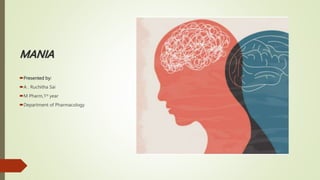
MANIA
Presented by:
A . Ruchitha Sai
M Pharm,1st year
Department of Pharmacology
Contents
 Introduction
 Definition of mania
 Pathophysiology of mania
 Drugs to treat mania
 Management of mania
 Drugs in pipeline
 Animal models
MANIA
 Mania is derived from the Greek word meaning “Madness and Frenzy”.
 The term mania describe a state of mind characterised by high energy,
excitement, and euphoria over a sustained period of time. It’s an extreme
change in mood and cognition that can interfere with school, work, or
home life.
 Mania is also the main feature of bipolar disorder
Definition
 Mania is an alteration in mood that is expressed by
feelings of elation, inflated, self esteem, extreme
happiness, hyperactivity, accelerated thinking and
speaking.
 In simple terms, mania makes abnormally energised
both physically and mentally
Stages of mania
 Stage 1 :- Hypomania
it is a mild form of mania that may not be recognised as a significant symptom
by those around the person experiencing it. While hypomania affects sleep and activity and may
lead to increased impulsivity. it usually doesn’t require hospitalization or cause psychosis.
 Stage 2 :- Acute Mania
During acute mania, an individual may experience increased impulsivity that
causes them to act in a way that is inappropriate or promiscuous. People with acute mania will
also likely have increased energy, little to no sleep and talk very quickly, often jump from topic to
topic. they may experience some symptoms of psychosis.
Cont…
 Stage 3 :- Delirious mania
it is the most severe of the three stages of mania. Its symptoms are similar to acute
mania. Its symptoms are similar to acute mania, with addition of delirium. Delirium is temporary
confusion and a decreased ability or inability to connect with reality. This stage can also involve a
combination of mania and psychosis. Because delirious mania can be profoundly disorientation,
many people experiencing it need to be hospitalized to prevent injury to themselves or other
Causes of mania
 There isn’t one single or clear cut reason that someone may become manic. It seems to be a
combination of long-term and short- term factors,which differs from person to person
 Possible causes of mania include
• High levels of stress
• Change or lack of sleep
• Seasonal changes, eg; some people likely to experience mania in spring
• significant changes in life
• child birth (postpartum psychosis)
• Family history – if a family member who experiences bipolar moods you are more likely to
experience mania
• Drugs eg; steroids, levodopa, other dopaminergic agents and hallucinogens
Pathogenesis

Pathophysiology:
 According to biogenic amine hypothesis, mood disorder results from abnormalities
in serotonin, norepinephrine or dopamine neurotransmission
 Serotoninergic fibres projecting from the raphei nuclei in the midbrain to limbic
structures are important in regulating mood
 The serotoninergic system is activated during behavioural arousal and increase
cortical awareness of emotional reactions to environmental events
 Impaired serotonin neurotransmission can decrease emotional activation leads to
mania
Cont…
 Nor adrenergic fibers that project from the locus ceruleus to the cerebral
cortex can also play role in depression.
Signs and symptoms
 Elevated expansive or irritable mood
 Stages of elevated mood
• Euphoria(stage1):increased sense of psychological well being and happiness
• Elation(stage2): moderate elevation of mood with increased psychomotor activity
• Exalation(stage3):intense elevation of mood with delusion of grandeur
• Ecstasy (stage4):severe elevation of mood intense sense of blissfulness
Cont…
Behavioural symptoms
• Aggressiveness
• Hyperactivity
• Increased motor activity
• Irresponsibility
• Irritability
• Argumentativeness
• Increased social activity
• Sexual hyperactivity
Cont…
Physiological symptoms
• Dehydration
• Little need of sleep
• Weight loss
• Inadequate nutrition
Treatment modalities
 There are basically 3 types of treatment modalities:
• Pharmacological treatment
• Psycho- social treatments
• ECT
Pharmacological treatment
 Mood stabilizer’s:
Lithium-drug of choice
Carbamazepine
Sodium valproate
Lithium carbonate
 Lithium a small monovalent cation, was found to be effective in
bipolar manic depressive illness.
 It mainly prevent the mood swings.
 A close control of serum concentration is required for safe and
effective use of lithium due to its therapeutic index.
 The desired therapeutic serum levels of lithium achieved in 8
days.
 Dose : Adults-300mg oral dose thrice a day
elders- 600mg
Mechanism of action
Mechanism of action
 The exact mechanism of action of lithium is unknown but the possible mechanism
of action may be due to the following effects,
1. Effects of electrolytes and ion transport: Lithium acts partially by replacing the
sodium ions in the body. this leads to changes in ionic fluxes across the brain cells.
2. Effects of neurotransmitter: lithium decreases the release and action of
neurotransmitter, such as dopamine and noradrenaline in the brain.
3. Effects of secondary messengers and intracellular enzymes.
Mechanism of action
• When neurotransmitter bind to Gq protein coupled
receptor , phospholipase-C (PLC) gets stimulated.
Activated PLC in turn hydrolyses PIP2 to IP3 and DAG.
IP3 is sequentially inactivated to IP1, IP2 and inositol.
This inositol acts as precursor for PIP and
PIP2(membrane phosphoinositides) which are the
sources of IP3 and DAG.
• In mania, these neuronal circuits becomes hyperactive
which results in more IP3 and DAG production. Lithium
selectively inhibits the hydrolysis of IP2 to IP1 and IP1 to
inositol. As result, the levels of inositol decrease and
this inturn decrease IP3 and DAG levels.
• Pharmacokinetics:
Lithium is slowly but readily absorbed from the gastrointestinal tract. Intially lithium
gets distributed in intracellular fluid, then in intracellular fluid and finally is slowly
enters into CNS.
The apparent volume of distribution of lithium is 0.5 L/kg (intial) and 0.8 L/kg at steady
state.
Lithium is not metabolised in the body and is almost completely excreted in urine
(96%), a very small amount of lithium excreted in saliva and sweat (4%).
The plasma half life of lithium is 20 hours.
The desired therapeutic plasma concentration of lithium is 0.6-1.4mEq/L, and toxicity
occur when it exceeds 1.5 mEq/L.
.
Toxicity
mild toxic effects include nausea, vomiting, diarrhoea, tremors, ataxia, blurred vision,
oedema, polyuria and allergy.
Chronic effects are seizures, ECG changes, hypothyroidism, coma and leucocytosis.
Therapeutic uses:
Acute mania : in acute mania episodes, lithium is administered in combination with atypical
antipsychotics(eg ; Olanzapine)
Alcohol dependence: As lithium reduces alcohol consumptions , it is used to treat alcohol withdrawal.
Leukopenia and agranulocytes: As lithium increases leukocytes count it is used in the treatment of
leukopenia and agranulocytosis, which are induced by cancer chemotherapy
Alternative to lithium:
Carbamazepine
It is used in the prophylaxis and treatment of acute mania. Combination of lithium with carbamazepine is
effective in treating patients with rapid cycling of mood or behavioural states.
 Mechanism of action
Reduces the influx of sodium ions into neurons, increases the serotonergic and dopaminergic post synaptic
activity and blocks the adenosine receptors
 Adverse effects
Dizziness, vertigo, sedation, ataxia, hypersensitivity reactions
 Therapeutic use
Prophylaxis and treatment of acute maniac episodes
 Dose
200mg orally twice a day
Psycho-Social treatment
 Family therapy
 Cognitive therapy
 Individual psychotherapy
 Group therapy
Electro- convulsive therapy
 ECT can also be used for acute manic excitement, if not adequately responding to
antipsychotics and lithium
Management of mania
Drugs in pipeline
 The drugs in late stage pipeline will enter the bipolar disorder market prior
to 2030 they are
 Fanapt (iloperiodone)- Vanda pharmaceuticals
 Dexmedetomidine- Bioxcel therapeutics
 RP5063 – Reviva pharmaceuticals
Animal models of mania
 These are 4 major features of mania that could be modelled:
Hyperactivity, Elation, Irritability, Insomnia
Sleep deprivation model
• The rat is kept on a small platform surrounded by water for 72h
• At the end of the period, it returns to its home cage and doesn’t ready to fall asleep
• Symptoms presented during this time: insomnia , hyperactivity, aggressiveness,
hypersexuality.
• Benefits: effective, economic, no invasive manipulation
Drug screening test
In this test latency to sleep and motor activity are measured.
Reference
 A textbook of pharmacology I – Dr.Shaik Harun Rasheed
 Brenner and stevens pharmacology- George M. Brenner, Craig W. Stevens
 Internet source
mania disorder.pptx

mania disorder.pptx

  • 1.
    MANIA Presented by: A .Ruchitha Sai M Pharm,1st year Department of Pharmacology
  • 2.
    Contents  Introduction  Definitionof mania  Pathophysiology of mania  Drugs to treat mania  Management of mania  Drugs in pipeline  Animal models
  • 3.
    MANIA  Mania isderived from the Greek word meaning “Madness and Frenzy”.  The term mania describe a state of mind characterised by high energy, excitement, and euphoria over a sustained period of time. It’s an extreme change in mood and cognition that can interfere with school, work, or home life.  Mania is also the main feature of bipolar disorder
  • 4.
    Definition  Mania isan alteration in mood that is expressed by feelings of elation, inflated, self esteem, extreme happiness, hyperactivity, accelerated thinking and speaking.  In simple terms, mania makes abnormally energised both physically and mentally
  • 5.
    Stages of mania Stage 1 :- Hypomania it is a mild form of mania that may not be recognised as a significant symptom by those around the person experiencing it. While hypomania affects sleep and activity and may lead to increased impulsivity. it usually doesn’t require hospitalization or cause psychosis.  Stage 2 :- Acute Mania During acute mania, an individual may experience increased impulsivity that causes them to act in a way that is inappropriate or promiscuous. People with acute mania will also likely have increased energy, little to no sleep and talk very quickly, often jump from topic to topic. they may experience some symptoms of psychosis.
  • 6.
    Cont…  Stage 3:- Delirious mania it is the most severe of the three stages of mania. Its symptoms are similar to acute mania. Its symptoms are similar to acute mania, with addition of delirium. Delirium is temporary confusion and a decreased ability or inability to connect with reality. This stage can also involve a combination of mania and psychosis. Because delirious mania can be profoundly disorientation, many people experiencing it need to be hospitalized to prevent injury to themselves or other
  • 7.
    Causes of mania There isn’t one single or clear cut reason that someone may become manic. It seems to be a combination of long-term and short- term factors,which differs from person to person  Possible causes of mania include • High levels of stress • Change or lack of sleep • Seasonal changes, eg; some people likely to experience mania in spring • significant changes in life • child birth (postpartum psychosis) • Family history – if a family member who experiences bipolar moods you are more likely to experience mania • Drugs eg; steroids, levodopa, other dopaminergic agents and hallucinogens
  • 8.
  • 9.
    Pathophysiology:  According tobiogenic amine hypothesis, mood disorder results from abnormalities in serotonin, norepinephrine or dopamine neurotransmission  Serotoninergic fibres projecting from the raphei nuclei in the midbrain to limbic structures are important in regulating mood  The serotoninergic system is activated during behavioural arousal and increase cortical awareness of emotional reactions to environmental events  Impaired serotonin neurotransmission can decrease emotional activation leads to mania
  • 10.
    Cont…  Nor adrenergicfibers that project from the locus ceruleus to the cerebral cortex can also play role in depression.
  • 11.
    Signs and symptoms Elevated expansive or irritable mood  Stages of elevated mood • Euphoria(stage1):increased sense of psychological well being and happiness • Elation(stage2): moderate elevation of mood with increased psychomotor activity • Exalation(stage3):intense elevation of mood with delusion of grandeur • Ecstasy (stage4):severe elevation of mood intense sense of blissfulness
  • 12.
    Cont… Behavioural symptoms • Aggressiveness •Hyperactivity • Increased motor activity • Irresponsibility • Irritability • Argumentativeness • Increased social activity • Sexual hyperactivity
  • 13.
    Cont… Physiological symptoms • Dehydration •Little need of sleep • Weight loss • Inadequate nutrition
  • 14.
    Treatment modalities  Thereare basically 3 types of treatment modalities: • Pharmacological treatment • Psycho- social treatments • ECT Pharmacological treatment  Mood stabilizer’s: Lithium-drug of choice Carbamazepine Sodium valproate
  • 15.
    Lithium carbonate  Lithiuma small monovalent cation, was found to be effective in bipolar manic depressive illness.  It mainly prevent the mood swings.  A close control of serum concentration is required for safe and effective use of lithium due to its therapeutic index.  The desired therapeutic serum levels of lithium achieved in 8 days.  Dose : Adults-300mg oral dose thrice a day elders- 600mg
  • 16.
    Mechanism of action Mechanismof action  The exact mechanism of action of lithium is unknown but the possible mechanism of action may be due to the following effects, 1. Effects of electrolytes and ion transport: Lithium acts partially by replacing the sodium ions in the body. this leads to changes in ionic fluxes across the brain cells. 2. Effects of neurotransmitter: lithium decreases the release and action of neurotransmitter, such as dopamine and noradrenaline in the brain. 3. Effects of secondary messengers and intracellular enzymes.
  • 17.
    Mechanism of action •When neurotransmitter bind to Gq protein coupled receptor , phospholipase-C (PLC) gets stimulated. Activated PLC in turn hydrolyses PIP2 to IP3 and DAG. IP3 is sequentially inactivated to IP1, IP2 and inositol. This inositol acts as precursor for PIP and PIP2(membrane phosphoinositides) which are the sources of IP3 and DAG. • In mania, these neuronal circuits becomes hyperactive which results in more IP3 and DAG production. Lithium selectively inhibits the hydrolysis of IP2 to IP1 and IP1 to inositol. As result, the levels of inositol decrease and this inturn decrease IP3 and DAG levels.
  • 18.
    • Pharmacokinetics: Lithium isslowly but readily absorbed from the gastrointestinal tract. Intially lithium gets distributed in intracellular fluid, then in intracellular fluid and finally is slowly enters into CNS. The apparent volume of distribution of lithium is 0.5 L/kg (intial) and 0.8 L/kg at steady state. Lithium is not metabolised in the body and is almost completely excreted in urine (96%), a very small amount of lithium excreted in saliva and sweat (4%). The plasma half life of lithium is 20 hours. The desired therapeutic plasma concentration of lithium is 0.6-1.4mEq/L, and toxicity occur when it exceeds 1.5 mEq/L. .
  • 19.
    Toxicity mild toxic effectsinclude nausea, vomiting, diarrhoea, tremors, ataxia, blurred vision, oedema, polyuria and allergy. Chronic effects are seizures, ECG changes, hypothyroidism, coma and leucocytosis. Therapeutic uses: Acute mania : in acute mania episodes, lithium is administered in combination with atypical antipsychotics(eg ; Olanzapine) Alcohol dependence: As lithium reduces alcohol consumptions , it is used to treat alcohol withdrawal. Leukopenia and agranulocytes: As lithium increases leukocytes count it is used in the treatment of leukopenia and agranulocytosis, which are induced by cancer chemotherapy
  • 20.
    Alternative to lithium: Carbamazepine Itis used in the prophylaxis and treatment of acute mania. Combination of lithium with carbamazepine is effective in treating patients with rapid cycling of mood or behavioural states.  Mechanism of action Reduces the influx of sodium ions into neurons, increases the serotonergic and dopaminergic post synaptic activity and blocks the adenosine receptors  Adverse effects Dizziness, vertigo, sedation, ataxia, hypersensitivity reactions  Therapeutic use Prophylaxis and treatment of acute maniac episodes  Dose 200mg orally twice a day
  • 21.
    Psycho-Social treatment  Familytherapy  Cognitive therapy  Individual psychotherapy  Group therapy Electro- convulsive therapy  ECT can also be used for acute manic excitement, if not adequately responding to antipsychotics and lithium
  • 22.
  • 23.
    Drugs in pipeline The drugs in late stage pipeline will enter the bipolar disorder market prior to 2030 they are  Fanapt (iloperiodone)- Vanda pharmaceuticals  Dexmedetomidine- Bioxcel therapeutics  RP5063 – Reviva pharmaceuticals
  • 24.
    Animal models ofmania  These are 4 major features of mania that could be modelled: Hyperactivity, Elation, Irritability, Insomnia Sleep deprivation model • The rat is kept on a small platform surrounded by water for 72h • At the end of the period, it returns to its home cage and doesn’t ready to fall asleep • Symptoms presented during this time: insomnia , hyperactivity, aggressiveness, hypersexuality. • Benefits: effective, economic, no invasive manipulation Drug screening test In this test latency to sleep and motor activity are measured.
  • 26.
    Reference  A textbookof pharmacology I – Dr.Shaik Harun Rasheed  Brenner and stevens pharmacology- George M. Brenner, Craig W. Stevens  Internet source