Balanced, Under Reinforced
and Over Reinforced Section
Name - Navdeep
L-2020-AE-051-BIV
Content
• Introduction
• Balanced section
• Under Reinforced section
• Over Reinforced Section
• Failure in Balanced, Under and Over Reinforced section
• Comparison
• Moment of resistance
• References
Introduction
• When it comes to designing RCC beams, there are several options to
consider when it comes to the amount of reinforcement used
• we have three types of sections:
1) Balanced Section
2) Under Reinforced Section
3) Over Reinforced Section
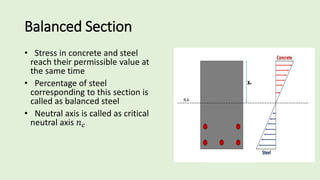
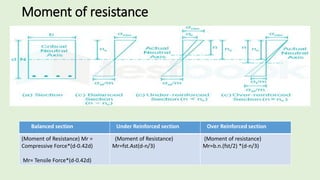
Balanced Section
• Stress in concrete and steel
reach their permissible value at
the same time
• Percentage of steel
corresponding to this section is
called as balanced steel
• Neutral axis is called as critical
neutral axis 𝑛𝑐
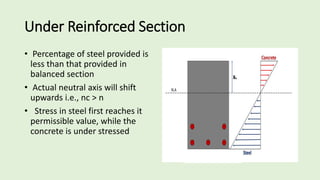
Under Reinforced Section
• Percentage of steel provided is
less than that provided in
balanced section
• Actual neutral axis will shift
upwards i.e., nc > n
• Stress in steel first reaches it
permissible value, while the
concrete is under stressed
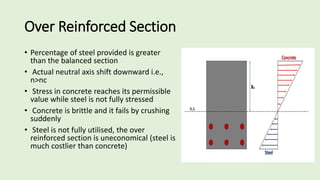
Over Reinforced Section
• Percentage of steel provided is greater
than the balanced section
• Actual neutral axis shift downward i.e.,
n>nc
• Stress in concrete reaches its permissible
value while steel is not fully stressed
• Concrete is brittle and it fails by crushing
suddenly
• Steel is not fully utilised, the over
reinforced section is uneconomical (steel is
much costlier than concrete)
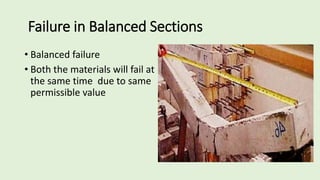
Failure in Balanced Sections
• Balanced failure
• Both the materials will fail at
the same time due to same
permissible value
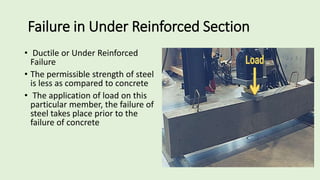
Failure in Under Reinforced Section
• Ductile or Under Reinforced
Failure
• The permissible strength of steel
is less as compared to concrete
• The application of load on this
particular member, the failure of
steel takes place prior to the
failure of concrete
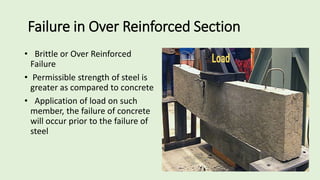
Failure in Over Reinforced Section
• Brittle or Over Reinforced
Failure
• Permissible strength of steel is
greater as compared to concrete
• Application of load on such
member, the failure of concrete
will occur prior to the failure of
steel
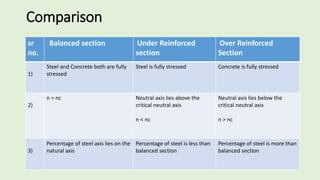
Comparison
sr
no.
Balanced section Under Reinforced
section
Over Reinforced
Section
1)
Steel and Concrete both are fully
stressed
Steel is fully stressed Concrete is fully stressed
2)
n = nc Neutral axis lies above the
critical neutral axis
n < nc
Neutral axis lies below the
critical neutral axis
n > nc
3)
Percentage of steel axis lies on the
natural axis
Percentage of steel is less than
balanced section
Percentage of steel is more than
balanced section
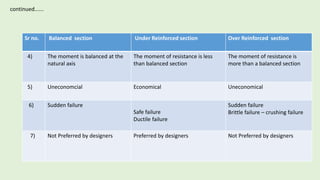
Sr no. Balanced section Under Reinforced section Over Reinforced section
4) The moment is balanced at the
natural axis
The moment of resistance is less
than balanced section
The moment of resistance is
more than a balanced section
5) Uneconomcial Economical Uneconomical
6) Sudden failure
Safe failure
Ductile failure
Sudden failure
Brittle failure – crushing failure
7) Not Preferred by designers Preferred by designers Not Preferred by designers
continued......
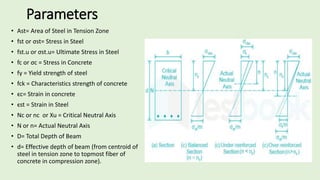
Parameters
• Ast= Area of Steel in Tension Zone
• fst or σst= Stress in Steel
• fst.u or σst.u= Ultimate Stress in Steel
• fc or σc = Stress in Concrete
• fy = Yield strength of steel
• fck = Characteristics strength of concrete
• ϵc= Strain in concrete
• ϵst = Strain in Steel
• Nc or nc or Xu = Critical Neutral Axis
• N or n= Actual Neutral Axis
• D= Total Depth of Beam
• d= Effective depth of beam (from centroid of
steel in tension zone to topmost fiber of
concrete in compression zone).
Moment of resistance
Balanced section Under Reinforced section Over Reinforced section
(Moment of Resistance) Mr =
Compressive Force*(d-0.42d)
Mr= Tensile Force*(d-0.42d)
(Moment of Resistance)
Mr=fst.Ast(d-n/3)
(Moment of resistance)
Mr=b.n.(fst/2) *(d-n/3)
References
Sr no. Slide number Reference
1) 3 ,7-9 https://civiltutorofficial.com/why-do-we-prefer-under-reinforced-
sections-over-balanced-or-over-reinforced-sections/
2) 4-6 https://www.google.com/url?sa=i&rct=j&q=&esrc=s&source=web&c
d=&ved=0CAMQw7AJahcKEwjQhveztdH-
AhUAAAAAHQAAAAAQAg&url=https%3A%2F%2Fcivilengineering.blo
g%2F2017%2F11%2F14%2Fbalanced-sections-under-reinforced-
section-over-reinforced-section%2F&psig=AOvVaw2Oh-H4W6z-
5abbhLF16LmN&ust=1682937637971857
3) 10-11 https://civilexperiences.com/balanced-sections-under-reinforced-
section-over-reinforced-section/
4) 12-13 https://civilideas374921463.wordpress.com/2021/09/11/balanced-
section-under-reinforced-section-over-reinforced-section/
Thank You

Balanced section,under reinforced,over reinforced section

  • 1.
    Balanced, Under Reinforced andOver Reinforced Section Name - Navdeep L-2020-AE-051-BIV
  • 2.
    Content • Introduction • Balancedsection • Under Reinforced section • Over Reinforced Section • Failure in Balanced, Under and Over Reinforced section • Comparison • Moment of resistance • References
  • 3.
    Introduction • When itcomes to designing RCC beams, there are several options to consider when it comes to the amount of reinforcement used • we have three types of sections: 1) Balanced Section 2) Under Reinforced Section 3) Over Reinforced Section
  • 4.
    Balanced Section • Stressin concrete and steel reach their permissible value at the same time • Percentage of steel corresponding to this section is called as balanced steel • Neutral axis is called as critical neutral axis 𝑛𝑐
  • 5.
    Under Reinforced Section •Percentage of steel provided is less than that provided in balanced section • Actual neutral axis will shift upwards i.e., nc > n • Stress in steel first reaches it permissible value, while the concrete is under stressed
  • 6.
    Over Reinforced Section •Percentage of steel provided is greater than the balanced section • Actual neutral axis shift downward i.e., n>nc • Stress in concrete reaches its permissible value while steel is not fully stressed • Concrete is brittle and it fails by crushing suddenly • Steel is not fully utilised, the over reinforced section is uneconomical (steel is much costlier than concrete)
  • 7.
    Failure in BalancedSections • Balanced failure • Both the materials will fail at the same time due to same permissible value
  • 8.
    Failure in UnderReinforced Section • Ductile or Under Reinforced Failure • The permissible strength of steel is less as compared to concrete • The application of load on this particular member, the failure of steel takes place prior to the failure of concrete
  • 9.
    Failure in OverReinforced Section • Brittle or Over Reinforced Failure • Permissible strength of steel is greater as compared to concrete • Application of load on such member, the failure of concrete will occur prior to the failure of steel
  • 10.
    Comparison sr no. Balanced section UnderReinforced section Over Reinforced Section 1) Steel and Concrete both are fully stressed Steel is fully stressed Concrete is fully stressed 2) n = nc Neutral axis lies above the critical neutral axis n < nc Neutral axis lies below the critical neutral axis n > nc 3) Percentage of steel axis lies on the natural axis Percentage of steel is less than balanced section Percentage of steel is more than balanced section
  • 11.
    Sr no. Balancedsection Under Reinforced section Over Reinforced section 4) The moment is balanced at the natural axis The moment of resistance is less than balanced section The moment of resistance is more than a balanced section 5) Uneconomcial Economical Uneconomical 6) Sudden failure Safe failure Ductile failure Sudden failure Brittle failure – crushing failure 7) Not Preferred by designers Preferred by designers Not Preferred by designers continued......
  • 12.
    Parameters • Ast= Areaof Steel in Tension Zone • fst or σst= Stress in Steel • fst.u or σst.u= Ultimate Stress in Steel • fc or σc = Stress in Concrete • fy = Yield strength of steel • fck = Characteristics strength of concrete • ϵc= Strain in concrete • ϵst = Strain in Steel • Nc or nc or Xu = Critical Neutral Axis • N or n= Actual Neutral Axis • D= Total Depth of Beam • d= Effective depth of beam (from centroid of steel in tension zone to topmost fiber of concrete in compression zone).
  • 13.
    Moment of resistance Balancedsection Under Reinforced section Over Reinforced section (Moment of Resistance) Mr = Compressive Force*(d-0.42d) Mr= Tensile Force*(d-0.42d) (Moment of Resistance) Mr=fst.Ast(d-n/3) (Moment of resistance) Mr=b.n.(fst/2) *(d-n/3)
  • 14.
    References Sr no. Slidenumber Reference 1) 3 ,7-9 https://civiltutorofficial.com/why-do-we-prefer-under-reinforced- sections-over-balanced-or-over-reinforced-sections/ 2) 4-6 https://www.google.com/url?sa=i&rct=j&q=&esrc=s&source=web&c d=&ved=0CAMQw7AJahcKEwjQhveztdH- AhUAAAAAHQAAAAAQAg&url=https%3A%2F%2Fcivilengineering.blo g%2F2017%2F11%2F14%2Fbalanced-sections-under-reinforced- section-over-reinforced-section%2F&psig=AOvVaw2Oh-H4W6z- 5abbhLF16LmN&ust=1682937637971857 3) 10-11 https://civilexperiences.com/balanced-sections-under-reinforced- section-over-reinforced-section/ 4) 12-13 https://civilideas374921463.wordpress.com/2021/09/11/balanced- section-under-reinforced-section-over-reinforced-section/
  • 15.