eXtensible Access Control
                                                  Markup Language
                                                  Rémon Sinnema
                                                    – Consultant Software Engineer at EMC
                                                    – Voting member of the XACML Technical Committee
                                                    –          sinnema313


© Copyright 2011 EMC Corporation. All rights reserved.                                                 1
Agenda
                                                • Access Control
                                                         – Various models
                                                         – How XACML fits in
                                                • XACML
                                                         –   Architecture
                                                         –   Request/Response Protocol
                                                         –   Policy Language
                                                         –   Optional Profiles
                                                         –   What’s new in 3.0
                                                         –   Implementations


© Copyright 2011 EMC Corporation. All rights reserved.                                   2
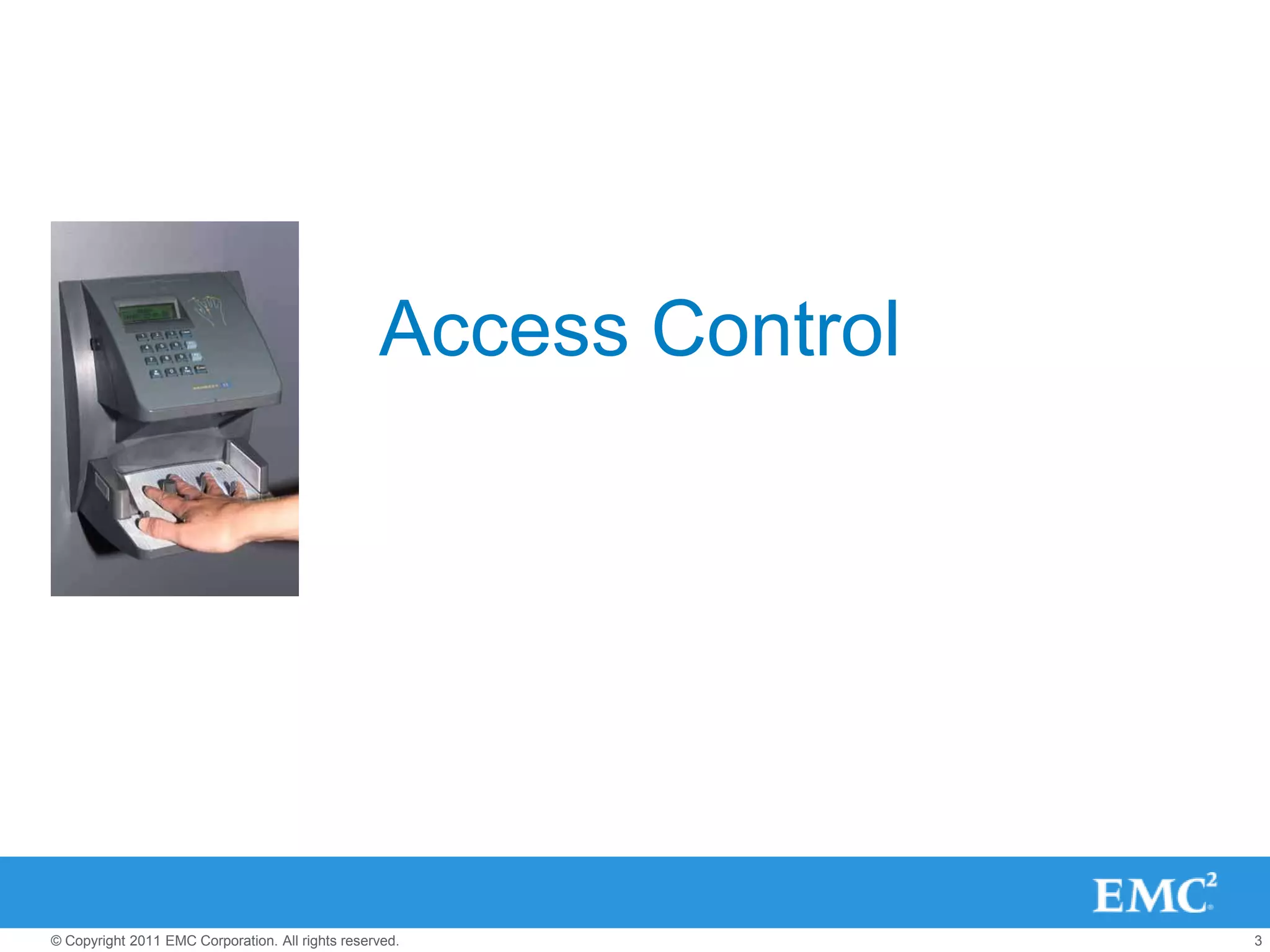
Access Control


© Copyright 2011 EMC Corporation. All rights reserved.             3
Access Control
• Access control is the basis of Information Security:
         – Confidentiality: prevent disclosure to unauthorized
           agents
         – Integrity: prevent modification by unauthorized agents
         – Availability: keep unauthorized agents off the system
• An access request occurs when
   – a given subject tries to access
   – a given resource to perform
   – a given action in
   – a given environment


© Copyright 2011 EMC Corporation. All rights reserved.              4
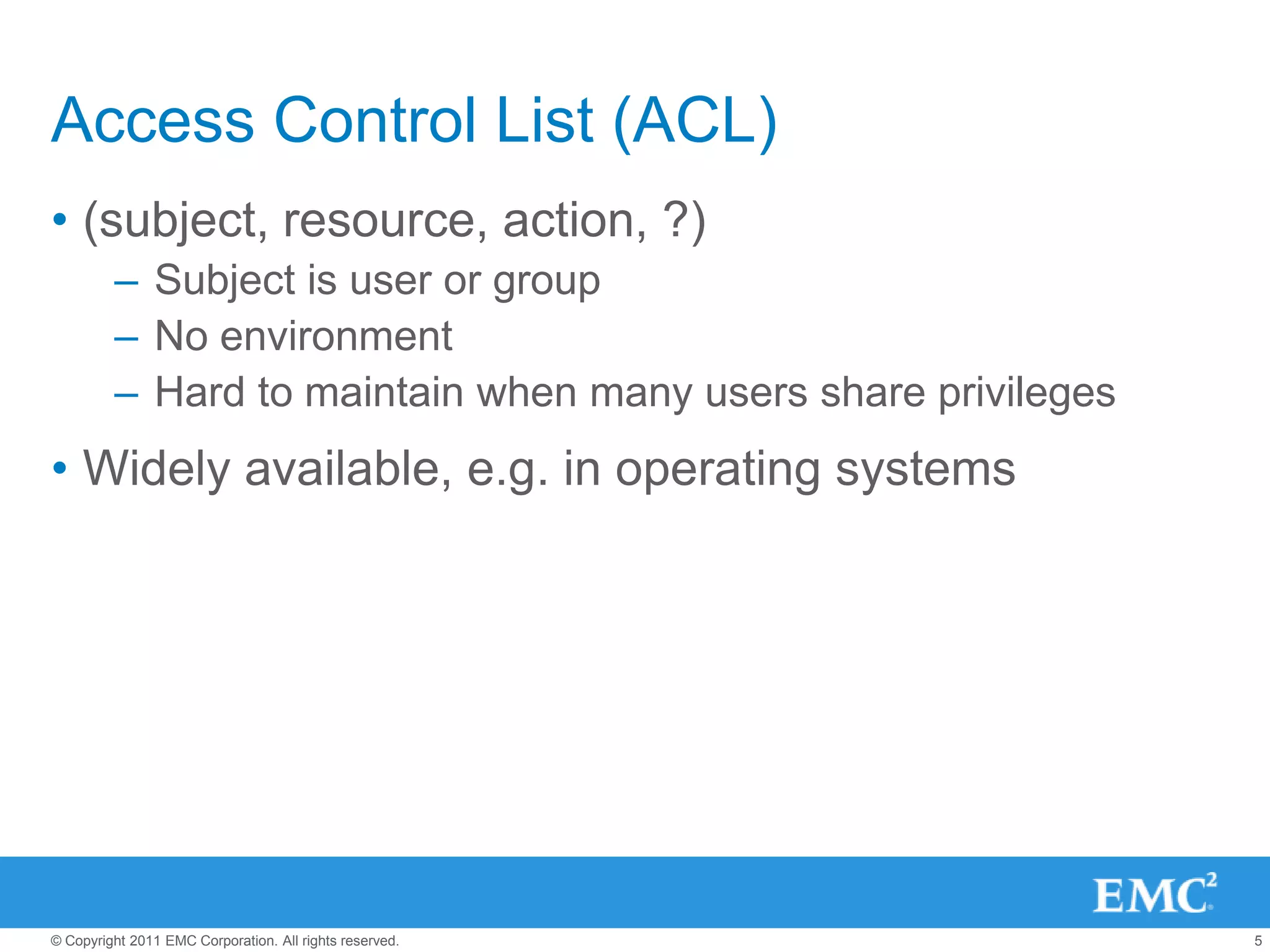
Access Control List (ACL)
• (subject, resource, action, ?)
         – Subject is user or group
         – No environment
         – Hard to maintain when many users share privileges
• Widely available, e.g. in operating systems


© Copyright 2011 EMC Corporation. All rights reserved.         5
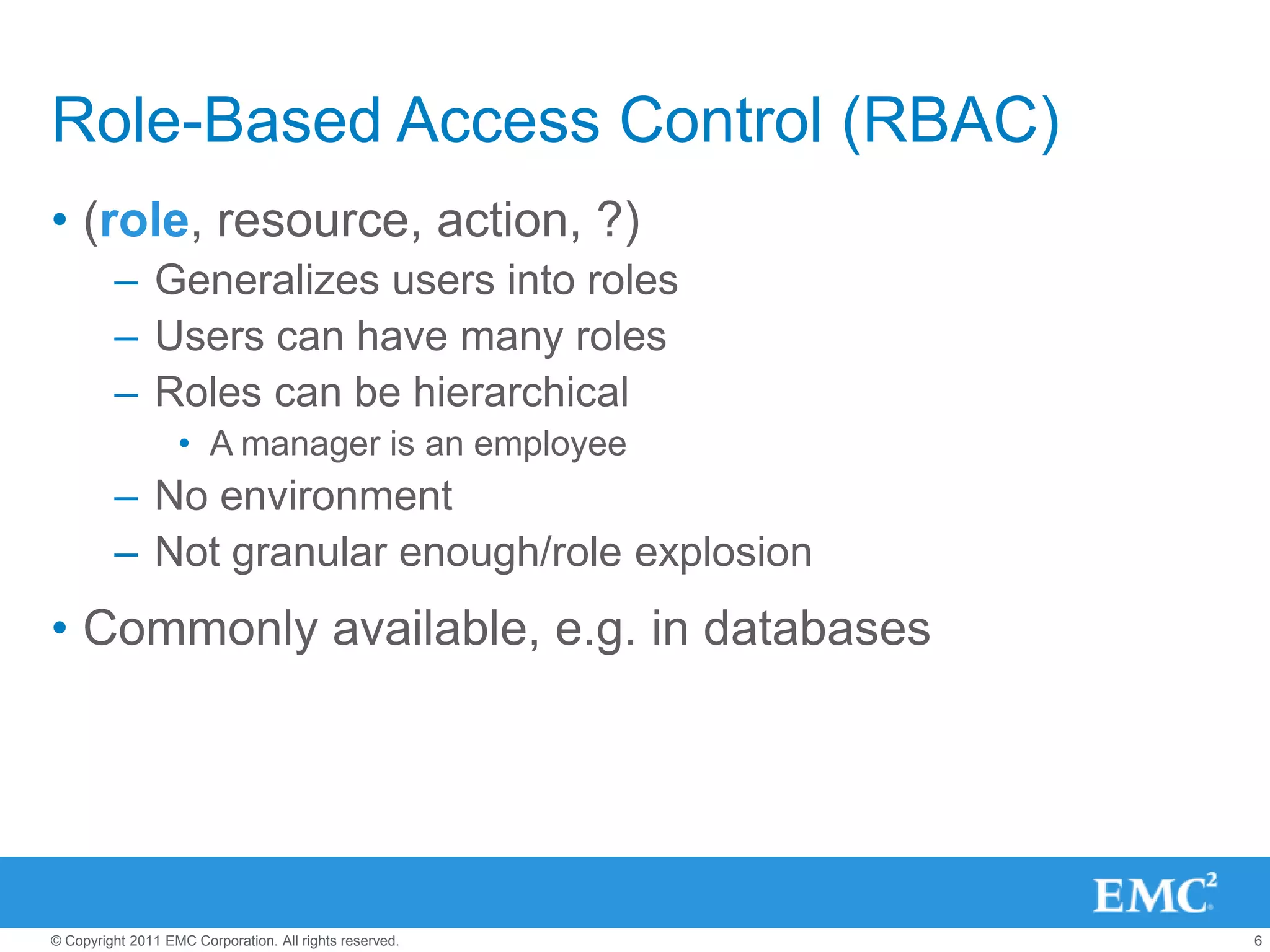
Role-Based Access Control (RBAC)
• (role, resource, action, ?)
         – Generalizes users into roles
         – Users can have many roles
         – Roles can be hierarchical
                   • A manager is an employee
         – No environment
         – Not granular enough/role explosion
• Commonly available, e.g. in databases


© Copyright 2011 EMC Corporation. All rights reserved.   6
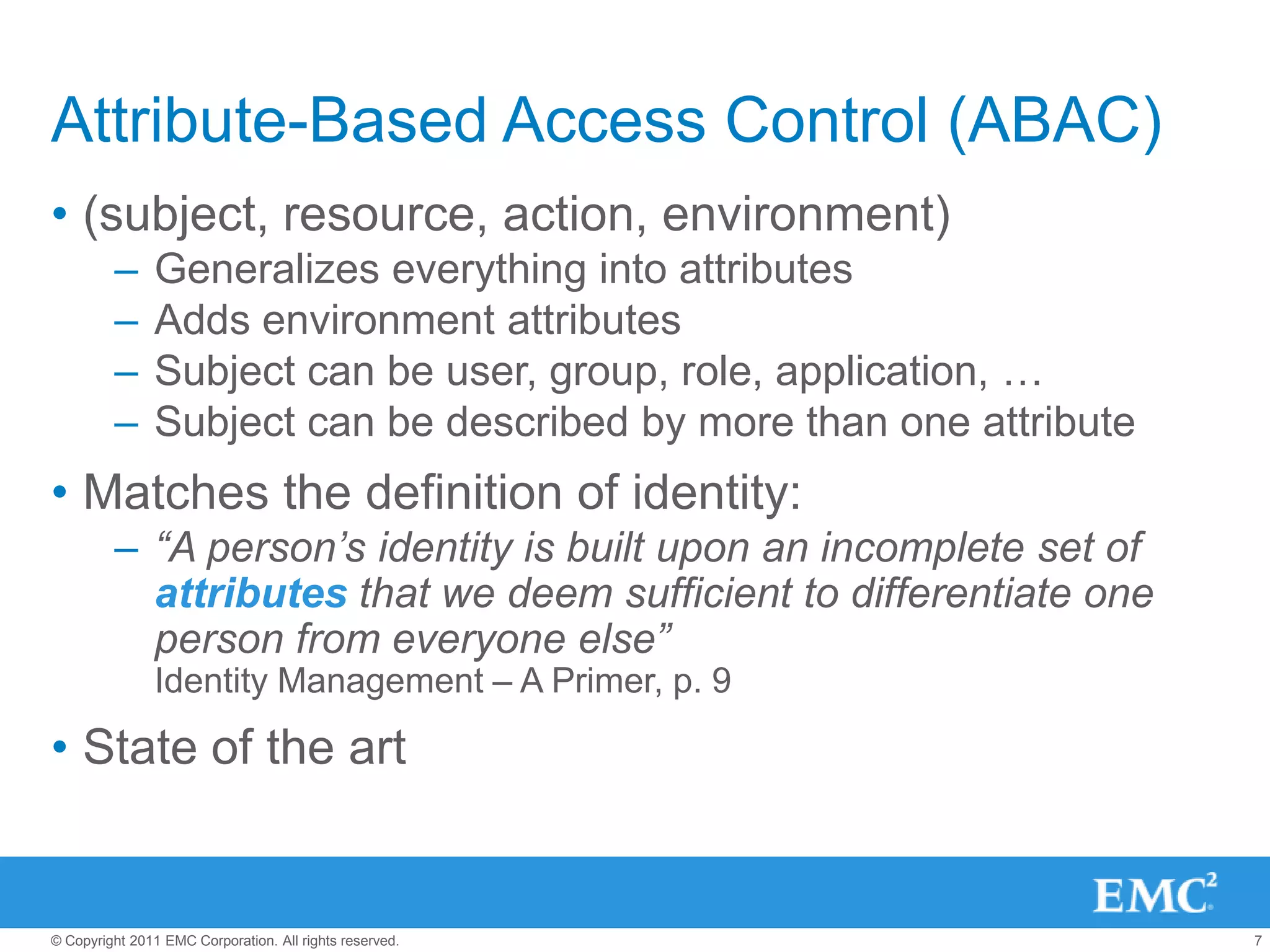
Attribute-Based Access Control (ABAC)
• (subject, resource, action, environment)
         –      Generalizes everything into attributes
         –      Adds environment attributes
         –      Subject can be user, group, role, application, …
         –      Subject can be described by more than one attribute
• Matches the definition of identity:
         – “A person’s identity is built upon an incomplete set of
           attributes that we deem sufficient to differentiate one
           person from everyone else”
                Identity Management – A Primer, p. 9

• State of the art


© Copyright 2011 EMC Corporation. All rights reserved.                7
Policy-Based Access Control (PBAC)
• (subject, resource, action, environment)
         – Harmonizes attributes across the (extended)
           organization
• Coming soon…


© Copyright 2011 EMC Corporation. All rights reserved.   8
Risk-Adaptive Access Control (RAdAC)
• (subject, resource, action, environment)
         – Dynamic risk levels as environment attributes
         – Threat level etc. from outside sources as well
• Not anytime soon


© Copyright 2011 EMC Corporation. All rights reserved.      9
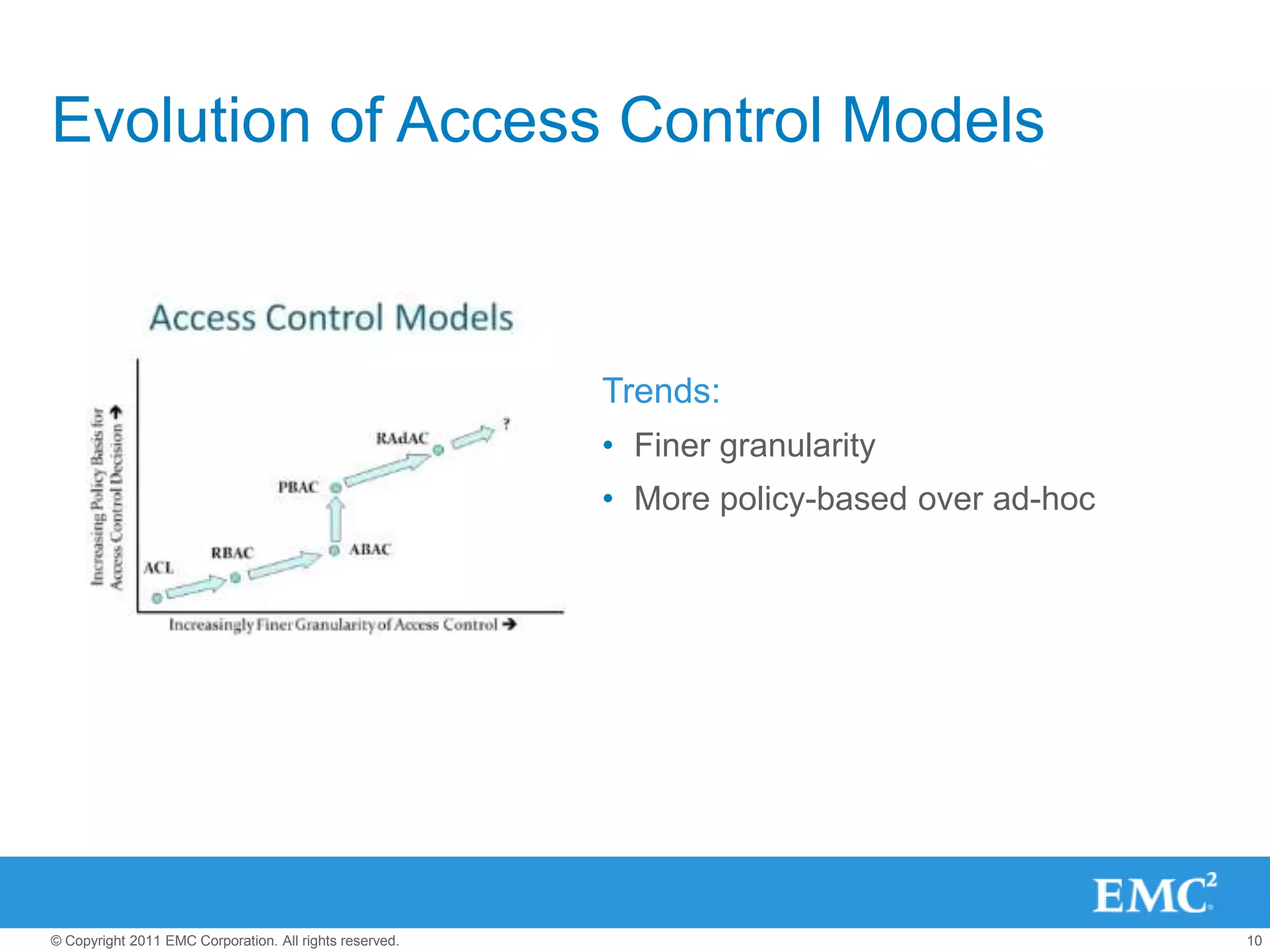
Evolution of Access Control Models


                                                         Trends:
                                                         • Finer granularity
                                                         • More policy-based over ad-hoc


© Copyright 2011 EMC Corporation. All rights reserved.                                     10
XACML supports all of
                                               ACL, RBAC, ABAC, PBAC, and
                                               RAdAC

                                                          One technology for all your
                                                         evolving access control needs!


© Copyright 2011 EMC Corporation. All rights reserved.                                    11
eXtensible Access
                                                  Control Markup
                                                  Language


© Copyright 2011 EMC Corporation. All rights reserved.                12
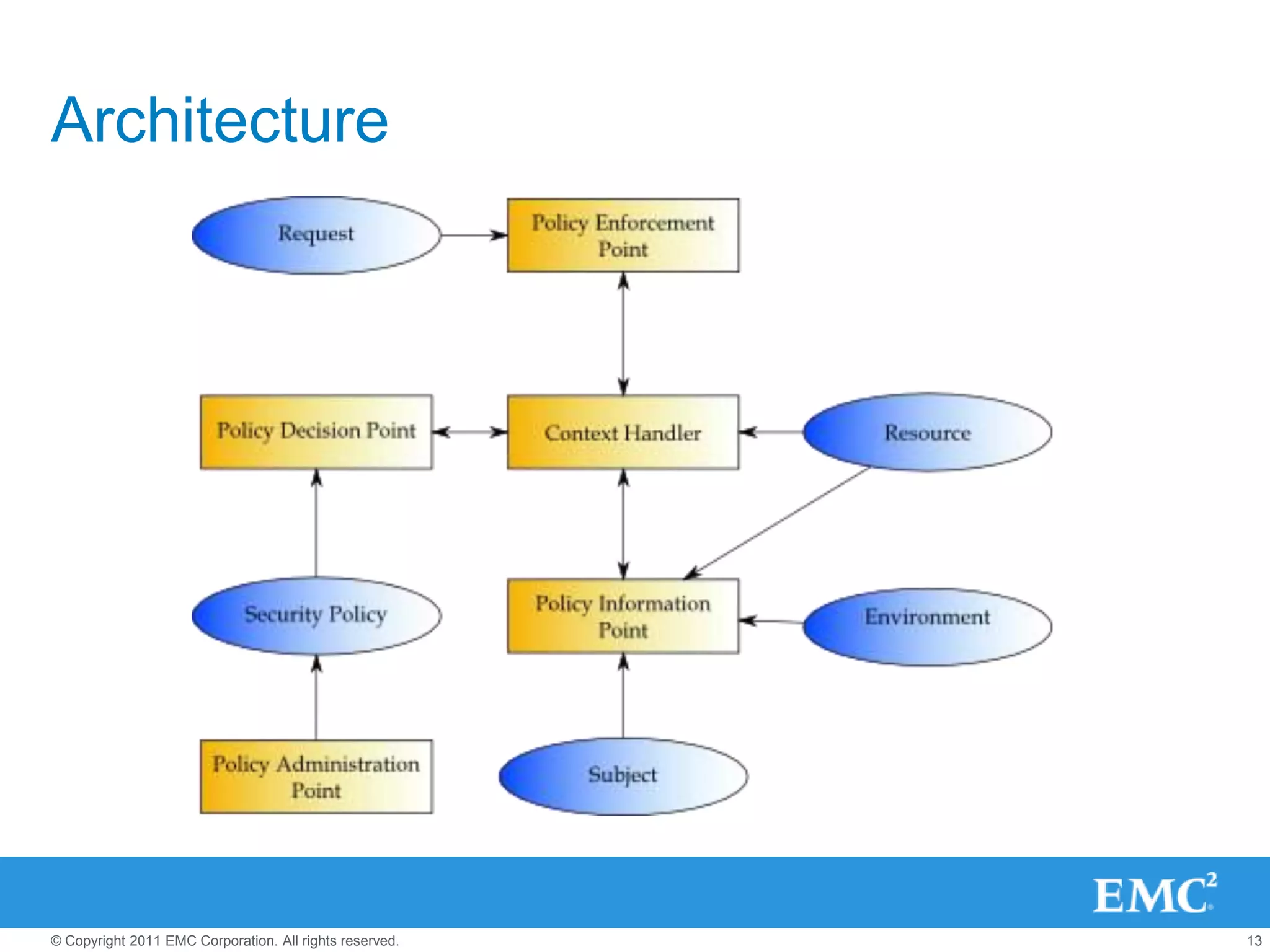
Architecture


© Copyright 2011 EMC Corporation. All rights reserved.   13
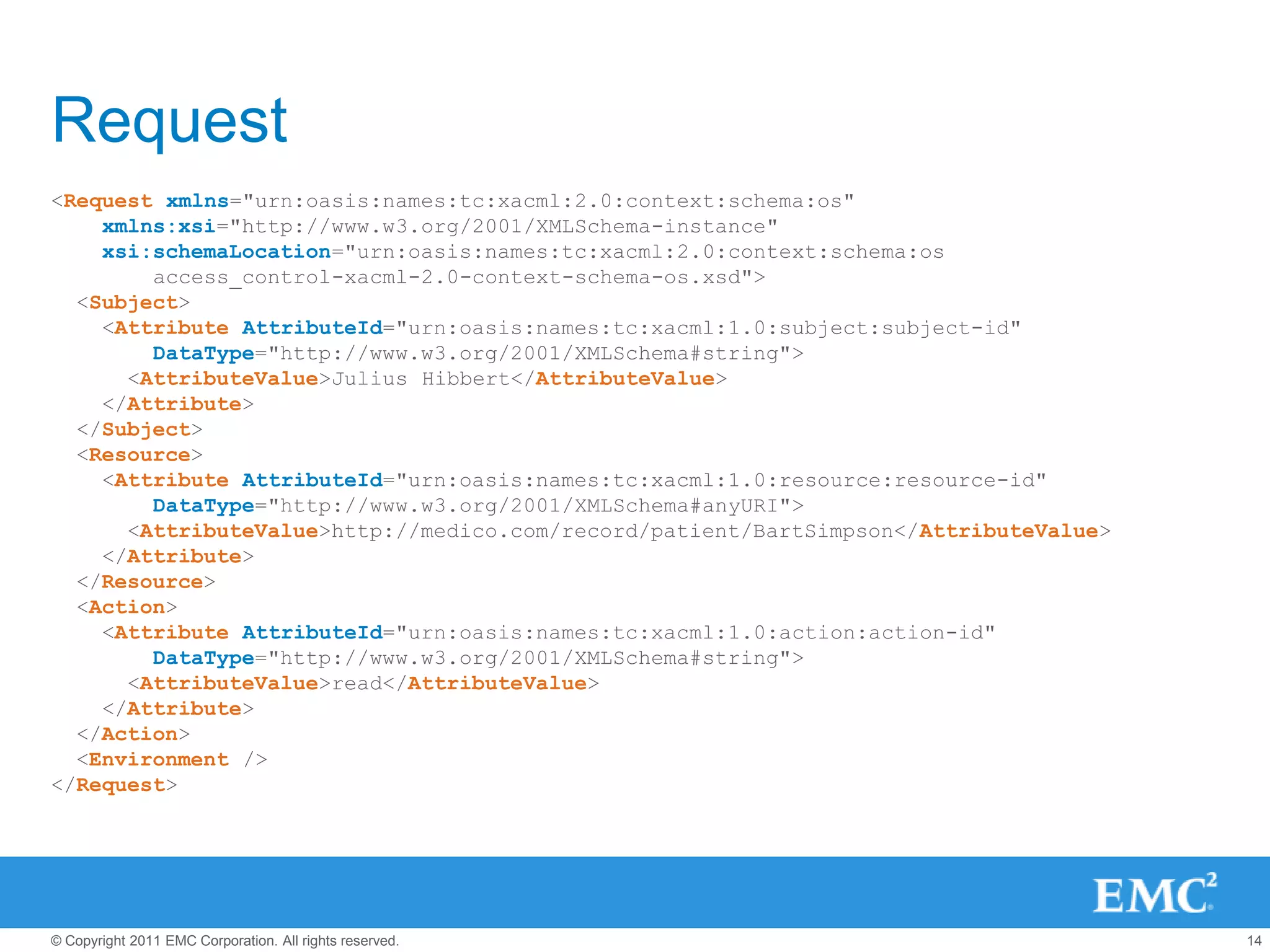
Request
<Request xmlns="urn:oasis:names:tc:xacml:2.0:context:schema:os"
    xmlns:xsi="http://www.w3.org/2001/XMLSchema-instance"
    xsi:schemaLocation="urn:oasis:names:tc:xacml:2.0:context:schema:os
        access_control-xacml-2.0-context-schema-os.xsd">
  <Subject>
    <Attribute AttributeId="urn:oasis:names:tc:xacml:1.0:subject:subject-id"
        DataType="http://www.w3.org/2001/XMLSchema#string">
      <AttributeValue>Julius Hibbert</AttributeValue>
    </Attribute>
  </Subject>
  <Resource>
    <Attribute AttributeId="urn:oasis:names:tc:xacml:1.0:resource:resource-id"
        DataType="http://www.w3.org/2001/XMLSchema#anyURI">
      <AttributeValue>http://medico.com/record/patient/BartSimpson</AttributeValue>
    </Attribute>
  </Resource>
  <Action>
    <Attribute AttributeId="urn:oasis:names:tc:xacml:1.0:action:action-id"
        DataType="http://www.w3.org/2001/XMLSchema#string">
      <AttributeValue>read</AttributeValue>
    </Attribute>
  </Action>
  <Environment />
</Request>


© Copyright 2011 EMC Corporation. All rights reserved.                                14
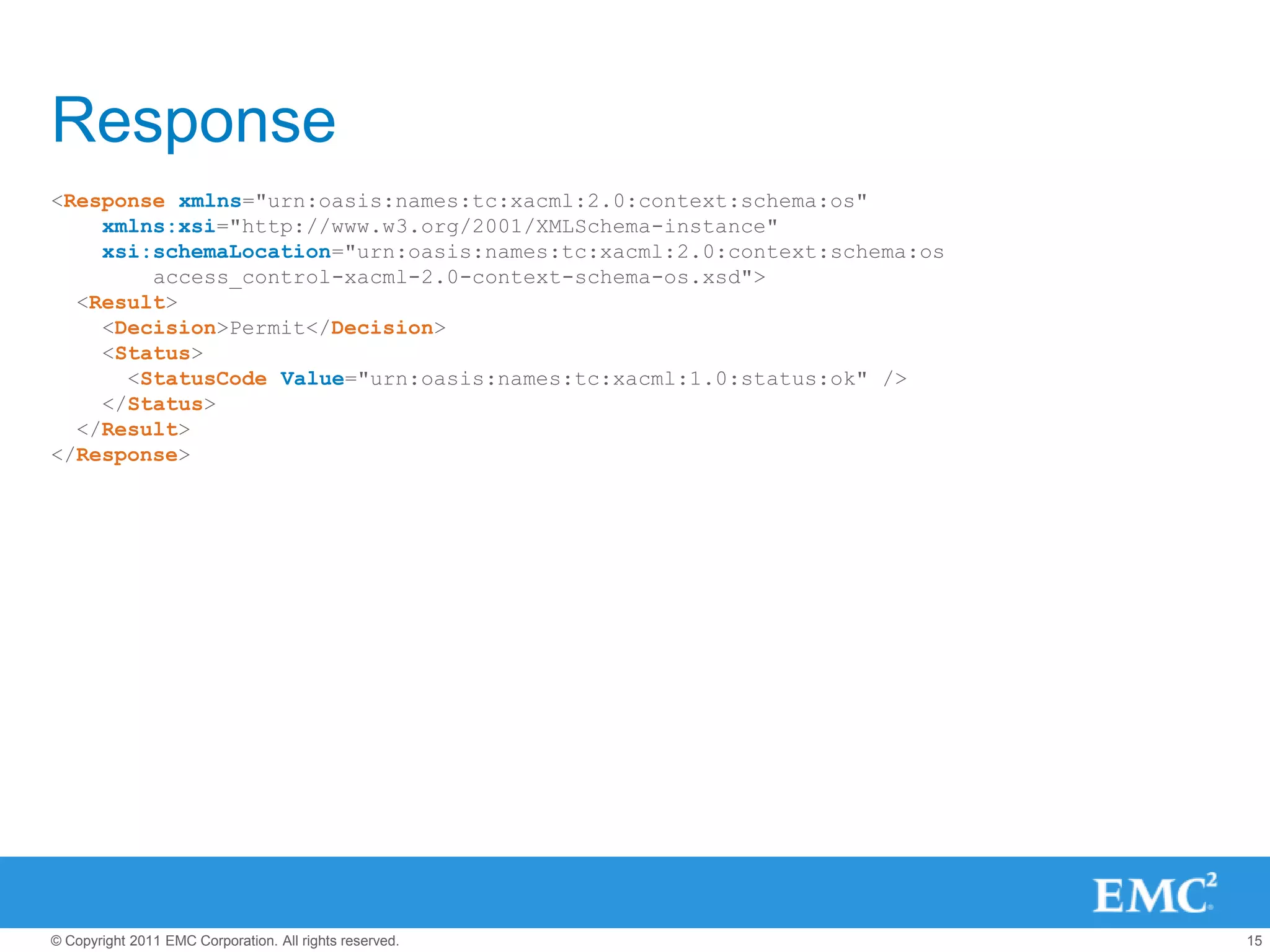
Response
<Response xmlns="urn:oasis:names:tc:xacml:2.0:context:schema:os"
    xmlns:xsi="http://www.w3.org/2001/XMLSchema-instance"
    xsi:schemaLocation="urn:oasis:names:tc:xacml:2.0:context:schema:os
        access_control-xacml-2.0-context-schema-os.xsd">
  <Result>
    <Decision>Permit</Decision>
    <Status>
      <StatusCode Value="urn:oasis:names:tc:xacml:1.0:status:ok" />
    </Status>
  </Result>
</Response>


© Copyright 2011 EMC Corporation. All rights reserved.                   15
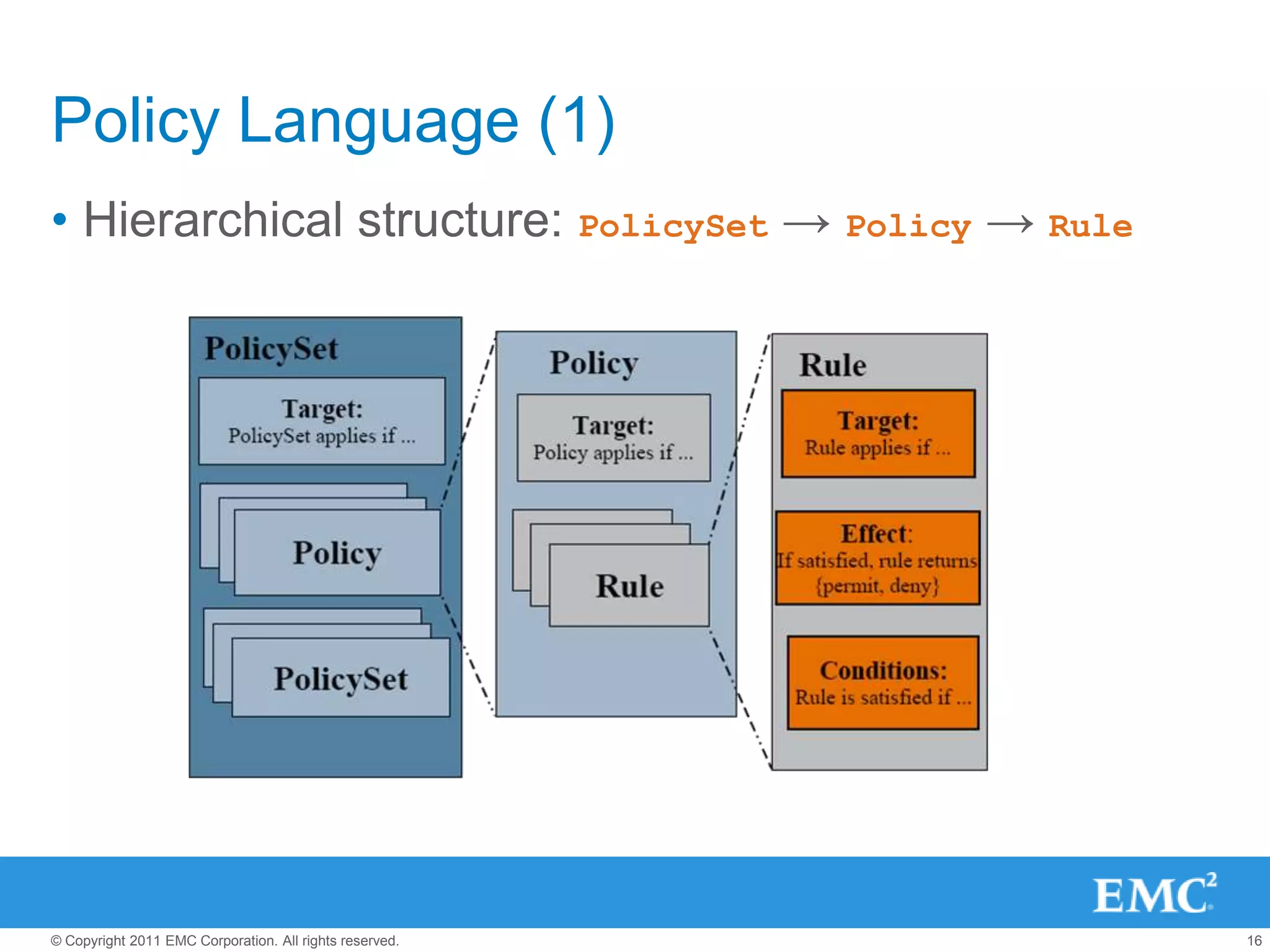
Policy Language (1)
• Hierarchical structure: PolicySet → Policy → Rule


© Copyright 2011 EMC Corporation. All rights reserved.   16
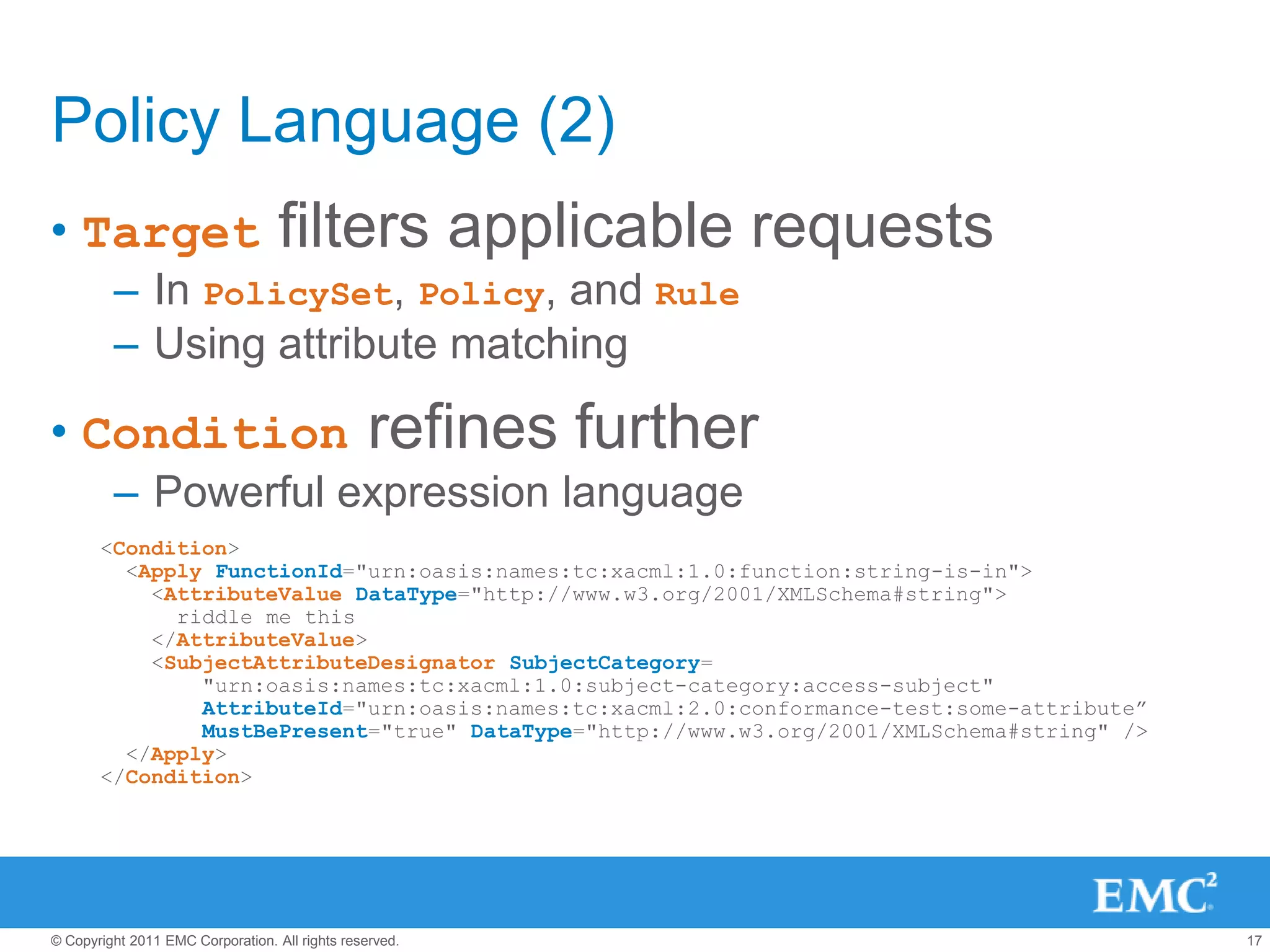
Policy Language (2)
• Target                           filters applicable requests
         – In PolicySet, Policy, and Rule
         – Using attribute matching

• Condition                                      refines further
         – Powerful expression language
       <Condition>
         <Apply FunctionId="urn:oasis:names:tc:xacml:1.0:function:string-is-in">
           <AttributeValue DataType="http://www.w3.org/2001/XMLSchema#string">
             riddle me this
           </AttributeValue>
           <SubjectAttributeDesignator SubjectCategory=
               "urn:oasis:names:tc:xacml:1.0:subject-category:access-subject"
               AttributeId="urn:oasis:names:tc:xacml:2.0:conformance-test:some-attribute”
               MustBePresent="true" DataType="http://www.w3.org/2001/XMLSchema#string" />
         </Apply>
       </Condition>


© Copyright 2011 EMC Corporation. All rights reserved.                                      17
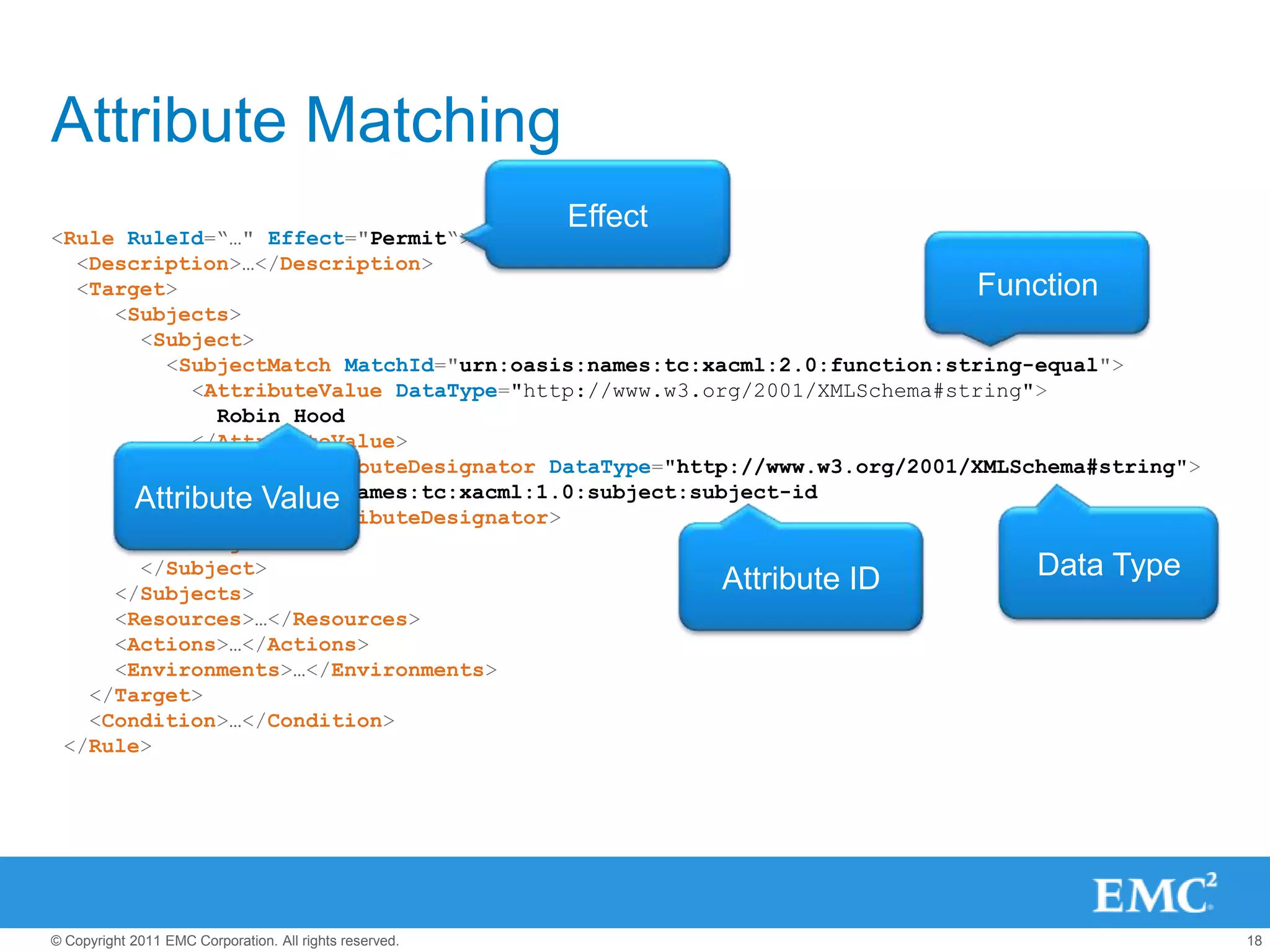
Attribute Matching
                                                         Effect
<Rule RuleId=“…" Effect="Permit“>
  <Description>…</Description>
  <Target>                                                               Function
     <Subjects>
       <Subject>
         <SubjectMatch MatchId="urn:oasis:names:tc:xacml:2.0:function:string-equal">
            <AttributeValue DataType="http://www.w3.org/2001/XMLSchema#string">
              Robin Hood
            </AttributeValue>
            <SubjectAttributeDesignator DataType="http://www.w3.org/2001/XMLSchema#string">
              urn:oasis:names:tc:xacml:1.0:subject:subject-id
       Attribute Value
            </SubjectAttributeDesignator>
         </SubjectMatch>
       </Subject>
                                                      Attribute ID            Data Type
     </Subjects>
     <Resources>…</Resources>
     <Actions>…</Actions>
     <Environments>…</Environments>
   </Target>
   <Condition>…</Condition>
 </Rule>


© Copyright 2011 EMC Corporation. All rights reserved.                                        18
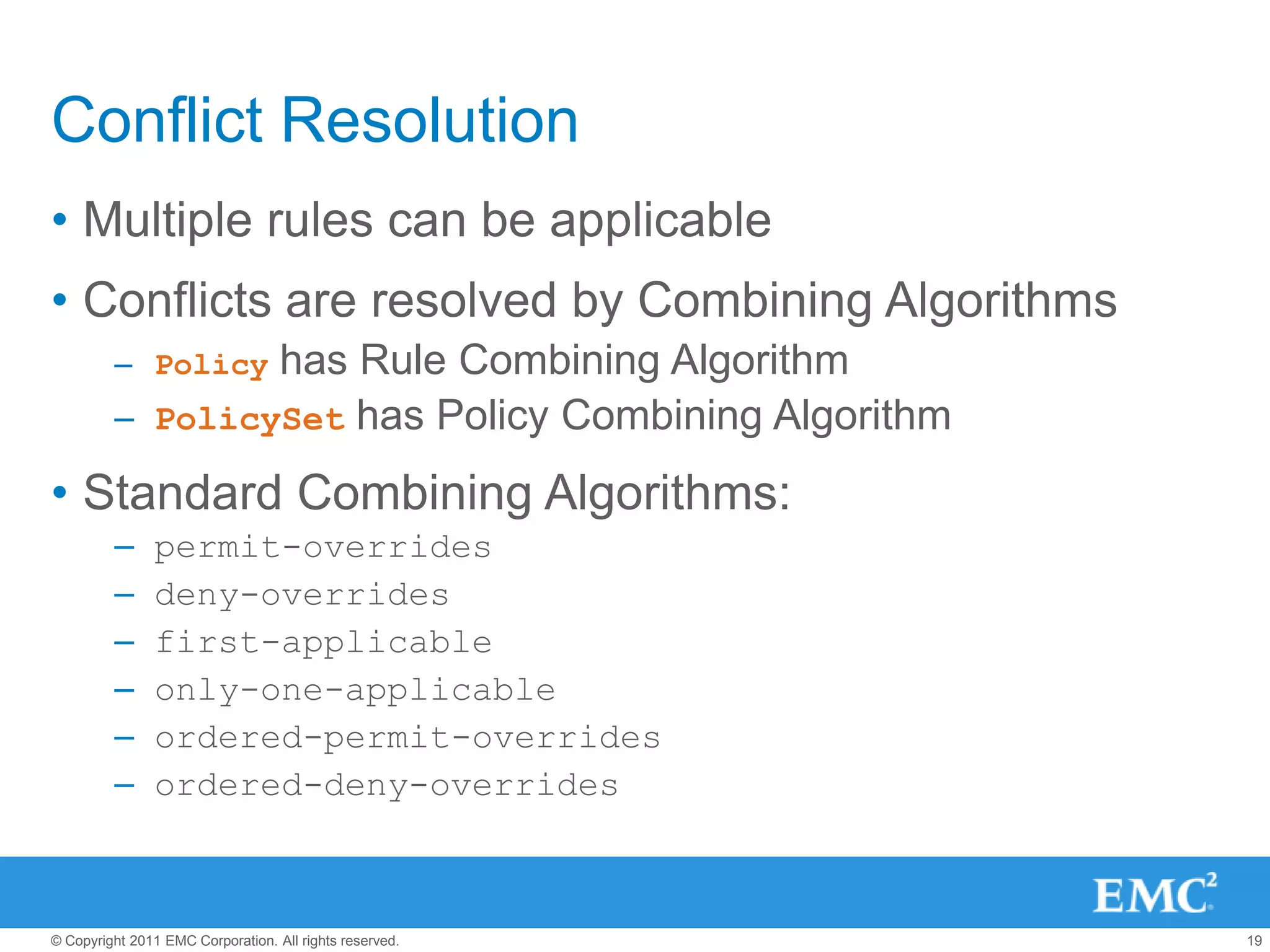
Conflict Resolution
• Multiple rules can be applicable
• Conflicts are resolved by Combining Algorithms
         – Policyhas Rule Combining Algorithm
         – PolicySet has Policy Combining Algorithm

• Standard Combining Algorithms:
         –      permit-overrides
         –      deny-overrides
         –      first-applicable
         –      only-one-applicable
         –      ordered-permit-overrides
         –      ordered-deny-overrides


© Copyright 2011 EMC Corporation. All rights reserved.   19
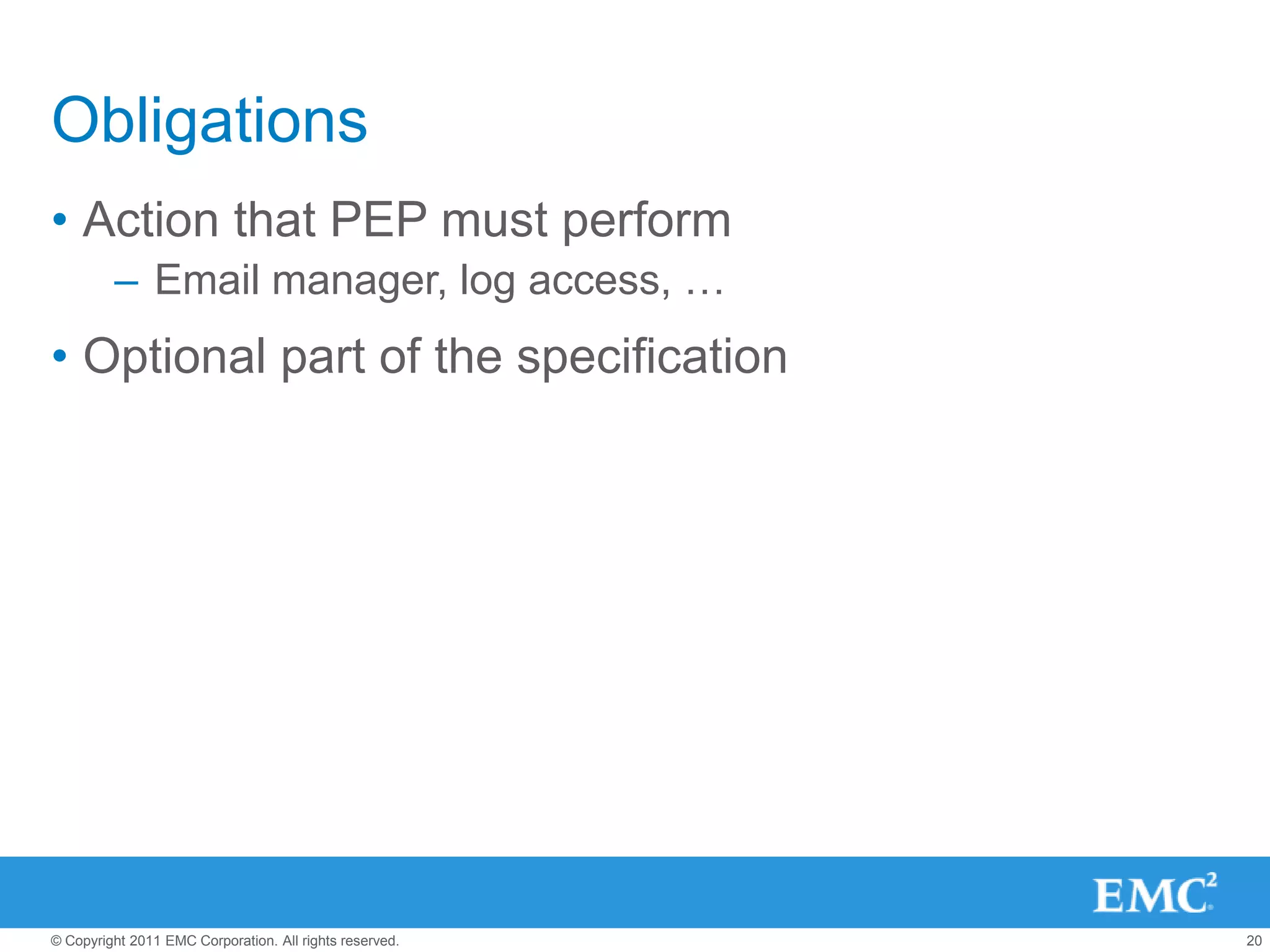
Obligations
• Action that PEP must perform
         – Email manager, log access, …
• Optional part of the specification


© Copyright 2011 EMC Corporation. All rights reserved.   20
X stands for eXtensible
• Custom attribute IDs
• Custom functions
• Custom data types
• Custom combining algorithms


© Copyright 2011 EMC Corporation. All rights reserved.   21
Optional Profiles
• RBAC
• Multiple Resource
• Hierarchical Resource
• Privacy
• SAML
• XML Digital Signature


© Copyright 2011 EMC Corporation. All rights reserved.   22
What’s new in 3.0
• Subject/Resource/Action/Environment generalized into attribute
    categories
• Advice (like obligation but optional)
• Obligations & advice can be dynamic
• More functions and combining algorithms (better handling of
  Indeterminate in CAs, new CAs)
• XPath improvements (XPath data type)
• Updated profiles
         – Multi: decision schemes
         – SAML :pass policies with request
• New profiles
         – Administration & Delegation (policies about who can change policies)
         – Export
         – Intellectual Property (in progress)


© Copyright 2011 EMC Corporation. All rights reserved.                            23
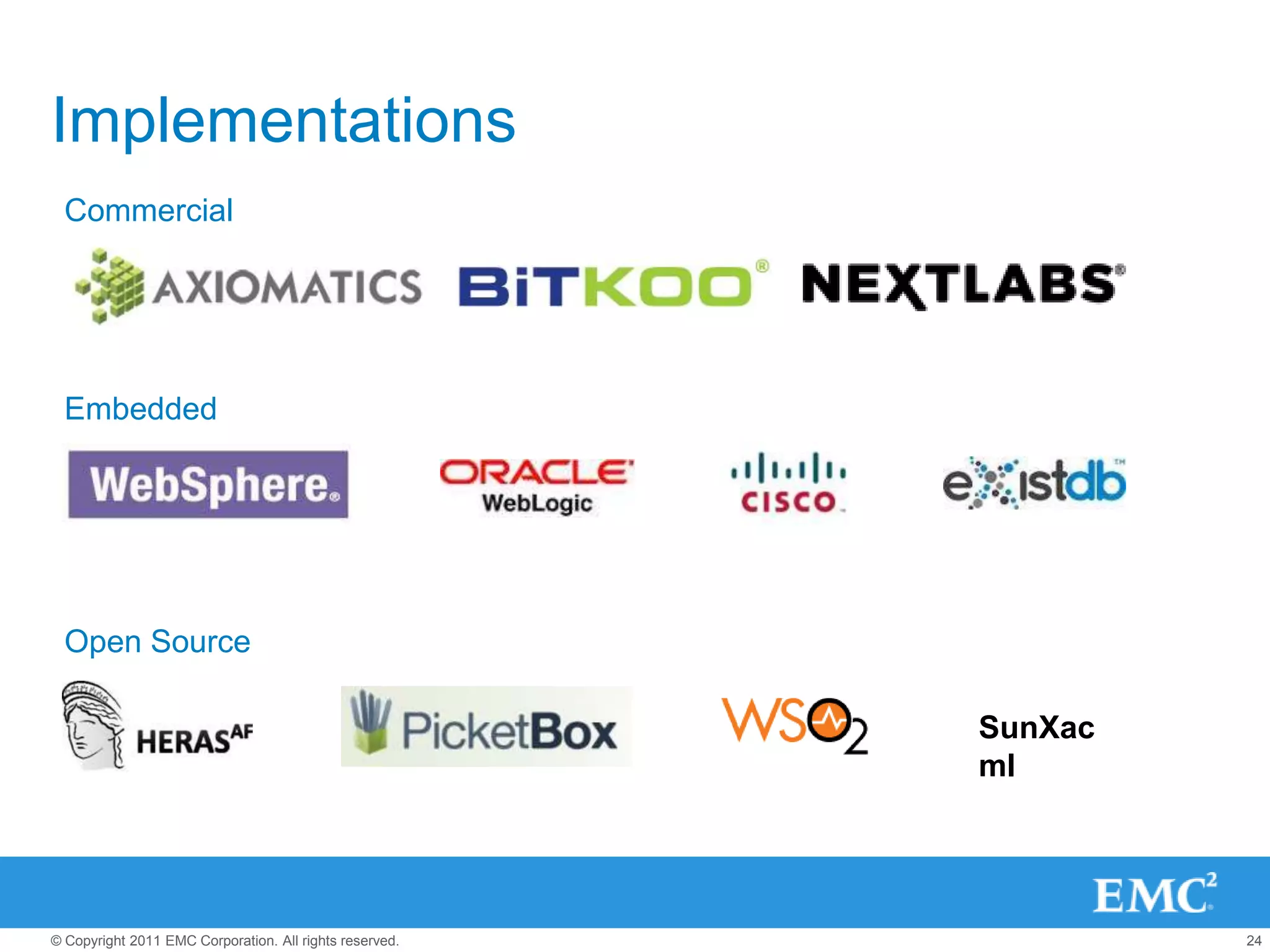
Implementations
  Commercial


  Embedded


  Open Source

                                                         SunXac
                                                         ml


© Copyright 2011 EMC Corporation. All rights reserved.            24
Q&A


                                                         sinnema313


© Copyright 2011 EMC Corporation. All rights reserved.                25
THANK YOU


© Copyright 2011 EMC Corporation. All rights reserved.   26

XACML - XML Amsterdam2011

  • 1.
    eXtensible Access Control Markup Language Rémon Sinnema – Consultant Software Engineer at EMC – Voting member of the XACML Technical Committee – sinnema313 © Copyright 2011 EMC Corporation. All rights reserved. 1
  • 2.
    Agenda • Access Control – Various models – How XACML fits in • XACML – Architecture – Request/Response Protocol – Policy Language – Optional Profiles – What’s new in 3.0 – Implementations © Copyright 2011 EMC Corporation. All rights reserved. 2
  • 3.
    Access Control © Copyright2011 EMC Corporation. All rights reserved. 3
  • 4.
    Access Control • Accesscontrol is the basis of Information Security: – Confidentiality: prevent disclosure to unauthorized agents – Integrity: prevent modification by unauthorized agents – Availability: keep unauthorized agents off the system • An access request occurs when – a given subject tries to access – a given resource to perform – a given action in – a given environment © Copyright 2011 EMC Corporation. All rights reserved. 4
  • 5.
    Access Control List(ACL) • (subject, resource, action, ?) – Subject is user or group – No environment – Hard to maintain when many users share privileges • Widely available, e.g. in operating systems © Copyright 2011 EMC Corporation. All rights reserved. 5
  • 6.
    Role-Based Access Control(RBAC) • (role, resource, action, ?) – Generalizes users into roles – Users can have many roles – Roles can be hierarchical • A manager is an employee – No environment – Not granular enough/role explosion • Commonly available, e.g. in databases © Copyright 2011 EMC Corporation. All rights reserved. 6
  • 7.
    Attribute-Based Access Control(ABAC) • (subject, resource, action, environment) – Generalizes everything into attributes – Adds environment attributes – Subject can be user, group, role, application, … – Subject can be described by more than one attribute • Matches the definition of identity: – “A person’s identity is built upon an incomplete set of attributes that we deem sufficient to differentiate one person from everyone else” Identity Management – A Primer, p. 9 • State of the art © Copyright 2011 EMC Corporation. All rights reserved. 7
  • 8.
    Policy-Based Access Control(PBAC) • (subject, resource, action, environment) – Harmonizes attributes across the (extended) organization • Coming soon… © Copyright 2011 EMC Corporation. All rights reserved. 8
  • 9.
    Risk-Adaptive Access Control(RAdAC) • (subject, resource, action, environment) – Dynamic risk levels as environment attributes – Threat level etc. from outside sources as well • Not anytime soon © Copyright 2011 EMC Corporation. All rights reserved. 9
  • 10.
    Evolution of AccessControl Models Trends: • Finer granularity • More policy-based over ad-hoc © Copyright 2011 EMC Corporation. All rights reserved. 10
  • 11.
    XACML supports allof ACL, RBAC, ABAC, PBAC, and RAdAC One technology for all your evolving access control needs! © Copyright 2011 EMC Corporation. All rights reserved. 11
  • 12.
    eXtensible Access Control Markup Language © Copyright 2011 EMC Corporation. All rights reserved. 12
  • 13.
    Architecture © Copyright 2011EMC Corporation. All rights reserved. 13
  • 14.
    Request <Request xmlns="urn:oasis:names:tc:xacml:2.0:context:schema:os" xmlns:xsi="http://www.w3.org/2001/XMLSchema-instance" xsi:schemaLocation="urn:oasis:names:tc:xacml:2.0:context:schema:os access_control-xacml-2.0-context-schema-os.xsd"> <Subject> <Attribute AttributeId="urn:oasis:names:tc:xacml:1.0:subject:subject-id" DataType="http://www.w3.org/2001/XMLSchema#string"> <AttributeValue>Julius Hibbert</AttributeValue> </Attribute> </Subject> <Resource> <Attribute AttributeId="urn:oasis:names:tc:xacml:1.0:resource:resource-id" DataType="http://www.w3.org/2001/XMLSchema#anyURI"> <AttributeValue>http://medico.com/record/patient/BartSimpson</AttributeValue> </Attribute> </Resource> <Action> <Attribute AttributeId="urn:oasis:names:tc:xacml:1.0:action:action-id" DataType="http://www.w3.org/2001/XMLSchema#string"> <AttributeValue>read</AttributeValue> </Attribute> </Action> <Environment /> </Request> © Copyright 2011 EMC Corporation. All rights reserved. 14
  • 15.
    Response <Response xmlns="urn:oasis:names:tc:xacml:2.0:context:schema:os" xmlns:xsi="http://www.w3.org/2001/XMLSchema-instance" xsi:schemaLocation="urn:oasis:names:tc:xacml:2.0:context:schema:os access_control-xacml-2.0-context-schema-os.xsd"> <Result> <Decision>Permit</Decision> <Status> <StatusCode Value="urn:oasis:names:tc:xacml:1.0:status:ok" /> </Status> </Result> </Response> © Copyright 2011 EMC Corporation. All rights reserved. 15
  • 16.
    Policy Language (1) •Hierarchical structure: PolicySet → Policy → Rule © Copyright 2011 EMC Corporation. All rights reserved. 16
  • 17.
    Policy Language (2) •Target filters applicable requests – In PolicySet, Policy, and Rule – Using attribute matching • Condition refines further – Powerful expression language <Condition> <Apply FunctionId="urn:oasis:names:tc:xacml:1.0:function:string-is-in"> <AttributeValue DataType="http://www.w3.org/2001/XMLSchema#string"> riddle me this </AttributeValue> <SubjectAttributeDesignator SubjectCategory= "urn:oasis:names:tc:xacml:1.0:subject-category:access-subject" AttributeId="urn:oasis:names:tc:xacml:2.0:conformance-test:some-attribute” MustBePresent="true" DataType="http://www.w3.org/2001/XMLSchema#string" /> </Apply> </Condition> © Copyright 2011 EMC Corporation. All rights reserved. 17
  • 18.
    Attribute Matching Effect <Rule RuleId=“…" Effect="Permit“> <Description>…</Description> <Target> Function <Subjects> <Subject> <SubjectMatch MatchId="urn:oasis:names:tc:xacml:2.0:function:string-equal"> <AttributeValue DataType="http://www.w3.org/2001/XMLSchema#string"> Robin Hood </AttributeValue> <SubjectAttributeDesignator DataType="http://www.w3.org/2001/XMLSchema#string"> urn:oasis:names:tc:xacml:1.0:subject:subject-id Attribute Value </SubjectAttributeDesignator> </SubjectMatch> </Subject> Attribute ID Data Type </Subjects> <Resources>…</Resources> <Actions>…</Actions> <Environments>…</Environments> </Target> <Condition>…</Condition> </Rule> © Copyright 2011 EMC Corporation. All rights reserved. 18
  • 19.
    Conflict Resolution • Multiplerules can be applicable • Conflicts are resolved by Combining Algorithms – Policyhas Rule Combining Algorithm – PolicySet has Policy Combining Algorithm • Standard Combining Algorithms: – permit-overrides – deny-overrides – first-applicable – only-one-applicable – ordered-permit-overrides – ordered-deny-overrides © Copyright 2011 EMC Corporation. All rights reserved. 19
  • 20.
    Obligations • Action thatPEP must perform – Email manager, log access, … • Optional part of the specification © Copyright 2011 EMC Corporation. All rights reserved. 20
  • 21.
    X stands foreXtensible • Custom attribute IDs • Custom functions • Custom data types • Custom combining algorithms © Copyright 2011 EMC Corporation. All rights reserved. 21
  • 22.
    Optional Profiles • RBAC •Multiple Resource • Hierarchical Resource • Privacy • SAML • XML Digital Signature © Copyright 2011 EMC Corporation. All rights reserved. 22
  • 23.
    What’s new in3.0 • Subject/Resource/Action/Environment generalized into attribute categories • Advice (like obligation but optional) • Obligations & advice can be dynamic • More functions and combining algorithms (better handling of Indeterminate in CAs, new CAs) • XPath improvements (XPath data type) • Updated profiles – Multi: decision schemes – SAML :pass policies with request • New profiles – Administration & Delegation (policies about who can change policies) – Export – Intellectual Property (in progress) © Copyright 2011 EMC Corporation. All rights reserved. 23
  • 24.
    Implementations Commercial Embedded Open Source SunXac ml © Copyright 2011 EMC Corporation. All rights reserved. 24
  • 25.
    Q&A sinnema313 © Copyright 2011 EMC Corporation. All rights reserved. 25
  • 26.
    THANK YOU © Copyright2011 EMC Corporation. All rights reserved. 26

Editor's Notes

  • #11 Access Control List focuses on ResourceRole-Based Access Control generalizes SubjectAttribute-Based Access Control generalizes all attributesPolicy-Based Access Control standardizes attributesRisk-Adaptive Access Control