Collaborat e  between Australian and Japanese students  to understand the cultural differences through their work and communication  Use of the ICTs and international group work may lead all students to be highly motivated in their learning Encouraging young Australian and Japanese to keep good relationships
Other purposes Encourage learning with peers to establish the sense of learning climate and empathy between them Teach each other in order to have accurate and precise knowledge into learning themselves Marzano & Pickering,1997
Audience and background Learning Outcomes Lesson plan  (Authentic scenario authentic products) - tasks, assessments, resources Links to engagement theory Summary
Audience:   - Year 10 (Australian students)  - Grade 1 (Japanese high school students) Background [Their learning style] <OZ students> -   Visual learner - Active learner : related to Australian custom & education system (eg. Habits of Mind: Quarry, discussion >> talk in order to solve problems <Jap students> - Visual learner - Passive learner: related to Japanese custom & education system (eg. Habits of Mind: Listen to others, take notes) >> focus individual study (research analyse in order to solve  problems, >> shy to discuss in front of people Marzano & Peckering, 1997
Audience  cont. [Their learning: multiple intelligence ] - Both Australian(OZ) students and Japanese  (Jap) students  completed same area at Maths.  <OZ students> - Students have been learning Japanese since they are primary  students <Jap students> - Students have been learning English since they are junior high  school students (Y7 in Australia)
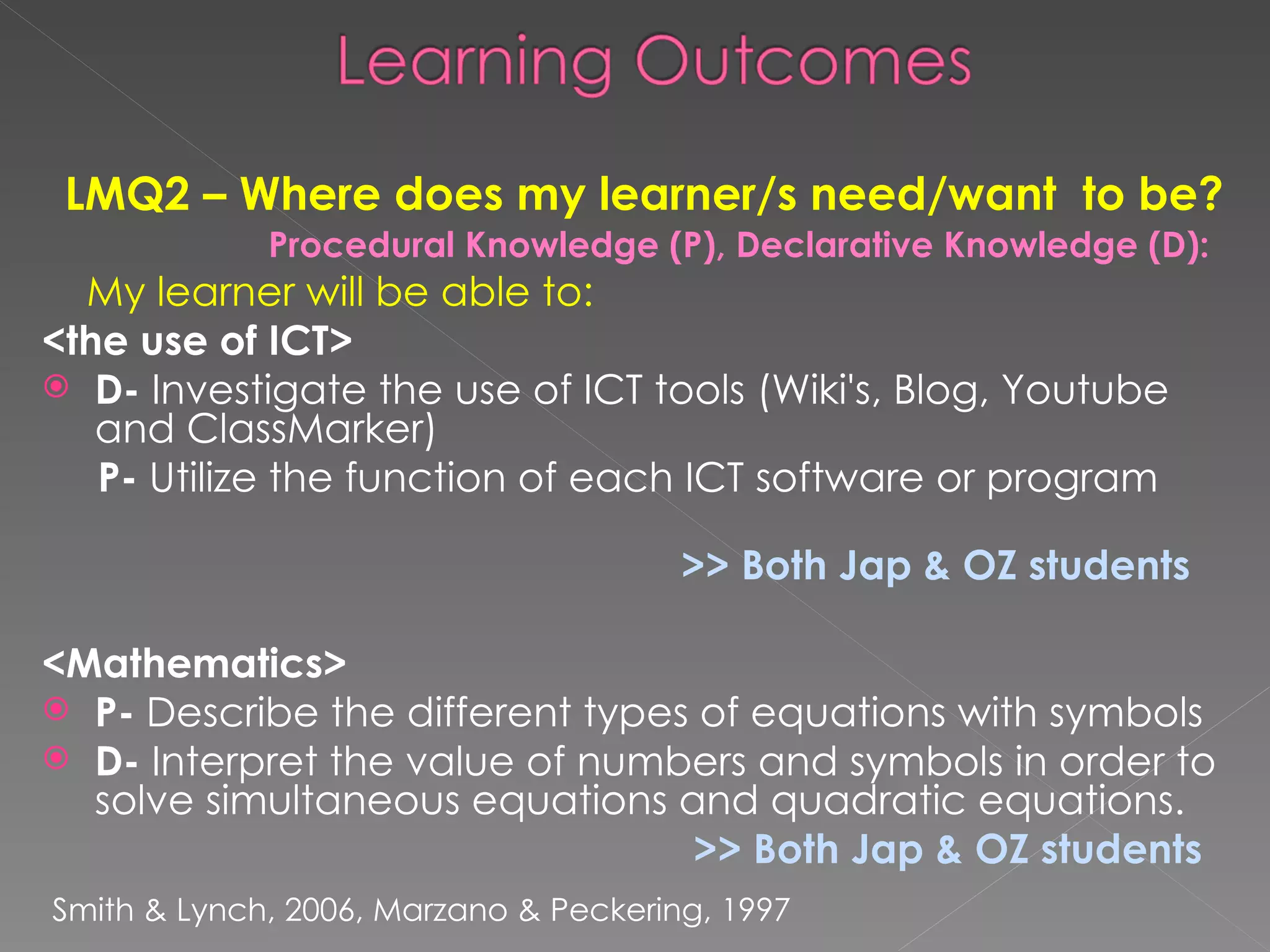
LMQ2 – Where does my learner/s need/want  to be? Procedural Knowledge (P), Declarative Knowledge (D): My learner will be able to:  <the use of ICT>   D-  Investigate the use of ICT tools (Wiki's, Blog, Youtube and ClassMarker) P -   Utilize the function of each ICT software or program  >> Both Jap & OZ students   <Mathematics> P-  Describe the different types of equations with symbols  D-  Interpret the value of numbers and symbols in order to solve simultaneous equations and quadratic equations.  >> Both Jap & OZ students Smith & Lynch, 2006, Marzano & Peckering, 1997
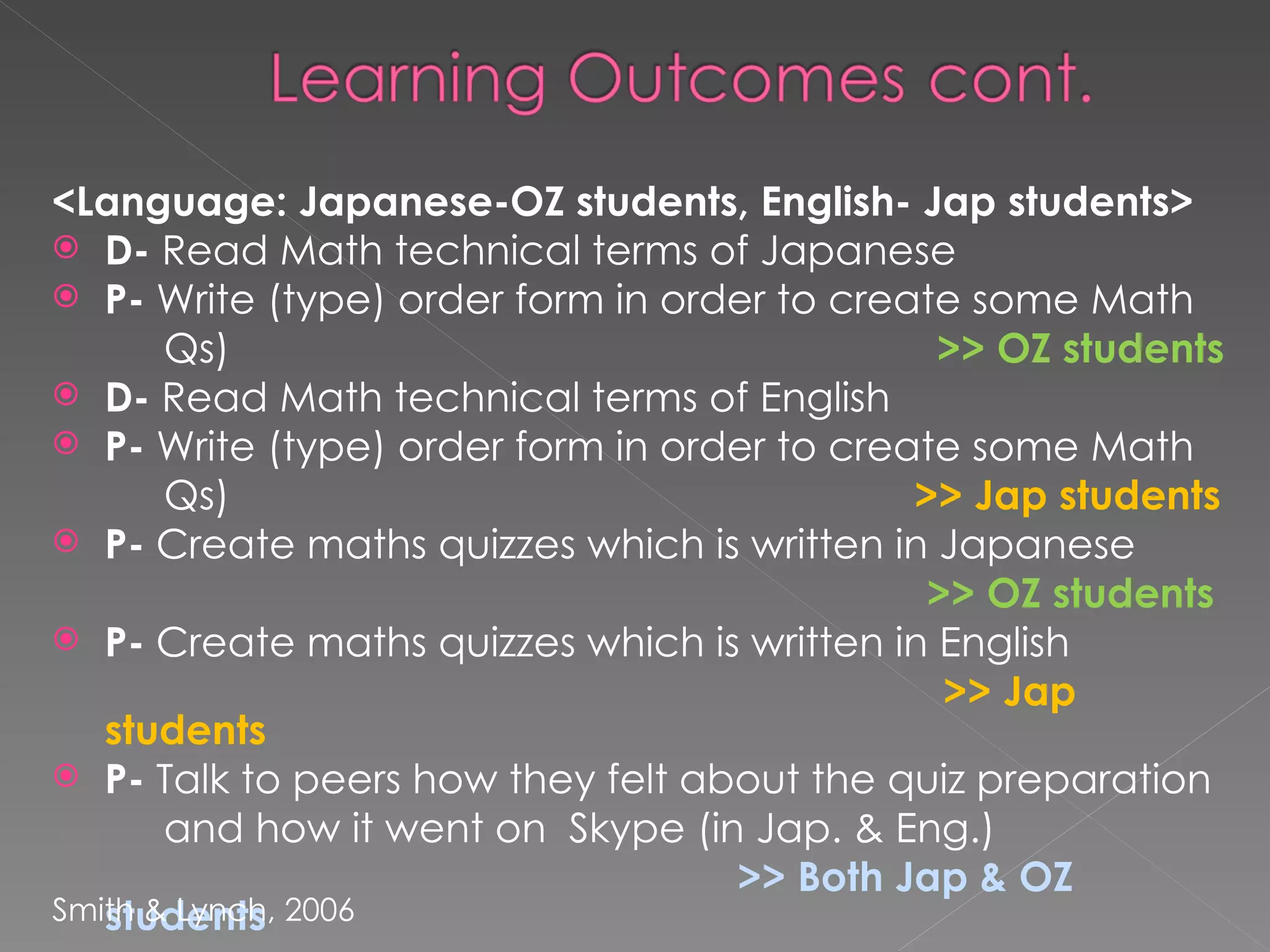
<Language: Japanese-OZ students, English- Jap students> D-  Read Math technical terms of Japanese  P-  Write (type) order form in order to create some Math  Qs)  >> OZ students D-  Read Math technical terms of English  P-  Write (type) order form in order to create some Math  Qs)  >> Jap students P-  Create maths quizzes which is written in Japanese >> OZ students P-  Create maths quizzes which is written in English  >> Jap students  P-  Talk to peers how they felt about the quiz preparation  and how it went on  Skype (in Jap. & Eng.)  >> Both Jap & OZ students Smith & Lynch, 2006
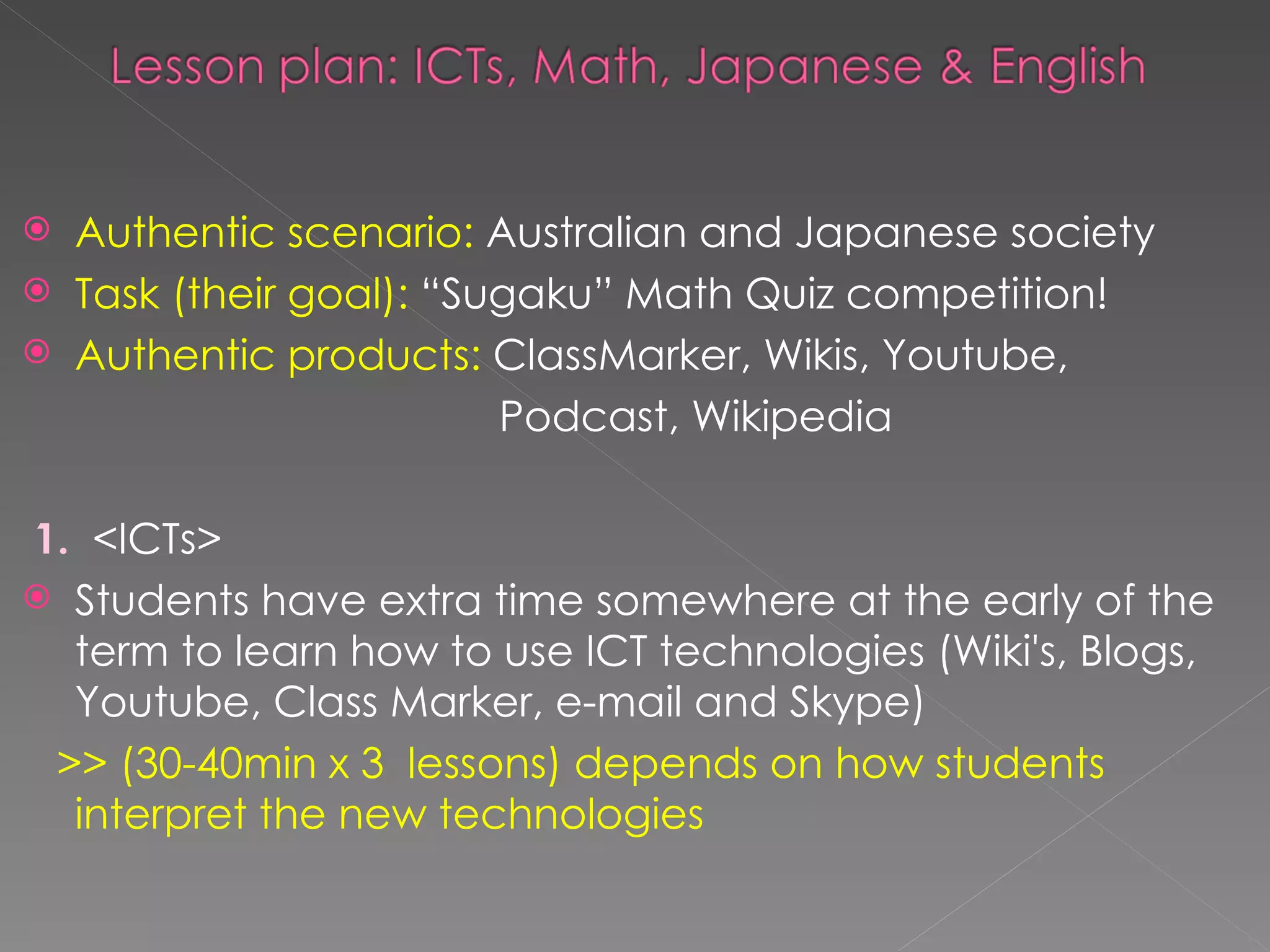
Authentic scenario:  Australian and Japanese society Task (their goal):  “Sugaku” Math Quiz competition! Authentic products:  ClassMarker, Wikis, Youtube,  Podcast, Wikipedia 1.   <ICTs> Students have extra time somewhere at the early of the term to learn how to use ICT technologies (Wiki's, Blogs, Youtube, Class Marker, e-mail and Skype)  >> (30-40min x 3  lessons) depends on how students interpret the new technologies
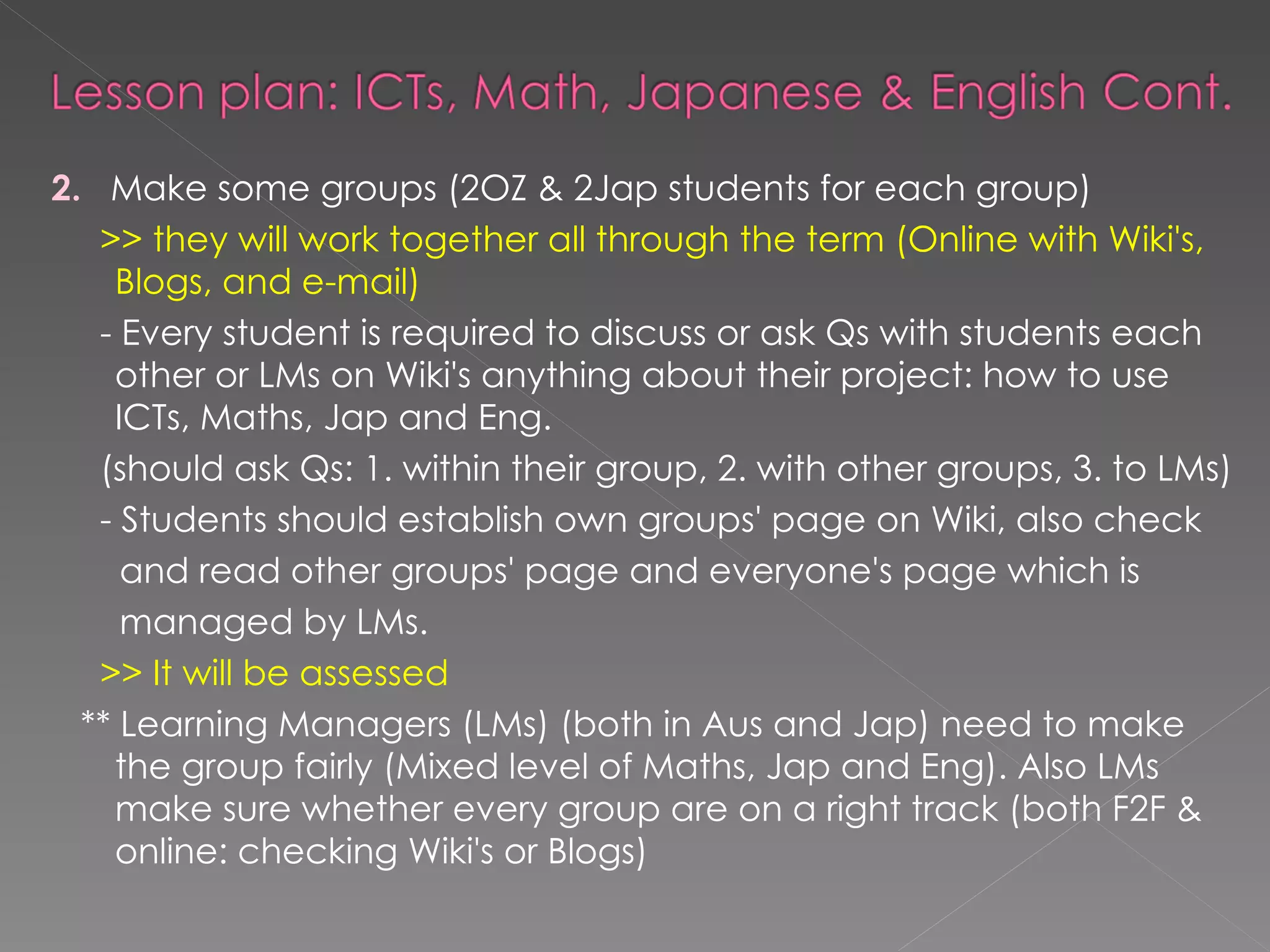
2.   Make some groups (2OZ & 2Jap students for each group) >> they will work together all through the term (Online with Wiki's, Blogs, and e-mail)  - Every student is required to discuss or ask Qs with students each other or LMs on Wiki's anything about their project: how to use ICTs, Maths, Jap and Eng.  (should ask Qs: 1. within their group, 2. with other groups, 3. to LMs) - Students should establish own groups' page on Wiki, also check  and read other groups' page and everyone's page which is  managed by LMs. >> It will be assessed ** Learning Managers (LMs) (both in Aus and Jap) need to make the group fairly (Mixed level of Maths, Jap and Eng). Also LMs make sure whether every group are on a right track (both F2F & online: checking Wiki's or Blogs)
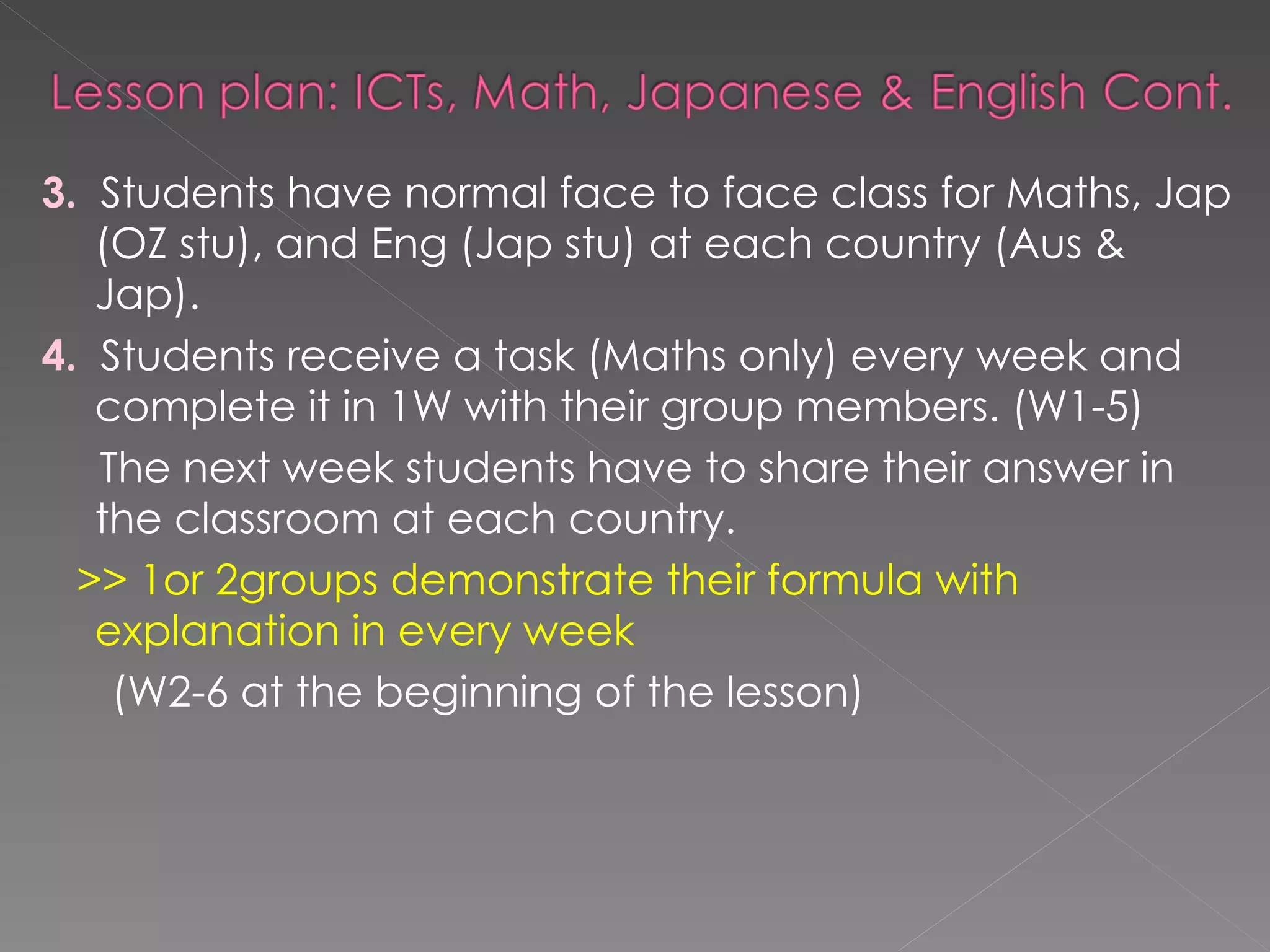
3.   Students have normal face to face class for Maths, Jap (OZ stu), and Eng (Jap stu) at each country (Aus & Jap).  4.   Students receive a task (Maths only) every week and complete it in 1W with their group members. (W1-5) The next week students have to share their answer in the classroom at each country.  >> 1or 2groups demonstrate their formula with explanation in every week   (W2-6 at the beginning of the lesson)
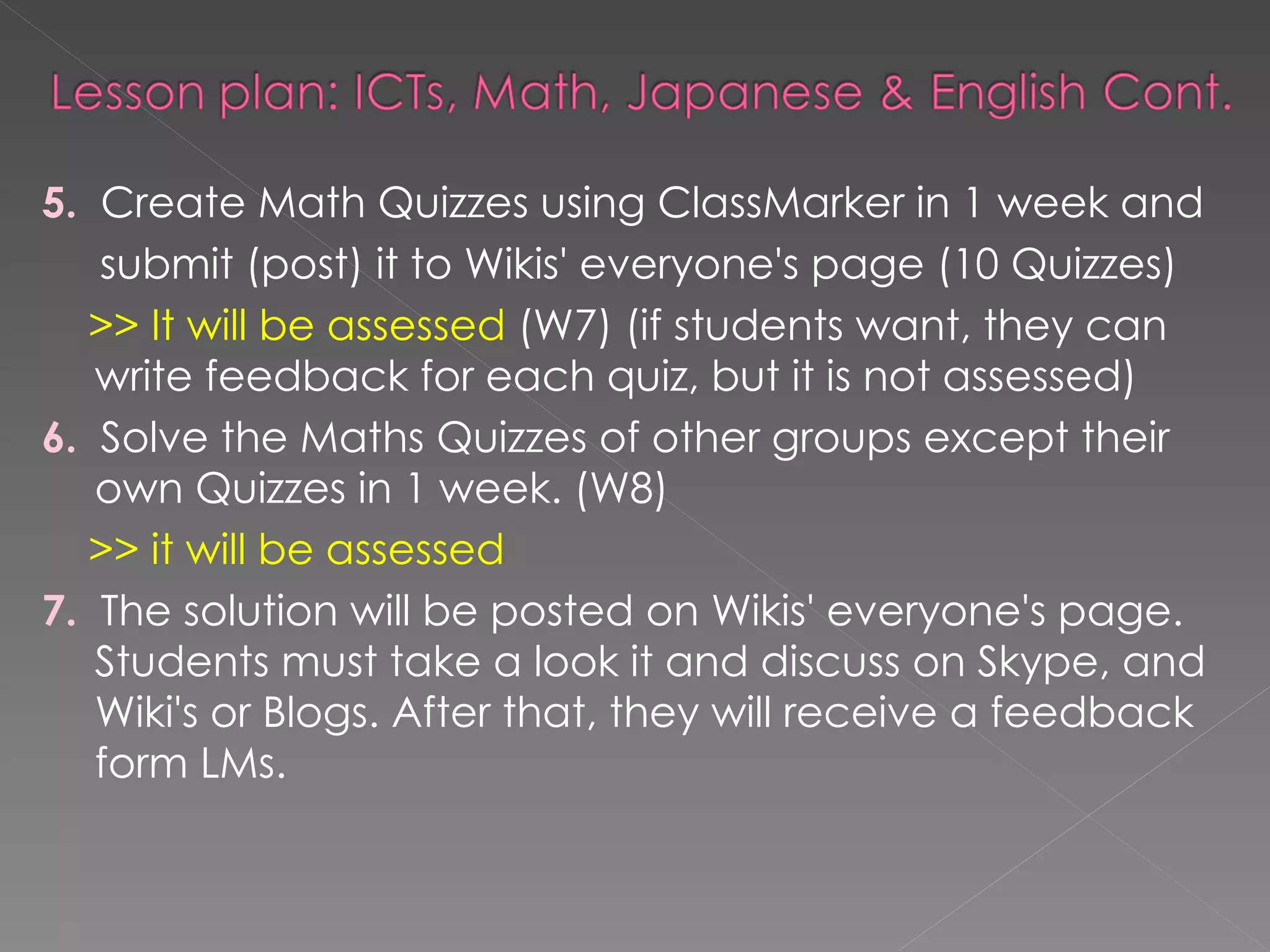
5.   Create Math Quizzes using ClassMarker in 1 week and  submit (post) it to Wikis' everyone's page (10 Quizzes) >> It will be assessed  (W7) (if students want, they can write feedback for each quiz, but it is not assessed) 6.   Solve the Maths Quizzes of other groups except their own Quizzes in 1 week. (W8)  >> it will be assessed 7.   The solution will be posted on Wikis' everyone's page. Students must take a look it and discuss on Skype, and Wiki's or Blogs. After that, they will receive a feedback form LMs.
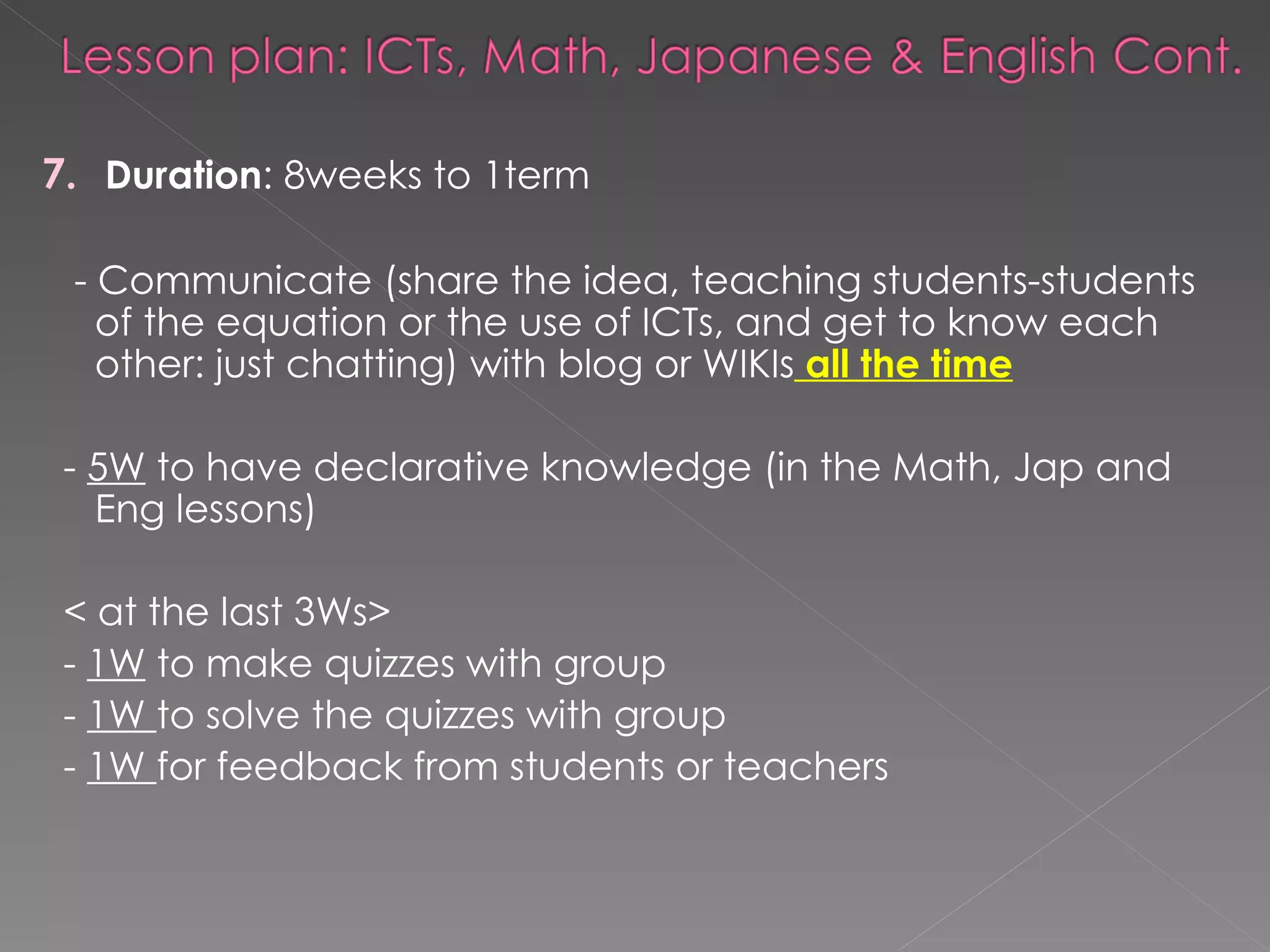
7.   Duration : 8weeks to 1term  - Communicate (share the idea, teaching students-students of the equation or the   use of ICTs, and get to know each other: just chatting) with blog or WIKIs   all the time -  5W  to have declarative knowledge (in the Math, Jap and Eng lessons) < at the last 3Ws> -  1W  to make quizzes with group  -  1W  to solve the quizzes with group  -  1W  for feedback from students or teachers
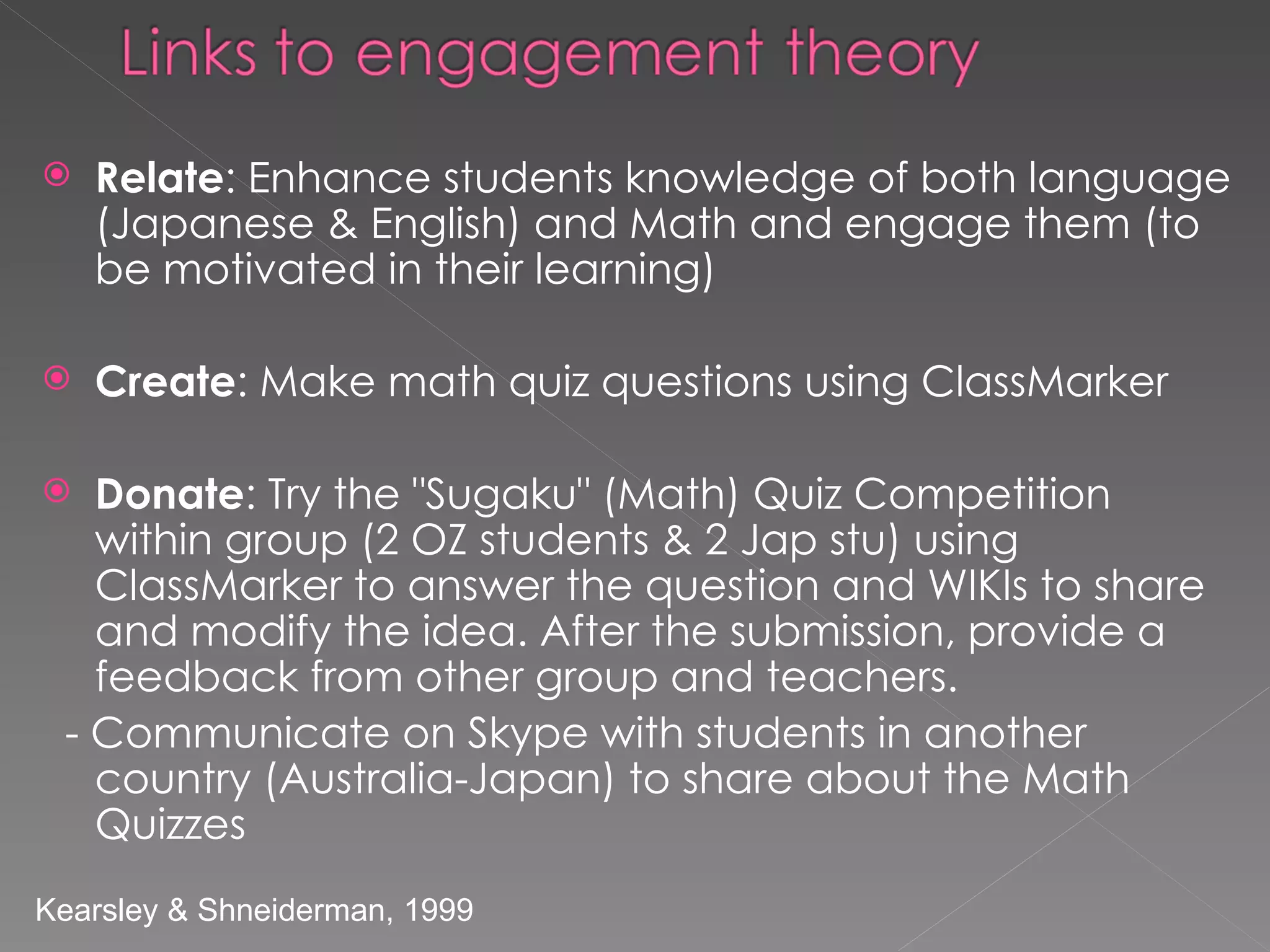
Relate : Enhance students knowledge of both language (Japanese & English) and Math and engage them (to be motivated in their learning) Create : Make math quiz questions using ClassMarker  Donate : Try the &quot;Sugaku&quot; (Math) Quiz Competition within group (2 OZ students & 2 Jap stu)   using ClassMarker to answer the question and WIKIs to share and modify the idea. After the submission, provide a feedback from other group and teachers.  - Communicate on Skype with students in another country (Australia-Japan) to share about the Math Quizzes Kearsley & Shneiderman, 1999
Authentic scenario :  Related to real life Australian and Japanese society Authentic products :   Make human interaction  (Collaboration ) ClassMarker, Wikis, Youtube, Podcast, Wikipedia Links to engagement theory : ~  Collaborative learning is  creative, meaningful and authentic  ~
Kearsley, G. & Shneiderman, B. (1999).  Engagement Theory: A framework for technology-based teaching and learning . Retrieved  August 1,  2009, from http://home.sprynet.com/~gkearsley/engage.htm   Marzano, R., & Pickering, D. (1997).  Dimensions of learning (2 nd  ed).  Aurora, Colorado, the USA: McREL. Smith, R., Lynch, D., & Knight, B. (2003).  LearningManagement: Transitioning teachers for national  and international change . Frenches Forest, NSW, Australia: Pearson Education  Australia.

My Learning Design

  • 1.
  • 2.
    Collaborat e between Australian and Japanese students to understand the cultural differences through their work and communication Use of the ICTs and international group work may lead all students to be highly motivated in their learning Encouraging young Australian and Japanese to keep good relationships
  • 3.
    Other purposes Encouragelearning with peers to establish the sense of learning climate and empathy between them Teach each other in order to have accurate and precise knowledge into learning themselves Marzano & Pickering,1997
  • 4.
    Audience and backgroundLearning Outcomes Lesson plan (Authentic scenario authentic products) - tasks, assessments, resources Links to engagement theory Summary
  • 5.
    Audience: - Year 10 (Australian students) - Grade 1 (Japanese high school students) Background [Their learning style] <OZ students> - Visual learner - Active learner : related to Australian custom & education system (eg. Habits of Mind: Quarry, discussion >> talk in order to solve problems <Jap students> - Visual learner - Passive learner: related to Japanese custom & education system (eg. Habits of Mind: Listen to others, take notes) >> focus individual study (research analyse in order to solve problems, >> shy to discuss in front of people Marzano & Peckering, 1997
  • 6.
    Audience cont.[Their learning: multiple intelligence ] - Both Australian(OZ) students and Japanese (Jap) students completed same area at Maths. <OZ students> - Students have been learning Japanese since they are primary students <Jap students> - Students have been learning English since they are junior high school students (Y7 in Australia)
  • 7.
    LMQ2 – Wheredoes my learner/s need/want to be? Procedural Knowledge (P), Declarative Knowledge (D): My learner will be able to: <the use of ICT> D- Investigate the use of ICT tools (Wiki's, Blog, Youtube and ClassMarker) P - Utilize the function of each ICT software or program >> Both Jap & OZ students <Mathematics> P- Describe the different types of equations with symbols D- Interpret the value of numbers and symbols in order to solve simultaneous equations and quadratic equations. >> Both Jap & OZ students Smith & Lynch, 2006, Marzano & Peckering, 1997
  • 8.
    <Language: Japanese-OZ students,English- Jap students> D- Read Math technical terms of Japanese P- Write (type) order form in order to create some Math Qs) >> OZ students D- Read Math technical terms of English P- Write (type) order form in order to create some Math Qs) >> Jap students P- Create maths quizzes which is written in Japanese >> OZ students P- Create maths quizzes which is written in English >> Jap students P- Talk to peers how they felt about the quiz preparation and how it went on Skype (in Jap. & Eng.) >> Both Jap & OZ students Smith & Lynch, 2006
  • 9.
    Authentic scenario: Australian and Japanese society Task (their goal): “Sugaku” Math Quiz competition! Authentic products: ClassMarker, Wikis, Youtube, Podcast, Wikipedia 1. <ICTs> Students have extra time somewhere at the early of the term to learn how to use ICT technologies (Wiki's, Blogs, Youtube, Class Marker, e-mail and Skype) >> (30-40min x 3 lessons) depends on how students interpret the new technologies
  • 10.
    2. Make some groups (2OZ & 2Jap students for each group) >> they will work together all through the term (Online with Wiki's, Blogs, and e-mail) - Every student is required to discuss or ask Qs with students each other or LMs on Wiki's anything about their project: how to use ICTs, Maths, Jap and Eng. (should ask Qs: 1. within their group, 2. with other groups, 3. to LMs) - Students should establish own groups' page on Wiki, also check and read other groups' page and everyone's page which is managed by LMs. >> It will be assessed ** Learning Managers (LMs) (both in Aus and Jap) need to make the group fairly (Mixed level of Maths, Jap and Eng). Also LMs make sure whether every group are on a right track (both F2F & online: checking Wiki's or Blogs)
  • 11.
    3. Students have normal face to face class for Maths, Jap (OZ stu), and Eng (Jap stu) at each country (Aus & Jap). 4. Students receive a task (Maths only) every week and complete it in 1W with their group members. (W1-5) The next week students have to share their answer in the classroom at each country. >> 1or 2groups demonstrate their formula with explanation in every week (W2-6 at the beginning of the lesson)
  • 12.
    5. Create Math Quizzes using ClassMarker in 1 week and submit (post) it to Wikis' everyone's page (10 Quizzes) >> It will be assessed (W7) (if students want, they can write feedback for each quiz, but it is not assessed) 6. Solve the Maths Quizzes of other groups except their own Quizzes in 1 week. (W8) >> it will be assessed 7. The solution will be posted on Wikis' everyone's page. Students must take a look it and discuss on Skype, and Wiki's or Blogs. After that, they will receive a feedback form LMs.
  • 13.
    7. Duration : 8weeks to 1term - Communicate (share the idea, teaching students-students of the equation or the use of ICTs, and get to know each other: just chatting) with blog or WIKIs all the time - 5W to have declarative knowledge (in the Math, Jap and Eng lessons) < at the last 3Ws> - 1W to make quizzes with group - 1W to solve the quizzes with group - 1W for feedback from students or teachers
  • 14.
    Relate : Enhancestudents knowledge of both language (Japanese & English) and Math and engage them (to be motivated in their learning) Create : Make math quiz questions using ClassMarker Donate : Try the &quot;Sugaku&quot; (Math) Quiz Competition within group (2 OZ students & 2 Jap stu) using ClassMarker to answer the question and WIKIs to share and modify the idea. After the submission, provide a feedback from other group and teachers. - Communicate on Skype with students in another country (Australia-Japan) to share about the Math Quizzes Kearsley & Shneiderman, 1999
  • 15.
    Authentic scenario : Related to real life Australian and Japanese society Authentic products : Make human interaction (Collaboration ) ClassMarker, Wikis, Youtube, Podcast, Wikipedia Links to engagement theory : ~ Collaborative learning is creative, meaningful and authentic ~
  • 16.
    Kearsley, G. &Shneiderman, B. (1999). Engagement Theory: A framework for technology-based teaching and learning . Retrieved August 1, 2009, from http://home.sprynet.com/~gkearsley/engage.htm Marzano, R., & Pickering, D. (1997). Dimensions of learning (2 nd ed). Aurora, Colorado, the USA: McREL. Smith, R., Lynch, D., & Knight, B. (2003). LearningManagement: Transitioning teachers for national and international change . Frenches Forest, NSW, Australia: Pearson Education Australia.