MOBILE VIDEO AUGMENTED REALITY FOR SPATIAL NAVIGATION Digital Media Design Final Year Project Sharon Brosnan – 0651869 sharonbrosnandmd.blogspot.com
OVERVIEW Specification, design and prototype development of an Augmented Reality (AR) interface for mobile phones to aid navigation of Bunratty Folk Park Visitor Support for the centre Tool: Augmented Reality toolkit ported to a smartphone Further research of bigger project in the IDC
AUGMENTED REALITY Puts layers of virtual/digital information to a persons physical environment (live video) in real time Digital information and communication capabilities Enhance the persons experience Powerful user interface On Smartphone Platform Uses global tracking, wireless communications, location based computing, cameras and mobile computing
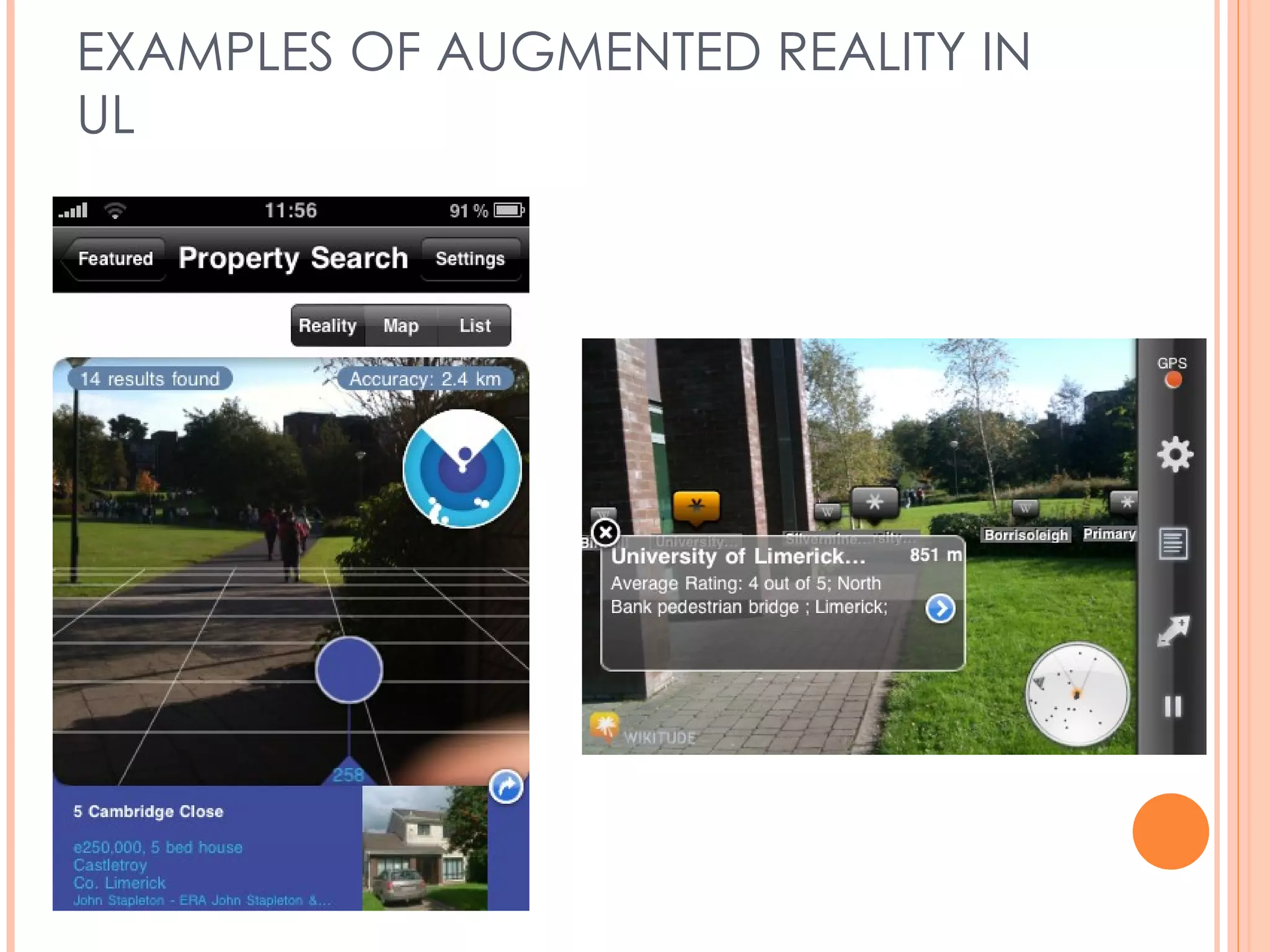
EXAMPLES OF AUGMENTED REALITY IN UL Wikitude Layar
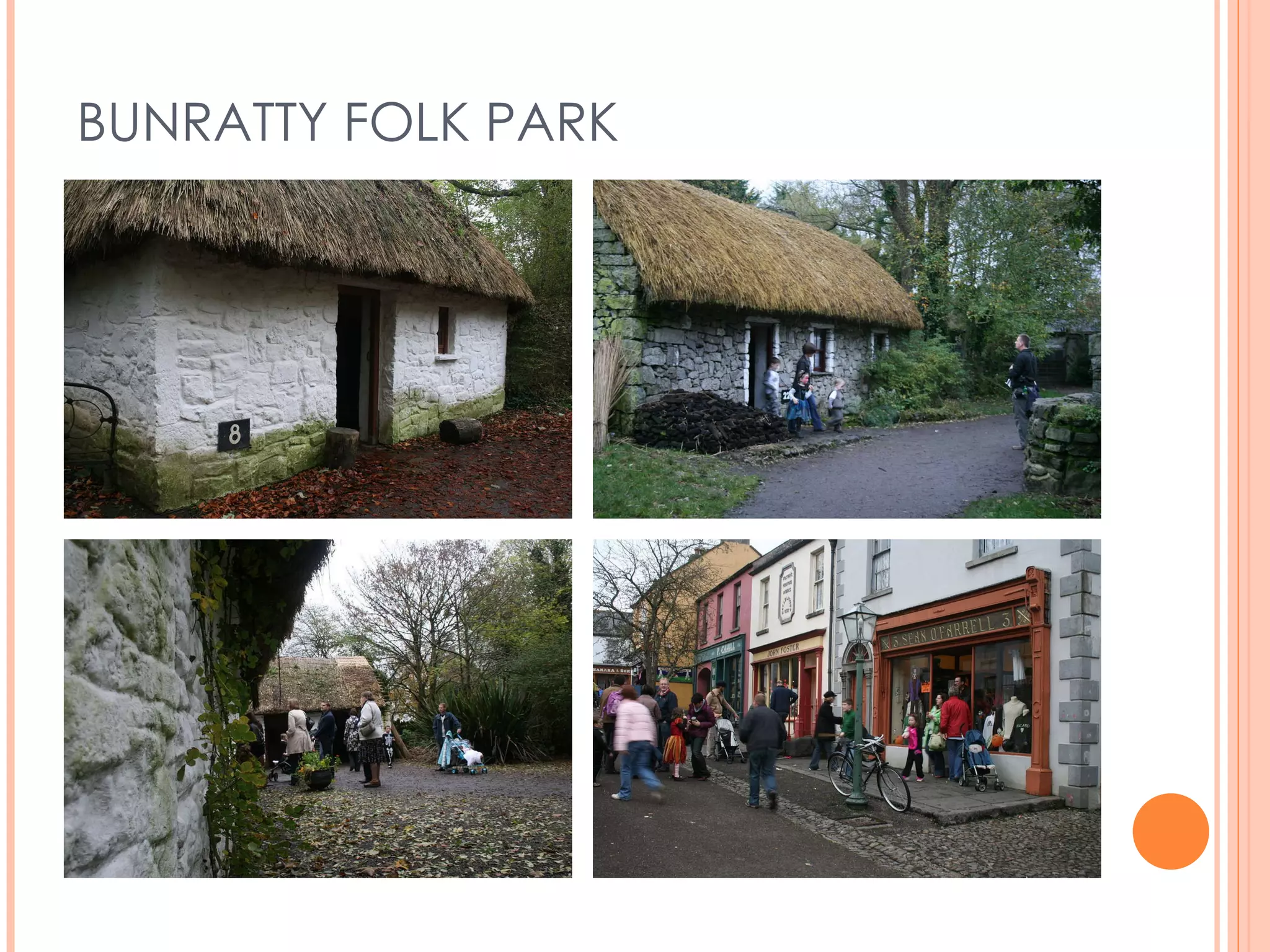
BUNRATTY FOLK PARK Detailed and customisable experience, introducing ICT assist to visitors Interact in a natural way with enhanced capabilities maintaining character of folk park Enhance visitor satisfaction Usability Experience Engagement Visitor can shape their own experience On demand information
‘ ENHANCING THE VISITOR EXPERIENCE AT VISITOR ATTRACTIONS THROUGH THE ADOPTION OF INFORMATION & COMMUNICATION TECHNOLOGY’
RESEARCH Papers Websites Similar Projects
‘ MOBILE AUGMENTED REALITY’  Context Aware computing environments In tourism Find destinations, display information 3D models of related information to a place/object Wide range of possibilities Components Needed, Displays, Usage, Wireless Network Issues Challenges Making visuals informative and realistic Computing Platforms (Holler and Feiner, 2004)
‘ LOCATION AWARE MOBILE INTERACTIVE GUIDES: USABILITY ISSUES’
‘ CONTEXT-AWARENESS IN MOBILE TOURIST INFORMATION SYSTEMS: CHALLENGES FOR USER INTERACTION’ Discusses mobile tourist information systems, and how to model, observe, and evaluate application area Context Aware Device Challenges Characteristics of mobile device - storage and screen size Network - bandwidth and peers Application - requirements in storage, download capabilities and display capabilities User - time, location Information objects – location Interaction HCI Consistency (Hinze and Buchanan, 2005)
BUNRATTY FOLK PARK
FUTURE READINGS Open Air Museums Mobile Tours Augmented Reality in Tourism ARToolKit tutorials Designing Interactive Systems Human Computer Interaction Design of Handheld Devices
PLAN OF ACTION Research in to more papers Develop research Organise several trips to Bunratty Folk Park Design workshops Interaction Groups Iterative Design Process Concept design generation Design scenario Storyboards
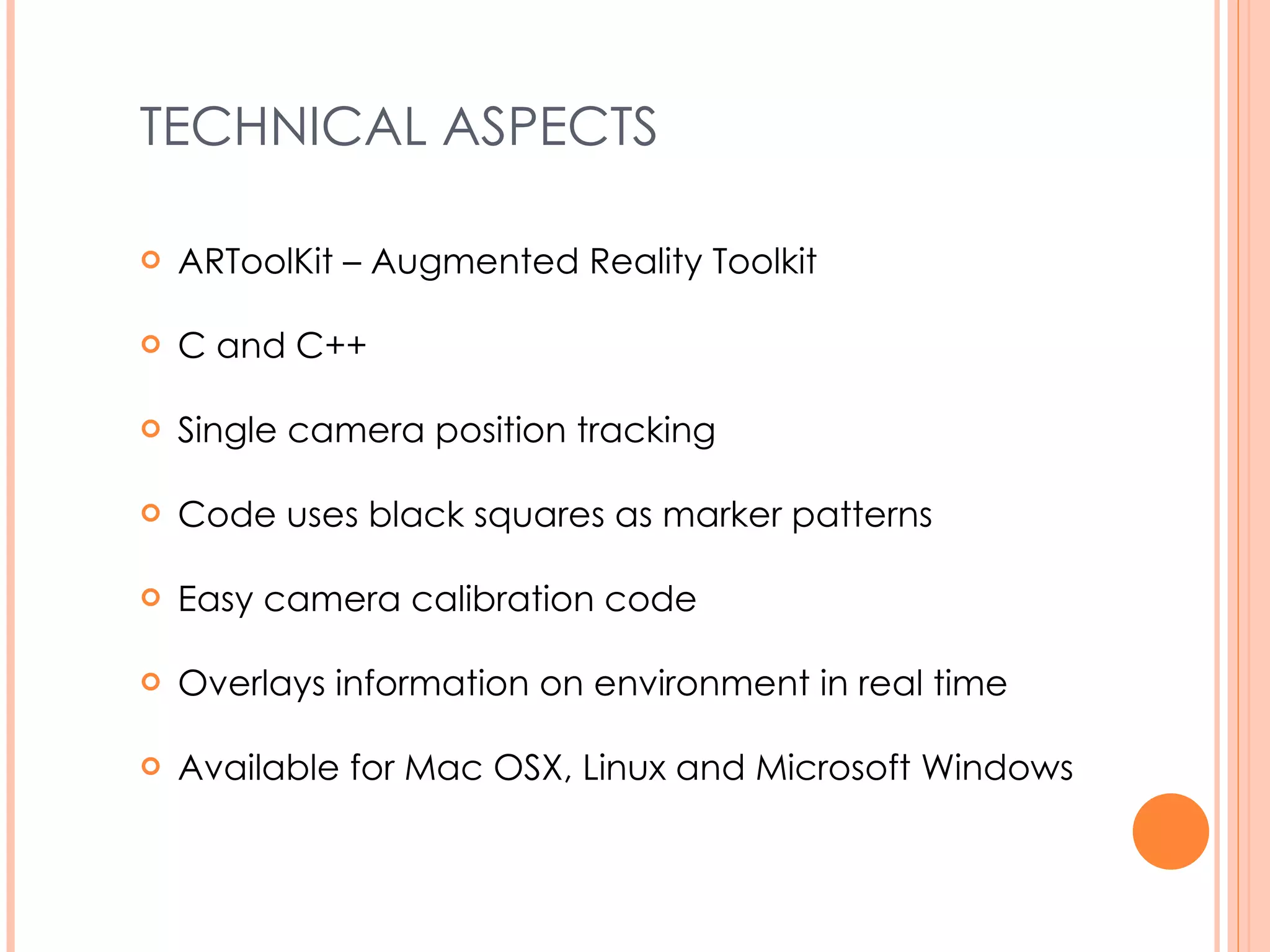
TECHNICAL ASPECTS ARToolKit – Augmented Reality Toolkit C and C++ Single camera position tracking Code uses black squares as marker patterns Easy camera calibration code Overlays information on environment in real time Available for Mac OSX, Linux and Microsoft Windows
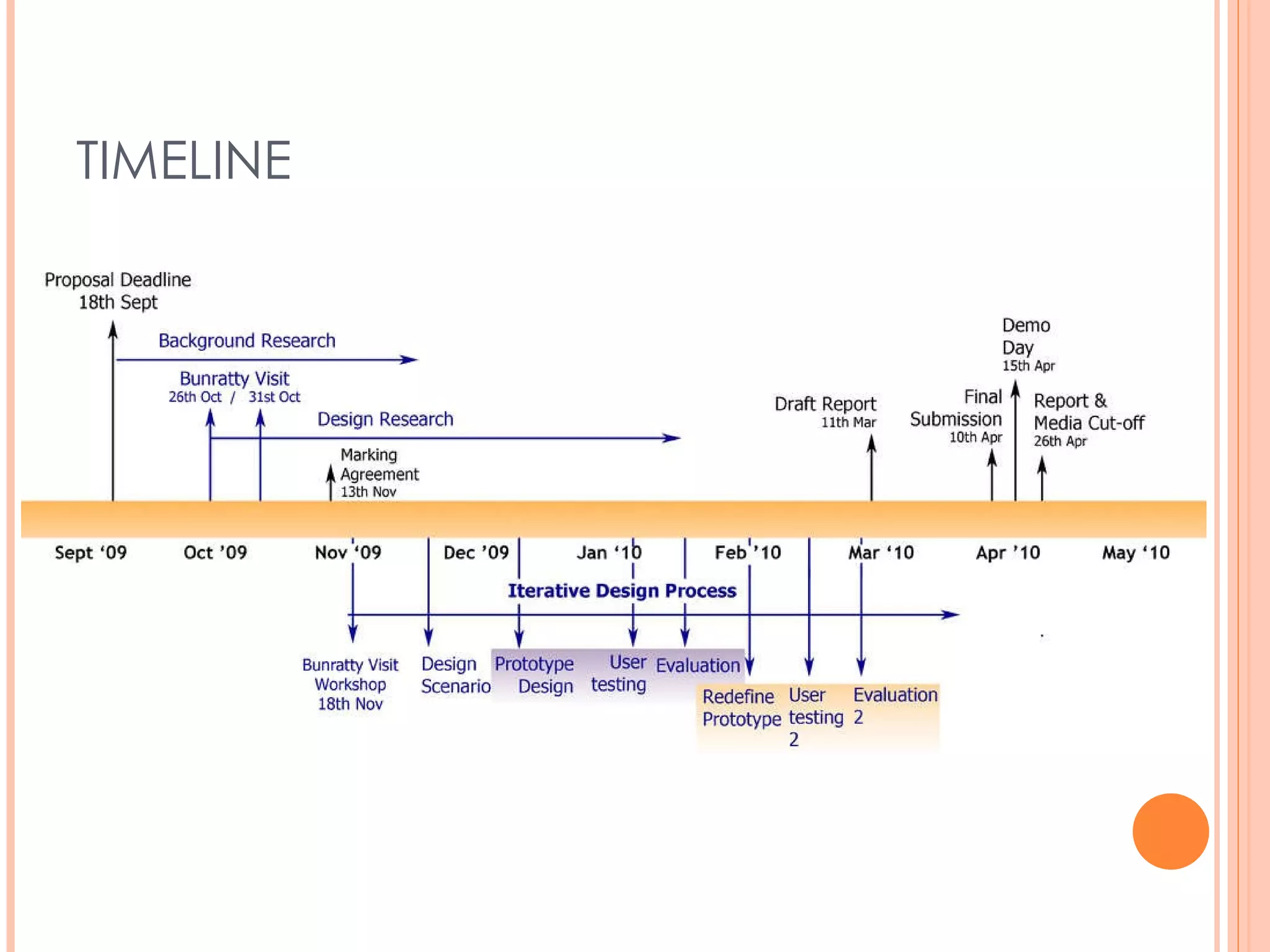
TIMELINE
THE WORLD BECOMES A USER INTERFACE.   (Holler and Feiner, 2004)
REFERENCES Abowd, G.D., Atkekson, C.G., Hong, J., Long, S., Kooper, R., and Pinkerton, M. (1997) ‘ Cyberguide: A Mobile Context Aware Tour’,  Science Publishers ,  Wireless Networks 3, 421-433 Broadbent, J., and Marti, P. (1997) ‘ Location Aware Mobile Interactive Guides: Usability Issues’ P roceedings of the Fourth International Conference, 1-15 Deegan, J., Hayes M., Ciolfi, L., McLoughlin, M., and Bannon, L. ‘ Enhancing the Visitor Experience at Visitor Attractions through the Adoption of Information & Communication Technology’ Hinze, A. and Buchanan, G. (2005) ‘ Context-Awareness in Mobile Tourist Information Systems: Challenges for User Interaction ’ Proceedings of the 29th Australasian Computer Science Conference, Volume 48, 257 – 266 Holler, T.H. and Feiner S. K. (2004)  Mobile Augmented Reality , Telegeoinformatics: Location-Based Computing and Services

Mobile Video Augmented Reality For Spatial Navigation: Interim Presentation

  • 1.
    MOBILE VIDEO AUGMENTEDREALITY FOR SPATIAL NAVIGATION Digital Media Design Final Year Project Sharon Brosnan – 0651869 sharonbrosnandmd.blogspot.com
  • 2.
    OVERVIEW Specification, designand prototype development of an Augmented Reality (AR) interface for mobile phones to aid navigation of Bunratty Folk Park Visitor Support for the centre Tool: Augmented Reality toolkit ported to a smartphone Further research of bigger project in the IDC
  • 3.
    AUGMENTED REALITY Putslayers of virtual/digital information to a persons physical environment (live video) in real time Digital information and communication capabilities Enhance the persons experience Powerful user interface On Smartphone Platform Uses global tracking, wireless communications, location based computing, cameras and mobile computing
  • 4.
    EXAMPLES OF AUGMENTEDREALITY IN UL Wikitude Layar
  • 5.
    BUNRATTY FOLK PARKDetailed and customisable experience, introducing ICT assist to visitors Interact in a natural way with enhanced capabilities maintaining character of folk park Enhance visitor satisfaction Usability Experience Engagement Visitor can shape their own experience On demand information
  • 6.
    ‘ ENHANCING THEVISITOR EXPERIENCE AT VISITOR ATTRACTIONS THROUGH THE ADOPTION OF INFORMATION & COMMUNICATION TECHNOLOGY’
  • 7.
    RESEARCH Papers WebsitesSimilar Projects
  • 8.
    ‘ MOBILE AUGMENTEDREALITY’ Context Aware computing environments In tourism Find destinations, display information 3D models of related information to a place/object Wide range of possibilities Components Needed, Displays, Usage, Wireless Network Issues Challenges Making visuals informative and realistic Computing Platforms (Holler and Feiner, 2004)
  • 9.
    ‘ LOCATION AWAREMOBILE INTERACTIVE GUIDES: USABILITY ISSUES’
  • 10.
    ‘ CONTEXT-AWARENESS INMOBILE TOURIST INFORMATION SYSTEMS: CHALLENGES FOR USER INTERACTION’ Discusses mobile tourist information systems, and how to model, observe, and evaluate application area Context Aware Device Challenges Characteristics of mobile device - storage and screen size Network - bandwidth and peers Application - requirements in storage, download capabilities and display capabilities User - time, location Information objects – location Interaction HCI Consistency (Hinze and Buchanan, 2005)
  • 11.
  • 12.
    FUTURE READINGS OpenAir Museums Mobile Tours Augmented Reality in Tourism ARToolKit tutorials Designing Interactive Systems Human Computer Interaction Design of Handheld Devices
  • 13.
    PLAN OF ACTIONResearch in to more papers Develop research Organise several trips to Bunratty Folk Park Design workshops Interaction Groups Iterative Design Process Concept design generation Design scenario Storyboards
  • 14.
    TECHNICAL ASPECTS ARToolKit– Augmented Reality Toolkit C and C++ Single camera position tracking Code uses black squares as marker patterns Easy camera calibration code Overlays information on environment in real time Available for Mac OSX, Linux and Microsoft Windows
  • 15.
  • 16.
    THE WORLD BECOMESA USER INTERFACE. (Holler and Feiner, 2004)
  • 17.
    REFERENCES Abowd, G.D.,Atkekson, C.G., Hong, J., Long, S., Kooper, R., and Pinkerton, M. (1997) ‘ Cyberguide: A Mobile Context Aware Tour’, Science Publishers , Wireless Networks 3, 421-433 Broadbent, J., and Marti, P. (1997) ‘ Location Aware Mobile Interactive Guides: Usability Issues’ P roceedings of the Fourth International Conference, 1-15 Deegan, J., Hayes M., Ciolfi, L., McLoughlin, M., and Bannon, L. ‘ Enhancing the Visitor Experience at Visitor Attractions through the Adoption of Information & Communication Technology’ Hinze, A. and Buchanan, G. (2005) ‘ Context-Awareness in Mobile Tourist Information Systems: Challenges for User Interaction ’ Proceedings of the 29th Australasian Computer Science Conference, Volume 48, 257 – 266 Holler, T.H. and Feiner S. K. (2004) Mobile Augmented Reality , Telegeoinformatics: Location-Based Computing and Services