The Results Are In:
Increasing the use of digital resources
is easier than you think
NCCCLRA Conference 2014
Emily Guhde, Online Services Librarian
Heather Klein, Member Services Librarian
Today’s Session
• Describe what, according to our study,
community college libraries with high use of
NC LIVE resources do differently from their
peers
• Based on those results, identify actions we
think community college libraries can take to
increase use of digital resources
Questions from NC LIVE Member Libraries:
What kind of use should we be seeing for our library?
What can we do to improve use of these resources?
“Making Usage Data Meaningful”
Research Project
• Year-long study
• NC LIVE member libraries’ usage data
(per FTE)
• Five NC LIVE-provided databases
– Academic Search Complete
– MasterFILE Complete
– Wall Street Journal
– LearningExpress Library
– SimplyMap
Peer Groups
• Seven community college peer groups
• Segmented each peer group into thirds:
Top, Middle and Bottom
• Made comparisons between Top, Middle
and Bottom groups
Library Characteristics
• Access & Authentication
• Content & Collections
• Awareness, Outreach & Support
• Library Characteristics
• Community Characteristics
1 2 3 4
The Results Are In…
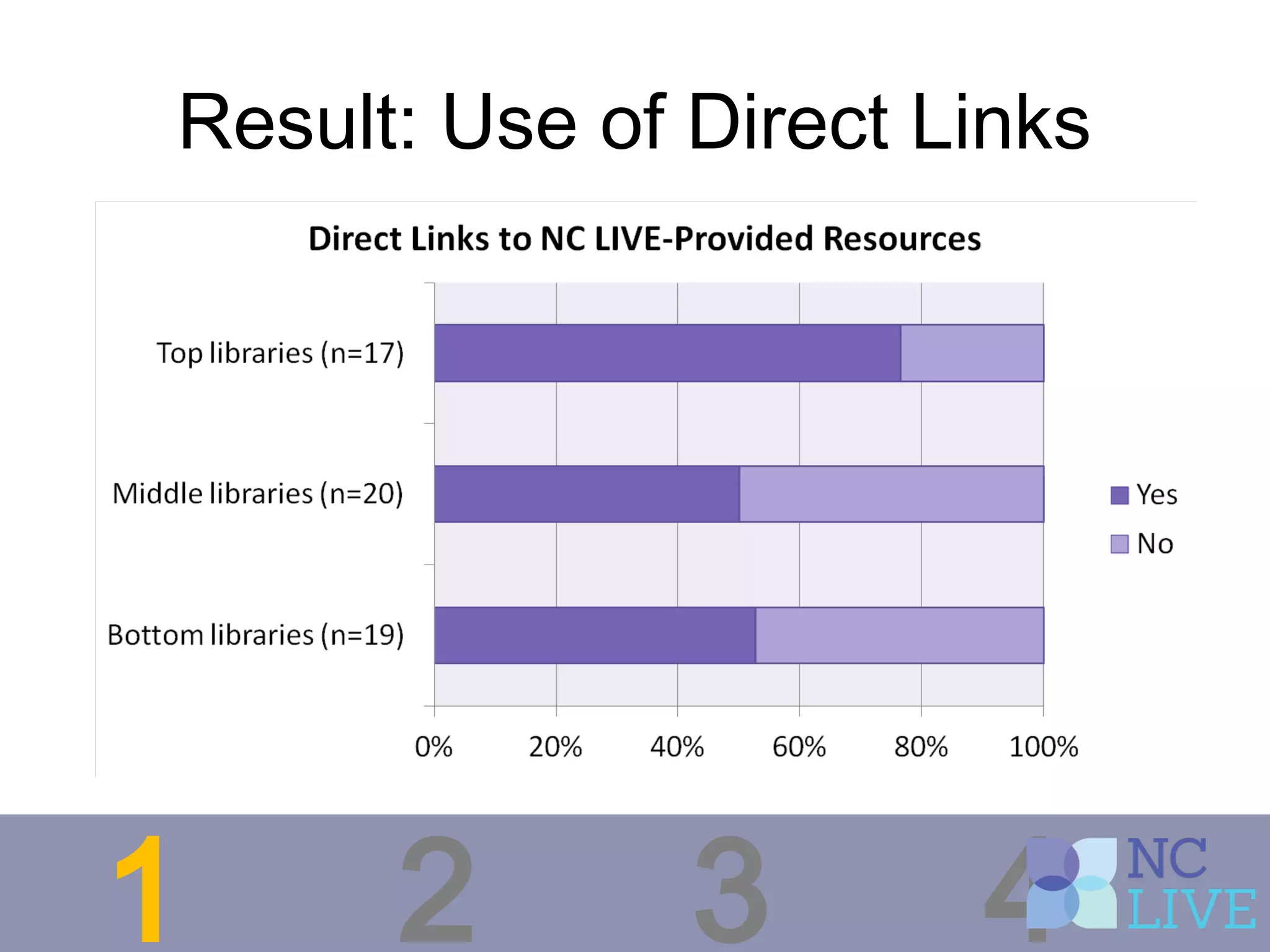
Result: Use of Direct Links
1 2 3 4
Action: Make NC LIVE Your
Own
1 2 3 4
Action: Make NC LIVE Your
Own
1 2 3 4
Action: Make NC LIVE Your
Own
1 2 3 4
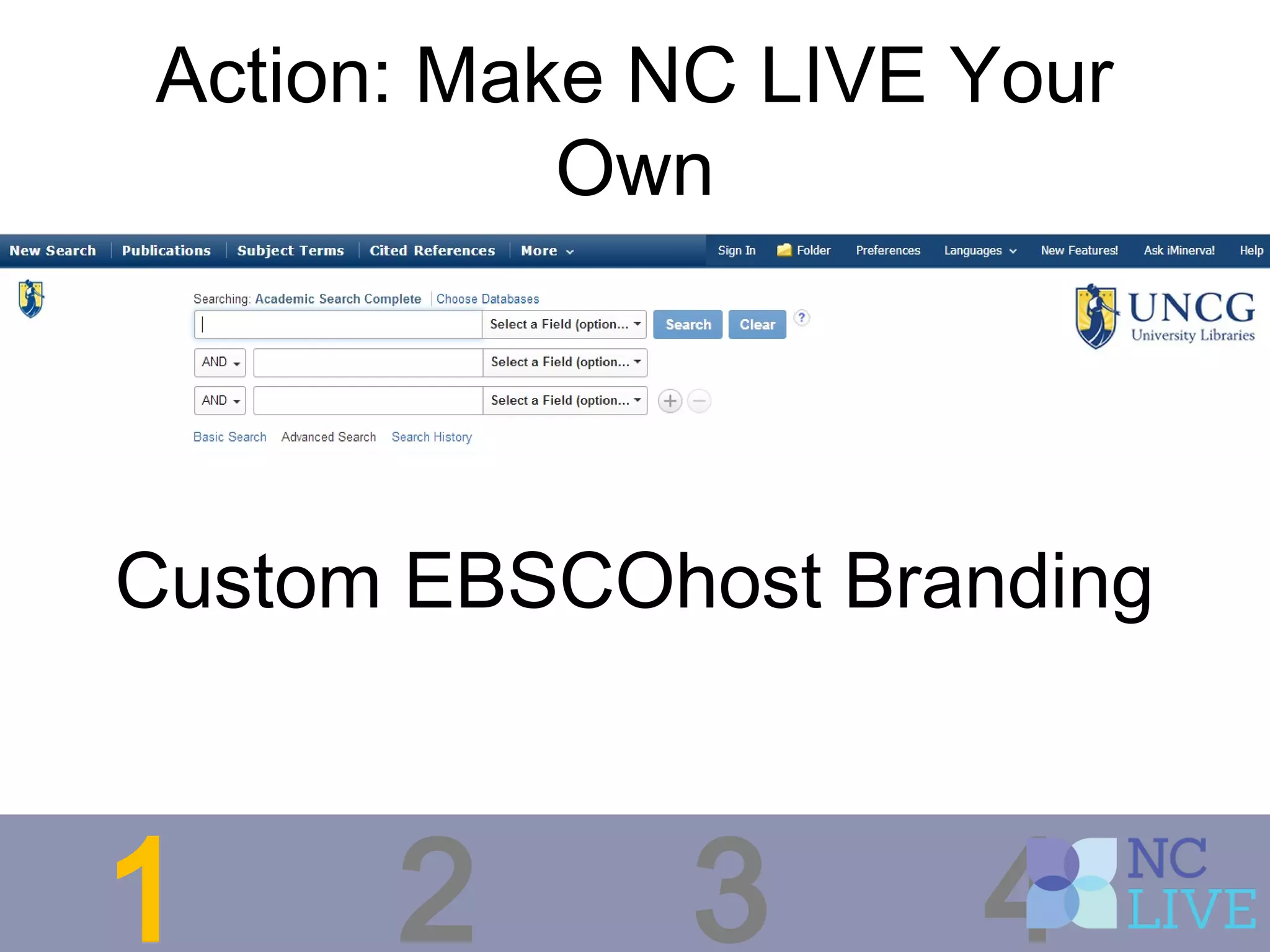
Custom EBSCOhost Branding
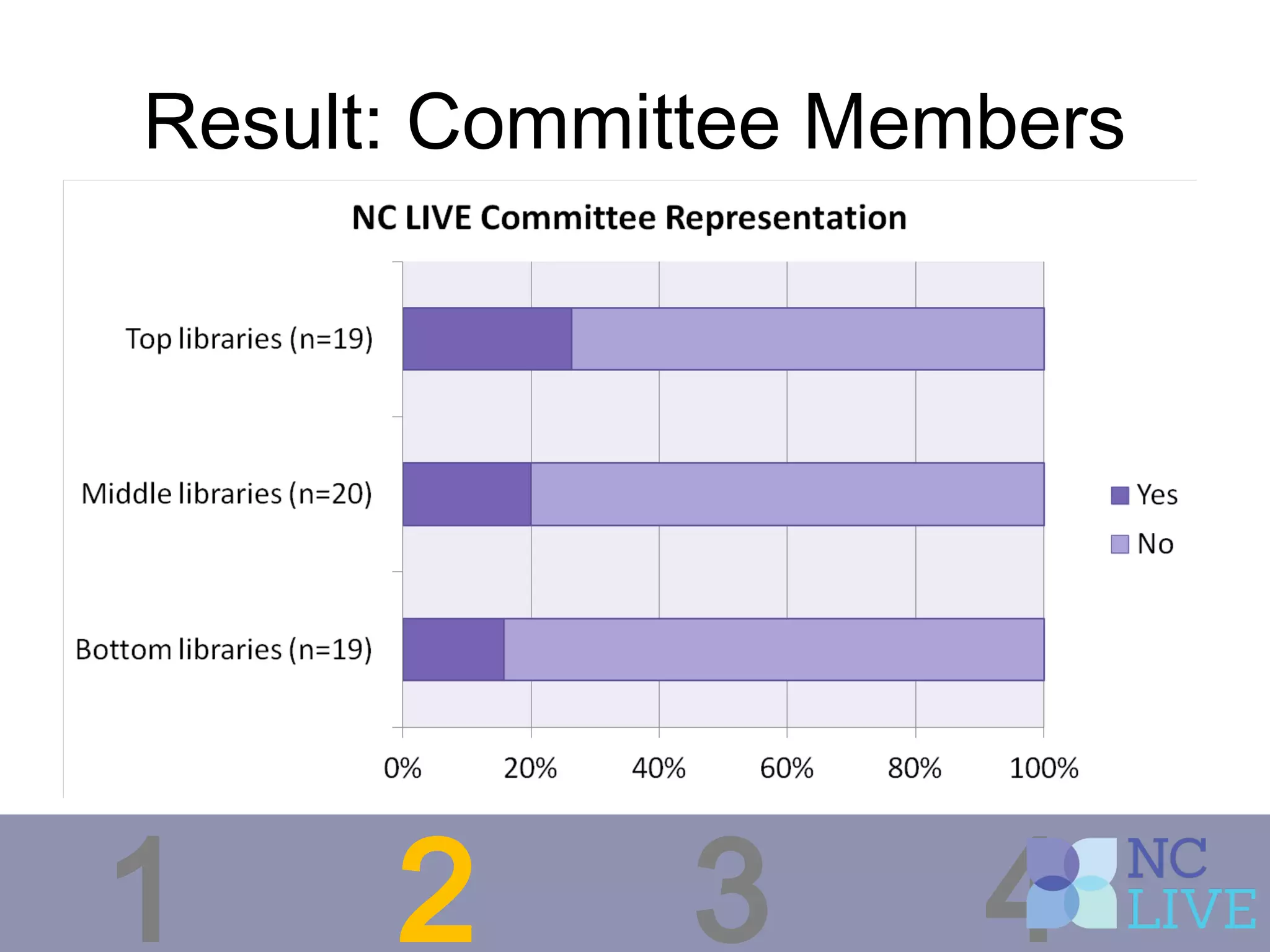
Result: Committee Members
1 2 3 4
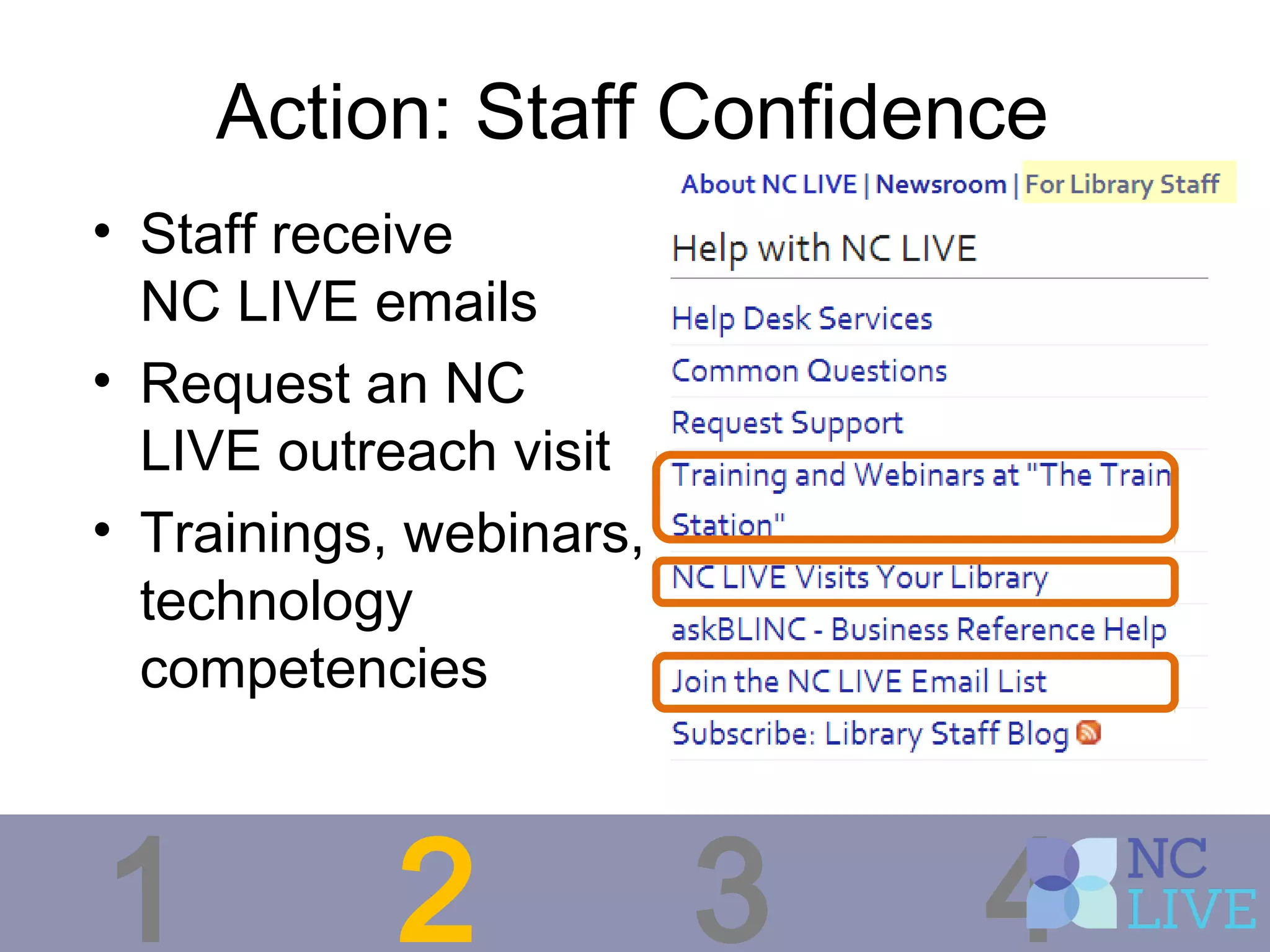
Action: Staff Confidence
• Staff receive
NC LIVE emails
• Request an NC
LIVE outreach visit
• Trainings, webinars,
technology
competencies
1 2 3 4
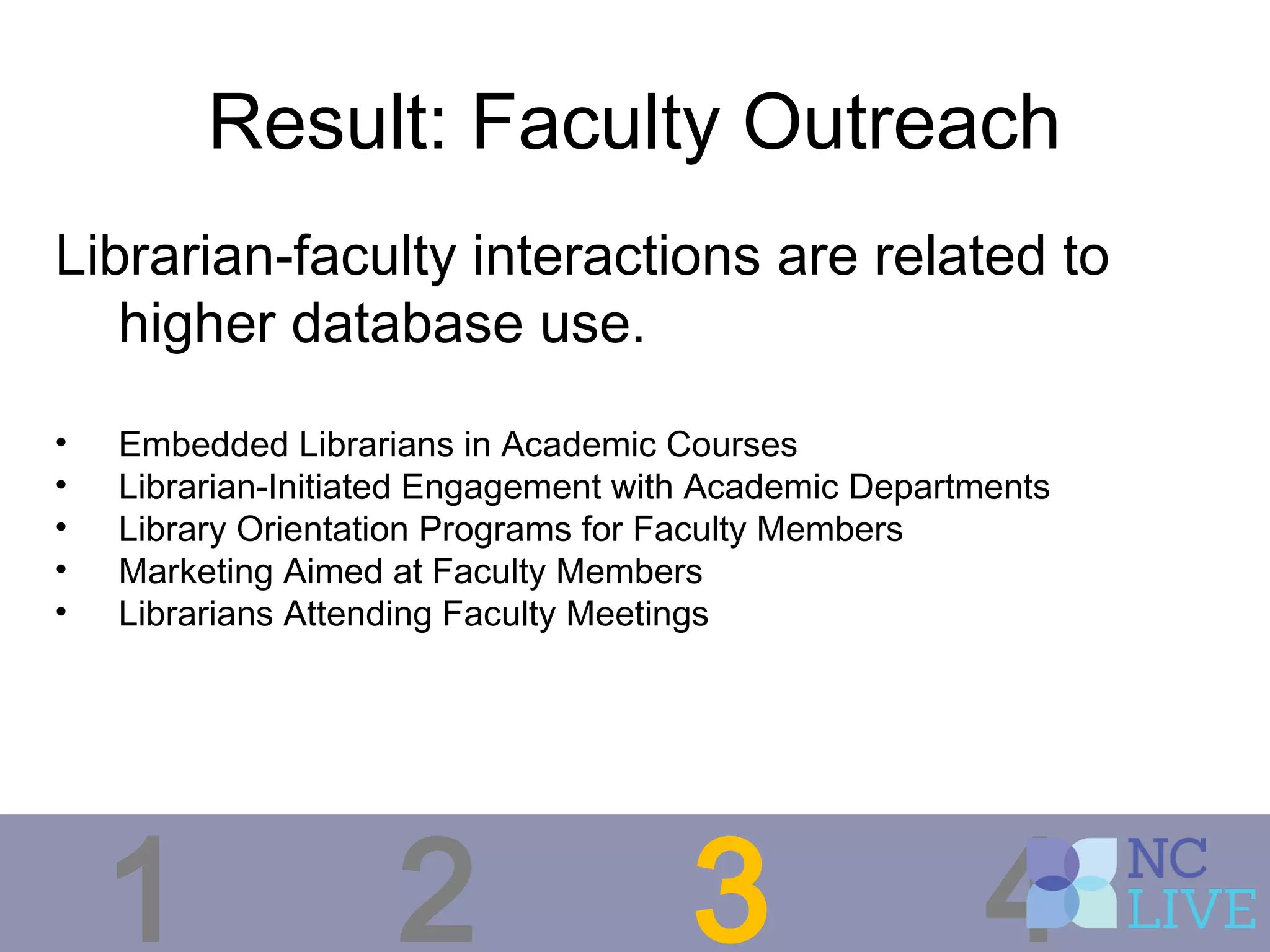
Result: Faculty Outreach
1 2 3 4
Librarian-faculty interactions are related to
higher database use.
• Embedded Librarians in Academic Courses
• Librarian-Initiated Engagement with Academic Departments
• Library Orientation Programs for Faculty Members
• Marketing Aimed at Faculty Members
• Librarians Attending Faculty Meetings
Action: Engage Faculty
• Embedded Librarians in Academic
Courses
• Librarian-Initiated Engagement with
Academic Departments
• Library Orientation Programs for Faculty
Members
• Marketing Aimed at Faculty Members
• Librarians Attending Faculty Meetings
1 2 3 4
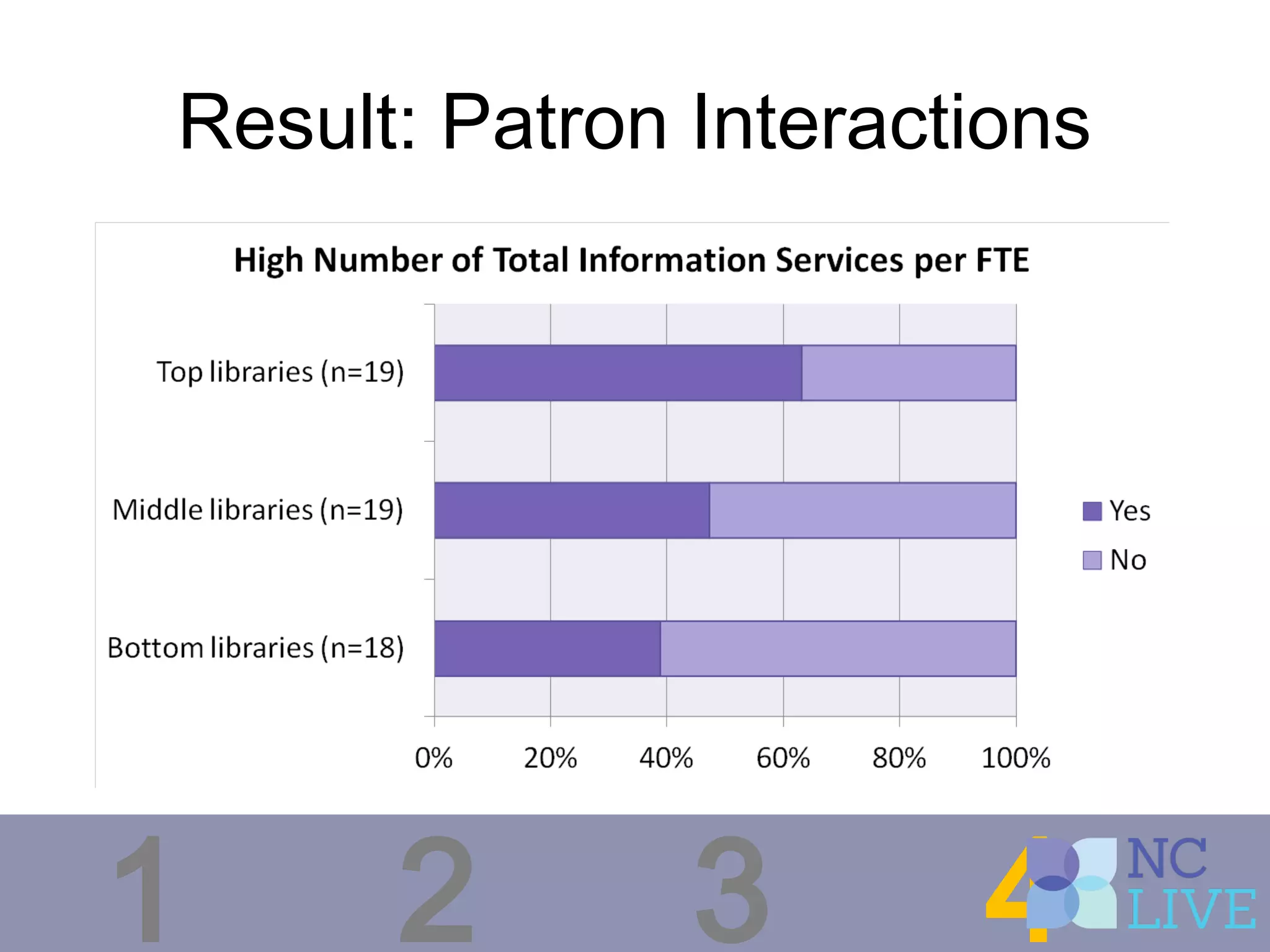
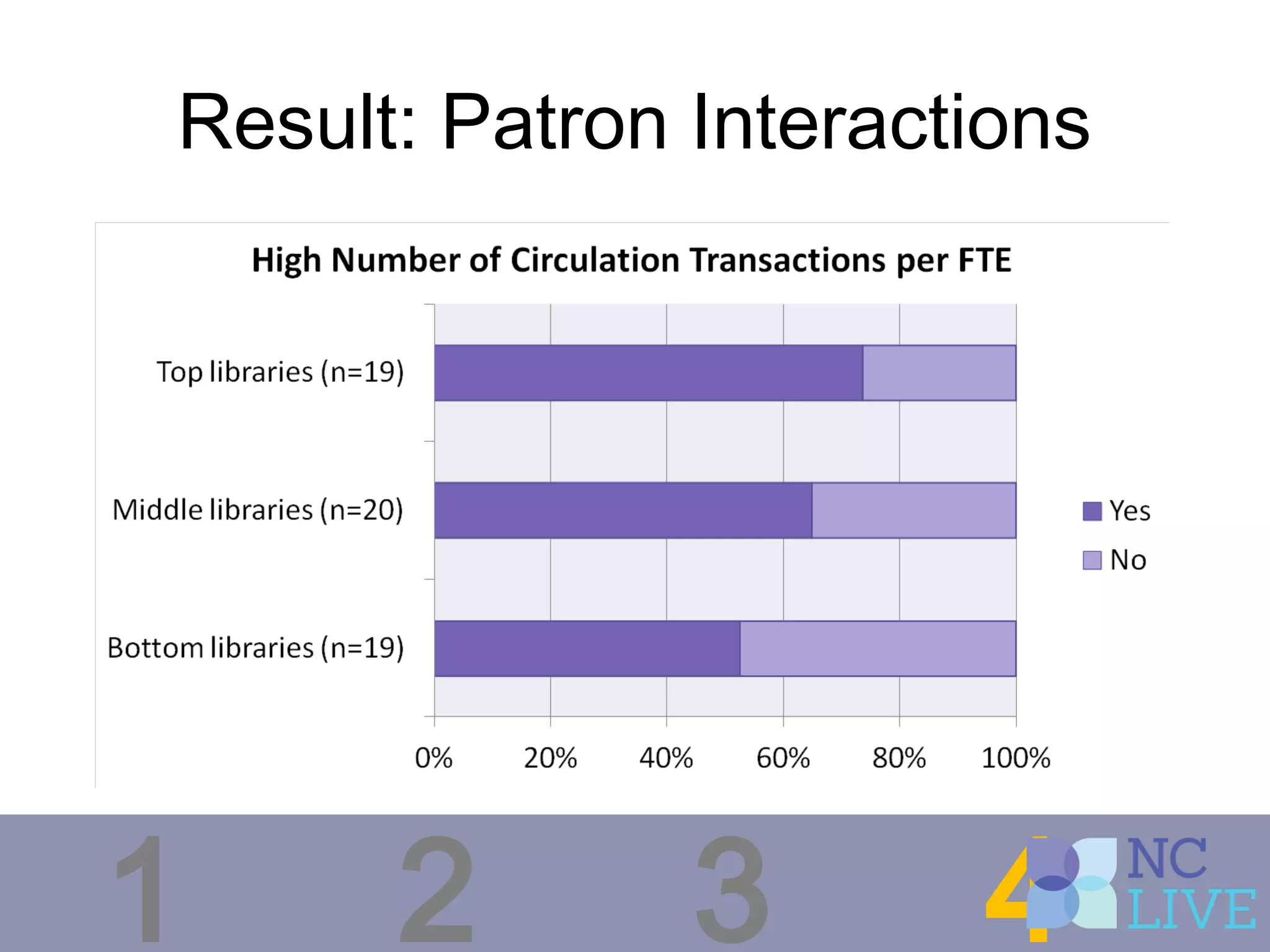
Result: Patron Interactions
1 2 3 4
Result: Patron Interactions
1 2 3 4
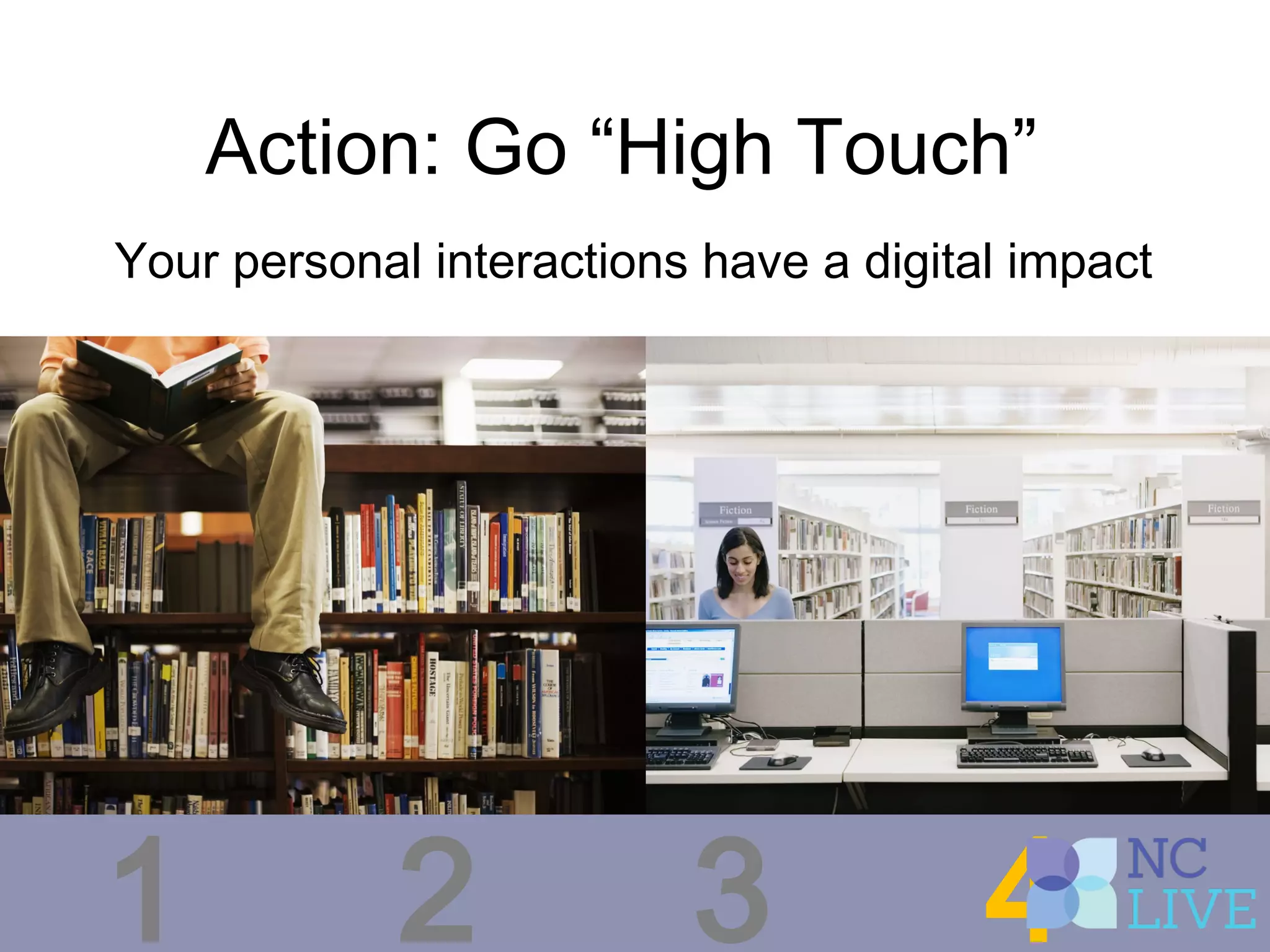
Action: Go “High Touch”
Your personal interactions have a digital impact
1 2 3 4
1.Make NC LIVE Your Own
2.Build Staff Confidence
3.Engage Faculty
4.Go “High Touch”
The Results Are In…
Thank You!
Questions? Ideas? Current Projects?
emily@nclive.org
heather@nclive.org
help@nclive.org
Visit our exhibit booth!Visit our exhibit booth!
Do you use nclive.org?Do you use nclive.org?
Come over and meet Web Librarian Sarah Dooley!Come over and meet Web Librarian Sarah Dooley!

The Results Are In: Increasing the use of Digital Resources

  • 1.
    The Results AreIn: Increasing the use of digital resources is easier than you think NCCCLRA Conference 2014 Emily Guhde, Online Services Librarian Heather Klein, Member Services Librarian
  • 2.
    Today’s Session • Describewhat, according to our study, community college libraries with high use of NC LIVE resources do differently from their peers • Based on those results, identify actions we think community college libraries can take to increase use of digital resources
  • 3.
    Questions from NCLIVE Member Libraries: What kind of use should we be seeing for our library? What can we do to improve use of these resources?
  • 4.
    “Making Usage DataMeaningful” Research Project • Year-long study • NC LIVE member libraries’ usage data (per FTE) • Five NC LIVE-provided databases – Academic Search Complete – MasterFILE Complete – Wall Street Journal – LearningExpress Library – SimplyMap
  • 5.
    Peer Groups • Sevencommunity college peer groups • Segmented each peer group into thirds: Top, Middle and Bottom • Made comparisons between Top, Middle and Bottom groups
  • 6.
    Library Characteristics • Access& Authentication • Content & Collections • Awareness, Outreach & Support • Library Characteristics • Community Characteristics
  • 7.
    1 2 34 The Results Are In…
  • 8.
    Result: Use ofDirect Links 1 2 3 4
  • 9.
    Action: Make NCLIVE Your Own 1 2 3 4
  • 10.
    Action: Make NCLIVE Your Own 1 2 3 4
  • 11.
    Action: Make NCLIVE Your Own 1 2 3 4 Custom EBSCOhost Branding
  • 12.
  • 13.
    Action: Staff Confidence •Staff receive NC LIVE emails • Request an NC LIVE outreach visit • Trainings, webinars, technology competencies 1 2 3 4
  • 14.
    Result: Faculty Outreach 12 3 4 Librarian-faculty interactions are related to higher database use. • Embedded Librarians in Academic Courses • Librarian-Initiated Engagement with Academic Departments • Library Orientation Programs for Faculty Members • Marketing Aimed at Faculty Members • Librarians Attending Faculty Meetings
  • 15.
    Action: Engage Faculty •Embedded Librarians in Academic Courses • Librarian-Initiated Engagement with Academic Departments • Library Orientation Programs for Faculty Members • Marketing Aimed at Faculty Members • Librarians Attending Faculty Meetings 1 2 3 4
  • 16.
  • 17.
  • 18.
    Action: Go “HighTouch” Your personal interactions have a digital impact 1 2 3 4
  • 19.
    1.Make NC LIVEYour Own 2.Build Staff Confidence 3.Engage Faculty 4.Go “High Touch” The Results Are In…
  • 20.
    Thank You! Questions? Ideas?Current Projects? emily@nclive.org heather@nclive.org help@nclive.org Visit our exhibit booth!Visit our exhibit booth! Do you use nclive.org?Do you use nclive.org? Come over and meet Web Librarian Sarah Dooley!Come over and meet Web Librarian Sarah Dooley!

Editor's Notes

  • #2 Hi Everyone My name is Jill Morris – I’m the Assistant Director at NC LIVE.
  • #4 Another question we often hear from libraries is how can we improve the use of these eResources? Libraries want to know what they can do to get the most out of these NC LIVE eResources. Library staff might want to know if they should be providing more training on NC LIVE resources, or if embedding an NC LIVE search box on their website will improve use. Up to this point, we have been unable to give libraries clear information about what steps they can take to improve use, because we’ve never looked at this question in depth before. Now, thanks to this research project, we have the opportunity to explore both of these questions and provide some guidance to our member libraries, and also potentially design a study that other libraries or consortia could replicate to explore their eResource usage.
  • #6 Mention type of test
  • #8 Your library may already be doing these things, in which case, great! You can be assured you are putting your attention in the right places for increasing usage
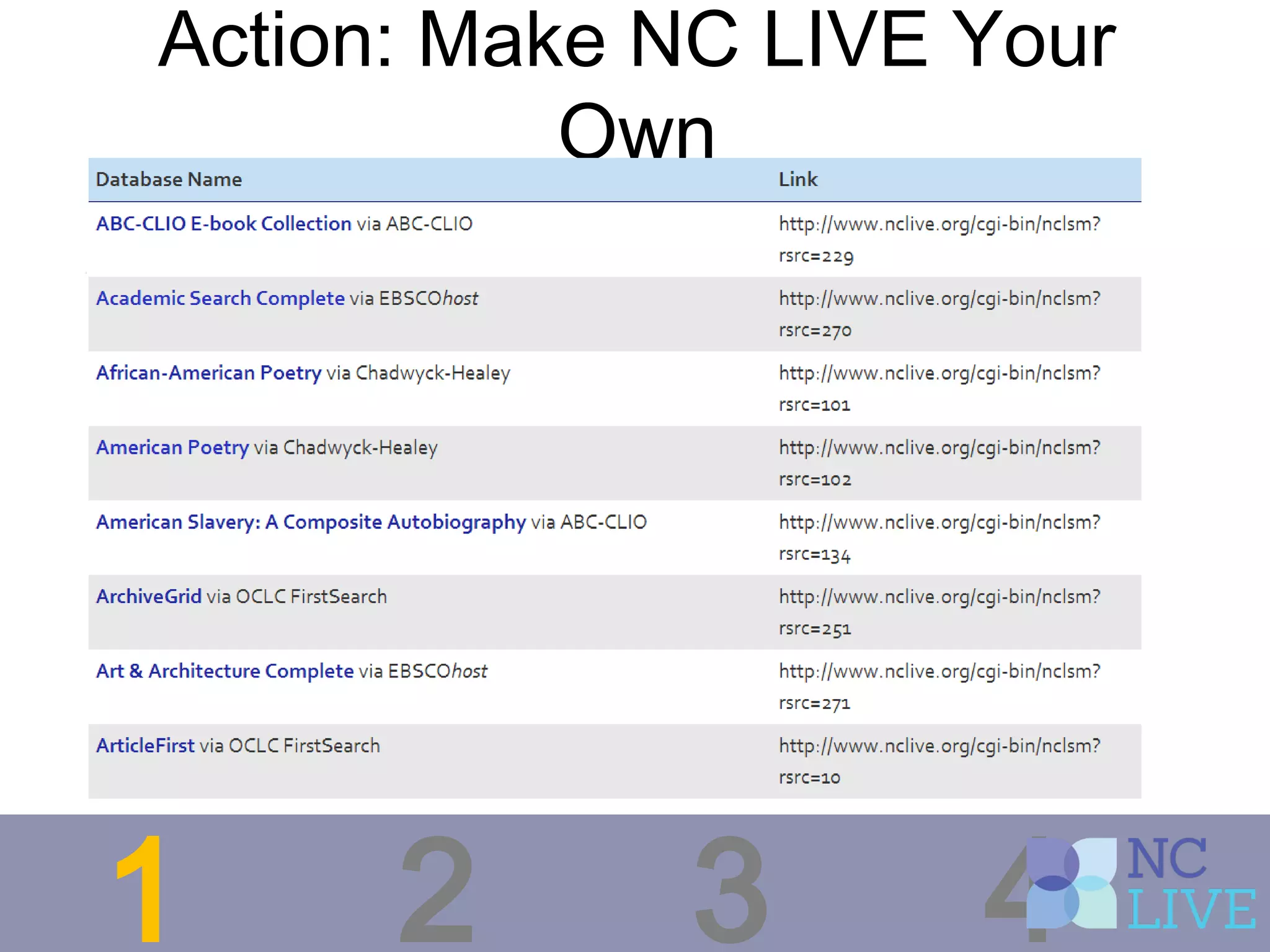
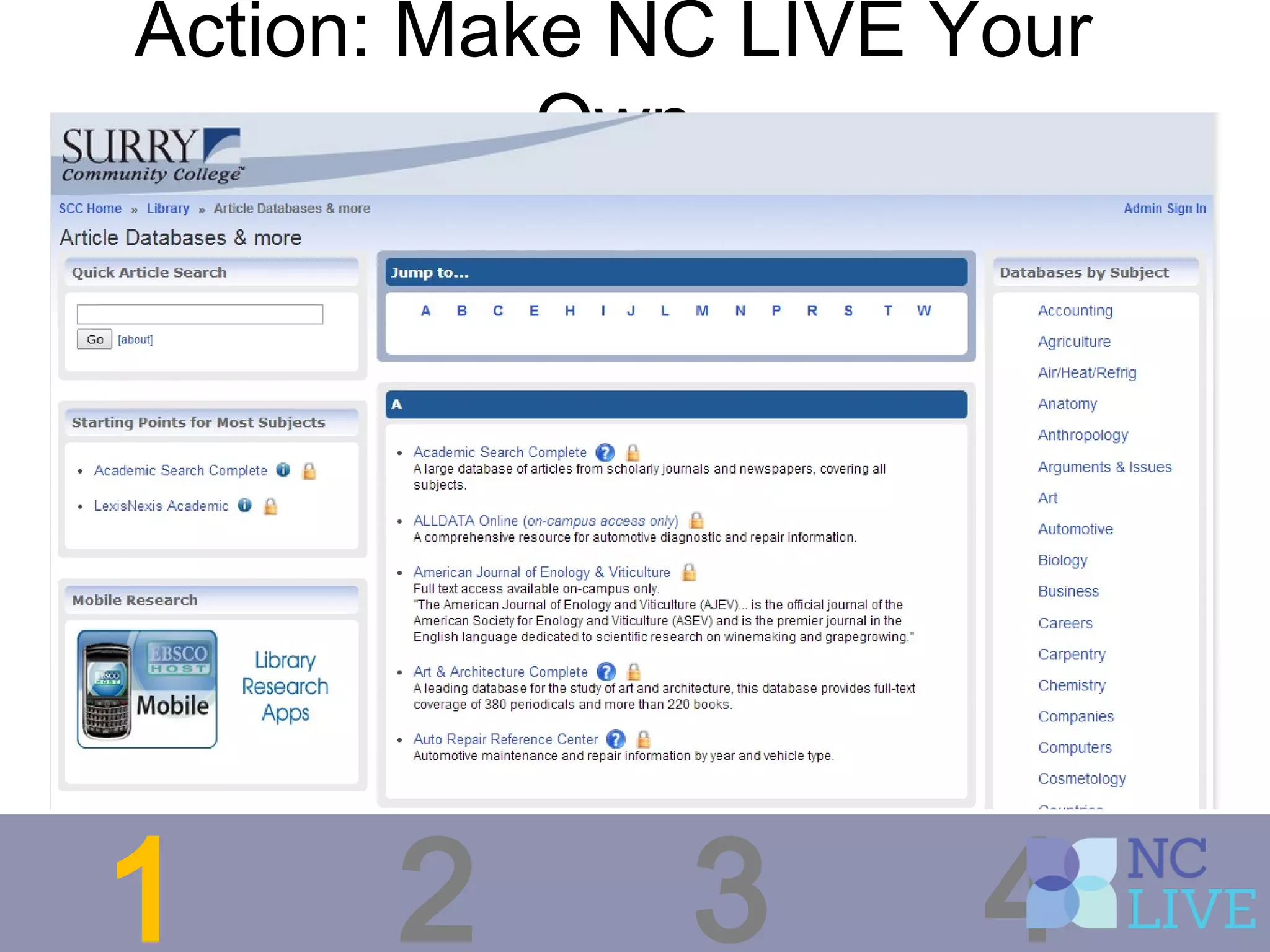
  • #9 77% of top community college libraries use direct links to NC LIVE-provided resources, compared with 50% of middle and 53% of bottom libraries.
  • #10 We think direct links are a means by which libraries make NC LIVE resources their own. There are as many ways to do this as there are libraries and that is the point—nclive.org is a great tool but it was not designed for your users. Only you know how to take the big bundle of resources that make up NC LIVE and organize them in a way that is most relevant and contextual to your users. There are small things you can do even if you don’t have control of your website right now, or if you aren’t allowed to take advantage of LibGuides. For example we can help you put custom branding into EBSCOhost that will help your users make the connection between your library and those resource databases.
  • #11 We think direct links are a means by which libraries make NC LIVE resources their own. There are as many ways to do this as there are libraries and that is the point—nclive.org is a great tool but it was not designed for your users. Only you know how to take the big bundle of resources that make up NC LIVE and organize them in a way that is most relevant and contextual to your users. There are small things you can do even if you don’t have control of your website right now, or if you aren’t allowed to take advantage of LibGuides. For example we can help you put custom branding into EBSCOhost that will help your users make the connection between your library and those resource databases.
  • #12 We think direct links are a means by which libraries make NC LIVE resources their own. There are as many ways to do this as there are libraries and that is the point—nclive.org is a great tool but it was not designed for your users. Only you know how to take the big bundle of resources that make up NC LIVE and organize them in a way that is most relevant and contextual to your users. There are small things you can do even if you don’t have control of your website right now, or if you aren’t allowed to take advantage of LibGuides. For example we can help you put custom branding into EBSCOhost that will help your users make the connection between your library and those resource databases.
  • #13 26% of top community college libraries have a representative on one of the NC LIVE advisory committees, and that’s compared with 20% of middle and 16% of bottom libraries.
  • #14 We think that committee membership is a proxy for staff awareness. Committee members are aware of what NC LIVE is, what our goals are, what we are working on.
  • #16 So we know that taking these actions to engage faculty leads to higher use of digital resources, and we can even guess that this is because faculty who are aware of what the library offers will create assignments that instruct students to use those resources. As to how to go about doing it, we suspect there are as many approaches as there are libraries. But we suspect that anything you do to engage faculty who are currently not engaged is likely to lead to increased use of digital resources, so if that is your goal any of these activities would be time well spent.
  • #17 63% of top community college libraries have high (above the median) total information services to individuals per FTE, compared with 47% of middle and 39% of bottom libraries.
  • #18 73% of top community college libraries have high (above the median) circulation transactions including reserves per FTE, compared with 65% of middle and 53% of bottom libraries.