Postnatal and Neonatal Problems Dr Samarnath Sen MD,DCH,MRCPCH SpR North Western Deanery
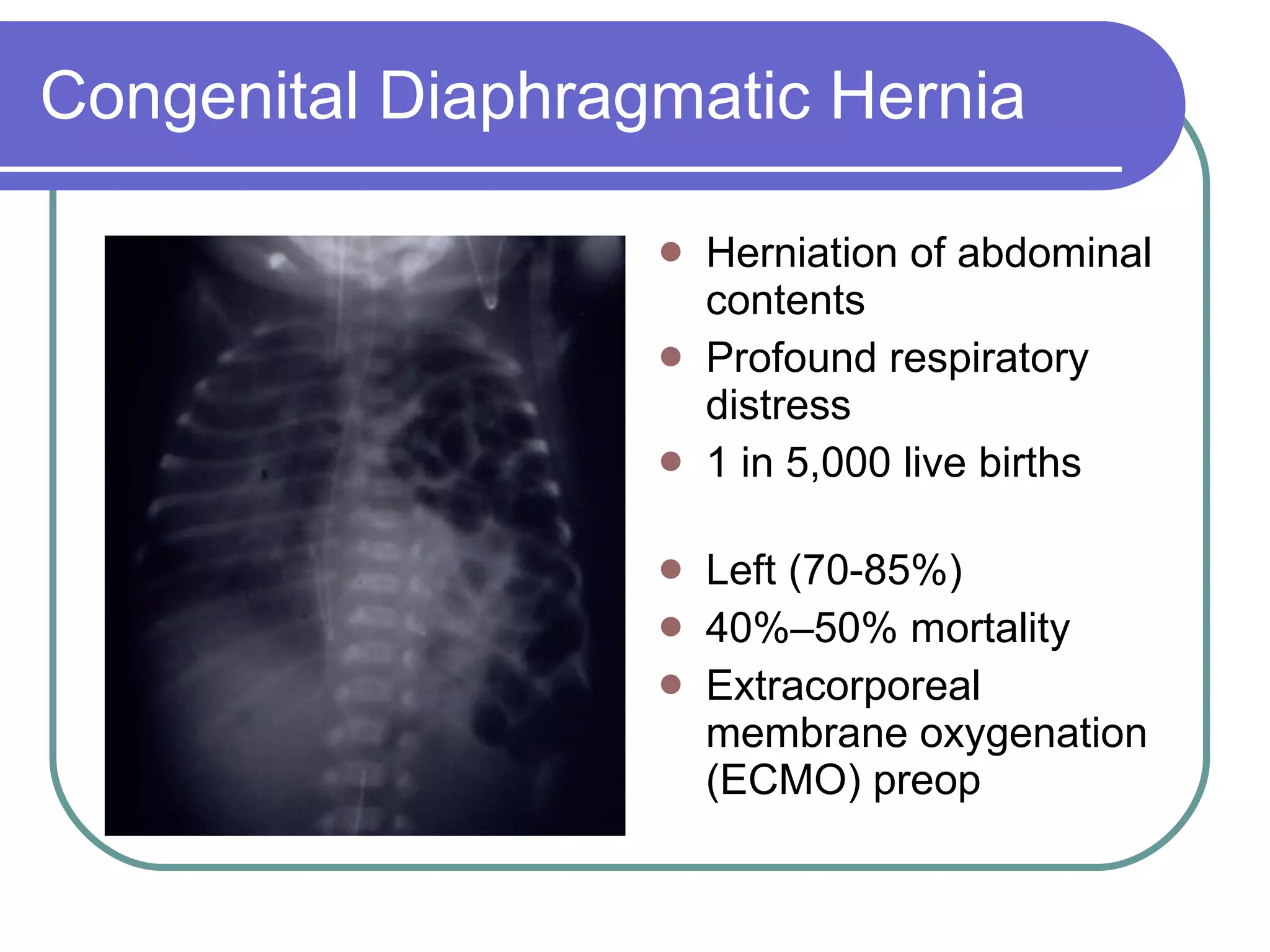
Congenital Diaphragmatic Hernia Herniation of abdominal contents  Profound respiratory distress 1 in 5,000 live births  Left (70-85%) 40%–50% mortality  Extracorporeal membrane oxygenation (ECMO) preop
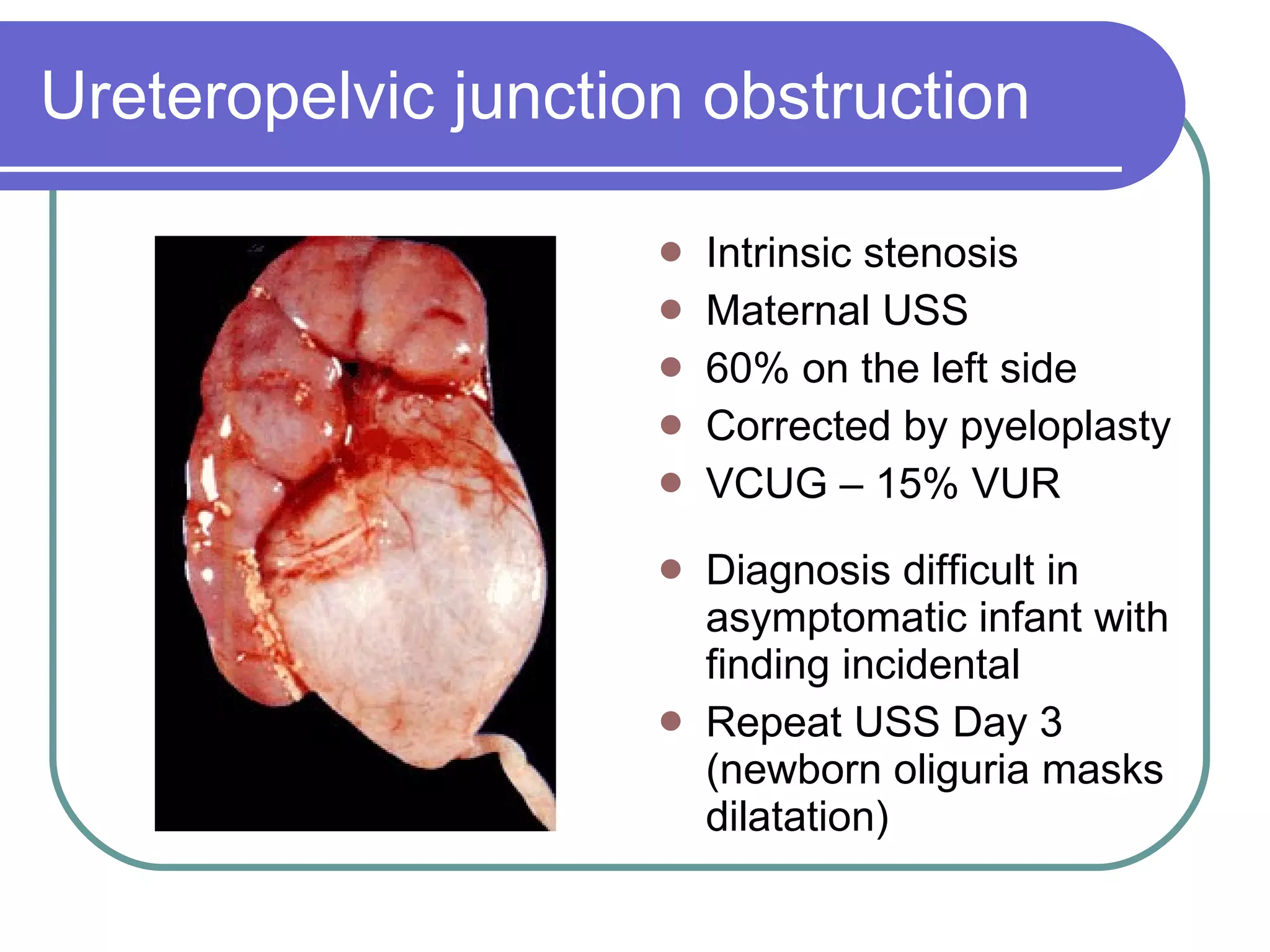
Ureteropelvic junction obstruction Intrinsic stenosis Maternal USS 60% on the left side Corrected by pyeloplasty VCUG – 15% VUR   Diagnosis difficult in asymptomatic infant with finding incidental Repeat USS Day 3 (newborn oliguria masks dilatation)
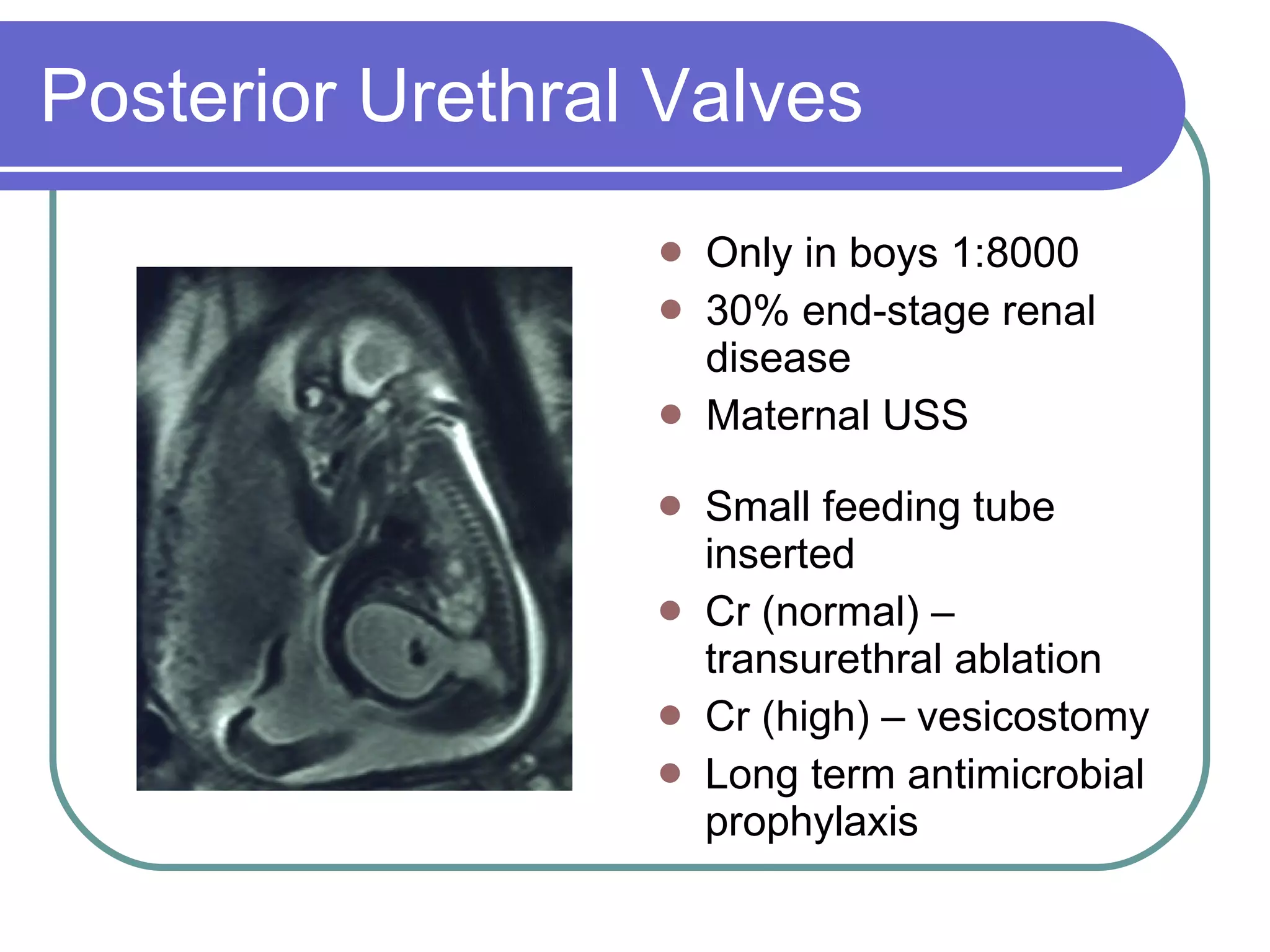
Posterior Urethral Valves Only in boys 1:8000 30% end-stage renal disease Maternal USS Small feeding tube inserted Cr (normal) – transurethral ablation Cr (high) – vesicostomy Long term antimicrobial prophylaxis
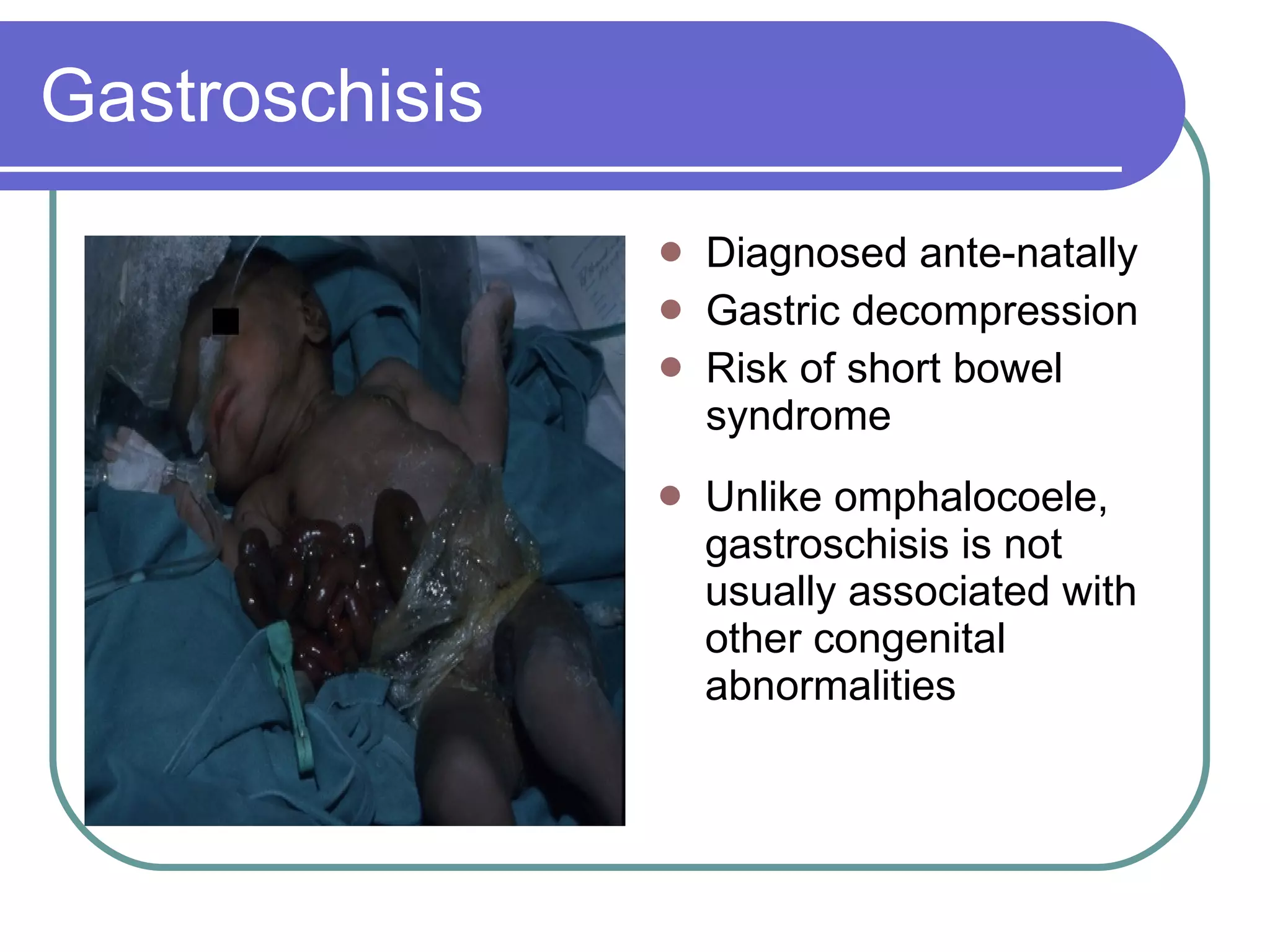
Gastroschisis Diagnosed ante-natally  Gastric decompression Risk of short bowel syndrome  Unlike omphalocoele, gastroschisis is not usually associated with other congenital abnormalities
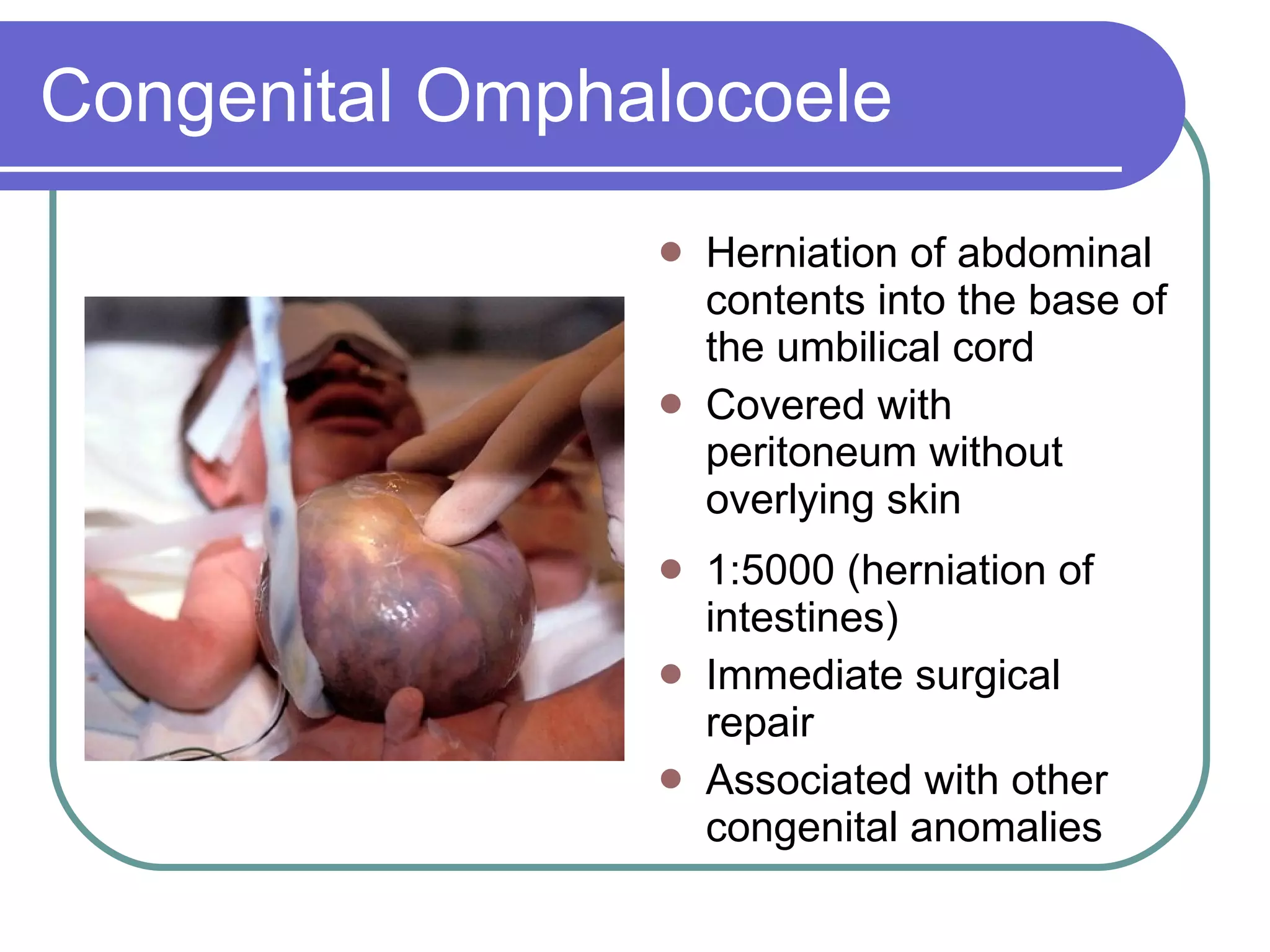
Congenital Omphalocoele Herniation of abdominal contents into the base of the umbilical cord Covered with peritoneum without overlying skin 1:5000 (herniation of intestines) Immediate surgical repair Associated with other congenital anomalies
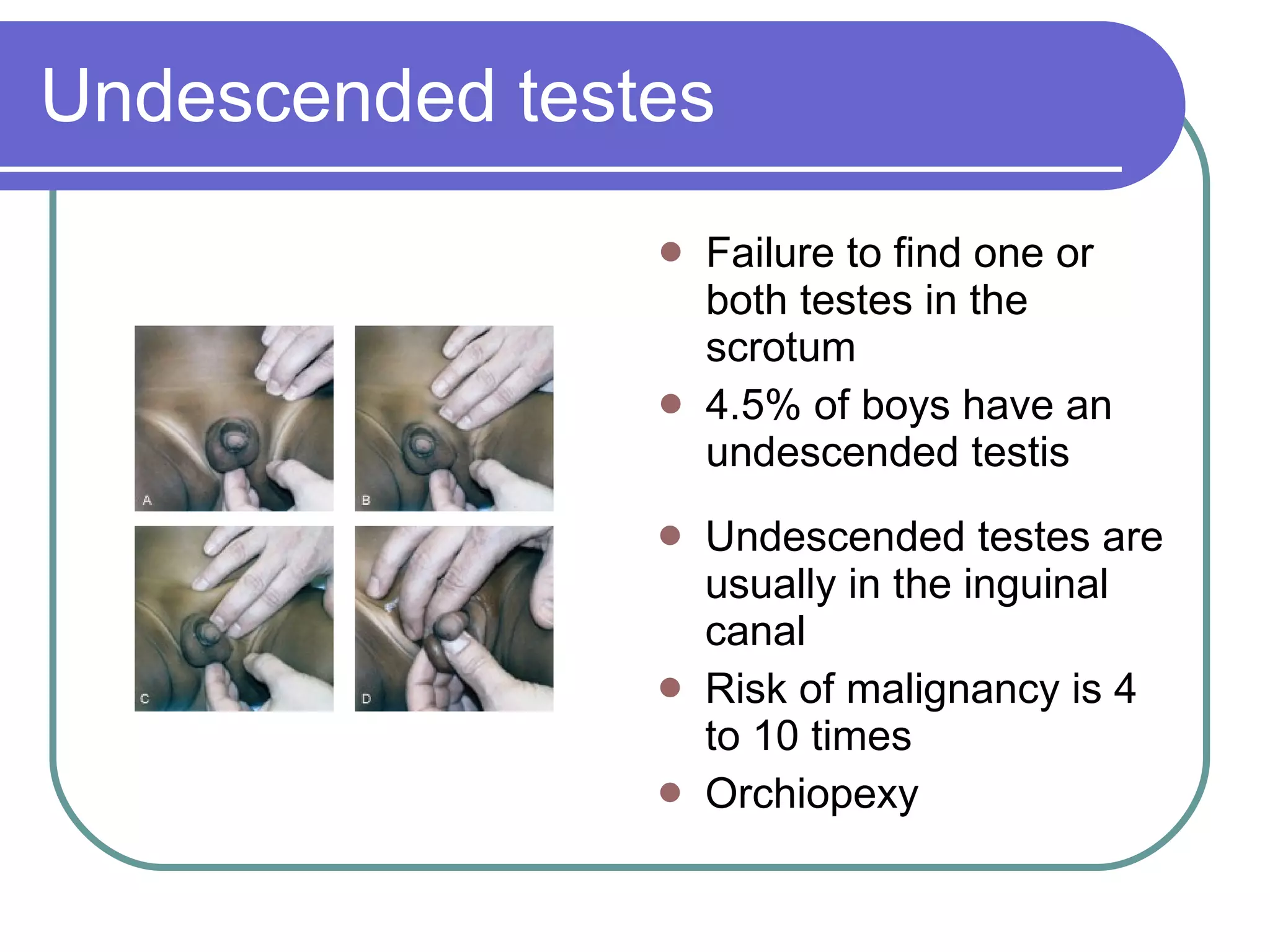
Undescended testes Failure to find one or both testes in the scrotum  4.5% of boys have an undescended testis  Undescended testes are usually in the inguinal canal Risk of malignancy is 4 to 10 times Orchiopexy
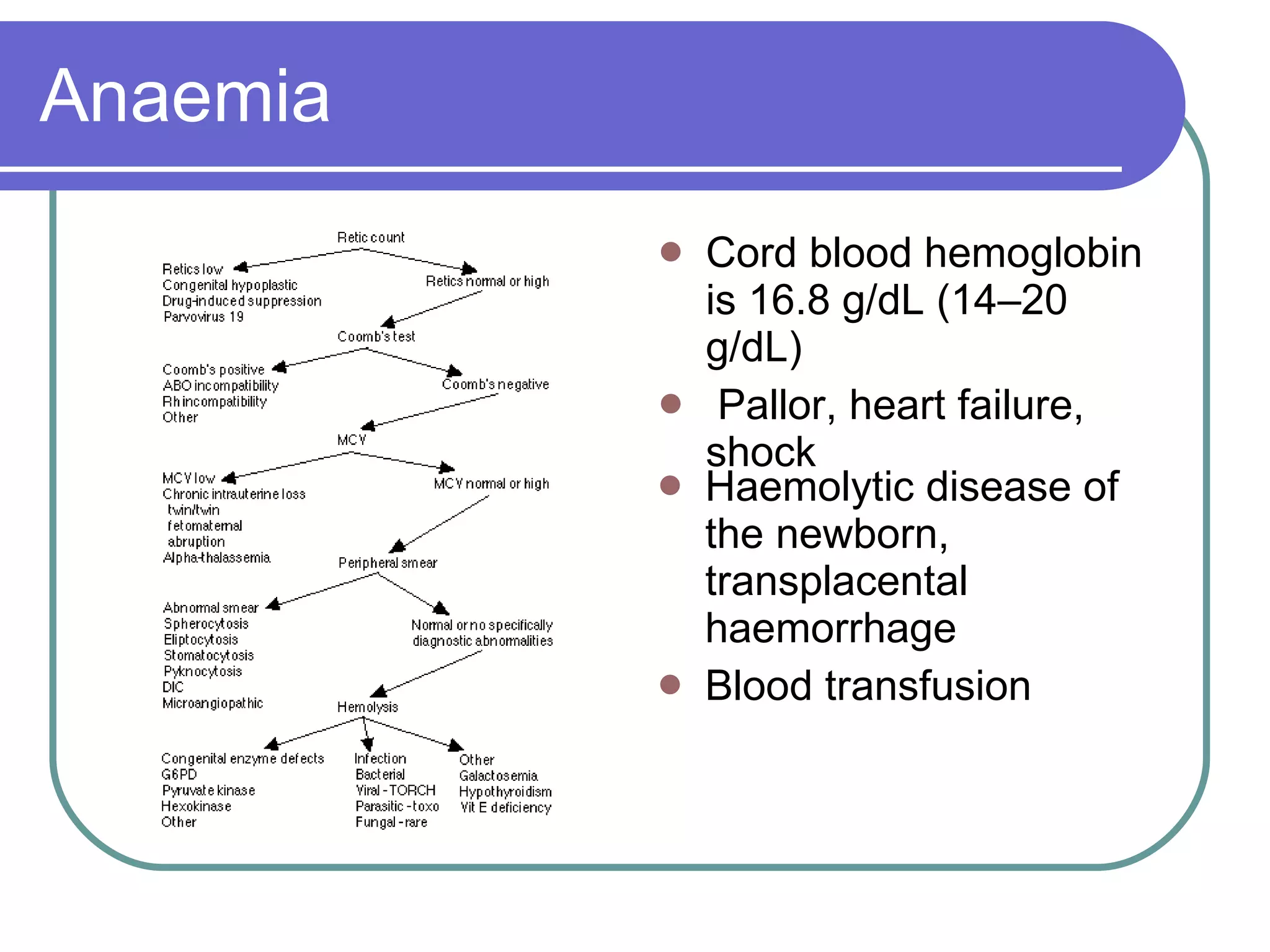
Anaemia Cord blood hemoglobin is 16.8 g/dL (14–20 g/dL) Pallor, heart failure, shock Haemolytic disease of the newborn, transplacental haemorrhage Blood transfusion
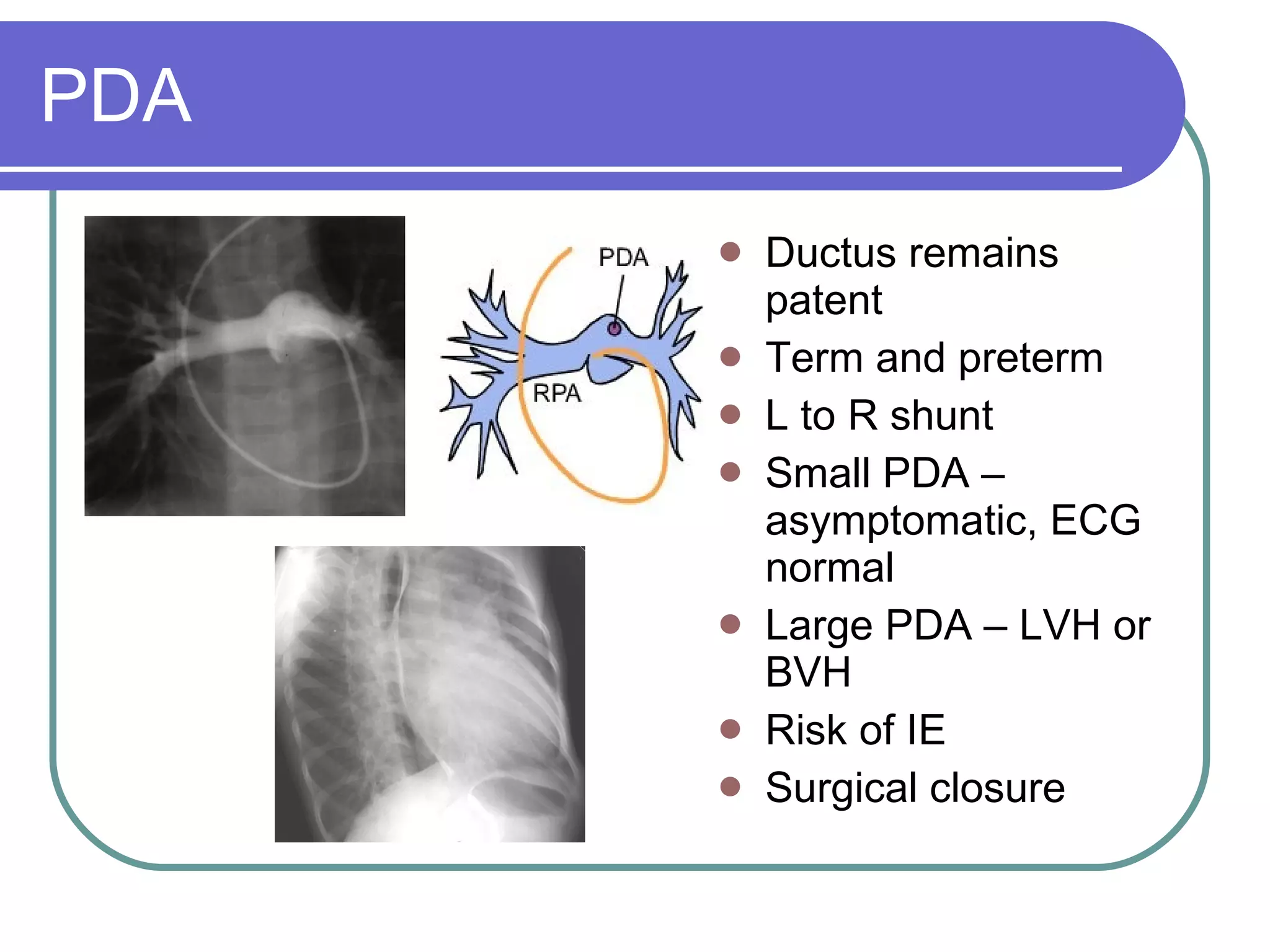
PDA Ductus remains patent  Term and preterm L to R shunt Small PDA – asymptomatic, ECG normal Large PDA – LVH or BVH Risk of IE Surgical closure
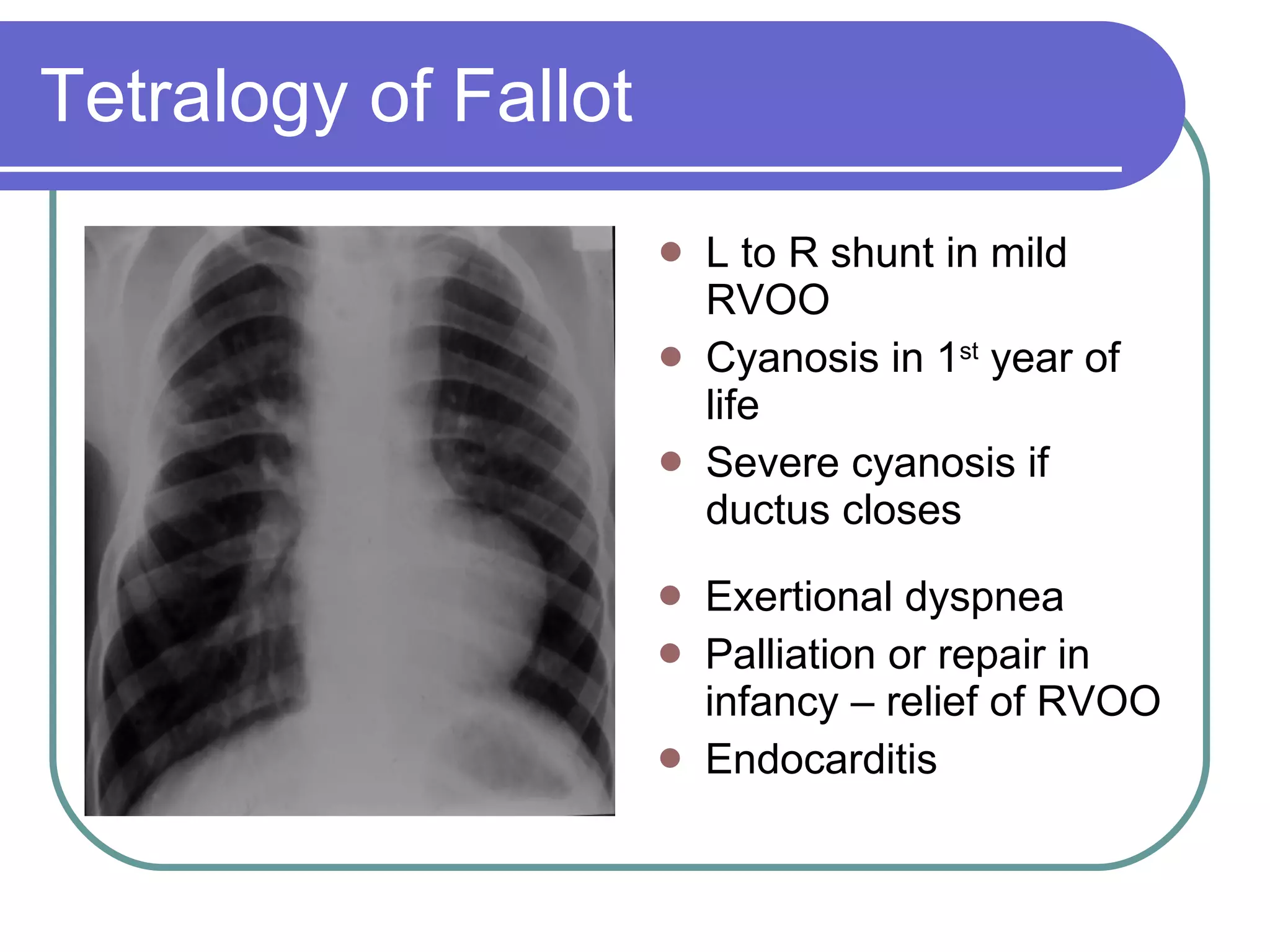
Tetralogy of Fallot L to R shunt in mild RVOO Cyanosis in 1 st  year of life Severe cyanosis if ductus closes Exertional dyspnea Palliation or repair in infancy – relief of RVOO Endocarditis
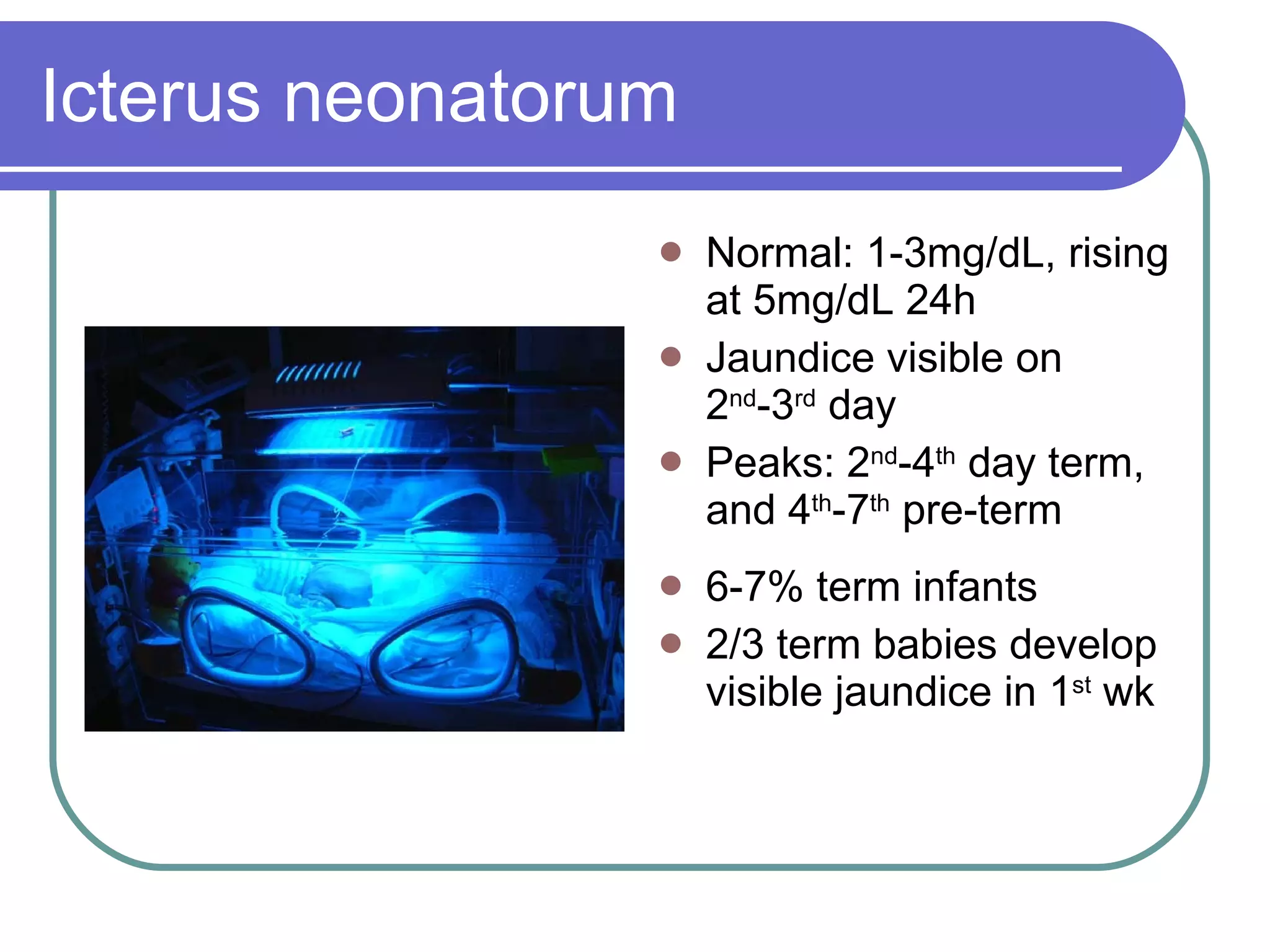
Icterus neonatorum Normal: 1-3mg/dL, rising at 5mg/dL 24h Jaundice visible on 2 nd -3 rd  day Peaks: 2 nd -4 th  day term, and 4 th -7 th  pre-term 6-7% term infants 2/3 term babies develop visible jaundice in 1 st  wk
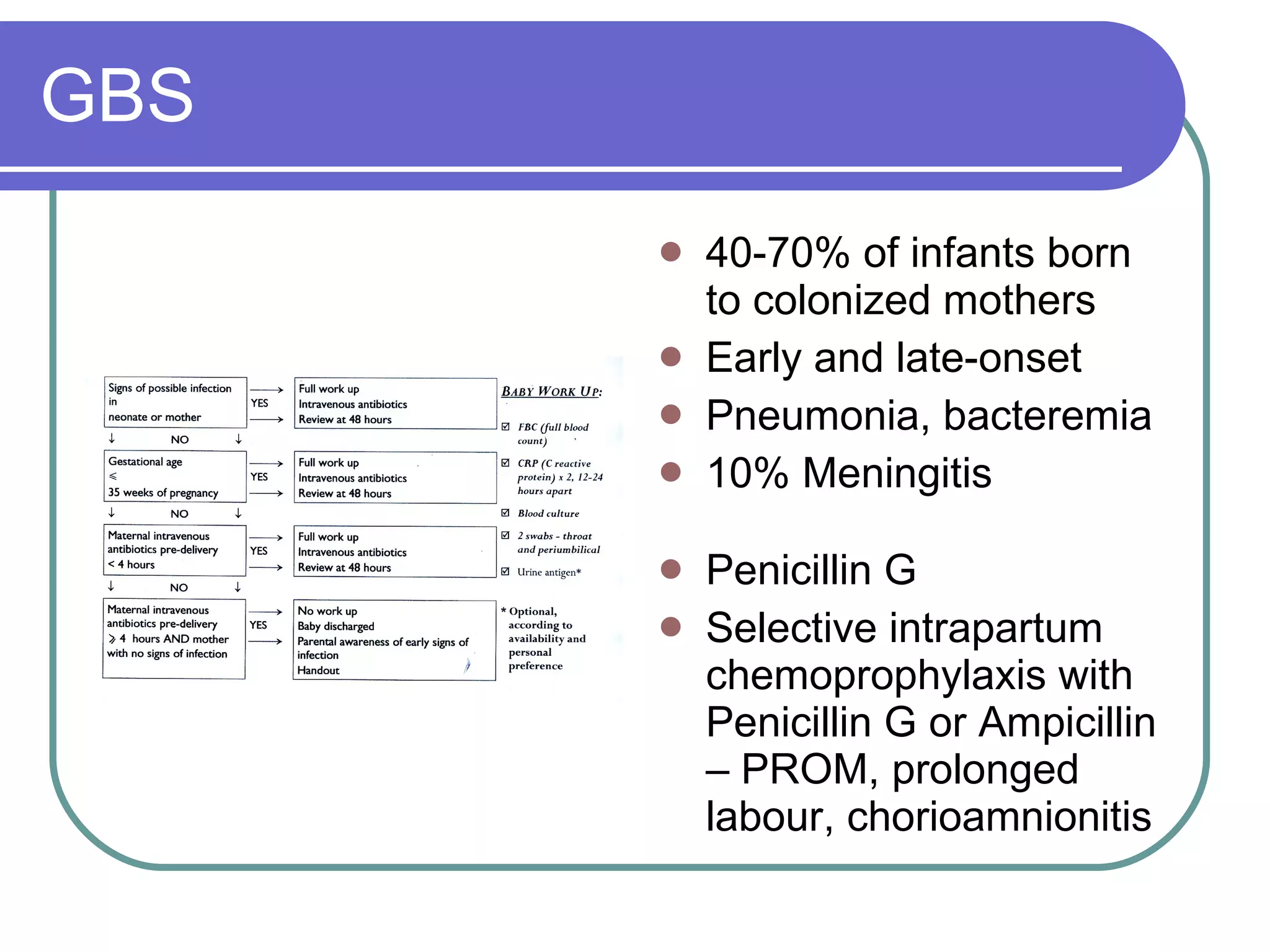
GBS 40-70% of infants born to colonized mothers Early and late-onset Pneumonia, bacteremia 10% Meningitis Penicillin G Selective intrapartum chemoprophylaxis with Penicillin G or Ampicillin – PROM, prolonged labour, chorioamnionitis
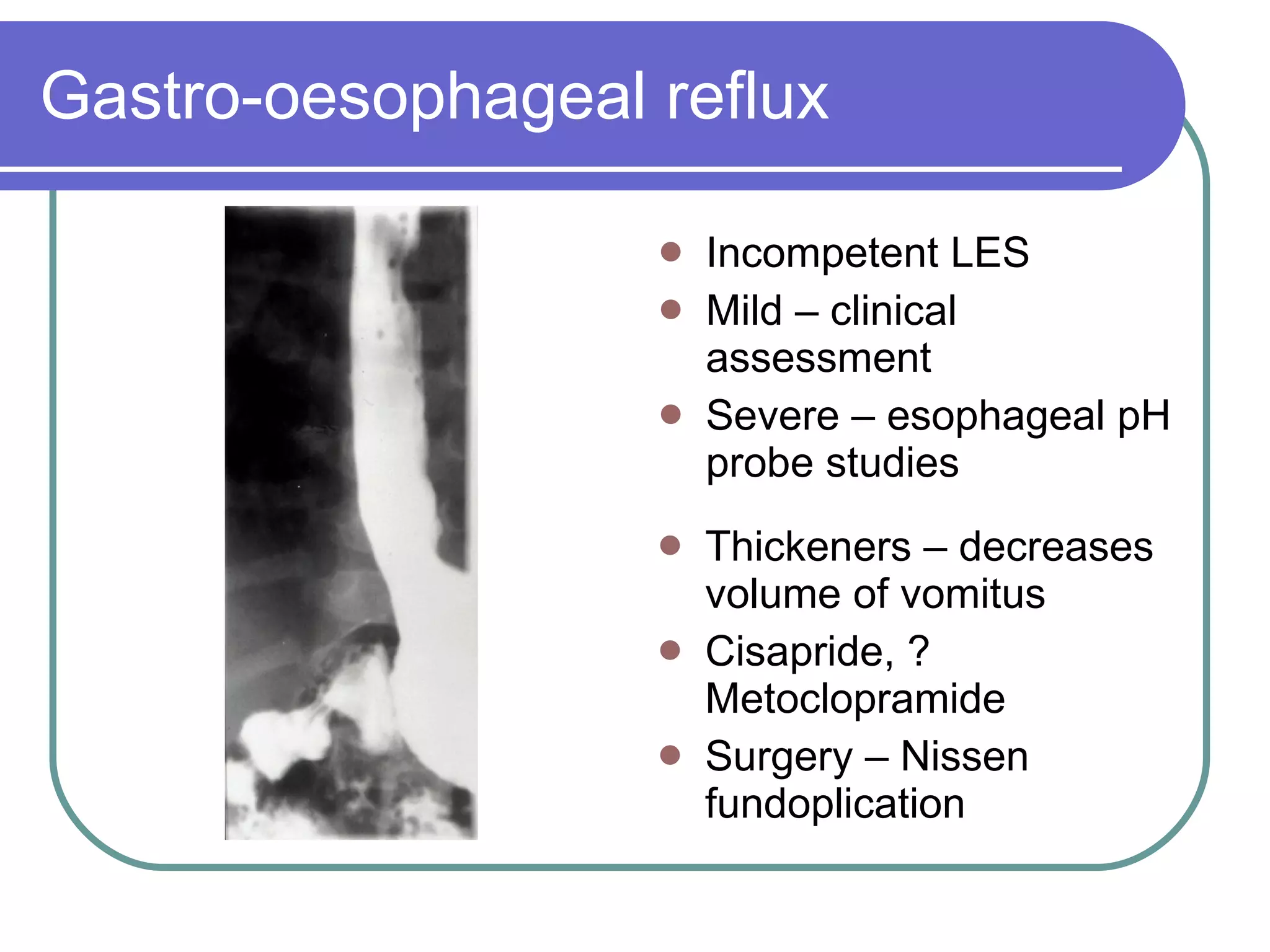
Gastro-oesophageal reflux Incompetent LES Mild – clinical assessment Severe – esophageal pH probe studies Thickeners – decreases volume of vomitus Cisapride, ?Metoclopramide Surgery – Nissen fundoplication
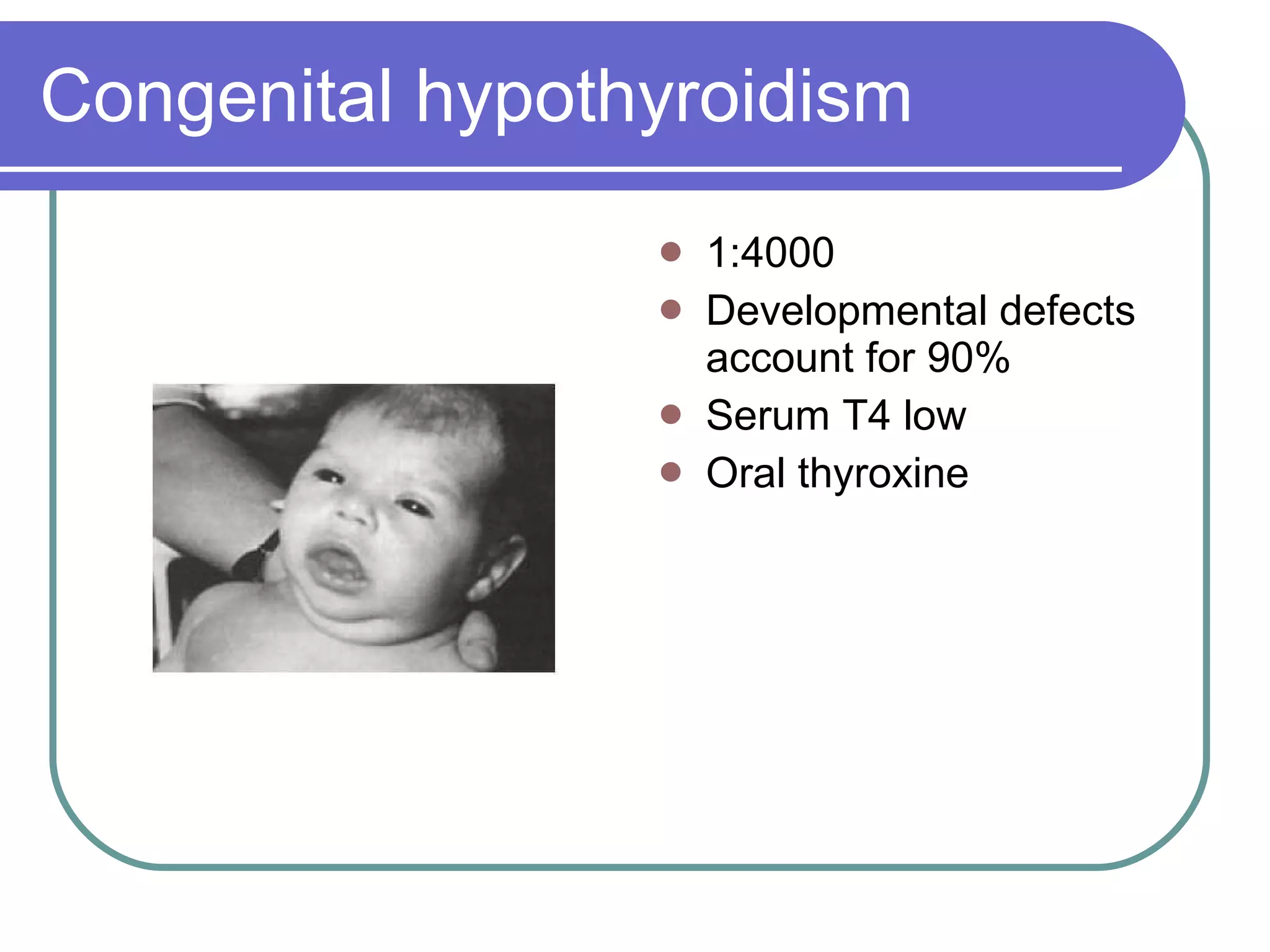
Congenital hypothyroidism 1:4000 Developmental defects account for 90% Serum T4 low Oral thyroxine
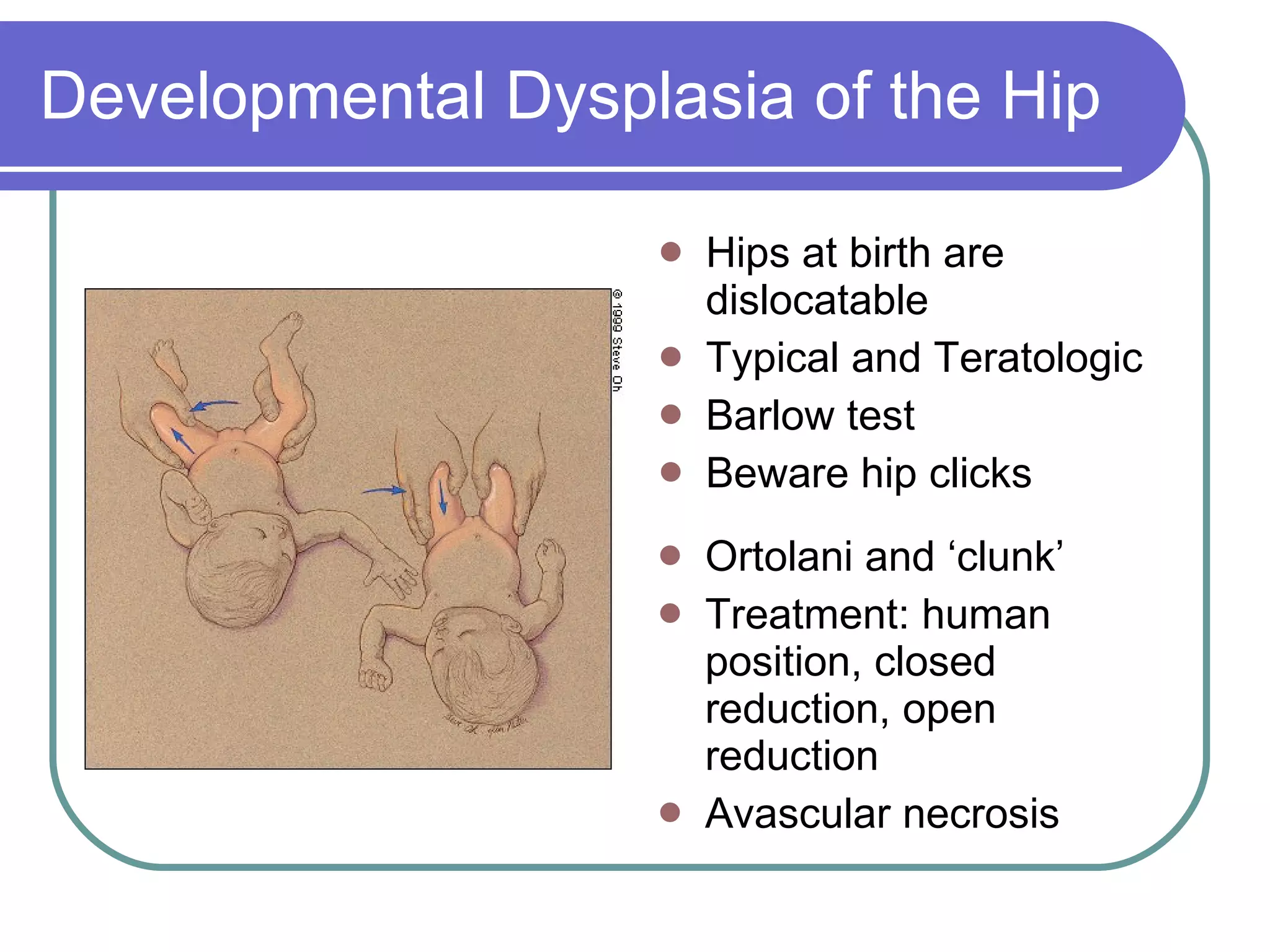
Developmental Dysplasia of the Hip Hips at birth are dislocatable Typical and Teratologic Barlow test Beware hip clicks Ortolani and ‘clunk’ Treatment: human position, closed reduction, open reduction Avascular necrosis
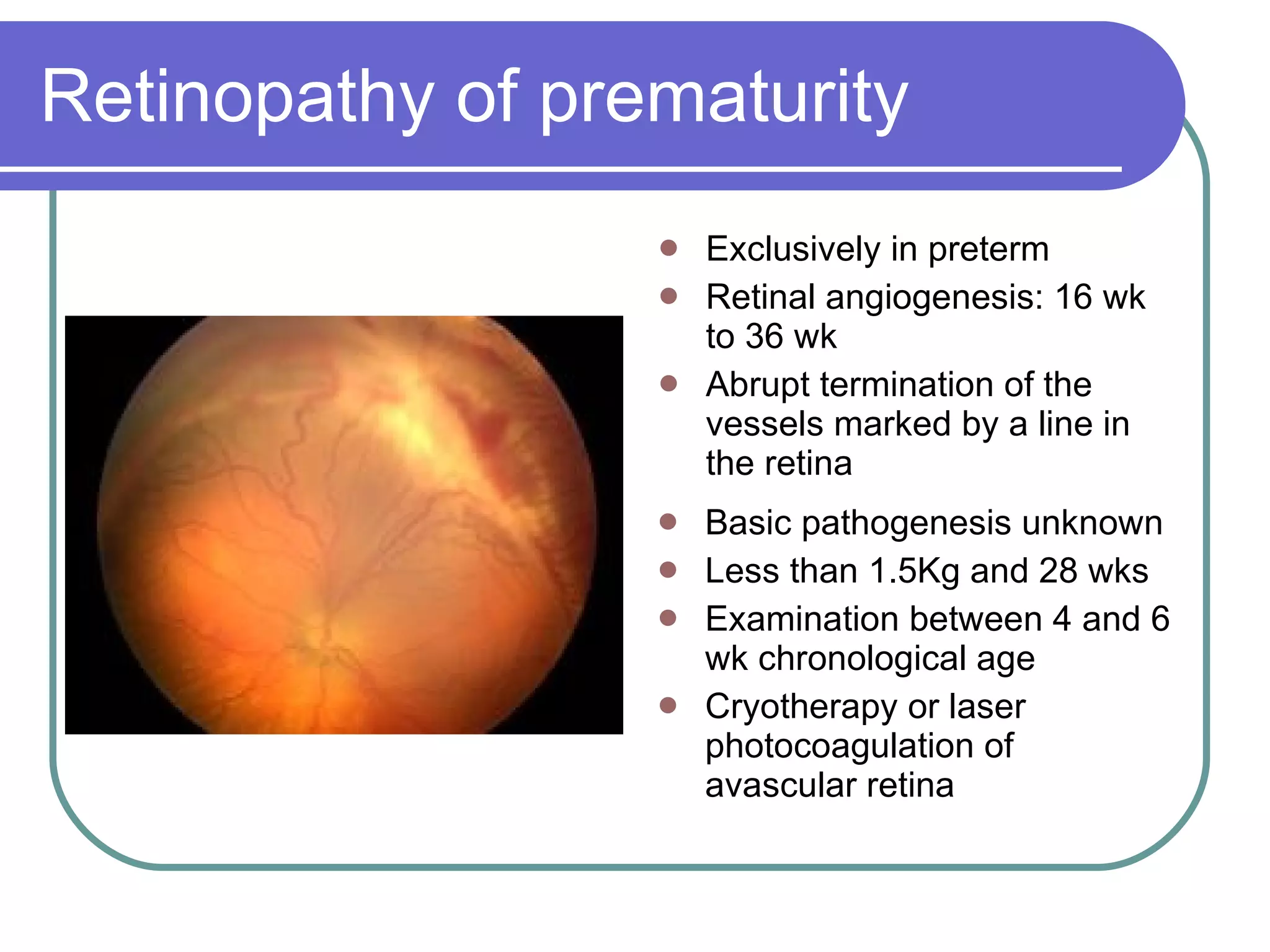
Retinopathy of prematurity Exclusively in preterm Retinal angiogenesis: 16 wk to 36 wk Abrupt termination of the vessels marked by a line in the retina Basic pathogenesis unknown Less than 1.5Kg and 28 wks Examination between 4 and 6 wk chronological age Cryotherapy or laser photocoagulation of avascular retina
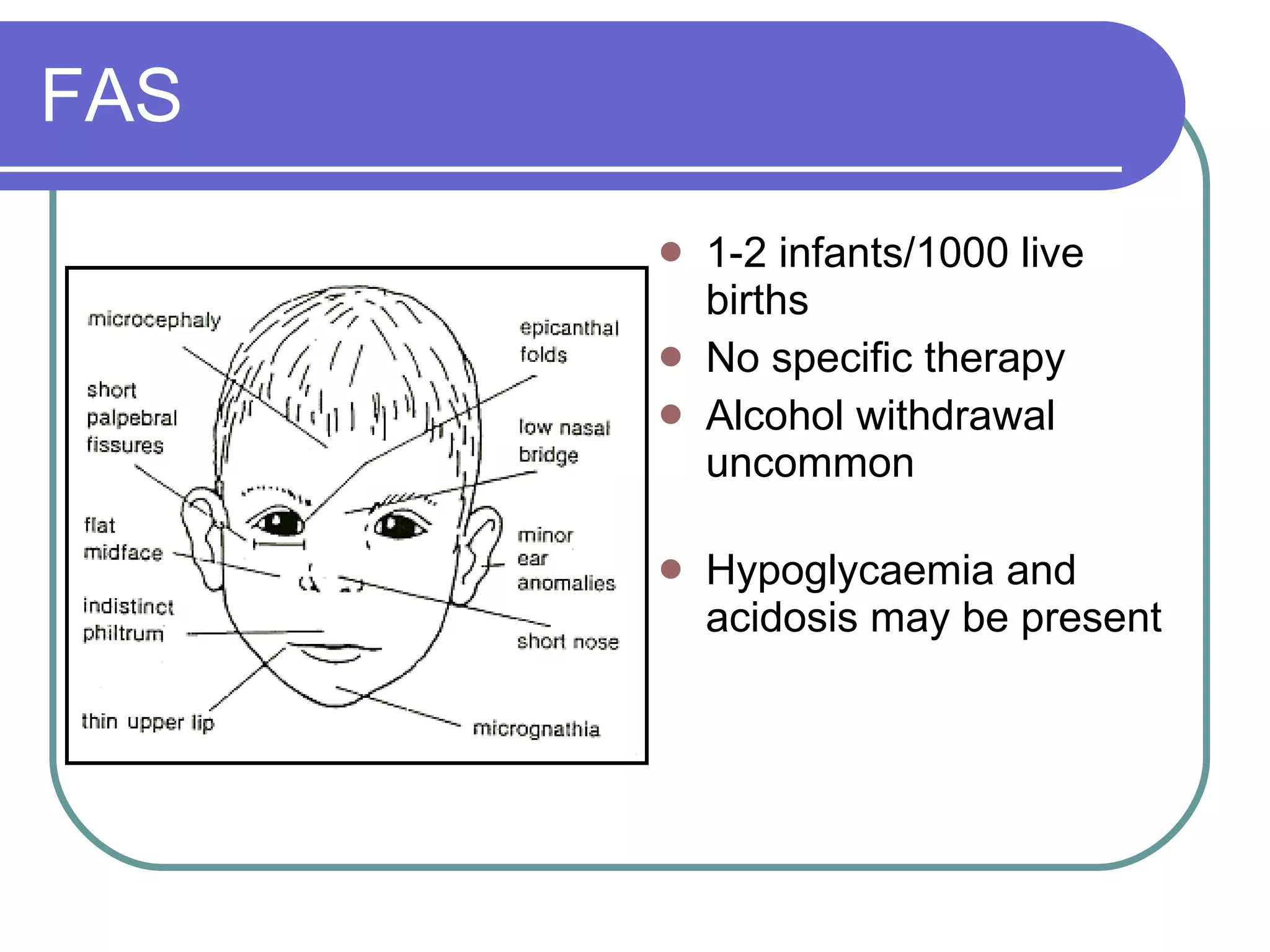
FAS 1-2 infants/1000 live births No specific therapy Alcohol withdrawal uncommon Hypoglycaemia and acidosis may be present
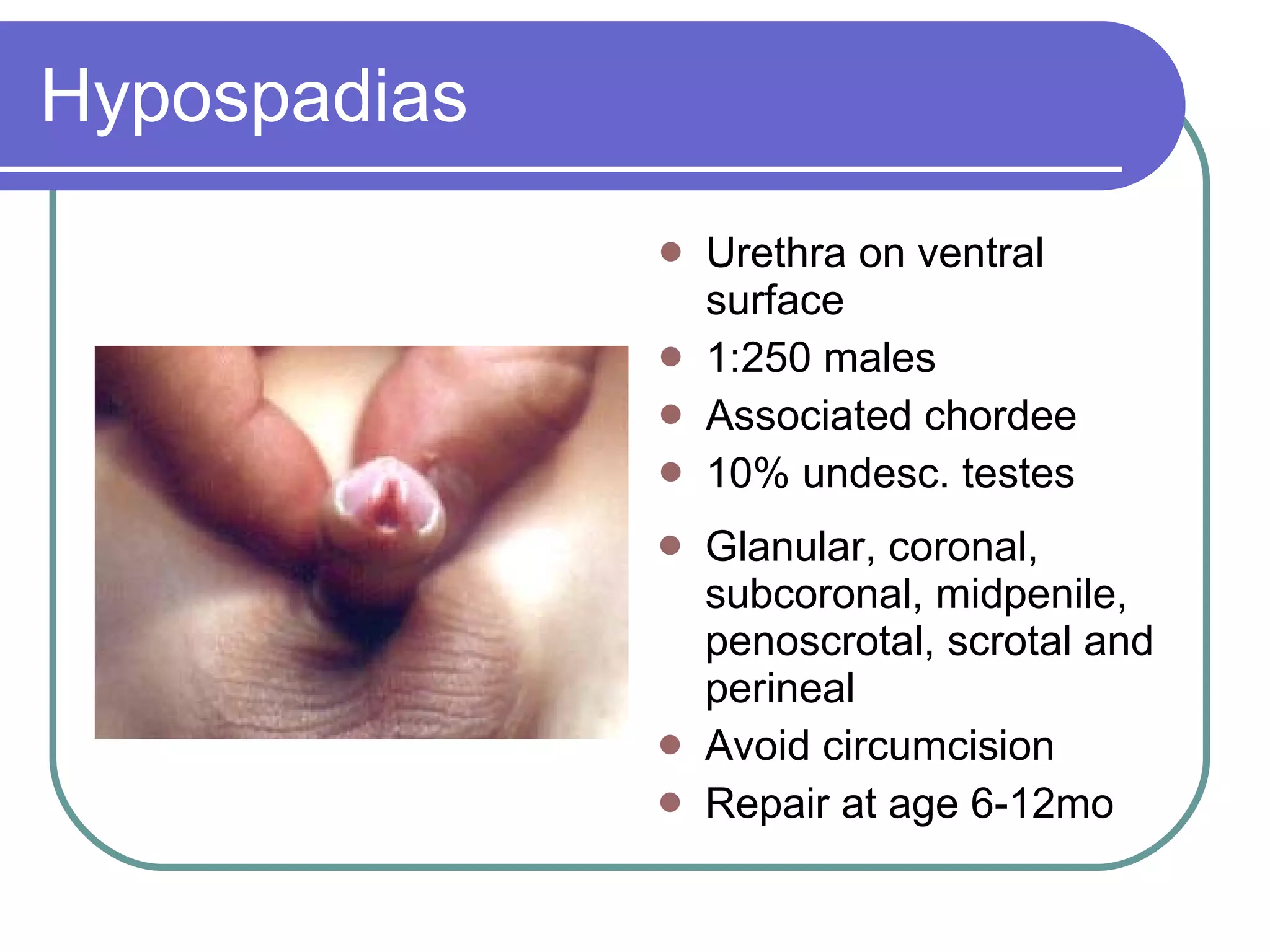
Hypospadias Urethra on ventral surface 1:250 males Associated chordee 10% undesc. testes Glanular, coronal, subcoronal, midpenile, penoscrotal, scrotal and perineal Avoid circumcision Repair at age 6-12mo
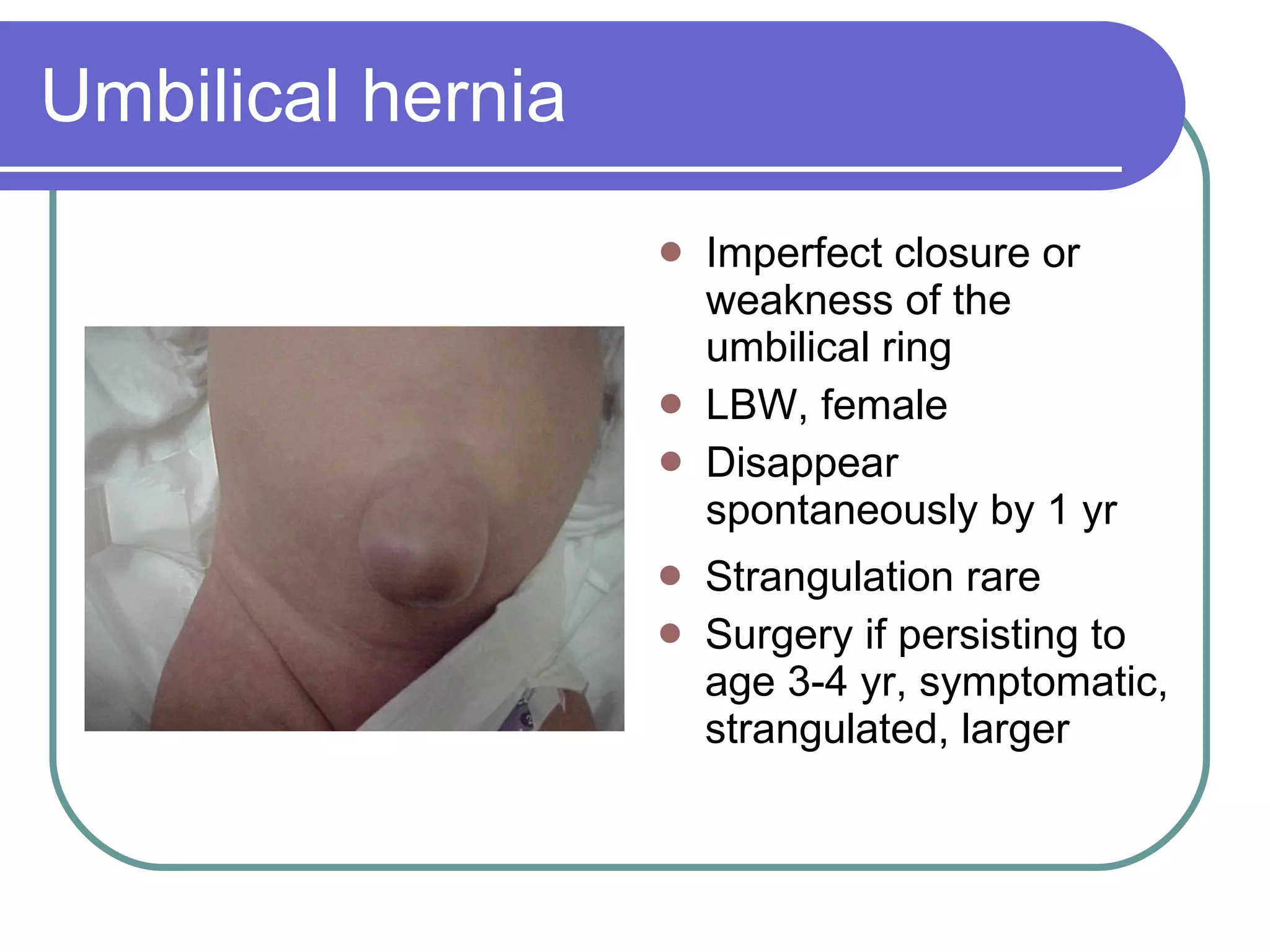
Umbilical hernia Imperfect closure or weakness of the umbilical ring LBW, female Disappear spontaneously by 1 yr Strangulation rare Surgery if persisting to age 3-4 yr, symptomatic, strangulated, larger
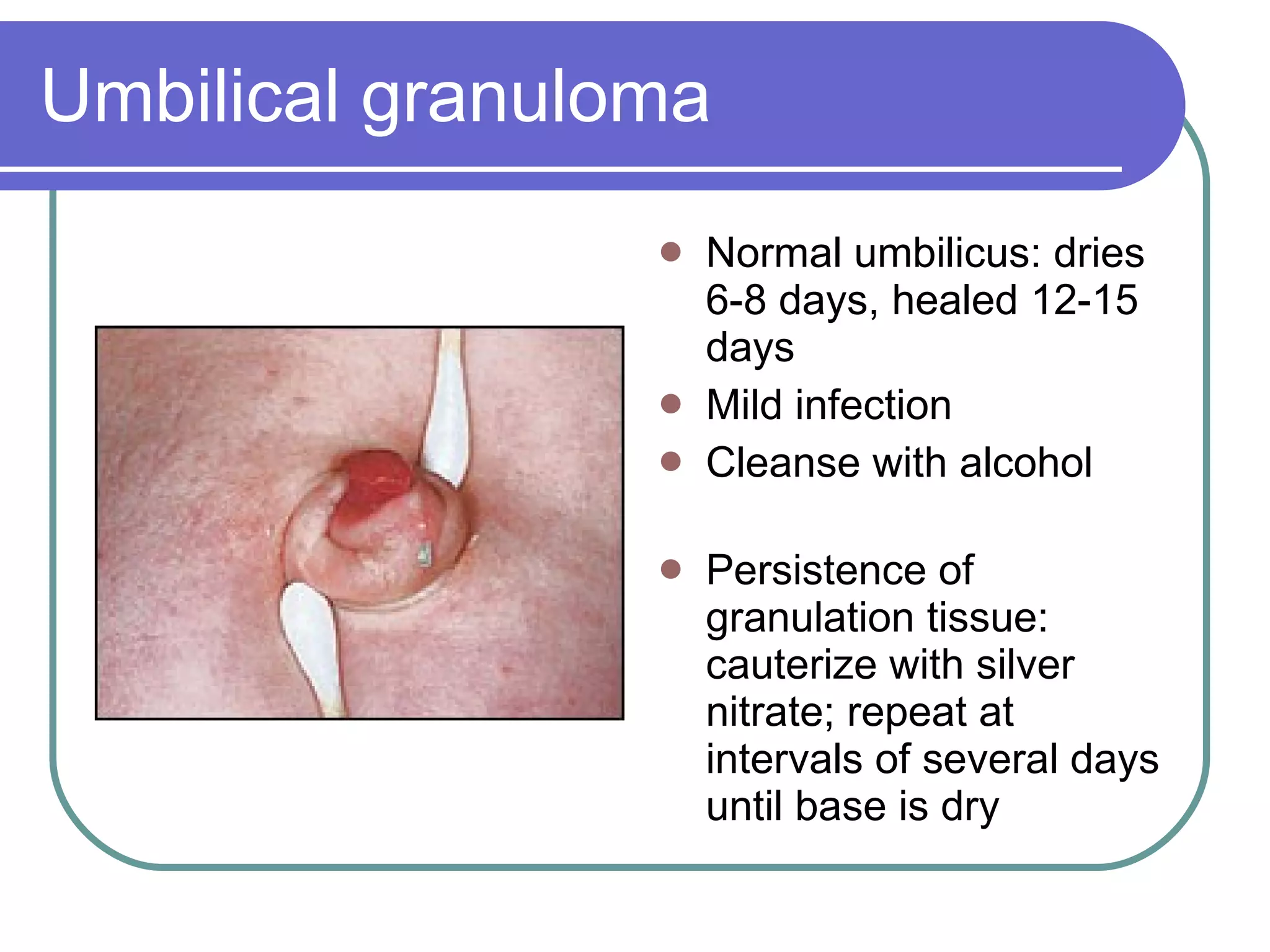
Umbilical granuloma Normal umbilicus: dries 6-8 days, healed 12-15 days Mild infection Cleanse with alcohol Persistence of granulation tissue: cauterize with silver nitrate; repeat at intervals of several days until base is dry
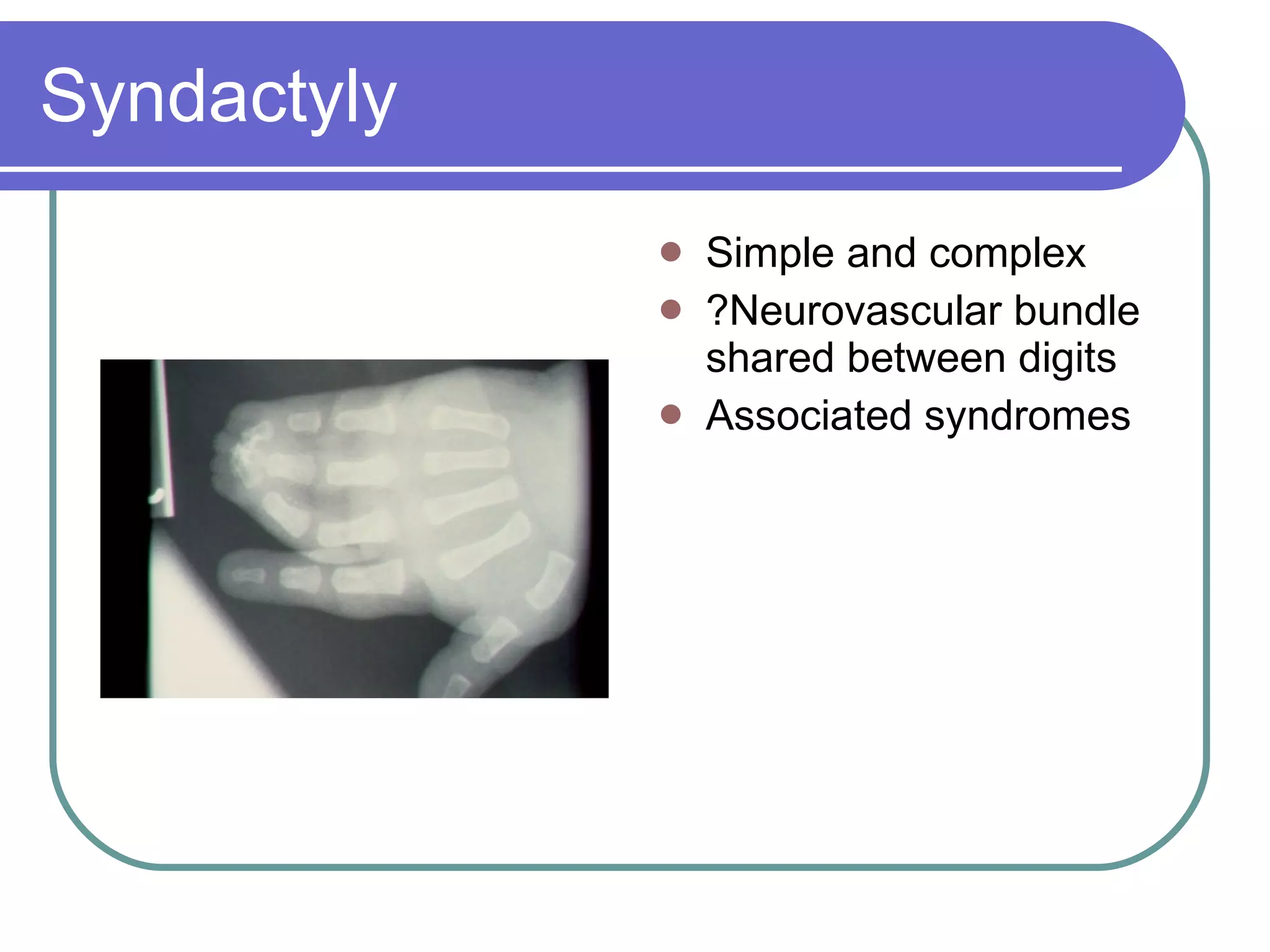
Syndactyly Simple and complex ?Neurovascular bundle shared between digits Associated syndromes
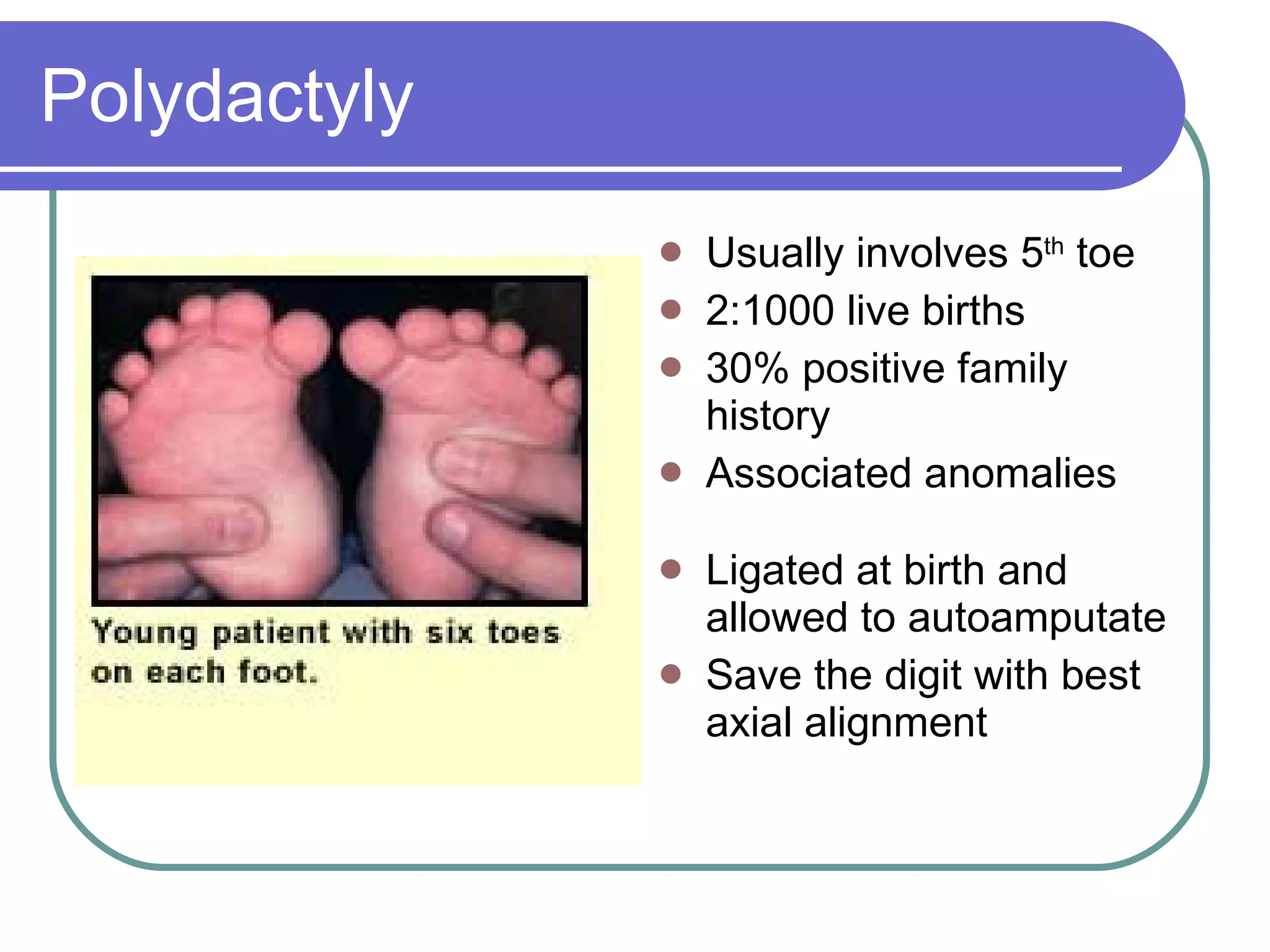
Polydactyly Usually involves 5 th  toe 2:1000 live births 30% positive family history Associated anomalies Ligated at birth and allowed to autoamputate Save the digit with best axial alignment
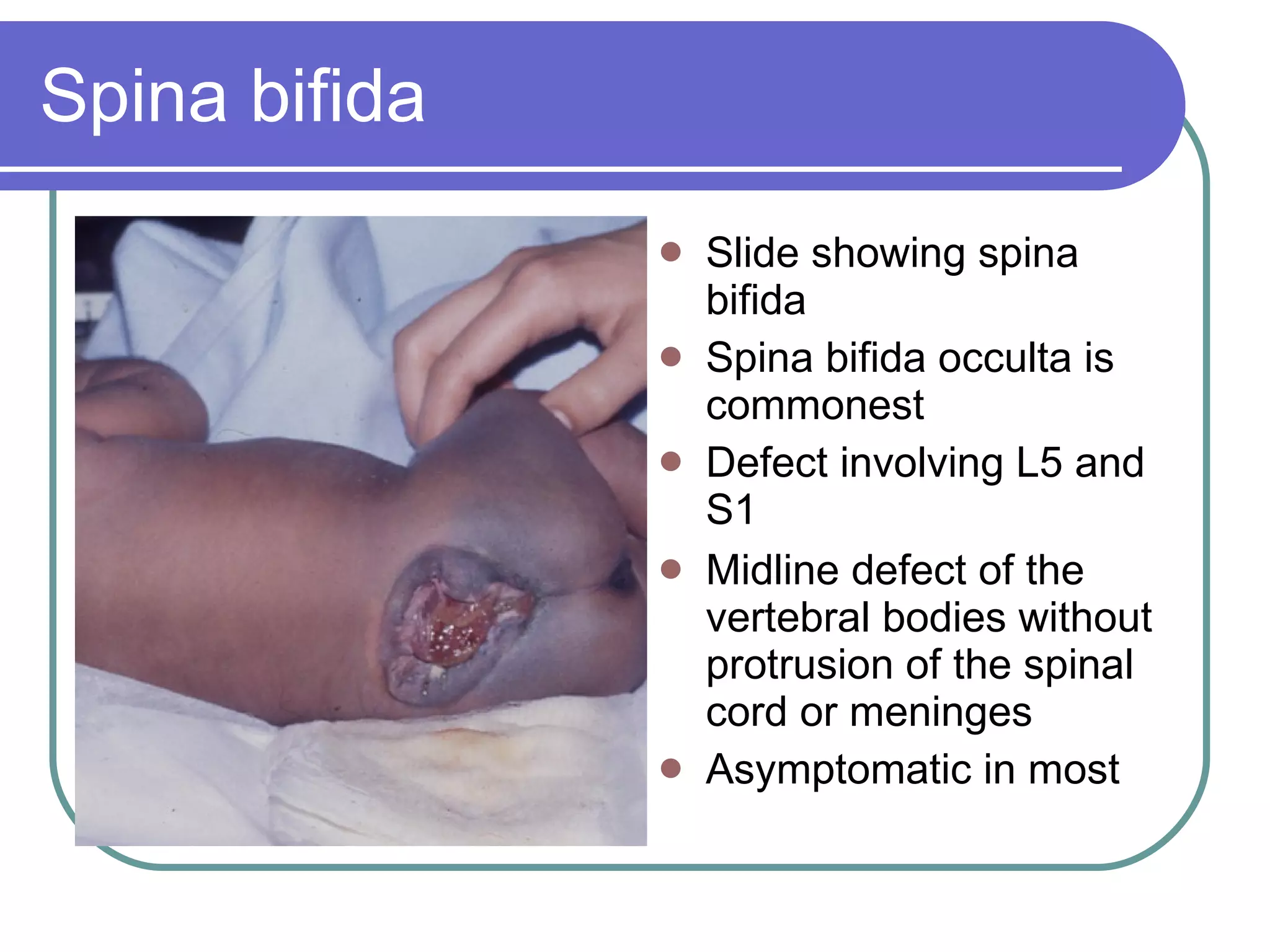
Spina bifida Slide showing spina bifida Spina bifida occulta is commonest Defect involving L5 and S1 Midline defect of the vertebral bodies without protrusion of the spinal cord or meninges Asymptomatic in most
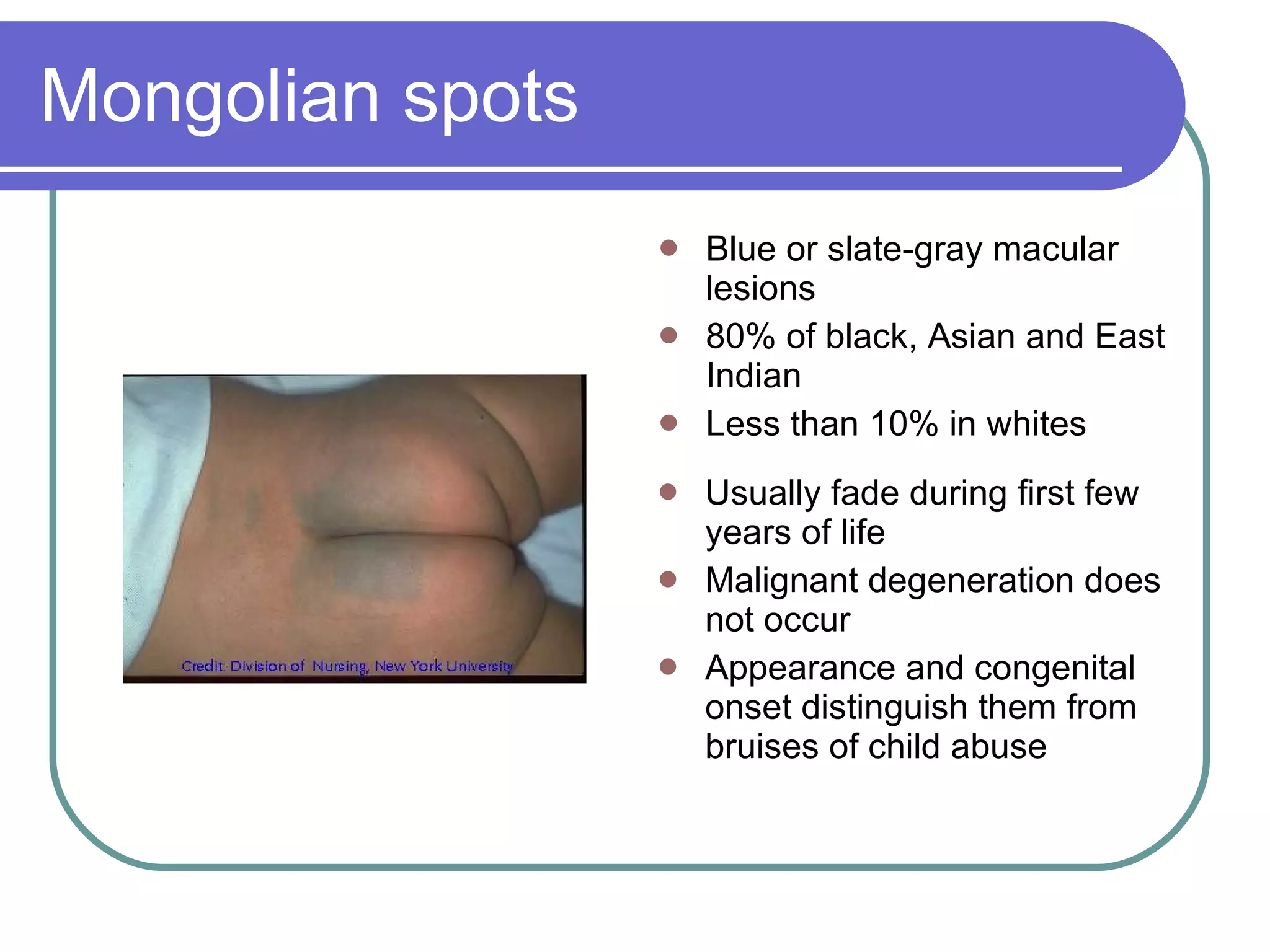
Mongolian spots Blue or slate-gray macular lesions 80% of black, Asian and East Indian Less than 10% in whites Usually fade during first few years of life Malignant degeneration does not occur Appearance and congenital onset distinguish them from bruises of child abuse
Thank you Please  click here  for the MS Word document with detailed text concerning the conditions described in this presentation

Neonatal Problems

  • 1.
    Postnatal and NeonatalProblems Dr Samarnath Sen MD,DCH,MRCPCH SpR North Western Deanery
  • 2.
    Congenital Diaphragmatic HerniaHerniation of abdominal contents Profound respiratory distress 1 in 5,000 live births Left (70-85%) 40%–50% mortality Extracorporeal membrane oxygenation (ECMO) preop
  • 3.
    Ureteropelvic junction obstructionIntrinsic stenosis Maternal USS 60% on the left side Corrected by pyeloplasty VCUG – 15% VUR Diagnosis difficult in asymptomatic infant with finding incidental Repeat USS Day 3 (newborn oliguria masks dilatation)
  • 4.
    Posterior Urethral ValvesOnly in boys 1:8000 30% end-stage renal disease Maternal USS Small feeding tube inserted Cr (normal) – transurethral ablation Cr (high) – vesicostomy Long term antimicrobial prophylaxis
  • 5.
    Gastroschisis Diagnosed ante-natally Gastric decompression Risk of short bowel syndrome Unlike omphalocoele, gastroschisis is not usually associated with other congenital abnormalities
  • 6.
    Congenital Omphalocoele Herniationof abdominal contents into the base of the umbilical cord Covered with peritoneum without overlying skin 1:5000 (herniation of intestines) Immediate surgical repair Associated with other congenital anomalies
  • 7.
    Undescended testes Failureto find one or both testes in the scrotum 4.5% of boys have an undescended testis Undescended testes are usually in the inguinal canal Risk of malignancy is 4 to 10 times Orchiopexy
  • 8.
    Anaemia Cord bloodhemoglobin is 16.8 g/dL (14–20 g/dL) Pallor, heart failure, shock Haemolytic disease of the newborn, transplacental haemorrhage Blood transfusion
  • 9.
    PDA Ductus remainspatent Term and preterm L to R shunt Small PDA – asymptomatic, ECG normal Large PDA – LVH or BVH Risk of IE Surgical closure
  • 10.
    Tetralogy of FallotL to R shunt in mild RVOO Cyanosis in 1 st year of life Severe cyanosis if ductus closes Exertional dyspnea Palliation or repair in infancy – relief of RVOO Endocarditis
  • 11.
    Icterus neonatorum Normal:1-3mg/dL, rising at 5mg/dL 24h Jaundice visible on 2 nd -3 rd day Peaks: 2 nd -4 th day term, and 4 th -7 th pre-term 6-7% term infants 2/3 term babies develop visible jaundice in 1 st wk
  • 12.
    GBS 40-70% ofinfants born to colonized mothers Early and late-onset Pneumonia, bacteremia 10% Meningitis Penicillin G Selective intrapartum chemoprophylaxis with Penicillin G or Ampicillin – PROM, prolonged labour, chorioamnionitis
  • 13.
    Gastro-oesophageal reflux IncompetentLES Mild – clinical assessment Severe – esophageal pH probe studies Thickeners – decreases volume of vomitus Cisapride, ?Metoclopramide Surgery – Nissen fundoplication
  • 14.
    Congenital hypothyroidism 1:4000Developmental defects account for 90% Serum T4 low Oral thyroxine
  • 15.
    Developmental Dysplasia ofthe Hip Hips at birth are dislocatable Typical and Teratologic Barlow test Beware hip clicks Ortolani and ‘clunk’ Treatment: human position, closed reduction, open reduction Avascular necrosis
  • 16.
    Retinopathy of prematurityExclusively in preterm Retinal angiogenesis: 16 wk to 36 wk Abrupt termination of the vessels marked by a line in the retina Basic pathogenesis unknown Less than 1.5Kg and 28 wks Examination between 4 and 6 wk chronological age Cryotherapy or laser photocoagulation of avascular retina
  • 17.
    FAS 1-2 infants/1000live births No specific therapy Alcohol withdrawal uncommon Hypoglycaemia and acidosis may be present
  • 18.
    Hypospadias Urethra onventral surface 1:250 males Associated chordee 10% undesc. testes Glanular, coronal, subcoronal, midpenile, penoscrotal, scrotal and perineal Avoid circumcision Repair at age 6-12mo
  • 19.
    Umbilical hernia Imperfectclosure or weakness of the umbilical ring LBW, female Disappear spontaneously by 1 yr Strangulation rare Surgery if persisting to age 3-4 yr, symptomatic, strangulated, larger
  • 20.
    Umbilical granuloma Normalumbilicus: dries 6-8 days, healed 12-15 days Mild infection Cleanse with alcohol Persistence of granulation tissue: cauterize with silver nitrate; repeat at intervals of several days until base is dry
  • 21.
    Syndactyly Simple andcomplex ?Neurovascular bundle shared between digits Associated syndromes
  • 22.
    Polydactyly Usually involves5 th toe 2:1000 live births 30% positive family history Associated anomalies Ligated at birth and allowed to autoamputate Save the digit with best axial alignment
  • 23.
    Spina bifida Slideshowing spina bifida Spina bifida occulta is commonest Defect involving L5 and S1 Midline defect of the vertebral bodies without protrusion of the spinal cord or meninges Asymptomatic in most
  • 24.
    Mongolian spots Blueor slate-gray macular lesions 80% of black, Asian and East Indian Less than 10% in whites Usually fade during first few years of life Malignant degeneration does not occur Appearance and congenital onset distinguish them from bruises of child abuse
  • 25.
    Thank you Please click here for the MS Word document with detailed text concerning the conditions described in this presentation