Jazz as a Metaphor for Agile Management

Loading...

Flash Player 9 (or above) is needed to view presentations.
We have detected that you do not have it on your computer. To install it, go here.

0 comments

Post a comment

    Post a comment
    Embed Video
    Edit your comment Cancel

    2 Favorites

    Jazz as a Metaphor for Agile Management - Presentation Transcript

    1. Jazz – A Metaphor for Agile Management
        • Charlie Berg [email_address]
        • August, '09
    2. The New Business Environment...
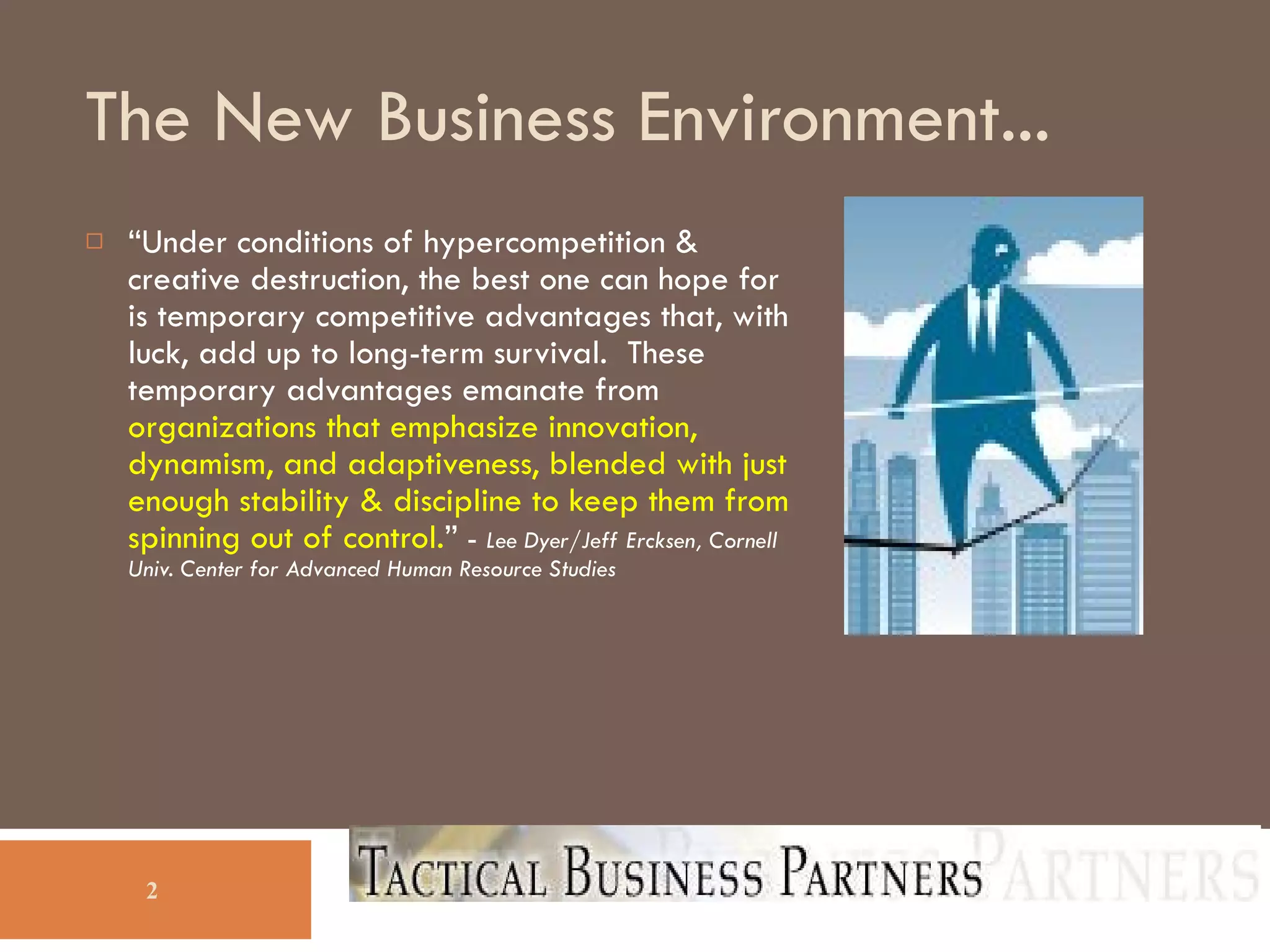
      • “ Under conditions of hypercompetition & creative destruction, the best one can hope for is temporary competitive advantages that, with luck, add up to long-term survival. These temporary advantages emanate from organizations that emphasize innovation, dynamism, and adaptiveness, blended with just enough stability & discipline to keep them from spinning out of control. ” - Lee Dyer/Jeff Ercksen, Cornell Univ. Center for Advanced Human Resource Studies
    3. Why Is Jazz a Useful Metaphor?
      • Jazz Bands are organizations that are:
        • Self-organizing
        • Self-motivated
        • Studied in their domain
        • Adept at change
        • Responsive to environment
      • Perfect development team model!
      • Jazz Bands can be viewed as Complex Adaptive Systems
    4. Complex Adaptive Systems (CAS)‏
      • Dynamic network of many agents acting in parallel, constantly acting and reacting to what the other agents are doing.
        • Constant interactions among agents amplify into bifurcations where agents forced to make choices. Feedback from these choices create additional bifurcations, additional choices, etc.
        • Subtle interplay of cooperation, competition, creation & adaptation
    5. Characteristics of CAS
      • Self-organizing – no one point of control
      • Operate at the edge of chaos
      • System Behavior & Solutions are emergent, not pre-determined
      • Maps to... " organizations that emphasize innovation, dynamism, and adaptiveness, blended with just enough stability & discipline to keep them from spinning out of control. ”
    6. Jazz Band on the Stand
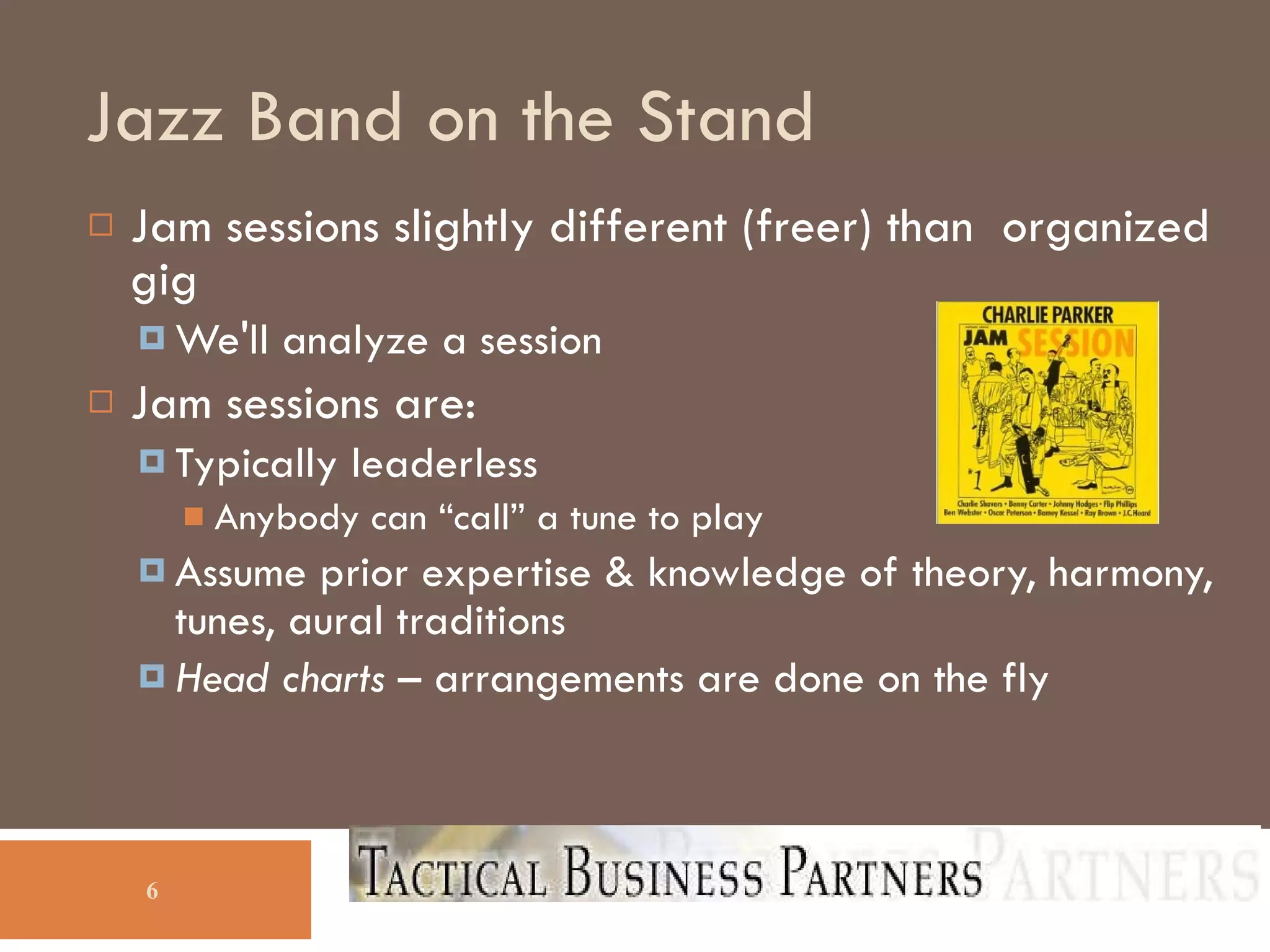
      • Jam sessions slightly different (freer) than organized gig
        • We'll analyze a session
      • Jam sessions are:
        • Typically leaderless
          • Anybody can “call” a tune to play
        • Assume prior expertise & knowledge of theory, harmony, tunes, aural traditions
        • Head charts – arrangements are done on the fly
    7. Sidebar – Aural Tradition
      • A particular musical phrase or snippet that is associated with a particular jazz standard
      • Ex: Standard bebop intro to All the Things You Are
        • Created by Dizzy Gillespie (1944 or 1945)‏
        • Based on Rachmaninoff Prelude in C sharp minor
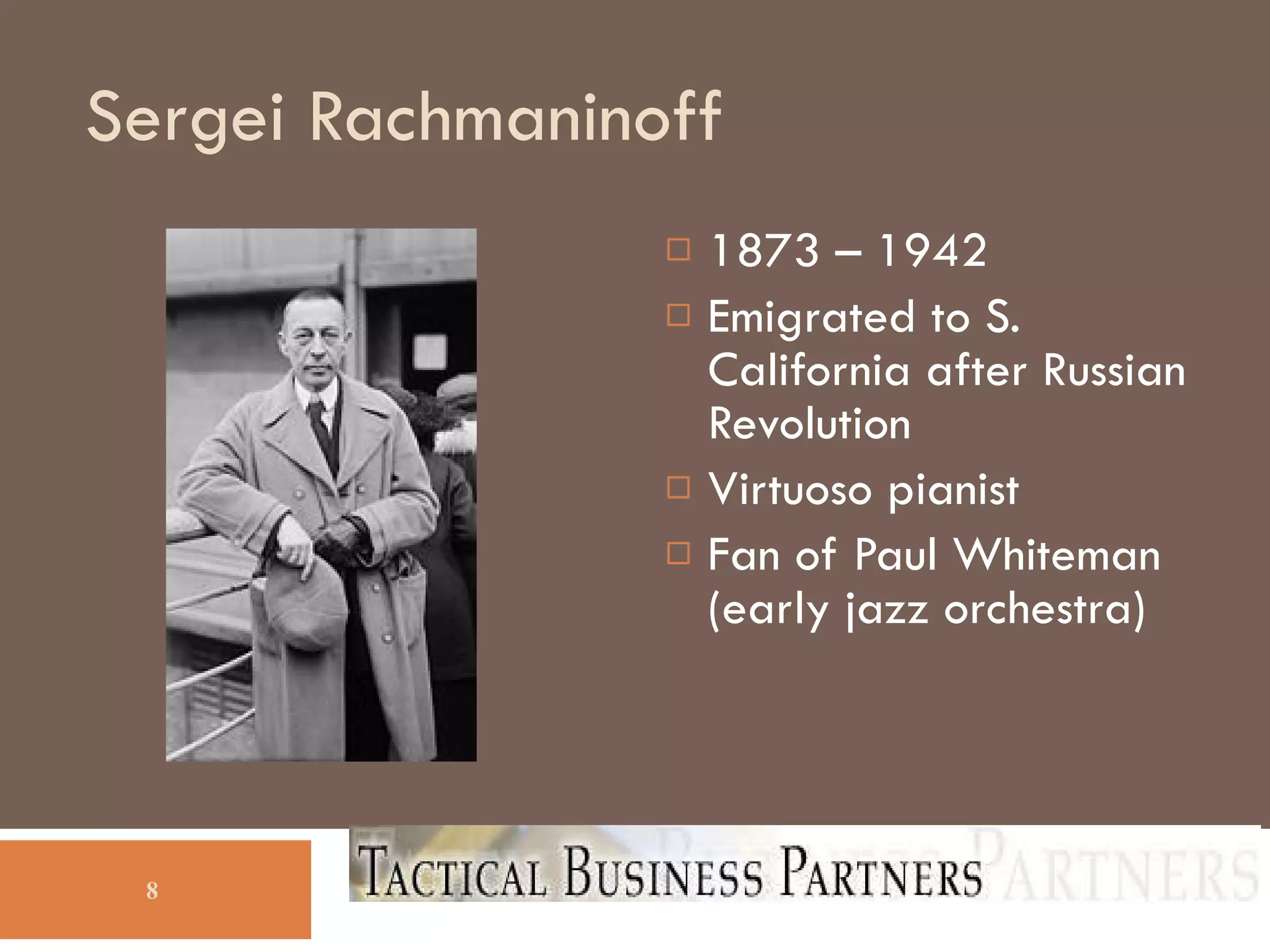
    8. Sergei Rachmaninoff
      • 1873 – 1942
      • Emigrated to S. California after Russian Revolution
      • Virtuoso pianist
      • Fan of Paul Whiteman (early jazz orchestra)‏
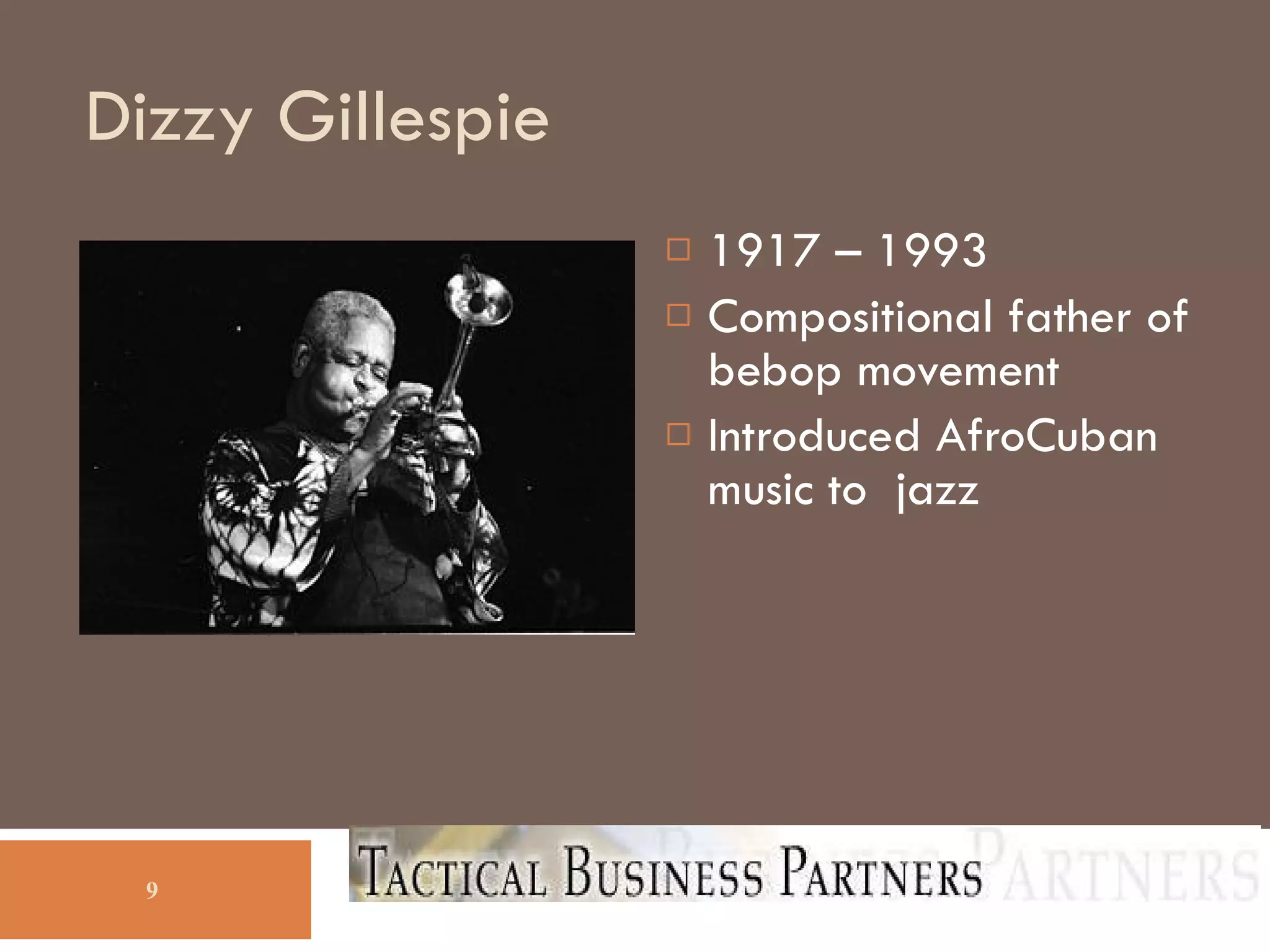
    9. Dizzy Gillespie
      • 1917 – 1993
      • Compositional father of bebop movement
      • Introduced AfroCuban music to jazz
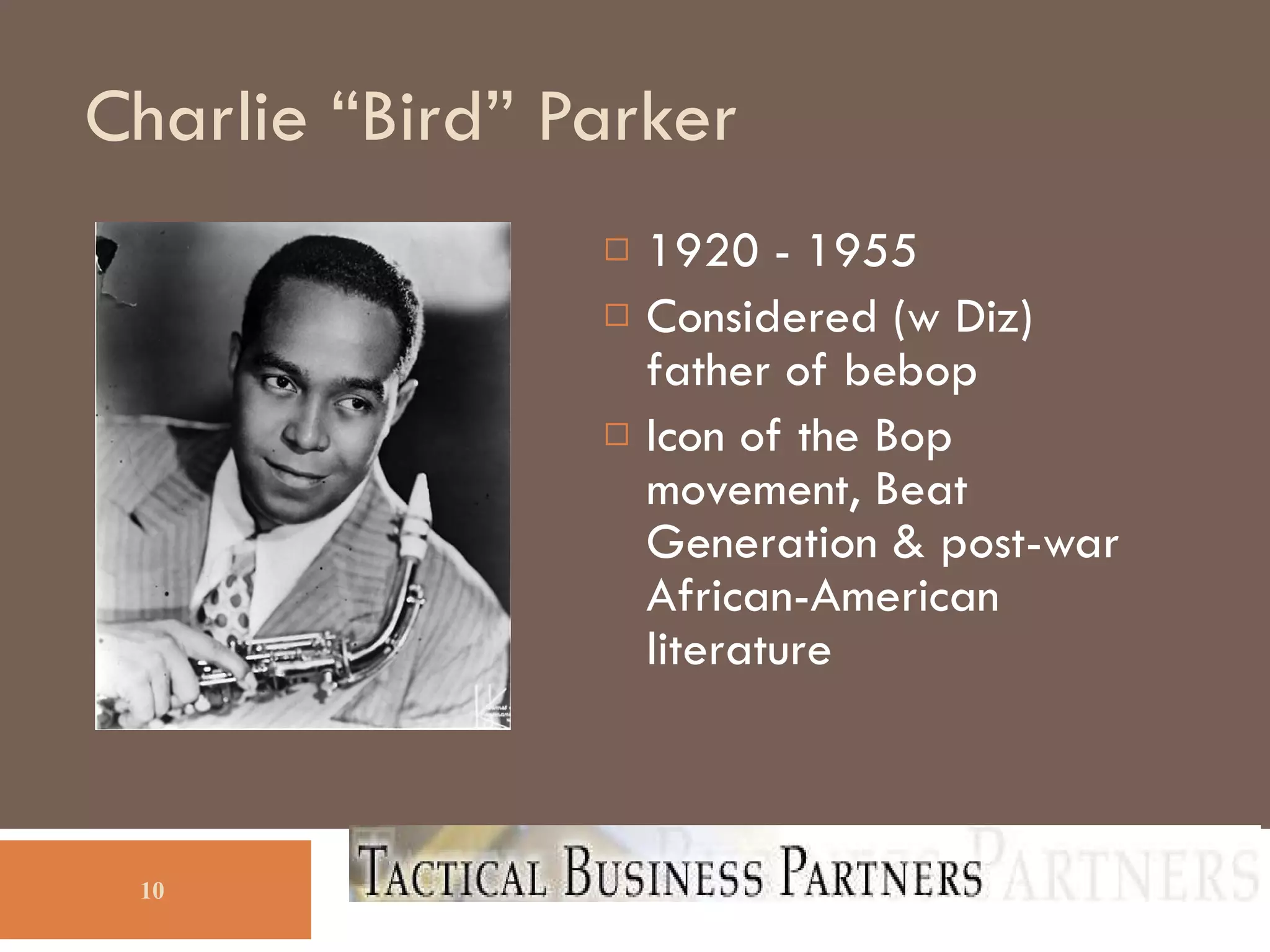
    10. Charlie “Bird” Parker
      • 1920 - 1955
      • Considered (w Diz) father of bebop
      • Icon of the Bop movement, Beat Generation & post-war African-American literature
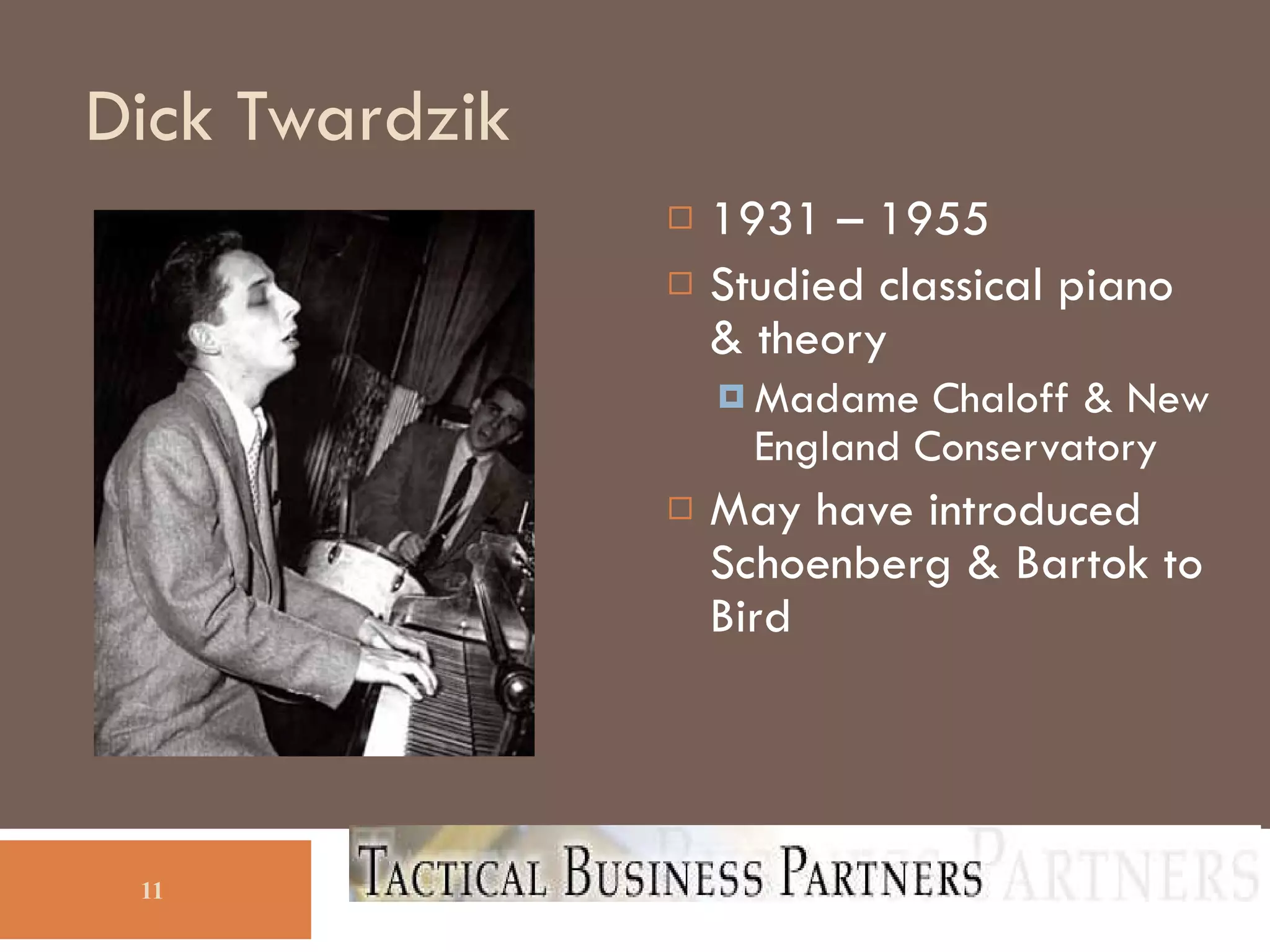
    11. Dick Twardzik
      • 1931 – 1955
      • Studied classical piano & theory
        • Madame Chaloff & New England Conservatory
      • May have introduced Schoenberg & Bartok to Bird
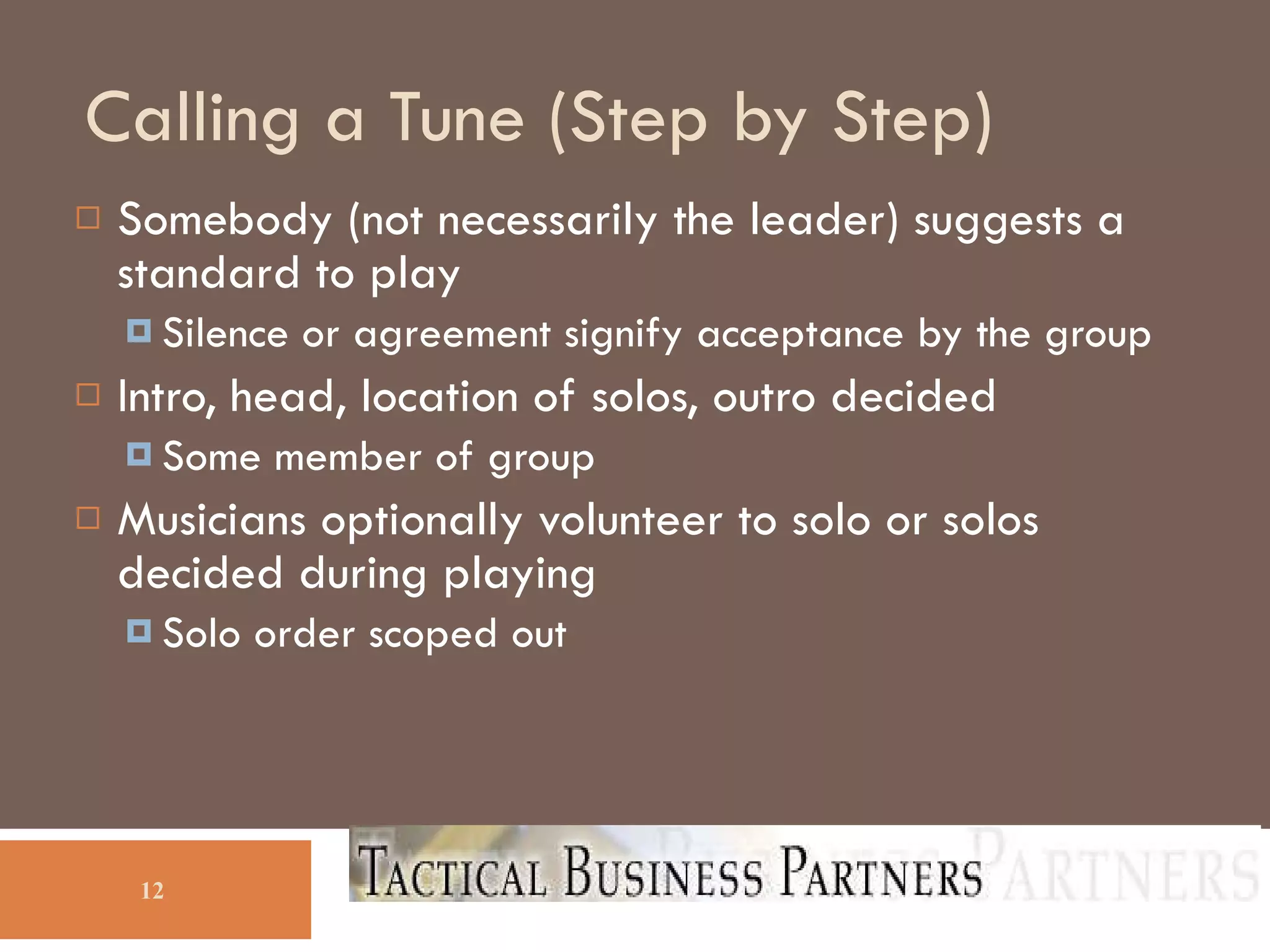
    12. Calling a Tune (Step by Step)‏
      • Somebody (not necessarily the leader) suggests a standard to play
        • Silence or agreement signify acceptance by the group
      • Intro, head, location of solos, outro decided
        • Some member of group
      • Musicians optionally volunteer to solo or solos decided during playing
        • Solo order scoped out
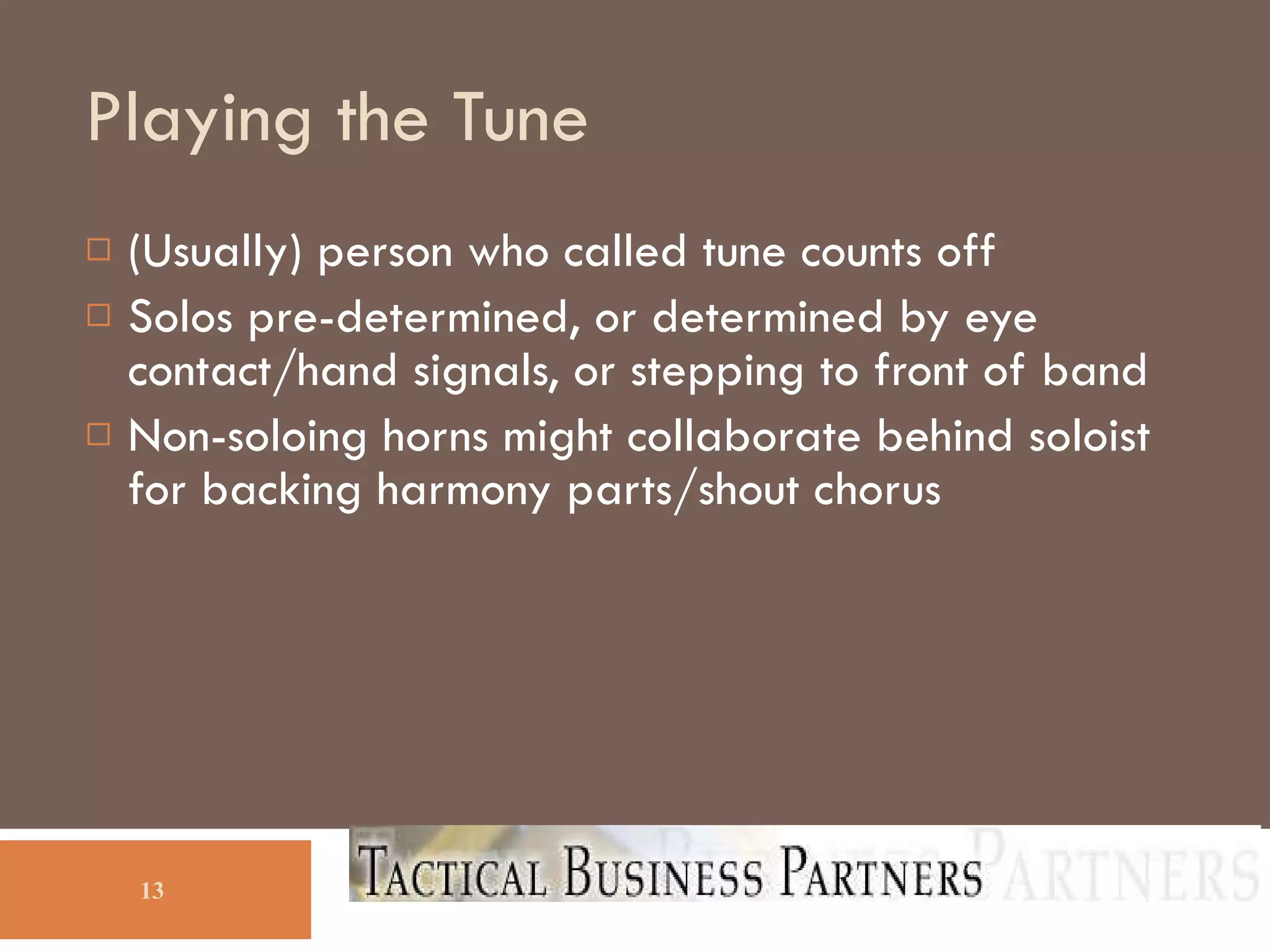
    13. Playing the Tune
      • (Usually) person who called tune counts off
      • Solos pre-determined, or determined by eye contact/hand signals, or stepping to front of band
      • Non-soloing horns might collaborate behind soloist for backing harmony parts/shout chorus
    14. Ending the Tune
      • Hand-signals or shout-out to return to head
      • Hand-signals to end
      • Rhythm section or lead horn will provide aural queues for ending
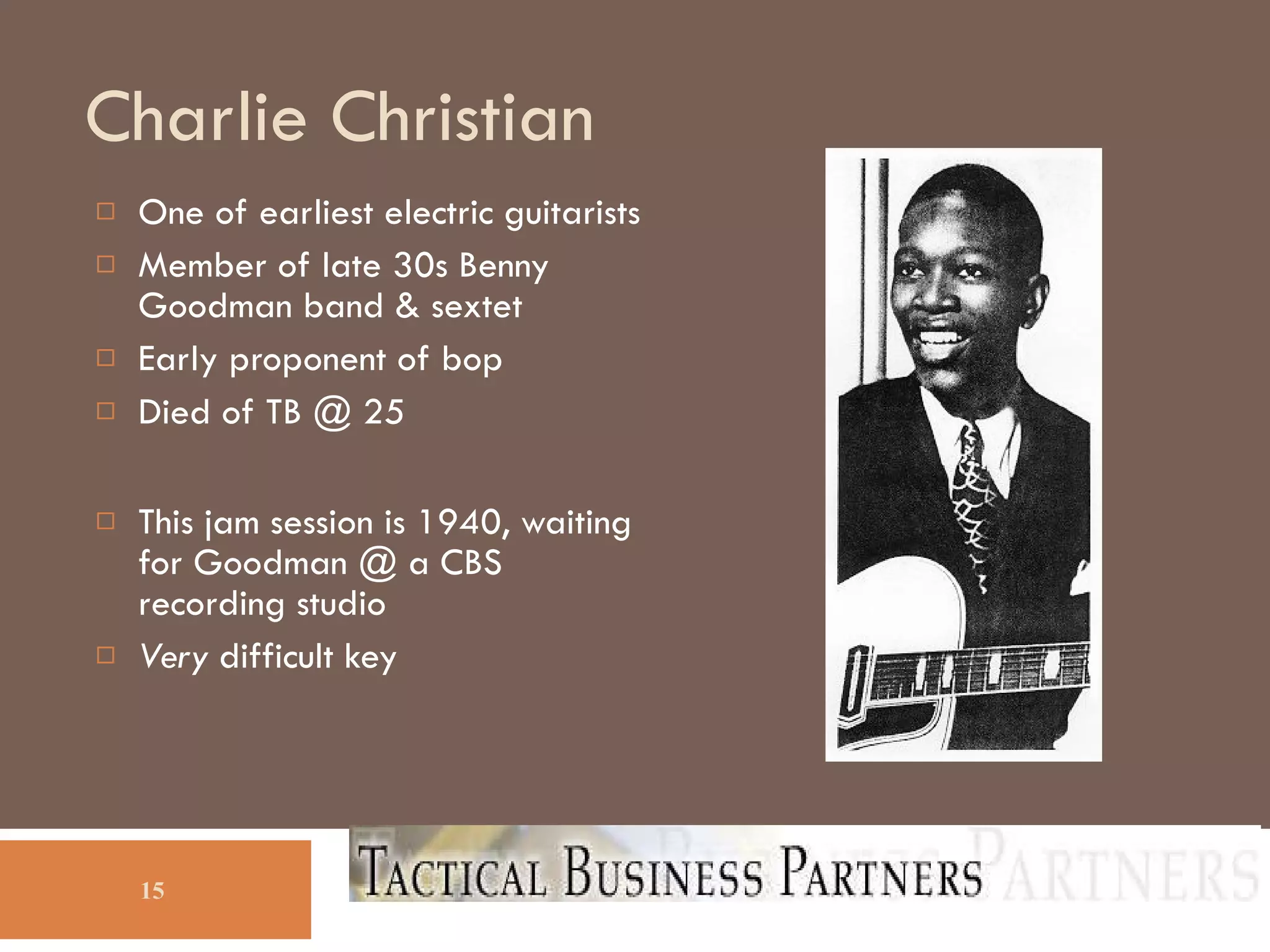
    15. Charlie Christian
      • One of earliest electric guitarists
      • Member of late 30s Benny Goodman band & sextet
      • Early proponent of bop
      • Died of TB @ 25
      • This jam session is 1940, waiting for Goodman @ a CBS recording studio
      • Very difficult key
    16. Ella Fitzgerald with... http://www.youtube.com/watch?v=7WgloYX44F4
      • Open separate browser window to above URL
        • Slideshare doesn't support video AND audio tracks!!!
      • Roy Eldridge (trumpet)‏
        • Known as influence of Dizzy, Miles
        • Fierce session competitor
      • Eddie “Lockjaw” Davis (tenor sax)‏
        • Hard bopper – Basie in the late 40s
      • Tommy Flanagan (piano)‏
        • Ella's accompanist
        • Well known bop pianist
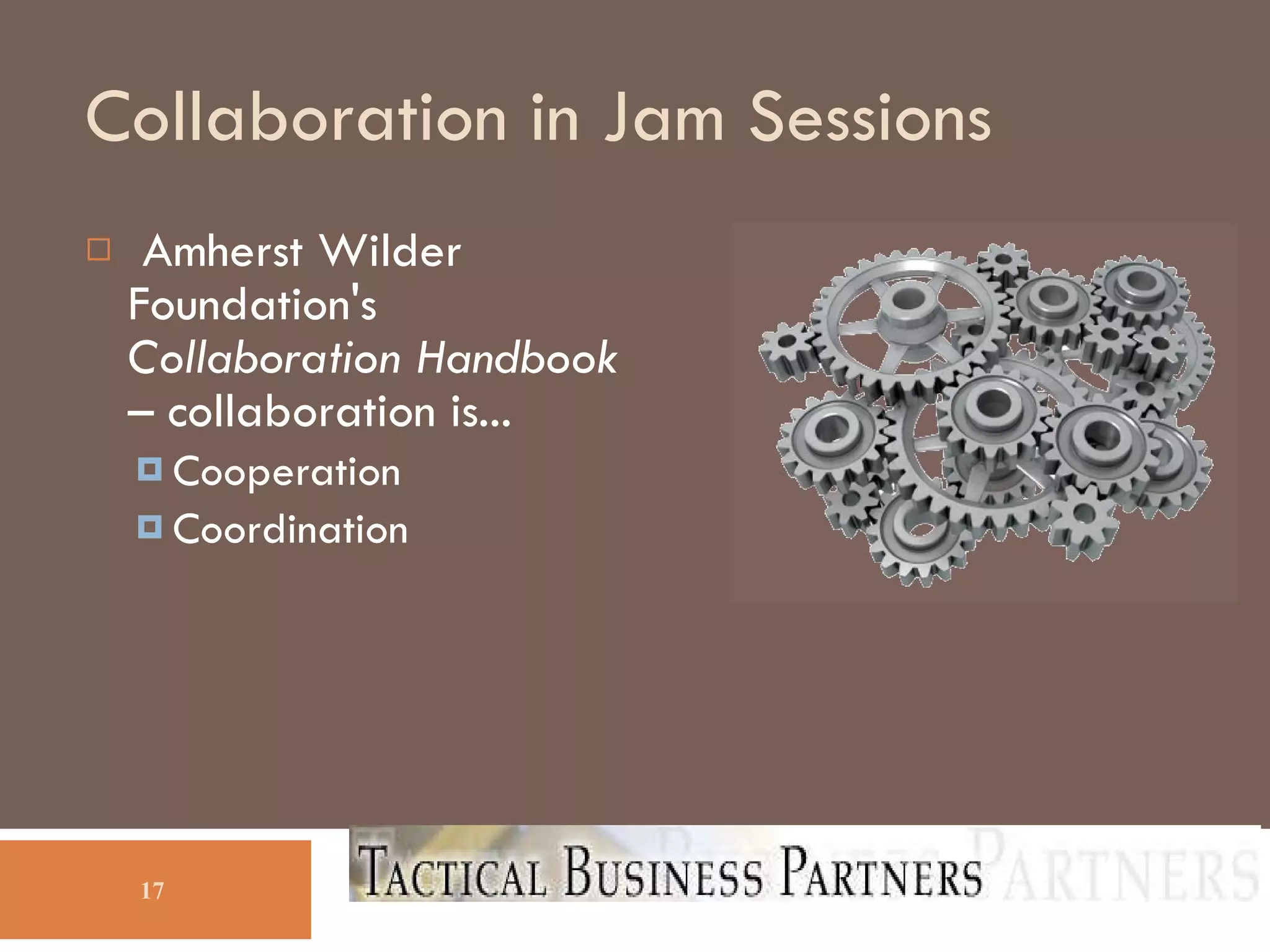
    17. Collaboration in Jam Sessions
      • Amherst Wilder Foundation's Collaboration Handbook – collaboration is...
        • Cooperation
        • Coordination
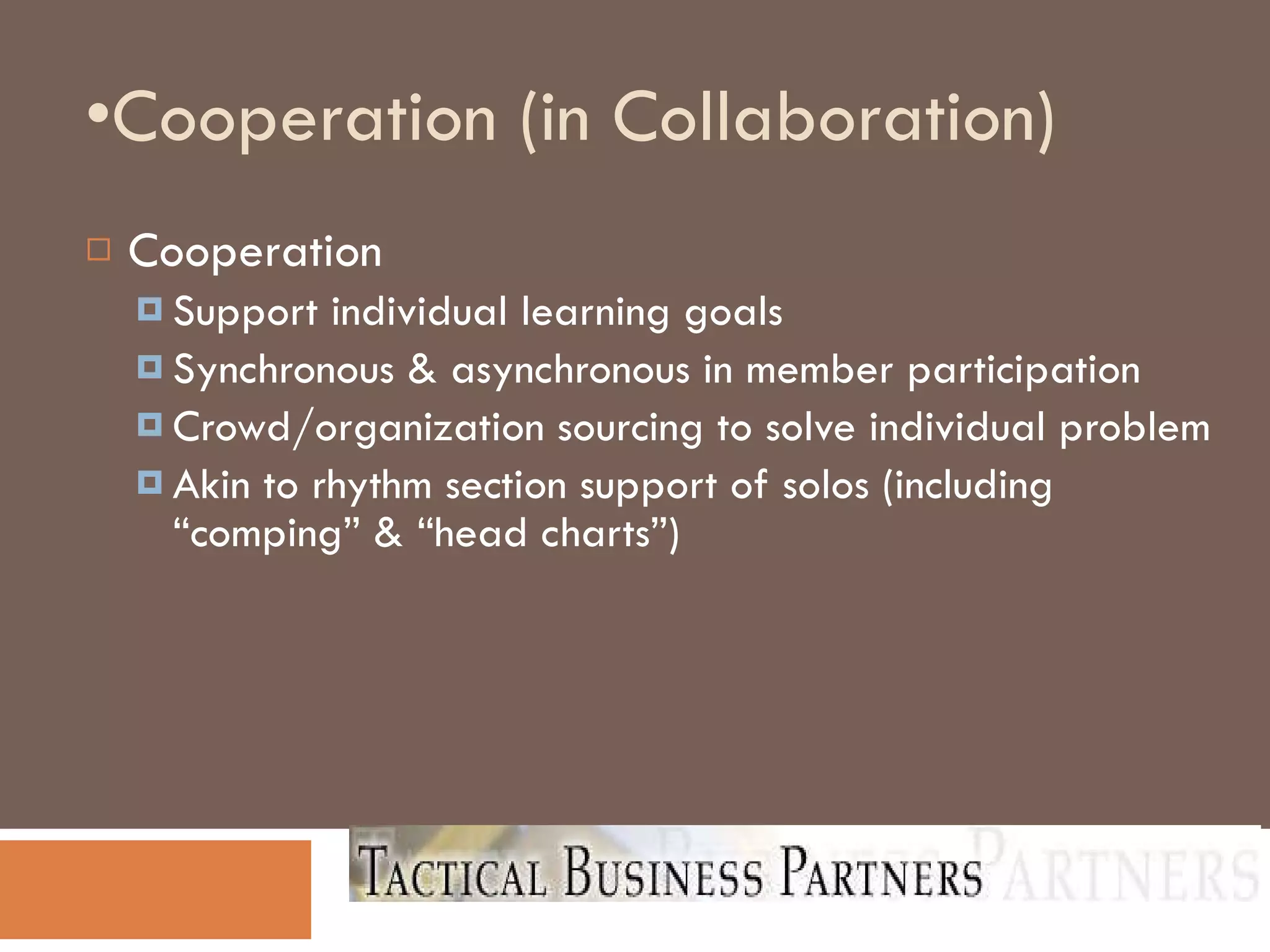
      • Cooperation (in Collaboration)‏
      • Cooperation
        • Support individual learning goals
        • Synchronous & asynchronous in member participation
        • Crowd/organization sourcing to solve individual problem
        • Akin to rhythm section support of solos (including “comping” & “head charts”)‏
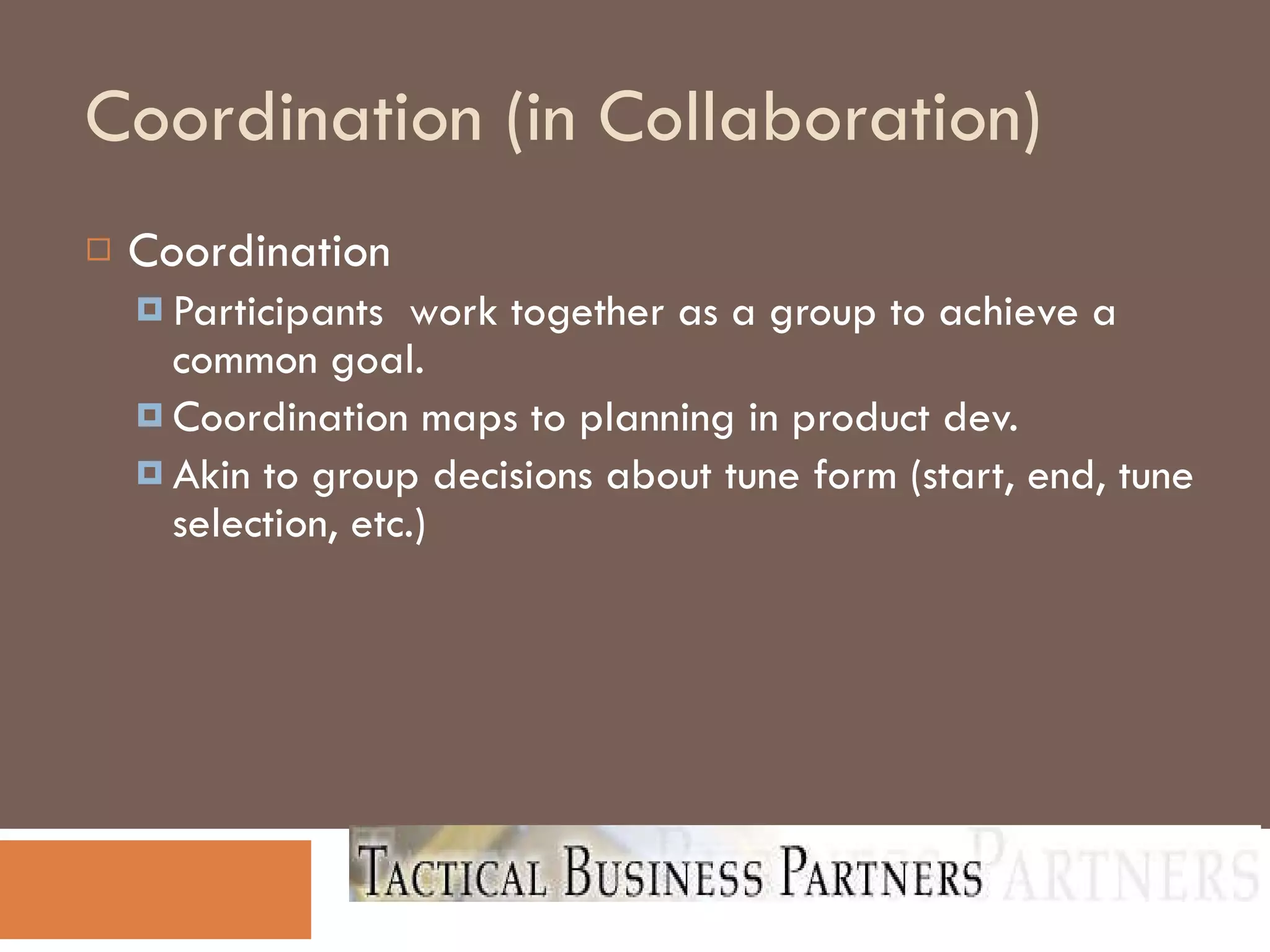
    18. Coordination (in Collaboration)‏
      • Coordination
        • Participants work together as a group to achieve a common goal.
        • Coordination maps to planning in product dev.
        • Akin to group decisions about tune form (start, end, tune selection, etc.)‏
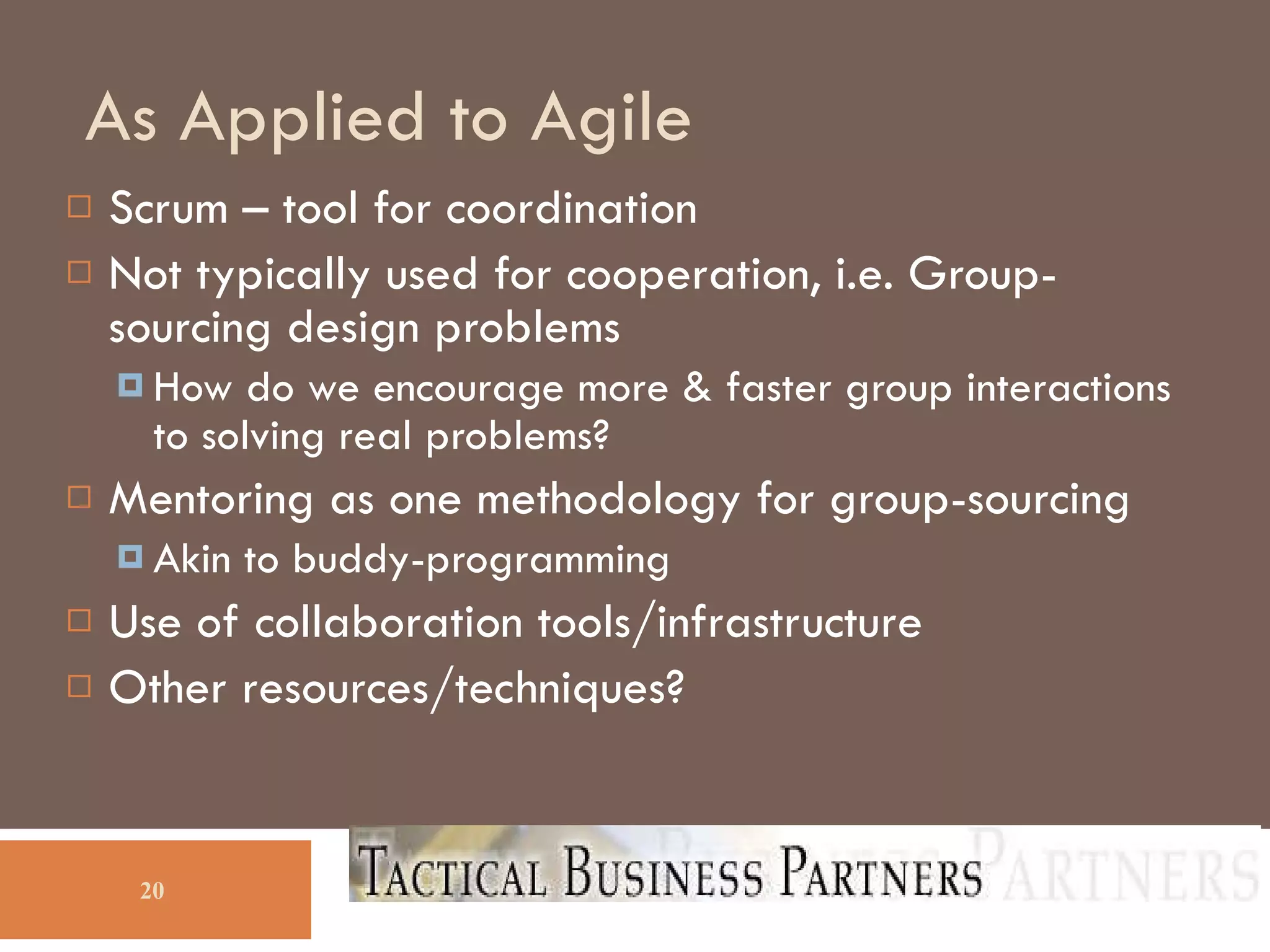
    19. As Applied to Agile
      • Scrum – tool for coordination
      • Not typically used for cooperation, i.e. Group-sourcing design problems
        • How do we encourage more & faster group interactions to solving real problems?
      • Mentoring as one methodology for group-sourcing
        • Akin to buddy-programming
      • Use of collaboration tools/infrastructure
      • Other resources/techniques?
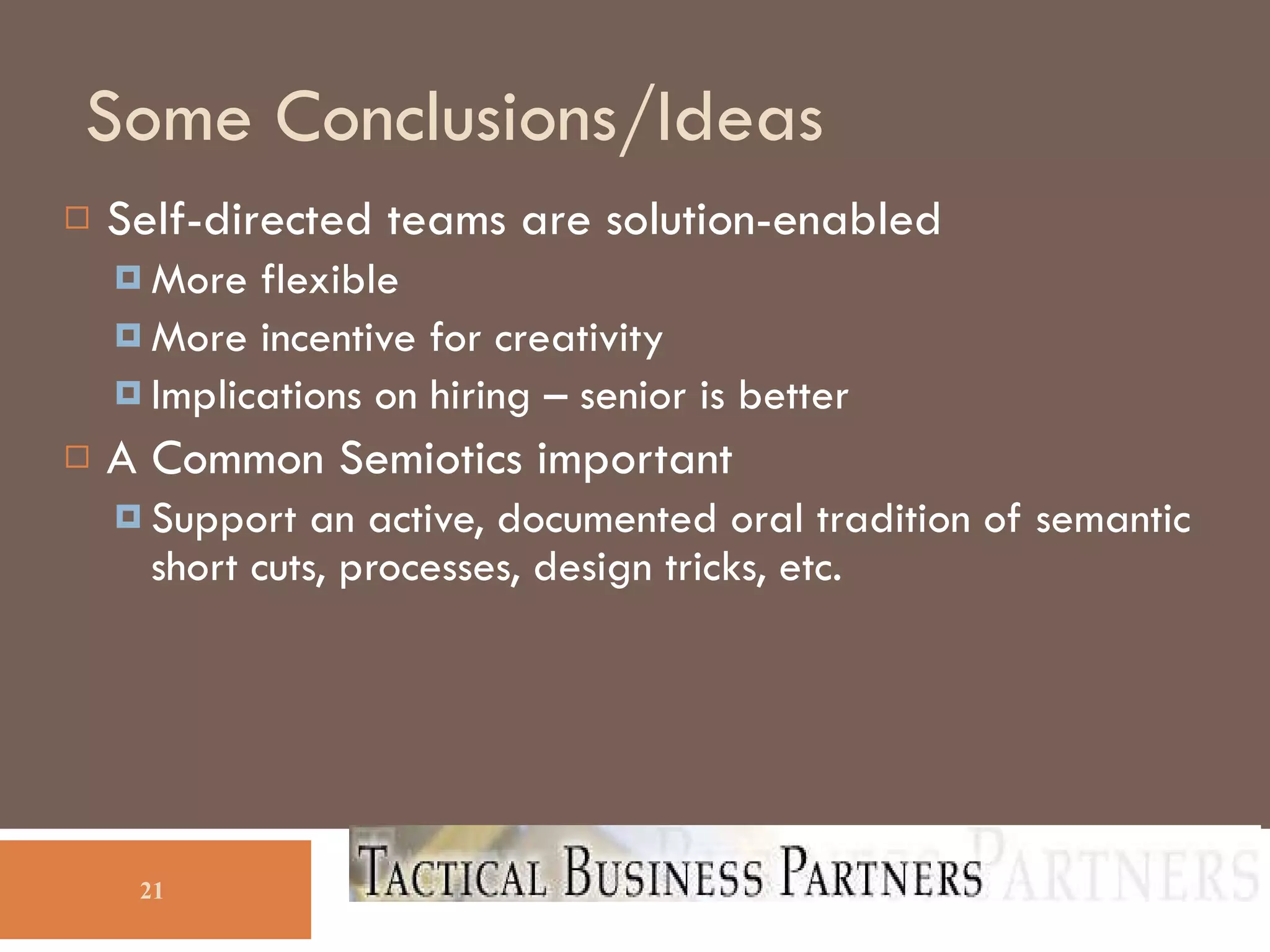
    20. Some Conclusions/Ideas
      • Self-directed teams are solution-enabled
        • More flexible
        • More incentive for creativity
        • Implications on hiring – senior is better
      • A Common Semiotics important
        • Support an active, documented oral tradition of semantic short cuts, processes, design tricks, etc.
    21. Some Conclusions/Ideas
      • Common tools for
        • Creativity
        • Self-Management
        • Solution-finding tools
      • Collaboration acceleration is key
        • Coordination is pretty well covered in Agile methodologies – what about cooperation to solve design problems?
    22. The Goal...
      • How do we get the rate of collaboration in jam session to product development?
      • Your chorus...fall in!
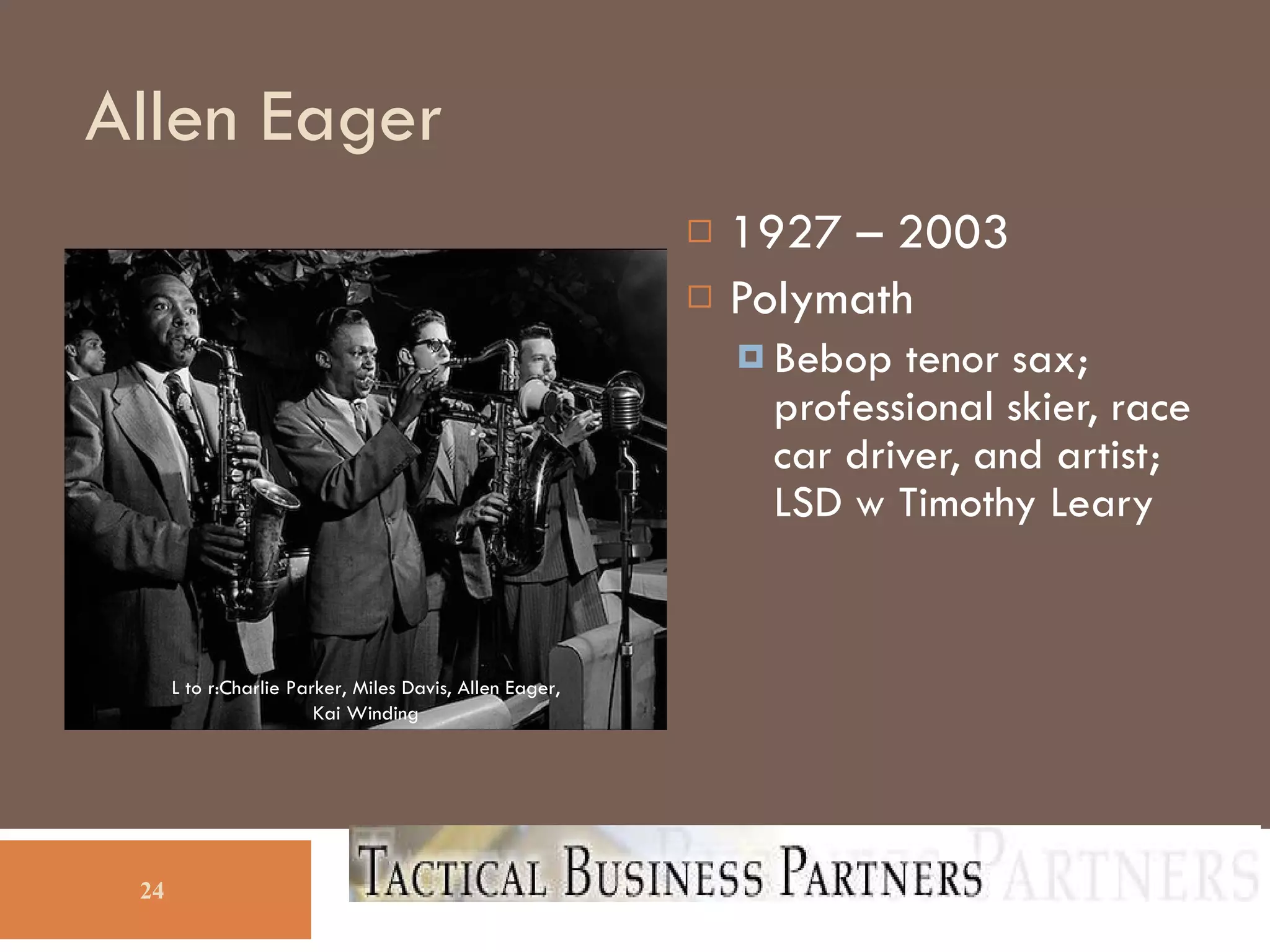
    23. Allen Eager
      • 1927 – 2003
      • Polymath
        • Bebop tenor sax; professional skier, race car driver, and artist; LSD w Timothy Leary
      L to r:Charlie Parker, Miles Davis, Allen Eager, Kai Winding
    SlideShare Zeitgeist 2009

    + Charlie BergCharlie Berg Nominate

    custom

    277 views, 2 favs, 1 embeds more stats

    Part of a larger presentation on Jazz as a metaphor more

    More info about this document

    © All Rights Reserved

    Go to text version

    • Total Views 277
      • 273 on SlideShare
      • 4 from embeds
    • Comments 0
    • Favorites 2
    • Downloads 0
    Most viewed embeds
    • 4 views on http://www.reginamullen.com

    more

    All embeds
    • 4 views on http://www.reginamullen.com

    less

    Flagged as inappropriate Flag as inappropriate
    Flag as inappropriate

    Select your reason for flagging this presentation as inappropriate. If needed, use the feedback form to let us know more details.

    Cancel
    File a copyright complaint
    Having problems? Go to our helpdesk?

    Categories