The Jazz ManifestoPRESENTED BY Andrew Coote and featuringAlan Cameron on KeyboardsChris Tokalon on SaxophoneWesley Rustin on Double BassRicardo Simon on Drums
Highly SkilledWe know our instrumentsWe know the Jazz repertoire – the “Standards”In each song we all knowHeadChord structureFormGrooveKey
Self ManagingKnow the Rules and Permutations:TempoStyleForm Pace the delivery (for us and the audience)Manage our own input/outputMaintain the continuity
SpecializedSubject experts - Aim to master main instrumentBut we understand each others instrumentsDiverse backgroundsDefined rolesNo one LeaderPeople/Role interchange
CollaborativeListenBuild on others’ ideasCommunicate our intentionsProvide feedbackShared sense of purpose/vision
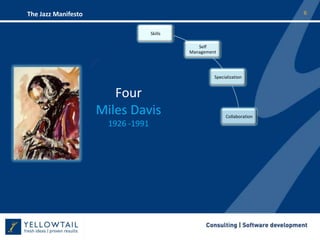
SkillsSelf ManagementSpecializationFourMiles Davis1926 -1991Collaboration
AdaptationReady for changeAdapt to what colleagues are doing Compliment the flowReady to move into the lead Turn mistakes into innovationExperience allows us to anticipate change
InnovationIncremental/Spontaneous innovationsUse our Creativity to extend the themeNatural creative exploration – influences/inspirationSystemic innovationsModal Scales, Substitute Chords, new instruments/soundsRadical innovationsUnusual instrumentation, playing “outside” the chordsDisruptive vs Sustaining Innovations
ImprovisationReset the canvasCreate the space to extend the themeExpress ourselvesChallenge ourselvesBuild on others’ ideasUse previous musical referencesKeep it fresh
Take RisksBreak new groundPush the boundaries when it feels rightTake calculated risks Be willing to make mistakesBe Remarkable
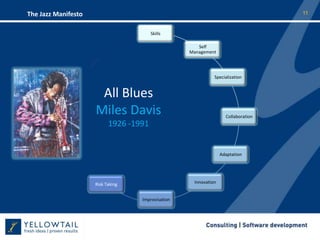
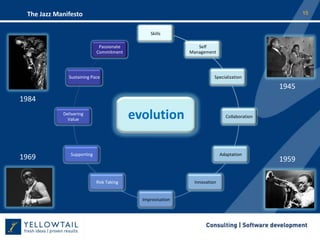
SkillsSelf ManagementSpecializationAll BluesMiles Davis1926 -1991CollaborationAdaptationRisk TakingInnovationImprovisation
SupportiveEncourage others to take the spotlightProvide solid support for the risk takerBuild Respect for innovationCreate a trusted environmentAcknowledge Efforts and Results
Deliver Value, Sustain PaceBuild an Incremental Performance Don’t over-commit and burn outAdapt Repertoire to the mood of the audienceFlexibility to capture the momentumBuild to a Crescendo and finish in style
Passionate CommitmentDoing what we love and excel atConstantly learning throughStudy and AnalysisPracticePerformanceTeachingGiving it everything we have
19451984evolution19691959
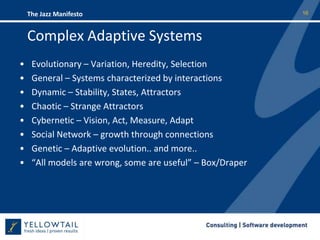
Complex Adaptive SystemsEvolutionary – Variation, Heredity, SelectionGeneral – Systems characterized by interactionsDynamic – Stability, States, AttractorsChaotic – Strange AttractorsCybernetic – Vision, Act, Measure, AdaptSocial Network – growth through connectionsGenetic – Adaptive evolution.. and more..“All models are wrong, some are useful” – Box/Draper
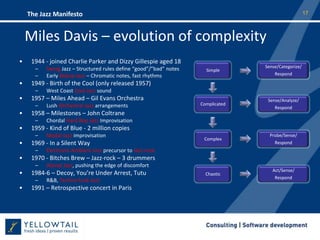
SimpleComplicatedComplexChaoticSense/Categorize/RespondSense/Analyze/RespondProbe/Sense/RespondAct/Sense/RespondMiles Davis – evolution of complexity1944 - joined Charlie Parker and Dizzy Gillespie aged 18 Swing Jazz – Structured rules define “good”/”bad” notes Early Bebop Jazz – Chromatic notes, fast rhythms 1949 - Birth of the Cool (only released 1957)  West Coast Cool Jazz sound1957 – Miles Ahead – Gil Evans Orchestra Lush Orchestral Jazz arrangements1958 – Milestones – John Coltrane Chordal Hard Bop Jazz Improvisation1959 - Kind of Blue - 2 million copiesModal Jazz improvisation1969 - In a Silent WayElectronic Ambient Jazz precursor to Jazz-rock1970 - Bitches Brew – Jazz-rock – 3 drummersAtonal Jazz, pushing the edge of discomfort1984-6 – Decoy, You’re Under Arrest, Tutu – 	 R&B, Techno-funk Jazz1991 – Retrospective concert in Paris
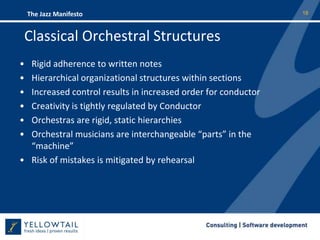
Classical Orchestral StructuresRigid adherence to written notes Hierarchical organizational structures within sectionsIncreased control results in increased order for conductorCreativity is tightly regulated by ConductorOrchestras are rigid, static hierarchiesOrchestral musicians are interchangeable “parts” in the “machine”Risk of mistakes is mitigated by rehearsal
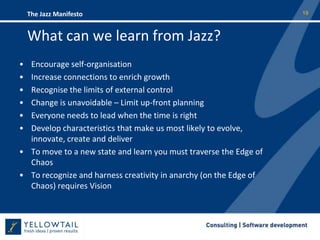
What can we learn from Jazz?Encourage self-organisationIncrease connections to enrich growthRecognise the limits of external controlChange is unavoidable – Limit up-front planning  Everyone needs to lead when the time is rightDevelop characteristics that make us most likely to evolve, innovate, create and deliverTo move to a new state and learn you must traverse the Edge of Chaos To recognize and harness creativity in anarchy (on the Edge of Chaos) requires Vision
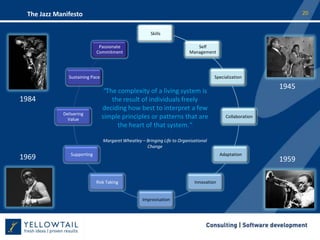
1945“The complexity of a living system is the result of individuals freely deciding how best to interpret a few simple principles or patterns that are the heart of that system.”Margaret Wheatley – Bringing Life to Organisational Change198419691959
about Yellowtail SoftwareCSSA Leading IT Employer 2010Talented, happy people delivering high quality softwareCustom Business Portal /SSAS Offerings Travel and TourismLocal Government and Public Space ManagementFinanceMarket ResearchGISSocial NetworkingMobileBusiness listingsHospitality

Agile - The Jazz Manifesto

  • 1.
    The Jazz ManifestoPRESENTEDBY Andrew Coote and featuringAlan Cameron on KeyboardsChris Tokalon on SaxophoneWesley Rustin on Double BassRicardo Simon on Drums
  • 2.
    Highly SkilledWe knowour instrumentsWe know the Jazz repertoire – the “Standards”In each song we all knowHeadChord structureFormGrooveKey
  • 3.
    Self ManagingKnow theRules and Permutations:TempoStyleForm Pace the delivery (for us and the audience)Manage our own input/outputMaintain the continuity
  • 4.
    SpecializedSubject experts -Aim to master main instrumentBut we understand each others instrumentsDiverse backgroundsDefined rolesNo one LeaderPeople/Role interchange
  • 5.
    CollaborativeListenBuild on others’ideasCommunicate our intentionsProvide feedbackShared sense of purpose/vision
  • 6.
  • 7.
    AdaptationReady for changeAdaptto what colleagues are doing Compliment the flowReady to move into the lead Turn mistakes into innovationExperience allows us to anticipate change
  • 8.
    InnovationIncremental/Spontaneous innovationsUse ourCreativity to extend the themeNatural creative exploration – influences/inspirationSystemic innovationsModal Scales, Substitute Chords, new instruments/soundsRadical innovationsUnusual instrumentation, playing “outside” the chordsDisruptive vs Sustaining Innovations
  • 9.
    ImprovisationReset the canvasCreatethe space to extend the themeExpress ourselvesChallenge ourselvesBuild on others’ ideasUse previous musical referencesKeep it fresh
  • 10.
    Take RisksBreak newgroundPush the boundaries when it feels rightTake calculated risks Be willing to make mistakesBe Remarkable
  • 11.
    SkillsSelf ManagementSpecializationAll BluesMilesDavis1926 -1991CollaborationAdaptationRisk TakingInnovationImprovisation
  • 12.
    SupportiveEncourage others totake the spotlightProvide solid support for the risk takerBuild Respect for innovationCreate a trusted environmentAcknowledge Efforts and Results
  • 13.
    Deliver Value, SustainPaceBuild an Incremental Performance Don’t over-commit and burn outAdapt Repertoire to the mood of the audienceFlexibility to capture the momentumBuild to a Crescendo and finish in style
  • 14.
    Passionate CommitmentDoing whatwe love and excel atConstantly learning throughStudy and AnalysisPracticePerformanceTeachingGiving it everything we have
  • 15.
  • 16.
    Complex Adaptive SystemsEvolutionary– Variation, Heredity, SelectionGeneral – Systems characterized by interactionsDynamic – Stability, States, AttractorsChaotic – Strange AttractorsCybernetic – Vision, Act, Measure, AdaptSocial Network – growth through connectionsGenetic – Adaptive evolution.. and more..“All models are wrong, some are useful” – Box/Draper
  • 17.
    SimpleComplicatedComplexChaoticSense/Categorize/RespondSense/Analyze/RespondProbe/Sense/RespondAct/Sense/RespondMiles Davis –evolution of complexity1944 - joined Charlie Parker and Dizzy Gillespie aged 18 Swing Jazz – Structured rules define “good”/”bad” notes Early Bebop Jazz – Chromatic notes, fast rhythms 1949 - Birth of the Cool (only released 1957) West Coast Cool Jazz sound1957 – Miles Ahead – Gil Evans Orchestra Lush Orchestral Jazz arrangements1958 – Milestones – John Coltrane Chordal Hard Bop Jazz Improvisation1959 - Kind of Blue - 2 million copiesModal Jazz improvisation1969 - In a Silent WayElectronic Ambient Jazz precursor to Jazz-rock1970 - Bitches Brew – Jazz-rock – 3 drummersAtonal Jazz, pushing the edge of discomfort1984-6 – Decoy, You’re Under Arrest, Tutu – R&B, Techno-funk Jazz1991 – Retrospective concert in Paris
  • 18.
    Classical Orchestral StructuresRigidadherence to written notes Hierarchical organizational structures within sectionsIncreased control results in increased order for conductorCreativity is tightly regulated by ConductorOrchestras are rigid, static hierarchiesOrchestral musicians are interchangeable “parts” in the “machine”Risk of mistakes is mitigated by rehearsal
  • 19.
    What can welearn from Jazz?Encourage self-organisationIncrease connections to enrich growthRecognise the limits of external controlChange is unavoidable – Limit up-front planning Everyone needs to lead when the time is rightDevelop characteristics that make us most likely to evolve, innovate, create and deliverTo move to a new state and learn you must traverse the Edge of Chaos To recognize and harness creativity in anarchy (on the Edge of Chaos) requires Vision
  • 20.
    1945“The complexity ofa living system is the result of individuals freely deciding how best to interpret a few simple principles or patterns that are the heart of that system.”Margaret Wheatley – Bringing Life to Organisational Change198419691959
  • 21.
    about Yellowtail SoftwareCSSALeading IT Employer 2010Talented, happy people delivering high quality softwareCustom Business Portal /SSAS Offerings Travel and TourismLocal Government and Public Space ManagementFinanceMarket ResearchGISSocial NetworkingMobileBusiness listingsHospitality