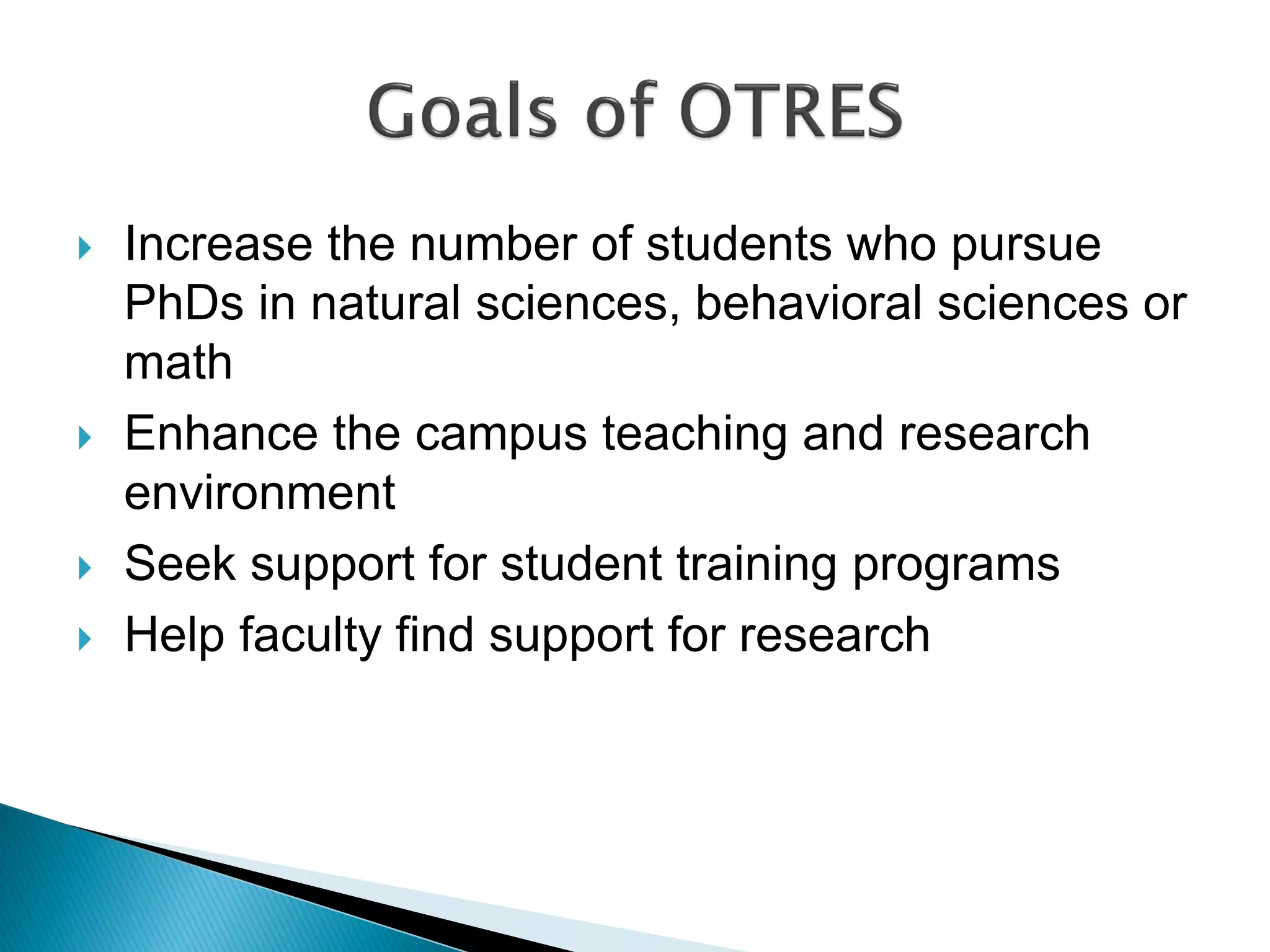
 Increase the number of students who pursue
PhDs in natural sciences, behavioral sciences or
math
 Enhance the campus teaching and research
environment
 Seek support for student training programs
 Help faculty find support for research
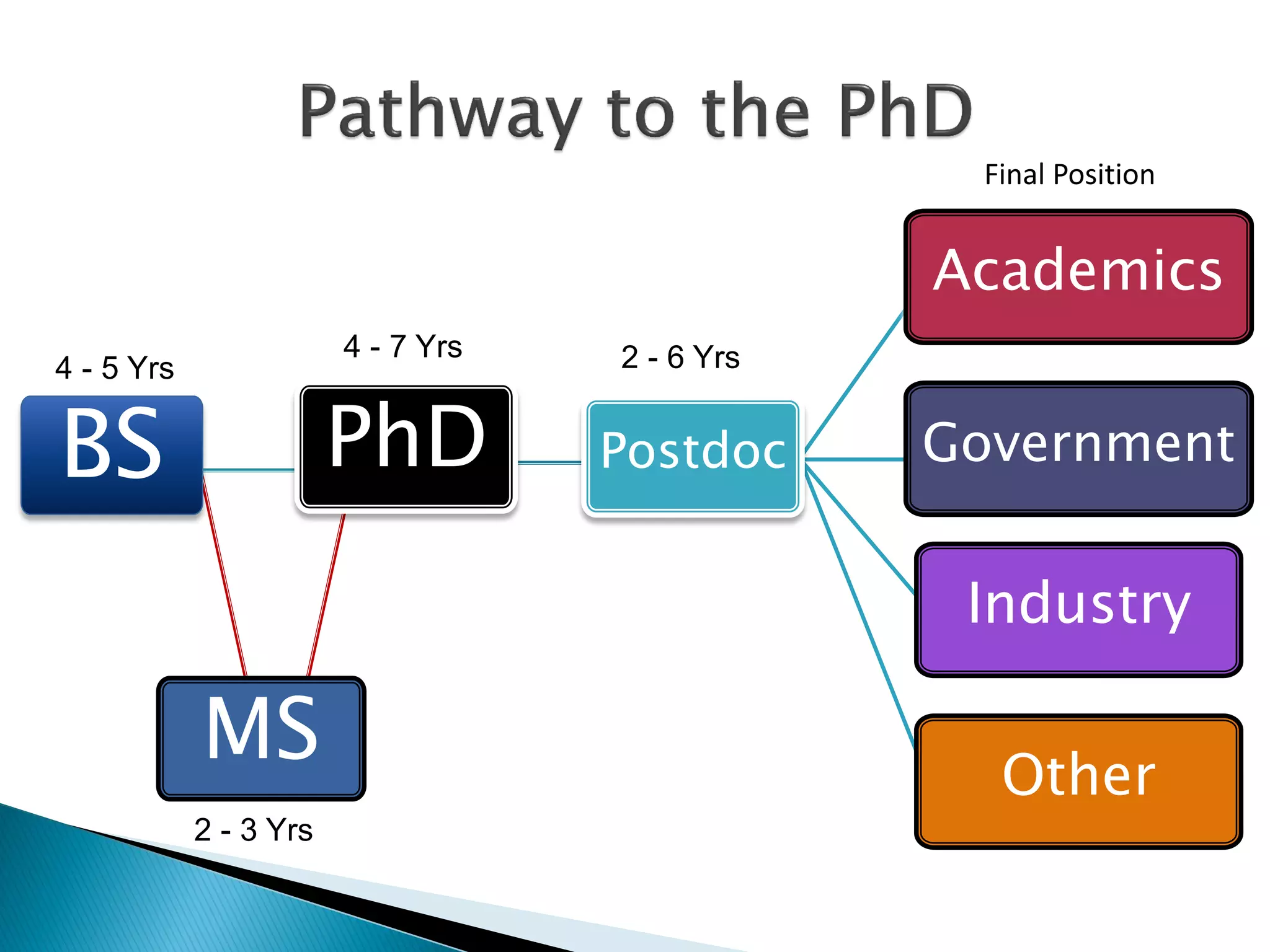
BS
MS
PhD
4 - 7 Yrs
4 - 5 Yrs
2 - 3 Yrs
Postdoc
2 - 6 Yrs
Academics
Government
Industry
Other
Final Position
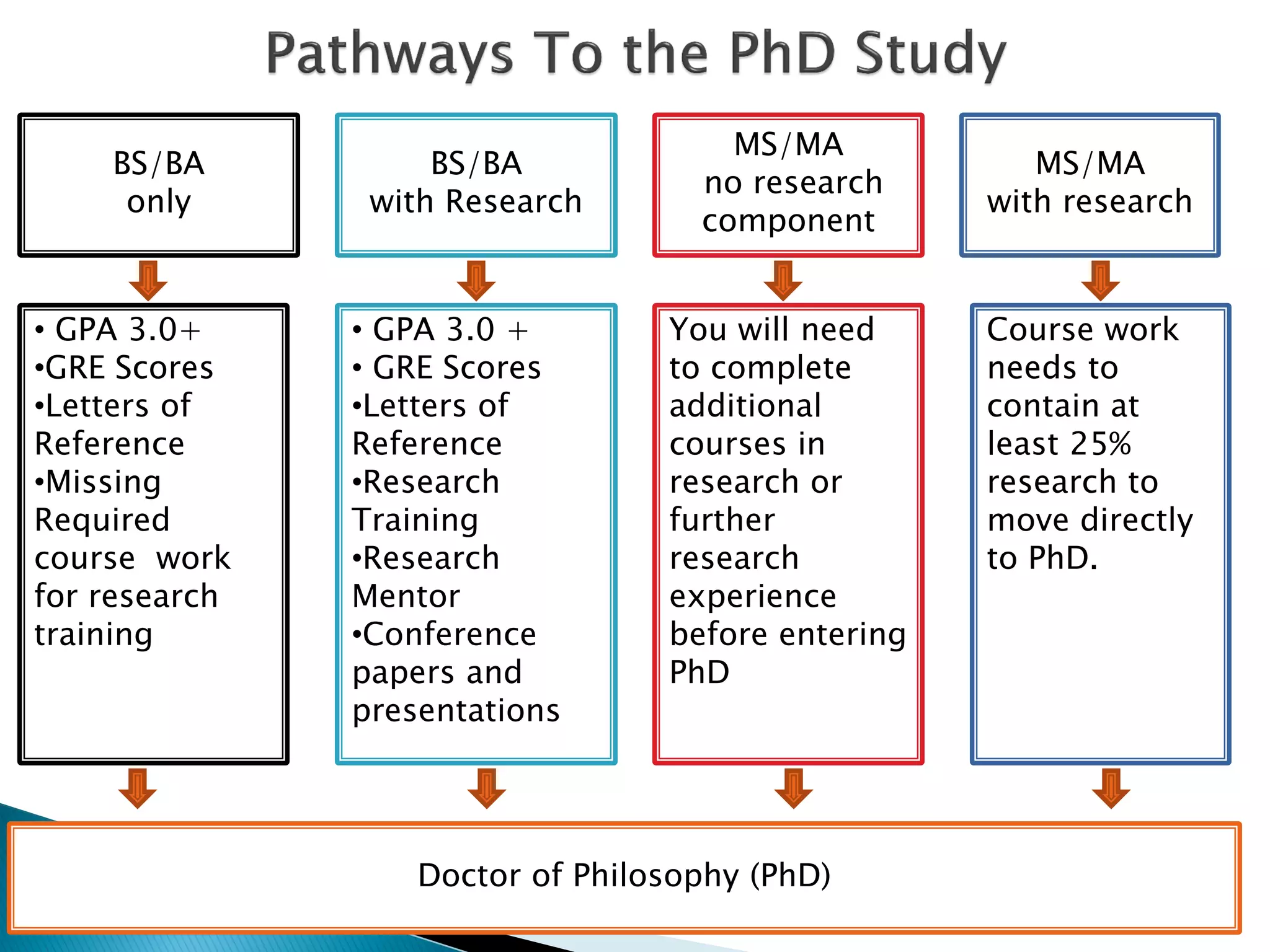
BS/BA
only
BS/BA
with Research
• GPA 3.0+
•GRE Scores
•Letters of
Reference
•Missing
Required
course work
for research
training
MS/MA
with research
Doctor of Philosophy (PhD)
MS/MA
no research
component
• GPA 3.0 +
• GRE Scores
•Letters of
Reference
•Research
Training
•Research
Mentor
•Conference
papers and
presentations
You will need
to complete
additional
courses in
research or
further
research
experience
before entering
PhD
Course work
needs to
contain at
least 25%
research to
move directly
to PhD.
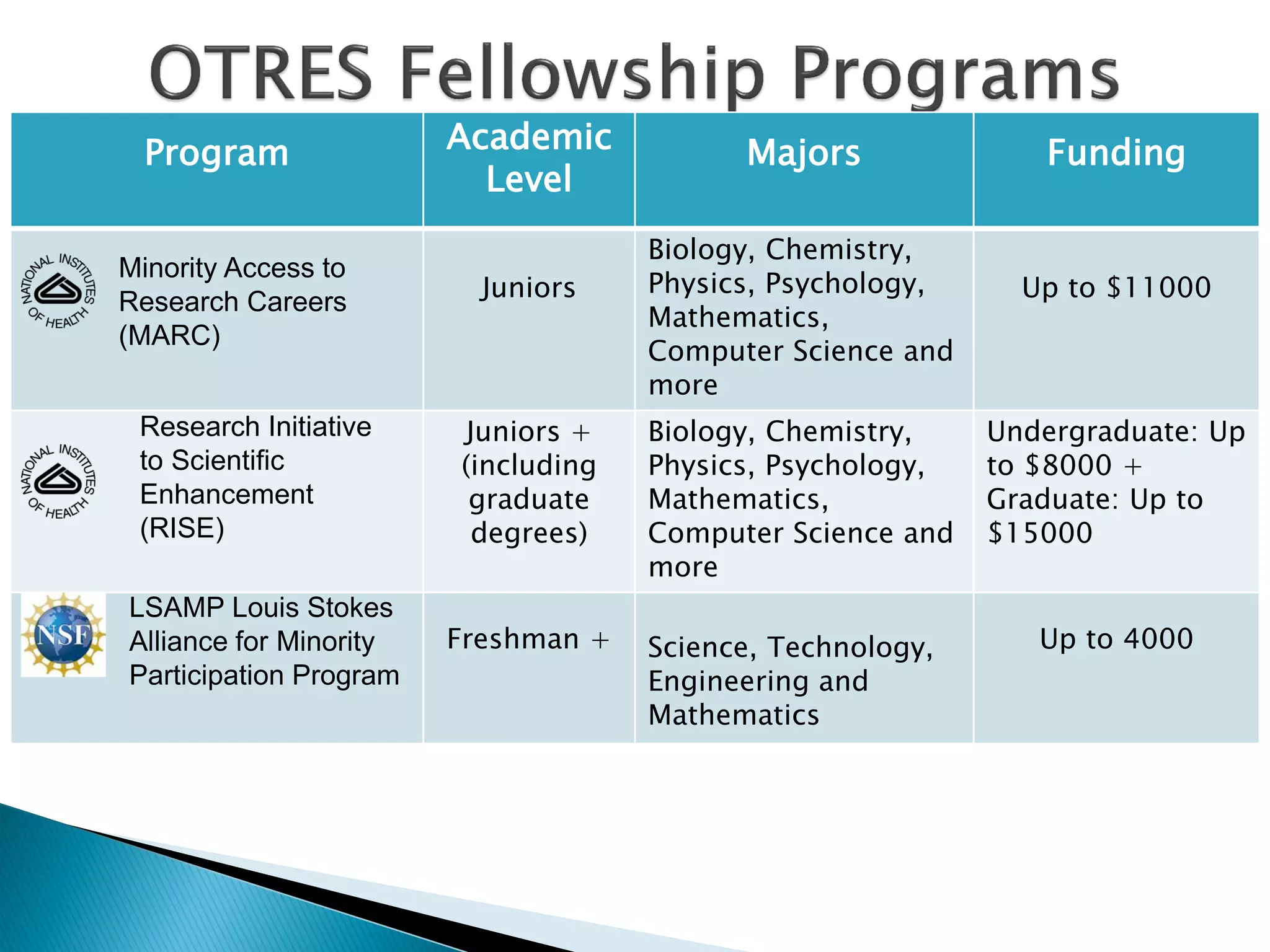
Program Academic
Level
Majors Funding
Juniors
Biology, Chemistry,
Physics, Psychology,
Mathematics,
Computer Science and
more
Up to $11000
Juniors +
(including
graduate
degrees)
Biology, Chemistry,
Physics, Psychology,
Mathematics,
Computer Science and
more
Undergraduate: Up
to $8000 +
Graduate: Up to
$15000
Freshman + Science, Technology,
Engineering and
Mathematics
Up to 4000
Minority Access to
Research Careers
(MARC)
Research Initiative
to Scientific
Enhancement
(RISE)
LSAMP Louis Stokes
Alliance for Minority
Participation Program
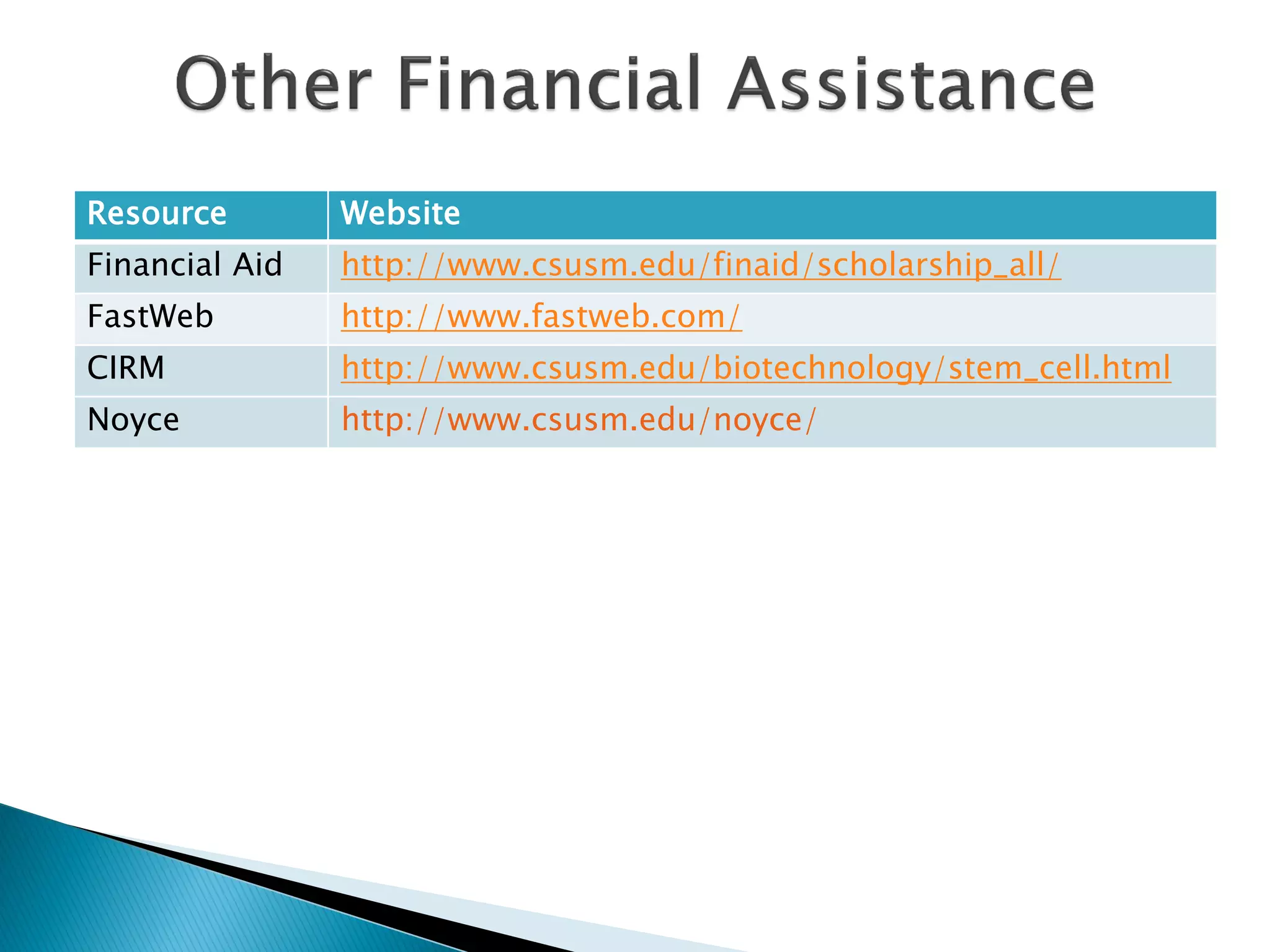
Resource Website
Financial Aid http://www.csusm.edu/finaid/scholarship_all/
FastWeb http://www.fastweb.com/
CIRM http://www.csusm.edu/biotechnology/stem_cell.html
Noyce http://www.csusm.edu/noyce/
Summer
GE/ Major
Req.
Sophomore
Academic counseling
Career Counseling
Supplemental Instr.
Skills/Ethics Wkshps
Science Seminars
Financial Support
Priority Registration
Excellence in Coursework Research & Prep for Grad School
Freshman
Academic counseling
Career Counseling
Supplemental Instr.
Science Seminars
Career Awareness
Financial Support
Priority Registration
First Summer
Summer School
Junior
Academic counseling
Career Counseling
Supplemental Instr.
Puentes
Research Participation
Attend Conferences
Skills/Ethics Wkshps
Seminars
Financial Support
Priority Registration
Senior
Academic counseling
Career Counseling
Research
Puentes
Present Research
Apply to Grad School
Grad School visits
Seminars
Financial Support
Priority Registration
Second Summer
SRTP
Summer School
Summer Internships
Third Summer
Research
Summer Internships
Puentes Program
Bachelors of Science (BS)/Arts (BA), 4-6 years
Masters of Science (MS), 2-3 years
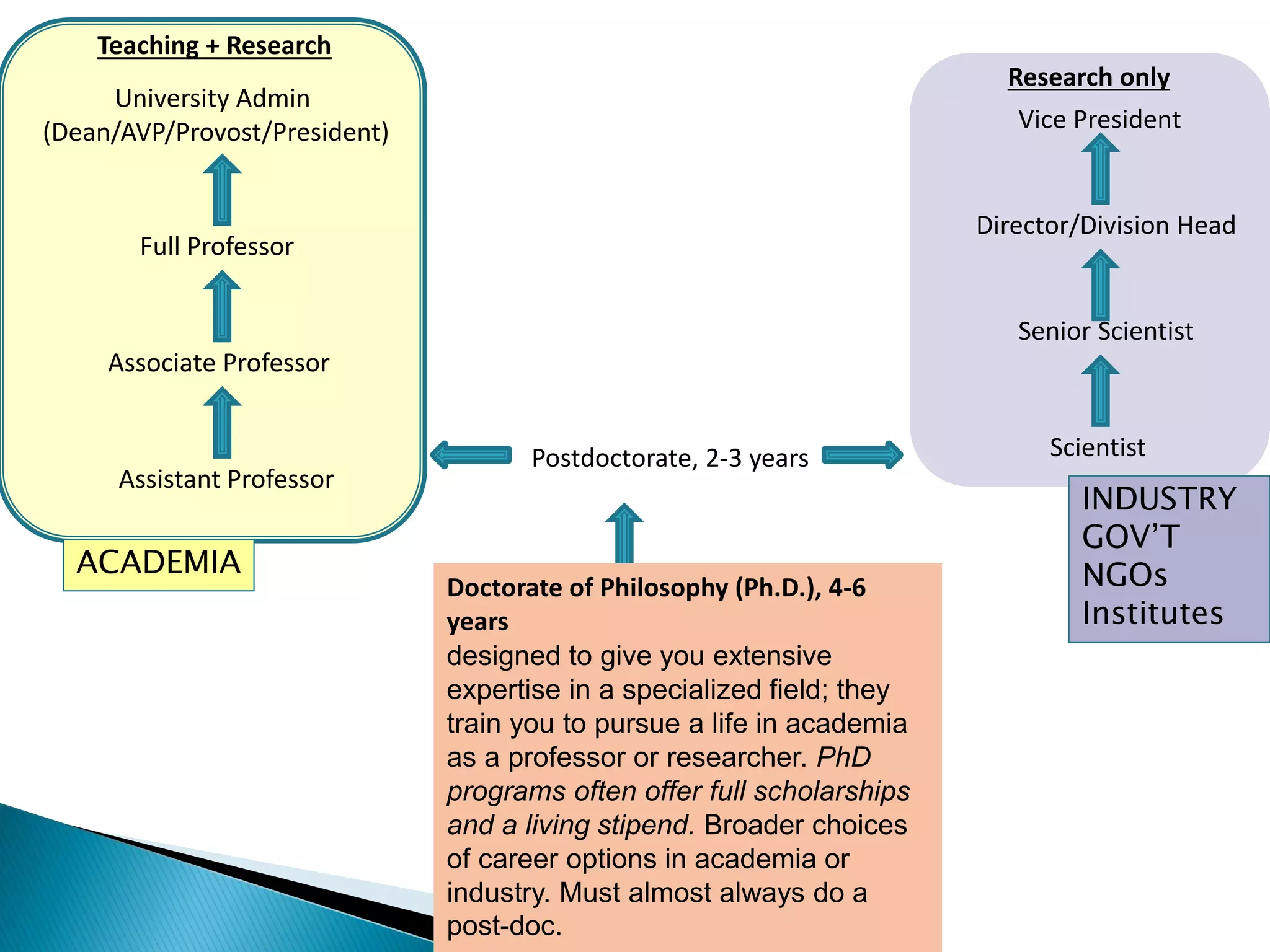
Doctorate of Philosophy (Ph.D.), 4-6 years
Assistant Professor
Associate Professor
Full Professor
University Admin
(Dean/AVP/Provost/President)
Postdoctorate, 2-3 years Scientist
Senior Scientist
Director/Division Head
Vice President
Teaching + Research
Research only
ACADEMIA
INDUSTRY
GOV’T
NGOs
Institutes
Bachelors of Science (BS)/Arts (BA), 4-6 years
Masters of Science (MS), 2-3 years
Doctorate of Philosophy (Ph.D.), 4-6 years
Assistant Professor
Associate Professor
Full Professor
University Admin
(Dean/AVP/Provost/President)
Postdoctorate, 2-3 years Scientist
Senior Scientist
Director/Division Head
Vice President
Teaching + Research
Research only
ACADEMIA
INDUSTRY
GOV’T
NGOs
Institutes
Masters of Science (MS), 2-3 years
designed to give you a solid
education in a specialized field. Most
master's candidates spend one to
two years earning their degree
before returning to the professional
world. A handful continue on to earn
a PhD. Little or no financial support.
Teach at community college or
industry as technician.
Assistant Professor
Associate Professor
Full Professor
University Admin
(Dean/AVP/Provost/President)
Postdoctorate, 2-3 years Scientist
Senior Scientist
Director/Division Head
Vice President
Teaching + Research
Research only
ACADEMIA
INDUSTRY
GOV’T
NGOs
Institutes
Doctorate of Philosophy (Ph.D.), 4-6
years
designed to give you extensive
expertise in a specialized field; they
train you to pursue a life in academia
as a professor or researcher. PhD
programs often offer full scholarships
and a living stipend. Broader choices
of career options in academia or
industry. Must almost always do a
post-doc.
What is a Postdoc?
• Specialized research training position after Ph.D.
• Often 2-3 years, but varies on project/person
• Some people do more than 1
• Can be a wonderful time!
• devote FULL TIME to research (no classes!)
• Move to a new area with no real commitments
• Earn an almost respectable salary (compared to grad school)
• …and do crazy things like chase lizards!
Or just pipet
things…whatever
floats your boat 
Compare Two Common Career Paths after Ph.D.
Private/Gov’t Research Scientist
• requires Ph.D. (rarely M.S. with 5+ years work exp)
• Report to a supervisor (usually Senior scientist or Division Head); amount of freedom varies widely
• full time research and/or supervising technicians in research
• salary varies widely (starting $50-70k in NGO/GOVT or upto $80k or more in Biotech/Pharmac
• Origin of salary varies widely (hard-money or soft-money grants/contracts)
Assistant Professor (T/T) at 4 year college
• requires Ph.D. for 4-year college (more competitive if you have postdoc exp)
• Lots of freedom (you are your own boss more-or-less)
• part-time research/supervising technicians & students in research
• part-time teaching (teaching load varies between research tier 1-3 schools)
• part-time service (committees)
• salary has standardized starting ranges, with raises at Associate and again at Full Professor levels
• paid for 9 months of year (summer is your own)
• supplement salary with summer teaching or research grants (up to 17-25% more)
• at tier 2-3 colleges, salary is stable (hard-money), but 2 year contracts until tenure
• at tier 1 colleges, salary stability is more variable (MUST get grants or else!)
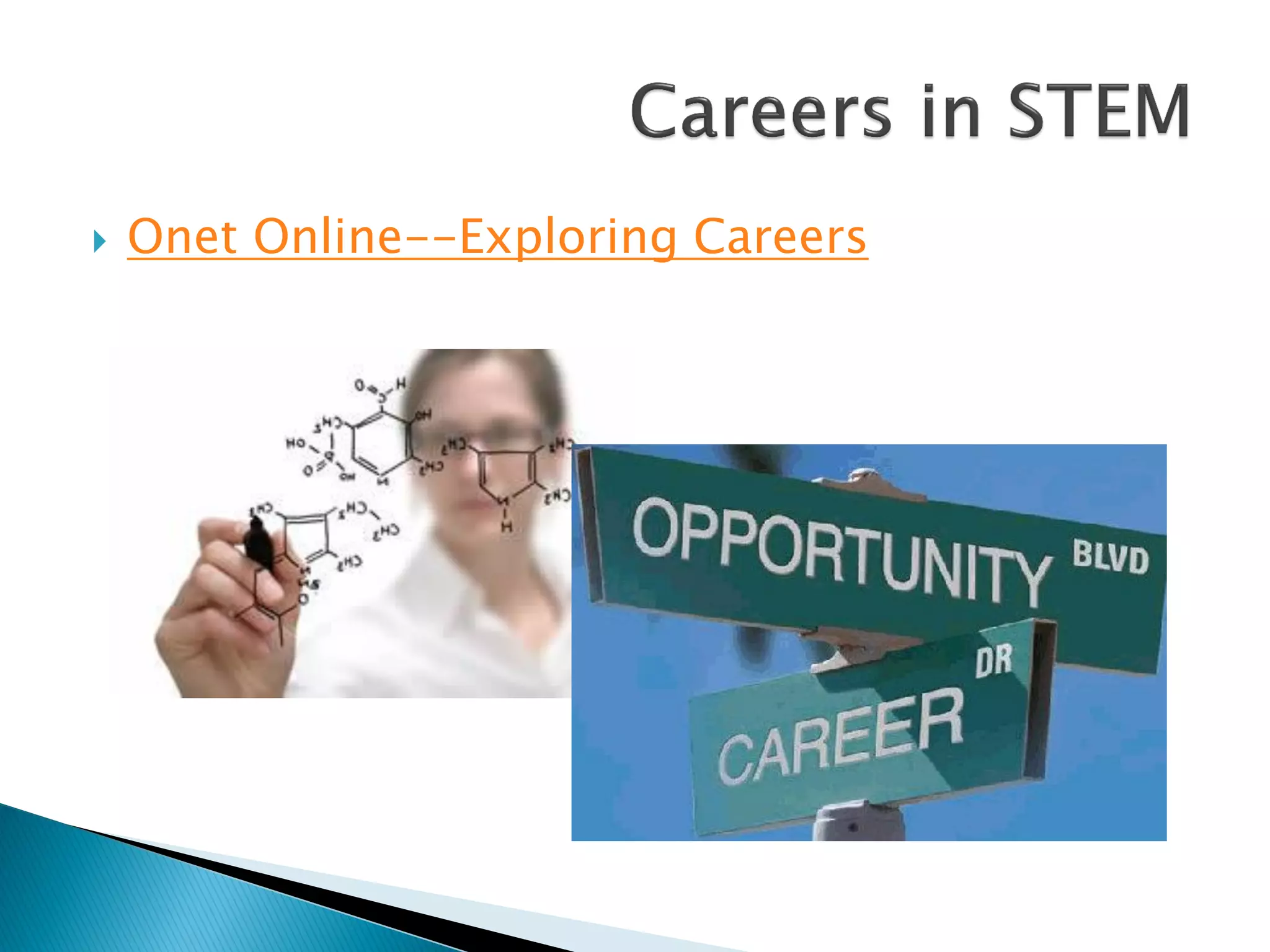
 Onet Online--Exploring Careers
Perla Rivas, M.A.
OTRES Academic Advisor/Student Coordinator
pmrivas@csusm.edu
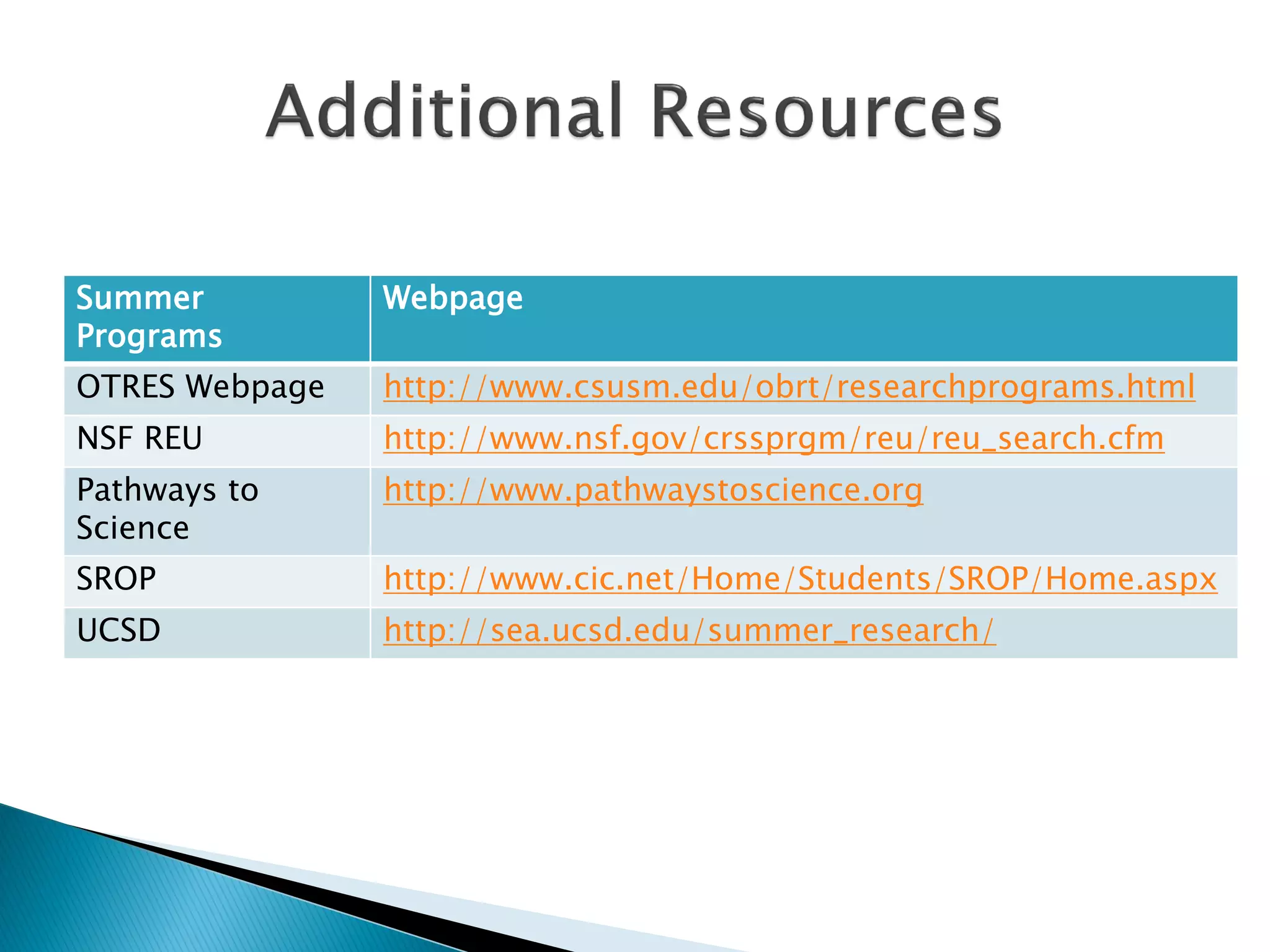
Summer
Programs
Webpage
OTRES Webpage http://www.csusm.edu/obrt/researchprograms.html
NSF REU http://www.nsf.gov/crssprgm/reu/reu_search.cfm
Pathways to
Science
http://www.pathwaystoscience.org
SROP http://www.cic.net/Home/Students/SROP/Home.aspx
UCSD http://sea.ucsd.edu/summer_research/
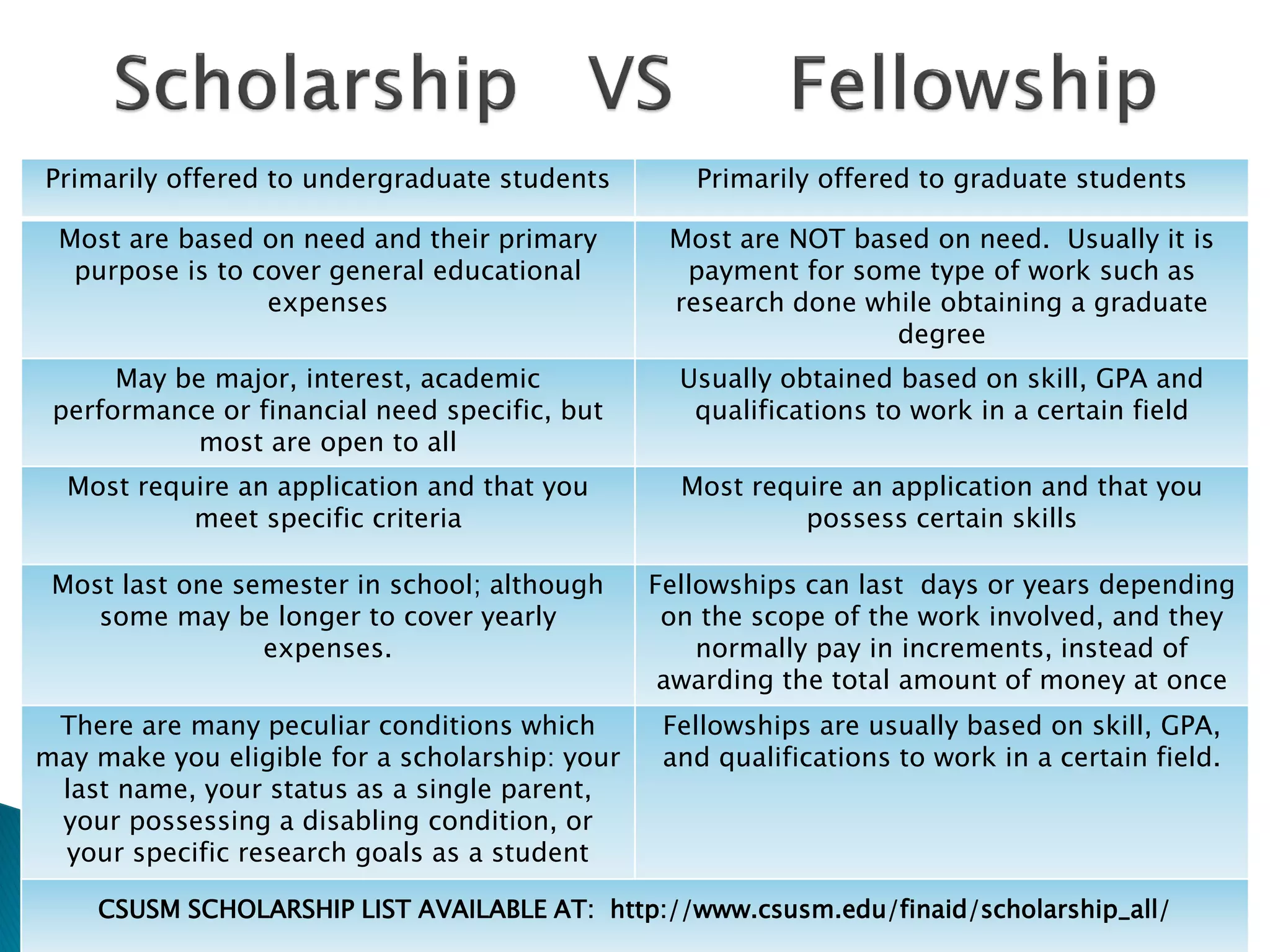
Primarily offered to undergraduate students Primarily offered to graduate students
Most are based on need and their primary
purpose is to cover general educational
expenses
Most are NOT based on need. Usually it is
payment for some type of work such as
research done while obtaining a graduate
degree
May be major, interest, academic
performance or financial need specific, but
most are open to all
Usually obtained based on skill, GPA and
qualifications to work in a certain field
Most require an application and that you
meet specific criteria
Most require an application and that you
possess certain skills
Most last one semester in school; although
some may be longer to cover yearly
expenses.
Fellowships can last days or years depending
on the scope of the work involved, and they
normally pay in increments, instead of
awarding the total amount of money at once
There are many peculiar conditions which
may make you eligible for a scholarship: your
last name, your status as a single parent,
your possessing a disabling condition, or
your specific research goals as a student
Fellowships are usually based on skill, GPA,
and qualifications to work in a certain field.
CSUSM SCHOLARSHIP LIST AVAILABLE AT: http://www.csusm.edu/finaid/scholarship_all/
Math Units
L-Non-Math Courses 16-17
L - Math Courses 13
Upper-Core
Requirements
36-37
Upper Electives 12
Total Units 75-80
Biological Sciences Units
L-Biology Courses 15
L – Non-Biology 26
Upper-Core
Requirements
17
Upper Electives 19
Total Units 75-80
Biotechnology Units
L-Non-Bio 25-26
L – Chem./Bio Courses 28
Upper-Core
Requirements
24
Upper Electives 7
Total Units 83-85
Computer Science Units
L-Division Courses 12
L – Non-CS Courses 30 (36-38)
Upper-Core
Requirements
30 (27)
Upper Electives 9 (3)
Total Units 81-85
Chemistry Units
L-Non-Chem Courses 21
L - Chem Courses 121
Upper-Core
Requirements
26
Upper Electives 4
Total Units 75-80
Biochemistry Units
L-Non-Chem Courses 17
L - Chem. Courses 29
Upper-Core
Requirements
31-32
Upper Electives 3-4
Total Units 75-80
Physics Units
L-Non-Phys Courses 24-25 (27-28)
L - Phys Courses 15
Upper-Core
Requirements
25
Upper Electives 10-11
Total Units 75-80
General Education Units
Area A- GEW 1st year
Area B – Chem. 150/Math 160
BB- Chem. 141
BB,CC, DD – 60 units or more
Total Units 52
Language (201 level) – Span 101,102, 201
Minimum of 120 semester units to graduate

Pathways to the PhD

  • 2.
     Increase thenumber of students who pursue PhDs in natural sciences, behavioral sciences or math  Enhance the campus teaching and research environment  Seek support for student training programs  Help faculty find support for research
  • 3.
    BS MS PhD 4 - 7Yrs 4 - 5 Yrs 2 - 3 Yrs Postdoc 2 - 6 Yrs Academics Government Industry Other Final Position
  • 4.
    BS/BA only BS/BA with Research • GPA3.0+ •GRE Scores •Letters of Reference •Missing Required course work for research training MS/MA with research Doctor of Philosophy (PhD) MS/MA no research component • GPA 3.0 + • GRE Scores •Letters of Reference •Research Training •Research Mentor •Conference papers and presentations You will need to complete additional courses in research or further research experience before entering PhD Course work needs to contain at least 25% research to move directly to PhD.
  • 6.
    Program Academic Level Majors Funding Juniors Biology,Chemistry, Physics, Psychology, Mathematics, Computer Science and more Up to $11000 Juniors + (including graduate degrees) Biology, Chemistry, Physics, Psychology, Mathematics, Computer Science and more Undergraduate: Up to $8000 + Graduate: Up to $15000 Freshman + Science, Technology, Engineering and Mathematics Up to 4000 Minority Access to Research Careers (MARC) Research Initiative to Scientific Enhancement (RISE) LSAMP Louis Stokes Alliance for Minority Participation Program
  • 8.
    Resource Website Financial Aidhttp://www.csusm.edu/finaid/scholarship_all/ FastWeb http://www.fastweb.com/ CIRM http://www.csusm.edu/biotechnology/stem_cell.html Noyce http://www.csusm.edu/noyce/
  • 9.
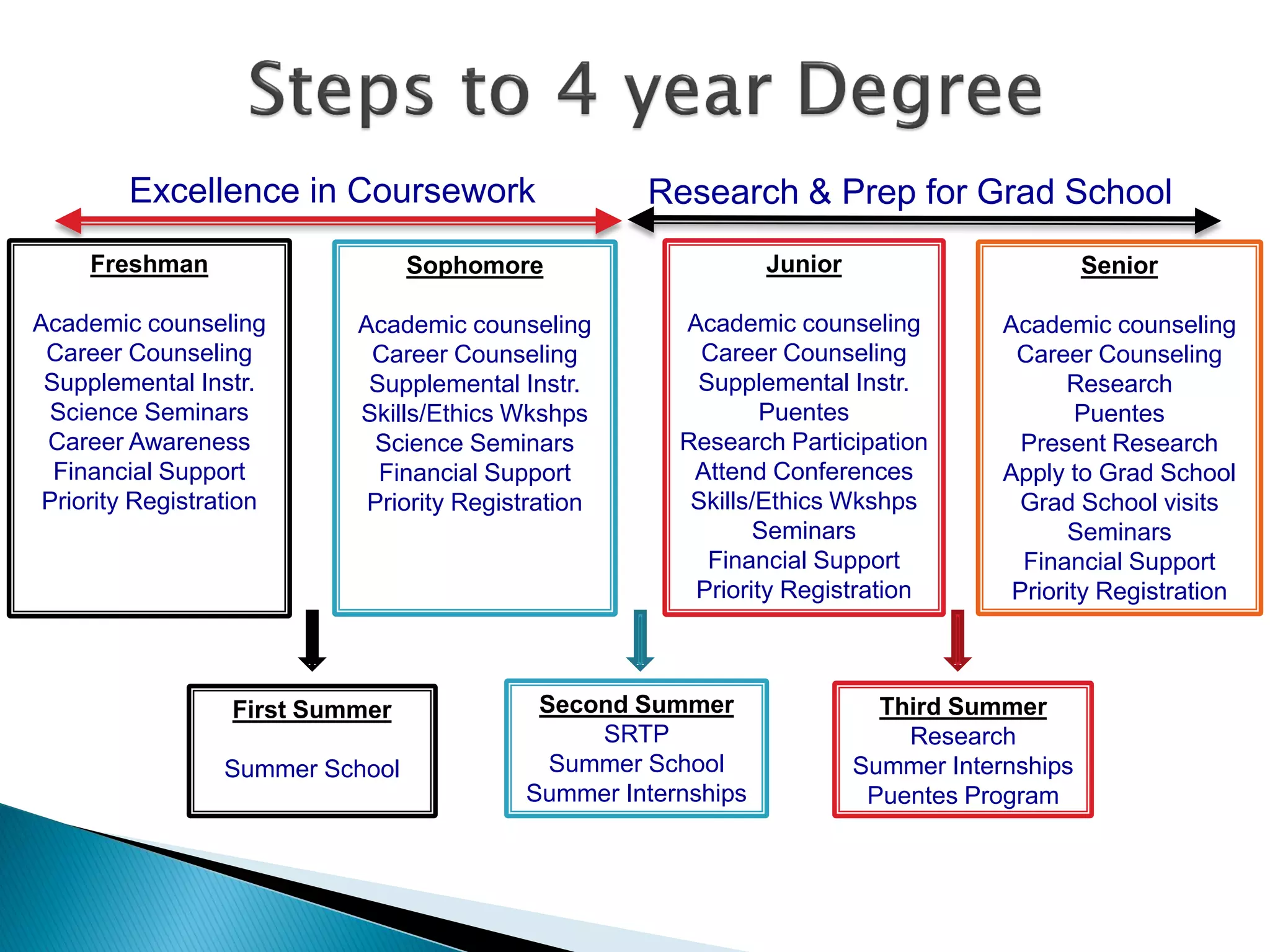
    Summer GE/ Major Req. Sophomore Academic counseling CareerCounseling Supplemental Instr. Skills/Ethics Wkshps Science Seminars Financial Support Priority Registration Excellence in Coursework Research & Prep for Grad School Freshman Academic counseling Career Counseling Supplemental Instr. Science Seminars Career Awareness Financial Support Priority Registration First Summer Summer School Junior Academic counseling Career Counseling Supplemental Instr. Puentes Research Participation Attend Conferences Skills/Ethics Wkshps Seminars Financial Support Priority Registration Senior Academic counseling Career Counseling Research Puentes Present Research Apply to Grad School Grad School visits Seminars Financial Support Priority Registration Second Summer SRTP Summer School Summer Internships Third Summer Research Summer Internships Puentes Program
  • 11.
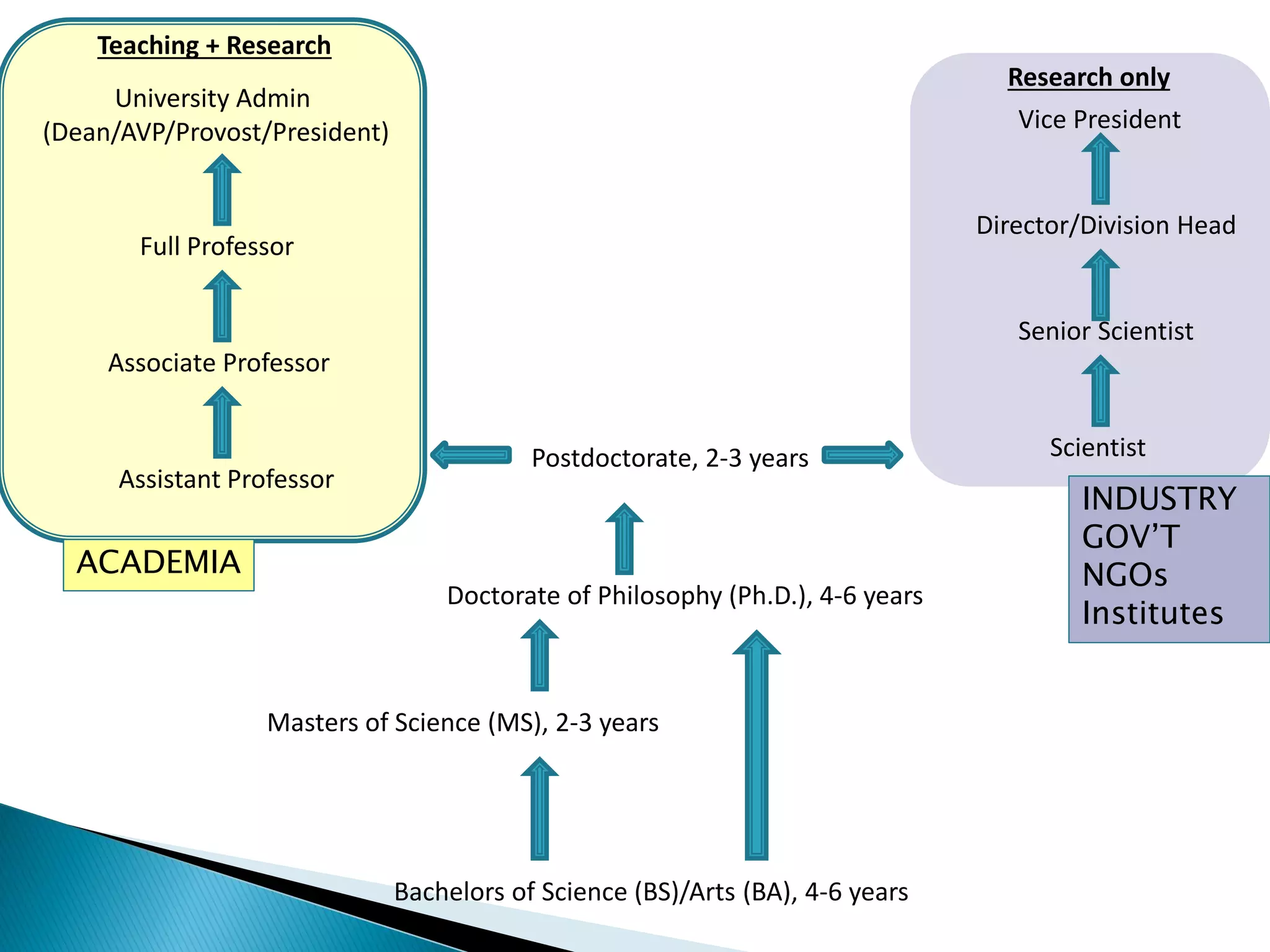
    Bachelors of Science(BS)/Arts (BA), 4-6 years Masters of Science (MS), 2-3 years Doctorate of Philosophy (Ph.D.), 4-6 years Assistant Professor Associate Professor Full Professor University Admin (Dean/AVP/Provost/President) Postdoctorate, 2-3 years Scientist Senior Scientist Director/Division Head Vice President Teaching + Research Research only ACADEMIA INDUSTRY GOV’T NGOs Institutes
  • 12.
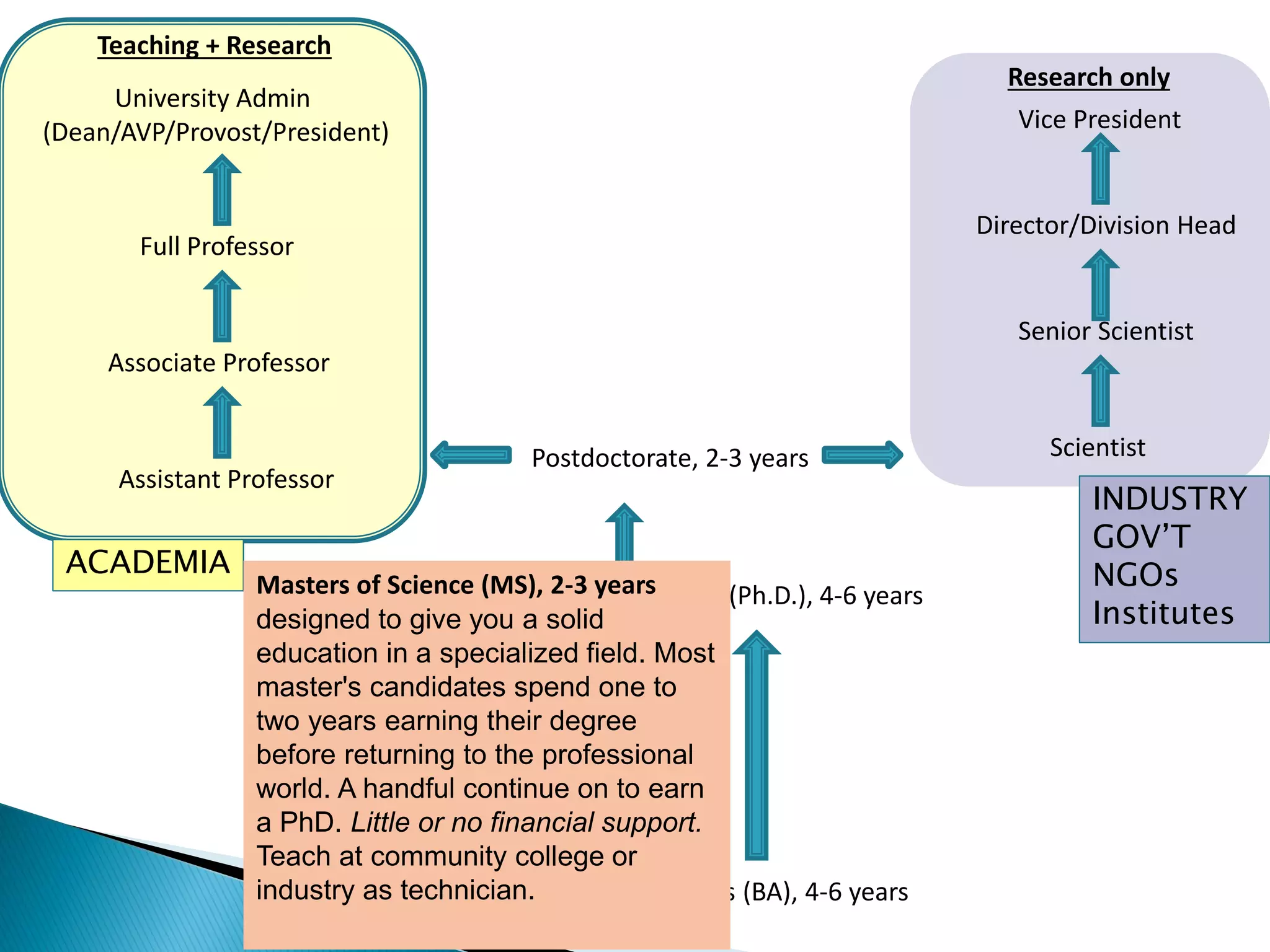
    Bachelors of Science(BS)/Arts (BA), 4-6 years Masters of Science (MS), 2-3 years Doctorate of Philosophy (Ph.D.), 4-6 years Assistant Professor Associate Professor Full Professor University Admin (Dean/AVP/Provost/President) Postdoctorate, 2-3 years Scientist Senior Scientist Director/Division Head Vice President Teaching + Research Research only ACADEMIA INDUSTRY GOV’T NGOs Institutes Masters of Science (MS), 2-3 years designed to give you a solid education in a specialized field. Most master's candidates spend one to two years earning their degree before returning to the professional world. A handful continue on to earn a PhD. Little or no financial support. Teach at community college or industry as technician.
  • 13.
    Assistant Professor Associate Professor FullProfessor University Admin (Dean/AVP/Provost/President) Postdoctorate, 2-3 years Scientist Senior Scientist Director/Division Head Vice President Teaching + Research Research only ACADEMIA INDUSTRY GOV’T NGOs Institutes Doctorate of Philosophy (Ph.D.), 4-6 years designed to give you extensive expertise in a specialized field; they train you to pursue a life in academia as a professor or researcher. PhD programs often offer full scholarships and a living stipend. Broader choices of career options in academia or industry. Must almost always do a post-doc.
  • 14.
    What is aPostdoc? • Specialized research training position after Ph.D. • Often 2-3 years, but varies on project/person • Some people do more than 1 • Can be a wonderful time! • devote FULL TIME to research (no classes!) • Move to a new area with no real commitments • Earn an almost respectable salary (compared to grad school) • …and do crazy things like chase lizards! Or just pipet things…whatever floats your boat 
  • 15.
    Compare Two CommonCareer Paths after Ph.D. Private/Gov’t Research Scientist • requires Ph.D. (rarely M.S. with 5+ years work exp) • Report to a supervisor (usually Senior scientist or Division Head); amount of freedom varies widely • full time research and/or supervising technicians in research • salary varies widely (starting $50-70k in NGO/GOVT or upto $80k or more in Biotech/Pharmac • Origin of salary varies widely (hard-money or soft-money grants/contracts) Assistant Professor (T/T) at 4 year college • requires Ph.D. for 4-year college (more competitive if you have postdoc exp) • Lots of freedom (you are your own boss more-or-less) • part-time research/supervising technicians & students in research • part-time teaching (teaching load varies between research tier 1-3 schools) • part-time service (committees) • salary has standardized starting ranges, with raises at Associate and again at Full Professor levels • paid for 9 months of year (summer is your own) • supplement salary with summer teaching or research grants (up to 17-25% more) • at tier 2-3 colleges, salary is stable (hard-money), but 2 year contracts until tenure • at tier 1 colleges, salary stability is more variable (MUST get grants or else!)
  • 16.
  • 17.
    Perla Rivas, M.A. OTRESAcademic Advisor/Student Coordinator pmrivas@csusm.edu
  • 18.
    Summer Programs Webpage OTRES Webpage http://www.csusm.edu/obrt/researchprograms.html NSFREU http://www.nsf.gov/crssprgm/reu/reu_search.cfm Pathways to Science http://www.pathwaystoscience.org SROP http://www.cic.net/Home/Students/SROP/Home.aspx UCSD http://sea.ucsd.edu/summer_research/
  • 19.
    Primarily offered toundergraduate students Primarily offered to graduate students Most are based on need and their primary purpose is to cover general educational expenses Most are NOT based on need. Usually it is payment for some type of work such as research done while obtaining a graduate degree May be major, interest, academic performance or financial need specific, but most are open to all Usually obtained based on skill, GPA and qualifications to work in a certain field Most require an application and that you meet specific criteria Most require an application and that you possess certain skills Most last one semester in school; although some may be longer to cover yearly expenses. Fellowships can last days or years depending on the scope of the work involved, and they normally pay in increments, instead of awarding the total amount of money at once There are many peculiar conditions which may make you eligible for a scholarship: your last name, your status as a single parent, your possessing a disabling condition, or your specific research goals as a student Fellowships are usually based on skill, GPA, and qualifications to work in a certain field. CSUSM SCHOLARSHIP LIST AVAILABLE AT: http://www.csusm.edu/finaid/scholarship_all/
  • 20.
    Math Units L-Non-Math Courses16-17 L - Math Courses 13 Upper-Core Requirements 36-37 Upper Electives 12 Total Units 75-80 Biological Sciences Units L-Biology Courses 15 L – Non-Biology 26 Upper-Core Requirements 17 Upper Electives 19 Total Units 75-80 Biotechnology Units L-Non-Bio 25-26 L – Chem./Bio Courses 28 Upper-Core Requirements 24 Upper Electives 7 Total Units 83-85 Computer Science Units L-Division Courses 12 L – Non-CS Courses 30 (36-38) Upper-Core Requirements 30 (27) Upper Electives 9 (3) Total Units 81-85 Chemistry Units L-Non-Chem Courses 21 L - Chem Courses 121 Upper-Core Requirements 26 Upper Electives 4 Total Units 75-80 Biochemistry Units L-Non-Chem Courses 17 L - Chem. Courses 29 Upper-Core Requirements 31-32 Upper Electives 3-4 Total Units 75-80
  • 21.
    Physics Units L-Non-Phys Courses24-25 (27-28) L - Phys Courses 15 Upper-Core Requirements 25 Upper Electives 10-11 Total Units 75-80 General Education Units Area A- GEW 1st year Area B – Chem. 150/Math 160 BB- Chem. 141 BB,CC, DD – 60 units or more Total Units 52 Language (201 level) – Span 101,102, 201 Minimum of 120 semester units to graduate