Applying to grad school in
the life sciences: some
unasked for advice
Jeff Ross-Ibarra
www.rilab.org
Why go to grad school?
• Some jobs require higher degrees
• Academia, industry, gov. jobs
• Be useful in another career
• patent law, business
• Not always a good idea
• pays poorly, stressful, long
• academia is a tough gig
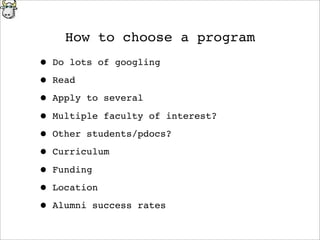
How to choose a program
• Do lots of googling
• Read
• Apply to several
• Multiple faculty of interest?
• Other students/pdocs?
• Curriculum
• Funding
• Location
• Alumni success rates
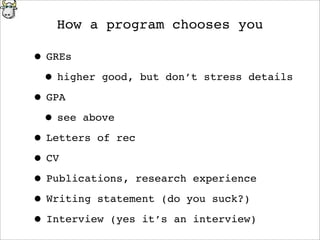
How a program chooses you
• GREs
• higher good, but don’t stress details
• GPA
• see above
• Letters of rec
• CV
• Publications, research experience
• Writing statement (do you suck?)
• Interview (yes it’s an interview)
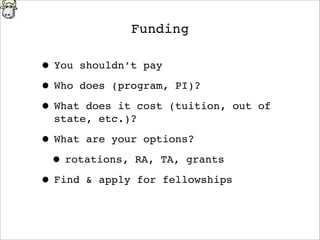
Funding
• You shouldn’t pay
• Who does (program, PI)?
• What does it cost (tuition, out of
state, etc.)?
• What are your options?
• rotations, RA, TA, grants
• Find & apply for fellowships
How to choose a lab
• Other people in lab
• Research interests (read)
• Funding
• Project details (flexibility,
funding, wet bench, computer)
• Expectations of students?
• work hours, papers, funding,
supervision, etc.
How to choose a lab
• Publication rate
• Alumni success (industry, academia)
• Other resources (lab, office space)
Talk to People
• Get to know their work (read)
• Talk to potential PIs
• Email, Skype etc.
• Avoid form emails
• Ask questions of PI, lab members
Letters of Recommendation
• You’ll need ≥3
• Find someone who knows you
• Cultivate letter writers
• Ask ahead of time
• Don’t offer bribes
Read some papers
• Why read?
• Google Scholar
• search for papers
• cited papers
• What authorship means, why it matters
• Slow speed of science
Other advice
• Learn to program (R)
• Learn to publish w/o data
• Write. Every day if possible
• Take most awesome notes
• Read. Lots
• Plan ahead, set goals (timeline)
• You’re on your own
• stand up for yourself
• you’re responsible to get stuff done

Advice for getting into grad school (in the biological sciences)

  • 1.
    Applying to gradschool in the life sciences: some unasked for advice Jeff Ross-Ibarra www.rilab.org
  • 2.
    Why go tograd school? • Some jobs require higher degrees • Academia, industry, gov. jobs • Be useful in another career • patent law, business • Not always a good idea • pays poorly, stressful, long • academia is a tough gig
  • 3.
    How to choosea program • Do lots of googling • Read • Apply to several • Multiple faculty of interest? • Other students/pdocs? • Curriculum • Funding • Location • Alumni success rates
  • 4.
    How a programchooses you • GREs • higher good, but don’t stress details • GPA • see above • Letters of rec • CV • Publications, research experience • Writing statement (do you suck?) • Interview (yes it’s an interview)
  • 5.
    Funding • You shouldn’tpay • Who does (program, PI)? • What does it cost (tuition, out of state, etc.)? • What are your options? • rotations, RA, TA, grants • Find & apply for fellowships
  • 6.
    How to choosea lab • Other people in lab • Research interests (read) • Funding • Project details (flexibility, funding, wet bench, computer) • Expectations of students? • work hours, papers, funding, supervision, etc.
  • 7.
    How to choosea lab • Publication rate • Alumni success (industry, academia) • Other resources (lab, office space)
  • 8.
    Talk to People •Get to know their work (read) • Talk to potential PIs • Email, Skype etc. • Avoid form emails • Ask questions of PI, lab members
  • 9.
    Letters of Recommendation •You’ll need ≥3 • Find someone who knows you • Cultivate letter writers • Ask ahead of time • Don’t offer bribes
  • 10.
    Read some papers •Why read? • Google Scholar • search for papers • cited papers • What authorship means, why it matters • Slow speed of science
  • 11.
    Other advice • Learnto program (R) • Learn to publish w/o data • Write. Every day if possible • Take most awesome notes • Read. Lots • Plan ahead, set goals (timeline) • You’re on your own • stand up for yourself • you’re responsible to get stuff done