Open Source:
   Freedom & Community
               Nicole C. Engard
Vice President of Education, ByWater Solutions
        Documentation Manager, Koha
             nengard@gmail.com
       nengard@bywatersolutions.com
What isn’t Open Source?
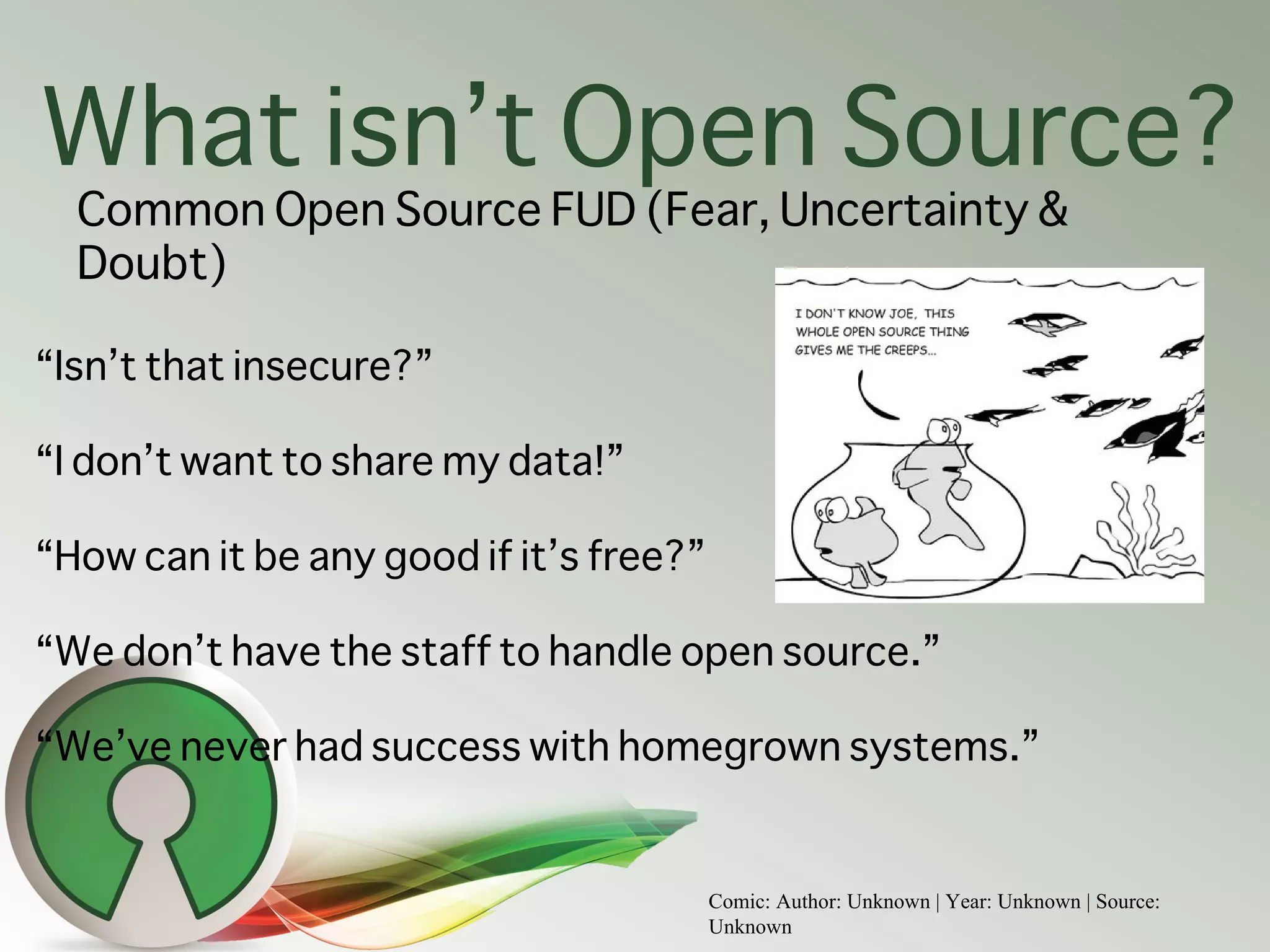
  Common Open Source FUD (Fear, Uncertainty &
  Doubt)

“Isn’t that insecure?”

“I don’t want to share my data!”

“How can it be any good if it’s free?”

“We don’t have the staff to handle open source.”

“We’ve never had success with homegrown systems.”


                                         Comic: Author: Unknown | Year: Unknown | Source:
                                         Unknown
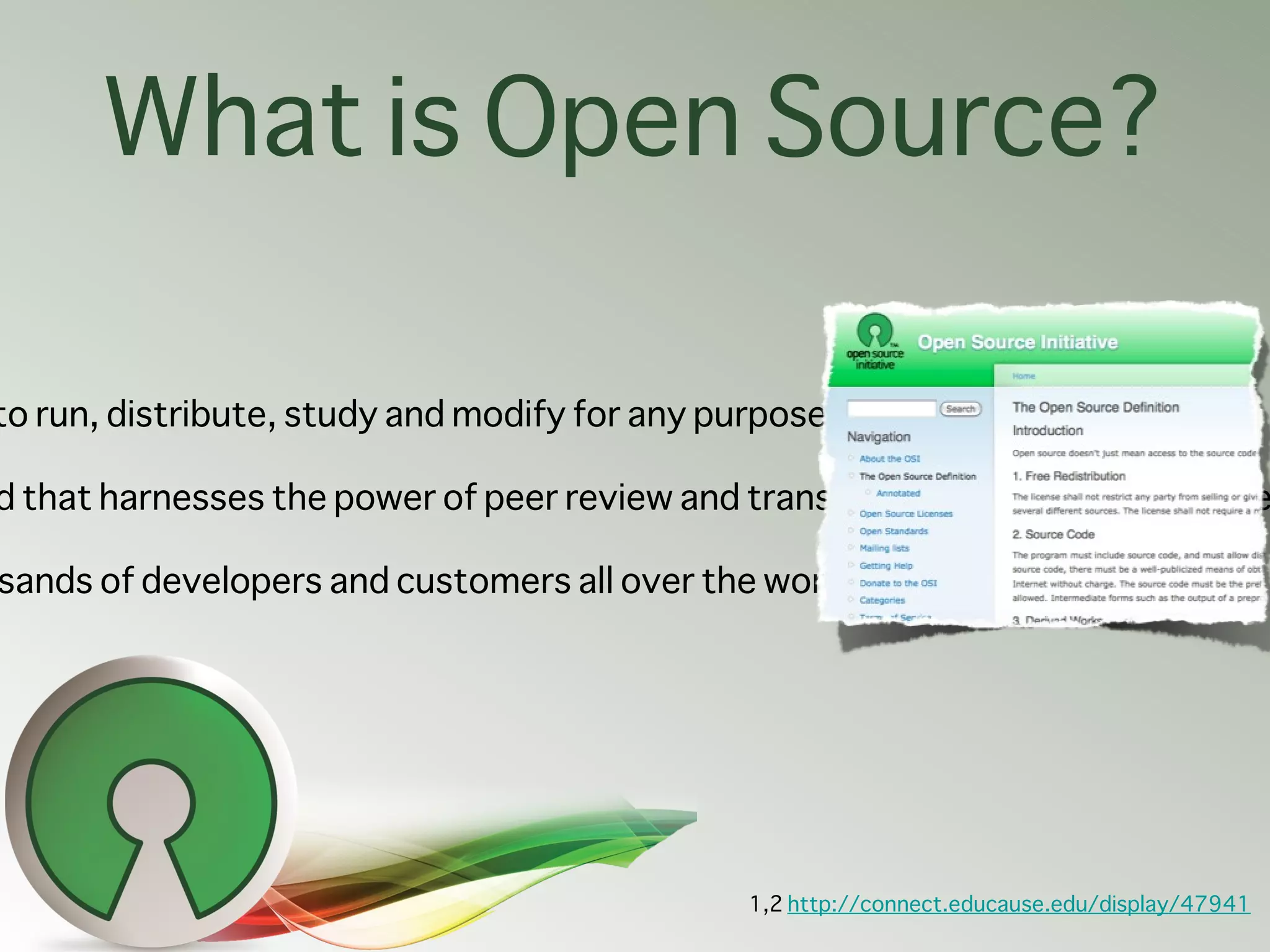
What is Open Source?

to run, distribute, study and modify for any purpose.

d that harnesses the power of peer review and transparency of process to deve

sands of developers and customers all over the world to drive innovation.2


                                               1,2 http://connect.educause.edu/display/47941
What is Free Software?
ar Free & Open Source Software (F/OSS) in conjunction.
e Definition
hilosophy/free-sw.html) is similar to, but not identical to the Open S
e.org/docs/definition.php)
an free of cost - it means Free as in Freedom
Four Freedoms of
       Free Software
You need all four of these freedoms to
have free software
Freedom of use
Freedom to copy
Freedom to modify
Freedom to contribute

                 http://www.web2learning.net/archives/4263
Sharing of ideas
"If you have an apple and I have an apple
and we exchange apples, then you and I
will still each have one apple. But if you
have an idea and I have an idea and we
exchange these ideas, then each of us will
have two ideas."
              Attributed to Bernard Shaw


                   http://ftacademy.org/materials/fsm/1#1
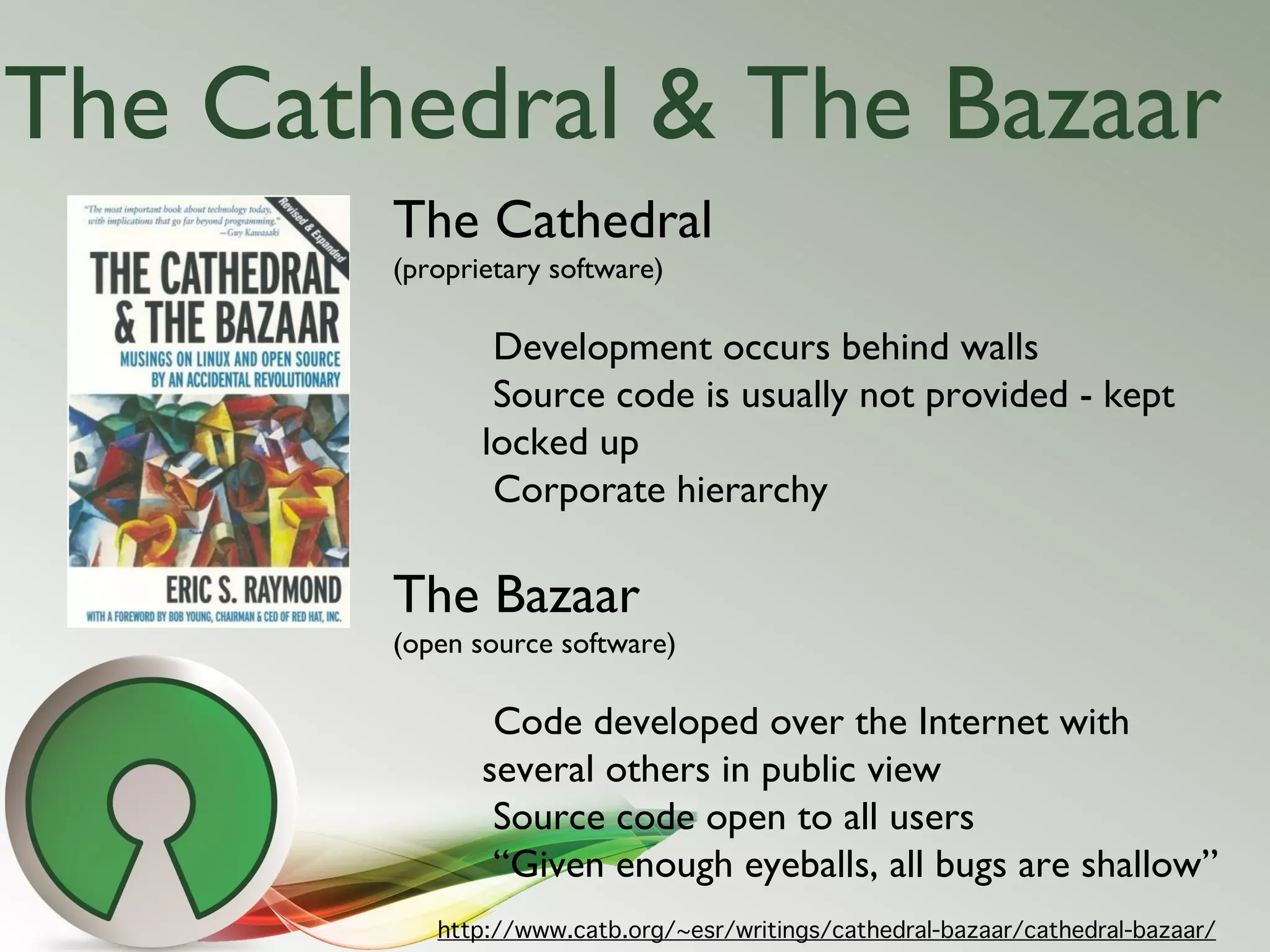
The Cathedral & The Bazaar
        The Cathedral
        (proprietary software)

                Development occurs behind walls
                Source code is usually not provided - kept
               locked up
                Corporate hierarchy

        The Bazaar
        (open source software)

                Code developed over the Internet with
               several others in public view
                Source code open to all users
                “Given enough eyeballs, all bugs are shallow”
           http://www.catb.org/~esr/writings/cathedral-bazaar/cathedral-bazaar/
Open Source Governance


who reviews the code and approves it before adding it to the final rele


s the governing body behind all decisions related to the software. The
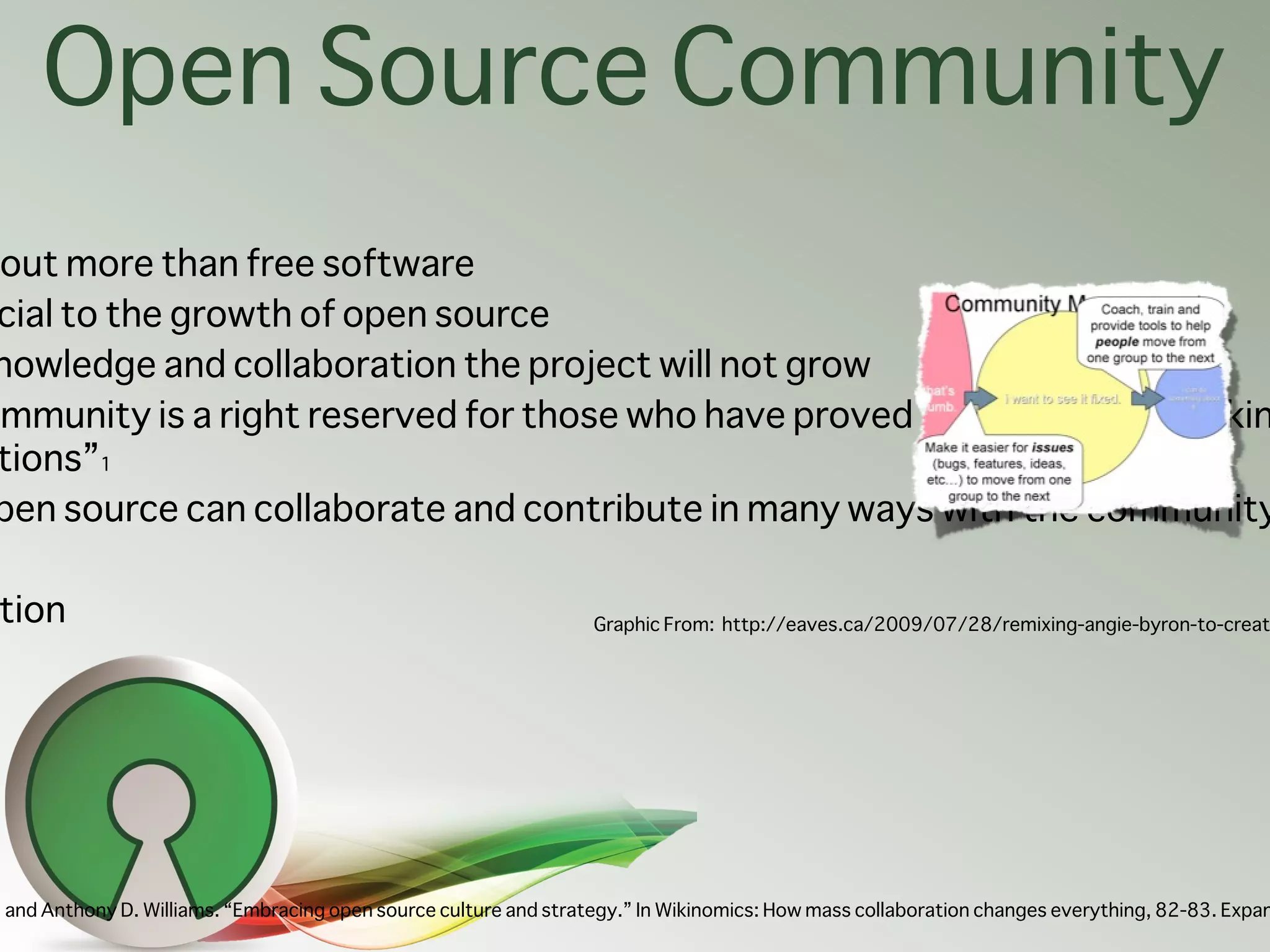
Open Source Community
 out more than free software
 cial to the growth of open source
 nowledge and collaboration the project will not grow
ommunity is a right reserved for those who have proved themselves by makin
 tions”1
 pen source can collaborate and contribute in many ways with the community

 tion                                                             Graphic From: http://eaves.ca/2009/07/28/remixing-angie-byron-to-creat


, and Anthony D. Williams. “Embracing open source culture and strategy.” In Wikinomics: How mass collaboration changes everything, 82-83. Expan
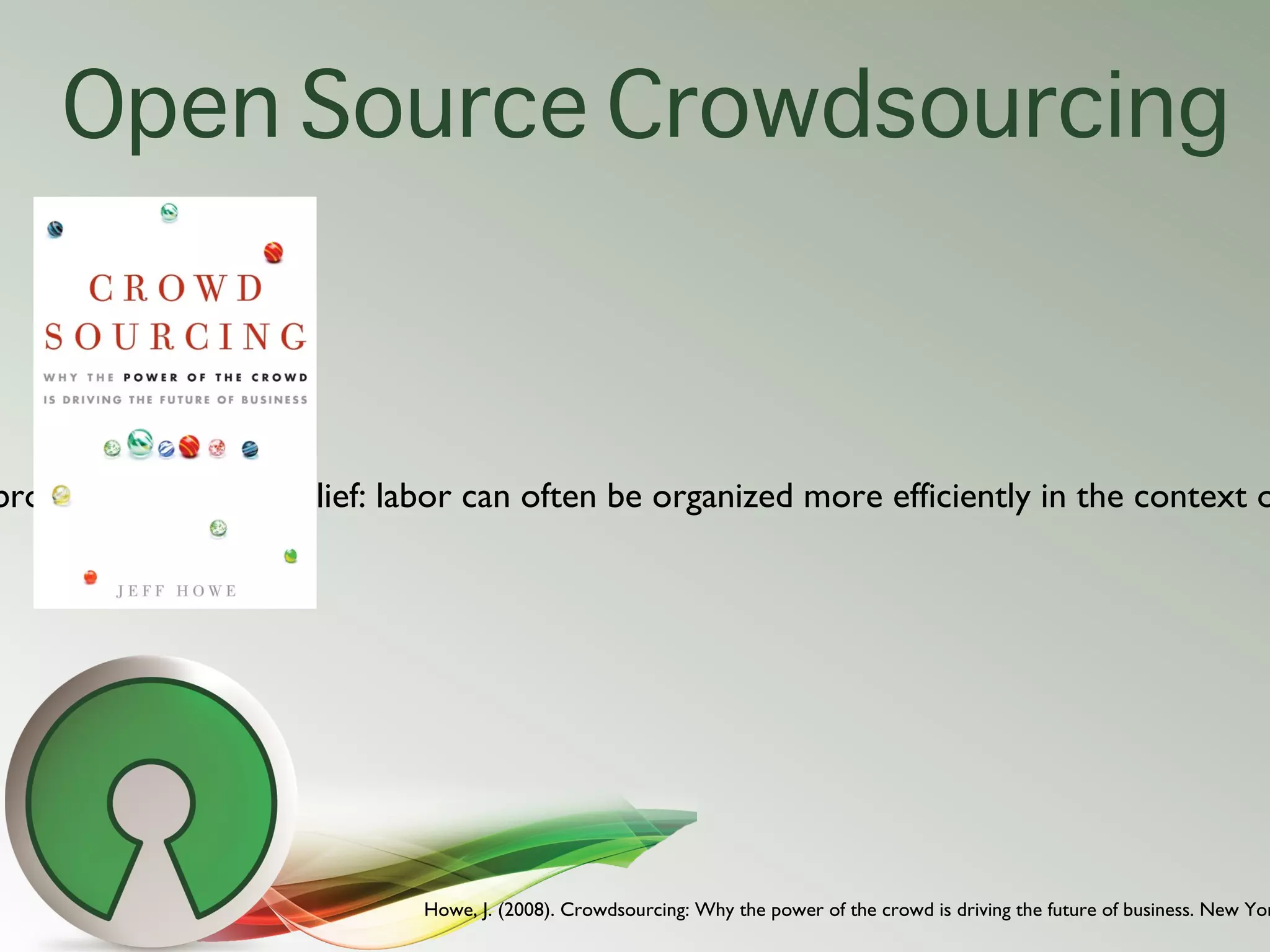
Open Source Crowdsourcing


brought it into high relief: labor can often be organized more efficiently in the context o


                              Howe, J. (2008). Crowdsourcing: Why the power of the crowd is driving the future of business. New Yor
Believing in Openness


people who believe what you believe. If you hire people just because t


                                              Simon Sinek: How great leaders inspire action
               http://www.ted.com/talks/simon_sinek_how_great_leaders_inspire_action.html
Open Source is Easy!

out 15 minutes.  Now, before I add my next point, keep in mind that I manage a staff whose averag

 libraries aren't sacrificing a thing by switching over to open source software.  If anything, open so


                                                              -- Mark at the The Rahway Public
                                                                           Library
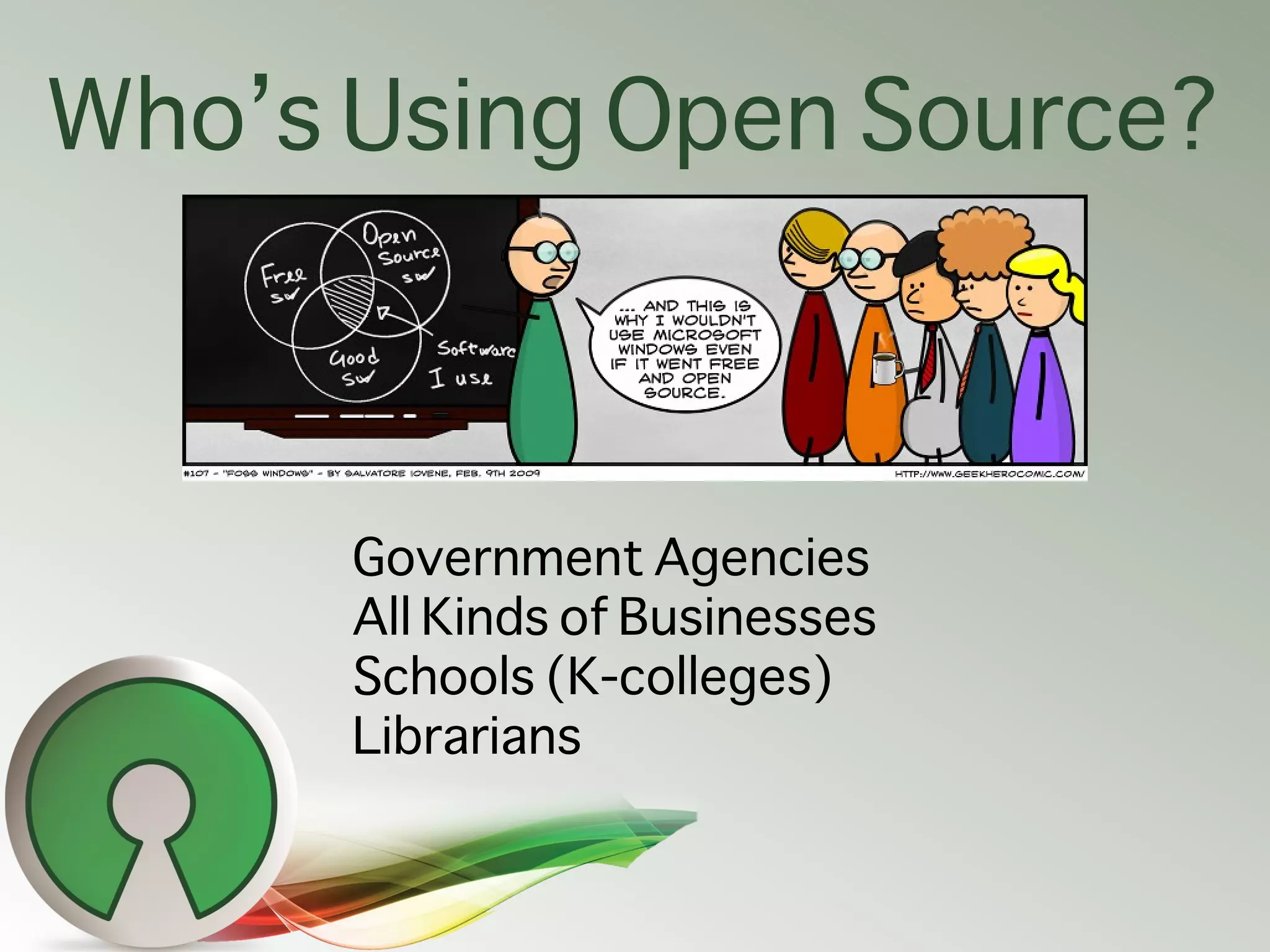
Who’s Using Open Source?


      Government Agencies
      All Kinds of Businesses
      Schools (K-colleges)
      Librarians
Open Source in Business
In 2010 a survey of 300 large organizations in both the private and public
sector found:
50% are fully committed to open source in their business
28% say they are experimenting with open source and keeping an open
mind to using it
38% expecting to migrate mission-critical software to open source in
next 12 months
The cost was no longer viewed as the key benefit, instead:
76% cited quality as a key benefit of open source
70% cited improved reliability
69% said better security/bug fixing


                                      http://newsroom.accenture.com/article_display.cfm?
                                      article_id=5045
Making money on open source
 “IBM not only accepted open source software products and processes
 but also its philosophy, which is to spur quality and fast growth rather
 than just profits based on proprietary ownership of intellectual
 property.”

 “Giving up so much control is unconventional to say the least, but the
 rewards for doing so have been handsome. IBM spends about $100
 million per year on Linux development. If the Linux community puts in $1
 billion of effort, and even half of that is useful to IBM customers, the
 company gets $500 million of software development for an investment
 of $100 million.”


Tapscott, Don, and Anthony D. Williams. “Joining Linux.” In Wikinomics: How mass collaboration changes everything, 79-82. Expanded Edit
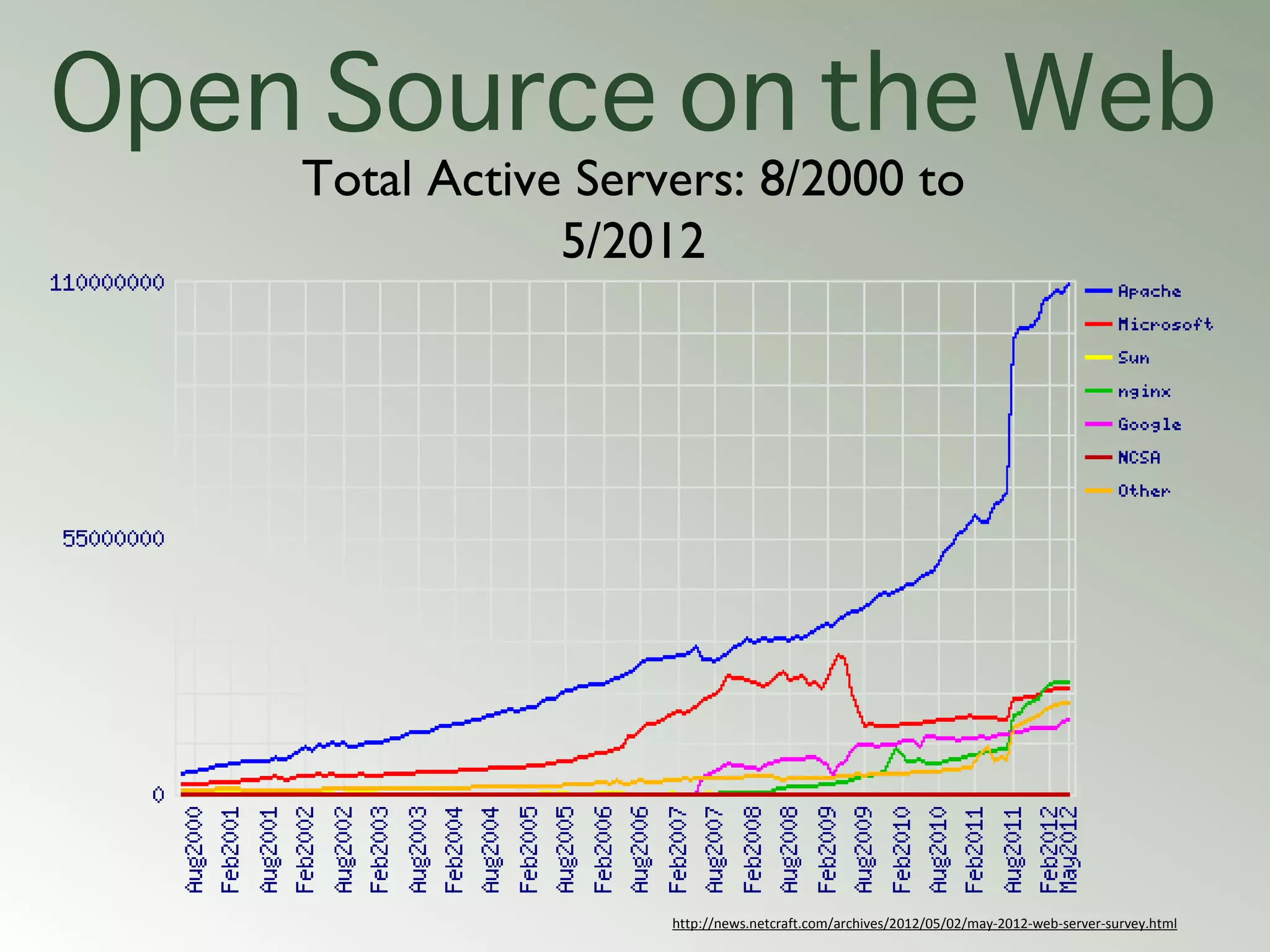
Open Source on the Web
    Total Active Servers: 8/2000 to
                5/2012


                     http://news.netcraft.com/archives/2012/05/02/may-2012-web-server-survey.html
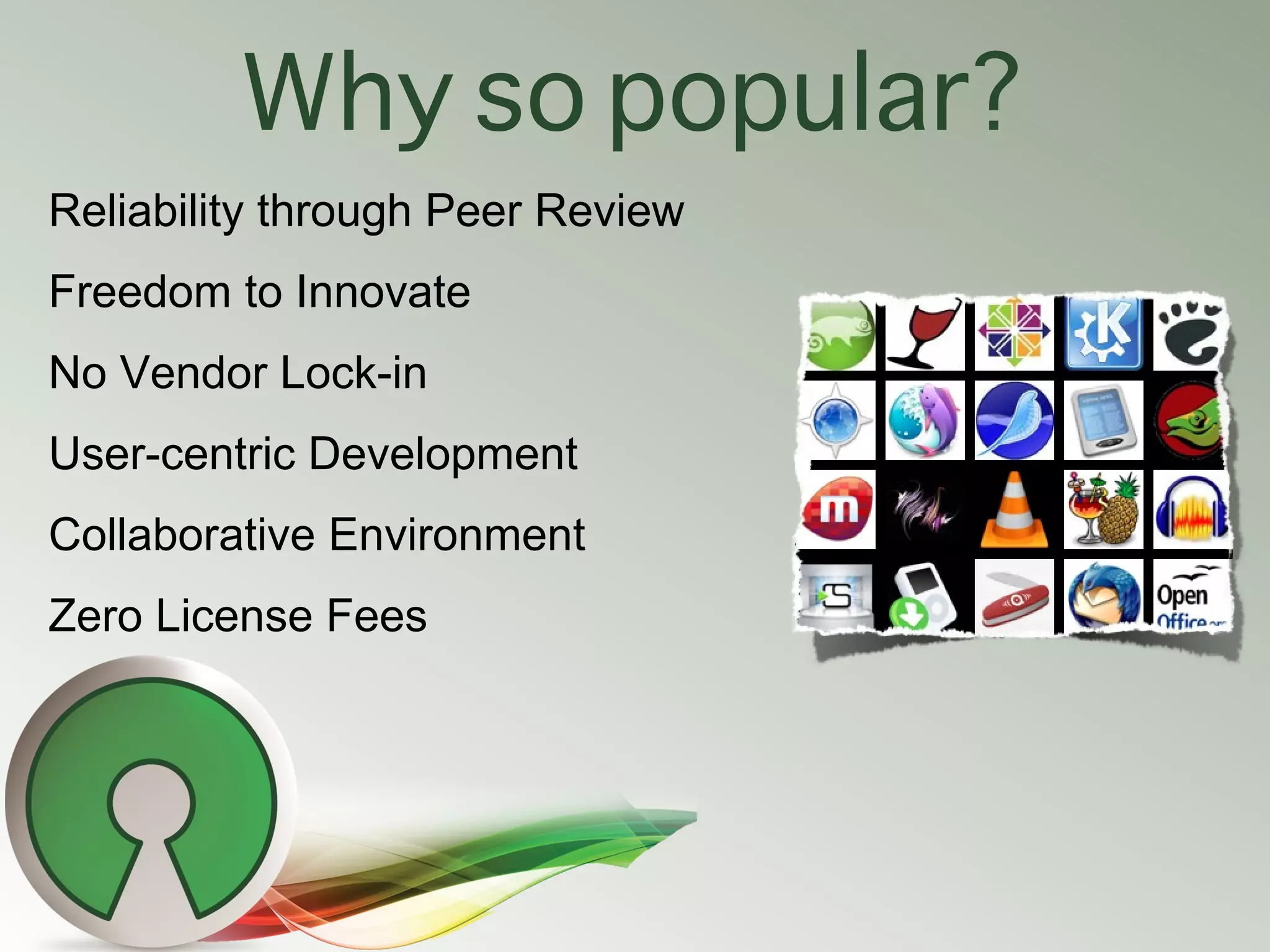
Why so popular?
Reliability through Peer Review
Freedom to Innovate
No Vendor Lock-in
User-centric Development
Collaborative Environment
Zero License Fees
Why should libraries care?
Open Source & Libraries
          Libraries and Open Source Both...

     Believe that information should be
     freely accessible to everyone

     Give away stuff

     Benefit from the generosity of others

     Are about communities

     Make the world a better place


                    -- Horton, G. http://tinyurl.com/3jvumn
Open Source & Libraries

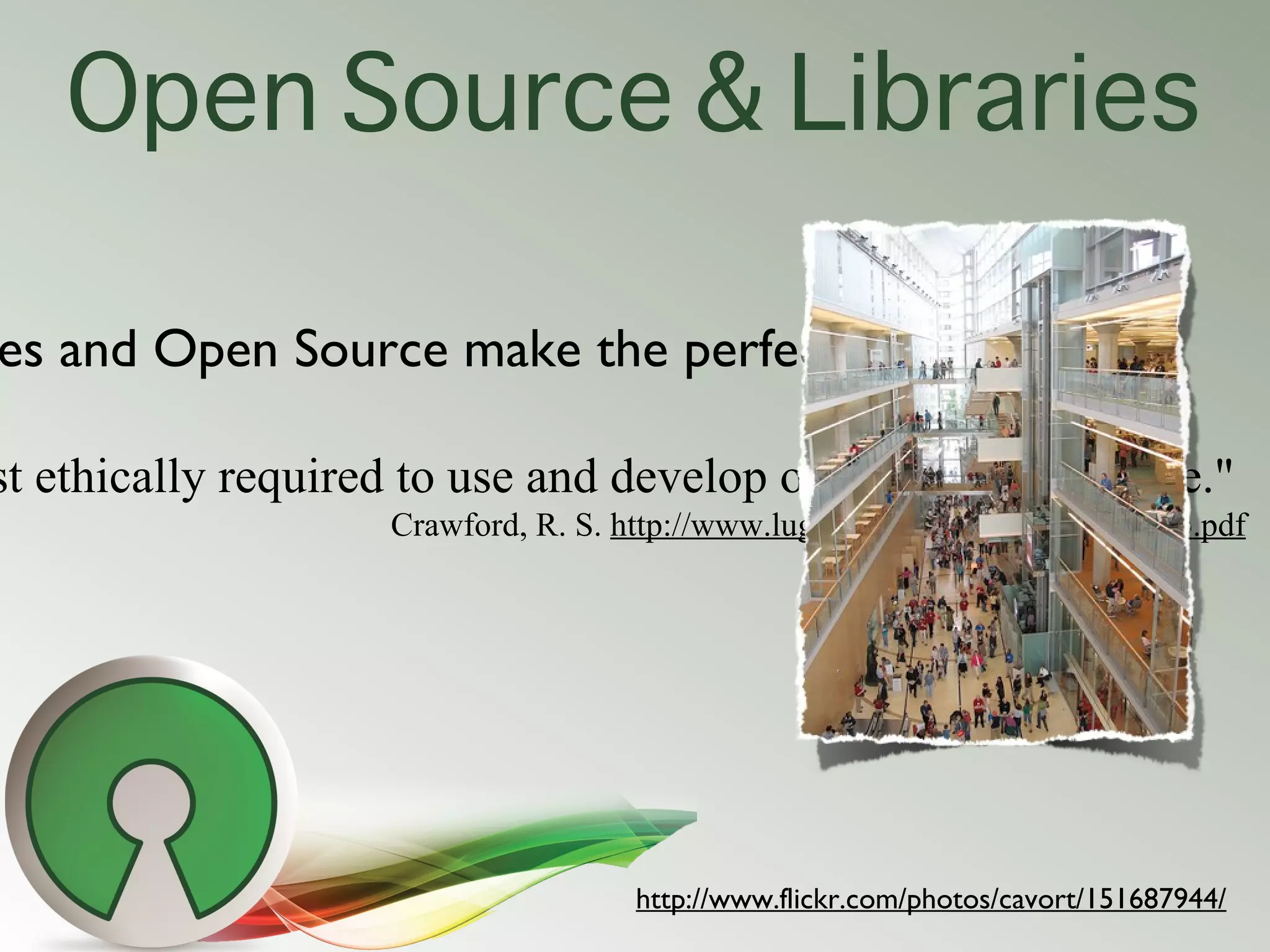
es and Open Source make the perfect pair

st ethically required to use and develop open source software."
                    Crawford, R. S. http://www.lugod.org/presentations/oss4lib.pdf


                                     http://www.flickr.com/photos/cavort/151687944/
Open Source & Libraries


at value system should extend to the intellectual work we do on our access syste


tal collaborators. Can you think of any other group of institutions that share their


                                                           -- Lucia, J.
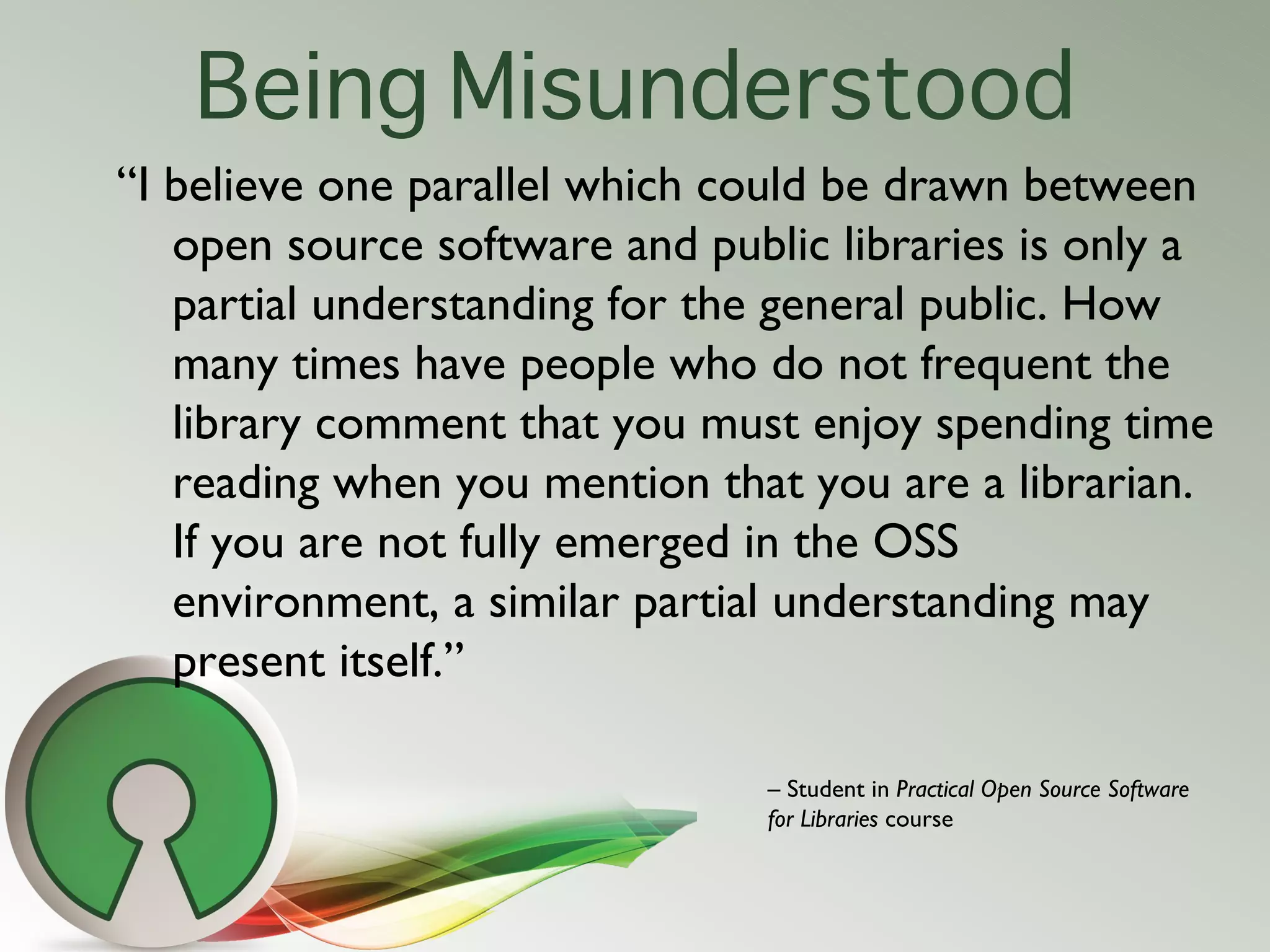
Being Misunderstood
“I believe one parallel which could be drawn between
   open source software and public libraries is only a
   partial understanding for the general public. How
   many times have people who do not frequent the
   library comment that you must enjoy spending time
   reading when you mention that you are a librarian.
   If you are not fully emerged in the OSS
   environment, a similar partial understanding may
   present itself.”

                                – Student in Practical Open Source Software
                                for Libraries course
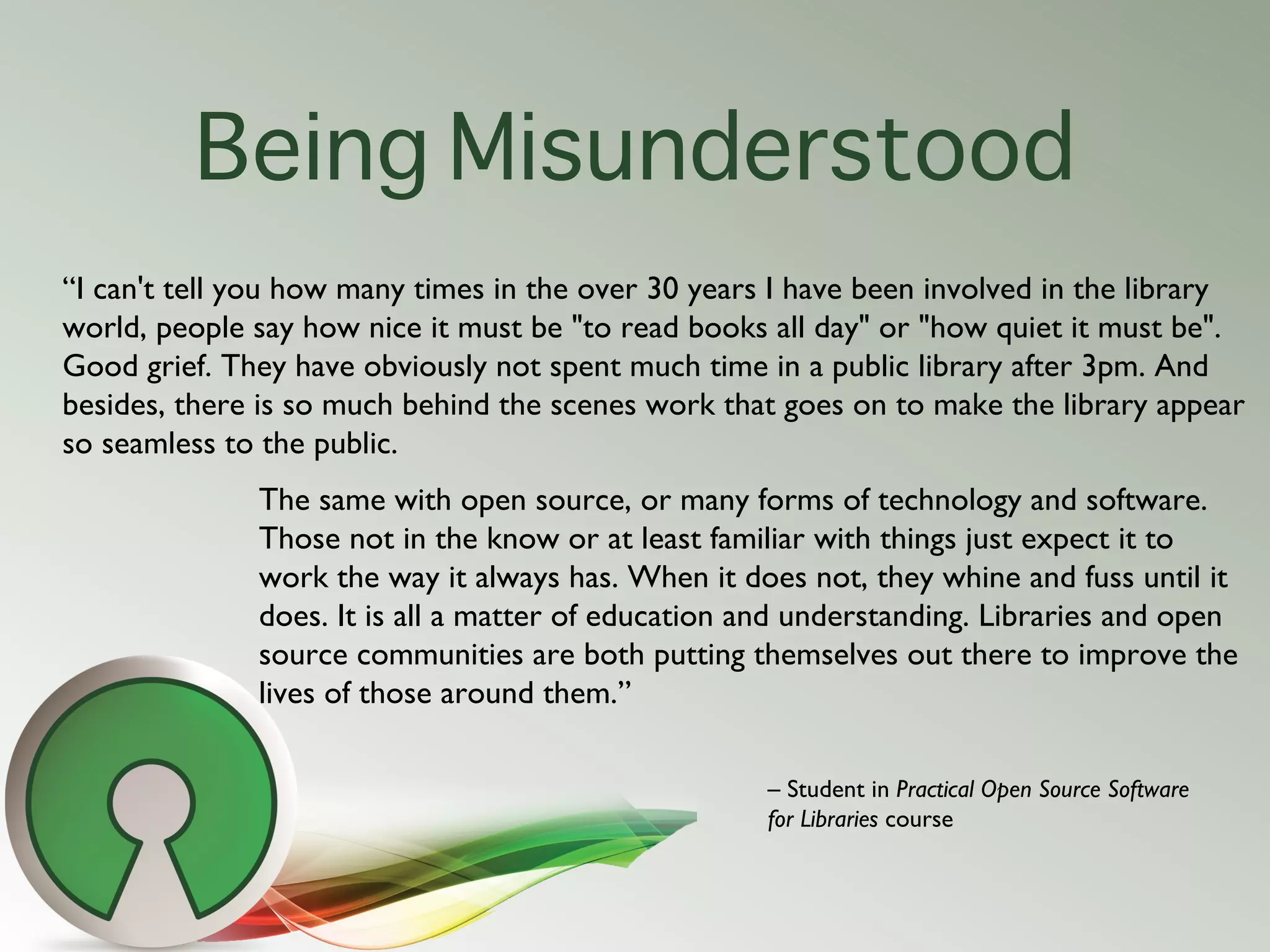
Being Misunderstood
“I can't tell you how many times in the over 30 years I have been involved in the library
world, people say how nice it must be "to read books all day" or "how quiet it must be".
Good grief. They have obviously not spent much time in a public library after 3pm. And
besides, there is so much behind the scenes work that goes on to make the library appear
so seamless to the public.
              The same with open source, or many forms of technology and software.
              Those not in the know or at least familiar with things just expect it to
              work the way it always has. When it does not, they whine and fuss until it
              does. It is all a matter of education and understanding. Libraries and open
              source communities are both putting themselves out there to improve the
              lives of those around them.”

                                                     – Student in Practical Open Source Software
                                                     for Libraries course
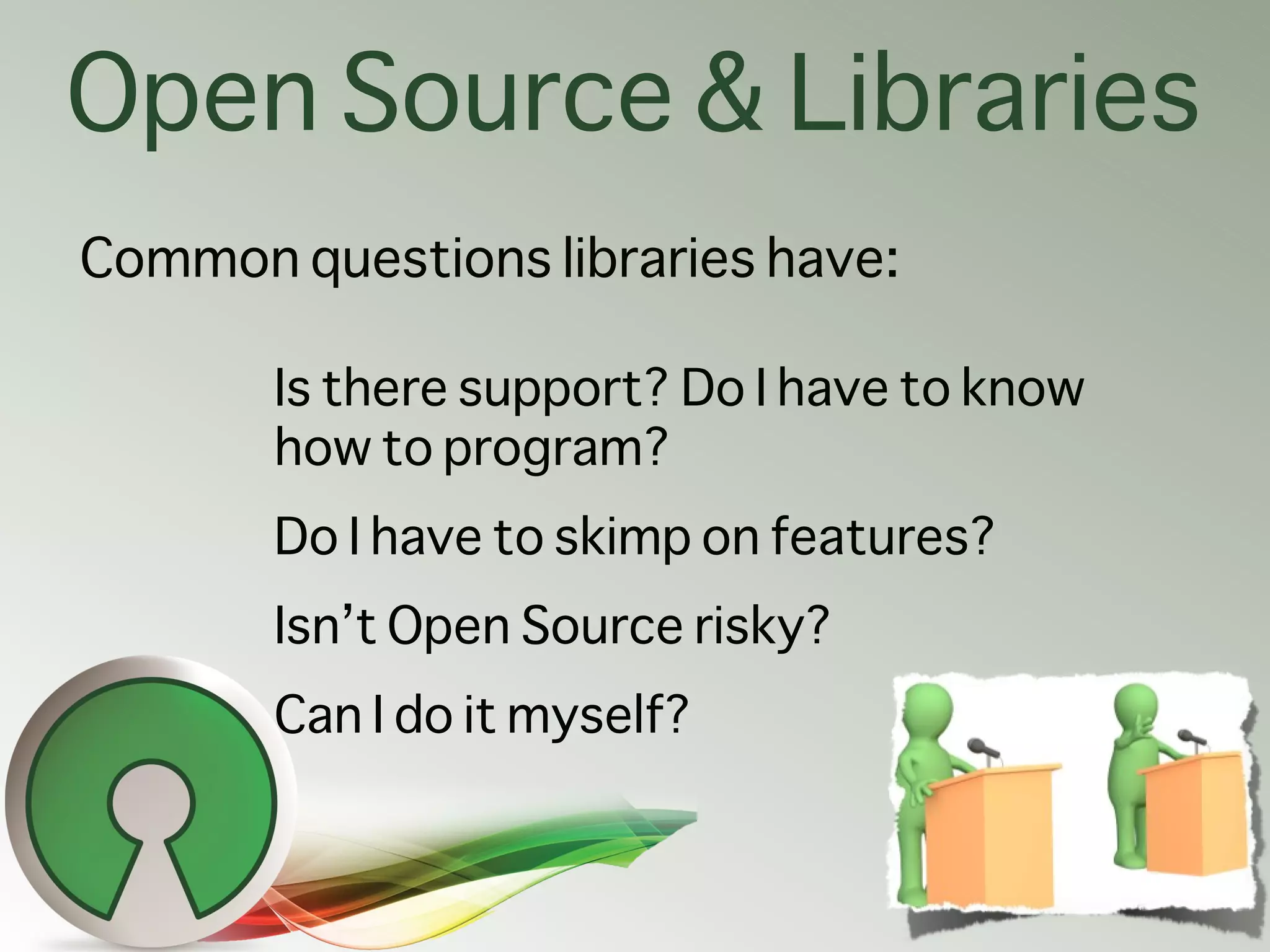
Open Source & Libraries
Common questions libraries have:

       Is there support? Do I have to know
       how to program?
       Do I have to skimp on features?
       Isn’t Open Source risky?
       Can I do it myself?
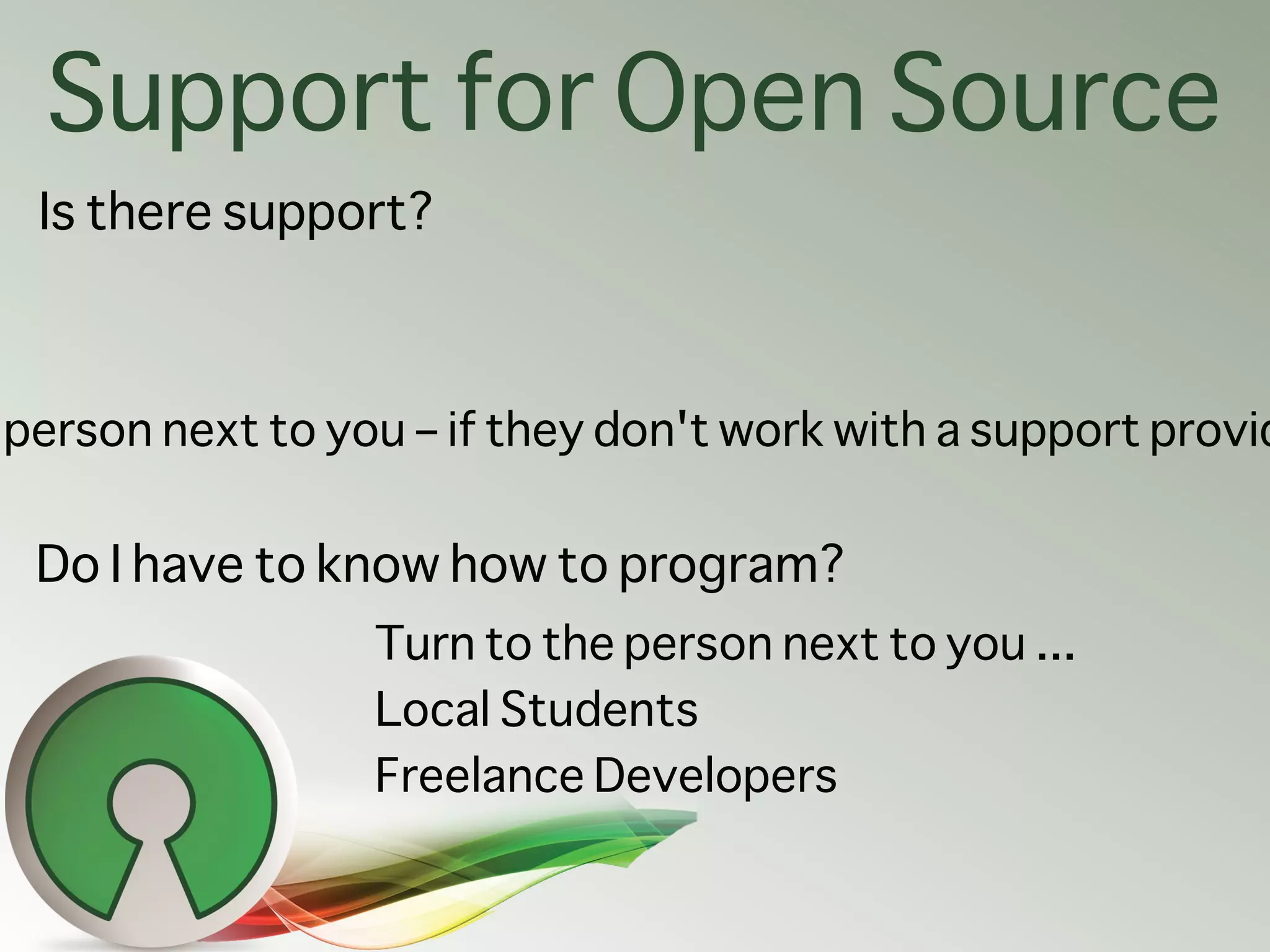
Support for Open Source
 Is there support?


person next to you – if they don't work with a support provid

 Do I have to know how to program?
                 Turn to the person next to you ...
                 Local Students
                 Freelance Developers
Do I have to skimp on features?


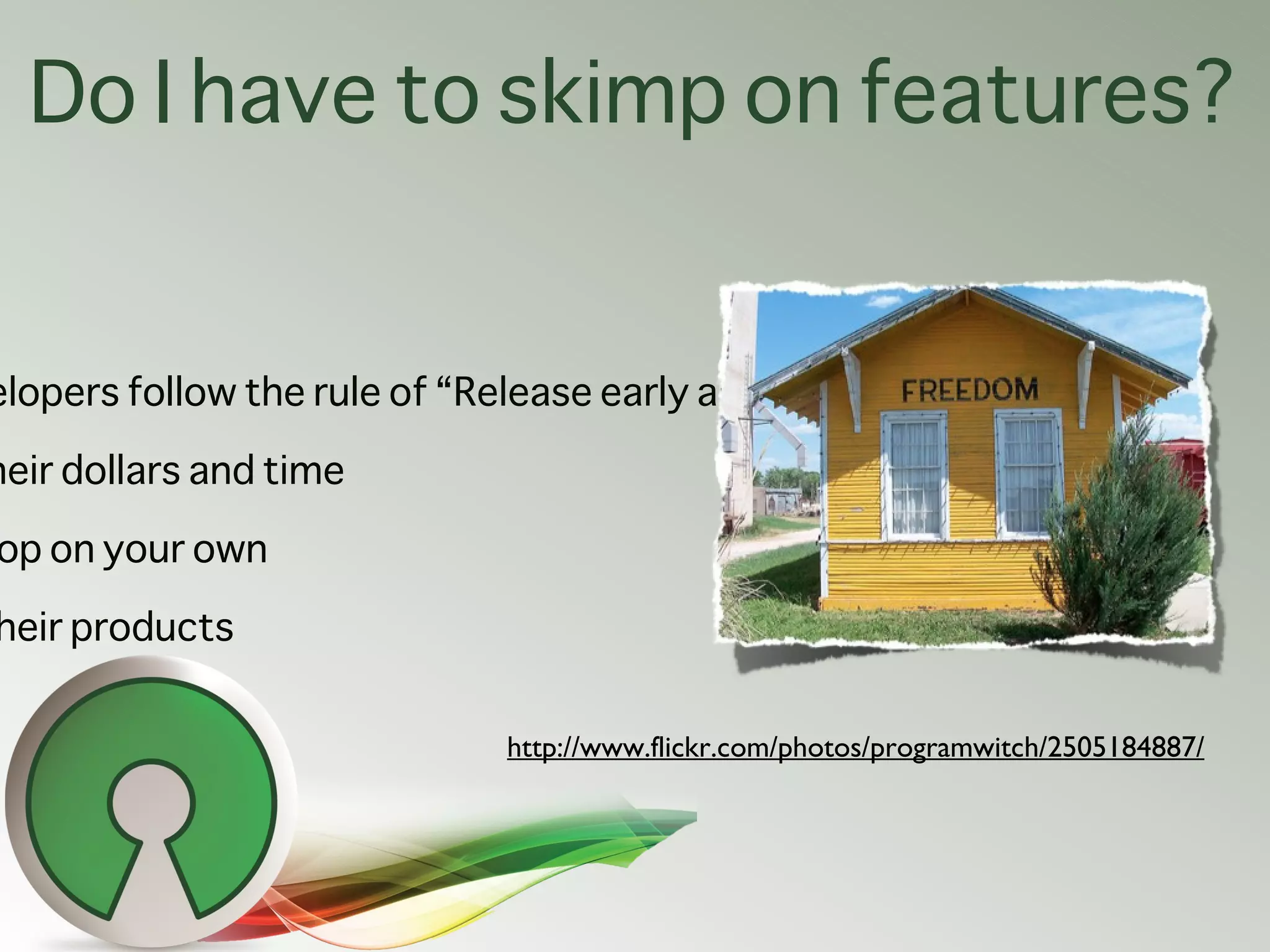
elopers follow the rule of “Release early and release often”

heir dollars and time

op on your own

heir products


                              http://www.flickr.com/photos/programwitch/2505184887/
Risk of Proprietary Software
  “Closed-source efforts often suffer from
  flaws and problems which the original
  development team never anticipated. Lack
  of inspection of the code by other
  programmers can mean that inappropriate
  design constraints and other errors might
  not be discovered until the code is already in
  use.”


                 Pavlicek, Russell. Embracing insanity : open source software development. I
Software is Risky!

isks, you need to evaluate open source the same way you do proprietary syste

 Risk to consider:

issues
st as secure if not more secure than proprietary systems because of its transp
urce software no differently than you do other software!

 s and acquisitions
n the code to your system you are not tied to one support source and will neve
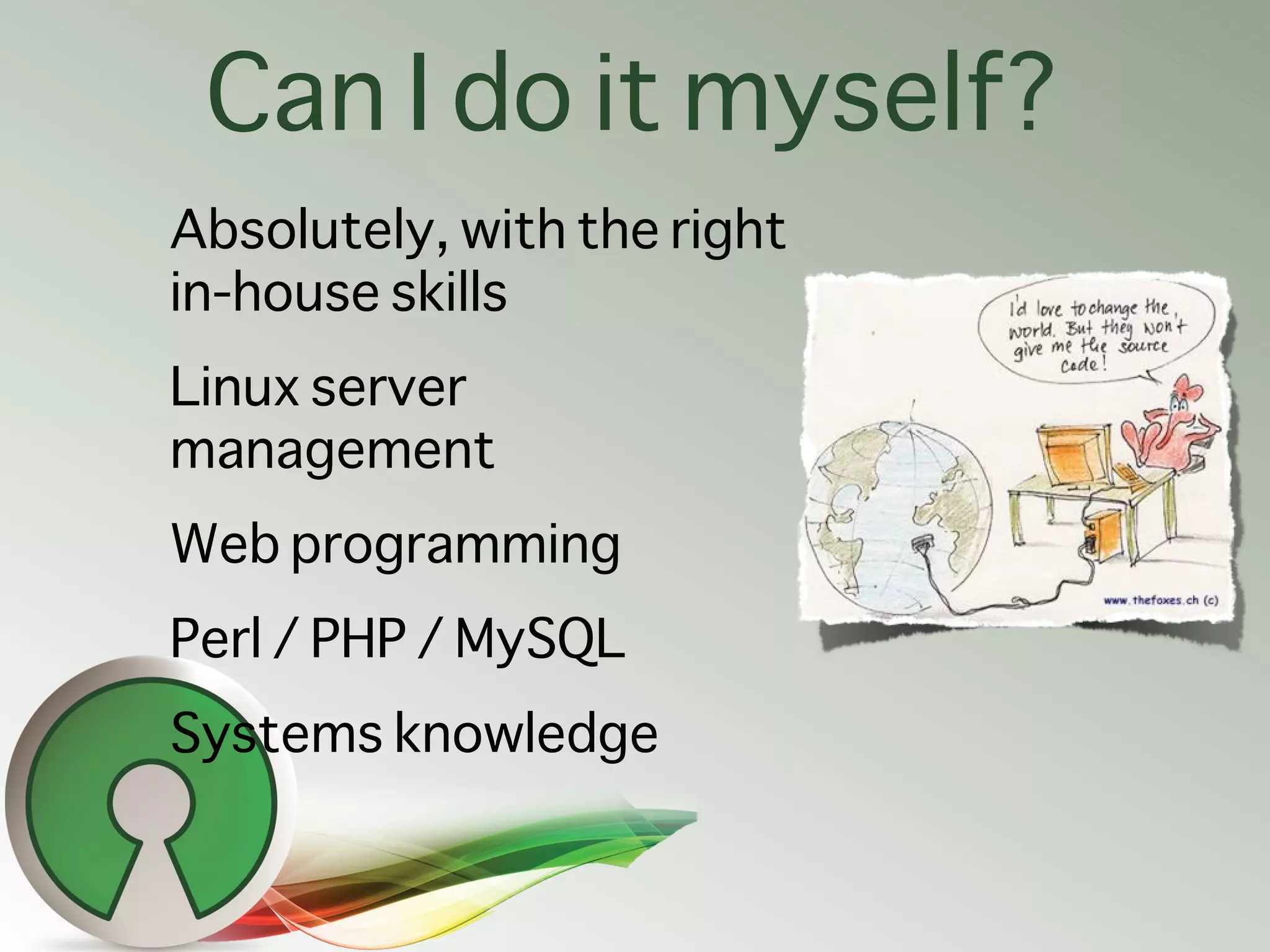
Can I do it myself?
Absolutely, with the right
in-house skills
Linux server
management
Web programming
Perl / PHP / MySQL
Systems knowledge
Additional Links
Top 50 Programs that Drive You Crazy & their OS Alternatives:
http://tinyurl.com/2xju2m

OSS Watch, open source software advisory service:
http://www.oss-watch.ac.uk

Open Source as Alternative
http://www.osalt.com

Nicole’s Delicious bookmarks:
http://delicious.com/nengard/opensource

   Open Source Living
   http://osliving.com
OSS & Libraries Links
en Source Software in Libraries
p://infomotions.com/musings/ossnlibraries/

en Source Software and Libraries Bibliography
ero.org/groups/freelibre_and_open_source_software_and_libraries_bibliogr

en Network Libraries http://onl.org.nz
rimer on Risk
p://www.libraryjournal.com/article/CA6611591.html

ctical Open Source Software for Librariesopensource.web2learning.net/blog
Open Source Blogs
The Open Road http://www.cnet.com/openroad/
Open Ended from Ars Technica http://arstechnica.com/open-source
The H Open Source http://www.h-online.com/open/
ZDNet Open Source http://blogs.zdnet.com/open-source
New York Times - Open http://open.nytimes.com
OpenSource.com http://opensource.com
Open Source at Datamation http://itmanagement.earthweb.com/osrc
Online Reading List

rrowing the Divides between Education, Business, and Community
educause.edu/display/47941
ree Software & Open Standards: Introduction to Free Software http://ftacademy.org/m
ware Tools And Directories: Where To Find Them, How To Evaluate Them
ternewmedia.org/open-source-software-tools-and-directories-where-to-find-them-how
urity Bibliography
 ro.org/nengard/items/collection/QKWPIXK9
brary
ro.org/nengard/items/collection/1796131
Print Reading List

Source Software in Libraries by Nicole C. Engard

and the Bazaar: Musings on Linux and Open Source by an Accidental Revolutionary by Eric

nity: Open Source Software Development by Russell Pavlicek

 open source by Steve Weber

ce alternative: Understanding risks and leveraging opportunities by Heather J. Meeker

2.0: The Continuing Evolution by Chris DiBona, Mark Stone, and Danese Cooper
Print Reading List

Source Software in Libraries by Nicole C. Engard

and the Bazaar: Musings on Linux and Open Source by an Accidental Revolutionary by Eric

nity: Open Source Software Development by Russell Pavlicek

 open source by Steve Weber

ce alternative: Understanding risks and leveraging opportunities by Heather J. Meeker

2.0: The Continuing Evolution by Chris DiBona, Mark Stone, and Danese Cooper
Thank You
       Nicole C. Engard
     nengard@gmail.com
nengard@bywatersolutions.com

Open Source: Freedom and Community

  • 1.
    Open Source: Freedom & Community Nicole C. Engard Vice President of Education, ByWater Solutions Documentation Manager, Koha nengard@gmail.com nengard@bywatersolutions.com
  • 2.
    What isn’t OpenSource? Common Open Source FUD (Fear, Uncertainty & Doubt) “Isn’t that insecure?” “I don’t want to share my data!” “How can it be any good if it’s free?” “We don’t have the staff to handle open source.” “We’ve never had success with homegrown systems.” Comic: Author: Unknown | Year: Unknown | Source: Unknown
  • 3.
    What is OpenSource? to run, distribute, study and modify for any purpose. d that harnesses the power of peer review and transparency of process to deve sands of developers and customers all over the world to drive innovation.2 1,2 http://connect.educause.edu/display/47941
  • 4.
    What is FreeSoftware? ar Free & Open Source Software (F/OSS) in conjunction. e Definition hilosophy/free-sw.html) is similar to, but not identical to the Open S e.org/docs/definition.php) an free of cost - it means Free as in Freedom
  • 5.
    Four Freedoms of Free Software You need all four of these freedoms to have free software Freedom of use Freedom to copy Freedom to modify Freedom to contribute http://www.web2learning.net/archives/4263
  • 6.
    Sharing of ideas "Ifyou have an apple and I have an apple and we exchange apples, then you and I will still each have one apple. But if you have an idea and I have an idea and we exchange these ideas, then each of us will have two ideas." Attributed to Bernard Shaw http://ftacademy.org/materials/fsm/1#1
  • 7.
    The Cathedral &The Bazaar The Cathedral (proprietary software) Development occurs behind walls Source code is usually not provided - kept locked up Corporate hierarchy The Bazaar (open source software) Code developed over the Internet with several others in public view Source code open to all users “Given enough eyeballs, all bugs are shallow” http://www.catb.org/~esr/writings/cathedral-bazaar/cathedral-bazaar/
  • 8.
    Open Source Governance whoreviews the code and approves it before adding it to the final rele s the governing body behind all decisions related to the software. The
  • 9.
    Open Source Community out more than free software cial to the growth of open source nowledge and collaboration the project will not grow ommunity is a right reserved for those who have proved themselves by makin tions”1 pen source can collaborate and contribute in many ways with the community tion Graphic From: http://eaves.ca/2009/07/28/remixing-angie-byron-to-creat , and Anthony D. Williams. “Embracing open source culture and strategy.” In Wikinomics: How mass collaboration changes everything, 82-83. Expan
  • 10.
    Open Source Crowdsourcing broughtit into high relief: labor can often be organized more efficiently in the context o Howe, J. (2008). Crowdsourcing: Why the power of the crowd is driving the future of business. New Yor
  • 11.
    Believing in Openness peoplewho believe what you believe. If you hire people just because t Simon Sinek: How great leaders inspire action http://www.ted.com/talks/simon_sinek_how_great_leaders_inspire_action.html
  • 12.
    Open Source isEasy! out 15 minutes.  Now, before I add my next point, keep in mind that I manage a staff whose averag libraries aren't sacrificing a thing by switching over to open source software.  If anything, open so -- Mark at the The Rahway Public Library
  • 13.
    Who’s Using OpenSource? Government Agencies All Kinds of Businesses Schools (K-colleges) Librarians
  • 14.
    Open Source inBusiness In 2010 a survey of 300 large organizations in both the private and public sector found: 50% are fully committed to open source in their business 28% say they are experimenting with open source and keeping an open mind to using it 38% expecting to migrate mission-critical software to open source in next 12 months The cost was no longer viewed as the key benefit, instead: 76% cited quality as a key benefit of open source 70% cited improved reliability 69% said better security/bug fixing http://newsroom.accenture.com/article_display.cfm? article_id=5045
  • 15.
    Making money onopen source “IBM not only accepted open source software products and processes but also its philosophy, which is to spur quality and fast growth rather than just profits based on proprietary ownership of intellectual property.” “Giving up so much control is unconventional to say the least, but the rewards for doing so have been handsome. IBM spends about $100 million per year on Linux development. If the Linux community puts in $1 billion of effort, and even half of that is useful to IBM customers, the company gets $500 million of software development for an investment of $100 million.” Tapscott, Don, and Anthony D. Williams. “Joining Linux.” In Wikinomics: How mass collaboration changes everything, 79-82. Expanded Edit
  • 16.
    Open Source onthe Web Total Active Servers: 8/2000 to 5/2012 http://news.netcraft.com/archives/2012/05/02/may-2012-web-server-survey.html
  • 17.
    Why so popular? Reliabilitythrough Peer Review Freedom to Innovate No Vendor Lock-in User-centric Development Collaborative Environment Zero License Fees
  • 18.
  • 19.
    Open Source &Libraries Libraries and Open Source Both... Believe that information should be freely accessible to everyone Give away stuff Benefit from the generosity of others Are about communities Make the world a better place -- Horton, G. http://tinyurl.com/3jvumn
  • 20.
    Open Source &Libraries es and Open Source make the perfect pair st ethically required to use and develop open source software." Crawford, R. S. http://www.lugod.org/presentations/oss4lib.pdf http://www.flickr.com/photos/cavort/151687944/
  • 21.
    Open Source &Libraries at value system should extend to the intellectual work we do on our access syste tal collaborators. Can you think of any other group of institutions that share their -- Lucia, J.
  • 22.
    Being Misunderstood “I believeone parallel which could be drawn between open source software and public libraries is only a partial understanding for the general public. How many times have people who do not frequent the library comment that you must enjoy spending time reading when you mention that you are a librarian. If you are not fully emerged in the OSS environment, a similar partial understanding may present itself.” – Student in Practical Open Source Software for Libraries course
  • 23.
    Being Misunderstood “I can'ttell you how many times in the over 30 years I have been involved in the library world, people say how nice it must be "to read books all day" or "how quiet it must be". Good grief. They have obviously not spent much time in a public library after 3pm. And besides, there is so much behind the scenes work that goes on to make the library appear so seamless to the public. The same with open source, or many forms of technology and software. Those not in the know or at least familiar with things just expect it to work the way it always has. When it does not, they whine and fuss until it does. It is all a matter of education and understanding. Libraries and open source communities are both putting themselves out there to improve the lives of those around them.” – Student in Practical Open Source Software for Libraries course
  • 24.
    Open Source &Libraries Common questions libraries have: Is there support? Do I have to know how to program? Do I have to skimp on features? Isn’t Open Source risky? Can I do it myself?
  • 25.
    Support for OpenSource Is there support? person next to you – if they don't work with a support provid Do I have to know how to program? Turn to the person next to you ... Local Students Freelance Developers
  • 26.
    Do I haveto skimp on features? elopers follow the rule of “Release early and release often” heir dollars and time op on your own heir products http://www.flickr.com/photos/programwitch/2505184887/
  • 27.
    Risk of ProprietarySoftware “Closed-source efforts often suffer from flaws and problems which the original development team never anticipated. Lack of inspection of the code by other programmers can mean that inappropriate design constraints and other errors might not be discovered until the code is already in use.” Pavlicek, Russell. Embracing insanity : open source software development. I
  • 28.
    Software is Risky! isks,you need to evaluate open source the same way you do proprietary syste Risk to consider: issues st as secure if not more secure than proprietary systems because of its transp urce software no differently than you do other software! s and acquisitions n the code to your system you are not tied to one support source and will neve
  • 29.
    Can I doit myself? Absolutely, with the right in-house skills Linux server management Web programming Perl / PHP / MySQL Systems knowledge
  • 30.
    Additional Links Top 50Programs that Drive You Crazy & their OS Alternatives: http://tinyurl.com/2xju2m OSS Watch, open source software advisory service: http://www.oss-watch.ac.uk Open Source as Alternative http://www.osalt.com Nicole’s Delicious bookmarks: http://delicious.com/nengard/opensource Open Source Living http://osliving.com
  • 31.
    OSS & LibrariesLinks en Source Software in Libraries p://infomotions.com/musings/ossnlibraries/ en Source Software and Libraries Bibliography ero.org/groups/freelibre_and_open_source_software_and_libraries_bibliogr en Network Libraries http://onl.org.nz rimer on Risk p://www.libraryjournal.com/article/CA6611591.html ctical Open Source Software for Librariesopensource.web2learning.net/blog
  • 32.
    Open Source Blogs TheOpen Road http://www.cnet.com/openroad/ Open Ended from Ars Technica http://arstechnica.com/open-source The H Open Source http://www.h-online.com/open/ ZDNet Open Source http://blogs.zdnet.com/open-source New York Times - Open http://open.nytimes.com OpenSource.com http://opensource.com Open Source at Datamation http://itmanagement.earthweb.com/osrc
  • 33.
    Online Reading List rrowingthe Divides between Education, Business, and Community educause.edu/display/47941 ree Software & Open Standards: Introduction to Free Software http://ftacademy.org/m ware Tools And Directories: Where To Find Them, How To Evaluate Them ternewmedia.org/open-source-software-tools-and-directories-where-to-find-them-how urity Bibliography ro.org/nengard/items/collection/QKWPIXK9 brary ro.org/nengard/items/collection/1796131
  • 34.
    Print Reading List SourceSoftware in Libraries by Nicole C. Engard and the Bazaar: Musings on Linux and Open Source by an Accidental Revolutionary by Eric nity: Open Source Software Development by Russell Pavlicek open source by Steve Weber ce alternative: Understanding risks and leveraging opportunities by Heather J. Meeker 2.0: The Continuing Evolution by Chris DiBona, Mark Stone, and Danese Cooper
  • 35.
    Print Reading List SourceSoftware in Libraries by Nicole C. Engard and the Bazaar: Musings on Linux and Open Source by an Accidental Revolutionary by Eric nity: Open Source Software Development by Russell Pavlicek open source by Steve Weber ce alternative: Understanding risks and leveraging opportunities by Heather J. Meeker 2.0: The Continuing Evolution by Chris DiBona, Mark Stone, and Danese Cooper
  • 36.
    Thank You Nicole C. Engard nengard@gmail.com nengard@bywatersolutions.com