Standards Based
  Grading/Assessment
The Benefits and Implementation in the Social Studies
                   Department

 By Martin Palamore, Teacher, Hancock High School
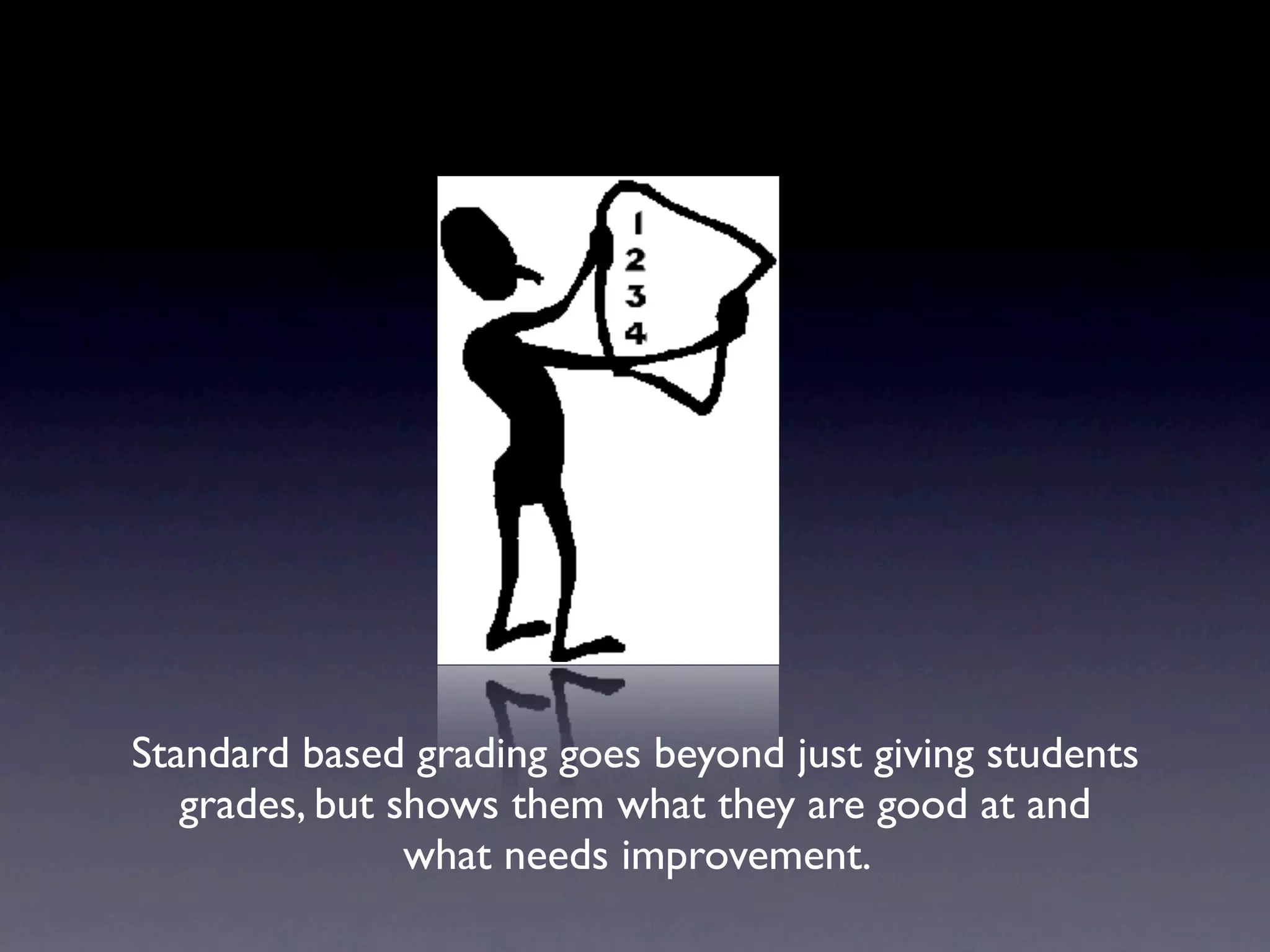
Standard based grading goes beyond just giving students
   grades, but shows them what they are good at and
                what needs improvement.
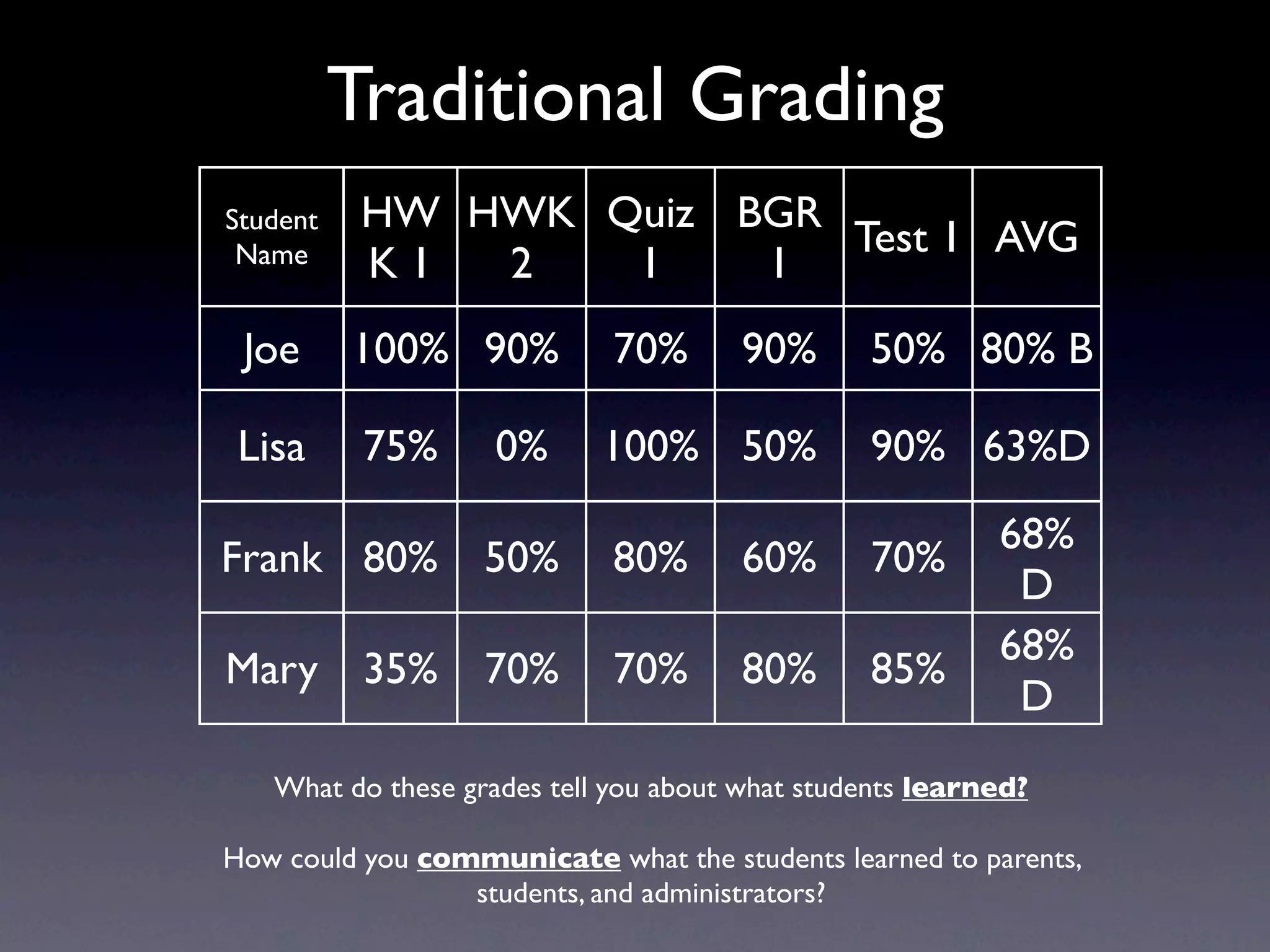
Traditional Grading


   What do these grades tell you about what students learned?

How could you communicate what the students learned to parents,
                 students, and administrators?
Traditional Grading
Student    HW HWK Quiz BGR
                           Test 1 AVG
 Name      K1  2   1    1
 Joe      100% 90%           70%      90%       50% 80% B

 Lisa      75%      0%      100% 50%            90% 63%D
                                                          68%
Frank 80%          50%       80%      60%       70%
                                                           D
                                                          68%
Mary       35%     70%       70%      80%       85%
                                                           D
   What do these grades tell you about what students learned?

How could you communicate what the students learned to parents,
                 students, and administrators?
Benefit One: Understanding/Communicating What
            Students Learned
Standards Based Grading


   What do these grades tell you about what students learned?

How could you communicate what the students learned to parents,
                 students, and administrators?
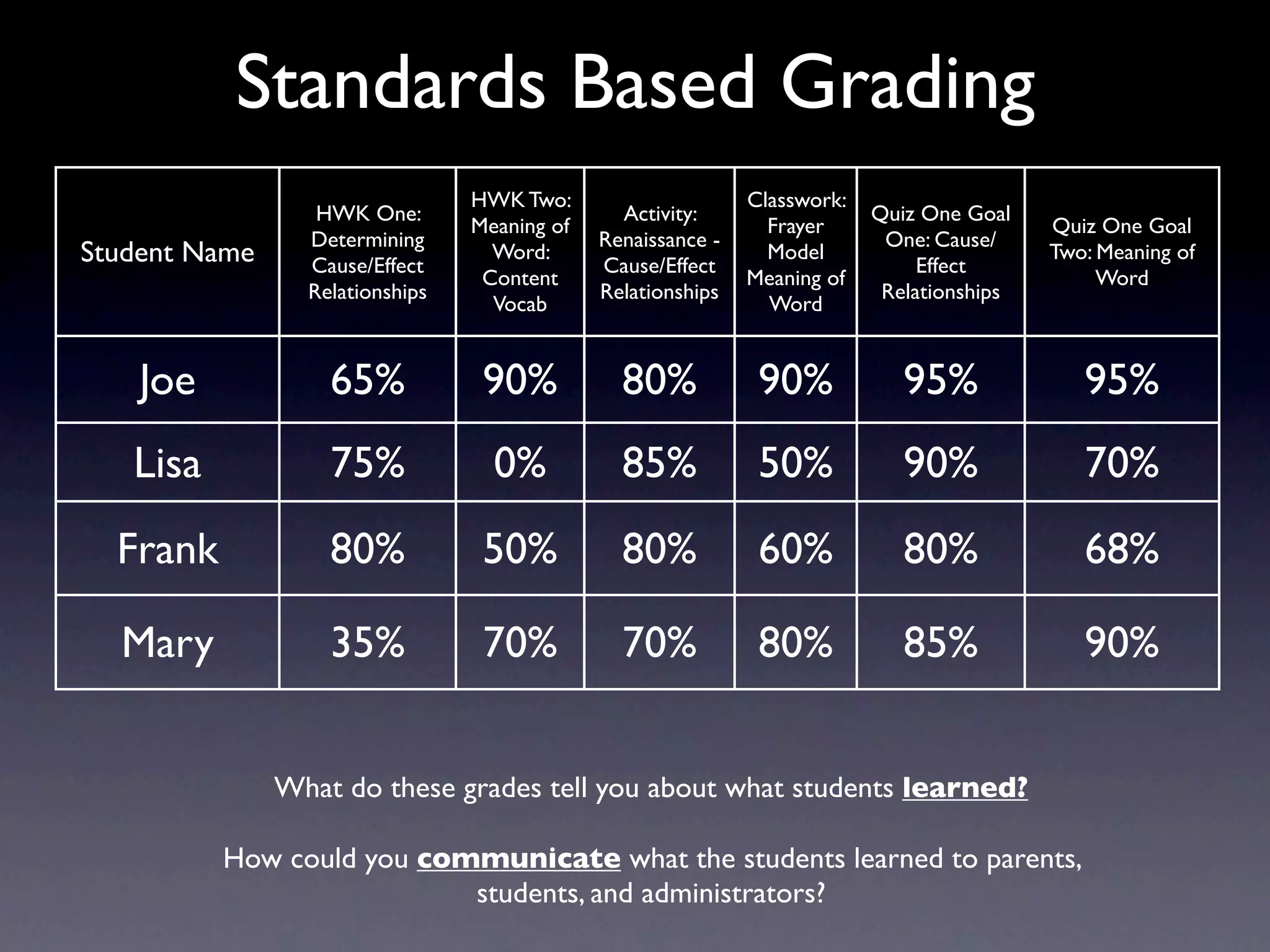
Standards Based Grading
                                 HWK Two:                     Classwork:
                  HWK One:                      Activity:                  Quiz One Goal
                                 Meaning of                     Frayer                      Quiz One Goal
                 Determining                  Renaissance -                 One: Cause/
Student Name     Cause/Effect
                                   Word:
                                              Cause/Effect
                                                                Model
                                                                                Effect
                                                                                            Two: Meaning of
                                  Content                     Meaning of                         Word
                 Relationships                Relationships                 Relationships
                                   Vocab                        Word


    Joe            65%            90%           80%            90%            95%              95%
   Lisa            75%             0%           85%            50%            90%              70%
  Frank            80%            50%           80%            60%            80%              68%

  Mary             35%            70%           70%            80%            85%              90%


               What do these grades tell you about what students learned?

          How could you communicate what the students learned to parents,
                           students, and administrators?
Benefit Two: Allows for easy reflection/knowing
               what works!
Planning for
 Standards
   Based
  Grading
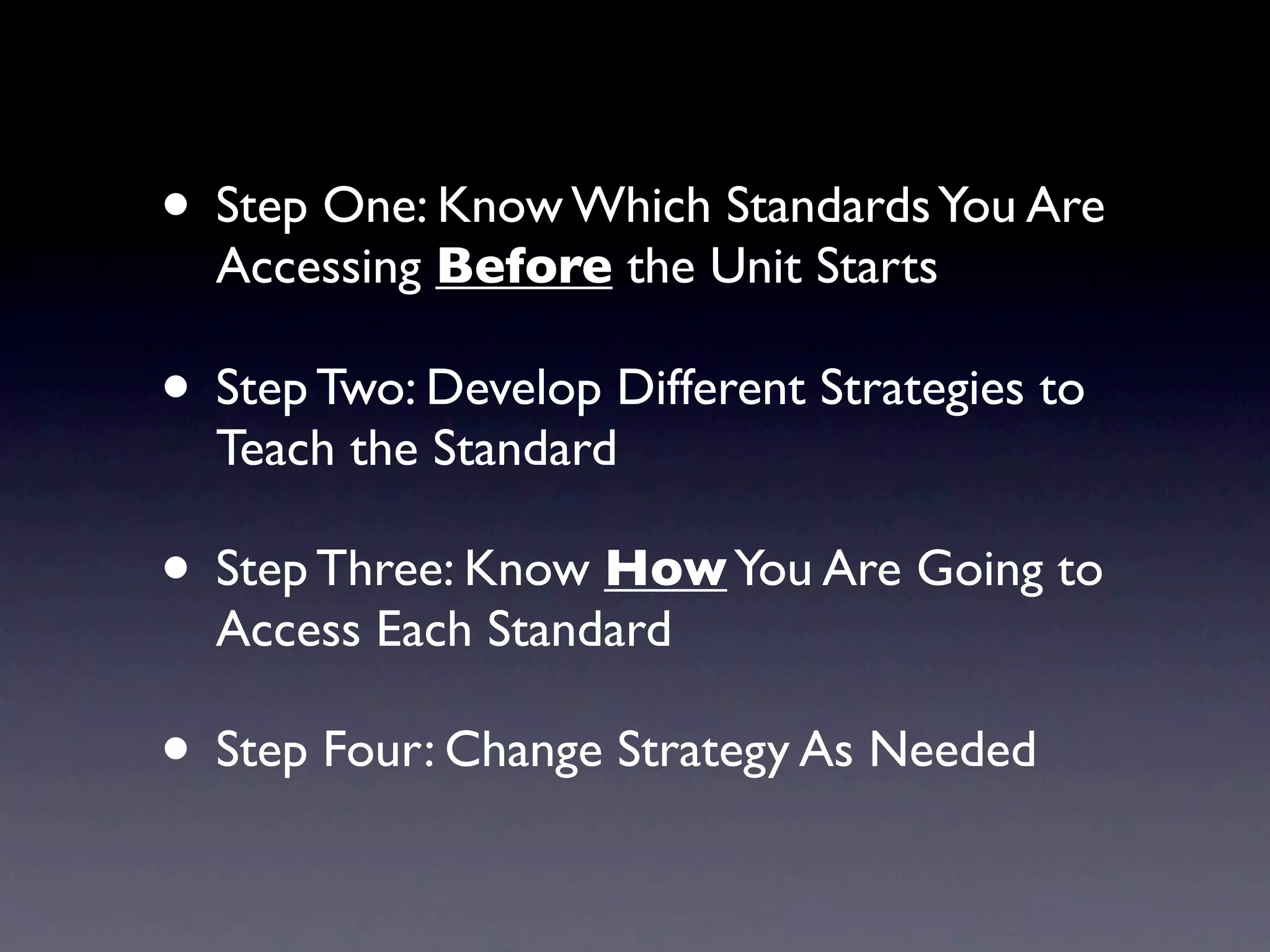
• Step One: Know Which Standards You Are
  Accessing Before the Unit Starts

• Step Two: Develop Different Strategies to
  Teach the Standard

• Step Three: Know How You Are Going to
  Access Each Standard

• Step Four: Change Strategy As Needed
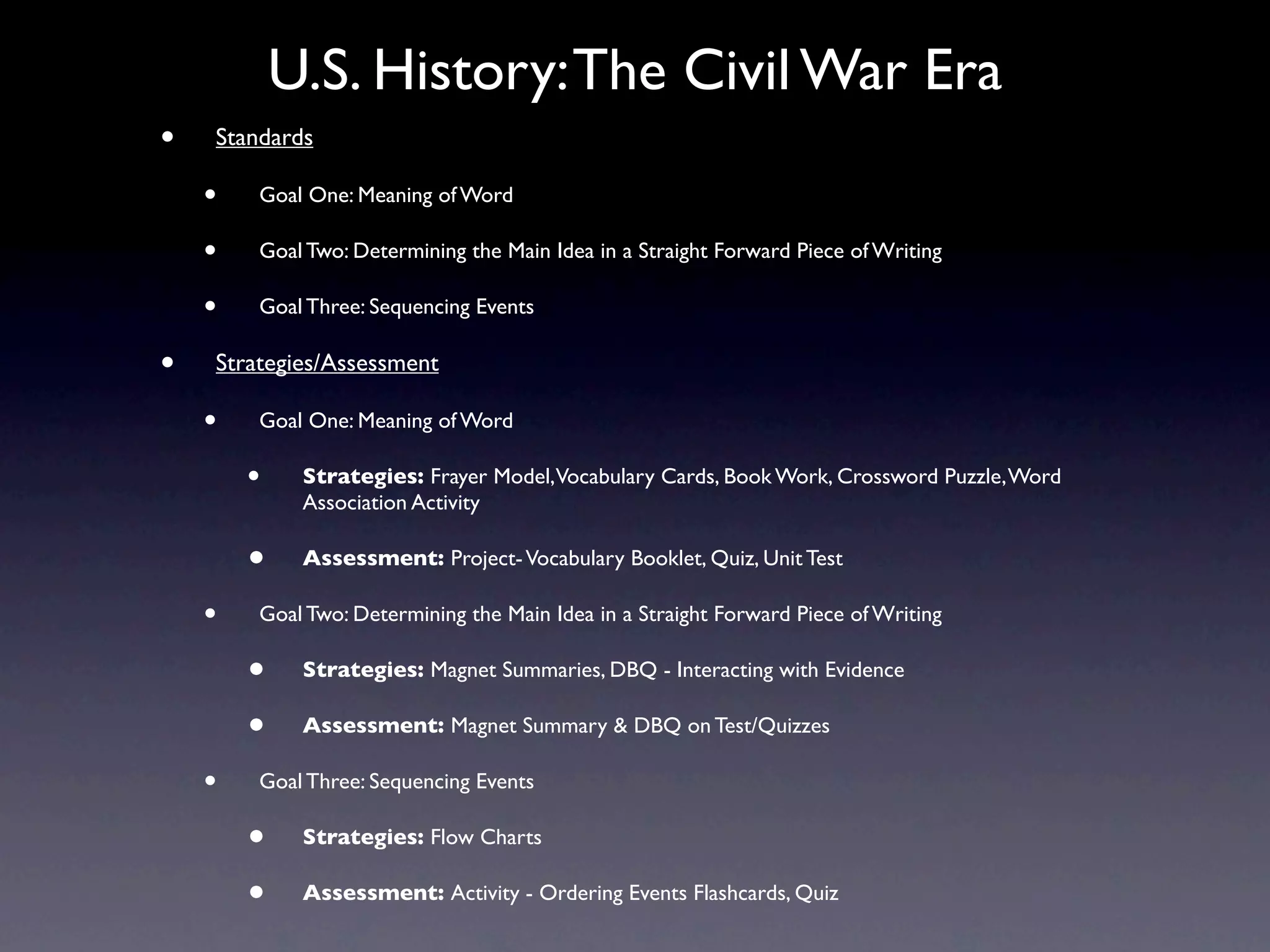
U.S. History: The Civil War Era
•   Standards

    •   Goal One: Meaning of Word

    •   Goal Two: Determining the Main Idea in a Straight Forward Piece of Writing

    •   Goal Three: Sequencing Events

•   Strategies/Assessment

    •   Goal One: Meaning of Word

        •    Strategies: Frayer Model, Vocabulary Cards, Book Work, Crossword Puzzle, Word
             Association Activity

        •    Assessment: Project- Vocabulary Booklet, Quiz, Unit Test

    •   Goal Two: Determining the Main Idea in a Straight Forward Piece of Writing

        •    Strategies: Magnet Summaries, DBQ - Interacting with Evidence

        •    Assessment: Magnet Summary & DBQ on Test/Quizzes

    •   Goal Three: Sequencing Events

        •    Strategies: Flow Charts

        •    Assessment: Activity - Ordering Events Flashcards, Quiz
The Power of Five
Five Different Assessments of the Standards
             Put into Gradebook
1. Gives Students Multiple Opportunities to Perfect a
                       Standard
        2. Allows You to See Student’s Growth
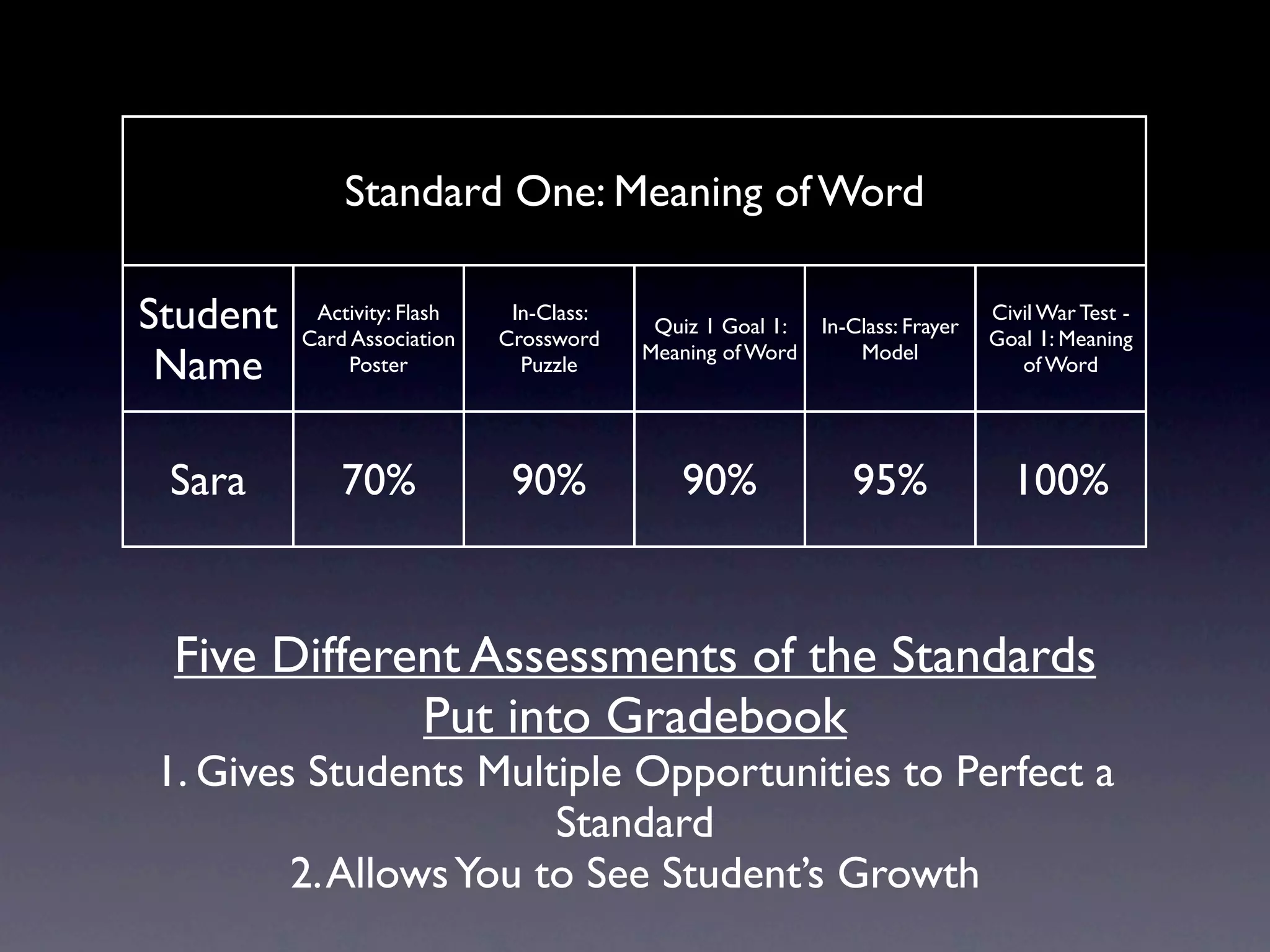
Standard One: Meaning of Word

Student    Activity: Flash
          Card Association
                              In-Class:
                             Crossword
                                           Quiz 1 Goal 1:   In-Class: Frayer
                                                                               Civil War Test -
                                                                               Goal 1: Meaning
 Name          Poster          Puzzle
                                          Meaning of Word       Model
                                                                                  of Word


 Sara         70%             90%            90%               95%               100%


 Five Different Assessments of the Standards
             Put into Gradebook
1. Gives Students Multiple Opportunities to Perfect a
                       Standard
        2. Allows You to See Student’s Growth
Best Practices/Rationale
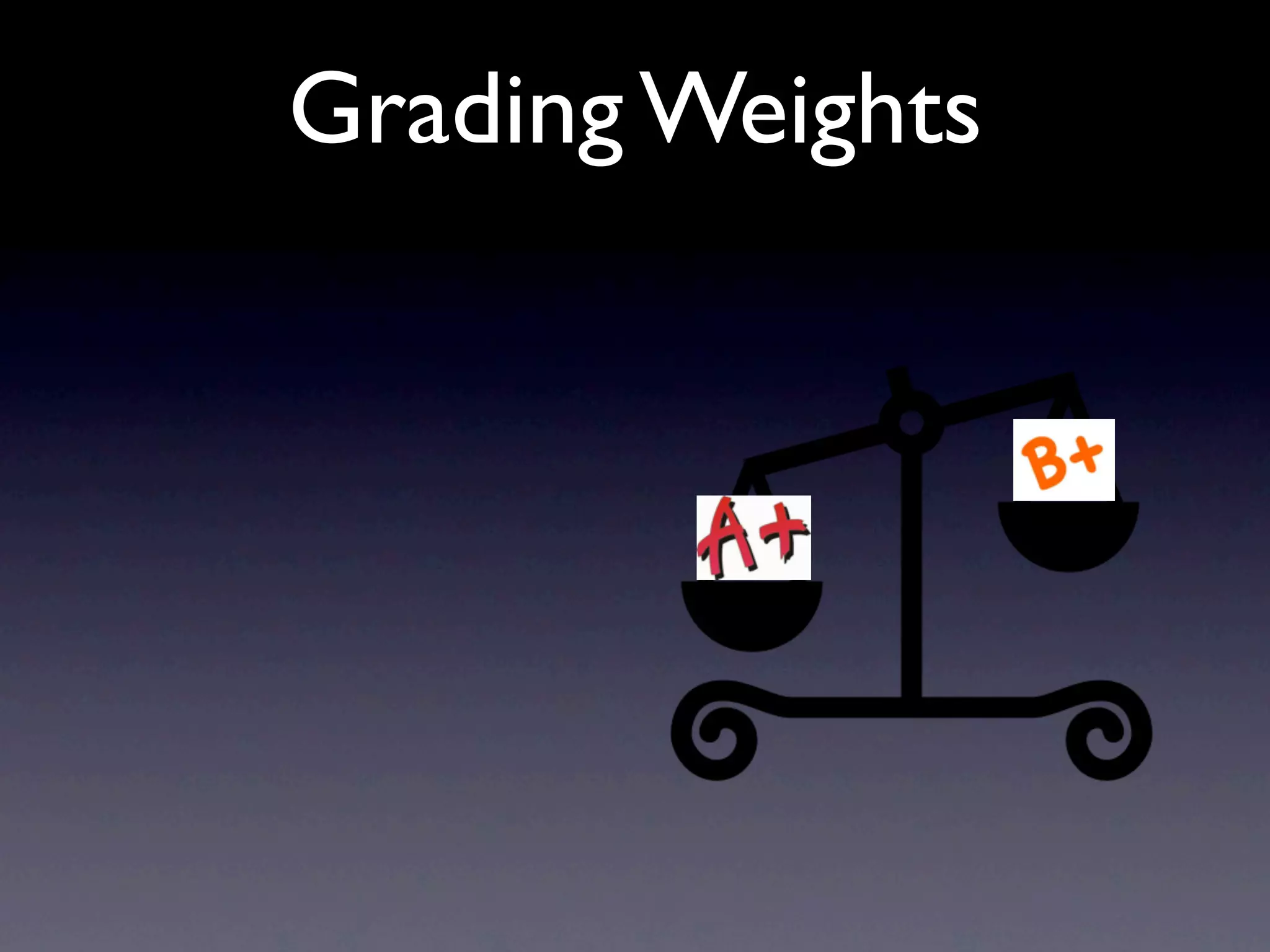
Grading Weights
Grading Weights
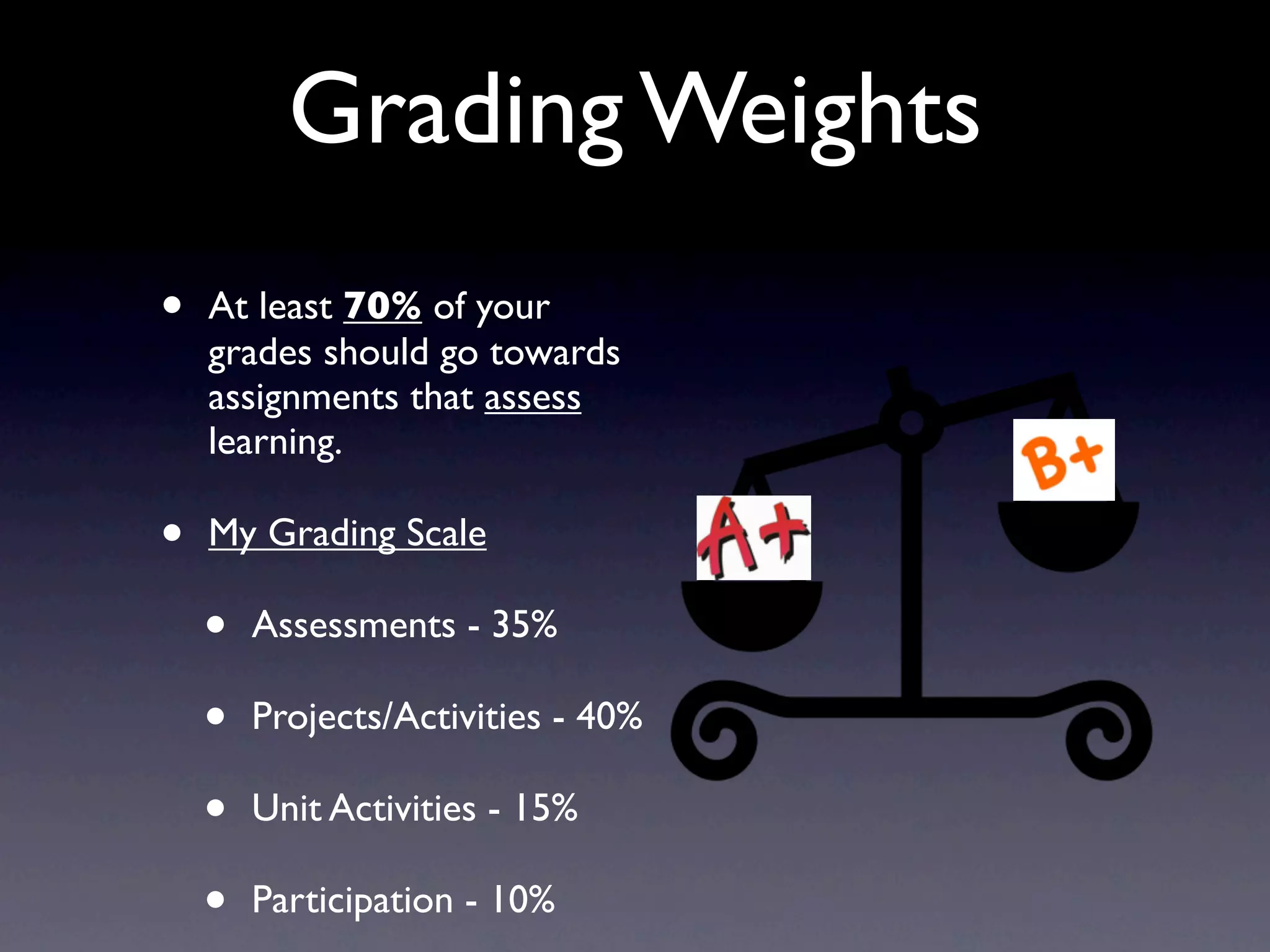
•   At least 70% of your
    grades should go towards
    assignments that assess
    learning.

•   My Grading Scale

    •   Assessments - 35%

    •   Projects/Activities - 40%

    •   Unit Activities - 15%

    •   Participation - 10%
Re-taking/Re-accessing
•   Retake = Allowing students to
    make corrections on their
    mistakes.

    •   Set a Max/Min Retake Score

        •   Mine: 70%


•   Re-accessing = Giving a different
    assessment on the standard.

    •   Set a Mastery Level

        •   Mine: 80%
Grading Homework
Grading Homework
•   Grading individual homework assignments doesn’t
    fit into standard-based grading unless they are an
    assessment.
Grading Homework
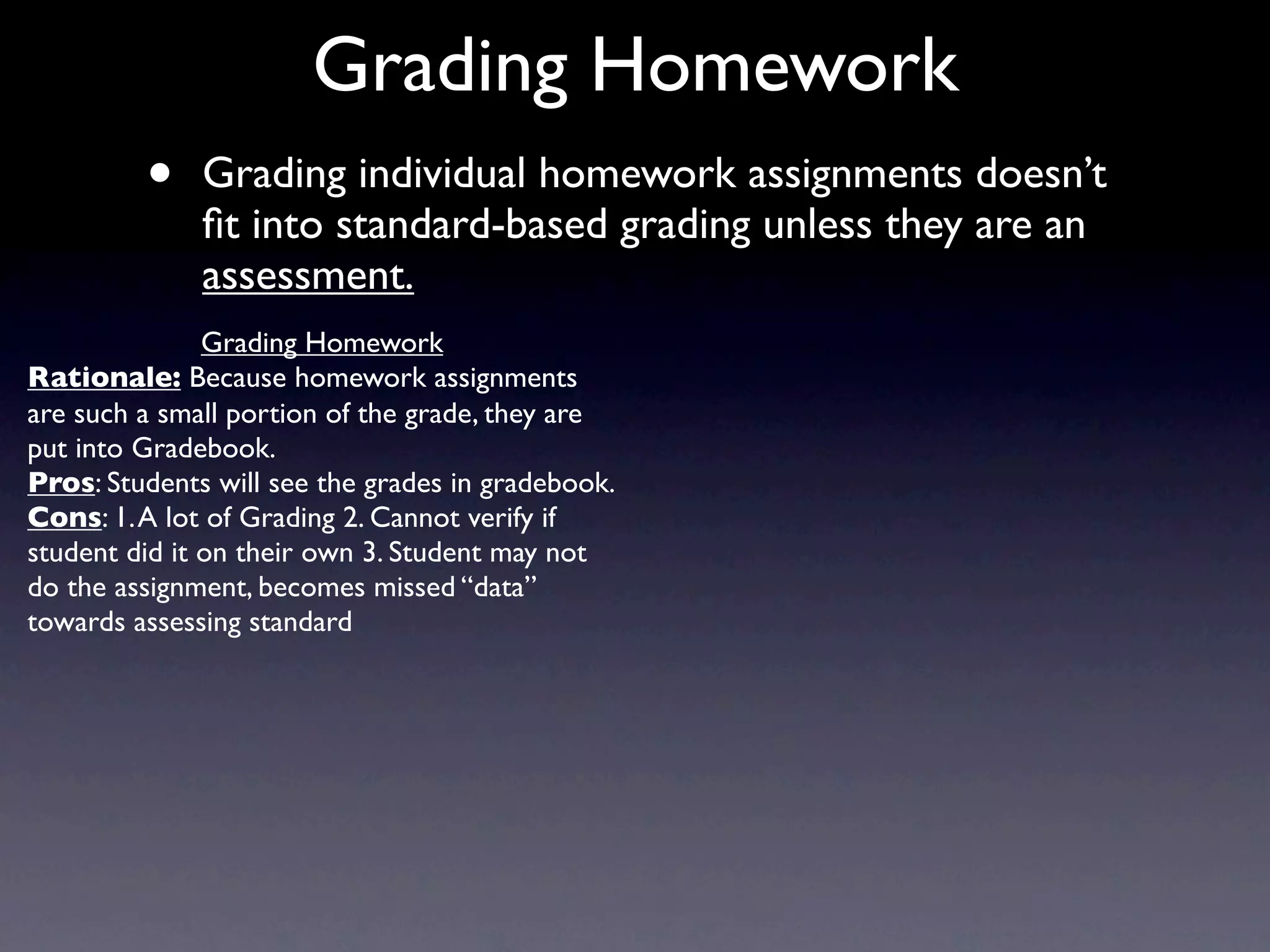
         •    Grading individual homework assignments doesn’t
              fit into standard-based grading unless they are an
              assessment.
               Grading Homework
Rationale: Because homework assignments
are such a small portion of the grade, they are
put into Gradebook.
Pros: Students will see the grades in gradebook.
Cons: 1. A lot of Grading 2. Cannot verify if
student did it on their own 3. Student may not
do the assignment, becomes missed “data”
towards assessing standard
Grading Homework
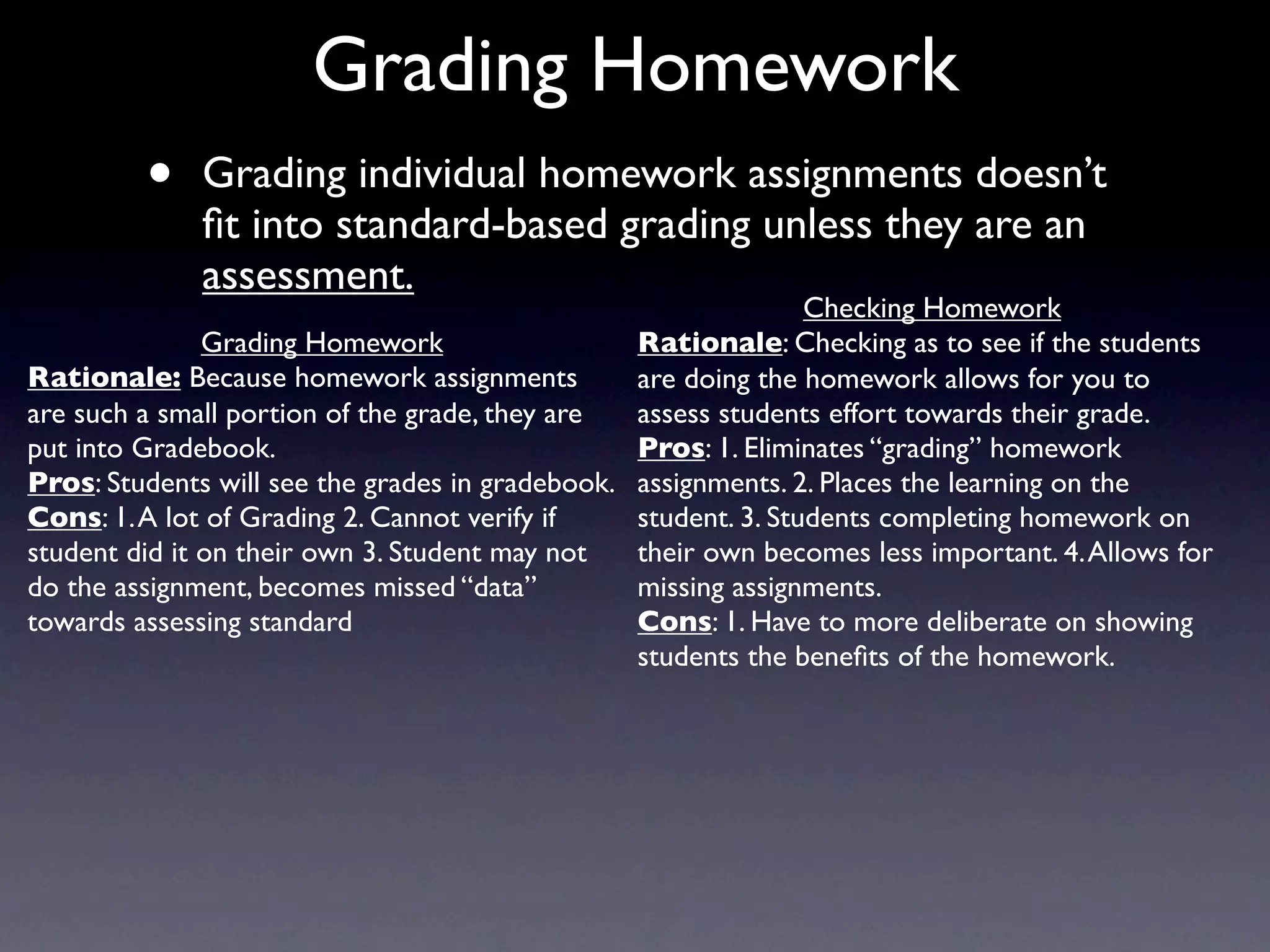
         •    Grading individual homework assignments doesn’t
              fit into standard-based grading unless they are an
              assessment.
                                                                Checking Homework
               Grading Homework                  Rationale: Checking as to see if the students
Rationale: Because homework assignments          are doing the homework allows for you to
are such a small portion of the grade, they are  assess students effort towards their grade.
put into Gradebook.                              Pros: 1. Eliminates “grading” homework
Pros: Students will see the grades in gradebook. assignments. 2. Places the learning on the
Cons: 1. A lot of Grading 2. Cannot verify if    student. 3. Students completing homework on
student did it on their own 3. Student may not   their own becomes less important. 4. Allows for
do the assignment, becomes missed “data”         missing assignments.
towards assessing standard                       Cons: 1. Have to more deliberate on showing
                                                 students the benefits of the homework.
Grading Homework
         •    Grading individual homework assignments doesn’t
              fit into standard-based grading unless they are an
              assessment.
                                                                Checking Homework
               Grading Homework                  Rationale: Checking as to see if the students
Rationale: Because homework assignments          are doing the homework allows for you to
are such a small portion of the grade, they are  assess students effort towards their grade.
put into Gradebook.                              Pros: 1. Eliminates “grading” homework
Pros: Students will see the grades in gradebook. assignments. 2. Places the learning on the
Cons: 1. A lot of Grading 2. Cannot verify if    student. 3. Students completing homework on
student did it on their own 3. Student may not   their own becomes less important. 4. Allows for
do the assignment, becomes missed “data”         missing assignments.
towards assessing standard                       Cons: 1. Have to more deliberate on showing
                                                 students the benefits of the homework.


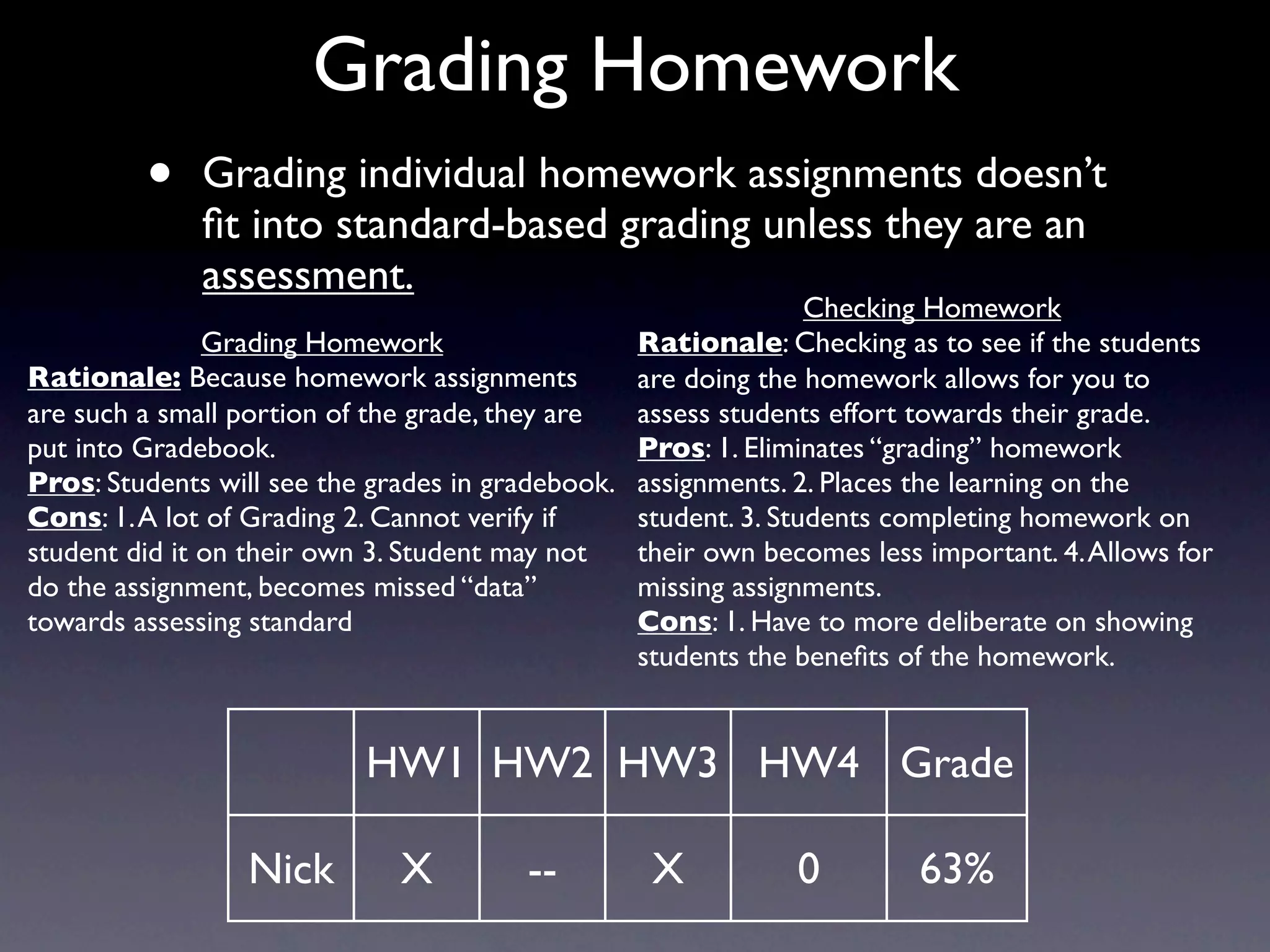
                           HW1 HW2 HW3 HW4 Grade

                 Nick         X         --        X           0         63%
Grading Scale
Grading Scale
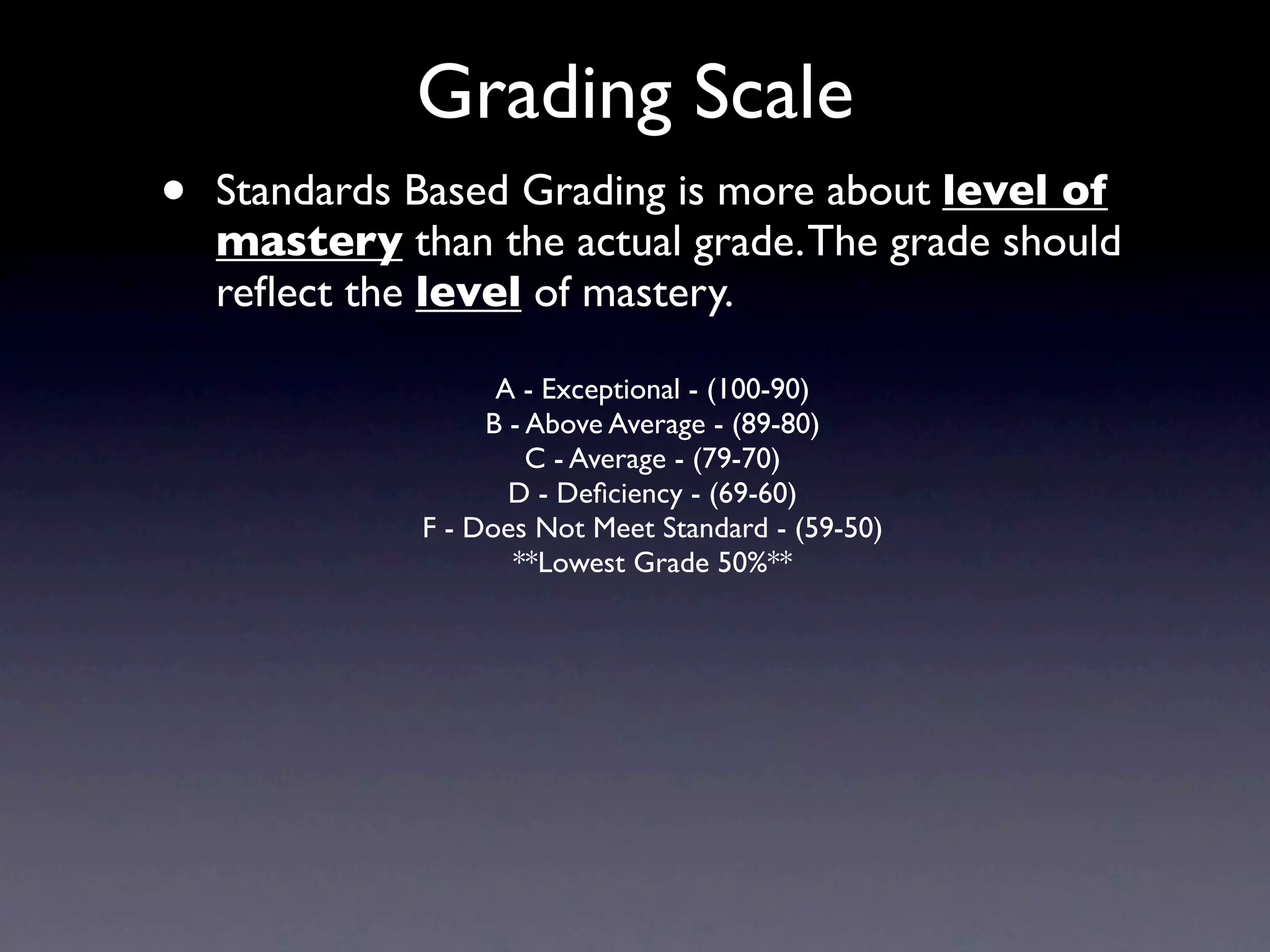
•   Standards Based Grading is more about level of
    mastery than the actual grade. The grade should
    reflect the level of mastery.
Grading Scale
•   Standards Based Grading is more about level of
    mastery than the actual grade. The grade should
    reflect the level of mastery.

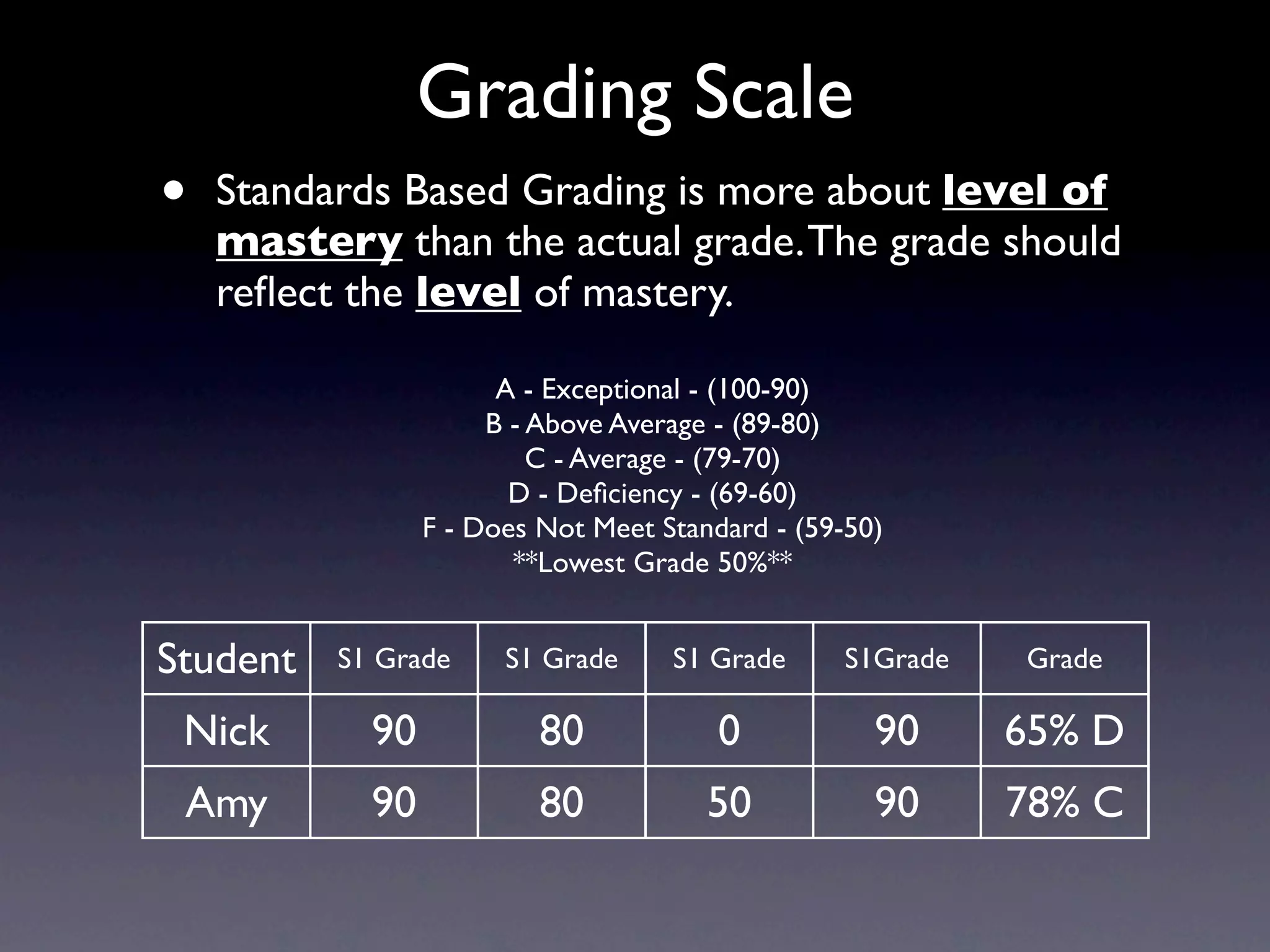
                    A - Exceptional - (100-90)
                   B - Above Average - (89-80)
                       C - Average - (79-70)
                     D - Deficiency - (69-60)
              F - Does Not Meet Standard - (59-50)
                     **Lowest Grade 50%**
Grading Scale
•   Standards Based Grading is more about level of
    mastery than the actual grade. The grade should
    reflect the level of mastery.

                       A - Exceptional - (100-90)
                      B - Above Average - (89-80)
                          C - Average - (79-70)
                        D - Deficiency - (69-60)
                 F - Does Not Meet Standard - (59-50)
                        **Lowest Grade 50%**


Student   S1 Grade     S1 Grade     S1 Grade      S1Grade   Grade

 Nick       90            80            0           90      65% D
 Amy        90            80           50           90      78% C
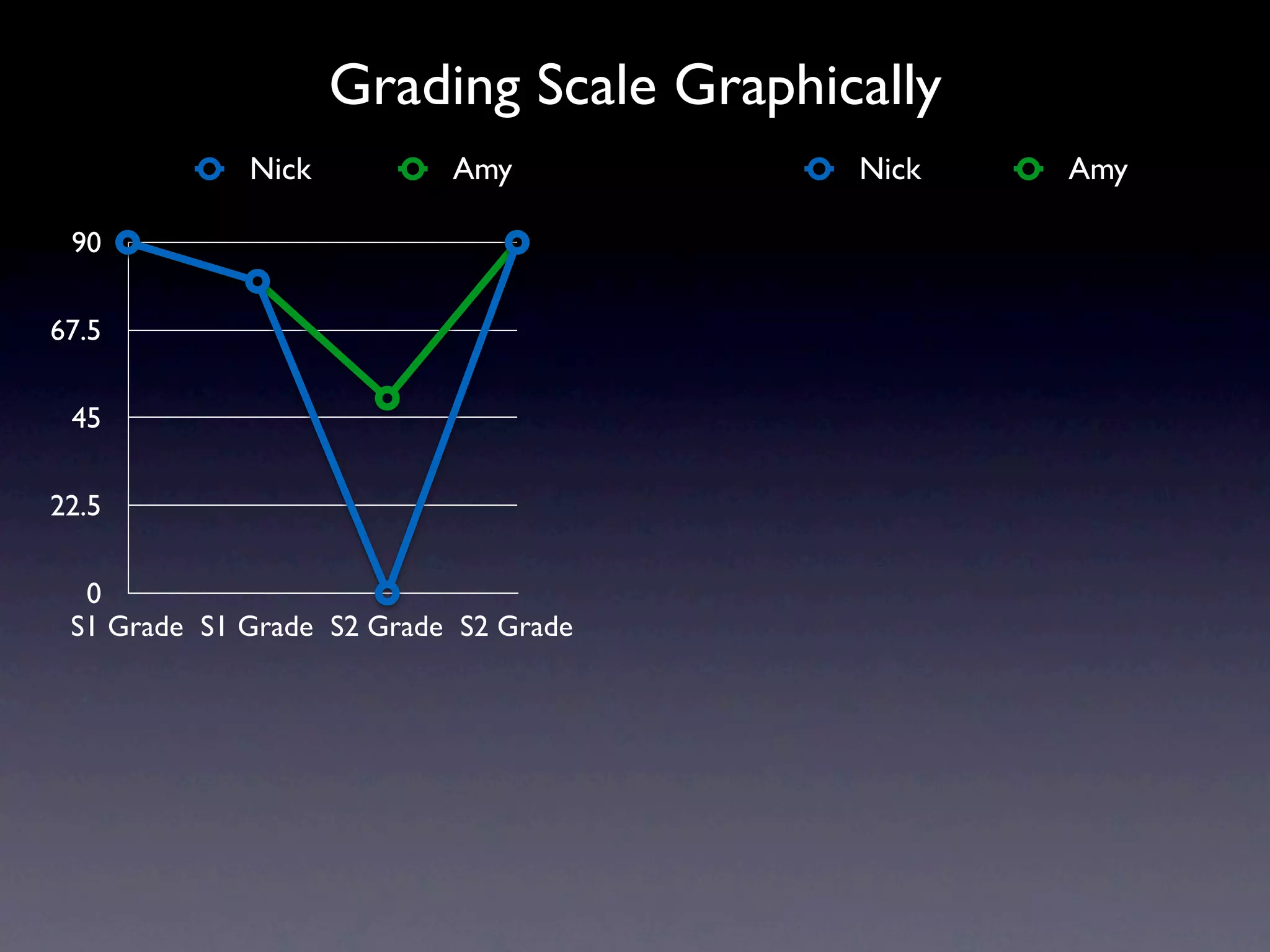
Grading Scale Graphically
Nick        Amy             Nick   Amy
Grading Scale Graphically
             Nick          Amy           Nick   Amy

 90

67.5

 45

22.5

  0
 S1 Grade S1 Grade S2 Grade S2 Grade
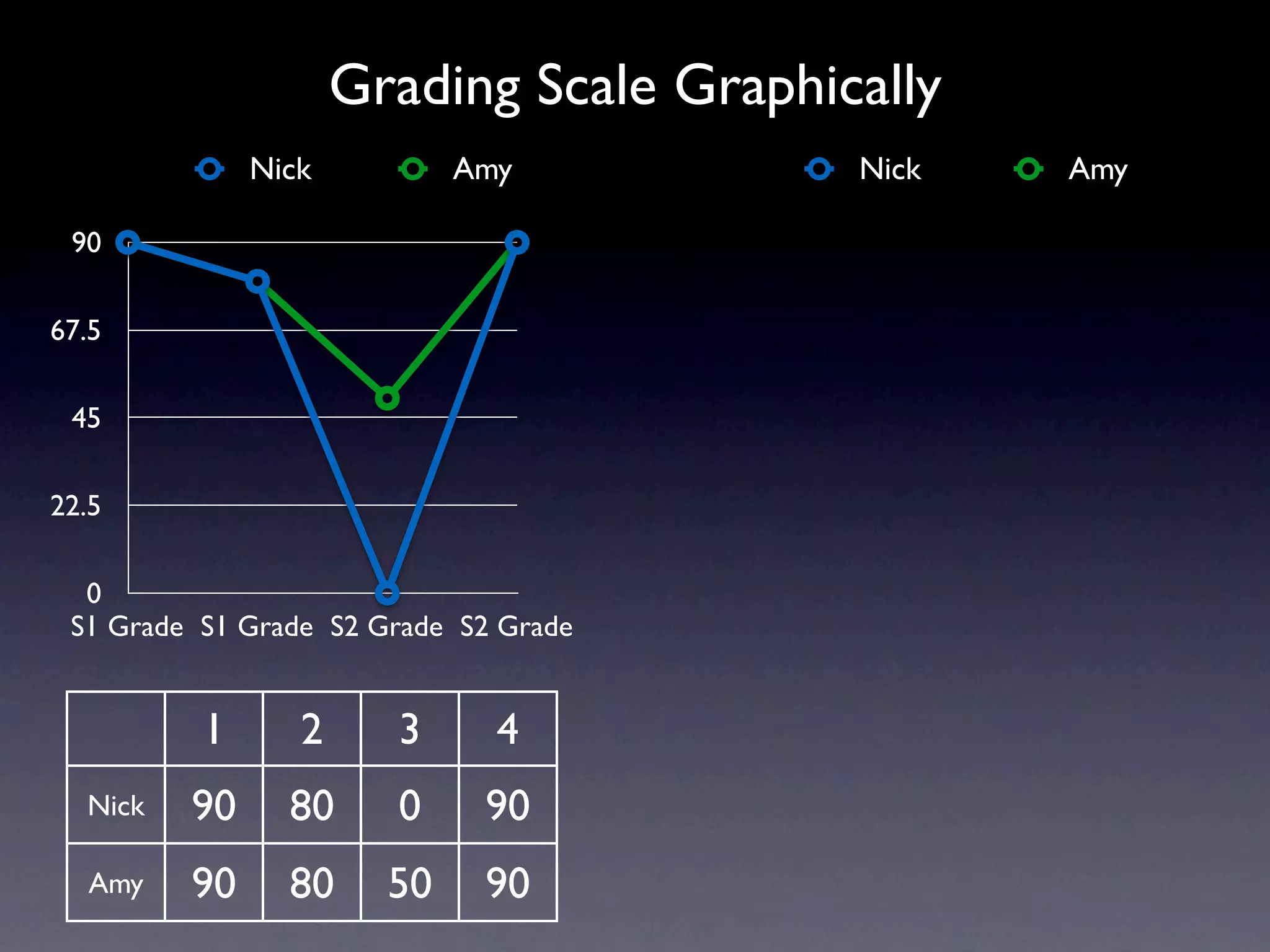
Grading Scale Graphically
              Nick          Amy           Nick   Amy

 90

67.5

 45

22.5

  0
 S1 Grade S1 Grade S2 Grade S2 Grade


          1      2     3      4
  Nick   90     80     0     90
  Amy    90     80     50    90
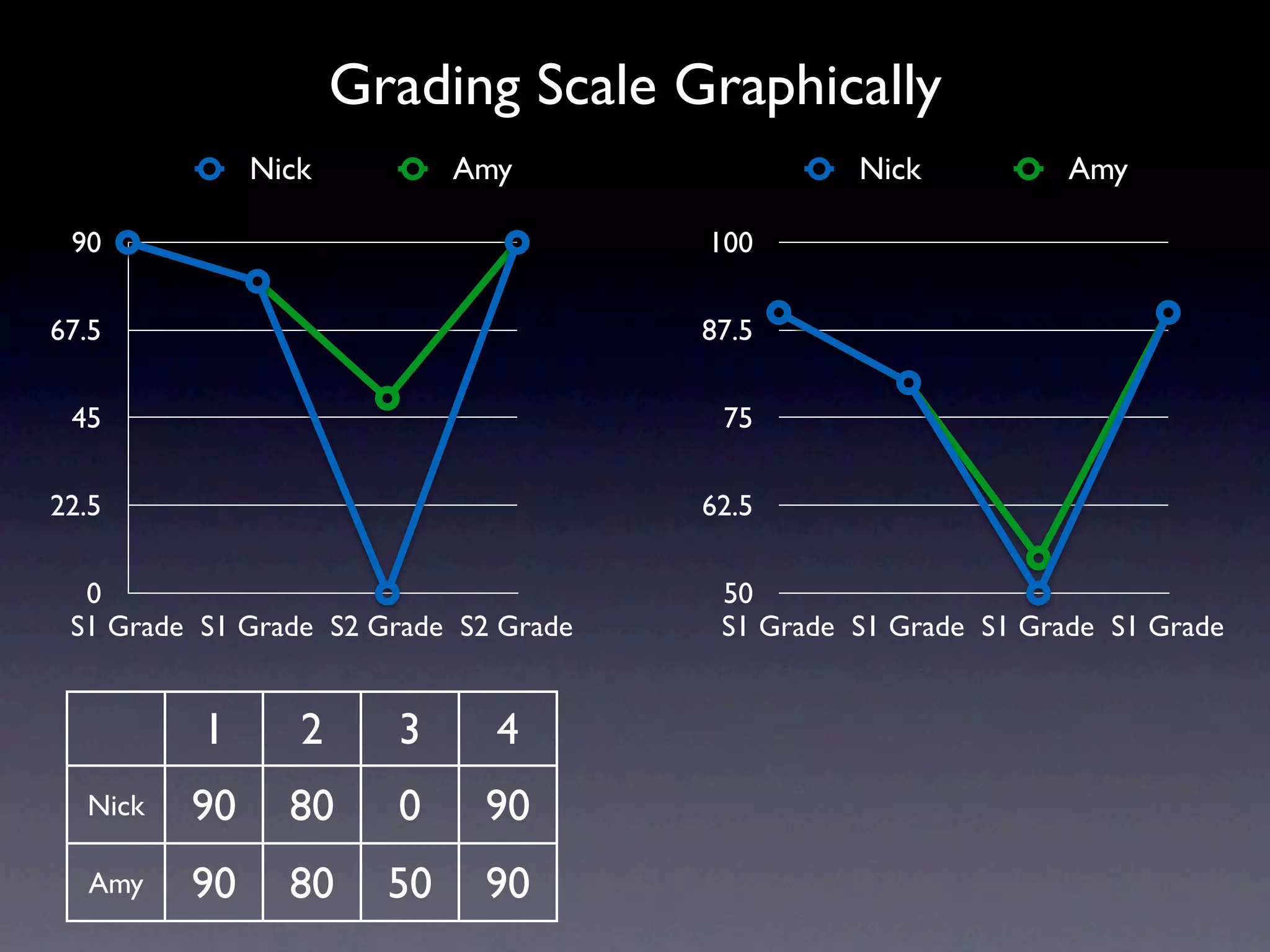
Grading Scale Graphically
              Nick          Amy                  Nick           Amy

 90                                    100

67.5                                   87.5

 45                                     75

22.5                                   62.5

  0                                     50
 S1 Grade S1 Grade S2 Grade S2 Grade    S1 Grade S1 Grade S1 Grade S1 Grade


          1      2     3      4
  Nick   90     80     0     90
  Amy    90     80     50    90
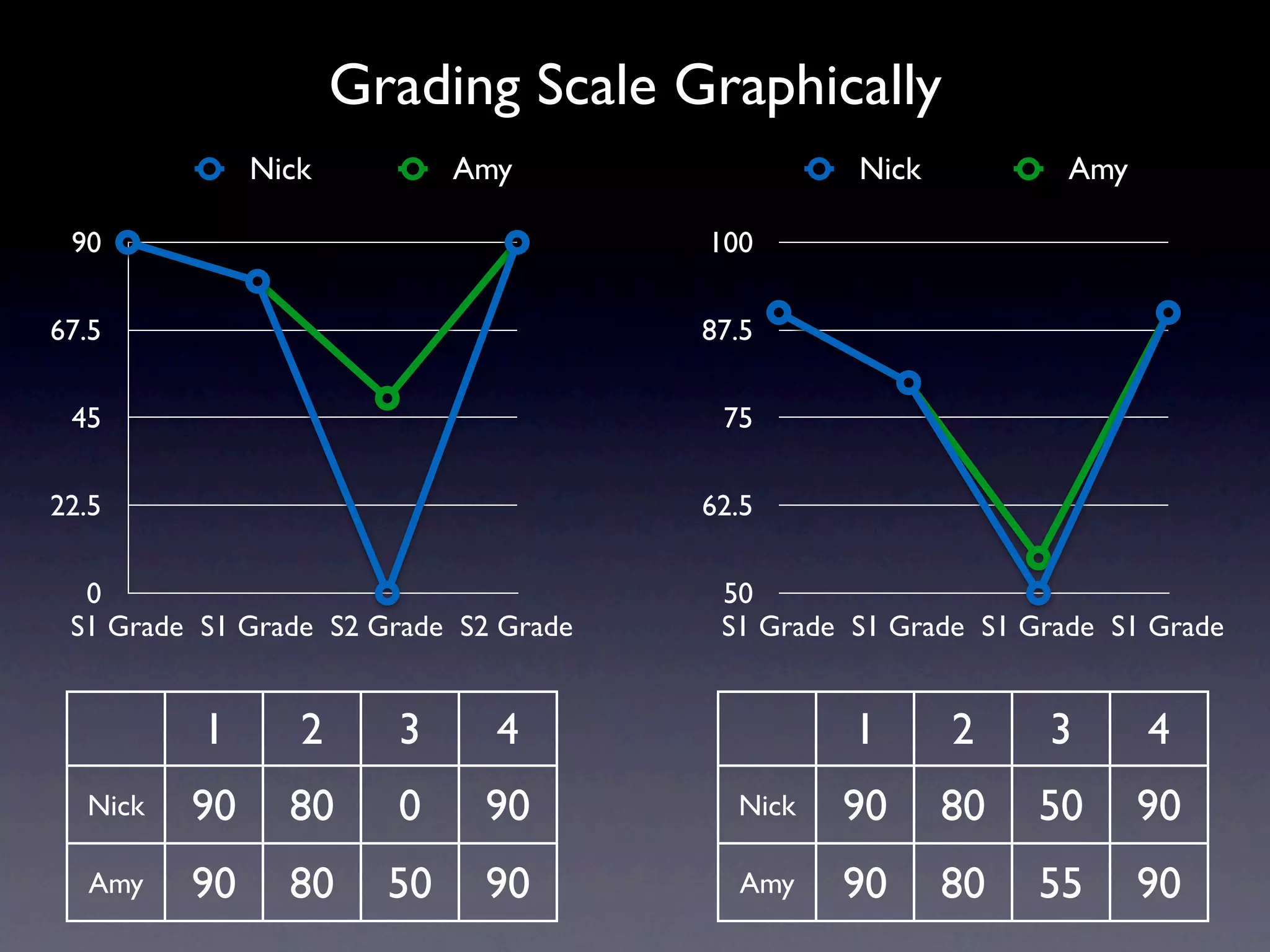
Grading Scale Graphically
              Nick          Amy                  Nick           Amy

 90                                    100

67.5                                   87.5

 45                                     75

22.5                                   62.5

  0                                     50
 S1 Grade S1 Grade S2 Grade S2 Grade    S1 Grade S1 Grade S1 Grade S1 Grade


          1      2     3      4                  1      2     3       4
  Nick   90     80     0     90          Nick   90      80    50      90
  Amy    90     80     50    90          Amy    90      80    55      90
Questions?

Standards Based Grading by Martin Palamore

  • 1.
    Standards Based Grading/Assessment The Benefits and Implementation in the Social Studies Department By Martin Palamore, Teacher, Hancock High School
  • 2.
    Standard based gradinggoes beyond just giving students grades, but shows them what they are good at and what needs improvement.
  • 3.
    Traditional Grading What do these grades tell you about what students learned? How could you communicate what the students learned to parents, students, and administrators?
  • 4.
    Traditional Grading Student HW HWK Quiz BGR Test 1 AVG Name K1 2 1 1 Joe 100% 90% 70% 90% 50% 80% B Lisa 75% 0% 100% 50% 90% 63%D 68% Frank 80% 50% 80% 60% 70% D 68% Mary 35% 70% 70% 80% 85% D What do these grades tell you about what students learned? How could you communicate what the students learned to parents, students, and administrators?
  • 5.
  • 6.
    Standards Based Grading What do these grades tell you about what students learned? How could you communicate what the students learned to parents, students, and administrators?
  • 7.
    Standards Based Grading HWK Two: Classwork: HWK One: Activity: Quiz One Goal Meaning of Frayer Quiz One Goal Determining Renaissance - One: Cause/ Student Name Cause/Effect Word: Cause/Effect Model Effect Two: Meaning of Content Meaning of Word Relationships Relationships Relationships Vocab Word Joe 65% 90% 80% 90% 95% 95% Lisa 75% 0% 85% 50% 90% 70% Frank 80% 50% 80% 60% 80% 68% Mary 35% 70% 70% 80% 85% 90% What do these grades tell you about what students learned? How could you communicate what the students learned to parents, students, and administrators?
  • 8.
    Benefit Two: Allowsfor easy reflection/knowing what works!
  • 9.
  • 10.
    • Step One:Know Which Standards You Are Accessing Before the Unit Starts • Step Two: Develop Different Strategies to Teach the Standard • Step Three: Know How You Are Going to Access Each Standard • Step Four: Change Strategy As Needed
  • 11.
    U.S. History: TheCivil War Era • Standards • Goal One: Meaning of Word • Goal Two: Determining the Main Idea in a Straight Forward Piece of Writing • Goal Three: Sequencing Events • Strategies/Assessment • Goal One: Meaning of Word • Strategies: Frayer Model, Vocabulary Cards, Book Work, Crossword Puzzle, Word Association Activity • Assessment: Project- Vocabulary Booklet, Quiz, Unit Test • Goal Two: Determining the Main Idea in a Straight Forward Piece of Writing • Strategies: Magnet Summaries, DBQ - Interacting with Evidence • Assessment: Magnet Summary & DBQ on Test/Quizzes • Goal Three: Sequencing Events • Strategies: Flow Charts • Assessment: Activity - Ordering Events Flashcards, Quiz
  • 12.
  • 13.
    Five Different Assessmentsof the Standards Put into Gradebook 1. Gives Students Multiple Opportunities to Perfect a Standard 2. Allows You to See Student’s Growth
  • 14.
    Standard One: Meaningof Word Student Activity: Flash Card Association In-Class: Crossword Quiz 1 Goal 1: In-Class: Frayer Civil War Test - Goal 1: Meaning Name Poster Puzzle Meaning of Word Model of Word Sara 70% 90% 90% 95% 100% Five Different Assessments of the Standards Put into Gradebook 1. Gives Students Multiple Opportunities to Perfect a Standard 2. Allows You to See Student’s Growth
  • 15.
  • 16.
  • 17.
    Grading Weights • At least 70% of your grades should go towards assignments that assess learning. • My Grading Scale • Assessments - 35% • Projects/Activities - 40% • Unit Activities - 15% • Participation - 10%
  • 18.
  • 19.
    Re-taking/Re-accessing • Retake = Allowing students to make corrections on their mistakes. • Set a Max/Min Retake Score • Mine: 70% • Re-accessing = Giving a different assessment on the standard. • Set a Mastery Level • Mine: 80%
  • 20.
  • 21.
    Grading Homework • Grading individual homework assignments doesn’t fit into standard-based grading unless they are an assessment.
  • 22.
    Grading Homework • Grading individual homework assignments doesn’t fit into standard-based grading unless they are an assessment. Grading Homework Rationale: Because homework assignments are such a small portion of the grade, they are put into Gradebook. Pros: Students will see the grades in gradebook. Cons: 1. A lot of Grading 2. Cannot verify if student did it on their own 3. Student may not do the assignment, becomes missed “data” towards assessing standard
  • 23.
    Grading Homework • Grading individual homework assignments doesn’t fit into standard-based grading unless they are an assessment. Checking Homework Grading Homework Rationale: Checking as to see if the students Rationale: Because homework assignments are doing the homework allows for you to are such a small portion of the grade, they are assess students effort towards their grade. put into Gradebook. Pros: 1. Eliminates “grading” homework Pros: Students will see the grades in gradebook. assignments. 2. Places the learning on the Cons: 1. A lot of Grading 2. Cannot verify if student. 3. Students completing homework on student did it on their own 3. Student may not their own becomes less important. 4. Allows for do the assignment, becomes missed “data” missing assignments. towards assessing standard Cons: 1. Have to more deliberate on showing students the benefits of the homework.
  • 24.
    Grading Homework • Grading individual homework assignments doesn’t fit into standard-based grading unless they are an assessment. Checking Homework Grading Homework Rationale: Checking as to see if the students Rationale: Because homework assignments are doing the homework allows for you to are such a small portion of the grade, they are assess students effort towards their grade. put into Gradebook. Pros: 1. Eliminates “grading” homework Pros: Students will see the grades in gradebook. assignments. 2. Places the learning on the Cons: 1. A lot of Grading 2. Cannot verify if student. 3. Students completing homework on student did it on their own 3. Student may not their own becomes less important. 4. Allows for do the assignment, becomes missed “data” missing assignments. towards assessing standard Cons: 1. Have to more deliberate on showing students the benefits of the homework. HW1 HW2 HW3 HW4 Grade Nick X -- X 0 63%
  • 25.
  • 26.
    Grading Scale • Standards Based Grading is more about level of mastery than the actual grade. The grade should reflect the level of mastery.
  • 27.
    Grading Scale • Standards Based Grading is more about level of mastery than the actual grade. The grade should reflect the level of mastery. A - Exceptional - (100-90) B - Above Average - (89-80) C - Average - (79-70) D - Deficiency - (69-60) F - Does Not Meet Standard - (59-50) **Lowest Grade 50%**
  • 28.
    Grading Scale • Standards Based Grading is more about level of mastery than the actual grade. The grade should reflect the level of mastery. A - Exceptional - (100-90) B - Above Average - (89-80) C - Average - (79-70) D - Deficiency - (69-60) F - Does Not Meet Standard - (59-50) **Lowest Grade 50%** Student S1 Grade S1 Grade S1 Grade S1Grade Grade Nick 90 80 0 90 65% D Amy 90 80 50 90 78% C
  • 29.
  • 30.
    Grading Scale Graphically Nick Amy Nick Amy 90 67.5 45 22.5 0 S1 Grade S1 Grade S2 Grade S2 Grade
  • 31.
    Grading Scale Graphically Nick Amy Nick Amy 90 67.5 45 22.5 0 S1 Grade S1 Grade S2 Grade S2 Grade 1 2 3 4 Nick 90 80 0 90 Amy 90 80 50 90
  • 32.
    Grading Scale Graphically Nick Amy Nick Amy 90 100 67.5 87.5 45 75 22.5 62.5 0 50 S1 Grade S1 Grade S2 Grade S2 Grade S1 Grade S1 Grade S1 Grade S1 Grade 1 2 3 4 Nick 90 80 0 90 Amy 90 80 50 90
  • 33.
    Grading Scale Graphically Nick Amy Nick Amy 90 100 67.5 87.5 45 75 22.5 62.5 0 50 S1 Grade S1 Grade S2 Grade S2 Grade S1 Grade S1 Grade S1 Grade S1 Grade 1 2 3 4 1 2 3 4 Nick 90 80 0 90 Nick 90 80 50 90 Amy 90 80 50 90 Amy 90 80 55 90
  • 35.