Management of Future Communication Networks and Services  Miguel Ponce de Leon TSSG, Waterford Institute of Technology
Agenda Major Trends In-Network management Architecture Modelling and Knowledge Engineering Algorithms and Processes 2 nd   Workshop on IMS enabled Converged Networks New paradigms for services delivery, Paris, Sept 12, 2008
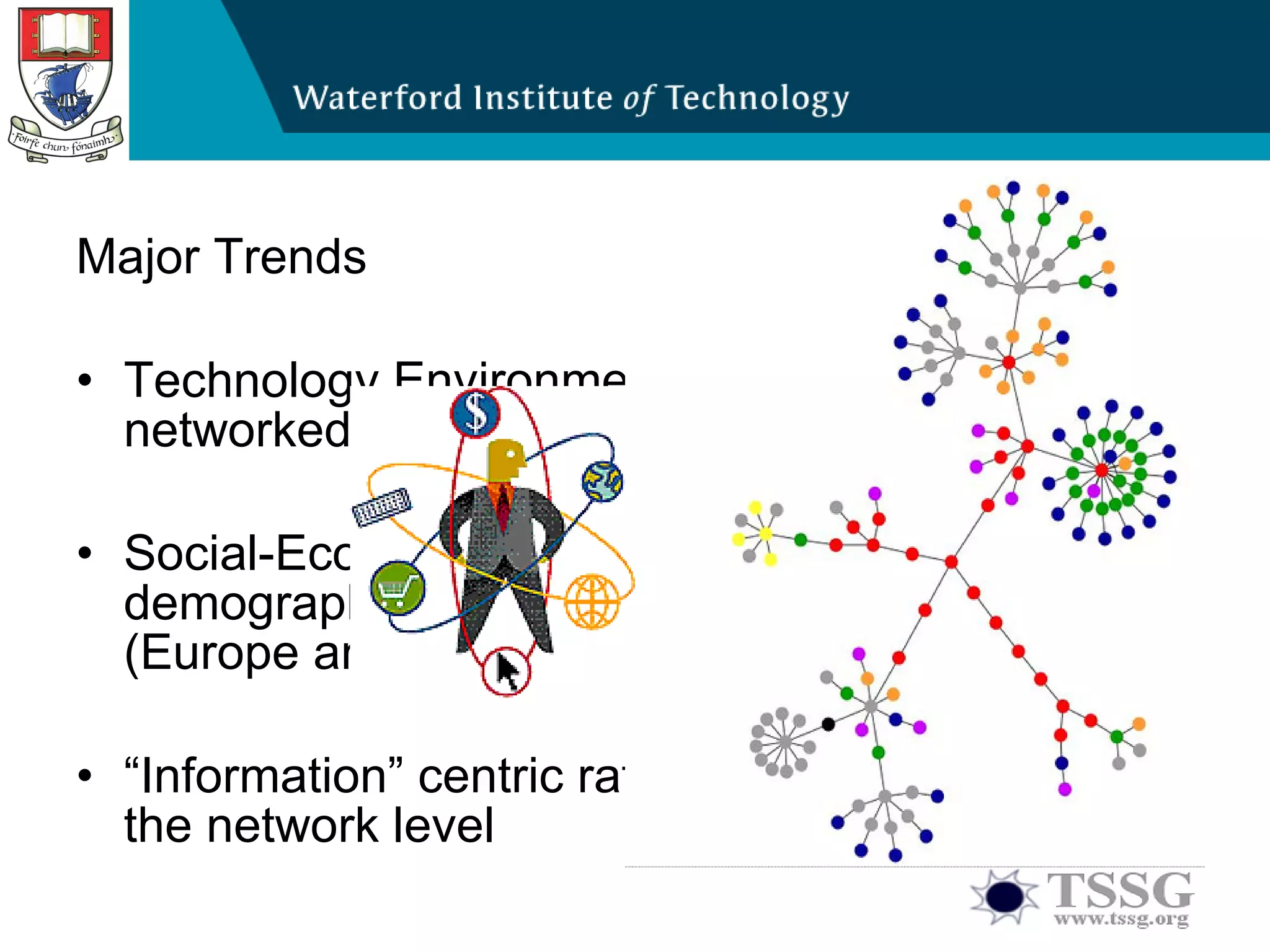
Major Trends Technology Environment: Multitude of networked/distributed applications  Social-Economic Environment: Awareness of demographic change in an aging society (Europe and others) “ Information” centric rather than “bit” centric at the network level
Integrated support of mobility Communication everywhere New services – new devices – new interactions  Complexity is largely due to heterogeneous traffic types (e.g. Data, VoIP, VoD) Traditional management has automation but it is still manually planned and deployed  leads to high cost and error prone 2 nd   Workshop on IMS enabled Converged Networks New paradigms for services delivery, Paris, Sept 12, 2008
Can  In-network management, be the essence for a system to self-govern its behaviour within the constraints of the business goals the system as a whole seeks to achieve?
The TSSG is carrying out research on  the Management  of  Communication Networks and Services  We are addressing Architecture and Methodology Modelling and Knowledge Engineering Policy Analysis and Deployment Algorithms and Processes
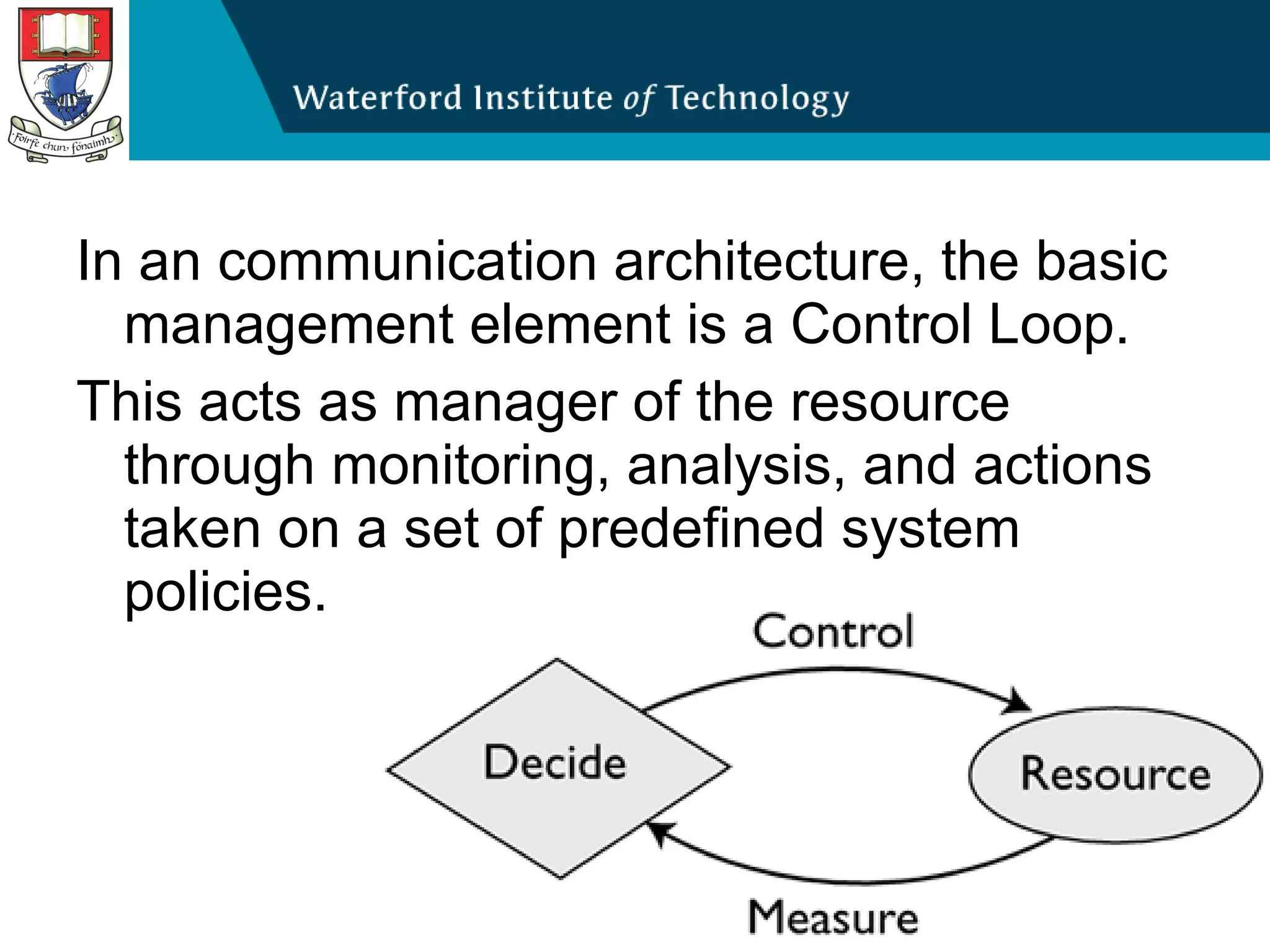
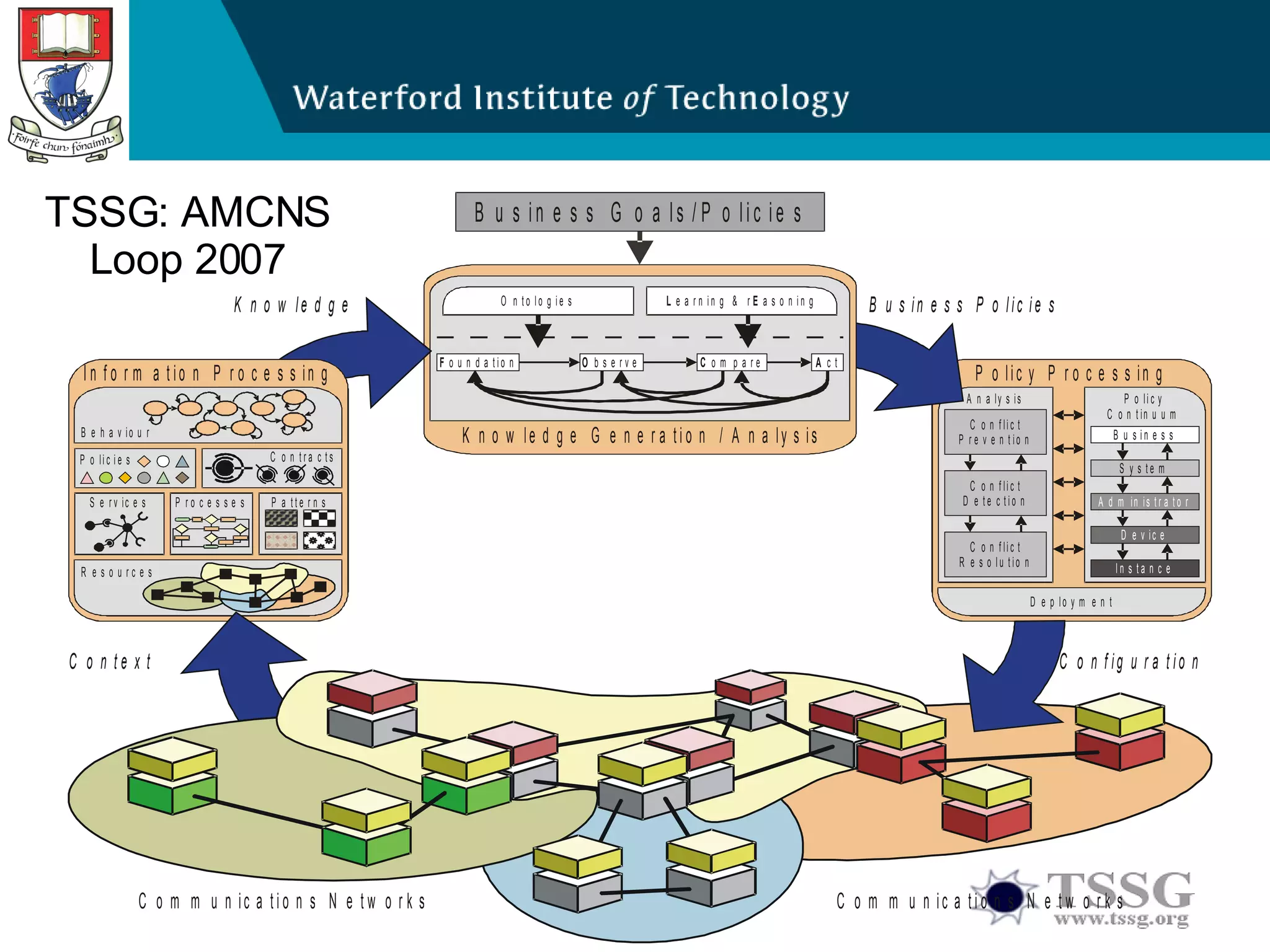
In an communication architecture, the basic management element is a Control Loop.  This acts as manager of the resource through monitoring, analysis, and actions taken on a set of predefined system policies.
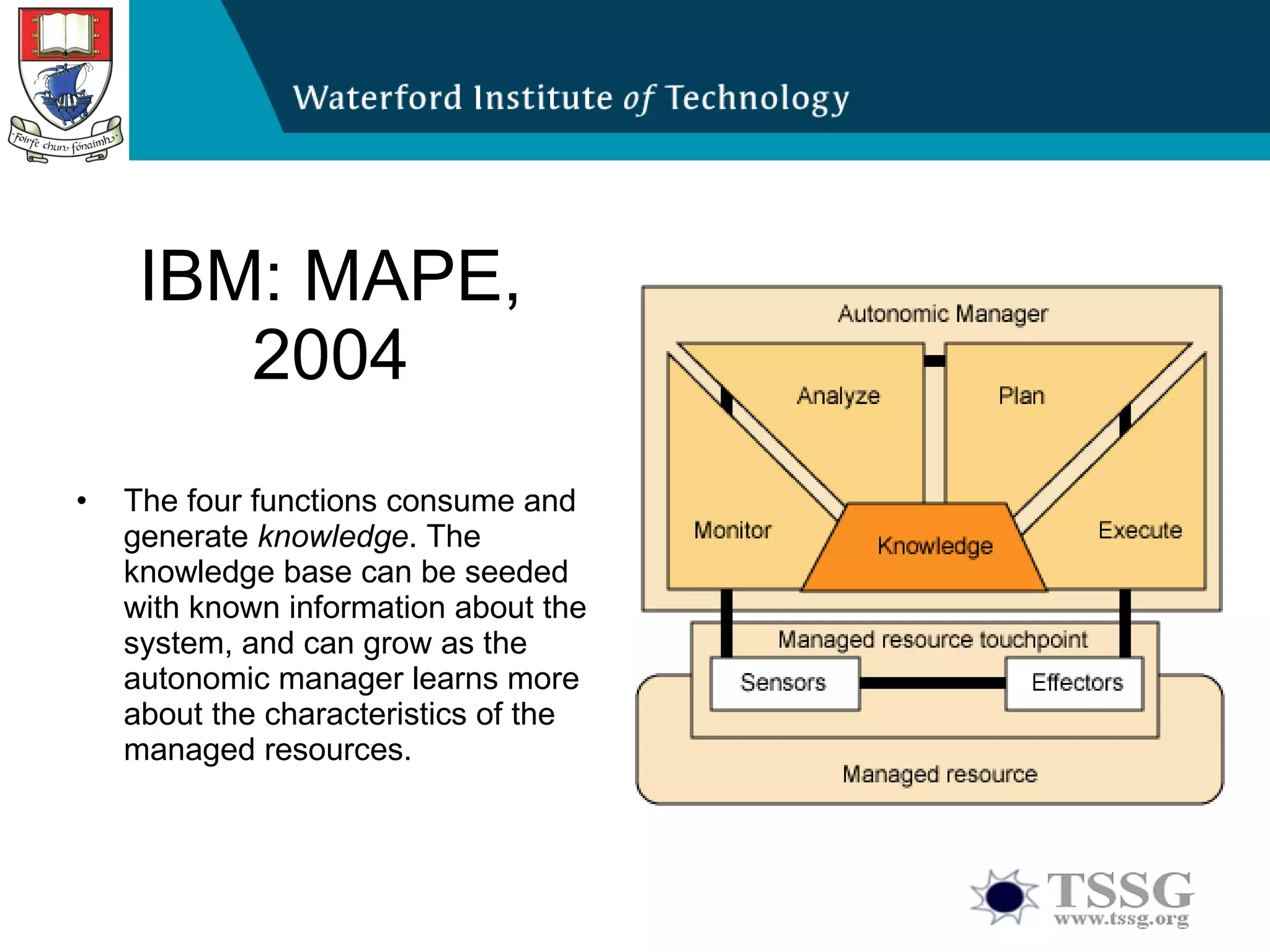
IBM: MAPE, 2004 The four functions consume and generate  knowledge . The knowledge base can be seeded with known information about the system, and can grow as the autonomic manager learns more about the characteristics of the managed resources.
Motorola: FOCALE, 2005 FOCALE: Foundation, Observe, Compare, Act, Learn, rEason Define New Device Configuration(s) Autonomic Manager Ontological Comparison Reasoning and Learning Managed Resource Analyze Data and Events Determine Actual State YES NO DEN-ng Models and  Ontologies Model-Based Translation Match? Control Control Control Control Policy Manager Policies control application of intelligence Context Manager
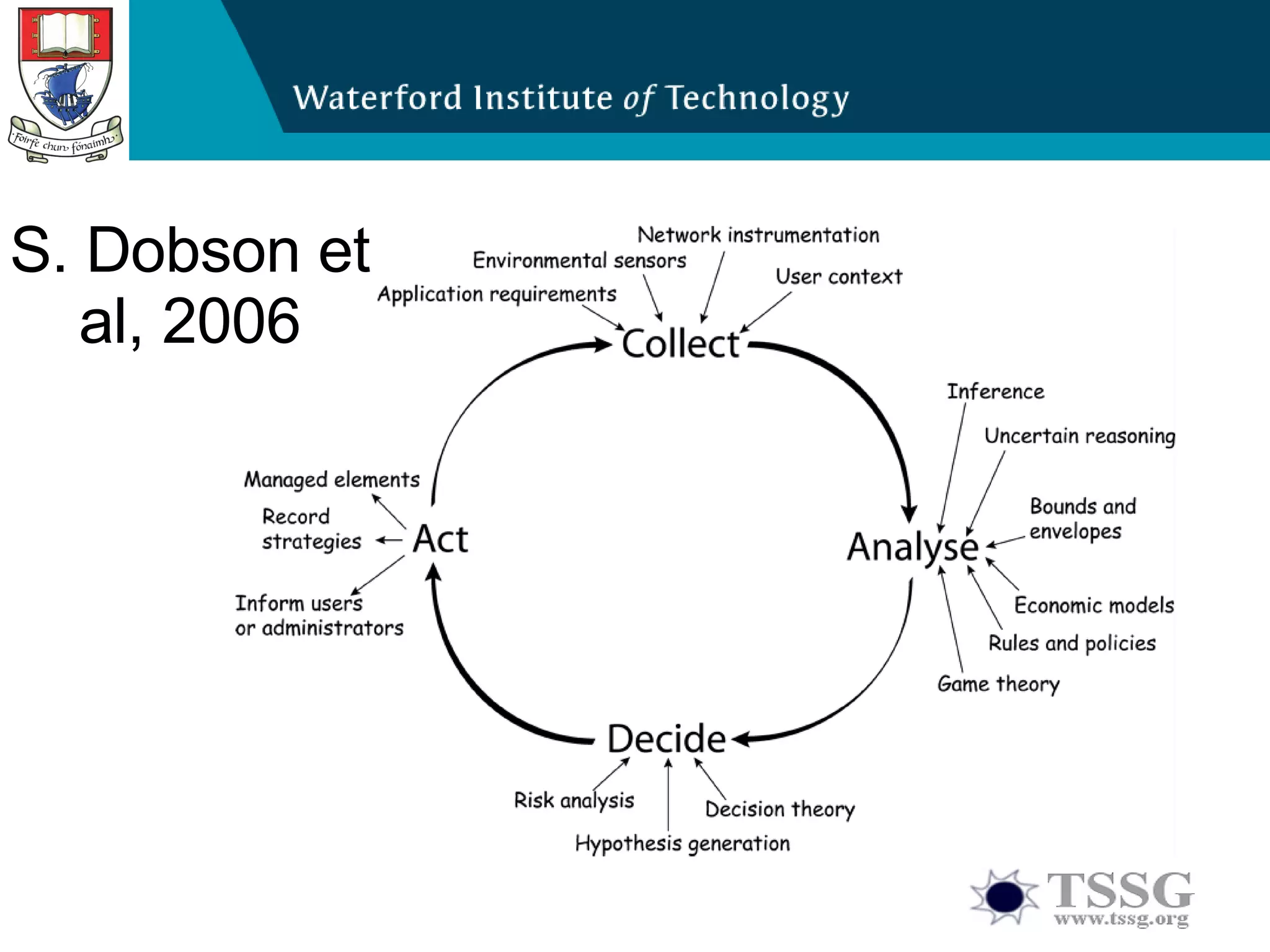
S. Dobson et al, 2006
TSSG: AMCNS Loop 2007
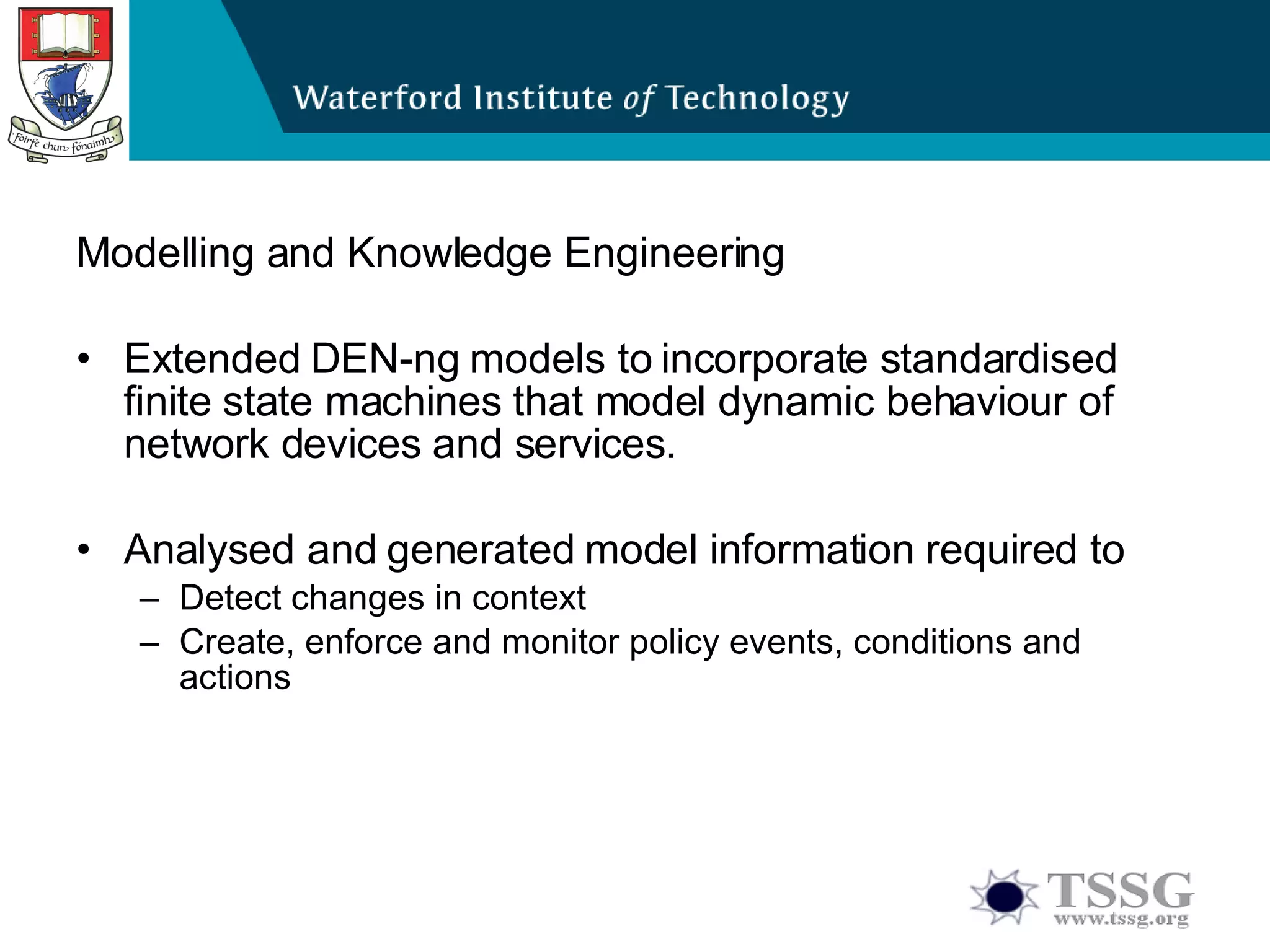
Modelling and Knowledge Engineering Extended DEN-ng models to incorporate standardised finite state machines that model dynamic behaviour of network devices and services. Analysed and generated model information required to Detect changes in context Create, enforce and monitor policy events, conditions and actions
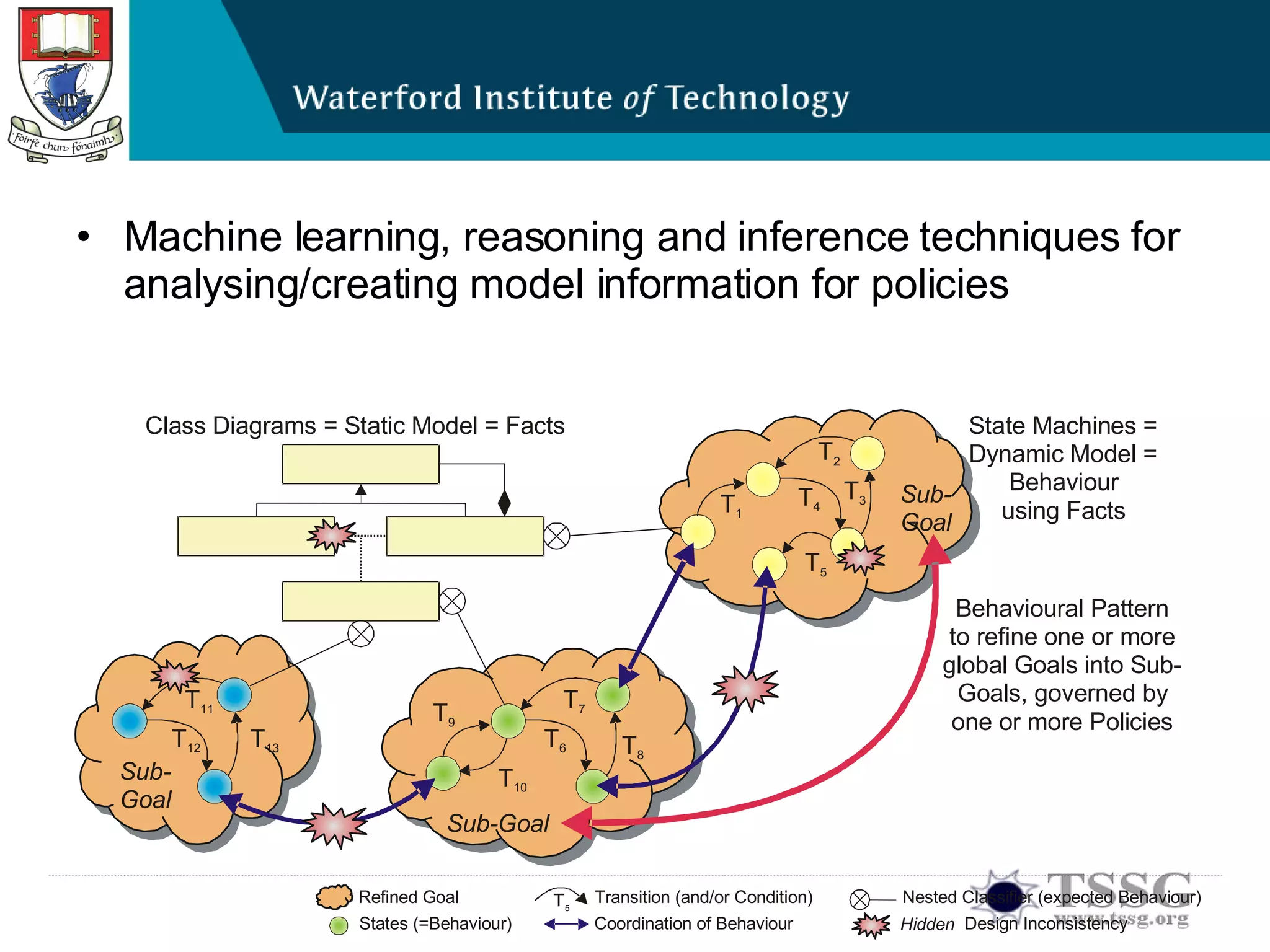
Machine learning, reasoning and inference techniques for analysing/creating model information for policies Coordination of Behaviour Transition (and/or Condition) T 5 States (=Behaviour) Refined Goal Hidden  Design Inconsistency Nested Classifier (expected Behaviour) Sub-Goal T 7 T 8 T 6 T 9 T 10 T 1 T 4 T 2 T 3 T 5 Sub- Goal T 11 T 12 T 13 Sub- Goal Class Diagrams = Static Model = Facts State Machines = Dynamic Model = Behaviour using Facts Behavioural Pattern to refine one or more global Goals into Sub- Goals, governed by one or more Policies
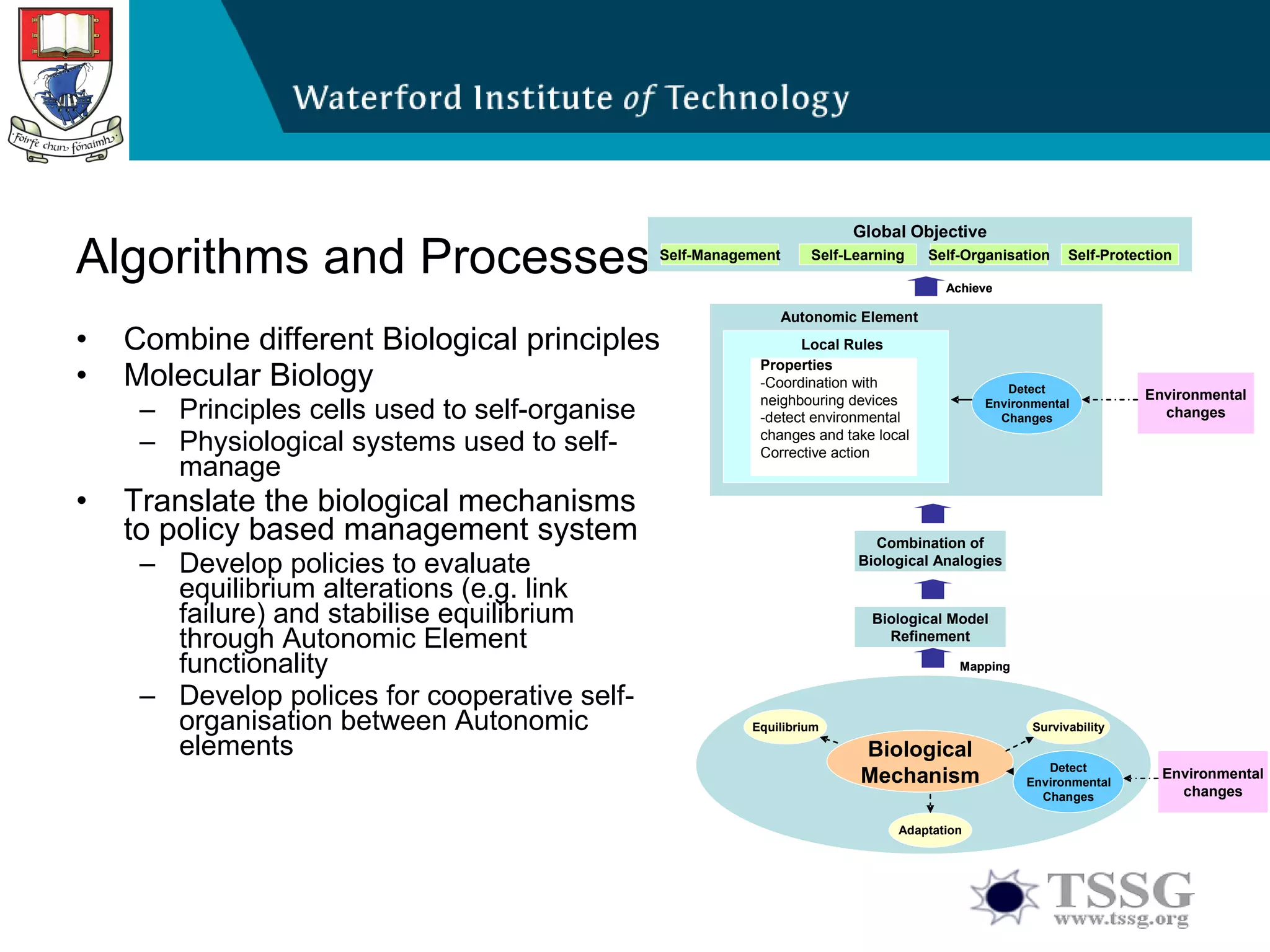
Algorithms and Processes Combine different Biological principles  Molecular Biology  Principles cells used to self-organise Physiological systems used to self-manage  Translate the biological mechanisms to policy based management system Develop policies to evaluate equilibrium alterations (e.g. link failure) and stabilise equilibrium through Autonomic Element functionality  Develop polices for cooperative self-organisation between Autonomic elements
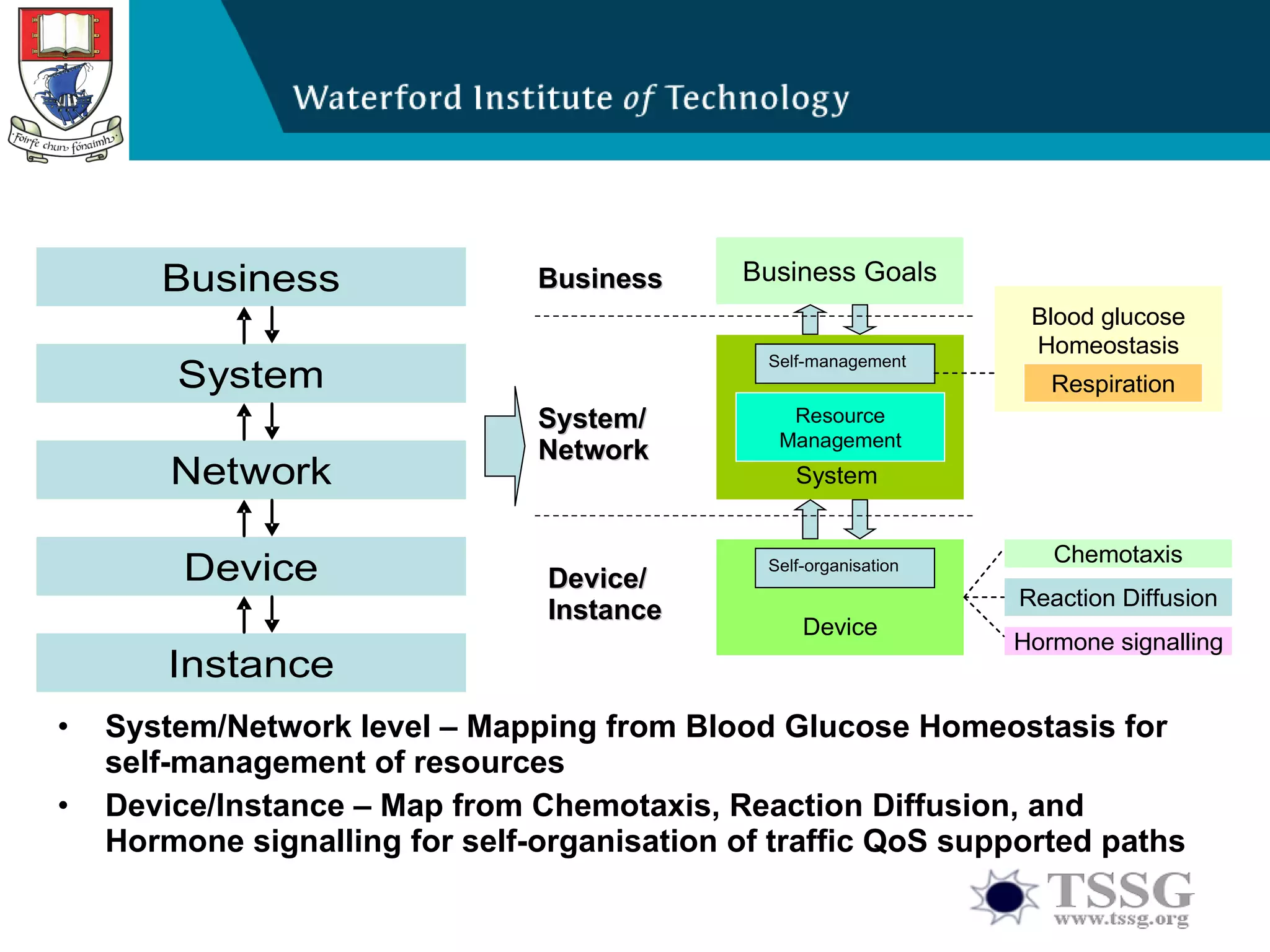
System/Network level – Mapping from Blood Glucose Homeostasis for self-management of resources Device/Instance – Map from Chemotaxis, Reaction Diffusion, and Hormone signalling for self-organisation of traffic QoS supported paths Business System/ Network Device/ Instance
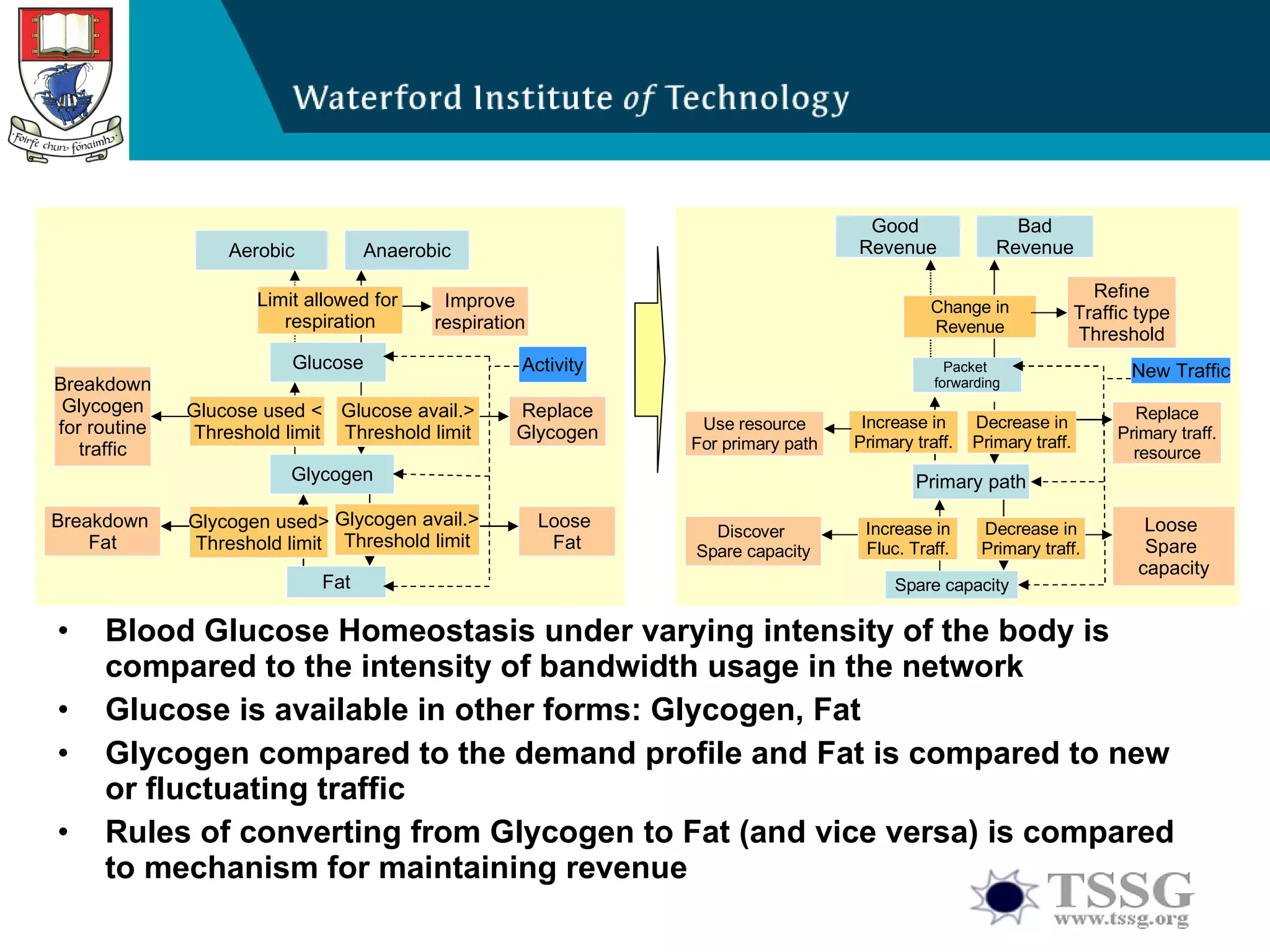
Blood Glucose Homeostasis under varying intensity of the body is compared to the intensity of bandwidth usage in the network Glucose is available in other forms: Glycogen, Fat Glycogen compared to the demand profile and Fat is compared to new or fluctuating traffic Rules of converting from Glycogen to Fat (and vice versa) is compared to mechanism for maintaining revenue Glucose Glycogen Fat Aerobic Anaerobic Limit allowed for  respiration Glucose used <  Threshold limit Glucose avail.> Threshold limit Glycogen used> Threshold limit Glycogen avail.> Threshold limit Activity Breakdown  Fat Loose  Fat Improve respiration Breakdown Glycogen for routine traffic Replace Glycogen Packet  forwarding Primary path Spare capacity Good  Revenue Bad Revenue Change in Revenue Increase in Primary traff. Decrease in Primary traff. Increase in Fluc. Traff. Decrease in Primary traff. New Traffic Refine Traffic type Threshold Discover  Spare capacity Loose  Spare  capacity Use resource For primary path Replace Primary traff. resource
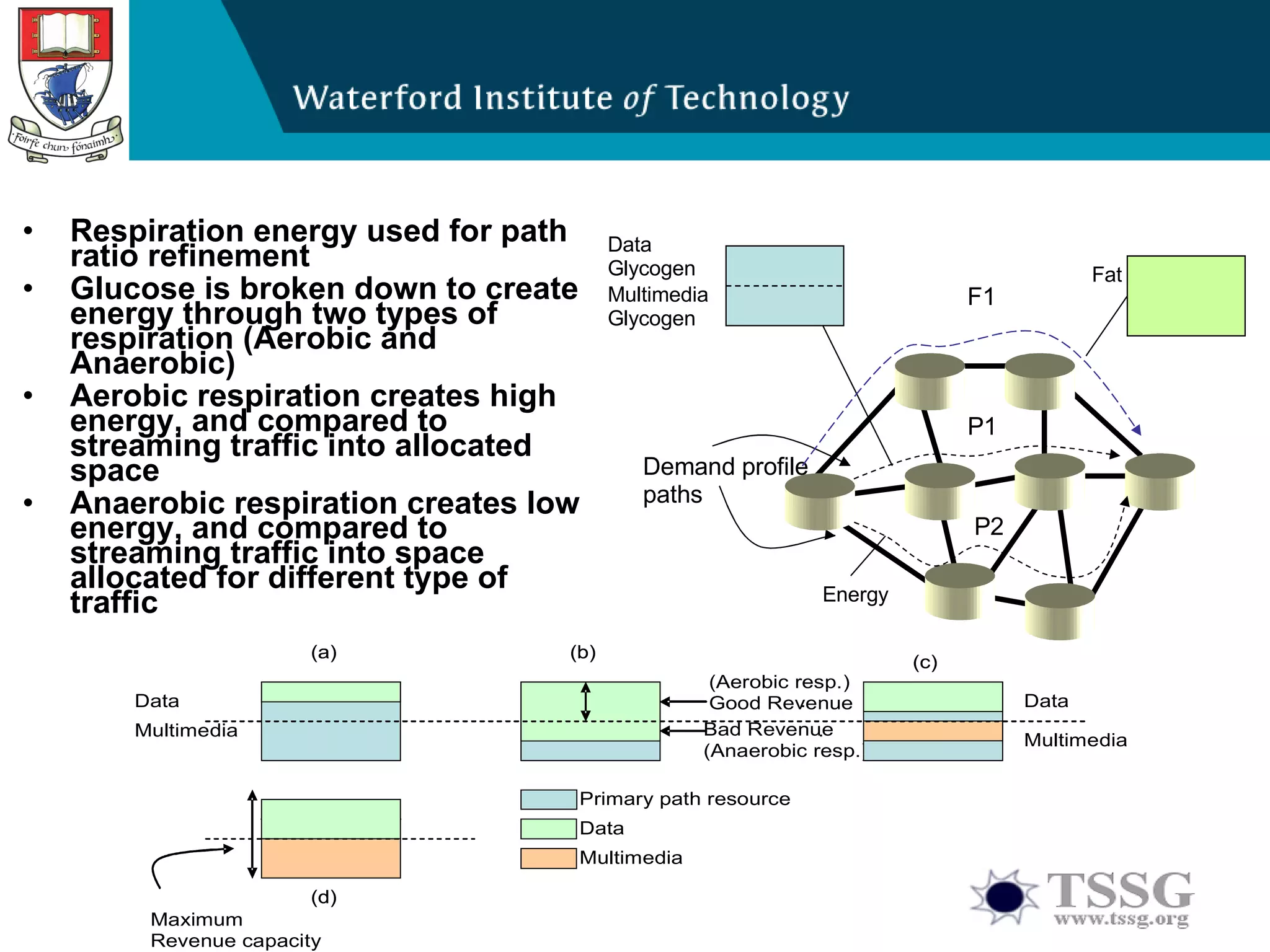
Respiration energy used for path ratio refinement Glucose is broken down to create energy through two types of respiration (Aerobic and Anaerobic) Aerobic respiration creates high energy, and compared to streaming traffic into allocated space Anaerobic respiration creates low energy, and compared to streaming traffic into space allocated for different type of traffic Multimedia Glycogen P1 P2 Demand profile paths Data Glycogen Fat F1 Energy

Management Of Future Communication Networks And Services

  • 1.
    Management of FutureCommunication Networks and Services Miguel Ponce de Leon TSSG, Waterford Institute of Technology
  • 2.
    Agenda Major TrendsIn-Network management Architecture Modelling and Knowledge Engineering Algorithms and Processes 2 nd Workshop on IMS enabled Converged Networks New paradigms for services delivery, Paris, Sept 12, 2008
  • 3.
    Major Trends TechnologyEnvironment: Multitude of networked/distributed applications Social-Economic Environment: Awareness of demographic change in an aging society (Europe and others) “ Information” centric rather than “bit” centric at the network level
  • 4.
    Integrated support ofmobility Communication everywhere New services – new devices – new interactions Complexity is largely due to heterogeneous traffic types (e.g. Data, VoIP, VoD) Traditional management has automation but it is still manually planned and deployed leads to high cost and error prone 2 nd Workshop on IMS enabled Converged Networks New paradigms for services delivery, Paris, Sept 12, 2008
  • 5.
    Can In-networkmanagement, be the essence for a system to self-govern its behaviour within the constraints of the business goals the system as a whole seeks to achieve?
  • 6.
    The TSSG iscarrying out research on the Management of Communication Networks and Services We are addressing Architecture and Methodology Modelling and Knowledge Engineering Policy Analysis and Deployment Algorithms and Processes
  • 7.
    In an communicationarchitecture, the basic management element is a Control Loop. This acts as manager of the resource through monitoring, analysis, and actions taken on a set of predefined system policies.
  • 8.
    IBM: MAPE, 2004The four functions consume and generate knowledge . The knowledge base can be seeded with known information about the system, and can grow as the autonomic manager learns more about the characteristics of the managed resources.
  • 9.
    Motorola: FOCALE, 2005FOCALE: Foundation, Observe, Compare, Act, Learn, rEason Define New Device Configuration(s) Autonomic Manager Ontological Comparison Reasoning and Learning Managed Resource Analyze Data and Events Determine Actual State YES NO DEN-ng Models and Ontologies Model-Based Translation Match? Control Control Control Control Policy Manager Policies control application of intelligence Context Manager
  • 10.
    S. Dobson etal, 2006
  • 11.
  • 12.
    Modelling and KnowledgeEngineering Extended DEN-ng models to incorporate standardised finite state machines that model dynamic behaviour of network devices and services. Analysed and generated model information required to Detect changes in context Create, enforce and monitor policy events, conditions and actions
  • 13.
    Machine learning, reasoningand inference techniques for analysing/creating model information for policies Coordination of Behaviour Transition (and/or Condition) T 5 States (=Behaviour) Refined Goal Hidden Design Inconsistency Nested Classifier (expected Behaviour) Sub-Goal T 7 T 8 T 6 T 9 T 10 T 1 T 4 T 2 T 3 T 5 Sub- Goal T 11 T 12 T 13 Sub- Goal Class Diagrams = Static Model = Facts State Machines = Dynamic Model = Behaviour using Facts Behavioural Pattern to refine one or more global Goals into Sub- Goals, governed by one or more Policies
  • 14.
    Algorithms and ProcessesCombine different Biological principles Molecular Biology Principles cells used to self-organise Physiological systems used to self-manage Translate the biological mechanisms to policy based management system Develop policies to evaluate equilibrium alterations (e.g. link failure) and stabilise equilibrium through Autonomic Element functionality Develop polices for cooperative self-organisation between Autonomic elements
  • 15.
    System/Network level –Mapping from Blood Glucose Homeostasis for self-management of resources Device/Instance – Map from Chemotaxis, Reaction Diffusion, and Hormone signalling for self-organisation of traffic QoS supported paths Business System/ Network Device/ Instance
  • 16.
    Blood Glucose Homeostasisunder varying intensity of the body is compared to the intensity of bandwidth usage in the network Glucose is available in other forms: Glycogen, Fat Glycogen compared to the demand profile and Fat is compared to new or fluctuating traffic Rules of converting from Glycogen to Fat (and vice versa) is compared to mechanism for maintaining revenue Glucose Glycogen Fat Aerobic Anaerobic Limit allowed for respiration Glucose used < Threshold limit Glucose avail.> Threshold limit Glycogen used> Threshold limit Glycogen avail.> Threshold limit Activity Breakdown Fat Loose Fat Improve respiration Breakdown Glycogen for routine traffic Replace Glycogen Packet forwarding Primary path Spare capacity Good Revenue Bad Revenue Change in Revenue Increase in Primary traff. Decrease in Primary traff. Increase in Fluc. Traff. Decrease in Primary traff. New Traffic Refine Traffic type Threshold Discover Spare capacity Loose Spare capacity Use resource For primary path Replace Primary traff. resource
  • 17.
    Respiration energy usedfor path ratio refinement Glucose is broken down to create energy through two types of respiration (Aerobic and Anaerobic) Aerobic respiration creates high energy, and compared to streaming traffic into allocated space Anaerobic respiration creates low energy, and compared to streaming traffic into space allocated for different type of traffic Multimedia Glycogen P1 P2 Demand profile paths Data Glycogen Fat F1 Energy