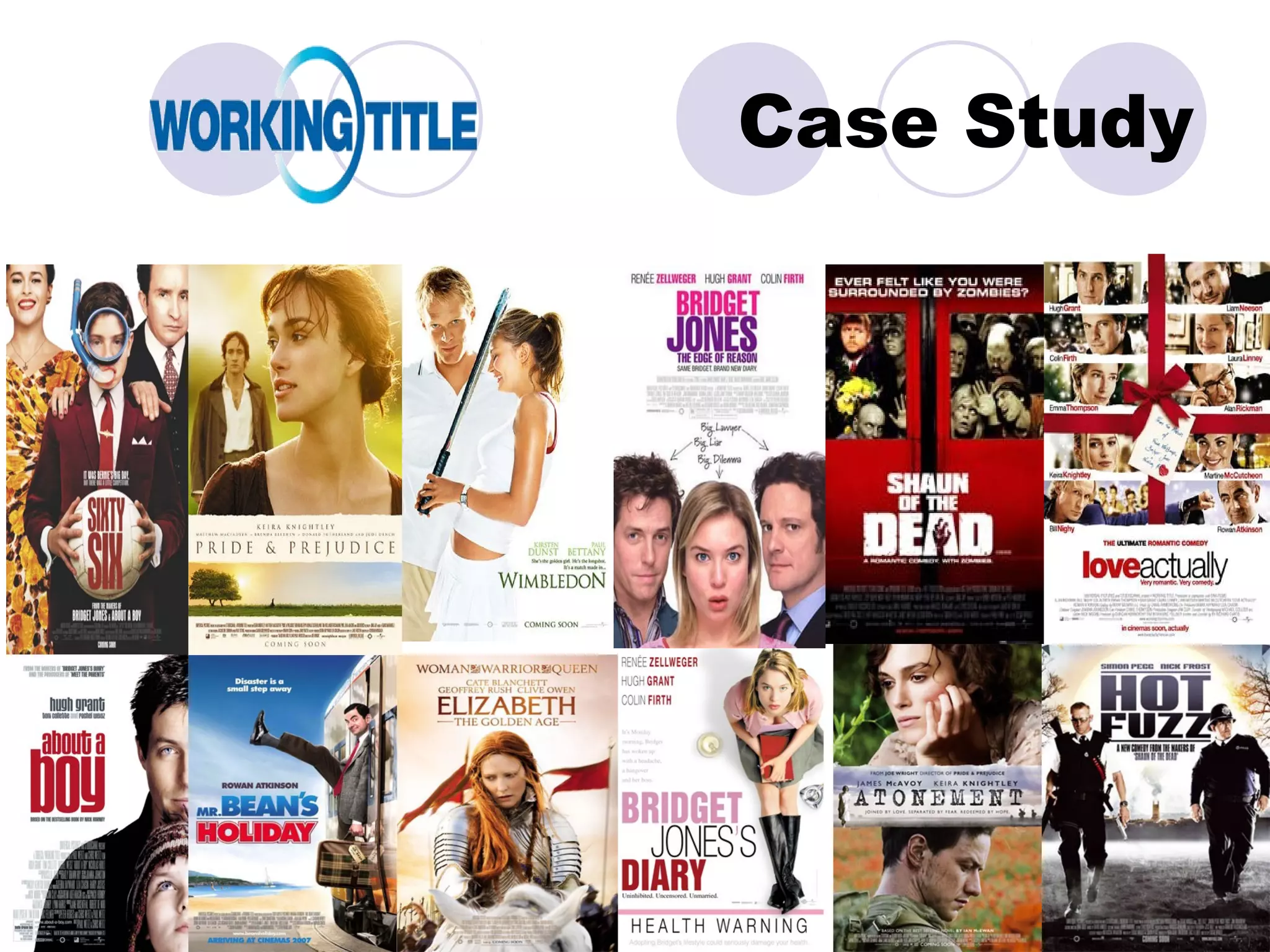
Case Study
G322 Key Media Concepts (TV
 Drama)
Section B: Institutions and
 Audiences
UK films aimed at an international audience
Largely traditional UK film genres
History of Working Title mirrors the history
 of the UK film industry
Increasingly typical UK film funding – co-
 productions with British TV companies and
 Hollywood studios
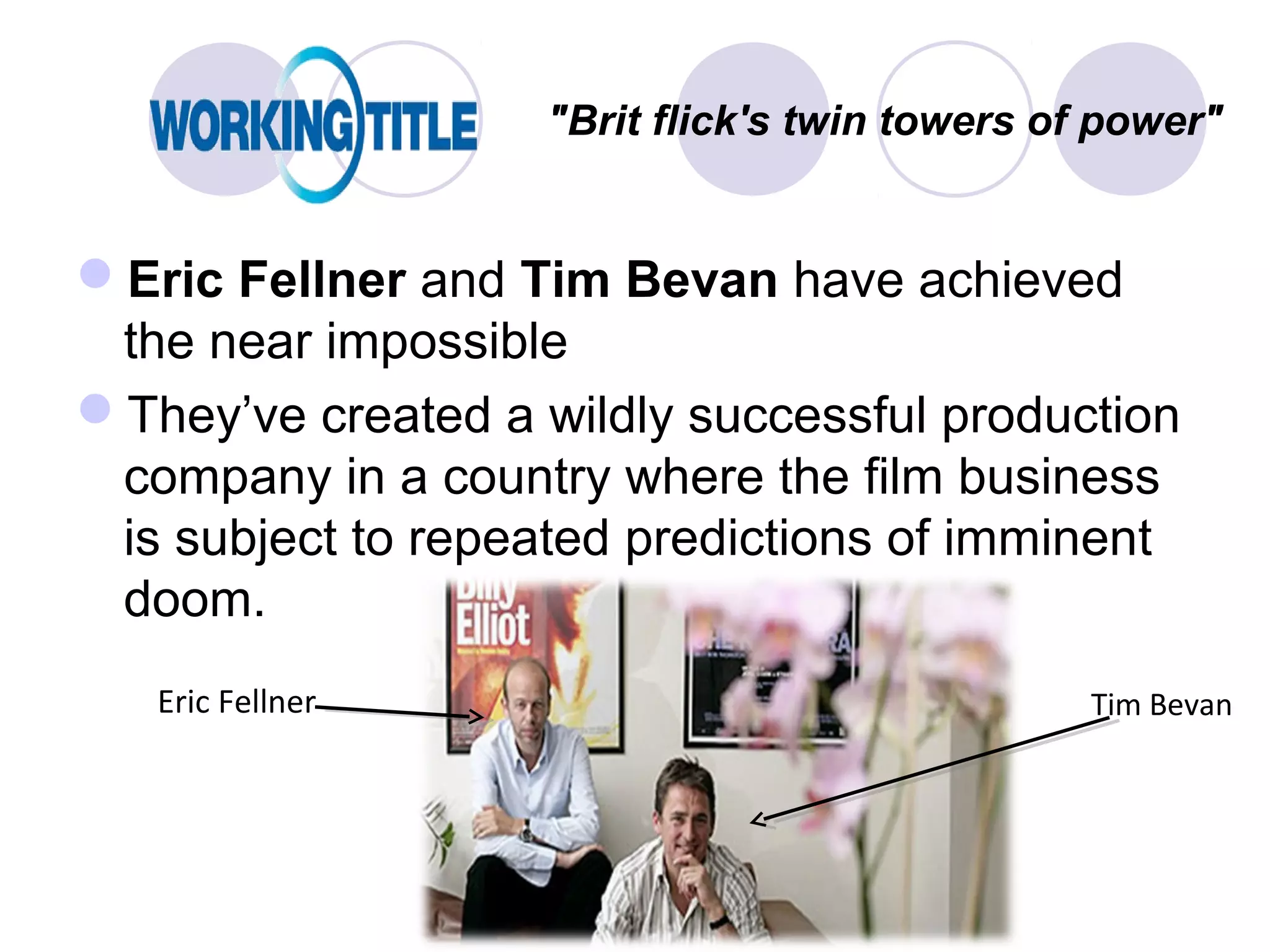
"Brit flick's twin towers of power"


Eric Fellner and Tim Bevan have achieved
 the near impossible
They’ve created a wildly successful production
 company in a country where the film business
 is subject to repeated predictions of imminent
 doom.
   Eric Fellner                                 Tim Bevan
 Working Title Films began life co-producing the short film
  The Man Who Shot Christmas (1984).
 This led to their first film for Channel Four and the first of
  many landmark Working Title Films - My Beautiful
  Laundrette (1985) Directed by Stephen Frears.


 In 2009 still the most successful British film production
  company ever.


  “Their films have grossed more than £1.2 billion
  Since 1984, and that is a conservative estimate.”
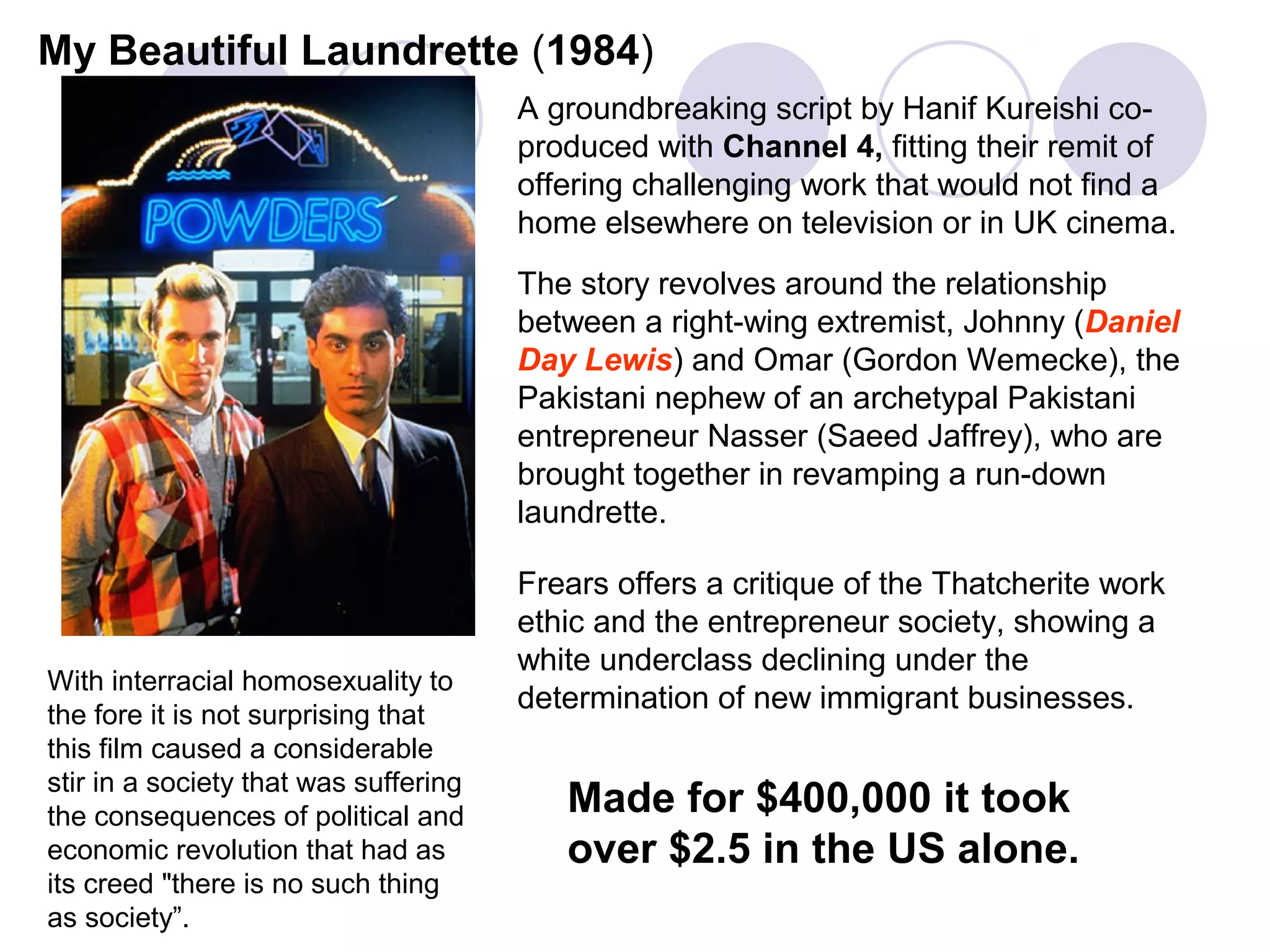
My Beautiful Laundrette (1984)
                                       A groundbreaking script by Hanif Kureishi co-
                                       produced with Channel 4, fitting their remit of
                                       offering challenging work that would not find a
                                       home elsewhere on television or in UK cinema.
                                       The story revolves around the relationship
                                       between a right-wing extremist, Johnny (Daniel
                                       Day Lewis) and Omar (Gordon Wemecke), the
                                       Pakistani nephew of an archetypal Pakistani
                                       entrepreneur Nasser (Saeed Jaffrey), who are
                                       brought together in revamping a run-down
                                       laundrette.

                                       Frears offers a critique of the Thatcherite work
                                       ethic and the entrepreneur society, showing a
                                       white underclass declining under the
With interracial homosexuality to
                                       determination of new immigrant businesses.
the fore it is not surprising that
this film caused a considerable
stir in a society that was suffering
the consequences of political and         Made for $400,000 it took
economic revolution that had as           over $2.5 in the US alone.
its creed "there is no such thing
as society”.
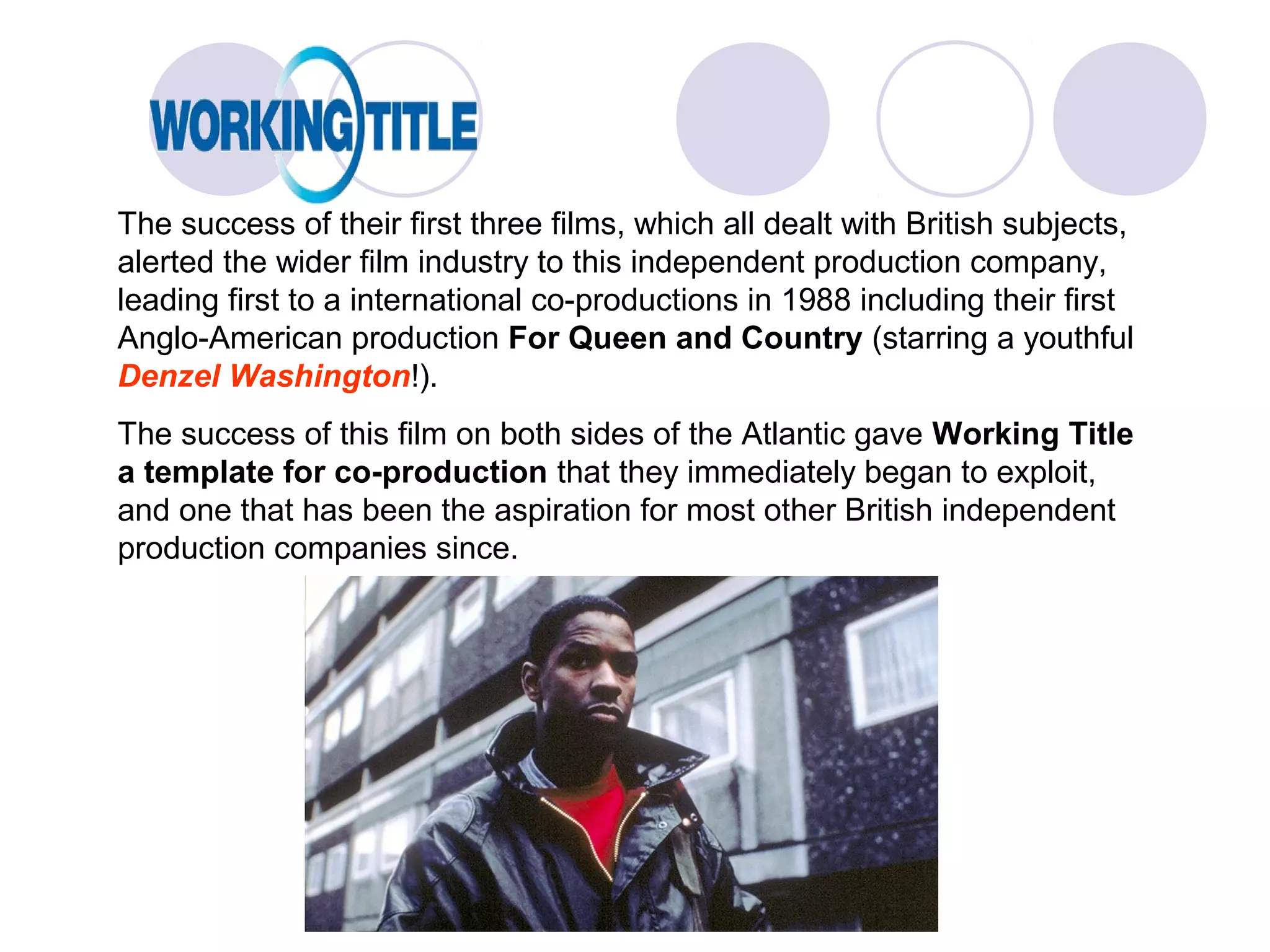
The success of their first three films, which all dealt with British subjects,
alerted the wider film industry to this independent production company,
leading first to a international co-productions in 1988 including their first
Anglo-American production For Queen and Country (starring a youthful
Denzel Washington!).
The success of this film on both sides of the Atlantic gave Working Title
a template for co-production that they immediately began to exploit,
and one that has been the aspiration for most other British independent
production companies since.
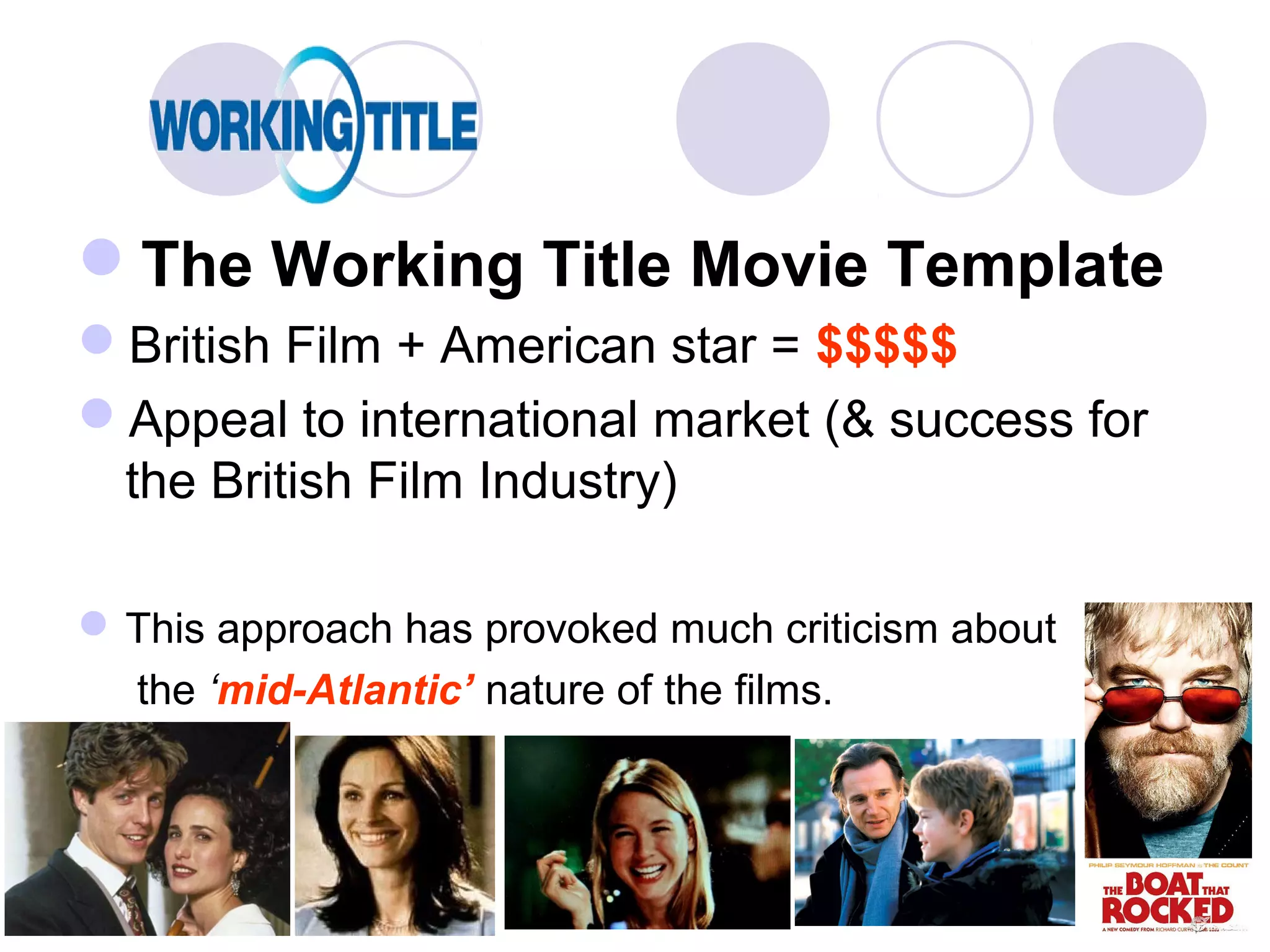
The Working Title Movie Template
British Film + American star = $$$$$
Appeal to international market (& success for
 the British Film Industry)

 This approach has provoked much criticism about
  the ‘mid-Atlantic’ nature of the films.
Why UK/US Co-productions?
According to Bevan: "Before co-productions we had been
independent producers, but it was very hand to mouth. We
would develop a script, that would take about 5% of our
time; we'd find a director, that'd take about 5% of the time
and then we'd spend 90% of the time trying to juggle
together deals from different sources to finance those
films. The films were suffering because there was no real
structure and the company was always virtually bankrupt."
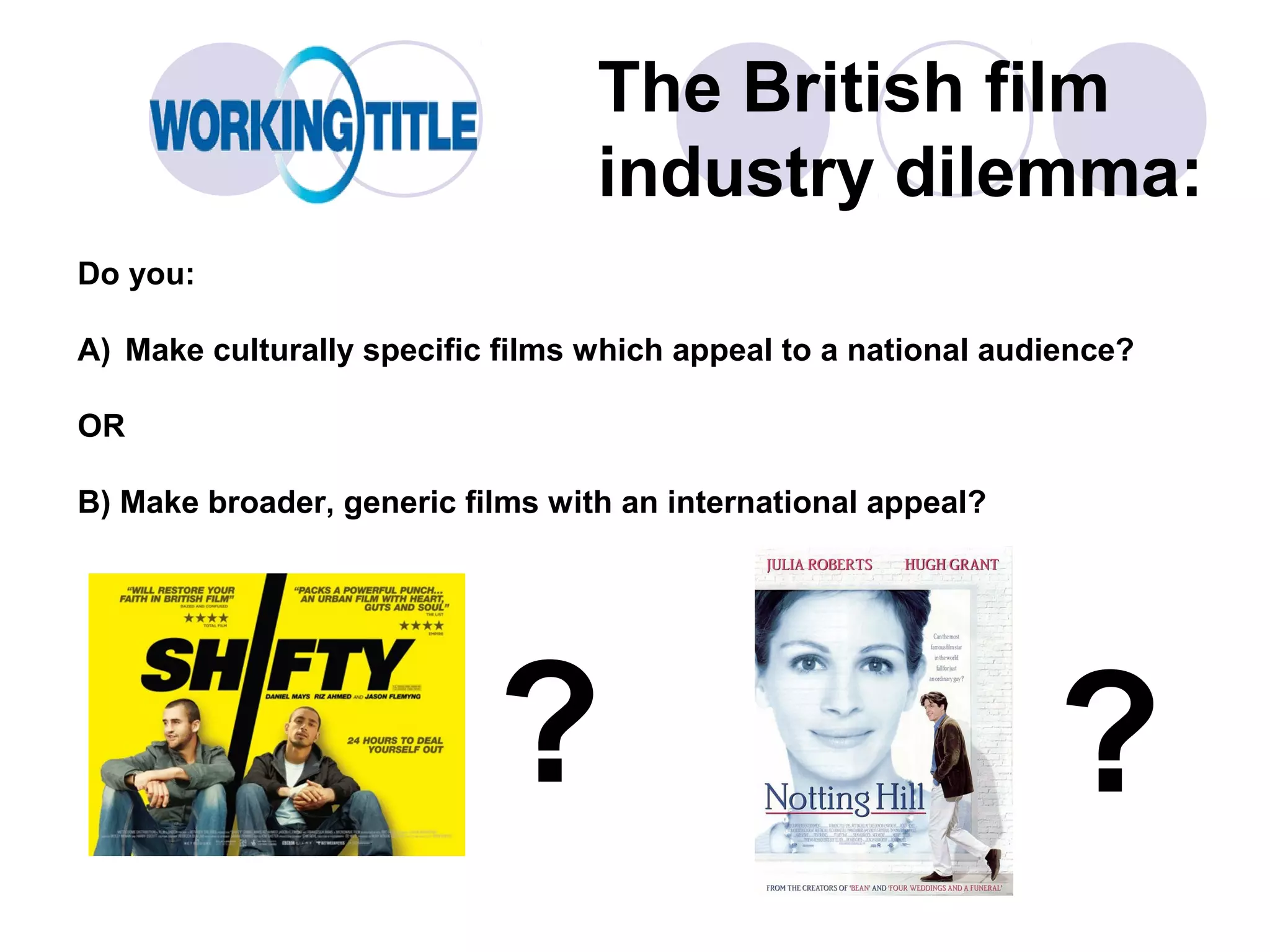
The British film
                                  industry dilemma:
Do you:

A) Make culturally specific films which appeal to a national audience?

OR

B) Make broader, generic films with an international appeal?


                           ?                                    ?
The British film
                                  industry dilemma:
Working Title want to make European films
 for a worldwide audience.
They want to imbue them with European ideas
 and influences and they can’t do these things
 without the backing of a major Hollywood
 studio.


 "I think anyone in Hollywood would want
 to do business with these guys,"
 Former boss of Universal Studios Edgar Bronfman Jr.
A HISTORY:
 1984 - Working Title founded
 1985 - My Beautiful Laundrette is the first
 of a series of collaborations with Channel
 4 Films
                                          Working Title produce a further 10 films
                                          in the 1980s
1988 - Production deal with PolyGram
Filmed Entertainment
                                            1992 - PolyGram (a European music and
                                            media company) buys Working Title.
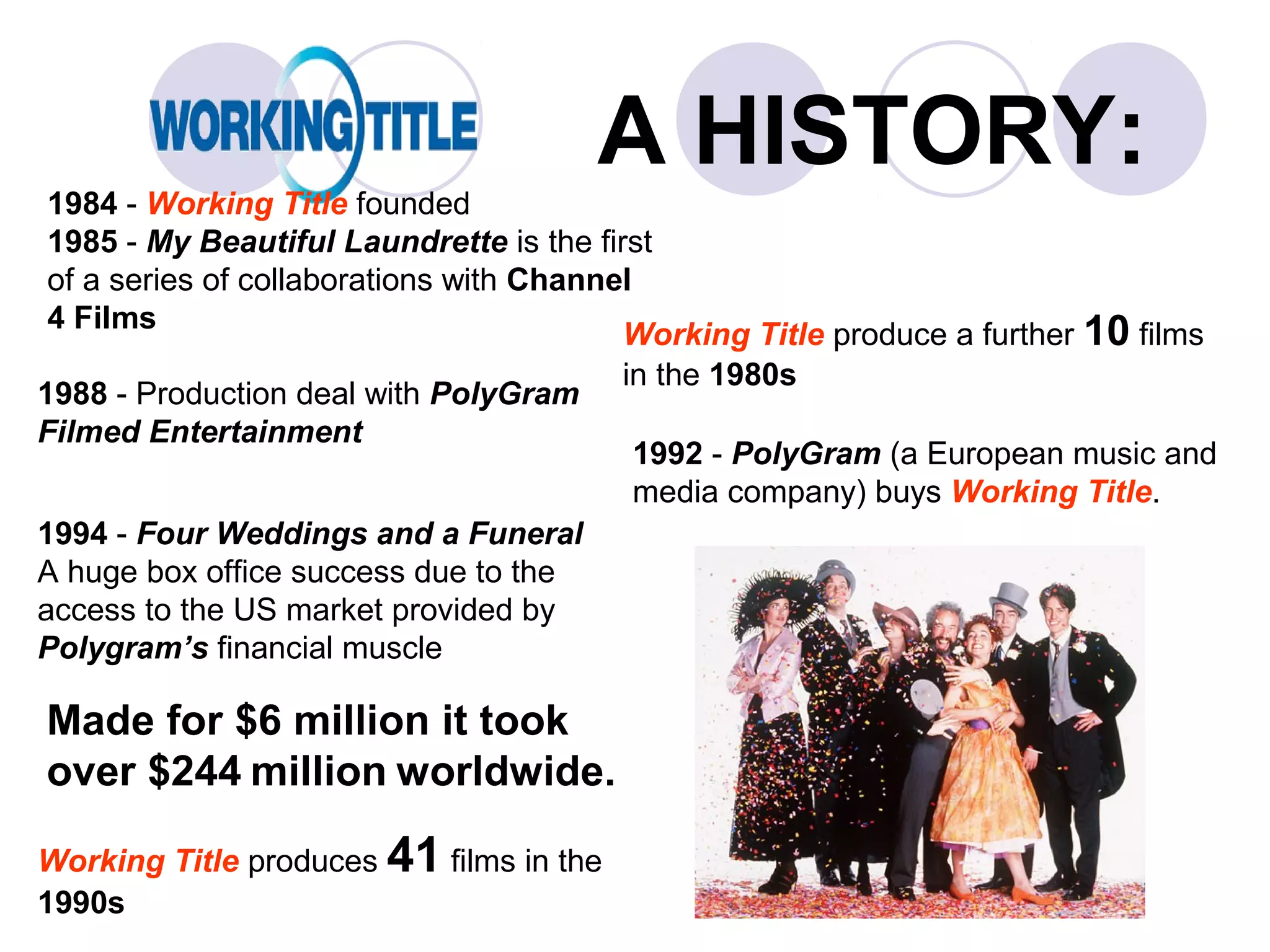
1994 - Four Weddings and a Funeral
A huge box office success due to the
access to the US market provided by
Polygram’s financial muscle

Made for $6 million it took
over $244 million worldwide.

Working Title produces 41 films in the
1990s
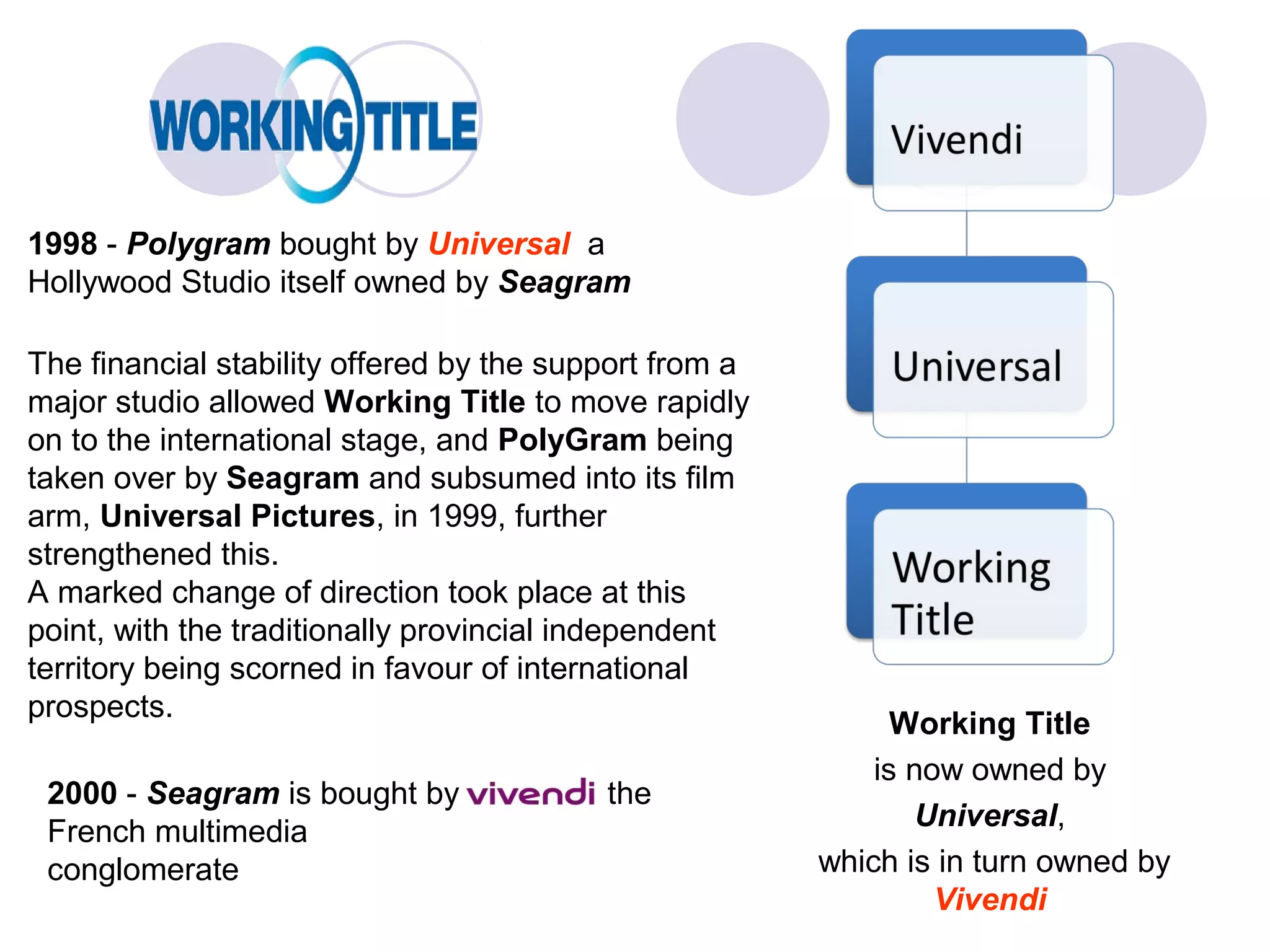
1998 - Polygram bought by Universal a
Hollywood Studio itself owned by Seagram

The financial stability offered by the support from a
major studio allowed Working Title to move rapidly
on to the international stage, and PolyGram being
taken over by Seagram and subsumed into its film
arm, Universal Pictures, in 1999, further
strengthened this.
A marked change of direction took place at this
point, with the traditionally provincial independent
territory being scorned in favour of international
prospects.
                                                              Working Title
                                                            is now owned by
 2000 - Seagram is bought by Vivendi, the
                                                               Universal,
 French multimedia
 conglomerate                                           which is in turn owned by
                                                                 Vivendi
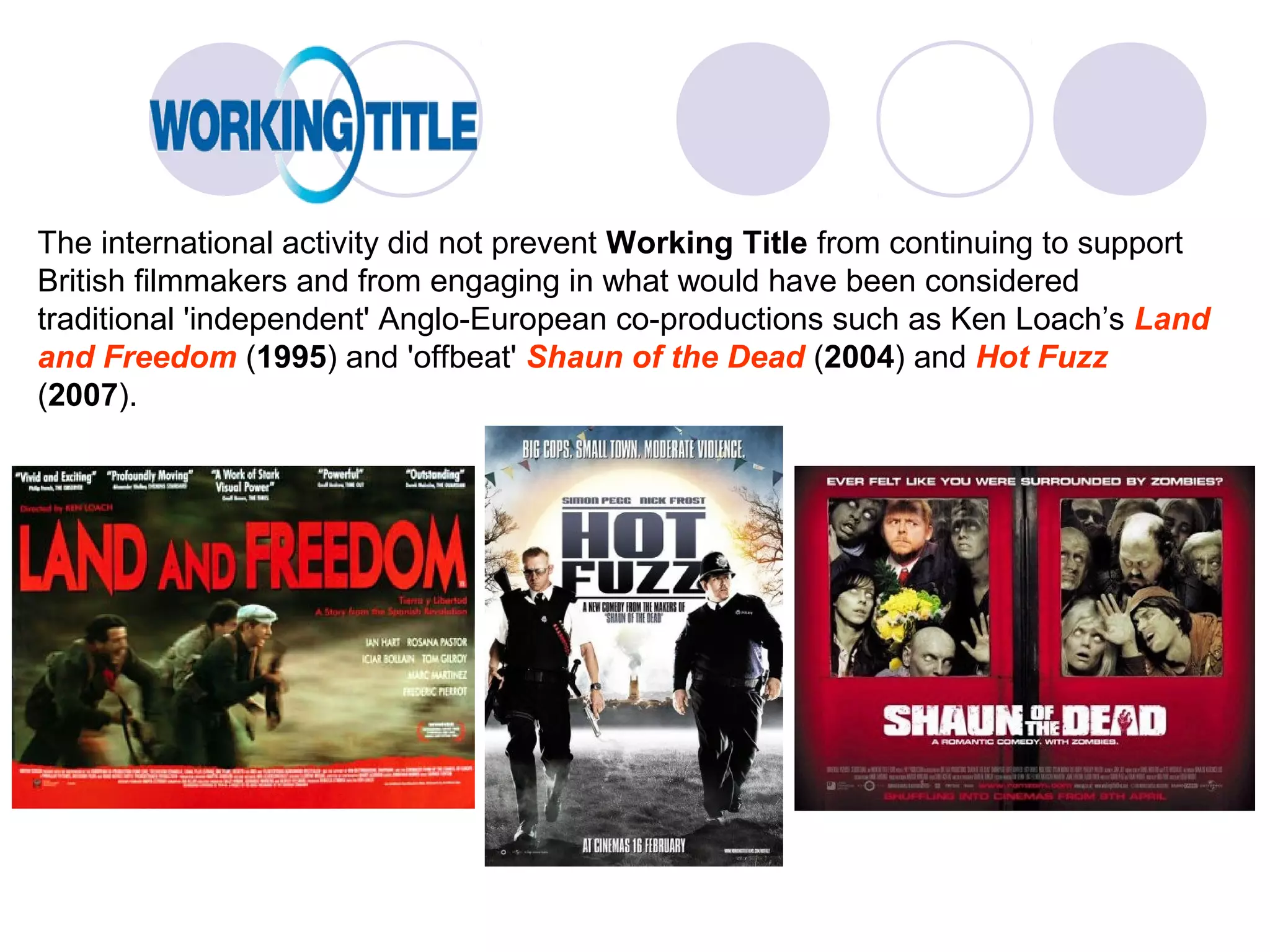
The international activity did not prevent Working Title from continuing to support
British filmmakers and from engaging in what would have been considered
traditional 'independent' Anglo-European co-productions such as Ken Loach’s Land
and Freedom (1995) and 'offbeat' Shaun of the Dead (2004) and Hot Fuzz
(2007).
So what is a
                                    Working Title film?
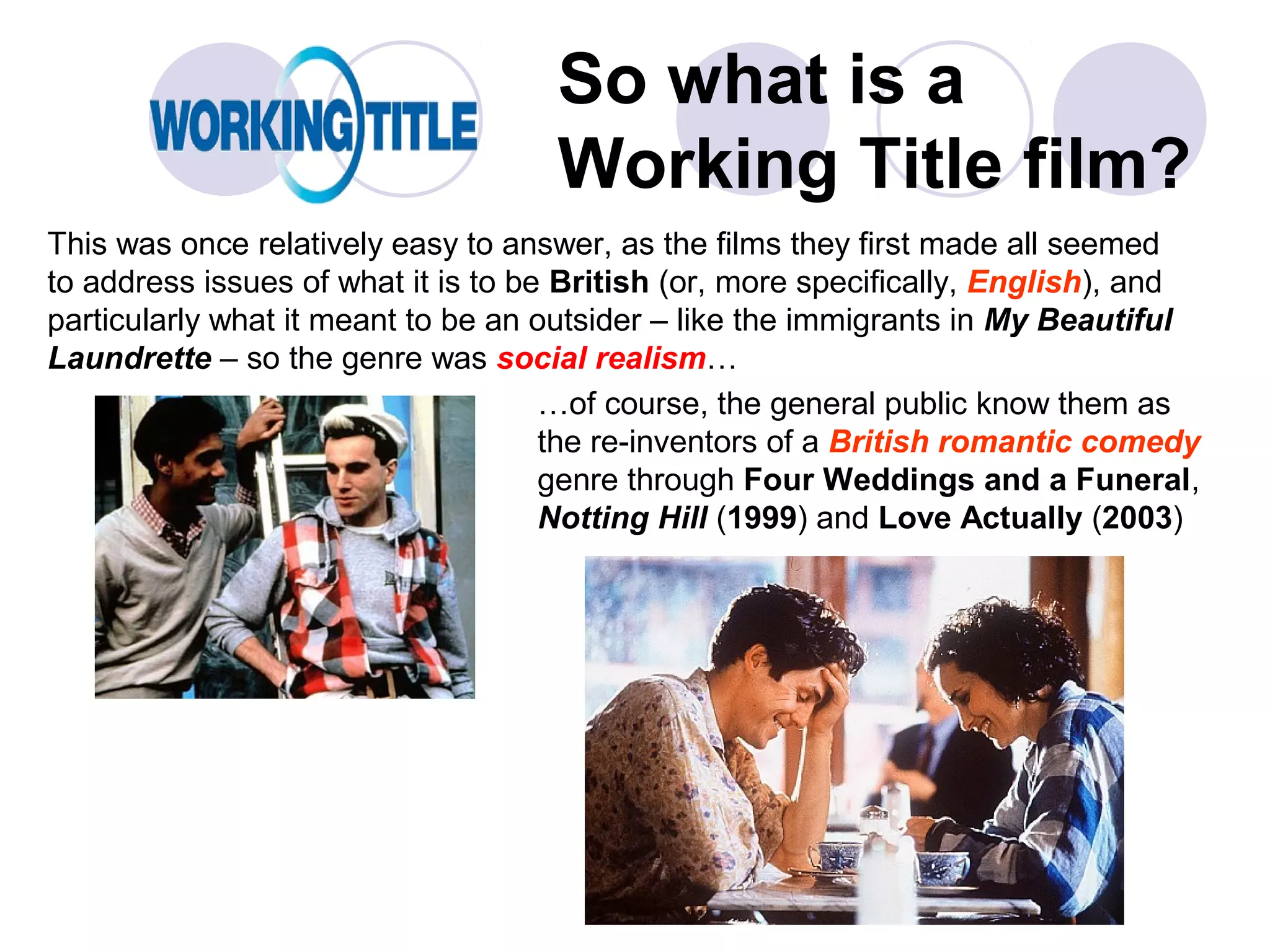
This was once relatively easy to answer, as the films they first made all seemed
to address issues of what it is to be British (or, more specifically, English), and
particularly what it meant to be an outsider – like the immigrants in My Beautiful
Laundrette – so the genre was social realism…
                                     …of course, the general public know them as
                                     the re-inventors of a British romantic comedy
                                     genre through Four Weddings and a Funeral,
                                     Notting Hill (1999) and Love Actually (2003)
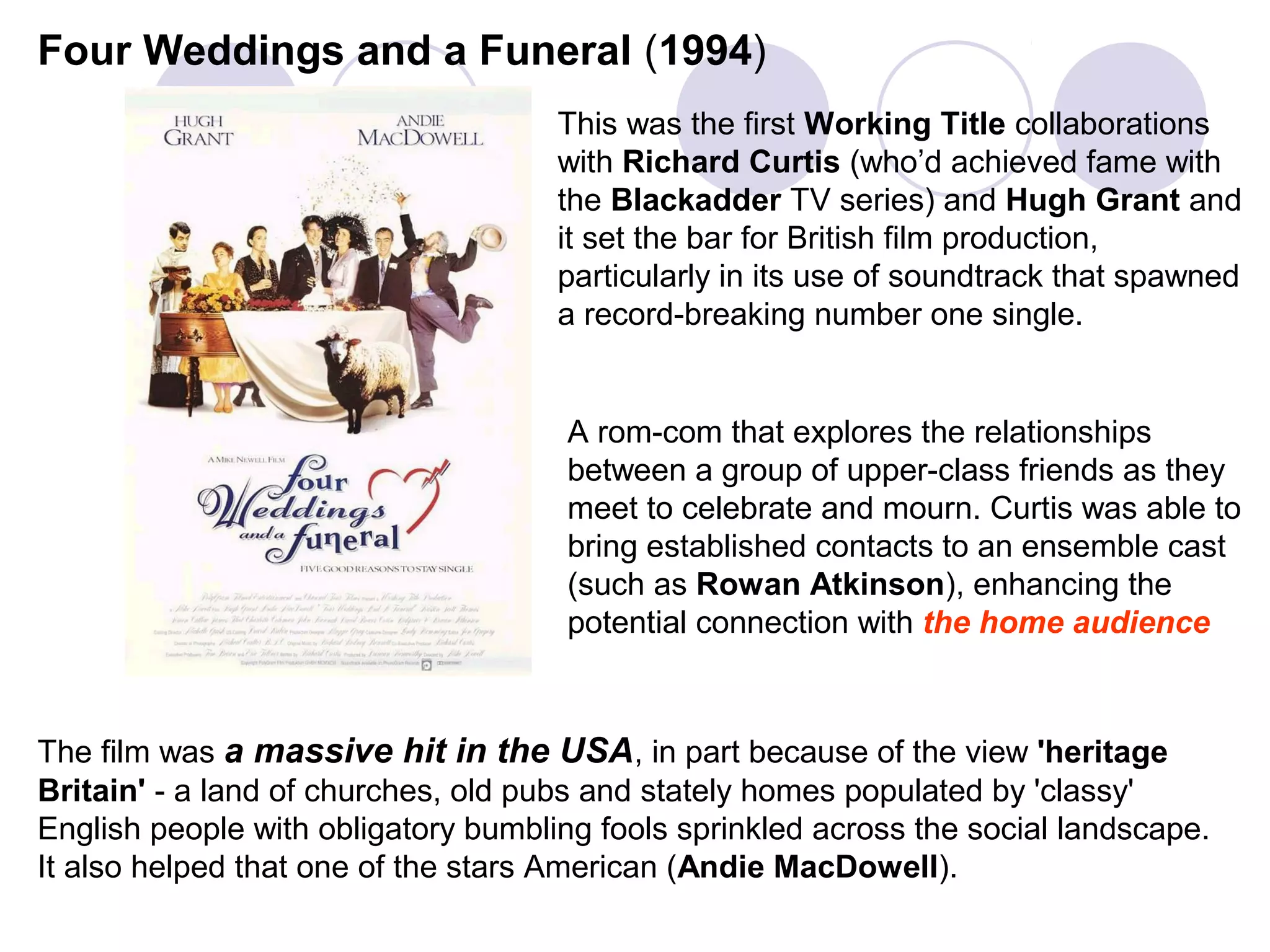
Four Weddings and a Funeral (1994)
                                     This was the first Working Title collaborations
                                     with Richard Curtis (who’d achieved fame with
                                     the Blackadder TV series) and Hugh Grant and
                                     it set the bar for British film production,
                                     particularly in its use of soundtrack that spawned
                                     a record-breaking number one single.


                                     A rom-com that explores the relationships
                                     between a group of upper-class friends as they
                                     meet to celebrate and mourn. Curtis was able to
                                     bring established contacts to an ensemble cast
                                     (such as Rowan Atkinson), enhancing the
                                     potential connection with the home audience


The film was a massive hit in the USA, in part because of the view 'heritage
Britain' - a land of churches, old pubs and stately homes populated by 'classy'
English people with obligatory bumbling fools sprinkled across the social landscape.
It also helped that one of the stars American (Andie MacDowell).
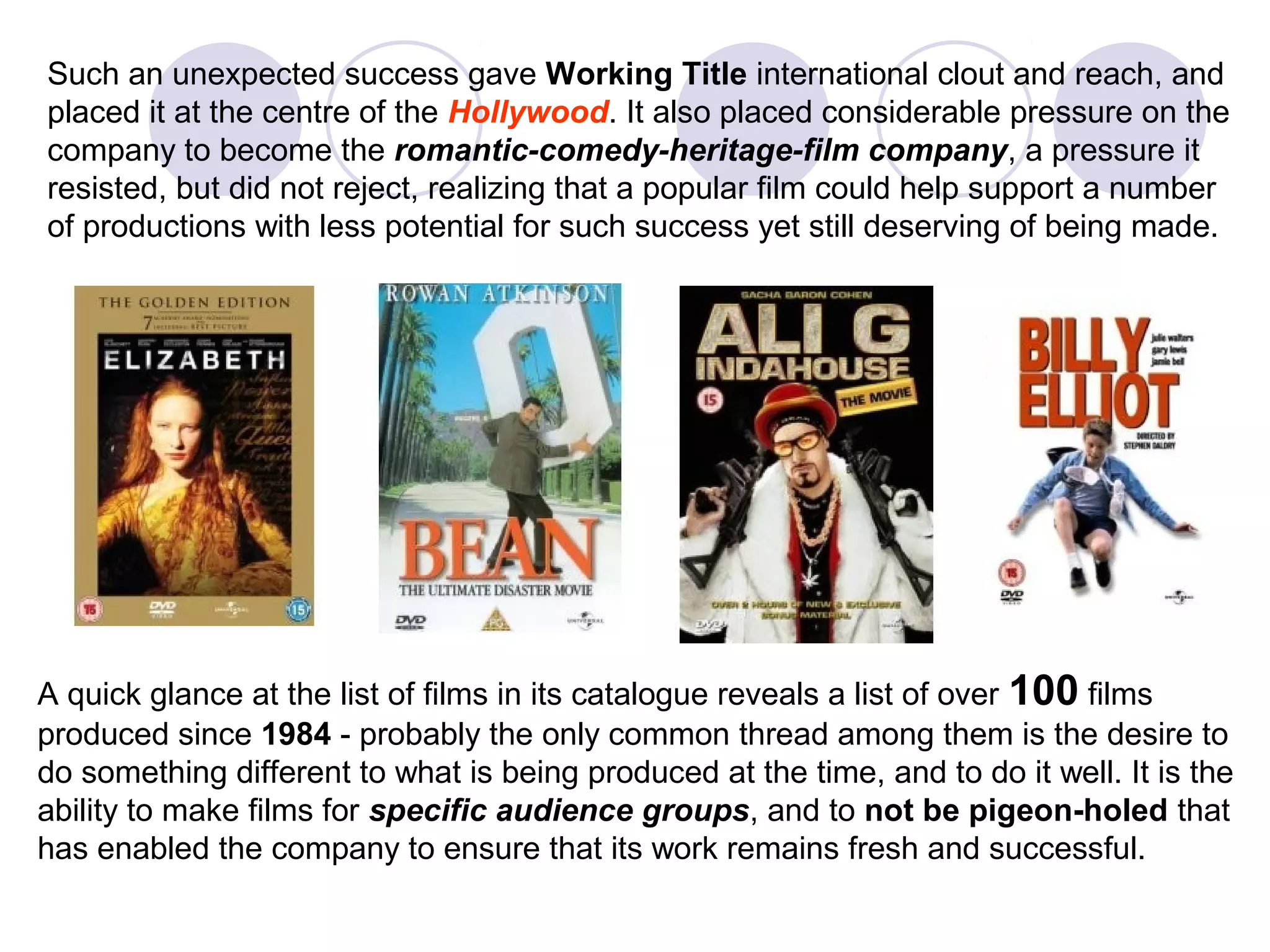
Such an unexpected success gave Working Title international clout and reach, and
placed it at the centre of the Hollywood. It also placed considerable pressure on the
company to become the romantic-comedy-heritage-film company, a pressure it
resisted, but did not reject, realizing that a popular film could help support a number
of productions with less potential for such success yet still deserving of being made.


A quick glance at the list of films in its catalogue reveals a list of over 100 films
produced since 1984 - probably the only common thread among them is the desire to
do something different to what is being produced at the time, and to do it well. It is the
ability to make films for specific audience groups, and to not be pigeon-holed that
has enabled the company to ensure that its work remains fresh and successful.
So what is a
                                      Working Title film?
It is easy to categorize them (dismissively) until you look through the catalogue and
realize that this is a company categorized only by diversity and the ability to
detect changes in the market that enable a reorientation of direction

                   There is no other British Film Company like
                    Working Title - it is allowed freedom to
                   make creative decisions but it is owned by
                           a US based conglomerate.

 How do Working Title choose which films to make? Fellner says “projects get
 championed by individuals in the development department and these
 'percolate' their way up to the top. Tim Bevan and I then both take the
 decision on what to greenlight.”
Working Title and
                                      Co-production
Co-production has long been a method of sharing risk within the film industry,
and when Working Title began its life, co-production was merely another
revenue stream that often involved pre-sale or pre-distribution deals on world or
national rights. Since one of Working Title’s principal partners was Channel
Four, and Channel Four pioneered international co-production in the UK, it is no
surprise that Working Title adopted and extended the model.

           Initially, Working Title explored these deals domestically,
              but as its success grew it found that the international
                             market opened up to it.

Working Title took co-production further when formalizing their relationship with
PolyGram (later Universal) where US investment of 30% did not prevent them
from obtaining EU/UK tax advantages. A 30% stake in the budget + Hollywood
support clearly stimulates other investors willingness to get involved in a film. It is
this advance in the model that radically enhanced the production processes and
values in Working Title films.
How does it work?
                “The Working Title philosophy has always been to
                make films for an audience - by that I mean play in a
                multiplex. We totally believe in this because we
                know it is the only hope we have of sustaining the
                UK film industry.”
Despite its famous name, the structure at Working Title is small. It employs just 42
full time staff, split between the main Working Title production arm and its recently
closed low-budget offshoot WT2 under Natasha Wharton.

                “When I was at Working Title we set up a New
                Writers Scheme to develop new talent. The
                problem was that at Working Title, smaller films
                would inevitably get less attention than the bigger
                budget projects so we decided to set up WT2 to
                give proper attention to those smaller films.”

                       2007 - Why did WT2 close down?
Does it always
                      work?
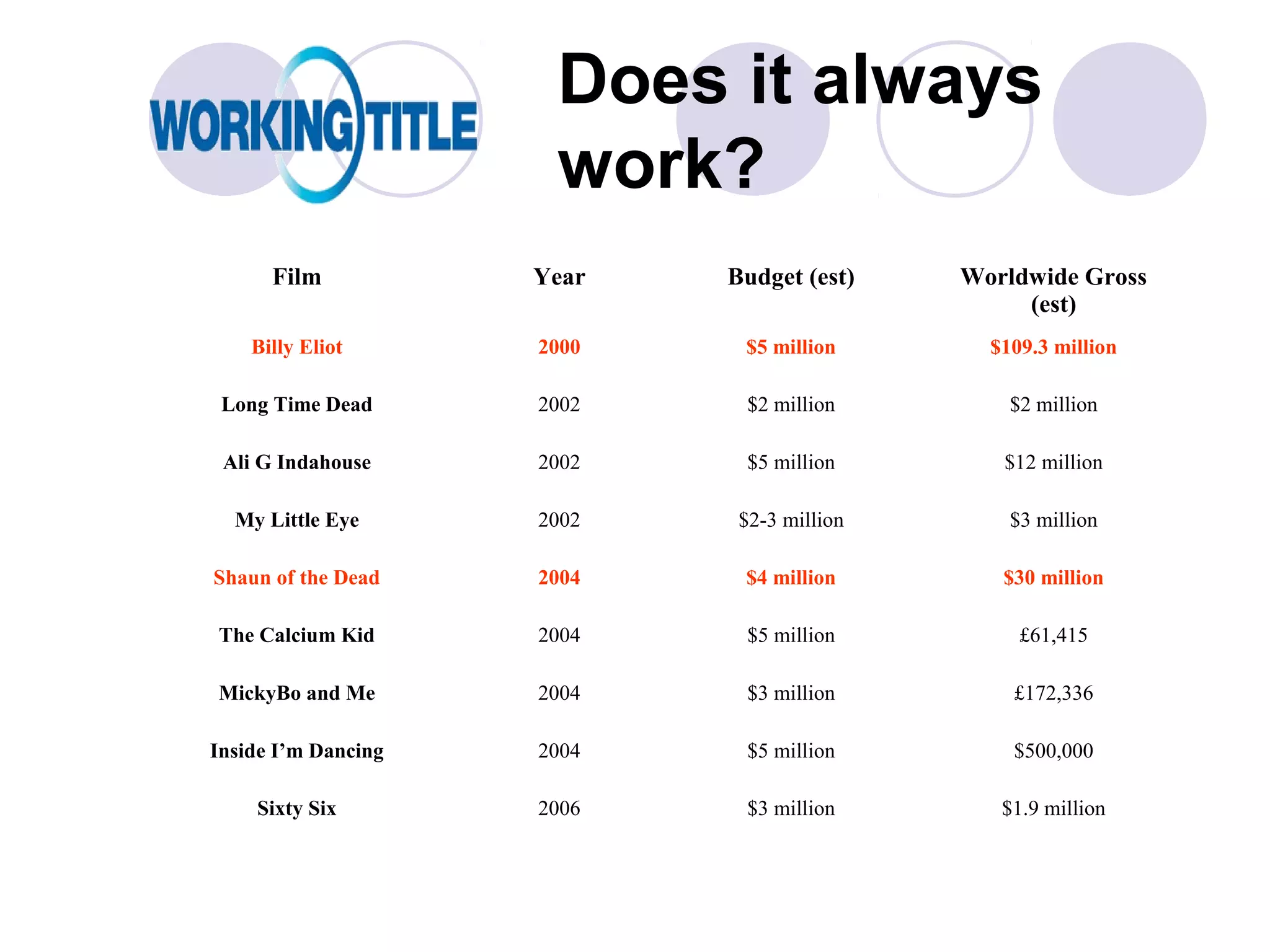
      Film           Year   Budget (est)    Worldwide Gross
                                                 (est)
    Billy Eliot      2000    $5 million       $109.3 million

 Long Time Dead      2002     $2 million        $2 million

 Ali G Indahouse     2002     $5 million       $12 million

  My Little Eye      2002    $2-3 million       $3 million

Shaun of the Dead    2004    $4 million        $30 million

The Calcium Kid      2004     $5 million         £61,415

MickyBo and Me       2004     $3 million        £172,336

Inside I’m Dancing   2004     $5 million        $500,000

    Sixty Six        2006     $3 million       $1.9 million
How does it work?
The most important part of the business is developing scripts. Working Title has a
strong development team and invests heavily in making sure that they get it right.
They usually have around 40 - 50 projects in development at any time and their
average spend on development is around $250,000 to $500,000 per script.


       They aim to make around 5 to 10 films a year, spread across
       different budget sizes (with an average of $30 to $40 million) and
       genres.

 Released in 2009/10 are 10 films including the Richard Curtis comedy The
 Boat That Rocked, political thriller State of Play based on the successful
 BBC television drama but re-imagined in Washington and Green Zone, an
 Iraq war thriller that reunites the Bourne series star Matt Damon and director
 Paul Greengrass. Bound to be a success, right?
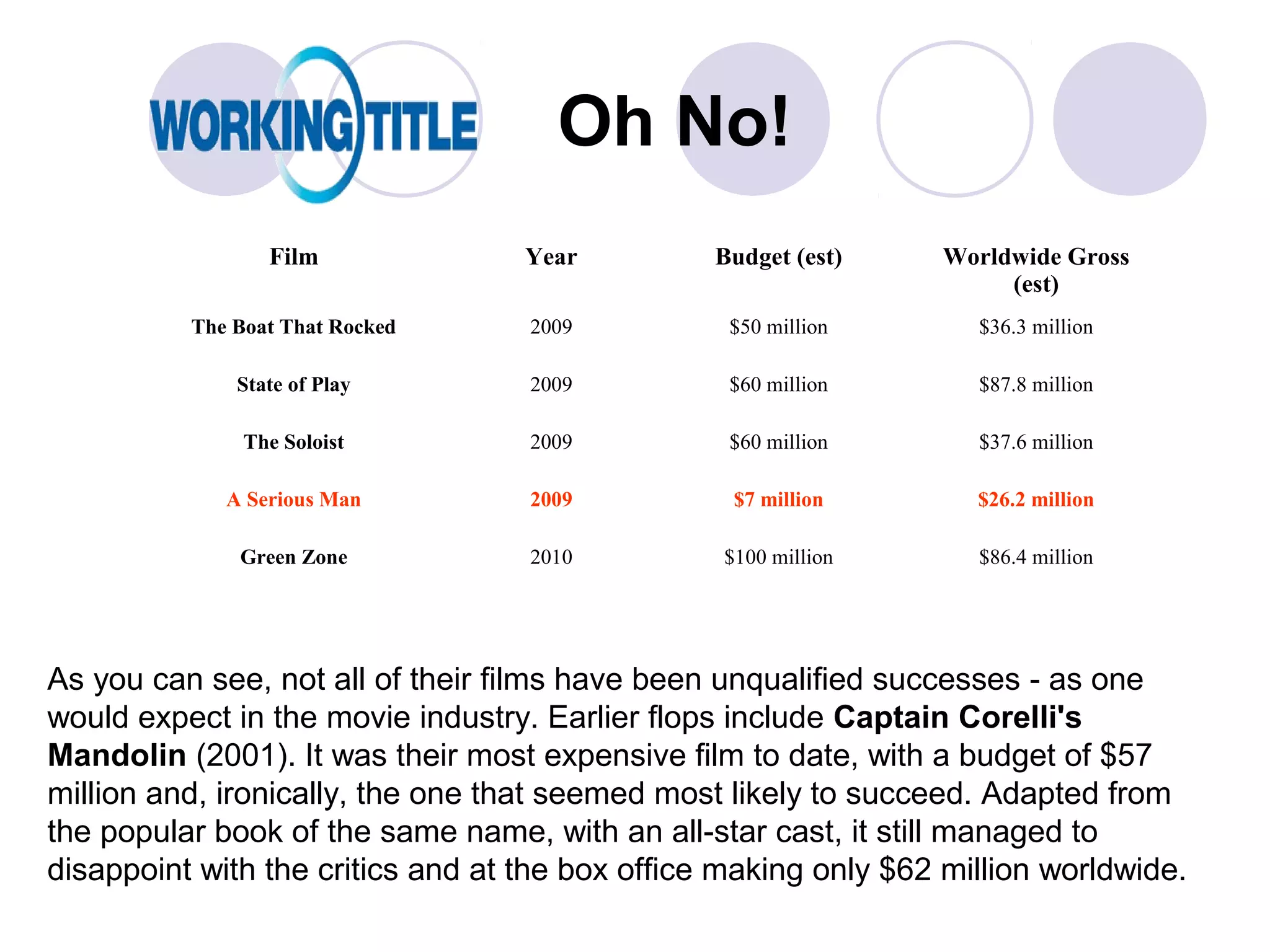
Oh No!
                 Film              Year          Budget (est)     Worldwide Gross
                                                                       (est)
          The Boat That Rocked     2009           $50 million       $36.3 million

              State of Play        2009           $60 million       $87.8 million

               The Soloist         2009           $60 million       $37.6 million

             A Serious Man         2009           $7 million        $26.2 million

              Green Zone           2010          $100 million       $86.4 million


As you can see, not all of their films have been unqualified successes - as one
would expect in the movie industry. Earlier flops include Captain Corelli's
Mandolin (2001). It was their most expensive film to date, with a budget of $57
million and, ironically, the one that seemed most likely to succeed. Adapted from
the popular book of the same name, with an all-star cast, it still managed to
disappoint with the critics and at the box office making only $62 million worldwide.
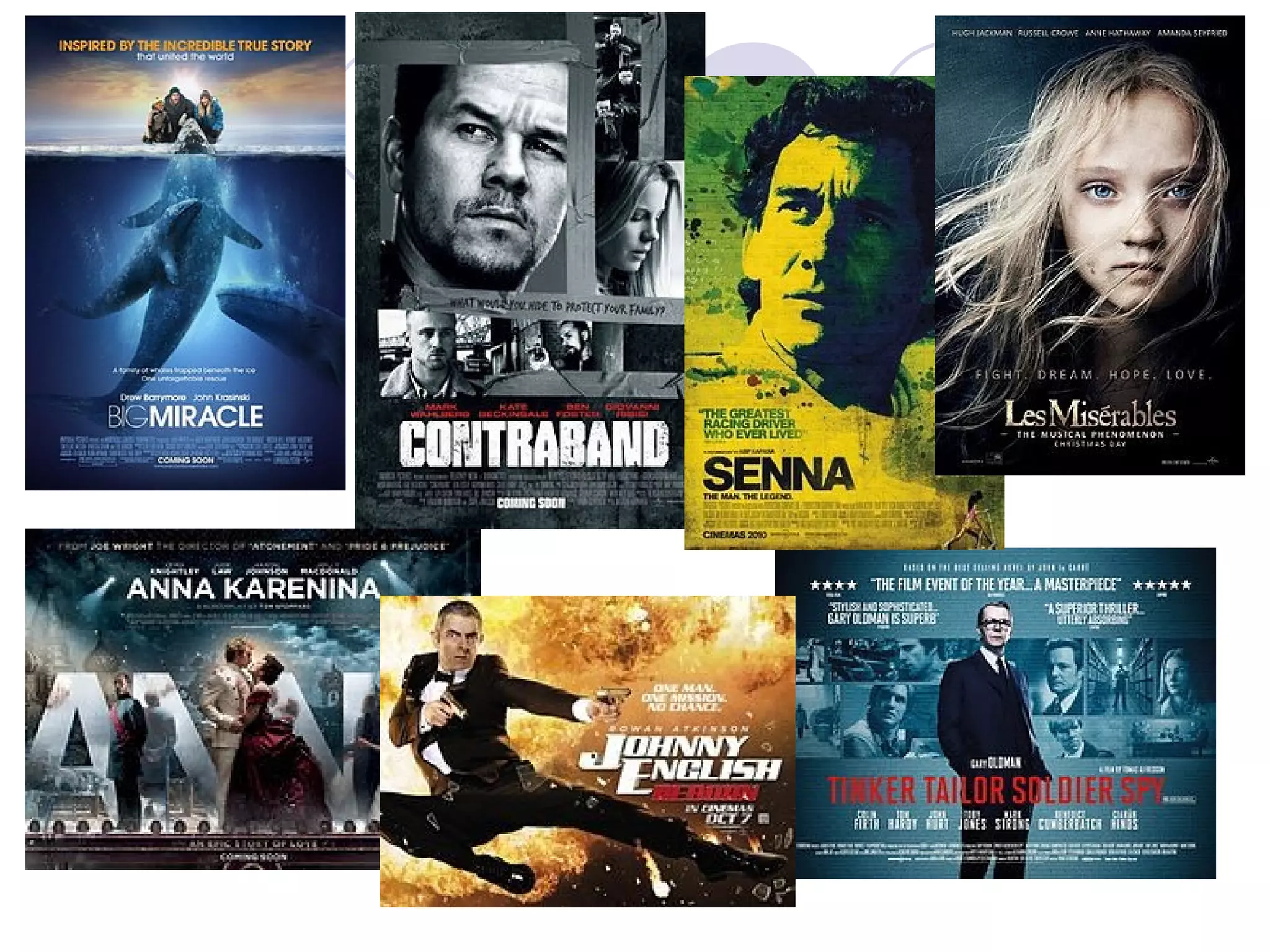
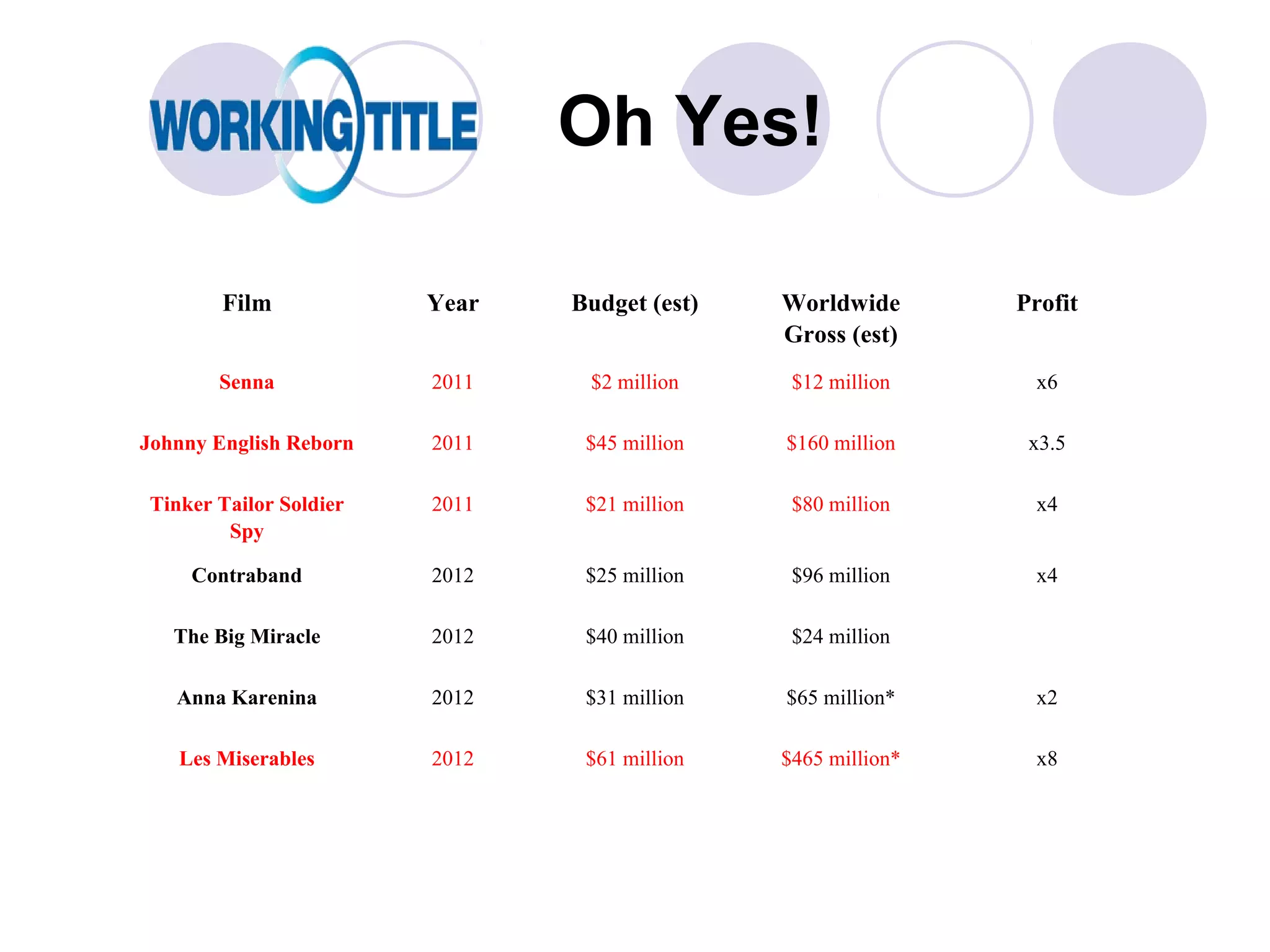
Oh Yes!

        Film            Year   Budget (est)   Worldwide       Profit
                                              Gross (est)
       Senna            2011    $2 million     $12 million     x6

Johnny English Reborn   2011    $45 million   $160 million     x3.5

Tinker Tailor Soldier   2011    $21 million    $80 million     x4
        Spy

     Contraband         2012    $25 million    $96 million     x4

   The Big Miracle      2012    $40 million    $24 million

   Anna Karenina        2012    $31 million   $65 million*     x2

   Les Miserables       2012    $61 million   $465 million*    x8
Does it always
                             work?

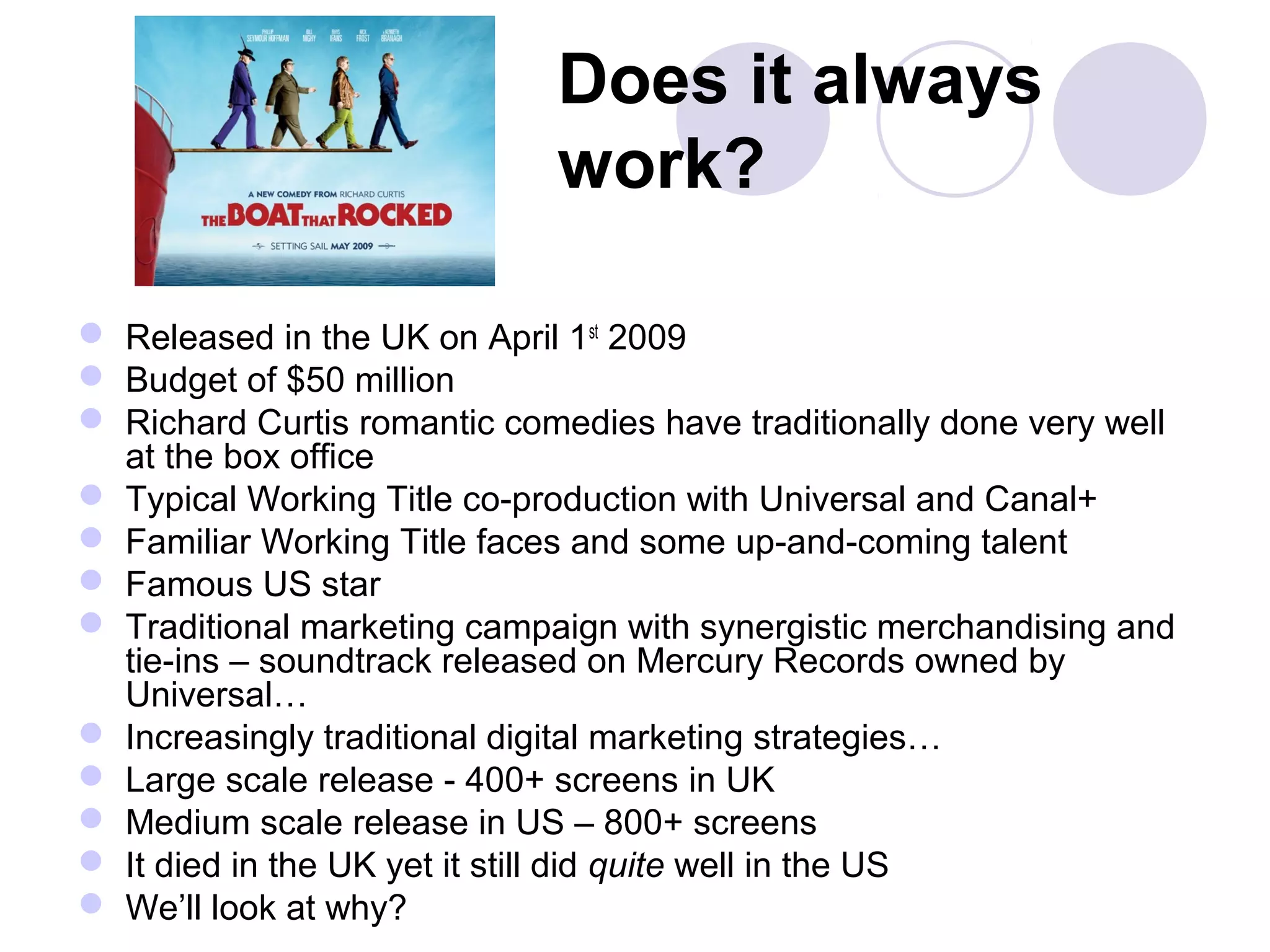
 Released in the UK on April 1st 2009
 Budget of $50 million
 Richard Curtis romantic comedies have traditionally done very well
  at the box office
 Typical Working Title co-production with Universal and Canal+
 Familiar Working Title faces and some up-and-coming talent
 Famous US star
 Traditional marketing campaign with synergistic merchandising and
  tie-ins – soundtrack released on Mercury Records owned by
  Universal…
 Increasingly traditional digital marketing strategies…
 Large scale release - 400+ screens in UK
 Medium scale release in US – 800+ screens
 It died in the UK yet it still did quite well in the US
 We’ll look at why?
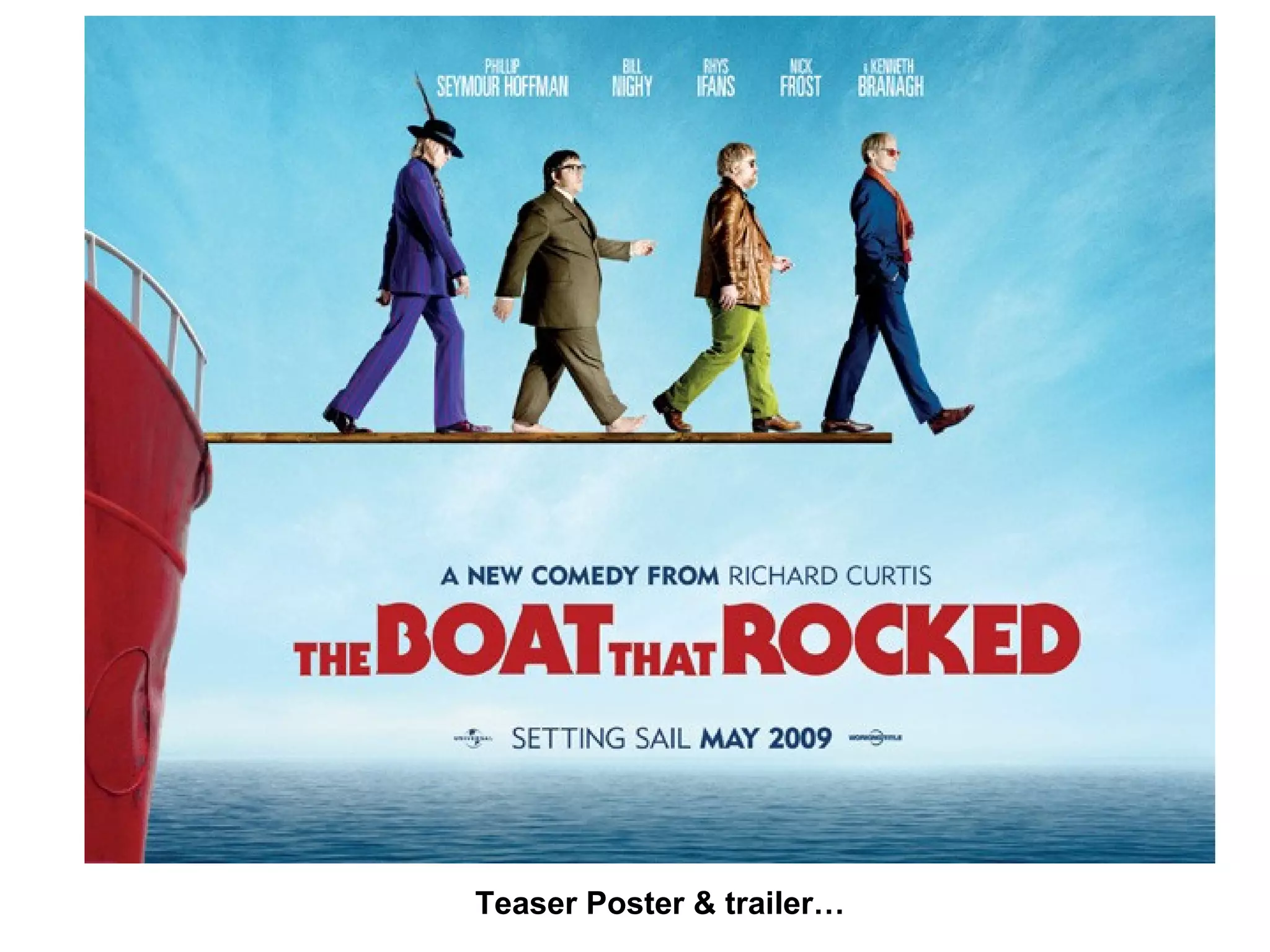
Teaser Poster & trailer…
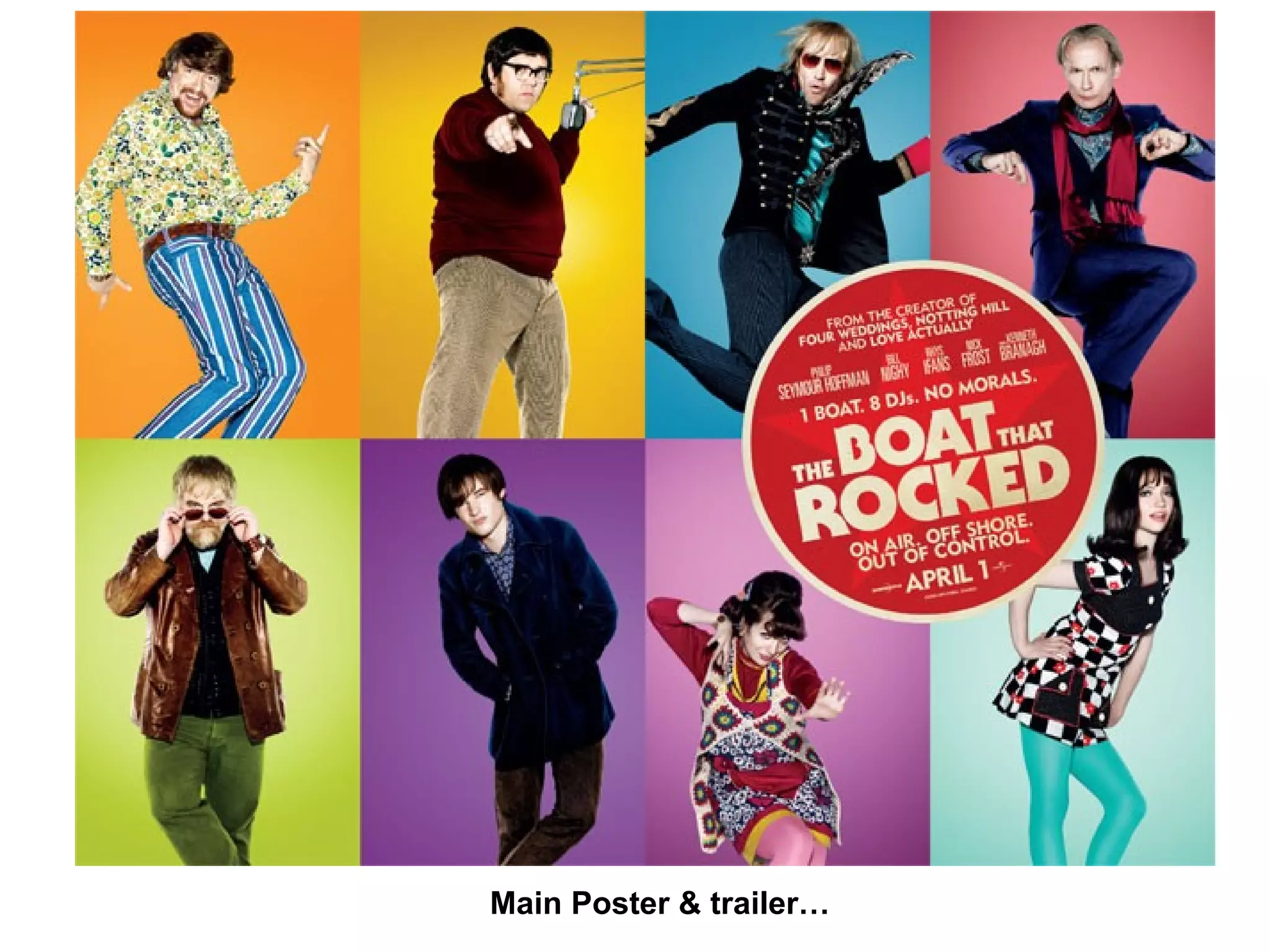
Main Poster & trailer…
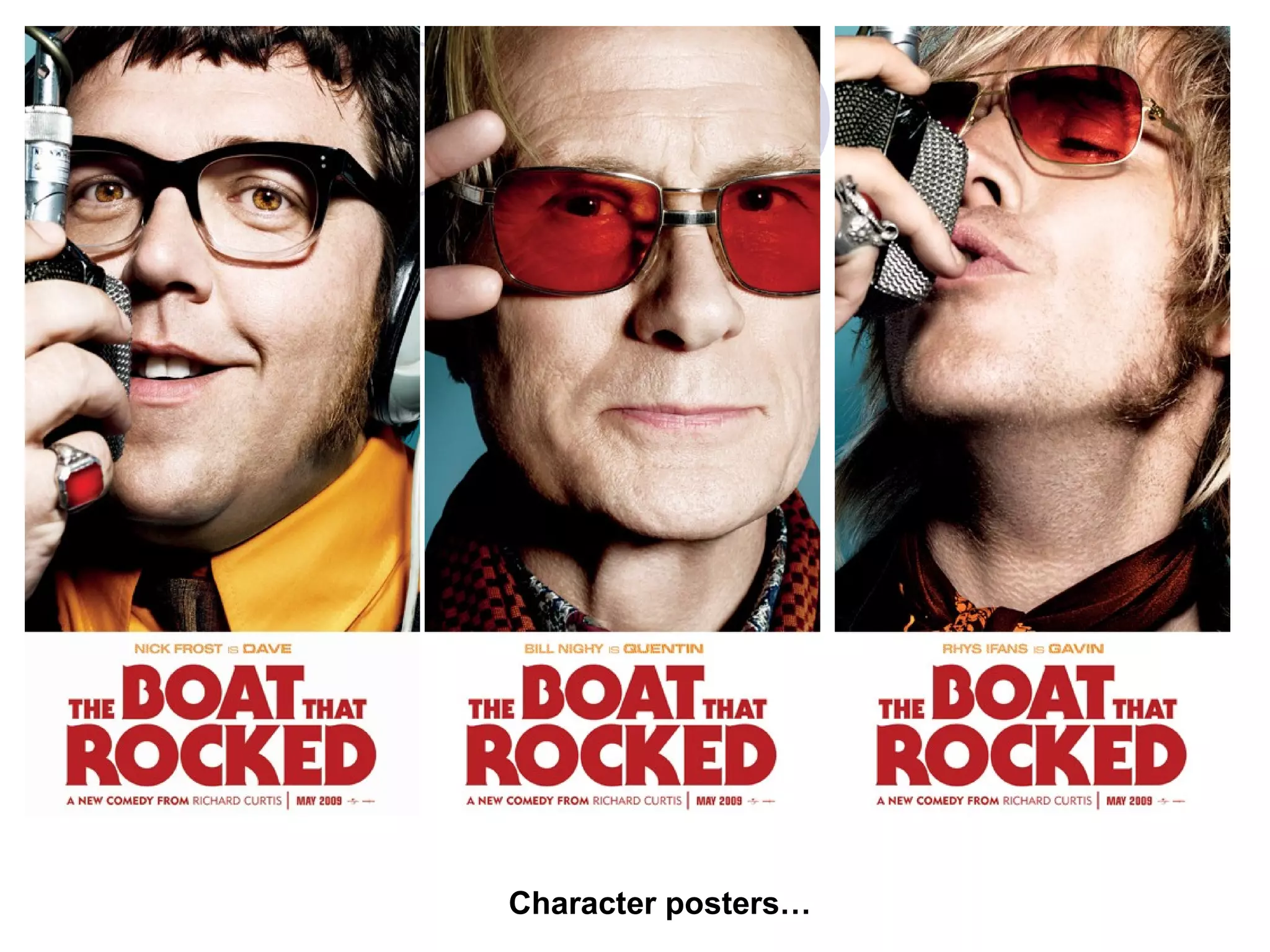
Character posters…
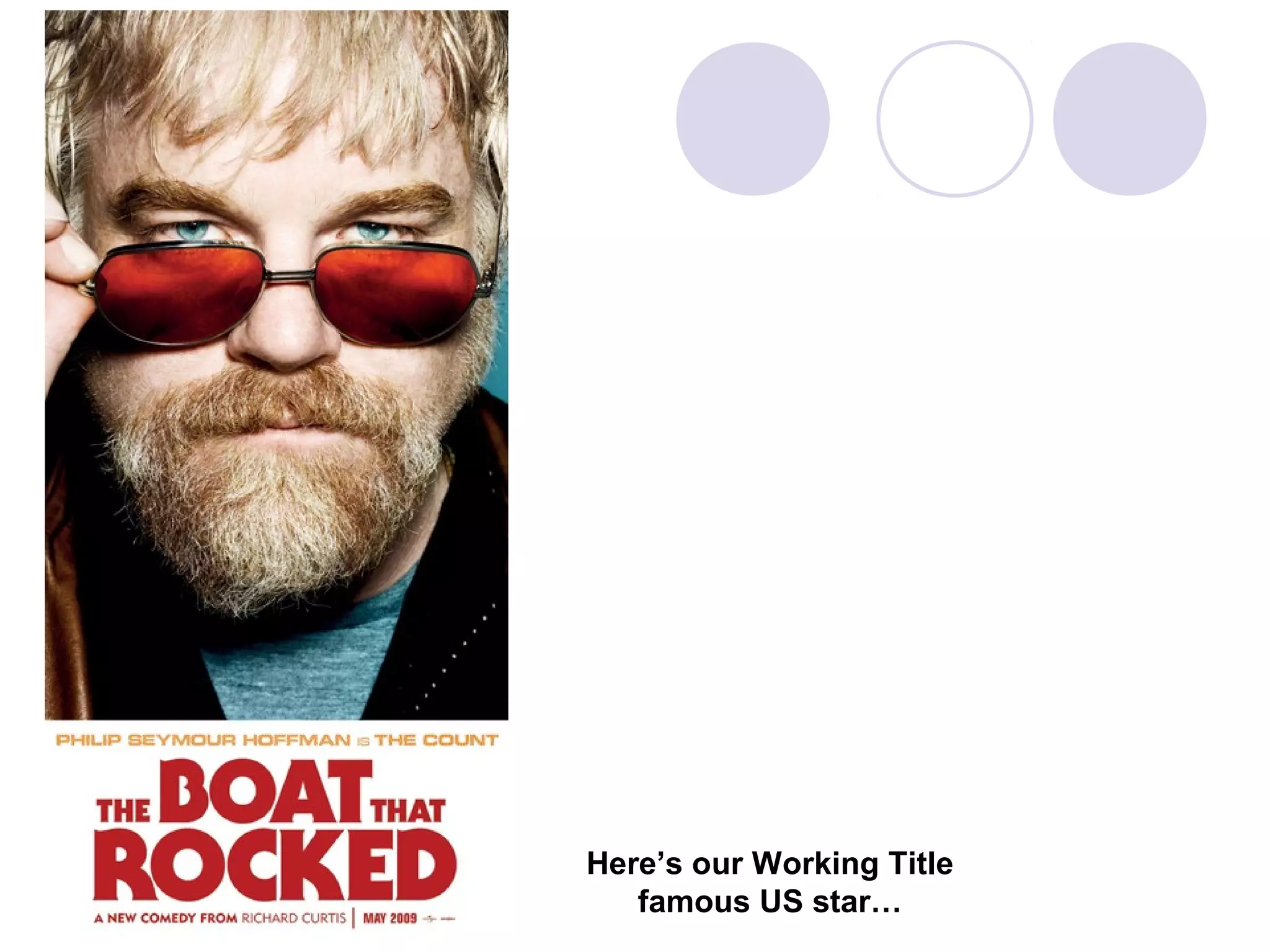
Here’s our Working Title
   famous US star…
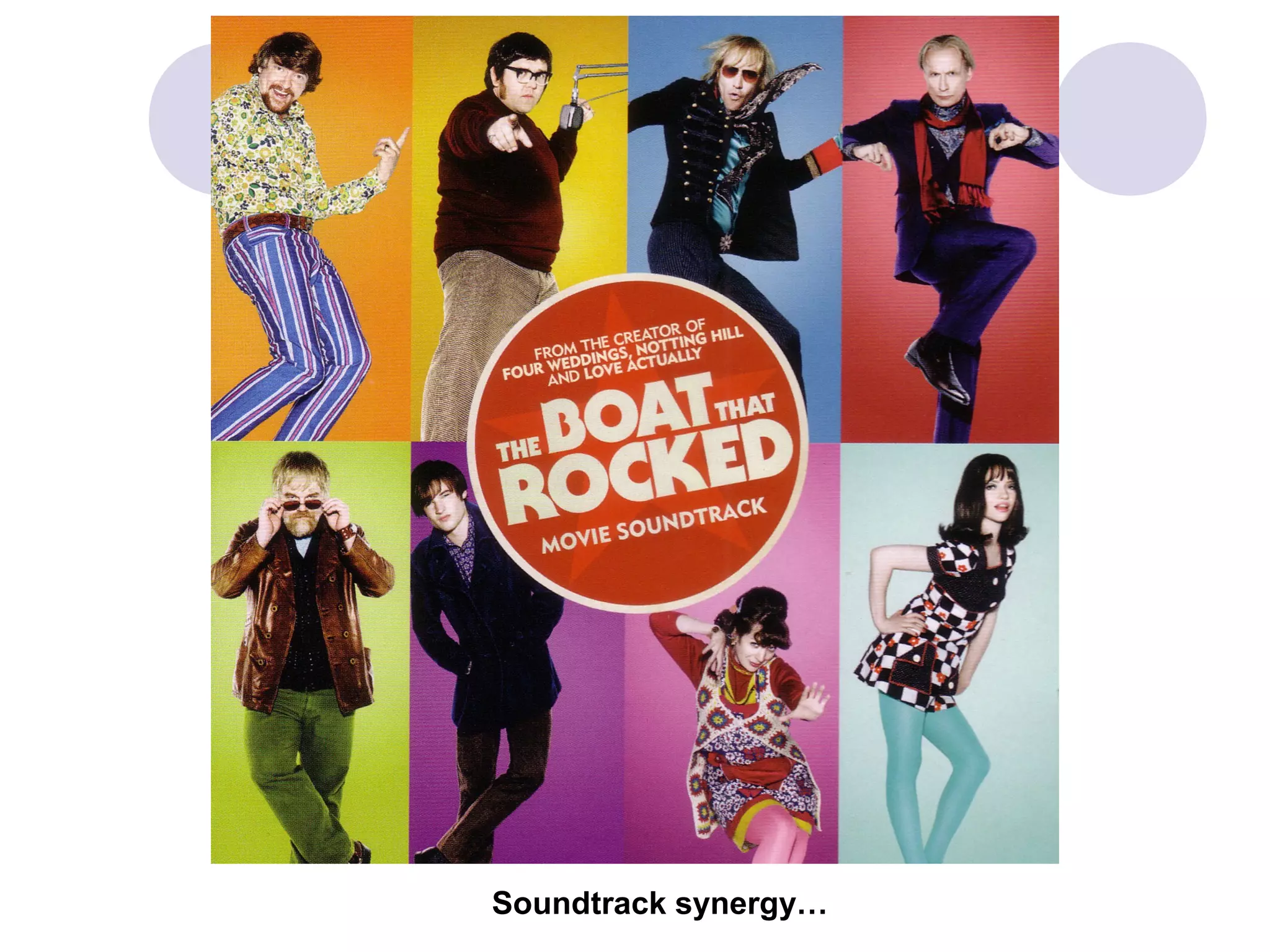
Soundtrack synergy…
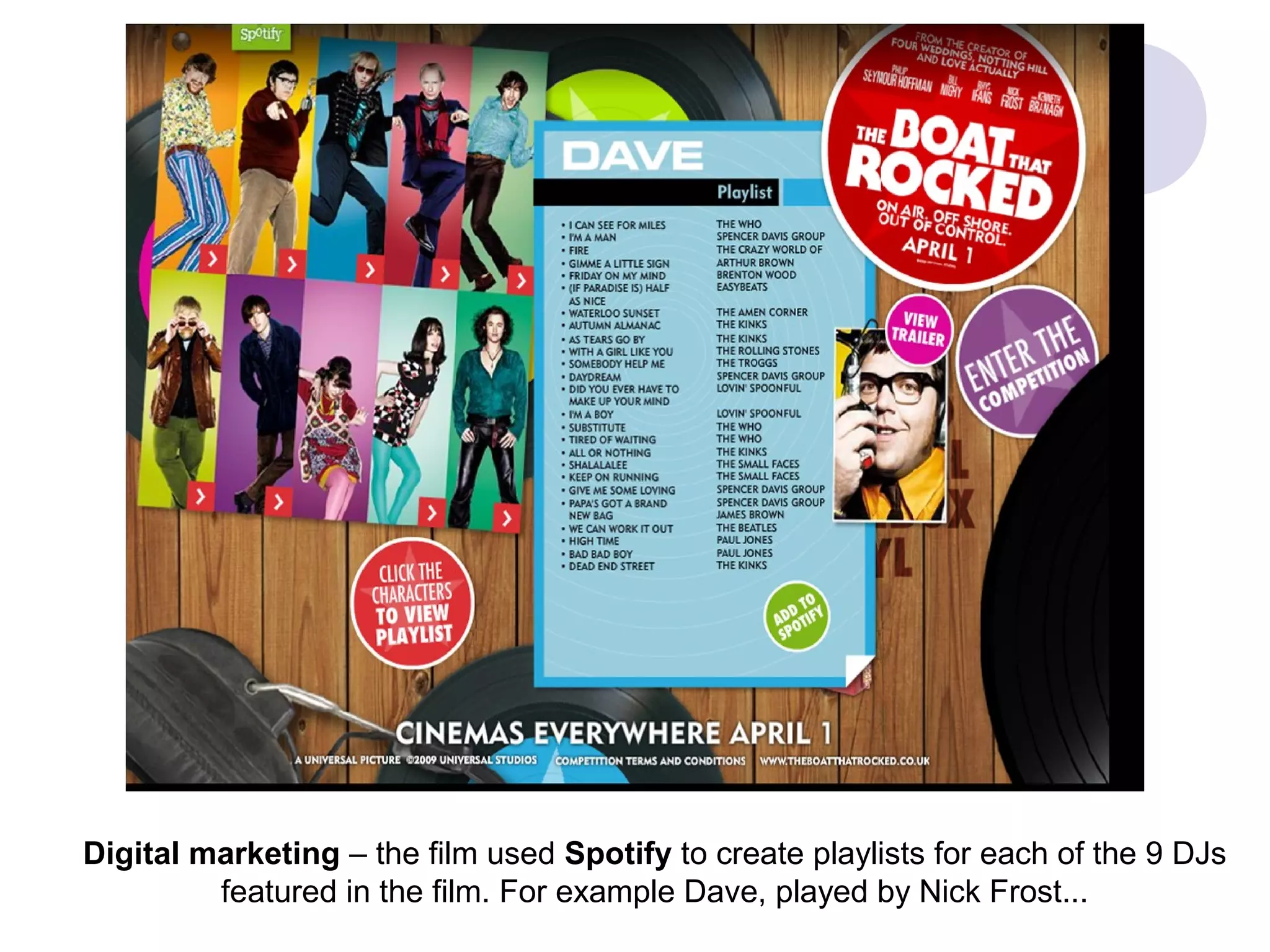
Digital marketing – the film used Spotify to create playlists for each of the 9 DJs
         featured in the film. For example Dave, played by Nick Frost...
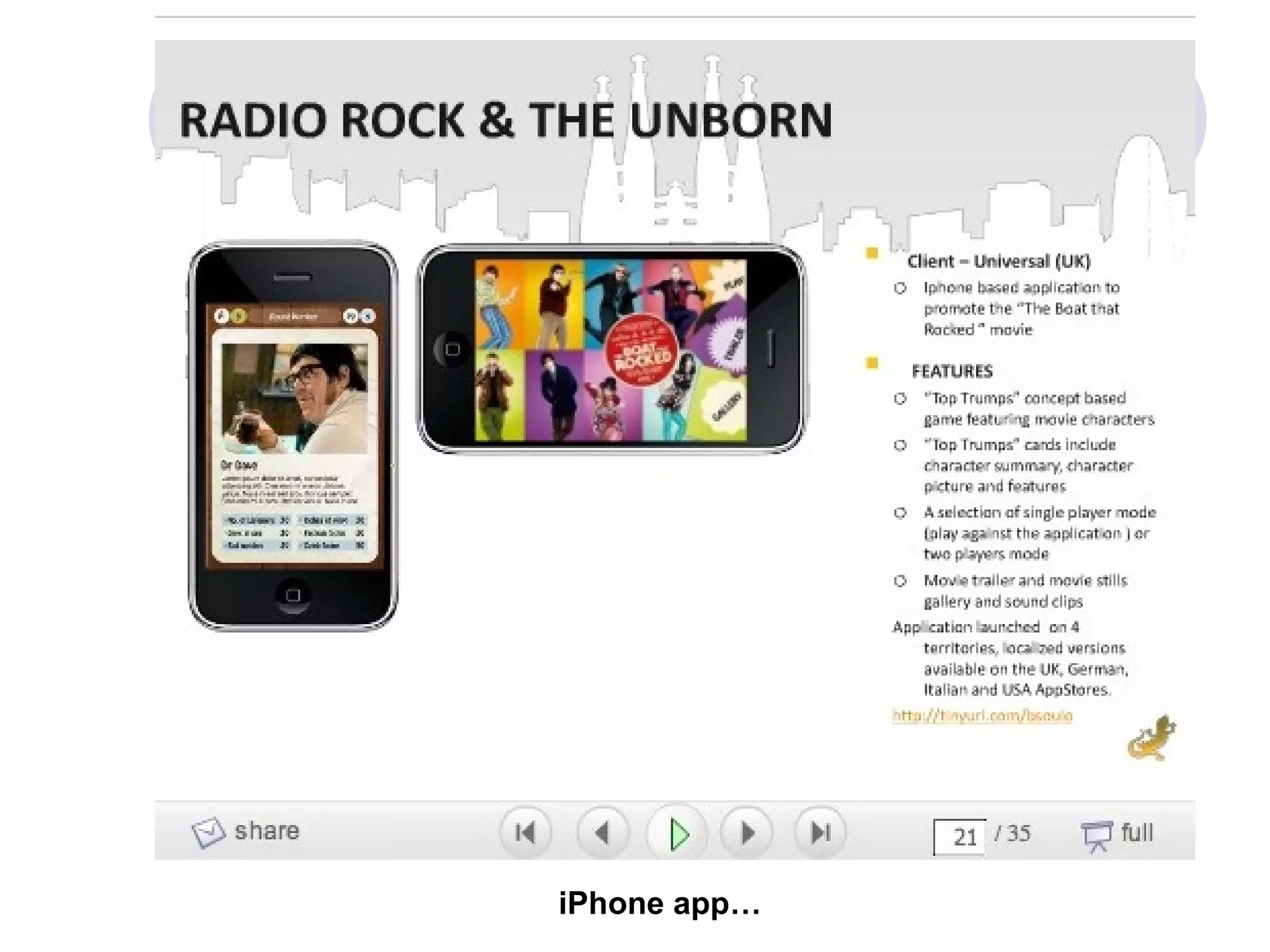
iPhone app…
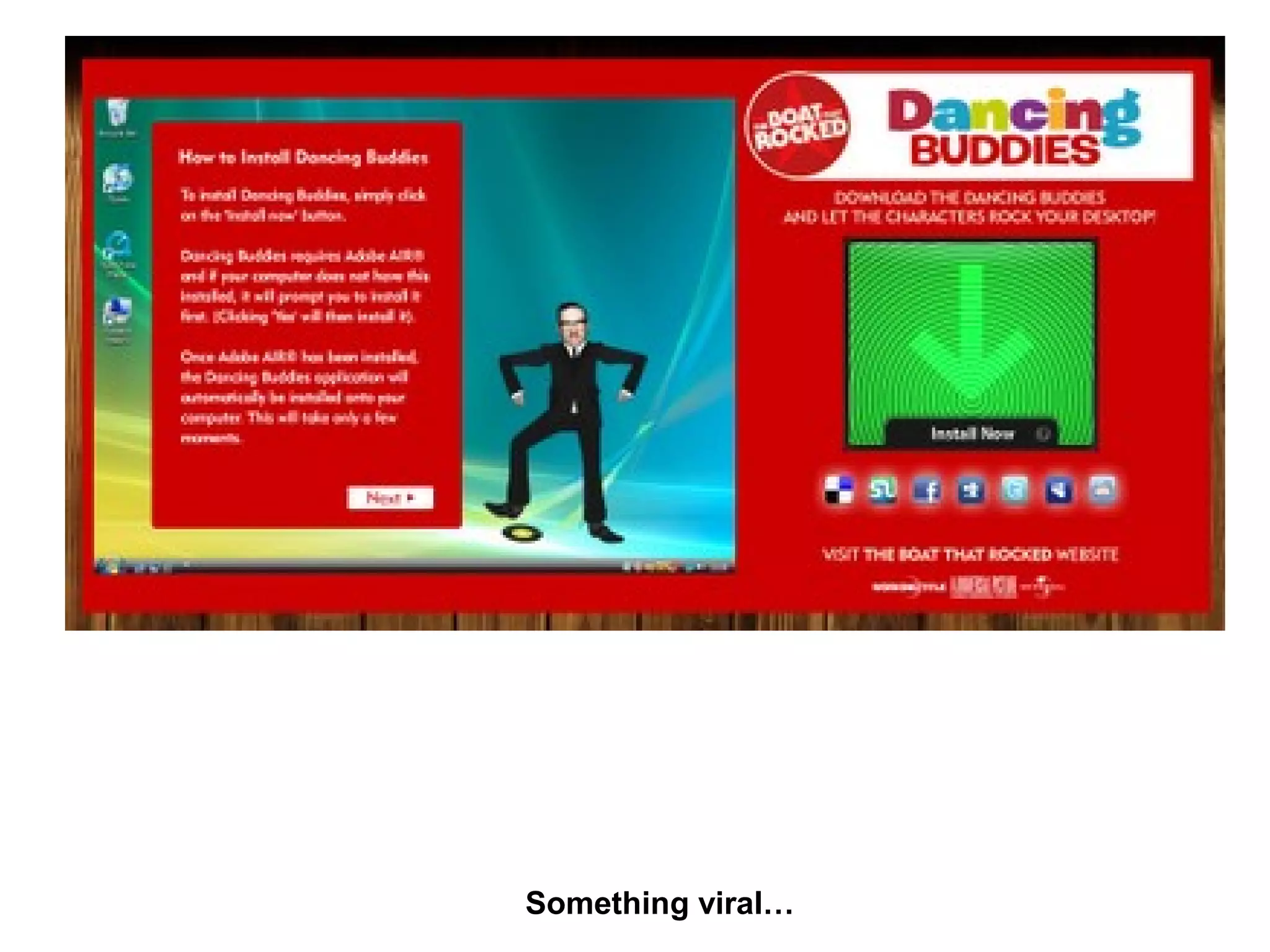
Something viral…
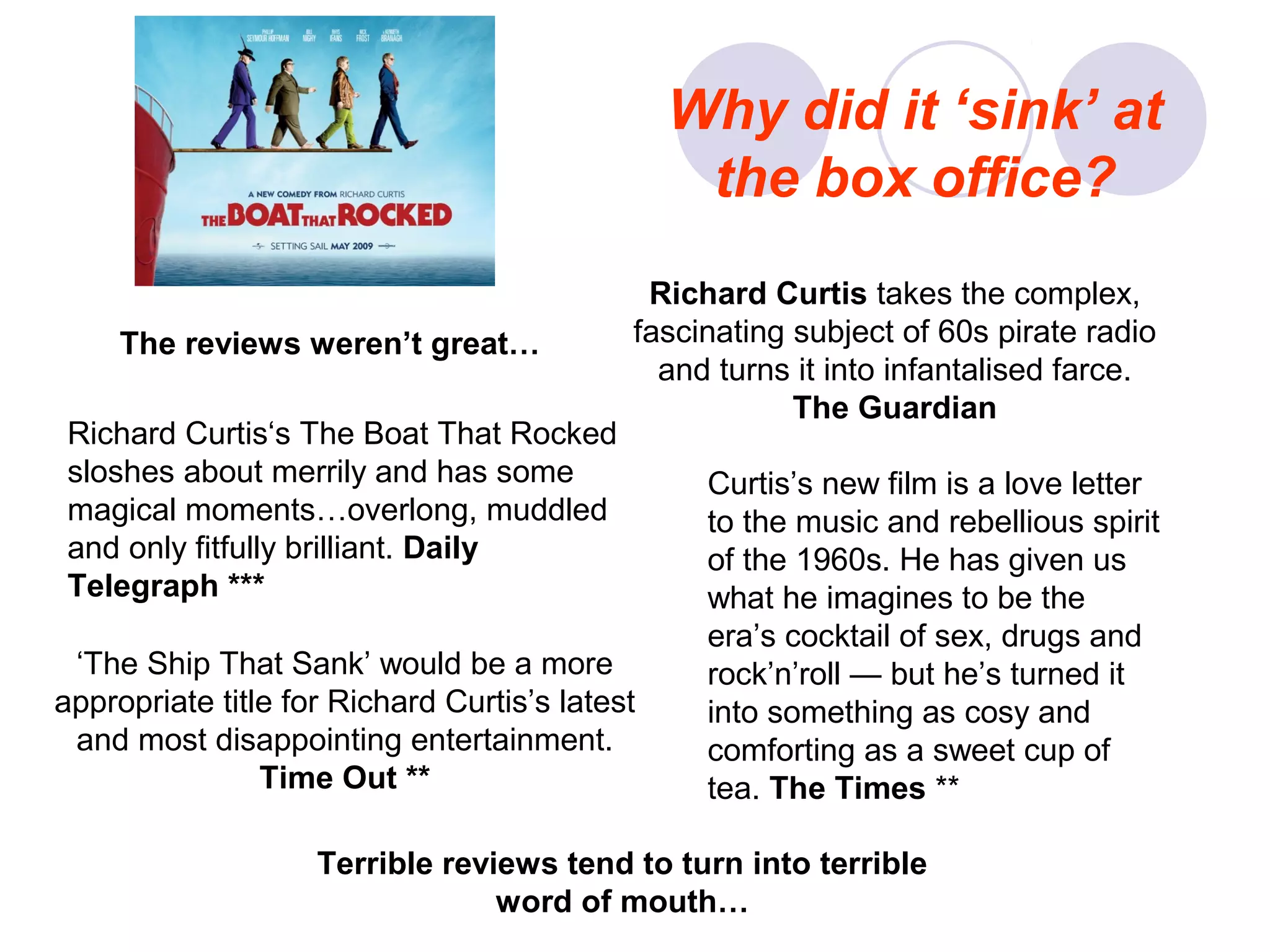
Why did it ‘sink’ at
                                                 the box office?
                                             Richard Curtis takes the complex,
     The reviews weren’t great…             fascinating subject of 60s pirate radio
                                              and turns it into infantalised farce.
                                                        The Guardian
 Richard Curtis‘s The Boat That Rocked
 sloshes about merrily and has some              Curtis’s new film is a love letter
 magical moments…overlong, muddled               to the music and rebellious spirit
 and only fitfully brilliant. Daily              of the 1960s. He has given us
 Telegraph ***                                   what he imagines to be the
                                                 era’s cocktail of sex, drugs and
 ‘The Ship That Sank’ would be a more            rock’n’roll — but he’s turned it
appropriate title for Richard Curtis’s latest    into something as cosy and
 and most disappointing entertainment.           comforting as a sweet cup of
                Time Out **                      tea. The Times **

                    Terrible reviews tend to turn into terrible
                                 word of mouth…
Why did it ‘sink’ at
                         the box office?

     Social recommendation is key - a
 personal recommendation from a friend,
   colleague or relative can be the most
 powerful trigger for a cinema visit. Pre-
 requisite for favourable 'word of mouth'
 are high levels of awareness and strong
    interest. Negative word of mouth is
  extremely difficult to overcome. Post-
release, hopefully, a combination of good
word of mouth and further advertising will
       combine to give the film 'legs'.
Why did it ‘sink’ at
                                          the box office?
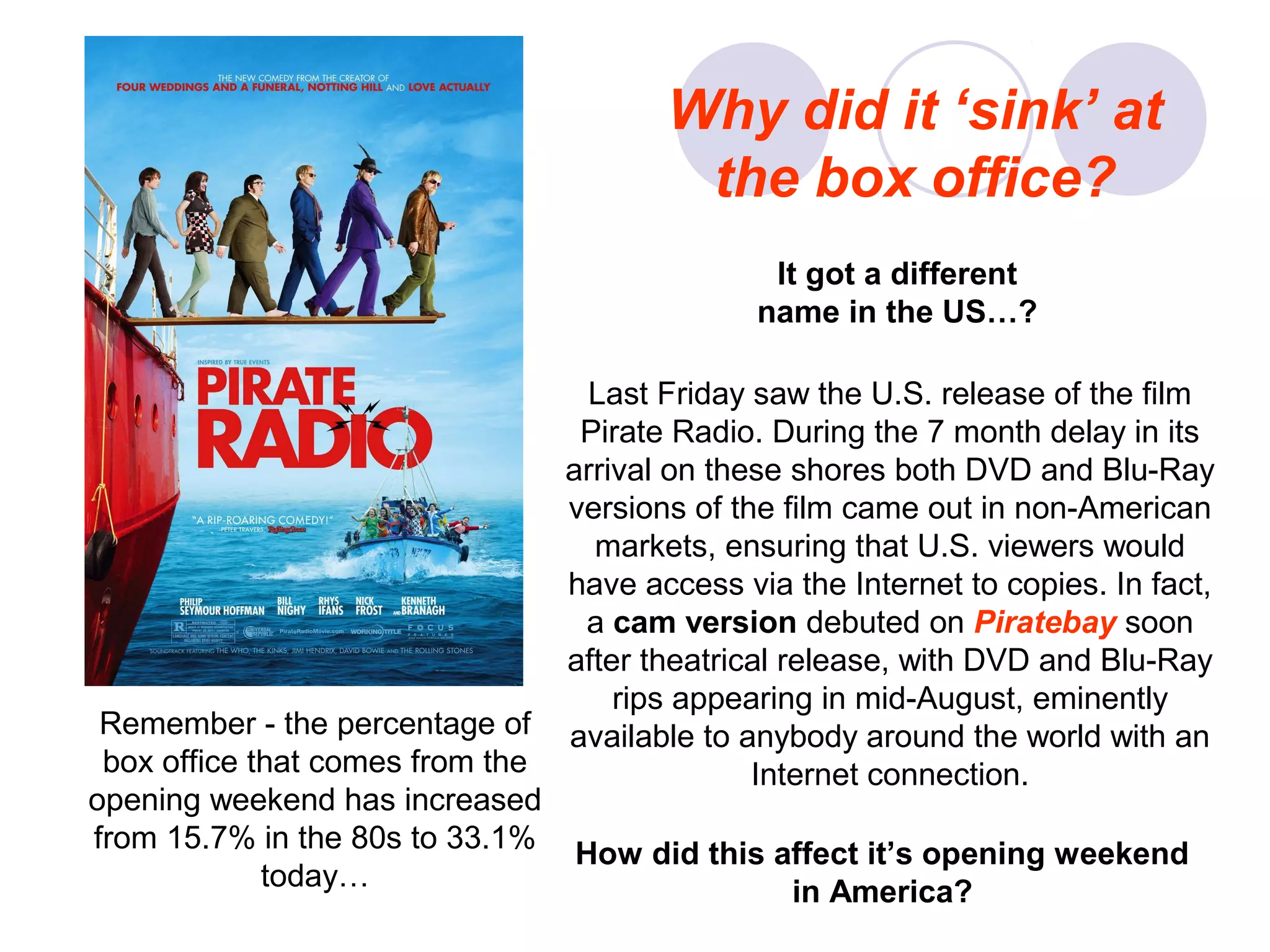
                                                 It got a different
                                                name in the US…?

                                   Last Friday saw the U.S. release of the film
                                   Pirate Radio. During the 7 month delay in its
                                  arrival on these shores both DVD and Blu-Ray
                                  versions of the film came out in non-American
                                    markets, ensuring that U.S. viewers would
                                  have access via the Internet to copies. In fact,
                                   a cam version debuted on Piratebay soon
                                  after theatrical release, with DVD and Blu-Ray
                                      rips appearing in mid-August, eminently
 Remember - the percentage of     available to anybody around the world with an
 box office that comes from the                 Internet connection.
opening weekend has increased
from 15.7% in the 80s to 33.1%    How did this affect it’s opening weekend
             today…                             in America?
Why didn’t it ‘sink’
                                               at the US box
                                                   office?
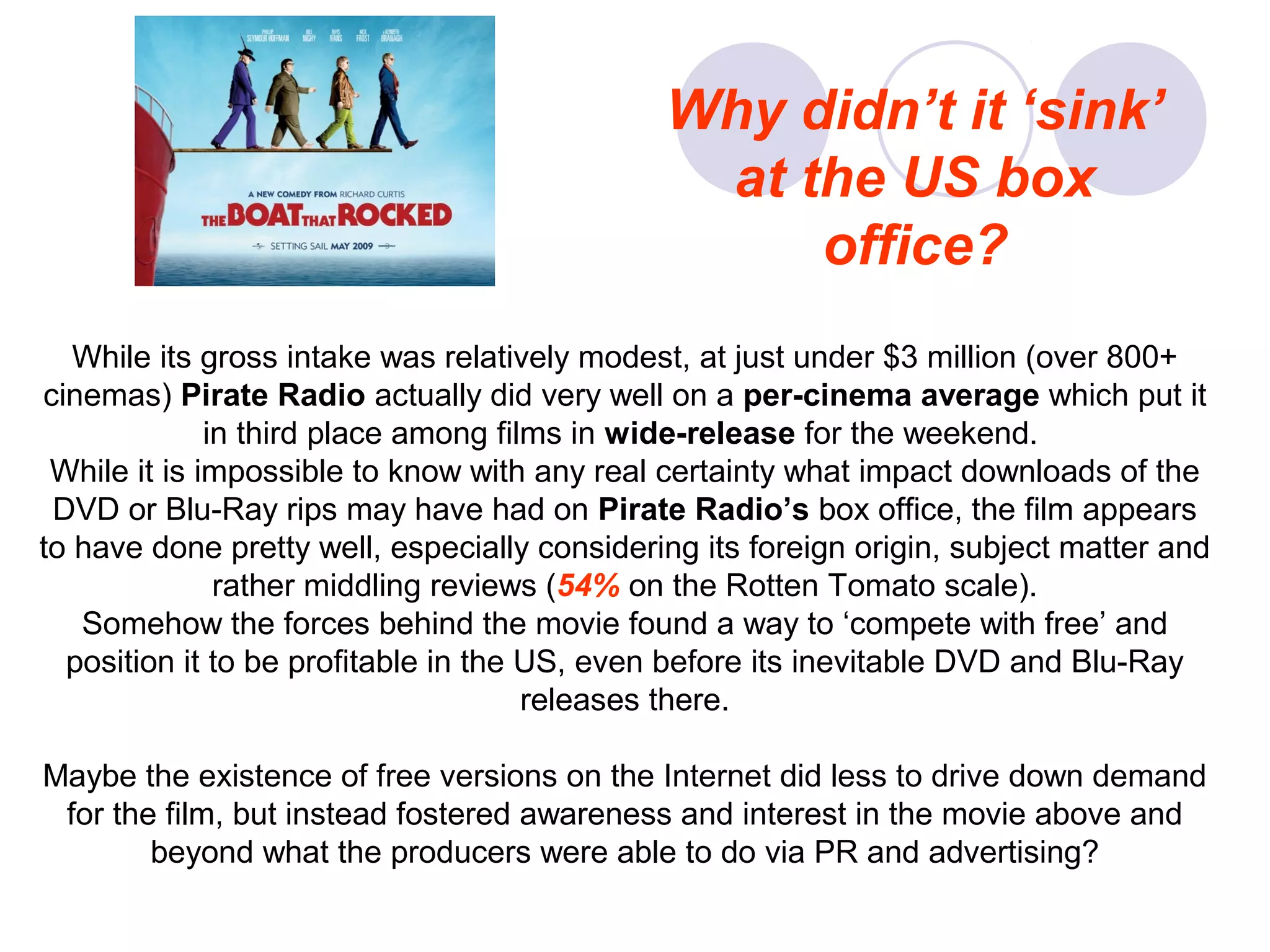
   While its gross intake was relatively modest, at just under $3 million (over 800+
cinemas) Pirate Radio actually did very well on a per-cinema average which put it
              in third place among films in wide-release for the weekend.
 While it is impossible to know with any real certainty what impact downloads of the
 DVD or Blu-Ray rips may have had on Pirate Radio’s box office, the film appears
to have done pretty well, especially considering its foreign origin, subject matter and
               rather middling reviews (54% on the Rotten Tomato scale).
   Somehow the forces behind the movie found a way to ‘compete with free’ and
  position it to be profitable in the US, even before its inevitable DVD and Blu-Ray
                                      releases there.

Maybe the existence of free versions on the Internet did less to drive down demand
 for the film, but instead fostered awareness and interest in the movie above and
        beyond what the producers were able to do via PR and advertising?
Despite being a very successful business model over the past 25 years Working
 Title have had a series of flops that would have ‘sunk’ a UK film company that
                   lacked the backing of a Hollywood studio.
    Despite making films with tried and trusted talent in recent years (Richard
              Curtis, Matt Damon) box office has not been great.
               How have Working Title been successful again?


                     http://www.launchingfilms.tv/index.php

           http://filminfocus.com/focusfeatures/film/pirate_radio/
                     http://www.workingtitlefilms.com/
            http://www.workingtitlefilms.com/film.php?filmID=120

         http://www.filmeducation.org/theboatthatrocked/activity3.html

    http://benjaminwigmore.blogspot.com/2009/04/boat-that-rocked.html

G322 case study working title Case Stu

  • 1.
  • 2.
    G322 Key MediaConcepts (TV Drama) Section B: Institutions and Audiences UK films aimed at an international audience Largely traditional UK film genres History of Working Title mirrors the history of the UK film industry Increasingly typical UK film funding – co- productions with British TV companies and Hollywood studios
  • 3.
    "Brit flick's twintowers of power" Eric Fellner and Tim Bevan have achieved the near impossible They’ve created a wildly successful production company in a country where the film business is subject to repeated predictions of imminent doom. Eric Fellner Tim Bevan
  • 4.
     Working TitleFilms began life co-producing the short film The Man Who Shot Christmas (1984).  This led to their first film for Channel Four and the first of many landmark Working Title Films - My Beautiful Laundrette (1985) Directed by Stephen Frears.  In 2009 still the most successful British film production company ever. “Their films have grossed more than £1.2 billion Since 1984, and that is a conservative estimate.”
  • 5.
    My Beautiful Laundrette(1984) A groundbreaking script by Hanif Kureishi co- produced with Channel 4, fitting their remit of offering challenging work that would not find a home elsewhere on television or in UK cinema. The story revolves around the relationship between a right-wing extremist, Johnny (Daniel Day Lewis) and Omar (Gordon Wemecke), the Pakistani nephew of an archetypal Pakistani entrepreneur Nasser (Saeed Jaffrey), who are brought together in revamping a run-down laundrette. Frears offers a critique of the Thatcherite work ethic and the entrepreneur society, showing a white underclass declining under the With interracial homosexuality to determination of new immigrant businesses. the fore it is not surprising that this film caused a considerable stir in a society that was suffering the consequences of political and Made for $400,000 it took economic revolution that had as over $2.5 in the US alone. its creed "there is no such thing as society”.
  • 6.
    The success oftheir first three films, which all dealt with British subjects, alerted the wider film industry to this independent production company, leading first to a international co-productions in 1988 including their first Anglo-American production For Queen and Country (starring a youthful Denzel Washington!). The success of this film on both sides of the Atlantic gave Working Title a template for co-production that they immediately began to exploit, and one that has been the aspiration for most other British independent production companies since.
  • 7.
    The Working TitleMovie Template British Film + American star = $$$$$ Appeal to international market (& success for the British Film Industry)  This approach has provoked much criticism about the ‘mid-Atlantic’ nature of the films.
  • 8.
    Why UK/US Co-productions? Accordingto Bevan: "Before co-productions we had been independent producers, but it was very hand to mouth. We would develop a script, that would take about 5% of our time; we'd find a director, that'd take about 5% of the time and then we'd spend 90% of the time trying to juggle together deals from different sources to finance those films. The films were suffering because there was no real structure and the company was always virtually bankrupt."
  • 9.
    The British film industry dilemma: Do you: A) Make culturally specific films which appeal to a national audience? OR B) Make broader, generic films with an international appeal? ? ?
  • 10.
    The British film industry dilemma: Working Title want to make European films for a worldwide audience. They want to imbue them with European ideas and influences and they can’t do these things without the backing of a major Hollywood studio. "I think anyone in Hollywood would want to do business with these guys," Former boss of Universal Studios Edgar Bronfman Jr.
  • 11.
    A HISTORY: 1984- Working Title founded 1985 - My Beautiful Laundrette is the first of a series of collaborations with Channel 4 Films Working Title produce a further 10 films in the 1980s 1988 - Production deal with PolyGram Filmed Entertainment 1992 - PolyGram (a European music and media company) buys Working Title. 1994 - Four Weddings and a Funeral A huge box office success due to the access to the US market provided by Polygram’s financial muscle Made for $6 million it took over $244 million worldwide. Working Title produces 41 films in the 1990s
  • 12.
    1998 - Polygrambought by Universal a Hollywood Studio itself owned by Seagram The financial stability offered by the support from a major studio allowed Working Title to move rapidly on to the international stage, and PolyGram being taken over by Seagram and subsumed into its film arm, Universal Pictures, in 1999, further strengthened this. A marked change of direction took place at this point, with the traditionally provincial independent territory being scorned in favour of international prospects. Working Title is now owned by 2000 - Seagram is bought by Vivendi, the Universal, French multimedia conglomerate which is in turn owned by Vivendi
  • 13.
    The international activitydid not prevent Working Title from continuing to support British filmmakers and from engaging in what would have been considered traditional 'independent' Anglo-European co-productions such as Ken Loach’s Land and Freedom (1995) and 'offbeat' Shaun of the Dead (2004) and Hot Fuzz (2007).
  • 14.
    So what isa Working Title film? This was once relatively easy to answer, as the films they first made all seemed to address issues of what it is to be British (or, more specifically, English), and particularly what it meant to be an outsider – like the immigrants in My Beautiful Laundrette – so the genre was social realism… …of course, the general public know them as the re-inventors of a British romantic comedy genre through Four Weddings and a Funeral, Notting Hill (1999) and Love Actually (2003)
  • 15.
    Four Weddings anda Funeral (1994) This was the first Working Title collaborations with Richard Curtis (who’d achieved fame with the Blackadder TV series) and Hugh Grant and it set the bar for British film production, particularly in its use of soundtrack that spawned a record-breaking number one single. A rom-com that explores the relationships between a group of upper-class friends as they meet to celebrate and mourn. Curtis was able to bring established contacts to an ensemble cast (such as Rowan Atkinson), enhancing the potential connection with the home audience The film was a massive hit in the USA, in part because of the view 'heritage Britain' - a land of churches, old pubs and stately homes populated by 'classy' English people with obligatory bumbling fools sprinkled across the social landscape. It also helped that one of the stars American (Andie MacDowell).
  • 16.
    Such an unexpectedsuccess gave Working Title international clout and reach, and placed it at the centre of the Hollywood. It also placed considerable pressure on the company to become the romantic-comedy-heritage-film company, a pressure it resisted, but did not reject, realizing that a popular film could help support a number of productions with less potential for such success yet still deserving of being made. A quick glance at the list of films in its catalogue reveals a list of over 100 films produced since 1984 - probably the only common thread among them is the desire to do something different to what is being produced at the time, and to do it well. It is the ability to make films for specific audience groups, and to not be pigeon-holed that has enabled the company to ensure that its work remains fresh and successful.
  • 17.
    So what isa Working Title film? It is easy to categorize them (dismissively) until you look through the catalogue and realize that this is a company categorized only by diversity and the ability to detect changes in the market that enable a reorientation of direction There is no other British Film Company like Working Title - it is allowed freedom to make creative decisions but it is owned by a US based conglomerate. How do Working Title choose which films to make? Fellner says “projects get championed by individuals in the development department and these 'percolate' their way up to the top. Tim Bevan and I then both take the decision on what to greenlight.”
  • 18.
    Working Title and Co-production Co-production has long been a method of sharing risk within the film industry, and when Working Title began its life, co-production was merely another revenue stream that often involved pre-sale or pre-distribution deals on world or national rights. Since one of Working Title’s principal partners was Channel Four, and Channel Four pioneered international co-production in the UK, it is no surprise that Working Title adopted and extended the model. Initially, Working Title explored these deals domestically, but as its success grew it found that the international market opened up to it. Working Title took co-production further when formalizing their relationship with PolyGram (later Universal) where US investment of 30% did not prevent them from obtaining EU/UK tax advantages. A 30% stake in the budget + Hollywood support clearly stimulates other investors willingness to get involved in a film. It is this advance in the model that radically enhanced the production processes and values in Working Title films.
  • 19.
    How does itwork? “The Working Title philosophy has always been to make films for an audience - by that I mean play in a multiplex. We totally believe in this because we know it is the only hope we have of sustaining the UK film industry.” Despite its famous name, the structure at Working Title is small. It employs just 42 full time staff, split between the main Working Title production arm and its recently closed low-budget offshoot WT2 under Natasha Wharton. “When I was at Working Title we set up a New Writers Scheme to develop new talent. The problem was that at Working Title, smaller films would inevitably get less attention than the bigger budget projects so we decided to set up WT2 to give proper attention to those smaller films.” 2007 - Why did WT2 close down?
  • 20.
    Does it always work? Film Year Budget (est) Worldwide Gross (est) Billy Eliot 2000 $5 million $109.3 million Long Time Dead 2002 $2 million $2 million Ali G Indahouse 2002 $5 million $12 million My Little Eye 2002 $2-3 million $3 million Shaun of the Dead 2004 $4 million $30 million The Calcium Kid 2004 $5 million £61,415 MickyBo and Me 2004 $3 million £172,336 Inside I’m Dancing 2004 $5 million $500,000 Sixty Six 2006 $3 million $1.9 million
  • 21.
    How does itwork? The most important part of the business is developing scripts. Working Title has a strong development team and invests heavily in making sure that they get it right. They usually have around 40 - 50 projects in development at any time and their average spend on development is around $250,000 to $500,000 per script. They aim to make around 5 to 10 films a year, spread across different budget sizes (with an average of $30 to $40 million) and genres. Released in 2009/10 are 10 films including the Richard Curtis comedy The Boat That Rocked, political thriller State of Play based on the successful BBC television drama but re-imagined in Washington and Green Zone, an Iraq war thriller that reunites the Bourne series star Matt Damon and director Paul Greengrass. Bound to be a success, right?
  • 22.
    Oh No! Film Year Budget (est) Worldwide Gross (est) The Boat That Rocked 2009 $50 million $36.3 million State of Play 2009 $60 million $87.8 million The Soloist 2009 $60 million $37.6 million A Serious Man 2009 $7 million $26.2 million Green Zone 2010 $100 million $86.4 million As you can see, not all of their films have been unqualified successes - as one would expect in the movie industry. Earlier flops include Captain Corelli's Mandolin (2001). It was their most expensive film to date, with a budget of $57 million and, ironically, the one that seemed most likely to succeed. Adapted from the popular book of the same name, with an all-star cast, it still managed to disappoint with the critics and at the box office making only $62 million worldwide.
  • 24.
    Oh Yes! Film Year Budget (est) Worldwide Profit Gross (est) Senna 2011 $2 million $12 million x6 Johnny English Reborn 2011 $45 million $160 million x3.5 Tinker Tailor Soldier 2011 $21 million $80 million x4 Spy Contraband 2012 $25 million $96 million x4 The Big Miracle 2012 $40 million $24 million Anna Karenina 2012 $31 million $65 million* x2 Les Miserables 2012 $61 million $465 million* x8
  • 25.
    Does it always work?  Released in the UK on April 1st 2009  Budget of $50 million  Richard Curtis romantic comedies have traditionally done very well at the box office  Typical Working Title co-production with Universal and Canal+  Familiar Working Title faces and some up-and-coming talent  Famous US star  Traditional marketing campaign with synergistic merchandising and tie-ins – soundtrack released on Mercury Records owned by Universal…  Increasingly traditional digital marketing strategies…  Large scale release - 400+ screens in UK  Medium scale release in US – 800+ screens  It died in the UK yet it still did quite well in the US  We’ll look at why?
  • 26.
    Teaser Poster &trailer…
  • 27.
    Main Poster &trailer…
  • 28.
  • 29.
    Here’s our WorkingTitle famous US star…
  • 30.
  • 31.
    Digital marketing –the film used Spotify to create playlists for each of the 9 DJs featured in the film. For example Dave, played by Nick Frost...
  • 32.
  • 33.
  • 34.
    Why did it‘sink’ at the box office? Richard Curtis takes the complex, The reviews weren’t great… fascinating subject of 60s pirate radio and turns it into infantalised farce. The Guardian Richard Curtis‘s The Boat That Rocked sloshes about merrily and has some Curtis’s new film is a love letter magical moments…overlong, muddled to the music and rebellious spirit and only fitfully brilliant. Daily of the 1960s. He has given us Telegraph *** what he imagines to be the era’s cocktail of sex, drugs and ‘The Ship That Sank’ would be a more rock’n’roll — but he’s turned it appropriate title for Richard Curtis’s latest into something as cosy and and most disappointing entertainment. comforting as a sweet cup of Time Out ** tea. The Times ** Terrible reviews tend to turn into terrible word of mouth…
  • 35.
    Why did it‘sink’ at the box office? Social recommendation is key - a personal recommendation from a friend, colleague or relative can be the most powerful trigger for a cinema visit. Pre- requisite for favourable 'word of mouth' are high levels of awareness and strong interest. Negative word of mouth is extremely difficult to overcome. Post- release, hopefully, a combination of good word of mouth and further advertising will combine to give the film 'legs'.
  • 36.
    Why did it‘sink’ at the box office? It got a different name in the US…? Last Friday saw the U.S. release of the film Pirate Radio. During the 7 month delay in its arrival on these shores both DVD and Blu-Ray versions of the film came out in non-American markets, ensuring that U.S. viewers would have access via the Internet to copies. In fact, a cam version debuted on Piratebay soon after theatrical release, with DVD and Blu-Ray rips appearing in mid-August, eminently Remember - the percentage of available to anybody around the world with an box office that comes from the Internet connection. opening weekend has increased from 15.7% in the 80s to 33.1% How did this affect it’s opening weekend today… in America?
  • 37.
    Why didn’t it‘sink’ at the US box office? While its gross intake was relatively modest, at just under $3 million (over 800+ cinemas) Pirate Radio actually did very well on a per-cinema average which put it in third place among films in wide-release for the weekend. While it is impossible to know with any real certainty what impact downloads of the DVD or Blu-Ray rips may have had on Pirate Radio’s box office, the film appears to have done pretty well, especially considering its foreign origin, subject matter and rather middling reviews (54% on the Rotten Tomato scale). Somehow the forces behind the movie found a way to ‘compete with free’ and position it to be profitable in the US, even before its inevitable DVD and Blu-Ray releases there. Maybe the existence of free versions on the Internet did less to drive down demand for the film, but instead fostered awareness and interest in the movie above and beyond what the producers were able to do via PR and advertising?
  • 38.
    Despite being avery successful business model over the past 25 years Working Title have had a series of flops that would have ‘sunk’ a UK film company that lacked the backing of a Hollywood studio. Despite making films with tried and trusted talent in recent years (Richard Curtis, Matt Damon) box office has not been great. How have Working Title been successful again? http://www.launchingfilms.tv/index.php http://filminfocus.com/focusfeatures/film/pirate_radio/ http://www.workingtitlefilms.com/ http://www.workingtitlefilms.com/film.php?filmID=120 http://www.filmeducation.org/theboatthatrocked/activity3.html http://benjaminwigmore.blogspot.com/2009/04/boat-that-rocked.html