
Web 2.0 in 30 Minutes or Less
•Download as PPT, PDF•
0 likes•286 views

This document provides an overview of key concepts and tools related to Web 2.0 in 30 minutes or less. It defines Web 2.0 as focusing on user collaboration, contribution and community through tools like blogs, wikis, RSS feeds, social bookmarking and networking sites. Some key concepts discussed include individual production and user-generated content, harnessing the power of the crowd through collective intelligence, the architecture of participation through open platforms, and network effects like power laws and the long tail. The document concludes by considering the implications of these changes and encouraging participants to explore and engage with Web 2.0.

Recommended
Recommended
More Related Content
What's hot
What's hot (20)
Viewers also liked
Similar to Web 2.0 in 30 Minutes or Less
Similar to Web 2.0 in 30 Minutes or Less (20)
Recently uploaded
Recently uploaded (20)
Web 2.0 in 30 Minutes or Less
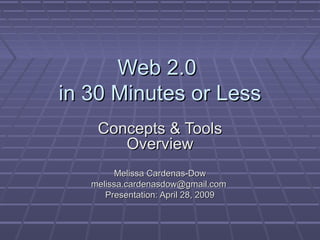
- 1. Web 2.0Web 2.0 in 30 Minutes or Lessin 30 Minutes or Less Concepts & ToolsConcepts & Tools OverviewOverview Melissa Cardenas-DowMelissa Cardenas-Dow melissa.cardenasdow@gmail.commelissa.cardenasdow@gmail.com Presentation: April 28, 2009Presentation: April 28, 2009
- 2. AgendaAgenda Parameters: What we’re going to do, what weParameters: What we’re going to do, what we can’t and what we won’tcan’t and what we won’t What is Web 2.0?What is Web 2.0? Web 2.0Web 2.0 Key conceptsKey concepts Tools: blogs, RSS, feeds and readers, wikisTools: blogs, RSS, feeds and readers, wikis Conclusion: So what? Why do these matter?Conclusion: So what? Why do these matter?
- 3. ParametersParameters Just a tour: Conceptual overviewJust a tour: Conceptual overview A lot of ground, very limited timeA lot of ground, very limited time Broad strokes leave off detailsBroad strokes leave off details My particular perspectiveMy particular perspective Points of detailPoints of detail points of contentionpoints of contention Purpose: introPurpose: intro description, backgrounddescription, background No opportunities to explore and applyNo opportunities to explore and apply
- 4. What is Web 2.0?What is Web 2.0? Michael Wesch,Michael Wesch, Asst. Prof. of CulturalAsst. Prof. of Cultural Anthropology, KansasAnthropology, Kansas State UniversityState University YouTubeYouTube video, “Thevideo, “The Machine is Us/ing Us”Machine is Us/ing Us” Uploaded: March 8,Uploaded: March 8, 20072007
- 5. Let’s break it down…Let’s break it down… What is Web 2.0?What is Web 2.0? depends on who youdepends on who you askask Wait…Wait… If there’s a Web 2.0…If there’s a Web 2.0… What’s Web 1.0?What’s Web 1.0? Who? The usual suspects Computer industries Information industries Those who use/are interested in Human activities, events Human creations Human institutions
- 6. Let’s break it down… Key concepts: Individual production & user-generated content Harnessing the power of the crowd Data on an epic scale Architecture of participation Network effects Openness -- Dr. Linda Main, SJSU-SLIS, LIBR 246-15 class, Fall 2007
- 7. Let’s break it down… In sum, Web 2.0 is online… …collaboration …contribution …community Focus is on the user Read-and-Write Web – Web as Platform
- 8. Individual Production & User-Generated Content Rising model of information production- dissemination-consumption cycle 2-way / multi-way conversation2-way / multi-way conversation Questions who has authority to say, to knowQuestions who has authority to say, to know Experts vs. AmateursExperts vs. Amateurs
- 9. Individual Production & User-Generated Content Some toolsSome tools BloggerBlogger RSS feeds, readersRSS feeds, readers YouTubeYouTube FlickrFlickr DeliciousDelicious
- 10. Individual Production & User-Generated Content Some definitions Blog Web log or diary; a web page organized chronologically Characteristics: chronological organization, easy to set up, update Describes format, not content Exs: Armacost Library, TechDirt, Chronicle of Higher Education
- 11. Individual Production & User-Generated Content Some definitions RSS Really Simple Syndication Standardized feed format Allows form and content to be separated Based on XML Allows for easy dissemination of frequently updated Web documents Users can subscribe to a page, receive notifications of updates RSS Reader exs: Bloglines, Google Reader
- 12. Individual Production & User-Generated Content
- 13. Individual Production & User-Generated Content
- 14. Harnessing the Power of the Crowd Crowdsourcing, collective intelligence, the wisdom of the crowd Depends on collaboration – the social aspect of the web Questions authorship, ownership, intellectual property rights
- 15. Harnessing the Power of the Crowd The central principle behind the success of the giants born in the Web 1.0 era who have survived to lead the Web 2.0 era appears to be this, that they have embraced the power of the web to harness collective intelligence. -- Tim O’Reilly, “What Is Web 2.0,” 09/30/2005
- 16. Harnessing the Power of the Crowd Wikipedia – prime example Wiki A web site/page that can be easily edited by anyone who is allowed access ‘wiki’ – Hawaiian for ‘fast’
- 17. Harnessing the Power of the Crowd
- 18. Harnessing the Power of the Crowd Social bookmarking Users choose terms to associate Web pages/sites Users organize information themselves Activity: ‘tagging’ Result: ‘folksonomies’ Ex: Delicious
- 19. Harnessing the Power of the Crowd Twitter Social networking, micro-blogging service Users send, read updates or ‘tweets’ Ex: Play Machinima Law Conference @ Stanford Law School CIS, April 24-25, 2009 http://cyberlaw.stanford.edu/ http://search.twitter.com/search?q=%23pml
- 20. Data on an Epic Scale Explosion of Information Acceleration & Increase Production Dissemination Distribution Affects new and old media Challenges established assumptions of order
- 21. Architecture of Participation Design encourages participation, contribution, lowers barriers Based on ‘open’ principle Opens up production to all users Exposes data for reuse and recombination, ‘mash-up’ Questions ownership, intellectual property rights
- 22. Architecture of Participation Design implies continuous improvement perpetual ‘beta’perpetual ‘beta’ Design ramps up ‘Web as Platform’Design ramps up ‘Web as Platform’ Questions perfectionism, established rules of order, software release life cycle
- 23. Network Effects More participation better tool, servicebetter tool, service Wikipedia entry for network effectWikipedia entry for network effect Critical mass must first be achieved Ex: Wikipedia
- 24. Network Effects Power Laws & The Long Tail Power Law – mathematical concept, frequency distribution “80/20 Rule” Power law distribution graphs tend to have long tails
- 25. Network Effects Power Laws & The Long Tail The Long Tail – business strategy coined by Chris Anderson, Oct 2004 remove physical barriers, demand for niche products are actually high Ex: Amazon.com
- 26. Network Effects We are moving towards a culture and economy in which the huge numbers of people who do (or can) participate in the niches of the Long Tail really matter. -- Dr. Linda Main, LIBR 246-15,SJSU-SLIS Fall 2007
- 27. Openness Open source Open access Open API (Application Programming Interface) Exposes data Free to use, access and remix Services Data Questions ownership, intellectual property rights
- 28. Openness Also an attitude or outlook… Trust Play
- 29. Let’s recap…
- 30. Let’s recap… We shape our tools and thereafter our tools shape us. -- Marshall McLuhan, 1964, Understanding Media: The Extensions of Man
- 31. So what?
- 32. So what? It’s here, it’s now What’s next? Mobile services, SMS technology What will happen to familiar formats, processes, institutions?
- 33. So what? It’s changing things But what is it again? Is this a publishing revolution? To what extent? Is it a revolution at all?
- 34. So what? ‘Teaching the Machine’ The semantic Web Depends on us ‘The Machine is Us/ing Us’ Presents us with challenges, opportunities Will we rise to meet them?
- 35. Extend yourself… Explore Web 2.0 Read blogs Read & write comments Tag, review something Start an account or two… Use the Web as Platform Participate!
- 36. Extend yourself… Connect With me Email: melissa.cardenasdow@gmail.com Facebook Twitter: http://twitter.com/micdow Google Talk Further Learning list available Colleagues Old friends, acquaintances Make new contacts
- 37. This work is licensed under the CreativeThis work is licensed under the Creative Commons Attribution-Noncommercial-Commons Attribution-Noncommercial- Share Alike 3.0 Unported License.Share Alike 3.0 Unported License. To view a copy of this license, visitTo view a copy of this license, visit http://creativecommons.org/licenses/by-nc-sahttp://creativecommons.org/licenses/by-nc-sa/ or send a letter to Creative Commons,or send a letter to Creative Commons, 171 Second Street, Suite 300, San171 Second Street, Suite 300, San Francisco, California, 94105, USA.Francisco, California, 94105, USA.