Jaipur Call Girl Service 📞9xx000xx09📞Just Call Divya📲 Call Girl In Jaipur No💰...
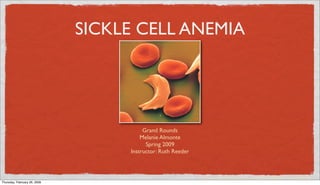
Grand Rounds Presentation
1. SICKLE CELL ANEMIA
Grand Rounds
Melanie Almonte
Spring 2009
Instructor: Ruth Reeder
http://www.mun.ca/biology/desmid/brian/BIOL2250/Week_Three/ssaRBC.jpg
Thursday, February 26, 2009
2. OUTLINE
Objectives Plan of care
Pathophysiology Nursing diagnoses
Signs and symptoms Goals
Labs Interventions
Diagnosis Results
Family impact
Cultural considerations
NCLEX practice questions
Patient demographics Summary
Past medical history References
Physical assessment
Thursday, February 26, 2009
3. OBJECTIVES
To increase the knowledge of the sickle cell disease process.
To identify risk factors that induce sickle cell crisis.
To learn how to manage acute pain related to ischemia.
Thursday, February 26, 2009
4. PATHOPHYSIOLOGY
genetic disorder
autosomal recessive pattern
of inheritance
for diagnosis at least 40% of
the total Hgb contains an
abnormality of the beta
chains (HbS)
HbS is very sensitive to
changes in O2 concentrations
in RBCs
Thursday, February 26, 2009
5. PATHOPHYSIOLOGY
genetic disorder
autosomal recessive pattern
of inheritance
for diagnosis at least 40% of
the total Hgb contains an
abnormality of the beta
chains (HbS)
HbS is very sensitive to
changes in O2 concentrations
in RBCs
Thursday, February 26, 2009
6. PATHOPHYSIOLOGY
genetic disorder
autosomal recessive pattern
of inheritance
for diagnosis at least 40% of
the total Hgb contains an
50%
abnormality of the beta
chains (HbS)
HbS is very sensitive to
changes in O2 concentrations
in RBCs
Thursday, February 26, 2009
7. PATHOPHYSIOLOGY
genetic disorder
autosomal recessive pattern
of inheritance
for diagnosis at least 40% of
the total Hgb contains an 25%
50%
abnormality of the beta
chains (HbS)
HbS is very sensitive to
changes in O2 concentrations
in RBCs
Thursday, February 26, 2009
8. PATHOPHYSIOLOGY
genetic disorder
autosomal recessive pattern
of inheritance
for diagnosis at least 40% of
the total Hgb contains an 25% 25%
50%
abnormality of the beta
chains (HbS)
HbS is very sensitive to
changes in O2 concentrations
in RBCs
Thursday, February 26, 2009
12. SIGNS & SYMPTOMS
CARDIOVASCULAR NEUROLOGICAL
cool extremities pain (most common symptom)
slow capillary refill seizures
cyanosis stroke
heart murmurs behavioral changes
tachycardia
MUSCULOSKELETAL
ANEMIA joint degeneration
dyspnea on exertion, SOB, bone density changes (seen in
weakness xray)
limited ROM
Thursday, February 26, 2009
13. SIGNS & SYMPTOMS, CONT’D
GI
jaundice
organ failure (abd organs 1st to be damaged due to multiple episodes
of hypoxia, ischemia)
INTEGUMENT
stasis and pressure ulcers on lower extremities
Thursday, February 26, 2009
14. DIAGNOSIS
Abnormal labs
elevated
%age of HbS
reticulocytes
WBC count
decreased
H/H
platelet count
Thursday, February 26, 2009
15. DIAGNOSIS
Abnormal labs
elevated
%age of HbS Reticulocyte counts are
reticulocytes increased with sickle cell disease
WBC count because the life span of sickled
decreased red blood cells is shortened.
H/H
platelet count
Thursday, February 26, 2009
16. CULTURAL CONSIDERATIONS
Also Caribbean, Middle Eastern and central american peoples.
http://discovermagazine.com/2005/mar/human-study-thyself/gene-map.jpg http://www.sicklecellsociety.org/img/research/italy.gif
Thursday, February 26, 2009
17. PATIENT INFORMATION
31 yo AAF
6’1” 171 lbs
CHIEF COMPLANT: pain in right side of neck, chest
PRIMARY DIAGNOSIS: superior vena cava thrombosis
ALLERGIES: Ceftriaxone, Dilaudid, Morphine, Rocephin, Fentanyl
DIET: Regular
No IV access due to infiltration
PICC consult placed
ACTIVITY: as tolerated; pt allowed to go outside (2/19)
CONFIDENTIAL status
Thursday, February 26, 2009
18. ADMISSION
Admitted 2/15/09
Presented to Summerville Medical Center
Chief complaint: chest discomfort that has been consistent, moderate,
but waxes and wanes
began 2 days ago
worsened by movement
unrelieved by meds (home med is: Demerol PO)
Chest CT upon admission, with and w/o contrast
revealed thrombus in SVC & right subclavian
Thursday, February 26, 2009
19. PAST MEDICAL HISTORY
Anemia
Cholelithiasis - advised by PCP to have cholecystectomy
Port-a-cath x 3
Heart murmurs
Pulmonary embolism, carotid clots
Cardiomegaly (mild)
10 hospitalizations due to sickle cell crisis since 2003
Typically between January and May
Recently began taking herbal supplements in place of Coumadin
Hospitalized in January due to L breast blood clots
Mondor’s Syndrome
Thursday, February 26, 2009
20. ASSESSMENT
CARDIOVASCULAR NEUROLOGICAL
cool extremities pain (most common symptom)
slow capillary refill seizures
cyanosis stroke
heart murmurs behavioral changes
tachycardia
MUSCULOSKELETAL
ANEMIA joint degeneration
dyspnea on exertion, SOB, bone density changes (seen in
weakness xray)
limited ROM
Thursday, February 26, 2009
21. ASSESSMENT
CARDIOVASCULAR NEUROLOGICAL
cool extremities pain (most common symptom)
slow capillary refill seizures
cyanosis stroke
heart murmurs behavioral changes
tachycardia
MUSCULOSKELETAL
ANEMIA joint degeneration
dyspnea on exertion, SOB, bone density changes (seen in
weakness xray)
limited ROM
Thursday, February 26, 2009
22. ASSESSMENT
CARDIOVASCULAR NEUROLOGICAL
cool extremities pain (most common symptom)
slow capillary refill seizures
cyanosis stroke
heart murmurs behavioral changes
tachycardia
MUSCULOSKELETAL
ANEMIA joint degeneration
dyspnea on exertion, SOB, bone density changes (seen in
weakness xray)
limited ROM
Thursday, February 26, 2009
23. ASSESSMENT
CARDIOVASCULAR NEUROLOGICAL
cool extremities pain (most common symptom)
slow capillary refill seizures
cyanosis stroke
heart murmurs behavioral changes
tachycardia
MUSCULOSKELETAL
ANEMIA joint degeneration
dyspnea on exertion, SOB, bone density changes (seen in
weakness xray)
limited ROM
Thursday, February 26, 2009
24. ASSESSMENT
CARDIOVASCULAR NEUROLOGICAL
cool extremities pain (most common symptom)
slow capillary refill seizures
cyanosis stroke
heart murmurs behavioral changes
tachycardia
MUSCULOSKELETAL
ANEMIA joint degeneration
dyspnea on exertion, SOB, bone density changes (seen in
weakness xray)
limited ROM
Thursday, February 26, 2009
25. ASSESSMENT, CONT’D
GI Labs
jaundice RBC 2.89
organ failure (abd organs 1st to Hgb 8.6
be damaged due to multiple Hct 25.0
episodes of hypoxia, ischemia) RDW 18.2
Na 139
INTEGUMENT K 3.9
stasis and pressure ulcers on WBC count 7.4
lower extremities PT 11.6 (9.0 - 11.5 sec)
INR 1.18 (2.0 - 3.0
What does this mean?!
Thursday, February 26, 2009
26. ASSESSMENT, CONT’D
GI Labs
jaundice RBC 2.89
organ failure (abd organs 1st to Hgb 8.6
be damaged due to multiple Hct 25.0
episodes of hypoxia, ischemia) RDW 18.2
Na 139
INTEGUMENT K 3.9
stasis and pressure ulcers on WBC count 7.4
lower extremities PT 11.6 (9.0 - 11.5 sec)
INR 1.18 (2.0 - 3.0
What does this mean?!
Thursday, February 26, 2009
27. ASSESSMENT, CONT’D
GI Labs
jaundice RBC 2.89
organ failure (abd organs 1st to Hgb 8.6
be damaged due to multiple Hct 25.0
episodes of hypoxia, ischemia) RDW 18.2
Na 139
INTEGUMENT K 3.9
stasis and pressure ulcers on WBC count 7.4
lower extremities PT 11.6 (9.0 - 11.5 sec)
INR 1.18 (2.0 - 3.0
What does this mean?!
Thursday, February 26, 2009
28. NURSING DIAGNOSES
Acute pain
related to ischemia of blood vessels in the anterior chest region as
evidenced by patient reporting discomfort, guarding and grimacing.
Ineffective tissue perfusion: cardiopulmonary
related to decreased hemoglobin concentration in blood as evidenced by
cold extremities, weak distal pulses, and chest pain.
Risk for infection
related to decreased WBC count.
Activity intolerance
related to imbalance between oxygen supply and demand as evidenced by
exertional discomfort and verbal report of fatigue.
Thursday, February 26, 2009
29. NURSING DIAGNOSES, CONT’D
Deficient knowledge
related to information misinterpretation as evidenced by inaccurate
follow through of medication administration instruction.
Impaired physical mobility
related to activity intolerance as evidenced by limited ability to perform
gross motor skills and slowed movement.
Decreased cardiac output
related to altered preload as evidenced by tachycardia and fatigue.
Anxiety
related to change in health status and decreased social interaction as
evidenced by displaying an apprehensive and distressed affect and voice
quivering.
Thursday, February 26, 2009
30. GOALS
Consistently report pain levels of 0 - 3/10
Maintain O2 saturation > 92%
Maintain adequate hydration via PO intake and continuous IVF
Improve musculoskeletal function
Patient will accurately verbalize understanding of importance of taking
medication in order to prevent sickle cell crisises
Patient will remain free from infection, injury or falls
Thursday, February 26, 2009
31. INTERVENTIONS
Frequently assess O2 saturation and treat low saturations with oxygen per
humidified NC.
Treat pain with Demerol on a regular schedule (q2h), not PRN.
Encourage PO fluid intake.
Teach patient to take breaks and rest as needed throughout the day in
order to conserve energy.
Teach patient to keep temperature in their room warm and to avoid cold,
stressful environments.
Administer drinks with little to no ice.
If possible, maintain IV access in order to prevent need for IM medication.
Teach patient importance of not wearing tight, constricting clothing.
Thursday, February 26, 2009
38. TREATMENT MODALITIES - RESEARCH
Yoon, S.L. & Black, S. (2006). Comprehensive, integrative management of
pain for patients with sickle-cell disease. The Journal of Alternative and
Complementary Medicine, 12(10), 995 - 1001.
Design: cross-sectional
Subjects: 63 caregivers of children w/ sickle cell disease
questionnaire examined use of pharmocological and complementary
therapies
wanted to see if type of therapy administered related to age of patient
Thursday, February 26, 2009
39. TREATMENT MODALITIES - RESEARCH
Results:
Children < age 9 were typically treated with NSAIDs or combination
of acetaminophen and an opioid
Majority (> 70%) of caregivers utilized some form of complementary
therapy for the child
Most common: prayer, spiritual healing, massage, relaxation
Use of complementary therapy was higher in children taking 2+
analgesics (compared to children taking 0 - 1)
Thursday, February 26, 2009
40. OUTCOMES
Discharged 2/25
reported pain as being controlled
reported pain level as being consistently < 5/10
O2 saturations on RA > 98%
accurately verbalized understanding of coumadin therapy and food
contraindications
reported feeling relieved and less anxious as compared to last week
*and is currently not taking or going home on benzodiazepines
remained free from infection, falls and injury during hospitalization
activity level increased; patient ambulated frequently
maintained IV access for 3 days (placed 2/22) with continuous IVF
maintained adequate hydration via PO intake (water)
Thursday, February 26, 2009
41. SOCIAL/FAMILIAL IMPACT
Patient lives in an apartment, 1 bedroom, alone in N. Charleston
No pets.
Unemployed, covered under disability.
Medicare A & B, Medicaid
Emergency contact is mother who lives in Summerville
reports visiting/speaking to mother and sister “often”
Has large support network consisting of primarily friends and church
people
During hospitalization, was seen talking on cell at least once an hour
Thursday, February 26, 2009
42. NCLEX QUESTION 1 OF 5
A 43-year-old African American male is admitted with sickle cell
anemia. The Nurse plans to assess circulation in the lower extremities
every 2 hours. Which of the following outcome criteria would the nurse
use?
A.
Body temperature of 99°F or less
B.
Toes moved in active range of motion
C.
Sensation reported when soles of feet are touched
D.
Capillary refill of < 3 seconds
Thursday, February 26, 2009
43. NCLEX QUESTION 1 OF 5
A 43-year-old African American male is admitted with sickle cell
anemia. The Nurse plans to assess circulation in the lower extremities
every 2 hours. Which of the following outcome criteria would the nurse
use?
A.
Body temperature of 99°F or less
B.
Toes moved in active range of motion
C.
Sensation reported when soles of feet are touched
D.
Capillary refill of < 3 seconds
Thursday, February 26, 2009
44. NCLEX QUESTION 2 OF 5
A 30-year-old male from Haiti is brought to the emergency department
in sickle cell crisis. What is the best position for this client?
A.
Side-lying with knees flexed
B.
Knee-chest
C.
High Fowler's with knees flexed
D.
Semi-Fowler's with legs extended on the bed
Thursday, February 26, 2009
45. NCLEX QUESTION 2 OF 5
A 30-year-old male from Haiti is brought to the emergency department
in sickle cell crisis. What is the best position for this client?
A.
Side-lying with knees flexed
B.
Knee-chest
C.
High Fowler's with knees flexed
D.
Semi-Fowler's with legs extended on the bed
Thursday, February 26, 2009
46. NCLEX QUESTION 3 OF 5
A 25-year-old male is admitted in sickle cell crisis. Which of the
following interventions would be of highest priority for this client?
A.
Taking hourly blood pressures with mechanical cuff
B.
Encouraging fluid intake of at least 200mL per hour
C.
Position in high Fowler's with knee gatch raised
D.
Administering Tylenol as ordered
Thursday, February 26, 2009
47. NCLEX QUESTION 3 OF 5
A 25-year-old male is admitted in sickle cell crisis. Which of the
following interventions would be of highest priority for this client?
A.
Taking hourly blood pressures with mechanical cuff
B.
Encouraging fluid intake of at least 200mL per hour
C.
Position in high Fowler's with knee gatch raised
D.
Administering Tylenol as ordered
Thursday, February 26, 2009
48. NCLEX QUESTION 4 OF 5
Which of the following foods would the nurse encourage the client in
sickle cell crisis to eat?
A.
Peaches
B.
Cottage cheese
C.
Popsicle
D.
Lima beans
Thursday, February 26, 2009
49. NCLEX QUESTION 4 OF 5
Which of the following foods would the nurse encourage the client in
sickle cell crisis to eat?
A.
Peaches
B.
Cottage cheese
C.
Popsicle
D.
Lima beans
Thursday, February 26, 2009
50. NCLEX QUESTION 5 OF 5
The test used to differentiate sickle cell anemia and sickle cell trait is:
A.
Sickle cell preparation
B.
Peripheral smear
C.
Sickledex
D.
Hemoglobin electrophoresis
Thursday, February 26, 2009
51. NCLEX QUESTION 5 OF 5
The test used to differentiate sickle cell anemia and sickle cell trait is:
A.
Sickle cell preparation
B.
Peripheral smear
C.
Sickledex
D.
Hemoglobin electrophoresis
Thursday, February 26, 2009
52. SICKLE CELL: TAKE AWAY
SCHEDULED pain medication - NOT PRN.
Keep environment warm/comfortable for patient.
Oxygenate, humidify.
Encourage PO fluids and to conserve energy during crises.
For prevention, patient education is key!
Thursday, February 26, 2009