Photo by Sangudo - Creative Commons Attribution-NonCommercial License https://www.flickr.com/photos/23743320@N03 Created with Haiku Deck
Melissa Bowles-Terry
Head of Educational Initiatives, UNLV Libraries
Vice-chair, ACRL Value of Academic Libraries Committee
@mbowlesterry
Photo by secretlondon123 - Creative Commons Attribution-ShareAlike License https://www.flickr.com/photos/25834786@N03 Created with Haiku Deck
• Does your work contribute directly
to student success?
• Does your work contribute
indirectly to student success?
• Are you doing work that hinders
student success?
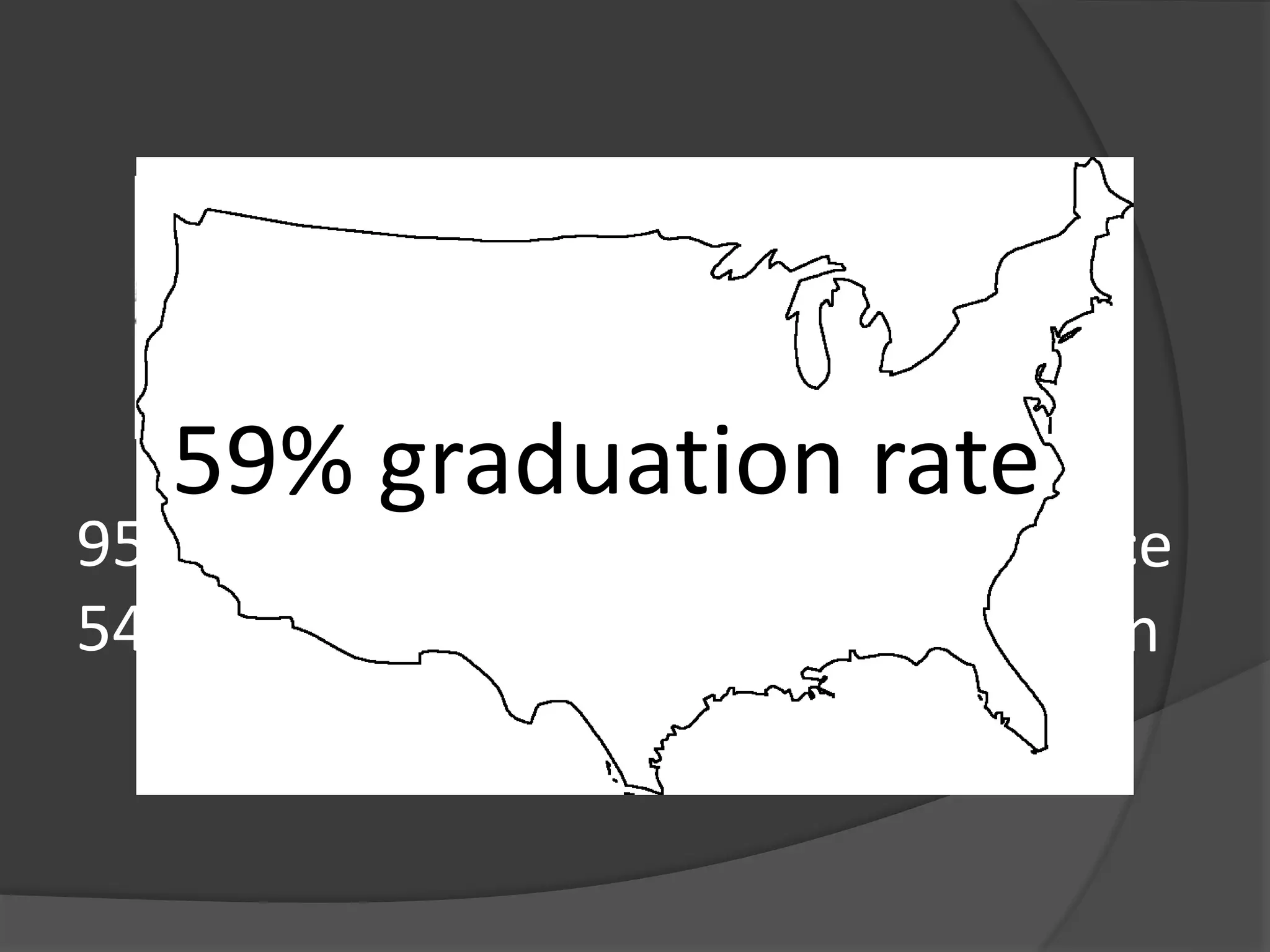
95% acceptance
54% graduation
88% acceptance
42% graduation
59% graduation rate
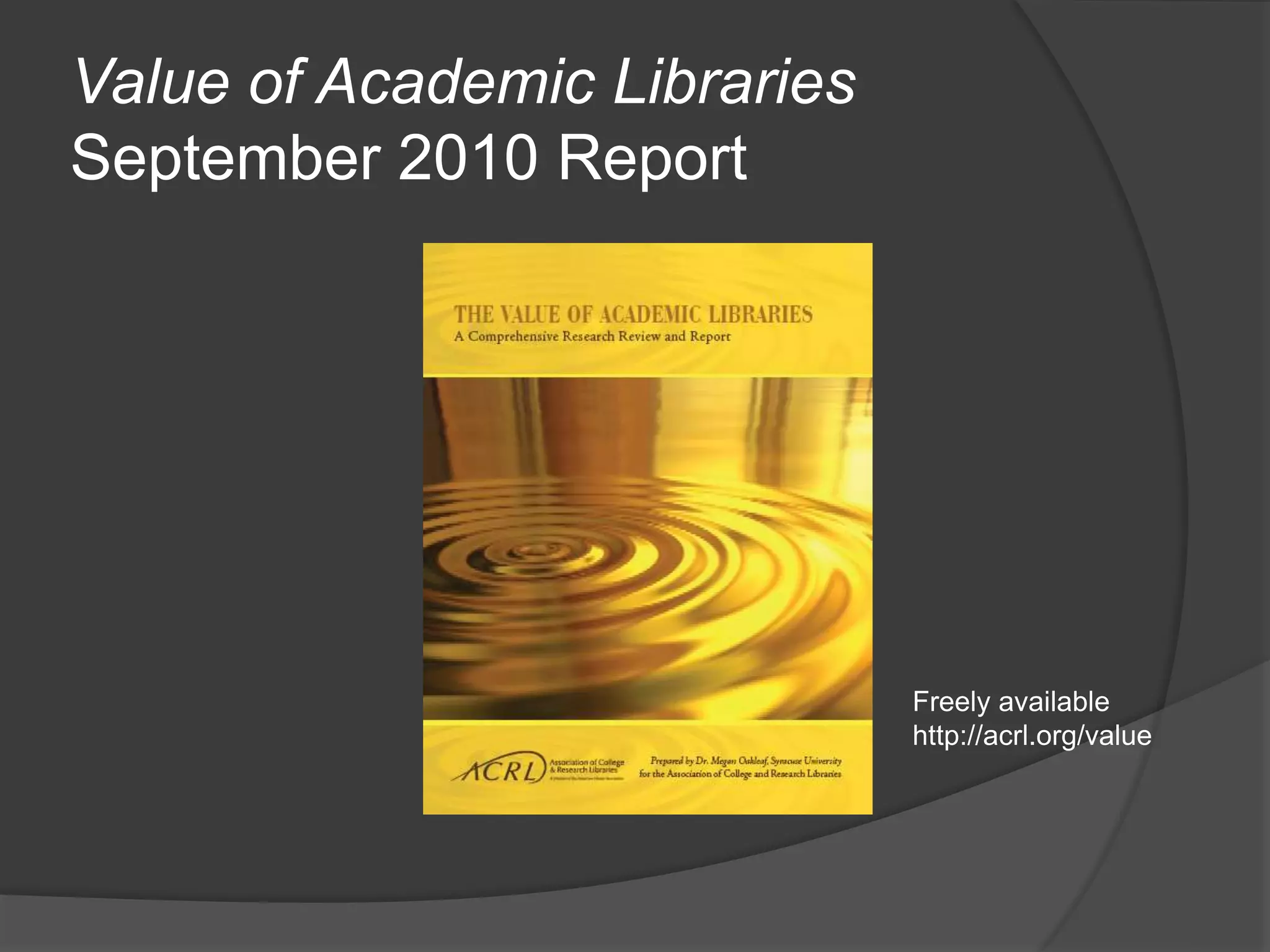
Value of Academic Libraries
September 2010 Report
Freely available
http://acrl.org/value
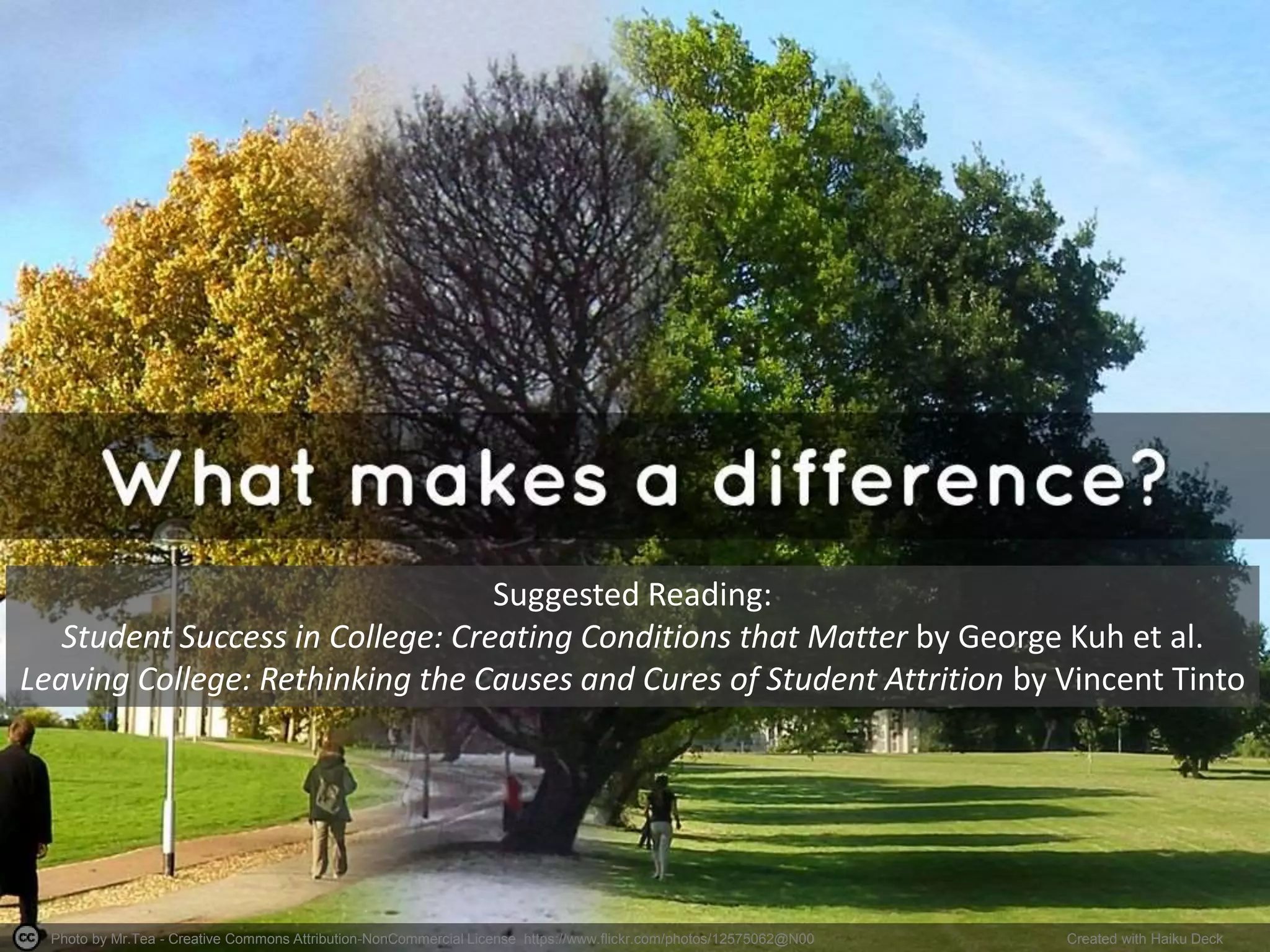
Photo by Mr.Tea - Creative Commons Attribution-NonCommercial License https://www.flickr.com/photos/12575062@N00 Created with Haiku Deck
Suggested Reading:
Student Success in College: Creating Conditions that Matter by George Kuh et al.
Leaving College: Rethinking the Causes and Cures of Student Attrition by Vincent Tinto
UNLV Libraries Retention Projects
• Professional development certificate for student
workers
• Direct instruction of UNLV students
• Redesigning courses & assignments with faculty
• Assessing student work from first-year composition
and Milestone courses
• Research consultations & other library interactions
UNLV Libraries Teaching Practices
• Transparency: identifying purpose, task, and
criteria for instruction sessions
• Collaborating with faculty on real-life learning
assignments that are informed by research on best
practices in field
Photo by RichGrundy - Creative Commons Attribution-NonCommercial License https://www.flickr.com/photos/32888907@N03 Created with Haiku Deck
From Assessment in Action
• Arizona State University
• Santa Barbara City College
• Murray State University
ACRL Student Retention Discussion Group
• Panel at ALA
• Bibliography
Photo by Bakar_88 - Creative Commons Attribution-NonCommercial-ShareAlike License https://www.flickr.com/photos/78174175@N00 Created with Haiku Deck
Soria, K. M., Fransen, J., & Nackerud, S. (2013). Library Use and Undergraduate
Student Outcomes: New Evidence for Students’ Retention and Academic
Success. Portal: Libraries and the Academy, 13(2), 147–164.
Soria, K. M., Fransen, J., & Nackerud, S. (2014). Stacks, Serials, Search Engines,
and Students' Success: First-Year Undergraduate Students' Library Use,
Academic Achievement, and Retention. Journal of Academic Librarianship,
40(1), 84-91.
Photo by gacabo - Creative Commons Attribution-ShareAlike License https://www.flickr.com/photos/50987838@N06 Created with Haiku Deck
Photo by smoorenburg - Creative Commons Attribution License https://www.flickr.com/photos/79908182@N00 Created with Haiku Deck
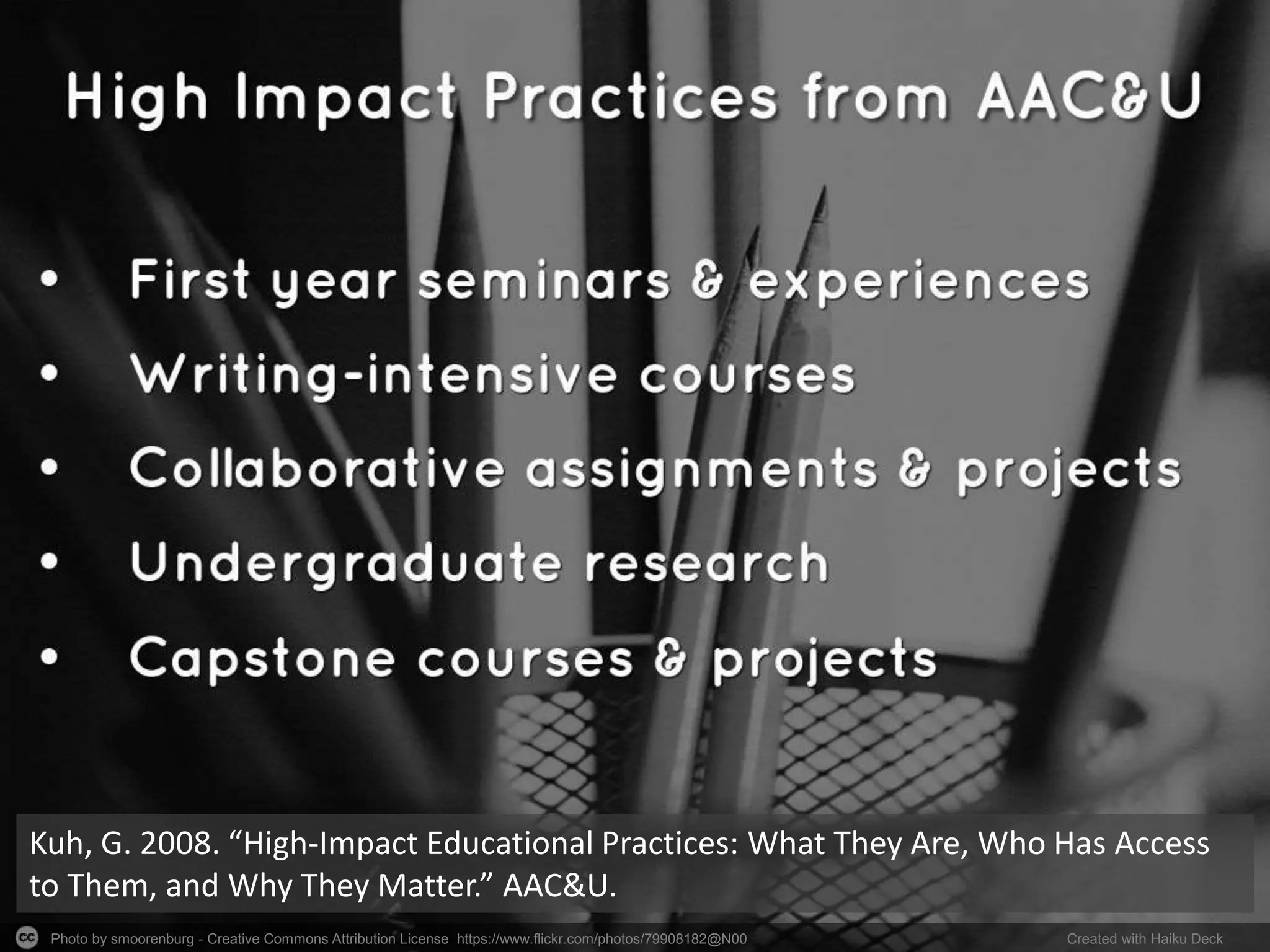
Kuh, G. 2008. “High-Impact Educational Practices: What They Are, Who Has Access
to Them, and Why They Matter.” AAC&U.
Photo by Mark Brannan - Creative Commons Attribution-NonCommercial-ShareAlike License https://www.flickr.com/photos/23403402@N00 Created with Haiku Deck
Booth, C., Lowe, M. S., Tagge, N., & Stone, S. M. (2014). Degrees of Impact:
Analyzing the Effects of Progressive Librarian Course Collaborations on Student
Performance. College & Research Libraries. (Pre-print. Expected pub. July 1, 2015).
Photo by paloetic - Creative Commons Attribution-NonCommercial-ShareAlike License https://www.flickr.com/photos/31102254@N02 Created with Haiku Deck
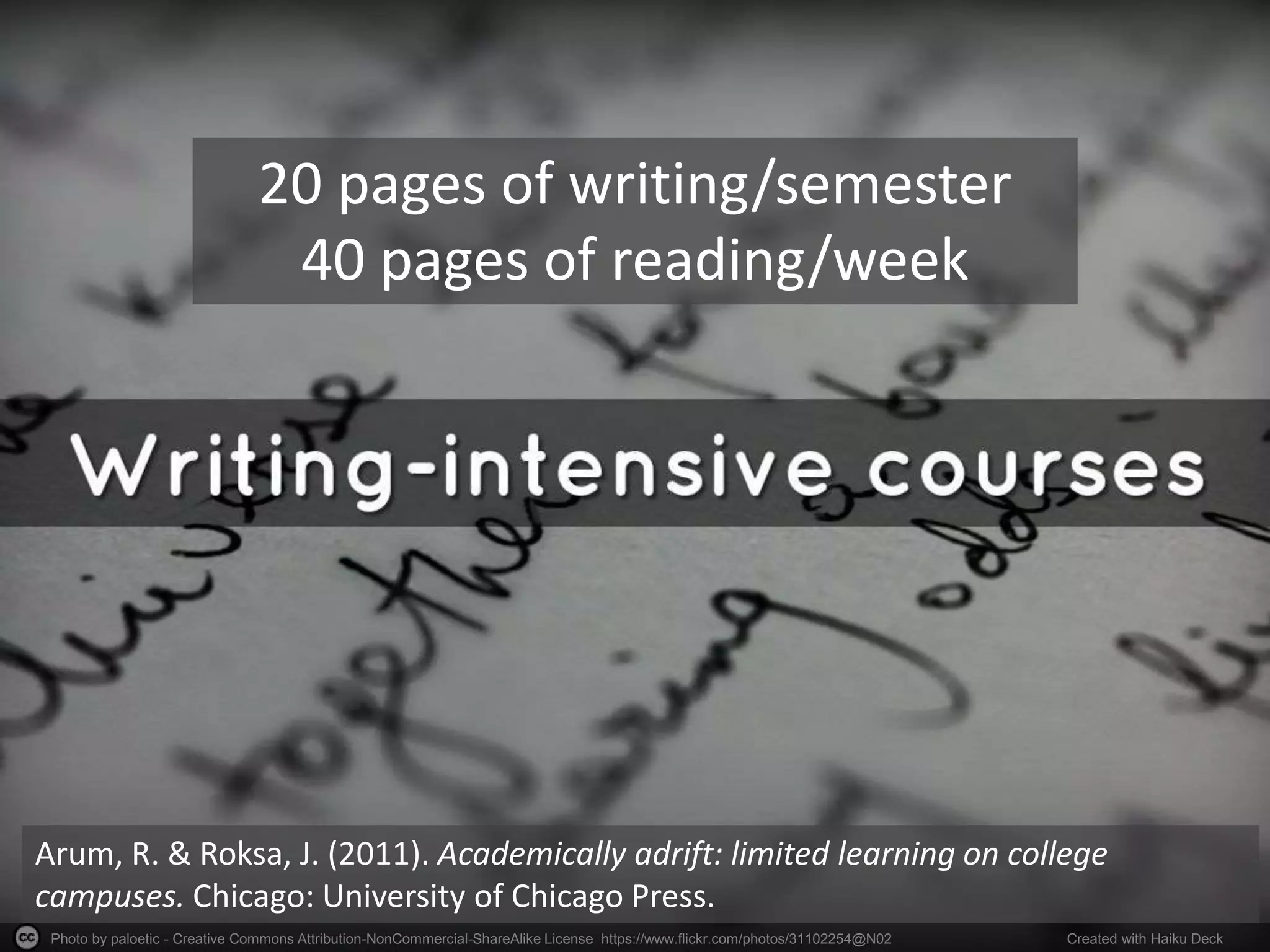
Arum, R. & Roksa, J. (2011). Academically adrift: limited learning on college
campuses. Chicago: University of Chicago Press.
20 pages of writing/semester
40 pages of reading/week
Photo by AJC1 - Creative Commons Attribution-NonCommercial-ShareAlike License https://www.flickr.com/photos/47353092@N00 Created with Haiku Deck
Stone, Graham, and Bryony Ramsden. 2013. “Library Impact Data Project: Looking
for the Link between Library Usage and Student Attainment.” College & Research
Libraries 74 (6): 546.
Photo by suttonhoo - Creative Commons Attribution-NonCommercial-ShareAlike License https://www.flickr.com/photos/19844101@N00 Created with Haiku Deck
UNLV University Libraries Lance and Elena Calvert Undergraduate Research Awards.
https://www.library.unlv.edu/award
Photo by Daniele Zedda - Creative Commons Attribution License https://www.flickr.com/photos/64742456@N00 Created with Haiku Deck
"Learning Curve: How College Graduates Solve Information Problems Once They Join
the Workplace," Alison J. Head, Project Information Literacy Research Report,
October 15, 2012.
Photo by smoorenburg - Creative Commons Attribution License https://www.flickr.com/photos/79908182@N00 Created with Haiku Deck
Kuh, G. 2008. “High-Impact Educational Practices: What They Are, Who Has Access
to Them, and Why They Matter.” AAC&U.
Photo by Hammonton Photography - Creative Commons Attribution-NonCommercial License https://www.flickr.com/photos/25880282@N04 Created with Haiku Deck
Photo by geishaboy500 - Creative Commons Attribution License https://www.flickr.com/photos/49503154413@N01 Created with Haiku Deck
Winkelmes, M. 2013. “Transparency in Teaching: Faculty Share Data and Improve
Students’ Learning.” Liberal Education 99 (2).
Photo by Peter JG Smith - Creative Commons Attribution-NonCommercial License https://www.flickr.com/photos/92056917@N02 Created with Haiku Deck
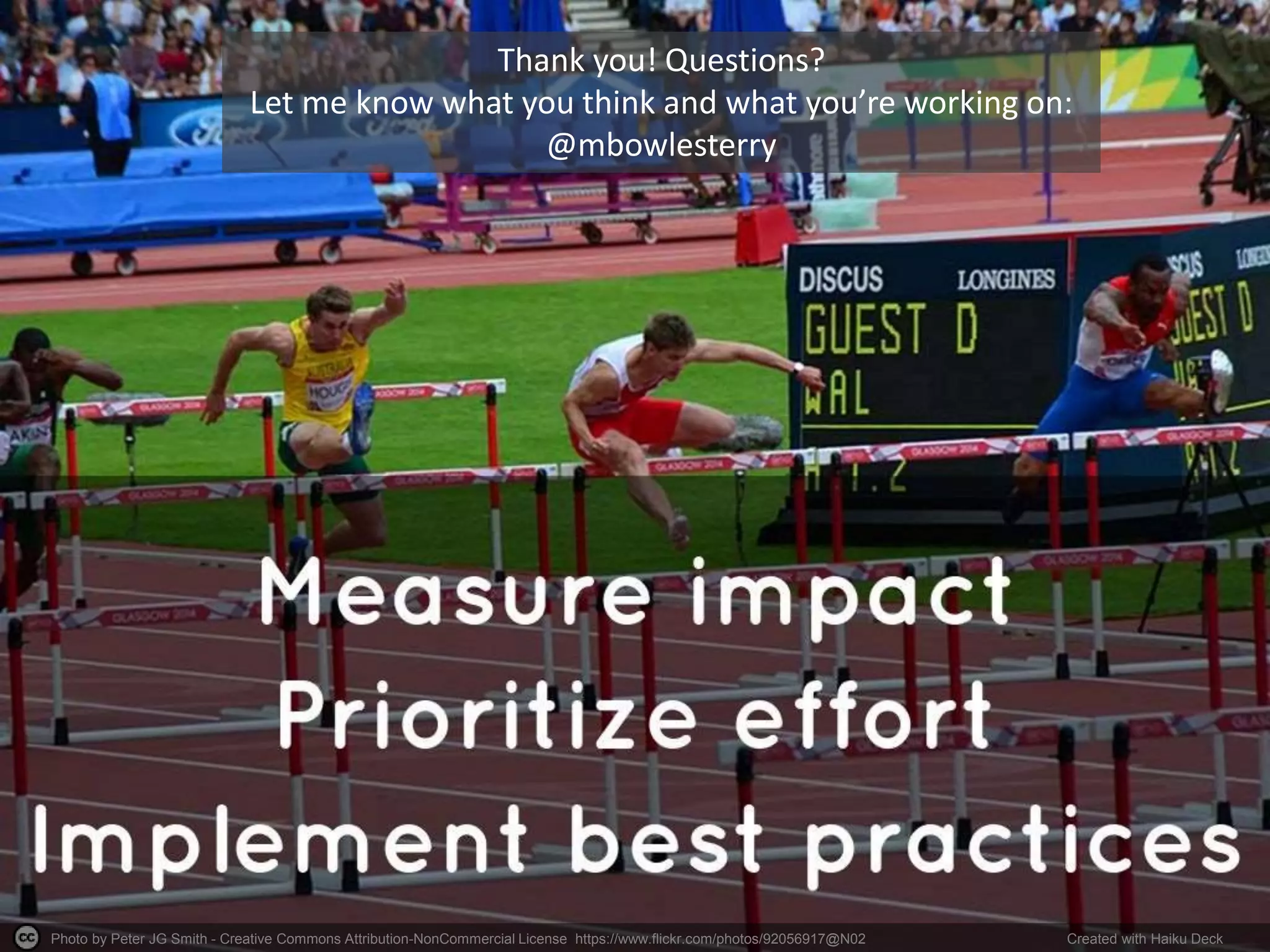
Thank you! Questions?
Let me know what you think and what you’re working on:
@mbowlesterry
References
Arum, R. & Roksa, J. (2011). Academically adrift: limited learning on college campuses. Chicago: University of
Chicago Press.
Booth, C., Lowe, M. S., Tagge, N., & Stone, S. M. (2014). Degrees of Impact: Analyzing the Effects of Progressive
Librarian Course Collaborations on Student Performance. College & Research Libraries. (Pre-print. Expected pub.
July 1, 2015).
Bowles-Terry, M. (2012). Library instruction and academic success: A mixed-methods assessment of a library
instruction program. Evidence Based Library and Information Practice, 7(1), 82–95.
Chronicle of Higher Education, Diversity in Academe: First-Generation Students, May 18, 2015
College Scorecard: http://www.whitehouse.gov/issues/education/higher-education/college-score-card
Graduation Rates: http://nces.ed.gov/fastfacts
Head, A. (2012). Learning Curve: How College Graduates Solve Information Problems Once They Join the Workplace,
Project Information Literacy Research Report.
Kuh, G. (2008). High-Impact Educational Practices: What They Are, Who Has Access to Them, and Why They Matter,
AAC&U.
Kuh, G. et al. (2005). Student Success in College: Creating Conditions that Matter. San Francisco: Jossey-Bass.
Soria, K. M., Fransen, J., & Nackerud, S. (2013). Library Use and Undergraduate Student Outcomes: New Evidence
for Students’ Retention and Academic Success. Portal: Libraries and the Academy, 13(2), 147–164.
Tinto, V. (1994). Leaving College: Rethinking the Causes and Cures of Student Attrition. Chicago: University of
Chicago Press.
UNLV University Libraries Lance and Elena Calvert Undergraduate Research Awards.
https://www.library.unlv.edu/award
Winkelmes, M. 2013. Transparency in Teaching: Faculty Share Data and Improve Students’ Learning. Liberal
Education 99 (2).
Academic Libraries & Retention Bibliography – From ACRL Student Retention Discussion Group
Barkey, P. (1965). Patterns of Student Use of a College Library. College & Research Library 20(2), 115-118.
Bell, S.J. (September, 2008). Keeping Them Enrolled: How Academic Libraries Contribute to Student Retention. Library
Issues: Briefings for Faculty and Administrators 29(1), 1-4.
Blackburn, H. (June 06, 2010). Shhh! No Talking about Retention in the Library! Education Libraries, 33(1), 24-30.
Breivik, P. S. (1974). Effects of Library-Based Instruction in the Academic Success of Disadvantaged College Freshmen.
[Doctoral Dissertation]. (UMI No. 7505206).
Collins, E. (July 10, 2012). Library usage and dropping out. Library Impact Data Project. Retrieved from
http://library.hud.ac.uk/blogs/projects/lidp/2012/07/10/library-usage-and-dropping-out/.
Emmons, M., & Wilkinson, F. C. (March 01, 2011). The academic library impact on student persistence. College and Research
Libraries, 72(2), 128-149.
Hamrick, F. A., Schuh, J. H., & Shelley, M. C. (2004). Predicting Higher Education Graduation Rates From Institutional
Characteristics and Resource Allocation. Education Policy Analysis Archives, 12(9), 1-24.
Knapp, J. A., Rowland, N. J., & Charles, E. P. (forthcoming, 2014). Retaining Students by Embedding Librarians into
Undergraduate Research Experiences. Reference Services Review, 42(1).
Knapp, P. B. (1966). The Montieth College Library Experiment. New York: Scarecrow Press.
Kraemer, B. A. (1997). The Academic and Social Integration of Hispanic Students into College. Review of Higher Education,
20(2), 163-179.
Kramer, L.A., & Kamer, M. B. (1968). The College Library and the Drop-out. College & Research Libraries, 29(4), 310-312.
Kuh, G. D., & Gonyea, R. M. (July 01, 2003). The Role of the Academic Library in Promoting Student Engagement in Learning.
College & Research Libraries, 64(4), 256-82.
Mallinckrodt, B., & Sedlacek, W. E. (1987). Student Retention and the Use of Campus Facilities by Race. NASPA Journal ,
24(3), 28-32.
Mezick, E.M. (2007). Return on Investment: Libraries and Student Retention. Journal of Academic Librarianship, 33(5), 561-
566.
Miller, W. (2013). Libraries and Student Success. Library Issues: Briefings for Faculty and Administrators, 34(2), 1-4.
Pagowsky, N., & Hammond, J. (November 01, 2012). A programmatic approach: Systematically tying the library to student
retention efforts on campus. College and Research Libraries News, 73(10), 582.
Soria, K. M., Fransen, J., & Nackerud, S. (forthcoming, 2014). Stacks, Serials, Search Engines, and Students' Success: First-
Year Undergraduate Students' Library Use, Academic Achievement, and Retention. Journal of Academic Librarianship.

Helping students cross the finish line

  • 1.
    Photo by Sangudo- Creative Commons Attribution-NonCommercial License https://www.flickr.com/photos/23743320@N03 Created with Haiku Deck Melissa Bowles-Terry Head of Educational Initiatives, UNLV Libraries Vice-chair, ACRL Value of Academic Libraries Committee @mbowlesterry
  • 2.
    Photo by secretlondon123- Creative Commons Attribution-ShareAlike License https://www.flickr.com/photos/25834786@N03 Created with Haiku Deck • Does your work contribute directly to student success? • Does your work contribute indirectly to student success? • Are you doing work that hinders student success?
  • 3.
    95% acceptance 54% graduation 88%acceptance 42% graduation 59% graduation rate
  • 4.
    Value of AcademicLibraries September 2010 Report Freely available http://acrl.org/value
  • 5.
    Photo by Mr.Tea- Creative Commons Attribution-NonCommercial License https://www.flickr.com/photos/12575062@N00 Created with Haiku Deck Suggested Reading: Student Success in College: Creating Conditions that Matter by George Kuh et al. Leaving College: Rethinking the Causes and Cures of Student Attrition by Vincent Tinto
  • 6.
    UNLV Libraries RetentionProjects • Professional development certificate for student workers • Direct instruction of UNLV students • Redesigning courses & assignments with faculty • Assessing student work from first-year composition and Milestone courses • Research consultations & other library interactions
  • 7.
    UNLV Libraries TeachingPractices • Transparency: identifying purpose, task, and criteria for instruction sessions • Collaborating with faculty on real-life learning assignments that are informed by research on best practices in field
  • 8.
    Photo by RichGrundy- Creative Commons Attribution-NonCommercial License https://www.flickr.com/photos/32888907@N03 Created with Haiku Deck From Assessment in Action • Arizona State University • Santa Barbara City College • Murray State University ACRL Student Retention Discussion Group • Panel at ALA • Bibliography
  • 9.
    Photo by Bakar_88- Creative Commons Attribution-NonCommercial-ShareAlike License https://www.flickr.com/photos/78174175@N00 Created with Haiku Deck Soria, K. M., Fransen, J., & Nackerud, S. (2013). Library Use and Undergraduate Student Outcomes: New Evidence for Students’ Retention and Academic Success. Portal: Libraries and the Academy, 13(2), 147–164. Soria, K. M., Fransen, J., & Nackerud, S. (2014). Stacks, Serials, Search Engines, and Students' Success: First-Year Undergraduate Students' Library Use, Academic Achievement, and Retention. Journal of Academic Librarianship, 40(1), 84-91.
  • 10.
    Photo by gacabo- Creative Commons Attribution-ShareAlike License https://www.flickr.com/photos/50987838@N06 Created with Haiku Deck
  • 11.
    Photo by smoorenburg- Creative Commons Attribution License https://www.flickr.com/photos/79908182@N00 Created with Haiku Deck Kuh, G. 2008. “High-Impact Educational Practices: What They Are, Who Has Access to Them, and Why They Matter.” AAC&U.
  • 12.
    Photo by MarkBrannan - Creative Commons Attribution-NonCommercial-ShareAlike License https://www.flickr.com/photos/23403402@N00 Created with Haiku Deck Booth, C., Lowe, M. S., Tagge, N., & Stone, S. M. (2014). Degrees of Impact: Analyzing the Effects of Progressive Librarian Course Collaborations on Student Performance. College & Research Libraries. (Pre-print. Expected pub. July 1, 2015).
  • 13.
    Photo by paloetic- Creative Commons Attribution-NonCommercial-ShareAlike License https://www.flickr.com/photos/31102254@N02 Created with Haiku Deck Arum, R. & Roksa, J. (2011). Academically adrift: limited learning on college campuses. Chicago: University of Chicago Press. 20 pages of writing/semester 40 pages of reading/week
  • 14.
    Photo by AJC1- Creative Commons Attribution-NonCommercial-ShareAlike License https://www.flickr.com/photos/47353092@N00 Created with Haiku Deck Stone, Graham, and Bryony Ramsden. 2013. “Library Impact Data Project: Looking for the Link between Library Usage and Student Attainment.” College & Research Libraries 74 (6): 546.
  • 15.
    Photo by suttonhoo- Creative Commons Attribution-NonCommercial-ShareAlike License https://www.flickr.com/photos/19844101@N00 Created with Haiku Deck UNLV University Libraries Lance and Elena Calvert Undergraduate Research Awards. https://www.library.unlv.edu/award
  • 16.
    Photo by DanieleZedda - Creative Commons Attribution License https://www.flickr.com/photos/64742456@N00 Created with Haiku Deck "Learning Curve: How College Graduates Solve Information Problems Once They Join the Workplace," Alison J. Head, Project Information Literacy Research Report, October 15, 2012.
  • 17.
    Photo by smoorenburg- Creative Commons Attribution License https://www.flickr.com/photos/79908182@N00 Created with Haiku Deck Kuh, G. 2008. “High-Impact Educational Practices: What They Are, Who Has Access to Them, and Why They Matter.” AAC&U.
  • 18.
    Photo by HammontonPhotography - Creative Commons Attribution-NonCommercial License https://www.flickr.com/photos/25880282@N04 Created with Haiku Deck
  • 19.
    Photo by geishaboy500- Creative Commons Attribution License https://www.flickr.com/photos/49503154413@N01 Created with Haiku Deck Winkelmes, M. 2013. “Transparency in Teaching: Faculty Share Data and Improve Students’ Learning.” Liberal Education 99 (2).
  • 20.
    Photo by PeterJG Smith - Creative Commons Attribution-NonCommercial License https://www.flickr.com/photos/92056917@N02 Created with Haiku Deck Thank you! Questions? Let me know what you think and what you’re working on: @mbowlesterry
  • 21.
    References Arum, R. &Roksa, J. (2011). Academically adrift: limited learning on college campuses. Chicago: University of Chicago Press. Booth, C., Lowe, M. S., Tagge, N., & Stone, S. M. (2014). Degrees of Impact: Analyzing the Effects of Progressive Librarian Course Collaborations on Student Performance. College & Research Libraries. (Pre-print. Expected pub. July 1, 2015). Bowles-Terry, M. (2012). Library instruction and academic success: A mixed-methods assessment of a library instruction program. Evidence Based Library and Information Practice, 7(1), 82–95. Chronicle of Higher Education, Diversity in Academe: First-Generation Students, May 18, 2015 College Scorecard: http://www.whitehouse.gov/issues/education/higher-education/college-score-card Graduation Rates: http://nces.ed.gov/fastfacts Head, A. (2012). Learning Curve: How College Graduates Solve Information Problems Once They Join the Workplace, Project Information Literacy Research Report. Kuh, G. (2008). High-Impact Educational Practices: What They Are, Who Has Access to Them, and Why They Matter, AAC&U. Kuh, G. et al. (2005). Student Success in College: Creating Conditions that Matter. San Francisco: Jossey-Bass. Soria, K. M., Fransen, J., & Nackerud, S. (2013). Library Use and Undergraduate Student Outcomes: New Evidence for Students’ Retention and Academic Success. Portal: Libraries and the Academy, 13(2), 147–164. Tinto, V. (1994). Leaving College: Rethinking the Causes and Cures of Student Attrition. Chicago: University of Chicago Press. UNLV University Libraries Lance and Elena Calvert Undergraduate Research Awards. https://www.library.unlv.edu/award Winkelmes, M. 2013. Transparency in Teaching: Faculty Share Data and Improve Students’ Learning. Liberal Education 99 (2).
  • 22.
    Academic Libraries &Retention Bibliography – From ACRL Student Retention Discussion Group Barkey, P. (1965). Patterns of Student Use of a College Library. College & Research Library 20(2), 115-118. Bell, S.J. (September, 2008). Keeping Them Enrolled: How Academic Libraries Contribute to Student Retention. Library Issues: Briefings for Faculty and Administrators 29(1), 1-4. Blackburn, H. (June 06, 2010). Shhh! No Talking about Retention in the Library! Education Libraries, 33(1), 24-30. Breivik, P. S. (1974). Effects of Library-Based Instruction in the Academic Success of Disadvantaged College Freshmen. [Doctoral Dissertation]. (UMI No. 7505206). Collins, E. (July 10, 2012). Library usage and dropping out. Library Impact Data Project. Retrieved from http://library.hud.ac.uk/blogs/projects/lidp/2012/07/10/library-usage-and-dropping-out/. Emmons, M., & Wilkinson, F. C. (March 01, 2011). The academic library impact on student persistence. College and Research Libraries, 72(2), 128-149. Hamrick, F. A., Schuh, J. H., & Shelley, M. C. (2004). Predicting Higher Education Graduation Rates From Institutional Characteristics and Resource Allocation. Education Policy Analysis Archives, 12(9), 1-24. Knapp, J. A., Rowland, N. J., & Charles, E. P. (forthcoming, 2014). Retaining Students by Embedding Librarians into Undergraduate Research Experiences. Reference Services Review, 42(1). Knapp, P. B. (1966). The Montieth College Library Experiment. New York: Scarecrow Press. Kraemer, B. A. (1997). The Academic and Social Integration of Hispanic Students into College. Review of Higher Education, 20(2), 163-179. Kramer, L.A., & Kamer, M. B. (1968). The College Library and the Drop-out. College & Research Libraries, 29(4), 310-312. Kuh, G. D., & Gonyea, R. M. (July 01, 2003). The Role of the Academic Library in Promoting Student Engagement in Learning. College & Research Libraries, 64(4), 256-82. Mallinckrodt, B., & Sedlacek, W. E. (1987). Student Retention and the Use of Campus Facilities by Race. NASPA Journal , 24(3), 28-32. Mezick, E.M. (2007). Return on Investment: Libraries and Student Retention. Journal of Academic Librarianship, 33(5), 561- 566. Miller, W. (2013). Libraries and Student Success. Library Issues: Briefings for Faculty and Administrators, 34(2), 1-4. Pagowsky, N., & Hammond, J. (November 01, 2012). A programmatic approach: Systematically tying the library to student retention efforts on campus. College and Research Libraries News, 73(10), 582. Soria, K. M., Fransen, J., & Nackerud, S. (forthcoming, 2014). Stacks, Serials, Search Engines, and Students' Success: First- Year Undergraduate Students' Library Use, Academic Achievement, and Retention. Journal of Academic Librarianship.

Editor's Notes

  • #2 What makes students stay in college and finish a degree? What prevents them from finishing? And what impact can libraries have on student retention and graduation? In this presentation, Melissa Bowles-Terry will discuss student retention projects currently underway in the libraries at University of Nevada, Las Vegas. Melissa will share results from other libraries that have made a concentrated effort to help students make progress towards graduation. She will also talk about broader research in higher education on what makes a difference in retention efforts and how libraries can fit into that larger framework.
  • #3 I have questions to start with. Who here feels like what you do in your library contributes directly to students succeeding in college? Who feels like what you do contributes indirectly to students succeeding in college? Anybody here doing work that hinders student success? ;-) This is a topic that I think all libraries and librarians have a stake in. Even if you don’t see students on a daily basis, the work we do to provide services, space, and resources are vital to student success. You may have a natural interest and instinct towards it, or your provost or dean may tell you that your library has an interest in it, but either way we need students who attend our institutions to do well in their classes and graduate. It’s central to the mission of any university or college and thus part of the job of everyone who works at that university or college.
  • #4 When I talk about student success, I’m talking at a basic level about helping students graduate from our institutions in a timely manner. A 6-year graduation rate is how that is usually measured. In my career so far I have worked at two public, state schools that accept over 85% of the students who apply. (UW 95% acceptance, 54% graduation; UNLV 88% acceptance, 42% graduation) This issue of retention and graduation (and other higher ed issues) have gotten a lot of attention from the White House lately. Have you seen the College ScoreCard? Graduation rates, costs, and employment are the major things measured for that scorecard. Nationally, about 59% of students who start a bachelor’s degree finish it in 6 years. Penn State – anybody here from Penn State? – and more selective schools like it are really breaking the curve for the rest of us (86% 6-year graduation, 54% admitted). You don’t have a retention/graduation problem, right? But we do all have a role to play in student engagement and creating an environment where students can be most successful. In my experience, universities have several incentives to help students succeed: there’s money, of course. We need happy alumni, we need happy legislators, we need to look good in college rankings and we can’t do that without a decent 6-year graduation rate. But there’s also a social and moral imperative: we are not doing right by our students if we don’t help them to earn the degrees that they came for. I hear some faculty and staff say, “We need to raise admissions standards and bring in more qualified students. Then they’ll graduate.” Sure they will. But the students we have are our students. And we have to meet them where they are. Success is not just about graduation, it’s also about student learning, and whether we’re helping students develop the skills they need to succeed as lifelong learners in careers and as citizens. Professionally, I come to librarianship by way of teaching college writing, and I saw myself as a teacher before I saw myself as a librarian. For that reason, my research and work have been directed towards libraries’ educational initiatives and their impact. I found in my work at University of Wyoming that there was a real interest in the profession in seeing what impact library interactions had on students’ success, and I did a study there that correlated student enrollment in an upper-division class that included library research with a higher GPA at graduation. We were all excited about that, because it suggested, “Yay! Library instruction can make a difference to student grades!” But I’m not a fan of assessment just to demonstrate impact, I also want to learn about what works and doesn’t work in order to prioritize our programs. Part of my argument today is that we need to measure our impact on student success in order to prioritize our efforts and put our time and resources into activities and programs that make a difference to student success.
  • #5 Since I’m telling you where I’m coming from on this topic, I’ll also mention that I am currently the vice-chair of the ACRL Value of Academic Libraries committee, which is focused on leveraging research that articulates and promotes the value of academic and research libraries, increasing the production of that type of research, and (more broadly) increasing the visibility of libraries in national conversations and activities focused on the value of higher education. The Value initiative inspired that University of Wyoming study, has shaped my work, and will inform this talk, as I’ll be referring to several studies and publications that are all about demonstrating libraries’ impact on student success. If you are working on that type of research, please let me know. I’d love to hear more and feature your work on the Value of Academic Libraries blog. Anyway, by the end of my talk, I hope you’ll all believe (if you don’t already) that librarians are in the business of student success. And you’ll have some ideas of how we can do a better job in that business. So let’s talk about how . . .
  • #6 So what actually makes a difference in retention and graduation? My framing questions for my talk today are: What makes students stay in college and finish a degree? What prevents them from finishing? What can librarians and faculty do to increase students' chances of succeeding at learning and at earning a degree? There are piles of research on retention, engagement, and high impact practices in higher education. The major work I’ll be citing comes from George Kuh and also from Vincent Tinto
  • #7 All guided by Kuh and Tinto, based on RPC efforts at university level, reporting yearly
  • #9 Retention-focused projects from AiA: Arizona State found that at-risk students who successfully complete a critical thinking course with an integrated information literacy component: demonstrate increased knowledge of and confidence in their information literacy skills; recognize the value of those particular skills to their current and future academic work; and persist at a higher rate than those who do not take the course.  Santa Barbara City College: Basic Skills student success is a practical and urgent need at our institution and in California. Students taking Basic Skills courses are the most likely not to complete courses or persist from semester to semester. As yet no data supports our notion that the library environment and library instruction are tied to student success but we believe that, since supportive relationships foster persistence, strong and positive relationships with librarians can create a sense of belonging to the college community and, further, customized instruction can support strong information literacy skill development and successful course completion. Our project sought to understand if students within Developmental English courses who receive step-by-step information literacy instruction have better learning outcomes, as measured by evidence of more frequent and selective use of databases and successful course completion. Murray State University: Now we know that we discovered that students who used the library in some way were nearly twice as likely to be retained from one semester to the next than students who didn’t use the library at all. Discussion group at ALA: ACRL Student Retention Discussion Group, 5 panelists
  • #10 Minnesota Analysis of the data suggests first-time, first-year undergraduate students who use the library have a higher GPA for their first semester and higher retention from fall to spring than non-library users. Soria, K. M., Fransen, J., & Nackerud, S. (2013). Library Use and Undergraduate Student Outcomes: New Evidence for Students’ Retention and Academic Success. Portal: Libraries and the Academy, 13(2), 147–164. GWLA 20 institutions in the west. Tracking library instruction methods and level of engagement in first-year courses. Correlating with student retention and grades.
  • #11 I’m going to talk about high impact practices identified by researcher George Kuh and adopted by the AAC&U, and give some examples of how libraries can support those high impact practices. I’m also going to talk about student engagement, as measured by tools like the National Survey of Student Engagement or NSSE, and how libraries can contribute to a sense of belonging and engagement for students. I’ll address some best practices for course design and assignment design, and how librarians can have an impact there. And then I’ll talk about the data, and what we know about library programs that make an impact on student grades and retention, specifically.
  • #12 I’m highlighting five of ten high impact practices identified through years of research by George Kuh. These are practices that have been widely tested and shown to be beneficial for students from many different backgrounds. Kuh, G. 2008. “High-Impact Educational Practices: What They Are, Who Has Access to Them, and Why They Matter.” AAC&U.
  • #13 First-year seminars & experiences The best FYS/FYE classes emphasize critical inquiry, writing, information literacy, collaboration, and developing intellectual and practical competencies. They are ideally small and taught by devoted faculty or staff. I’m sure you’re familiar with courses like these. Exploring majors class at UNLV, Honors Symposium at UW. How can libraries contribute to these courses and help students succeed? Library example: Claremont College article:  http://crl.acrl.org/content/early/2014/07/22/crl14-621.full.pdf+html At Claremont College, librarians analyzed the impact of differing levels of librarian engagement in first-year seminars and found that as librarians were more engaged with syllabus and assignment design, there was an increasingly positive impact on student performance.
  • #14 Writing-intensive courses This is writing across the curriculum, not just in first-year composition. Encourages writing and revising, for different audiences and different disciplines. Includes final-year projects. In 2011, University of Chicago Press published Academically Adrift by Richard Arum and Josipa Roksa. Did you all hear about it? Their conclusions were summarized everywhere. I saw them on Gawker, Slate, and all over the web. Basically, they found that college students were making tiny gains in academic skills (as measured by the CLA Collegiate Learning Assessment) after their first two years in college. The performance tasks measured by the CLA involve critical thinking, complex reasoning, and writing. These are skills that are best developed in writing intensive courses that require at least 20 pages of writing per semester and 40 pages of reading per week. Academically Adrift cites NSSE, revealing that 51% of college seniors have not written a paper of that length. Arum, R. (2011). Academically adrift: limited learning on college campuses. Chicago: University of Chicago Press. Library example: What can libraries and librarians do to support writing-intensive courses? Many library instruction programs are already involved with first-year composition programs, and that’s a good start. But a vertical pathway for students to practice writing and research at all levels in their college career is really important. At UNLV, we had librarians involved in general education reform and they were successful in getting writing and research outcomes to be embedded in every level.
  • #15 Collaborative assignments & projects Two goals here: learning to work with and solve problems with others AND improving understanding by listening to and learning from others. Study groups, team-based assignments, cooperative projects and research. Library example: Stone, Graham, and Bryony Ramsden. 2013. “Library Impact Data Project: Looking for the Link between Library Usage and Student Attainment.” College & Research Libraries 74 (6): 546. Actually shows that using space -- doesn’t lead to better outcomes. But library space can facilitate collaborative work, which does improve outcomes. If we are intentional about designing space that meets student needs, based on curriculum and assignments, we will be doing better by our students.
  • #16 Undergraduate research Not just in STEM! Involve students with actually contested questions, empirical observation, technology, and the excitement of solving important problems and answering relevant questions. A focus on undergraduate research acknowledges the importance of experiential learning, and it might include internships, study abroad programs, student teaching, summer fellow programs, summer research programs. You may think of things like student teaching or internships to be purely practical, but they should be informed by research and reflection so as to model best practices and help students prepare for careers and lifelong learning. Library example: Undergraduate research awards from libraries. Lots of libraries doing this! We can build in support for students and for mentors – workshops, incentives, etc. University Libraries Lance and Elena Calvert Undergraduate Research Awards. https://www.library.unlv.edu/award
  • #17 Capstone courses & projects Culminating experiences that require students to create a project that integrates and applies what they’ve learned in their years at college: research paper, performance, portfolio, exhibit.   Library example:  How College Graduates Solve Information Problems Once They Join the Workplace. Project Information Literacy Research Report: The Passage Studies. http://projectinfolit.org/images/pdfs/pil_fall2012_workplacestudy_fullreport_revised.pdf. Project information literacy studied how college graduates solve information problems once they join the workplace, and found that while recent college graduates were quick to find answers online, they were not prepared to dig deep and do comprehensive research on a topic. If we can make capstone courses and projects relevant to students’ post-college life, we’re in good shape. It also requires support. At CSUMB (California State Monterey Bay), there is a required senior capstone in which students complete master’s degree-level work, according to faculty. The whole process is scaffolded through students’ time at the university: freshmen learn about the capstone project in their first-year seminar. There’s a required junior seminar, where librarians work with students to help them develop their research questions, and students do a “capstone light” type assignment. Then the capstone itself is divided into two semesters of work: one semester for brainstorming with peers and faculty to flesh out the topic and approach and the second semester for completing the project. Writing tutors and librarians are available to help. (Kuh 110).
  • #18 What do you do at your library to support any of these types of activities? – 3 minutes to share with the person next to you
  • #19 Student engagement and a sense of belonging NSSE: National Survey of Student Engagement asks students about time spent working with other students on projects, writing papers or reports, examining the strengths or weaknesses of one's own views on a topic, participating in co-curricular activities. These are all activities that strengthen a student’s engagement with college and then helps to create a sense of belonging. The library can have a hand in this with outreach and co-curricular planning and support, and again – thoughtful space planning.
  • #20 Course & assignment design I’m hearing about more and more librarians doing this on a programmatic basis, and not just on a one-shot basis where they might have a great relationship with a professor or a department. Transparency: Winkelmes, M. 2013. “Transparency in Teaching: Faculty Share Data and Improve Students’ Learning.” Liberal Education 99 (2). https://www.aacu.org/publications-research/periodicals/transparency-teaching-faculty-share-data-and-improve-students Flexible formats Build skills in a logical sequence Explicate assignments' purpose and task in advance Criteria for success provided to students in advance Self, peer, and group evaluations
  • #21 Conclusion What we do for students: providing them with space, resources, and support to develop research skills and lifelong learning skills does make a difference. It prepares them for college success and for whatever they plan to do after college. We can always do better! Let’s stretch ourselves to measure our impact, prioritize our efforts, and rely on established best practices in higher education to help our students succeed. Thank you! Questions?