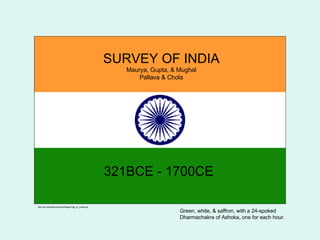
1. SURVEY OF INDIA Maurya, Gupta, & Mughal Pallava & Chola 321BCE - 1700CE http://en.wikipedia.org/wiki/Image:Flag_of_India.svg Green, white, & saffron, with a 24-spoked Dharmachakra of Ashoka, one for each hour.
3. ASHOKA & THE MAURYA EMPIRE http://en.wikipedia.org/wiki/Image:Ashoka2.jpg 304 - 232BCE -Ashoka the Great after witnessing the destruction he caused with the Kalinga war. “ What have I done?” http://en.wikipedia.org/wiki/Image:MauryanCoin.JPG Punch-mark coins of silver, showing Buddhist symbols like the elephant, the dharmachakra, the Bodhi tree, and burial mound. http://en.wikipedia.org/wiki/Image:EdictsOfAshoka.jpg Image courtesy PHGCOM Photo courtesy Rajeev Kumar http://en.wikipedia.org/wiki/Image:Asokanpillar2.jpg A pillar edict containing Buddhist-related messages. Buddhist Period http://en.wikipedia.org/wiki/Emblem_of_India Image courtesy Miljoshi
4.
5. SANCHI Source: Monuments of India Images courtesy Michael D. Gunther / www.art-and-archaeology.com Stupas, or “heaps” from the Sanskrit and Pali translations, were mounds of earth covered in masonry (bricks and stones) that were hemispherical in form. These funerary structures also could contain Buddhist relics. The “evolution” of the stupa can be seen in architectural forms in China, Korea, Sri Lanka, SE Asia, Tibet, and even Japan (pagodas). Aniconism
6. http://en.wikipedia.org/wiki/Image:Giant_Wild_Goose_Pagoda.jpg Giant Wild Goose Pagoda: Xi’an, China Photo courtesy Alex Kwok Photo courtesy Michael Reeve http://en.wikipedia.org/wiki/Image:Temple_Miruksa.jpg Mireuksa Jiseoktap: Iksan, South Korea Photo courtesy Hyo lee http://en.wikipedia.org/wiki/Image:Bangkok_Grand_Palace.JPG Photo courtesy Luca Gorlero Wat Phra Kaeo: Bangkok, Thailand http://en.wikipedia.org/wiki/Image:Shwedagon-Pano.jpg Photo couresy Ralf-André Lettau Shwedagon Zedi Daw: Yangon, Burma Toji Gojyunotou: Kyoto, Japan http://commons.wikimedia.org/wiki/Image:Toji-temple-kyoto.jpg FROM STUPA TO PAGODA Mahayana & Theravada http://en.wikipedia.org/wiki/Image:Pha_That_Luang%2C_Vientiane%2C_Laos.jpg Pha That Luang: Vientiane, Laos Photo courtesy Aaron Smith
7. PAGODA: MODERN DERIVATIVES http://en.wikipedia.org/wiki/Image:101.portrait.altonthompson.jpg Taipei 101: Taipei, Taiwan Photo courtesy Alton.arts http://en.wikipedia.org/wiki/Image:Torres_Petronas_Mayo_2004.jpg Petronas Towers: Kuala Lumpur, Malaysia Photo courtesy Ángel Riesgo Martínez http://en.wikipedia.org/wiki/Image:Skyscrapercompare.svg Image courtesy Greyengine5 & Antilived
8. AJANTA CAVES http://en.wikipedia.org/wiki/Image:Aurangabad_-_Ajanta_Caves_%2836%29.JPG http://en.wikipedia.org/wiki/Image:Aurangabad_-_Ajanta_Caves_%2855%29.JPG http://en.wikipedia.org/wiki/Image:Ajanta_viewpoint.jpg Photo courtesy Ashok http://en.wikipedia.org/wiki/Image:Indischer_version3.jpg Pigments were applied on wet plaster so as to absorb the color, and not peel. The works are known as the ‘Jataka Tales’, and depict Buddhist legends and gods. The rock surface of the caves was chiseled to give it a rough surface so that the plaster would stick. Although construction is Maurya, the paintings are Gupta. 2nd Century BCE Ajanta is monastery with both chaitya - grihas (monuments) and viharas (residence halls).
9. SAMUDRAGUPTA & THE GUPTA EMPIRE Hindu Period http://en.wikipedia.org/wiki/Image:SamudraguptaCoin.jpg The Golden Age The Gupta period, often referred to as the “Golden Age of India”, was quite similar to the Edo period in Japan, in that it was peaceful and secure, enabling the development of the arts (painted murals of Ajanta), music, and poetry written in Sanskrit (the official language of the empire). Science, mathematics, religion, philosophy and astronomy were other areas of development. Achievements: Over 120 surgical instruments Higher education (Nalanda University) Arabic Numerals Absence of capital punishment Advancements in Algebra Development of ‘Zero’ and ‘Infinity’ Samadragupta Gold Dinars (coins) were composed of eight types, all pure gold. Kumaragupta http://en.wikipedia.org/wiki/Image:KumaraguptaFightingLion.jpg Chandragutpa II http://en.wikipedia.org/wiki/Image:ChandraguptaIIOnHorse.jpg Photos courtesy PHGCOM http://en.wikipedia.org/wiki/Image:Iron-pillar.jpg The mysterious Iron Pillar Photo courtesy Nataraja
10. Photos courtesy Bryonic501 http://www.flickr.com/photos/byronic501/ DASHAVATARA TEMPLE Moksha Panel Lakshmi & Vishnu The 5 Pandav Brothers Located in Orissa, the temple is a cubic cella. It is a holy place called garbha griha (womb chamber) covered with sculptured panels depicting Hindu myths about Krishna, Ram, Vishnu, Nara, and Narayana. Being a residence of a god, Deogarh causes us to question basic assumptions of architecture.
11.
12.
13.
14. KHAJURAHO Hindu and Jain temples in North Central India, built between 950-1050CE. The temples are famous for their erotic sculpture. http://en.wikipedia.org/wiki/Image:Kandariya_mahadeva_temple.jpg Kandariya Mahadeva Temple is the most ornate, and the largest temple of the complex. It is one of the most popular tourist sites in all of India.
15. Shah Jahan & The Taj Mahal Photo courtesy Amal Mongia http://en.wikipedia.org/wiki/Image:TajMahalbyAmalMongia.jpg AKBAR & THE MOGHUL EMPIRE Islamic Period (Monotheism) To be discussed with Islam…
16. AKBAR & THE MOGHUL EMPIRE 'Lal Haveli’ - The Red Fort (bungalow) of Agra Photo courtesy Vasant Dave http://commons.wikimedia.org/wiki/Image:RedFortAgra-Jahangir-Mahal-20080211-3.jpg Photos courtesy Hans A. Rosbach http://commons.wikimedia.org/wiki/Image:RedFortAgra-Jahangir-Mahal-20080211-2.jpg http://commons.wikimedia.org/wiki/Image:RedFortAgra-Jahangir-Mahal-20080211-1.jpg Jahangir Mahal
17. INDIAN FASHIONS A Hindu and a Moslem - 1860, Bengal A Kurta for either men or women, is a long-sleeve collarless shirt, usually fabricated in wool, cotton, or silk depending on the season. http://en.wikipedia.org/wiki/Image:Dom_man2_kurta_eastbengal1860.jpg http://en.wikipedia.org/wiki/Image:Muslim_scholar2_in_kurta1860eastbengal.jpg http://en.wikipedia.org/wiki/Image:Nehru.gif A Nehru jacked has a Mandarin collar, and is for either men or women. http://en.wikipedia.org/wiki/Image:Sherwani.jpg The Sherwani is a long coat that shows influence from the British frock coat. The felt hat is called a Fez .
18. http://en.wikipedia.org/wiki/Image:Sari1847.jpg A Sari is unstitched cloth for females, which is draped over the shoulders, and wrapped around the waist. http://en.wikipedia.org/wiki/Image:Churidar.jpg Churidar pants are visible through transparent skirts. http://en.wikipedia.org/wiki/Image:Jaipur-India_n001.jpg Photo coutesy Steve Evans Symbols of modesty, Dupatta scarves over Salwar Kameez. INDIAN FASHIONS http://en.wikipedia.org/wiki/Image:MoghulWomen2.jpg Choli with lehnga skirt
21. MADURAI: A DRAVIDIAN STYLE http://en.wikipedia.org/wiki/Image:Maduraitemple.jpg Photo courtesy McKay Savage http://commons.wikimedia.org/wiki/Image:Madurai_02.jpg Photo courtesy Bernard Gagnon Minakshi Sundareshvara Temple (1623-1659) is located in Madurai, an historic temple city in the south of India. The architecture of Southern India is often referred to as ‘Dravidian’ as opposed to the Northern style known as ‘ Nagara’ . The ornate towers of the complex are known as Gopurams . They are stucco, painted with vivid polychrome pigments. Visitors walk amongst the granite columns of the portico.
22. Temple Complex Plan Image courtesy Michael D. Gunther / www.art-and-archaeology.com MADURAI: A DRAVIDIAN STYLE
23.
24. Questions 1.Who was Ashoka the Great? 2. What is a Gopuram? Where is it used? 3. What is the chronological order of these 5 empires? Gupta, Mughal, Maurya, Pallava, Chola 4. What is the function of a stupa? Materials? How did it evolve over time? 5. Can you give an example of Hindu architecture? What features does it have? 6. What domestic materials were used for Indian fashion? 7. Name some of the leit-motifs used in Indian design. Do they have symbolic meaning? 8. Explain the term Dravidian. What is an example of Dravidian design? 9. What are some differences between Buddhism and Hinduism? 10. How is the Mandala used in design?