Philosophy of Big Data:
Big Data, the Individual, and Society
Melanie Swan
m@melanieswan.com

January 24, 2013
Microsoft, Mountain View CA
Slides: http://slideshare.net/LaBlogga
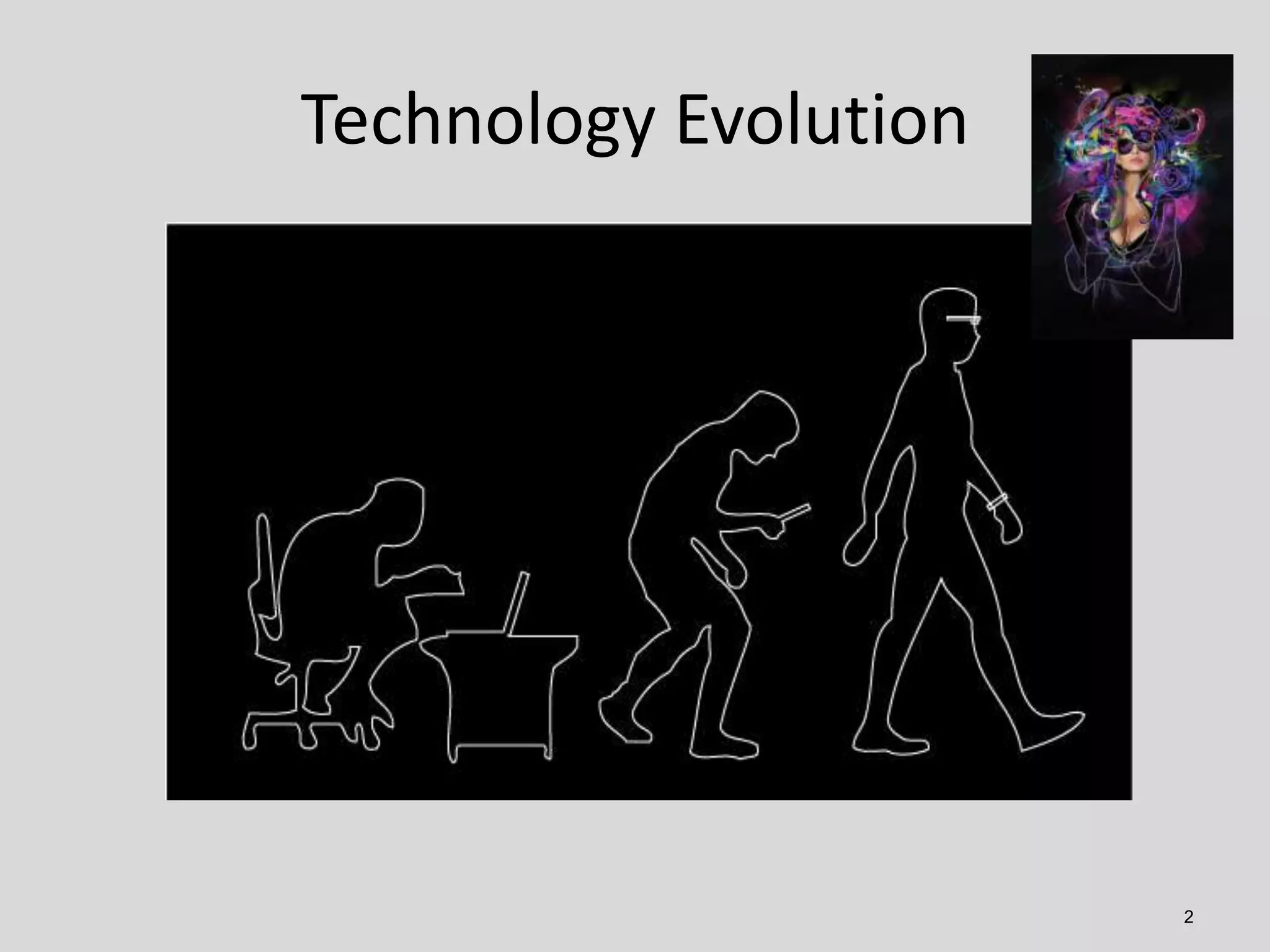
Technology Evolution

2
Data

Big Data!
3
Big Data
What is it?
Biggest hope?
Biggest fear?
4
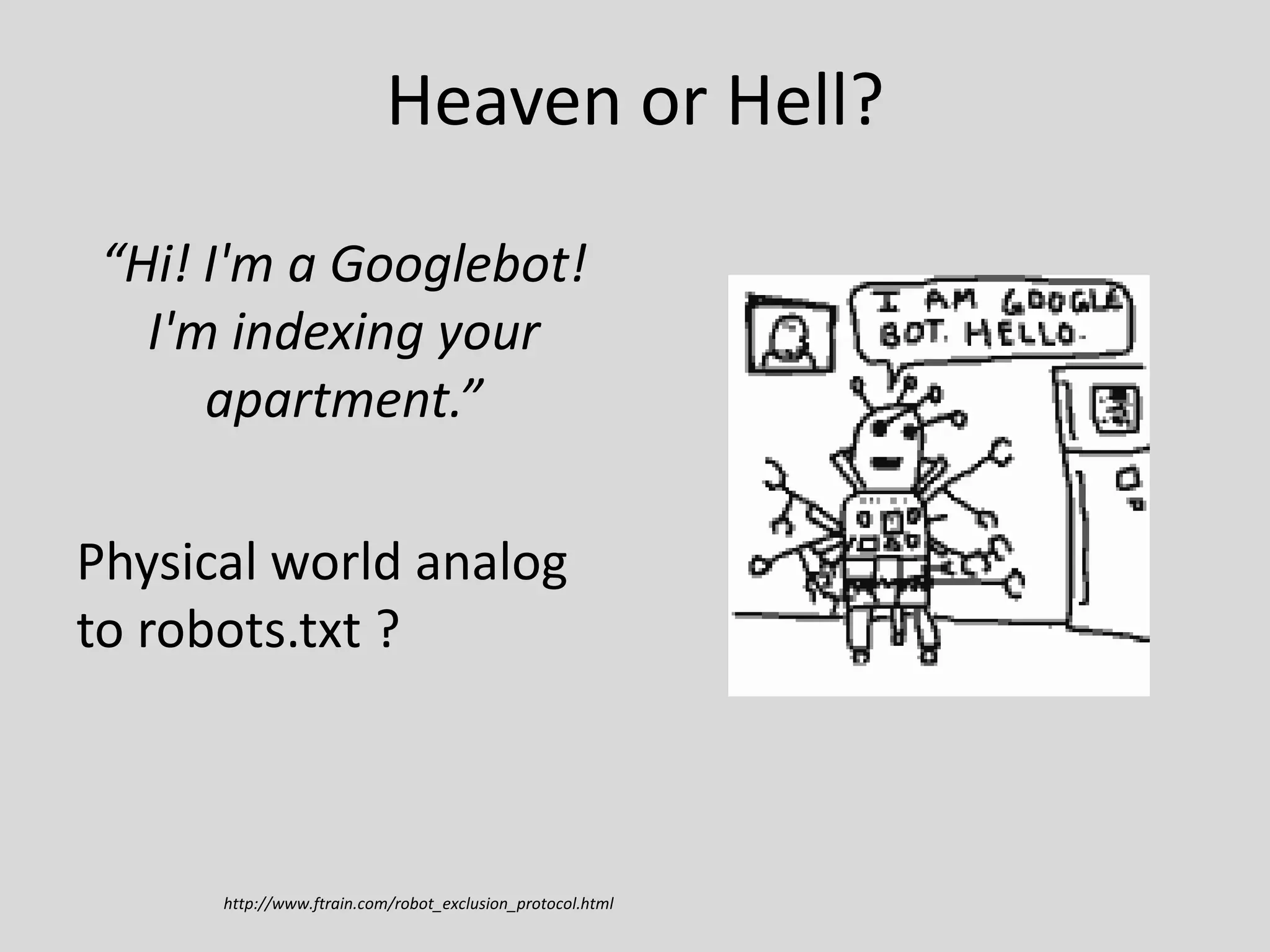
Heaven or Hell?
“Hi! I'm a Googlebot!
I'm indexing your
apartment.”

Physical world analog
to robots.txt ?

http://www.ftrain.com/robot_exclusion_protocol.html
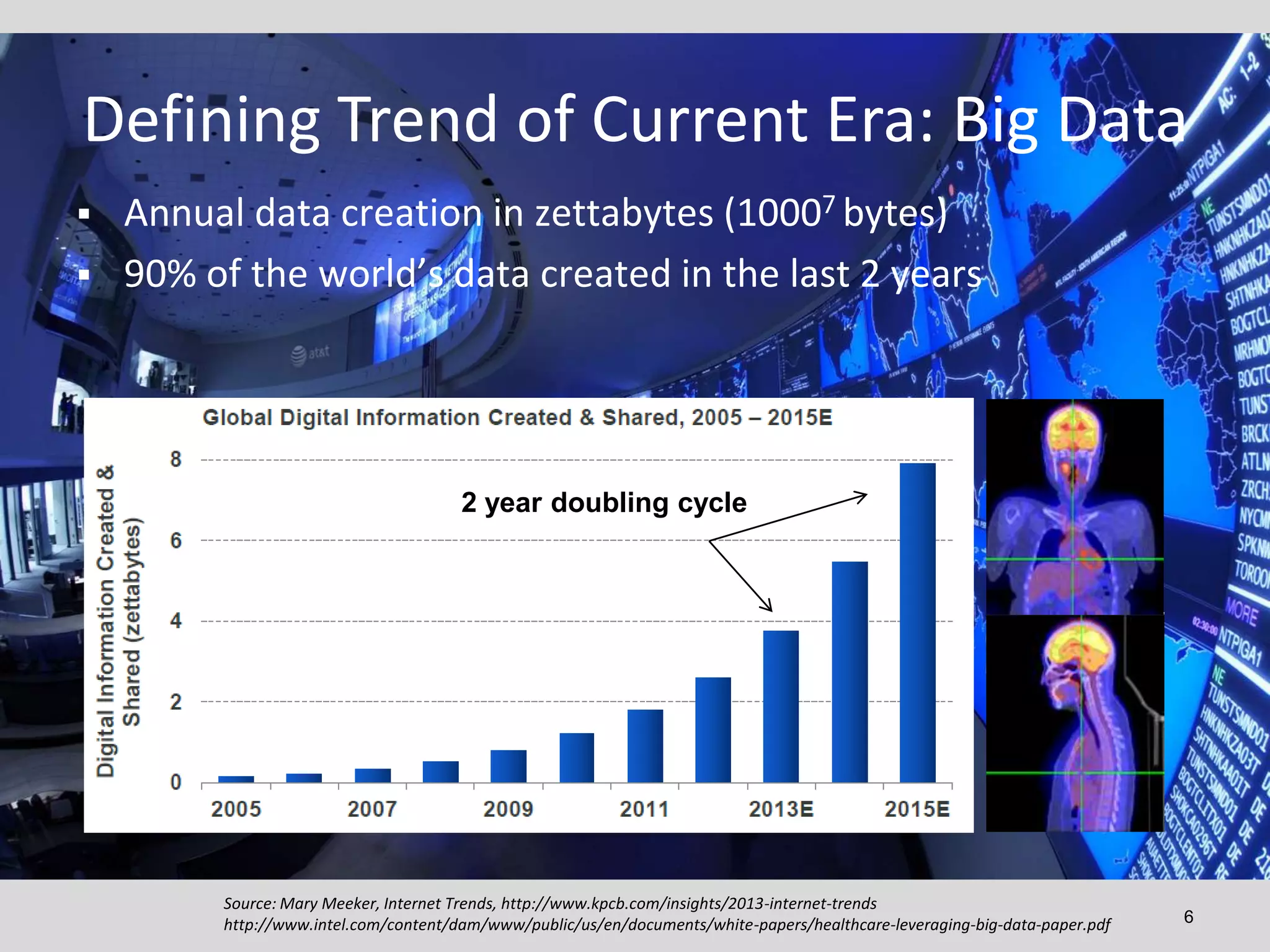
Defining Trend of Current Era: Big Data



Annual data creation in zettabytes (10007 bytes)
90% of the world’s data created in the last 2 years

2 year doubling cycle

Source: Mary Meeker, Internet Trends, http://www.kpcb.com/insights/2013-internet-trends
http://www.intel.com/content/dam/www/public/us/en/documents/white-papers/healthcare-leveraging-big-data-paper.pdf

6
Big Data Composition
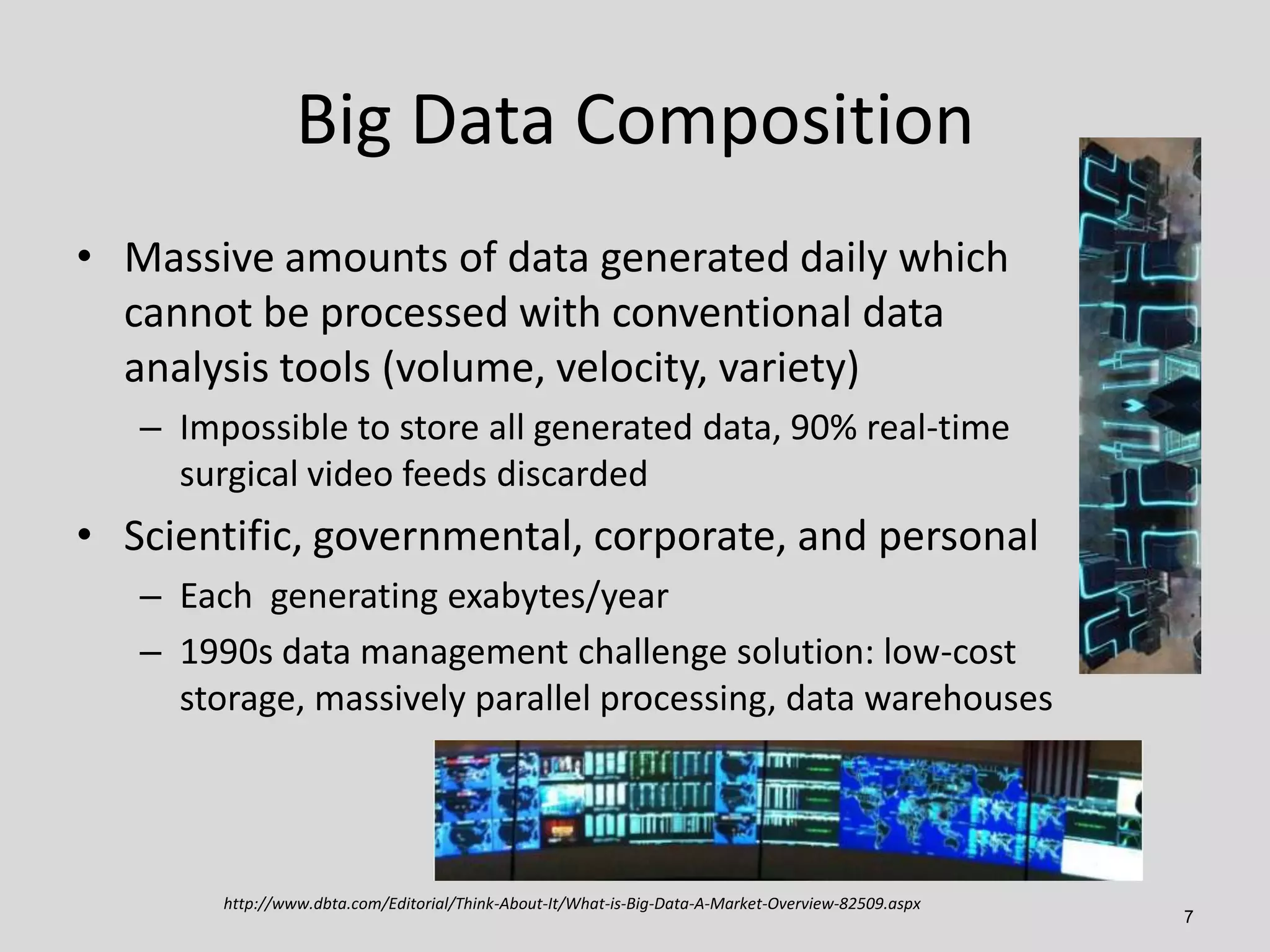
• Massive amounts of data generated daily which
cannot be processed with conventional data
analysis tools (volume, velocity, variety)
– Impossible to store all generated data, 90% real-time
surgical video feeds discarded

• Scientific, governmental, corporate, and personal
– Each generating exabytes/year
– 1990s data management challenge solution: low-cost
storage, massively parallel processing, data warehouses

http://www.dbta.com/Editorial/Think-About-It/What-is-Big-Data-A-Market-Overview-82509.aspx

7
Typical Big Data Problems
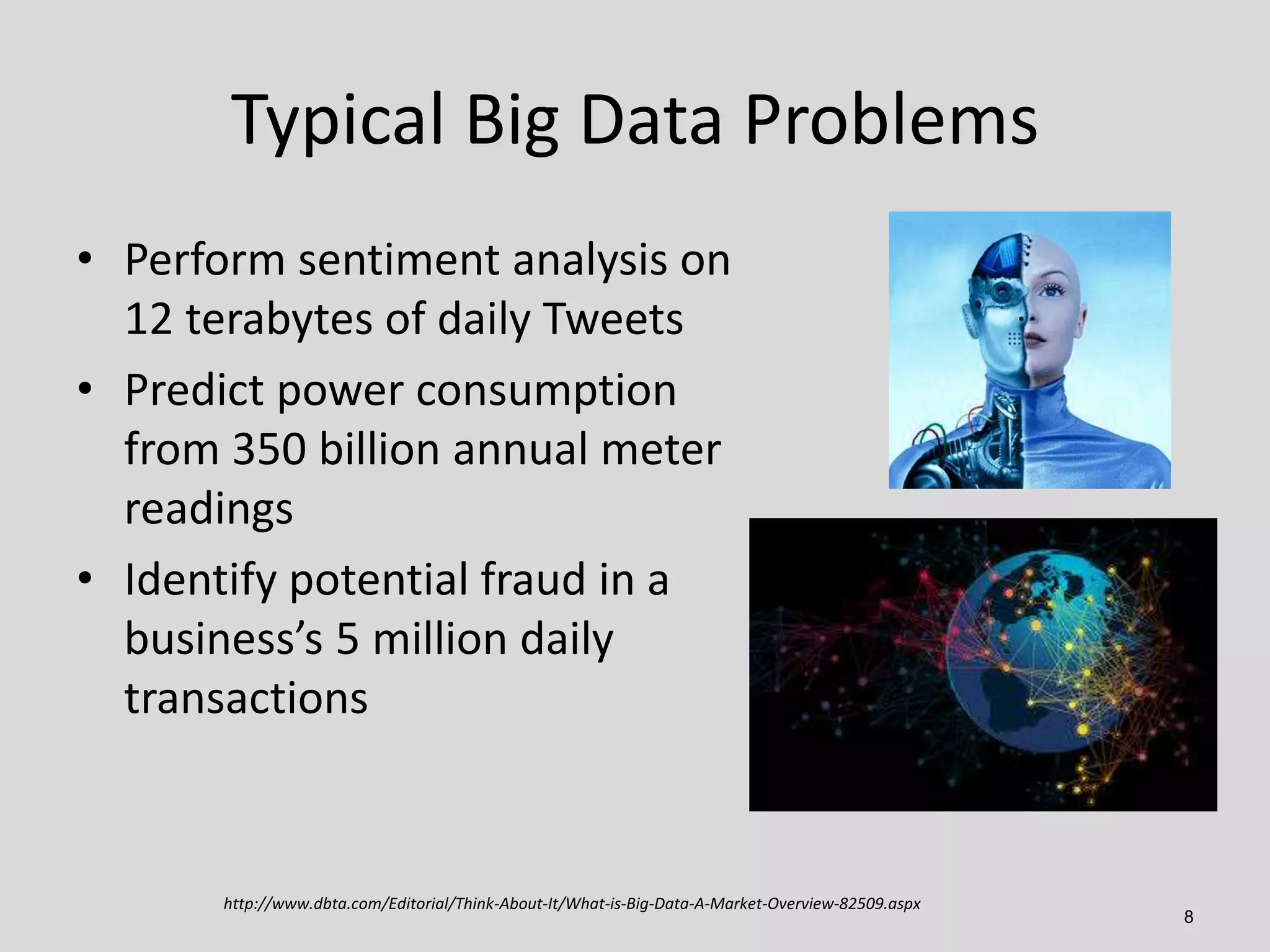
• Perform sentiment analysis on
12 terabytes of daily Tweets
• Predict power consumption
from 350 billion annual meter
readings
• Identify potential fraud in a
business’s 5 million daily
transactions

http://www.dbta.com/Editorial/Think-About-It/What-is-Big-Data-A-Market-Overview-82509.aspx

8
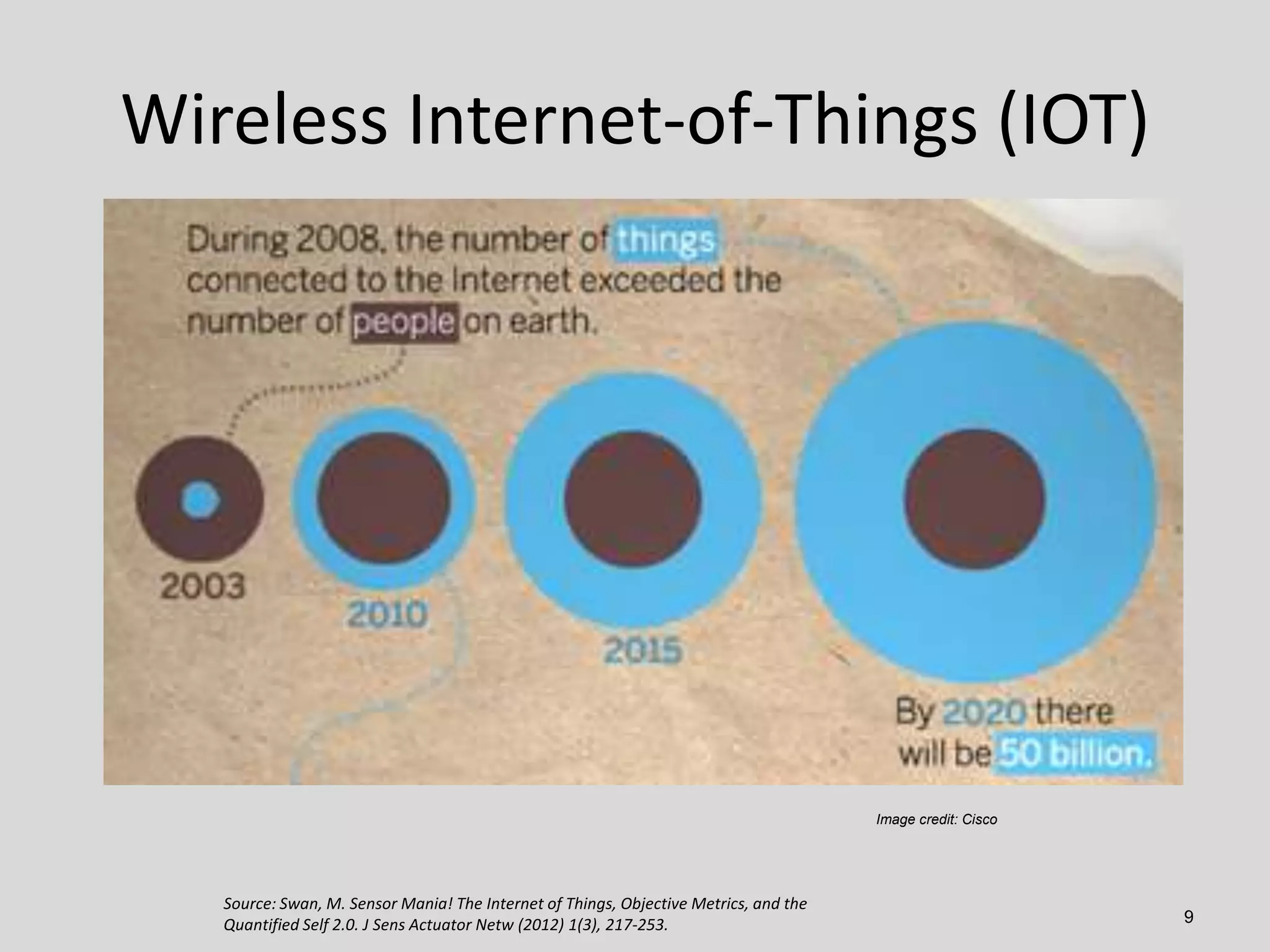
Wireless Internet-of-Things (IOT)

Image credit: Cisco

Source: Swan, M. Sensor Mania! The Internet of Things, Objective Metrics, and the
Quantified Self 2.0. J Sens Actuator Netw (2012) 1(3), 217-253.

9
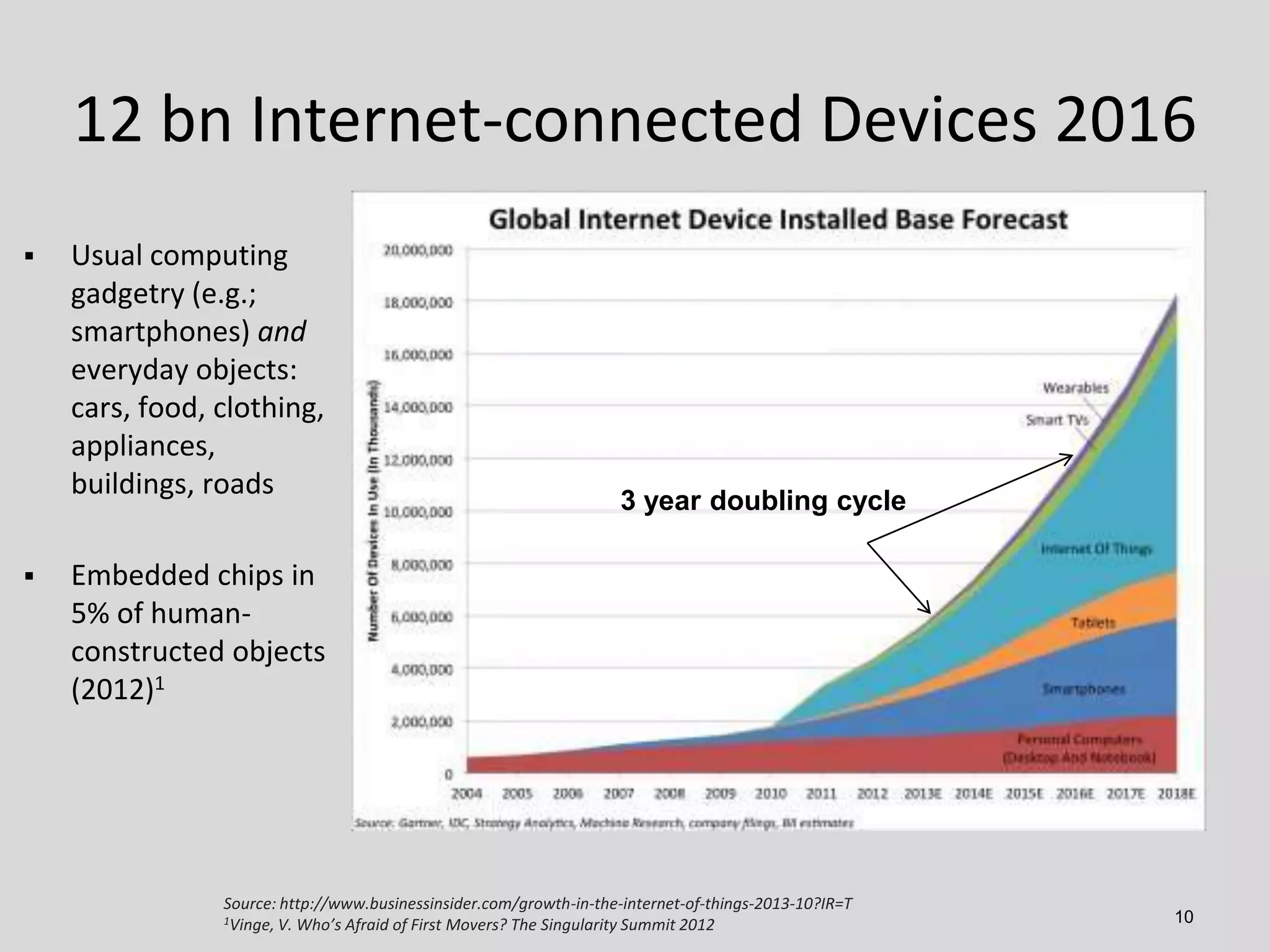
12 bn Internet-connected Devices 2016




Usual computing
gadgetry (e.g.;
smartphones) and
everyday objects:
cars, food, clothing,
appliances,
buildings, roads

3 year doubling cycle

Embedded chips in
5% of humanconstructed objects
(2012)1

Source: http://www.businessinsider.com/growth-in-the-internet-of-things-2013-10?IR=T
1Vinge, V. Who’s Afraid of First Movers? The Singularity Summit 2012

10
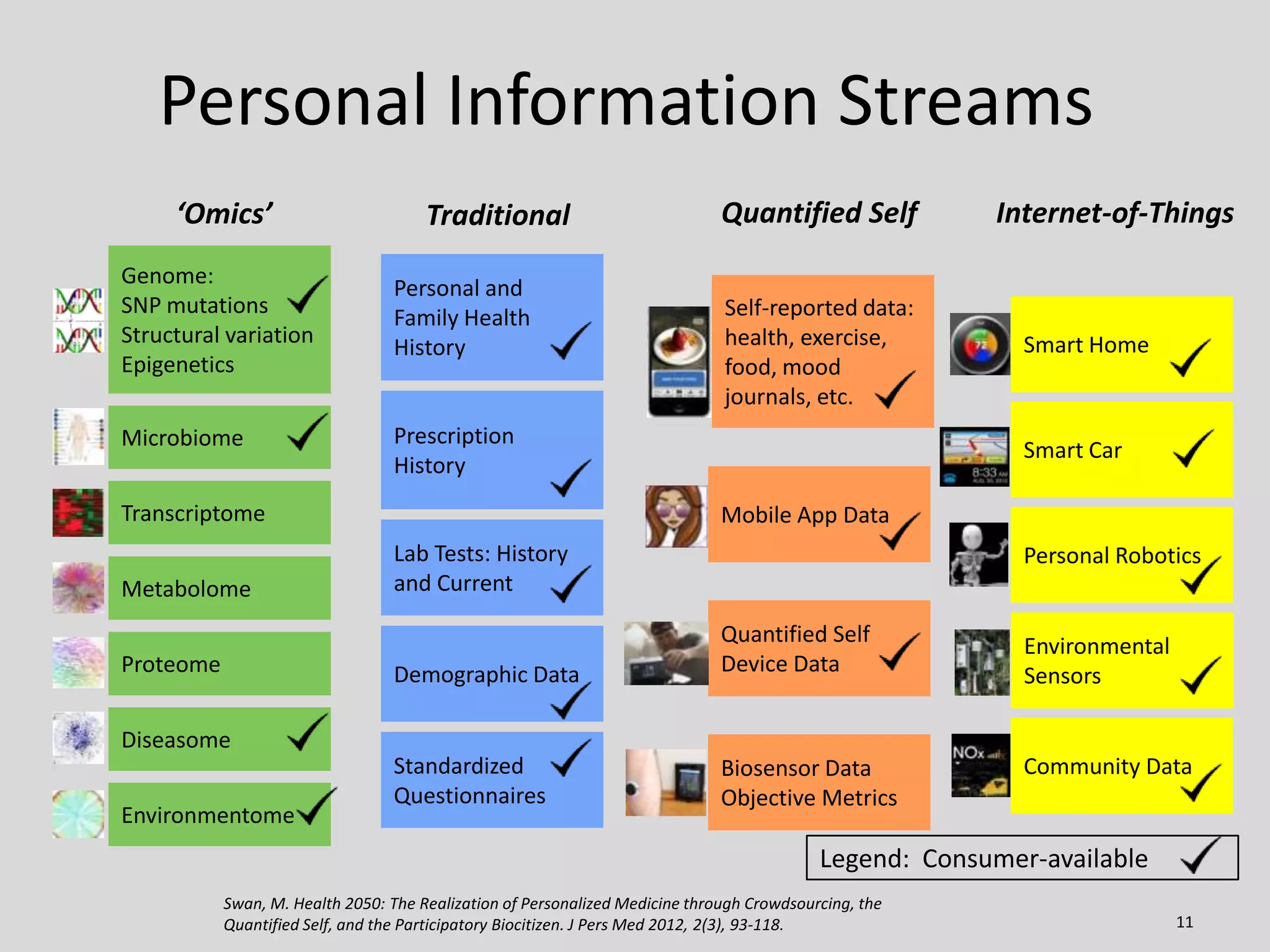
Personal Information Streams
‘Omics’
Genome:
SNP mutations
Structural variation
Epigenetics
Microbiome

Traditional
Personal and
Family Health
History

Self-reported data:
health, exercise,
food, mood
journals, etc.

Prescription
History

Transcriptome
Metabolome

Quantified Self

Internet-of-Things

Smart Home

Smart Car
Mobile App Data

Lab Tests: History
and Current

Personal Robotics

Demographic Data

Proteome

Quantified Self
Device Data

Environmental
Sensors

Standardized
Questionnaires

Biosensor Data
Objective Metrics

Community Data

Diseasome
Environmentome

Legend: Consumer-available
Swan, M. Health 2050: The Realization of Personalized Medicine through Crowdsourcing, the
Quantified Self, and the Participatory Biocitizen. J Pers Med 2012, 2(3), 93-118.

11
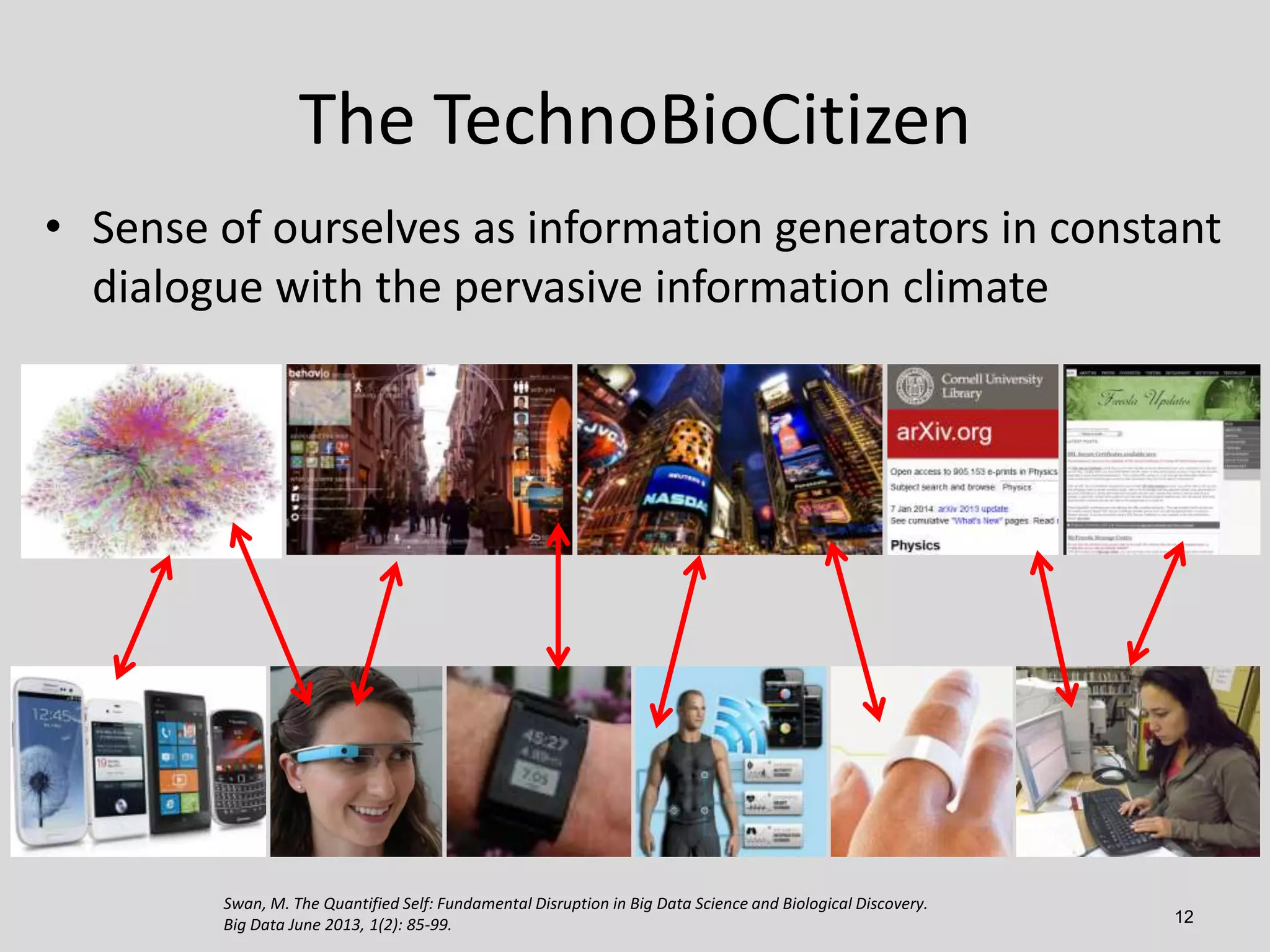
The TechnoBioCitizen
• Sense of ourselves as information generators in constant
dialogue with the pervasive information climate

Swan, M. The Quantified Self: Fundamental Disruption in Big Data Science and Biological Discovery.
Big Data June 2013, 1(2): 85-99.

12
What are Big Data Scientists Saying?
• Jim Harris, Data Science Consultant: beware of
big data fundamentalism; need for data
philosophers
• Evelyn Rupert, Goldsmith’s London, Economies
and Ecologies of Big Data: (dangerous)
normative relation to data ; no reality, just
representation; data is performative
• Grady Booch, IBM Chief Scientist: human and
ethical aspects, tremendous social benefits,
full life-cycle of data, ineffective legal controls
• James Kobielus, IBM Big Data Evangelist: no
‘single version of the truth’; be critical of
beautiful data visualizations and data-driven
narrative stories
13
Big Data

What other kinds of things
is Big Data like?
14
Big Data: Profound Unknown
• Profound, overwhelming,
intangible unknown
• Approaches: how do we deal with
something that is unknown?
• Other vast unknowns
–
–
–
–
–
–

Exploring the ‘new’ world
Space
God/spiritual realm
Disease cure
National debt
Large-project completion
15
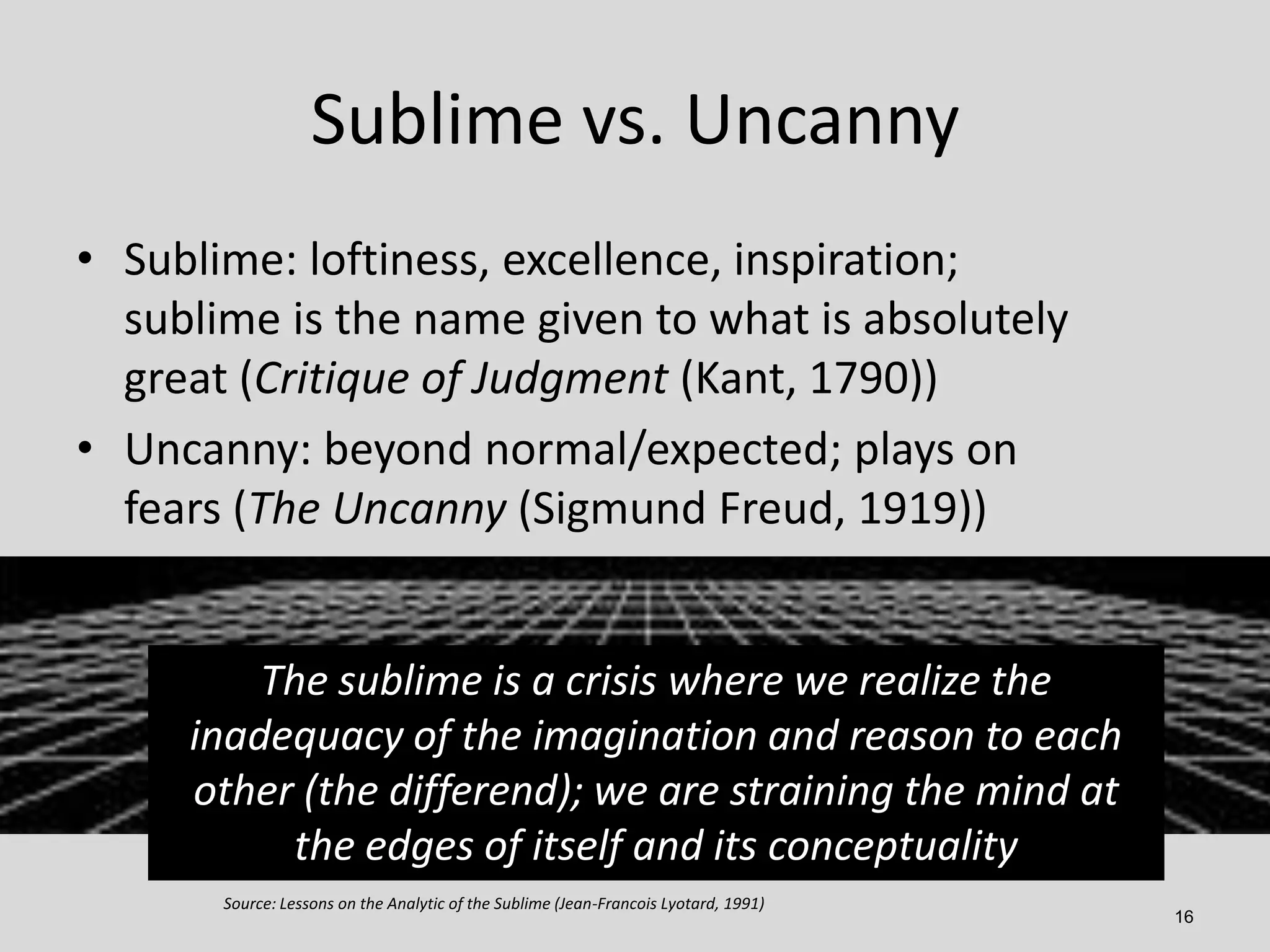
Sublime vs. Uncanny
• Sublime: loftiness, excellence, inspiration;
sublime is the name given to what is absolutely
great (Critique of Judgment (Kant, 1790))
• Uncanny: beyond normal/expected; plays on
fears (The Uncanny (Sigmund Freud, 1919))

The sublime is a crisis where we realize the
inadequacy of the imagination and reason to each
other (the differend); we are straining the mind at
the edges of itself and its conceptuality
Source: Lessons on the Analytic of the Sublime (Jean-Francois Lyotard, 1991)

16
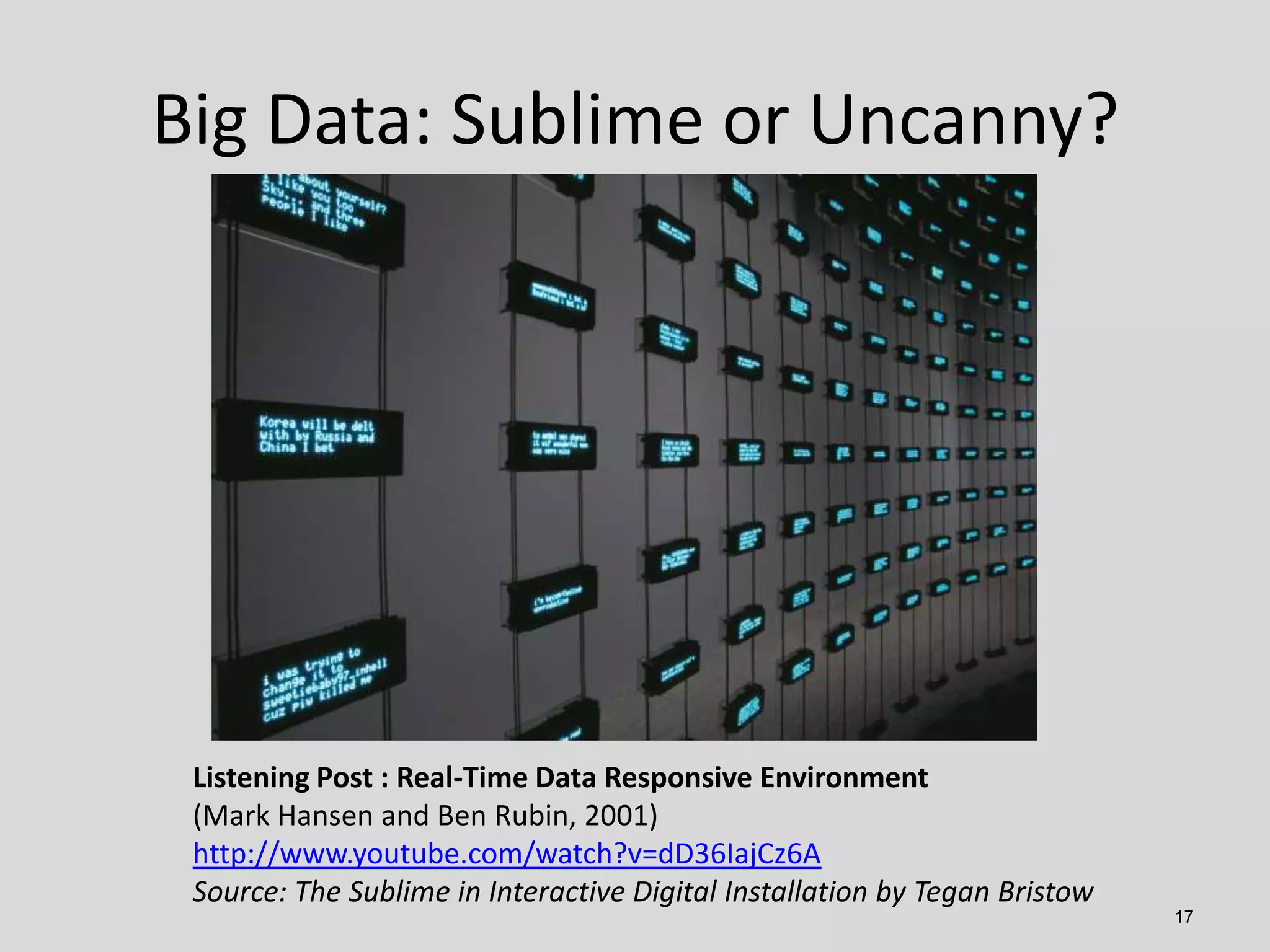
Big Data: Sublime or Uncanny?

Listening Post : Real-Time Data Responsive Environment
(Mark Hansen and Ben Rubin, 2001)
http://www.youtube.com/watch?v=dD36IajCz6A
Source: The Sublime in Interactive Digital Installation by Tegan Bristow
17
Is Big Data Different?
Are there ways in which big data is not part of
the natural ongoing process of making our
world more intelligible and manageable
(collect and exploit information)?

Is there something about big data which is
fundamentally different than animal breeding,
the plow, eyeglasses, the airplane,
computing, and the Internet?
18
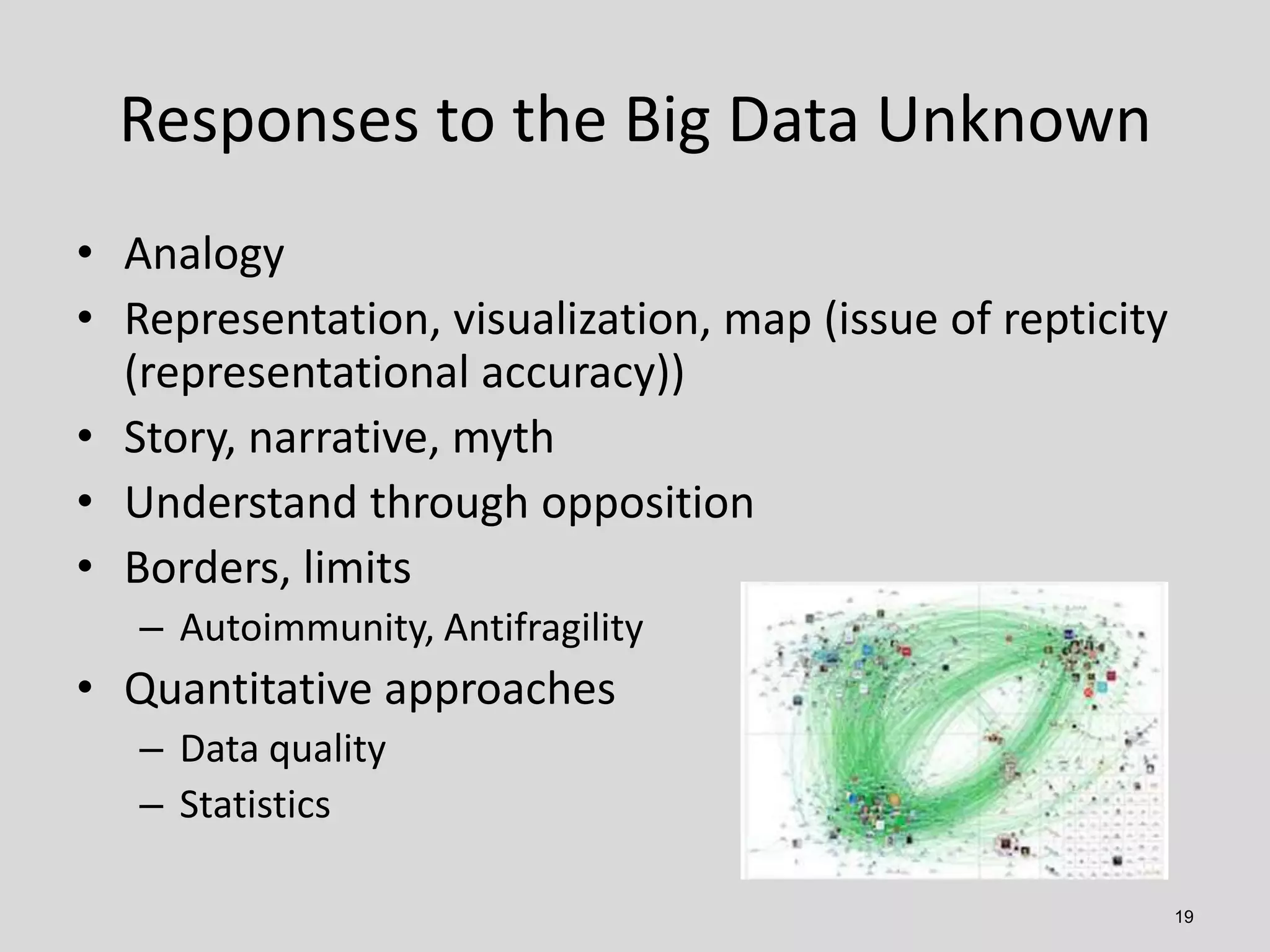
Responses to the Big Data Unknown
• Analogy
• Representation, visualization, map (issue of repticity
(representational accuracy))
• Story, narrative, myth
• Understand through opposition
• Borders, limits
– Autoimmunity, Antifragility

• Quantitative approaches
– Data quality
– Statistics
19
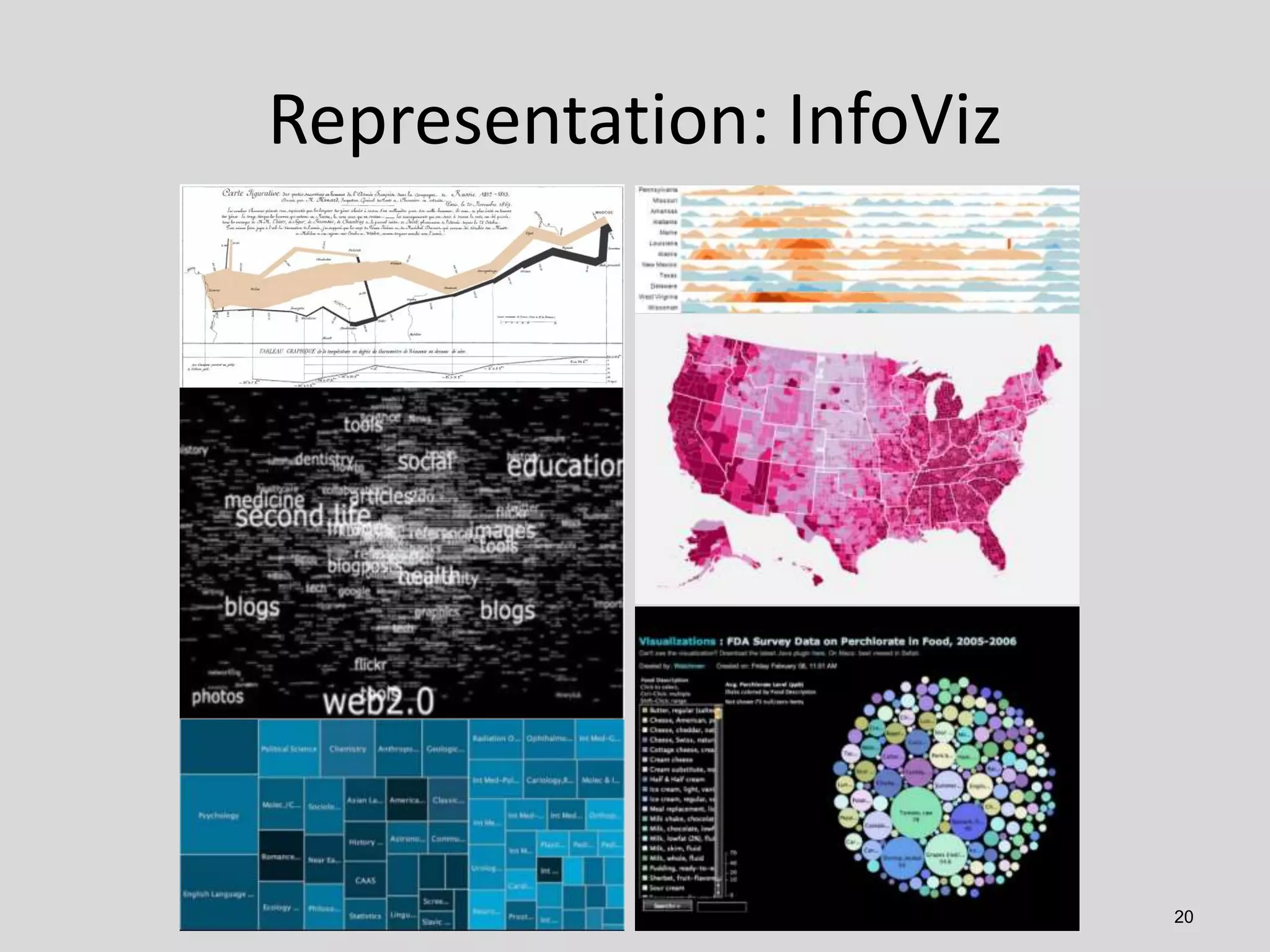
Representation: InfoViz

20
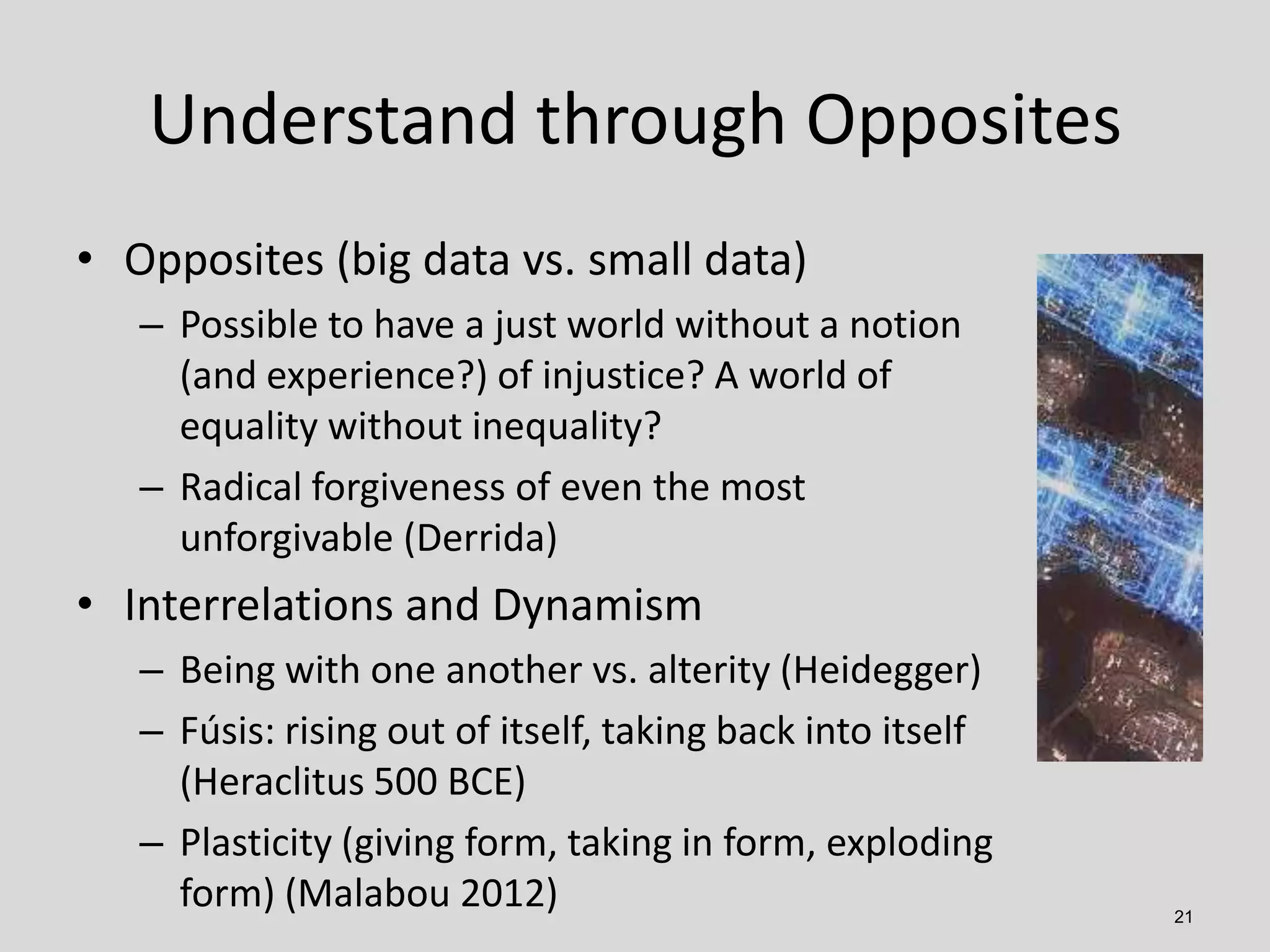
Understand through Opposites
• Opposites (big data vs. small data)
– Possible to have a just world without a notion
(and experience?) of injustice? A world of
equality without inequality?
– Radical forgiveness of even the most
unforgivable (Derrida)

• Interrelations and Dynamism
– Being with one another vs. alterity (Heidegger)
– Fúsis: rising out of itself, taking back into itself
(Heraclitus 500 BCE)
– Plasticity (giving form, taking in form, exploding
form) (Malabou 2012)

21
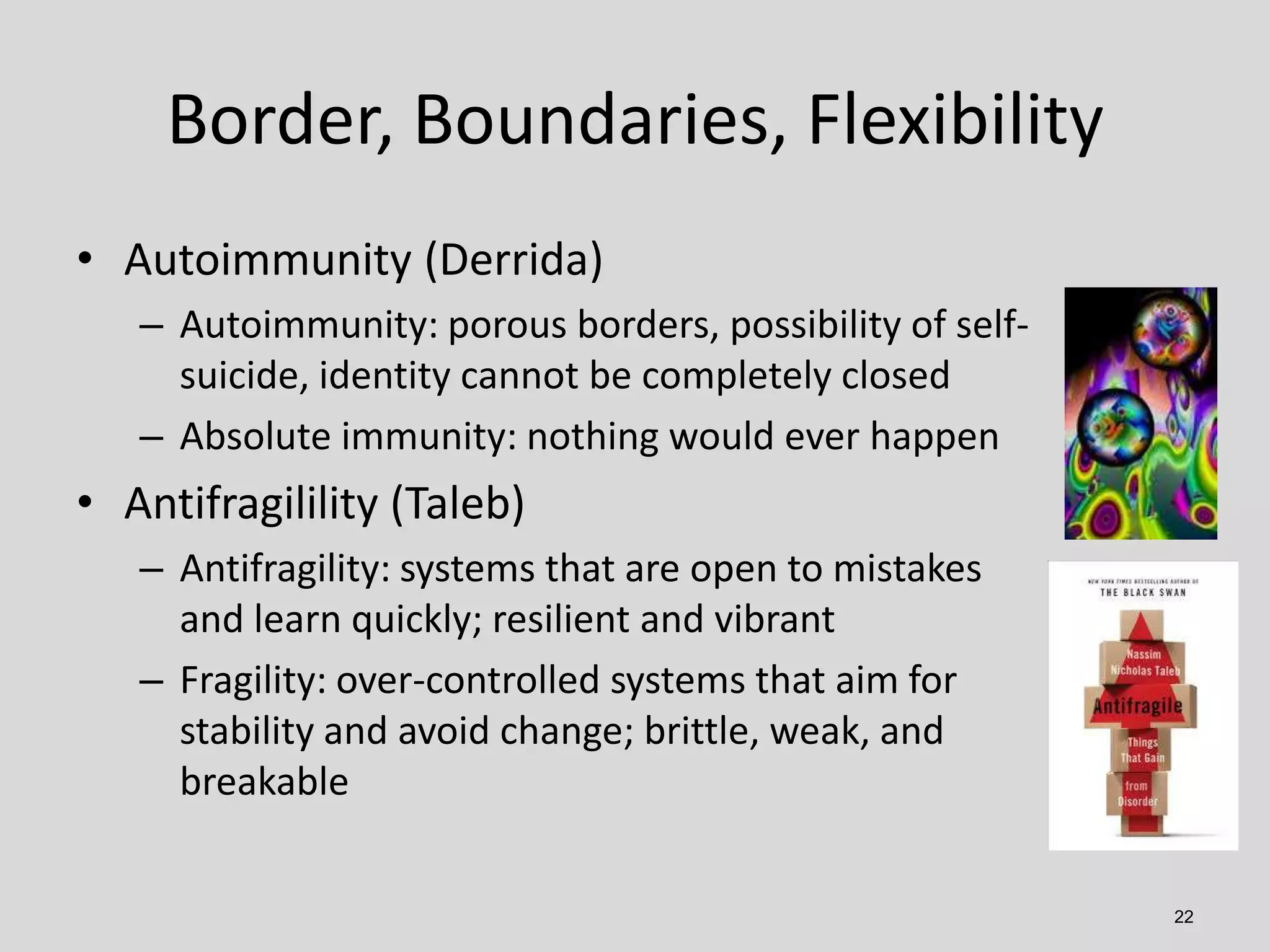
Border, Boundaries, Flexibility
• Autoimmunity (Derrida)
– Autoimmunity: porous borders, possibility of selfsuicide, identity cannot be completely closed
– Absolute immunity: nothing would ever happen

• Antifragilility (Taleb)
– Antifragility: systems that are open to mistakes
and learn quickly; resilient and vibrant
– Fragility: over-controlled systems that aim for
stability and avoid change; brittle, weak, and
breakable
22
Subjectivation in Modern Life
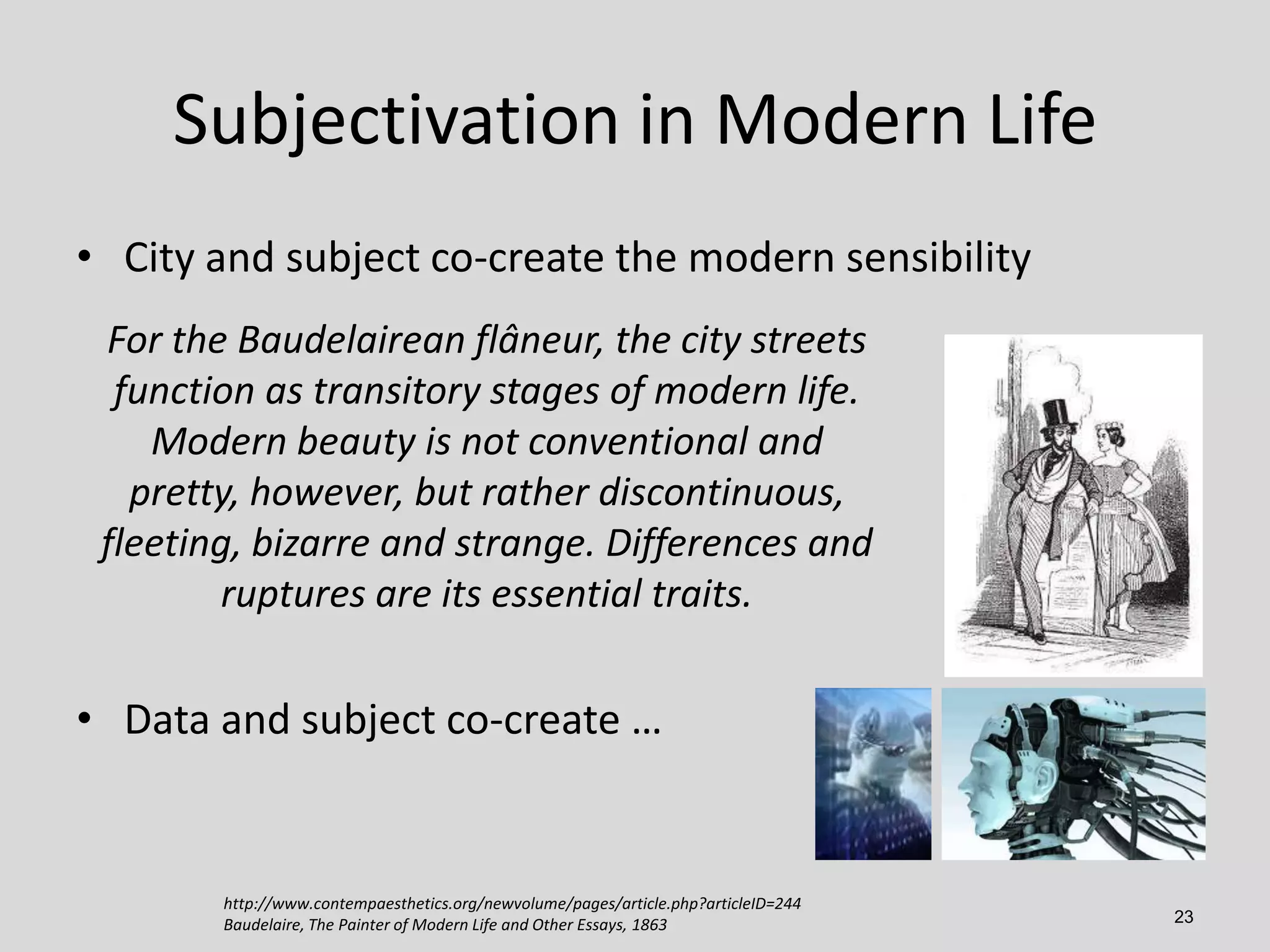
• City and subject co-create the modern sensibility
For the Baudelairean flâneur, the city streets
function as transitory stages of modern life.
Modern beauty is not conventional and
pretty, however, but rather discontinuous,
fleeting, bizarre and strange. Differences and
ruptures are its essential traits.

• Data and subject co-create …

http://www.contempaesthetics.org/newvolume/pages/article.php?articleID=244
Baudelaire, The Painter of Modern Life and Other Essays, 1863

23
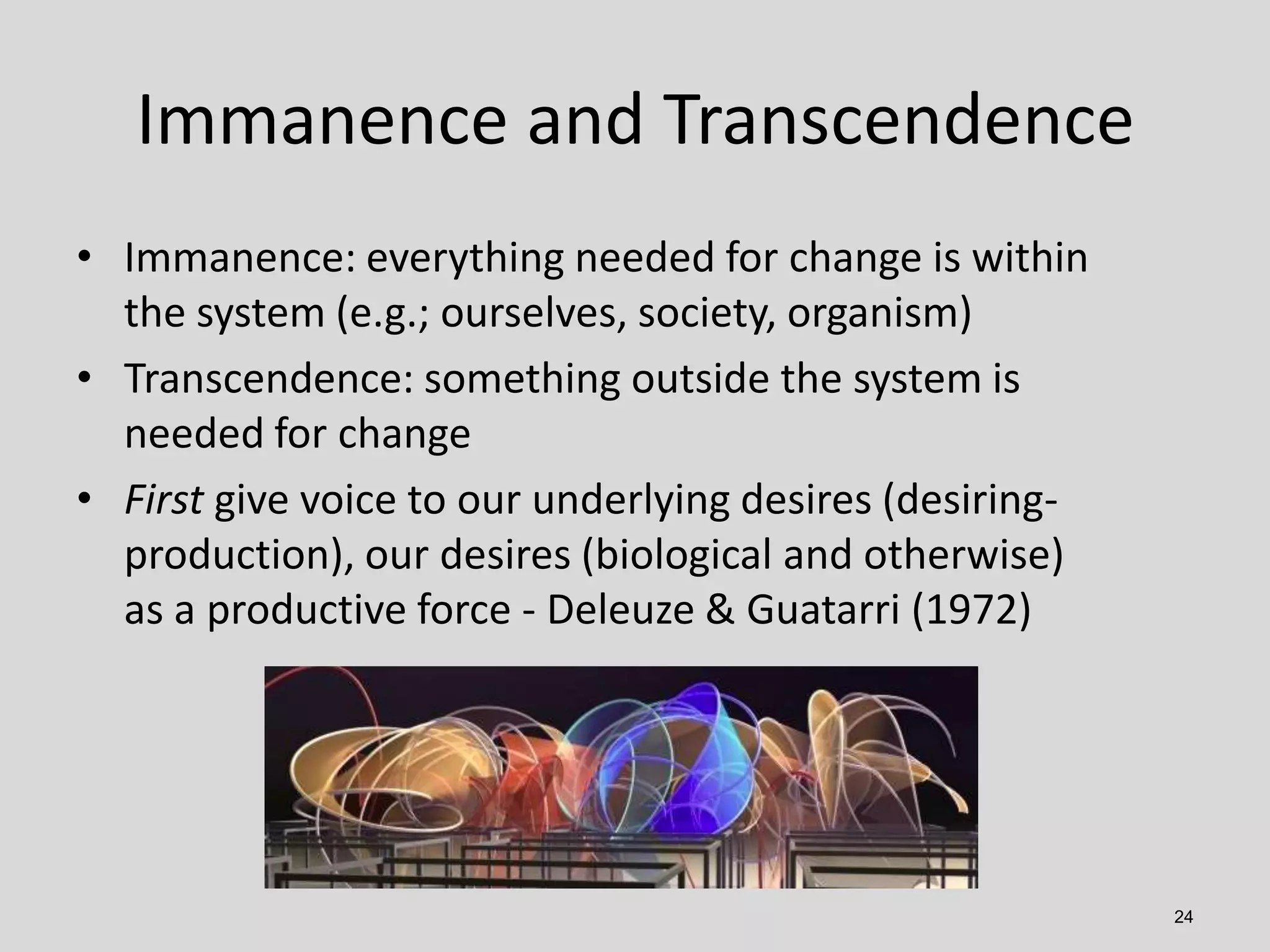
Immanence and Transcendence
• Immanence: everything needed for change is within
the system (e.g.; ourselves, society, organism)
• Transcendence: something outside the system is
needed for change
• First give voice to our underlying desires (desiringproduction), our desires (biological and otherwise)
as a productive force - Deleuze & Guatarri (1972)

24
Living in Harmony: Relation to Others
• Hell is other people – Sartre (1944)
• Desire for recognition; dependence on others for this,
ephemerality; bubble, globe, foam - Sloterdijk (2011)
• Modes of existence – LaTour (2013), Souriau
• Modes of experience, equality techniques - Rancière (2010)
• Group ethics: an honest negotiation between individual
desires (not repression) - Deleuze & Guatarri (1972)

25
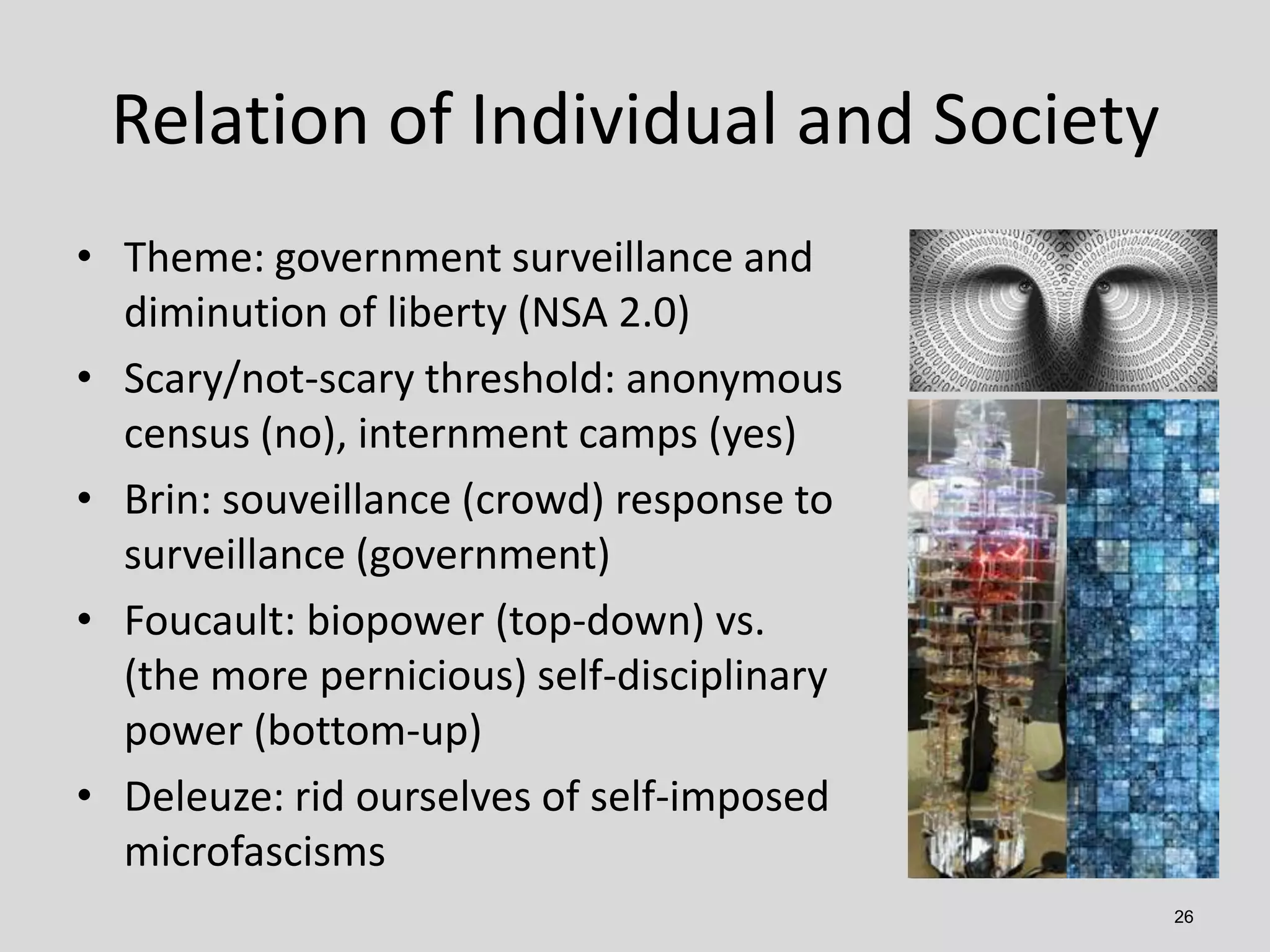
Relation of Individual and Society
• Theme: government surveillance and
diminution of liberty (NSA 2.0)
• Scary/not-scary threshold: anonymous
census (no), internment camps (yes)
• Brin: souveillance (crowd) response to
surveillance (government)
• Foucault: biopower (top-down) vs.
(the more pernicious) self-disciplinary
power (bottom-up)
• Deleuze: rid ourselves of self-imposed
microfascisms
26
We are in a world that is fundamentally changing

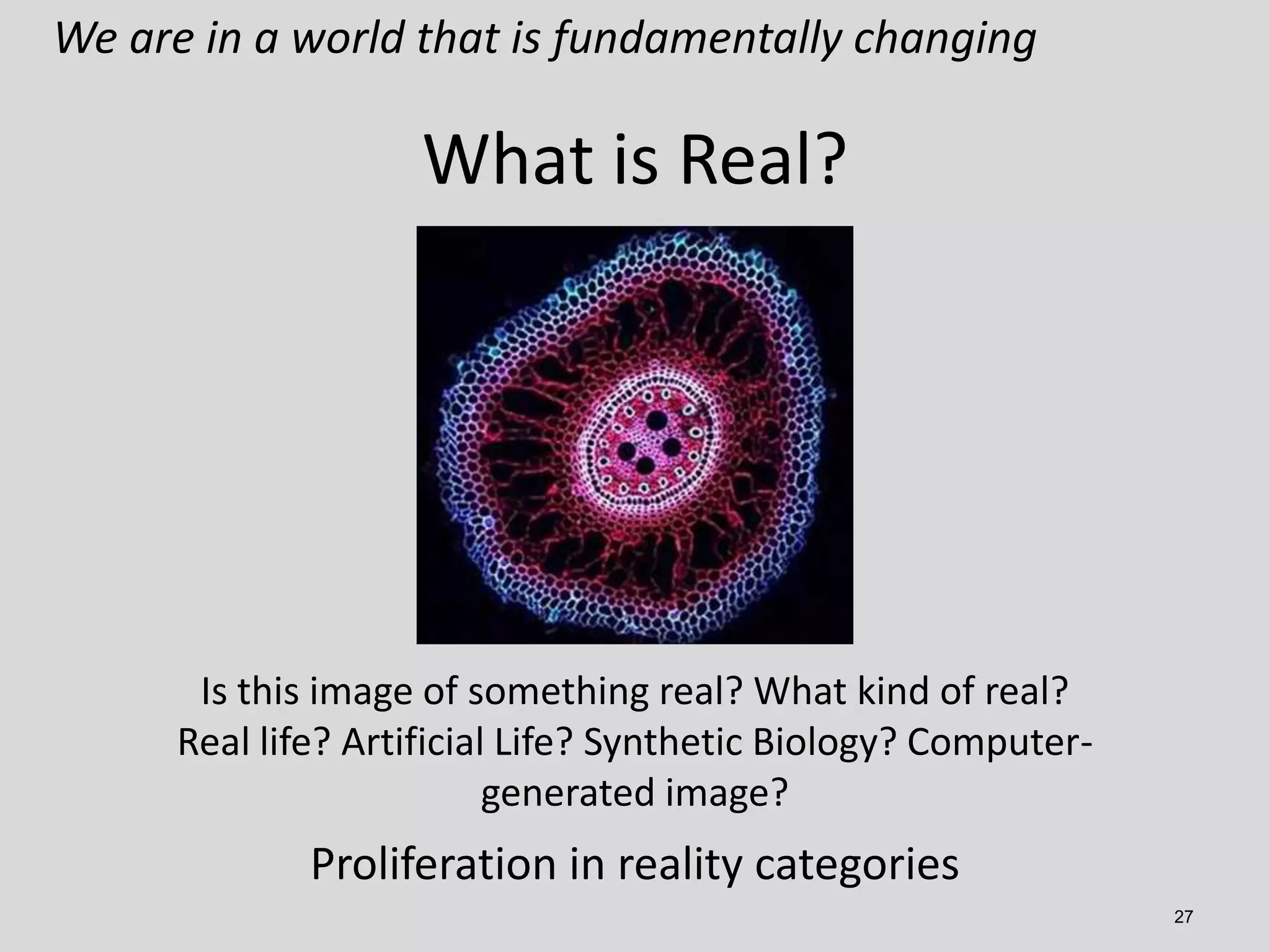
What is Real?

Is this image of something real? What kind of real?
Real life? Artificial Life? Synthetic Biology? Computergenerated image?

Proliferation in reality categories
27
Wholly new relation to Information
– Formerly everything signal, now 99% noise
– Exception, variability, probability, patterns, prediction
– New kinds of information
• Longitudinal baseline measures, normal deviation
patterns, contingency adjustments, anomaly, emergence
• Multiple data analysis paradigms: time, frequency,
episode, cycle
• New kinds of models (supplementing the scientific method)
– Machine learning, hierarchical representation, neural
networks, information visualization

Source: Swan, M. The Quantified Self. Big Data (2013) 1(2): 85-99.
A New World of Futurity
• Shifting from focus on the past (known) and the
present (measurable) to the future (predictable)
• Increasing importance of math and heuristics
– Statistics: mode, mean, variance, outliers
– Probability: quantum mechanics, semiconductors,
nanomaterials, financial markets, disease risk,
preventive medicine

• Systemic, dynamic, episodic, chaotic worldviews
• Collaboration especially drawing upon
crowdsourced communities
Source: Kido, Swan, et al. Systematic evaluation of personal genome services. Nature: Journal of
Human Genetics (2013) 58, 734–741.

29
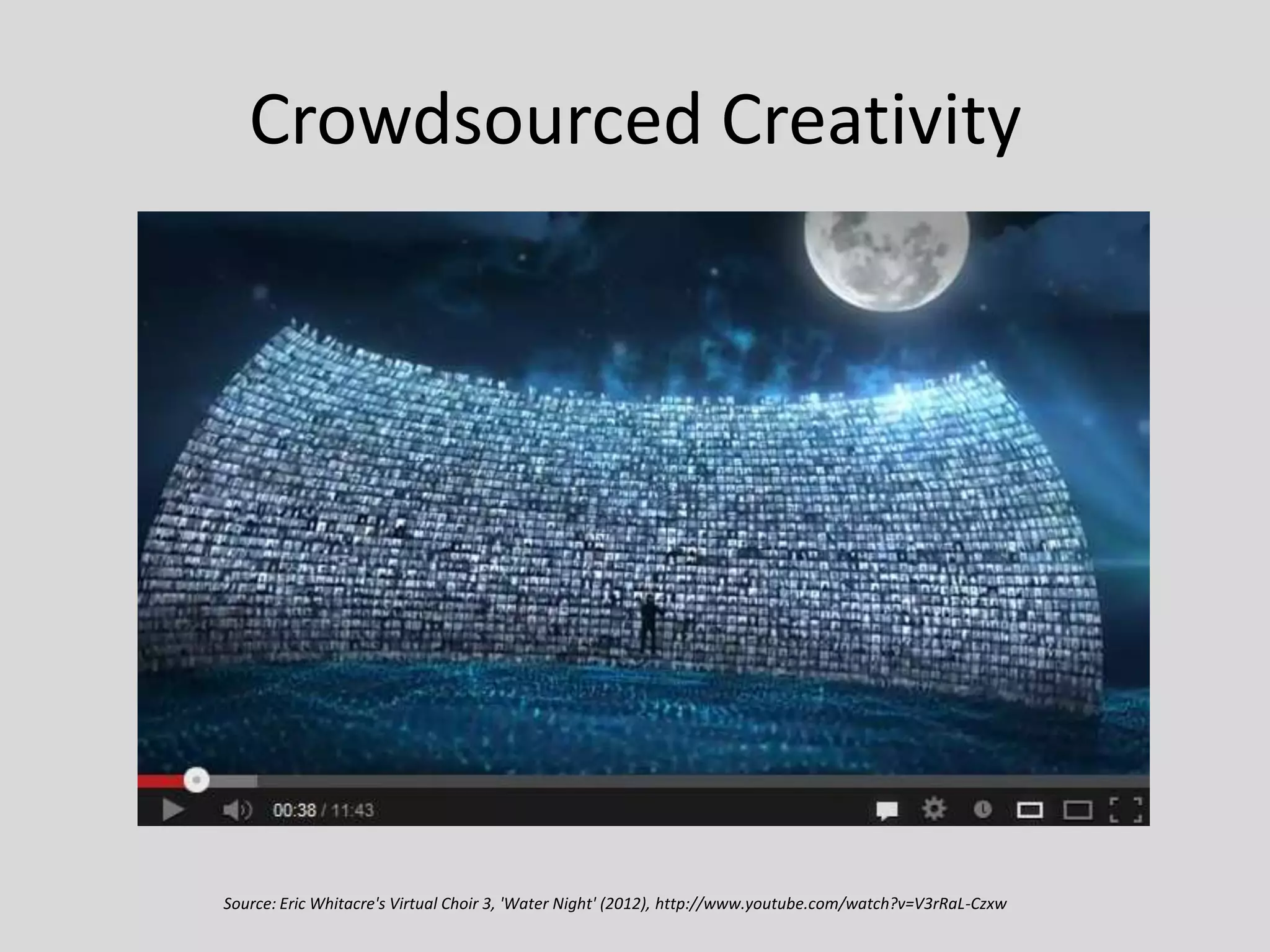
Crowdsourced Creativity

Source: Eric Whitacre's Virtual Choir 3, 'Water Night' (2012), http://www.youtube.com/watch?v=V3rRaL-Czxw
Summary: Science and Society
Summary
• Big Data as a profound, intangible, pervasive
feature of life requiring novel representation
• Big Data as the inspiration for a new
• New era of scientific discovery with a greatly
formation and sensibility of ourselves as
expanded range of possibilities due to big data,
TechnoBiocitizens in a collaborative society
computation, and big data:participation our
• Philosophy of crowd centrally about
relation to technology

• Our attunement to to technology as an enabling
Our attunement technology as an enabng
background helps us see the possibilities true
background helpsus see the possibilities for thefor the
meaningfulness of our being - Heideg
true meaningfulness of our being - Heidegger
Source: Heidegger, M. The Question Concerning Technology (1954)

31
Technology Futures Institute
http://melanieswan.com/TFI.html

32
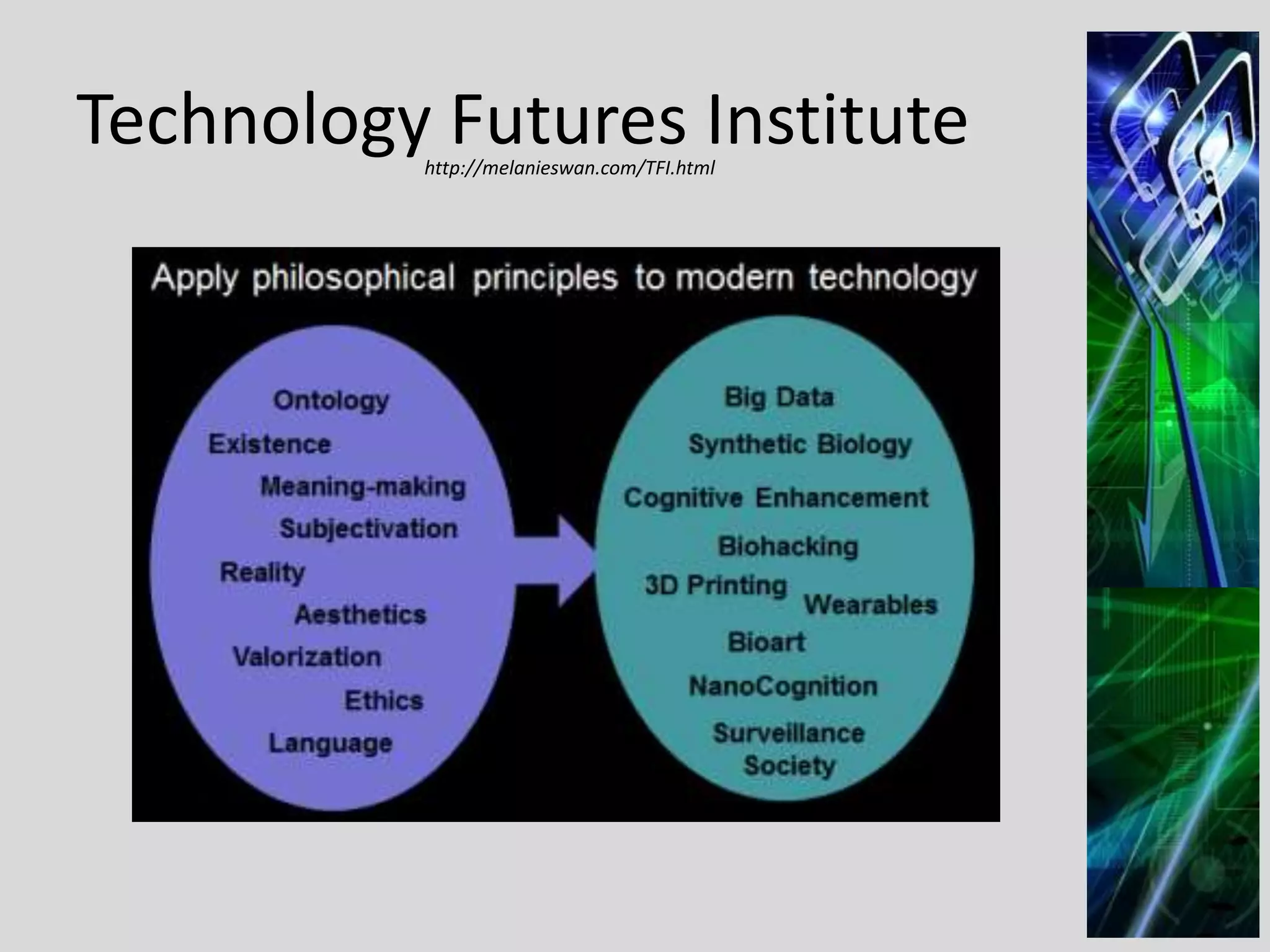
Technology Futures Institute
http://melanieswan.com/TFI.html

• Mission: use philosophy to improve the rigor of our
thinking about science and technology
• Sample Projects
– Ethics of Perception in Nanocognition – Perception is a feature
(Glass, electronic contacts, nanorobotic cognitive aids), not an
evolutionary given, therefore how do we want to perceive
– Digital Art and Philosophy – Integration of science/technology,
aesthetics, and meaning-making in complex human endeavor
– A Critical Theory of BioArt – How artists appropriating
biological materials and practices to create art is or is not art
– Conceptualizing Big Data – How big data is remaking our world
– Live Philosophy Workshop – Hands on concept generation

• Services
– Strategic Collaborations, Research Papers, Articles
– Speaking engagements, Workshops, Classes, Conferences
– Philosophy Studies: Epistemology1, Subjective Experience2
1http://genomera.com/studies/knowledge-generation-through-self-experimentation
2http://genomera.com/studies/subjective-experience-citizen-qualia-study

33
Philosophy of Big Data:
Big Data, the Individual, and Society

Thank you !
January 24, 2013
Microsoft, Mountain View CA
Slides: http://slideshare.net/LaBlogga

Melanie Swan
m@melanieswan.com

Philosophy of Big Data: Big Data, the Individual, and Society

  • 1.
    Philosophy of BigData: Big Data, the Individual, and Society Melanie Swan m@melanieswan.com January 24, 2013 Microsoft, Mountain View CA Slides: http://slideshare.net/LaBlogga
  • 2.
  • 3.
  • 4.
    Big Data What isit? Biggest hope? Biggest fear? 4
  • 5.
    Heaven or Hell? “Hi!I'm a Googlebot! I'm indexing your apartment.” Physical world analog to robots.txt ? http://www.ftrain.com/robot_exclusion_protocol.html
  • 6.
    Defining Trend ofCurrent Era: Big Data   Annual data creation in zettabytes (10007 bytes) 90% of the world’s data created in the last 2 years 2 year doubling cycle Source: Mary Meeker, Internet Trends, http://www.kpcb.com/insights/2013-internet-trends http://www.intel.com/content/dam/www/public/us/en/documents/white-papers/healthcare-leveraging-big-data-paper.pdf 6
  • 7.
    Big Data Composition •Massive amounts of data generated daily which cannot be processed with conventional data analysis tools (volume, velocity, variety) – Impossible to store all generated data, 90% real-time surgical video feeds discarded • Scientific, governmental, corporate, and personal – Each generating exabytes/year – 1990s data management challenge solution: low-cost storage, massively parallel processing, data warehouses http://www.dbta.com/Editorial/Think-About-It/What-is-Big-Data-A-Market-Overview-82509.aspx 7
  • 8.
    Typical Big DataProblems • Perform sentiment analysis on 12 terabytes of daily Tweets • Predict power consumption from 350 billion annual meter readings • Identify potential fraud in a business’s 5 million daily transactions http://www.dbta.com/Editorial/Think-About-It/What-is-Big-Data-A-Market-Overview-82509.aspx 8
  • 9.
    Wireless Internet-of-Things (IOT) Imagecredit: Cisco Source: Swan, M. Sensor Mania! The Internet of Things, Objective Metrics, and the Quantified Self 2.0. J Sens Actuator Netw (2012) 1(3), 217-253. 9
  • 10.
    12 bn Internet-connectedDevices 2016   Usual computing gadgetry (e.g.; smartphones) and everyday objects: cars, food, clothing, appliances, buildings, roads 3 year doubling cycle Embedded chips in 5% of humanconstructed objects (2012)1 Source: http://www.businessinsider.com/growth-in-the-internet-of-things-2013-10?IR=T 1Vinge, V. Who’s Afraid of First Movers? The Singularity Summit 2012 10
  • 11.
    Personal Information Streams ‘Omics’ Genome: SNPmutations Structural variation Epigenetics Microbiome Traditional Personal and Family Health History Self-reported data: health, exercise, food, mood journals, etc. Prescription History Transcriptome Metabolome Quantified Self Internet-of-Things Smart Home Smart Car Mobile App Data Lab Tests: History and Current Personal Robotics Demographic Data Proteome Quantified Self Device Data Environmental Sensors Standardized Questionnaires Biosensor Data Objective Metrics Community Data Diseasome Environmentome Legend: Consumer-available Swan, M. Health 2050: The Realization of Personalized Medicine through Crowdsourcing, the Quantified Self, and the Participatory Biocitizen. J Pers Med 2012, 2(3), 93-118. 11
  • 12.
    The TechnoBioCitizen • Senseof ourselves as information generators in constant dialogue with the pervasive information climate Swan, M. The Quantified Self: Fundamental Disruption in Big Data Science and Biological Discovery. Big Data June 2013, 1(2): 85-99. 12
  • 13.
    What are BigData Scientists Saying? • Jim Harris, Data Science Consultant: beware of big data fundamentalism; need for data philosophers • Evelyn Rupert, Goldsmith’s London, Economies and Ecologies of Big Data: (dangerous) normative relation to data ; no reality, just representation; data is performative • Grady Booch, IBM Chief Scientist: human and ethical aspects, tremendous social benefits, full life-cycle of data, ineffective legal controls • James Kobielus, IBM Big Data Evangelist: no ‘single version of the truth’; be critical of beautiful data visualizations and data-driven narrative stories 13
  • 14.
    Big Data What otherkinds of things is Big Data like? 14
  • 15.
    Big Data: ProfoundUnknown • Profound, overwhelming, intangible unknown • Approaches: how do we deal with something that is unknown? • Other vast unknowns – – – – – – Exploring the ‘new’ world Space God/spiritual realm Disease cure National debt Large-project completion 15
  • 16.
    Sublime vs. Uncanny •Sublime: loftiness, excellence, inspiration; sublime is the name given to what is absolutely great (Critique of Judgment (Kant, 1790)) • Uncanny: beyond normal/expected; plays on fears (The Uncanny (Sigmund Freud, 1919)) The sublime is a crisis where we realize the inadequacy of the imagination and reason to each other (the differend); we are straining the mind at the edges of itself and its conceptuality Source: Lessons on the Analytic of the Sublime (Jean-Francois Lyotard, 1991) 16
  • 17.
    Big Data: Sublimeor Uncanny? Listening Post : Real-Time Data Responsive Environment (Mark Hansen and Ben Rubin, 2001) http://www.youtube.com/watch?v=dD36IajCz6A Source: The Sublime in Interactive Digital Installation by Tegan Bristow 17
  • 18.
    Is Big DataDifferent? Are there ways in which big data is not part of the natural ongoing process of making our world more intelligible and manageable (collect and exploit information)? Is there something about big data which is fundamentally different than animal breeding, the plow, eyeglasses, the airplane, computing, and the Internet? 18
  • 19.
    Responses to theBig Data Unknown • Analogy • Representation, visualization, map (issue of repticity (representational accuracy)) • Story, narrative, myth • Understand through opposition • Borders, limits – Autoimmunity, Antifragility • Quantitative approaches – Data quality – Statistics 19
  • 20.
  • 21.
    Understand through Opposites •Opposites (big data vs. small data) – Possible to have a just world without a notion (and experience?) of injustice? A world of equality without inequality? – Radical forgiveness of even the most unforgivable (Derrida) • Interrelations and Dynamism – Being with one another vs. alterity (Heidegger) – Fúsis: rising out of itself, taking back into itself (Heraclitus 500 BCE) – Plasticity (giving form, taking in form, exploding form) (Malabou 2012) 21
  • 22.
    Border, Boundaries, Flexibility •Autoimmunity (Derrida) – Autoimmunity: porous borders, possibility of selfsuicide, identity cannot be completely closed – Absolute immunity: nothing would ever happen • Antifragilility (Taleb) – Antifragility: systems that are open to mistakes and learn quickly; resilient and vibrant – Fragility: over-controlled systems that aim for stability and avoid change; brittle, weak, and breakable 22
  • 23.
    Subjectivation in ModernLife • City and subject co-create the modern sensibility For the Baudelairean flâneur, the city streets function as transitory stages of modern life. Modern beauty is not conventional and pretty, however, but rather discontinuous, fleeting, bizarre and strange. Differences and ruptures are its essential traits. • Data and subject co-create … http://www.contempaesthetics.org/newvolume/pages/article.php?articleID=244 Baudelaire, The Painter of Modern Life and Other Essays, 1863 23
  • 24.
    Immanence and Transcendence •Immanence: everything needed for change is within the system (e.g.; ourselves, society, organism) • Transcendence: something outside the system is needed for change • First give voice to our underlying desires (desiringproduction), our desires (biological and otherwise) as a productive force - Deleuze & Guatarri (1972) 24
  • 25.
    Living in Harmony:Relation to Others • Hell is other people – Sartre (1944) • Desire for recognition; dependence on others for this, ephemerality; bubble, globe, foam - Sloterdijk (2011) • Modes of existence – LaTour (2013), Souriau • Modes of experience, equality techniques - Rancière (2010) • Group ethics: an honest negotiation between individual desires (not repression) - Deleuze & Guatarri (1972) 25
  • 26.
    Relation of Individualand Society • Theme: government surveillance and diminution of liberty (NSA 2.0) • Scary/not-scary threshold: anonymous census (no), internment camps (yes) • Brin: souveillance (crowd) response to surveillance (government) • Foucault: biopower (top-down) vs. (the more pernicious) self-disciplinary power (bottom-up) • Deleuze: rid ourselves of self-imposed microfascisms 26
  • 27.
    We are ina world that is fundamentally changing What is Real? Is this image of something real? What kind of real? Real life? Artificial Life? Synthetic Biology? Computergenerated image? Proliferation in reality categories 27
  • 28.
    Wholly new relationto Information – Formerly everything signal, now 99% noise – Exception, variability, probability, patterns, prediction – New kinds of information • Longitudinal baseline measures, normal deviation patterns, contingency adjustments, anomaly, emergence • Multiple data analysis paradigms: time, frequency, episode, cycle • New kinds of models (supplementing the scientific method) – Machine learning, hierarchical representation, neural networks, information visualization Source: Swan, M. The Quantified Self. Big Data (2013) 1(2): 85-99.
  • 29.
    A New Worldof Futurity • Shifting from focus on the past (known) and the present (measurable) to the future (predictable) • Increasing importance of math and heuristics – Statistics: mode, mean, variance, outliers – Probability: quantum mechanics, semiconductors, nanomaterials, financial markets, disease risk, preventive medicine • Systemic, dynamic, episodic, chaotic worldviews • Collaboration especially drawing upon crowdsourced communities Source: Kido, Swan, et al. Systematic evaluation of personal genome services. Nature: Journal of Human Genetics (2013) 58, 734–741. 29
  • 30.
    Crowdsourced Creativity Source: EricWhitacre's Virtual Choir 3, 'Water Night' (2012), http://www.youtube.com/watch?v=V3rRaL-Czxw
  • 31.
    Summary: Science andSociety Summary • Big Data as a profound, intangible, pervasive feature of life requiring novel representation • Big Data as the inspiration for a new • New era of scientific discovery with a greatly formation and sensibility of ourselves as expanded range of possibilities due to big data, TechnoBiocitizens in a collaborative society computation, and big data:participation our • Philosophy of crowd centrally about relation to technology • Our attunement to to technology as an enabling Our attunement technology as an enabng background helps us see the possibilities true background helpsus see the possibilities for thefor the meaningfulness of our being - Heideg true meaningfulness of our being - Heidegger Source: Heidegger, M. The Question Concerning Technology (1954) 31
  • 32.
  • 33.
    Technology Futures Institute http://melanieswan.com/TFI.html •Mission: use philosophy to improve the rigor of our thinking about science and technology • Sample Projects – Ethics of Perception in Nanocognition – Perception is a feature (Glass, electronic contacts, nanorobotic cognitive aids), not an evolutionary given, therefore how do we want to perceive – Digital Art and Philosophy – Integration of science/technology, aesthetics, and meaning-making in complex human endeavor – A Critical Theory of BioArt – How artists appropriating biological materials and practices to create art is or is not art – Conceptualizing Big Data – How big data is remaking our world – Live Philosophy Workshop – Hands on concept generation • Services – Strategic Collaborations, Research Papers, Articles – Speaking engagements, Workshops, Classes, Conferences – Philosophy Studies: Epistemology1, Subjective Experience2 1http://genomera.com/studies/knowledge-generation-through-self-experimentation 2http://genomera.com/studies/subjective-experience-citizen-qualia-study 33
  • 34.
    Philosophy of BigData: Big Data, the Individual, and Society Thank you ! January 24, 2013 Microsoft, Mountain View CA Slides: http://slideshare.net/LaBlogga Melanie Swan m@melanieswan.com