
Is Sustainability a Myth?
•
31 likes•3,461 views

The Earth’s ecosystem has been in flux throughout its history. Major climate and landscape changes, as well as mass extinctions of advanced lifeforms have occurred multiple times. Many of the forces responsible for instability are still threats today and will be into the future. This challenge, as well as several other potential hurdles to creating sustainability, are highlighted.

Recommended
More Related Content
What's hot
What's hot (20)
Viewers also liked
Viewers also liked (8)
Similar to Is Sustainability a Myth?
Similar to Is Sustainability a Myth? (20)
Recently uploaded
Recently uploaded (20)
Is Sustainability a Myth?
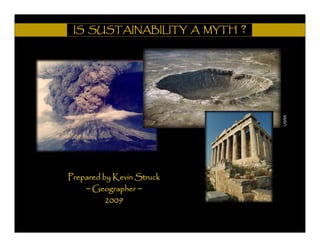
- 1. ? IS SUSTAINABILITY A MYTH USRA Prepared by Kevin Struck ~ Geographer ~ 2009
- 2. ACKNOWLEDGEMENTS Barbara Lazewski Steenbock Library liaison to UWEX Cooperative Extension Steenbock Library University of Wisconsin-Madison Photos courtesy of Microsoft Design Gallery unless otherwise noted.
- 3. WORD & CONCEPT ORIGIN “Sustain” comes from the Latin Sustainability was preceded sustinere, meaning by the “sustained-yield” “to uphold” or concept, which had its roots “to bear the in the forest industry of weight of.” 1800’s Germany. Other definitions include “to keep going” and “to endure without giving way or yielding.”
- 4. MODERN USAGE Modern concept of sustainability was popularized by 1987 World Commission on Environment and Development (Brundtland Commission) report Our Common Future. Development is considered to be sustainable when it meets present needs without compromising the ability of future generations to meet their needs.
- 5. TYPES and PRACTICES TYPES: Development, Agriculture, Design, Living, Energy, Tourism, Housing, Industry, Communities, Foods, Packaging, etc. PRACTICES: Green roofs, organic fibers, walkable communities, community supported agriculture, renewable energy, micro loans, conservation subdivisions, low VOC inks, day-lighting, closed-loop manufacturing, biodegradable materials, urban gardening, hazardous waste collections, manure digesters, rain gardens, mass transit, publishing on demand, historic preservation, permeable pavement, virtual education, accessible health care, biomimicry, recycling, value stream mapping, etc.
- 6. TYPES and PRACTICES nutrition organics value H e a l th stream I mapping nd us tr e y ur ult solar ric y erg Tou Ag rism n E Eco hotel Development Biosphere EARTH
- 7. SKEPTICS “It is increasingly difficult to have a discussion about planning or urbanization without mentioning sustainability. And if you don't, you're likely to be dismissed as being hopelessly out of date and out of touch with today's dogma. I myself have often experienced this reaction, in part because I describe myself as a sustainability skeptic. I do so not because I am skeptical about the underlying issues, but because I am skeptical about our current ability to find solutions.” – Paul Farmer, Executive Director, American Planning Association July 2008
- 8. SKEPTICS “That so few sustainable resource-use plans have been effective stands as testimony to the differences between what we expect of nature and what nature can provide. In the context of the use of wild living resources, I suggest that sustainability is more myth than reality.” – David Duffus, Associate Professor of Geography, University of Victoria, British Columbia, June 1993
- 9. HURDLES 1. AMBIGUITY 2. MOVING TARGETS 3. CONSISTENCY 4. BIODIVERSITY 5. COMPLEXITY 6. VOLATILITY
- 10. AMBIGUITY “Sustainability, to begin with, “The idea of ‘sustainability’ is an idea that has never really is problematic precisely been defined. . . . Consider because it is utterly devoid the matter of a time frame. Is a of truth content — one sustainable society one that can never know if one endures for a decade, a human has achieved it.” Ahl’s lifetime, or a thousand years? . . . What degree of sustainability – Daniel W. Bromley, should we settle on?” Professor of Applied Economics, University of Wisconsin–Madison Ecological Economics, – Donald Worster, Distinguished Professor of March 2007 History, University of Kansas, The Wealth of Nature, 1993
- 11. AMBIGUITY Extremes of opinion of what is needed to attain sustainability . . . Sustainable Development Club of Rome concluded that advocates support economic growth in order to avoid ecological, demographic and resource as long as it doesn’t harm humans disasters in the near future, and the environment. it was necessary to stop demographic and economic growth. The quot;deep ecologistsquot; suggest that negative growth is the only option, with the ultimate aim of eliminating all human impacts. Wildlands Conservancy opposes a new wind/solar/geothermal project in Mojave; Wilderness Society supports it. (TIME Magazine, 2009)
- 12. MOVING TARGETS Modeling the future is far from an exact science . . . “Originally, industry and Forest Service planners stated that the rate of logging was sustainable. However, so many different figures and interpretations have been made of the forest's productivity in the Tsitika valley that . . . Now it appears that nobody believes the forest has been logged at a sustainable rate.” (David Duffus, 1993) Ecologists can try to make predictions, but the uncertainties are so great that a crystal ball might do as well. Stephen Carpenter, a freshwater ecosystem specialist at UW-Madison, says that ecologists tend to use words like “projection” and “scenario” rather than “prediction” or “forecast,” for just these reasons. (World Watch, Sept/Oct 2003)
- 13. MOVING TARGETS Modeling the impacts of human activities on the future global climate, for example, relies on the following inputs . . . Economic activity (estimate) Population (estimate) Energy usage (estimate) Land use/land cover (estimate) Technological innovations (guess) Volcanic activity (estimate) “Estimates of future global and regional impacts of human-induced climate change are inherently uncertain. This is because projections are based on a series of model calculations with each succeeding model using as its inputs increasingly uncertain outputs of previous models.” – 2007, Indur Goklany, U.S. delegate to International Panel on Climate Change
- 14. CONSISTENCY 1. INTERNAL: Need consistency among your own efforts so as not to conflict with what you’ve already done or with other types of sustainability goals. 2. EXTERNAL: Any process that doesn’t get total participation from everyone risks being undermined by negative efforts.
- 15. CONSISTENCY ( INTERNAL ) “You cannot really declare any practice ‘sustainable’ until you have done a complete life-cycle analysis of its environmental costs. Even then, technology and public policy keep evolving, and that evolution can lead to unforeseen and unintended consequences.” - Michael D. Lemonick, Scientific American, 2009 Not all human needs can be met legislatively.
- 16. CONSISTENCY ( EXTERNAL ) Outside influences . . . wildcards “Under sustainable development, success is dependent upon the extent to which a community is a closed system.” – Edward Jepson, Jr., Ph.D., WAPA News, 2001
- 17. BIODIVERSITY “The notion of a ‘sustainable yield’ is a myth. It assumes that the preservation of species is all that is important, and ignores loss of diversity below the species level.” – Michael J. Vandeman, Ph.D., UCLA, 2001 The very first time a new gene is created, it most likely exists in a single individual. Suppose, for example, that a soon to-be-logged tree in a “sustainably” harvested forest contains a mutation that would allow the species to survive global warming. Harvesting even that one tree could destroy biodiversity and have a significant negative effect on the species. Thus, harvesting any reproducing organism can never be “sustainable.” No one can guarantee that it won't destroy a key piece in the world's future store of genetic biodiversity.
- 18. COMPLEXITY Biosphere 2 is a major sealed glasshouse complex north of Univ. of Edinburgh Tucson in the desert of Arizona “Biosphere 2 was an experiment in sustainability, exploring the essential question: How do we make a self-contained place to live, and keep it going for a long time? Biosphere 2 showed that ecosystems are extraordinarily complex and dynamic, poorly understood, and prone to unforeseeable behavior that may alter their functionality. (As the saying goes, ecology isn't rocket science; it's a lot harder.)” – World Watch, Sept/Oct 2003
- 19. COMPLEXITY Advanced life-forms require more resources, and thus make ever more demands on the ecosystem. AMEOBA: Simple life-form needs only water, food, air HUMAN: Complex life-form needs clean water; vitamins and minerals; a specific ratio of nitrogen, oxygen, and other gases to breathe; nurturing and care for our first years of life; shelter from the elements; warmth; clothing; a mate in order to reproduce; mental stimulation; and probably more. Humans are much harder to sustain than any other life-form. Even worse, in the last 100 years, our life span has increased, our caloric intake has risen, and our interests have become more varied.
- 20. VOLATILITY “Change now appears to be intrinsic and natural at many scales of time and space in the biosphere. . . . Whenever we seek to find constancy, we discover change.” – Daniel Botkin, Ph. D. ecologist Chaos Butterfly Theory Effect “When we try to pick out anything by itself, we find it hitched to everything else in the universe.” – John Muir
- 21. VOLATILITY Major Extinctions 5 billion ABCDE 5 billion years years ago Brighter sun ahead boils off 3 billion Earth’s oceans years ago First single-celled Today Sun engulfs Earth organisms Earth formed A. Ordovician (marine species) B. Devonian (marine species) C. Permian (marine species) D. Triassic (land and marine species) E. Cretaceous (dinosaurs)
- 22. VOLATILITY “Since the dawn of life, species have become extinct, paving the way for the development of new species that might better utilize the environment. . . . If species did not become extinct to make room for more advanced organisms, life on Earth would not have progressed to where it is today. . . . Geologists are beginning to accept global catastrophes, such as mass extinctions, as normal occurrences in geologic history.” – Jon Erickson, geophysicist, author of Dying Planet
- 23. VOLATILITY VOLCANOES: About 14 active and dozens more considered dormant (not extinct). VENTS / GEYSERS: “Old Faithful” is overdue for a super explosive caldera- forming eruption. QUAKE FAULTS: quot;Nothing, not even the wind that blows, is so unstable as the crust USGS of this earth.quot; - Charles Darwin ASTEROIDS: An approximately 400-meter wide NEO will come closer to Earth in 2029 than the orbit of our geostationary satellites. If it passes through a several hundred-meter wide quot;keyholequot; in 2029, it will impact Earth in 2036. Current estimates, however, rate the probability of impact as very low.
- 24. VOLATILITY SOLAR RADIATION: Supernova Vela appeared about 10,000 years ago. Its deadly cosmic rays may have led to the extinctions of mastodons and mammoths. DISEASE: Several pandemics have swept the Earth. MAGNETIC FIELD REVERSAL: Currently undergoing a slow steady decrease in intensity; Earth well overdue for a reversal. PBS CLIMATE CHANGE: There have been 4 major ice ages in the last 100,000 years.
- 25. VOLATILITY 15m Recent Major Ice Ages 30m 4m 65m 700m 230m 1 billion 2m years ago 250 750 500 Today 100,000 1m 20,000 15,000 10,000
- 26. VOLATILITY “For . . . as long as anyone would claim for ‘ecological time’ there has never been an interval when temperature was in a steady state with symmetrical fluctuations about a mean. . .” – Professor Margaret Davis, University of Minnesota December 17, 2008
- 27. VOLATILITY Barneveld Tornado NOAA 93 homes were completely destroyed, 64 others were damaged. 17 of the 18 businesses and public facilities in the community were also destroyed.
- 29. CONCLUSION The Earth is volatile, unpredictable, temporary, QUOTATIONS from Aldo Leopold and unsustainable — and we keep hoping to make it stable, predictable, permanent, and sustainable. “We shall never achieve harmony with land, any more than we shall achieve absolute justice or liberty for people. In these higher aspirations, the important thing is not to achieve but to strive.” quot;That the situation appears hopeless should not prevent us from doing our best.quot; “SUSTAINABLE” vs. “RESPONSIBLE” “A land ethic, then, reflects the existence Taking proper care of my yard is being responsible, that I can of an ecological conscience, and this guarantee. But nothing I do will guarantee my yard is still in turn reflects a going to be around 50 years from now. conviction of individual responsibility for the health of the land.”
- 30. THE END Dan Wilson ( IS ALWAYS ANOTHER BEGINNING )