Karina Joyce E. Limbo
Jedan Tipura
BLIS-III

RELATIONAL DATABASE MODEL:
LOGICAL VIEW OF DATA
AND
KEYS
Logical View of Data


 Logical simplicity yields simpler and more
  effective database design methodologies.
• The model was first proposed by E.F.Codd in
   1970.
Entity
An entity is simply a person, place, event, or
  thing for which we intend to collect data.
Examples:
❖ University -- Students, Faculty
  Members, Courses
❖ Airlines -- Pilots, Aircraft, Routes, Supplier
Attributes

Each entity has certain characteristics known as
  attributes.
Examples:
❖ Student -- Student
  Number, Name, GPA, Date of
  Enrollment, Data of Birth, Home
  Address, Phone Number, Major
❖ Aircraft -- Aircraft Number, Data of Last
  Maintenance, Total Hours Flown, Hours
  Flown since Last Maintenance
Entities and Attributes

     A grouping of related entities becomes
  an entity set.
Examples:
❖ The STUDENT entity set contains all student
  entities.
❖ The FACULTY entity set contains all faculty
  entities.
❖ The AIRCRAFT entity set contains all aircraft
  entities
Tables and Their
Characteristics
 A table is perceived as a two-dimensional
  structure composed of rows and columns.
 Each table row (tuple) represents a single
  entity within the entity set.
 Each column represents an attribute and
  each column has a distinct name.
 Each row/column intersection represents a
  single data value
 All values in a column must conform to the
  same data format.
 Each column has a specific range of values
  known as the attribute domain.
 The order of the rows and columns is
  immaterial to the DBMS
 Each table must have an attribute or a
  combination of attributes that uniquely
  identifies each row.
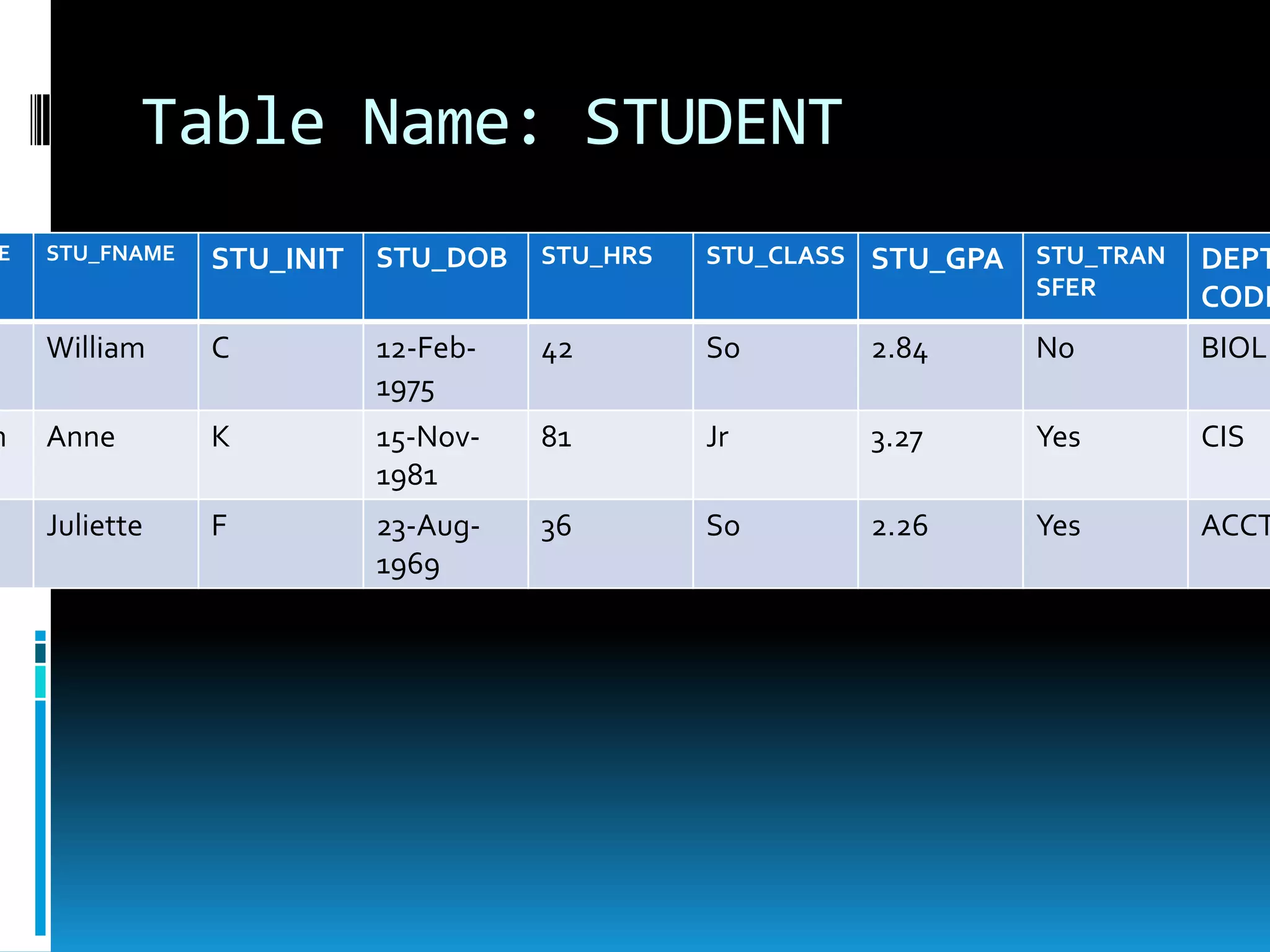
Table Name: STUDENT
E   STU_FNAME   STU_INIT   STU_DOB   STU_HRS   STU_CLASS STU_GPA   STU_TRAN   DEPT
                                                                   SFER       CODE
    William     C          12-Feb-   42        So       2.84       No         BIOL
                           1975
n   Anne        K          15-Nov-   81        Jr       3.27       Yes        CIS
                           1981
    Juliette    F          23-Aug-   36        So       2.26       Yes        ACCT
                           1969
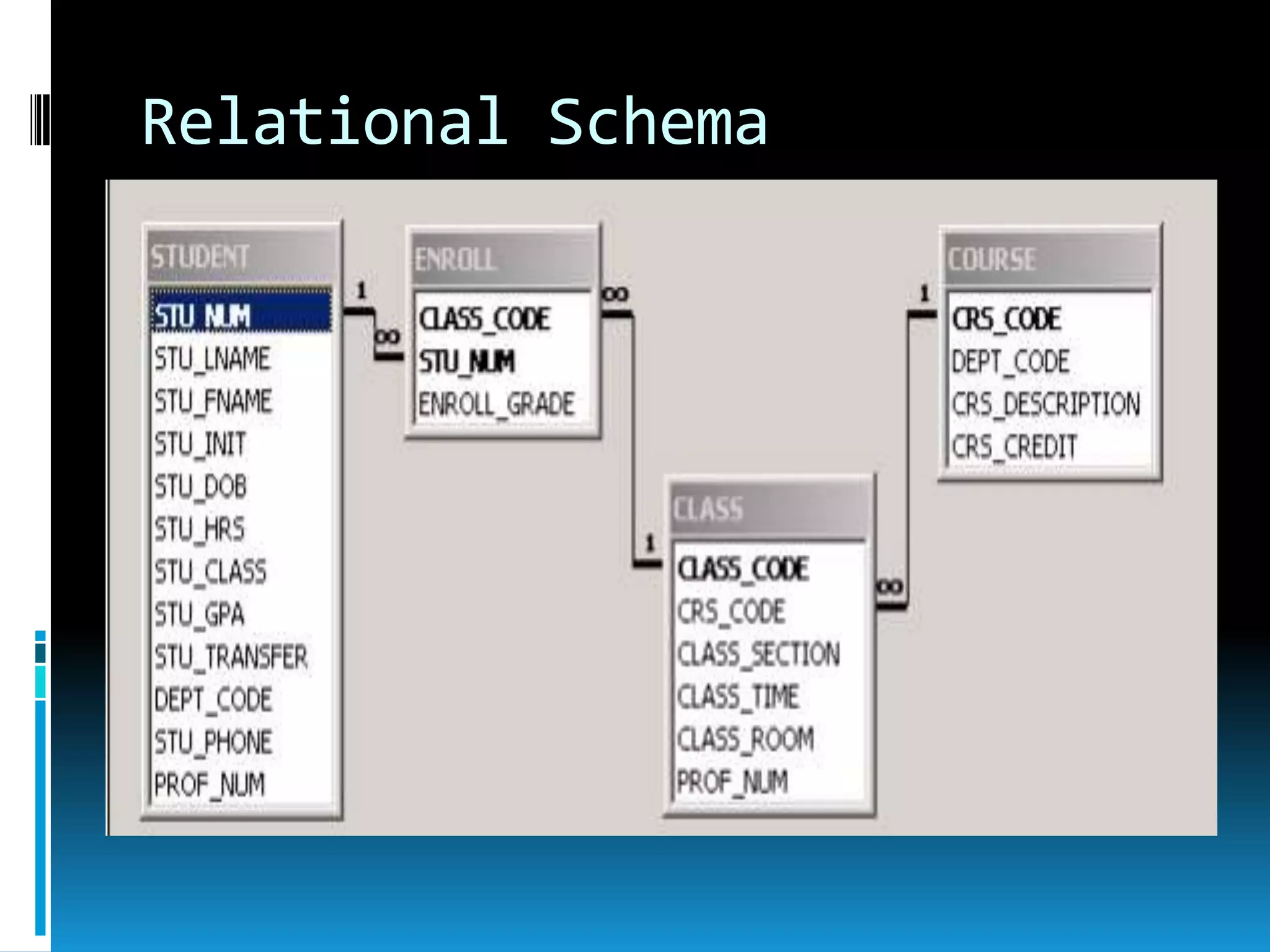
Relational Schema
Keys


 It is an attribute that determines the values of
  other attributes within the entity.
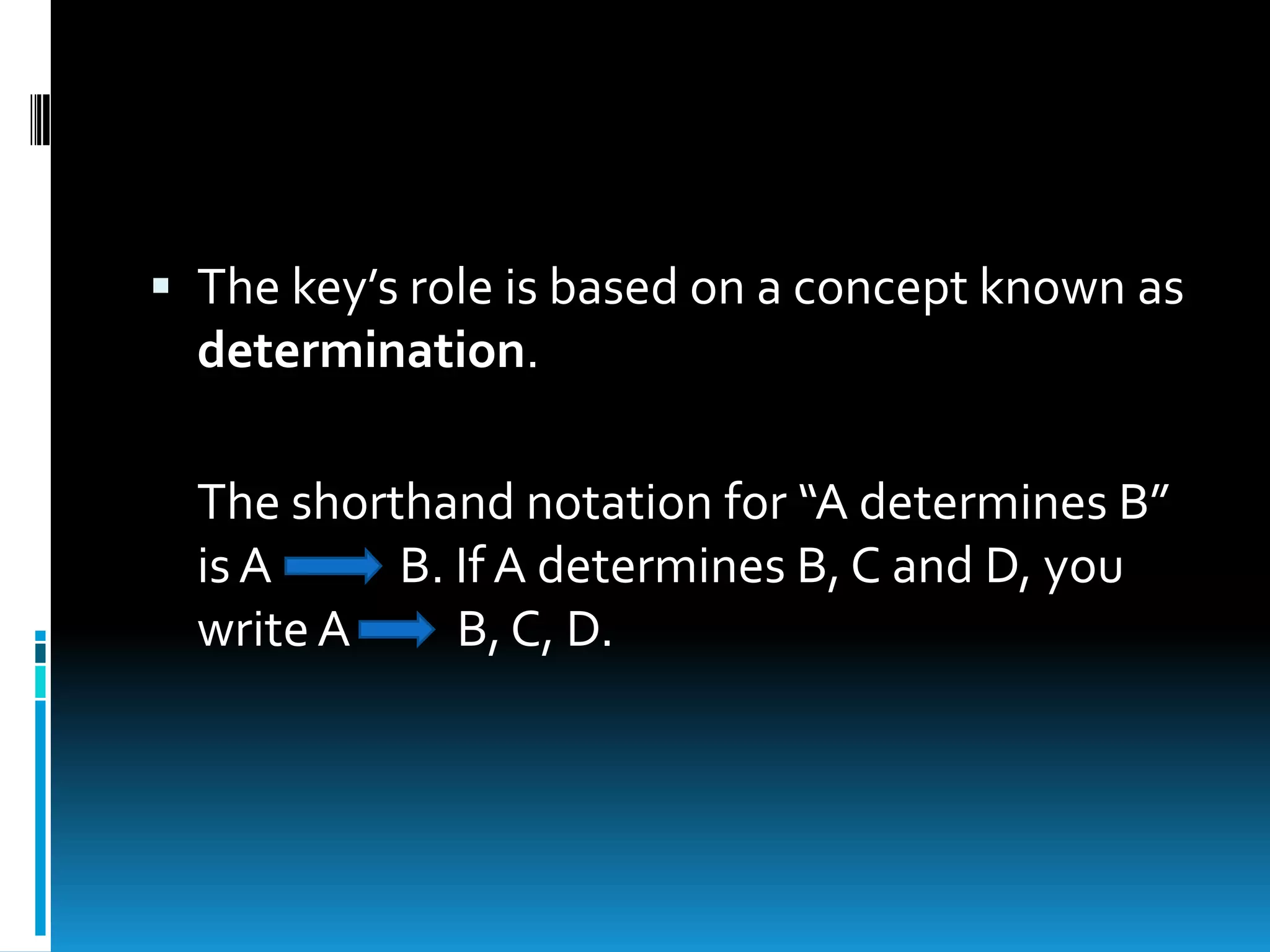
 The key’s role is based on a concept known as
  determination.

  The shorthand notation for “A determines B”
  is A     B. If A determines B, C and D, you
  write A     B, C, D.
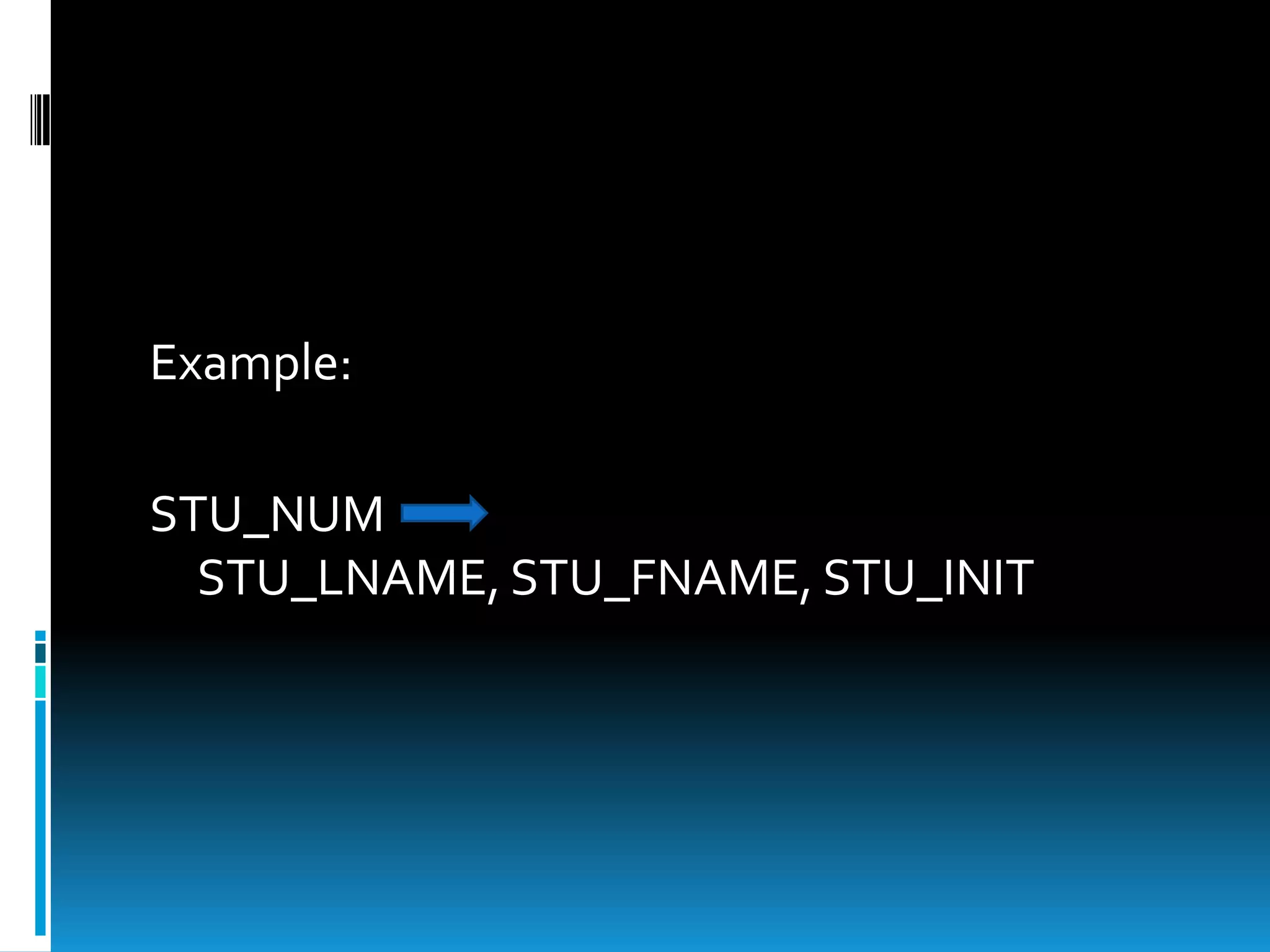
Example:

STU_NUM
  STU_LNAME, STU_FNAME, STU_INIT
Functional Dependence


 Can be generalized to cover the case in which
  the determining attribute values occur more
  than once in a table.
 Attribute A determines Attribute B (that is, B
  is functionally dependent on A) if all of the
  rows in the table that agree in value for
  attribute A also agree in value for attribute B.
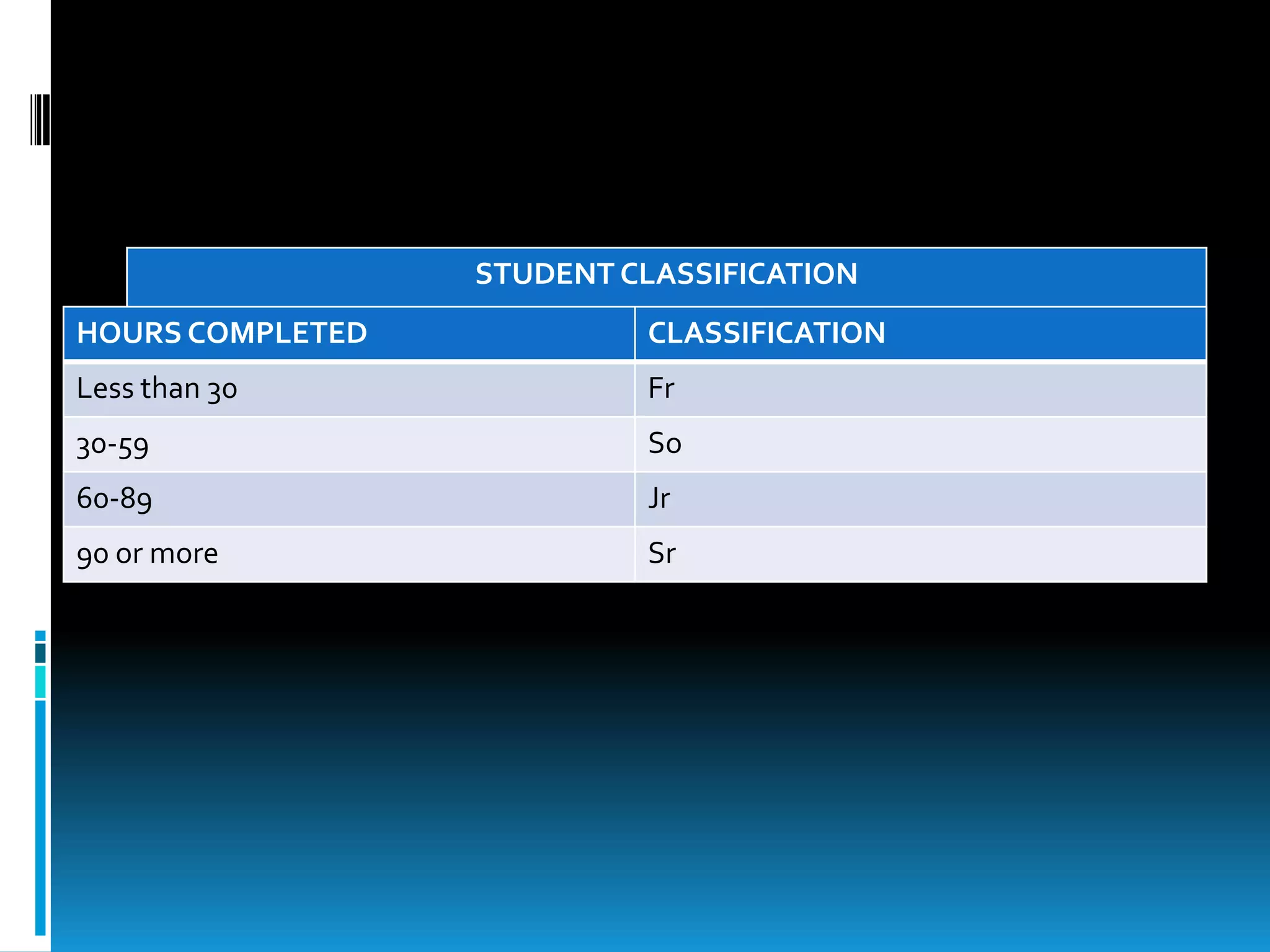
STUDENT CLASSIFICATION
HOURS COMPLETED            CLASSIFICATION
Less than 30               Fr
30-59                      So
60-89                      Jr
90 or more                 Sr
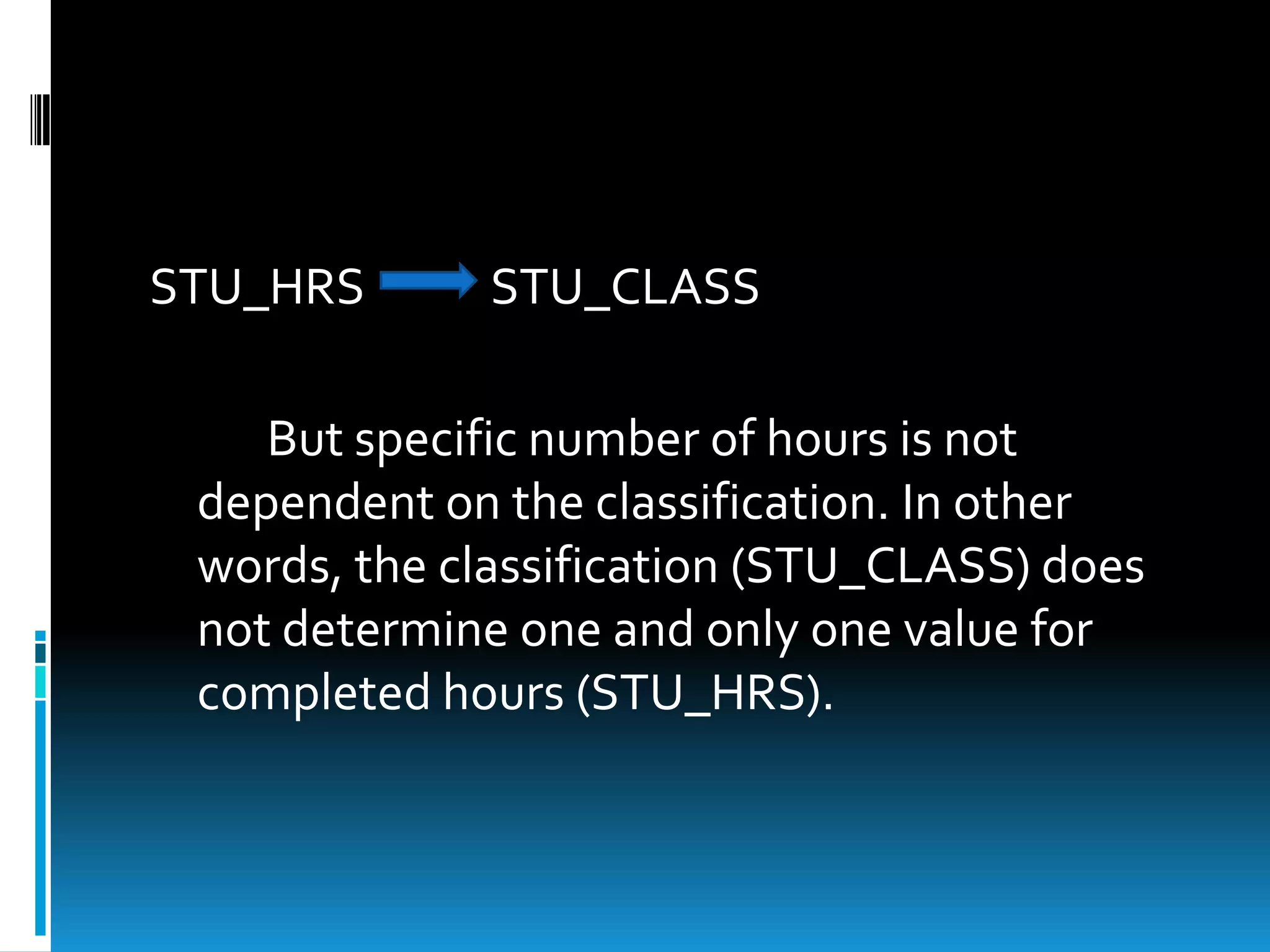
STU_HRS      STU_CLASS

    But specific number of hours is not
 dependent on the classification. In other
 words, the classification (STU_CLASS) does
 not determine one and only one value for
 completed hours (STU_HRS).
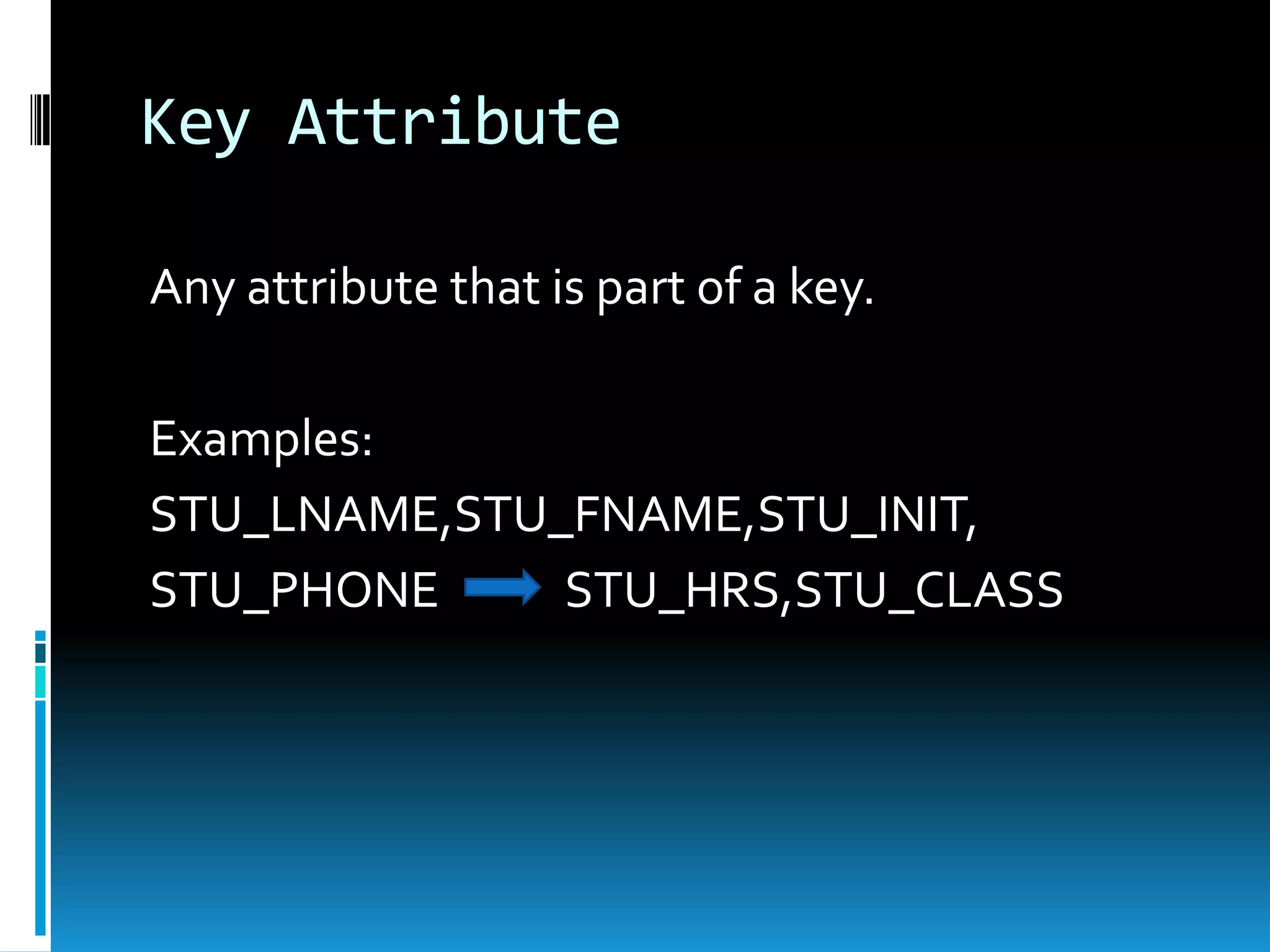
Key Attribute

Any attribute that is part of a key.

Examples:
STU_LNAME,STU_FNAME,STU_INIT,
STU_PHONE     STU_HRS,STU_CLASS
Relational Database Keys


Superkey
 An attribute (or combination of attributes)
  that uniquely identifies each entity in a table.
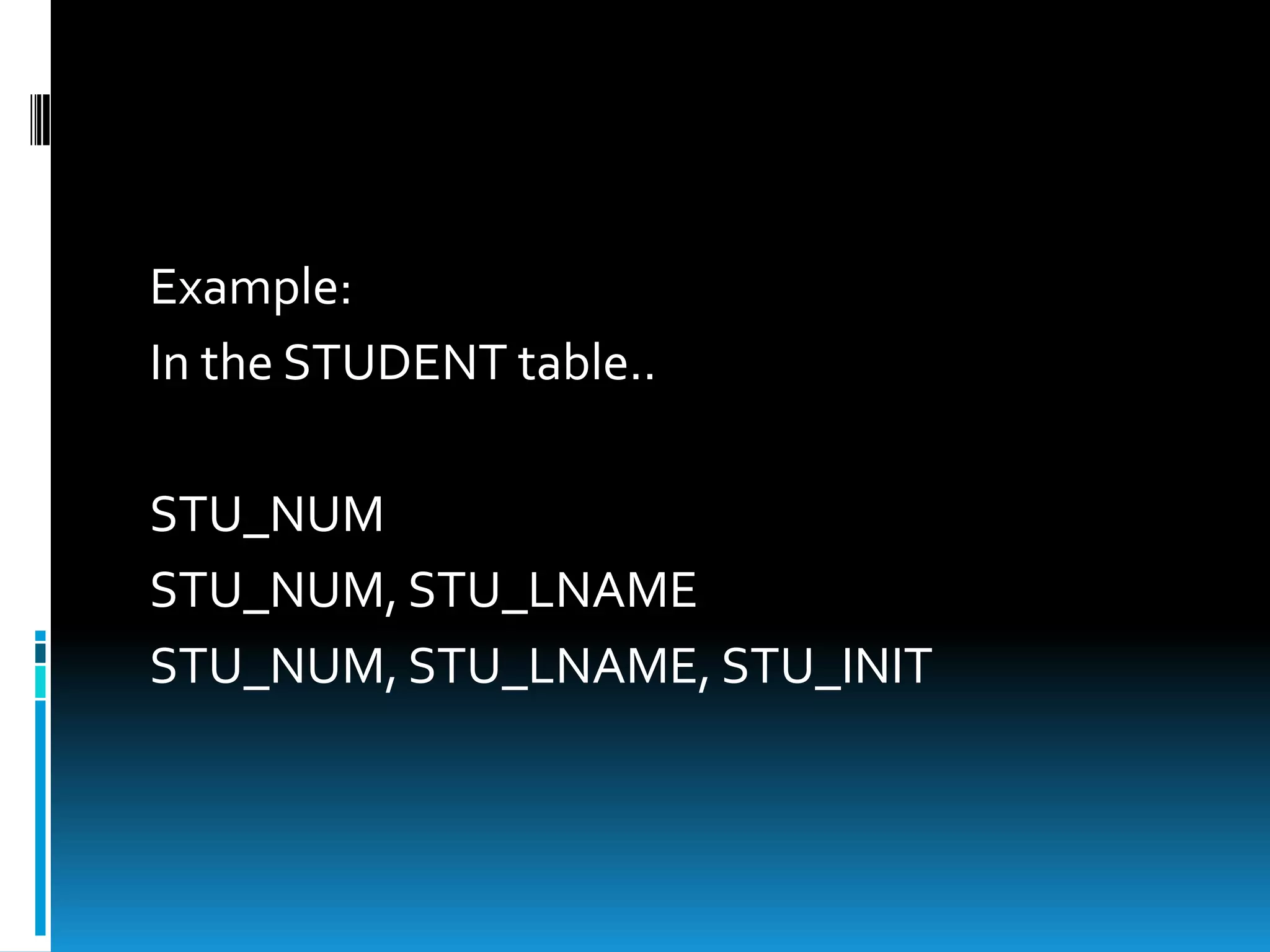
Example:
In the STUDENT table..

STU_NUM
STU_NUM, STU_LNAME
STU_NUM, STU_LNAME, STU_INIT
Candidate Key
 A minimal superkey. A superkey that does not
  contain a subset of attributes that is itself a
  superkey.
STU_NUM,STU_LNAME
is a superkey, but it is not a candidate key
   because STU_NUM by itself is a candidate
   key.
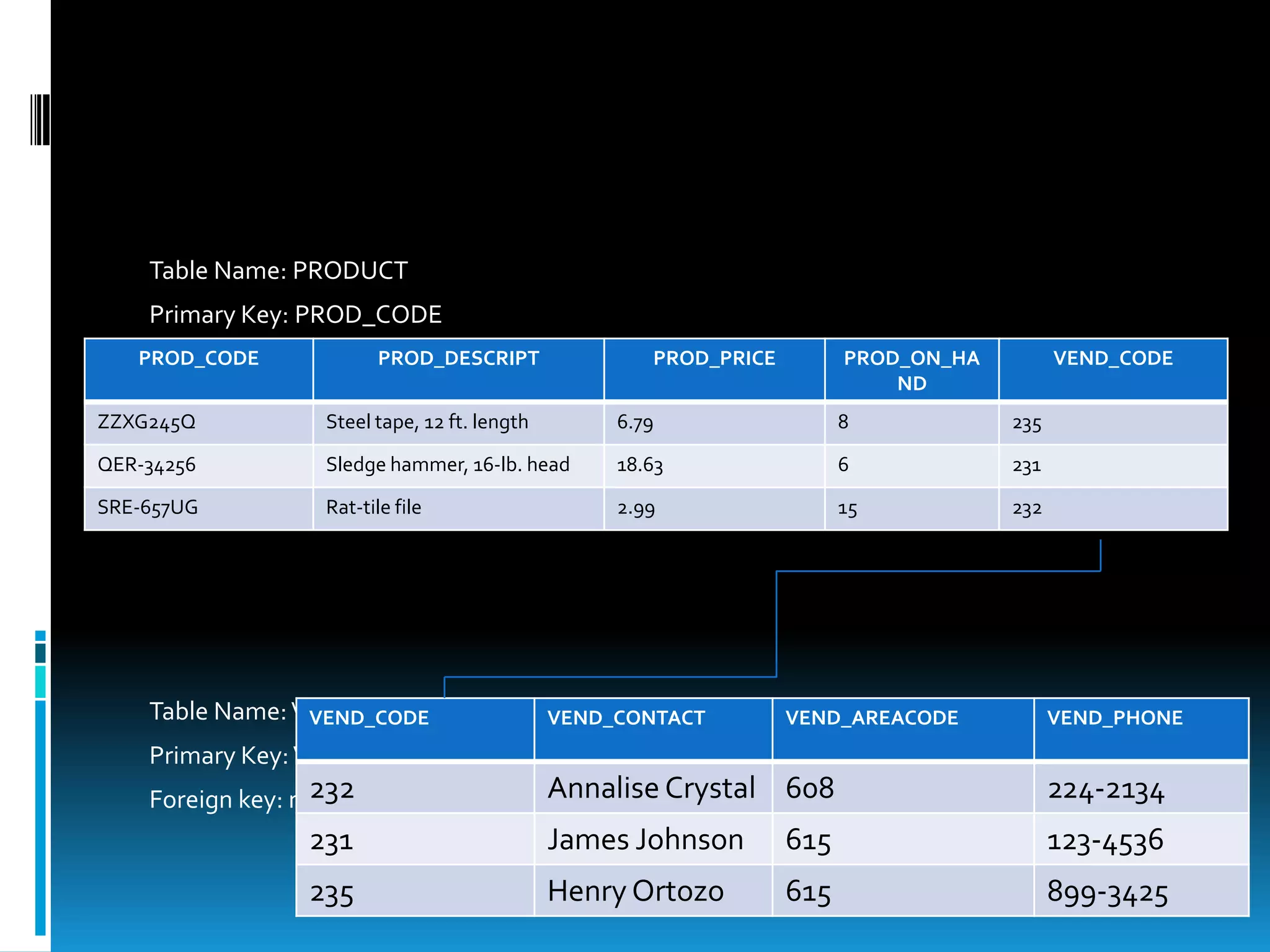
Controlled Redundancy

 -makes the relational database work.
 -tables within the database share common
 attributes that enable the tables to be linked
 together.
Table Name: PRODUCT
    Primary Key: PROD_CODE
   PROD_CODE VEND_CODE
    Foreign key:   PROD_DESCRIPT                      PROD_PRICE         PROD_ON_HA         VEND_CODE
                                                                             ND
ZZXG245Q          Steel tape, 12 ft. length        6.79                  8            235

QER-34256         Sledge hammer, 16-lb. head       18.63                 6            231

SRE-657UG         Rat-tile file                    2.99                  15           232


    Table Name: VENDOR
                 VEND_CODE                    VEND_CONTACT     link
                                                                 VEND_AREACODE              VEND_PHONE
    Primary Key: VEND_CODE
                  232
    Foreign key: none                         Annalise Crystal 608                          224-2134
                 231                          James Johnson        615                      123-4536
                 235                          Henry Ortozo         615                      899-3425
Primary Key

 -is usually underlined.
 - A candidate key selected to uniquely
 identify all other attribute values in any given
 row.
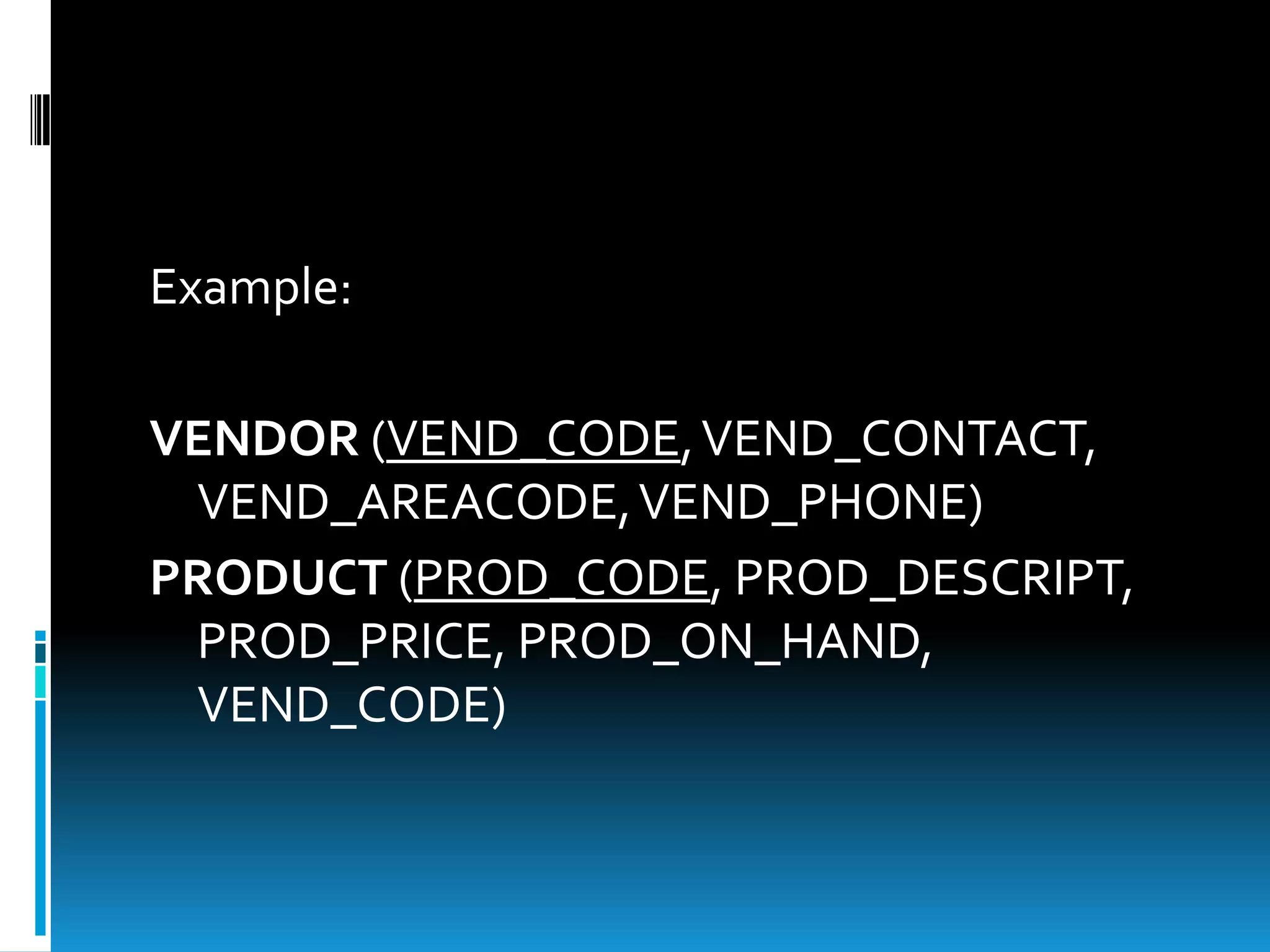
Example:

VENDOR (VEND_CODE, VEND_CONTACT,
 VEND_AREACODE, VEND_PHONE)
PRODUCT (PROD_CODE, PROD_DESCRIPT,
 PROD_PRICE, PROD_ON_HAND,
 VEND_CODE)
Secondary Key

 - An attribute used strictly for data retrieval
 purposes.
Example:

    A customer date are stored in a
 CUSTOMER table. The customer number is
 the primary key; the secondary key is the
 combination of the customer’s last name and
 phone number.
Foreign Key

     - An attribute in one table whose values
  must either match the primary key in another
  table or be null.
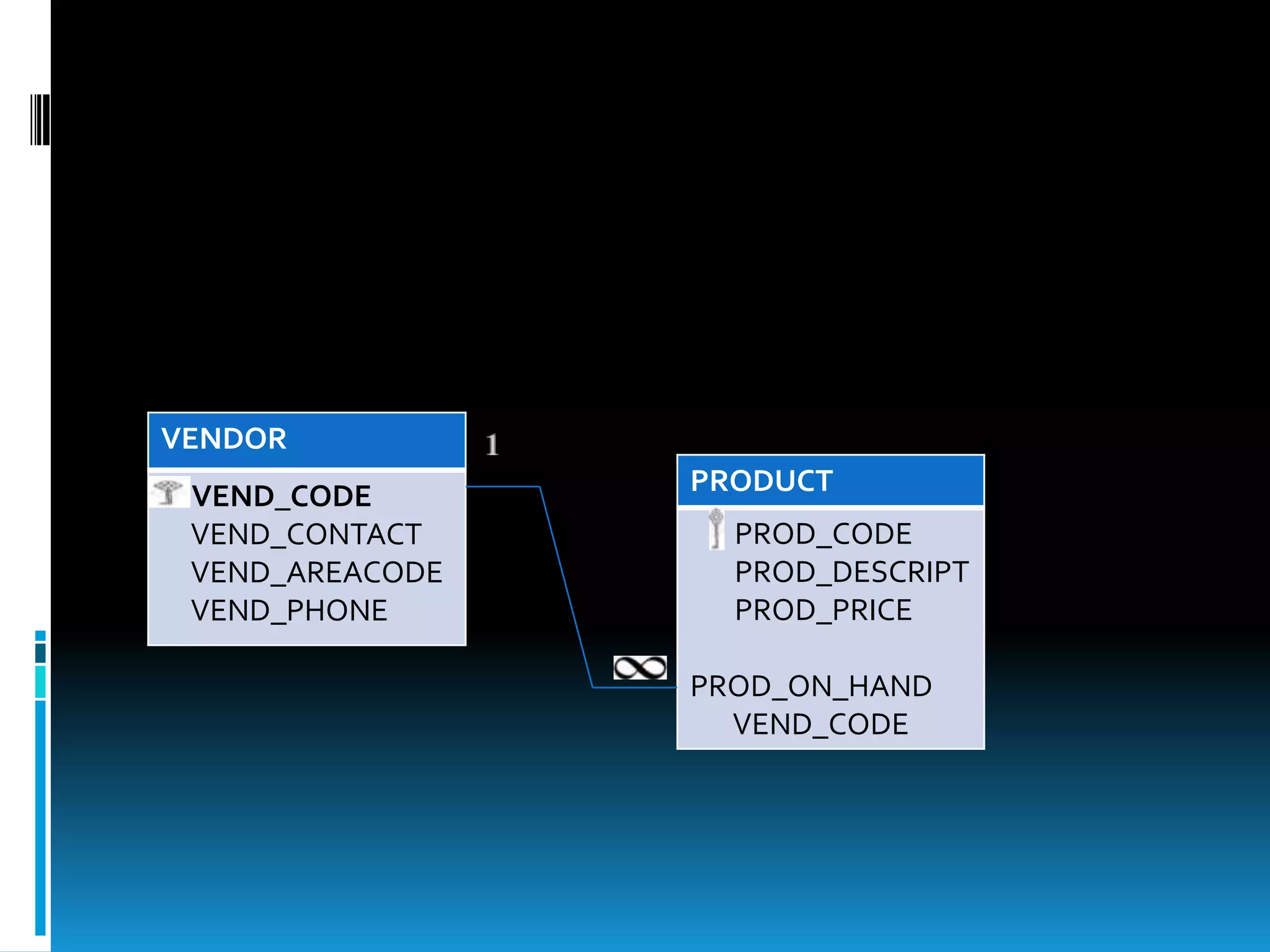
VENDOR
 VEND_CODE       PRODUCT
 VEND_CONTACT      PROD_CODE
 VEND_AREACODE     PROD_DESCRIPT
 VEND_PHONE        PROD_PRICE

                 PROD_ON_HAND
                   VEND_CODE

Relational database model -report

  • 1.
    Karina Joyce E.Limbo Jedan Tipura BLIS-III RELATIONAL DATABASE MODEL: LOGICAL VIEW OF DATA AND KEYS
  • 2.
    Logical View ofData  Logical simplicity yields simpler and more effective database design methodologies.
  • 3.
    • The modelwas first proposed by E.F.Codd in 1970.
  • 4.
    Entity An entity issimply a person, place, event, or thing for which we intend to collect data. Examples: ❖ University -- Students, Faculty Members, Courses ❖ Airlines -- Pilots, Aircraft, Routes, Supplier
  • 5.
    Attributes Each entity hascertain characteristics known as attributes. Examples: ❖ Student -- Student Number, Name, GPA, Date of Enrollment, Data of Birth, Home Address, Phone Number, Major ❖ Aircraft -- Aircraft Number, Data of Last Maintenance, Total Hours Flown, Hours Flown since Last Maintenance
  • 6.
    Entities and Attributes A grouping of related entities becomes an entity set. Examples: ❖ The STUDENT entity set contains all student entities. ❖ The FACULTY entity set contains all faculty entities. ❖ The AIRCRAFT entity set contains all aircraft entities
  • 7.
    Tables and Their Characteristics A table is perceived as a two-dimensional structure composed of rows and columns.  Each table row (tuple) represents a single entity within the entity set.  Each column represents an attribute and each column has a distinct name.  Each row/column intersection represents a single data value
  • 8.
     All valuesin a column must conform to the same data format.  Each column has a specific range of values known as the attribute domain.  The order of the rows and columns is immaterial to the DBMS  Each table must have an attribute or a combination of attributes that uniquely identifies each row.
  • 9.
    Table Name: STUDENT E STU_FNAME STU_INIT STU_DOB STU_HRS STU_CLASS STU_GPA STU_TRAN DEPT SFER CODE William C 12-Feb- 42 So 2.84 No BIOL 1975 n Anne K 15-Nov- 81 Jr 3.27 Yes CIS 1981 Juliette F 23-Aug- 36 So 2.26 Yes ACCT 1969
  • 10.
  • 11.
    Keys  It isan attribute that determines the values of other attributes within the entity.
  • 12.
     The key’srole is based on a concept known as determination. The shorthand notation for “A determines B” is A B. If A determines B, C and D, you write A B, C, D.
  • 13.
    Example: STU_NUM STU_LNAME,STU_FNAME, STU_INIT
  • 14.
    Functional Dependence  Canbe generalized to cover the case in which the determining attribute values occur more than once in a table.
  • 15.
     Attribute Adetermines Attribute B (that is, B is functionally dependent on A) if all of the rows in the table that agree in value for attribute A also agree in value for attribute B.
  • 16.
    STUDENT CLASSIFICATION HOURS COMPLETED CLASSIFICATION Less than 30 Fr 30-59 So 60-89 Jr 90 or more Sr
  • 17.
    STU_HRS STU_CLASS But specific number of hours is not dependent on the classification. In other words, the classification (STU_CLASS) does not determine one and only one value for completed hours (STU_HRS).
  • 18.
    Key Attribute Any attributethat is part of a key. Examples: STU_LNAME,STU_FNAME,STU_INIT, STU_PHONE STU_HRS,STU_CLASS
  • 19.
    Relational Database Keys Superkey An attribute (or combination of attributes) that uniquely identifies each entity in a table.
  • 20.
    Example: In the STUDENTtable.. STU_NUM STU_NUM, STU_LNAME STU_NUM, STU_LNAME, STU_INIT
  • 21.
    Candidate Key  Aminimal superkey. A superkey that does not contain a subset of attributes that is itself a superkey.
  • 22.
    STU_NUM,STU_LNAME is a superkey,but it is not a candidate key because STU_NUM by itself is a candidate key.
  • 23.
    Controlled Redundancy -makesthe relational database work. -tables within the database share common attributes that enable the tables to be linked together.
  • 24.
    Table Name: PRODUCT Primary Key: PROD_CODE PROD_CODE VEND_CODE Foreign key: PROD_DESCRIPT PROD_PRICE PROD_ON_HA VEND_CODE ND ZZXG245Q Steel tape, 12 ft. length 6.79 8 235 QER-34256 Sledge hammer, 16-lb. head 18.63 6 231 SRE-657UG Rat-tile file 2.99 15 232 Table Name: VENDOR VEND_CODE VEND_CONTACT link VEND_AREACODE VEND_PHONE Primary Key: VEND_CODE 232 Foreign key: none Annalise Crystal 608 224-2134 231 James Johnson 615 123-4536 235 Henry Ortozo 615 899-3425
  • 25.
    Primary Key -isusually underlined. - A candidate key selected to uniquely identify all other attribute values in any given row.
  • 26.
    Example: VENDOR (VEND_CODE, VEND_CONTACT, VEND_AREACODE, VEND_PHONE) PRODUCT (PROD_CODE, PROD_DESCRIPT, PROD_PRICE, PROD_ON_HAND, VEND_CODE)
  • 27.
    Secondary Key -An attribute used strictly for data retrieval purposes.
  • 28.
    Example: A customer date are stored in a CUSTOMER table. The customer number is the primary key; the secondary key is the combination of the customer’s last name and phone number.
  • 29.
    Foreign Key - An attribute in one table whose values must either match the primary key in another table or be null.
  • 30.
    VENDOR VEND_CODE PRODUCT VEND_CONTACT PROD_CODE VEND_AREACODE PROD_DESCRIPT VEND_PHONE PROD_PRICE PROD_ON_HAND VEND_CODE